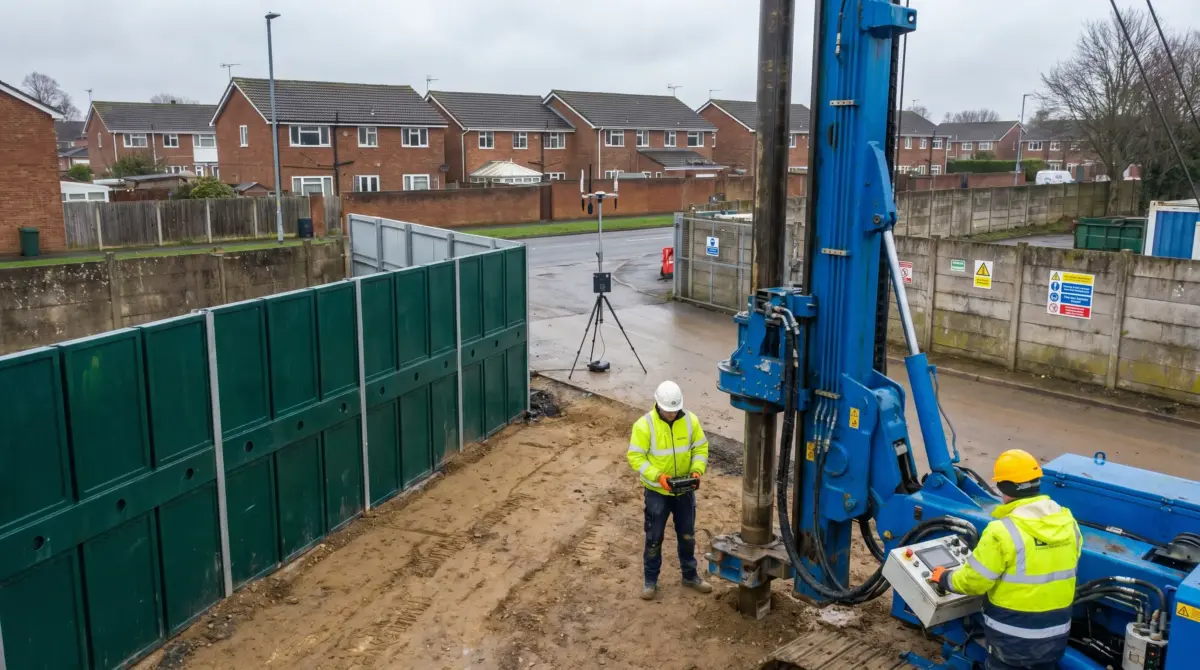
Noise action levels are regulatory thresholds defined in the Control of Noise at Work Regulations 2005 (UK) that trigger escalating employer duties based on workers' daily noise exposure, measured as LEP,d. The three levels are the lower exposure action value at 80 dB(A), the upper exposure action value at 85 dB(A), and the exposure limit value at 87 dB(A) — a hard ceiling that must not be exceeded. These values derive from EU Directive 2003/10/EC and are not interchangeable with OSHA's US framework.
This article provides general HSE knowledge. Noise assessment, LEP,d calculation, and hearing protection selection for specific workplaces must be carried out by a competent person with relevant training in occupational noise measurement and jurisdiction-specific regulatory requirements. The information here does not replace a site-specific noise risk assessment.
Three out of every four workers in noisy UK workplaces could not explain how to store, check, or report faults with their hearing protection (HSE, 2025). That finding emerged from the Health and Safety Executive's targeted noise inspection campaign — a campaign that also rated 60% of noise control reports submitted by employers and consultants as unsatisfactory (HSE, 2025/2026). The gap is not in the availability of ear defenders. It is in the system that should have determined whether those defenders were the right control, whether they were sufficient, and whether anyone understood what they were protecting against.
The system in question is the three-tier noise action level framework: 80, 85, and 87 dB(A). Each threshold activates a different set of legal duties, and each is assessed against a specific metric — LEP,d, the daily personal noise exposure level normalised to an eight-hour reference period. This article explains what each value means, how LEP,d is calculated, what compliance requires at every tier, and where the UK/EU framework diverges from the OSHA system used in the United States. The primary keyword throughout is the framework itself: noise action levels, and how they translate from regulation into operational reality.
What Are Noise Action Levels and Why Do They Matter?
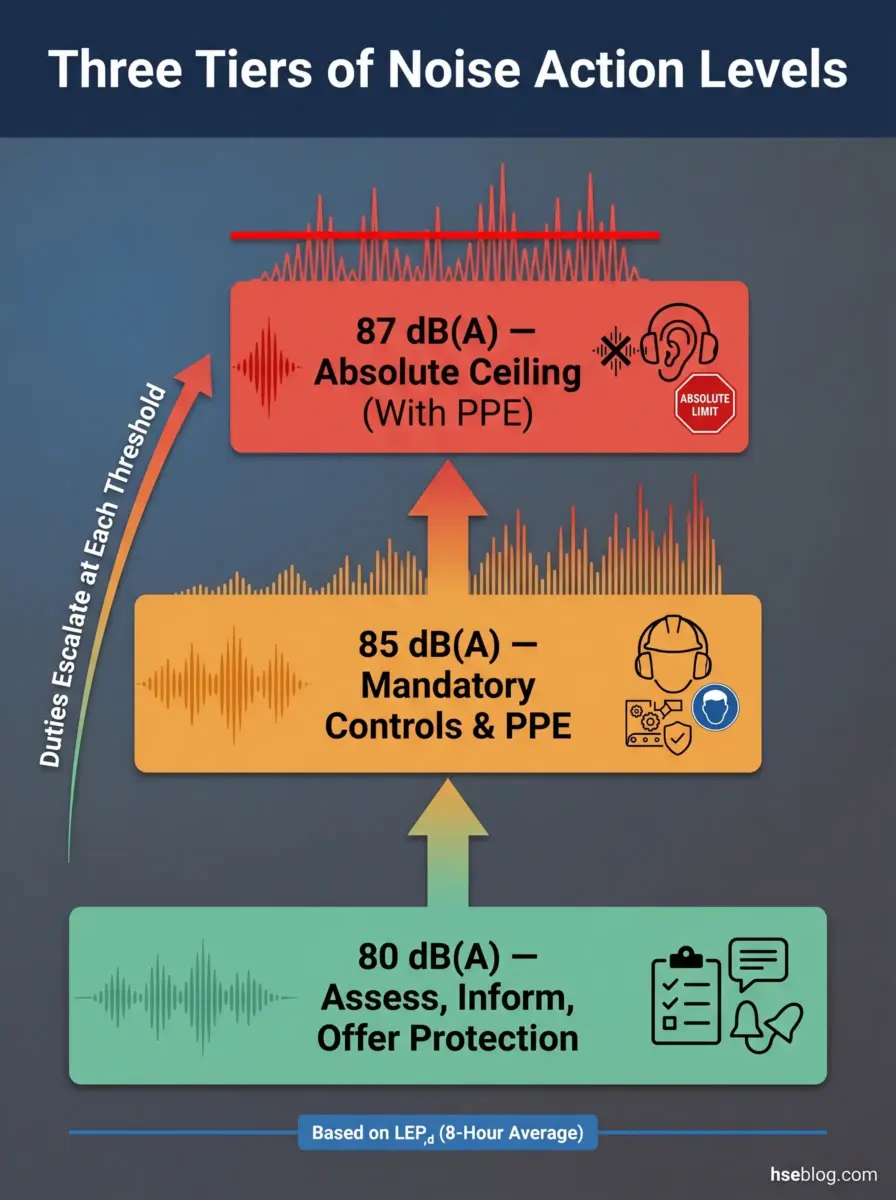
Noise action levels are not limits on how loud a workplace can be. They are thresholds on a worker's personal daily exposure that trigger specific, escalating employer duties under the Control of Noise at Work Regulations 2005 (UK), which transposed EU Directive 2003/10/EC into domestic law.
The framework operates on three tiers:
| Tier | dB(A) LEP,d | dB(C) Peak | Category |
|---|---|---|---|
| Lower Exposure Action Value | 80 | 135 | Inform and make available |
| Upper Exposure Action Value | 85 | 137 | Mandatory controls |
| Exposure Limit Value | 87 | 140 | Absolute ceiling |
A critical distinction separates the first two from the third. The lower and upper action values are assessed against the worker's exposure without hearing protection factored in. The exposure limit value is assessed with hearing protection attenuation accounted for — a structural difference that changes every compliance calculation.
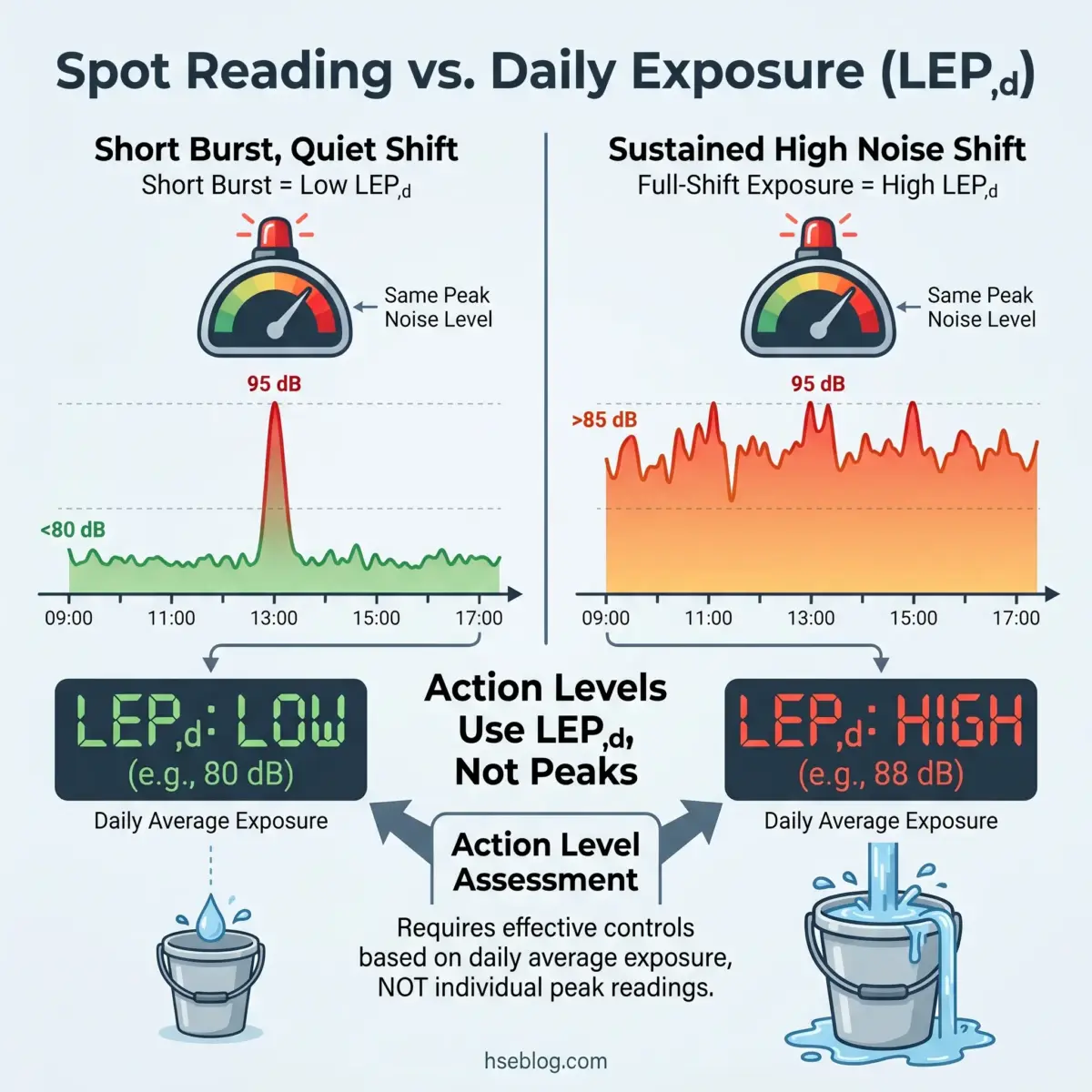
One misconception drives frequent errors: treating a single sound level meter reading above 80 dB as proof that the lower action value has been reached. The regulations require a time-weighted daily average (LEP,d), not an instantaneous snapshot. A machine producing 90 dB for fifteen minutes in an otherwise quiet eight-hour shift produces a very different LEP,d than that same 90 dB sustained for six hours.
What Does LEP,d Mean and How Is It Calculated?
LEP,d — the daily personal noise exposure level — is the single metric that determines which action level tier applies to a worker. It represents the equivalent continuous A-weighted sound pressure level, normalised to an eight-hour reference period.
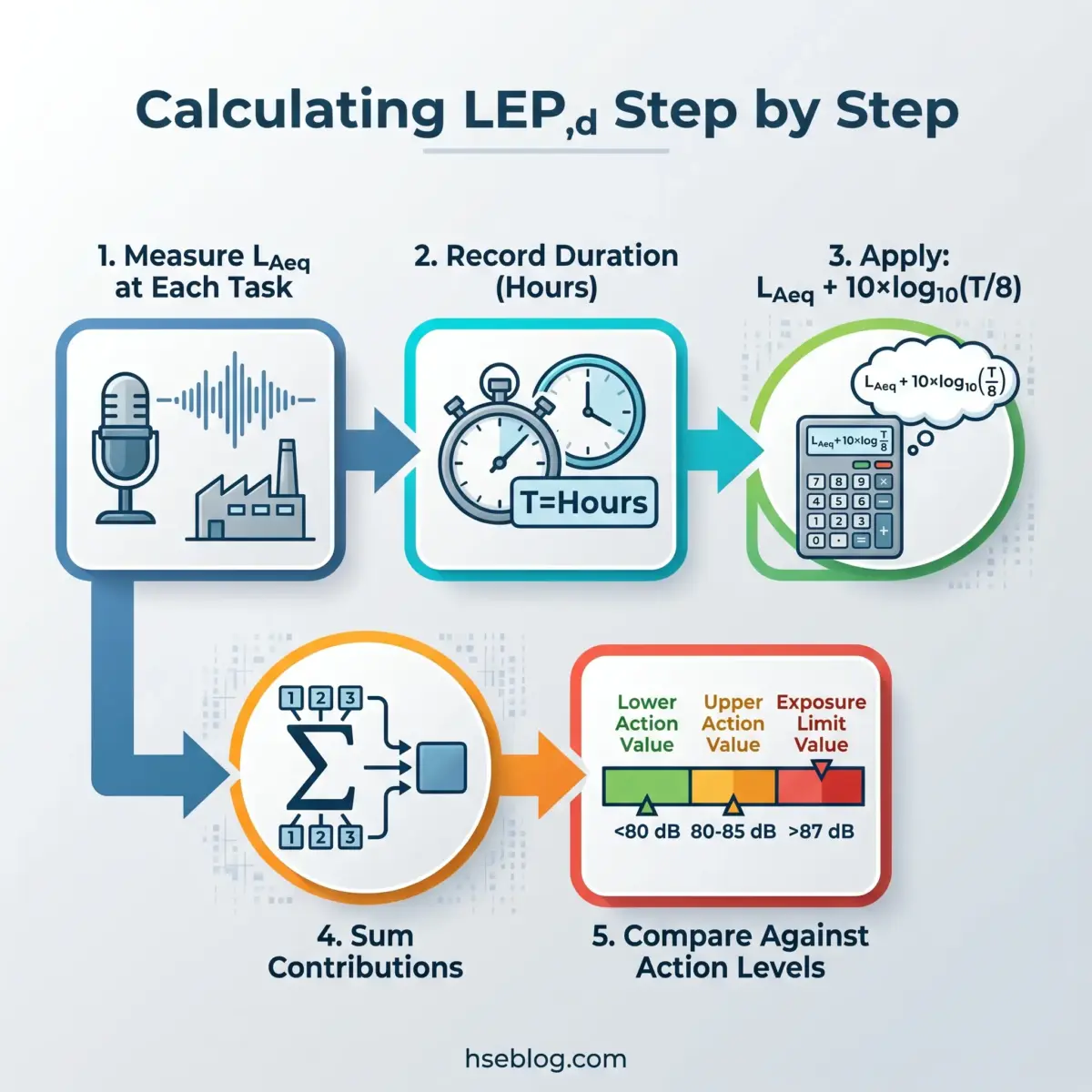
The formula is:
LEP,d = LAeq + 10 × log₁₀(T/8)
Where LAeq is the equivalent continuous sound level during the exposure, and T is the actual exposure duration in hours.
Worked example: A worker is exposed to an LAeq of 92 dB(A) for 3 hours during a grinding operation, with the remaining 5 hours of the shift at 70 dB(A) (negligible contribution). The grinding exposure alone produces:
LEP,d = 92 + 10 × log₁₀(3/8) = 92 + 10 × (−0.426) = 92 − 4.3 ≈ 87.7 dB(A)
That single three-hour task pushes the worker above the exposure limit value. The rest of the shift being quiet does not rescue compliance.
Two measurement approaches feed the LEP,d calculation:
- Task-based analysis uses a sound level meter to measure LAeq at each work position, with the assessor recording time spent at each. This works well in structured environments with predictable task durations.
- Full-shift dosimetry mounts a noise dosimeter on the worker's shoulder for the entire shift, capturing cumulative exposure including movement between noise zones.
Competent assessors cross-check both methods, particularly in dynamic environments where workers move between tasks unpredictably. Over-reliance on dosimetry alone — without understanding which tasks drove the result — leaves employers unable to target controls effectively.
LEP,w — the weekly alternative. When daily exposure varies significantly across the working week (one or two days 5+ dB higher than others), the regulations permit employers to use a weekly average instead of daily. The weekly value must still not breach the 87 dB(A) exposure limit value.
The 3 dB Doubling Rule and Why Small Numbers Matter
The difference between 80 and 85 dB sounds negligible. It is not. Under the equal energy principle (the 3 dB exchange rate used by UK/EU regulations, NIOSH, and ISO), every 3 dB increase doubles the acoustic energy reaching the ear and halves the permissible exposure time.
| Noise Level dB(A) | Maximum Exposure Duration (3 dB Rule) |
|---|---|
| 85 | 8 hours |
| 88 | 4 hours |
| 91 | 2 hours |
| 94 | 1 hour |
| 97 | 30 minutes |
| 100 | 15 minutes |
The jump from 80 to 85 dB(A) represents more than a threefold increase in sound energy. This is why the regulations place substantially different duties at each tier — the biological damage potential scales logarithmically, not linearly.
OSHA's US framework uses a 5 dB exchange rate instead, meaning 90 dBA for 8 hours, 95 dBA for 4 hours, and so on. This is a historical regulatory choice, not scientific consensus — NIOSH and virtually every international standards body use the 3 dB rule. The practical consequence: for identical noise exposures, the 3 dB rule produces a higher calculated dose than the 5 dB rule, triggering compliance duties sooner.
The Lower Exposure Action Value: 80 dB(A)
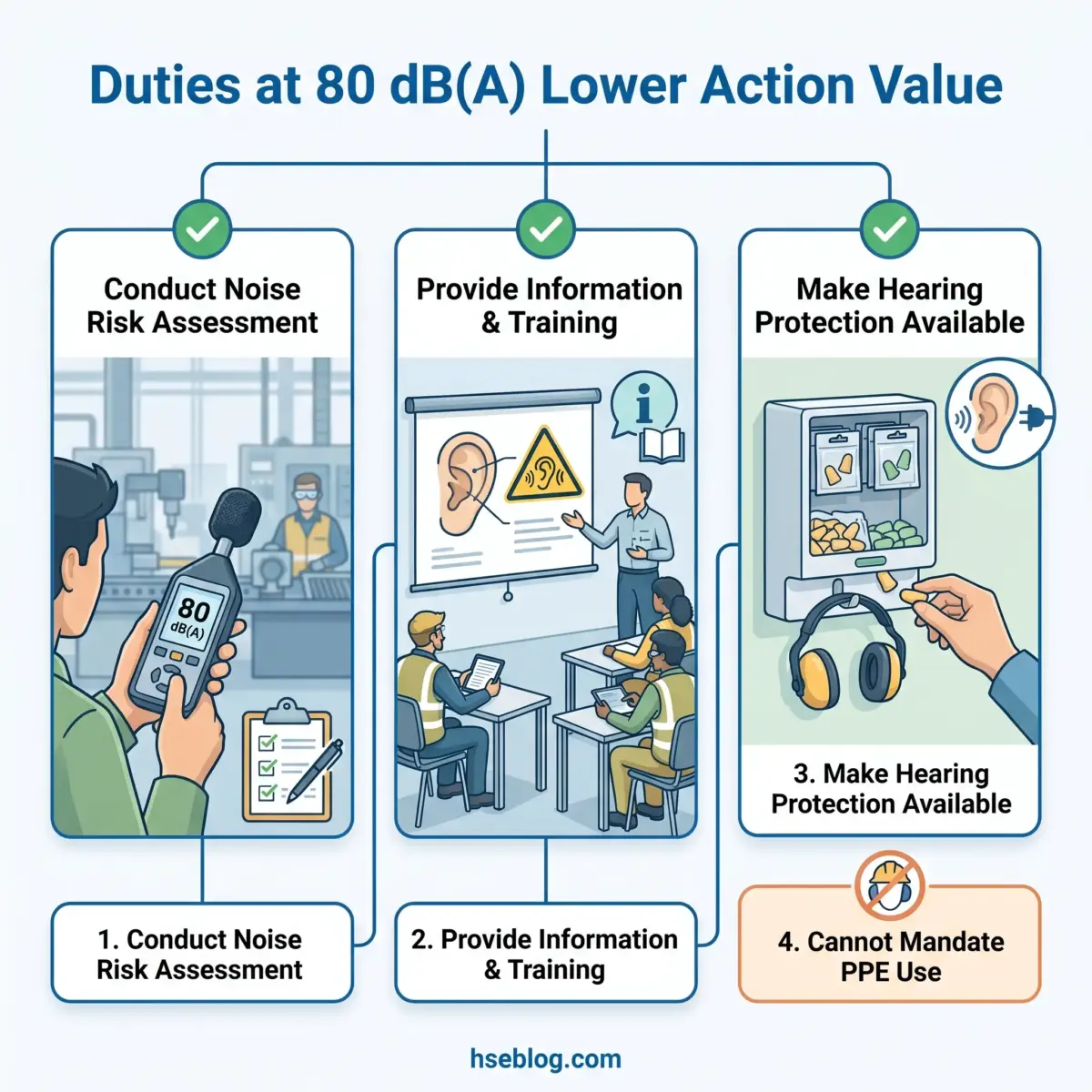
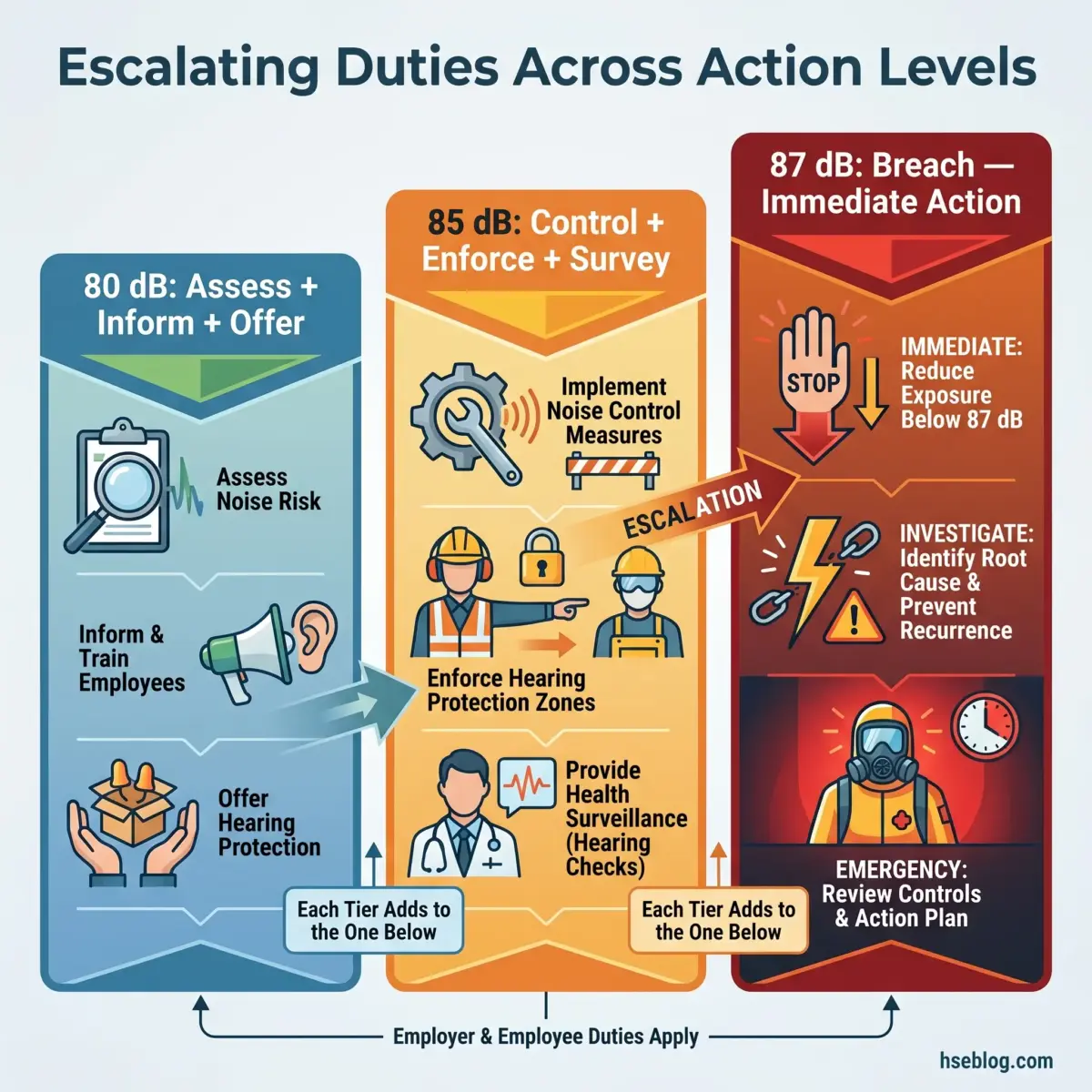
The 80 dB(A) lower exposure action value — or 135 dB(C) peak — is where employer duties begin. Under Regulations 6–10 of the Control of Noise at Work Regulations 2005, reaching this threshold requires the employer to:
- Carry out a noise risk assessment identifying workers at risk, noise sources, and exposure levels
- Provide information and training covering risks of noise exposure, control measures in place, and workers' own duties
- Make hearing protection available to any worker who requests it — but the employer cannot mandate its use at this level
The HSE's practical screening rule: if noise is intrusive but you can still hold a normal conversation at 2 metres, exposure is probably around or just above 80 dB(A).
This is the tier where compliance most commonly fails — not through deliberate disregard, but through never assessing whether the threshold is reached at all. Many manufacturing, logistics, and food-processing environments sit just above 80 dB(A) without anyone recognising it. The sound level corresponds roughly to a busy street or a vacuum cleaner at close range — noticeable but not alarming, which is precisely why it goes unmeasured.
The Upper Exposure Action Value: 85 dB(A)
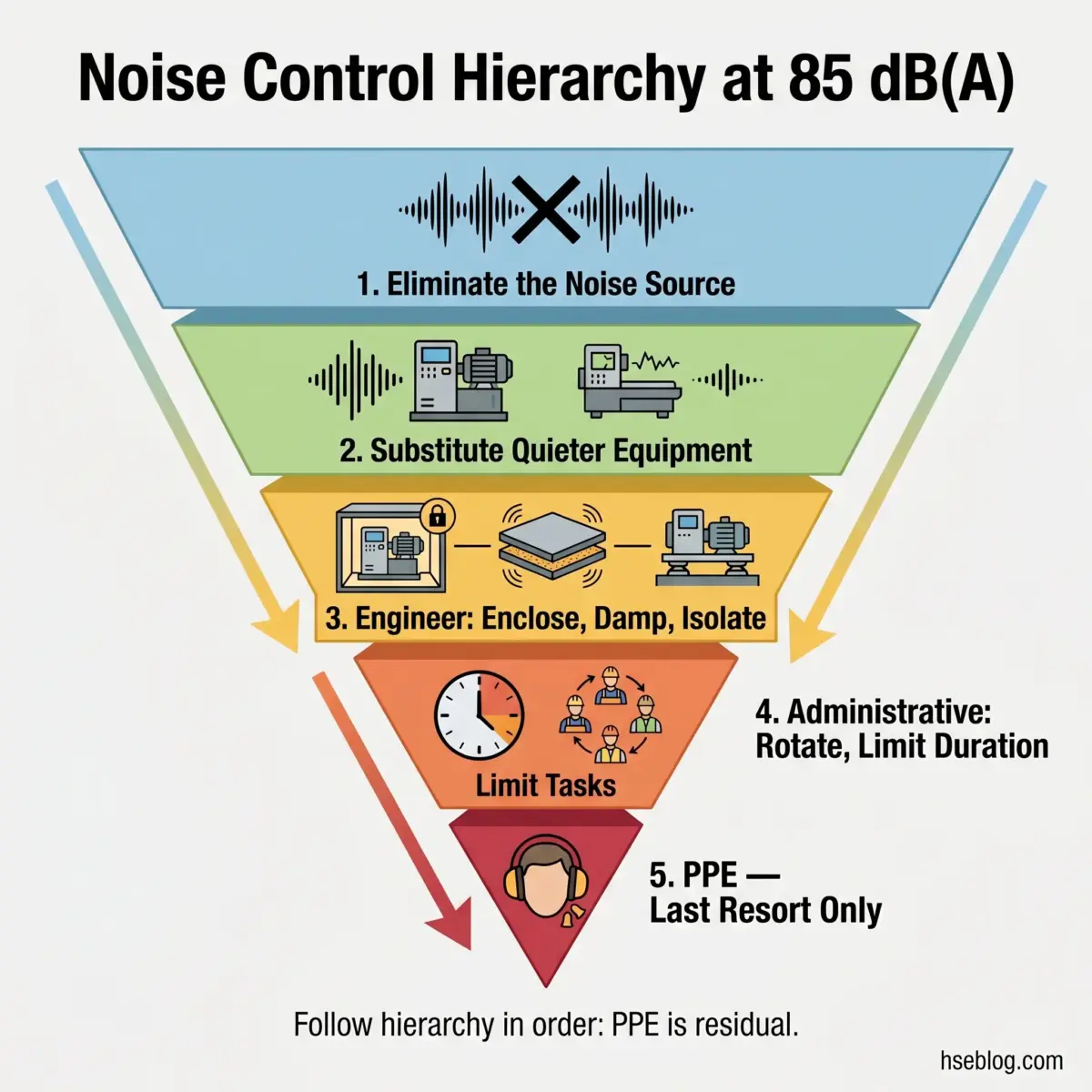
At 85 dB(A) LEP,d — or 137 dB(C) peak — the regulatory posture shifts from voluntary to compulsory. The employer must now:
- Reduce exposure to as low as reasonably practicable, applying the control hierarchy: eliminate the noise source, substitute quieter equipment, enclose or isolate the source, apply damping or silencing, then — only as a last resort — rely on hearing protection.
- Provide hearing protection and ensure it is worn. Use is no longer optional; the employer must enforce compliance.
- Designate and mark hearing protection zones where exposure reaches or exceeds this level, with signage restricting entry without protection.
- Implement health surveillance — audiometric testing for all workers regularly exposed at or above 85 dB(A).
The HSE's screening rule at this tier: if you have to shout to be heard by someone 2 metres away for more than about two hours per day, exposure is probably at or above 85 dB(A).
The biggest compliance failure at this level is treating hearing protection as the primary control rather than the residual one. The regulations under HSE's approved code of practice L108 explicitly require employers to demonstrate why engineering controls are not reasonably practicable before defaulting to PPE. The HSE's 2025 inspection campaign confirmed that most employers skip this step entirely — issuing ear defenders without documenting any consideration of engineering alternatives.
This is not just poor practice. It is a regulatory breach. The control hierarchy is a legal requirement, not a suggestion.
The Exposure Limit Value: 87 dB(A) — The Hard Ceiling
The 87 dB(A) exposure limit value is not an action level. It is an absolute legal ceiling on worker exposure under Regulation 4 of the Control of Noise at Work Regulations 2005 (UK), with a corresponding peak limit of 140 dB(C).
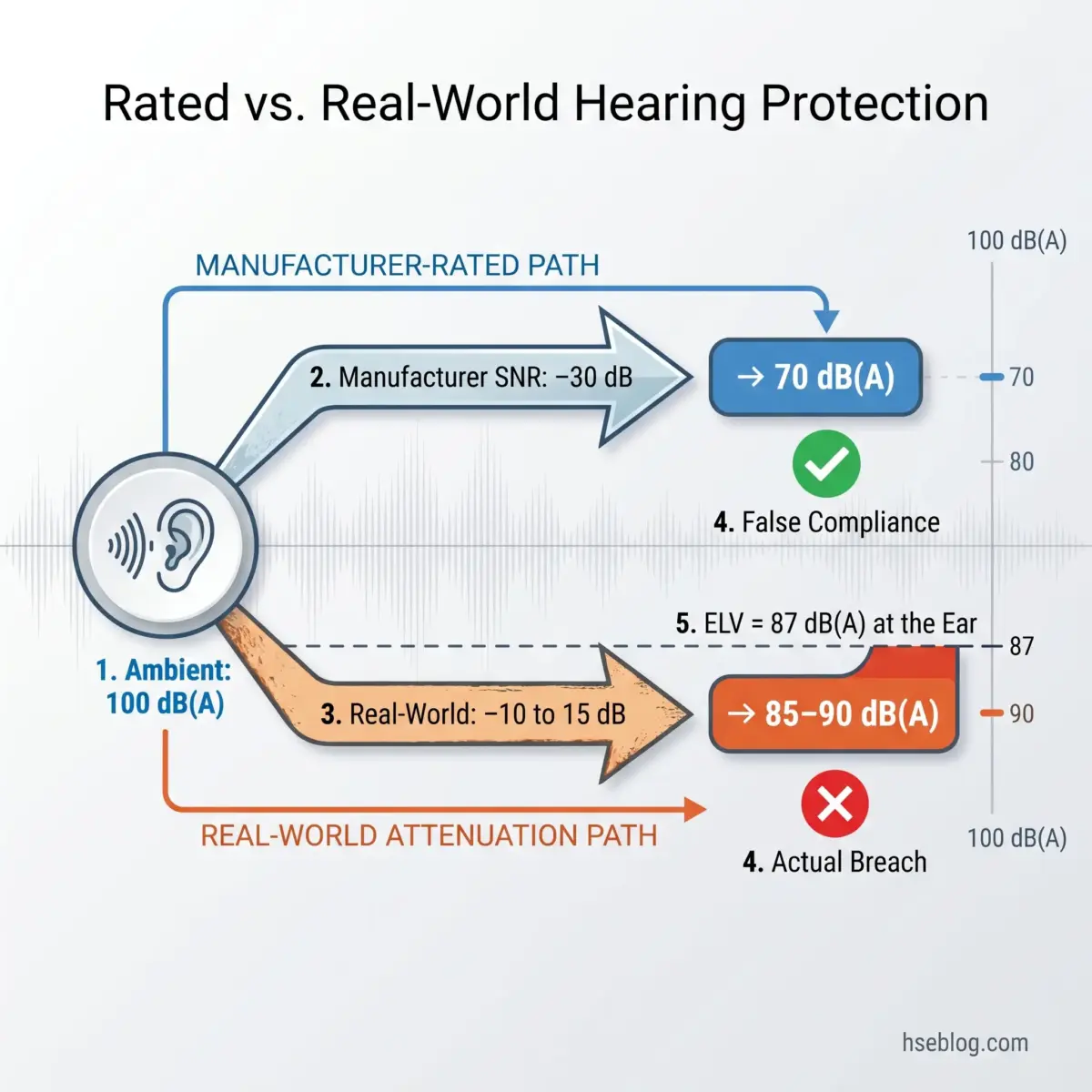
The structural distinction that most employers miss: the ELV is assessed after accounting for hearing protection attenuation, while both action values are assessed without it. This means a workplace running at 95 dB(A) ambient noise can still comply with the ELV — provided hearing protection reduces effective exposure at the ear to below 87 dB(A). But that same 95 dB(A) still triggers every upper action value duty, because those duties are assessed against the unprotected exposure.
If the ELV is exceeded, the employer must:
- Immediately reduce exposure below the limit
- Investigate the cause of the breach
- Modify controls to prevent recurrence
Here is where the real-world attenuation gap becomes dangerous. Manufacturers rate hearing protection using laboratory conditions — SNR (Single Number Rating) values of 25–35 dB are common on packaging. HSE data consistently shows real-world attenuation of only 3–10 dB for many protector types, depending on fit, maintenance, and user behaviour.
The practical consequence of this gap is severe. An employer issuing ear defenders rated at SNR 30 dB to workers exposed at 100 dB(A) may calculate effective exposure as 70 dB(A) — comfortably below the ELV. Real-world performance, however, often delivers only 10–15 dB of attenuation, leaving workers exposed at 85–90 dB(A) and potentially above the legal ceiling.
The judgment call for any noise assessor is clear: never use manufacturer ratings at face value. HSE L108 provides three derating methods — the SNR method, HML method, and octave band method — all requiring adjustment from laboratory to field performance. Using unmodified ratings is not conservative practice. It is a compliance failure waiting to surface.
How Do UK/EU Noise Action Levels Compare with OSHA Standards?
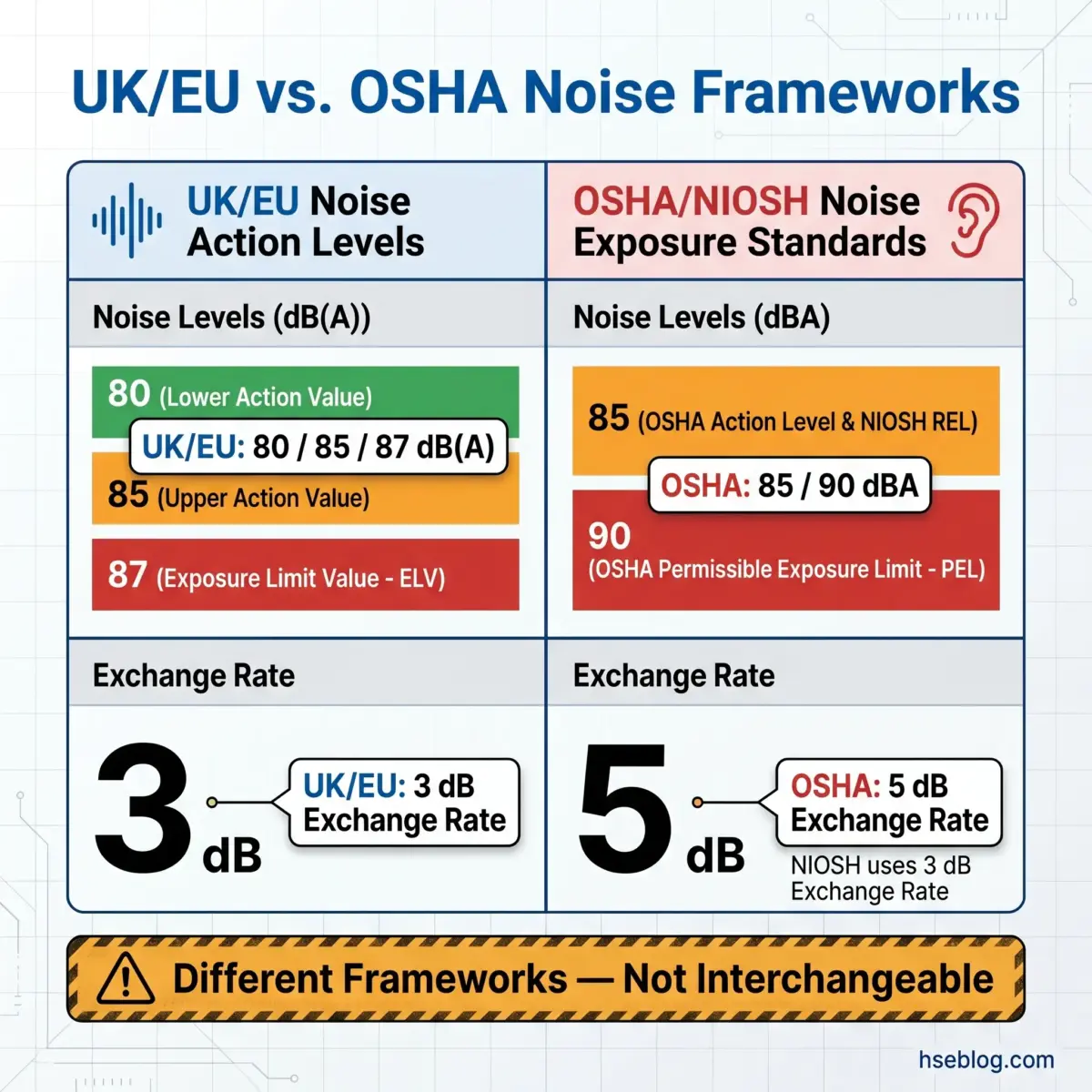
Multinational HSE professionals encounter both frameworks regularly, and applying the wrong one in the wrong jurisdiction is a compliance failure that produces either under-protection or unnecessary cost. The two systems are structurally different — not just numerically different.
| Parameter | UK/EU (Regs 2005 / Directive 2003/10/EC) | US OSHA (29 CFR 1910.95) | US NIOSH REL (1998) |
|---|---|---|---|
| Lower threshold | 80 dB(A) — Lower EAV | 80 dBA — Threshold level (measurement parameter only, no duties) | — |
| Mid threshold | 85 dB(A) — Upper EAV | 85 dBA — Action Level (hearing conservation program trigger) | 85 dBA — REL |
| Upper threshold | 87 dB(A) — ELV (with HPE) | 90 dBA — PEL (without HPE) | — |
| Exchange rate | 3 dB | 5 dB | 3 dB |
| Peak limit | 140 dB(C) | 140 dB (not frequency-weighted) | 140 dBP |
Three differences matter most in practice:
- Exchange rate. The 3 dB vs. 5 dB difference is the single largest practical divergence. For a worker exposed to 100 dB(A) for 2 hours and silence for the remaining 6, the UK/EU 3 dB rule calculates a significantly higher dose than OSHA's 5 dB rule. NIOSH's recommended standard aligns with the UK/EU on this point — and has recommended OSHA adopt the 3 dB rate for decades.
- ELV vs. PEL. The UK 87 dB(A) ELV accounts for hearing protection worn. OSHA's 90 dBA PEL does not. These are not comparable thresholds — they measure different things.
- The 80 dB gap. OSHA's 80 dBA threshold level is a dosimeter measurement parameter — it tells the instrument when to start accumulating dose. It triggers no employer duties. The UK's 80 dB(A) lower exposure action value creates real legal obligations: assessment, training, and making protection available.
The interpretive error to avoid in any multinational operation is assuming one framework's thresholds satisfy the other's requirements. They do not, and the 3 dB exchange rate difference means identical noise exposures produce different calculated doses depending on which jurisdiction's formula is applied.
Employer Duties at Each Noise Action Level: A Practical Summary
The compliance question auditors most want answered is not "do you have hearing protection?" but "show me how you calculated the LEP,d for your highest-exposed worker and what controls you considered before defaulting to PPE." The table below consolidates every duty triggered at each tier.
| Duty | 80 dB(A) / 135 dB(C) Peak | 85 dB(A) / 137 dB(C) Peak | 87 dB(A) / 140 dB(C) Peak |
|---|---|---|---|
| Noise risk assessment | Required | Required (review controls) | Investigate breach cause |
| Information & training | Required | Required (enhanced detail) | — |
| Hearing protection | Make available on request | Provide and enforce use | Verify attenuation achieves <87 |
| Engineering controls | — | Reduce exposure so far as reasonably practicable | Immediate reduction required |
| Hearing protection zones | — | Designate and sign | — |
| Health surveillance | — | Required (audiometry) | — |
| Employee duties | Cooperate with assessment | Wear protection, report defects | Report any suspected breach |
Each tier builds on the one below it. Reaching 85 dB(A) does not remove the 80 dB(A) duties — it adds to them. The ELV column is narrower because 87 dB(A) is a breach response, not a management tier.
Workers carry duties too. At the upper action value, employees must use provided hearing protection, maintain it in good condition, and report defects. Under the UK regulations, failure to cooperate can result in enforcement against the individual — though in practice, employer duty failures are prosecuted far more frequently.
How to Conduct a Noise Risk Assessment Against the Action Levels
Approximately 27 million US workers are exposed to hazardous noise annually (CDC/NIOSH, 2026), and globally, over 430 million people require rehabilitation for disabling hearing loss (WHO, 2024). The noise risk assessment is the mechanism that determines whether a workplace contributes to these figures — or prevents it. HSE L108, the UK's approved code of practice, sets out the expected methodology.
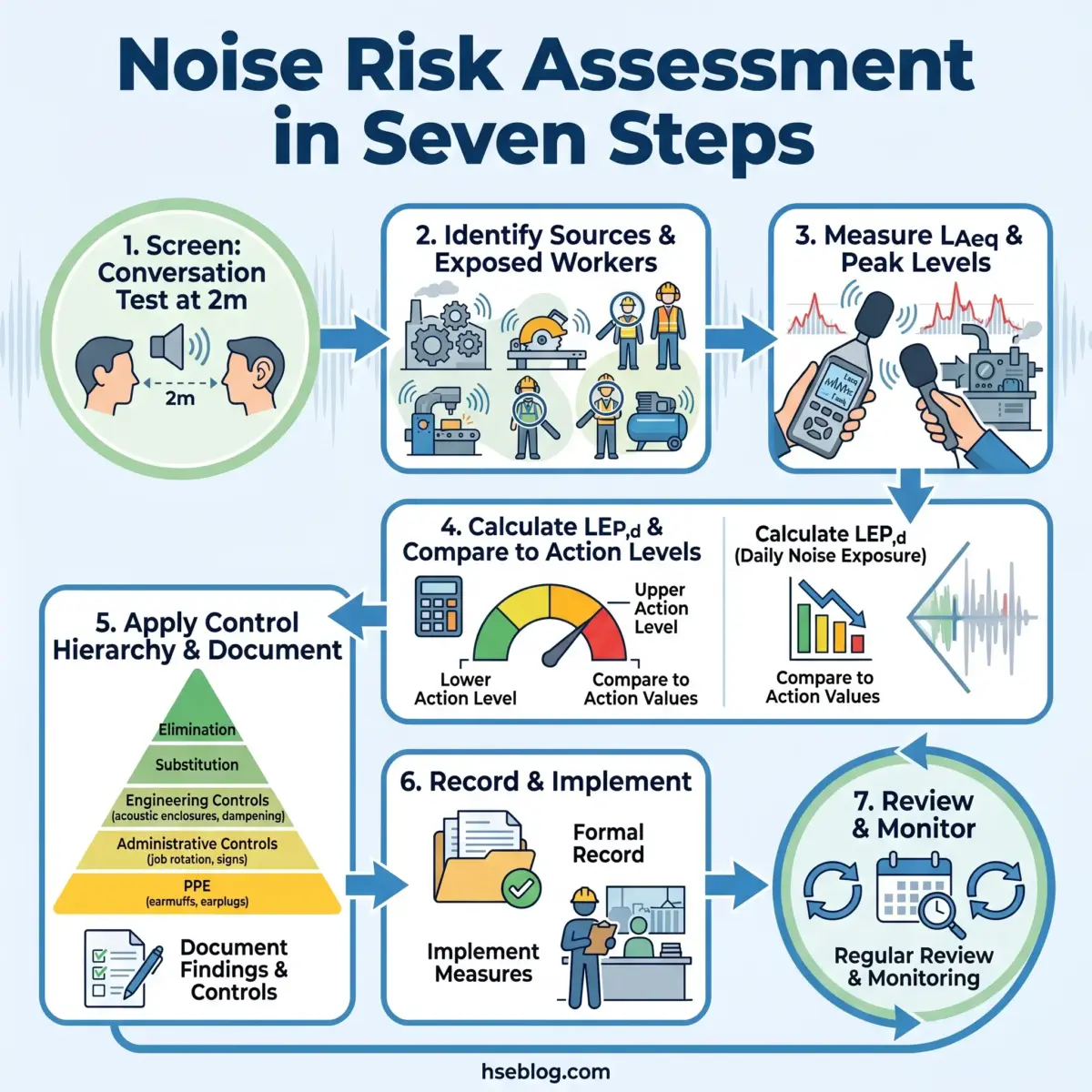
- Screen. Use the HSE's rule-of-thumb tests. Can you hold a normal conversation at 2 metres? If not, formal assessment is likely needed. Do workers have to shout? Assessment is definitely needed.
- Identify noise sources and exposed workers. Map every significant noise source — fixed plant, mobile equipment, hand tools, process noise — and identify which workers are exposed, for how long, and in which combinations.
- Measure. Record LAeq at each work position using a calibrated sound level meter (task-based approach), or deploy personal noise dosimeters for full-shift cumulative measurement. Capture peak levels (dB(C)) separately for impulsive noise sources.
- Calculate LEP,d. Apply the formula for each worker or homogeneous exposure group. For variable exposures, consider whether LEP,w is more representative.
- Compare against action levels. Determine which tier of duties applies. Where the result falls near a threshold boundary, the conservative approach is to assume the higher tier applies.
- Apply the control hierarchy. Eliminate, substitute, engineer, administer, then — and only then — PPE. Document the reasoning at each stage. The HSE's 2025 inspection findings confirm that the failure to document why engineering controls were rejected is the most common assessment deficiency — and the one most likely to attract enforcement.
- Record, communicate, and schedule review. Produce a written action plan with a timetable. Communicate findings to exposed workers. Set a review trigger — new equipment, process changes, worker complaints, or at minimum an annual check.
The assessment is not a one-time exercise. Conditions change, equipment ages, processes evolve. A noise risk assessment frozen in time is a liability, not a compliance document.
Frequently Asked Questions
What is the difference between an exposure action value and an exposure limit value?
Exposure action values (80 and 85 dB(A)) are thresholds that trigger specific employer duties — assessment, training, controls, health surveillance — but can be exceeded provided appropriate measures are in place. The exposure limit value (87 dB(A)) is an absolute ceiling that must not be exceeded under any circumstances. The critical structural difference: action values are assessed against the worker's unprotected exposure, while the ELV is assessed after accounting for hearing protection attenuation.
Can an employer use weekly noise exposure (LEP,w) instead of daily (LEP,d)?
Yes, but only when daily exposure varies markedly across the working week — typically when one or two days are 5 dB or more above others, or the working week involves three or fewer exposure days. The weekly average must still comply with the 87 dB(A) exposure limit value. LEP,w is a permitted alternative under the Control of Noise at Work Regulations 2005 (UK), not a default — and most auditors will question why it was chosen if daily variation does not clearly justify it.
What is the difference between dB(A) and dB(C) in noise action levels?
dB(A) uses A-weighting, which approximates the human ear's frequency response and is used for measuring average daily exposure (LEP,d). dB(C) uses C-weighting, which captures the full frequency range more evenly and is used for peak sound pressure measurements — the sharp, impulsive events (hammering, cartridge tools, explosive processes) that can cause instant damage. The regulations set separate action and limit values for both: 80/85/87 dB(A) for daily average and 135/137/140 dB(C) for peak events.
Do noise action levels apply to the music and entertainment industry?
Yes. The Control of Noise at Work Regulations 2005 (UK) extended to music and entertainment from April 2008. The same 80/85/87 dB(A) thresholds and 135/137/140 dB(C) peak values apply. Practical compliance in this sector requires sector-specific measures — musician's filtered earplugs that reduce level without distorting frequency response, managed set lengths, acoustic treatment of performance spaces, and monitoring with personal dosimeters calibrated for music-spectrum noise.
How often must noise risk assessments be reviewed?
No fixed statutory interval exists under UK law. However, assessments must be reviewed whenever there is reason to believe they are no longer valid — installation of new equipment, changes to work processes, employee complaints, or changes in working patterns. HSE L108 recommends regular review as good practice, and in enforcement, an assessment more than two years old with no documented review is typically treated as insufficient unless the workplace can demonstrate nothing material has changed.
Is noise-induced hearing loss from workplace exposure reversible?
No. Noise-induced hearing loss is permanent and irreversible. The sensory hair cells in the cochlea, once damaged by excessive noise energy, do not regenerate in humans. This biological fact is precisely why the noise action level framework is preventive — by the time audiometric health surveillance detects a threshold shift, permanent damage has already occurred. Over 430 million people worldwide currently require rehabilitation for disabling hearing loss (WHO, 2024), with occupational noise as a significant contributing factor.
Conclusion
The noise action level framework fails at a specific, identifiable point — and it is not the point most employers suspect. Hearing protection is widely available. Signage gets posted. Audiometry gets scheduled. What consistently breaks down, confirmed by the HSE's 2025 inspection campaign, is the step before all of that: the honest calculation of LEP,d, the genuine consideration of engineering controls before PPE, and the understanding that manufacturer attenuation ratings describe laboratory conditions, not the ear canal of a worker on a twelve-hour shift.
The highest-impact change an employer can make is not buying better ear defenders. It is ensuring that someone competent calculates the actual daily noise exposure for the highest-exposed worker, documents why each step of the control hierarchy was or was not reasonably practicable, and verifies hearing protection performance using real-world derating — not packaging claims. Recognised training pathways such as NEBOSH, IOSH, or equivalent national qualifications provide the competence framework; HSE L108 provides the methodology.
Noise-induced hearing loss does not announce itself until the damage is done. The 80, 85, and 87 dB(A) noise action levels exist to force action before that threshold — but only if the system behind them is built on measurement, not assumption.