Ground control in mining is the engineered system of rock reinforcement, pillar design, slope management, geotechnical monitoring, and regulatory compliance that prevents the collapse of underground excavations and surface slopes. It encompasses rock bolting, shotcrete, cable bolting, standing support, backfill, and — critically — the management frameworks that ensure these controls respond to changing geological conditions. Ground falls remain the leading cause of underground mining fatalities, making ground control the single most consequential safety discipline in mining operations.
Why Ground Control Is the Most Critical Safety System in Mining
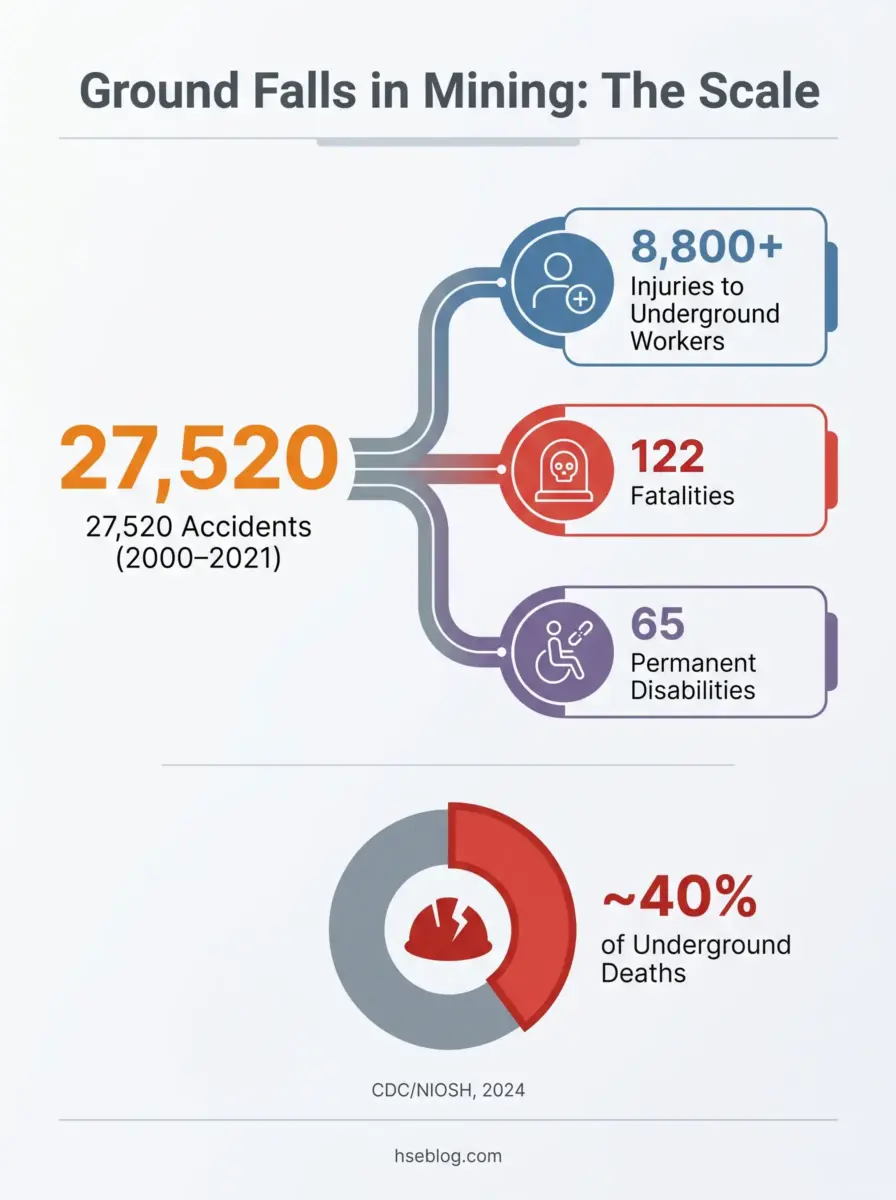
Between 2000 and 2021, the US Mine Safety and Health Administration recorded 27,520 ground control related accidents across underground and surface operations — accidents that resulted in more than 8,800 injuries to underground workers alone, including 122 fatalities and 65 instances of permanent disability (CDC/NIOSH, 2024). These numbers place ground control failures ahead of every other accident category in underground mining for both frequency and severity.
The raw fatality count, though, has declined significantly since its peak decades. That decline tempts a comforting narrative: the problem is being solved. Practitioners who work close to the data see a different pattern. The incidents that still occur are disproportionately concentrated during specific high-risk activities — pillar recovery operations, intersection widening, and mining under deep cover where stress regimes are difficult to predict. The residual risk is not evenly distributed. It clusters around the operations where geological complexity meets production pressure, and where the margin between a controlled roof and a fatal collapse narrows to centimetres of rock movement.
Ground control also extends beyond the underground environment. Surface mining operations face their own ground control challenge: slope stability. Slope failures at surface operations contribute to an estimated 15% of surface mining fatalities (MSHA/NIOSH). Bench collapses, highwall failures, and large-scale slope movements demand a parallel but distinct set of engineering controls, monitoring technologies, and management systems. This article addresses both domains — underground and surface — because a comprehensive understanding of ground control in mining requires treating them as two faces of the same discipline.
What Causes Mine Collapses? Geology, Stress, and Human Factors
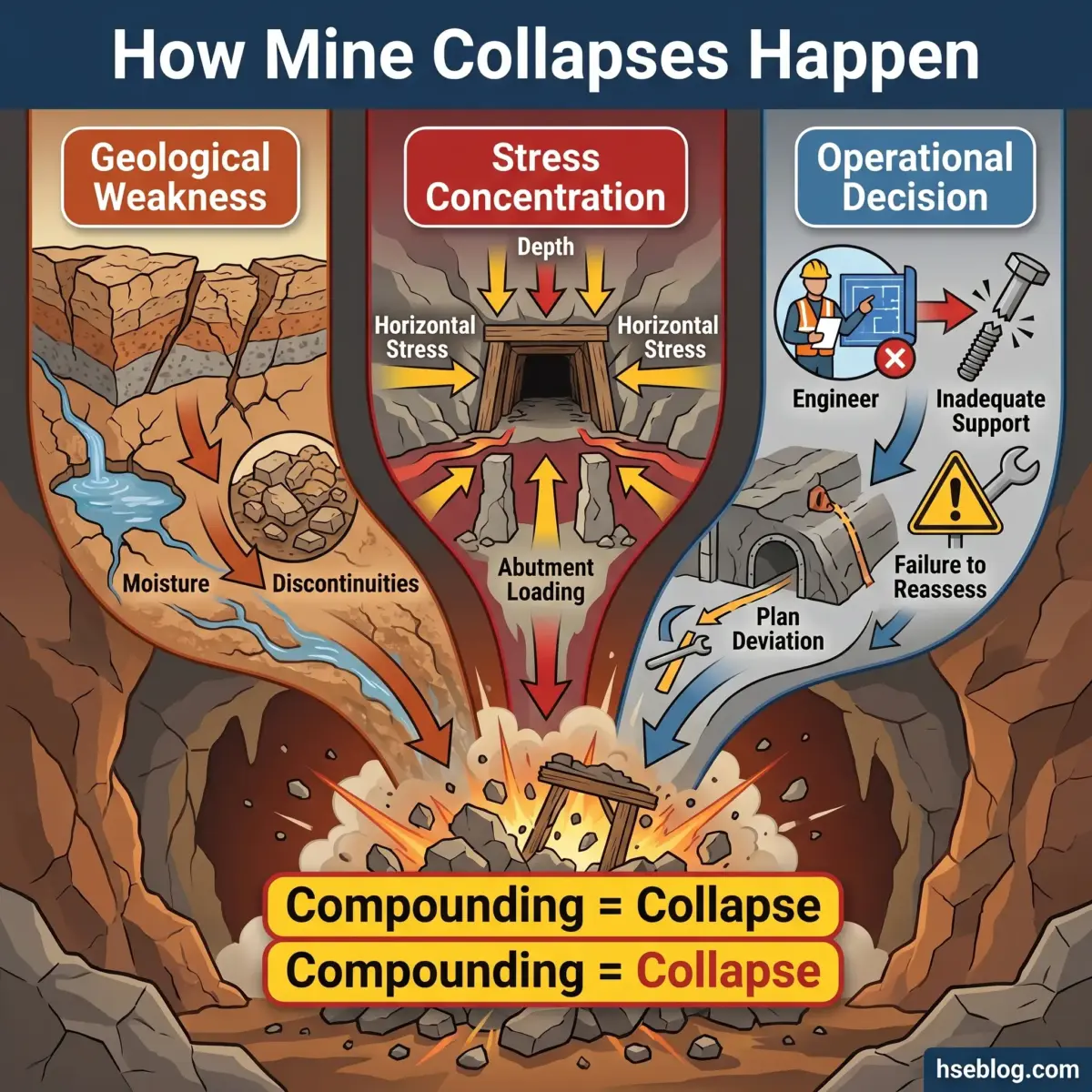
A mine collapse is almost never a single-cause event. Reviewing published investigation reports from MSHA and NIOSH reveals a consistent pattern: failure occurs when geological weakness, elevated stress, and an operational decision converge. One factor alone may be manageable. Two create vulnerability. Three produce collapse.
Understanding these causes requires organizing them into three interacting categories — geological conditions, stress concentrations, and human/operational factors — and recognizing that the lethal scenarios nearly always involve compounding across categories.
Geological Conditions That Weaken Roof and Rib Integrity
Certain rock types are inherently predisposed to failure. Thinly bedded shale, mudstone, and what miners call "drawrock" — weak, laminated roof material that separates along bedding planes — are consistent features in ground fall investigations. Structural discontinuities amplify the problem: clay veins that act as planes of zero tensile strength, slickensided surfaces that reduce shear resistance, joints and faults that interrupt otherwise competent strata, and paleochannels that introduce unexpected changes in roof lithology.
Moisture plays a slower but equally destructive role. Water infiltration degrades clay-rich roof rock over time, reducing its strength progressively. A roof that was stable at development can deteriorate weeks or months later as moisture migrates through fractures — a failure timeline that makes the initial support assessment misleading if it does not account for long-term rock-water interaction.
How Stress Concentrations Lead to Sudden Failures
Horizontal stress is the most frequently underestimated contributor to underground roof failure in coal mines. High horizontal stress produces sudden, violent rock failures — cutter roof, guttering along rib lines, and explosive ejection of rock fragments — that conventional support systems may not control if the stress field was not accounted for in the roof control plan design.
Depth of cover intensifies these forces. As mining extends deeper, both vertical and horizontal stresses increase, and the ratio between them changes in ways that alter failure modes. Abutment loading during pillar recovery creates additional stress concentrations at the worst possible time — when miners are working in areas of deliberately reduced support.
The Crandall Canyon mine disaster in Utah in 2007 stands as the defining case for stress-driven failure in the US mining record. Six miners and three rescue workers died when a massive pillar collapse — driven by excessive extraction under deep cover — was initially mischaracterized as an earthquake. The investigation fundamentally changed industry understanding of pillar design under high-cover conditions and accelerated adoption of NIOSH's pillar stability analysis tools.
Operational Decisions That Create the Conditions for Failure
The geological and stress conditions set the stage. Operational decisions determine whether the stage becomes a collapse site. Widening rooms or intersections beyond the parameters specified in the approved roof control plan, installing support with inadequate torque or incorrect spacing, and proceeding with pillar recovery without updated geotechnical assessment are recurring themes in fatality investigations.
A consistent pattern across MSHA investigation reports is the failure to reassess. Conditions changed — a geological anomaly was encountered, water inflow increased, stress-induced fracturing appeared — but the operation continued under the original plan. The plan-to-conditions gap is where many collapses originate.
Underground Ground Control: Support Systems and Design Principles
The selection of ground support is not a menu exercise — it is a design process. The common mistake, visible across audits and incident reports, is choosing a support type based on what neighboring mines use rather than on what the site-specific geology and stress regime demand. Rock mass classification systems like NIOSH's Coal Mine Roof Rating (CMRR) inform the process, but they do not replace engineering judgment. CMRR calculates inherent roof strength within the bolted horizon; what it cannot calculate is how that roof will behave under the specific stress field, moisture conditions, and extraction geometry of a particular operation.
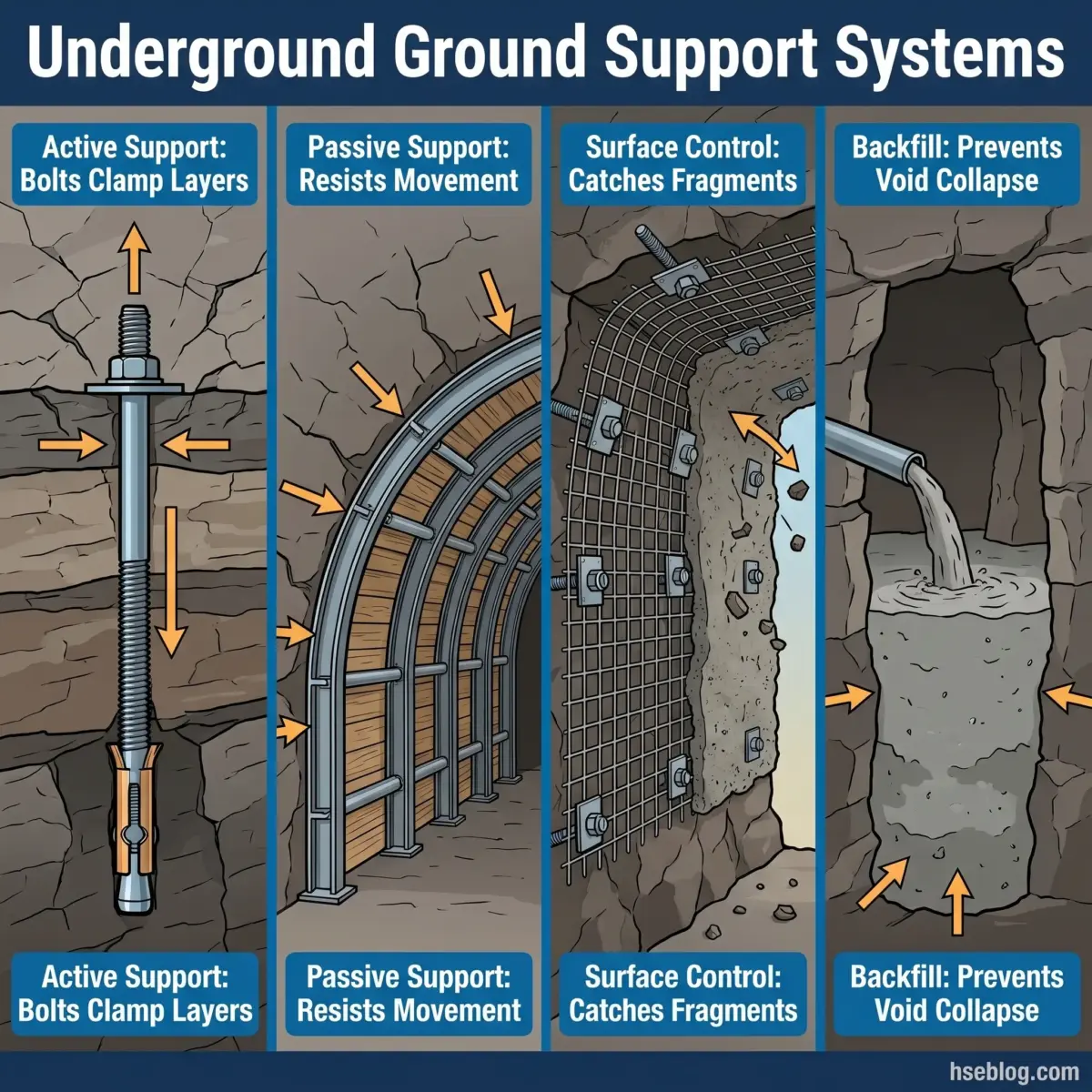
Ground support systems fall into two functional categories: active support, which modifies the rock mass behaviour by clamping layers together, and passive support, which resists movement after it begins.
Rock Bolting: The Primary Line of Defence
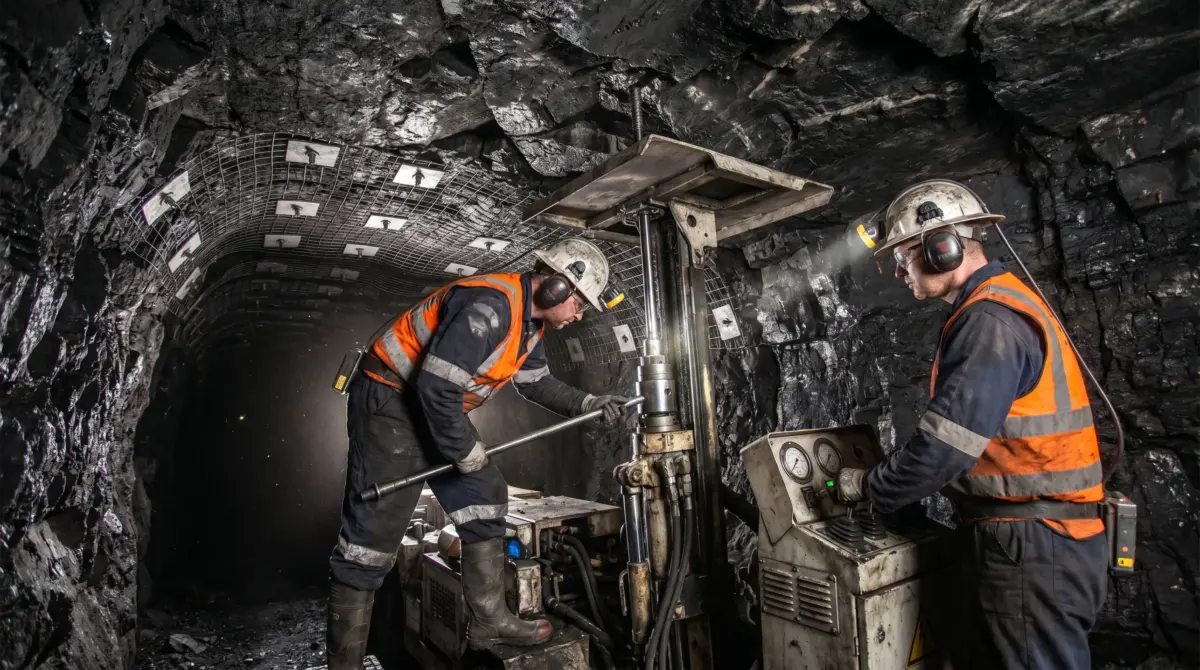
Rock bolts are the dominant support system in underground coal and hard-rock mining worldwide. Their function is deceptively simple: anchor into competent rock above the weak zone, clamp the weak layers together, and create a reinforced beam or arch that distributes load across the bolted horizon.
Three primary bolt types serve different ground conditions. Mechanically anchored bolts use an expansion shell to grip competent rock at the top of the hole, applying tension to the lower strata. Fully grouted resin bolts bond along their entire length, providing both load transfer and resistance to shear movement along bedding planes — they are the preferred choice in horizontally stressed ground because they restrict lateral displacement. Friction bolts (split sets and Swellex) rely on radial pressure against the borehole wall and are most effective as pattern support in hard rock where immediate confinement is needed.
Under 30 CFR 75.222 (US jurisdiction), bolt spacing in underground coal mines must not exceed five feet, and bolts must be tensioned to at least 50% of either bolt yield strength or anchorage capacity, whichever is less. The practical significance of these numbers extends beyond compliance: inadequate tension means the bolt is not actively clamping the roof layers, reducing it to a passive dowel rather than an active support element. Installation quality — proper hole diameter, correct resin mixing, adequate spin-and-hold time — determines whether a bolt performs as designed or merely occupies a hole.
Shotcrete, Mesh, and Surface Control
Bolting controls large-scale roof movement. It does not prevent everything from falling. Between bolts, small rock fragments — sometimes just a few kilograms — continue to dislodge and fall. This is not a minor issue: 400–500 coal mine workers are injured each year by small pieces of rock falling between bolts (CDC/NIOSH, 2024).
Surface control systems address this gap. Welded wire mesh and chain-link mesh, installed against the roof between bolt plates, catch dislodged fragments before they reach workers. Shotcrete — sprayed concrete applied directly to the rock surface — serves a dual purpose: it prevents small falls and, when fibre-reinforced, provides additional load-bearing capacity to the supported zone. In hard-rock mines, shotcrete-and-mesh combinations are standard primary support in development headings.
The ILO Encyclopaedia chapter on underground ground control classifies surface control as a necessary complement to bolting in all but the most competent roof conditions — a position that aligns with field experience across jurisdictions.
Standing Support and Backfill for High-Risk Zones
Where openings exceed the span that bolting can safely control — intersections, belt entries, longwall gateroads — additional standing support is required. Timber cribs, steel posts, hydraulic props, and yieldable steel arches each serve different ground behaviour profiles. Rigid support resists displacement up to a threshold, then fails suddenly. Yieldable support deforms progressively, maintaining load-bearing capacity through larger displacements — a critical distinction in areas of expected convergence.
Mobile roof supports (MRS) have transformed safety in pillar recovery operations, providing relocatable, high-capacity overhead protection in the active mining zone. Backfill — waste rock, cemented tailings, or paste fill pumped into mined-out voids — prevents large-scale void failures that could propagate to the surface. In deep metalliferous mines, cemented paste backfill also serves a structural role, confining pillars and reducing stress concentrations on remaining ore.
Pillar Design and Recovery: Managing Global Stability
Pillar recovery is the deliberate creation of an unstable situation. The goal is not to prevent roof collapse — it is to ensure collapse occurs only after miners have completed their work and left the area. This reframing is essential and often misunderstood by non-specialists who assume that any roof fall represents a control failure. In pillar recovery, a controlled fall behind the retreating operation is the intended outcome.
The distinction between global and local stability governs every pillar design decision. Global stability concerns overall mine layout: pillar sizes, room widths, and extraction ratios designed to prevent massive, multi-panel collapse. Local stability concerns roof control in the immediate working area where miners are present. Both must be achieved simultaneously — a globally stable mine layout means nothing if a local roof fall kills a miner at the working face.
Historically, pillar recovery was one of the most hazardous activities in underground mining, responsible for roughly a quarter of all roof fall fatalities. NIOSH research published in 2016 documented the dramatic improvement that followed targeted interventions: adequate stump size to maintain temporary local stability, limiting the number of open crosscuts to reduce exposed roof span, and proper use of mobile roof supports to provide overhead protection during extraction. The result: only one fatal roof fall on a pillar line since 2007 (NIOSH/ScienceDirect, 2016).
NIOSH's Analysis of Coal Pillar Stability (ACPS) software enables engineers to model pillar strength against expected loads and design extraction sequences that maintain global stability throughout the retreat. The tool does not guarantee safe outcomes — it provides a framework within which engineering judgment and site-specific geological knowledge must still operate. A pillar that is mathematically adequate under ACPS assumptions can still fail if the actual geology includes undetected discontinuities or if horizontal stress was underestimated in the model inputs.
Audit Point: During pillar recovery operations, verify that the number of open crosscuts does not exceed the approved plan limit, that stump dimensions match design specifications, and that mobile roof support positioning follows the sequence prescribed by the roof control plan. Deviations at this stage compress the safety margin to its thinnest point.
Open-Pit Slope Stability: Preventing Surface Collapses
Most competitor content treats ground control as exclusively an underground concern. Surface mining operations face a parallel but distinct ground control challenge — slope stability — that demands its own engineering controls, monitoring systems, and failure-mode analysis.
Open-pit slope design balances two competing objectives: steeper slopes maximize ore recovery and minimize waste stripping, while shallower slopes improve stability margins. The economic pressure to steepen slopes intensifies as pits deepen, and the consequences of misjudging that balance escalate with pit scale — a bench-level failure may injure one operator; a large-scale slope failure can bury equipment and personnel under millions of tonnes of rock.
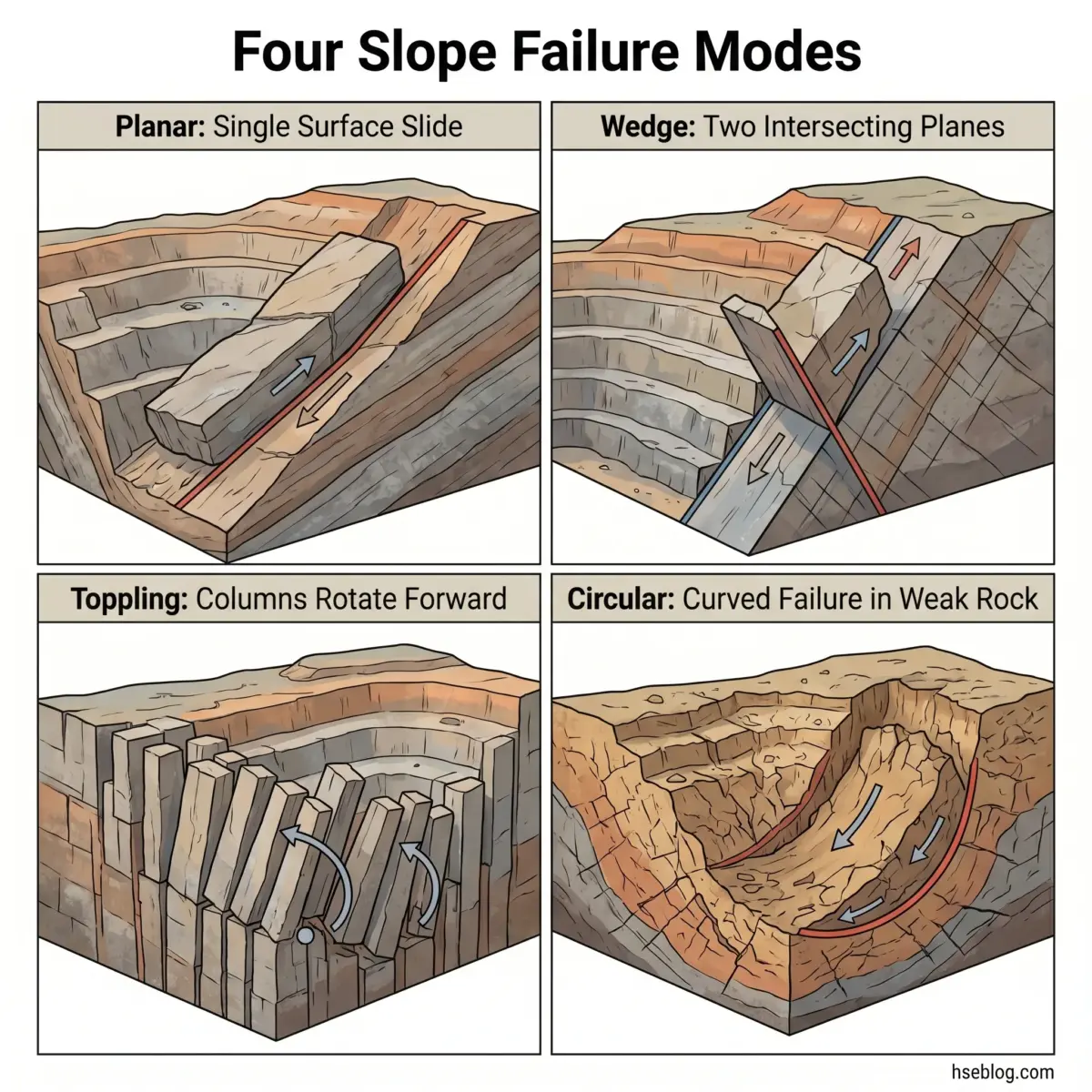
Slope failures manifest in four primary modes, each requiring a different assessment approach. Planar failure occurs along a single discontinuity dipping out of the slope face. Wedge failure involves two intersecting discontinuities releasing a wedge-shaped block. Toppling failure affects steeply dipping, columnar rock that rotates forward under gravity. Circular failure occurs in weaker rock masses where the failure surface curves through the material rather than following pre-existing structures. Kinematic analysis identifies which modes are geometrically possible; limit equilibrium and numerical modelling assess whether the driving forces exceed resistance.
Water pressure is a primary driver of slope failure. Groundwater reduces the effective stress on potential failure surfaces, and rapid infiltration from rainfall or snowmelt can trigger failures that would not occur under dry conditions. Drainage — horizontal drain holes, pumping wells, surface water diversion — is often the highest-value slope stability control because it addresses the triggering mechanism directly.
The Western Australia Department of Mines' Geotechnical Considerations in Open Pit Mines Guideline provides a structured framework for slope management in surface operations, including the requirement for trigger-action response plans (TARPs) — pre-defined response protocols that specify what actions are taken at each stage of slope movement. This TARP model is increasingly adopted internationally as a ground control management standard.
The failure mode that most often catches operations off guard is progressive failure — small slope movements observed over weeks or months, dismissed as "normal creep," until the displacement velocity suddenly accelerates toward catastrophic failure. Practitioners trained in inverse-velocity analysis can recognise this acceleration pattern and predict approximate failure timing, but only if the monitoring data is being collected, analysed, and acted upon at the speed the failure demands.
Geotechnical Monitoring: From Observation to Prediction
Monitoring hardware is not the bottleneck in geotechnical safety — response protocols are. Many mining operations invest in sensor arrays, radar systems, and satellite data services, but have not defined clear action triggers. At what displacement rate does work stop? Who has authority to halt production on a prism reading? How quickly must a radar alarm reach the pit floor? The alarm-to-action chain is where monitoring fails in practice, not in the sensors themselves.
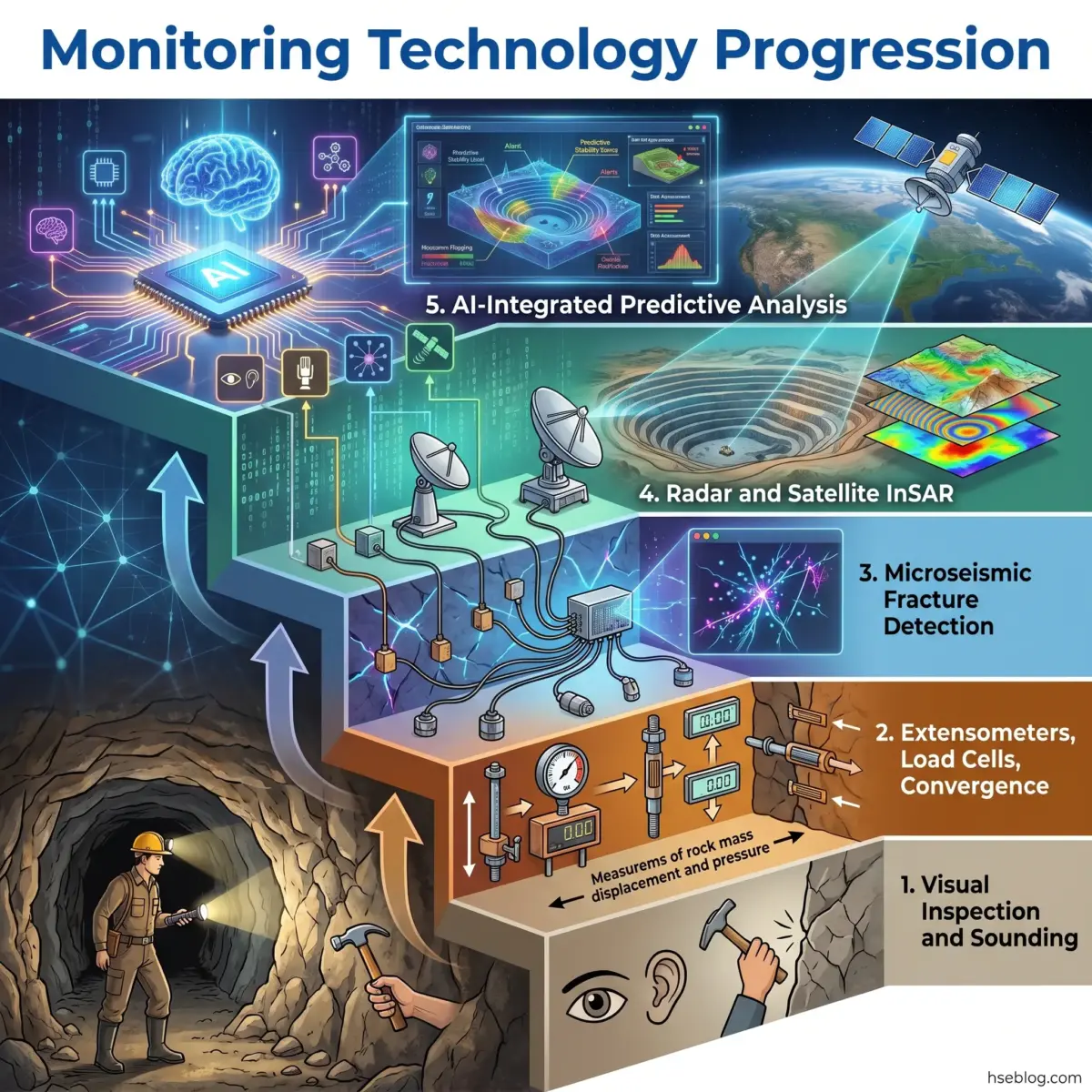
Traditional Observation and In-Situ Methods
The most basic form of geotechnical monitoring is visual inspection and manual sounding — tapping the roof with a scaling bar and listening for the "drummy" hollow sound that indicates detached rock. NIOSH's own assessment describes observational techniques as neither efficient nor accurate, yet most mines still rely on them as a primary detection method.
Extensometers measure displacement within the rock mass, providing quantitative data on how much and how fast the roof is moving. Convergence meters track closure between roof and floor. Load cells installed on support elements indicate whether bolts or props are taking load as designed. These instruments provide early warning — but only when someone reads and interprets the data in time to act.
Advanced and Remote Sensing Technologies
Microseismic monitoring detects the acoustic emissions produced by rock fracture. In underground mines, a network of geophones can triangulate fracture locations and intensities, identifying zones where the rock mass is actively failing before it becomes visible. This technology has saved lives in deep hard-rock mines where seismicity-driven rock bursts are the primary ground control hazard.
At the surface, ground-based slope stability radar (SSR and IBIS systems) measures sub-millimetre displacement across entire pit walls in near-real-time. Satellite InSAR — Interferometric Synthetic Aperture Radar — is reaching operational maturity in open-pit mining, enabling millimetre-scale displacement detection across entire mine footprints without installing ground-level sensors (SkyGeo/MDPI, 2025). Multiple vendors now offer decision-grade InSAR services integrated with ground-based radar for mining applications. UAV-borne LiDAR and photogrammetry complement these systems by providing high-resolution topographic models for change detection.
The frontier is integration: AI-driven analysis combining multiple sensor data streams — radar displacement, piezometric water levels, microseismic event rates, and weather data — to predict failure timing rather than simply detecting movement. Inverse-velocity analysis remains the most established predictive technique, plotting the reciprocal of displacement velocity against time to forecast when velocity will reach infinity (i.e., when failure will occur). The technique is powerful but imperfect — it assumes a consistent failure mechanism, and any change in the driving process (a rainfall event, a blast, a change in dewatering) can alter the trajectory.
Watch For: Monitoring systems that generate data without defined action triggers. If the site's TARP does not specify displacement-rate thresholds and named decision-makers at each level, the monitoring system is generating information, not safety.
What Does a Roof Control Plan Require?
Under 30 CFR 75.220 (US jurisdiction), every underground coal mine operator must develop and follow a roof control plan approved by the District Manager. The plan must be suitable to the prevailing geological conditions and the mining system used — a requirement that sounds straightforward but carries substantial operational weight. A plan designed for one geological environment becomes inadequate the moment conditions change, and conditions in underground coal mines change continuously.
The approval criteria under 30 CFR 75.222 specify minimum engineering parameters: bolt spacing not exceeding five feet, tensioning to at least 50% of bolt yield or anchorage capacity, and supplementary support requirements for openings exceeding 20 feet in width. Plans must also address the sequence of installation — when support must be installed relative to face advance — and the procedures for intersections, crosscuts, and belt entries where roof spans widen and stress concentrations shift.
For metal and nonmetal underground mines, 30 CFR 57.3360 establishes a broader requirement: ground support must be used where ground conditions or mining operations create a hazard. The regulatory language is less prescriptive than coal mine standards, placing greater reliance on operator judgment and geotechnical engineering assessment.
MSHA reviews approved roof control plans every six months under 30 CFR 75.223(d), and plans must be revised when conditions change or when accident experience indicates the existing plan is inadequate. The trigger for revision is not limited to fatalities — a pattern of near-miss events, a geological anomaly encountered during development, or a change in extraction sequence should all prompt plan reassessment.
Jurisdiction Note: In July 2025, MSHA published a proposed rule (Docket MSHA-2025-0072, Federal Register 90 FR 28432) to revise roof control plan approval criteria. The proposal would eliminate District Manager authority to impose additional requirements beyond those specified in regulations. The comment period was extended to September 2, 2025. This is part of a broader 18-rule deregulatory initiative. At the time of writing, existing requirements under 30 CFR 75.220 and 75.222 remain in force. Operations should monitor the Federal Register for final rule status. Australian and ILO-guided operations are unaffected by this US-specific regulatory change.
A compliant roof control plan and an adequate roof control plan are not always the same thing. The plan on paper may satisfy the minimum regulatory criteria specified in 30 CFR 75.222 while failing to account for site-specific geological surprises — a clay vein intersecting the entry at an unexpected angle, a change in roof lithology between drill holes, or a horizontal stress regime that rotates across the panel. Plans must be treated as living documents, updated when conditions deviate from the assumptions they were built on — not filed after approval and forgotten until the next six-month review cycle.
Training and Competency: The Human Side of Ground Control
Pre-shift examination requirements under MSHA regulations mandate that a certified person examine the working environment before each shift, specifically assessing roof, rib, and face conditions. On-shift examinations continue this assessment during production. The regulations establish the minimum. The skill they demand — reading the roof — is not something a regulation can create.
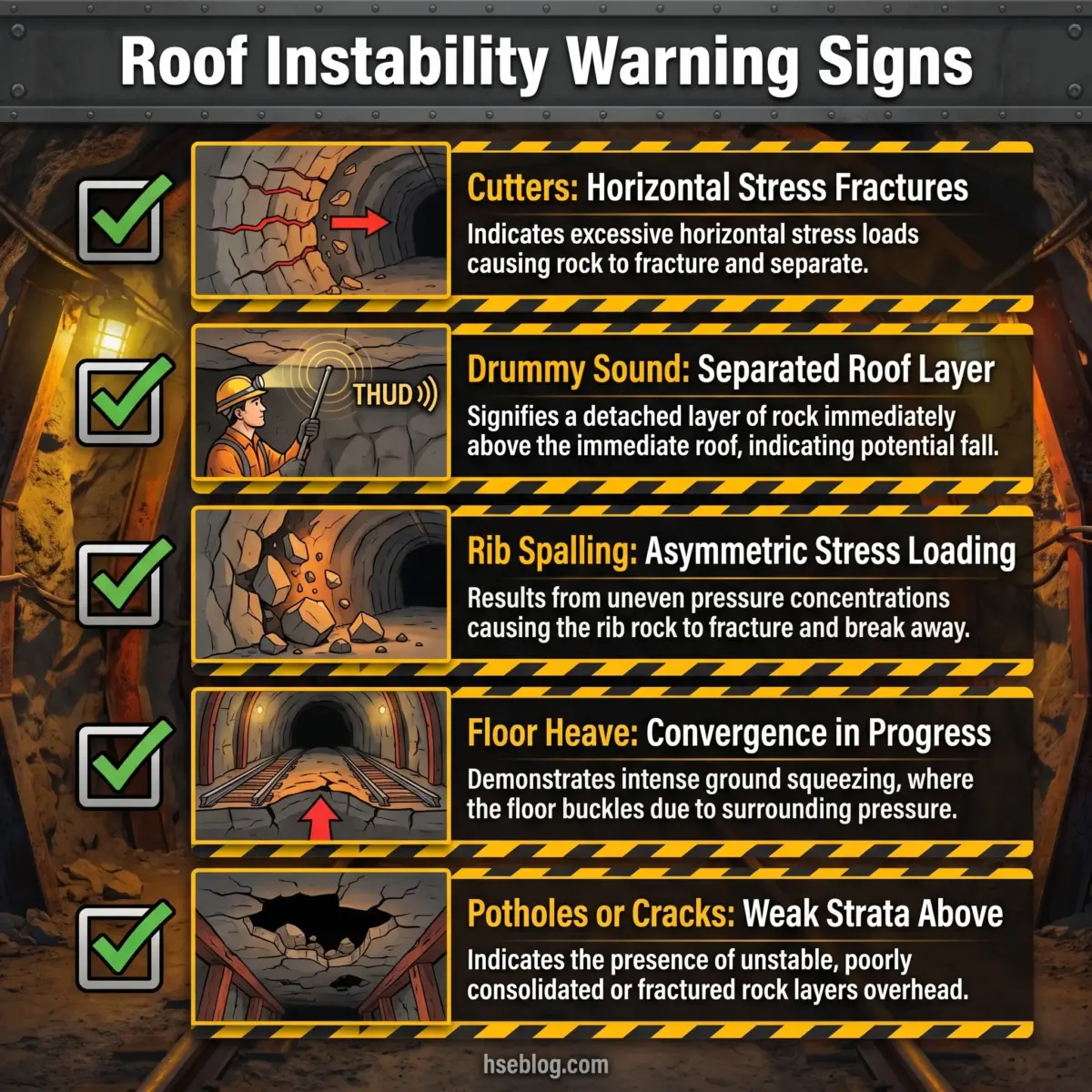
Ground control training that only teaches bolt installation patterns misses the point. Miners need to develop pattern recognition — the ability to assess roof conditions the way an experienced pilot reads weather. Cutters forming along rib lines indicate horizontal stress. Pot holes in the roof suggest weak, moisture-sensitive strata. A drummy-sounding roof means a layer has separated from the formation above. Floor heave signals convergence that will eventually load the ribs. Rib spalling on one side of the entry but not the other suggests asymmetric stress. Each of these signs tells a story, and experienced miners read them in combination, not isolation.
This intuitive assessment layer takes years of underground experience to develop. Checklists support it — they ensure nothing is skipped during a rushed pre-shift exam — but they cannot replace the practitioner's ability to recognize when something has changed since the last inspection. The most dangerous condition is not a dramatic roof fall; it is the subtle change that a less-experienced examiner dismisses as "normal" because the deterioration has been gradual.
Stop-work authority is the last line of defence. When a miner or examiner identifies conditions that have changed beyond the parameters assumed in the roof control plan, work must stop until the area is assessed by a competent person and, if necessary, additional support is installed or the plan is revised. The challenge is cultural: exercising stop-work authority under production pressure requires both training and management systems that genuinely protect the person who makes the call.
Field Test: Ask a mine examiner to explain what each warning sign they check for actually indicates about the rock mass behaviour — not just that it exists, but what mechanical process it represents. The answer reveals whether training has built understanding or merely rote observation.
Frequently Asked Questions
What is the most common cause of mine roof collapse?
There is no single common cause — collapses result from the convergence of geological weakness, stress concentration, and operational factors acting together. A clay vein alone may not cause failure; the same vein under high horizontal stress, at an intersection widened beyond design width, creates collapse. In US coal mines, horizontal stress is a frequently underestimated contributor because its effects (cutters, guttering) are sometimes misattributed to other causes. Ground fall investigations by MSHA consistently identify multiple interacting factors rather than a single root cause.
How do rock bolts prevent mine collapses?
Rock bolts clamp weak, layered roof rock together to form a reinforced beam or arch, transferring load from unstable zones into competent rock higher in the formation. Mechanically anchored bolts grip at the top of the hole and tension the layers below. Fully grouted resin bolts bond along their entire length, resisting both vertical separation and lateral shear movement — the preferred type in high horizontal stress conditions. Friction bolts apply radial pressure for immediate confinement. Under 30 CFR 75.222 (US), bolt spacing must not exceed five feet and tension must reach at least 50% of yield strength or anchorage capacity.
How often must a mine roof control plan be reviewed?
Under 30 CFR 75.223(d) (US jurisdiction), MSHA requires roof control plans to be reviewed every six months. Plans must also be revised immediately when geological conditions change, when a new mining section is developed, or when accident or near-miss experience indicates the current plan is inadequate. In July 2025, MSHA proposed revisions (Docket MSHA-2025-0072) to the approval criteria that could alter how plan modifications are processed; operators should monitor the Federal Register for the final rule. Australian and ILO-aligned jurisdictions maintain separate review schedules.
What is the difference between global and local stability in mining?
Global stability concerns the overall mine layout — whether pillar sizes, room widths, and extraction ratios are sufficient to prevent massive, multi-panel collapse affecting large areas of the mine. Local stability concerns roof control in the immediate working area — whether the roof, ribs, and face are adequately supported where miners are actively working. A mine can be globally stable (pillars are adequate) while having local instability at a specific intersection. Both must be achieved simultaneously for safe operations; failure of either can be fatal.
Can technology predict mine collapses before they happen?
Microseismic monitoring detects rock fracture activity before visible failure occurs in underground mines. Ground-based radar and satellite InSAR track sub-millimetre surface displacement in open pits in near-real-time. Inverse-velocity analysis — plotting the reciprocal of displacement velocity against time — is the most established technique for forecasting failure timing. AI-integrated systems combining multiple data streams are improving prediction capability. However, predicting exact timing remains challenging because any change in the driving process (a rainfall event, a blast, altered dewatering) can alter the failure trajectory. Technology detects and tracks movement; human protocols determine whether that information reaches the right person in time.
What should miners do if they notice signs of roof instability?
Immediately alert all workers in the affected area and the shift supervisor. Do not travel under unsupported or visibly deteriorating roof. Follow the mine's emergency procedures and the applicable roof control plan. Warning signs that demand immediate response include drummy-sounding roof, visible cracks or cutters, accelerating rib spalling, sudden water inflow changes, and floor heave. Under MSHA regulations, any person who identifies an imminent danger condition has the right and responsibility to withdraw from the area without reprisal. The examiner should barricade the area to prevent entry until a competent person assesses conditions.
Conclusion
The ground control record in US mining shows a discipline that has achieved extraordinary improvements — pillar recovery fatalities reduced by more than 90% through targeted NIOSH research, overall ground fall fatality rates declining decade over decade — while still confronting a persistent residual risk that concentrates in the operations where geological uncertainty is highest and production pressure is most intense. The lesson from the published record is not that ground control is unsolved, but that the solutions are specific. Generic support patterns do not address site-specific geology. Monitoring hardware does not generate safety without defined action triggers and empowered decision-makers. Roof control plans that satisfy minimum regulatory requirements do not automatically account for the geological surprises that underground mining continuously delivers.
The highest-impact change available to any mining operation is closing the gap between the plan and the conditions — not by making plans more complex, but by making them more responsive. That means geotechnical data flowing to the people who can revise the plan, examiners trained to read the roof rather than just check boxes, and a stop-work authority that is genuinely exercised when conditions change. Ground control in mining is ultimately a judgment discipline, and the quality of that judgment — informed by engineering tools, regulatory standards, monitoring data, and field experience — determines whether the roof stays where it belongs.
The July 2025 MSHA proposed rule on roof control plan approval criteria (Docket MSHA-2025-0072, Federal Register 90 FR 28432) signals that the regulatory framework itself is in motion. Whether the final rule strengthens or weakens the oversight structure, the operational obligation remains unchanged: the rock does not read regulations. It responds to physics. Ground control systems must respond to the rock.