Underground mining hazards span ground failure, atmospheric contamination, fire and explosion risk, equipment-related injuries, noise-induced hearing loss, heat stress, and chronic dust exposure. Controlling these hazards requires integrated ventilation engineering, ground support systems, continuous atmospheric monitoring, personal protective equipment, mandatory pre-shift examinations, emergency evacuation planning, and structured training programs governed by regulations including MSHA's 30 CFR Part 75 for coal mines, 30 CFR Part 57 for metal/nonmetal operations, and ILO Convention No. 176 internationally.
What Makes Underground Mining Uniquely Hazardous
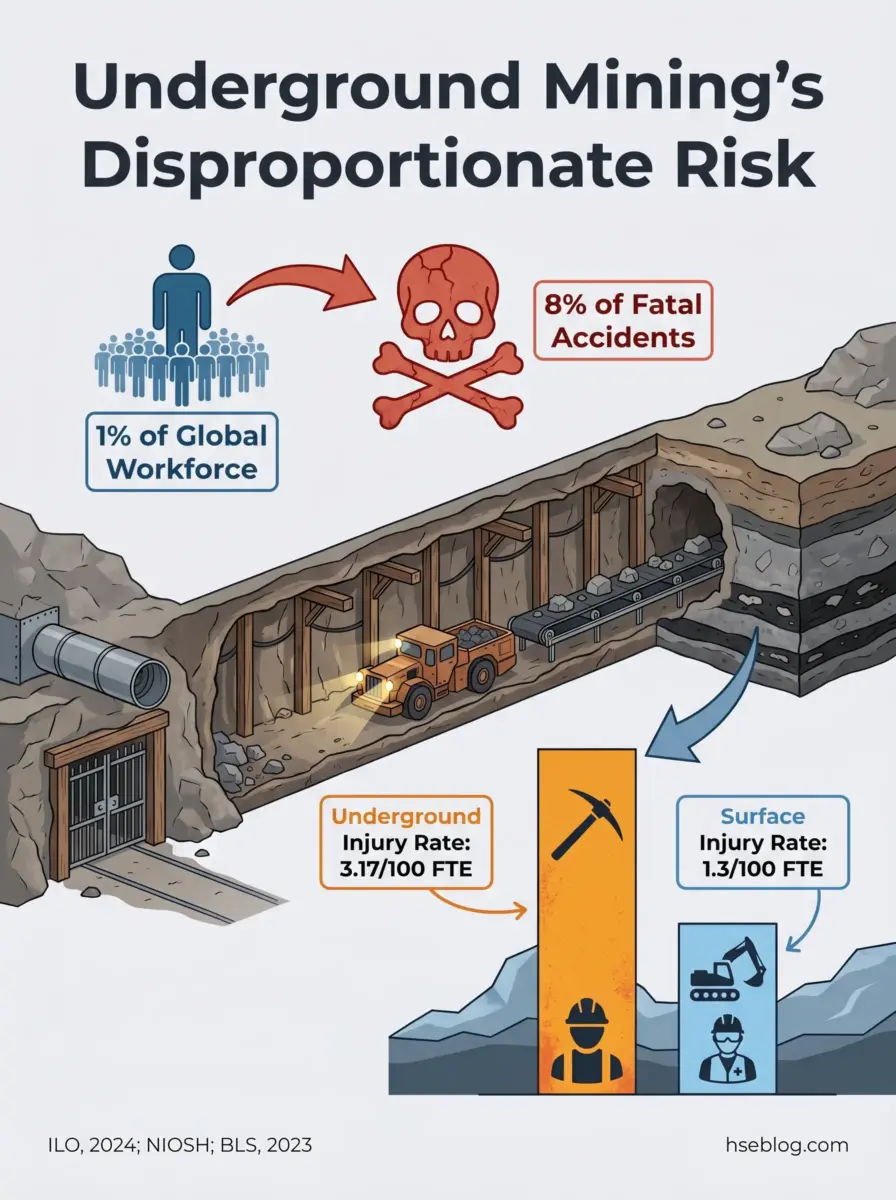
Mining occupies an uncomfortable statistical position. The International Labour Organization estimates the sector employs approximately 1% of the global workforce yet accounts for roughly 8% of fatal work accidents (ILO, 2024). That ratio alone signals something fundamentally different about mining risk — and the disproportion sharpens further when the focus narrows to underground operations.
The distinction between underground and surface mining safety is not a matter of degree. It is a difference in kind. Surface operations deal primarily with mobile equipment interaction, slope stability, and weather exposure — serious hazards, but ones that occur in open environments with visible sightlines, natural ventilation, and immediate egress. Underground mines compress multiple simultaneous hazard categories into confined, poorly lit, geologically unstable spaces with limited escape routes and atmospheres that can shift from breathable to lethal within meters.
Consider what underground miners face simultaneously: geotechnical instability overhead and underfoot, atmospheres that may contain explosive methane, toxic carbon monoxide, or insufficient oxygen, ambient temperatures that can exceed human tolerance at depth, noise levels from drilling and haulage equipment that exceed 100 dB, and dust concentrations that cause irreversible lung disease over years of exposure. No other industrial environment stacks this many lethal and chronic hazard categories in a space where the nearest exit may be kilometers away.
The injury data reflects this reality. NIOSH data shows the nonfatal lost-time injury rate for underground mining in the US is approximately 3.17 per 100 full-time equivalent workers, compared to roughly 1.3 for surface mining. The fatal injury rate for mining as a whole stood at 14.2 per 100,000 FTE workers in 2021 — approximately 3.7 times the rate for all private industry (US Bureau of Labor Statistics, 2023). Coal mining alone reached 19.6 per 100,000 FTE.
A practitioner observation worth noting: teams transitioning from surface to underground operations frequently underweight atmospheric and geotechnical risks because those hazard categories simply do not exist at the same intensity on the surface. The assumption that "a hazard is a hazard" leads to dangerous gaps in risk perception. Underground mining demands its own safety framework — not an adaptation of surface procedures.
Ground Control Hazards: Roof Falls, Cave-Ins, and Rock Bursts
Ground failure has historically been the single largest killer in underground mining. The mechanism is straightforward in principle but treacherous in practice: removing material from within a rock mass redistributes geological stresses. Where that redistribution exceeds the strength of the remaining support structure — whether natural pillars, installed bolts, or shotcrete linings — the ground moves. The consequences range from small rockfalls causing localized injuries to catastrophic collapses that entomb entire working sections.
MSHA requires underground mine operators to develop and follow approved roof control plans. For coal operations, 30 CFR §75.200 mandates that the roof control plan address support methods, pillar dimensions, and procedures for supplemental support in areas of adverse geology. Metal and nonmetal mines operate under 30 CFR §57.3360, which requires ground control measures consistent with the geological conditions encountered. These are not discretionary — they are enforceable conditions of operation.
The choice of mining method directly shapes the ground control risk profile. Room-and-pillar mining creates a grid of openings supported by remnant pillars, where pillar sizing calculations must account for overburden depth, rock quality, and extraction ratio. Longwall mining removes entire panels and allows controlled caving behind the shield supports — eliminating the pillar-failure risk but introducing face and gate road stability challenges. Cut-and-fill methods in metalliferous mines use backfill to provide support, but the quality and placement of fill material become critical control variables.
Monitoring technologies extend the examiner's ability to detect ground movement before it becomes catastrophic. Extensometers measure displacement in roof strata. Microseismic monitoring detects the acoustic emissions from rock fracturing under stress — a precursor to larger failures. LiDAR scanning of stope geometry allows comparison against designed excavation profiles to identify areas of unexpected convergence or overbreak.
Watch For: A consistent failure pattern across published ground failure investigations is that roof control plans become static documents filed at the mine office rather than living risk assessments. Teams stop reassessing support adequacy when geology transitions between ore zones or rock types — which is precisely when conditions change fastest and existing support designs may no longer be adequate.
Warning Signs of Impending Ground Failure
Trained miners and examiners are the first line of detection, and the observable indicators they should recognize are specific and physical. Audible cracking or popping sounds from the roof — sometimes described as "working ground" — indicate active stress redistribution. Visible rib spalling, where the walls of an opening begin to fragment and shed material, signals that the pillars or sidewalls are approaching their load-bearing limits.
Roof sag, particularly when bolts begin to show plate deformation or tension cracks appear in shotcrete, indicates that the installed support is being loaded beyond design capacity. Floor heave — upward displacement of the mine floor — is a less intuitive but equally important indicator, as it suggests the overall stress field is exceeding the capacity of the opening geometry. Sudden changes in water inflow, particularly in previously dry areas, can indicate the development of fracture networks in the surrounding rock mass that may precede larger displacements.
The judgment call for examiners is distinguishing between normal convergence within the design parameters of the excavation and progressive failure that requires evacuation and re-support. That distinction requires understanding of the ground control plan's assumptions, the geological context, and the monitoring data trends — not just the single-point observation during a shift examination.
Atmospheric Hazards: Gases, Dust, and Oxygen Deficiency
The atmosphere inside an underground mine is never a given — it is a manufactured condition maintained by continuous ventilation. The moment that ventilation is compromised, the atmosphere can shift from safe to lethal through the accumulation of toxic or explosive gases, the depletion of oxygen, or the buildup of respirable dust.
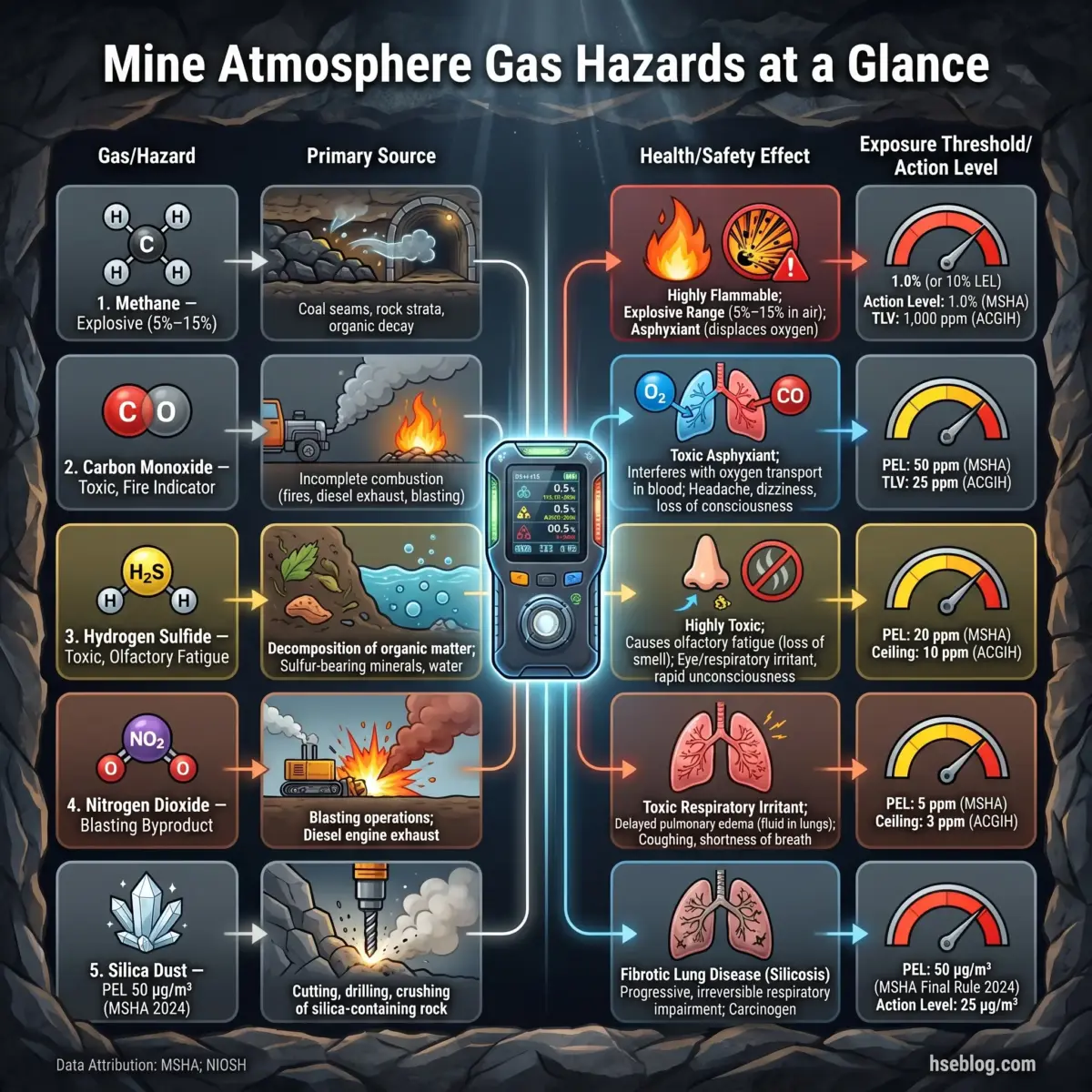
Methane is the defining atmospheric hazard in underground coal mines. It occurs naturally within coal seams, is released during mining, and is explosive at concentrations between 5% and 15% in air. Under 30 CFR §75.323 (US jurisdiction), methane testing must be performed by qualified persons using MSHA-approved detectors, calibrated at least once every 31 days. When methane reaches 1% at a working face, adjustments must be made; at 1.5%, equipment must be de-energized and miners withdrawn.
Carbon monoxide signals fire or combustion — its presence in a mine atmosphere should never be treated as routine. Hydrogen sulfide, encountered in certain geological formations, is both toxic and an olfactory deceiver: the characteristic "rotten egg" smell disappears at higher concentrations due to olfactory fatigue, creating the dangerous illusion that the gas has cleared when it has intensified. Nitrogen dioxide, a product of blasting, is an irritant at low concentrations and potentially fatal at higher levels. Radon, a radioactive gas, presents a chronic exposure hazard in uranium mines and some non-uranium operations depending on the host geology.
Oxygen deficiency and enrichment are both hazardous. Below 19.5% oxygen, the atmosphere is officially oxygen-deficient. Above 23.5%, it is oxygen-enriched and dramatically increases the combustibility of materials. The practical concern is not just the absolute level but the spatial distribution — oxygen-deficient pockets can form in poorly ventilated dead-end headings, sumps, or raises where heavier-than-air gases displace breathable air.
The most significant recent regulatory development in mining health is MSHA's 2024 final rule lowering the permissible exposure limit for respirable crystalline silica to 50 µg/m³, with an action level of 25 µg/m³. This rule requires medical surveillance programs at metal/nonmetal mines and strengthens exposure monitoring requirements. However, enforcement for coal mines was stayed by the Eighth Circuit Court of Appeals in April 2025 pending litigation, while metal/nonmetal operations face an April 8, 2026 compliance deadline.
The urgency behind this rule is clinical. Approximately one in five Appalachian coal miners now suffers from black lung disease, and one in 20 has progressive massive fibrosis — rates approaching levels not seen since the 1970s (NIOSH/CHEST Physician, 2025). The resurgence is linked to silica-rich dust generated when thin-seam mining cuts into surrounding sandstone and quartz-bearing rock, producing dust far more pathogenic than coal dust alone.
Audit Point: Atmospheric monitoring is often treated as a compliance exercise — take the reading, record the number, move on. The critical practitioner skill is pattern recognition over time. A single methane reading of 0.4% is unremarkable. A trend of readings climbing from 0.2% to 0.4% over three shifts in the same location tells a very different story. Effective monitoring reads trends, not snapshots.
Ventilation Systems: The Primary Engineering Control
If there is a single system that separates a survivable underground mine from a death trap, it is ventilation. Every atmospheric hazard discussed in the previous section — methane accumulation, toxic gas buildup, oxygen depletion, dust concentration — is managed primarily through the delivery and circulation of fresh air. Ventilation is the engineering control upon which all other atmospheric safety measures depend.
Underground mine ventilation operates through two primary configurations. Forcing systems push fresh air into the mine through intake airways, pressurizing the working areas and displacing contaminated air toward exhaust routes. Exhausting systems pull air through the mine by creating negative pressure at the exhaust shaft, drawing fresh air in through intake openings. Most large operations use a combination, with main surface fans establishing the overall circuit and auxiliary fans directing air to individual working faces.
The regulatory baseline in US underground coal operations is explicit: 30 CFR §75.325 requires a minimum mean entry air velocity of 60 feet per minute at each working face. This is not arbitrary — it is the velocity necessary to dilute methane liberation from the coal face below hazardous concentrations and to carry respirable dust away from the breathing zone. In practice, many operations exceed this minimum to provide additional safety margin, particularly in gassy seams.
Ventilation serves a triple function that is sometimes underappreciated. Beyond gas dilution and removal, it controls airborne dust concentrations — a function that will become even more critical as MSHA's silica rule compliance deadlines arrive for metal/nonmetal mines. It also regulates temperature, a function that becomes essential at depth, where virgin rock temperatures can exceed 50°C and metabolic heat from miners and equipment compounds the thermal load.
Fan stoppage protocols reflect the criticality of the system. Under 30 CFR §75.311, when a main mine fan stops, miners must be withdrawn from affected areas immediately, and those areas must be examined by a certified person before re-entry. The regulation exists because the atmospheric safety margin in an underground mine can collapse within minutes of ventilation failure, depending on the rate of gas emission and the volume of the workings.
Field Test: Ventilation failures rarely present as sudden catastrophic events. The more dangerous pattern is gradual erosion — a stopping damaged by equipment and not immediately repaired, a regulator left partially open to "improve comfort" in an adjacent area, an auxiliary fan duct with accumulated holes. Each individual shortcut is trivial. Collectively, they consume the ventilation circuit's safety margin until a routine monitoring round discovers methane concentrations that should never have reached those levels. The fix that works: treat ventilation control devices — stoppings, overcasts, regulators, brattice — with the same inspection and maintenance discipline applied to fall protection or machine guarding.
Fire and Explosion Prevention in Underground Mines
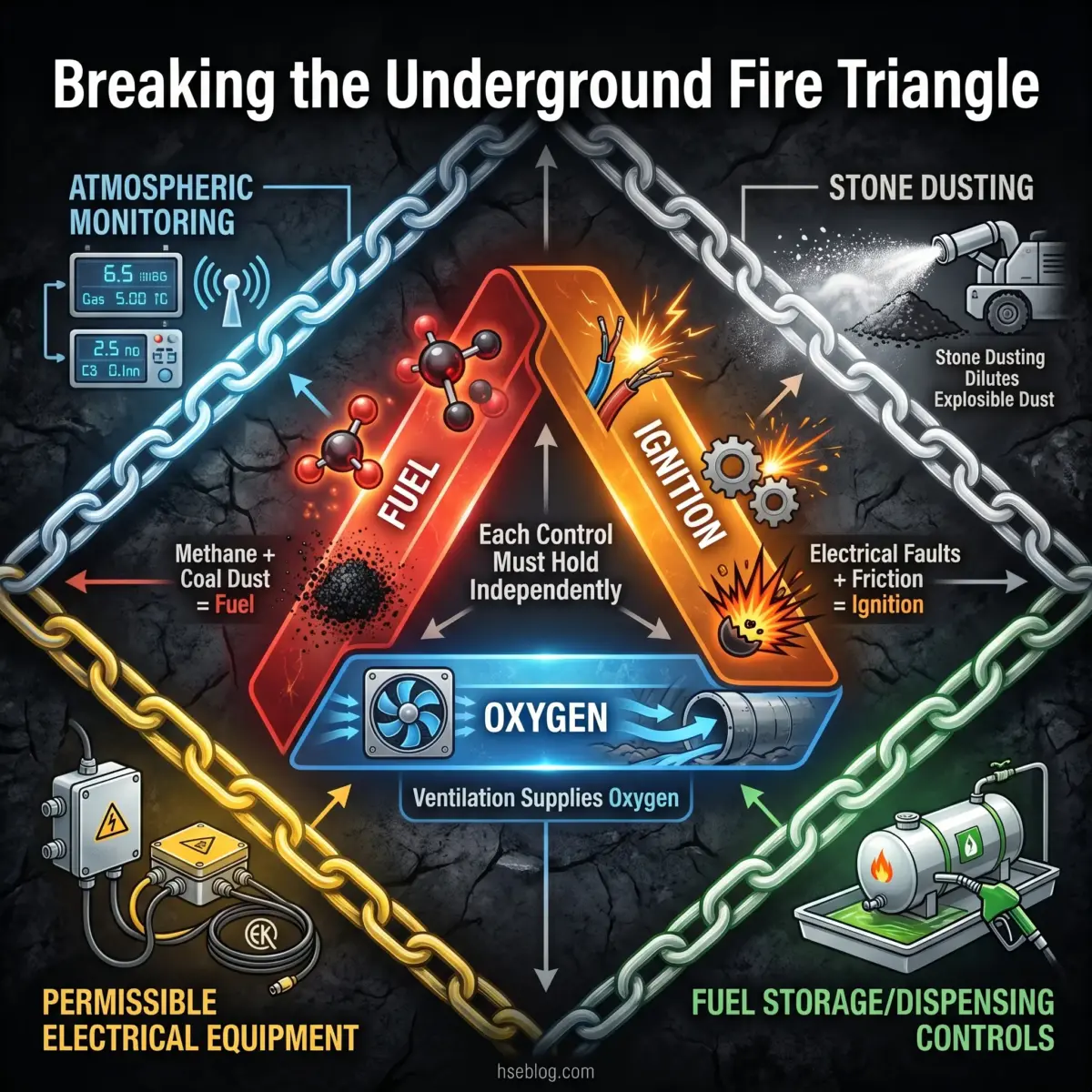
Underground mine fires and explosions operate within the same fire triangle as any combustion event — fuel, oxygen, ignition source — but the underground environment gives each element a dangerous amplification. Fuel sources include methane liberated from coal seams, accumulations of coal dust, diesel fuel and hydraulic fluids from mobile equipment, and conveyor belt materials. Ignition sources range from electrical faults and frictional heating to spontaneous combustion of coal pillars and the use of explosives in development. The oxygen is supplied by the ventilation system itself — the same system that keeps miners alive also sustains combustion.
Coal dust explosion prevention relies on a deceptively simple control: rock dusting. The application of pulverized limestone (stone dust) to mine surfaces dilutes the coal dust concentration below the threshold at which it can propagate an explosion. The requirements under 30 CFR §75.400 series mandate that accumulations of combustible materials be cleaned up and that the incombustible content of combined dust be maintained at specified levels — typically 80% in intake airways and 80% in return airways within 40 feet of working faces (with higher requirements in some conditions).
Electrical equipment in underground coal mines classified as gassy must meet MSHA's permissibility standards — designed to prevent electrical arcs or sparks from igniting the surrounding atmosphere. In December 2024, MSHA published a final rule updating the testing and approval requirements for electric motor-driven mine equipment, incorporating ANSI-approved voluntary consensus standards as alternatives to existing approval protocols. Effective January 9, 2025, this rule enables faster adoption of innovative electrical technologies, including battery-electric vehicles, while maintaining explosion-proof protections — a meaningful regulatory evolution that balances innovation with the non-negotiable requirement for intrinsic safety in gassy environments.
Diesel equipment introduces fuel storage, dispensing, and exhaust emission hazards that require dedicated controls under 30 CFR §75.1900 series, including fire suppression systems on diesel-powered equipment, fuel storage facility requirements, and exhaust gas monitoring.
Spontaneous combustion monitoring in coal mines relies on carbon monoxide as an early indicator. Rising CO levels in a sealed area or along a bleeder entry system signal oxidation reactions within the coal that may progress to open combustion if not detected and managed. Bundle tube systems and atmospheric monitoring stations provide continuous surveillance of these vulnerable areas.
The critical practitioner principle across all fire and explosion controls is redundancy through independence. Gas monitoring, stone dusting, electrical maintenance, and fuel management each constitute a separate link in the prevention chain. Each must hold on its own because any one can fail without warning — and in an underground environment, the consequences of simultaneous failure are not additive but catastrophic.
Personal Protective Equipment for Underground Miners
PPE occupies the bottom of the hierarchy of controls for good reason — it does not eliminate or reduce the hazard, it only places a barrier between the hazard and the worker. In underground mining, the temptation to lean on PPE is particularly strong because it is visible, auditable, and relatively easy to implement compared to the engineering controls that would reduce the need for it. That temptation is precisely what makes PPE over-reliance one of the most persistent failure patterns in mine safety.
The PPE requirements for underground mining go well beyond the generic hard hat, safety glasses, and steel-toed boots. The specialized equipment reflects the specialized hazards.
- Self-Contained Self-Rescuers (SCSRs) are the most critical piece of personal emergency equipment. Unlike filter self-rescuers, which only remove specific contaminants, SCSRs generate breathable oxygen through a chemical reaction, providing a self-contained air supply for escape through irrespirable atmospheres. Under 30 CFR §75.1504, miners in underground coal operations must participate in quarterly donning drills, and SCSRs must be stored at intervals along primary and alternate escape routes. The distinction matters: a filter device is useless in an oxygen-deficient atmosphere, which is exactly the condition most likely during a mine fire or explosion.
- Respiratory protection for dust and gas exposures must follow the hierarchy — engineering controls first, respiratory protective equipment as supplementary. The recently adopted ASTM F3387-19 standard, now referenced by MSHA, provides updated guidance on respirator selection, fit testing, and use in mining environments. Fit testing is not optional — an improperly sealed respirator provides a false sense of protection while allowing exposure to continue.
- Hearing protection must be rated for continuous exposure to heavy equipment noise. NIOSH data shows 76% of miners experience noise overexposure — the highest prevalence of any industry — and 27% have material hearing impairment compared to 18% across all industries (NIOSH, 2000–2008 data period).
- Cap lamps with integrated gas detectors serve a dual function, providing illumination and continuous atmospheric awareness at the breathing zone.
| PPE Type | Specific Underground Mining Hazard | Key Requirement |
|---|---|---|
| SCSR | Fire, explosion, irrespirable atmosphere | Quarterly donning drills; stored along escape routes |
| Respirator (APR/PAPR) | Silica dust, diesel particulate, toxic gas | Fit-tested; engineering controls implemented first |
| Hearing protection | Continuous drilling, haulage, ventilation noise | Rated for >100 dB environments; audiometric monitoring |
| Hard hat with cap lamp | Roof falls, low-profile openings, darkness | Impact rated; gas detector integration where available |
| Flame-resistant clothing | Fire, flash events | Required in underground coal mines per 30 CFR §75.1720 |
The misconception that PPE compliance equals safety management is widespread and dangerous. PPE should represent the residual risk management layer after engineering controls (ventilation, ground support, equipment design) and administrative controls (procedures, training, monitoring) have done their work. When an operation's safety conversation is dominated by PPE inspection results and compliance percentages, it often signals under-investment in the controls that would actually reduce hazard exposure.
What Are the Key Safety Procedures for Underground Mining?
The procedural framework for underground mine safety is built on the principle that conditions change continuously and must be verified continuously. Unlike a factory floor where the physical environment is largely static, an underground mine is a dynamic geological and atmospheric system. Every shift begins with uncertainty about what has changed since the last crew departed.
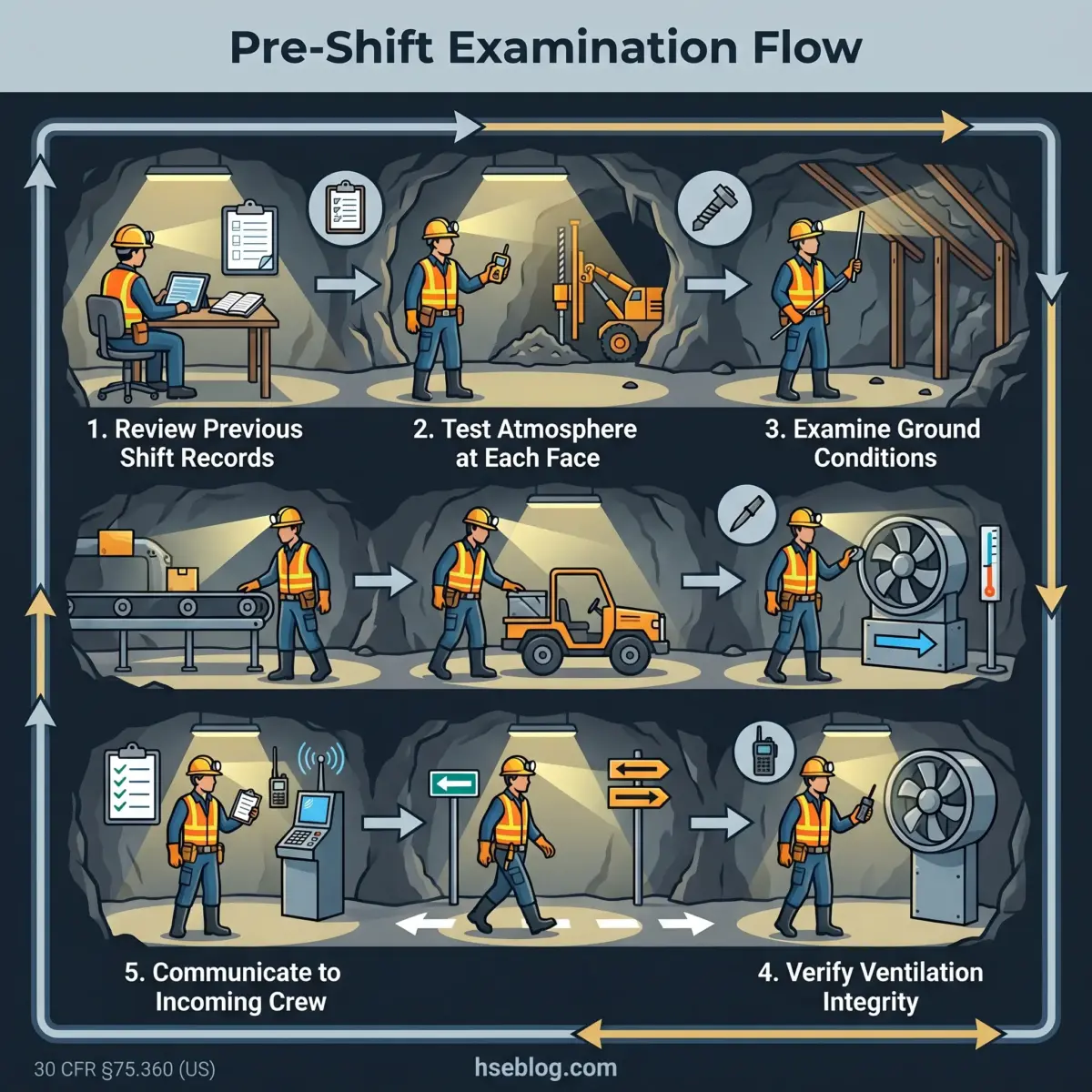
Pre-shift and on-shift examinations form the backbone of this procedural system. Under 30 CFR §75.360 through §75.364 (US jurisdiction, coal mines), a certified person must examine working places before miners enter each shift. The examination covers roof and rib conditions, ventilation adequacy, methane and other gas levels, equipment condition, and the status of all escape routes. The quality of this examination depends entirely on the competence and authority of the examiner. When examiners face pressure to clear faces quickly for production, the examination degrades from genuine risk assessment to a paperwork exercise — a pattern that investigation reports identify repeatedly as a contributing factor in underground mining incidents.
Personnel tracking systems — tag-in/tag-out or electronic tracking — are critical to emergency response effectiveness. Knowing who is underground and where they were last located determines the rescue strategy when an incident occurs. Modern systems use RFID tags or wireless tracking to provide real-time location data, though communication infrastructure limitations in underground environments mean these systems are not infallible.
Permit-to-work systems govern non-routine, high-risk tasks. Hot work underground (welding, cutting, grinding near combustible materials or in gassy atmospheres) requires specific authorization, atmospheric testing, fire watch protocols, and equipment positioning that differs substantially from surface hot work permits. Similarly, entry into abandoned or sealed areas, work near high-voltage electrical installations, and any activity requiring deviation from the standard operating procedure trigger formal risk assessment and authorization.
Lockout/tagout (LOTO) procedures for mobile and fixed equipment must account for the unique challenges of the underground environment — limited space for positioning, multiple energy sources on complex machinery, and the potential for equipment to be restarted remotely. The procedure must also address the isolation of mobile equipment on gradients, where gravitational potential energy is a stored energy source that standard LOTO checklists sometimes overlook.
Communication systems appropriate for underground environments include leaky feeder radio systems, which use a radiating coaxial cable to distribute radio signals through mine workings, and through-the-earth (TTE) communication, which can transmit signals directly through rock strata to surface — a capability that becomes critical when conventional communication infrastructure is damaged by an incident.
Pre-shift examination protocol, summarized in sequence:
- Review previous shift examination records and any outstanding corrective actions before entering the mine.
- Test atmospheric conditions — methane, oxygen, carbon monoxide — at each working face and along travel routes, using calibrated, MSHA-approved instruments.
- Examine roof, rib, and floor conditions against the approved ground control plan; identify and mark areas of concern.
- Verify ventilation — check stoppings, regulators, and curtains for damage; confirm air movement direction and adequacy at working faces.
- Inspect equipment, electrical installations, and fire suppression systems in the examination area.
- Confirm escape route accessibility, lifeline integrity, and SCSR availability.
- Record all findings, report hazards requiring corrective action, and communicate conditions to incoming crew before work begins.
Emergency Preparedness and Mine Rescue
Emergency response in underground mining operates under a constraint that no other industry faces at the same intensity: the people who need rescuing are located inside a geological structure that may itself be the source of the emergency, and reaching them requires entering the same hazardous environment that caused the crisis.
Evacuation plans for underground mines must be practiced, not merely written. Under 30 CFR §75.1502, underground coal mine operators are required to conduct evacuation drills quarterly. These drills are not formalities — they consistently reveal wayfinding problems that tabletop exercises cannot surface, communication dead zones where radio coverage fails precisely when it is most needed, and SCSR donning failures among miners who last practiced the skill months ago.
Lifelines in underground coal mines provide tactile and visual guidance through smoke-filled or zero-visibility conditions. The requirements specify tethered lifelines with directional indicators (cones that point toward the nearest exit) and reflective markers. These systems only work if they are maintained — damaged reflectors, sagging tether lines, and missing directional cones discovered during a real evacuation represent a control that existed on paper but not in practice.
Refuge chambers and refuge alternatives represent the last-resort survival strategy when evacuation is impossible. These sealed enclosures provide breathable atmosphere, communication capability, and protection from fire and toxic gases for a rated duration — typically 96 hours. Their limitations must be understood clearly: they are survival shelters, not comfortable accommodations; their air supply is finite; they depend on structural integrity against the specific hazard scenario; and their effectiveness assumes miners can reach them, which requires functional wayfinding systems.
Mine rescue teams are specialized emergency response units trained in underground firefighting, search and recovery in irrespirable atmospheres, and stabilization of underground conditions. MSHA requires mine operators to have rescue capability available — either through in-house teams or contracted arrangements with approved rescue stations. Mine rescue competitions, while sometimes perceived as ceremonial, serve a genuine readiness function: they test team coordination, apparatus proficiency, and decision-making under pressure in unfamiliar underground environments.
ILO Convention 176, Article 9, establishes the international framework, requiring employers to prepare emergency response plans specific to each mine. The Convention's approach recognizes that generic emergency plans are inadequate — every mine has unique geometry, ventilation circuits, geological conditions, and hazard profiles that must be reflected in the plan.
Training Requirements and Safety Culture in Underground Mining
Under MSHA Part 48 (US jurisdiction), new underground miners must complete 40 hours of training before being assigned to work independently. This training covers hazard recognition, emergency procedures, first aid, self-rescue and evacuation, rights and responsibilities, and the specific health and safety aspects of the tasks they will perform. Annual refresher training of 8 hours is required for all underground miners, and task-specific training must be provided before any new work assignment.
These are minimum legal requirements. The distinction between an operation that meets these requirements and one that builds genuine safety culture lies in what happens beyond the training room. Compliance-driven training produces miners who can pass a test. Culture-driven training produces miners who recognize hazards that aren't on the test.
Near-miss reporting offers a useful diagnostic of where an operation falls on this spectrum. A genuine near-miss reporting culture generates data — actual reports of events that could have caused harm but didn't, reported voluntarily and without fear of reprisal. Many operations claim robust near-miss programs but produce suspiciously clean data, suggesting that workers are self-censoring because they perceive reporting as risky or pointless. The difference between genuine reporting and compliance artifacts is visible in the data: if near-miss reports are increasing while injury rates are stable or declining, the system is likely working as intended. If near-miss reports are near zero, the culture is suppressing information rather than surfacing it.
ILO Convention 176, Article 10, enshrines the principle that workers have the right to report dangers and remove themselves from danger without discrimination. Under US jurisdiction, Section 105(c) of the Mine Act provides equivalent protection. These rights exist on paper in virtually every mining jurisdiction — the question is whether the operational culture makes them exercisable in practice.
The most reliable indicator of genuine safety culture is not the number of policies, posters, or training hours logged. It is whether a new miner in their first week would feel comfortable stopping work over a safety concern and reporting it to their supervisor without fear of consequences. That behavioral test reveals more about an operation's safety culture than any audit score.
Technology and Innovation in Underground Mine Safety
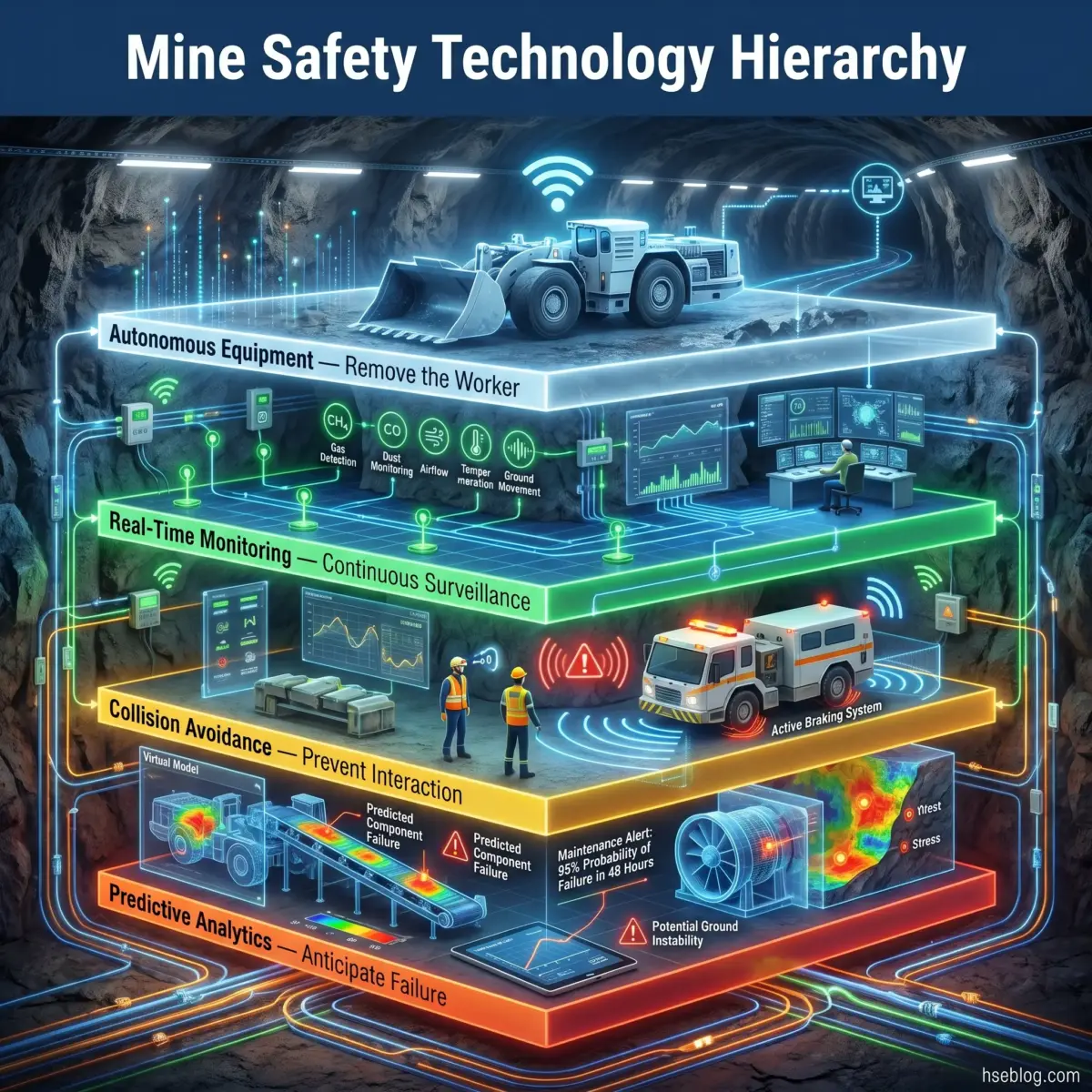
Autonomous and remote-controlled equipment represents the most significant shift in underground mining risk management in a generation. When a load-haul-dump unit operates autonomously or a development drill is controlled from the surface, the human operator is removed from the immediate hazard zone — no exposure to ground fall, no exposure to the face atmosphere, no exposure to equipment interaction risk. The concept of "zero-entry mining," where production zones operate without human presence, remains aspirational for most operations but is already reality in specific applications at some advanced mines.
Real-time atmospheric monitoring networks — IoT sensor arrays distributed throughout mine workings — transform atmospheric safety from periodic sampling to continuous surveillance. These systems can detect methane accumulations, CO trends, and ventilation anomalies as they develop, triggering automated responses such as equipment de-energization or ventilation adjustments before conditions reach hazardous thresholds.
Proximity detection and collision avoidance systems address the equipment interaction hazard that machinery and powered haulage represent — recall that these categories accounted for 65% of the 40 US mining fatalities in 2023 (MSHA, 2024). Underground environments with limited visibility, tight clearances, and overlapping traffic patterns between pedestrians, light vehicles, and heavy equipment make collision avoidance technology particularly valuable.
Predictive analytics, driven by machine learning models trained on equipment sensor data and geological monitoring inputs, offer the potential to identify impending failures — in equipment, ground stability, or ventilation systems — before they manifest as incidents. Digital twin modeling of ventilation circuits allows engineers to simulate the effects of proposed changes, fan failures, or fire scenarios on airflow distribution without experimenting on the live system.
Pro Tip: Technology changes the risk profile rather than eliminating it. Every automated system, sensor network, and AI-driven analytical tool introduces its own failure modes — sensor drift and calibration errors, software faults, communication latency, over-reliance on automated warnings that reduce manual vigilance. Each new technology requires its own risk assessment, maintenance regime, and competency requirements for the personnel who depend on it. The worst outcome is a workforce that trusts a system more than it trusts its own hazard recognition skills.
Frequently Asked Questions
What is the most dangerous hazard in underground mining?
No single hazard can be named definitively — the answer depends on the commodity being mined, the geology, and the mining method. Historically, ground failure (roof falls and cave-ins) and atmospheric events (methane explosions, toxic gas exposure) account for the largest share of underground mining fatalities. In the US, MSHA's 2023 fatality data shows machinery and powered haulage as the leading accident classifications across all mining, accounting for 65% of the 40 fatalities recorded that year.
What is the difference between underground and surface mining safety?
Underground mining introduces hazard categories that surface mining does not face at comparable intensity: atmospheric risks including gas accumulation and oxygen depletion, geotechnical risks from roof and rib instability, confined-space dynamics, extreme heat at depth, and severely limited egress. The nonfatal injury rate gap quantifies the difference — approximately 3.17 per 100 FTE workers for underground operations versus 1.3 for surface mining, based on NIOSH data. Safety procedures, training, and regulatory frameworks for underground mining are correspondingly more specialized and stringent.
How often must underground mines be inspected under MSHA?
MSHA requires multiple layers of inspection. Operators must conduct pre-shift examinations before miners enter working areas each shift, on-shift examinations during production, and weekly examinations of the entire mine — all under 30 CFR §75.360 through §75.364 for coal operations. Separately, MSHA's federal inspectors conduct mandatory inspections of every underground mine four times per year. These are independent obligations — the operator's self-examination duty does not substitute for federal inspections, and vice versa.
Can you refuse to enter an underground mine if you feel unsafe?
Yes. Under Section 105(c) of the US Federal Mine Safety and Health Act, miners have the legal right to refuse work they believe poses an imminent danger, and they are protected from discrimination for exercising that right. Internationally, ILO Convention No. 176, Article 13, provides equivalent protection. Exercising this right requires a good-faith belief in imminent danger and should be communicated through the established reporting channels — but the legal protection is clear: no miner should face retaliation for refusing to enter conditions they reasonably believe are immediately dangerous.
Is black lung disease still a problem in modern mining?
It is not only still a problem — it is a worsening one. Research reported by NIOSH and CHEST Physician in 2025 indicates that approximately one in five Appalachian coal miners now suffers from coal workers' pneumoconiosis (black lung), with progressive massive fibrosis rates approaching levels last seen in the 1970s. The resurgence is linked to silica-rich dust exposure from thin-seam mining that cuts into surrounding quartz-bearing rock. MSHA's 2024 rule lowering the silica PEL to 50 µg/m³ addresses this directly, though enforcement for coal mines remains stayed pending litigation.
What training is required before working in an underground mine?
Under MSHA Part 48 (US jurisdiction), new underground miners must complete 40 hours of training covering hazard recognition, emergency procedures, first aid, self-rescue and evacuation, miners' rights and responsibilities, and task-specific instruction — all before being assigned to work independently. Annual refresher training of 8 hours is mandatory. Task-specific training must be provided before any new work assignment. Recognized training pathways for supervisors and safety professionals include MSHA certification programs, NEBOSH International Mining Diploma, and IOSH qualifications.
Conclusion
The pattern that runs through every underground mining fatality investigation is depressingly consistent: the controls existed on paper but eroded in practice. Ground control plans that stopped being updated when geology changed. Atmospheric monitoring treated as a number-recording exercise rather than a trend-analysis discipline. Ventilation circuits degraded by accumulated, unreported damage to stoppings and regulators. PPE programs that consumed management attention while engineering controls went under-resourced. Emergency plans tested only as tabletop exercises, leaving wayfinding failures and SCSR donning problems undiscovered until a real event.
The industry's recent trajectory offers both caution and encouragement. Mining fatal accidents decreased approximately 30% in 2024 compared to 2023, and for the first time since 2021 no US mines met MSHA's Pattern of Violations criteria (North American Mining, 2025). At the same time, the resurgence of black lung disease — driven by silica dust exposure that existing controls failed to prevent — demonstrates that chronic health hazards can worsen even as acute safety metrics improve. The 2024 MSHA silica rule, now caught in litigation, represents the regulatory system's attempt to close a health protection gap that should have been addressed a decade earlier.
Effective management of underground mining hazards requires no single breakthrough. It requires the discipline to maintain every link in the control chain simultaneously — ventilation, ground support, atmospheric monitoring, equipment maintenance, training, emergency readiness — knowing that any single link can fail without warning. That discipline is not sustained by regulation alone. It is sustained by operations that treat safety procedures as dynamic risk management tools rather than static compliance documents, and that measure their safety culture not by audit scores but by whether the newest miner on the crew would stop work over a concern without hesitating.