Mining safety is the systematic practice of identifying, assessing, and controlling hazards across every phase of mining operations — from exploration through closure — to prevent injuries, occupational diseases, and fatalities. It encompasses regulatory compliance under frameworks like MSHA (US) and ILO Convention 176 (internationally), the disciplined application of the hierarchy of controls from elimination down to PPE, and the use of safety management systems to maintain safe working conditions in both surface and underground mines.
What Is Mining Safety and Why Does It Matter?
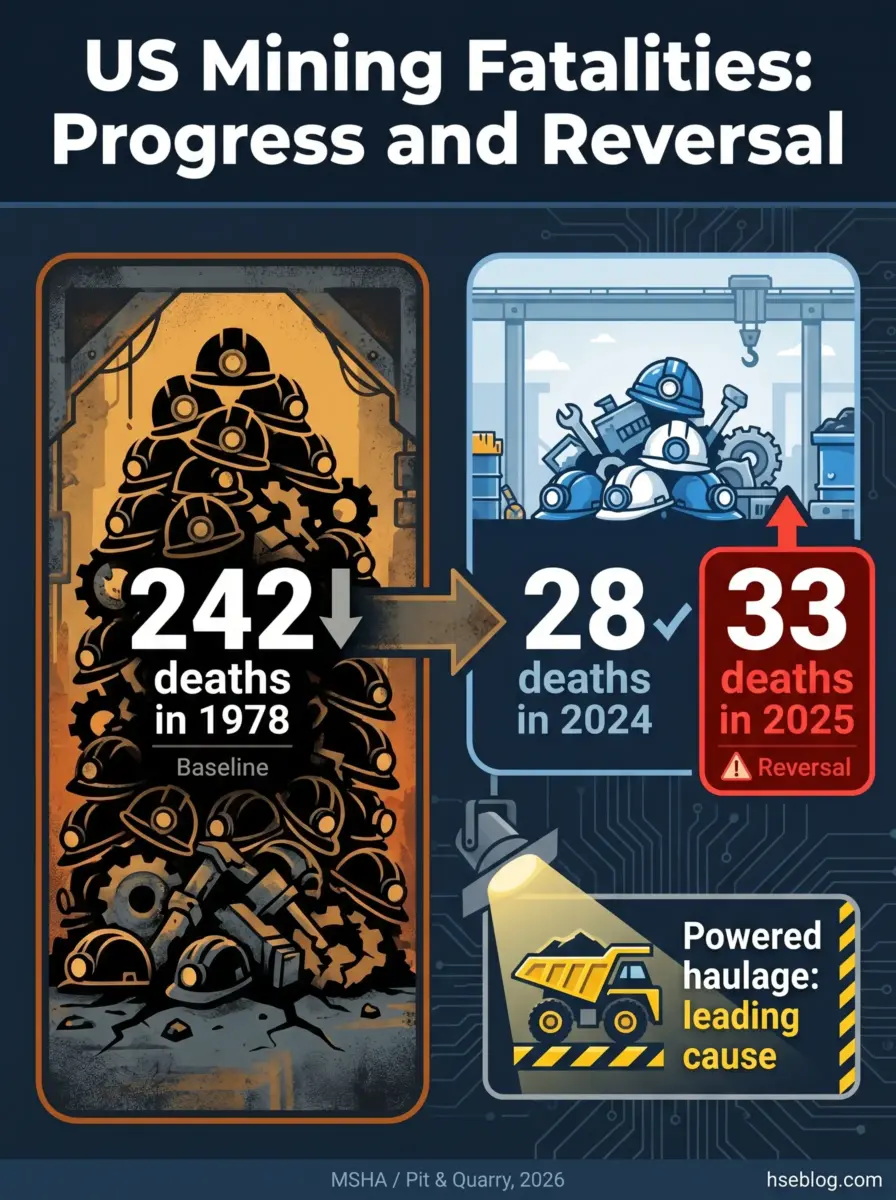
In 1978, the first full year under the Federal Mine Safety and Health Act, 242 miners died in US mining accidents (MSHA, 2023). By 2024, that figure had fallen to 28 — a reduction that reflects decades of regulatory enforcement, engineering advancement, and hard-won operational discipline. Then 2025 reversed the trend: 33 fatalities, with MSHA issuing a safety alert in March after 10 miners died in the first two months of the year (MSHA, via Pit & Quarry, 2026). That reversal carries a clear message — the trajectory is never guaranteed.
Mining safety, defined precisely, is the systematic identification, assessment, and control of hazards across the entire mine life cycle. It covers surface and underground operations, extends from exploration drilling through active extraction to closure and rehabilitation, and applies equally to coal, metal, and non-metal mining. The scope reaches beyond injury prevention into occupational disease management, emergency preparedness, and environmental protection. What separates mining from most other industries is the combination of a hostile physical environment — geology that shifts, atmospheres that change, temperatures that punish — with very large mobile equipment and chemical exposures that accumulate over careers.
A pattern that recurs across underperforming operations is the treatment of mining safety as a compliance exercise. Inspections get completed, forms get filed, toolbox talks follow a script — and the organization mistakes documentation for risk control. The mines that sustain low incident rates treat safety as a dynamic risk-management discipline, where hazard identification is continuous, controls are verified at the working face, and near-miss data drives design changes rather than filing-cabinet entries. That mindset gap — compliance versus genuine risk management — is the single largest predictor of whether an operation trends toward zero incidents or stagnates at a persistent injury plateau.
Major Categories of Mining Hazards
Hazard identification in mining requires a systematic framework — not a random catalogue. The classification approach used in peer-reviewed mining OHS literature groups hazards by type: physical, chemical, biological, ergonomic, and psychosocial. Each category has a distinct mechanism of harm, and each demands controls designed for that specific mechanism. Listing hazards without understanding how they cause harm leads to generic controls that miss the point.
What makes mining hazard assessment uniquely challenging is the compounding effect. Hazard registers that treat each category independently miss the interaction between them. Fatigue combined with limited visibility combined with mobile equipment operating on haul roads produces a risk profile that exceeds any individual hazard's isolated score. A competent mining risk assessment accounts for these interactions — it does not simply add up individual risk ratings.
Ground Control and Geotechnical Hazards
Ground control is the most unpredictable hazard category in mining because geology changes continuously and pre-existing support systems degrade over time. Roof falls in underground operations, rib failures, pillar collapses, and highwall instability in surface mines all share the same fundamental mechanism: the rock mass surrounding or above the working area loses structural integrity, and the failure occurs with minimal warning.
MSHA data consistently places ground control among the leading fatal accident classes. The difficulty for practitioners is that ground conditions are assessed at one point in time — during geotechnical surveys and pre-shift inspections — but the geology continues to change due to blasting vibration, water infiltration, stress redistribution, and weathering. A roof bolt pattern that was adequate last month may not be adequate after adjacent pillars are extracted.
The controls at each hierarchy tier look different for ground control than for any other hazard. Elimination means mine design that avoids unstable geology entirely — routing development away from fault zones or leaving protective pillars in place. Engineering controls include bolting patterns, shotcrete, mesh, standing support, and monitoring systems such as extensometers and microseismic arrays. Administrative controls cover geotechnical inspection frequencies, ground-control plans, and training on recognizing deterioration signs. PPE — primarily hard hats — provides minimal protection when a roof fall involves tonnes of material.
Fire, Explosion, and Atmospheric Hazards
Underground coal mines face the persistent threat of methane accumulation, which becomes explosive at concentrations between 5% and 15% in air. Coal dust suspended in the atmosphere can propagate an explosion far beyond the ignition point — the mechanism behind some of the deadliest disasters in mining history. Surface operations carry fire risk from fuel storage, hydraulic fluid leaks on heavy equipment, and vegetation around stockpiles.
Ventilation serves as the primary engineering control for atmospheric hazards underground. Adequate airflow dilutes methane below explosive concentrations, removes blasting fumes, and supplies breathable air to working faces. When ventilation systems fail — whether through fan breakdown, door damage, or poorly managed auxiliary ventilation — the atmospheric hazard escalates within minutes. Real-time gas monitoring, methane detectors on continuous miners, and automatic machine de-energization at trigger concentrations form the layered control strategy.
Oxygen-deficient atmospheres present a separate but related danger. Oxidation of sulfide ore bodies, biological decomposition in sealed areas, and displacement by inert gases (nitrogen, carbon dioxide) can reduce oxygen below safe levels without any visible or odorous warning.
Powered Haulage and Mobile Equipment Hazards
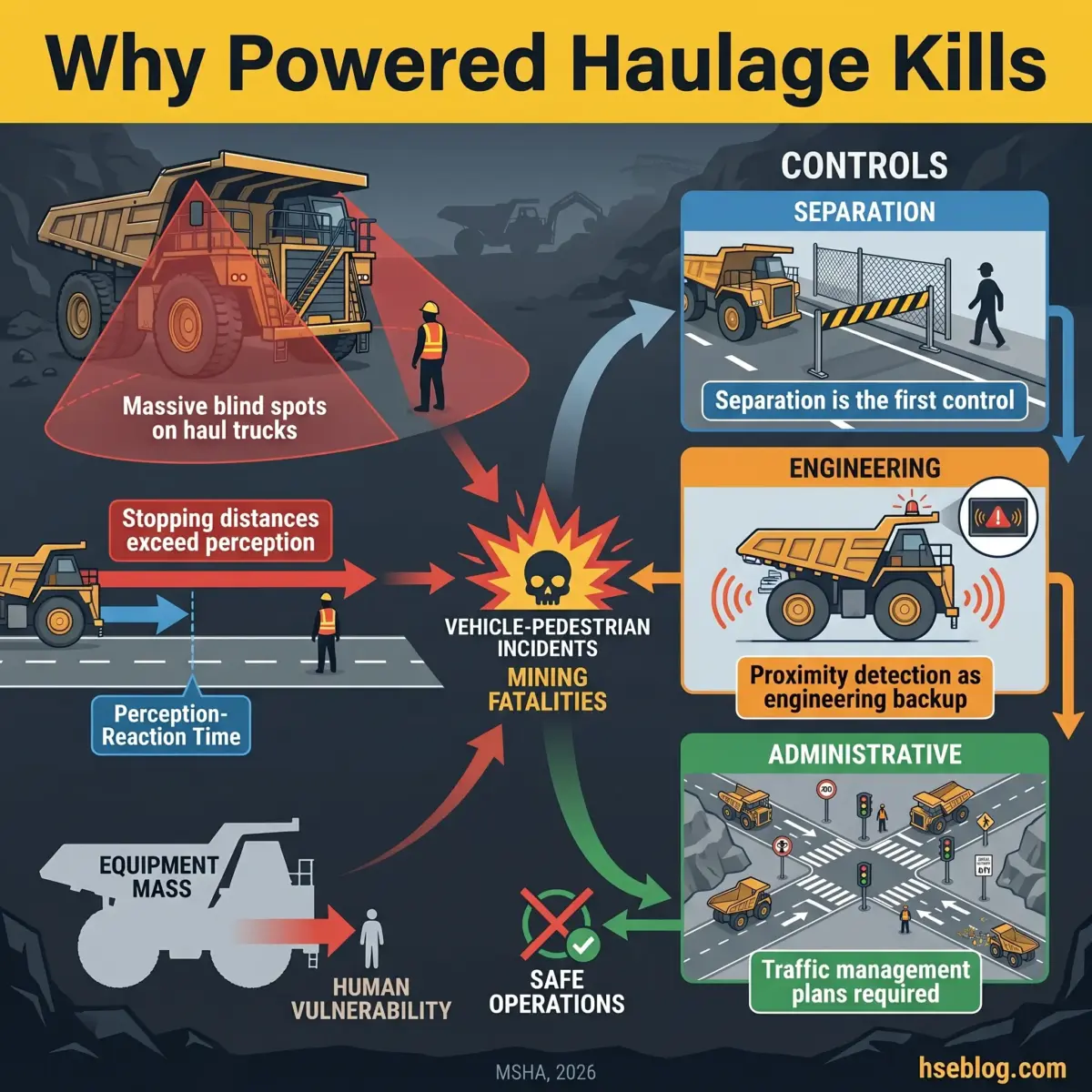
Powered haulage accounted for 13 of 33 US mining fatalities in 2025 (MSHA, via Pit & Quarry, 2026) — making it the leading accident class by a significant margin. The hazard mechanism involves vehicle-to-pedestrian interaction, collision between machines, rollover events, and loss-of-control incidents on grades and haul roads.
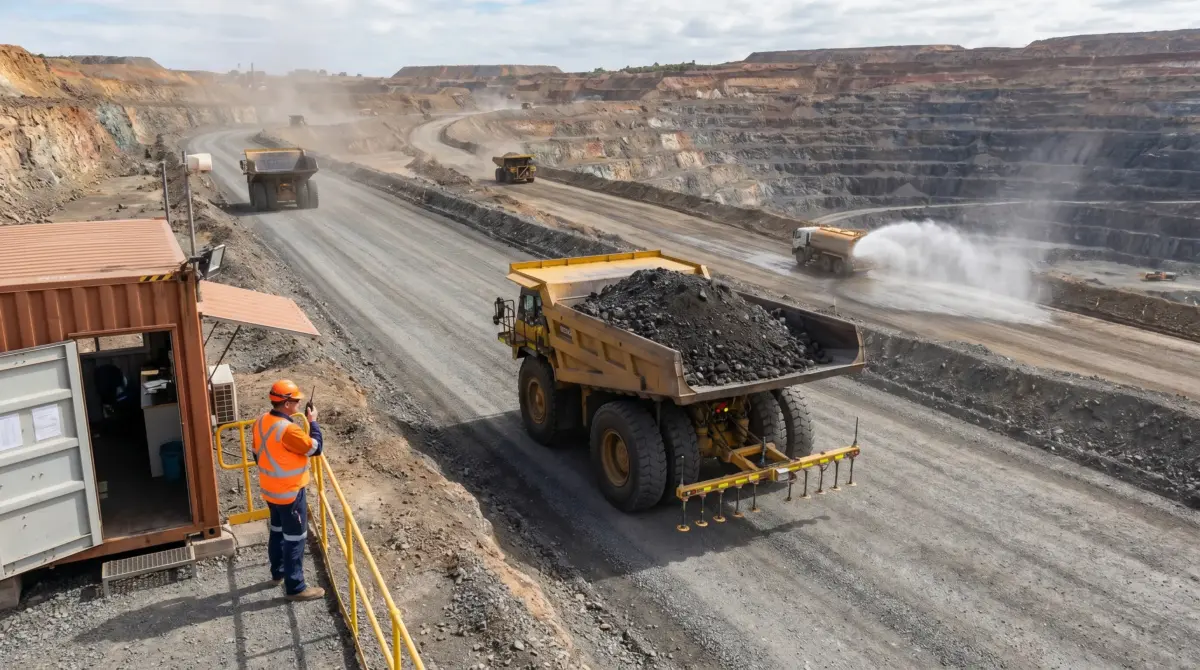
The scale of surface mining equipment amplifies every risk factor. Haul trucks carrying 200+ tonnes have blind spots measured in tens of meters. Stopping distances extend well beyond what an operator can perceive as adequate at speed. The interaction between these machines and light vehicles or pedestrians creates a disparity in mass and energy that makes any collision almost certainly fatal for the smaller party.
Over 40% of the most serious mining injuries involve struck-by or caught-in incidents with machinery and haulage equipment (NIOSH Mining Program, 2024). The control landscape for this hazard category centers on separation — physical barriers, traffic management plans, designated pedestrian zones, and proximity detection systems that alert operators and can intervene autonomously to prevent collision. The hierarchy of controls applied here favors elimination first: if a worker does not need to be in the active haulage zone, they should not be there.
Respiratory and Chemical Exposure Hazards
Respirable crystalline silica, coal dust, diesel particulate matter, and process chemicals such as cyanide and sulfuric acid represent the chronic exposure hazards that cause more long-term deaths in mining than acute traumatic injuries. Silicosis and coal workers' pneumoconiosis (black lung disease) are irreversible lung diseases caused by cumulative inhalation of fine particles — and black lung has experienced a documented resurgence in recent years, particularly among younger Appalachian coal miners.
MSHA finalized its respirable crystalline silica rule (30 CFR Part 60) in April 2024, establishing a uniform permissible exposure limit of 50 µg/m³ and an action level of 25 µg/m³ across all mining operations. The agency's economic analysis projected that this rule would prevent 1,067 lifetime deaths and 3,746 lifetime illness cases (MSHA, 2024). For metal and non-metal (MNM) mine operators, the compliance deadline is April 8, 2026. Coal mine operators face a stayed compliance timeline — the Eighth Circuit Court of Appeals issued a stay pending litigation, creating regulatory uncertainty for coal operations.
It is worth distinguishing MSHA's PEL from other reference values. The ACGIH Threshold Limit Value for respirable crystalline silica sits at 25 µg/m³ — half the MSHA and OSHA limit. Practitioners working in jurisdictions that reference ACGIH values should apply the stricter threshold. NIOSH's recommended exposure limit aligns with MSHA's at 50 µg/m³, but ACGIH's TLV represents the more protective benchmark.
Jurisdiction Note: The MSHA silica rule applies exclusively to operations under MSHA jurisdiction (mines as defined by the Federal Mine Safety and Health Act). Downstream processing facilities may fall under OSHA jurisdiction and are governed by OSHA's silica standard (29 CFR 1926.1153 for construction, 29 CFR 1910.1053 for general industry). Confirm jurisdictional coverage before assuming which limit applies.
Controls for respiratory hazards follow the hierarchy: wet suppression systems, enclosed operator cabs with filtered air, ventilation design, and — as the last line of defense — respiratory protective equipment. Dust monitoring programs, both personal and area sampling, verify that engineering controls are performing to standard.
Noise, Vibration, Ergonomic, and Psychosocial Hazards
These chronic hazards receive less regulatory attention and operational focus than acute traumatic risks, yet they drive a higher cumulative injury burden across the mining workforce. Noise-induced hearing loss remains one of the most prevalent occupational diseases in mining — drilling, blasting, crushing, and the constant operation of diesel engines create sustained noise exposures that exceed 85 dBA across many work tasks.
Whole-body vibration from operating heavy equipment over rough terrain contributes to spinal disorders and musculoskeletal damage over years of exposure. Ergonomic hazards from repetitive tasks — particularly in maintenance and material handling — add to the cumulative strain. These are not dramatic hazards. They do not produce fatality statistics or safety alerts. But they end careers, degrade quality of life, and generate substantial workers' compensation liability.
The emerging recognition of fatigue and mental health as safety-critical factors represents a significant shift in mining OHS practice. Shift-work patterns common in mining — 12-hour shifts, fly-in/fly-out rosters, extended rotations — create fatigue profiles that directly impair decision-making, reaction time, and hazard perception. A fatigued haul truck operator on a night shift is not the same risk as an alert operator on day shift, and the risk assessment must reflect that difference.
How the Hierarchy of Controls Applies to Mining
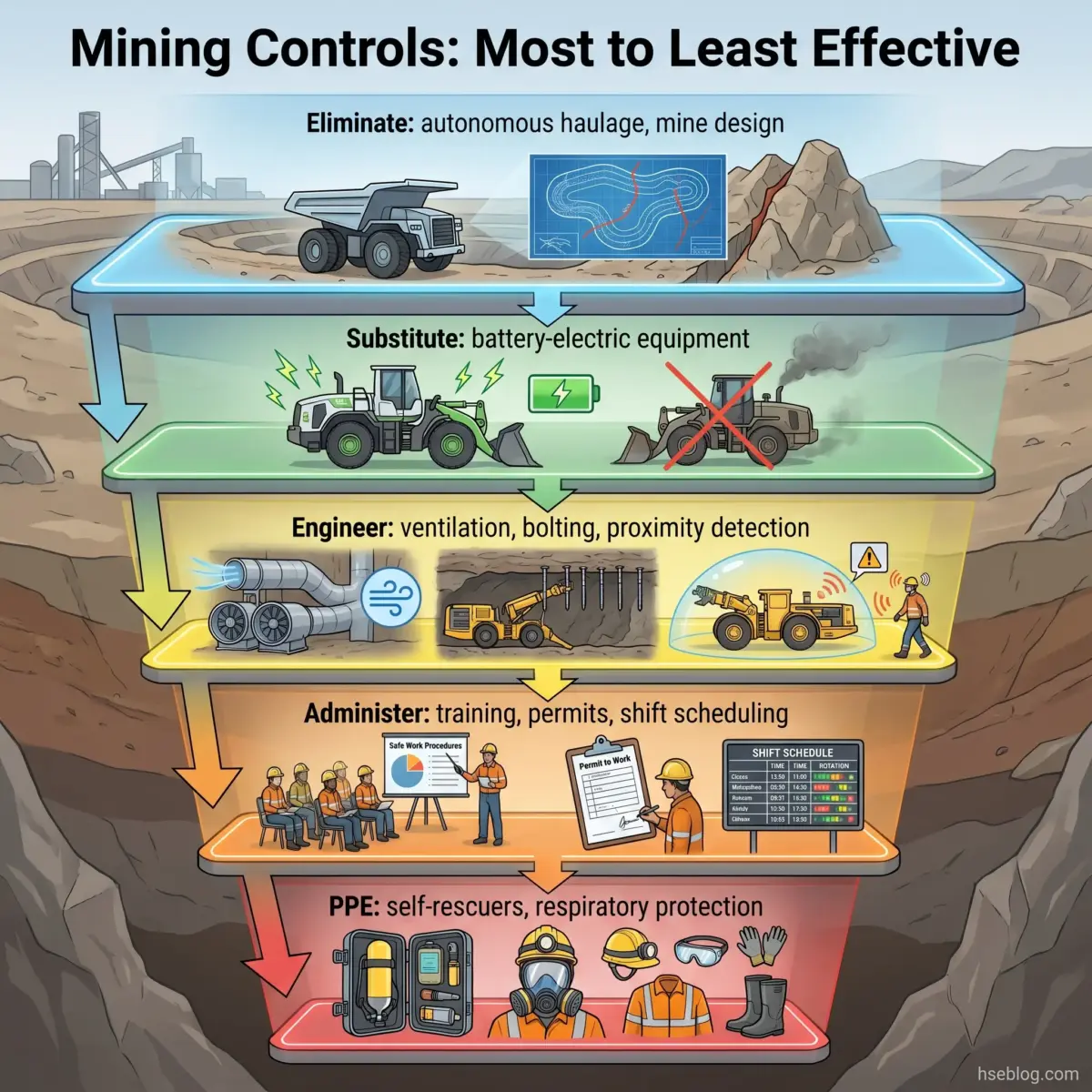
Most competitor resources mention the hierarchy of controls as a concept and move on. The actual value lies in demonstrating how each tier applies to mining's specific hazard profile — because mining is one of the few industries where all five tiers are simultaneously active for multiple hazard categories.
The most common failure mode practitioners observe across the published incident record is over-reliance on administrative controls and PPE when engineering solutions exist but are perceived as too expensive or too disruptive to production schedules. The hierarchy is not a menu where operators select their preferred option. It is a sequence: higher-tier controls must be exhausted or demonstrated as infeasible before lower-tier controls become acceptable. Articles that present all five tiers as equally valid options fundamentally misrepresent how competent safety management operates.
Elimination removes the hazard entirely. In mining, this means mine design that avoids unstable geological formations — routing development headings away from mapped fault zones, or leaving barrier pillars in place rather than extracting maximum ore. Autonomous haulage systems represent elimination applied to the powered haulage hazard: removing the human operator from the cab eliminates the vehicle-pedestrian fatality mechanism at source.
Substitution replaces a hazardous agent or process with a less hazardous one. The transition from diesel-powered underground equipment to battery-electric vehicles is a direct substitution that reduces diesel particulate matter exposure — addressing both the respiratory hazard and the ventilation load required to dilute exhaust.
Engineering controls physically reduce exposure. Ventilation systems in underground mines, ground support (roof bolting, shotcrete, mesh), proximity detection systems on mobile equipment, dust suppression through water sprays and chemical surfactants, and enclosed pressurized operator cabs all fall into this tier. These controls work without requiring the worker to remember or choose to use them — which is precisely why they rank above administrative measures.
Administrative controls change the way work is organized. MSHA's Part 46 and Part 48 training requirements (30 CFR Parts 46 and 48, US jurisdiction) mandate specific training hours for new miners and annual refresher training. Permit-to-work systems, shift scheduling to manage fatigue, pre-shift inspections, and standard operating procedures all function at this tier. They are essential — but they depend on human compliance.
PPE is the last line of defense. Self-contained self-rescuers (SCSRs), hearing protection rated to NRR standards, respiratory protection programs, and high-visibility clothing protect the individual worker when all other controls have been applied. The ASTM F3387-19 standard provides performance requirements for SCSRs — a critical piece of life-safety equipment for underground miners escaping irrespirable atmospheres.
What Are the Key Mining Safety Regulations Worldwide?
Regulatory frameworks for mining safety differ fundamentally in philosophy — and that philosophical difference shapes how mines operate, how compliance is measured, and where failure modes develop. Understanding the regulatory landscape requires more than listing standards; it requires recognizing why different jurisdictions chose different approaches and what each approach demands from operators.
US: MSHA and the Federal Mine Act
The Federal Mine Safety and Health Act of 1977 (Mine Act) established MSHA's authority over all mining operations in the United States, with jurisdiction entirely separate from OSHA. This jurisdictional boundary is a common source of confusion: OSHA does not regulate mines. MSHA has exclusive authority over what the Act defines as a "mine," which includes the extraction site, milling operations, and associated surface facilities.
MSHA's regulatory approach is prescriptive — standards specify what operators must do, in measurable terms. Underground coal mines receive mandatory inspections four times per year. Surface mines receive two inspections annually. Beyond scheduled inspections, MSHA retains authority for spot inspections and can issue Section 103(k) orders for imminent-danger withdrawal, shutting down operations immediately when conditions present an immediate threat to life.
Training requirements under 30 CFR Part 48 mandate 40 hours of initial training for new underground coal miners and 24 hours for surface coal miners, with 8 hours of annual refresher training. Part 46 applies to surface non-coal operations, requiring 24 hours of new miner training. These are minimum floors — competent operators build training programs that exceed them.
The prescriptive model creates a characteristic failure mode that practitioners working across jurisdictions frequently identify: operators do exactly what the standard requires, nothing more. Compliance becomes a ceiling rather than a floor. When the standard does not anticipate a novel hazard — and standards always lag behind operational reality — the prescriptive model leaves a gap.
International: ILO Convention 176 and National Frameworks
ILO Safety and Health in Mines Convention, 1995 (No. 176) provides the international framework for mining safety obligations. Ratified by over 35 countries, the Convention establishes core requirements: employer responsibility for hazard identification and control, worker right to withdraw from danger without reprisal (Article 13), and multi-employer coordination obligations when multiple contractors operate on the same site (Article 12). Chile's ratification in 2024 represents the most recent expansion of the Convention's reach.
EU Directive 92/104/EEC establishes minimum health and safety requirements for mineral-extracting industries across EU member states, requiring operators to produce safety and health documents, conduct risk assessments, and implement worker protection measures. The Directive operates within the EU's broader OSH framework and is transposed into national law by each member state.
Australia's WHS (Mining) Regulations operate on a goal-setting philosophy — similar to the UK's Mines Regulations 2014 under HSE enforcement. Goal-setting regimes require operators to demonstrate that risks are controlled to a level that is "as low as reasonably practicable" (ALARP) or "so far as is reasonably practicable" (SFAIRP). This approach can drive better outcomes than prescriptive standards because it requires operators to think about risk rather than simply follow instructions. The trade-off is ambiguity: what constitutes "enough" is always a judgment call, and that judgment gets tested in court after an incident, not before.
Audit Point: When operating across jurisdictions, identify the most restrictive applicable standard for each hazard and apply it as the operational baseline. The prescriptive standard provides a compliance floor; the goal-setting standard demands demonstrated adequacy. Meeting both requires more than either alone.
Neither regulatory philosophy is inherently superior. Prescriptive regimes provide clarity and enforceability but create compliance ceilings. Goal-setting regimes demand genuine risk thinking but introduce enforcement uncertainty. The most effective mining operations borrow from both: meeting prescriptive requirements as a minimum while applying ALARP reasoning to drive continuous improvement beyond the regulatory floor.
Technology Transforming Mining Safety
Technology adoption in mining has accelerated over the past decade, with several innovations materially changing risk profiles rather than merely adding digital dashboards to existing processes. The distinction matters: technology that genuinely removes workers from hazardous zones reduces risk at the elimination tier. Technology that adds a monitoring layer without changing the work process operates at the administrative tier at best.
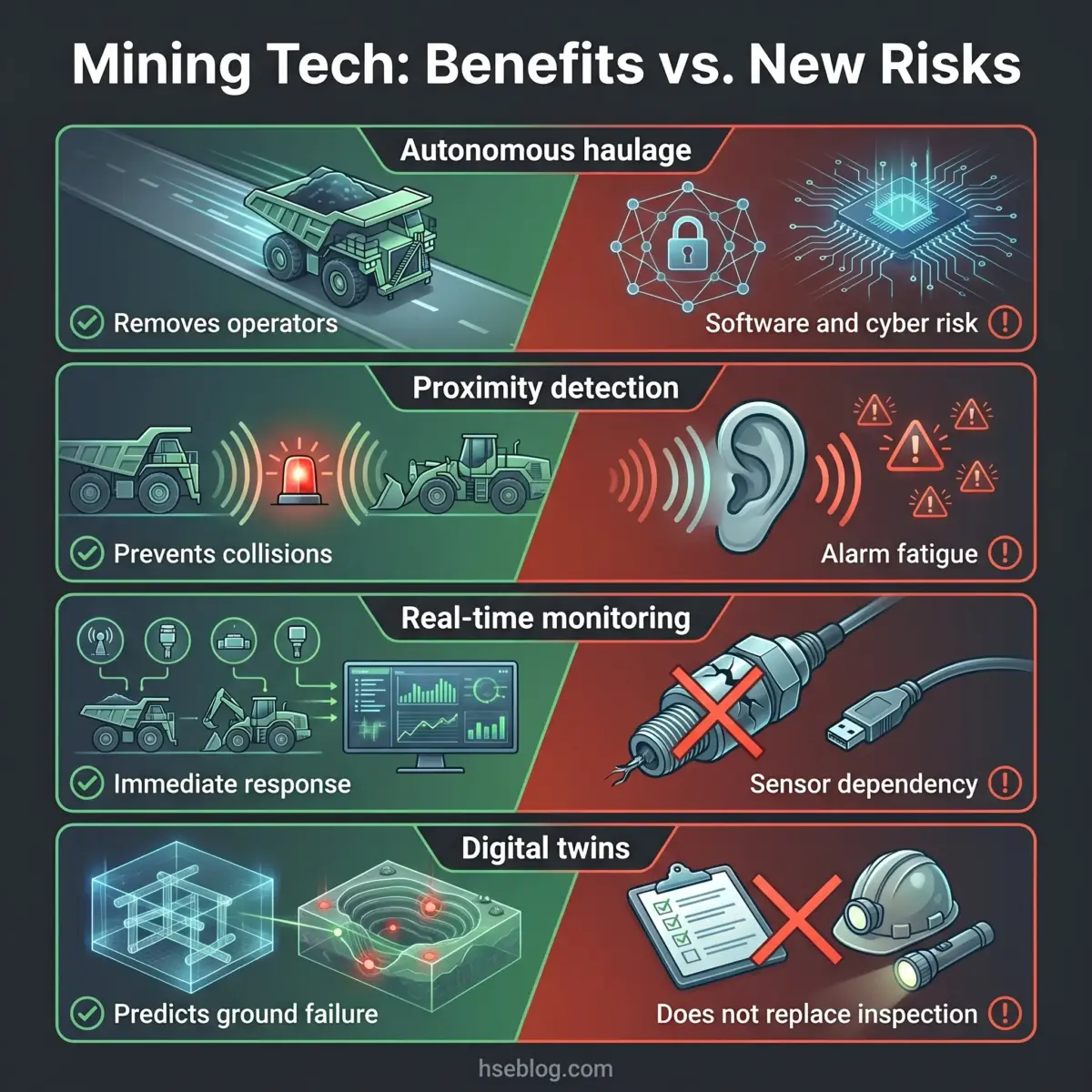
Autonomous and semi-autonomous haulage systems deployed by manufacturers including Caterpillar and Komatsu have removed human operators from haul truck cabs at multiple large-scale surface operations. Given that powered haulage was responsible for 13 of 33 US mining fatalities in 2025, removing the human from the cab directly addresses the leading fatal accident class. Autonomous systems do not fatigue, do not get distracted, and follow programmed routes with precision — but they introduce novel risks around software reliability, sensor failure, cybersecurity, and the human-machine interface at the supervisory level.
Proximity detection and collision avoidance systems represent a NIOSH research priority, with the intelligent Proximity Detection (iPD) system developed specifically for mining applications. These systems use electromagnetic fields, radar, GPS, or camera-based detection to alert operators or autonomously intervene when equipment encroaches on personnel or other machines. The challenge practitioners observe is alarm fatigue: systems that trigger too frequently in normal operations get silenced or ignored, converting an engineering control into background noise.
Real-time environmental monitoring — continuous gas detection, particulate monitoring, and ventilation flow measurement — has replaced periodic sampling in progressive operations. Telemetric systems transmit atmospheric data to surface control rooms, enabling immediate response to ventilation failures or gas accumulations. Wearable technology adds biometric monitoring (heart rate, core temperature, fatigue indicators) and real-time location tracking, giving supervisors situational awareness that was previously impossible in underground environments.
Digital twins and predictive analytics applied to ground control use sensor data and geological models to predict ground movement before visible signs appear. These systems do not replace geotechnical inspections — they augment them with continuous monitoring that fills the gap between periodic human observations.
Watch For: Technology that creates a false sense of security. Proximity detection systems are effective only if alarm thresholds are properly calibrated and maintained, and if the operational culture does not tolerate alarm silencing. Autonomous systems require a parallel investment in supervisory training, cybersecurity, and maintenance protocols. Technology is a control measure, not a solution — it must be integrated into the broader safety management system or it becomes another layer that gives the appearance of safety without the substance.
Building a Mining Safety Management System
Individual hazard controls, however well-designed, fail without a management system that integrates them into a coherent operational framework. ISO 45001:2018 provides the internationally recognized structure for occupational health and safety management systems — applicable to mining as a voluntary standard — requiring hazard identification, risk assessment, legal compliance monitoring, and continual improvement through the Plan-Do-Check-Act cycle.
Risk assessment and job hazard analysis (JHA) form the foundational process. Every task in a mining operation should have a documented risk assessment that identifies the hazards, evaluates the risk, and specifies the controls in place. Pre-shift inspections, pre-task hazard assessments, and formal JHAs for non-routine work serve different functions: pre-shift inspections verify that conditions have not changed since the last shift; pre-task assessments capture the hazards specific to today's work; formal JHAs document the baseline risk profile for recurring tasks.
Critical control management has emerged as the most significant evolution in mining safety practice over the past decade. The ICMM (International Council on Mining and Metals) critical controls framework distinguishes between the hundreds of controls in a mine's risk register and the handful of controls that, if they fail, allow a catastrophic or fatal event to occur. The discipline requires identifying these critical controls, defining measurable performance standards for each, and verifying at the working face — not through document review — that they are functioning as intended.
The judgment call for safety professionals is where to direct finite audit and verification resources. Verifying every control on the register with equal intensity is impossible. Critical control management answers this by concentrating verification effort on the controls that prevent fatalities. A ground-support bolting pattern is a critical control. A toolbox talk attendance sheet is not.
Incident investigation and learning systems in mature mining operations move beyond root-cause analysis to systemic learning. Root-cause analysis too often converges on "worker error" or "failed to follow procedure" — findings that describe what happened but not why the system allowed it to happen. Systemic investigation methods examine organizational factors: resourcing, competing production pressures, design of procedures, quality of supervision, and whether the conditions that led to the incident are present elsewhere in the operation.
Safety culture — the difference between a compliance-driven and a values-driven workforce — determines whether the management system operates as designed or exists only on paper. Compliance culture produces organizations that do what is required when observed and revert to expedient practice when supervision is absent. Values-driven culture produces organizations where workers intervene on unsafe conditions because they genuinely believe in the outcome, not because a procedure tells them to. Building the latter takes years of consistent leadership behavior, not a poster campaign.
Leading versus lagging indicators determine whether the SMS detects deterioration before or after harm occurs. Mines with extensive documentation and low injury rates can still experience catastrophic events — because their measurement systems track lagging indicators (injury rates, lost-time incidents) rather than leading indicators (critical control verification completion rates, quality scores on pre-shift inspections, management visible-felt-leadership frequency). The management system must measure what predicts the future, not just what records the past.
Emergency Preparedness and Mine Rescue
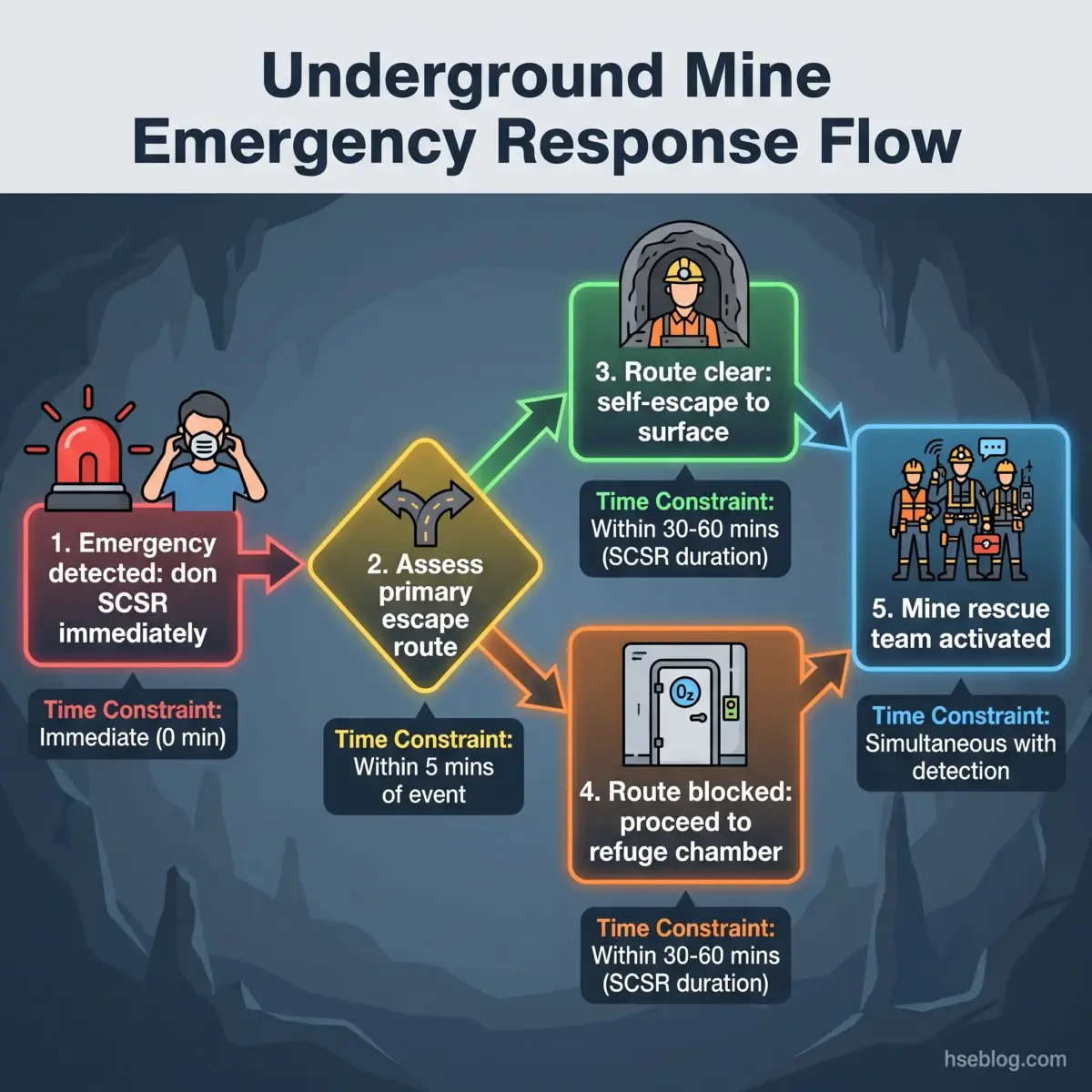
Emergency preparedness in mining faces constraints that most other industries do not. Underground access is limited to a small number of entries. Atmospheric conditions can change rapidly — a fire or explosion may render the primary escape route irrespirable within minutes. Communication systems that work on the surface may not penetrate underground. The distance from the working face to the portal can be measured in kilometers.
Self-contained self-rescuers (SCSRs) are the primary self-escape device for underground miners. These closed-circuit breathing apparatus units provide a limited oxygen supply — typically 60 to 90 minutes depending on the model and the user's exertion level. Their limitations are significant: they are uncomfortable, reduce communication ability, and their duration may be insufficient for miners working at the extremes of a large underground operation. Training in SCSR donning and use must be practiced regularly, under conditions that simulate the stress and confusion of an actual emergency — not calmly in a training room.
Refuge chambers and alternatives provide a hardened shelter where miners can wait for rescue when self-escape is not possible. Requirements vary by jurisdiction and mine type. These facilities maintain a breathable atmosphere, provide communication capability, and stock consumables for a defined duration. The practical consideration — often debated among practitioners — is whether refuge chambers create a false refuge. If the mine's atmosphere is toxic and rescue may take days, the chamber's consumable duration becomes the critical constraint.
Emergency response plans under MSHA and ILO Convention 176 require documented procedures for fire, explosion, inundation, and ground failure scenarios. The plans must specify evacuation routes, communication protocols, rescue team activation, and coordination with external emergency services. Under the ILO Convention, Article 13 affirms workers' right to withdraw from danger — a right that must be operationally meaningful, not just printed in a manual.
The Fix That Works: Emergency drills that follow the same script every time teach procedure memorization, not decision-making under stress. The most effective mine emergency preparedness programs introduce variability — changing the scenario parameters, disabling communication systems, simulating multiple concurrent events, blocking the primary escape route — to build genuine adaptive capacity. If every drill goes smoothly, the drill program is testing execution of a known plan, not readiness for the unknown.
Frequently Asked Questions
What is the most common cause of death in mining?
In the United States, powered haulage and mobile equipment incidents are the leading fatal accident class — responsible for 13 of 33 mining deaths in 2025 (MSHA, via Pit & Quarry, 2026). Ground control failures (roof falls, highwall collapses) are the second major category. Globally, however, occupational respiratory diseases — silicosis and coal workers' pneumoconiosis — cause more mining-related deaths than acute traumatic injuries when long-term mortality is counted. The answer depends on whether the question addresses acute fatalities or total mortality.
What PPE is required for mining operations?
Baseline PPE across most mining jurisdictions includes hard hats, steel-toed boots, hearing protection, safety glasses, and high-visibility clothing. Underground miners additionally require self-contained self-rescuers (SCSRs) and, depending on the atmospheric hazard, respiratory protection. Specific requirements vary by jurisdiction (MSHA in the US, state WHS regulations in Australia) and by the task being performed. PPE sits at the lowest tier of the hierarchy of controls — it protects the individual worker only when all higher-tier controls have been applied or demonstrated as infeasible.
What is the MSHA silica rule and when does it take effect?
MSHA's 2024 final rule (30 CFR Part 60) established a uniform permissible exposure limit of 50 µg/m³ and an action level of 25 µg/m³ for respirable crystalline silica across all mining operations. Metal and non-metal mine operators face a compliance deadline of April 8, 2026. Coal mine operator compliance is currently stayed by the Eighth Circuit Court of Appeals pending litigation. The rule requires exposure monitoring, corrective actions when limits are exceeded, and medical surveillance for MNM mines. MSHA projected it will prevent 1,067 lifetime deaths (MSHA, 2024).
How often does MSHA inspect mines?
MSHA mandates four inspections per year for underground mines and two per year for surface mines — these are non-discretionary scheduled inspections. Beyond this schedule, MSHA retains authority for unannounced spot inspections at any time and can issue Section 103(k) imminent-danger withdrawal orders, which shut down operations immediately when conditions threaten life. The inspection frequency applies to all mines under MSHA jurisdiction as defined by the Federal Mine Safety and Health Act of 1977.
What is critical control management in mining?
Critical controls are the specific controls that prevent or mitigate catastrophic and fatal events — distinct from the hundreds of controls listed in a typical mine risk register. The ICMM framework requires operators to identify these controls, set measurable performance standards, and verify them at the working face through physical observation, not document review alone. A roof-bolting pattern is a critical control. A training attendance record is not. The discipline focuses finite audit resources on the controls where failure means fatality.
Can autonomous mining equipment eliminate all safety risks?
Autonomous haulage systems remove operators from direct exposure to vehicle collision and rollover hazards — the leading fatal accident class. They are a powerful elimination-tier control. But they do not eliminate all risks. Autonomous systems introduce new hazard categories: software errors, sensor failures, cybersecurity vulnerabilities, and interface failures where autonomous and manually operated equipment interact. Maintenance personnel still access the machines physically. Automation changes the risk profile rather than removing risk entirely.
Conclusion
The industry's persistent failure — visible in the published incident record across jurisdictions and decades — is treating the hierarchy of controls as a reference poster rather than an operational sequence. Mines that sustain genuine safety performance apply elimination and engineering controls first, measure their effectiveness through leading indicators, and reserve administrative controls and PPE for residual risk that higher-tier measures cannot reach. Mines that stagnate invert this sequence: they default to training, procedures, and personal protective equipment because those measures are cheaper, faster, and do not interrupt production schedules.
The 2025 US fatality data — 33 deaths, with powered haulage alone accounting for 13 — reinforces that progress is not self-sustaining. Every one of those fatalities occurred in an industry with mandatory inspections, codified training requirements, and decades of published guidance. Regulations establish a floor. Technology opens new possibilities. But the difference between a mine trending toward zero and one accumulating fatalities lies in whether the management system verifies critical controls at the working face, whether risk assessments account for hazard interactions, and whether the organizational culture treats safety as a dynamic discipline rather than a documentation exercise.
For practitioners reviewing their own operations, the uncomfortable question is specific: are your critical controls verified by observation at the face, or by signature on a form?