
TL;DR — Three Questions That Define Safety Culture
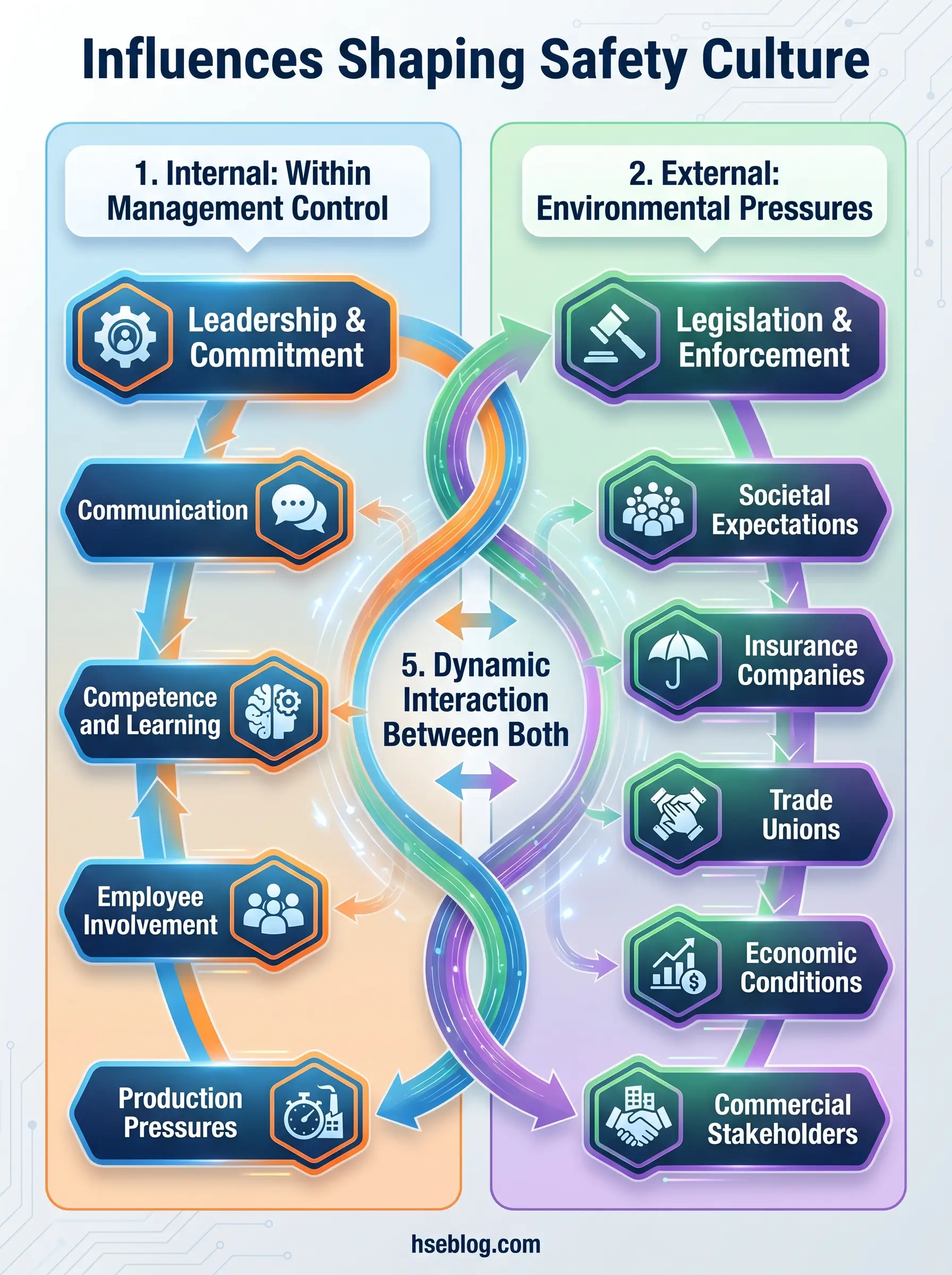
What actually shapes safety culture? Two forces — internal influences (leadership commitment, communication, competence, employee involvement, and production pressures) and external influences (legislation, enforcement, trade unions, insurance, economic conditions, and societal expectations) — interact dynamically to produce the culture an organization experiences on the ground.
Can you control it? Internal factors sit within management’s direct span of control. External factors constrain or enable what’s possible. Organizations that treat these as separate checklists instead of an interconnected system consistently stall in their cultural maturity.
How do you know where you stand? Safety culture maturity models — particularly the Hudson Safety Culture Ladder — provide a five-level framework from pathological to generative. The clearest diagnostic: compare how management describes the culture with how frontline workers experience it. A wide gap signals immaturity more reliably than any survey score.
Health and safety culture is the product of individual and group values, attitudes, perceptions, competencies, and patterns of behaviour that determine an organization’s commitment to safety. It is shaped by internal influences — management commitment, communication, competence, employee involvement, and production pressures — and external influences — legislation, enforcement, trade unions, insurance, economic conditions, and societal expectations. Organizations with a positive safety culture experience fewer incidents, higher near-miss reporting rates, and stronger regulatory compliance. Understanding these influences is the foundation of any serious effort to improve safety performance.
What Is Health and Safety Culture and Why Does It Matter?
Approximately 2.9 million people die each year from work-related accidents and diseases globally (International Labour Organization, 2023). That figure does not describe an equipment problem or a training gap alone. It describes a systemic failure in how organizations value, prioritize, and operationalize safety — in other words, a failure of culture. Behind the data sit organizations where safety procedures exist on paper but dissolve under production pressure, where incidents go unreported because workers fear blame, and where management commitment stops at the policy statement.
The concept of safety culture entered professional vocabulary after the International Atomic Energy Agency’s analysis of the 1986 Chernobyl disaster. Subsequent major accident investigations — King’s Cross, Piper Alpha, the Herald of Free Enterprise — reinforced the conclusion that organizational culture was not incidental to these disasters; it was causal. Understanding what shapes that culture, both from within an organization and from forces outside it, is now a core competency for HSE professionals. This article analyses those internal and external influences — not as a textbook checklist, but as a dynamic system where factors reinforce, undermine, and interact with each other in ways that determine real safety outcomes.
The most widely cited definition comes from the Advisory Committee on the Safety of Nuclear Installations (ACSNI), which described safety culture as the product of individual and group values, attitudes, perceptions, competencies, and patterns of behaviour that determine the commitment to, and the style and proficiency of, an organization’s health and safety management. This definition matters because it positions culture as an outcome — a product — rather than a programme or initiative. You do not install a safety culture. You produce one through the accumulated effect of every decision, behaviour, and system that touches safety.
A distinction worth drawing early: safety culture and safety climate are not the same thing. Culture refers to the deep, slow-changing shared beliefs and values that operate within an organization — often below conscious awareness. Climate is a snapshot of attitudes and perceptions at a specific point in time, typically captured through surveys. Many organizations confuse measuring climate with changing culture. The survey is a thermometer, not a treatment. Organizations that administer annual climate surveys without acting on results inadvertently signal that culture work is a compliance exercise, which makes the problem worse rather than better.
The HSE UK’s Human Factors guidance identifies six key influences on safety culture: management commitment, employee involvement, training and competence, communication, compliance with procedures, and organisational learning. These are internal factors — elements within management’s direct control. But culture is not shaped by internal forces alone. Legislation, enforcement, trade union activity, insurance markets, economic conditions, and societal expectations all exert pressure from outside. The practical challenge for HSE professionals is understanding how these forces interact.
Internal Influences on Health and Safety Culture
Internal influences represent the factors within an organization’s span of control. They are where management has the greatest leverage to effect change — and where responsibility most clearly sits when culture fails. Six core factors operate here: leadership commitment and style, employee involvement, training and competence, communication, compliance with procedures, and organisational learning.
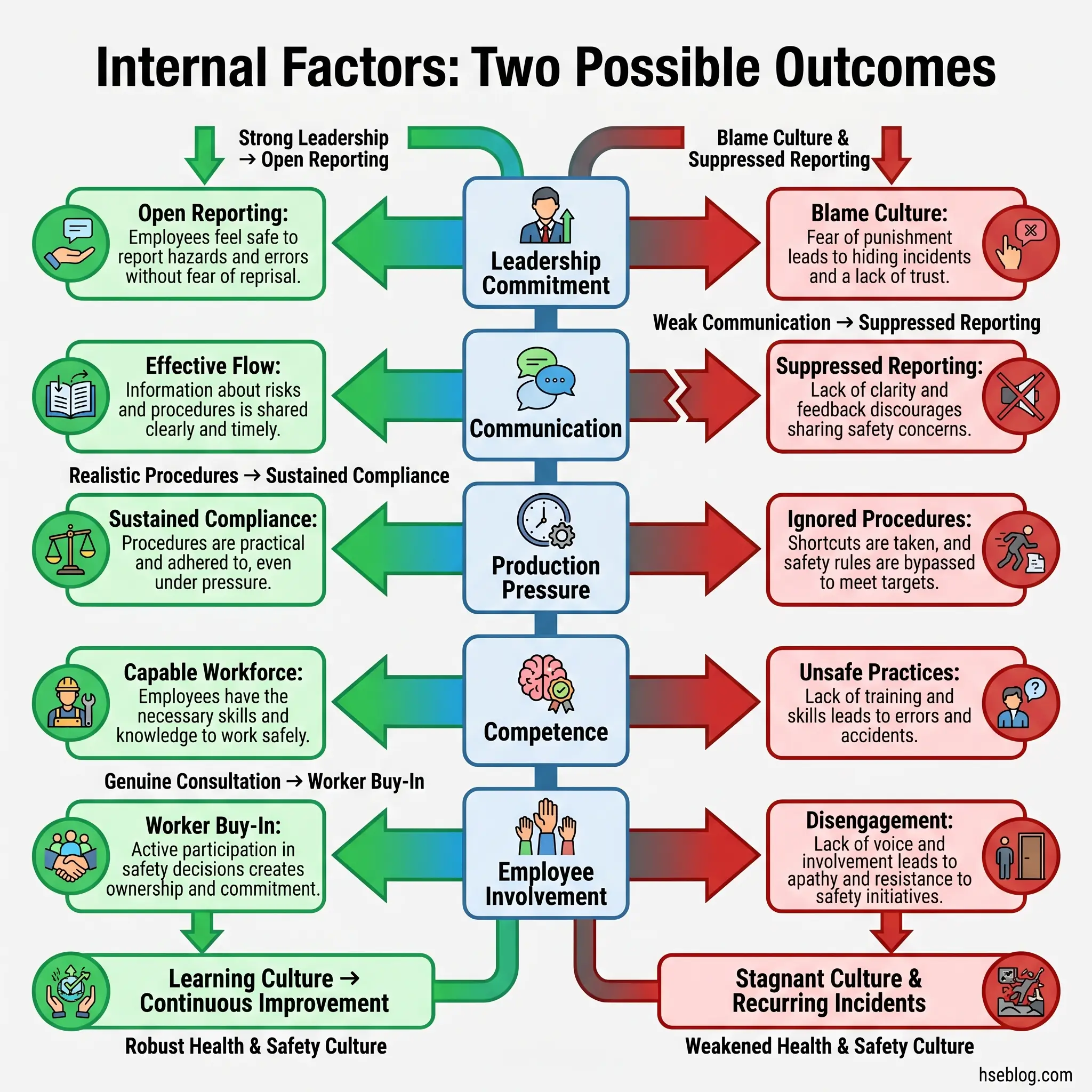
None of these factors operates in isolation. Leadership commitment shapes communication tone. Communication quality determines whether training translates into competence. Competence levels affect whether procedures are followed. And the approach to organisational learning — blame or improvement — determines whether incident data feeds back into any of these systems at all. The gap between policy and practice becomes most visible in internal influences. The practitioner’s task is to test whether what management says aligns with what workers experience.
Management Commitment and Leadership
Research consistently identifies management commitment as the single most influential driver of safety culture. The mechanism is behavioural signalling: workers observe what leaders do, not what they sign. Visible leadership behaviours — attending safety committee meetings, personally participating in incident investigations, allocating budget without requiring a business case for every safety improvement — build credibility. Their absence does the opposite.
The negative signals are equally specific. Directors who bypass safety rules when production deadlines tighten, who treat safety spending as a cost centre to be minimised, or who delegate all safety responsibility to the safety manager communicate a clear message about organisational priorities. Safety culture is delegated to destruction when it is owned solely by one department rather than integrated into operational leadership.
The most reliable indicator of genuine management commitment is what happens when safety and production conflict. Organizations with mature safety cultures have pre-agreed escalation protocols for these moments — documented processes for stopping work, adjusting schedules, and communicating with clients — rather than relying on ad hoc management judgment under pressure. Where those protocols do not exist, production wins by default, regardless of what the safety policy states.
Audit Point: Ask three frontline workers to describe, in their own words, how their organization prioritizes safety. If the answers are generic or inconsistent with the published policy, the gap between stated and demonstrated commitment is wider than management believes.
Production and Service Demand Pressures
Delivery schedules, customer expectations, and short-term performance metrics create direct pressure on safety compliance. The dynamic is straightforward: when rules cannot be followed under normal production conditions, they will eventually be ignored. This is not a failure of worker discipline. It is a systems failure — procedures written to satisfy an auditor rather than to be workable during peak-demand periods.
Courts do not accept production pressure as a defence for safety failures. Under the UK Health and Safety at Work etc. Act 1974, Section 2, the employer’s general duty to ensure the health, safety, and welfare of employees applies regardless of commercial pressures (Jurisdiction: UK). The legal position is unambiguous. The cultural position is more complex: organizations need to agree with clients and workers, before pressure situations arise, how safety-versus-production conflicts will be prioritised. Pre-crisis planning is a cultural intervention, not just an operational one.
A practical test: review your safety procedures during a period of maximum operational demand. If workers cannot physically follow them within the time available, the procedures need redesigning — not the workers.
Communication
The quality, frequency, and direction of safety communication shape culture more directly than most organisations recognise. Poorly communicated procedures lead to misunderstanding and non-compliance — not through negligence, but through ambiguity. When workers must interpret unclear instructions under time pressure, they default to experience, habit, or whatever their colleagues are doing.
Face-to-face communication — toolbox talks, one-to-one conversations, safety walk-rounds — demonstrates management interest in a way that emails and posted notices cannot replicate. The absence of verbal communication signals indifference, regardless of the volume of written material produced.
Two-way communication matters more than top-down broadcasting. Safety committees, feedback mechanisms, open reporting channels, and genuine follow-up on reported concerns all build the reporting culture that mature safety systems depend on. In contrast, blame-oriented cultures suppress incident reporting. When workers believe that reporting a near-miss will result in investigation of their behaviour rather than investigation of the system, reporting rates collapse — and with them, the organization’s ability to learn before someone is seriously harmed.
Watch For: Ask frontline workers to describe their organization’s safety priorities in specific operational terms. In organizations with weak communication culture, workers default to generic phrases — “safety first” — rather than specific expectations. That gap between slogan and substance is a communication failure.
Competence, Training, and Organisational Learning
Competence is more than a training certificate. It encompasses knowledge, skills, experience, and aptitude — developed through recruitment, on-the-job development, mentoring, and retention of experienced personnel. Training that develops genuine competence differs from training that checks a compliance box. The distinction is whether the worker can apply the knowledge under real operational conditions, not whether they passed a test in a classroom.
Organisational learning is the mechanism through which incident data, near-miss reports, audit findings, and external investigation outcomes feed back into operational practice. The characteristics of a learning organisation — analysing systemic causes rather than assigning individual blame, sharing lessons across teams and sites, updating procedures based on operational evidence — are widely described in HSE literature. The characteristics of a blame organisation are equally recognisable: investigation stops at the individual who made the error, lessons do not travel beyond the immediate team, and procedures remain unchanged until the next incident forces a review.
Organizations that investigate incidents only to assign blame will eventually stop receiving incident reports. The feedback loop between learning and reporting is a fragile cultural asset. Once workers learn that reporting leads to punishment rather than improvement, the information flow stops — and the organisation loses its primary early warning system.
Employee Involvement and Representation
Meaningful worker participation strengthens safety culture through a mechanism that goes beyond compliance: ownership. People accept restrictions more readily when they participate in setting them. Involvement in hazard identification, risk assessment, and solution development produces both better risk controls and stronger cultural buy-in.
Legal requirements for worker consultation vary by jurisdiction. In the UK, the Safety Representatives and Safety Committees Regulations 1977 (SRSCR) enable recognised trade unions to appoint safety representatives, and employers must establish safety committees if requested (Jurisdiction: UK). The EU Framework Directive 89/391/EEC, Article 11, requires employers to consult workers and their representatives on all questions relating to safety and health at work (Jurisdiction: EU). OSHA in the US does not mandate safety committees but promotes them through its voluntary protection programmes (Jurisdiction: US).
The distinction between consultation and information is critical. Organizations that inform workers about decisions already made and call it “consultation” undermine the cultural asset they are trying to build. Genuine consultation means worker input influences outcomes — otherwise it is a performance, and workers recognise performances quickly.
Field Test: Review the minutes of your last three safety committee meetings. Did any worker-raised concern result in a documented change to procedure, equipment, or practice? If not, the committee may be functioning as a communication channel rather than a consultation mechanism.
External Influences on Health and Safety Culture
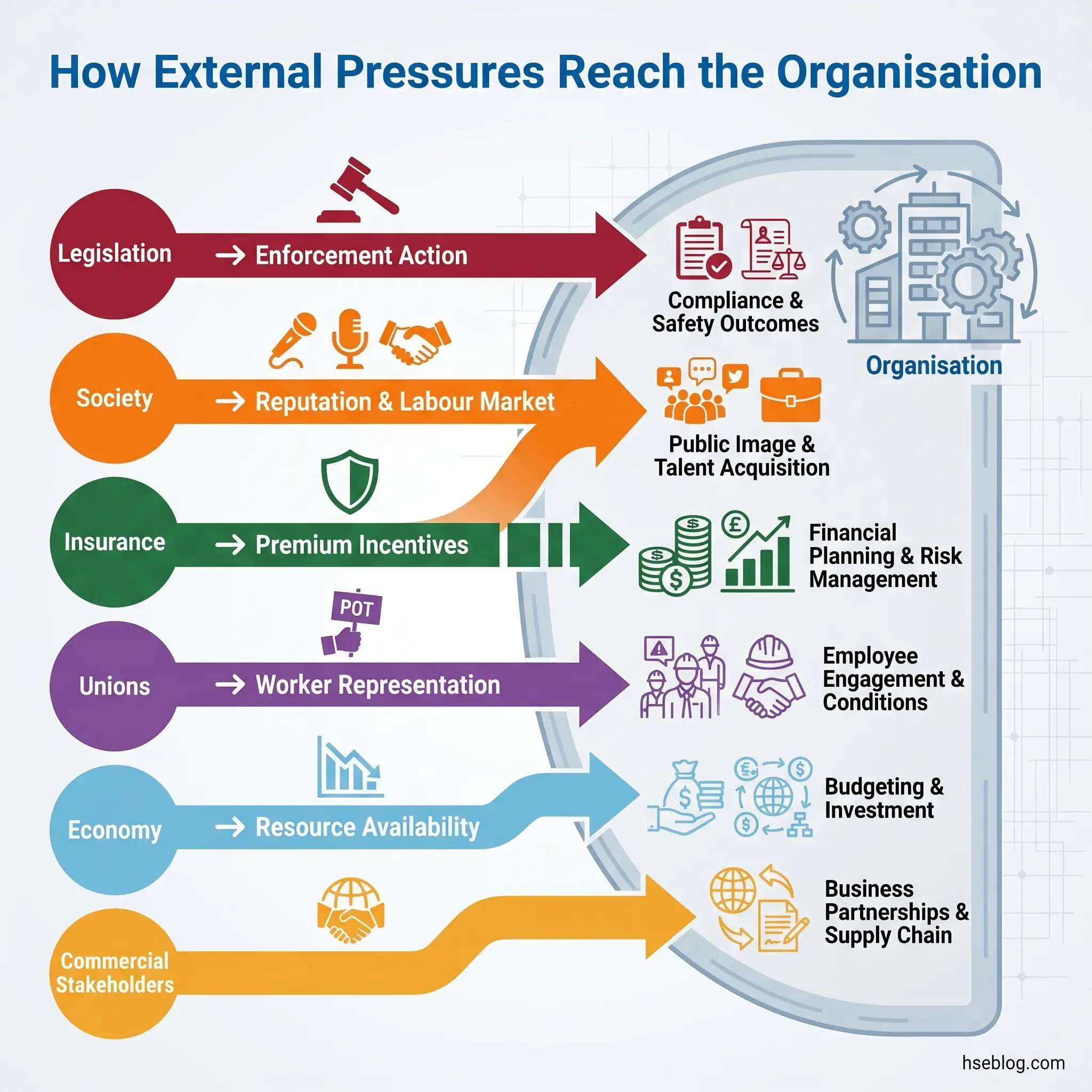
External influences operate outside an organization’s direct control, but they exert significant pressure — positive or negative — on the cultural conditions inside it. Legislation sets minimum standards. Enforcement gives those standards teeth. Trade unions amplify worker voice. Insurance markets translate safety performance into financial consequences. Economic conditions test whether safety commitment survives commercial pressure. Societal expectations define what the public, the media, and prospective employees will tolerate.
These factors do not simply form a backdrop. They interact with internal influences in feedback loops that can either reinforce or undermine cultural maturity. Understanding these dynamics is what separates a textbook understanding of safety culture from a practitioner’s working knowledge of it.
Legislation and Regulatory Enforcement
Legislation provides the baseline to which all employers must conform. Its cultural influence depends on two variables: how the law is framed and how vigorously it is enforced.
The UK’s Health and Safety at Work etc. Act 1974 (HASAWA) adopts a goal-setting approach — requiring employers to ensure the health, safety, and welfare of employees “so far as is reasonably practicable” under Section 2 (Jurisdiction: UK). This framework gives organisations flexibility in how they meet their duties, encouraging risk-based thinking rather than prescription. In contrast, older prescriptive regulatory models specified exact methods, which could be followed to the letter without engaging with actual risk. The EU Framework Directive 89/391/EEC similarly establishes general employer duties across member states, including requirements for risk assessment and worker consultation (Jurisdiction: EU). OSHA in the US operates through a standards-and-enforcement model, setting specific permissible exposure limits, guarding requirements, and training mandates enforced through inspection and citation (Jurisdiction: US).
Enforcement is where legislation translates into cultural impact. Inspection regimes, improvement notices, prohibition notices, and prosecution serve both as deterrent and as a signal of societal values. Where enforcement is weak or under-resourced, the cultural effect is corrosive — it signals that non-compliance carries little consequence. Organizations that treat regulatory compliance as a ceiling rather than a floor reveal the limits of a purely legislative approach to culture.
Societal Expectations and Public Pressure
Societal expectations about acceptable levels of workplace risk are not static. They rise over time, particularly in wealthier economies where public awareness of safety rights increases alongside media scrutiny of corporate failures. A workplace fatality that would have drawn limited attention forty years ago now triggers media coverage, regulatory response, and reputational damage.
Labour market effects add a second channel of influence. In tight employment markets, workers have the choice to prefer safer employers — and many exercise it. Corporate social responsibility (CSR), environmental, social and governance (ESG) criteria, and ethical investment screening now routinely include occupational safety performance. The Lloyd’s Register Foundation World Risk Poll found that 18% of the global workforce reported experiencing harm from work in the previous two years (Lloyd’s Register Foundation / Gallup, 2024). That figure shapes public and investor expectations about the standards organizations should meet.
One uncomfortable pattern: societal expectations for product safety consistently run higher than expectations for worker safety. Consumers demand rigorous quality controls on the products they buy while accepting that the workers who make those products face significantly less public scrutiny of their working conditions.
Insurance Companies and Financial Incentives
Employers’ liability insurance is a legal requirement in the UK, and equivalent requirements apply in many jurisdictions. Insurers influence safety standards through premium structures, risk assessments, and conditions of coverage. Risk-based pricing models reward safer organizations with lower premiums and penalise poor performers — in theory providing a direct financial incentive for safety investment.
HSE research has documented that the ratio of insured costs to uninsured costs of workplace accidents ranges from 1:8 to 1:36. The uninsured costs — production disruption, investigation time, temporary labour, reputational damage, management distraction — dwarf the direct insurance payout. This data, when it reaches decision-makers, can reframe safety investment from cost to financial protection.
The true influence of insurance companies depends on whether cost-of-risk data reaches the people who control safety spending. In many organizations, insurance premiums are managed by finance departments entirely disconnected from operational safety teams. The financial feedback loop — higher risk leads to higher premiums, which should trigger investment in risk reduction — never completes because the information sits in the wrong department.
Jurisdiction Note: The legal requirement for employers’ liability insurance varies. In the UK, it is mandatory under the Employers’ Liability (Compulsory Insurance) Act 1969. In the US, workers’ compensation insurance requirements are set at state level. In some EU member states, social insurance systems serve a similar function. The mechanism differs, but the principle — that financial consequences of poor safety should flow back to the employer — operates across jurisdictions.
Trade Unions and Worker Organisations
The evidence base on trade union influence on workplace safety is stronger than many employers expect. A peer-reviewed study published in BMJ Occupational & Environmental Medicine found that a 1% decrease in unionization was associated with a 5% increase in occupational fatalities (BMJ Occupational & Environmental Medicine, 2022). Separately, analysis of Workplace Safety and Insurance Board claims data found that workers in unionized construction firms reported 23% fewer lost-time injuries than those in non-union firms (TUC, ongoing).
The mechanisms are specific: trained safety representatives who understand both the law and the operational reality, collective bargaining agreements that include enforceable safety provisions, whistleblower protections that enable workers to report hazards without fear of retaliation, and lobbying for stronger legislation. In the UK, the Safety Representatives and Safety Committees Regulations 1977 provide the legal framework for union-appointed safety representatives (Jurisdiction: UK). The ILO positions freedom of association as a direct enabler of improved occupational safety and health outcomes (ILO, 2024).
Limitations exist. Declining union membership in some economies reduces the reach of these mechanisms. In some contexts, union priorities may focus more heavily on wages and conditions than on safety-specific issues. But the weight of evidence supports a clear conclusion: effective worker representation, whether through unions or equivalent structures, is associated with measurably better safety outcomes.
Economic Conditions and Market Pressures
The economic cost of poor occupational safety and health practices is estimated at 4% of global GDP annually (International Labour Organization, ongoing). That macroeconomic figure translates into microeconomic pressures at the organisational level that cut both ways.
During economic booms, activity increases, labour shortages intensify, and pressure to deliver accelerates — conditions that consistently correlate with higher accident rates, particularly in construction and extractive industries. Inexperienced workers are hired rapidly, training is compressed, and supervision stretches thin. During recessions, the dynamics shift: cost-cutting can reduce safety investment, maintenance is deferred, and experienced workers are made redundant — but reduced activity also lowers exposure hours, which can temporarily lower absolute incident numbers even as risk per hour increases.
Economic pressures are the external factor that most reliably exposes the depth of an organization’s cultural commitment. Organizations with mature safety cultures maintain standards during downturns because safety is integrated into operational identity, not treated as an overhead that can be scaled back when revenue drops.
Commercial Stakeholders and Supply Chain Influence
Clients, principal contractors, and supply chain partners influence safety standards through procurement requirements, pre-qualification questionnaires, contractual conditions, and audit programmes. For smaller organizations, a major client’s safety requirements can drive more improvement than the regulatory inspector’s visit — because the consequence of failing the client’s audit is immediate and commercial: loss of the contract.
Industry schemes and contractor accreditation bodies — CHAS, SafeContractor, and ISNetworld among them — formalise this supply chain pressure into standardised assessment frameworks. Under the UK’s Construction (Design and Management) Regulations, the principal contractor carries explicit duties for supply chain safety management (Jurisdiction: UK). In the US, OSHA’s multi-employer citation policy holds controlling employers accountable for hazards created by subcontractors on their site (Jurisdiction: US).
The supply chain mechanism is powerful but uneven. Large, safety-mature clients impose rigorous requirements. Smaller clients in less regulated sectors may select contractors on price alone. The safety culture effect depends on which end of the supply chain holds the leverage.
How Internal and External Factors Interact
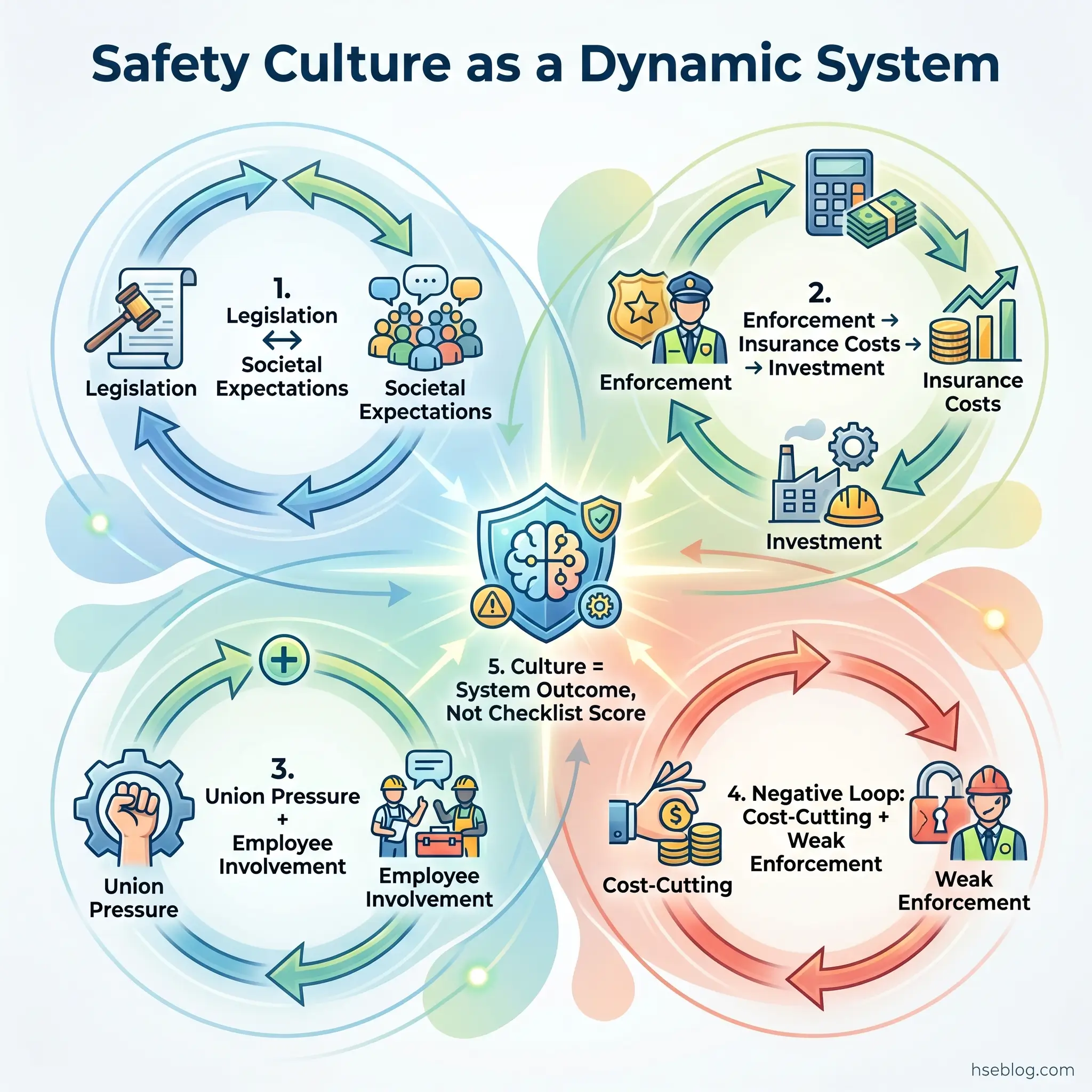
The most common failure pattern in safety culture work is treating internal and external influences as separate checklists — addressing each factor independently, then expecting the cultural outcome to follow. It does not. Culture is a byproduct of how these factors interact, not a sum of how they score individually.
Specific feedback loops illustrate the dynamic. Legislation shapes societal expectations about what is acceptable, and elevated societal expectations in turn create political pressure for stronger legislation — a reinforcing cycle visible in the progressive tightening of occupational health regulation across developed economies over the past fifty years. Insurance costs driven by enforcement patterns drive management investment in risk reduction, but only where the financial data flows from the finance department to the safety function. Trade union pressure, combined with genuine employee involvement mechanisms inside the organisation, creates reinforced commitment that is stronger than either factor alone.
Negative interactions are equally powerful. Economic pressure combined with weak enforcement creates a compounded effect: the incentive to cut costs is high, and the deterrent against doing so is low. Production pressure combined with a blame culture suppresses reporting, which removes the early-warning data that management needs to intervene before a serious incident occurs. These compounded failures are visible in the investigation reports of most major industrial disasters — rarely is a single factor responsible. The causal chain almost always involves multiple internal and external influences interacting in ways that individually seemed manageable but collectively proved catastrophic.
Organizations that want to improve their safety culture need to map how their specific combination of factors reinforces or undermines the cultural outcome they want. A strong legislative environment means little if management commitment is performative. Excellent internal communication cannot compensate for production schedules that make safe procedures unworkable. The assessment question is not “how does each factor score?” but “how do these factors interact in our specific context?”
What Does a Positive Health and Safety Culture Look Like?
Observable indicators of a positive safety culture include consistently low incident rates, high near-miss reporting volumes, open communication between management and frontline workers, and safety considerations integrated into routine operational decisions rather than bolted on as a separate process. The International Association of Oil & Gas Producers (IOGP) identifies additional characteristics: few at-risk behaviours observed during monitoring, low staff turnover, low absenteeism, and — counterintuitively to some managers — high productivity.
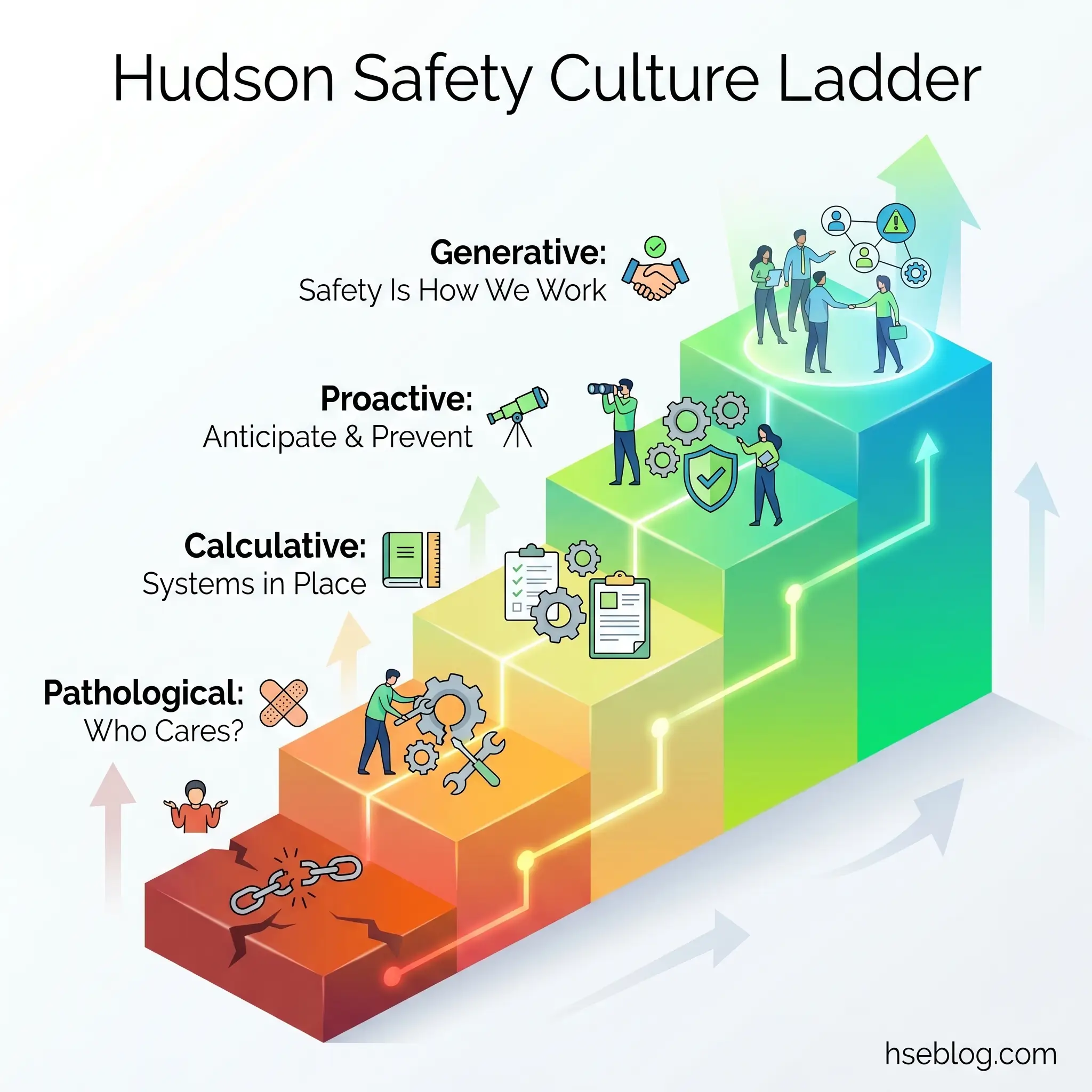
The Hudson Safety Culture Ladder provides the most widely used maturity framework for assessing where an organization sits and what progression looks like. Developed by Patrick Hudson and adopted by Shell, the Energy Institute, and numerous other organisations, it describes five levels:
- Pathological — Safety is a problem caused by workers. Management interest is limited to avoiding prosecution.
- Reactive — Organizations respond after incidents occur but do not anticipate them. Safety is treated as a serious issue only after something goes wrong.
- Calculative — Systems and data collection are in place. The organization manages safety through procedures and metrics but has not yet achieved widespread cultural engagement.
- Proactive — The shift from managing safety through systems to engaging people. Workers and managers actively identify and address hazards before incidents occur.
- Generative — Safety is fully integrated into organizational identity. Information flows freely, failure is a learning opportunity, and the organization actively seeks out what it does not know.
HSE UK’s Safety Culture Maturity Model follows a similar five-level progression. Assessment methods include safety climate surveys (such as HSE’s Safety Climate Tool or the Hearts and Minds toolkit), focus groups, behavioural observation programmes, and qualitative interviews. Each measures a different dimension — no single tool captures culture comprehensively.
ISO 45001 does not use the word “culture” explicitly, but its requirements address culture’s core components: leadership commitment and worker participation under Clause 5, worker consultation and participation under Clause 5.4, and understanding organizational context under Clause 4 (Jurisdiction: Global). The ISO 45001 revision process, initiated in 2024 and currently at Committee Draft stage as of July 2025, is expected to introduce explicit focus on organisational culture, ethics, psychological well-being, and ESG alignment in the new edition anticipated for 2027 (ISO / Bureau Veritas, 2024–2025).
A related development: ISO 45003, published in 2021, provides the first global framework for managing psychosocial risks within an occupational health and safety management system (Jurisdiction: Global). The practical relevance is growing — UK HSE reported 22.1 million working days lost to work-related stress, depression, and anxiety in 2024/25 (British Safety Council, 2025). Psychosocial factors are increasingly recognised not as a separate domain but as an integral dimension of safety culture itself. An organization where workers fear speaking up about hazards because of management retaliation is experiencing both a psychosocial risk and a safety culture failure — the two are not separate problems.
Organizations often self-assess their culture as more mature than it actually is. The clearest diagnostic: compare management’s assessment with the frontline’s experience. A wide gap between the two is the most reliable indicator of cultural immaturity — more reliable than any single metric, survey score, or incident rate.
The Fix That Works: Rather than commissioning a full culture survey, start with five structured conversations between senior management and frontline workers — not about safety specifically, but about what makes their work difficult. The answers will reveal more about real culture than any questionnaire.
Frequently Asked Questions
Conclusion
The industry’s persistent habit of treating internal and external influences on safety culture as two separate lists — to be checked off and filed — is the single most common obstacle to cultural improvement. Culture is not a programme. It is the accumulated outcome of how leadership behaves under pressure, whether communication flows in both directions, whether competence is developed or merely documented, whether workers participate in decisions or receive them, and whether external forces like legislation, unions, and economic conditions reinforce or erode whatever internal commitment exists. The factors interact. The interactions determine the outcome.
The highest-impact change most organizations can make is closing the gap between stated commitment and demonstrated practice. Not a new policy. Not another survey. A deliberate, honest assessment of whether what management says about safety matches what workers experience — and a willingness to act on the difference. The Hudson Safety Culture Ladder provides a framework for that progression. ISO 45001 provides the management system structure. Published investigation reports from Chernobyl to Piper Alpha to the present provide the evidence of what happens when culture fails.
Every organization has a safety culture. The question is whether it has the one it intends — or the one its combined internal and external influences have produced by default.