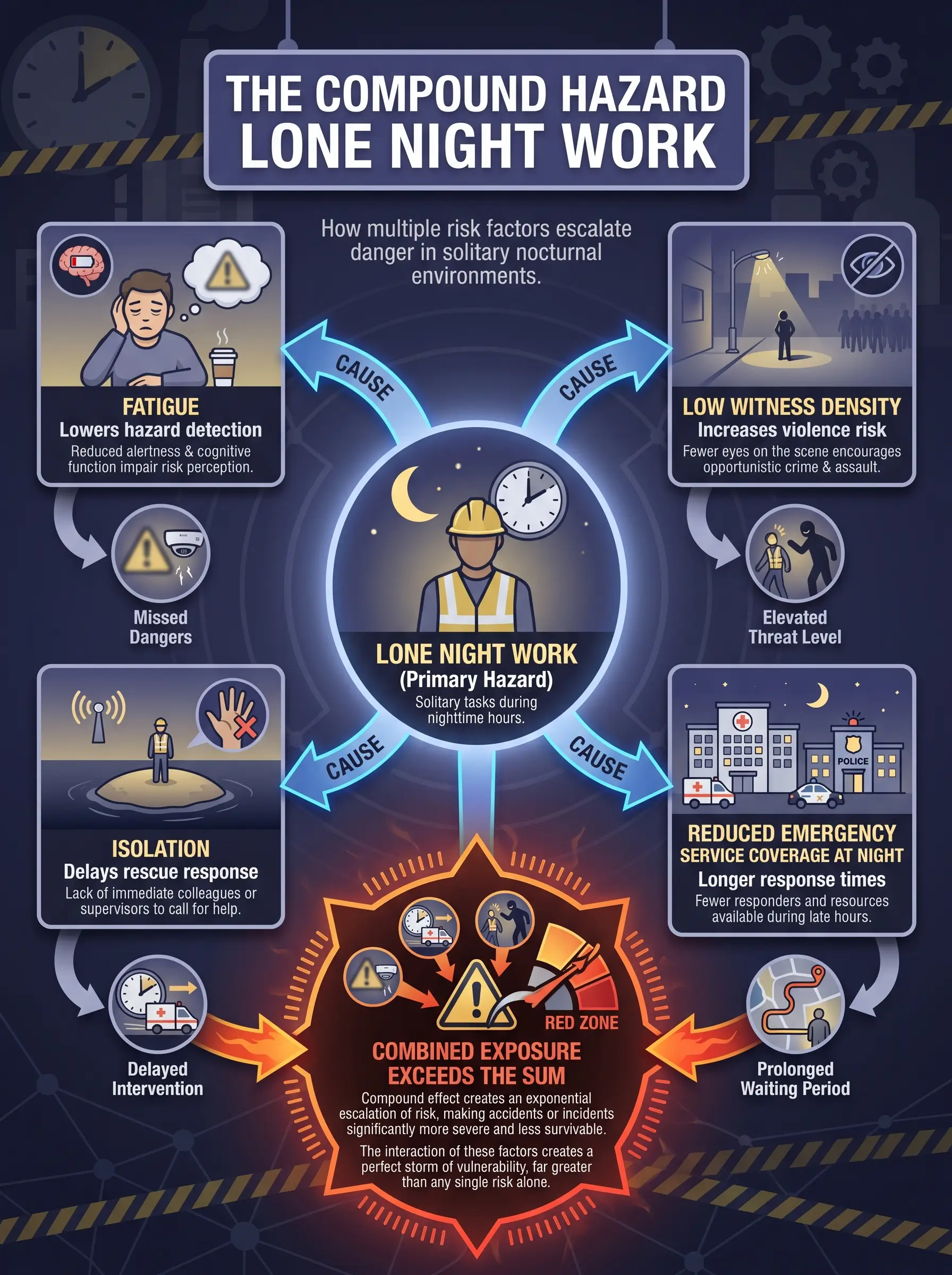
Lone working on night shifts is a compound hazard: fatigue lowers hazard detection, isolation delays rescue, and low-witness conditions amplify violence exposure. Safe operation requires a specific risk assessment, scheduled check-ins, engineered controls such as lighting and CCTV, administrative limits on shift length, and a dedicated lone-worker device as the last line of defence.
A slip on a wet floor at 14:00 in a staffed hospital and the same slip at 03:00 on a deserted ward are not the same incident. The hazard is identical. The response time is not. In one case the worker is helped within a minute; in the other, they may be undiscovered for hours — conscious, injured, and alone. That gap is the defining characteristic of lone working on night shifts: what changes is not the hazard itself, but the consequence when control fails.
The stakes are practical, legal, and sometimes fatal. Retail, healthcare, security, cleaning, hospitality, logistics, and manufacturing all run skeleton crews through the overnight window, and the data is blunt about what that costs. Injury rates climb, violence concentrates in late-night premises, fatigue degrades judgement across the night's lowest-alertness window, and regulators in the UK, US, Australia, and Canada have all moved to tighten employer obligations. This article sets out the risks honestly, the legal duties that apply across jurisdictions, and the controls — in hierarchy order — that bring lone night-shift work back inside an acceptable risk envelope.
What Counts as Lone Working on a Night Shift?
"Lone worker" and "night worker" are separate regulatory categories that often overlap on the same roster. The UK Health and Safety Executive defines a lone worker as someone who works without close or direct supervision. The Working Time Regulations 1998 (regulation 2) defines a night worker as a person who normally works at least three hours of their daily working time between 23:00 and 06:00. When one person carries both labels, the risk profile shifts.
The scenarios are familiar: the single-crew care worker visiting a residential property at 02:00, the overnight cleaner in an empty office tower, the warehouse operative on a skeleton shift, the hotel night auditor covering reception and security, the solo petrol station attendant. None of these arrangements is unlawful. All of them require a specific risk assessment that treats "lone" and "night" as compounding, not additive.
The table below separates day-shift lone exposure from night-shift lone exposure so the compound is visible.
| Factor | Day-shift lone worker | Night-shift lone worker |
|---|---|---|
| Witness density | Moderate to high | Low to none |
| Emergency response time | Typical urban 8–10 min | Often extended |
| Alertness baseline | Circadian peak | Circadian trough (02:00–05:00) |
| Violence exposure | Variable | Elevated in cash-handling and customer-facing roles |
| Commute conditions | Public transport, daylight | Reduced service, darkness, fatigue |
Why Night Shifts Increase Risk for Lone Workers
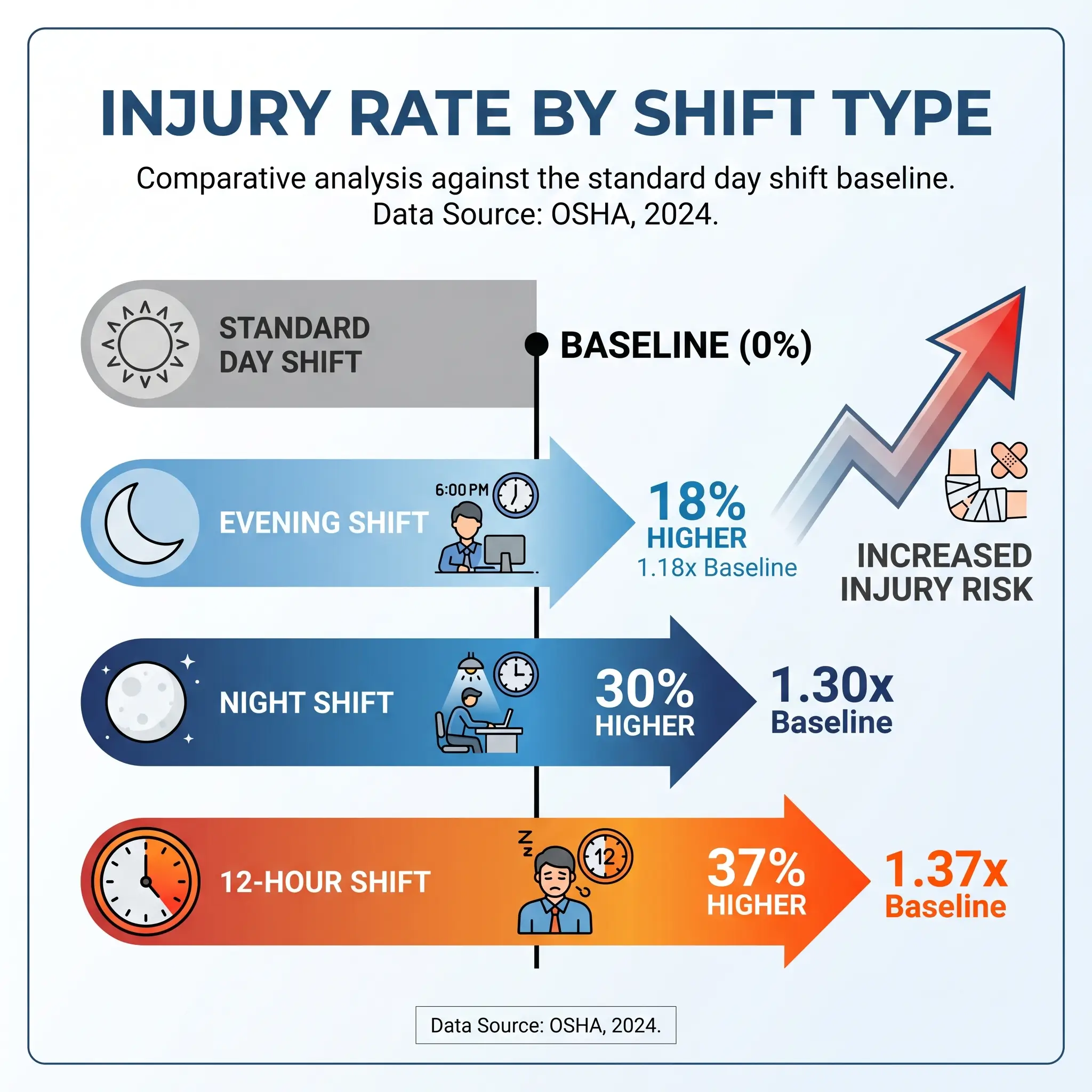
The numbers draw a clear line. OSHA reports accident and injury rates approximately 18% greater on evening shifts, 30% greater on night shifts, and 37% greater on 12-hour shifts compared with standard days (OSHA, 2024). These are not marginal differences — they reflect a measurable degradation of human performance across the overnight window.
The mechanism is circadian. Between roughly 02:00 and 05:00 the body pushes hardest for sleep, core temperature drops, and reaction time slows. Add a long shift, a cold workplace, or a second consecutive night, and the window widens. Major industrial incidents — Chernobyl, Three Mile Island, the Challenger launch decision, and the 2005 BP Texas City refinery explosion — all involved fatigued operators working outside normal alertness windows. Fatigue did not cause those events alone, but it removed the margin that would have caught the error.
Night conditions also degrade the environment. Lighting around external work is limited, public and vehicular presence drops, and emergency services cover wider ground with thinner overnight resources in many regions. Fatigue plus darkness plus isolation — three risk multipliers stacked on the same worker.
Watch For: The second-night and fourth-consecutive-night effect. Sleep debt accumulates across consecutive nights, and the lowest alertness often arrives on night two or night four of a rotation — not night one. Schedule-design decisions matter more than individual willpower here.
Key Risks Faced by Night-Shift Lone Workers
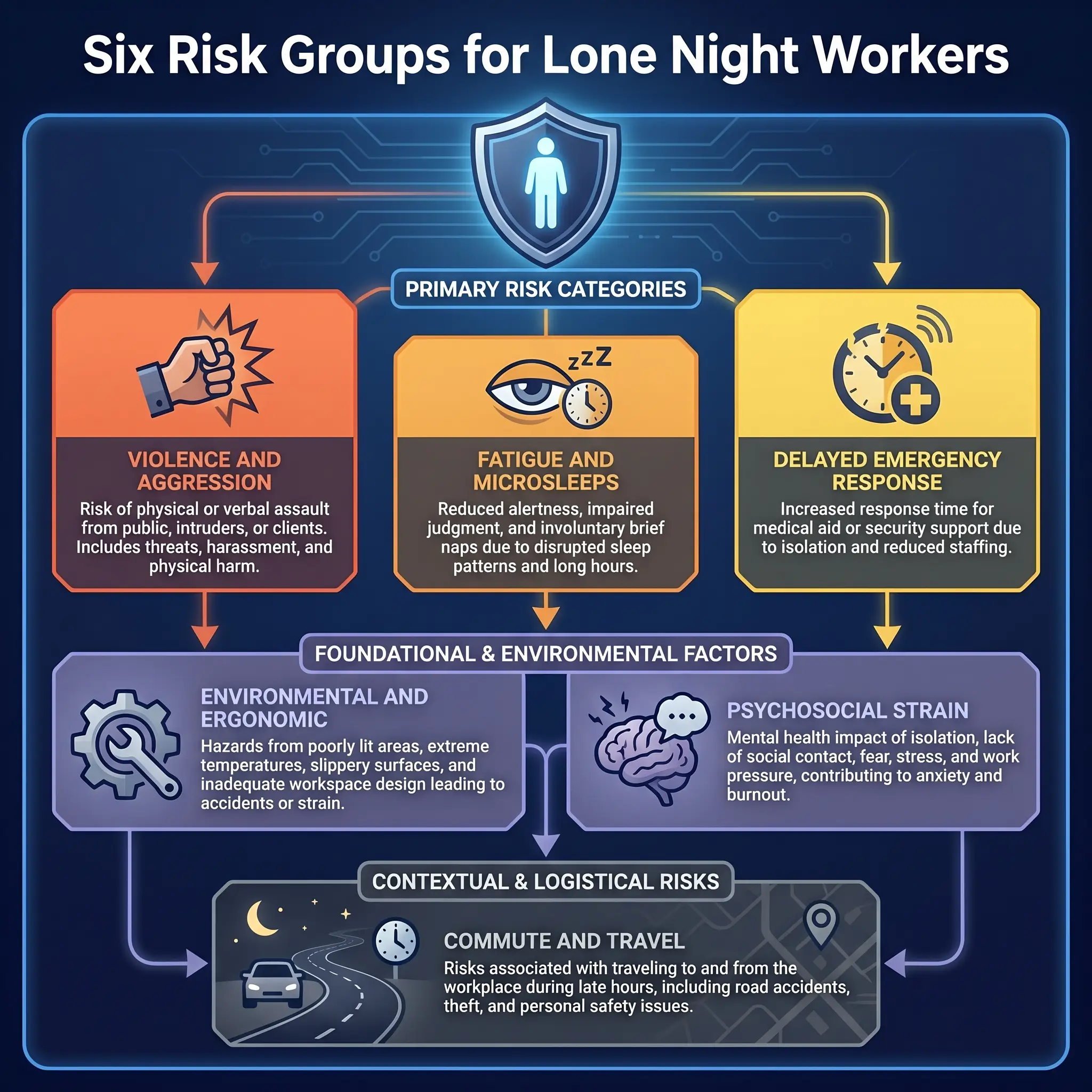
A consistent pattern in published lone-worker incident reports is that risk clusters into six distinct groups, not one undifferentiated failure mode. Treating them separately helps the risk assessment land on the right controls.
Violence, Robbery, and Aggression
Workplace violence is the highest-severity category for many lone night roles. Of the 5,283 fatal workplace injuries in the United States in 2023, 740 were due to violent acts — the third-leading cause of fatal occupational injury (US Bureau of Labor Statistics, 2024). NIOSH data puts the average at 20 US workers murdered each week and roughly one million assaulted annually (NIOSH Current Intelligence Bulletin No. 57). OSHA identifies working late at night or in early morning hours, working alone or in small numbers, and exchanging money with the public as leading risk factors for workplace violence — and late-night retail, fuel stations, solo healthcare visits, and hotel reception concentrate all three.
Fatigue, Microsleeps, and Impaired Judgement
Fatigue shows up as slips on unseen spills, vehicle incidents on the drive home, medication errors on lone care visits, and machinery mistakes on skeleton shifts. HSE guidance HSG256 Managing Shift Work recommends capping safety-critical night shifts at eight hours, avoiding permanent night assignment, and using forward-rotating schedules where rotation is used.
Delayed Emergency Response
This is the hazard competitor articles under-cover. The likelihood of a fall, cardiac event, or laceration does not necessarily rise at night — but the time to rescue does. An incident at 03:00 with no second worker, limited CCTV monitoring, and a missed check-in can leave an injured worker without help for hours. The severity multiplier lives in the response gap, not the initial event.
Environmental and Ergonomic Hazards
Cold stress in unheated premises, poor lighting on external routes, slips on spills no one has cleared, and height work without a second pair of eyes. Ordinary hazards with night-amplified consequences.
Psychosocial and Mental Health Strain
Insomnia prevalence among shift workers is between 29% and 38%, compared with approximately 6% in the general population (StatPearls / NCBI Bookshelf, 2023). Social desynchronisation, chronic sleep disruption, and isolation contribute to anxiety and depression. The IARC 2019 evaluation classifies night-shift work involving circadian disruption as probably carcinogenic to humans (Group 2A) — a long-horizon health cost that employers are increasingly expected to manage alongside acute incident risk.
Commute and Travel Risks
The shift ends when the worker is home, not when they clock out. Drowsy driving, reduced public transport, and lone foot travel across unlit car parks sit outside most risk assessments and inside most lone-worker realities. Any article that ignores the commute ignores one of the highest-frequency exposures in the whole category.
What the Law Says: Legal Duties for Lone Night-Shift Work
Working alone at night is generally lawful in the UK, US, Australia, and Canada — provided the employer has discharged their duty of care and completed a specific risk assessment. The legal architecture is consistent across jurisdictions even where the wording differs.
Under UK law, the Health and Safety at Work etc. Act 1974, Section 2, places a general duty on employers to ensure the health, safety, and welfare of employees so far as is reasonably practicable. The Management of Health and Safety at Work Regulations 1999, Regulation 3, makes the suitable and sufficient risk assessment a specific legal obligation — and lone night-shift scenarios are exactly what regulators expect to see named in that assessment. The Working Time Regulations 1998, Regulations 6 and 7, define night work as three or more hours between 23:00 and 06:00, cap average weekly night work at eight hours in 24 for most workers, and require employers to offer a free health assessment before night assignment and periodically thereafter.
Under US law, OSHA's General Duty Clause, Section 5(a)(1) of the OSH Act 1970, is the foundation — employers must provide a workplace free from recognised hazards likely to cause death or serious harm. OSHA 29 CFR 1915.84 (Shipyard Employment — Working Alone) requires the employer to account for each lone worker by sight or verbal communication at intervals appropriate to the nature of the assignment, and at the end of the job or shift. The wording "appropriate to the assignment" is where most of the interpretive work happens: a fuel station cashier and an office security patrol do not belong on the same check-in schedule.
California has moved further. Labor Code §6401.9 (SB 553) became enforceable on 1 July 2024 and requires most California employers to maintain a written Workplace Violence Prevention Plan covering training, incident logs, de-escalation, and hazard controls. Late-night retail, cash handling, and lone-worker operations sit directly inside the scope the statute was written to address.
In Australia, the Work Health and Safety Act 2011, Section 19, places the primary duty of care on the person conducting a business or undertaking — including specific attention to lone and remote workers in the model WHS regulations. Canadian employers face provincial variation; federal workers fall under the Canada Labour Code Part II, and each province has its own OHS regulation that must be checked directly. At international level, the ILO Night Work Convention 1990 (No. 171) sets the baseline principles: health assessment before assignment, suitable alternative work for those medically unfit for night duty, and specific protection for pregnant workers.
Jurisdiction Note: Where OSHA and HSE UK differ on check-in intervals, the stricter reading should govern internal policy. OSHA 1915.84 defaults to "appropriate to the assignment"; HSE's practical reading for high-risk lone work sits at 15–30 minute intervals. The stricter is the safer compliance posture.
Regulatory content here reflects general HSE professional understanding of UK, US, Australian, and Canadian requirements as of April 2026. It is not legal advice. Specific compliance questions, enforcement situations, or prosecution risk should be directed to qualified legal counsel in the applicable jurisdiction.
How to Conduct a Lone-Working Risk Assessment for Night Shifts
The HSE's five-step risk assessment structure works cleanly when adapted to lone and night-shift context — but only if each step is addressed specifically, not ticked generically.
- Identify night-specific hazards alongside task-specific ones. Violence, fatigue, isolation, cold, and commute risk sit alongside the task hazards (working at height, machinery, chemicals, vehicles, public interaction). List them separately so controls map cleanly.
- Identify who is at risk. Include vulnerable workers — new starters, young workers, workers with underlying conditions flagged in night-worker health assessments, and pregnant workers who retain a right under the WTR 1998 to request transfer from night work on medical grounds.
- Evaluate likelihood and severity — with the delayed-rescue factor explicit. A slip rated "medium severity" at 14:00 may become "high severity" at 03:00 because rescue is delayed. Apply that adjustment visibly; do not hide it inside a single score.
- Record findings and controls, specifying what is permitted alone versus prohibited after dark. Tasks such as stock deliveries, cash handling, work at height, and confined-space entry often warrant a two-person rule or daylight-only restriction.
- Review after incidents, near-misses, staff turnover, or seasonal changes. Shorter daylight, winter commutes, and festive-season cash volumes shift the exposure profile without changing the task.
Triggers that should automatically escalate the assessment include cash handling, public access, work at height, confined-space entry, customer-facing roles, and any task where a single missed check-in could delay rescue beyond the survivable window.
Safety Controls: The Hierarchy Applied to Lone Night Work
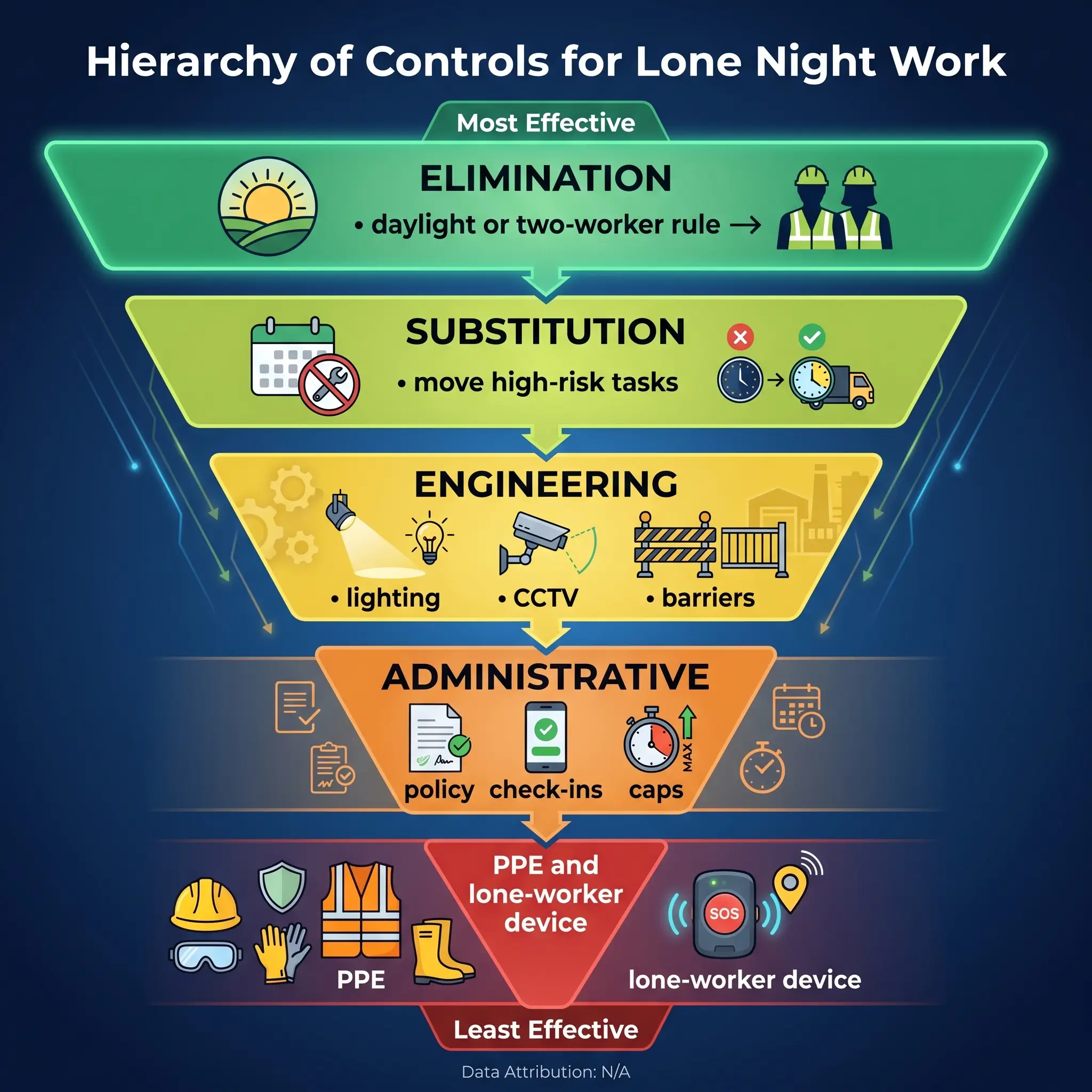
Most content on lone-worker safety jumps straight to technology. That order is wrong. The hierarchy of control — elimination, substitution, engineering, administrative, then personal protection — puts the panic button where it belongs: as the last line of defence, not the first.
Elimination. The first question on every lone-night task should be: can this be done during daylight or with a second worker? If yes, the law and HSG256 expect it. Stock takes, cash transfers, hazardous maintenance, and external perimeter checks usually survive this test.
Substitution. Move high-risk tasks — cash counting, deliveries, waste disposal, plant shutdown operations — into daylight hours or onto shifts where two workers are present. Reschedule the risk out of the lone window wherever practicable.
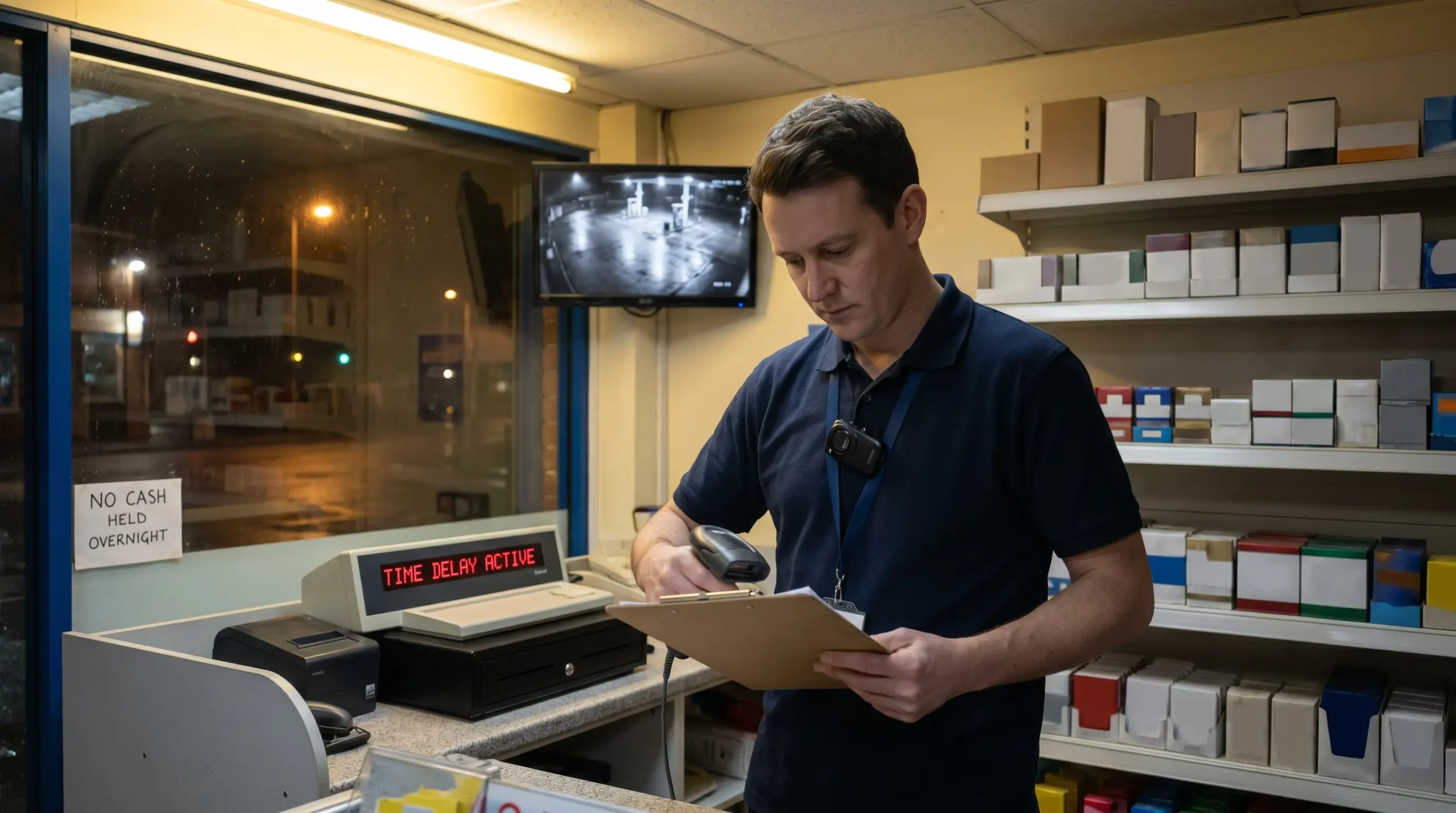
Engineering. Controls that do not rely on worker behaviour: external and internal lighting on timers and motion sensors, CCTV with live monitoring by an alarm receiving centre, physical cash screens and bollards, remote-locked back-of-house doors, secure entry control, time-delay safes.
Administrative. Lone-working policy specifying what is and is not permitted alone at night; scheduled check-ins; buddy-pair rotations where feasible; forward-rotating shift patterns; eight-hour shift caps for safety-critical work (HSG256); break planning including a short nap where permitted; conflict de-escalation training.
PPE and personal technology. Dedicated lone-worker alarms, panic buttons, man-down or no-motion sensors, GPS-enabled apps, two-way radios, and reflective hi-vis for external tasks. These are essential — but they are the last layer, deployed because the earlier layers have residual risk, not because they replace them.
Safety Tips for Night-Shift Lone Workers
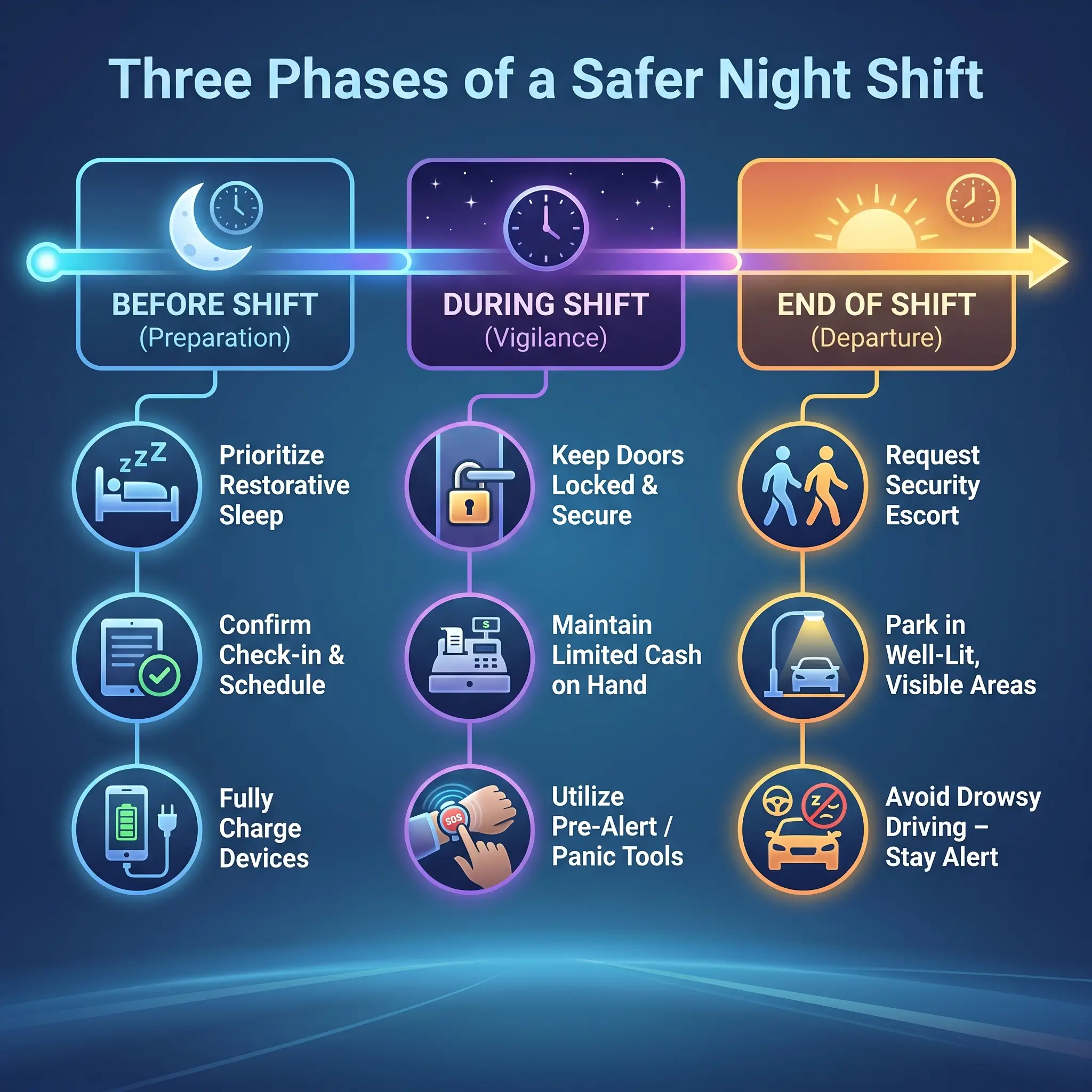
The shift experience breaks into three phases, and advice should match. Tips that ignore the commute home ignore one of the highest-frequency exposures in the whole category.
Before your shift
- Protect the sleep opportunity. Sleep in a dark, cool room; blackout curtains matter more than most workers expect. Aim to enter the shift closer to rested than to depleted.
- Confirm your check-in contact and expected response time. Know who is monitoring you, how they escalate, and how long they will wait before acting on a missed check-in.
- Charge every device. Lone-worker alarm, phone, and a backup battery. Flat batteries are a leading cause of failed emergency activations.
During your shift
- Keep doors locked outside trading hours. Route customers through a single controlled entrance where operationally possible.
- Limit cash on premises and display clear "no cash held overnight" signage where cash storage is genuinely reduced.
- Never confront an offender. Comply with demands, prioritise personal safety over property, and raise the alarm from a safe location. This is the single most important rule in a robbery scenario, and it is the legal and operational expectation.
- Use the pre-alert at the first sign of unease, not only during a full incident. Waiting until the incident is in progress costs response time.
- Take scheduled breaks. Where permitted and safe, a 20-minute nap can restore alertness without the deep-sleep inertia that follows a longer rest.
- Scan before you move. Walking into stockrooms, loading bays, or external compounds after dark is when situational awareness matters most.
End of shift and commute
- Leave with a colleague or with a security escort to your transport where that can be arranged.
- Park in well-lit, CCTV-covered areas. Decide the route home before the shift, not at 05:00 when fatigue is peaking.
- Do not drive if microsleeps are occurring. Use a taxi, rideshare, or rest on-site before driving. Drowsy driving impairment approaches the profile of alcohol intoxication at higher sleep-debt levels.
Employer Responsibilities and Policy Essentials
Employer duty of care for lone night-shift workers is not discretionary, and the documentation requirement is where most enforcement action lands. A defensible policy covers the following elements.
- Written lone-worker policy specifying what is permitted alone at night and what is prohibited after dark. The absence of this document is usually the first finding in any post-incident investigation.
- Free night-worker health assessment before assignment and at appropriate intervals thereafter — a specific requirement under WTR 1998 Regulation 7 in the UK, with equivalent occupational-health obligations in Australian and Canadian regimes.
- Documented check-in procedure with named roles, intervals matched to risk level, and a written escalation path if a check-in is missed.
- Workplace Violence Prevention Plan — mandatory in California under Labor Code §6401.9 as of 1 July 2024, and best practice elsewhere. Should cover de-escalation training, incident logs, and post-incident care.
- Training in lone-working safety, conflict resolution, emergency response, and de-escalation — refreshed at defined intervals, not once at induction.
- Communication tools appropriate to the risk — for high-risk roles, a dedicated lone-worker device with 24/7 monitoring rather than reliance on a personal phone.
- Rota review to avoid permanent night assignment where possible and to support forward-rotating patterns.
- Post-incident support — workers' compensation access, counselling or employee assistance programme referral, formal investigation, and documented corrective actions closing back into the risk assessment.
Audit Point: In a post-incident review, auditors typically ask three questions first. Was there a written risk assessment naming this scenario? Was there a documented check-in procedure, and is there evidence it was followed on the night in question? Was a night-worker health assessment on file? A "no" on any of these shifts the investigation from incident-specific to systemic.
Emergency Response and Check-In Procedures
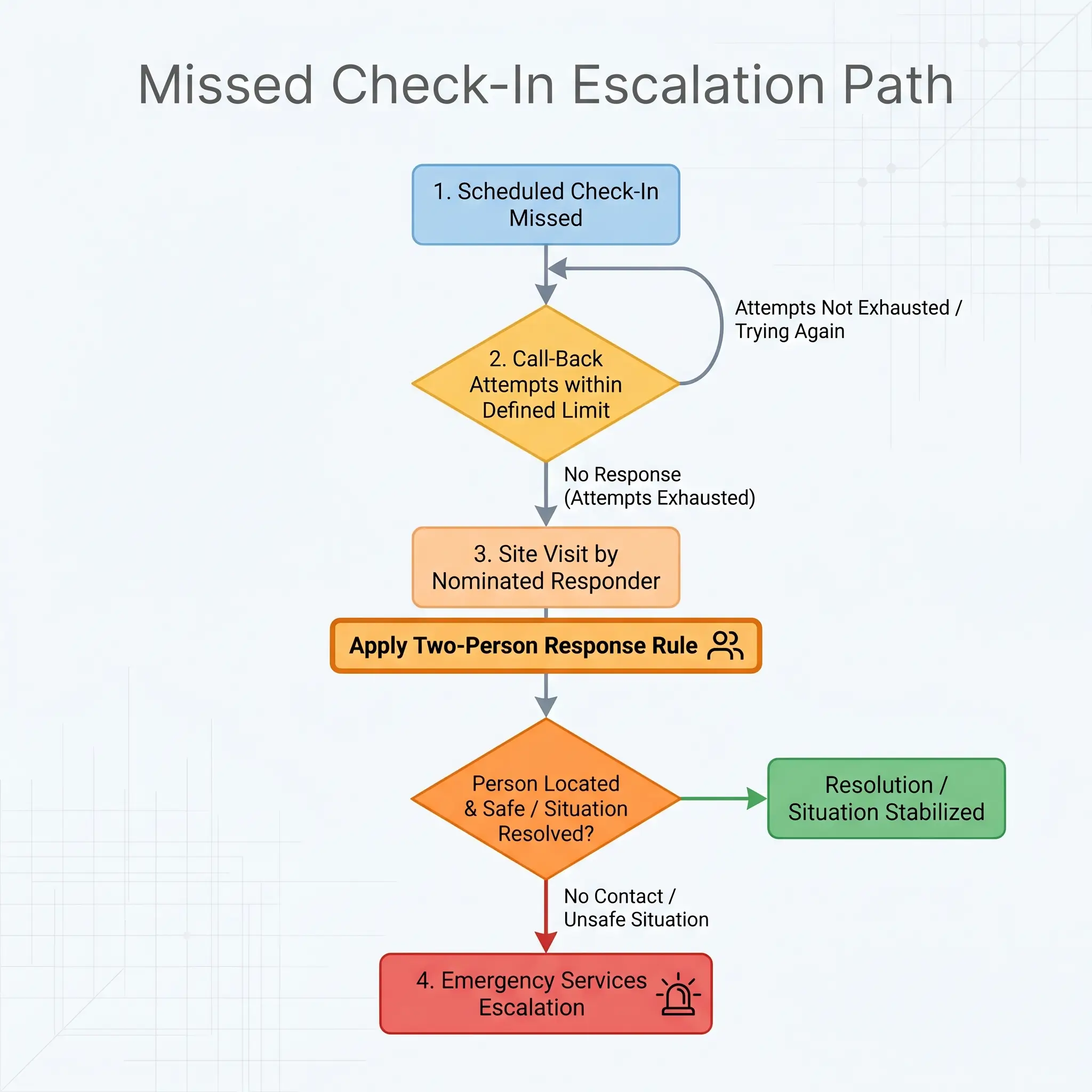
A consistent failure mode in lone-worker fatality investigations is that a check-in procedure existed on paper but was not operated in practice — or the escalation path was not defined, so a missed check-in drifted into a delayed rescue. A defensible procedure specifies both the intervals and the response.
- Two-way check-in at an interval appropriate to the risk. Practical ranges: 15–30 minutes for high-risk lone retail, cash handling, or volatile customer environments; 30–60 minutes for medium-risk; up to 60 minutes for low-risk office or facility monitoring.
- On a missed check-in, immediate call-back attempt — with a defined number of attempts and a defined timeout before escalating.
- If call-back fails, site visit by a nominated responder. The responder must never attend a suspected violent incident alone; the two-person response rule applies here.
- If the situation is unsafe or unclear, emergency services are called. Named roles know who has authority to escalate and what information to pass (address, known hazards, worker location, known medical conditions).
- Pre-alert vs. full duress. The worker should have both — a discreet "something feels wrong" signal that alerts the monitor without alerting an offender, and a full duress alarm for an active incident.
- Incident investigation within 24–48 hours and corrective action closed back into the risk assessment. The procedure is only as strong as its last post-incident review.
Technology That Supports Lone Night Workers
Technology sits at the bottom of the hierarchy because it mitigates residual risk — it does not eliminate it. Selected correctly, a lone-worker device turns a delayed rescue into a fast one. Selected on price alone, it turns into a false sense of security.
The functional categories that matter:
- Panic/SOS button with location share. Activates silently; transmits GPS or indoor position to a monitoring centre.
- Man-down, no-motion, or fall-detection sensor. Triggers an automatic alarm if the worker is motionless for a set period, with an adjustable pre-alarm countdown calibrated to the task.
- GPS tracking and indoor positioning. Outdoor GPS plus Wi-Fi or Bluetooth triangulation for inside buildings where satellite signal fails.
- Geofencing. Automatic alert when the worker enters or exits a defined high-risk zone.
- Two-way voice and push-to-talk. Live communication with a monitor or colleague without handling a phone.
- 24/7 Alarm Receiving Centre (ARC) monitoring. Staffed response that escalates to emergency services; the specification most easily overlooked when purchasing on price.
- Integration considerations. Cellular versus satellite coverage for remote sites, battery life under continuous monitoring, intrinsic-safety certification for hazardous environments, and data-privacy handling of location and biometric data.
A current trend worth naming: the convergence of lone-worker monitoring with wearable physiological sensing — heart-rate variability, heat stress, and fatigue indicators — is shifting the category from reactive to predictive. The direction is promising, but the evidence base is still maturing; procurement decisions should rest on validated clinical and operational performance, not marketing claims.
This article provides general HSE knowledge. Life-critical work — including the design of a lone-worker safety system, the specification of check-in intervals for high-risk roles, and post-incident response planning — must be planned and supervised by a competent person with relevant training, jurisdiction-specific authorisation, and site-specific risk assessment. The information here does not replace that. Recognised training pathways include NEBOSH, IOSH, OSHA outreach programmes, and regional equivalents.
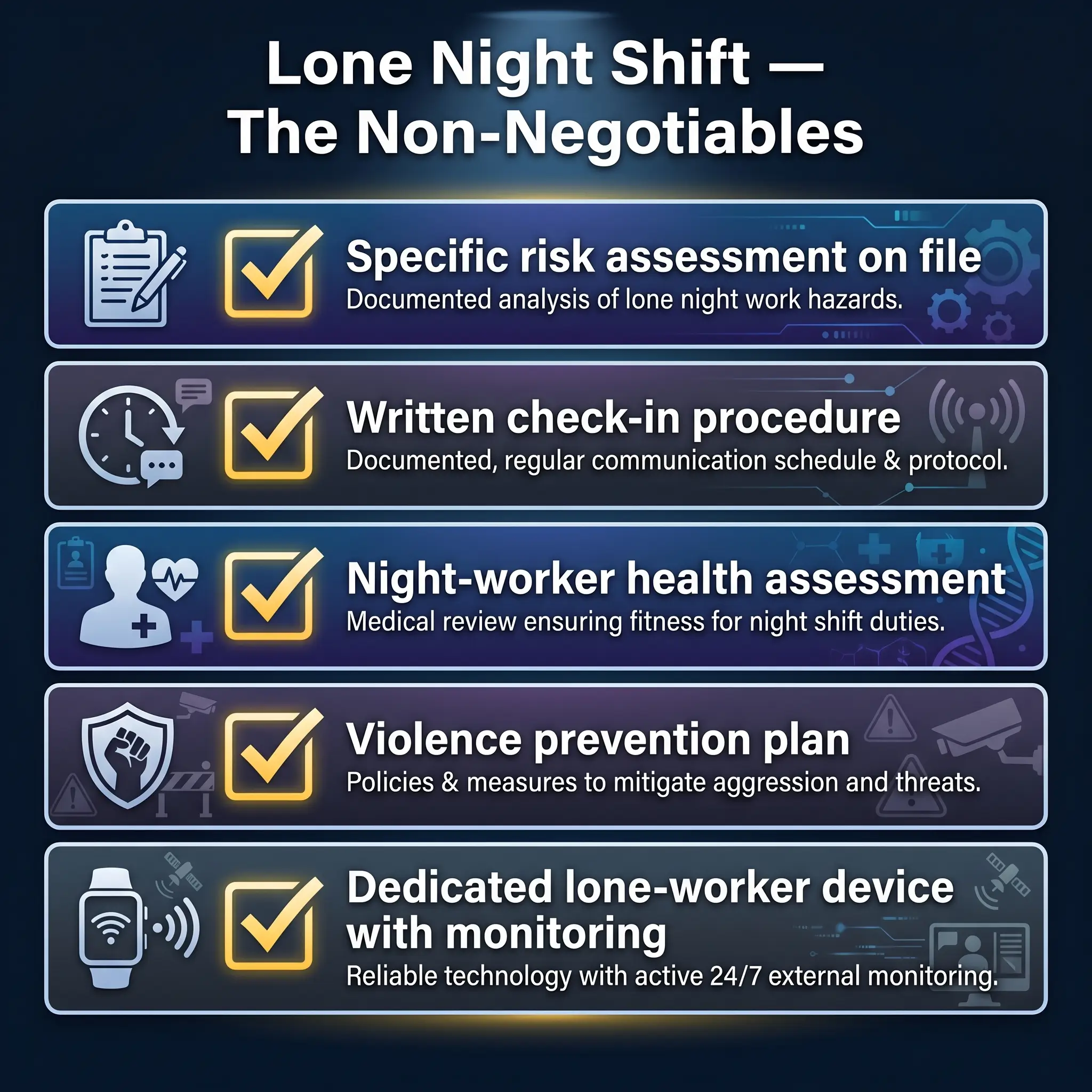
Infographic Type: Checklist Infographic Title: Lone Night Shift — The Non-Negotiables Key Points:
- Specific risk assessment on file
- Written check-in procedure
- Night-worker health assessment
- Violence prevention plan
- Dedicated lone-worker device with monitoring Data Attribution (if statistic shown): N/A Branding: None — no logos, no watermarks, no brand marks of any kind
Frequently Asked Questions
Is it illegal to work alone at night?
No. In the UK, US, Australia, and Canada, working alone at night is generally lawful provided the employer has completed a specific risk assessment and discharged their duty of care. The Health and Safety at Work Act 1974 (UK), OSHA's General Duty Clause (US), and the Work Health and Safety Act 2011 (Australia) all require the employer to assess and control the added exposure rather than prohibiting solo night work outright.
How often should a lone worker check in during a night shift?
Intervals scale with risk. For high-risk lone work — cash handling, late-night retail, volatile customer interaction — 15 to 30 minutes is a defensible range. Medium-risk settings sit at 30 to 60 minutes, and low-risk office or facility monitoring can extend to 60 minutes. OSHA 29 CFR 1915.84 uses the phrase "at intervals appropriate to the nature of the assignment," which is where risk-based calibration lives.
What is the single biggest risk for lone workers at night?
It depends on the role. Violence and robbery dominate customer-facing and cash-handling roles; fatigue-related error dominates safety-critical roles in healthcare, transport, and process operations; delayed rescue after a medical or injury event is the universal risk across every lone context. Any risk assessment that picks one and ignores the others is incomplete.
What is the difference between a lone-worker alarm and a regular mobile phone?
Function. A dedicated lone-worker device adds silent panic activation, man-down or no-motion detection, GPS tracking, and 24/7 monitoring by an alarm receiving centre that escalates to emergency services. A mobile phone requires the worker to be conscious, able to dial, able to speak, and able to explain their location — all of which a stressed or injured lone worker often cannot do.
Can pregnant or young workers do lone night shifts?
Additional assessment is required, and restrictions vary by jurisdiction. Under the UK Working Time Regulations 1998, pregnant workers can request transfer from night work on written medical advice. Under-18s face tighter limits on night working hours in most jurisdictions. The ILO Night Work Convention 1990 requires suitable alternative work where a worker is medically unfit for night duty, and specific protections for pregnant workers.
What should I do if I feel unsafe during a night shift?
Act on the pre-alert function rather than waiting for a confirmed incident. Relocate to a safer area — a locked back-of-house room, a secure vehicle, an area covered by CCTV. Contact the supervisor or monitoring centre, and if the situation escalates, emergency services. Document the event afterwards so the risk assessment is updated. Acting early is the difference between a near-miss record and an injury record.
Conclusion
The worker at 03:00 in an empty petrol station, the care visitor at a single dwelling, the solo security guard on a perimeter round — these are not edge cases. They are the normal operating profile of several industries, and the data around them is unambiguous. Night-shift injury rates are a third higher than day-shift rates. Lone-worker violence concentrates in the exact premises and exact hours where solo coverage is cheapest. Fatigue strips the margin that keeps routine tasks from becoming incidents. Every one of those exposures is preventable, and every one of them has killed people who were competent, careful, and doing exactly what they were asked to do.
The work that makes the difference is neither glamorous nor technological at its core. A written risk assessment that names the scenario. A check-in schedule matched to real risk, with a rehearsed escalation path. A lighting and CCTV specification that removes the incentive for offenders. A shift-length cap that respects the circadian reality. A health assessment that catches the worker who should not be on nights at all. Technology — the panic button, the man-down sensor, the alarm receiving centre — matters, but it matters last, because the earlier layers reduce how often it ever needs to fire. Lone working on night shifts will not become safe through slogans or stickers. It becomes safe through employers who treat the compound hazard as compound, and through workers who are given the policy, the tools, and the authority to use both.