
TL;DR — The Numbers That Define This Hazard
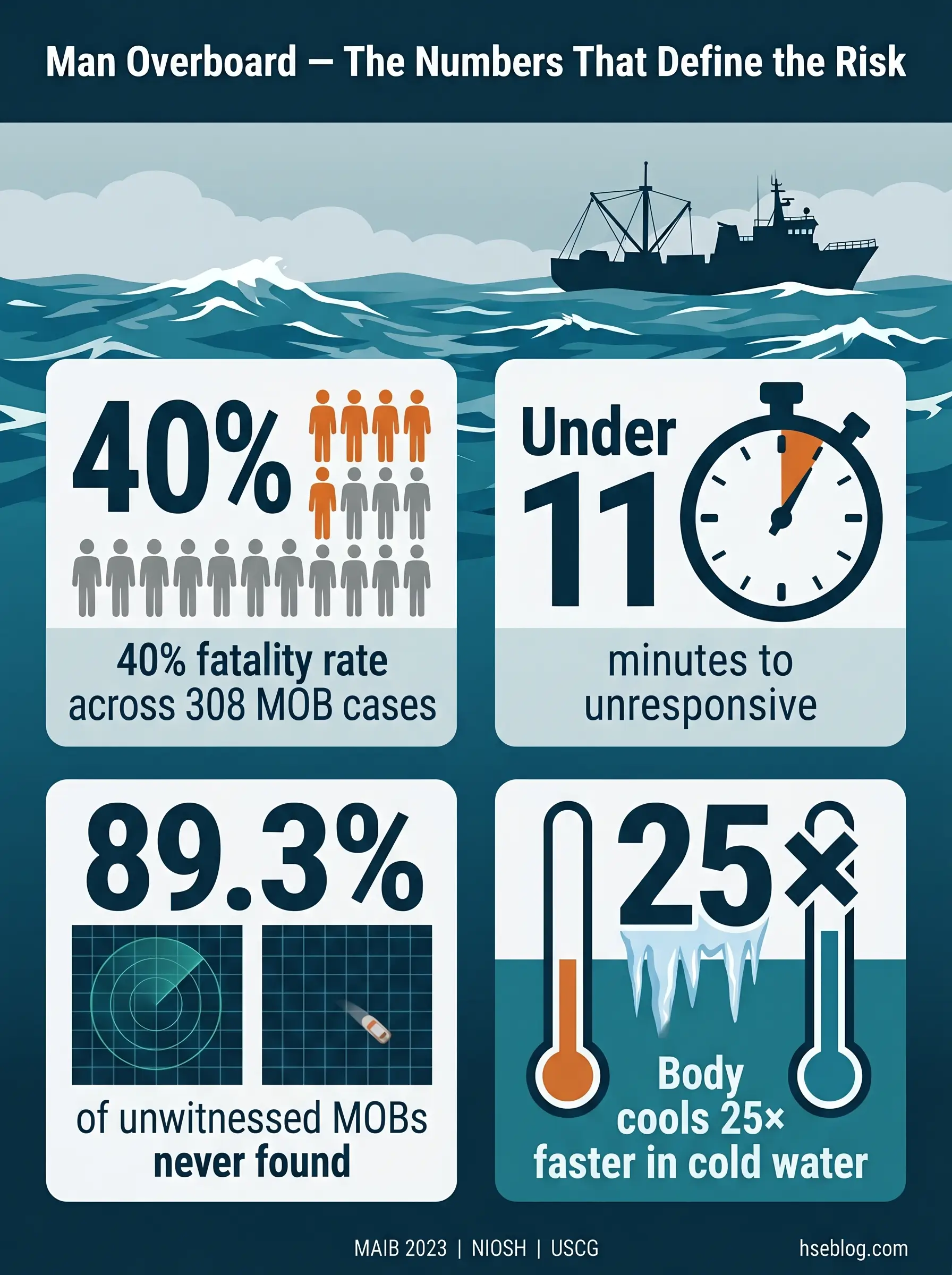
- 40% fatality rate across 308 man overboard occurrences reported to the UK Marine Accident Investigation Branch between 2015 and 2023 (MAIB, 2023). MOB is not a rare edge case — it is a recurring fatality driver.
- Under 11 minutes average time before a cold-water casualty becomes unresponsive, based on MAIB analysis of 20 incidents between 2017 and 2021, falling to 4–5 minutes in the coldest conditions (MAIB, 2023).
- 89.3% of unwitnessed US commercial fishing MOB victims (2000–2016) were never found (NIOSH, 2019). Without a witness, the response chain collapses.
- 25× faster cooling in cold water than in cold air of the same temperature (US Coast Guard). The survival window is narrower than most SMS documents assume.
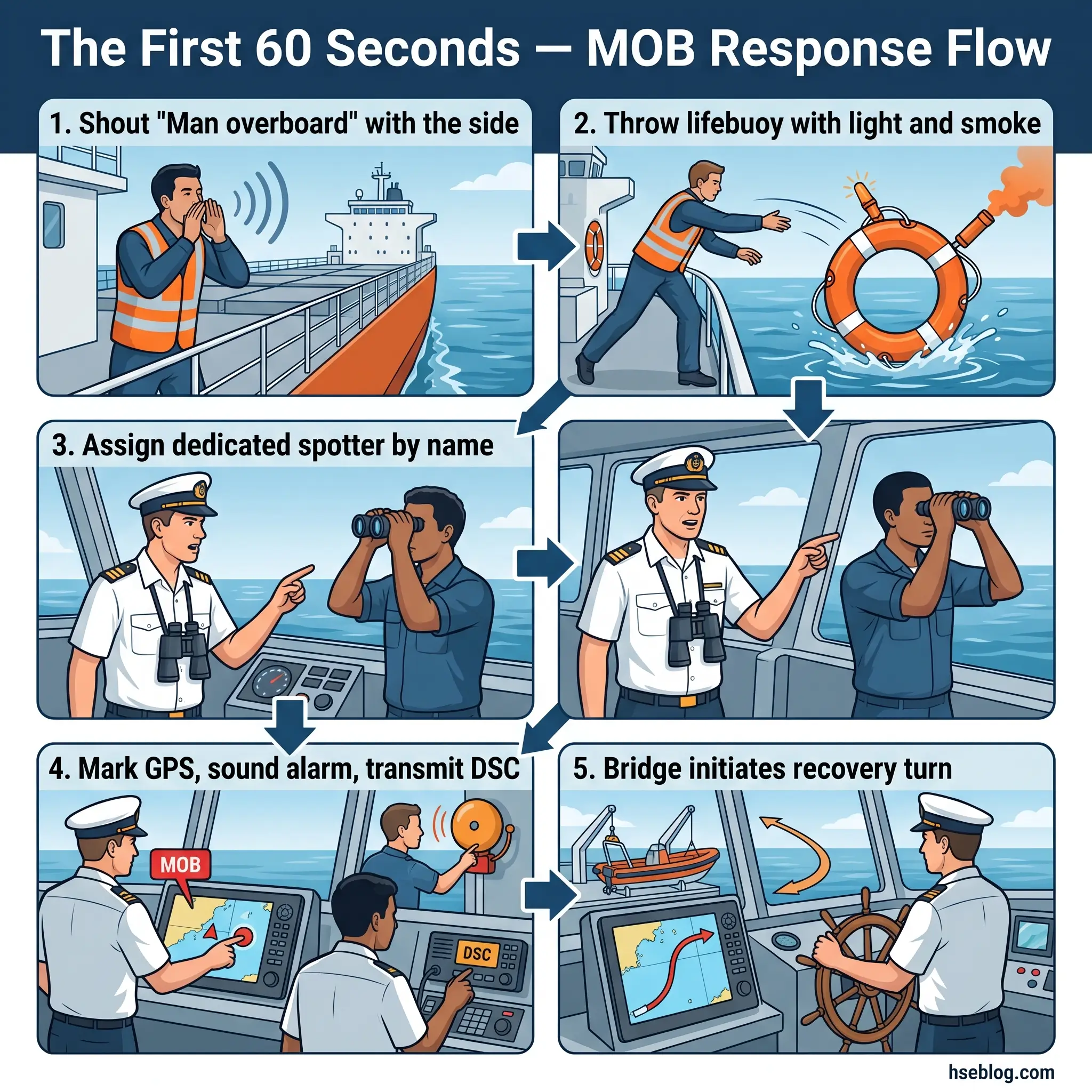
The moment someone falls overboard, shout “Man overboard” with the side (port or starboard), throw flotation immediately, assign one crew member as a dedicated spotter who keeps constant visual contact, mark GPS position, and sound the alarm. The bridge then initiates an Anderson, Williamson, or Scharnow turn based on visibility and conditions. Cold-water incapacitation typically begins within 11 minutes (MAIB, 2023), so every second of the first response matters.
Across 308 man overboard occurrences reported to the UK Marine Accident Investigation Branch between 2015 and 2023, 40% ended in fatality (MAIB, 2023). That figure is the benchmark every bridge team, skipper, and HSE manager should carry into every watch. It tells you MOB is not a sailing-magazine anecdote — it is a routine fatality mechanism across every sector that puts people on a deck above water. The MAIB’s 2023 synthesis of 20 incidents from 2017 to 2021 pushed the evidence further: crews on average had under 11 minutes before the casualty stopped responding, and as little as 4 to 5 minutes in the coldest or roughest conditions.
That narrow survival window is what this article is built around. Man overboard prevention and emergency procedures cannot be written as two separate topics because the prevention failure and the response failure share the same root causes — unassigned roles, unrehearsed recovery, lifejackets available but not worn, and drill scenarios that never reflect real conditions. What follows covers the hazard mechanism, the prevention controls that actually reduce MOB frequency, the minute-by-minute response that maximises recovery probability, the regulatory stack across IMO, US, UK, and fishing-sector regimes, and the specific failure modes the published investigation record keeps surfacing.
Why Man Overboard Remains a Leading Cause of Maritime Fatality
The MAIB dataset does more than state the headline fatality rate — it exposes a stubborn distribution across sectors that refuses to improve. Within the 2015–2023 dataset, the fishing industry carried a 56% fatality rate, recreational and pleasure craft 47%, cargo operations around 30%, inland waterways 25%, and the service-ship sector recorded an outlier recovery rate of roughly 85% (MAIB, 2023, summarised in Practical Boat Owner coverage). The gap between 56% and 15% fatality is not primarily a difference in sea state.
Reviewing the sector data alongside NIOSH’s surveillance of US commercial fishing fatalities (2000–2016), the dominant explanatory variable is witness presence. NIOSH recorded 204 US fishermen dying after falls overboard, and 121 of those falls — 59.3% — were unwitnessed. Of those unwitnessed victims, 89.3% were never recovered (NIOSH, 2019). Without a witness, there is no alarm, no position mark, no turn, no search. The statistical collapse is immediate.
| Sector | MOB Fatality Rate (MAIB 2015–2023) |
|---|---|
| Fishing | 56% |
| Recreational / pleasure craft | 47% |
| Cargo | ~30% |
| Inland waterways | 25% |
| Service ships | ~15% (inverse of ~85% recovery) |
The service-ship sector’s recovery rate is instructive. Smaller crews, frequent operational drills, near-constant visual contact between crew, and integrated launch-and-recovery systems combine to shrink the response time. It is a rehearsal-and-witness effect, not a technology effect. That pattern sets the agenda for the rest of this article.
Root Causes: Why People Go Overboard
The search-intent literature wants a list of causes, and a list is a useful starting point — but only if each cause is linked to a prevention control. Causes of man overboard incidents cluster into three categories that map directly to the hierarchy of controls introduced in the next section.
Task-based triggers dominate the commercial record. Mooring and unmooring operations put crew close to rolling decks with loaded lines under tension. Gear handling on fishing vessels — net hauling, long-line setting, trawl-door management — places workers in contact with moving equipment at the gunwale. Over-the-side maintenance without fall protection recurs across the MAIB prosecution history, as does single-handed fish-handling in adverse weather.
Environmental triggers amplify task risk. Rolling decks, ice accretion, standing water at winches, inadequate lighting in the working deck area, and poor drainage around fish-handling stations all shift a routine task toward a fall. On offshore standby and supply vessels, swell-driven deck motion during personnel transfer by crane basket is a specific overboard scenario that does not fit generic “slip, trip, fall” categories.
Human-factor triggers are where investigation reports most often land the proximate cause. Fatigue dominates the fishing literature, with long watches and split-shift patterns eroding balance and reaction. Working alone on deck eliminates witness presence. Missed toolbox talks before high-risk operations — a recurring finding in SAFETY4SEA incident summaries — leave the crew without a shared mental model of where they should and should not be during the task.
Sitting behind these three categories is a design dimension the sector often treats as fixed. Railing height, bulwark continuity, handhold placement, and deck-opening guarding are engineered features of the vessel. Where the Cruise Vessel Security and Safety Act 2010 applies — US-calling cruise ships carrying 250 or more passengers — the statutory minimum railing height is 42 inches (1.07 m). Outside that regime, SOLAS does not specify a single harmonised height, and flag-state variance is significant.
Watch For — The Domeh et al. 2021 Bayesian network analysis of small fishing vessel MOB scenarios identified “failed to use fall-arrest system” as the single most powerful pre-existing condition in fatality outcomes. It is not railings that are mainly killing crew on fishing boats; it is the fall-arrest PPE that exists on paper and is not worn at the task.
The unwitnessed-fall finding is the thread running through every category. When a fall is unwitnessed, task-based, environmental, and human-factor causes compound into a survival probability close to zero. That is why the rest of this article treats witness presence not as a discipline issue but as a survival control.
Prevention: The Control Hierarchy Applied to Man Overboard Risk
In HSE practice, the hierarchy of controls is routinely applied to machinery guarding and chemical exposure but rarely rigorously applied to man overboard risk. Doing so exposes where most vessels concentrate effort at the bottom of the hierarchy — PPE — while leaving the higher-order controls thinly implemented.
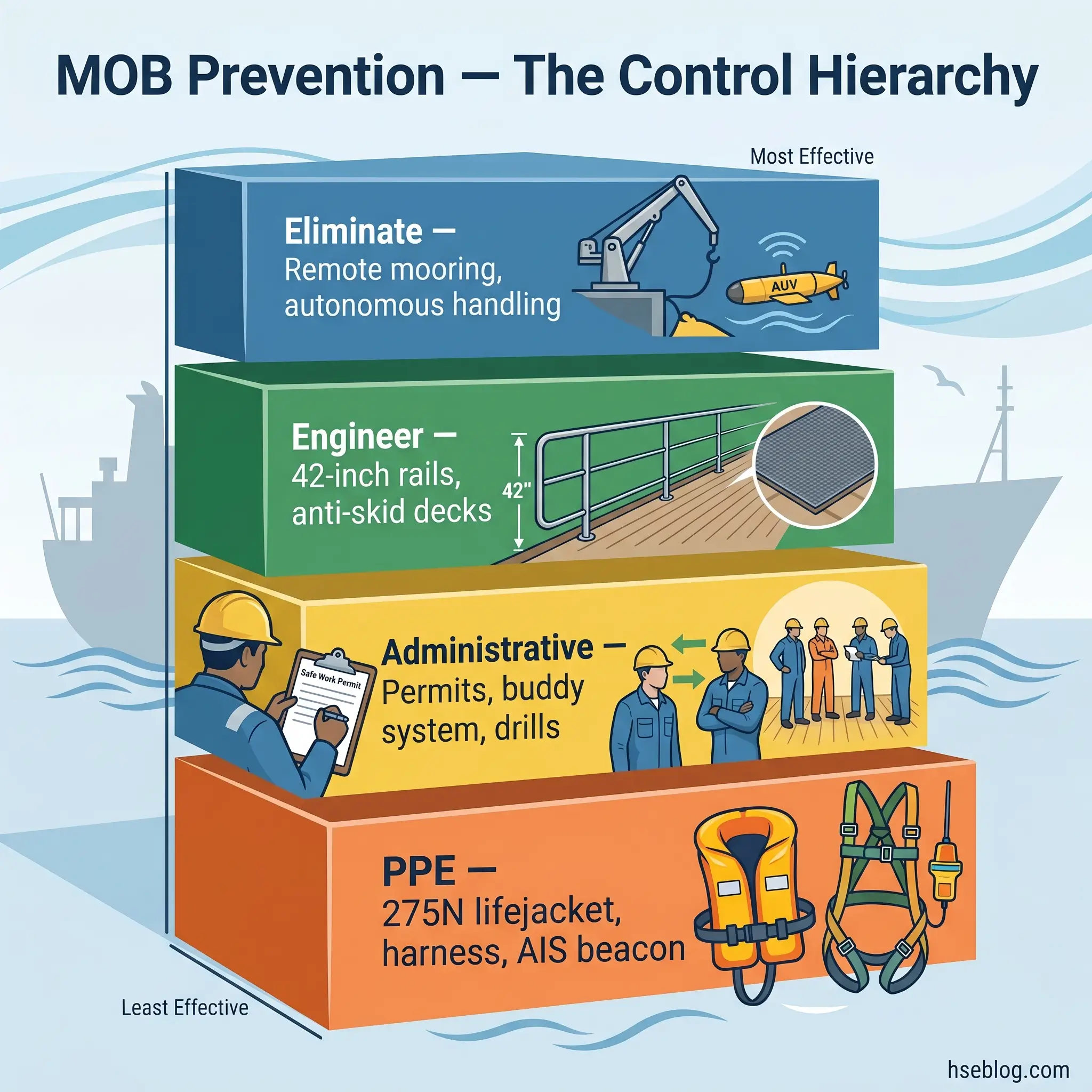
Elimination is the strongest control. On a vessel, elimination means removing the human from the hazard location entirely. Remote mooring systems on modern cruise and cargo vessels, autonomous or semi-autonomous net-handling systems on newer trawlers, and conning from enclosed bridge wings rather than open platforms all belong in this category. These are capital decisions taken at design stage, but they set an upper ceiling on residual MOB risk for the life of the vessel.
Engineering controls are where most vessels must do the heavy lifting. Railing height, bulwark design, non-slip deck surfaces, guarded openings, and enclosed freeboard all reduce the probability of a fall given that a person is on deck. The FAO/ILO/IMO Voluntary Guidelines for small fishing vessels require anti-skid surfaces in working areas; the OSHA shipyard standard at 29 CFR 1915.159 requires fall-protection systems that prevent free falls greater than six feet; and the CVSSA rail standard of 42 inches is the most specific US engineering benchmark.
Administrative controls carry the procedural load. A permit-to-work regime for over-the-side tasks, a lone-working prohibition on exposed decks in heavy weather, a documented toolbox talk before mooring operations, a buddy system for any task within two metres of an unguarded edge, and a vessel-specific risk assessment under the ISM Code — these are the controls SMS audits should be testing. The ISM Code (Part A, §1.2) requires the safety management system to identify risks and establish safeguards against them, and MOB is one of the identified emergency scenarios under Part A §8.
Personal Protective Equipment is the last line, not the first. Inflatable lifejacket buoyancy classes under ISO 12402 range from 100N through 150N (recreational) to 275N (offshore workwear). SOLAS requires a minimum of 100N for adults on merchant vessels, with 150N recommended where workwear is exposed. For open-deck work in heavy weather, the 275N specification should govern. On sailing and offshore vessels, integrated harness-and-tether systems clipped to jackstays, kill cords on small craft, personal 406 MHz PLBs, and personal AIS MOB beacons all belong in a layered PPE strategy.
A preventive-technology layer now sits alongside traditional PPE. Motion-sensor MOB detection systems such as MARSS MOBtronic, deck-camera analytics, and thermal imaging have matured into commercial deployment on cruise and offshore vessels. The Cruise Vessel Security and Safety Act §3507(a)(1)(D) requires integration of MOB detection technology “to the extent available,” but industry estimates place effective automated MOB detection on less than 2% of cruise ships — a compliance gap the USCG Supplemental Notice of Proposed Rulemaking (RIN 1625-AB91) is intended to close.
Jurisdiction Note — CVSSA railing and detection-technology obligations apply only to vessels carrying 250 or more passengers calling at US ports. A SOLAS-compliant cruise ship that never calls at a US port faces no equivalent statutory railing height and no detection-technology mandate. The US regime is the stricter reference here and is the de facto global standard for any cruise line with US itineraries.
The enduring failure mode across the middle of the hierarchy is PFD compliance. MAIB prosecution patterns repeatedly cite “PFD available but not worn” as the proximate survival failure. A written lifejacket policy with no wear-check regime is a paper control. The practical test is whether a master can walk onto the working deck during any operation, observe the crew, and see the policy being complied with. If the answer is no, the engineering and administrative layers above have to absorb the load.
Railing, Deck Design, and Passive Engineering
Where CVSSA applies, the 42-inch (1.07 m) rail minimum is the benchmark and has become a de facto cruise-industry standard regardless of flag. Outside cruise, flag states and classification societies set the specification: the UK MCA’s MGN 544 Amendment 1 frames rails and handholds as part of the “means of recovery” picture rather than a stand-alone engineering requirement. Anti-skid deck treatments are covered under FAO/ILO voluntary guidelines for fishing vessels and under OSHA’s shipyard walking-working surfaces standards where US jurisdiction applies. The passive-engineering layer matters most at the edges most crew do not consciously approach — bulwark tops that become steps in heavy weather, railings interrupted by winch runs, and mooring-deck openings that revert to hazard when covers are displaced.
PPE Selection: PFDs, Harnesses, and Personal Beacons
Lifejacket specification is the most commonly misapplied PPE decision in MOB planning. A 150N jacket is adequate for inshore and near-coastal work in workwear; offshore open-deck work in heavy-weather conditions warrants the 275N workwear class per ISO 12402-2, which is designed to turn an unconscious casualty face-up even when heavy oilskins restrict inflation. Automatic hydrostatic inflation eliminates the manual-activation failure mode, which investigation reports repeatedly identify in the moments after immersion when cold shock makes manual activation unreliable.
Harness and tether use on sailing and small offshore vessels is a separate control. A tether clipped to a through-bolted jackstay converts a fall overboard into a fall-on-deck event — a less serious outcome but one with its own injury risk. The practical interpretation: the tether is a prevention control, not a recovery control, and must be specified for the task.
Personal beacons split into two functional categories. A personal AIS MOB transmitter alerts AIS-equipped vessels within VHF line-of-sight (typically under 5 nautical miles) within seconds of activation. A 406 MHz Personal Locator Beacon alerts the COSPAS-SARSAT satellite network with global coverage, but the alert routes through a Rescue Coordination Centre and then back to local assets, which introduces time. Combined 406+AIS devices now available give the fastest local alert and the global backstop in a single unit. For offshore and remote-area commercial work, combined units are the baseline specification.
What to Do the Moment Someone Falls Overboard: The First 60 Seconds
The first minute determines recovery probability. The actions below are drawn from SOLAS III/17-1 practice, MCA MGN 544 guidance, and STCW A-VI/1-2 competencies. They are sequenced, but several run in parallel — no single crew member performs all of them.
Competent-person caveat — This section provides a general outline of immediate man overboard response. Life-critical decisions — turn selection, rescue-boat launch, recovery method for an unresponsive casualty — must be planned and executed by a competent master, deck officer, or fast rescue craft coxswain with current training, flag-state authorisation, and vessel-specific familiarisation. The information here does not replace that.
- Shout “Man overboard” with the side. “Port” or “starboard” — not “left” or “right.” The side determines which way the bridge will swing the rudder and whether the nearest crew throw a lifebuoy to port or starboard racks.
- Throw the lifebuoy with self-igniting light and smoke signal immediately. SOLAS Ch. III requires the lifebuoy nearest the bridge to carry a self-igniting light and smoke signal and to be capable of rapid release. Throwing it within seconds gives the casualty both flotation and a visible datum for the spotter and the bridge.
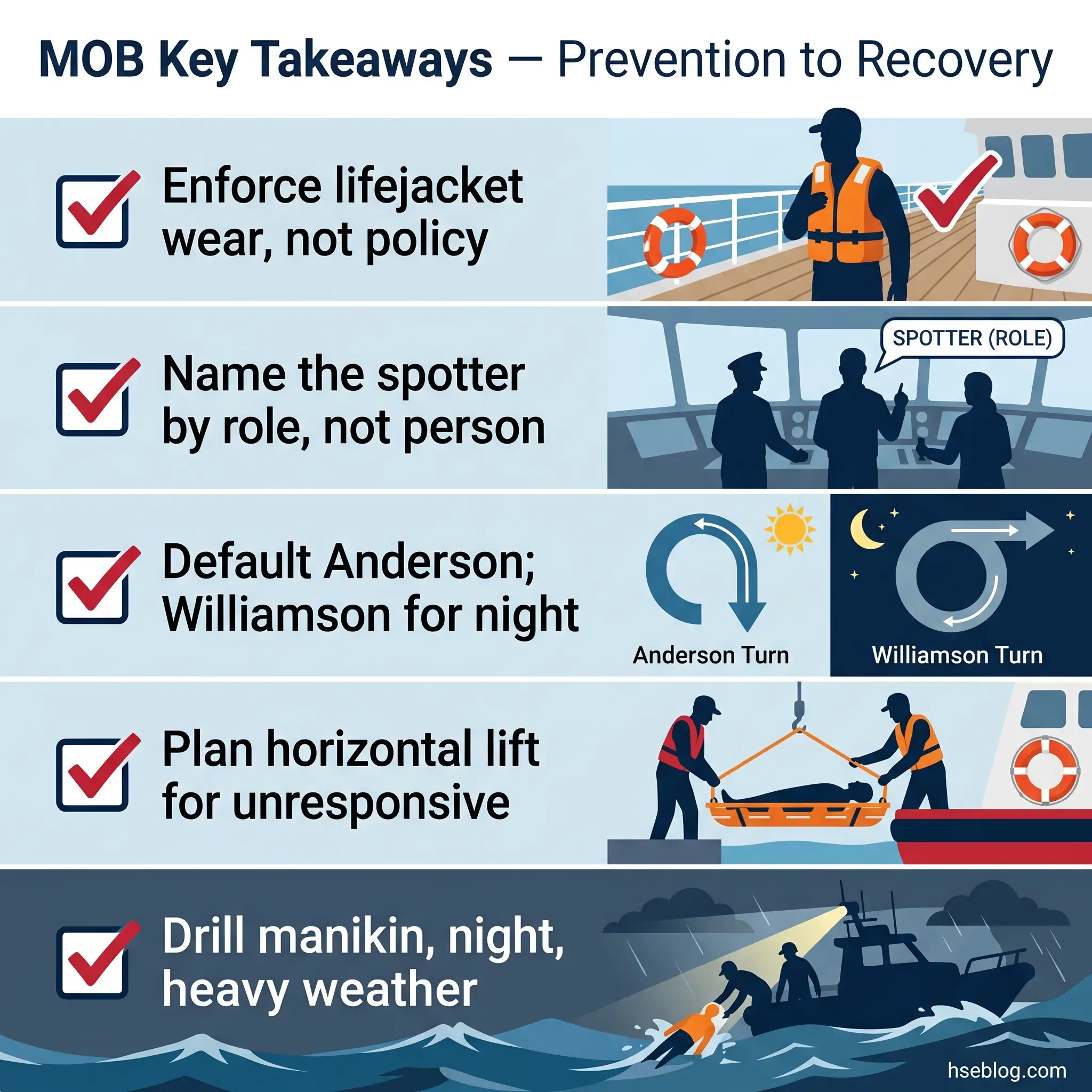
- Assign a dedicated spotter and say their name. One crew member whose only job is to point at the casualty and keep pointing. No secondary task. In real incidents this is the step most often lost — everyone on deck is doing something, and no one is exclusively watching.
- Mark the GPS position. The MOB button on the bridge ECDIS or chartplotter records the position at the instant of the alert and seeds the return track.
- Sound the general alarm and broadcast MOB on the internal PA. The alarm mobilises the muster; the PA specifies side and status.
- The bridge initiates the recovery manoeuvre. Turn selection is covered in the next section — the choice is driven by visibility, time elapsed, and vessel handling.
- Transmit distress. DSC alert on VHF Channel 70; Mayday or Pan-Pan as appropriate on Channel 16; notify the nearest RCC or Coast Guard with position, number of persons in the water, and status.
- Prepare rescue boat and recovery equipment. Crews dress for the conditions, rig recovery equipment on the intended recovery side, and run launch checks.
The step that fails most often is step three. Reviewing the MAIB 2023 analysis, the recurring pattern is that the spotter is either not named, or is named and then drawn into another task — marking the GPS, fetching equipment, or manning the radio. Two minutes of drift in a moderate sea state puts a casualty several hundred metres from the vessel, and once visual contact is lost at dusk or in a chop the probability of reacquisition collapses. The fix is procedural: the spotter is named in the muster list, the role is assigned by position rather than by person, and the spotter is relieved — not removed — if another task demands them.
Choosing a Recovery Manoeuvre: Williamson, Anderson, Scharnow, and Quick Stop
A consistent pattern in the competitor literature is to describe these four manoeuvres as interchangeable options. They are not. Each is optimised for a different combination of visibility, time elapsed, and casualty position relative to the vessel. The selection is a conditions decision, not a preference decision.
| Manoeuvre | Best Used When | Approximate Return | Primary Advantage | Primary Trade-off |
|---|---|---|---|---|
| Anderson turn | Casualty still in sight; good visibility; single-propeller vessel | Fastest — single ~270° turn | Minimum time back to casualty | Can overshoot; requires good handling judgment |
| Williamson turn | Reduced visibility; night; casualty out of sight | Longer — vessel moves farther from datum before returning | Returns vessel along its own track | Slower; the delay can be decisive in cold water |
| Scharnow turn | Fall happened some time ago; casualty astern of turning radius | Between Anderson and Williamson | Returns on track with less offset than Williamson | Not suitable when casualty is still close |
| Quick Stop | Sailing vessel; small commercial sail; under sail | Very fast in its context | Immediate round-up into wind | Sail-specific; not applicable to displacement cargo |
The MSC full-mission simulator comparisons consistently place Anderson as the fastest return in good visibility, which makes it the default selection when the casualty is still in sight and conditions permit. The reason Williamson still appears in every MOB SOP — and in every STCW training syllabus — is not general superiority; it is low-visibility and night resilience. Returning along the vessel’s own track is the best defence against losing a casualty entirely when spotter visual contact fails.
A point the competitor literature treats loosely: the textbook Williamson specification of rudder hard over, 60° course deviation, then hard over opposite until 20° from reciprocal course, is a generic specification. Recent full-mission simulator studies have shown that modern vessels — particularly wide-beam container ships and specialised offshore tonnage — require modified yaw angles to return accurately on their own wake. The practical reading of SOLAS III/17-1 is that each vessel’s actual Williamson track should be documented in the ship-specific recovery plan, not the textbook version. Bridge teams that inherit the generic specification and never simulator-validate it are likely to finish a night Williamson offset from the casualty’s position.
Approaching, Contacting, and Recovering the Casualty
SOLAS Regulation III/17-1 places the specific obligation on the ship-specific recovery-of-persons plan: it must identify equipment, method, and crew competence for the recovery phase. Where the response phase covered above is often well-rehearsed, this phase — the part that starts when the vessel is back in the area — is frequently where real incidents fail.
The final approach should always bring the vessel upwind of the casualty, so it drifts toward them rather than over them. Engine stopped and clutch disengaged before the casualty is alongside is the non-negotiable propeller-discipline rule. Recovery-of-persons equipment categories include rescue boats launched by SOLAS III/14 or III/17 arrangements, rescue slings and horse-collars, Jason’s Cradle, Lifesling systems, recovery nets, davit-launched boats, and purpose-built rescue stretchers. MCA MGN 544 Amendment 1 (2024) sets the UK acceptance criteria for this equipment and is the cleanest reference text for procurement and audit purposes.
The most frequently cited recovery-failure mode in MAIB analysis is the vertical lift of an unresponsive casualty. When the body has been immersed long enough for blood pressure to redistribute — even for a few minutes in cold water — a vertical lift by a harness or single-point sling can trigger circum-rescue collapse. The recovery method for a suspected or confirmed unresponsive casualty must be horizontal. That means a cradle, stretcher, net, or improvised horizontal rig — not a crew member going over the side to clip a harness.
Audit Point — “Recovery becomes much harder if the casualty is unconscious or unresponsive” was the MAIB’s own framing when releasing the 2023 analysis. Yet most drill records show alert, cooperating “casualties” climbing a boarding ladder. The audit question that exposes the gap: when was the last drill run with a manikin simulating an unresponsive casualty being recovered horizontally? If the answer is “we don’t do that,” the drill record is compliant but the competence is not.
High-freeboard vessels — VLCCs, container ships, bulk carriers — cannot recover a casualty without purpose-built means. The SOLAS III/17-1 ship-specific plan on these vessels must specify the equipment and method explicitly; a pilot-ladder-and-boarding-ladder reference is inadequate. Night recovery introduces additional requirements: search lights, the lifebuoy’s self-igniting light, AIS MOB beacon tracking, and — increasingly on modern offshore fleets — thermal-camera drones launched from the bridge wing.
Cold Water Shock, Incapacitation, and Hypothermia: What Actually Kills
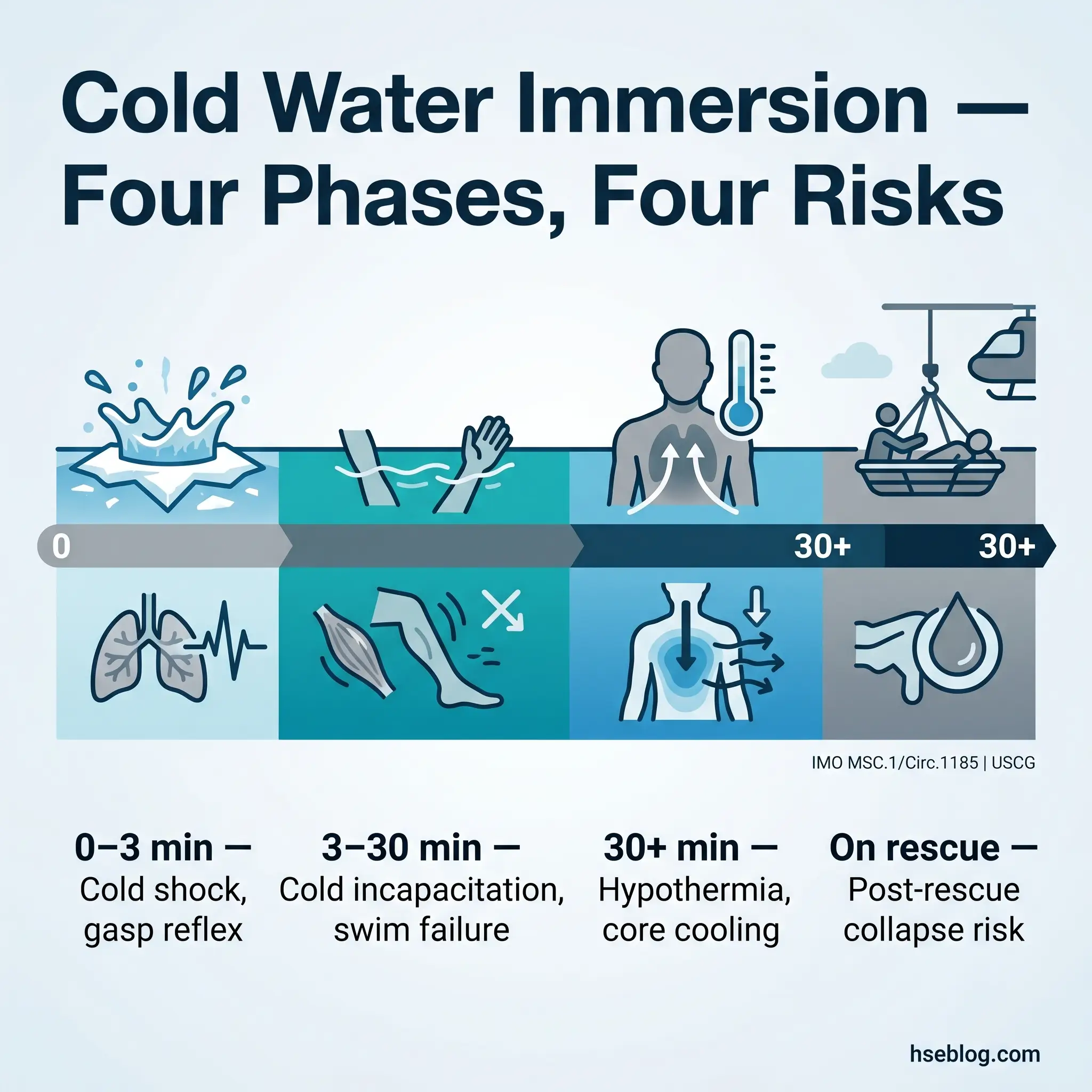
The physiology of cold-water immersion is the area most frequently misunderstood in SMS documents. Readers grew up with a “hypothermia survival chart” that predicts survival times of several hours at 10°C and plans recovery accordingly. The chart is not wrong — it is wrong about which phase kills. Four phases are now recognised in the peer-reviewed literature and in IMO MSC.1/Circ.1185/Rev.1 guidance on cold-water survival.
This is a general physiological overview for HSE practitioner reference and is not medical advice. Workers exposed to cold-water immersion, whether briefly or otherwise, require assessment by a qualified occupational physician regardless of apparent condition.
Phase 1 — Cold shock (0–3 minutes). On first immersion the body triggers an involuntary gasp reflex, hyperventilation, tachycardia, and a sharp blood-pressure spike. The gasp reflex underwater causes aspiration drowning — the casualty inhales water before any swim response begins. According to the US National Weather Service, cold shock can be triggered at water temperatures as warm as 25°C (77°F) and reaches maximum intensity between 10°C and 15.5°C. This is the phase a non-PFD casualty is most likely to die in.
Phase 2 — Cold incapacitation (3–30 minutes). Surface muscle and nerve cooling causes loss of dexterity, grip failure, and swim incapacitation. The casualty may still be conscious, may still be calling out, but cannot grip a rescue sling, climb a ladder, or hold a rope. This is the MAIB under-11-minute window (MAIB, 2023). This is the phase in which witnessed, responsive casualties still die because the recovery method cannot get them back on board before swim failure.
Phase 3 — Hypothermia (typically after 30 minutes). Core temperature falls below 35°C, cognition slows, and cardiac arrhythmia risk rises. This is the phase the survival charts describe accurately — and it is the phase most casualties never reach, because Phase 1 and Phase 2 have already killed them.
Phase 4 — Post-rescue (circum-rescue) collapse. On removal from the water, blood-pressure redistribution and continued core cooling can cause cardiac events and collapse. This is why the SOLAS recovery doctrine requires horizontal handling of cold-water casualties and slow, controlled rewarming under medical direction.
The US Coast Guard’s cold-water reference puts the underlying physics plainly: the body cools approximately 25 times faster in cold water than in cold air at the same temperature (US Coast Guard). That multiplier is why the survival window is so much narrower than air-based hypothermia intuitions suggest. The planning implication is stark — any recovery plan based on “we have at least 30 minutes” is effectively a Phase 3 plan, and the casualty is dying in Phase 2.
The misconception correction belongs in every bridge brief: the survival window is set by cold incapacitation, not by hypothermia. IMO MSC.1/Circ.1185/Rev.1 acknowledges the four-phase model; many SMS documents still work from the older, optimistic chart. An SMS that plans for hypothermia but does not plan for cold shock and incapacitation has a gap the first real casualty will expose.
Regulatory and Drill Requirements Across Jurisdictions
The regulatory content below reflects general HSE professional understanding of the cited instruments as of 2025. It is not legal advice. Specific compliance questions, enforcement situations, or prosecution exposure should be directed to qualified maritime legal counsel in the applicable flag state.
The compliance framework for man overboard prevention and emergency procedures does not sit inside a single instrument. It stacks across international, national, and sector-specific layers, and the audit path depends on which inspector arrives first.
International — IMO / SOLAS / STCW. SOLAS Regulation III/17-1, in force since 1 July 2014, requires all ships other than Ro-Ro passenger ships complying with III/26.4 to carry ship-specific plans and procedures for recovering persons from the water, identifying the equipment, personnel, and measures needed to minimise risk to rescue crews. The implementing framework is IMO MSC.1/Circ.1447. Regulation III/19 requires monthly abandon-ship and MOB drills with an additional drill within 24 hours of departure when more than 25% of the crew has changed. Regulation III/20 covers weekly and monthly equipment inspection. Regulation V/28 addresses passage planning and situational awareness. STCW Code Table A-VI/1-2 sets the competence standards for seafarers in personal survival techniques, including reaction to MOB emergencies. The ISM Code Part A §8 requires MOB to be identified as an emergency scenario with documented response procedures.
United States — CVSSA, USCG, OSHA. The Cruise Vessel Security and Safety Act of 2010 (Public Law 111-207, §3507) applies to vessels carrying 250 or more passengers calling at US ports. It mandates a 42-inch (1.07 m) minimum railing height, integration of MOB detection technology “to the extent available,” video surveillance, and crew security training. USCG Supplemental Notice of Proposed Rulemaking RIN 1625-AB91 is the pending update intended to close the detection-technology enforcement gap. Commercial fishing vessels are governed by 46 CFR 28.270, which imposes monthly emergency drills including MOB recovery and vessel-specific procedures. OSHA 29 CFR 1915 Subpart I covers shipyard PPE and fall protection, including the 1915.159 requirement for fall-protection systems that prevent free falls greater than six feet.
United Kingdom — MCA / MAIB. MCA MGN 570 sets the emergency drill framework for UK-flag vessels. MGN 571 (F) is the fishing-sector prevention guidance, including risk-assessment template and PFD-wear expectations. MGN 544 Amendment 1 (2024) reproduces MSC.1/Circ.1447 in Annex 1 and provides UK acceptance criteria for recovery equipment, including its extension to non-SOLAS vessels. MSN 1871 Chapter 8 governs small fishing vessel codes.
Fishing-sector international. The ILO Work in Fishing Convention (C188), which entered into force 16 November 2017, imposes occupational safety and health obligations on fishing vessels including fall prevention, PPE provision, and crew training; national implementation varies by ratifying state. The FAO/ILO/IMO Voluntary Guidelines for the Design, Construction and Equipment of Small Fishing Vessels provide the design-stage framework that interacts with C188 on built-in risk controls.
Port State Control inspections test these instruments through two separate paths. The ISM audit path examines the ship-specific recovery plan for completeness, consistency with MSC.1/Circ.1447, and integration into the SMS. The PSC inspection path tests drill record-keeping, equipment availability, and crew familiarity. A vessel compliant on paper under III/17-1 can still fail a PSC inspection on III/19 drill-record grounds — and PSC deficiencies in MOB drill compliance can escalate to detainable findings and ISM Code non-conformities affecting the Safety Management Certificate.
Designing an Effective Man Overboard Drill
How this plays out in real operations is the deciding variable between a fleet with a strong recovery record and a fleet with a compliant drill log. The SOLAS III/19 monthly frequency is the floor; the drill design is what converts the frequency into competence.
Frequency begins with the SOLAS III/19 monthly requirement and the additional drill within 24 hours of a crew changeover above 25%. In practice, fleets with the best recovery records run MOB drills more frequently than the minimum, and they integrate drill timing with crew rotations so each new crew member sees a realistic drill within their first week.
Scenario rotation is where most drill programs fail the competence test. A drill that runs every month at noon in calm weather with the rescue swimmer wearing a survival suit and an alert “casualty” climbing the boarding ladder is compliant. It also produces crews that execute flawlessly in conditions that almost never match real incidents. The rotation that actually builds competence cycles through day and night, good and heavy weather, alert and unresponsive casualties, rescue-boat launch where sea state permits, and at least one full manikin-based recovery drill each quarter.
Roles to test under SOLAS III/19 drills and MCA MGN 570 guidance include the spotter, the alarm-initiator, the bridge conning officer, the rescue-boat coxswain and crew, the recovery team on deck, and the medical/first-aid responder. Each role has a specific failure mode, and the drill debrief is the mechanism that surfaces them.
Record-keeping for SOLAS III/19 requires the drill to be entered in the logbook with date, duration, personnel involved, and any deficiencies. The drill report in the SMS adds corrective actions and close-out dates. The MCA MGN 570 interpretation in UK practice adds explicit expectations on realistic training elements — which is where the manikin-based drill becomes not merely recommended but effectively expected at audit.
Debrief discipline is the quiet differentiator. Drills that end with “good job, everyone” build neither competence nor audit evidence. Drills that end with a structured debrief — time-to-alarm, time-to-spotter-assigned, time-to-turn-initiated, time-to-recovery-equipment-deployed, time-to-casualty-back-on-deck — surface the delays that kill in real incidents. The 85% recovery rate in the MAIB service-ship sector is not an accident of equipment; it is the product of this debrief discipline sustained across many drill cycles.
Special Cases: Fishing Vessels, Cruise Ships, and Offshore Installations
The sector breakdown in the MAIB dataset tells a clearer story than the overall fatality rate. Three sectors carry distinct risk profiles and distinct regulatory overlays that a generic MOB article tends to miss.
Fishing carries the highest fatality rate — 56% of UK MOB incidents (MAIB, 2023) and 204 US fatalities from falls overboard between 2000 and 2016 (NIOSH, 2019). The dominant risk factor, from the Domeh et al. 2021 Bayesian network analysis, is failure to use a fall-arrest system that exists on paper. Single-handed operation, night gear handling, and the commercial rhythm that prioritises catch over pause combine with the witness-presence deficit to collapse survival probability. ILO C188 and MCA MGN 571 are the instruments that matter; kill-cord use on small craft is the single-highest-impact prevention measure on a vessel with a sole operator at the helm.
Cruise has the most detection technology available to it and the most passenger witnesses, and yet the CLIA dataset of 212 MOB incidents between 2009 and 2019 records approximately 28% rescued alive (CLIA data, 2024). Industry tracking counted 19 cruise MOB incidents across major lines in calendar year 2024 (Cruise Radio, 2025). The CVSSA 42-inch rail minimum, the §3507(a)(1)(D) detection-technology obligation, the mandated video surveillance — all are in place in regulation. The enforcement gap the USCG RIN 1625-AB91 rulemaking is intended to close is the implementation rate: less than 2% of cruise ships are estimated to use effective automated MOB detection. The reason cruise MOB fails is most often detection delay, not response failure.
Offshore oil and gas installations treat MOB as a subset of fall-from-height risk. On fixed platforms, FPSOs, and jack-up rigs the primary MOB scenarios are personnel transfer by basket or walk-to-work gangway, and over-the-side work on boat-landings. OSHA 29 CFR 1915 applies to US shipyard work; the US OCS adds BSEE SEMS overlay. The primary recovery mechanism is a fast rescue craft launched from the standby vessel, and standby-vessel FRC readiness — crew drill frequency, launch time in the actual sea state, recovery equipment on board — is the specific control that determines whether an offshore MOB is survivable.
The cross-sector synthesis: cruise MOBs fail because detection is slow, fishing MOBs fail because they are unwitnessed, commercial cargo MOBs fail because crews drill the turn but not the lift, and offshore MOBs fail because FRC launch times in actual sea state exceed the cold-water incapacitation window. Each sector has its own dominant failure mode — and each requires a different emphasis in prevention and drill design.
Frequently Asked Questions
Closing Thoughts — The Human Stakes
The hardest part of writing about man overboard prevention and emergency procedures is also the simplest: the 40% fatality rate across the MAIB 2015–2023 dataset does not move because the hazard does not move. Every generation of master, every new HSE manager, every fishing skipper inherits the same physics, the same rolling decks, the same witness-presence problem, and the same under-11-minute window.
What changes is competence. The sectors that improve their recovery numbers do so by taking the higher-order controls seriously — elimination where capital allows, engineering where retrofits are practical, administrative rigour where people are the only layer left. They run drills that match real conditions, they name the spotter by role, they rehearse the horizontal lift of an unresponsive casualty, and they debrief with a stopwatch. The sectors that do not do this continue to post the same numbers decade after decade.
The uncomfortable question every HSE professional should carry into their next vessel audit is the one the drill log rarely answers: if the casualty in your next real incident is unresponsive, in heavy weather, at night, and unwitnessed for the first ninety seconds, does your crew have the competence to recover them alive? The statistics say most crews do not. The honest assessment of where your vessel sits on that answer is where prevention and emergency procedures stop being paperwork and start being what they should always have been.