
TL;DR
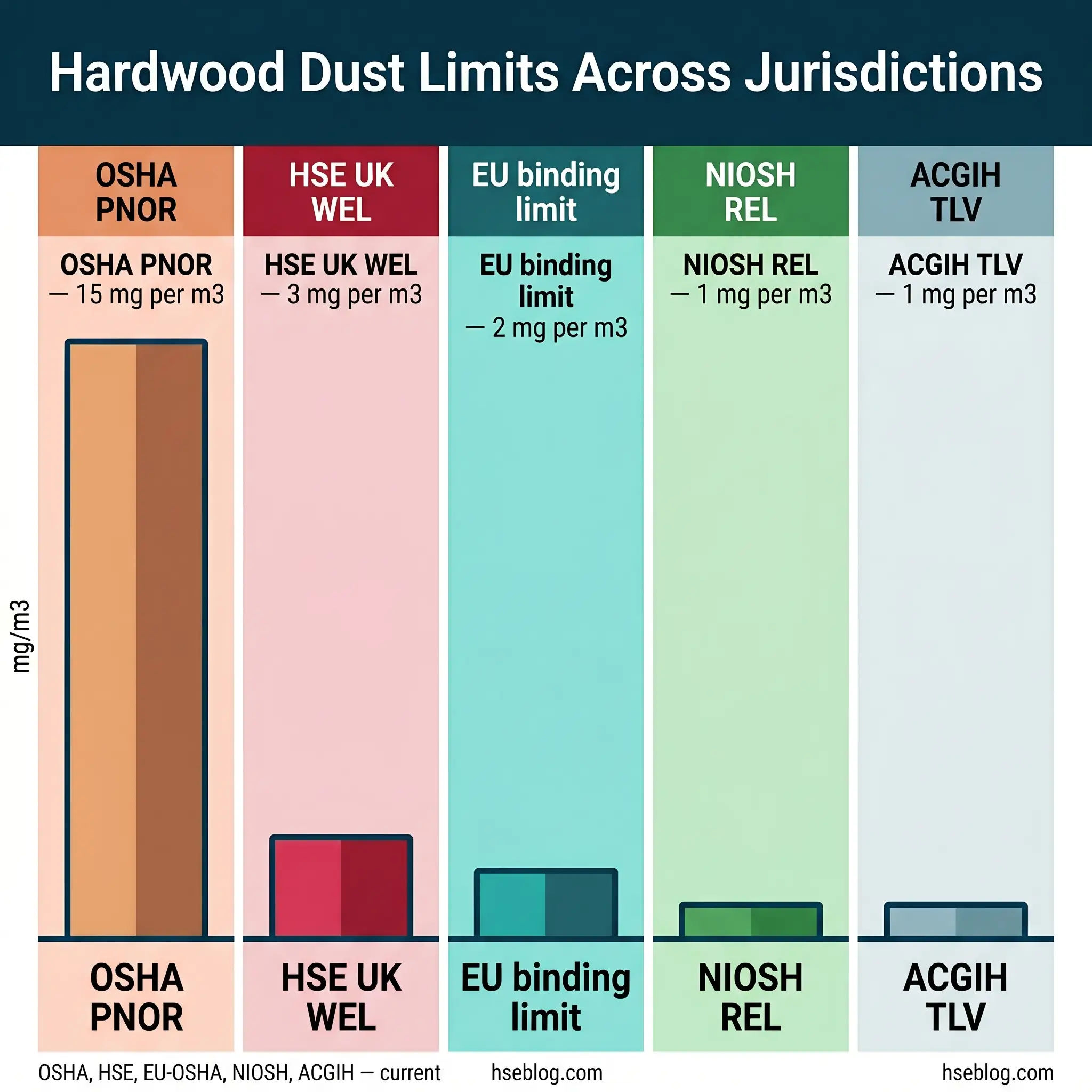
- 3 mg/m³ — UK hardwood dust WEL (8-hour TWA), inhalable fraction, enforceable under COSHH and EH40/2005 (HSE, 2020)
- 2 mg/m³ — EU binding hardwood dust OEL since 17 January 2023 under Directive 2017/2398 (EU-OSHA, 2023)
- 1 mg/m³ — NIOSH REL and ACGIH TLV for hardwood, the strictest health-protective reference in routine use (NIOSH Pocket Guide; ACGIH TLV Book)
- 15 mg/m³ — OSHA PNOR total-dust limit that wood dust falls under in the US; not a wood-dust-specific PEL (29 CFR 1910.1000 Table Z-1)
- 78% — proportion of UK woodworking businesses found non-compliant with respiratory-sensitiser controls during HSE’s 2022–23 Dust Kills inspections (HSE, 2023)
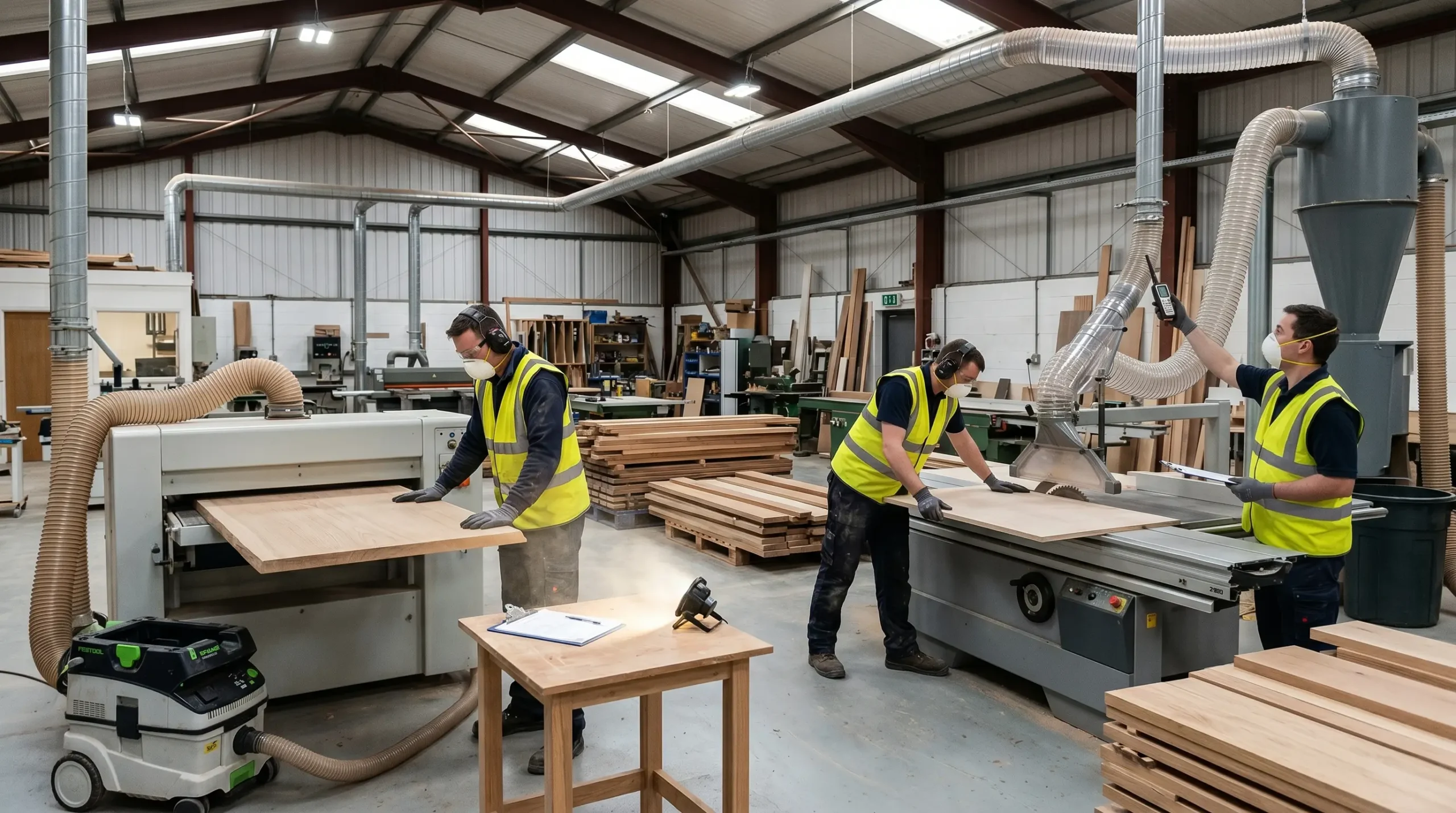
Wood dust is classified by IARC as a Group 1 human carcinogen and is a leading cause of occupational asthma. Legal exposure limits vary by jurisdiction: OSHA applies a 15 mg/m³ PNOR total-dust limit (US), HSE sets 3 mg/m³ hardwood and 5 mg/m³ softwood (UK), and the EU binding limit is 2 mg/m³ hardwood dust since January 2023. NIOSH and ACGIH recommend 1 mg/m³ for health protection.
In 2022–23, the UK Health and Safety Executive inspected more than 1,000 woodworking businesses under its Dust Kills campaign. Inspectors found failures to protect workers from respiratory sensitisers in 78% of those visits, triggering 402 enforcement actions (HSE, 2023). That is not a compliance gap at the edges of the sector. It is the sector’s baseline.
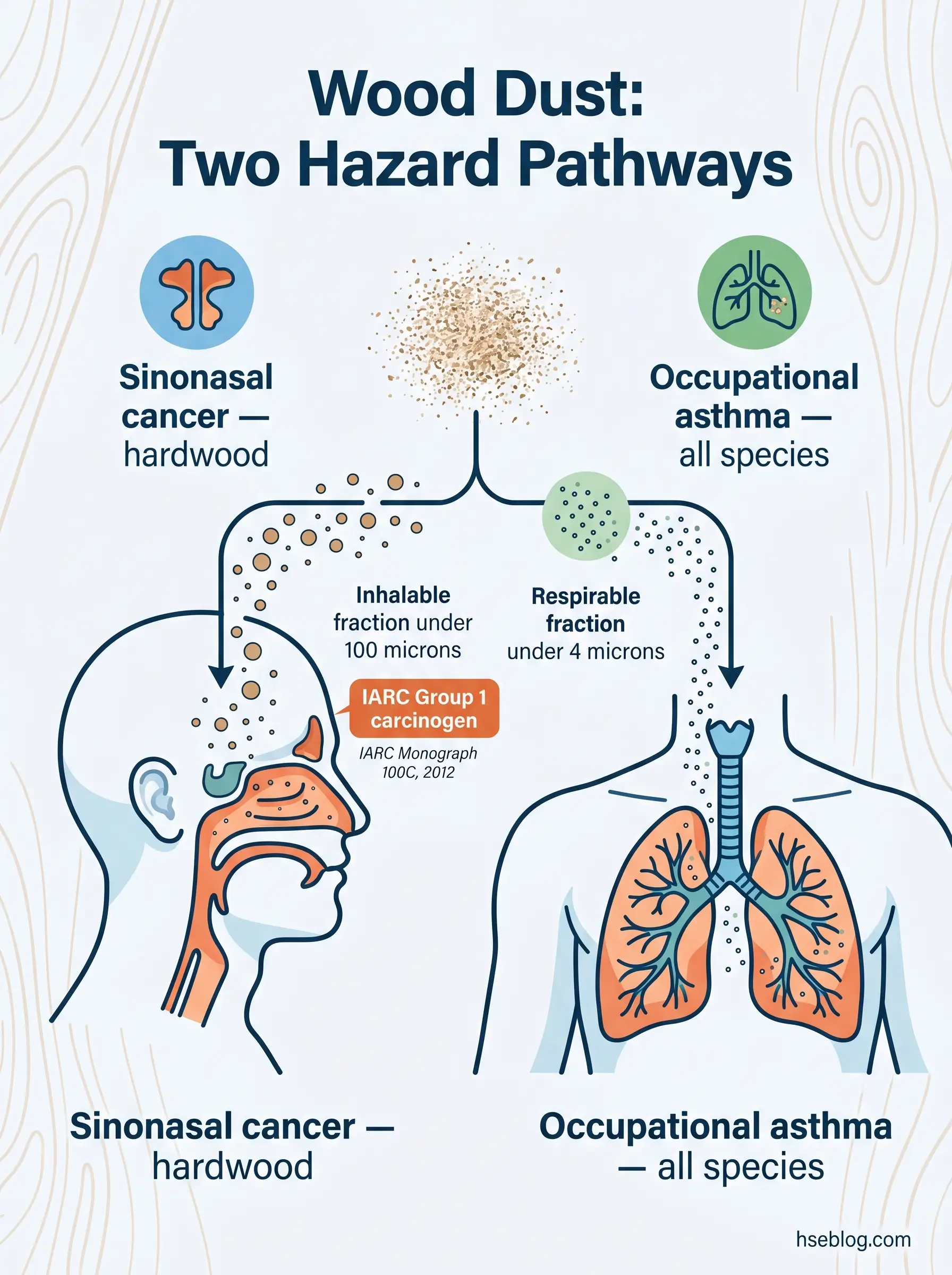
Wood dust is not a nuisance dust. The International Agency for Research on Cancer classifies it as Group 1 — carcinogenic to humans — with a causal link to sinonasal adenocarcinoma (IARC Monograph 100C, 2012). Approximately 19,000 new UK cases of self-reported work-related respiratory disease are recorded annually (HSE, 2023). This article covers what effective wood dust safety requires in practice: the occupational exposure limits that actually apply across the main English-language jurisdictions, and the prevention measures that separate compliant sites from the 78%.
Why Wood Dust Is Not “Just Sawdust”: The Carcinogen and Asthmagen Problem
The most common failure in wood dust control is a categorisation error. Operators see sawdust, think housekeeping, and size their response to a nuisance problem. Under IARC’s 2012 reaffirmation of Monograph 100C, wood dust sits in Group 1 — the same carcinogen class as asbestos, benzene, and crystalline silica. The epidemiological signal is strongest for sinonasal adenocarcinoma and nasopharyngeal cancer, and strongest of all for hardwood species. Oak, beech, mahogany, walnut, birch, elm, and ash are specifically named in the monograph.
Asthma is the more immediate hazard. HSE guidance reports that carpenters and joiners are approximately four times more likely to develop occupational asthma than other UK workers. The peer-reviewed literature puts global asthma prevalence among wood workers at 6–18%, with rhinitis at 16–33% (Wiggans et al., Occupational Medicine, 2023). Western red cedar — technically a softwood — is a distinct respiratory-sensitiser case. Its plicatic acid content causes asthma at concentrations an order of magnitude below the hardwood WEL.
The dust itself is chemically plural. Alongside cellulose and lignin, it carries endotoxins, moulds, resin acids, and monoterpenes. For treated timber and engineered boards, add formaldehyde and biocides — and formaldehyde carries its own Group 1 classification.
A recurring pattern across HSE prosecution reports is exactly this categorisation error: treating the exposure as a cleaning problem rather than a carcinogen-control problem. Downstream, that misclassification drives almost every other failure — no written risk assessment, no LEV thorough examination, no face-fit testing, no health surveillance.
Hardwood vs Softwood: Why the Distinction Matters for Exposure Limits
Hardwood and softwood are botanical categories, not hardness ratings. Hardwoods come from deciduous broadleaf trees — oak, beech, maple, walnut, mahogany, birch, ash. Softwoods come from conifers — pine, spruce, fir, cedar, larch. Balsa is botanically a hardwood; yew is a softwood. The categorisation drives the regulatory difference because epidemiological evidence for sinonasal cancer is stronger in hardwood-exposed cohorts.
Mixed exposures are the operational default. Most workshops run both hardwood and softwood through the same machines, ducts, and filters. HSE and the EU CMRD handle this by applying the stricter hardwood limit to the whole mixture. A cabinet shop that cuts a single oak panel on a saw that otherwise runs pine is, from that point forward, operating under the hardwood WEL — not the softwood one.
Engineered boards carry a separate hazard arithmetic. MDF, particleboard, and plywood are bonded with formaldehyde-based resins, and the dust generated when cutting or sanding them carries both the wood-dust Group 1 classification and the formaldehyde Group 1 classification. HSE applies the hardwood WEL to MDF dust for compliance purposes; the underlying health risk is higher than the headline number suggests.
What Are the Occupational Exposure Limits for Wood Dust?
The OEL landscape for wood dust is fragmented. A company with US, UK, and EU operations is subject to four distinct numerical limits, two advisory and two enforceable. The table below reconciles the primary jurisdictions.
| Jurisdiction | Hardwood (8-hr TWA) | Softwood (8-hr TWA) | Western Red Cedar | Legally Enforceable? | Reference |
|---|---|---|---|---|---|
| US — OSHA PEL | 15 mg/m³ total / 5 mg/m³ respirable (PNOR) | Same (PNOR) | Not specified | Yes | 29 CFR 1910.1000 Table Z-1 |
| US — NIOSH REL | 1 mg/m³ (10-hr TWA) | 1 mg/m³ (10-hr TWA) | 0.5 mg/m³ | No (advisory) | NIOSH Pocket Guide |
| US — ACGIH TLV | 1 mg/m³ (oak, beech A1) | 5 mg/m³ + 10 mg/m³ STEL | 0.5 mg/m³ | No (advisory) | ACGIH TLV Book |
| UK — HSE WEL | 3 mg/m³ (inhalable) | 5 mg/m³ (inhalable) | Treat as softwood | Yes | EH40/2005 (HSE) |
| EU — CMRD | 2 mg/m³ (since 17 Jan 2023) | Not specified | Not specified | Yes (binding) | Directive 2004/37/EC |
| Safe Work Australia | 1 mg/m³ | 1 mg/m³ | 0.5 mg/m³ | Yes (state-dependent) | WES list |
| Canada — CCOHS | 1 mg/m³ recommended | Province-dependent | 0.5 mg/m³ | Yes (provincial) | Provincial OHS |
The US figure deserves particular care. OSHA attempted a wood-dust-specific PEL of 5 mg/m³ in 1989; the rule was vacated by the US Court of Appeals. Wood dust in the US is therefore regulated as a Particulate Not Otherwise Regulated at 15 mg/m³ total, 5 mg/m³ respirable — a nuisance-dust limit applied to a Group 1 carcinogen. US employers citing PNOR compliance are legally defensible; in litigation involving sinonasal cancer or occupational asthma, NIOSH and ACGIH values are the figures a plaintiff’s expert will foreground.
The EU change dated 17 January 2023 is the most significant OEL revision affecting wood dust in the past five years. Under Directive 2017/2398 amending the Carcinogens and Mutagens Directive, the hardwood dust binding OEL moved from 3 mg/m³ to 2 mg/m³ (EU-OSHA, 2023). An estimated 3.3 million EU workers are exposed to wood dust at work (European Parliament, 2017). Several member states — France, Denmark — operated below that headline figure already, at 1 mg/m³.
Jurisdiction Note. For a UK employer, the legally enforceable hardwood WEL is 3 mg/m³. An EU sister-site is now bound by 2 mg/m³, and a French site by 1 mg/m³. Multi-site operators cannot manage to the weakest applicable number and remain compliant across the group.
Reading the Table: Which Limit Actually Applies to You
The table presents numbers; the reader needs a decision rule. Three steps:
- Identify the jurisdictional WEL or PEL. This is the legal minimum. Failure to meet it triggers enforcement.
- Identify the lowest credible health-protective value. For hardwood that is 1 mg/m³ (NIOSH, ACGIH, Australia). For Western red cedar, 0.5 mg/m³.
- Apply ALARP. Under UK COSHH and the EU CMRD, exposure to a Group 1 carcinogen must be reduced to as low as reasonably practicable regardless of whether the WEL is being met. The WEL is a ceiling, not a target.
An 8-hour TWA also hides peak exposures. A 30-minute dry-sanding task can generate breathing-zone concentrations several times the WEL without the shift average being breached. Risk assessments must capture peak exposures, not only time-weighted averages.
How Wood Dust Causes Harm: Exposure Pathways and Target Organs
Wood dust harms through three routes: inhalation of the inhalable fraction (deposition in the upper airways, driving sinonasal cancer risk), inhalation of the respirable fraction (reaching the lower airways, driving asthma and lung function decline), and dermal contact (irritant and allergic dermatitis, especially with iroko, mahogany, and Western red cedar).
The inhalable fraction — particles below approximately 100 µm aerodynamic diameter — deposits in the nose and upper airways. That is where the sinonasal carcinoma signal originates. Australian population-attributable-fraction work estimates approximately 16% of male and 2% of female nasal and nasal-sinus cancers are attributable to occupational wood dust exposure (Fritschi & Driscoll, cited in Cancer Council Australia, 2006). The respirable fraction — below approximately 4 µm — penetrates deeper and is reflected in spirometry decrements (FEV₁, FVC) documented across multiple woodworker cohort studies.
The feature that most distinguishes wood dust from acute hazards is latency. Occupational asthma can develop from weeks to decades after first exposure. Sinonasal cancers typically emerge 20–40 years after exposure onset. The practical meaning: today’s controls protect against tomorrow’s disease, and the absence of current sickness among exposed workers is not evidence that exposure is adequately controlled.
Settled dust is the hidden exposure pathway. Fine particles that settle on beams, ledges, and machine guards re-aerosolise the moment they are disturbed — by walking past, by sweeping, by compressed air. That is why housekeeping method is a wood dust control question, not a facilities question.
Competent-person caveat. This article provides general HSE knowledge on wood dust OELs and prevention. Life-critical decisions — LEV design and commissioning, DSEAR or Dust Hazard Analysis assessment, health surveillance interpretation, and combustible-dust risk categorisation — must be planned and supervised by a competent person with relevant training, jurisdiction-specific authorisation, and site-specific risk assessment. The information here does not replace that. Recognised training pathways include NEBOSH, IOSH, BOHS (UK), and OSHA outreach programmes (US) and their regional equivalents.
The Hierarchy of Controls Applied to Wood Dust
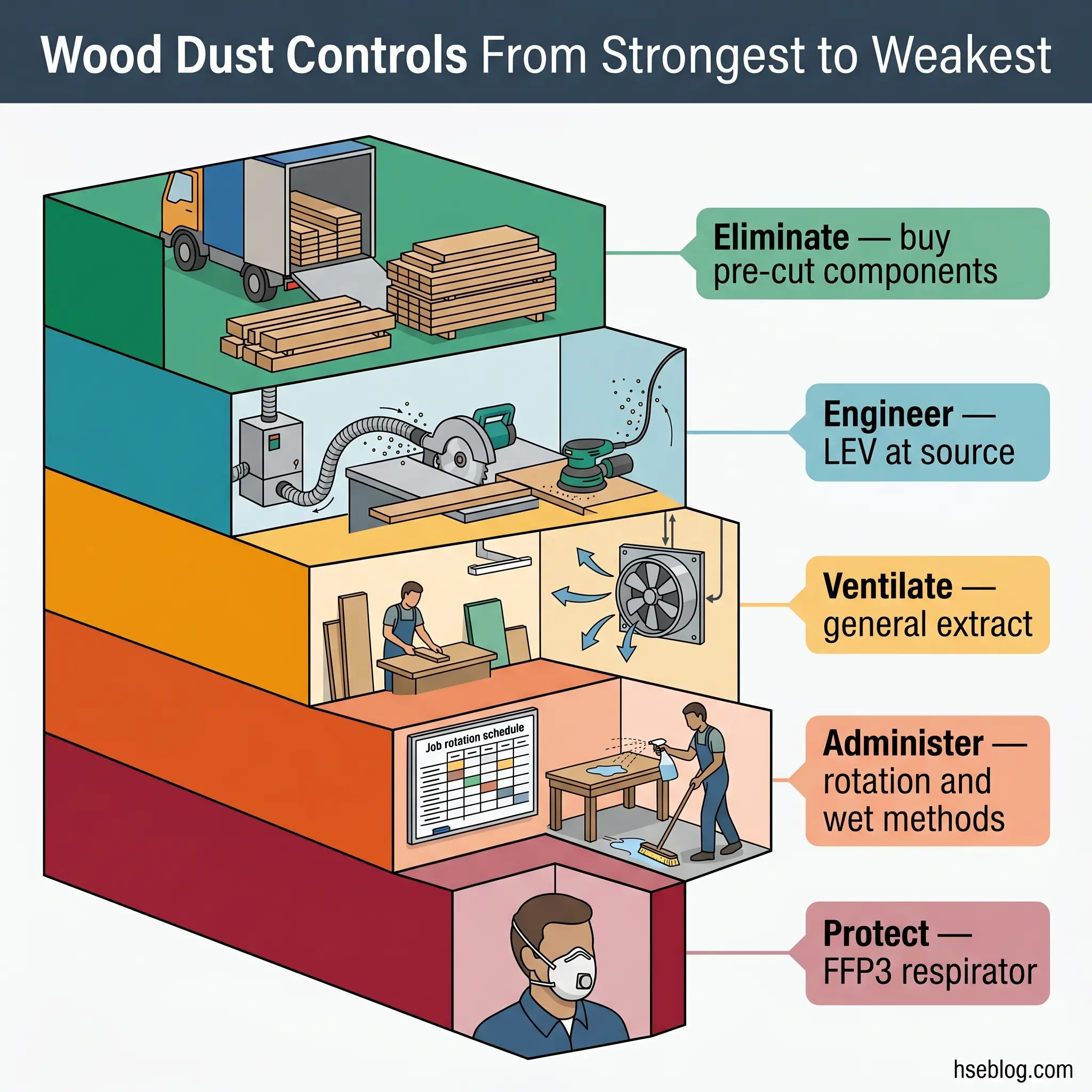
The hierarchy of controls is sometimes invoked as abstract theory; for wood dust it has specific operational content at every level.
- Elimination and substitution. Buying pre-cut, pre-sanded, or pre-finished components shifts dust generation off the premises entirely. Substituting MDF with solid timber changes the chemical profile but does not remove the dust.
- Engineering — source capture. Fixed local exhaust ventilation (LEV) on every dust-generating machine: saws, sanders, planers, routers, shapers, moulders. On-tool extraction for portable power tools, paired with an M-Class or H-Class vacuum. Enclosure for CNC and automated machining.
- Engineering — general ventilation. Supplementary only. General extract ventilation cannot substitute for source capture because it does not control the breathing zone.
- Administrative. Job rotation to limit individual cumulative exposure, scheduling dusty operations late in the shift, wet methods where fire and electrical hazards permit, documented permit-to-work for high-exposure tasks, and structured training.
- PPE. Respiratory protection as a supplementary control, never as the primary one. FFP3 or equivalent minimum for wood dust.
The point that repeatedly surfaces in HSE prosecutions is this: PPE alone cannot achieve ALARP for a Group 1 carcinogen. Sites that defend themselves on the basis of mask provision without LEV, or LEV that was never verified, consistently lose that argument at enforcement.
HSE’s own 2014–2017 research survey (Simpson et al., 2024, Annals of Work Exposures and Health) found 17.6% of hardwood and mixed-wood exposure measurements exceeded 3 mg/m³ across 22 sites selected as representative of good practice. The exceedance rate in average or below-average sites is higher. The practical implication: if engineering controls are not designed, installed, and verified to specification, the WEL will be breached regardless of what PPE is worn.
Local Exhaust Ventilation: Design, Maintenance, and the 14-Month Rule
LEV is the single largest compliance exposure for most woodworking operations, and it is rarely the presence of LEV that triggers enforcement — it is the failure to maintain and verify it. Four recurring failure modes appear in the published enforcement record:
- Undersized or wrongly-positioned receiving hoods. Narrow hoods on cross-cut and mitre saws are a specific finding in HSE research. A hood that looks adequate from the operator’s viewpoint often fails to capture the dust plume from the blade exit angle.
- Duct velocity below specification. NIOSH and OSHA guidance for wood dust duct velocity sits at roughly 2,500–4,000 feet per minute (12.7–20.3 m/s) to prevent settling. Accumulated duct deposits reduce airflow further and compound the failure.
- No statutory thorough examination and test (TExT). Under COSHH Regulation 9, LEV must be thoroughly examined and tested by a competent person at intervals not exceeding 14 months, with records retained for at least five years. The UK competence benchmark is BOHS P601.
- TExT conducted but remedial actions not closed out. A report that lists deficiencies without follow-up offers no compliance defence.
Operator-level verification between formal tests is a separate duty. Airflow indicators, dust lamps (Tyndall beam), and pressure differential monitoring across filters are the practical tools. If the dust lamp shows a visible cloud escaping the hood, the LEV is not controlling at the breathing zone regardless of what the TExT report said eleven months ago.
Audit Point. A clean LEV file with a current TExT certificate and no evidence of daily or weekly operator checks is a partial compliance record. Inspectors read both.
Housekeeping: Why Brooms and Compressed Air Are a Compliance Breach
Three cleaning methods turn up repeatedly in enforcement cases, and two of them are prohibited.
- Dry sweeping. Re-aerosolises the fine fraction that had safely settled. Breathing-zone concentrations during and immediately after sweeping routinely exceed the WEL.
- Compressed air cleaning. Explicitly prohibited under HSE guidance and under NFPA 660 for combustible dust environments. It is, in practice, the fastest way to generate a deflagration hazard.
- Class M (UK) or HEPA-filtered H-Class (US equivalent) industrial vacuum. The only compliant option for settled wood dust, per BS EN 60335-2-69. Wet methods are acceptable for bulk waste where fire and electrical risk permits.
The 3.2 mm (1/8 inch) accumulation threshold over 5% of floor area or 2,000 ft² — whichever is smaller — is the NFPA criterion at which a deflagration hazard is deemed to exist (NFPA 660, 2024). Cleaning cadence should be set to keep the facility meaningfully below that threshold.
Respiratory Protective Equipment Selection and Face-Fit Testing
Respiratory protection for wood dust starts at FFP3 (EN 149) or N100/P100 (NIOSH 42 CFR 84) for routine task exposure. FFP2 and N95 masks are inadequate for hardwood dust specifically — the assigned protection factor gap is material.
For prolonged sanding, dust-heavy assembly, or cleaning tasks, powered air-purifying respirators (PAPRs) with TH3 hood or helmet are the appropriate step up. PAPRs also solve the face-fit problem for workers with beards, glasses, or facial structures that tight-fitting masks do not seal against.
Tight-fitting RPE — any half-mask or full-face respirator — requires quantitative or qualitative face-fit testing at recruitment and at least annually under UK COSHH and under OSHA 29 CFR 1910.134. Facial hair in the seal area disqualifies the mask from achieving its assigned protection factor. The UK’s Fit2Fit scheme is the accredited benchmark; OSHA’s requirements are codified in the respiratory protection program provisions of 29 CFR 1910.134.
Watch For. Roughly half of respirators in field use do not deliver their nominal protection factor, due to fit, training, or maintenance failures. This is the consistent finding across BOHS and HSE RPE research, and it is why RPE sits below engineering controls in the hierarchy — not alongside them.
The respiratory protection programme also covers medical fitness assessment, training in donning and seal checks, cartridge and filter maintenance, storage, and record-keeping. A mask in a locker without any of those elements is not controlled RPE.
Health Surveillance: What to Measure, When, and Why
Health surveillance for wood dust is a legal requirement under COSHH Regulation 11 where there is identified residual risk of asthma or dermatitis, and it is strongly recommended practice under OSHA and CCOHS frameworks even where not explicitly mandated.
Medical advice disclaimer. Content covering health surveillance, exposure monitoring, and biological effects is for HSE practitioner reference. It is not medical advice. Workers with respiratory symptoms, skin reactions, or known hardwood exposure concerns should consult an occupational physician or qualified medical professional. Surveillance results must be interpreted by an appropriately qualified occupational health professional.
The HSE surveillance model has four components:
- Baseline assessment before exposure begins, or within six weeks of exposure starting.
- Annual respiratory questionnaire and spirometry (FEV₁, FVC, FEV₁/FVC), interpreted by an occupational health professional.
- Skin inspection where dermatitis is a foreseeable risk.
- Record retention. Under COSHH, health records for workers exposed to a carcinogen must be kept for at least 40 years from the date of the last entry — matched to the sinonasal cancer latency period.
Surveillance data carries two signals. Individual signals — a worker with declining FEV₁ or a positive asthma screen — require medical follow-up. Cluster signals — multiple similarly-exposed workers with reduced lung function — require control revision. A recurring pattern in audits is that companies run surveillance as a paperwork exercise and do not use the data to reassess the risk assessment or the LEV specification. The point of surveillance is to trigger change when the data suggests it.
Combustible Dust: The Explosion Hazard Most Woodworkers Underestimate
Wood dust is a combustible dust when mean particle size falls below roughly 500 µm, with measurable explosion risk below 200 µm (HSE). This is governed by a separate standards framework from the carcinogen OELs.
In the US, NFPA 660 (2024) now consolidates what were previously NFPA 664 (wood processing), NFPA 652, 654, 655, 484, and 61 into a single combustible dust standard. The consolidation affects every wood-processing facility subject to AHJ enforcement. Core requirements include a Dust Hazard Analysis (DHA), housekeeping to below the 3.2 mm accumulation threshold, ignition source control, and explosion protection (venting, suppression, isolation) on dust collectors and ductwork.
In the UK and EU, the relevant framework is the Dangerous Substances and Explosive Atmospheres Regulations 2002 (DSEAR) and the ATEX Directive 2014/34/EU — hazardous zone classification, ignition source control, and equipment categorisation.
The secondary explosion mechanism is the feature that makes wood-dust deflagrations disproportionately destructive. A primary event — often a small deflagration inside a dust collector or duct — suspends settled fugitive dust elsewhere in the facility. The secondary explosion, fuelled by that suspended dust, is frequently the one that causes major structural damage and fatalities. US Chemical Safety Board investigations of wood-dust incidents consistently identify housekeeping, non-compliant ductwork, and absent explosion venting as recurring root causes.
Exposure Monitoring: Proving Your Controls Work
Controls without monitoring are assumed to work; with monitoring, they can be shown to work. The UK reference method is MDHS 14/4 (HSE) — gravimetric personal sampling using an IOM sampler for the inhalable fraction at 2 L/min flow rate. The US equivalent for wood dust is OSHA Method PV2121. Personal sampling in the worker’s breathing zone is the reference; area sampling supplements but does not replace it.
Monitoring is required when controls are first introduced, when they are materially changed, and periodically thereafter. HSE guidance for wood dust suggests a three-year maximum interval for routine re-monitoring in stable operations. For high-exposure tasks, or where LEV performance has been questioned, the interval shortens.
Real-time direct-reading instruments — laser photometers, dust-trak monitors — are useful for LEV verification, walkthrough surveys, and investigating spikes. They are not calibrated against the OEL for compliance purposes. A laser photometer can tell you the LEV failed at 14:20; it cannot replace the gravimetric measurement that determines whether the eight-hour TWA exceeded the WEL.
Training, Supervision, and the Competent Person
Paperwork controls fail at the point of execution. HSE’s 2024 published research on dust control uptake identified “habitual ways of working” as a primary barrier — operators and supervisors doing what they have always done, even where a written procedure specifies otherwise.
Training content for operatives has to be concrete, not generic. Recognition of the hazard (Group 1 carcinogen, not nuisance), correct LEV use including daily airflow checks, RPE donning with seal check, housekeeping method discipline (no brooms, no compressed air), and the route to report symptoms. Supervisors carry the enforcement role — without consistent day-to-day supervisor reinforcement, written procedures do not survive contact with the production schedule.
Under the UK Management of Health and Safety at Work Regulations 1999, the competent person is defined by knowledge, training, and experience matched to the task. For LEV, BOHS P601 is the benchmark. For DHA and DSEAR assessment, the competence standard rises further.
Wood Dust Safety: A Compliance Checklist
The following self-audit captures the operational minimum this article has built:
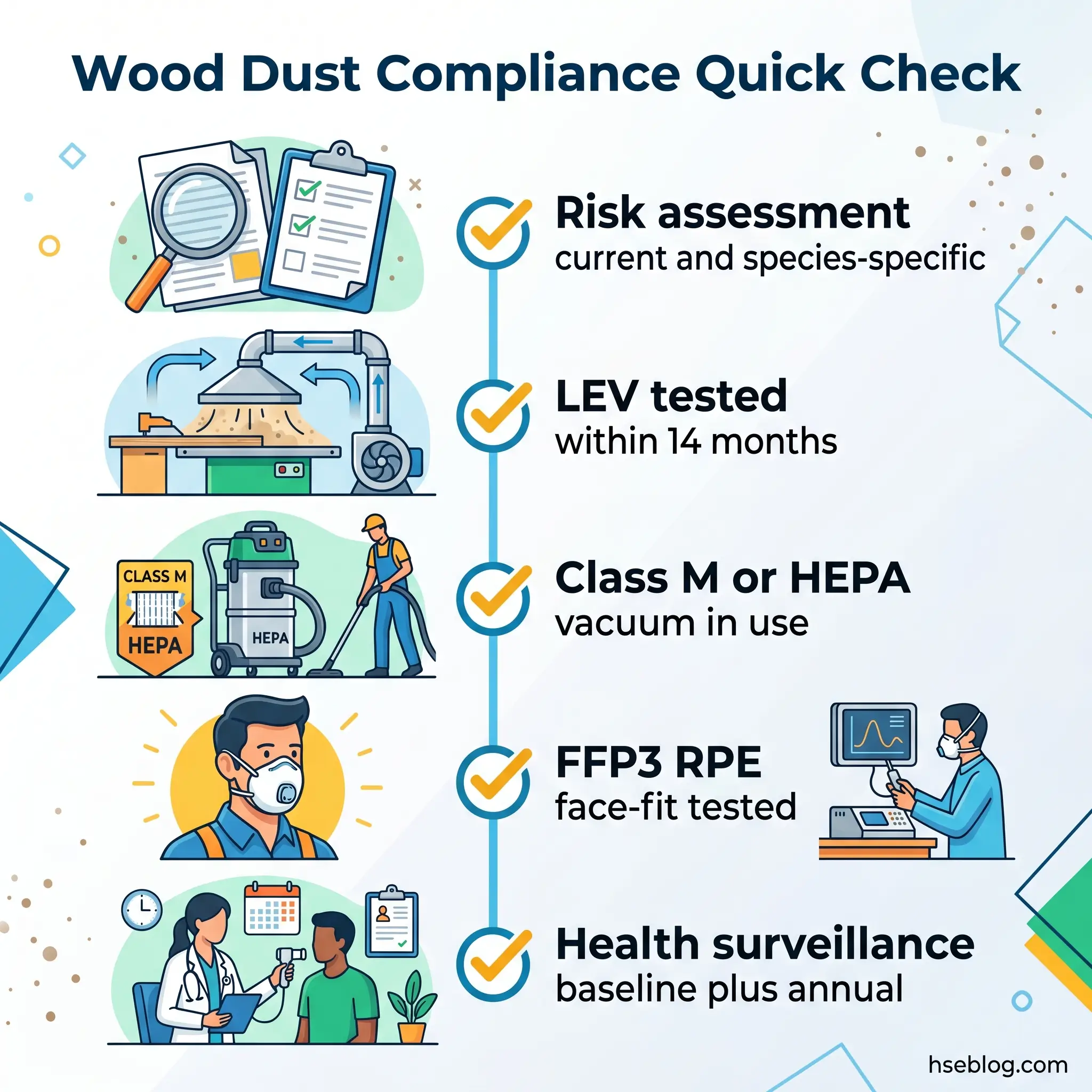
- Written COSHH or OSHA risk assessment current, species-specific, and process-specific.
- Jurisdictional OEL identified and applied; strictest applicable where multi-site.
- LEV in place at every dust-generating machine, with a documented design specification and capture verification.
- LEV thorough examination and test current (within 14 months for UK sites) with remedial actions closed out.
- Class M or HEPA-filtered industrial vacuum available and in routine use; no brooms, no compressed air.
- FFP3 or equivalent RPE available, face-fit tested at least annually, used for specified tasks.
- Baseline and annual health surveillance in place; records retained 40 years per COSHH where carcinogen exposure applies.
- Personal exposure monitoring conducted within the last three years to MDHS 14/4 or OSHA PV2121.
- Dust Hazard Analysis or DSEAR assessment complete and reviewed for combustible-dust risk.
- Worker training documented; supervisor reinforcement visible on shift.
- Symptom and incident reporting route understood and used.
Legal disclaimer. Regulatory content here reflects general HSE professional understanding of UK, US, and EU requirements as of the last-reviewed date shown in the byline. It is not legal advice. Specific compliance questions, enforcement situations, or prosecution risk should be directed to qualified legal counsel in the applicable jurisdiction. Limits and standards are subject to revision; verify current values with the relevant regulator before acting on them.
Frequently Asked Questions
Conclusion
Wood dust safety operates on two locked-together duties. The OEL duty is to stay below the legally enforceable limit in the jurisdiction of work — 3 mg/m³ hardwood for UK sites, 2 mg/m³ for EU sites since January 2023, the OSHA PNOR 15 mg/m³ for US sites with NIOSH’s 1 mg/m³ as the defensible health-protective target. The carcinogen duty is to reduce exposure to ALARP regardless of whether that number is being met, because for a Group 1 carcinogen the WEL is a ceiling, not a safe threshold.
The prevention measures that separate compliant sites from the 78% HSE finds non-compliant are not exotic. Engineered LEV at source, designed and TExT’d to specification. Class M or HEPA vacuums replacing brooms and compressed air. FFP3 RPE with annual face-fit testing as a supplementary control, not a primary one. Baseline and annual health surveillance feeding back into the risk assessment. A Dust Hazard Analysis that recognises wood dust is also a deflagration hazard. Every one of those controls is named in the published enforcement record as a failure point.
The operational test is not whether the paperwork exists. It is whether the LEV is pulling to specification this week, whether face-fit testing is current, whether the 1/8-inch accumulation threshold is being kept clear, and whether the last surveillance cluster signal triggered a control review. Wood dust safety is built in the weeks between TExT certificates — not in the certificates themselves.