
TL;DR
- If your team uses abrasive wheels, training is a legal duty under both PUWER 1998 Regulation 9 (UK) and OSHA 29 CFR 1910.215 (US) — not an optional best practice.
- If you train operators but not the people who mount, change, or supervise wheels, your compliance system has a gap that HSG17 directly addresses.
- If your training is delivered online only, it does not meet HSG17 — practical mounting competence cannot be acquired through a screen.
- If you have not documented a refresher policy, you are exposed: the British Abrasives Federation recommends a three-year refresher cycle, and HSG17 also expects trigger-based reviews after incidents, near misses, or new equipment.
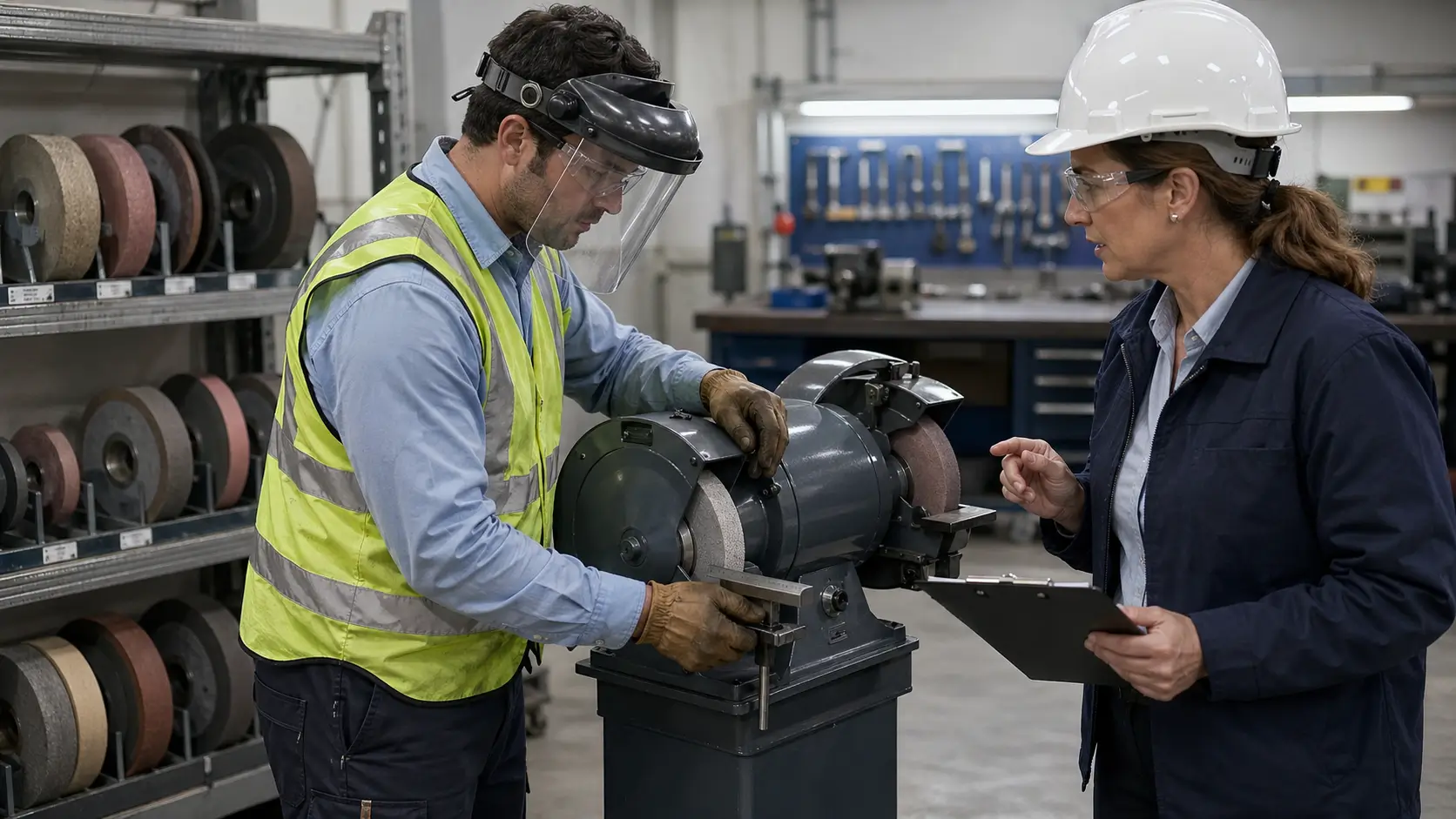
Abrasive wheel regulations require employers to ensure all personnel who use, mount, or supervise abrasive wheel equipment receive adequate training. In the United Kingdom this duty arises under PUWER 1998 Regulation 9, supported by HSE guidance document HSG17. In the United States, OSHA 29 CFR 1910.215 and 1926.303 require operator training covering machine hazards, guard use, and safe operation.
Regulatory content here reflects general HSE professional understanding of UK, US, and EU requirements as of April 2026. It is not legal advice. Specific compliance questions, enforcement situations, or prosecution risk should be directed to qualified legal counsel in the applicable jurisdiction.
Regulation 9 of the Provision and Use of Work Equipment Regulations 1998 places a clear duty on UK employers: every person who uses work equipment must receive adequate training in safe methods of operation, including the precautions to be taken. For abrasive wheels — which routinely run at peripheral speeds above 80 metres per second — that duty is not abstract. A wheel that bursts at full operating speed throws fragments at velocities high enough to cause amputations, facial penetration injuries, and fatalities. The HSE’s HSG17, the document inspectors reach for first when investigating a wheel-related incident, treats training as the foundation of the compliance system, not a finishing touch.
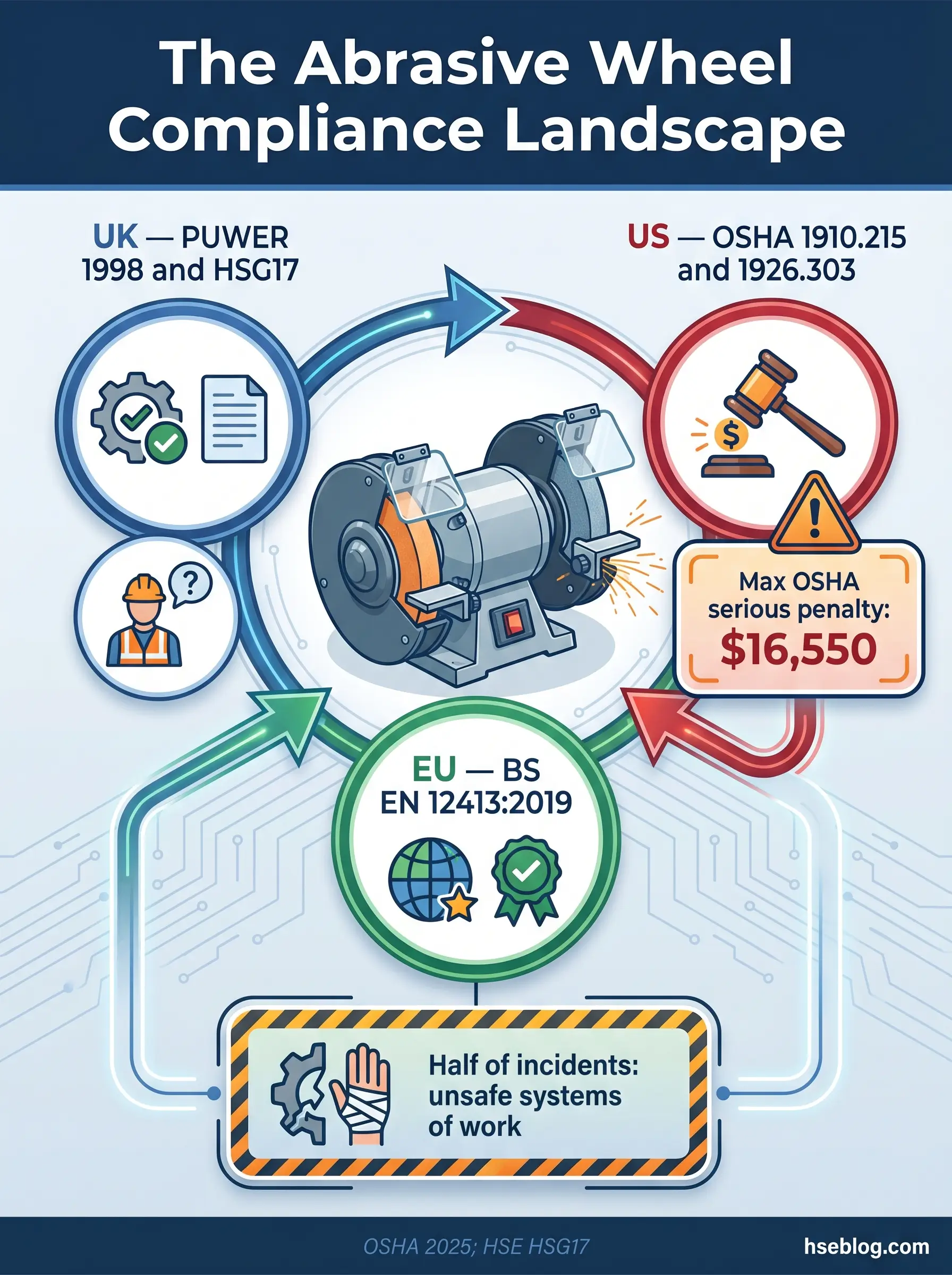
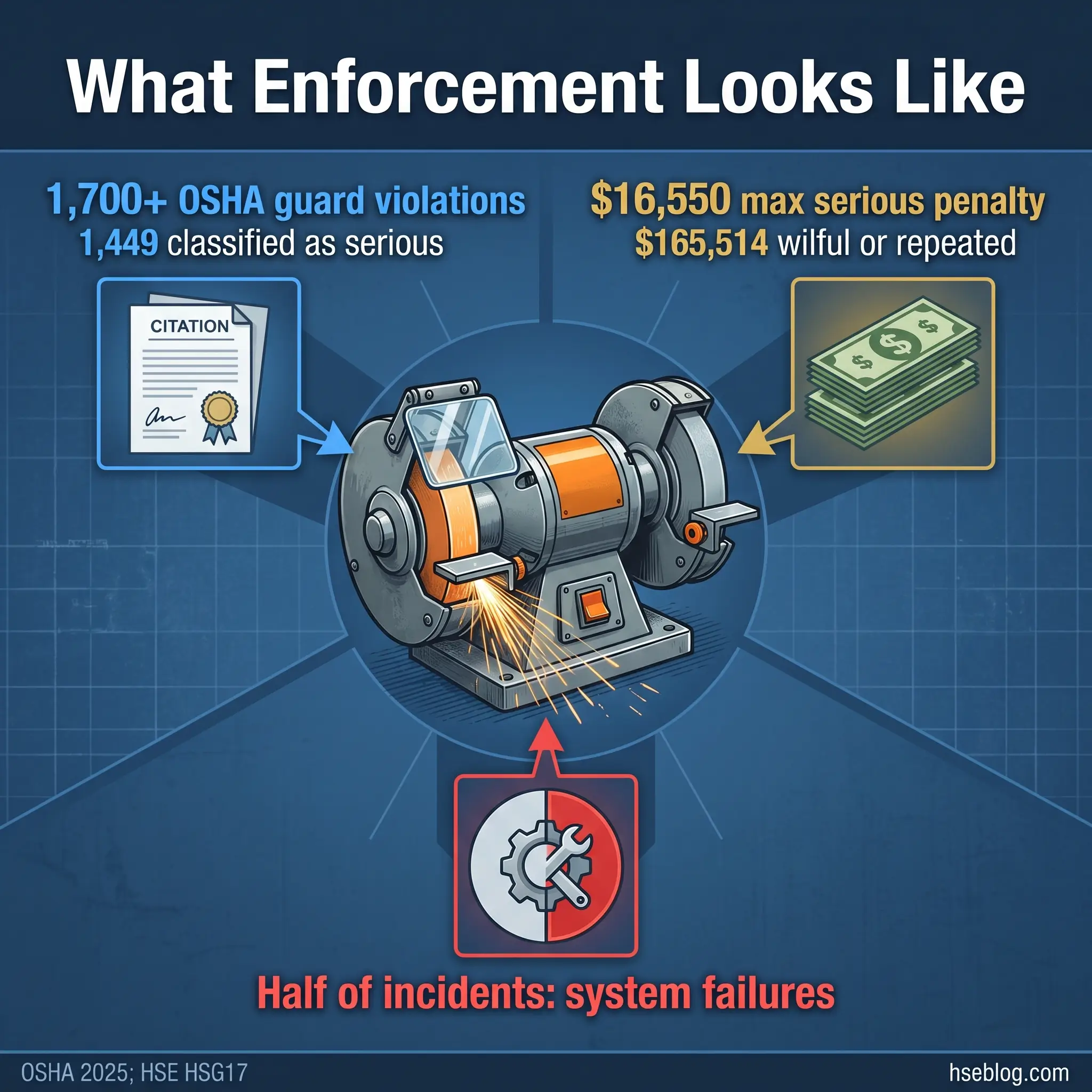
The penalties for getting this wrong have sharpened. OSHA’s maximum penalty for a serious violation rose to $16,550 per citation effective 15 January 2025, with wilful or repeated violations reaching $165,514 (OSHA / NAHB, 2025). Beyond financial exposure sit the human consequences — life-changing injuries that compliance was meant to prevent. This article maps the abrasive wheel regulations that govern UK, US, and EU operations, explains who must be trained and to what standard, and sets out what a defensible compliance programme actually contains.
What Are Abrasive Wheel Regulations?
Abrasive wheels are bonded discs or cylinders made of abrasive grain held together by a vitrified, resin, rubber, or shellac bond. They cut, grind, and polish through the deliberately controlled fracture of grain at high rotational speed. That high speed is also the source of the hazard. A 230 mm cutting disc rated at 6,600 RPM has a peripheral speed exceeding 80 metres per second — fast enough that a structural failure scatters fragments before an operator can react.
Regulation exists because of how abrasive wheels fail. Bond degradation, side loading, speed mismatch, prior damage during handling, and improper mounting can all initiate a fracture that releases stored rotational energy almost instantaneously. The injury profile reflects that energy release: lacerations, fractures, amputations, blindness, facial penetration, and a measurable fatality rate. In an OSHA review of 27 grinder accidents over an eight-year period, more than 26% resulted in employee deaths (OSHA, cited NKyTribune 2025).
The UK regulatory pathway has shifted over time. The prescriptive Abrasive Wheels Regulations 1970 — which limited training duties largely to those who mounted wheels — were repealed and absorbed into the broader Provision and Use of Work Equipment Regulations 1998. PUWER 1998, supported by HSE guidance HSG17, now governs the full lifecycle: selection, suitability, maintenance, inspection, training, and safe use. The US framework sits within OSHA’s machine guarding standards, which incorporate the ANSI B7.1 consensus standard by reference.
A misconception worth correcting at the start: many organisations treat the purchase of EN 12413–compliant wheels as the compliance line. It is not. Compliant product is necessary but not sufficient. Compliance is a system — selection, storage, mounting, guarding, training, inspection, and documentation — and the regulations ultimately measure that system, not the certificate that came in the box.
Key Regulations Governing Abrasive Wheel Use
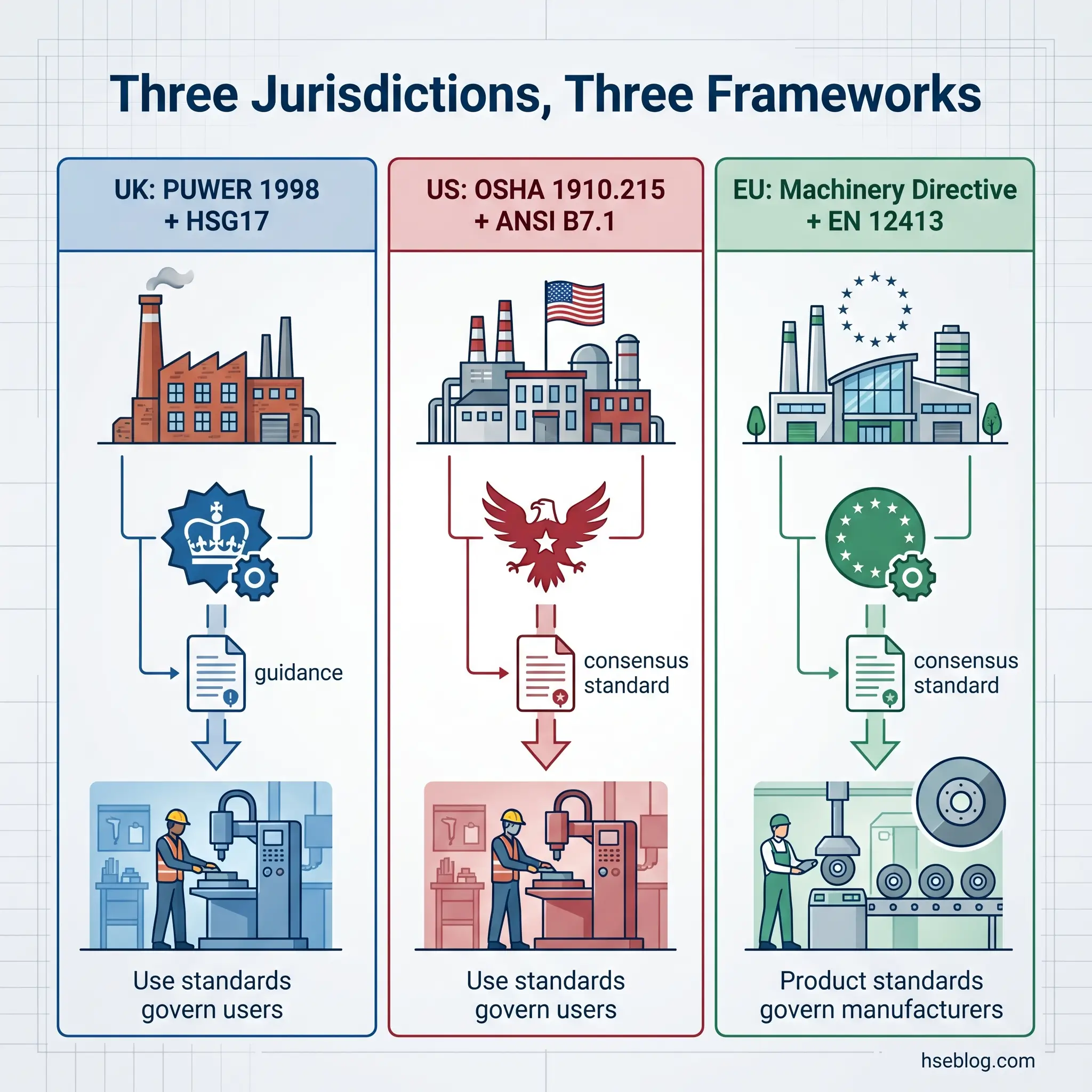
The regulations that impose direct duties on employers split cleanly along jurisdictional lines. Treating them as a unified body of rules is one of the more common compliance errors, particularly for organisations operating across UK and US sites. Each regime carries its own duty-holders, prescriptive elements, and enforcement style.
UK Regulatory Framework: PUWER 1998 and HSG17
PUWER 1998 is the central instrument for abrasive wheels in the United Kingdom. The clauses that matter most in practice are Regulation 4 (suitability of work equipment for the task), Regulation 5 (maintenance in efficient working order), Regulation 6 (inspection where safety depends on installation conditions), Regulation 9 (adequate training), and Regulation 11 (effective measures to prevent access to dangerous parts). The general duties under sections 2 and 7 of the Health and Safety at Work etc. Act 1974 sit above these, and the Management of Health and Safety at Work Regulations 1999 require a suitable and sufficient risk assessment as the precondition for everything else.
HSG17: Safety in the Use of Abrasive Wheels is the operational benchmark. It is not law itself, but it is the document the HSE uses when deciding whether an employer met the standard expected by PUWER. HSG17 replaced the prescriptive “appointed person” structure from the 1970 regulations with a broader competence requirement — anyone selecting, mounting, or using abrasive wheels must be competent, and competence must be demonstrable. The practical reading on most UK sites: if HSE inspectors arrive after an incident, they will compare what your operation actually does to what HSG17 sets out, and the burden of explaining any gap falls on the employer.
US Regulatory Framework: OSHA Standards and ANSI B7.1
The principal US standards are OSHA 29 CFR 1910.215 for general industry, 29 CFR 1926.303 for construction, and 29 CFR 1915.134 for shipyard operations. All three impose prescriptive requirements on guard design, work rest gap (maximum 1/8 inch), tongue guard gap (maximum 1/4 inch), ring testing before mounting, flange specifications, and operator eye protection. Training duties are not given their own standalone regulation — they are embedded inside OSHA’s general machine guarding expectations and the duty to ensure operator competence.
The edition mismatch around ANSI B7.1 deserves explicit attention because it is a recurring source of US compliance confusion. OSHA’s standards reference ANSI B7.1-1970, but the consensus standard has been revised several times — the current version is ANSI/UAMA B7.1-2017. OSHA applies a de minimis policy: an employer following the newer edition will generally not be cited so long as the protection achieved is at least equivalent to the 1970 edition. The judgment call here is documentation. Sites that comply with the 2017 edition without recording that fact give an inspector no easy way to verify equivalence — sites that document their adoption of the newer edition close the loop. Norton’s published overview of ANSI B7.1 is a useful plain-language reference for organisations that cannot purchase the full standard.
European and International Standards
The European framework operates on a different axis. BS EN 12413:2019 is a product safety standard for bonded abrasive products — it tells manufacturers what a wheel must satisfy before it reaches the user. Mandatory marking elements include abrasive type, grain size, grade, bond, maximum operating speed in metres per second and RPM, dimensions, and a use-by date for organic-bonded products intended for hand-held machines. BS ISO 525 sets out the marking and identification system that runs across both EN and ISO references. The EU Machinery Directive 2006/42/EC governs machine-side safety integration.
Jurisdiction Note: EN 12413 is a product standard, not a use standard. It governs what manufacturers must ensure. PUWER, HSG17, and the OSHA standards govern how users must behave. A wheel that arrives marked to EN 12413 still has to be selected for the right machine, mounted correctly, and operated within its rated speed. A correctly manufactured wheel is the starting point of compliance, not the end of it.
Who Needs Abrasive Wheel Training?
The breadth of who must be trained is one of the larger differences between the old AWR 1970 and the current PUWER framework. AWR 1970 essentially required appointed-person training for those who mounted wheels — it was narrow and certificate-driven. PUWER Regulation 9 cast the net wider: training must be adequate for any person who uses work equipment, and HSG17 confirms this includes operators, mounters, supervisors, and managers responsible for the system.
Four duty groups need defined training scope. Operators require safe-use competence — wheel and machine matching, pre-use inspection, correct technique, work rest adjustment, PPE, emergency response. Mounters require everything operators have plus the specific mounting skill set: flange selection, blotter use, bush fitting, balancing, and the test run after mounting. Supervisors and managers need enough technical knowledge to recognise when wheel selection or mounting has gone wrong and to assess the competence of others — they do not need to mount wheels themselves, but they must be able to identify a non-compliant set-up. Contractors fall under the employer’s duty as well: PUWER Regulation 12 makes the host employer responsible for ensuring contractors using equipment on site meet the same standard.
A pattern visible across audit findings: organisations train operators thoroughly and then leave nobody on site competent to verify that wheels have been mounted correctly. The result is a system where the operator inherits whatever the previous shift handed over, with no independent check. This is one of the more common findings in HSE-published prosecutions involving wheel failures — the trained operator was set up to fail by an upstream gap.
What Must Abrasive Wheel Training Cover?
HSG17 sets out nine training areas that the HSE expects to see in any UK abrasive wheel programme. OSHA’s training expectations are less prescriptive but converge on the same operational substance. Mapping the two regimes side by side is a useful exercise for any organisation operating across both jurisdictions, because a single curriculum properly designed can satisfy both.
The HSG17 nine areas cover hazards and associated risks; wheel marking systems (per BS EN 12413 and BS ISO 525); storage, handling, and transport of wheels; pre-mounting inspection methods including the ring test; mounting procedures (flanges, blotters, bushes, balancing, test run); the relationship between wheel rated speed and machine spindle speed; guarding requirements; PPE selection; and emergency response. OSHA’s expectations under the machine guarding standards focus on the hazards associated with the particular machine, how guards provide protection, how to use them properly, and the circumstances under which guards may be removed. ANSI B7.1 separately requires that operators be instructed in the use, care, and protection of abrasive wheels.
| Training Topic | UK — HSG17 (Nine Areas) | US — OSHA / ANSI B7.1 |
|---|---|---|
| Hazards of the equipment | Required | Required (29 CFR 1910.215) |
| Wheel markings and selection | Required (EN 12413, ISO 525) | Required (ANSI B7.1) |
| Storage and handling | Required | Required (ANSI B7.1) |
| Ring test before mounting | Required | Required (1910.215(d)(1)) |
| Mounting procedures | Required (practical) | Required (ANSI B7.1) |
| Speed matching | Required | Required (1910.215(d)(1)) |
| Guarding requirements | Required | Required (1910.215(b), (c)) |
| PPE selection | Required | Required (1910.215(a) and 1910.133) |
| Emergency procedures | Required | Required (general duty) |
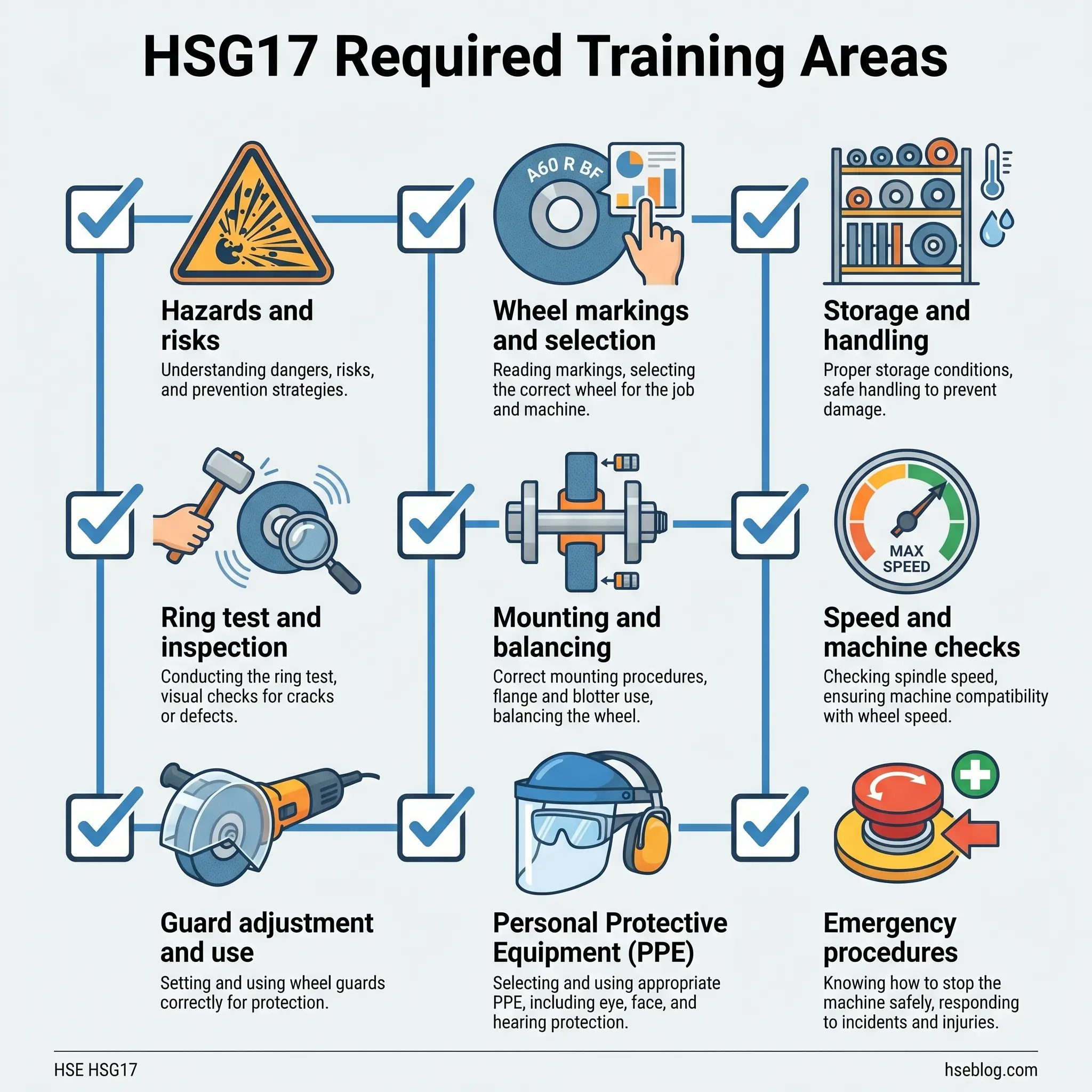
The point HSG17 makes most forcefully is that there is no substitute for hands-on practical training, particularly for mounting. Theoretical instruction can be delivered through e-learning or classroom — but the moment a trainee picks up a flange, fits a blotter, and balances a wheel under supervision, the assessment becomes practical. Training programmes that pass the theory test and skip the practical mounting component do not satisfy HSG17, and they leave the highest-risk skill gap unaddressed.
Audit Point: The single most common training-records failure during HSE-aligned audits is not the absence of a course certificate. It is the absence of a documented practical mounting assessment — proof that the trainee was observed performing the mounting steps correctly and was signed off by a competent assessor. From a compliance standpoint, a trained operator with no practical assessment record is not demonstrably competent.
Documentation is the other half of the training requirement. A defensible training file contains the curriculum delivered, the trainer’s credentials, the date of training, the practical assessment outcome, the trainee’s signed acknowledgement, and the appointment register entry where mounting authorisation has been granted. Without this paperwork, the training existed only in memory — and in an investigation, that is a poor place for it to live.
How Often Should Abrasive Wheel Training Be Refreshed?
A direct question with a deceptively layered answer: neither PUWER 1998 nor OSHA 29 CFR 1910.215 prescribes a fixed refresher interval. The absence of a number is not the absence of a duty. Both regimes require that competence be maintained, which puts the onus on the employer to define what maintaining competence looks like.
The British Abrasives Federation — the only accreditation body specifically referenced in HSG17 for abrasive wheel training — recommends refresher training at no more than three-year intervals. HSG17 itself takes a trigger-based approach in addition to any time-based cycle: refresher training should be considered when standards are seen to slip, after incidents or near misses, when new equipment is introduced, when wheel types change, and when legislative requirements update. OSHA 29 CFR 1910.215 does not specify a refresher cycle, but OSHA’s general machine guarding training expectations require retraining when new or altered safeguards are put into service or when an employee is assigned to a new machine or operation.
A consistent pattern in audit findings is that organisations choose either time-based or trigger-based refresher policies — and rarely both. A site that delivers annual refreshers but does nothing after a near-miss has reduced compliance to a calendar event. A site that refreshes only after incidents waits for harm to do its training planning. The defensible position is a documented policy that combines both: a maximum interval (commonly three years for full refresher, twelve months for awareness updates) layered with explicit trigger conditions that drive an ad-hoc review whenever a defined event occurs.
Watch For: A refresher policy is not a compliance artefact unless it is documented and implemented. Verbal commitments to “refresh as needed” are read by HSE inspectors and OSHA compliance officers as the absence of a policy. The minimum defensible position is a written refresher procedure naming both the maximum interval and the trigger events.
Common Compliance Failures and Enforcement Patterns
Enforcement intelligence is the practical companion to regulatory knowledge. Both regulators publish the violations they find most often, and the consistency of these patterns across years tells you where compliance systems most commonly break.
In a recent reporting year, OSHA recorded over 1,700 violations related to abrasive wheel guard exposure adjustments, of which 1,449 were classified as serious (OSHA inspection data, cited via AmTrust 2024). Machine guarding broadly — which includes abrasive wheel guards — regularly appears in OSHA’s top ten most-cited standards. Looking at the specific violation pattern, the recurring US findings are predictable: work rest gap exceeding the 1/8 inch maximum, tongue guard gap exceeding the 1/4 inch maximum, missing or mis-adjusted guards, failure to perform a ring test before mounting, and operators using the wrong wheel for the machine speed.
UK enforcement intelligence reveals a parallel pattern: failure to provide demonstrable training, use of unmarked or expired organic-bonded wheels, inadequate guarding, and the absence of a documented competence assessment. The HSE notes that nearly half of all abrasive wheel accidents are attributable to unsafe systems of work or operator error rather than equipment failure (HSE, HSG17, 2000). The implication is direct: the dominant control is the system, not the wheel.
The financial consequences have moved upward in 2025. OSHA’s adjusted maximum penalty for a serious violation is now $16,550 per violation, with wilful or repeated violations reaching $165,514 (OSHA, 2025). OSHA also revised penalty guidance in July 2025 to refine penalty structures supporting small businesses and to focus on hazard elimination, applicable immediately to investigations where penalties had not yet been issued (OSHA, 2025).
The misconception worth correcting in this section: many employers treat training delivery as the compliance objective. The enforcement data tells a different story. Inspectors and HSE investigators find the training gap most often by looking for missing records, missing practical assessments, and missing appointment registers. Training that happened but cannot be proven is, for compliance purposes, training that did not happen.
Building a Compliant Abrasive Wheel Management System
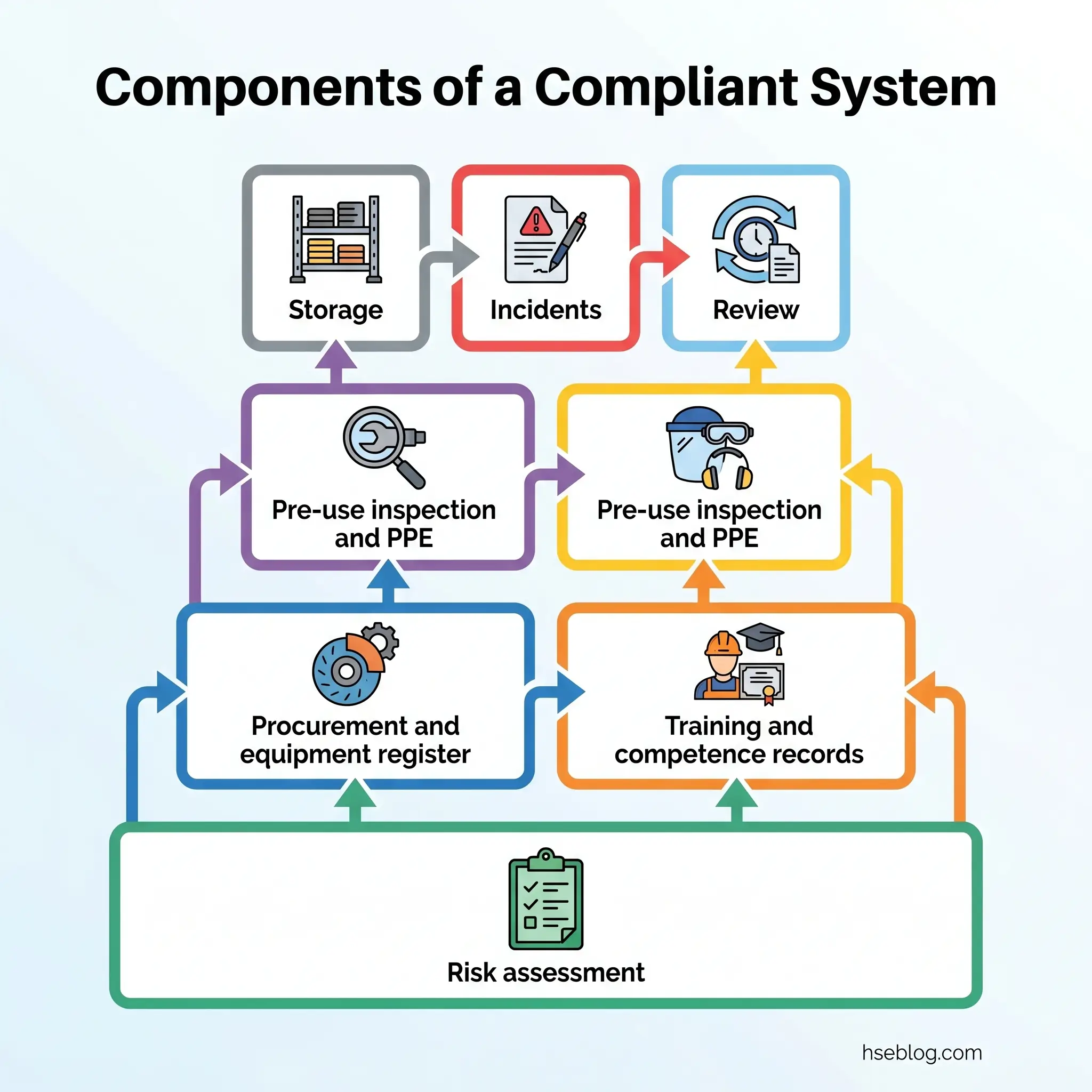
Regulations describe duties; a management system delivers them. The components below translate PUWER, HSG17, and OSHA expectations into a defensible operating framework. The arrangement is deliberate — treating wheel selection and procurement as a safety-critical step, not a stores function, because an incorrectly specified wheel can defeat every downstream control.
A compliant system needs eight integrated components. Risk assessment comes first — specific to the abrasive wheel operations on the site, not a generic equipment template. An equipment register captures every machine, its spindle speed, and the wheel specifications it can accept. Procurement controls restrict purchasing to wheels marked to BS EN 12413 / BS ISO 525 (UK/EU) or ANSI B7.1 (US), with speed compatibility verified before the order is placed. A training programme delivers the HSG17 / OSHA content with documented practical assessment and a published refresher schedule. A pre-use inspection protocol captures visual inspection, ring test, guard check, work rest gap (maximum 1/8 inch under OSHA), tongue guard gap (maximum 1/4 inch), and speed verification. PPE selection is matched to the operation — impact-rated eye protection (minimum EN 166 or ANSI Z87+), face shield for higher-energy work, hearing protection where noise exceeds action levels, respiratory protection where silica or metal fumes are generated, and appropriate gloves. Storage and handling protocols keep wheels protected from impact, moisture, and contamination, with organic-bonded wheels rotated against their three-year use-by date under EN 12413. Incident and near-miss reporting feeds back into training reviews and risk assessment updates.
NIOSH has published a freely available abrasive wheel safety inspection checklist that organisations can adapt to fit their own operations and language conventions. It covers the practical inspection points that align well with both OSHA and HSG17 expectations and is a useful starting reference for sites building their own pre-use inspection protocol.
Frequently Asked Questions
Conclusion
Abrasive wheel regulations in both the UK and US converge on the same operational truth: the wheel is dangerous, and the system around it has to be deliberate. PUWER 1998 Regulation 9, HSG17, OSHA 29 CFR 1910.215, and ANSI B7.1 all describe the same defensible position from different angles — competent personnel, correctly specified equipment, documented mounting and inspection, properly adjusted guards, and records that can survive an inspector’s review.
For HSE managers and training coordinators, four operational decisions carry most of the compliance weight. Define training scope to cover users, mounters, and supervisors — not just operators. Include a documented practical mounting assessment in every programme; the certificate without the practical evidence is not enough. Set a written refresher policy that combines both a maximum interval (three years aligned with the British Abrasives Federation recommendation) and a list of trigger events. Treat procurement, storage, and pre-use inspection as parts of the same compliance system the training supports — wheels selected outside the system can defeat every other control.
The abrasive wheel regulations have not changed in their fundamentals, but enforcement has. With OSHA serious-violation penalties at $16,550 per citation as of January 2025 and HSG17 now twenty-five years into use as the HSE’s investigation benchmark, the cost of an undocumented training programme has grown faster than the cost of a properly resourced one. The defensible position is built deliberately, recorded clearly, and refreshed before harm forces the review.