

Regulation 7 of the Control of Major Accident Hazards Regulations 2015 makes one demand that catches operators out more than any other. It requires every COMAH operator — lower tier and upper tier — to prepare and retain a written Major Accident Prevention Policy, and to make that policy specific, proportionate, and demonstrably implemented through a safety management system. Not a corporate values statement. Not a health and safety policy that could have been lifted from a logistics depot. A targeted, site-specific, board-signed document that sets out, in plain terms, how this particular establishment will prevent its credible major accidents. When the Competent Authority inspector walks onto site, Regulation 7 is almost always where the conversation begins.
I have watched experienced site directors stumble at that opening question for a simple reason: their MAPP was real, printed, and signed — but it could have sat on any chemical site in the country. A Major Accident Prevention Policy (MAPP) is a legal instrument unique to the Seveso / COMAH regime, and it is assessed against Schedule 2 of the Regulations and Annex III of the Seveso III Directive. This guide dissects Regulation 7 clause by clause, maps each Annex III element to the wording the Competent Authority expects to see, walks through a step-by-step drafting workflow, and explains what actually happens when an inspector opens your MAPP. The aim is narrow and practical — by the end you should be able to draft, review, and defend one.
What Is a Major Accident Prevention Policy (MAPP)?
A Major Accident Prevention Policy is a written policy document, required under Regulation 7 of the Control of Major Accident Hazards Regulations 2015 in the UK and Article 8 of the Seveso III Directive (2012/18/EU) in the EU, that sets out an operator's aims and principles of action for preventing major accidents involving dangerous substances. It is a specific, legally defined instrument — not a safety report, not a corporate HSE policy, not a safety manual.
The law is narrow on what the MAPP must contain. Three elements are non-negotiable: the aims and principles of action for controlling major-accident hazards, the roles and responsibilities of managers at every level required to deliver those principles, and a commitment to continuous improvement of the control of major-accident hazards. Everything else — the site description, the summary of the SMS, the review history — supports these three load-bearing elements.
Proportionality is written into the Regulations. A MAPP must be proportionate to the major-accident hazards and the complexity of the organisation, which means the expected depth for a large multi-unit upper-tier chemicals complex is not the same as for a lower-tier distribution warehouse holding a single qualifying substance. The common thread is that the document must connect, in a traceable way, to the specific major accidents credible at that establishment.
The reason the MAPP exists at all is historical. Management system failures were identified as a contributing cause in over 85% of major accidents reviewed under Seveso I — and that single finding is why Seveso II introduced a formal policy requirement in the first place.
Why the MAPP Matters: The Regulatory and Accident History Behind It
The current form of the MAPP is the end-point of a fifty-year chain of industrial catastrophes and regulatory responses. Understanding that chain is not academic — it tells you exactly what inspectors are looking for when they read your policy.
The release of toxic trichlorophenol residue from the ICMESA plant at Seveso, Italy, in 1976 gave the European Directive its name and forced the first EU-level legal response to major industrial hazards. Directive 82/501/EEC — Seveso I — followed in 1982 and established the obligation to notify dangerous establishments and to report major accidents through what became the eMARS database. When a review of eMARS data showed that management failures lay behind the majority of those reported accidents, Seveso II (96/82/EC) introduced the MAPP and the safety management system concept in 1996. Seveso III (2012/18/EU) recast the framework in 2012 to align with the CLP Regulation (EC) No 1272/2008, and that Directive was transposed into UK law as the Control of Major Accident Hazards Regulations 2015.
Between those landmarks sat the accidents that shaped the current expectations. Flixborough in 1974. Bhopal in 1984. The Enschede fireworks disaster in 2000. The AZF explosion at Toulouse in 2001. Closer to home for anyone working in fuel storage, the Buncefield fire in December 2005, which resulted in combined fines and costs of approximately £10 million across five companies after HSE and Environment Agency investigation. Each of those events changed something tangible about how inspectors read MAPPs — how tank-farm overfill protection is justified, how organisational competence is evidenced, how emergency planning interfaces with off-site authorities.
The present-day enforcement structure reflects that accumulated experience. In Great Britain, the COMAH Competent Authority is a joint body: the Health and Safety Executive together with the Environment Agency (England), the Scottish Environment Protection Agency (Scotland) or Natural Resources Wales. The Office for Nuclear Regulation operates alongside for relevant licensed sites. Approximately 950 COMAH establishments are monitored across Great Britain, split between upper-tier and lower-tier operations, and the main sectors in scope include power generation, supply and distribution (roughly 13% of establishments), fuel storage (around 10%), general chemicals manufacture (about 9%), and wholesale and retail (around 8%).
Who Needs a MAPP? COMAH Scope and Tier Classification
Before any drafting starts, the first question has to be whether COMAH 2015 applies at all, and if so, at which tier. I have walked onto sites where the operations team assumed the MAPP was the chemical engineer's problem and never actually ran the scoping calculation — the consequence is either a document that does not need to exist, or a missing document that the business did not realise it needed.
COMAH scoping follows the logic set out in Regulation 3 and Schedule 1. Every dangerous substance present — or that might reasonably be present — is measured against the qualifying quantities in the two columns of Schedule 1. Column 2 sets the lower-tier threshold. Column 3 sets the upper-tier threshold. Where a site holds multiple qualifying substances, the partial-fraction aggregation method combines them by hazard class (health, physical, environmental), and if any aggregated fraction reaches or exceeds one, the site falls into scope at the tier corresponding to that threshold. The dangerous substance classification itself follows the CLP Regulation.
Two principles matter here. First, intentional inventory control is a legitimate compliance strategy — keeping below threshold is a valid outcome, but it must be demonstrably maintained, not a paper exercise. Second, the duty to produce a MAPP does not depend on tier. Every COMAH operator — lower tier and upper tier — must prepare and retain a MAPP. This catches out readers of competitor content that presents the MAPP as an upper-tier document. It is not.
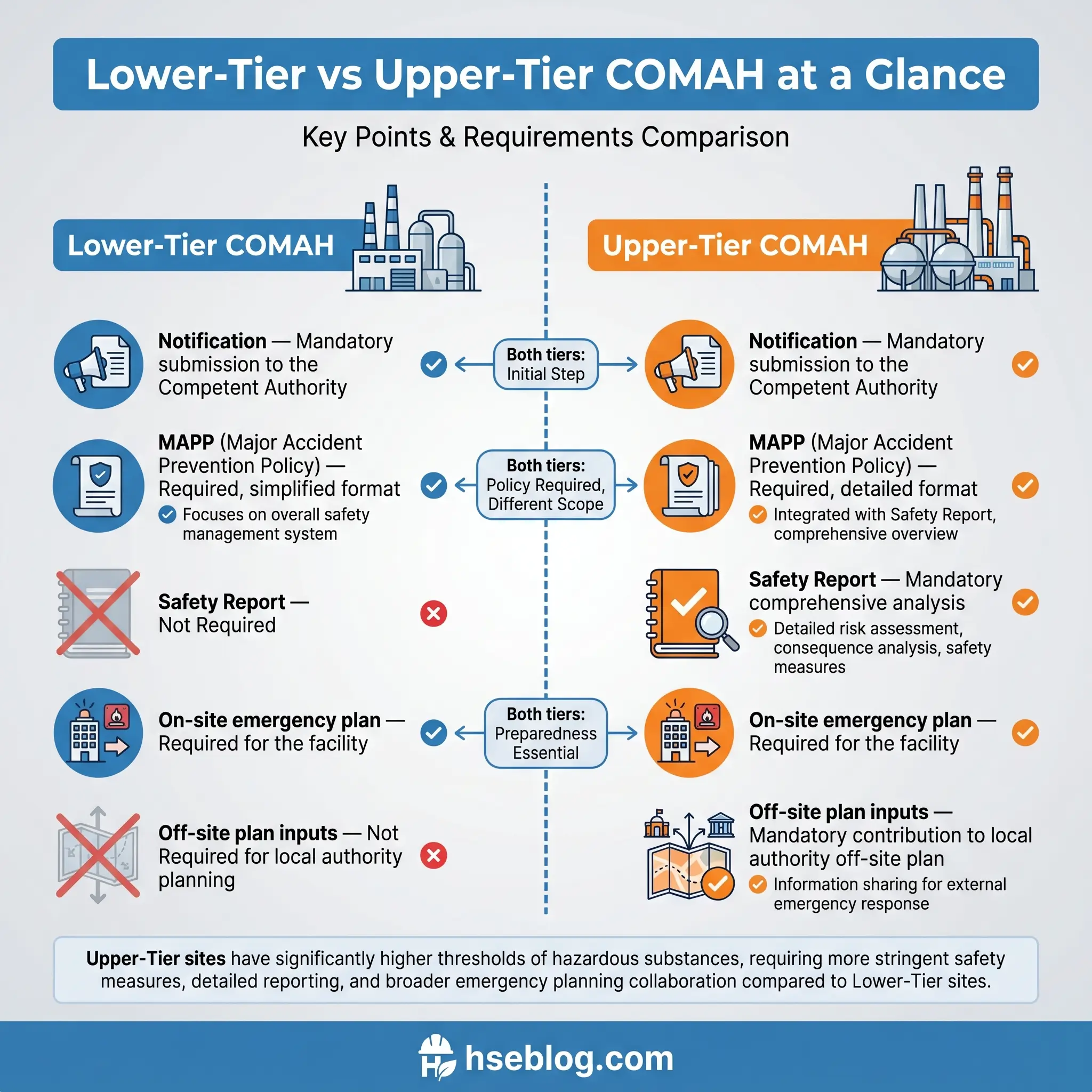
| Duty | Lower Tier | Upper Tier |
|---|---|---|
| COMAH notification | Required | Required |
| Major Accident Prevention Policy | Required (standalone document) | Required (embedded in safety report) |
| Safety Management System | Required | Required |
| Safety Report | Not required | Required before operations begin |
| Internal Emergency Plan | Required (proportionate) | Required (detailed) |
| Information to local authority for external plan | Not required | Required |
| Public information | Required (reactive) | Required (proactive) |
Lower-Tier COMAH Duties at a Glance
A lower-tier operator must notify the Competent Authority of the establishment, prepare and retain the MAPP, implement a safety management system proportionate to the major-accident hazards, maintain internal emergency arrangements, and report any major accident that occurs. The MAPP is the policy document that sits above the SMS — it is retained on site, made available on request, and inspected in place rather than submitted.
Upper-Tier COMAH Duties at a Glance
An upper-tier operator carries the full set. Notification, MAPP, full SMS, and on top of those a detailed safety report submitted to the Competent Authority before operations begin, a documented on-site emergency plan, the information the local authority needs to produce the off-site emergency plan, proactive public information under Schedule 4, and formal inputs into land-use planning decisions for the area around the establishment. Here, the MAPP forms a distinct, identifiable section within the safety report rather than a freestanding document.
The Legal Basis: Regulation 7 and Schedule 2 of COMAH 2015 Explained
Regulation 7 is only four sub-paragraphs long, but each carries weight and each has drafting consequences. Working through them in order is the only way to understand why the MAPP has to read the way it does.
Regulation 7(1) — the duty to prepare and retain. Every operator must prepare and retain a document setting out the MAPP. "Prepare" means the document must exist in written form before the establishment comes into operation. "Retain" means it must be kept, current, and available for inspection at all times. Lost, outdated, or draft-only MAPPs fail this sub-paragraph on their face.
Regulation 7(2) — the outcome standard. The MAPP must be designed to ensure a high level of protection for human health and the environment. This is the outcome test inspectors apply. If the document's content does not plausibly deliver that outcome for the hazards present — if the aims and principles are too generic, if the SMS elements are mentioned but not implemented — the MAPP fails the test regardless of whether every required heading is there.
Regulation 7(3) — proportionality. The MAPP must be proportionate to the major-accident hazards. A two-reactor speciality chemicals plant holding toxic intermediates does not need the same document as an LPG bulk storage depot, and neither looks like an explosives magazine. The Regulations explicitly allow the content to scale with hazard complexity. This is the clause that protects small operators from over-engineering their documents — and that allows inspectors to reject under-engineered ones.
Regulation 7(4) — the three mandatory content elements. The MAPP must state the aims and principles of action for controlling major-accident hazards; the roles and responsibilities of managers at every level; and the commitment to continuous improvement. All three must be present. A missing element is not a formatting issue — it is a Regulation 7 breach.
The link to Schedule 2 is where the MAPP becomes more than a statement of intent. Schedule 2 sets out the safety management system elements that must put the policy into effect. It transposes Annex III of Seveso III almost verbatim, and it is the place where Competent Authority inspectors find what they actually audit against. The overarching duty under Regulation 4 — to take all measures necessary to prevent major accidents and limit their consequences — is what Regulation 7 operationalises through the MAPP, and the ALARP standard for human risk and the Best Available Technique (BAT) approach for environmental risk sit behind both.
The Seven Annex III Principles Every MAPP Must Address
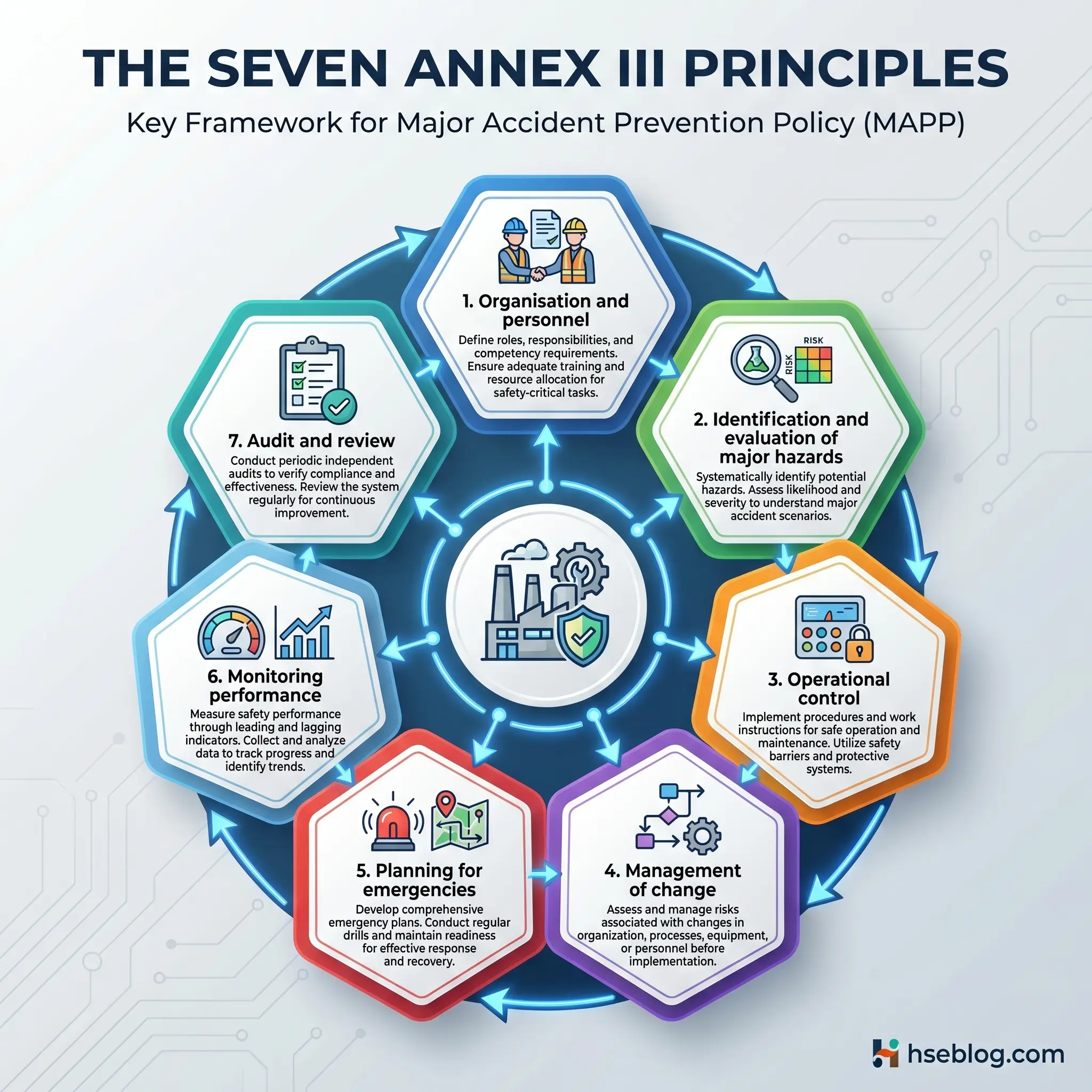
Seven SMS elements form the backbone of Annex III of Seveso III and, through transposition, of Schedule 2 of COMAH 2015. The MAPP itself does not need to duplicate the underlying procedures — that is what the SMS documents are for — but it must demonstrably reference how each element is addressed, and the linkage must be traceable. I work through these in the same order they appear in Schedule 2 because that is the order an inspector will follow.
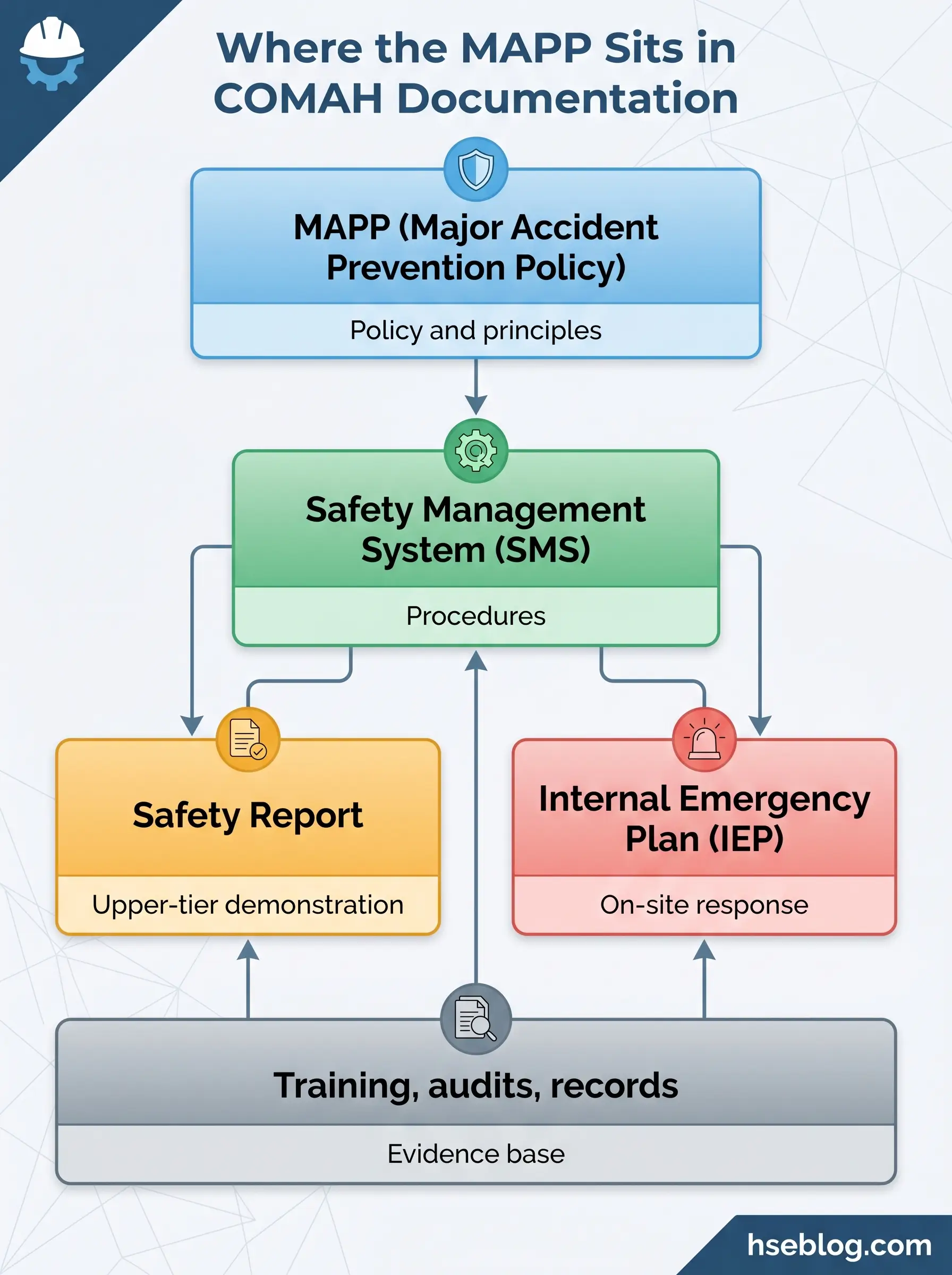
Before any of the seven: remember that the MAPP sits at the apex of the documentation hierarchy. It is not a mini-safety report. It is a short policy-level document that points to the SMS, where the procedural detail lives.
1. Organisation and Personnel
Roles, responsibilities, competence, training, consultation with the workforce, and contractor management. The MAPP must identify accountability for the delivery of the policy at senior level — in practice, a named board director or site director. The SMS behind it has to evidence competence assurance for safety-critical roles, training records, and the mechanism through which workers and their representatives are consulted on major-accident issues. An audit question I have watched inspectors ask first: who, by name and role, is responsible for the control of major-accident hazards on this site? If the answer requires the site manager to look through three documents, the MAPP has not done its job.
2. Identification and Evaluation of Major Hazards
Systematic hazard identification and risk evaluation — HAZID, HAZOP, LOPA, bowtie analysis, consequence modelling — supporting the ALARP demonstration for human risk and the BAT demonstration for environmental risk. The MAPP must state that these methods are used and link to the SMS procedures that implement them. For a lower-tier site, proportionality matters: the Competent Authority does not expect a full quantified risk assessment of every scenario, but it does expect a systematic, auditable process that has produced the list of credible major-accident scenarios the rest of the MAPP is linked to.
3. Operational Control
The procedures that keep the plant inside its safe operating envelope. Safe operating procedures (SOPs), safety-critical task analysis, permit-to-work systems, shift handovers, control of ignition sources in flammable atmospheres, and plant integrity arrangements including inspection, testing, and maintenance of safety-critical elements (SCEs). The MAPP statement here is policy-level — a commitment to formal operational control. The SMS procedures are where the detail lives. Watch the link between the two: an MAPP that mentions permits without a permit system on the ground is the single most common finding in this area.
4. Management of Change (MoC)
Temporary and permanent modifications to plant, process, substance, procedure, or personnel have a specific procedural requirement under Schedule 2. The MAPP must commit to a formal management of change process with pre-startup safety review (PSSR) before modified plant is returned to service. The failure pattern I see repeatedly is a MoC procedure that captures engineering changes well but misses organisational change — a shift-pattern restructure, a reduction in operator numbers, an outsourced maintenance contract — even though these can affect major-accident risk just as much as a replaced vessel.
5. Planning for Emergencies
The MAPP must commit to a documented emergency response capability proportionate to the major accidents identified. For lower-tier sites this is primarily the on-site emergency plan, tested at a frequency defined in the SMS. For upper-tier sites the MAPP must also commit to providing the information the local authority needs to produce the off-site emergency plan, and to participating in combined drills. The Regulations set no universal test frequency — it is risk-based — but inspectors expect the test frequency, the scope of drills, and the lessons-learned loop to be written down and followed.
6. Monitoring Performance
Leading and lagging process safety indicators, incident and near-miss reporting, the performance of safety-critical elements against their performance standards, and the status of corrective actions. The HSE / Chemical Industries Association publication HSG254 — Developing Process Safety Indicators — is the reference framework the Competent Authority expects operators to work against. The MAPP must commit to the principle; the SMS must evidence the KPIs. Relying on lagging data alone — LTIs, reportable incidents — has been a specific finding in a succession of CA inspections, because by the time lagging data moves, the control gap has already existed for some time.
7. Audit and Review
Systematic independent audit of the SMS, management review of the audit findings, and review of the MAPP itself at defined intervals. The MAPP must commit to a review cycle — at least every five years, and immediately after any significant modification or major incident — and must commit to documented corrective action for the findings. A revision history page in the MAPP itself is evidence of this element being implemented, and its absence is one of the quickest ways to signal to an inspector that the policy has not actually been reviewed since it was signed off.
What a Compliant MAPP Document Actually Looks Like
A well-written MAPP does not need to be long. For a lower-tier site with a single qualifying substance inventory, the document frequently runs to four or five pages plus a short set of appendices referencing the SMS procedures. For an upper-tier multi-unit establishment, ten to fifteen pages inside the safety report is typical. Length is not the test. Specificity is.
The document structure below is the one I draft against and the one I have seen hold up in front of Competent Authority inspectors at COMAH upper-tier chemicals sites. It maps each section to the Regulation 7 / Schedule 2 requirements.
- Statement of intent and scope. A short opening section identifying the operator, the establishment, the COMAH tier, and the scope of the policy. The statement of intent addresses the Regulation 7(2) outcome — a high level of protection for human health and the environment.
- Description of the establishment and its major-accident hazards. A concise description of the site, the dangerous substances held, the qualifying basis under Schedule 1, and the list of credible major-accident scenarios identified through the hazard identification process. This is the section that anchors the rest of the MAPP to the specific site.
- Aims and principles of action. The Regulation 7(4) core. This is where the operator commits to ALARP, to BAT, to the hierarchy of control (elimination, substitution, engineering, administrative, PPE) applied to major-accident hazards, and to preventative rather than reactive risk management.
- Roles and responsibilities. Named senior accountability, the chain of responsibility down through line management, the role of safety-critical staff, and the consultation arrangements for the workforce.
- Summary of the SMS for each Annex III element. Two or three short paragraphs per element, each referencing the underlying SMS procedure by document number. This is the single biggest drafting discipline — the MAPP summarises, the SMS procedures carry the detail.
- Continuous improvement commitment. The formal statement that the policy and the SMS will be reviewed and improved in light of monitoring, audit, incident learning, and developments in good practice.
- Review and revision history. Dated entries showing when the MAPP has been reviewed, what changed, and who approved each revision. This section should not be empty.
Signed off by the senior accountable manager. Dated. Communicated. Any MAPP without a current, dated senior signature is, in practical inspection terms, not a current policy.
The rule I give to every new drafter: if you can cut and paste a section of your MAPP into another COMAH operator's MAPP and neither operator would notice the switch, rewrite that section.
Lower-Tier vs Upper-Tier MAPP: Key Practical Differences
Both tiers require a MAPP. The legal outcome — a written, proportionate, senior-signed policy addressing all seven Annex III elements — is the same. The practical treatment diverges in three specific ways.
| Aspect | Lower Tier | Upper Tier |
|---|---|---|
| Format | Standalone document | Distinct section within the safety report |
| Submission | Retained on site; inspected in place | Submitted as part of the safety report before operations begin |
| SMS evidencing | May be implemented through "other appropriate means, structures and management systems" proportionate to hazards | Full formalised SMS expected, integrated with the safety report's demonstration of ALARP / BAT |
| Review cycle | At least every five years and on significant modification | At least every five years and on significant modification; revisions may trigger safety report revision |
| Public information | Reactive (on request) | Proactive (Schedule 4) and inputs into off-site plan and land-use planning |
The Seveso III allowance for lower-tier operators to use "other appropriate means" has been misread by more than one operator as removing the need to address all seven Annex III principles. It does not. It allows flexibility in how each principle is implemented — what is documented, how formalised the procedures are — but all seven must still be demonstrably addressed. A lower-tier MAPP that stays silent on management of change, or on audit and review, is not compliant.
How to Write a MAPP: A Step-by-Step Drafting Workflow
Most competitor content stops at describing what a MAPP should cover. The harder question is how to produce one from a blank page. The workflow below is the one I use, and the one I recommend to anyone who has just inherited a MAPP rewrite on site.
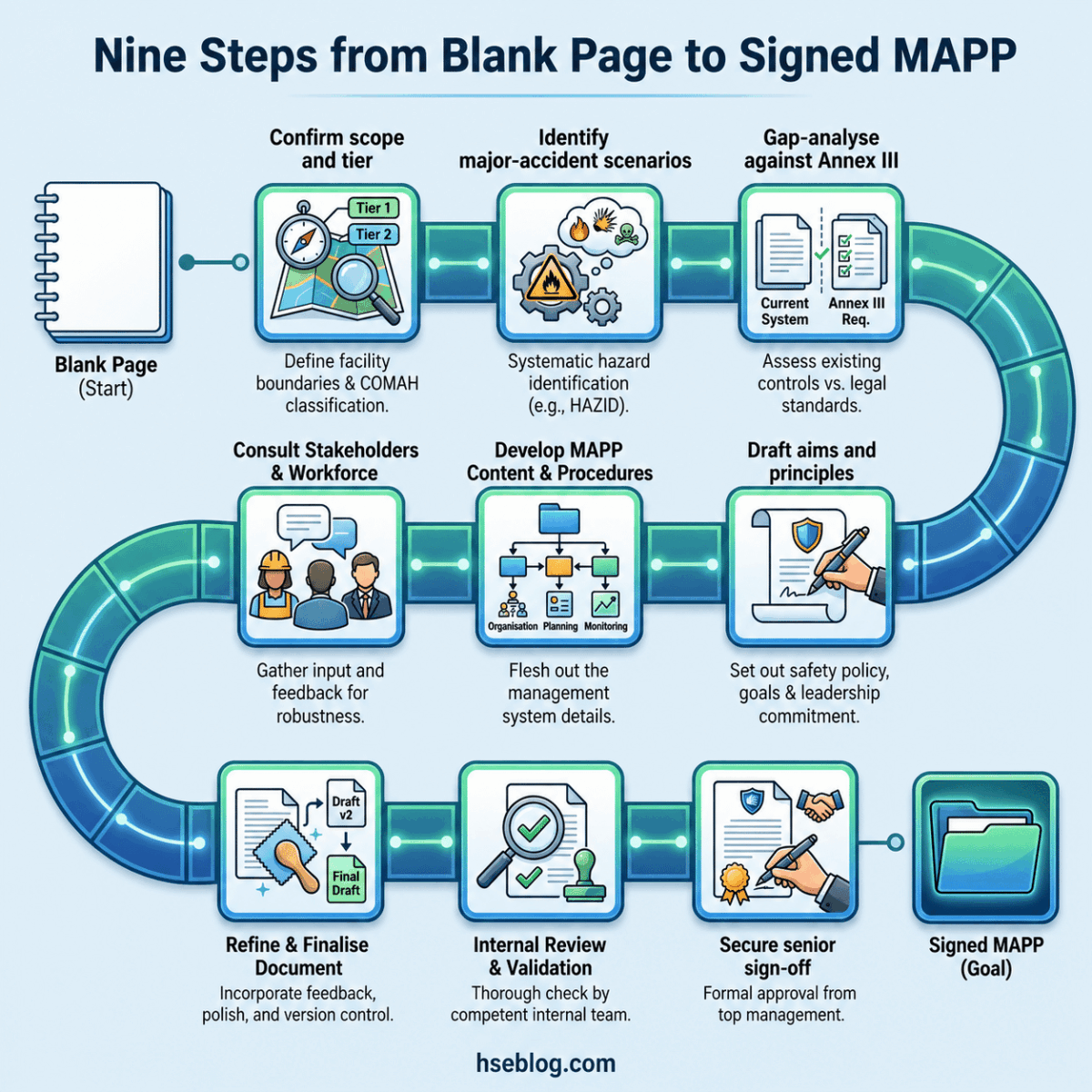
- Confirm scope and tier. Complete the Schedule 1 substance inventory. Run the partial-fraction aggregation across health, physical, and environmental hazard classes. Document the result. Confirm whether the establishment is lower tier, upper tier, or out of scope. This is the foundation — every later decision flows from it.
- Identify the site's credible major-accident scenarios. Use HAZID, HAZOP, and where relevant LOPA and bowtie analysis to produce the list of scenarios the MAPP must protect against: fire, explosion, toxic release, environmental release. These scenarios are the anchor every other part of the MAPP must link back to.
- Map existing arrangements against the seven Annex III elements. A two-column gap analysis — what Schedule 2 requires for each element, what is currently in place, what needs to be added or formalised. This is where you find the missing MoC procedures, the absent SCE performance standards, the unformalised audit schedule.
- Draft the policy statement, aims and principles. Use language the Competent Authority recognises — ALARP, BAT, hierarchy of control, continuous improvement. Avoid marketing language. A MAPP is a legal document and should read like one.
- Document roles and responsibilities. Senior accountability must be named. Line responsibility must be traceable. Safety-critical roles must be identified. Workforce consultation arrangements must be stated.
- Summarise each SMS element in short paragraphs. Two or three paragraphs per element, each pointing to the underlying SMS procedure by document number. Keep the summary high-level. The procedure carries the detail.
- Secure board or senior-management sign-off. The signature is the evidence of the continuous improvement commitment and of the provision of resources required under Regulation 7.
- Communicate the MAPP to workforce and contractors. Embed it into induction, into contractor pre-mobilisation briefings, and into refresher training for safety-critical roles. An uncommunicated MAPP has not been implemented.
- Set the review schedule and trigger criteria. Calendar entry for the five-year review. Documented triggers for ad-hoc review: significant modification, substance change, tier change, organisational restructuring, significant incident, industry-wide lessons learned.
MAPP Review, Revision, and Management of Change
The MAPP is not a one-off deliverable. Regulation 7 is a continuing duty, and the policy has to stay current with the site it describes. Two mechanisms drive this — a scheduled review cycle and a set of ad-hoc revision triggers — and both must be evidenced in the document itself.
The minimum review cycle is five years. That is a floor, not a target. Many upper-tier operators run a rolling three-year internal review that feeds into the formal five-year revision, particularly where the site has a high MoC volume or where safety report cycles align to shorter intervals. The scheduled review is less about rewriting the document wholesale and more about confirming that every section still reflects the site, the hazards, the organisation, and the SMS as they currently are.
Ad-hoc review triggers you must write into the policy:
- Any modification to installation, process, substance quantity, or physical form that could have significant consequences for major-accident hazards.
- Any change of dangerous substance holding that could move the site between tiers.
- Organisational restructuring affecting safety-critical roles or senior accountability.
- Any on-site major accident or serious near-miss.
- Lessons learned from industry-wide events — Buncefield-type tank overfills, Toulouse-type explosive decomposition events, eMARS-reported accidents in the same sub-sector.
- Changes to underpinning standards or Competent Authority Operational Delivery Guides.
Documenting the review is as important as doing it. The revision history page in the MAPP should show the date of the review, the scope, the changes made, the responsible person, and the senior approval. Where the review addressed lessons learned from an incident or an industry event, that linkage should be recorded. For upper-tier sites, revisions that materially change the major-accident hazard profile will also trigger safety report revision.
Communication closes the loop. A revised MAPP that has not been communicated to the workforce, the contractors on site, and — for upper-tier establishments — the Competent Authority, has not been implemented in the Regulation 7(2) sense.
How the Competent Authority Inspects a MAPP
COMAH inspection is a specific discipline carried out by trained inspectors under published Operational Delivery Guides. The MAPP is not inspected as a standalone document — it is inspected as the policy end of a chain that runs through the SMS, the procedures, and the evidence of implementation on site. Understanding what inspectors look for changes how the document is written.
The CA uses a set of Operational Delivery Guides that target specific SMS elements — Competence Management Systems, Ageing Plant, Flood Preparedness, and from the 2024–25 programme a new campaign on maintaining safety in a changing climate at COMAH establishments. The climate-change inspection stream reflects the regulatory recognition that net-zero-driven process changes — hydrogen introduction, carbon capture retrofits, battery storage additions, bioenergy conversions — are prompting substantive changes to long-established major-accident hazard profiles. If your process is undergoing any of those transitions, expect the MAPP and the MoC arrangements behind it to be read against that guide.
Typical inspection findings that drive enforcement action:
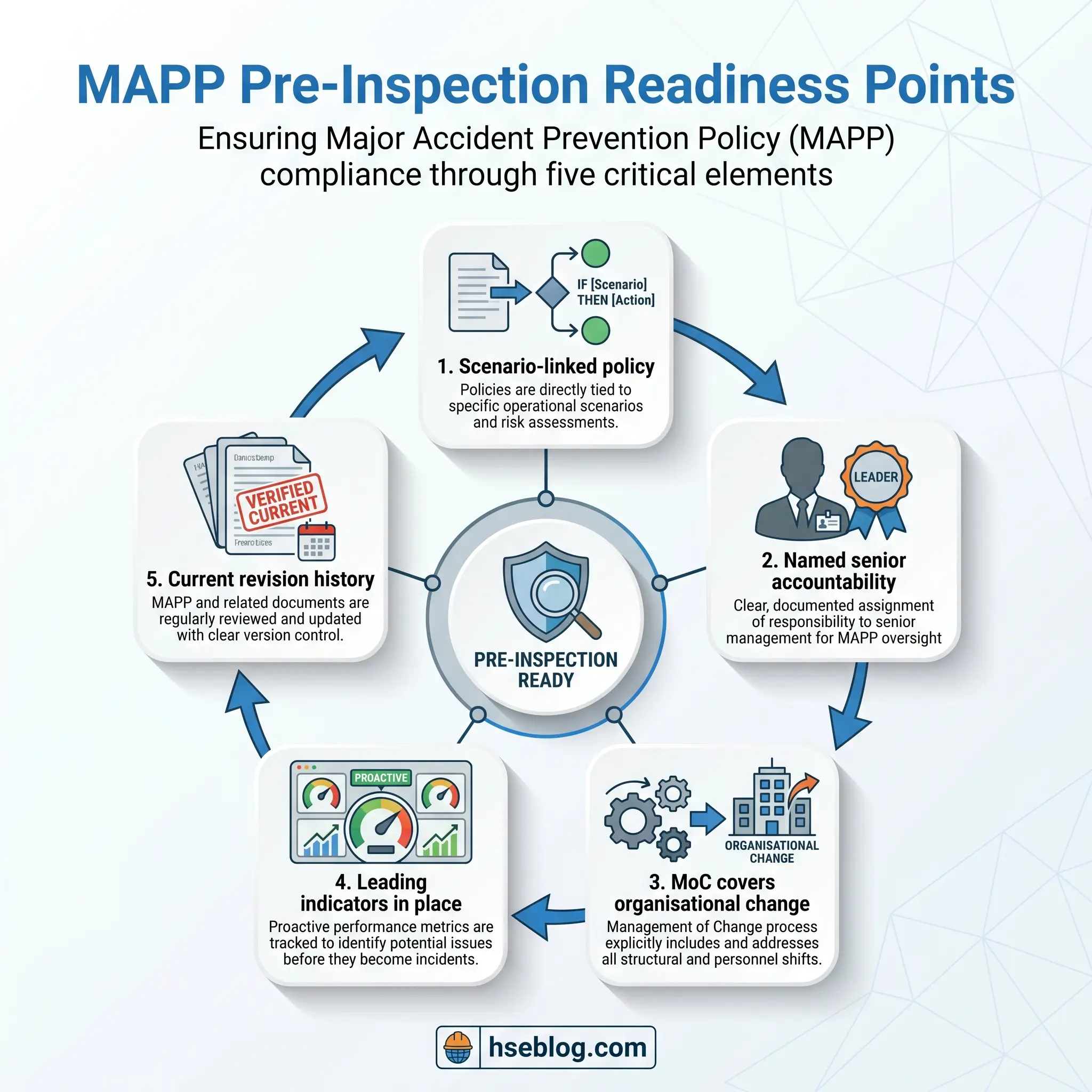
- Generic MAPPs not linked to the site's specific major accidents. The most common single finding.
- Insufficient senior-level ownership — no named accountability, stale signatures, board-level disengagement.
- Weak linkage between the MAPP and the SMS procedures it claims to implement.
- Absence of leading process safety indicators; reliance on lagging injury data only.
- MoC procedures that miss organisational change.
- No revision history or a revision history with a gap exceeding five years.
- Upper-tier MAPPs buried in the safety report rather than presented as a distinct, identifiable section.
Enforcement follows the Enforcement Management Model. The escalation path runs from written advice, through improvement notices, to prohibition notices, to prosecution. Where prosecution occurs, the underpinning breach is frequently framed under Regulation 4 — the general duty to take all measures necessary — with Regulation 7 as the vehicle showing that the management system failure was systemic rather than one-off. The Buncefield prosecutions sit in that pattern. So do subsequent prosecutions in the fuel storage, fine chemicals, and explosives sectors.
Audit Point: Inspectors routinely ask the site manager to name, without reference to documents, the top three credible major-accident scenarios for the site and the top three SCEs preventing them. If the answer is hesitant, the MAPP's implementation — not its wording — becomes the focus of the visit.
The MAPP in Context: How It Fits with the Safety Report, SMS, and Emergency Plans
The MAPP does not sit alone. It is the apex document in a wider COMAH documentation ecosystem, and the relationships between those documents are the source of most of the confusion I see on site. The cleaner the ecosystem, the cleaner the inspection.
- COMAH notification — the basic establishment data submitted to the Competent Authority under Regulation 6 that triggers all downstream obligations.
- Major Accident Prevention Policy (MAPP) — sets the policy and principles of action; the short, senior-signed document.
- Safety Management System (SMS) — the suite of procedures that implements the MAPP, addressing each of the seven Schedule 2 / Annex III elements.
- Safety Report — upper tier only; demonstrates to the Competent Authority that the MAPP and SMS have been put into effect and that the major-accident hazards are controlled to ALARP.
- Internal (on-site) Emergency Plan — Regulation 12; details the on-site response to the identified major-accident scenarios and is tested at a frequency defined in the SMS.
- External (off-site) Emergency Plan — prepared by the local authority for upper-tier sites under Regulation 13, based on information supplied by the operator.
- Land-use planning inputs — upper-tier only; under Regulation 26 the operator provides information that feeds into land-use decisions around the establishment.
Read in order, the logic runs: the notification triggers the regime, the MAPP sets the policy, the SMS implements it, the safety report demonstrates it for upper tier, the emergency plans respond to what cannot be prevented, and the land-use planning inputs manage the risk to populations around the site.
International Equivalents: MAPP vs OSHA PSM vs EPA RMP
COMAH readers working in multinational operators frequently need to translate the MAPP / SMS model into the US regulatory vocabulary, and the other way round. The frameworks are not identical, and the vocabulary differs, but the underlying process safety content overlaps to a substantial degree.
| Feature | UK / EU (COMAH / Seveso III) | US (OSHA PSM + EPA RMP) |
|---|---|---|
| Legal instrument | COMAH 2015 / Directive 2012/18/EU | 29 CFR 1910.119 (OSHA PSM) and 40 CFR Part 68 (EPA RMP) |
| Scope trigger | Schedule 1 dangerous substances + qualifying quantities | PSM list of highly hazardous chemicals + threshold quantities; RMP regulated substances + thresholds |
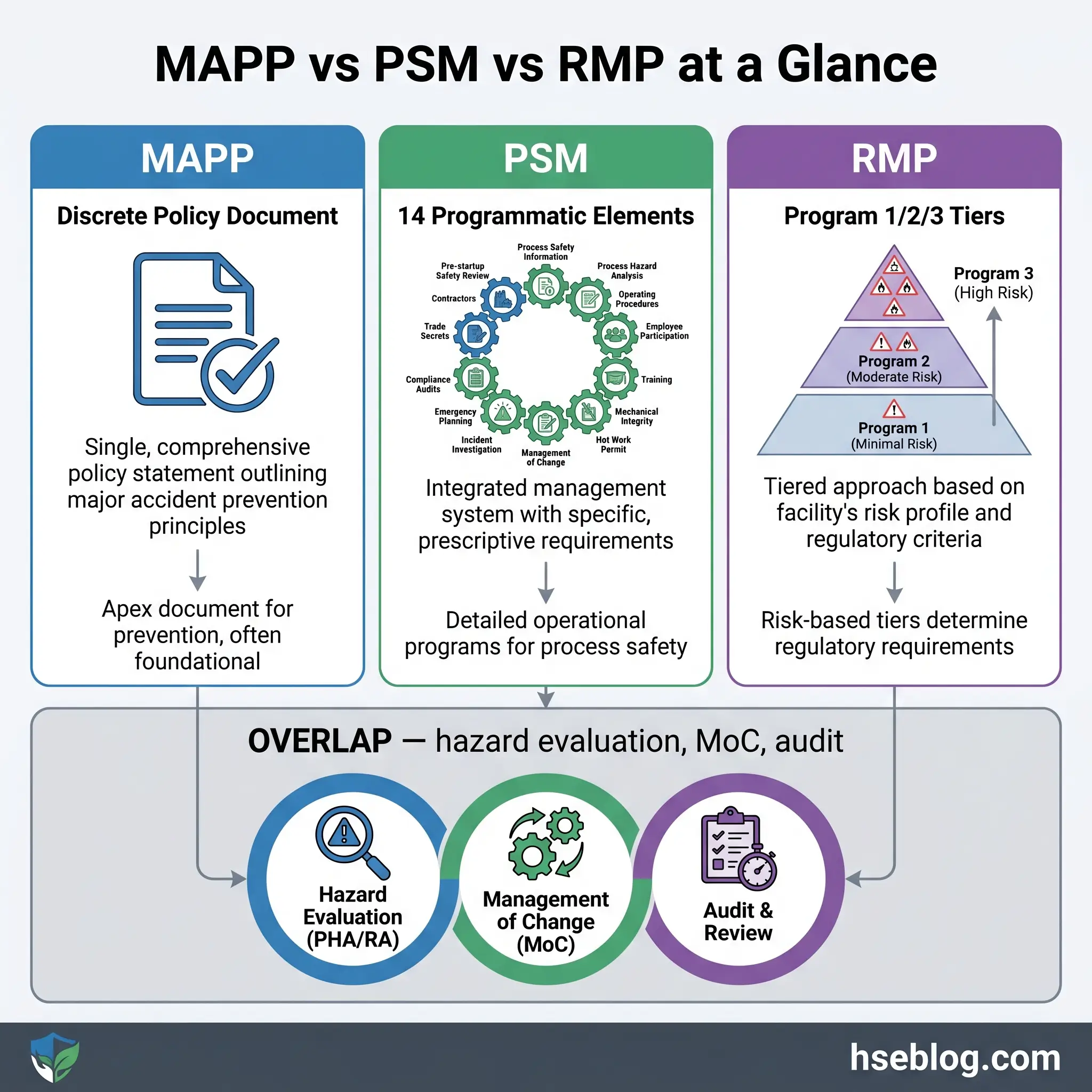
| Apex policy document | MAPP — discrete, senior-signed policy | No single equivalent; PSM operates as 14 programmatic elements |
| Regulator model | Joint Competent Authority (HSE + EA/SEPA/NRW) | OSHA for worker safety (PSM); EPA for off-site consequences (RMP) |
| Tiering | Lower tier / upper tier | RMP Program 1 / 2 / 3 |
| Demonstration document | Safety Report (upper tier) | PSM compliance audit + RMP Risk Management Plan |
The overlap is in the content. Hazard evaluation (PSM process hazard analysis maps directly to COMAH hazard identification). Operating procedures. Training. Management of change. Mechanical integrity. Incident investigation. Audit. The structural difference is that the MAPP is a discrete policy document sitting above the SMS, whereas PSM is a programmatic standard whose 14 elements are evidenced element-by-element without a single overarching policy artefact. Any multinational operator with sites in both jurisdictions will typically run a single process safety management system mapped to both frameworks, with the MAPP produced where COMAH applies and a PSM compliance programme documentation set produced where PSM applies.
The EPA RMP framework is worth tracking for freshness. The 2024 Safer Communities by Chemical Accident Prevention final rule expanded RMP requirements in several areas that will be familiar to COMAH operators — third-party audits, employee participation, natural hazard and power-loss considerations. For readers at operators with US facilities, these developments are prompting parallel reviews of MAPP-level climate and resilience content in the UK and EU.
The OECD Guiding Principles for Chemical Accident Prevention, Preparedness and Response remain the underlying international benchmark that both frameworks draw from, and they are a useful reference when harmonising policy content across jurisdictions.
Common MAPP Pitfalls and How to Avoid Them
Across inspections I have seen, the failure patterns are remarkably consistent. The same seven or eight issues come up across chemicals sites, fuel terminals, and warehousing operations, regardless of tier. Understanding them upfront is the fastest way to raise a MAPP from pass-with-comments to pass-clean.
- Generic corporate templates. A MAPP lifted from a parent company's intranet, adapted by changing the site name, and signed off without site-specific scenario linkage. The Competent Authority reads this quickly — the giveaway is that the major-accident scenarios in the MAPP do not match the ones in the site's HAZOP or safety report.
- General HSE policy mistaken for a MAPP. A document focused on occupational health and safety — slips, trips, manual handling, PPE — signed by the managing director and labelled as a MAPP. A MAPP addresses major-accident hazards specifically. Occupational safety belongs elsewhere.
- Missing or weak management of change. Strong on engineering MoC, silent on organisational MoC. Shift restructures, outsourced maintenance, reductions in the competent supervision layer — none captured.
- Lagging indicators only. Lost-time injury rates and reportable incidents as the whole of the performance story, with no leading indicators on SCE performance, near misses, overdue MoC closures, or audit findings. HSG254 is the reference the Competent Authority works against.
- Five-year review cycles that never actually happen. The MAPP committed to a five-year review; the revision history stops at the original sign-off.
- SMS referenced but not implemented. The MAPP names every SMS procedure by document number, and the procedures either do not exist or have not been updated since the site commissioned.
- Upper-tier MAPP buried in the safety report. The MAPP is legally required to be a distinct, identifiable section. A one-paragraph mention inside a safety report chapter fails this test.
The Fix That Works: Build a single-page traceability matrix that maps each of the seven Annex III elements to the specific MAPP paragraph, the underlying SMS procedure number, and the last review date. If any cell is blank, you have found your gap before the inspector does.
Frequently Asked Questions
Is a Major Accident Prevention Policy a legal requirement?
Yes. Under Regulation 7 of the Control of Major Accident Hazards Regulations 2015 in the UK, and Article 8 of the Seveso III Directive (2012/18/EU) in the EU, every operator of an establishment meeting the Schedule 1 or Annex I thresholds must prepare and retain a MAPP. The duty applies to both lower-tier and upper-tier sites. For lower-tier operators the MAPP is a standalone document retained on site; for upper-tier operators it sits as a distinct section within the safety report.
How often should a MAPP be reviewed?
At least every five years, and always after any significant modification that could change the major-accident hazard profile of the establishment. "Significant modification" includes changes to the installation, process, dangerous substance, quantity, physical form, organisational structure affecting safety-critical roles, and lessons learned from on-site or industry-wide major accidents. The five-year review is the minimum floor — many upper-tier operators run a rolling internal cycle on a shorter frequency to feed into the formal revision.
What is the difference between a MAPP and a safety report?
The MAPP is a short policy document setting out the aims and principles of action for preventing major accidents, the roles and responsibilities, and the commitment to continuous improvement. The safety report is a detailed demonstration document — required only for upper-tier sites — that shows the Competent Authority the MAPP and SMS have been put into effect and that the major-accident hazards are controlled to ALARP. For upper-tier sites the MAPP sits within the safety report as a distinct, identifiable section; it does not replace the safety report.
How long should a MAPP document be?
There is no prescribed length. In practice, lower-tier MAPPs typically run between four and ten pages, including the revision history; upper-tier MAPPs inside a safety report typically run ten to fifteen pages. The statutory test is proportionality under Regulation 7(3) and traceable linkage to the site's specific major-accident scenarios — not page count. A short, site-specific MAPP will always outperform a long, generic one.
Who is responsible for signing off the MAPP?
Senior management. The MAPP must demonstrate commitment at a level that can authorise resources for the control of major-accident hazards, which in most corporate structures means the site director or a designated board-level director. The signature is the evidence of the Regulation 7(4) continuous improvement commitment and of the resource commitment that sits behind it. A MAPP without a current, dated senior signature is, in inspection terms, not a current policy.
Does a MAPP need to be sent to the Competent Authority?
It depends on tier. Lower-tier MAPPs are retained on site and made available for inspection — they are not routinely submitted. Upper-tier MAPPs are submitted as a distinct section within the safety report before operations begin. Both are subject to Competent Authority inspection in place, and both must be accessible to inspectors on request at any time.
Can a generic corporate safety policy serve as a MAPP?
No. A MAPP must be specifically focused on the prevention of major accidents involving dangerous substances and linked to the specific major-accident scenarios identified at the site. Generic corporate HSE policies — focused on occupational health and safety, wellbeing, or environmental stewardship in general terms — fail the Regulation 7 test because they do not address major-accident hazards specifically and cannot be traced to the site's HAZOP or safety report outputs. This is one of the most common inspection findings.
Conclusion
A compliant Major Accident Prevention Policy comes down to four operational decisions that every drafter has to get right. Write the document against your own site — the scenarios, the substances, the scale of your organisation — not against a corporate template. Name senior accountability in terms an inspector can check without opening a second document. Link every one of the seven Annex III elements to an SMS procedure that actually exists and is current. Keep the revision history alive, with scheduled five-year reviews and documented ad-hoc reviews triggered by modifications, organisational change, and lessons learned.
Those four decisions, taken together, determine whether the MAPP holds up when the Competent Authority inspector sits down with it. Everything else — format, section headings, length, layout — is secondary. The Regulation 7 duty is about substance, not presentation, and the Enforcement Management Model responds to substance.
The one action I would take away from this guide, if I had inherited a MAPP review on site today, is to build the traceability matrix first and write the document second. A single sheet mapping each Annex III element to a MAPP paragraph, an SMS procedure number, and a last-review date will expose every gap before the inspector does. That matrix is also the quickest way to turn a compliance burden into a live management tool, which is how a Major Accident Prevention Policy is supposed to operate in the first place.