I was auditing a mid-sized petrochemical facility in the Gulf when I asked the plant manager a straightforward question: "Show me your management system." He pointed at three separate binders on three different shelves — one for safety, one for health, and one for environment. Each had a different revision date. The safety binder referenced a risk assessment process that the environmental binder contradicted. The health surveillance schedule hadn't been updated in fourteen months. Three systems, three owners, three sets of gaps — and a workforce caught in the middle trying to figure out which procedure applied when a chemical spill happened near a confined space entry.
That facility wasn't lacking effort. It was lacking integration. And that is precisely the problem a SHEMS solves. A Safety, Health, and Environment Management System brings every protective function — hazard control, health surveillance, environmental compliance, emergency preparedness, legal obligations — into a single, unified framework. When a SHEMS works properly, there are no orphaned procedures, no contradictory risk assessments, and no confusion about who owns what. This article breaks down what SHEMS actually means in practice, the key elements that make it function, the standards that underpin it, and the common failures I've seen across industries that render a management system useless on paper and dangerous on site.
What Does SHEMS Stand For?
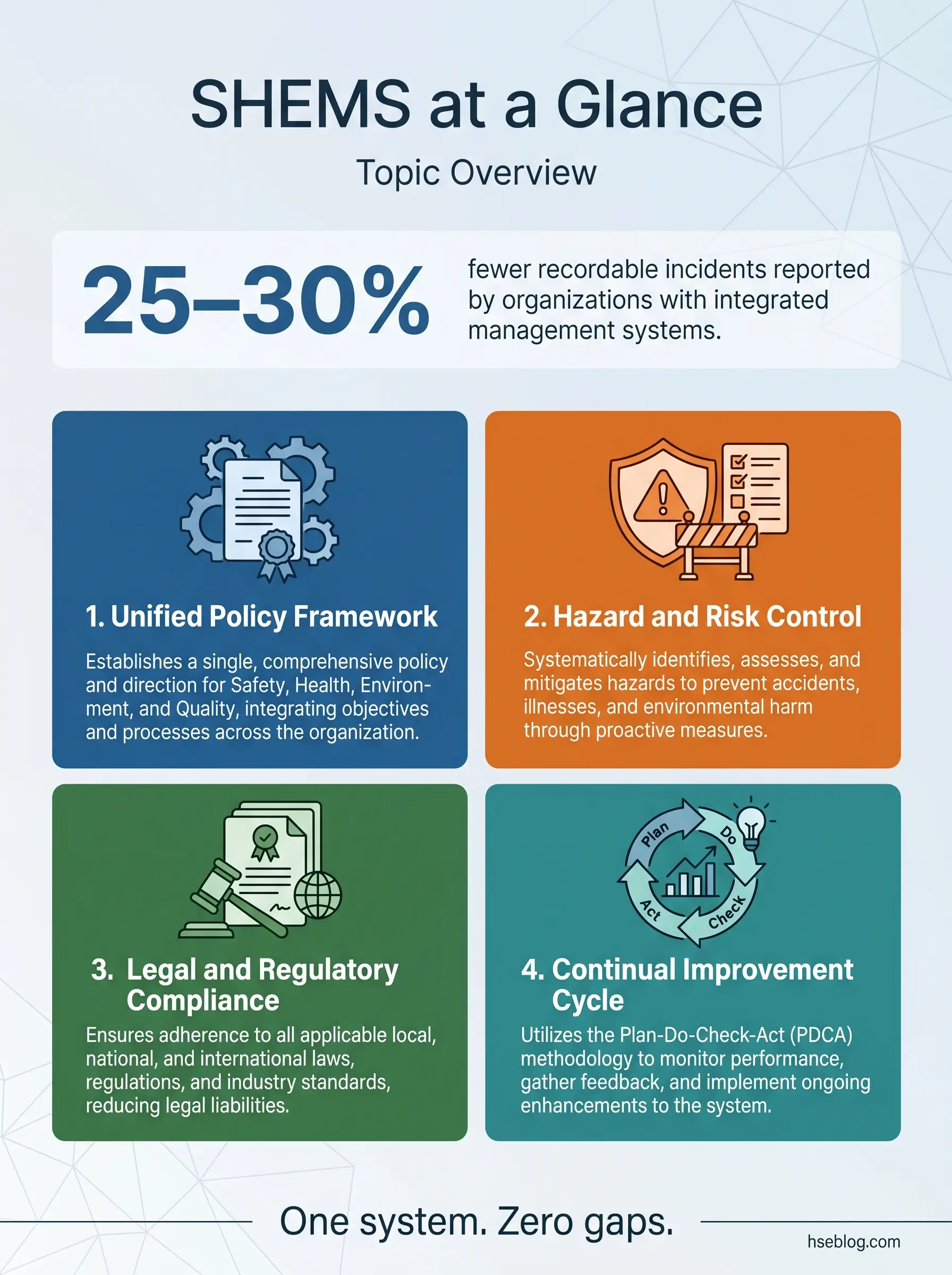
SHEMS stands for Safety, Health, and Environment Management System. It is a structured, organization-wide framework that systematically manages workplace safety risks, occupational health exposures, and environmental impacts through a single integrated system rather than treating each discipline in isolation.
A SHEMS defines how an organization identifies hazards, assesses risks, sets objectives, implements controls, monitors performance, and drives continual improvement across all three domains — safety, health, and environment. The most direct way to understand it is this: a SHEMS is the operating system that connects your safety policy to what actually happens on the shop floor, at the wellhead, or on the construction deck.
The key distinctions that separate a SHEMS from informal safety efforts are worth understanding clearly:
- Systematic, not ad hoc: Every process — from risk assessment to incident investigation to emergency response — follows defined procedures with assigned responsibilities, timelines, and review mechanisms.
- Integrated, not siloed: Safety, occupational health, and environmental management share common processes for document control, training, auditing, corrective action, and management review. One audit program covers all three domains.
- Performance-driven, not compliance-only: A functioning SHEMS tracks leading indicators (near-miss reports, inspection completion rates, training coverage) alongside lagging indicators (LTIFR, severity rate, environmental incidents). Compliance is the floor, not the ceiling.
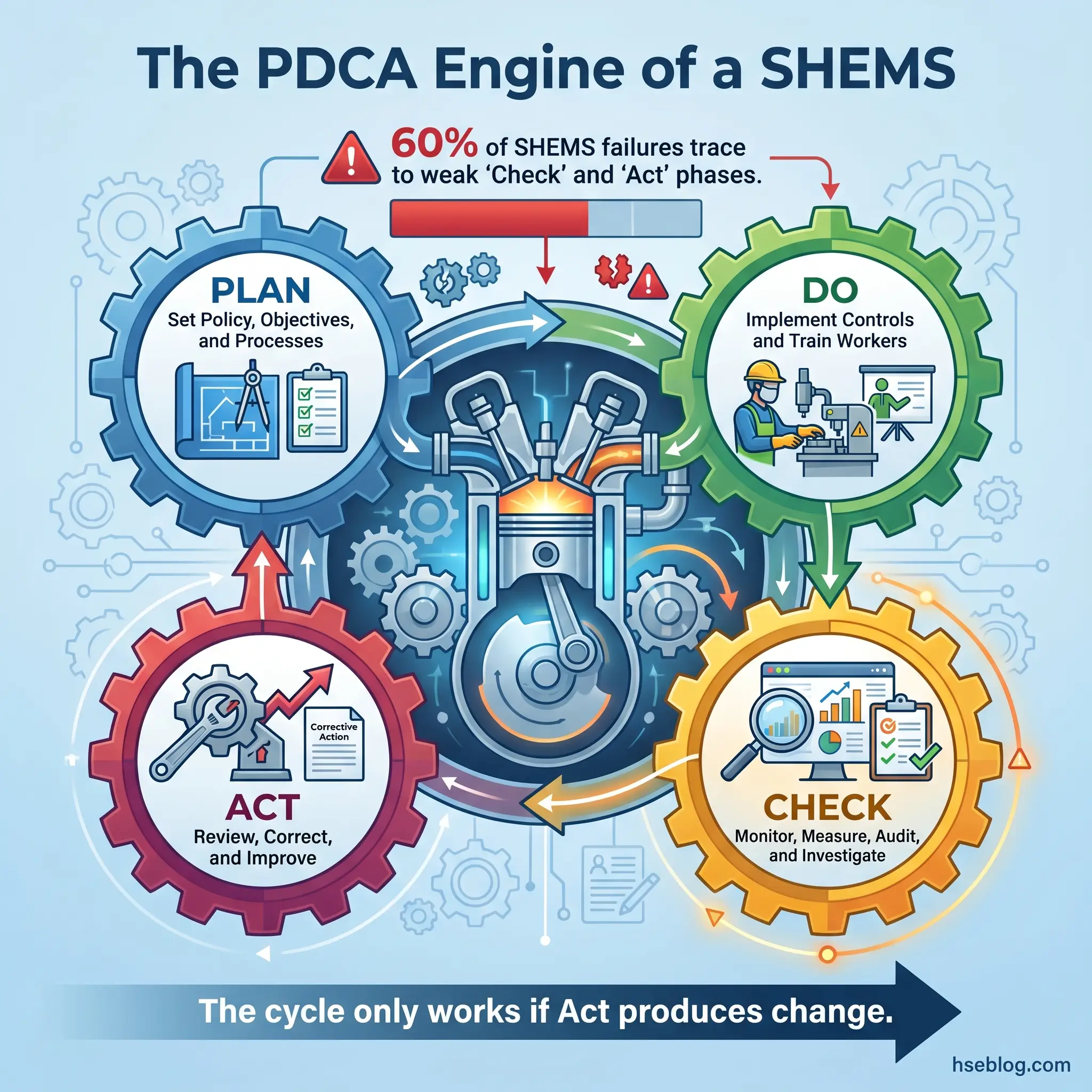
- Continual improvement, not static: The Plan-Do-Check-Act (PDCA) cycle is embedded into the system architecture. Every audit finding, incident investigation, and management review feeds back into system revision.
A management system is not a manual sitting on a shelf. It is the living architecture that determines whether your safety policy produces safe outcomes or just safe-looking documentation.
Pro Tip: When evaluating whether an organization has a real SHEMS or just documentation, ask one question: "Can a frontline supervisor trace a hazard they reported last month through to the corrective action that was implemented?" If they can't, the system exists on paper only.
Why Organizations Need a SHEMS
I've worked with operations that had excellent safety policies — eloquently worded, signed by the CEO, laminated and posted at every entrance. And I've watched those same operations accumulate lost-time injuries quarter after quarter because the policy had no system underneath it. A policy without a management system is a promise nobody keeps.
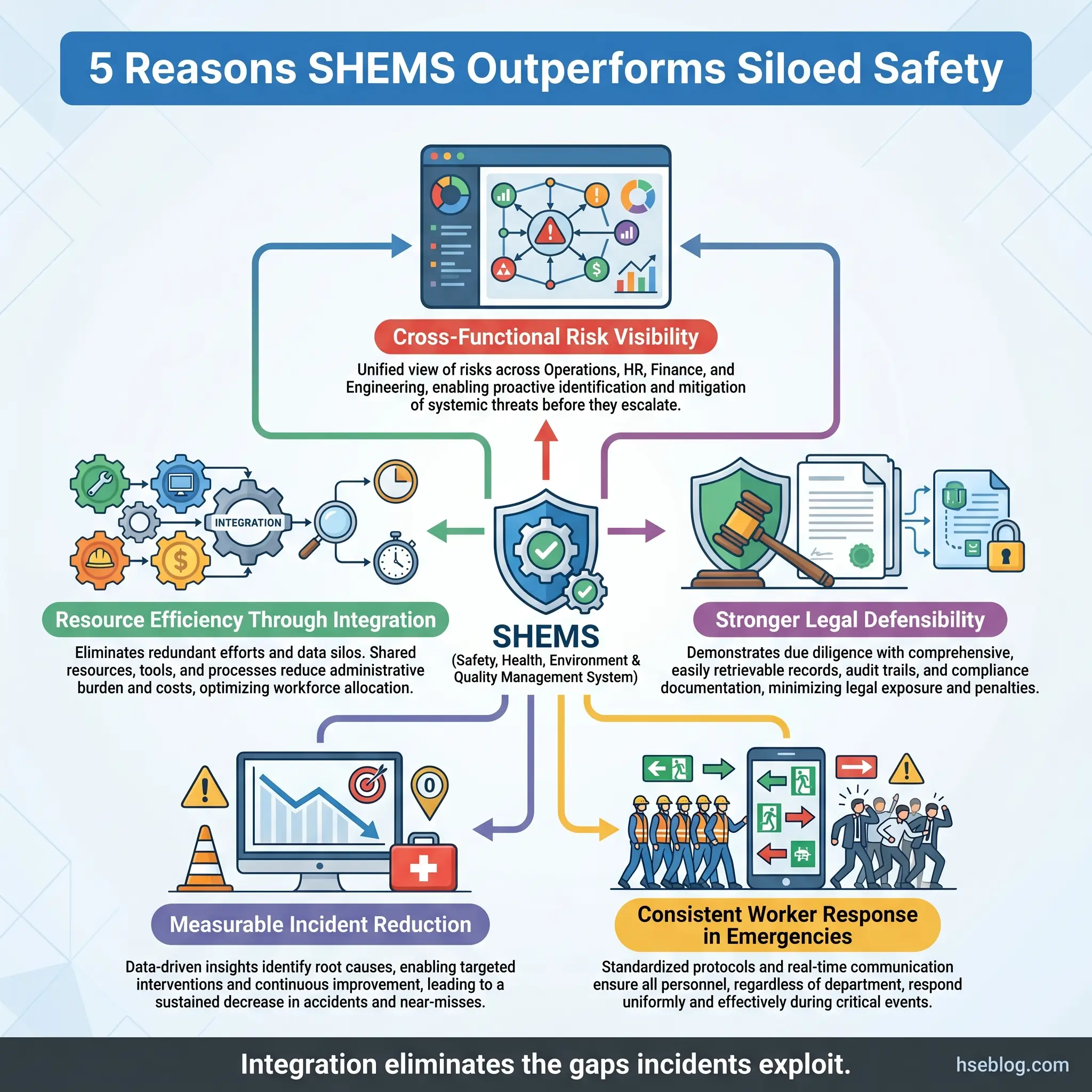
The operational case for implementing a SHEMS goes well beyond regulatory compliance. Organizations that run integrated management systems consistently outperform those managing safety, health, and environment in separate channels across several critical dimensions:
- Risk visibility: A SHEMS forces cross-functional hazard identification. A chemical storage issue that the environmental team flagged becomes visible to the safety team assessing fire risk and the occupational health team monitoring exposure — all through the same risk register.
- Resource efficiency: Integrated auditing, training, and document control eliminate the duplication that comes with running three parallel systems. One internal audit covers safety, health, and environmental compliance simultaneously.
- Legal defensibility: When regulators investigate an incident, they look for evidence of systematic management — not just isolated safe work procedures. A SHEMS provides the documented evidence chain from policy through risk assessment, control implementation, training records, and monitoring.
- Incident reduction: The data is consistent across industries. Organizations with mature, integrated management systems report significantly lower recordable incident rates than those relying on standalone safety programs.
- Worker confidence: Crews trust systems that are consistent. When the emergency procedure for a chemical release aligns with the environmental spill response plan and the occupational health decontamination protocol, workers respond faster and with less confusion.
Pro Tip: During management reviews, present SHEMS performance data alongside operational KPIs — production output, project milestones, cost performance. This positions the management system as a business enabler, not an overhead function that competes with operations for attention.
Key Elements of a SHEMS
A SHEMS is only as strong as its weakest element. I've seen organizations invest heavily in hazard identification tools while neglecting management review — and the result is a system that identifies risks brilliantly but never allocates the resources to control them. Every element described below must function, and they must function together.
SHE Policy and Leadership Commitment
The SHE policy is the foundation document that defines the organization's commitment to protecting people, health, and the environment. But a policy only matters if leadership treats it as a binding operational commitment rather than a public relations statement.
An effective SHE policy must meet specific criteria to serve as a genuine system anchor:
- Signed by the highest-ranking executive — not delegated to the HSE department. This signals organizational ownership.
- Specific to the organization's risk profile — a petrochemical facility's policy should read differently from a logistics company's policy. Generic statements like "we are committed to safety" add nothing.
- Includes measurable commitments — to legal compliance, continual improvement, hazard elimination, consultation with workers, and provision of adequate resources.
- Communicated and understood at every level — not just posted. Workers should be able to describe what the policy commits the company to in practical terms.
- Reviewed at defined intervals — typically annually or after significant organizational change, major incidents, or regulatory updates.
ISO 45001 Clause 5.2 requires that the OH&S policy includes commitments to eliminate hazards, reduce risks, consult with workers, and pursue continual improvement. A SHEMS policy extends these same commitments to environmental protection.
Hazard Identification and Risk Assessment
This element is where the system connects to physical reality. Hazard identification and risk assessment within a SHEMS must cover all three domains — safety hazards, health exposures, and environmental aspects — through a unified process.
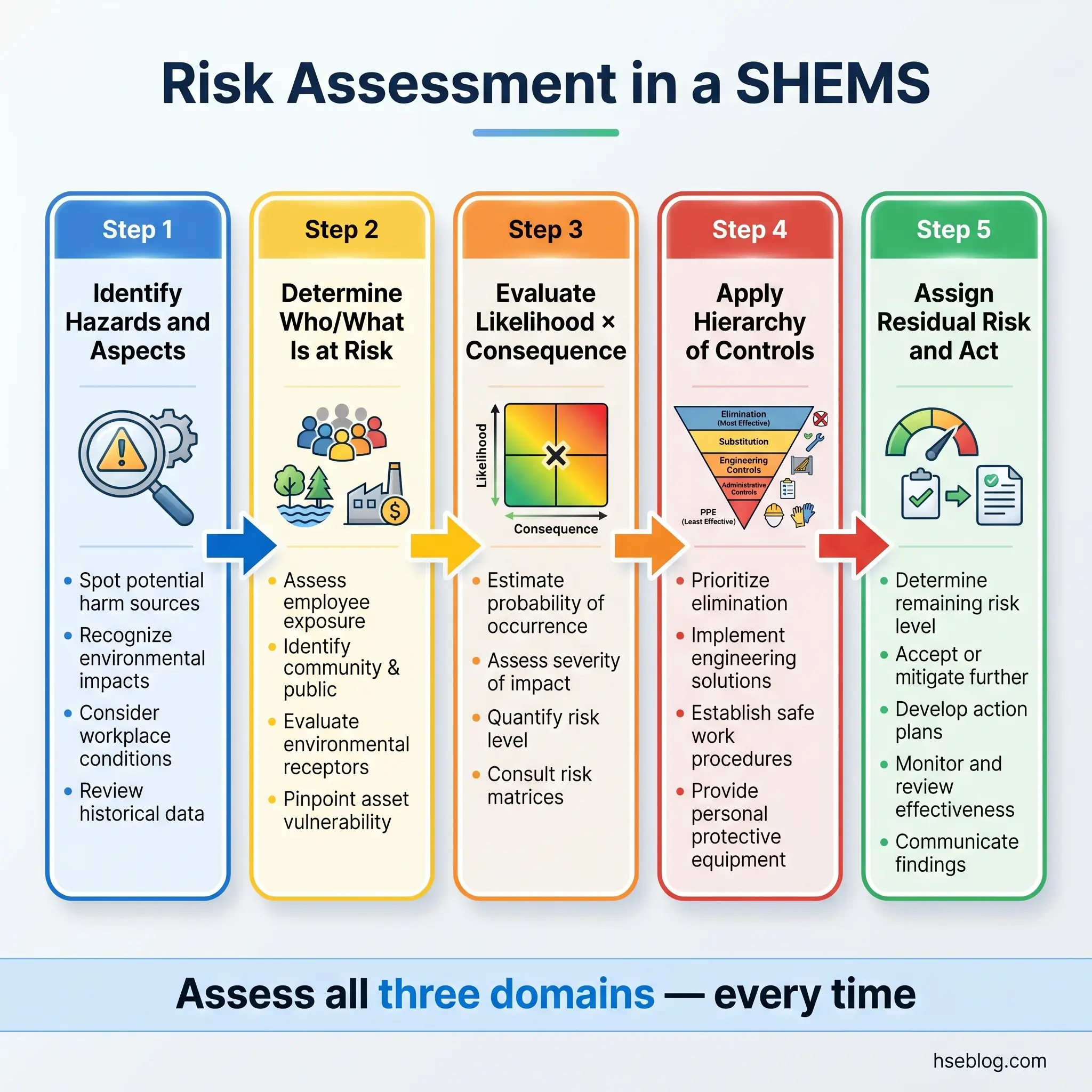
The risk assessment process within a SHEMS typically follows this sequence:
- Identify hazards and environmental aspects across all activities, including routine operations, non-routine tasks, maintenance, emergencies, and contractor work.
- Determine who or what is at risk — workers, contractors, visitors, communities, ecosystems, water sources, air quality.
- Evaluate the risk using a consistent methodology (likelihood × consequence matrix) applied uniformly across safety, health, and environmental risks.
- Determine existing controls and evaluate their adequacy against the hierarchy of controls — elimination, substitution, engineering, administrative, PPE.
- Assign residual risk ratings and prioritize actions based on risk significance.
- Document findings and communicate to affected workers, supervisors, and management.
The critical difference between a SHEMS risk assessment and a standalone safety assessment is scope. When I assess a painting operation through a SHEMS lens, I evaluate fall protection (safety), solvent vapor exposure and respiratory protection (health), and VOC emissions and waste paint disposal (environment) — all within the same assessment document, owned by the same process.
Pro Tip: Build your risk register so that every line item is tagged to at least one domain — S, H, or E. When you run the data, you'll quickly see if your organization is strong on safety identification but weak on health or environmental risks. That imbalance is where your next incident will come from.
Legal and Regulatory Compliance
A SHEMS must include a formal process for identifying, accessing, and maintaining compliance with all applicable legal requirements across safety, health, and environmental legislation. This is not a one-time checklist — it is a living register that requires active management.
The compliance element of a SHEMS involves several interconnected functions:
- Legal register maintenance: A documented list of all applicable legislation, regulations, codes of practice, permits, and license conditions. Updated whenever new legislation is enacted or existing requirements change.
- Compliance evaluation: Periodic assessment — typically quarterly or semi-annually — confirming that the organization meets each identified legal requirement. Findings documented and tracked to closure.
- Regulatory interface: A defined process for receiving, reviewing, and acting on regulatory communications — inspection reports, enforcement notices, permit conditions, and new legislative requirements.
- Change management trigger: Any new legal requirement must trigger a review of existing risk assessments, procedures, training materials, and operational controls.
On a large EPC project in Northern Europe, the legal register alone ran to over 200 line items spanning workplace safety regulations, occupational exposure limits, environmental discharge permits, waste management licenses, and noise emission requirements. Without a systematic approach, compliance gaps were inevitable. The SHEMS legal compliance process caught a critical change in environmental discharge limits six weeks before a regulatory inspection — enough time to adjust treatment processes and avoid an enforcement action.
Operational Controls and Safe Systems of Work
Operational controls are the procedures, permits, and physical safeguards that translate risk assessment findings into actual protection on the ground. Within a SHEMS, operational controls must address safety, health, and environmental risks through coordinated rather than competing procedures.
Effective operational controls within a SHEMS share common characteristics across all three domains:
- Hierarchy-based: Controls follow the hierarchy — elimination and engineering controls before administrative controls and PPE. A SHEMS audit should verify that the hierarchy was genuinely applied, not bypassed in favor of cheaper administrative solutions.
- Permit-integrated: High-risk activities (confined space entry, hot work, excavation, work at height, chemical handling) are managed through a permit-to-work system that addresses safety, health, and environmental requirements on a single permit or linked permit set.
- Contractor-inclusive: Operational controls apply equally to contractors, subcontractors, and visitors. The SHEMS must define how contractor competence is verified and how contractor activities are monitored.
- Change-managed: Any modification to plant, process, materials, or organizational structure triggers a management of change review that assesses safety, health, and environmental implications before implementation.
Emergency Preparedness and Response
A SHEMS requires documented emergency procedures that cover the full spectrum of foreseeable emergencies — not just fire evacuation. Chemical releases, medical emergencies, environmental spills, natural disasters, structural failures, and security incidents all require pre-planned response procedures.
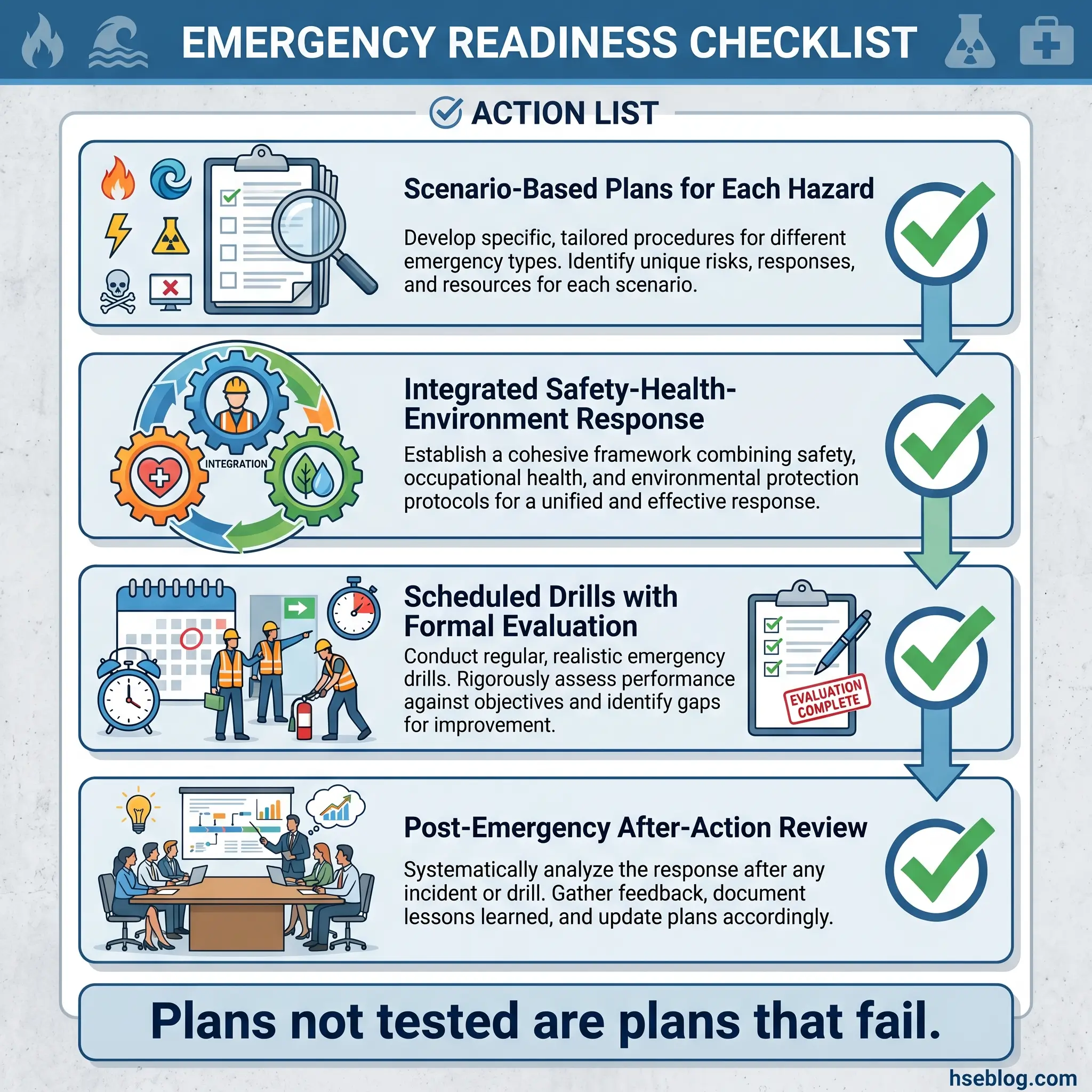
Emergency preparedness within a SHEMS must deliver these capabilities:
- Scenario-based planning: Each identified emergency scenario has a specific response plan with defined roles, communication protocols, resource requirements, and escalation triggers.
- Integrated response: A chemical release plan, for example, addresses worker evacuation and medical response (safety and health) alongside containment, clean-up, and regulatory notification (environment) — in one coordinated procedure.
- Drills and exercises: Regular testing of emergency procedures through tabletop exercises, functional drills, and full-scale simulations. Drill performance is formally evaluated and findings fed back into procedure revision.
- Post-emergency review: Every actual emergency and every drill produces a formal after-action review. Lessons learned drive updates to emergency procedures, training, equipment, and resource allocation.
Performance Monitoring, Measurement, and Audit
What you don't measure, you can't manage — and what you measure poorly, you manage badly. A SHEMS requires a defined monitoring and measurement program that tracks both leading and lagging indicators across safety, health, and environment.
The monitoring framework within a mature SHEMS typically includes these layers:
- Leading indicators: Inspection completion rates, near-miss reporting frequency, training compliance percentage, corrective action closure rates, management safety walk participation, environmental monitoring completion.
- Lagging indicators: Lost Time Injury Frequency Rate (LTIFR), Total Recordable Incident Rate (TRIR), occupational illness rates, environmental non-compliance incidents, regulatory enforcement actions, workers' compensation costs.
- Internal auditing: A scheduled program of internal audits covering all SHEMS elements across all operational areas. Audits assess both conformance (are we following the procedure?) and effectiveness (is the procedure actually controlling the risk?).
- External auditing: Third-party certification audits (ISO 45001, ISO 14001) and client or regulatory audits provide independent assurance.
| Indicator Type | Safety Examples | Health Examples | Environment Examples |
|---|---|---|---|
| Leading | Inspections completed, PTW compliance | Health surveillance completion, exposure monitoring | Waste segregation audits, emission checks |
| Lagging | LTIFR, fatalities | Occupational disease cases, hearing loss rates | Spills, regulatory notices, permit exceedances |
| System | Audit findings closure rate | Training currency rate | Legal register update frequency |
Pro Tip: Don't fall into the trap of reporting only lagging indicators to senior management. A zero LTIFR means nothing if your leading indicators show declining inspection quality, overdue corrective actions, and stagnant near-miss reporting. Those patterns predict the next incident — the lagging indicator just confirms it happened.
Management Review and Continual Improvement
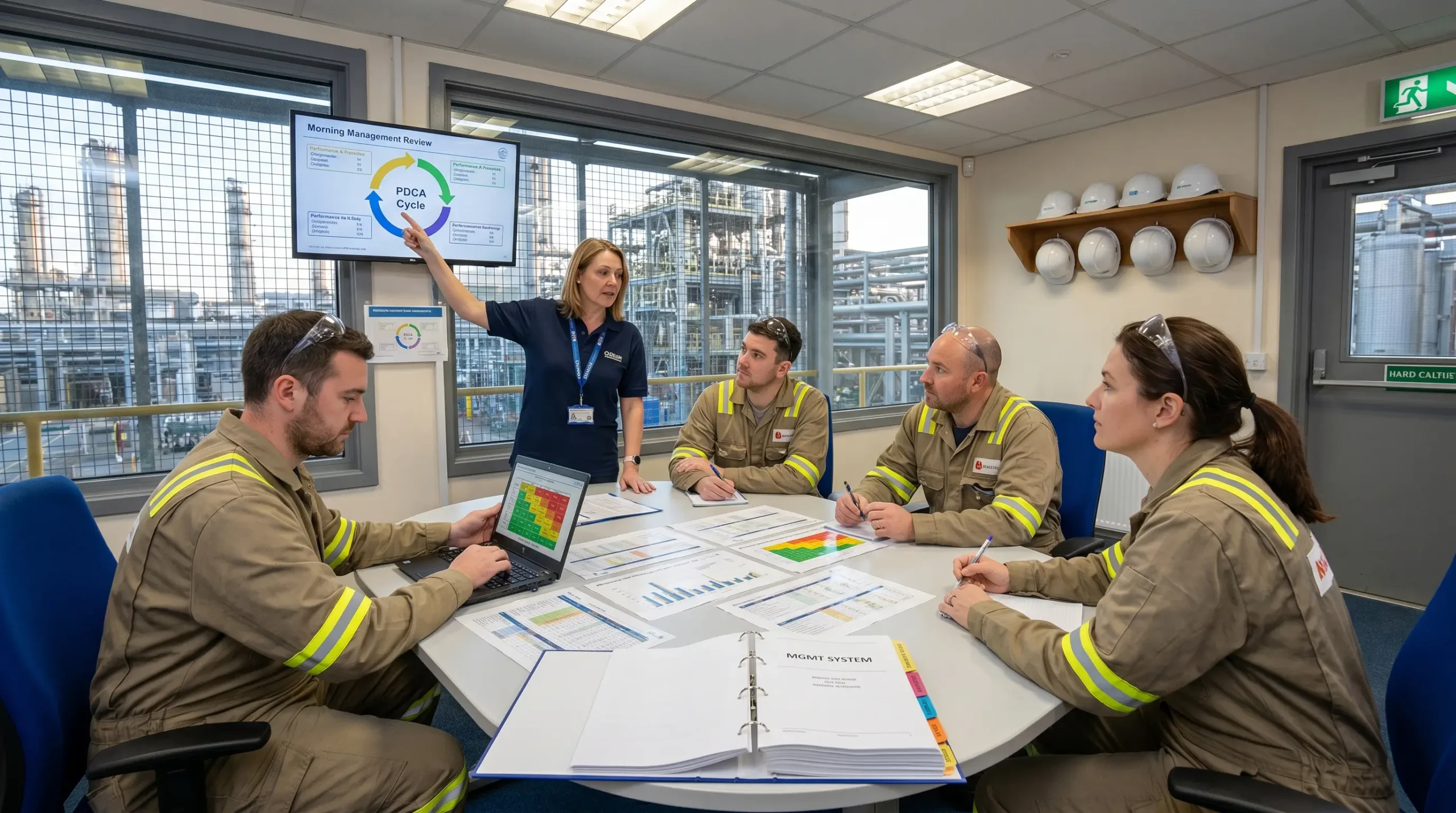
The management review is where the entire SHEMS cycle converges. Senior leadership reviews system performance, evaluates the adequacy and effectiveness of the management system, and makes decisions about resources, objectives, and strategic direction.
A management review that actually drives improvement — rather than simply satisfying an audit requirement — must address specific inputs:
- Audit findings and trends — internal, external, and regulatory
- Incident investigation outcomes and corrective action status
- Performance against SHE objectives and targets
- Results of compliance evaluations
- **Worker consultation and participation feedback
- Changes in legal requirements, technology, or organizational context
- Resource adequacy — staffing, budget, equipment, training
The outputs must include concrete decisions: revised objectives, resource allocations, system changes, and assigned responsibilities with deadlines. I've attended management reviews where the minutes read like a transcript of passive listening. No decisions. No resource commitments. No accountability. That is not a management review — that is a meeting.
SHEMS Standards and Frameworks
No SHEMS operates in a vacuum. The architecture of any credible management system draws from internationally recognized standards that provide the structural requirements and audit criteria. Understanding which standards apply — and how they interact — is critical for building a system that holds up under regulatory scrutiny and third-party certification.
The principal standards and frameworks that underpin a SHEMS are often implemented together as an integrated management system:
| Standard / Framework | Domain | Key Focus |
|---|---|---|
| ISO 45001:2018 | Occupational Health & Safety | Worker protection, hazard elimination, worker participation, PDCA |
| ISO 14001:2015 | Environmental Management | Environmental aspects, compliance obligations, pollution prevention |
| ISO 9001:2015 | Quality Management | Process consistency, customer requirements, continual improvement |
| OHSAS 18001 (superseded) | Occupational Health & Safety | Legacy standard replaced by ISO 45001 in March 2021 |
| ILO-OSH 2001 | Occupational Safety & Health | ILO guidelines for national/organizational OHS management systems |
| HSG65 (HSE UK) | Health & Safety | Plan-Do-Check-Act framework for UK organizations |
ISO 45001 and ISO 14001 share the same High-Level Structure (HLS) — Annex SL — which means they use identical clause numbering, common terminology, and aligned core requirements. This is intentional. Organizations that implement both standards can build one integrated management system with shared processes for document control, internal audit, corrective action, competence management, and management review.
The practical advantage of this alignment is significant. During an integrated audit I conducted at a chemical manufacturing plant in Southeast Asia, we assessed ISO 45001, ISO 14001, and ISO 9001 compliance in a single five-day audit using one audit plan, one set of opening and closing meetings, and one integrated corrective action tracker. Three separate audits would have taken twelve days and generated three disconnected reports. Integration halved the disruption to operations and produced a unified improvement plan.
ILO-OSH 2001 Guidelines state that the occupational safety and health management system should be compatible with or integrated into other management systems in the organization.
Common Failures That Undermine a SHEMS
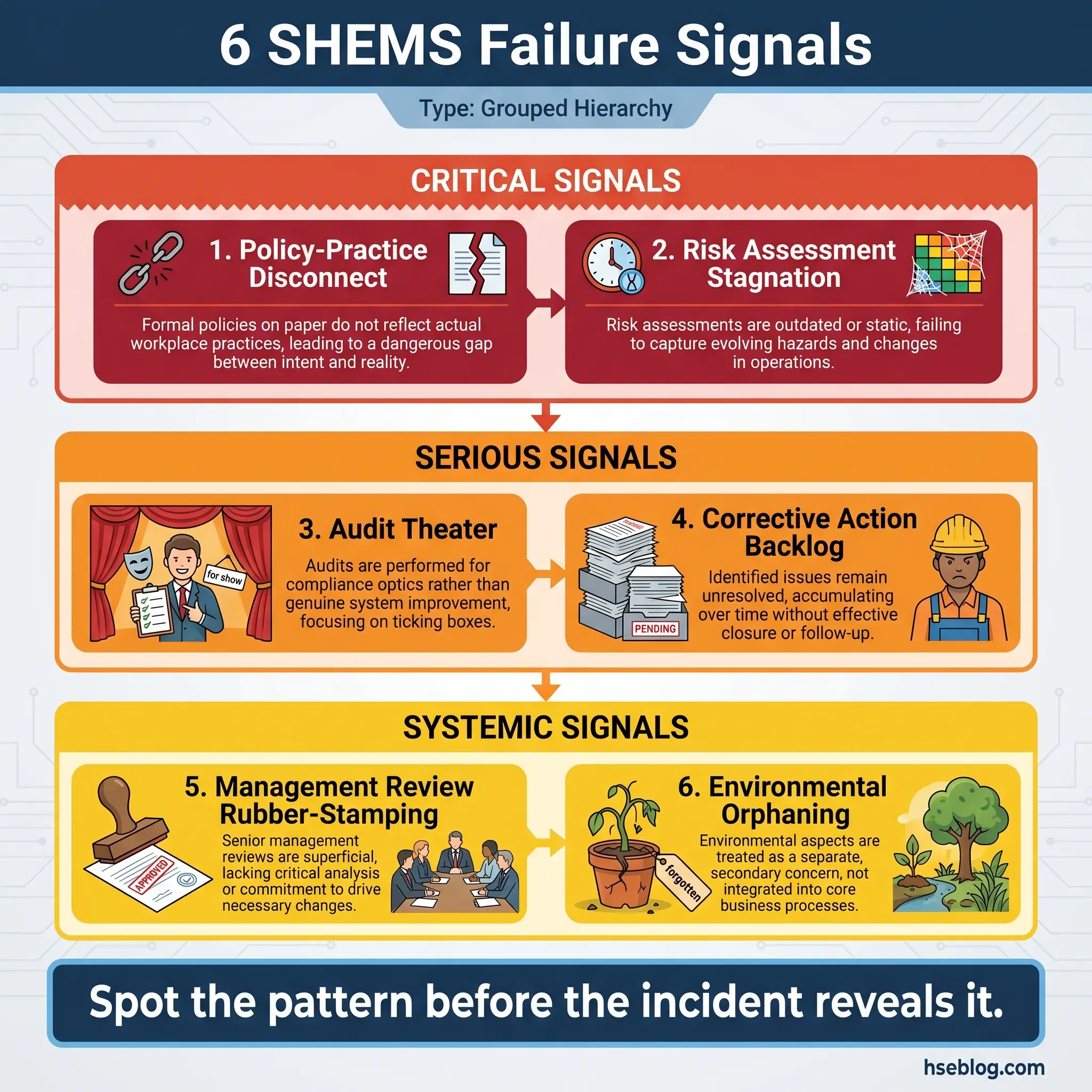
A SHEMS can exist on paper and fail completely in practice. Across dozens of audits and system reviews, I've identified recurring failure patterns that weaken management systems regardless of the industry or organizational size.
These failures aren't random. They follow predictable patterns that any HSE professional can learn to recognize and prevent:
- Policy-practice disconnect: The SHE policy commits to worker consultation, but no formal consultation mechanism exists. The policy commits to continual improvement, but the management review hasn't produced a single system change in two years.
- Risk assessment stagnation: Risk assessments completed during initial system setup are never reviewed, even after incidents, process changes, or new legal requirements. The system generates assessments but doesn't maintain them.
- Audit theater: Internal audits check document existence rather than system effectiveness. The audit asks, "Do you have a confined space procedure?" instead of, "Show me evidence that the confined space procedure is followed and effective."
- Corrective action backlog: Incident investigations and audit findings generate corrective actions that are logged but never closed. The backlog grows until the system loses credibility with the workforce.
- Management review as rubber stamp: Senior leadership attends the review, listens to the presentation, and signs the minutes without making resource decisions, setting new objectives, or challenging underperformance.
- Environmental orphaning: Safety and health elements receive attention and resources while environmental management is treated as a reporting obligation rather than an operational discipline.
Pro Tip: Run a "system health check" every six months. Pick ten corrective actions from different sources — audits, incidents, inspections — and trace each one from identification through to verified closure. If fewer than seven out of ten are genuinely closed with evidence, your SHEMS is hemorrhaging credibility.
How to Build or Strengthen Your SHEMS
Building a SHEMS from scratch — or strengthening one that has drifted into a documentation exercise — requires a structured approach. The organizations I've seen succeed treat implementation as a multi-phase project, not a one-time documentation effort.
The following sequence has worked consistently across greenfield implementations and system overhauls:
- Conduct a gap analysis against ISO 45001 and ISO 14001 requirements. Map existing safety, health, and environmental processes against each clause. Identify what exists, what's missing, and what exists but doesn't function.
- Secure leadership commitment with a clear business case. Present the gap analysis findings alongside incident data, compliance risks, and benchmarking data from peer organizations.
- Define the SHE policy with input from senior leadership and worker representatives. Ensure it reflects the organization's actual risk profile, not generic language.
- Build the hazard identification and risk assessment framework as the system's core engine. Train all supervisors and managers in the methodology. Pilot it on one operational area before full deployment.
- Develop operational controls, procedures, and permit systems based on risk assessment outputs. Prioritize high-risk activities first.
- Establish the monitoring, measurement, and internal audit program with a defined annual schedule, trained auditors, and clear audit criteria.
- Implement the management review process with a standing agenda, defined inputs, and a requirement for documented decisions — not just minutes.
- Run the first full PDCA cycle — typically twelve months — before pursuing certification. The first cycle reveals the real weaknesses that documentation alone cannot expose.
Conclusion
A Safety, Health, and Environment Management System is not a set of documents. It is the operating architecture that determines whether an organization's commitment to protecting people and the environment translates into measurable outcomes or remains a statement on a wall. The difference between organizations that prevent incidents and those that merely investigate them almost always traces back to whether a functioning SHEMS exists beneath the surface.
Every element — from the SHE policy through hazard identification, operational controls, emergency preparedness, performance monitoring, and management review — must work together as an integrated system. When one element weakens, the entire chain is compromised. I've never investigated a serious incident where the management system was genuinely healthy. There is always a broken link: an outdated risk assessment, an ignored audit finding, a management review that produced no decisions, a corrective action that was logged but never completed.
The organizations that get this right treat their SHEMS the way they treat their core production processes — with the same rigor, the same investment, and the same expectation of measurable performance. Because the output of a management system isn't paperwork. It's whether everyone goes home at the end of the shift.