
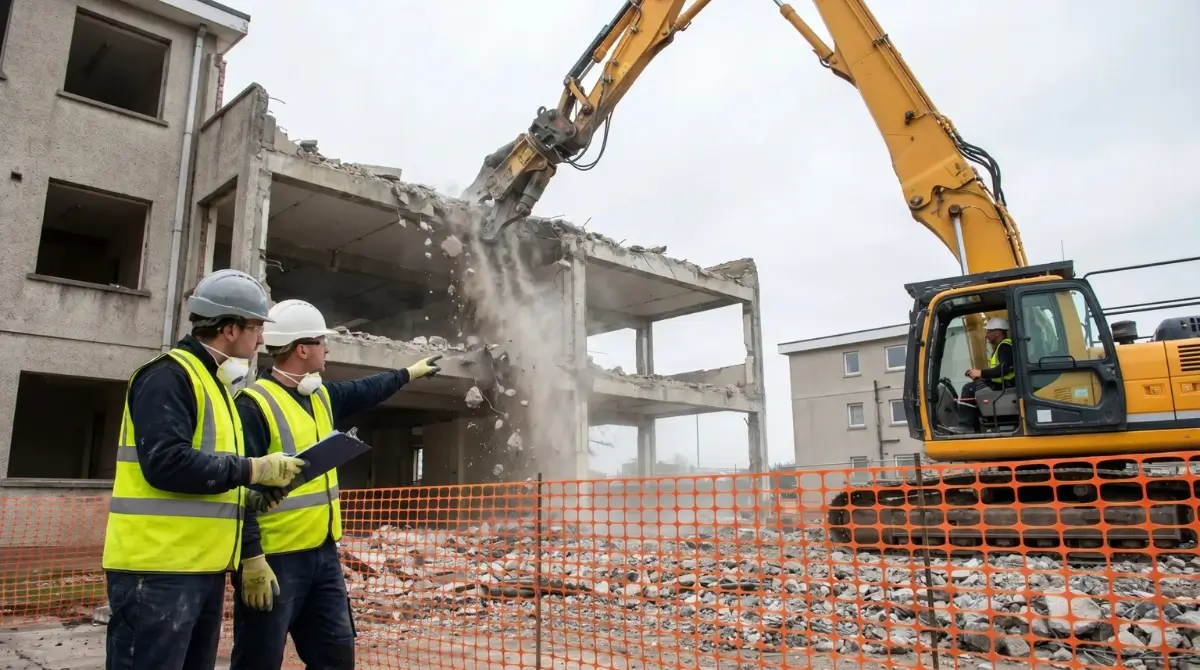
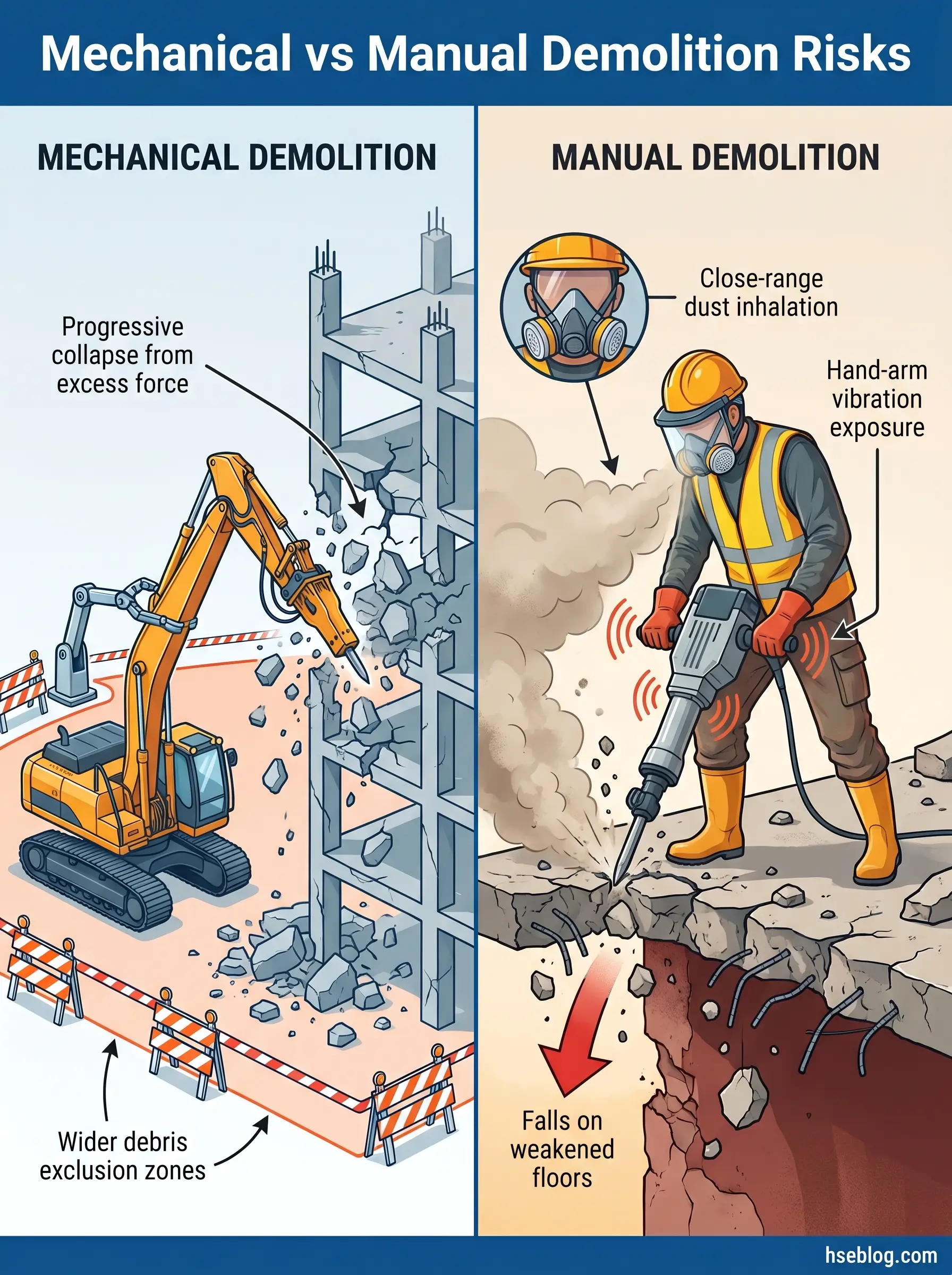
Mechanical demolition and manual demolition carry fundamentally different risk profiles rather than one being universally safer. Mechanical methods present higher risks from uncontrolled progressive collapse and struck-by debris across wider zones, while manual methods create greater worker exposure to falls from height, musculoskeletal injury, hand-arm vibration syndrome, and close-proximity respirable dust inhalation. Safe outcomes depend on matched controls and competent planning — not method preference.
A hydraulic excavator fitted with a high-reach arm can bring down a four-storey concrete frame in hours. A manual soft-strip crew working the same building with breakers and pry bars might spend weeks inside the structure before the first wall comes down. Both approaches end with the same pile of rubble — but the hazards workers face at each stage, the failure modes that kill, and the controls that prevent those deaths are almost entirely different.
That difference matters because the question “which method is safer?” has no honest universal answer. In 2024, 1,032 construction and extraction workers died on the job in the United States (Bureau of Labor Statistics, 2026). Falls, struck-by events, and caught-in/between incidents — the three hazard categories most relevant to demolition — account for the majority of those deaths. The risk isn’t in the method itself. It’s in whether the controls match the method, the structure, and the sequence.
This article provides general HSE knowledge for professional reference. Life-critical demolition work must be planned and supervised by a competent person holding relevant training, jurisdiction-specific authorization, and a site-specific engineering survey and method statement. The information here does not replace that requirement.
What Is Mechanical Demolition and What Is Manual Demolition?
Mechanical demolition uses powered mobile plant — excavators, high-reach arms, hydraulic breakers, and in some cases wrecking balls — to bring down structural elements. The operator typically works from within a protective cab or controls the machine remotely, maintaining physical separation from the structure being demolished.
Manual demolition relies on hand-held tools and light pneumatic equipment: breakers, reciprocating saws, pry bars, and chipping hammers. Workers are in direct contact with the structure throughout the process, often standing on the floors they are progressively removing.
The Hybrid Reality
The clean split between “mechanical” and “manual” rarely exists on actual projects. Most real-world demolition follows a sequence:
- Asbestos and hazardous material survey and removal — manual, under controlled conditions.
- Soft strip — manual removal of non-structural elements (fixtures, services, cladding).
- Structural demolition — typically mechanical, once the structure is cleared of hazardous materials and workers are withdrawn.
The risk profile changes at each transition point. A risk assessment that covers only the primary demolition method and ignores the phases before and after it misses some of the most dangerous moments on the project.
How Do Demolition Risks Differ Between Mechanical and Manual Methods?
Neither method is inherently safer — each generates a distinct hazard profile that demands its own matched controls. The critical error in most demolition risk assessments is treating hazards generically rather than mapping how each one behaves differently depending on whether a machine or a person is doing the breaking.
Structural Collapse Risk: Force vs Proximity
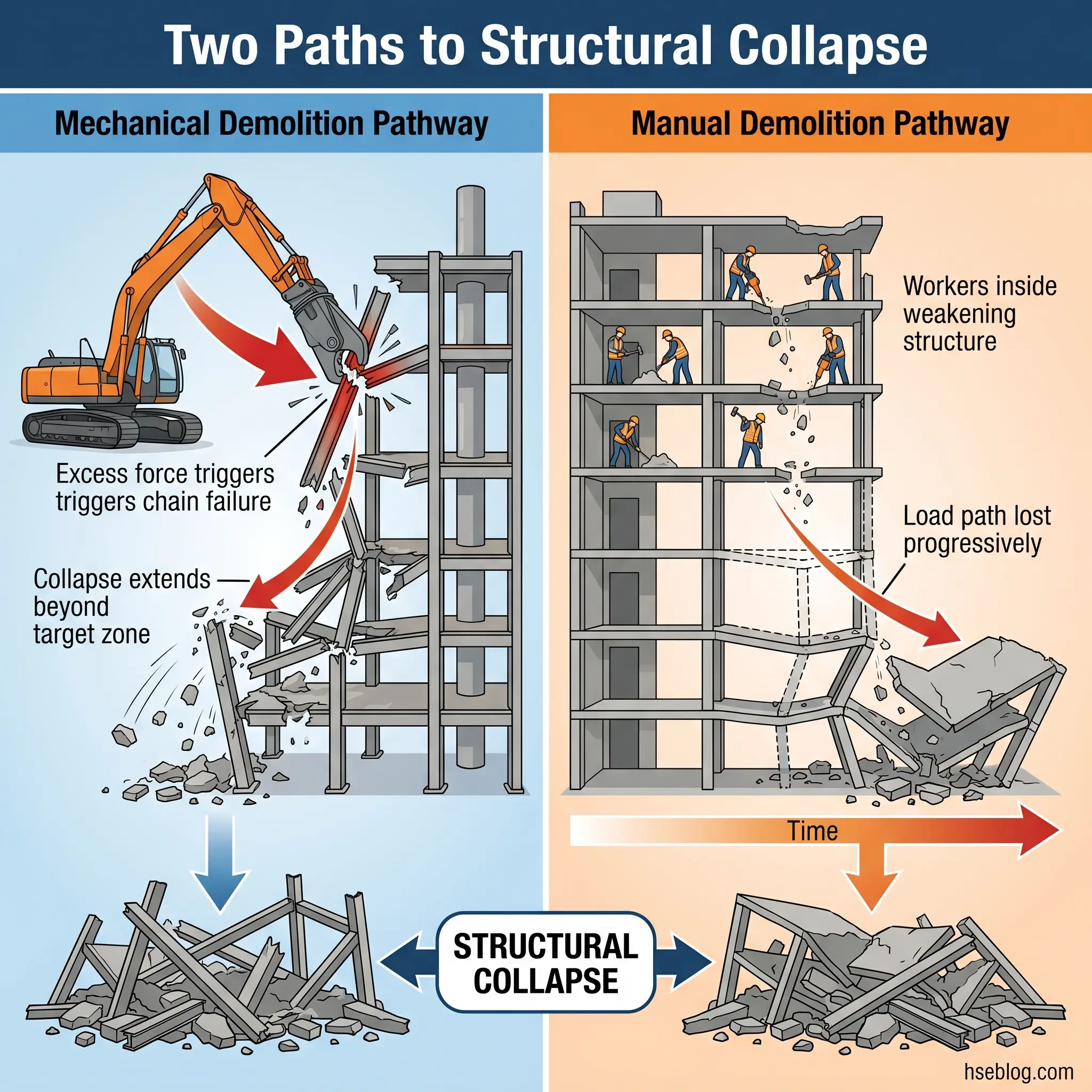
Mechanical demolition applies force that can exceed the structure’s remaining load-path capacity, triggering progressive collapse beyond the intended demolition zone. An excavator bucket pulling on a beam doesn’t distinguish between the beam it’s targeting and the slab that beam supports three bays away.
Manual demolition carries a different collapse mechanism. Workers spend hours — sometimes days — physically inside a structure that is being progressively weakened. The risk isn’t excessive force; it’s prolonged presence within a structure whose stability is declining with every element removed.
OSHA requires an engineering survey by a competent person before any demolition begins (29 CFR 1926.850(a), US). BS 6187:2011 (UK) specifies structural assessment requirements that inform both method selection and demolition sequence planning. Both standards exist because collapse risk cannot be managed reactively — it must be assessed and sequenced before the first strike.
Respirable Hazards: Volume vs Proximity
Here is where intuition misleads. Mechanical demolition generates more total dust — the visible cloud when an excavator collapses a concrete wall is dramatic. Manual demolition generates less total volume but concentrates personal exposure at the breathing zone.
A worker running a pneumatic breaker on a concrete slab operates within arm’s length of the fracture point. Personal exposure monitoring in these conditions frequently reveals that manual workers exceed occupational exposure limits for respirable crystalline silica faster than mechanical operators sitting in filtered cabs 15 metres away. RPE selection and fit-testing protocols must reflect this — the smaller visible cloud does not mean lower personal dose.
This affects control strategy in a practical way:
- Mechanical demolition — controls focus on perimeter dust suppression, water suppression at the demolition face, and exclusion zones that keep unprotected workers out of the dust plume.
- Manual demolition — controls must address the individual worker’s breathing zone: local exhaust ventilation on tools, wet-cutting methods, and higher-protection-factor RPE worn consistently throughout the shift.
Musculoskeletal and Vibration Injuries
Manual demolition carries a distinctive occupational health burden that mechanical methods largely avoid. Three exposures converge:
- Hand-arm vibration — pneumatic breakers, chipping hammers, and grinders deliver direct vibration to the hands and arms. Prolonged exposure causes hand-arm vibration syndrome (HAVS), a chronic condition producing numbness, tingling, blanching of fingers, and progressive loss of grip strength. The UK Control of Vibration at Work Regulations 2005 set an exposure action value of 2.5 m/s² A(8) and a limit value of 5 m/s² A(8).
- Whole-body vibration — mechanical demolition plant transmits vibration through the operator’s seat, but modern cabs with suspension seating reduce this significantly compared to the direct skeletal loading manual workers experience.
- Cumulative musculoskeletal strain — manual handling of demolished material from upper floors, sustained awkward postures while working on partially demolished structures, and repetitive tool operation compound over shifts and weeks.
Falls, Debris, and Equipment-Specific Hazards
Falls from height are more acute in manual demolition. Workers stand on partially demolished floors, work from temporary platforms on structures that are losing stability, and access areas where guardrails may have been removed as part of the demolition sequence. OSHA requires fall protection at 6 feet (1.8 m) in construction and demolition (US). UK Working at Height Regulations 2005 apply to all work at height, with 2 metres as a commonly applied guardrail benchmark.
Falling debris and struck-by hazards differ by method:
| Hazard Dimension | Mechanical Demolition | Manual Demolition |
|---|---|---|
| Debris size | Large, heavy fragments | Smaller, lighter pieces |
| Debris field | Wider zone, harder to predict trajectory | Narrower zone, closer to workers |
| Exclusion zone need | Larger — typically 1.5× structure height minimum | Smaller perimeter, but workers inside the zone |
| Equipment struck-by risk | Moving plant, hydraulic line failure, boom swing | Hand-tool kickback, dropped tools from height |
What Are the Safety Controls for Mechanical Demolition?
The controls for mechanical demolition address one central problem: the operator is separated from the structure, but everyone else on site may not be. Exclusion zones, machine integrity, and demolition sequencing carry the safety burden.
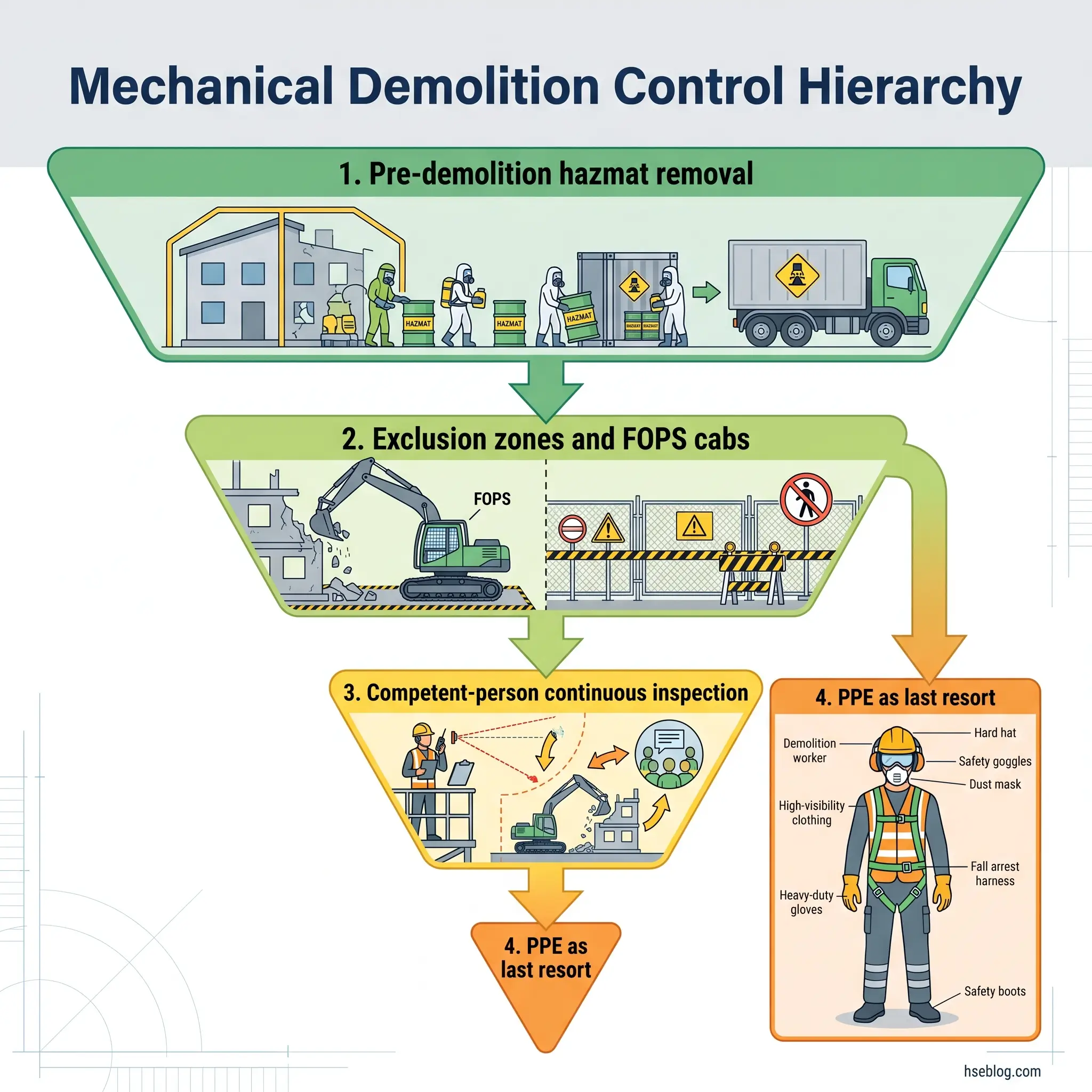
Structured by the hierarchy of controls:
- Elimination / Substitution — pre-demolition removal of all hazardous materials (asbestos, lead, PCBs) under manual controlled conditions before mechanical work begins. No substitution eliminates the demolition itself, but remote-controlled plant substitutes human proximity.
- Engineering controls:
- Engineering survey and demolition sequence plan — required under OSHA 1926.850(a) (US) and BS 6187 Clause 5 (UK). The sequence must account for load-path changes as demolition progresses.
- Exclusion zones — sized based on structure height, debris trajectory, and method. The common benchmark of 1.5× structure height is a starting point, not a universal answer. BS 6187 provides calculation guidance. OSHA 1926.859(a) (US) requires restricting access to areas adversely affected by balling or clamming operations.
- FOPS/ROPS cabs — falling object and rollover protective structures on all demolition plant.
- Demolition ball weight limits — OSHA 1926.859(b) (US) limits the demolition ball to 50% of the crane’s rated load or 25% of the line breaking strength, whichever is lesser.
- Administrative controls:
- Continuous competent-person inspection during mechanical operations — OSHA 1926.859(g) (US).
- Dynamic exclusion zone adjustment — the zone established on Day 1 may be inadequate by Day 5 as load paths shift. Reviewing and adjusting the exclusion zone as demolition progresses is a critical control that published incident reviews show is routinely neglected.
- Operator competency verification — documented training, machine-specific familiarisation, site induction.
- PPE — hard hats, high-visibility clothing, safety boots, hearing protection. Operators rely primarily on the cab as their protective envelope.
What Are the Safety Controls for Manual Demolition?
Manual demolition controls must solve a problem mechanical methods largely avoid: the worker is the tool delivery system. Every control has to account for prolonged human presence inside a structure that is actively losing integrity.
Sequencing and Structural Integrity
- Top-down demolition sequence — OSHA 1926.850(j) (US) requires that demolition of exterior walls and floor construction proceed from the top of the structure downward. Deviating from this sequence is the single most common precursor to manual demolition collapse incidents identified across published investigation reports. Workers under schedule pressure begin removing structural elements out of order, compromising the engineered load path assumed in the method statement.
- Floor loading assessment — demolished material accumulating on lower floors can exceed the floor’s load capacity. This is a failure mode specific to manual demolition; mechanical methods typically drop material externally.
- Temporary shoring and bracing — required when working within structures damaged by fire, flood, or explosion. OSHA 1926.850(b) (US) mandates shoring and bracing of walls and floors to prevent unplanned collapse in these conditions.
Worker Protection Controls
Fall protection is non-negotiable at the applicable jurisdictional trigger height. The practical challenge is that demolition progressively removes the very structures to which fall protection systems anchor. This demands pre-planned anchor points and rescue procedures that account for a changing structural environment.
Vibration exposure management for manual demolition requires a multi-layered approach:
- Tool selection — lower-vibration tool models where technically feasible.
- Rotation schedules — limiting individual trigger time per shift.
- Trigger-time monitoring — tracking cumulative daily exposure against action and limit values.
- Health surveillance — regular screening for early HAVS symptoms.
Respiratory protection must match close-proximity exposure. A standard dust mask is inadequate when breaking concrete with a pneumatic breaker at arm’s length — minimum half-face respirator with P100 particulate filters, with fit-testing completed and documented.
Manual handling risk assessment addresses the removal of demolished material from upper floors. Mechanical aids — hoists, chutes, small conveyors — reduce the cumulative musculoskeletal load that multiplies over a multi-week manual strip.
When Should Each Method Be Used? Risk-Based Method Selection
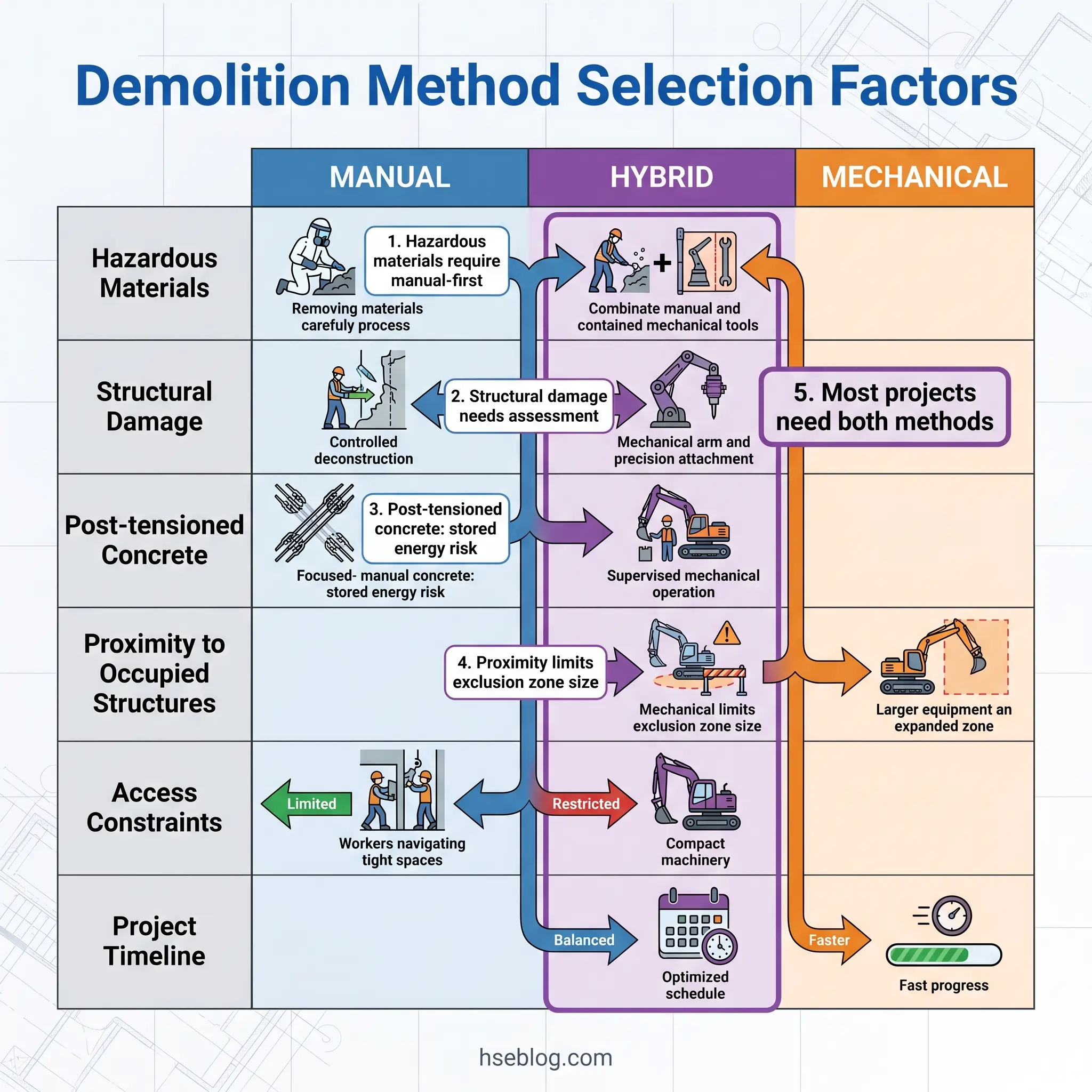
Method selection is a risk-based decision, not a size-based one. The common framing of “manual for small jobs, mechanical for large ones” oversimplifies a judgment call that depends on at least six site-specific factors.
The engineering survey — required under OSHA 1926.850(a) (US) and BS 6187 (UK) — provides the data that drives this decision. Without it, method selection is guesswork. OSHA’s preparatory operations standard (1926.850(a)) is the most frequently cited demolition standard, accounting for approximately three-quarters of demolition worksite citations (OSHA, current enforcement data). That citation rate tells practitioners exactly where enforcement attention focuses — and where planning failures concentrate.
Decision Factors
| Factor | Favours Manual | Favours Mechanical | Hybrid Trigger |
|---|---|---|---|
| Hazardous materials present | ACM/lead must be manually removed first | After hazmat clearance | Always — manual phase precedes mechanical |
| Pre-existing structural damage | Manual assessment before machine contact | Only after stability confirmed | Usually — damaged structures need careful sequencing |
| Post-tensioned concrete | Specialist manual de-stressing required | After stored energy released | Always — stored energy release demands manual-first |
| Proximity to occupied structures | May preclude large exclusion zones | When adequate exclusion zone is achievable | Often — manual near boundary, mechanical at centre |
| Access constraints | When plant cannot physically reach | When access roads support heavy equipment | Depends on structure layout |
| Project timeline | Slower but may be only option | Faster structural demolition | Phased — manual soft-strip then mechanical |
The critical practitioner judgment is recognising that method selection is not binary on real projects. The risk assessment should map which method applies to which structural element, in which sequence, and what controls govern the transition between manual and mechanical phases.
How Do Regulations Govern Demolition Method Selection and Safety?
Regulatory frameworks in both the US and UK treat demolition as high-risk work requiring written planning, competent-person oversight, and method-specific controls — but they structure these requirements differently.
United States — OSHA 29 CFR 1926 Subpart T
OSHA’s demolition standards are prescriptive and method-specific. The key provisions that directly affect the mechanical-versus-manual decision:
- 1926.850 — Preparatory Operations — requires a written engineering survey by a competent person before demolition begins, covering the condition of framing, floors, walls, and the possibility of unplanned collapse. This survey is the foundation for method selection. The engineering survey requirement (1926.850(a)(1)) accounts for more than half of all preparatory operations citations (OSHA, current enforcement data).
- 1926.850(j) — mandates top-down sequence for exterior walls and floor removal, directly governing manual demolition procedures.
- 1926.855 and 1926.856 — address manual removal of floors and walls/masonry/chimneys respectively, with specific requirements for worker positioning and structural stability during removal.
- 1926.859 — Mechanical Demolition — governs balling and clamming operations, sets demolition ball weight limits, requires continuous competent-person inspection, and mandates worker exclusion from adversely affected areas.
ANSI/ASSP A10.6 supplements OSHA requirements as a consensus standard, providing additional programme elements for demolition safety.
United Kingdom — CDM 2015 and BS 6187
CDM 2015 Regulation 20 requires that demolition be planned and carried out to prevent danger or reduce it to as low as reasonably practicable. The arrangements must be recorded in writing before work begins. Unlike OSHA’s prescriptive approach, CDM 2015 is goal-setting — it requires the outcome without specifying the exact method of compliance.
BS 6187:2011 provides the detailed code of practice, covering project management, structural assessment, exclusion zone calculation, method selection criteria, and competency requirements. While not legislation, it is the recognised standard against which demolition planning is judged in UK enforcement and prosecution.
Asbestos: The Regulatory Hard Stop
Both jurisdictions impose an absolute requirement: identified asbestos-containing materials must be removed under controlled conditions before any mechanical demolition begins. This is not a best-practice recommendation.
Under OSHA 1926.1101 (US) and the Control of Asbestos Regulations 2012 (UK), asbestos removal is a manual, controlled process. HSE guidance on demolition requires the client to obtain a refurbishment and demolition asbestos survey before any demolition work proceeds. Mechanical demolition of a structure containing unidentified or unremoved ACMs creates uncontrolled fibre release — a regulatory violation and a public health hazard.
For a consolidated overview of US demolition safety standards and enforcement data, OSHA’s demolition safety page provides the current regulatory starting point.
Emerging Technologies Changing the Risk Profile
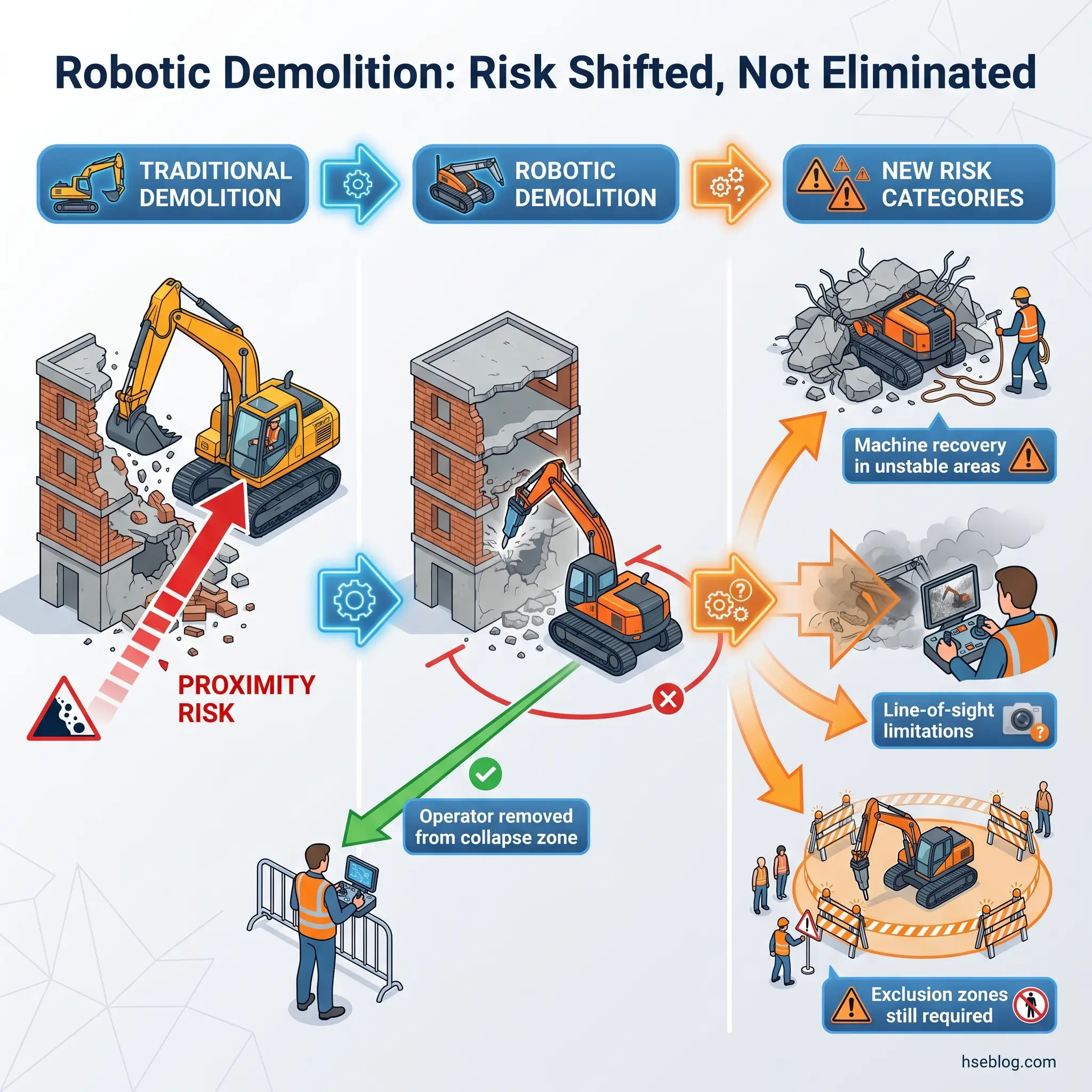
Remote-controlled demolition robots — units like the Brokk range — are shifting the traditional risk trade-off between mechanical efficiency and worker proximity. These machines deliver mechanical demolition force while keeping the operator outside the collapse zone entirely. The global demolition robot market is projected at USD 12.90 billion in 2025, with 10.36% annual growth projected through 2035 (Spherical Insights, 2025). Brokk introduced the Brokk 130+ at Utility Expo 2025, specifically designed for confined infrastructure demolition where neither traditional mechanical plant nor manual methods offer an acceptable risk profile.
BIM and 3D laser scanning are improving pre-demolition structural assessment. A detailed digital model of the existing structure allows the engineering survey to identify load paths, hidden voids, and structural interdependencies before any physical work begins — improving both method selection accuracy and demolition sequence planning.
Robotic demolition does not eliminate risk. It redistributes it. The operator is safer, but new hazards emerge: machine recovery from unstable environments when a robot becomes trapped, line-of-sight limitations during remote operation, and the behavioural tendency to undersize exclusion zones because “no one is near the machine.” The machine may not contain a person, but it can still trigger a progressive collapse that reaches people outside an inadequate exclusion zone.
Frequently Asked Questions
Conclusion
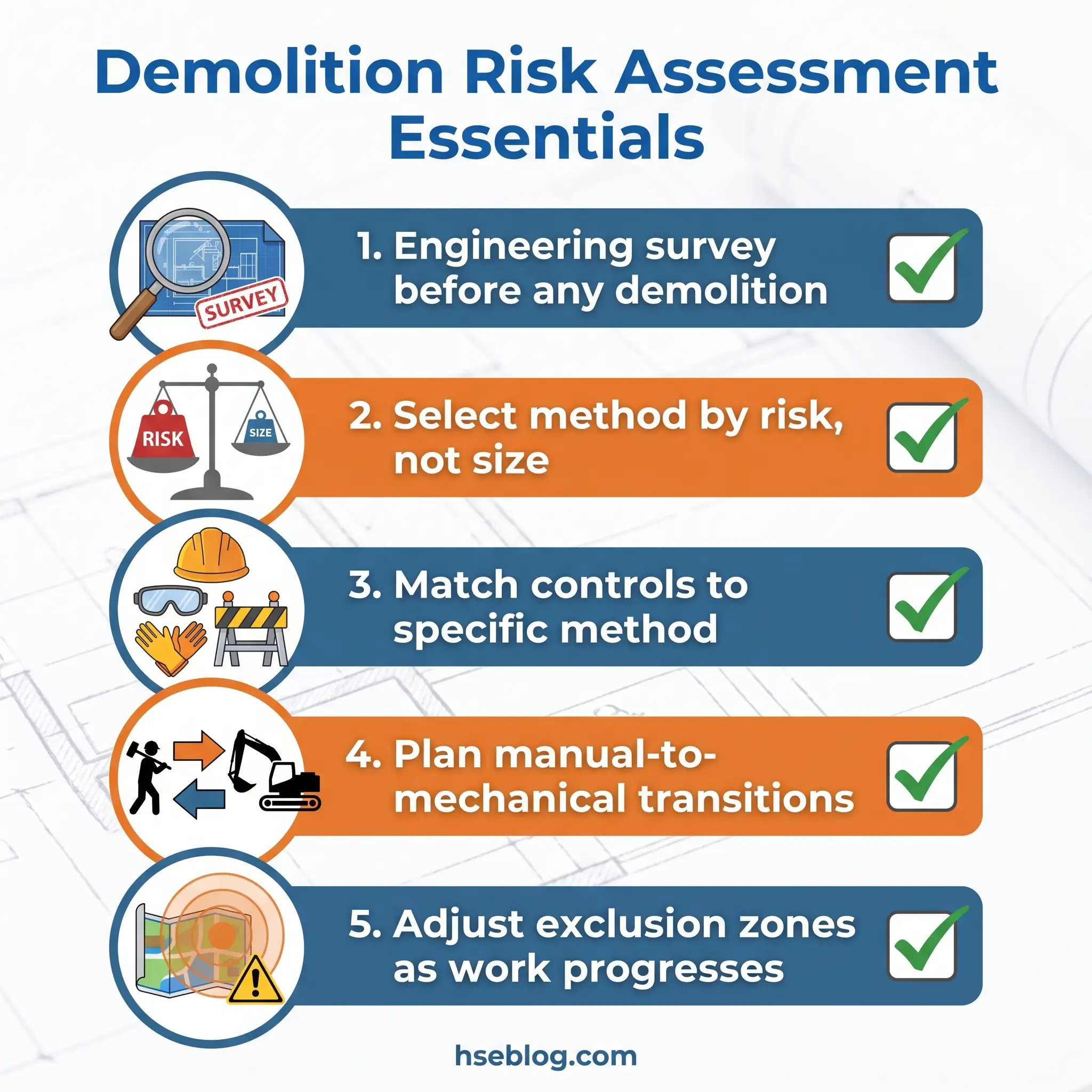
The industry’s persistent framing of mechanical demolition versus manual demolition as a binary choice — one safe, one dangerous — misrepresents how demolition risk actually works. Both methods kill workers when controls are mismatched, sequences are improvised, and engineering surveys are treated as paperwork rather than survival documents. The highest-impact change a demolition planner can make is to stop selecting methods by project size and start selecting them by structural condition, hazardous material status, and the specific hazard mechanism each method introduces to each structural element.
What the published record consistently shows is that failures cluster at three points: the engineering survey that wasn’t done or wasn’t followed, the demolition sequence that was altered under schedule pressure, and the exclusion zone that was set once and never updated. These aren’t mechanical-versus-manual problems. They are planning problems that manifest lethally through whichever method is in use when the planning fails.
Every demolition project is a hybrid. The risk assessment must be too — covering the manual soft-strip, the mechanical structural demolition, and the transition between them with the same rigour. The structure doesn’t care which method brought it down. It collapses according to physics, not method statements.