
TL;DR
- Complete hazardous-material surveys first — a Refurbishment and Demolition asbestos survey and an engineering survey by a competent person are separate legal obligations that must precede any physical work.
- Embed safety controls within each phase — dust suppression, RPE selection, manual handling assessments, and structural monitoring belong inside the workflow, not in a separate “safety” section bolted on afterward.
- Sequence asbestos removal before general strip — general operatives must not enter an area until the licensed removal contractor issues a clearance certificate, regardless of programme pressure.
- Segregate waste streams at source — plasterboard, metals, timber, and hazardous waste each require separate handling; mixing plasterboard into general skips generates hydrogen sulphide in landfill and triggers enforcement action.
- Treat soft strip as demolition — BS 6187:2011 (UK) explicitly includes soft stripping in its scope, and a 1994 OSHA interpretation letter (US) confirms Subpart T applies to interior non-load-bearing removal.
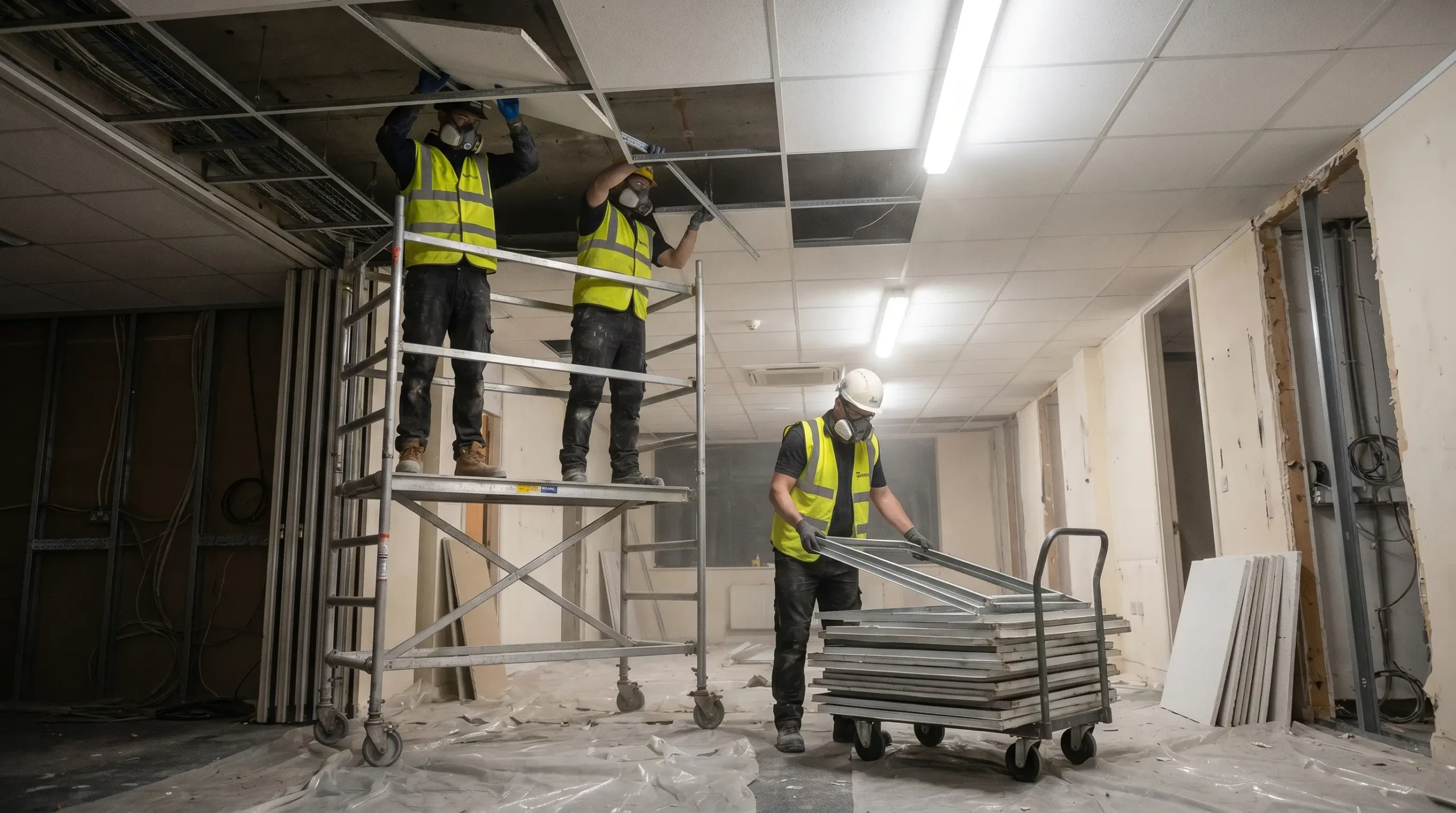
Soft strip demolition is the controlled removal of all non-structural elements from a building — fixtures, fittings, partition walls, suspended ceilings, floor coverings, and mechanical and electrical services — while preserving the structural shell. It requires phased planning, hazardous-material surveys, systematic removal with integrated dust and noise controls, and segregated waste management under CDM 2015 (UK) or OSHA Subpart T (US).
BS 6187:2011, the UK code of practice for full and partial demolition, explicitly names “soft stripping” within its scope — placing interior strip-out work under the same demolition-safety obligations as knocking down load-bearing walls. That single scoping decision matters because it means a construction phase plan, an engineering survey, written demolition arrangements under CDM 2015 Regulation 20, and a Refurbishment and Demolition asbestos survey are all legally required before a single ceiling tile is pulled down. In the US, a 1994 OSHA interpretation letter confirmed the same principle: Subpart T demolition regulations apply to interior removal of ceilings and non-load-bearing partitions.
Despite these obligations, soft strip projects routinely begin without the surveys, plans, or competent supervision the law demands. The UK construction sector recorded 35 worker fatalities in 2024/25, with the construction fatal-injury rate running 4.8 times the all-industry average (HSE, 2025). Falls from height — a hazard present even in interior strip work — accounted for approximately 53% of those deaths (HSE, 2025). This article maps the soft strip demolition process phase by phase, with safety controls embedded where they belong: inside each operational step, not in a disconnected section.
This article provides general HSE knowledge. Life-critical work such as soft strip demolition must be planned and supervised by a competent person with relevant training, jurisdiction-specific authorization, and site-specific risk assessment and method statement. The information here does not replace that. Readers seeking formal competence should pursue recognised pathways such as NEBOSH, IOSH Managing Safely, OSHA Outreach, or CITB Site Safety Plus programmes.
What Is Soft Strip Demolition?
Soft strip demolition — also called soft stripping, strip-out, or interior demolition — is the systematic removal of every non-structural element from a building while leaving the structural frame, floors, and external envelope intact. The result is a clean interior shell ready for refurbishment, change of use, or full structural demolition.
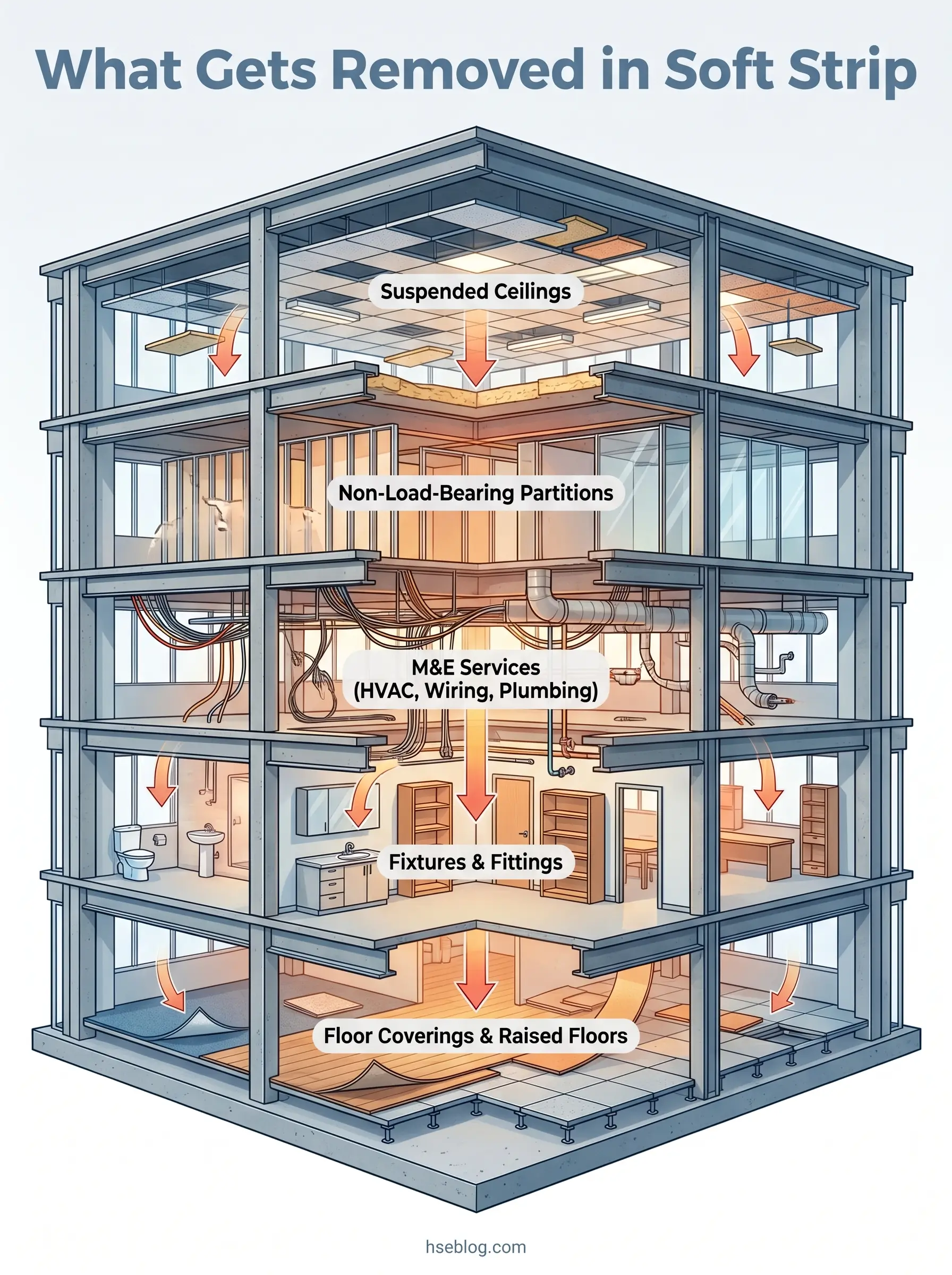
The elements removed in a typical soft strip include: suspended ceilings, partition walls (non-load-bearing), floor coverings and raised access floors, mechanical and electrical services (HVAC ductwork, electrical wiring, plumbing, data cabling), fixtures and fittings (sanitaryware, kitchen units, joinery), non-structural staircases, and temporary internal structures.
Common project contexts range from pre-refurbishment preparation and change-of-use conversion to pre-demolition hazardous-material clearance, end-of-lease dilapidation works, and heritage renovation where the shell must be preserved.
A persistent misconception treats soft strip as minor work that falls outside demolition regulations because it does not touch load-bearing structure. That reading is wrong. BS 6187:2011 (UK) includes soft stripping in its scope of demolition activities, and CDM 2015 Regulation 20 (Great Britain) requires written demolition arrangements before work begins. In the US, OSHA’s 1994 interpretation letter explicitly confirms that 29 CFR 1926 Subpart T applies to “gut rehab” projects involving only non-load-bearing elements. Projects that skip the engineering survey or construction phase plan on the assumption that “it’s only a strip-out” face both enforcement action and uncontrolled site hazards.
Soft Strip Demolition vs Hard Demolition
The distinction between soft strip and hard demolition governs which tools, competencies, and risk controls apply — but the boundary is not always clean on site.
| Criteria | Soft Strip Demolition | Hard Demolition |
|---|---|---|
| Scope | Non-structural elements only | Load-bearing structure (beams, columns, façades) |
| Typical Tools | Hand tools, reciprocating saws, battery grinders | Excavators, crushers, wrecking balls, hydraulic breakers |
| Primary Hazards | Dust, asbestos, manual handling, falls | Structural collapse, falling debris, heavy plant |
| Regulatory Framework | CDM 2015 / OSHA Subpart T (confirmed by interpretation) | CDM 2015 / OSHA Subpart T (explicit) |
| Planning Permission (UK) | Generally not required unless listed building | Usually required; demolition notice under Building Act 1984 s.80 always applies |
| Sequencing | Precedes hard demolition | Follows soft strip completion |
One judgment call that recurs across refurbishment projects: the line between soft and hard strip is not always visible. A partition that appears non-load-bearing may have been retrospectively braced to support services or mezzanine loads. A concrete floor screed may conceal post-tensioned cables. Cutting into either turns a soft strip task into a structural intervention without warning — which is precisely why the engineering survey by a competent person must happen before work begins, not after an operative hits something unexpected.
Step-by-Step Soft Strip Demolition Process
Soft strip demolition follows a strict phase sequence, and safety controls are embedded within each phase rather than treated as a separate consideration. The most dangerous moment in any strip-out project is not the physical stripping itself — it is the transition between planned phases, where scope-creep decisions get made under programme pressure without revisiting the Risk Assessment and Method Statements (RAMS).
Phase 1 — Pre-Commencement Surveys and Planning
Every consequential failure in soft strip demolition traces back to what was missed or skipped before work began. This phase carries the highest enforcement risk and delivers the largest safety return of any phase in the process.
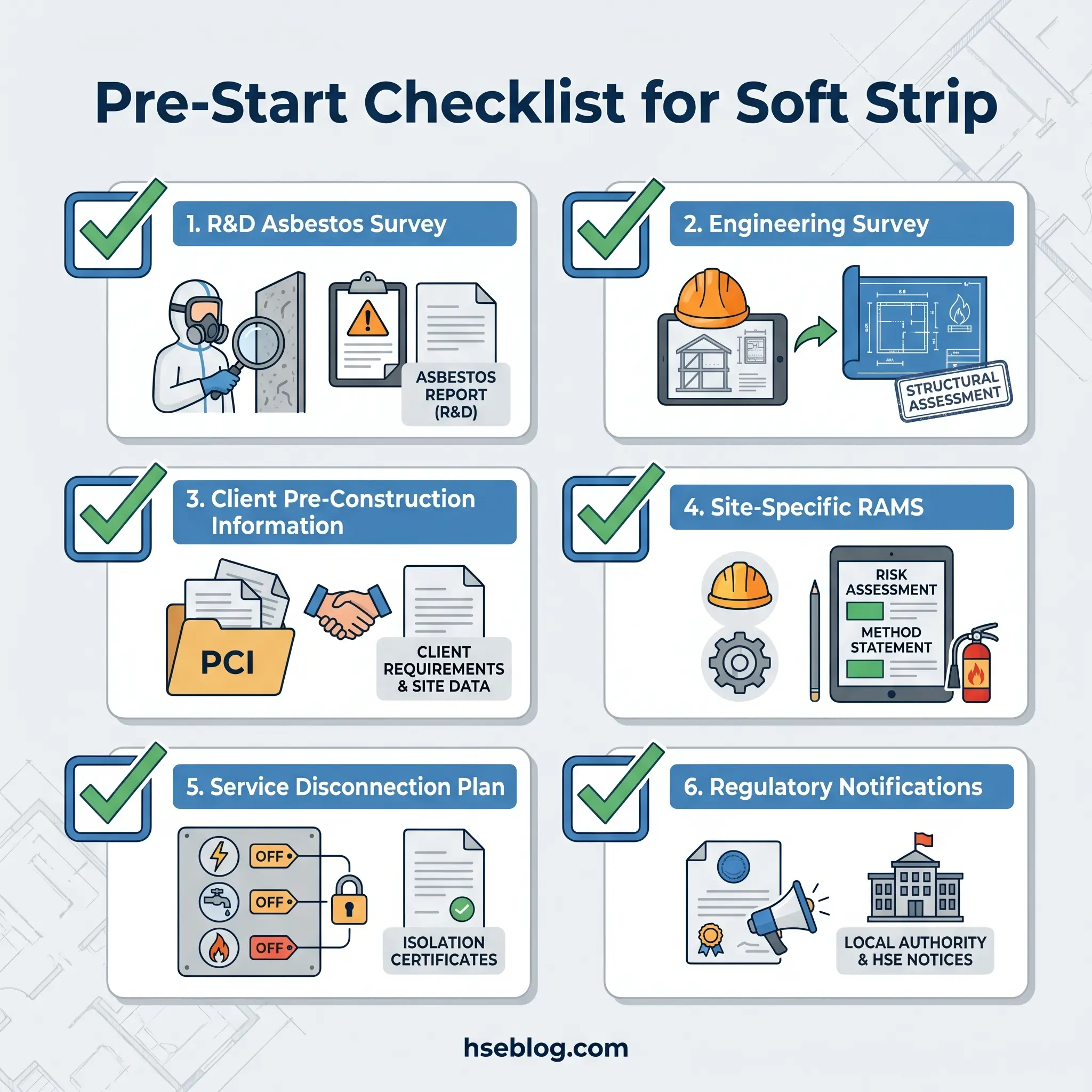
The obligations that must be completed before any physical work starts:
- Refurbishment and Demolition (R&D) Asbestos Survey — a fully intrusive survey identifying and locating all asbestos-containing materials. This is a legal requirement under the Control of Asbestos Regulations 2012, Regulation 4 (Great Britain) and OSHA 1926.1101 (US). It must be completed by a competent asbestos surveyor — not by the demolition contractor’s own staff.
- Engineering survey by a competent person — required under OSHA 1926.850(a) (US) and CDM 2015 Regulation 20 (Great Britain). This survey assesses the structural condition of the building and identifies any elements that affect demolition sequencing. OSHA’s preparatory-operations standard, 1926.850(a), accounts for up to three-quarters of all citations on a demolition worksite (OSHA, current).
- Pre-construction information (PCI) — the client’s duty under CDM 2015 Regulation 4 (Great Britain). The client must provide information about known hazards, previous uses, and existing conditions to all designers and contractors before the construction phase begins.
- Construction Phase Plan and site-specific RAMS — the principal contractor’s responsibility. These must be genuinely site-specific, not generic templates with the project name substituted.
- Service identification and disconnection plan — covering electricity, gas, water, data, and drainage.
- Notification — F10 notification to HSE (Great Britain) if the project meets notifiable thresholds; 6-week demolition notice to local authority building control under Building Act 1984, Section 80 (England and Wales).
A failure pattern worth flagging: the R&D asbestos survey and the engineering survey are separate obligations requiring different competencies. Treating the asbestos surveyor’s visit as also fulfilling the structural assessment obligation is a common shortcut — and it leaves a gap that only becomes visible when an operative encounters an unidentified structural element during stripping.
Phase 2 — Site Set-Up and Isolation
Before stripping begins, the site must be physically prepared to contain the work, protect adjacent areas, and provide safe access and egress.
Key set-up tasks include utility disconnection and capping (or protected temporary relocation where services must remain live during phased works), hoarding and barriers to establish exclusion zones — critical in partially occupied buildings — and welfare facilities compliant with CDM 2015 Schedule 2 (Great Britain).
Permit-to-work systems should be established for any activities requiring them: hot works, working at height, confined-space entry. Emergency procedures, evacuation routes, and first-aid provision must be confirmed and communicated before the first operative enters the strip zone.
Phase 3 — Hazardous Material Removal
Asbestos-containing materials, lead-based paint, and other hazardous substances must be removed before general soft strip work can proceed. This phase carries the highest occupational health risk in the entire strip-out sequence.
The sequencing boundary is non-negotiable: general strip operatives must not enter an area until the licensed asbestos removal contractor (UK) or accredited abatement contractor (US) has completed removal, conducted air monitoring, and issued a clearance certificate. On compressed programmes, this boundary is the one most likely to be eroded — and the consequences of erosion are irreversible, given that 2,218 mesothelioma deaths were recorded in the UK in 2023 from historical asbestos exposure (HSE, 2025).
Beyond asbestos, other hazardous materials requiring assessment and specialist handling include:
- Lead-based paint — common in pre-1980s buildings, requiring assessment and controlled removal or encapsulation.
- PCBs in older fluorescent light ballasts — requiring identification and hazardous waste disposal.
- Mercury in thermostats and switches — small quantities but regulated as hazardous waste.
- Refrigerants in HVAC systems — must be recovered by a certified technician before equipment removal.
Phase 4 — Systematic Non-Structural Removal
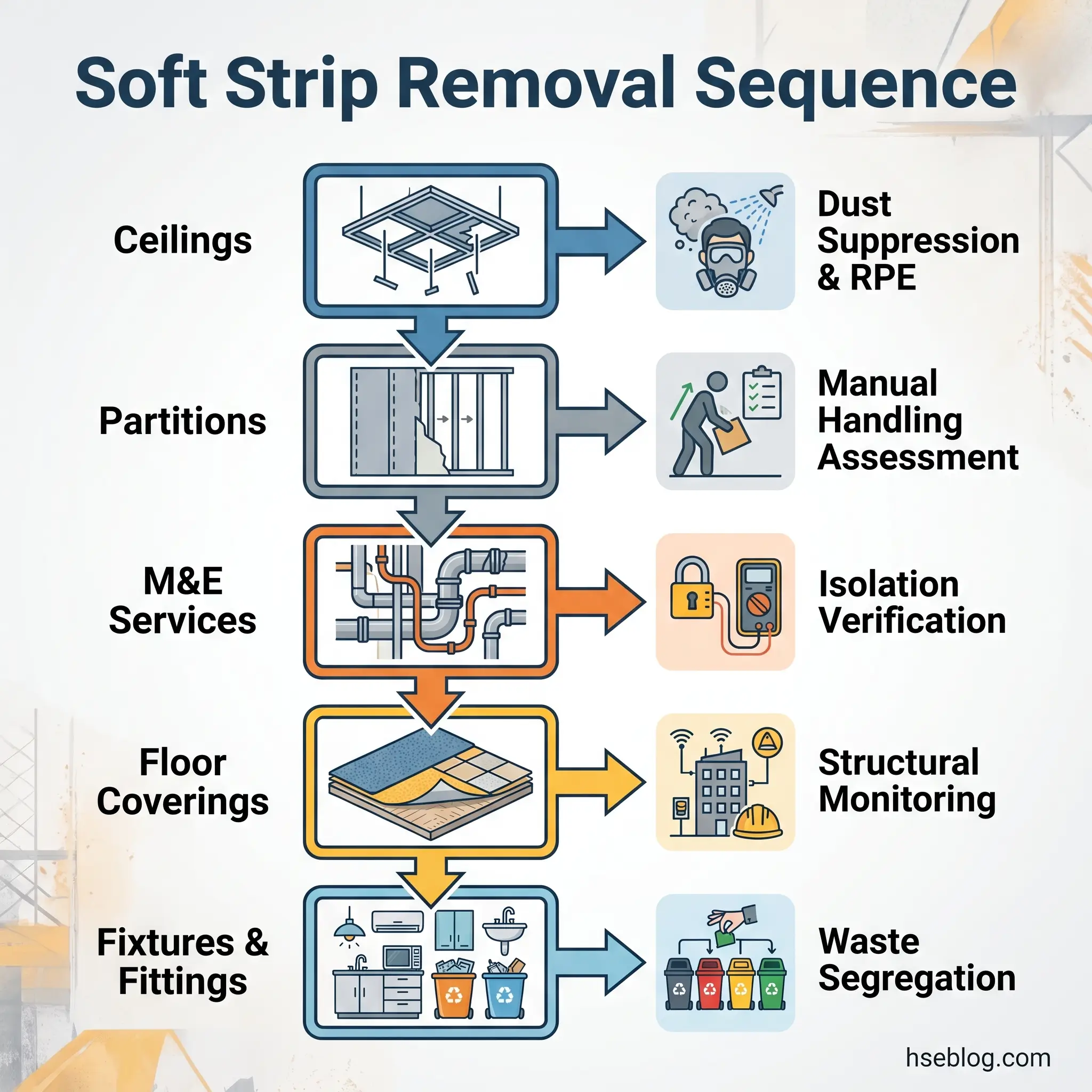
This is the main stripping operation — the sequential removal of all non-structural elements, with safety controls integrated at each task rather than applied as a blanket afterthought. The removal sequence is typically ceilings first, then partitions, M&E services, floor coverings, and finally fixtures and fittings, though the exact order is determined by the site-specific method statement.
Dust control is the safety measure most systematically underestimated at this phase. HSE UK specifically identifies soft strip demolition as high-risk for dust exposure, yet many method statements treat dust control as an RPE-only measure. The hierarchy of control requires water suppression or on-tool extraction as the primary measure, with RPE as secondary protection. For soft strip work, RPE must have an assigned protection factor of at least 20 — FFP3 disposable masks or half-masks with P3 filters as minimum. For work exceeding one hour, powered RPE such as a TH2 powered hood or helmet should be considered.
The hazards embedded within Phase 4 tasks:
- Manual handling injuries — the dominant injury mechanism in soft strip. Heavy ceiling grid sections, partition panels, cast-iron radiators, and M&E components all require task-specific manual handling assessments. Mechanical lifting aids should be used for items exceeding guideline weights.
- Working at height — removing suspended ceilings and high-level services creates fall risk even in interior environments. Mobile access towers (erected by PASMA-trained operatives), podium steps, or scaffold must replace improvised platforms.
- Contact with live services — despite Phase 2 isolation, residual live services are found on a significant proportion of strip-out projects. Lock-out/tag-out verification at each work area is essential.
- Structural monitoring — as partitions and ceilings come out, previously concealed conditions become visible: water damage, cracking, movement, or undocumented structural modifications. Operatives must be trained to recognise and report these immediately.
One risk that rarely appears in method statements: cumulative floor-loading change. As heavy M&E equipment is staged on upper floors for removal, and as debris accumulates before clearance, localised overloading can develop — particularly in older buildings with timber floor construction. The engineering survey should establish permissible floor loads, and the method statement should specify debris-clearance intervals.
Phase 5 — Waste Segregation, Recycling, and Disposal
Waste management in soft strip demolition is both a legal obligation and a significant cost lever — yet most project teams treat it as an afterthought. Professional strip-out contractors routinely achieve 90% or higher diversion from landfill through disciplined source segregation.
The legal framework governing soft strip waste includes the Environmental Protection Act 1990 and Waste (England and Wales) Regulations 2011 (UK), the Resource Conservation and Recovery Act (RCRA) and state-level requirements (US), and the EU Waste Framework Directive (EU). In all jurisdictions, the duty of care requires waste to be transferred only to licensed waste carriers, with documented waste transfer notes.
Typical recyclable streams from soft strip work include metals (steel framing, copper cabling, aluminium ceiling grids), timber (partition studs, door frames, joinery), glass, plastics, and plasterboard.
Plasterboard is the material most commonly mishandled in soft strip waste streams. Gypsum in landfill generates hydrogen sulphide gas, making mixed disposal both an environmental hazard and a common enforcement trigger. Separate skips for plasterboard, clearly labelled and monitored, are a baseline requirement.
Hazardous waste — asbestos, lead paint debris, PCB-containing components, mercury — follows a separate chain of custody with specialist licensed disposal. Projects pursuing BREEAM (UK) or LEED (US) certification can earn credits through documented waste diversion, making accurate waste tracking a commercial as well as a compliance benefit.
Phase 6 — Site Clearance and Final Inspection
The final phase delivers a clean, safe structural shell for handover. Remaining debris is cleared, floors are swept or vacuumed (not dry-swept, to avoid resuspending dust), and a structural inspection confirms no inadvertent damage to load-bearing elements occurred during the strip.
Handover documentation includes the updated asbestos register (reflecting materials removed and any remaining), waste transfer notes for all waste streams, the completion certificate, and the Health and Safety File contribution required under CDM 2015 (Great Britain) — residual hazard information that will inform anyone carrying out future works on the building.
What Are the Key Safety Hazards in Soft Strip Demolition?
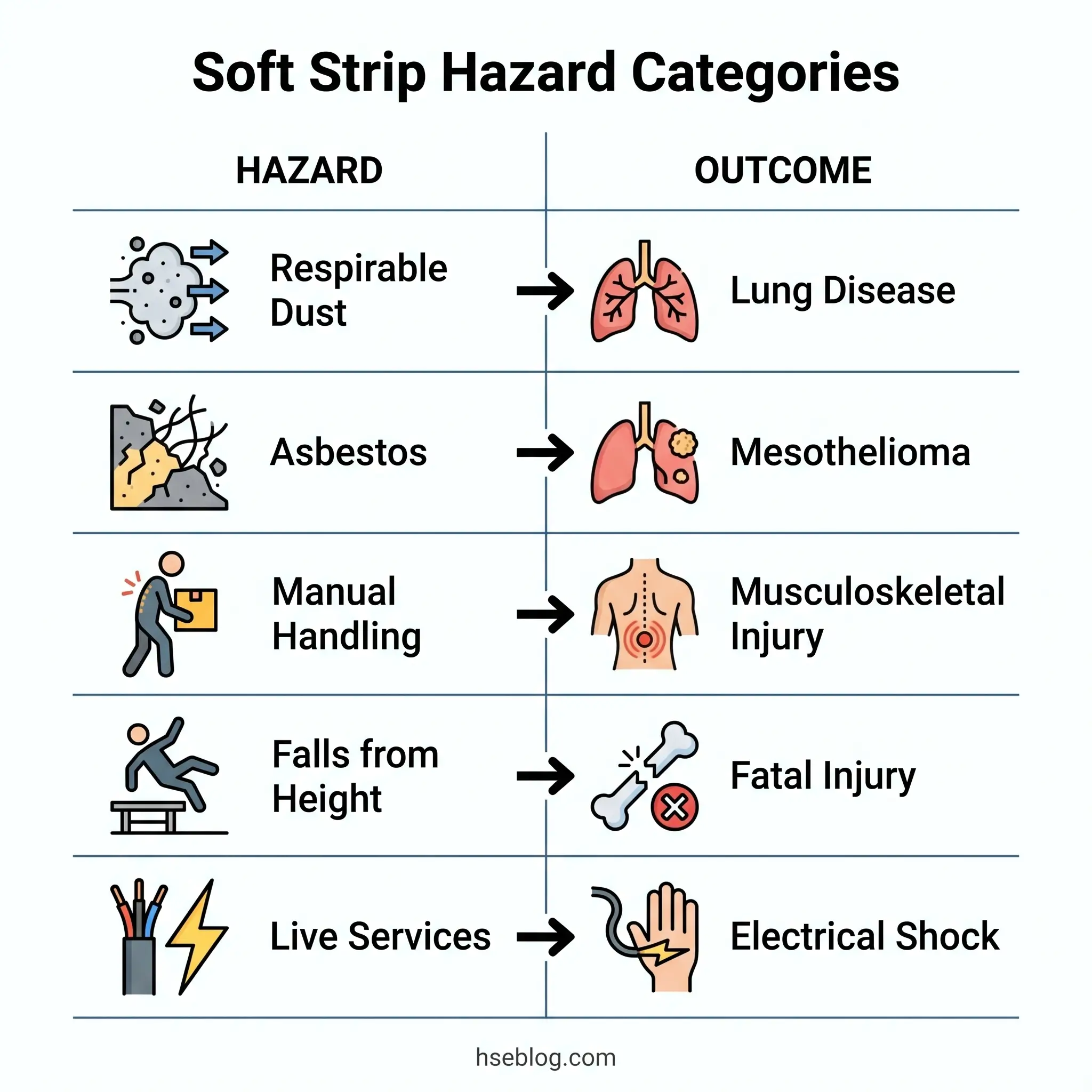
Soft strip demolition concentrates five categories of serious harm risk into enclosed indoor spaces — making each hazard more acute than its equivalent in open-air construction. This section provides a standalone hazard reference for toolbox talks and RAMS development.
Respirable dust — including respirable crystalline silica, wood dust, and general construction dust — is the hazard most consistently undercontrolled in soft strip. Because the work happens indoors with limited ventilation, airborne concentrations build rapidly. Long-term exposure causes silicosis, chronic obstructive pulmonary disease (COPD), and lung cancer. HSE UK’s dedicated guidance on dust control during soft strip demolition identifies water suppression and on-tool extraction as primary controls — RPE alone is not sufficient.
Asbestos exposure remains the most lethal legacy hazard in refurbishment work. Disturbing asbestos-containing materials without prior identification and controlled removal releases fibres that cause mesothelioma, asbestosis, and lung cancer. The 2,218 mesothelioma deaths recorded in the UK in 2023 (HSE, 2025) are the consequence of exposures decades earlier — a reminder that the harm from today’s failures will not become visible for 15–50 years.
Manual handling injuries are the most common injury type in soft strip operations. Ceiling grid sections, partition panels, cast-iron radiators, and bundled cabling all present awkward loads in confined spaces, often involving carrying through doorways and down stairs.
Slips, trips, and falls — from debris accumulation, uneven surfaces exposed by removed floor coverings, and open floor penetrations revealed when services are removed — account for a persistent proportion of lost-time injuries.
Falls from height — even in interior strip-out, accessing suspended ceilings and high-level M&E services creates fall risk. Falls from height accounted for approximately 53% of worker deaths in UK construction in 2024/25 (HSE, 2025).
Additional hazards include contact with live services (electrical shock, gas release), noise from powered tools and impact-driven removal, and sharps injuries from exposed fixings, broken glass, and cut metal edges.
Regulatory Requirements for Soft Strip Demolition
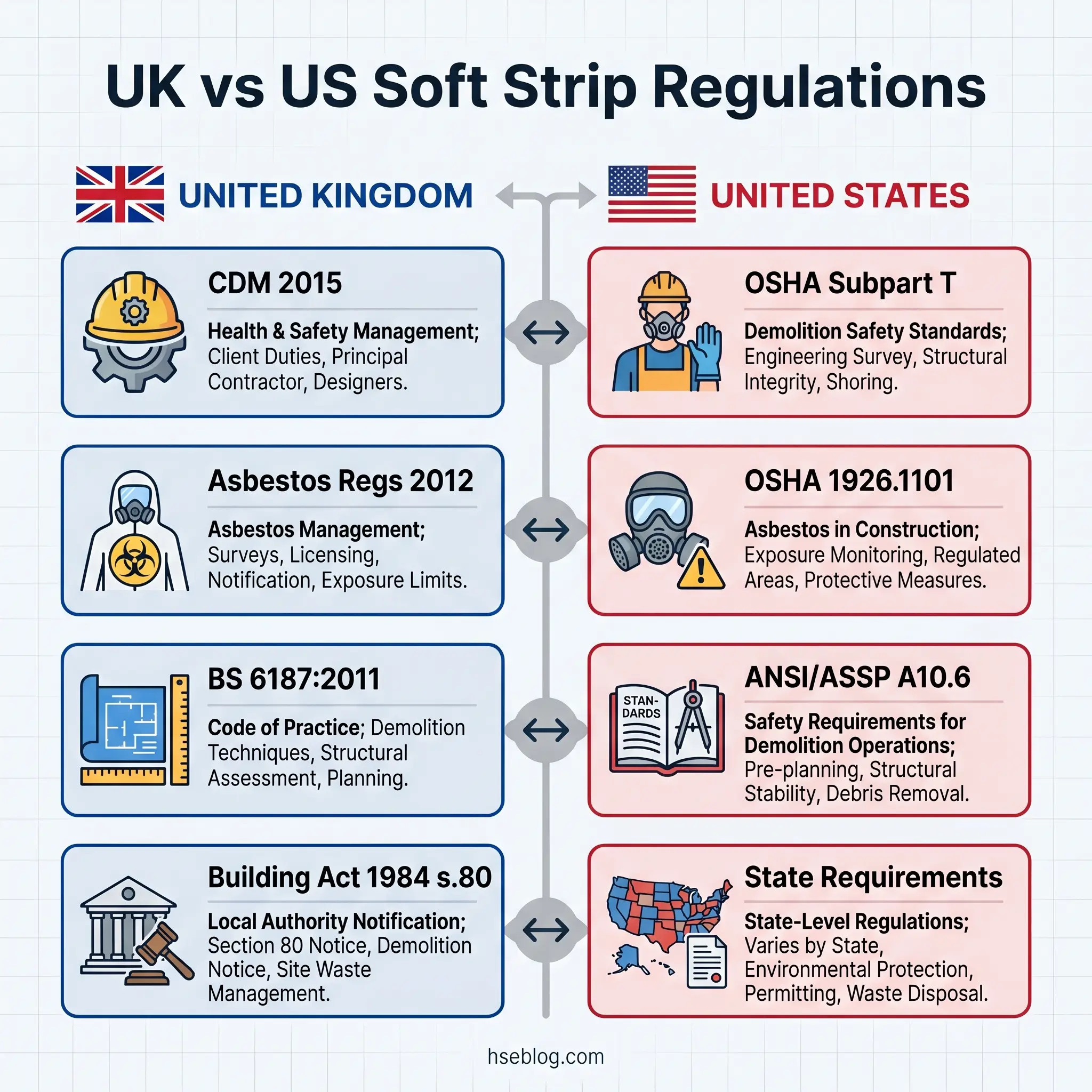
The legal obligations governing soft strip works are more extensive than most project teams realise — particularly because multiple overlapping regimes apply simultaneously. The table below cross-references the core obligations by jurisdiction.
| Obligation | UK Requirement | US Requirement |
|---|---|---|
| Demolition planning | CDM 2015 Regulation 20 — written arrangements before work begins | OSHA 1926.850(a) — engineering survey by competent person |
| Client duties | CDM 2015 Regulation 4 — provide PCI to all parties | No direct federal equivalent; contract-driven |
| Asbestos survey | Control of Asbestos Regulations 2012, Regulation 4 — R&D survey before refurbishment/demolition | OSHA 1926.1101 — building/facility owner must inform employers of ACM presence |
| Demolition notice | Building Act 1984 Section 80 — 6-week notice to local authority (England & Wales) | Varies by state and municipality |
| Demolition code of practice | BS 6187:2011 — explicitly includes soft stripping | ANSI/ASSP A10.6 — national consensus standard for demolition safety |
| Waste management | Environmental Protection Act 1990; Waste Regulations 2011 | RCRA and state-level requirements |
The written demolition arrangements required under CDM 2015 Regulation 20 (Great Britain) must be recorded before work begins — not after the first day or “once things settle down.” The regulation requires that demolition or dismantling is planned and carried out in a manner that prevents or minimises danger, and that these arrangements are written and available for inspection.
In the US, the preparatory-operations standard at OSHA 1926.850(a) is the most frequently cited demolition standard, accounting for up to three-quarters of all demolition-worksite citations (OSHA, current). The engineering survey it mandates must be conducted by a competent person and documented in writing before demolition operations begin. The 1994 OSHA interpretation letter confirming Subpart T’s application to “gut rehab” projects involving only non-load-bearing elements is one of the most overlooked pieces of guidance in US interior demolition — many contractors assume Subpart T only applies to full structural demolition.
A development worth noting for UK projects: the Building Safety Regulator (BSR) became a standalone non-departmental public body on 27 January 2026, transferring functions from HSE to a new body under MHCLG (GOV.UK, 2026). For higher-risk buildings, the BSR is now the building control authority, and the regulatory landscape for demolition and refurbishment in those buildings is actively shifting.
Regulatory content here reflects general HSE professional understanding of the cited jurisdictions’ requirements as of 2026. It is not legal advice. Specific compliance questions, enforcement situations, or prosecution risk should be directed to qualified legal counsel in the applicable jurisdiction.
How to Choose a Soft Strip Demolition Contractor
The quality of the contractor determines whether the safety framework described above exists on paper or operates on site. The single best indicator of contractor competence is the quality of their RAMS — if the risk assessment reads as a generic document with the project name pasted in, the contractor has not conducted a site-specific assessment.
Accreditations and Licensing
Verify these before shortlisting:
- CSCS cards for all operatives (UK) — confirming occupational competence.
- PASMA certification — for anyone erecting or using mobile access towers.
- SSIP membership — Safety Schemes in Procurement accreditation, demonstrating pre-qualified health and safety management.
- NFDC membership (UK) — National Federation of Demolition Contractors; confirms adherence to industry standards.
- State licensing and OSHA 30-hour certification (US) — requirements vary by state.
Evaluating Competence Beyond Paperwork
Insurance cover — public liability, employer’s liability, and professional indemnity — is a baseline, not a differentiator. The evaluation criteria that separate competent contractors from certificate-holders are track record on similar building types, willingness to share project-specific RAMS for review, documented waste diversion rates, and a named site supervisor with relevant experience.
Three questions that reveal contractor capability:
- How do you handle unexpected asbestos finds mid-strip?
- What is your dust-control methodology beyond RPE?
- What recycling diversion rate do you commit to, and how do you document it?
A contractor who cannot answer these questions with specifics has not internalised the work they are bidding on.
Frequently Asked Questions
Conclusion
The pattern that runs through published soft strip failures is remarkably consistent: the work was treated as low-risk because it did not involve structural elements, so the surveys were abbreviated, the RAMS were generic, and the phase boundaries — particularly between asbestos clearance and general strip — were compressed under programme pressure. The physical stripping is rarely the point of failure. The planning and sequencing decisions made before the first ceiling tile comes down determine whether the project runs safely or generates the exposures and injuries that define the published incident record.
The single highest-impact change a project team can make is to stop treating soft strip as a preliminary activity that precedes “real” demolition and start treating it as demolition — because legally, under both BS 6187:2011 (UK) and OSHA Subpart T (US), that is exactly what it is. That recognition triggers the engineering survey, the construction phase plan, the written demolition arrangements, and the competent supervision that soft strip demolition demands. Without it, every subsequent control is built on a missing foundation.