A pre-demolition survey is a formal, multi-disciplinary investigation of a structure carried out before demolition begins. It identifies structural risks, hazardous materials such as asbestos and lead, utility services requiring disconnection, ecological constraints, and materials suitable for recovery. Under OSHA in the US and CDM 2015 in the UK, this survey is a legal requirement — failing to conduct one can trigger enforcement action, project stop-orders, and serious harm to workers and the public.
This article provides general HSE knowledge. Life-critical work such as demolition planning, structural assessment, and asbestos abatement must be planned and supervised by a competent person with relevant training, jurisdiction-specific authorization, and site-specific risk assessment. The information here does not replace that.
In 2024, 1,032 construction and extraction workers died on the job in the United States alone (US Bureau of Labor Statistics, 2026). Demolition sits within that broader toll, but its hazard profile is distinct — unplanned structural collapse, uncontrolled asbestos release, live utility contact, and ecological violations each carry the potential for mass-casualty events, chronic occupational disease, or six-figure regulatory penalties. The pre-demolition survey exists to prevent these outcomes by ensuring every risk is identified, documented, and addressed before a single element of the structure is disturbed.
This article breaks down what a pre-demolition survey must cover, which regulatory frameworks mandate it, who is competent to conduct each element, and where surveys most commonly fail in practice. The coverage is jurisdictionally explicit — US, UK, and EU requirements are labelled throughout rather than blended into vague generalities. If you are commissioning, conducting, or relying on one of these surveys, you need to understand all of its components, not just the asbestos chapter.
What Is a Pre-Demolition Survey?
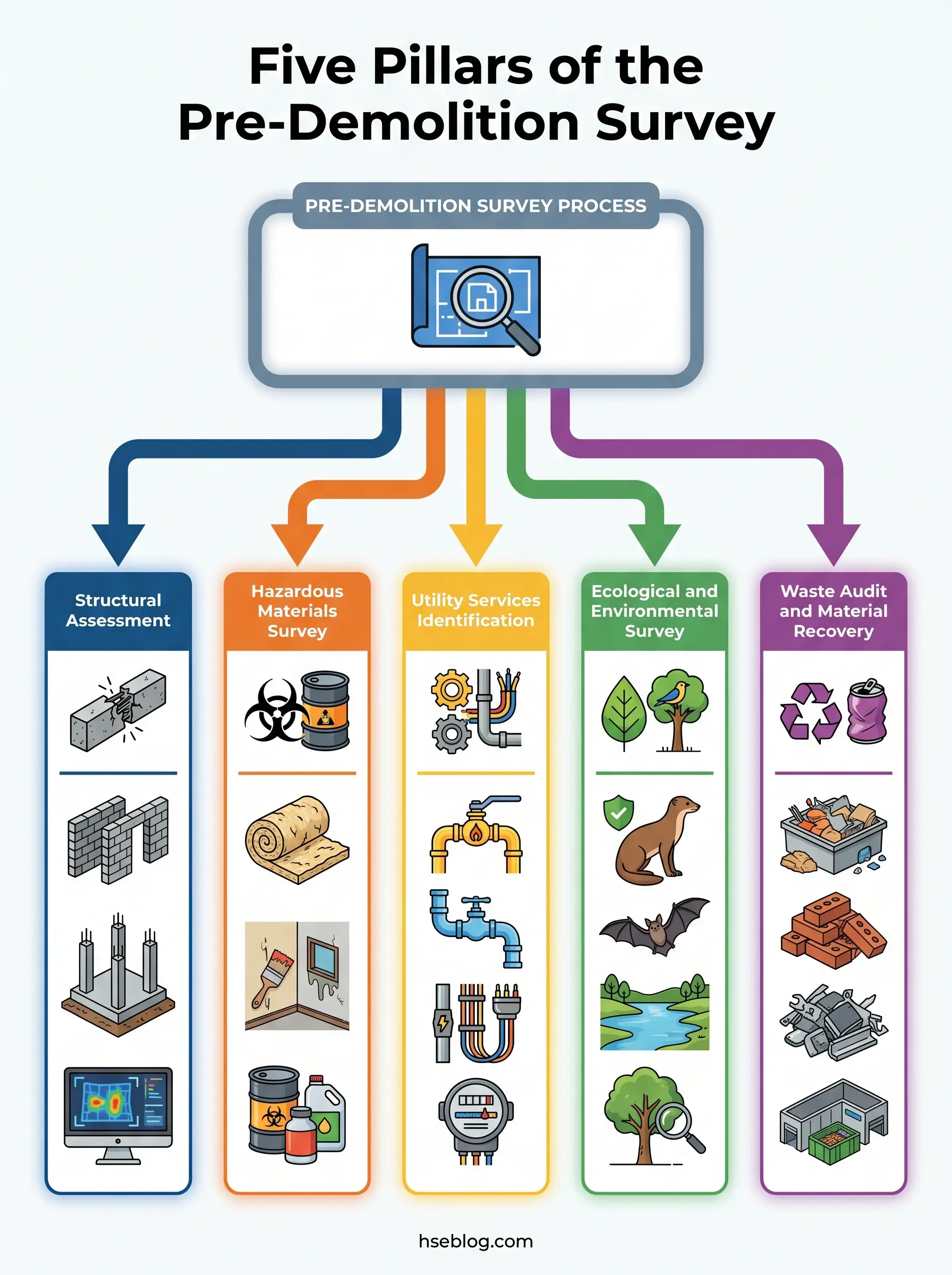
A pre-demolition survey is a systematic, multi-disciplinary investigation of a building or structure conducted before any demolition or major strip-out work begins. It is not a quick walkthrough or a single-topic inspection — it is a coordinated set of specialist assessments covering structural condition, hazardous materials, utility services, ecological factors, and material recovery potential.
The distinction matters because most organizations treat it as a single-discipline exercise. The most common version of this mistake is commissioning only an asbestos survey and treating it as the entire pre-demolition assessment.
In practice, structural, hazmat, utilities, ecological, and waste audit investigations are each separate workstreams with different competency requirements. A surveyor accredited to identify asbestos-containing materials is not qualified to assess structural load paths. An ecologist conducting a bat emergence survey is not assessing whether utility disconnections have been confirmed.
The survey serves two parallel functions:
- Protecting people — workers, adjacent occupants, and the public from structural collapse, hazardous substance exposure, and uncontrolled utility contact.
- Protecting the project — from unplanned costs, schedule disruption, regulatory stop-orders, and criminal prosecution.
The "Competent Person" Requirement
Every jurisdiction that mandates a pre-demolition survey also specifies that a competent person must conduct or oversee it. The definition of "competent person" varies significantly:
| Jurisdiction | Definition | Typical Qualification |
|---|---|---|
| US (OSHA) | Capable of identifying hazards and authorized to take corrective action | PE, certified safety professional, or experienced demolition employee |
| UK | Sufficient training, experience, knowledge, and other qualities | Specialist structural engineer, UKAS-accredited asbestos surveyor, licensed ecologist |
| EU | Varies by member state | Aligned with national transposition of relevant directives |
The key point for practitioners: no single individual covers all survey components. On a medium-to-large project, the survey team typically includes a structural engineer, hazmat surveyor, utility locator, ecologist, and — increasingly — a waste auditor. The project manager coordinates; they do not substitute.
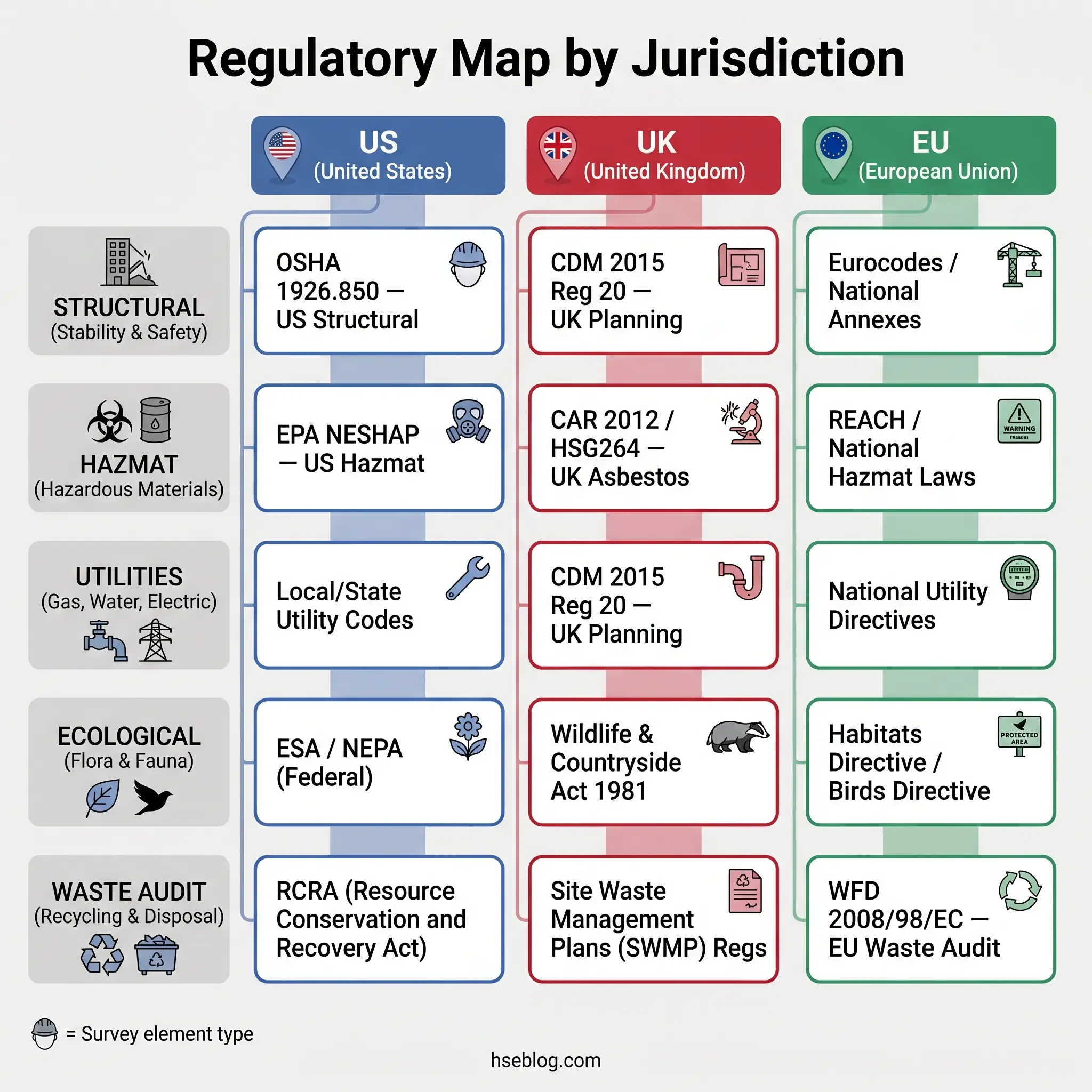
Why Pre-Demolition Surveys Are a Legal Requirement
The pre-demolition survey is not a best-practice recommendation. In every major regulatory jurisdiction, it is a legal obligation with enforcement teeth — fines, prosecution, project stop-orders, and civil liability for property owners, principal contractors, and demolition companies.
The OSHA demolition standards page makes this starkly visible: the engineering survey requirement under 29 CFR 1926.850(a)(1) accounts for more than half of all demolition preparatory-operations citations (OSHA, current enforcement data). The reason is consistent — employers assume a verbal walkthrough or a mental assessment qualifies as an "engineering survey." It does not. The standard requires written evidence.
US Requirements: OSHA and EPA
OSHA's 29 CFR 1926.850(a) sets the baseline obligation. Before demolition begins, an engineering survey of the structure must be completed by a competent person. The survey must assess the condition of framing, floors, walls, and all structural elements. Findings must be documented in writing, and the written evidence must be maintained at the project site.
Adjacent structures must also be assessed. If there is a risk that demolition activities could damage neighboring buildings or endanger their occupants, protective measures — shoring, bracing, or exclusion zones — must be in place before work starts.
On the hazardous materials side, the EPA's NESHAP regulations (40 CFR Part 61, Subpart M) impose a separate, parallel obligation:
- A thorough inspection for regulated asbestos-containing materials (ACMs) must be completed before demolition.
- The inspection must be conducted by an accredited inspector (AHERA-accredited or state equivalent).
- A written notification must be submitted to the appropriate state agency or EPA regional office at least 10 working days before demolition begins.
State plans may add further requirements. New York, for example, mandates an asbestos survey for any pre-1980 building scheduled for demolition or renovation — regardless of building size.
UK Requirements: CDM 2015, BS 6187, and Asbestos Regulations
The UK framework layers three interlocking obligations.
CDM 2015, Regulation 20 requires that demolition or dismantling of a structure is planned and carried out in a way that prevents or reduces danger so far as is reasonably practicable. The arrangements must be recorded in writing before work begins. The HSE's demolition safety guidance provides the practical interpretation of this requirement.
BS 6187:2011 (Code of Practice for Full and Partial Demolition), Clause 7, requires comprehensive knowledge of the site — structural condition, hazardous materials, services, and adjacent structures — before planning the demolition method. This is the UK's most detailed technical standard for demolition survey scope.
Control of Asbestos Regulations 2012 (CAR 2012), Regulation 7, read alongside HSG264 guidance, requires a refurbishment and demolition (R&D) asbestos survey before any major refurbishment or final demolition. This survey is intrusive — it requires accessing concealed spaces behind walls, above suspended ceilings, inside service risers, and below raised floors.
Additionally, the demolition contractor must give the local authority building control department at least six weeks' notice before demolition begins (under the Building Act 1984, Section 80).
EU and International Requirements
The EU's framework is currently evolving, and practitioners who are not paying attention to it will find themselves retrofitting capabilities later.
The Waste Framework Directive (2008/98/EC) established a target of 70% recycling of non-hazardous construction and demolition waste by weight (European Commission, 2008). The European Commission subsequently published guidelines for waste audits before demolition works, formalizing the process for identifying reusable and recyclable materials prior to demolition.
CEN/TC 350/SC1/WG 8 is actively developing a European standard for pre-demolition and pre-redevelopment audits, discussed at the European Demolition Association's Think Tank in 2025 (European Demolition Association, 2025). When published, this standard will likely formalize pre-demolition waste audits across EU member states, transforming them from best practice into regulatory expectation.
Key Elements of a Pre-Demolition Survey
The pre-demolition survey is not one inspection. It is a coordinated set of specialist investigations, each producing distinct deliverables that feed directly into the demolition method statement and risk assessment. Missing any single element can invalidate the entire demolition plan — or worse, leave a lethal hazard undiscovered until work is underway.
The most dangerous gap in practice occurs when survey components are completed at different times. A structural assessment conducted six months before asbestos sampling — with conditions changing in the interim — creates a false sense of completeness. Survey elements need to be time-synchronized, with a defined validity window established at the outset.
Structural Survey and Engineering Assessment
The structural survey determines whether the building can be safely demolished and how. It assesses framing systems, floor and wall construction, foundation condition, load-bearing elements, cantilever structures, fragile roofs, and signs of deterioration such as corrosion, fire damage, or previous unauthorized modifications.
Under OSHA 29 CFR 1926.850(a), this assessment must be conducted by a competent person. In UK practice, a specialist structural engineer typically performs the work, producing a report that directly informs demolition method selection.
Critical outputs include:
- Condition of the structure — identifying areas where unplanned collapse is a risk during demolition.
- Adjacent structure assessment — party walls, shared foundations, and neighboring buildings that could be destabilized.
- Demolition method determination — whether manual, mechanical, or controlled explosive demolition is appropriate given the structural findings.
- Removal sequencing — the order in which structural elements must be removed to maintain stability throughout the demolition process.
A consistent pattern across published structural-collapse investigations is that the survey identified deterioration but the method statement did not adjust the demolition sequence accordingly. The survey is only valuable when it changes what the demolition team actually does.
Hazardous Materials Survey
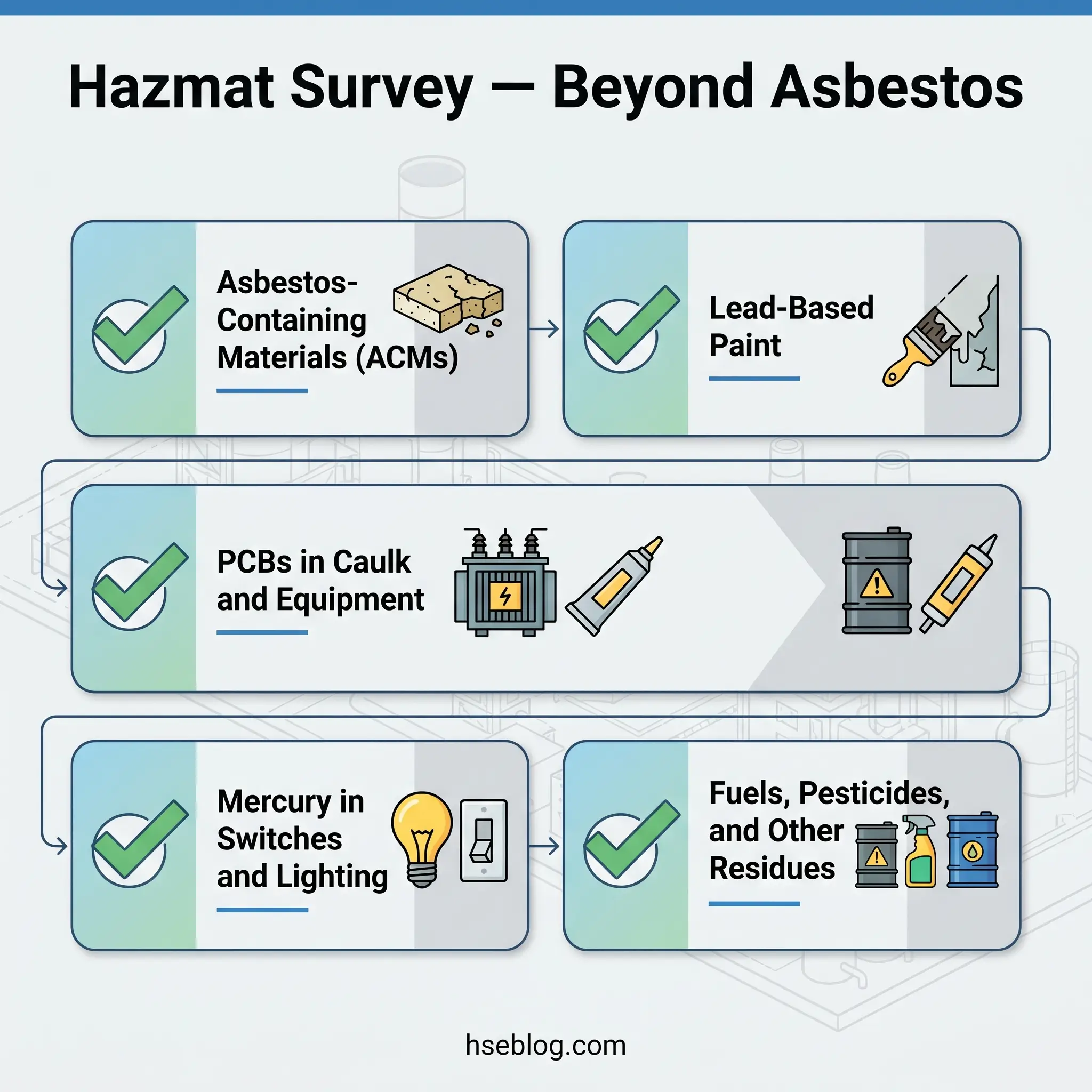
Asbestos dominates the hazardous materials conversation, but treating the hazmat survey as an asbestos-only exercise is a serious gap. The full scope includes:
- Asbestos-containing materials (ACMs) — the primary concern. The refurbishment and demolition survey (UK) or NESHAP inspection (US) is intrusive, requiring destructive access to concealed areas behind walls, above ceilings, inside risers, and below floors. Bulk samples are analyzed by UKAS-accredited (UK) or NVLAP-accredited (US) laboratories.
- Lead-based paint — mandatory assessment for pre-1978 buildings in the US (HUD/EPA Lead-Based Paint Hazards Reduction Act). Assessment dates vary by jurisdiction elsewhere.
- PCBs — found in caulking, sealants, window glazing compounds, and electrical equipment (capacitors, ballasts) in buildings constructed or renovated between the 1950s and 1979.
- Mercury — often present in thermostats, HVAC switches, fluorescent lighting, and laboratory equipment.
- Other hazards — radon, silica-bearing materials, residual fuels and oils, pesticides, batteries, and stored flammable materials.
The distinction between a management asbestos survey and a refurbishment/demolition (R&D) survey is a frequent source of confusion. A management survey identifies ACMs in their current state to manage them during normal occupancy. An R&D survey is destructive — it accesses every concealed space to identify all ACMs that will be disturbed during demolition. Before final demolition, the R&D survey is the legal requirement under CAR 2012 in the UK and NESHAP in the US.
Utility and Services Survey
Uncontrolled contact with live utilities during demolition causes fires, explosions, flooding, and electrocution. The utility survey identifies, maps, and confirms the disconnection of every service entering or running through the structure.
The scope covers electrical supply, gas, water, steam, sewer, telecommunications, and any district heating or cooling connections. OSHA 29 CFR 1926.850(a) requires that utility services be "shut off, capped, or otherwise controlled outside the building line" before demolition begins.
Three operational steps must be completed in sequence:
- Identification and mapping — locating all utility entry points, internal routing, and connections to adjacent buildings. In the US, the 811 "Call Before You Dig" process locates underground services. UK equivalents include utility search providers and Ordnance Survey records.
- Disconnection request — formal notification to each utility company with requested disconnection dates.
- Disconnection verification — confirmed evidence that disconnection has occurred, not merely that it has been requested. This is the critical distinction. A disconnection request submitted to a utility company is not evidence that the service has been isolated. Site-level verification — testing, visual confirmation, or written confirmation from the utility provider — must be obtained and documented.
Ecological and Environmental Survey
Protected species and habitat assessments are frequently treated as irrelevant to demolition, particularly in urban settings. This is a costly assumption.
In the UK, bats are protected under the Conservation of Habitats and Species Regulations 2017 and the Wildlife and Countryside Act 1981. Any building that could harbor roosting bats — including urban structures — requires a preliminary roost assessment and potentially emergence surveys. Bat emergence surveys can only be conducted between May and August, which means failing to plan this survey early enough can delay the entire demolition program by months.
Nesting birds are similarly protected during breeding season (March–August in the UK), and great crested newts trigger additional survey obligations where suitable terrestrial or aquatic habitat exists.
In the US, the Endangered Species Act applies where demolition affects habitat for federally listed species, including the Indiana bat, northern long-eared bat, and tricolored bat.
Beyond species, the ecological survey encompasses:
- Soil contamination — Phase I and Phase II Environmental Site Assessments under ASTM standards (ASTM E1527 and E1903 in the US) determine whether ground contamination requires remediation before or during demolition.
- Water course impact — runoff, sediment, and contamination risk to adjacent water bodies.
Pre-Demolition Waste Audit and Material Recovery Assessment
This is the survey element that most current guidance neglects — and the one most likely to become a regulatory gatekeeping requirement within the next few years.
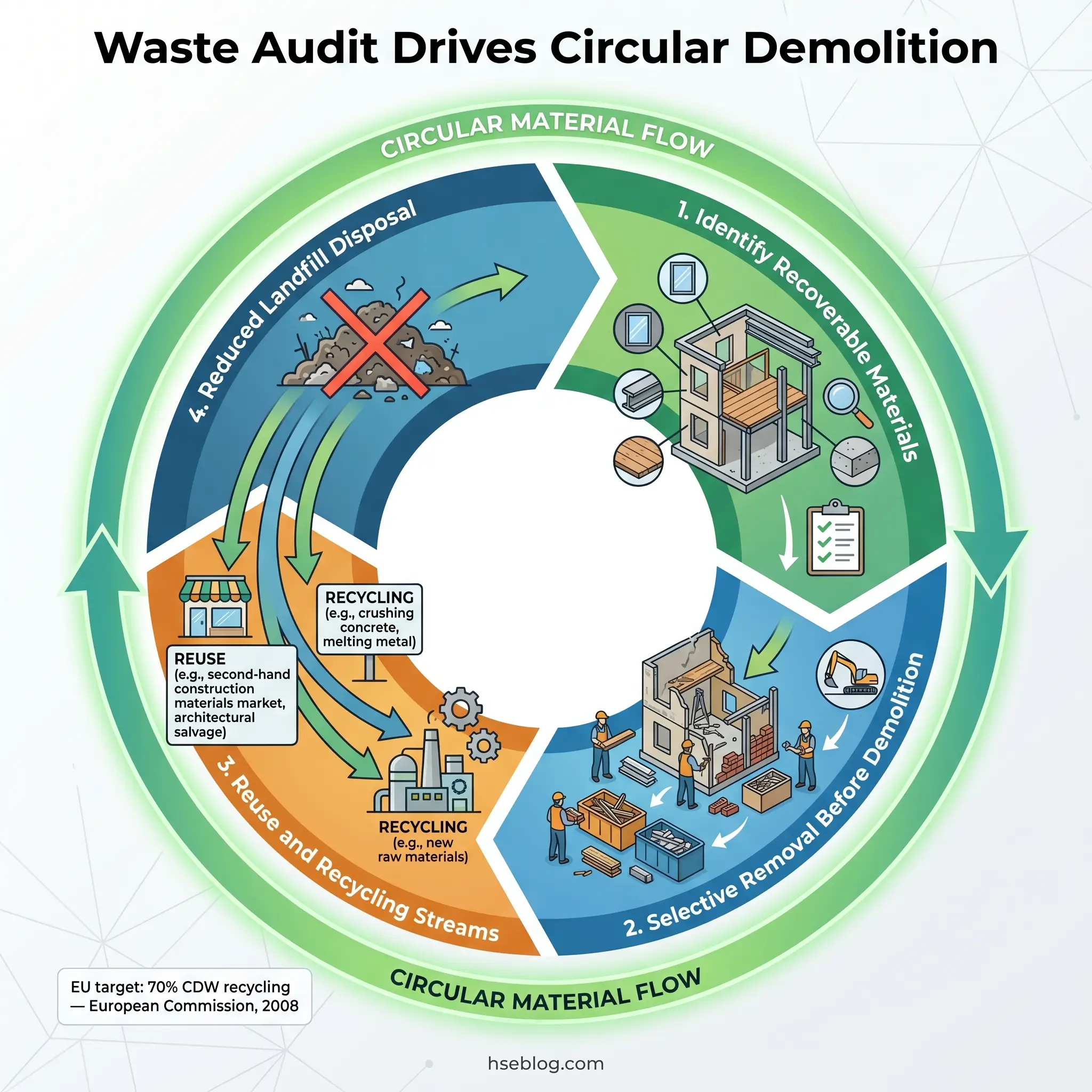
The pre-demolition waste audit assesses which materials in the structure can be recovered for reuse or recycling before demolition proceeds. It is the practical mechanism for implementing the waste hierarchy — prevent, reuse, recycle — at the demolition stage.
The EU has been the driving force. The Waste Framework Directive (2008/98/EC) established a 70% target for recycling of non-hazardous construction and demolition waste by weight (European Commission, 2008). The European Commission published guidelines for waste audits before demolition works, providing a structured methodology.
Materials typically assessed for recovery include:
- Structural steel — high salvage value, readily recyclable.
- Timber — reusable beams, joists, and floorboards; dependent on condition and treatment.
- Bricks — handmade and period bricks command significant salvage value.
- Fixtures and architectural elements — doors, windows, radiators, fireplaces, ironmongery.
- Concrete and masonry — recyclable as aggregate.
The CEN/TC 350/SC1/WG 8 standard currently under development will likely formalize this audit requirement across EU member states (European Demolition Association, 2025). In the US, EPA guidance already encourages considering deconstruction for structurally sound buildings as an alternative to wholesale demolition.
The economic case is straightforward: revenue from salvaged materials and avoided landfill disposal costs can offset a meaningful portion of demolition project costs, while simultaneously reducing the environmental footprint and meeting increasingly stringent regulatory expectations.
Who Conducts a Pre-Demolition Survey?
The question of who conducts the survey is more nuanced than it appears, because it actually involves three distinct roles: who commissions the survey, who conducts each specialist component, and who reviews and approves the findings.
In the UK under CDM 2015, the client (property owner or developer) holds the duty to provide pre-construction information — which includes commissioning the necessary surveys. The client does not conduct the surveys personally, but they bear the legal responsibility for ensuring they are done.
Under OSHA in the US, the obligation falls to the employer — typically the demolition contractor — to ensure an engineering survey is completed by a competent person before demolition begins.
For each survey component, the specialist role differs:
- Structural assessment — chartered structural engineer (UK) or professional engineer / competent demolition professional (US).
- Asbestos survey — UKAS-accredited surveyor (UK) or AHERA-accredited inspector (US).
- Utility survey — specialist utility survey company or licensed utility locators.
- Ecological survey — licensed ecologist with relevant species survey licenses.
- Waste audit — waste management specialist or environmental consultant with construction waste expertise.
A common confusion is assuming one individual can cover all components. For a small residential demolition, a single experienced contractor might reasonably address structural and utility elements. For anything larger, the survey is a team effort, and the project manager's role is coordination — scheduling, cross-referencing findings, and ensuring no gaps between specialists.
The Pre-Demolition Survey Process: Step by Step
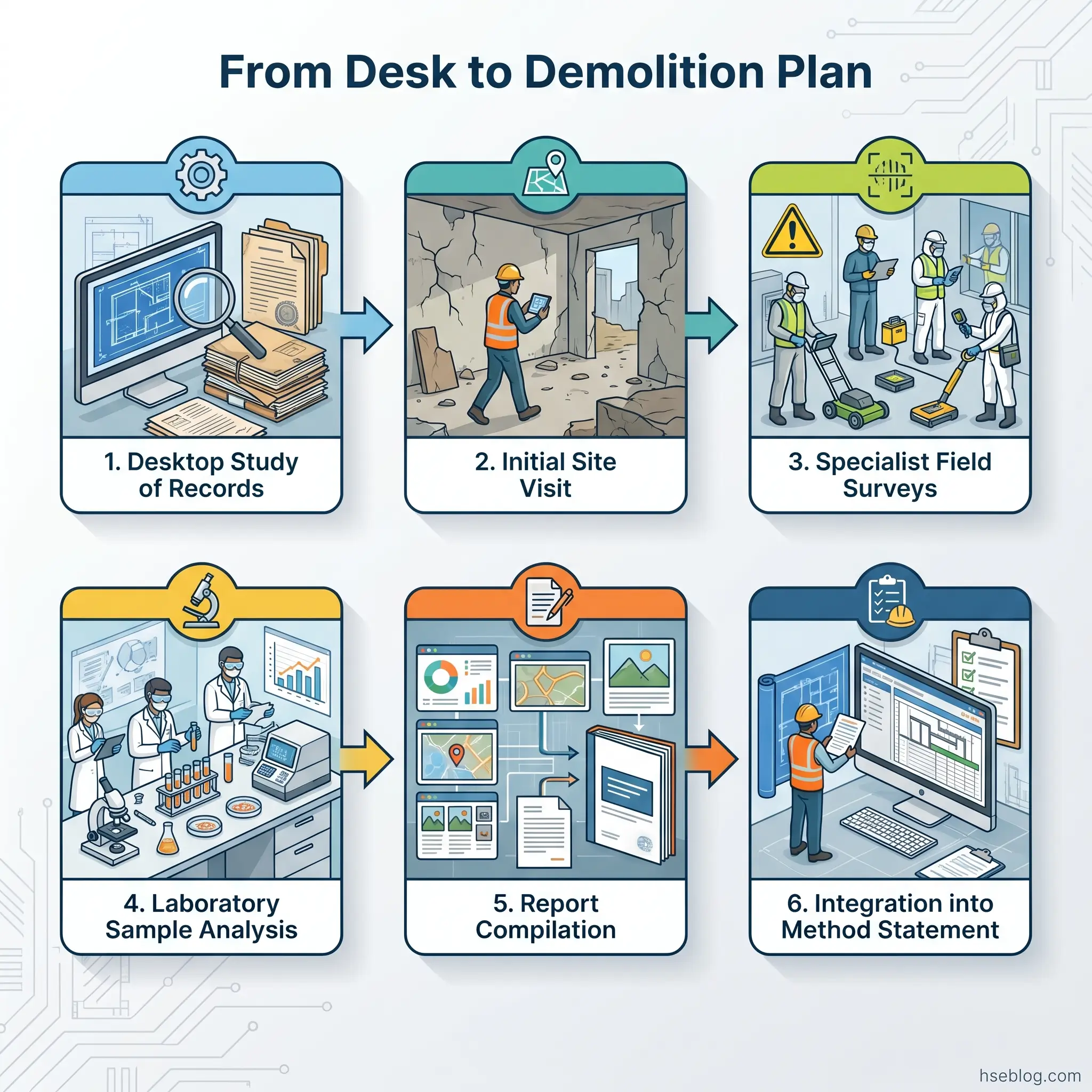
From commission to deliverables, the pre-demolition survey follows a six-stage sequence. Each stage builds on the one before it, and skipping stages — particularly the desktop study — leads to incomplete fieldwork.
- Desktop study — review historical building plans, architectural drawings, previous survey records, construction date, known modifications, asbestos registers, and any prior Phase I environmental assessments. This stage identifies what the fieldwork must investigate and flags areas of concern before anyone enters the structure.
- Initial site visit — physical familiarization with the building layout, access constraints, neighboring structures, and any visible hazards. This is a reconnaissance visit, not the full survey — its purpose is to inform the scope and logistics for each specialist investigation.
- Specialist surveys — the five core survey elements (structural, hazmat, utilities, ecological, waste audit) are conducted by their respective specialists. The hazmat survey is intrusive and destructive — sampling behind walls, above ceilings, inside risers. Ecological surveys may require repeat visits across different seasons.
- Laboratory analysis — asbestos bulk samples, lead paint chip analysis, soil samples, PCB testing, and any other material analysis. Accredited laboratories must be used (NVLAP in the US, UKAS in the UK).
- Reporting — each specialist compiles findings into a survey report. These individual reports are then compiled into a comprehensive pre-demolition survey report covering all five elements, with clear cross-references where findings in one discipline affect another (e.g., structural deterioration affecting safe access for asbestos removal).
- Integration — survey findings feed directly into the demolition method statement, risk assessment, and — in the UK — the Construction Phase Plan. If the method statement reads the same before and after the survey, the survey was wasted.
Common Failures and How to Avoid Them
Published enforcement actions, investigation reports, and industry prosecution records reveal a remarkably consistent set of survey failures. These are not obscure edge cases — they are the patterns that recur across demolition incidents, OSHA citations, and HSE prosecutions.
Treating the Survey as a Box-Ticking Exercise
The most fundamental failure is conducting the survey to satisfy a paper requirement rather than as a genuine risk-discovery process. When this happens, survey reports are generic templates with boilerplate findings that do not reflect the specific structure. The tell-tale sign: the method statement does not change after the survey is completed, because the survey was never intended to inform the plan — it was intended to demonstrate compliance to an auditor.
Avoidance: the pre-demolition survey report should contain findings that are impossible to copy-paste to a different building. If the structural assessment does not name specific structural elements, reference specific floor-by-floor conditions, or flag specific deterioration, it is a template, not a survey.
Failing to Survey Concealed Areas
The refurbishment and demolition asbestos survey is intrusive for a reason. ACMs are frequently located behind walls, above suspended ceilings, inside service risers, below raised floors, and within insulation around pipe and duct work.
A management survey — which only assesses what is visible and accessible during normal occupancy — is insufficient before demolition. CAR 2012 Regulation 7 and HSG264 make this explicit. Yet published HSE prosecution summaries repeatedly show contractors proceeding with demolition based on a management survey rather than the required R&D survey.
Surveys Completed but Not Re-Validated
Structural and utility surveys have a shelf life. When demolition is delayed by months or years after the initial survey, conditions change — water ingress accelerates structural deterioration, utility reconnections occur, ecological conditions shift with seasons.
The practical safeguard is establishing a survey validity window at commissioning. If demolition does not proceed within that window, re-survey or verification visits are required.
Disconnection Requested but Not Verified
This failure mode appears consistently in incident investigations involving electrocution and gas ignition during demolition. A disconnection request was submitted to the utility company. The demolition team assumed it was complete. Work began with live services still in the structure.
Sites operating under OSHA's requirement that services be "shut off, capped, or otherwise controlled outside the building line" need documented, site-verified evidence of disconnection — not a copy of the request letter.
Ecological Surveys Dismissed in Urban Settings
The assumption that urban buildings do not harbor protected species is incorrect and has led to significant project delays and regulatory penalties. Bats roost in building crevices, soffits, and roof spaces regardless of whether the building is in a city center or a rural setting.
In the UK, proceeding with demolition without adequate bat surveys when bats are subsequently found constitutes an offense under the Conservation of Habitats and Species Regulations 2017. Penalties include fines and imprisonment.
Missing Written Records
The field procedure most auditors test first under OSHA 1926.850(a) is not whether a survey was done — it is whether written evidence of the survey exists. The absence of a documented engineering survey is the single most common citation under this standard.
The fix is procedural: if the survey is not written, it did not happen — regardless of what was observed or discussed verbally.
How Pre-Demolition Survey Findings Shape the Demolition Plan
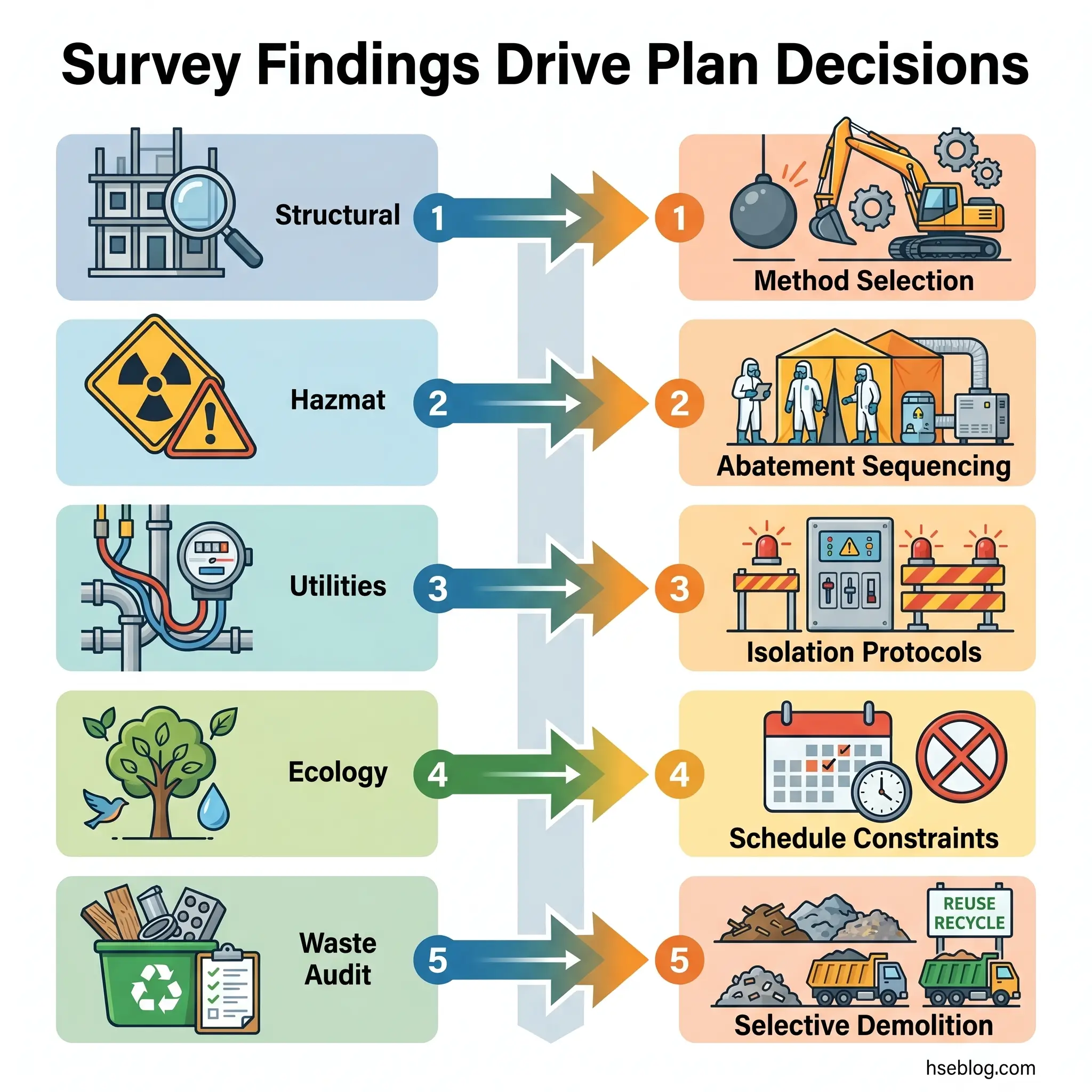
Survey findings are not archival records. They are operational inputs that directly determine the demolition method, phasing, temporary works, exclusion zones, waste management, and emergency procedures. Where surveys are superficial, demolition plans default to worst-case conservative assumptions that inflate costs — or, more dangerously, they default to optimistic assumptions that leave uncontrolled risks in play.
Structural Findings Drive Method Selection
The structural survey determines whether manual demolition, mechanical demolition, or controlled explosive demolition is appropriate. A heavily deteriorated reinforced concrete frame with compromised load paths may preclude mechanical demolition from elevated positions due to stability risk. Previous unauthorized modifications — removed load-bearing walls, undocumented mezzanine additions — can make sections of the building behave unpredictably during dismantlement.
The survey also defines the sequence of structural element removal. Removing a secondary element before its primary support has been assessed and temporary-worked, if necessary, is the mechanism behind most unplanned partial collapses during demolition.
Hazmat Findings Determine Abatement Sequencing
All identified ACMs must be removed by licensed or accredited contractors before structural demolition begins. This is a sequencing dependency, not a parallel activity.
The hazmat survey findings determine:
- Which materials require specialist abatement — licensed asbestos removal, lead paint stabilization, PCB-containing equipment decommissioning.
- Abatement phasing — in a multi-story building, abatement typically progresses floor by floor, from top down.
- Waste disposal routing — hazardous waste streams require separate handling, transport, and disposal at licensed facilities.
Utility Findings Define Isolation Protocols
The utility survey informs the lock-out/isolation plan. Every service must be positively isolated and verified before demolition begins. Live service detection during demolition triggers immediate stop-work.
Ecological Findings Impose Timing Constraints
If bat roosts or nesting bird sites are identified, the demolition schedule must accommodate seasonal exclusion periods. In the UK, bat mitigation works typically require a Natural England license, adding further lead time. These constraints can shift an entire project schedule by months if they are discovered late.
Waste Audit Findings Enable Selective Demolition
Where the waste audit identifies materials with salvage or recycling value, the demolition plan incorporates a selective demolition phase — manual strip-out of recoverable materials before mechanical demolition of the remaining structure. This phasing must be sequenced alongside the hazmat abatement schedule.
Frequently Asked Questions
Is a pre-demolition survey legally required?
Yes, in most jurisdictions — but the specific obligations vary. In the US, OSHA 29 CFR 1926.850(a) mandates a written engineering survey by a competent person, and EPA NESHAP requires a separate asbestos inspection with 10-day advance notification. In the UK, CDM 2015 Regulation 20 requires a written demolition plan informed by site knowledge, and CAR 2012 requires an intrusive asbestos survey. Some requirements are absolute (the NESHAP asbestos inspection before any demolition), while others are triggered by project characteristics such as building age or size.
What is the difference between a pre-demolition survey and a refurbishment and demolition asbestos survey?
The asbestos R&D survey is one component of the broader pre-demolition survey — not a substitute for it. A pre-demolition survey also covers structural integrity, utility services, ecological factors, and waste recovery. Confusing the two creates dangerous gaps: a building can be cleared for asbestos but still have live gas mains, unstable load-bearing walls, or a protected bat roost that would halt demolition.
How long does a pre-demolition survey take?
Duration depends on building size, age, complexity, and the number of survey elements required. A small residential structure might be surveyed within days. A large industrial facility — particularly one with extensive concealed spaces, complex utility networks, and potential ecological constraints — can take weeks to months. Ecological surveys introduce the longest lead times: bat emergence surveys in the UK can only be conducted between May and August, so missing that window adds up to a year of delay.
Can demolition proceed if asbestos is found during the survey?
Finding asbestos does not cancel the project — it triggers an abatement phase. All identified ACMs must be removed by licensed or accredited asbestos removal contractors before any structural demolition begins. The survey identifies the scope of abatement work, which then becomes a precondition to demolition, not a reason to abandon it. Costs and schedule must account for this sequencing dependency.
What happens if a pre-demolition survey is not done?
Regulatory consequences are severe. Under EPA NESHAP, penalties can reach tens of thousands of dollars per day per violation for failure to inspect or notify before demolition. In the UK, HSE prosecution for failing to conduct required surveys before demolition can result in unlimited fines and imprisonment of responsible persons. Beyond enforcement, the operational consequences include unplanned asbestos exposure (triggering health surveillance obligations for affected workers), structural collapse during demolition, and civil liability if workers or neighbors develop occupational disease.
Do I need an ecological survey before demolition?
In the UK, almost certainly — if the building could harbor bats, nesting birds, or other protected species, a preliminary ecological assessment is the starting point. In the US, an ecological survey is required where demolition affects habitat for federally listed species under the Endangered Species Act. The critical planning consideration is timing: ecological surveys are season-dependent, so they must be commissioned early in the project planning phase to avoid delaying the entire demolition program.
Conclusion
The pre-demolition survey is the point where competent practice and negligent practice diverge. Every element — structural assessment, hazardous materials identification, utility mapping, ecological evaluation, and waste audit — serves a distinct protective function, and each carries its own competency requirements that no single individual can credibly cover across the full scope.
The regulatory direction is clear: jurisdictions are tightening, not relaxing, pre-demolition obligations. The CEN/TC 350 standard under development will extend formal waste audit requirements across EU member states (European Demolition Association, 2025). OSHA continues to cite the engineering survey requirement more frequently than any other demolition preparatory standard. The trend is toward greater documentation, greater specialist involvement, and greater accountability for the client and contractor who commission and rely on these surveys.
The judgment call that distinguishes a competent demolition project from a dangerous one happens before any machinery arrives on site. It happens in the quality, completeness, and integration of the pre-demolition survey — and in the willingness to let its findings change the plan.