
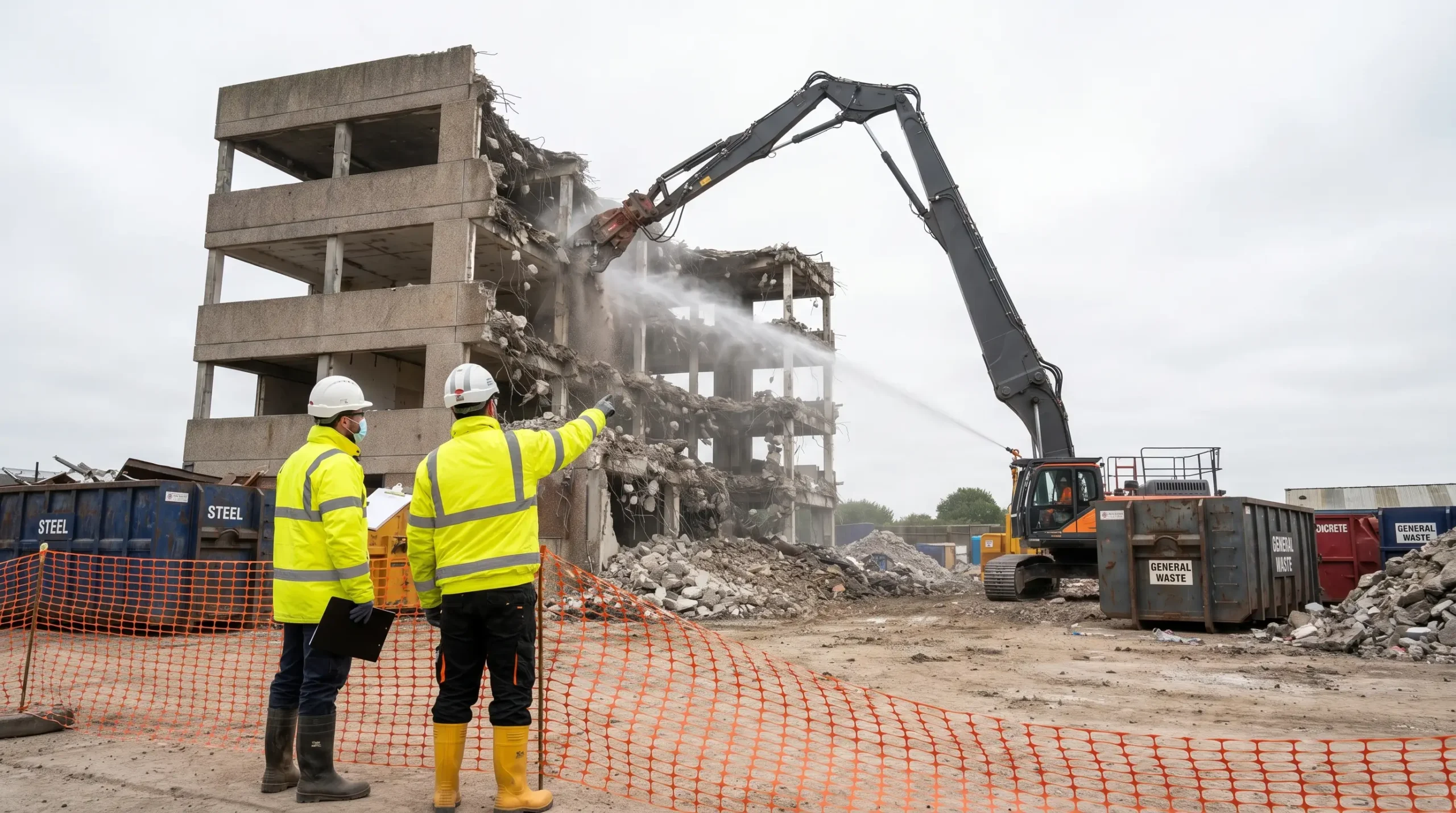
TL;DR
- Written before any demolition begins — CDM 2015 Regulation 20 (UK) singles out demolition as the only construction activity requiring written arrangements before work starts.
- Site-specific, never a swapped-in template — the document must address the actual structure, actual hazards, and actual sequence for this project; generic submissions are the most common enforcing-authority rejection.
- Covers surveys, sequence, stability, hazards, zones, and emergencies — each section is a link in a chain; a gap in any one of them leaves the demolition crew exposed to uncontrolled collapse, asbestos release, or entrapment.
- Must be revised as conditions change — BS 6187:2011 requires the planning cycle to restart whenever unforeseen circumstances arise on site.
- Produced by a competent person and briefed to every operative — a technically complete document sitting unread in the site office has prevented zero incidents.
A demolition method statement is a written document that records the planned sequence, methods, and safety arrangements for demolition work before it begins. In the UK, CDM 2015 Regulation 20 makes it mandatory for all demolition or dismantling. In the US, OSHA 29 CFR 1926.850(a) requires a written engineering survey by a competent person. In Australia, a SWMS is required for demolition classified as high-risk construction work. The document must detail pre-demolition surveys, the demolition sequence, structural stability measures, hazardous materials management, exclusion zones, emergency procedures, and waste management — all site-specific and revised whenever conditions change.
This article provides general HSE knowledge. Life-critical work such as demolition planning, structural stability assessment, and asbestos management must be planned and supervised by a competent person with relevant training, jurisdiction-specific authorization, and site-specific risk assessment. The information here does not replace that.
CDM 2015 Regulation 20 does something no other construction regulation does: it names demolition by title and demands that arrangements be recorded in writing before work begins. Not “should be.” Must be. That single clause — two sentences in the legislation — has generated more enforcement action, more project delays, and more legal argument than almost any other provision in UK construction law. The reason is straightforward: demolition is the controlled reversal of a structure’s engineering. Get the sequence wrong and the structure does not wait for a revised plan.
The consequences of a deficient demolition method statement are not hypothetical. UK construction recorded 35 worker fatalities in the year ending March 2025 (HSE, 2025), and construction accounted for 28% of all worker fatal injuries across British industries. In the US, OSHA reported 5,070 fatal work injuries across all sectors in 2024 (Bureau of Labor Statistics, 2025). The financial exposure is equally severe: as of 2025, OSHA maximum penalties for serious violations reach $16,550 per violation, with willful or repeat violations reaching $165,514 (OSHA, 2025). This article breaks down every section a demolition method statement must contain, who is responsible for producing it, and what separates a compliant document from one that actually prevents someone from being killed.
What Is a Demolition Method Statement and Why Is It Legally Required?
A demolition method statement is a written record of exactly how a structure will be taken down — the sequence, the methods, the equipment, the hazard controls, and the emergency arrangements — produced and agreed before any demolition activity starts on site.
Its legal basis differs by jurisdiction, but the core obligation is consistent: plan the work in writing, and do it before anyone picks up a tool.
In the UK, CDM 2015 Regulation 20 requires that the demolition or dismantling of a structure, or part of a structure, must be planned and carried out in a way that prevents danger, or where that is not reasonably practicable, reduces it. The arrangements must be recorded in writing before work begins. BS 6187:2011 Clause 5.2.3 provides the code-of-practice framework for what the method statement must contain.
In the US, OSHA 29 CFR 1926.850(a) requires a written engineering survey by a competent person before demolition operations are permitted. This standard is the most frequently cited demolition regulation — accounting for approximately three-quarters of all citations on US demolition worksites (OSHA, current enforcement data).
In Australia, any demolition classified as high-risk construction work under WHS Regulations requires a Safe Work Method Statement (SWMS) before work commences, produced by the Person Conducting a Business or Undertaking (PCBU).
| Requirement | UK | US | Australia |
|---|---|---|---|
| Document name | Method Statement | Engineering Survey / Written Plan | SWMS |
| Primary regulation | CDM 2015, Reg 20; BS 6187:2011 | OSHA 29 CFR 1926.850(a) | WHS Regulations (HRCW) |
| Who produces it | Demolition contractor (as designer under CDM) | Competent person (employer responsibility) | PCBU |
| When required | Before work begins | Before employees start demolition operations | Before high-risk work commences |
One point that gets missed repeatedly: the method statement is not a standalone document created in isolation. It draws from pre-construction information provided by the client and feeds into the construction phase plan managed by the principal contractor. Treating it as a standalone tick-box exercise — disconnected from the wider project documentation — is precisely how critical information about the structure’s history, previous alterations, and known hazards fails to reach the demolition crew.
Who Is Responsible for Producing the Demolition Method Statement?
The chain of responsibility for a demolition method statement is longer than most contractors realize — and each link carries legal exposure.
Under CDM 2015, the specialist demolition contractor who produces the method statement is treated as a designer. This is not a technicality. It means the author carries full CDM designer duties: they must eliminate foreseeable risks where possible, reduce risks that cannot be eliminated, and provide information about remaining risks. The National Federation of Demolition Contractors (NFDC) guidance makes this classification explicit.
The Client’s Role
The client’s obligation comes first in the sequence, not the contractor’s. CDM 2015 requires the client to provide pre-construction information — structural drawings, prior survey reports, information about previous uses of the building, and asbestos survey data. Without this information, the demolition contractor is writing a method statement based on assumptions rather than verified facts.
A consistent failure pattern in published incident investigations: the client provides incomplete or outdated structural drawings, and the contractor produces a method statement based on a structure that no longer matches reality. Internal alterations, removed load-bearing walls, mezzanine additions — any undocumented modification can turn a planned sequence into an uncontrolled collapse.
Principal Contractor and Demolition Contractor
The principal contractor must ensure the method statement is adequate before work begins, but adequacy review requires technical competence in demolition engineering — not just a signature on a cover sheet.
| Role | Primary Responsibility |
|---|---|
| Client | Provide pre-construction information (structural drawings, surveys, building history) |
| Principal Designer | Coordinate pre-construction information; ensure designers comply with CDM duties |
| Principal Contractor | Review and approve the method statement; manage the construction phase plan |
| Demolition Contractor | Produce the site-specific method statement (carries designer duties under CDM) |
Under OSHA, the employer must have written evidence that an engineering survey has been performed by a competent person before demolition operations begin. In Australia, the PCBU holds responsibility for ensuring the SWMS is prepared and followed.
What a Demolition Method Statement Must Include: Section-by-Section Breakdown
This is the section that answers the primary search query directly. Every element below is either a mandatory requirement under the applicable standards or a recognized-good-practice inclusion that enforcing authorities expect to see.
The method statement must be site-specific. Auditors and enforcing authorities can immediately identify a generic template with the project name swapped in — and a template that has not been adapted to actual site conditions is treated as equivalent to having no method statement at all.
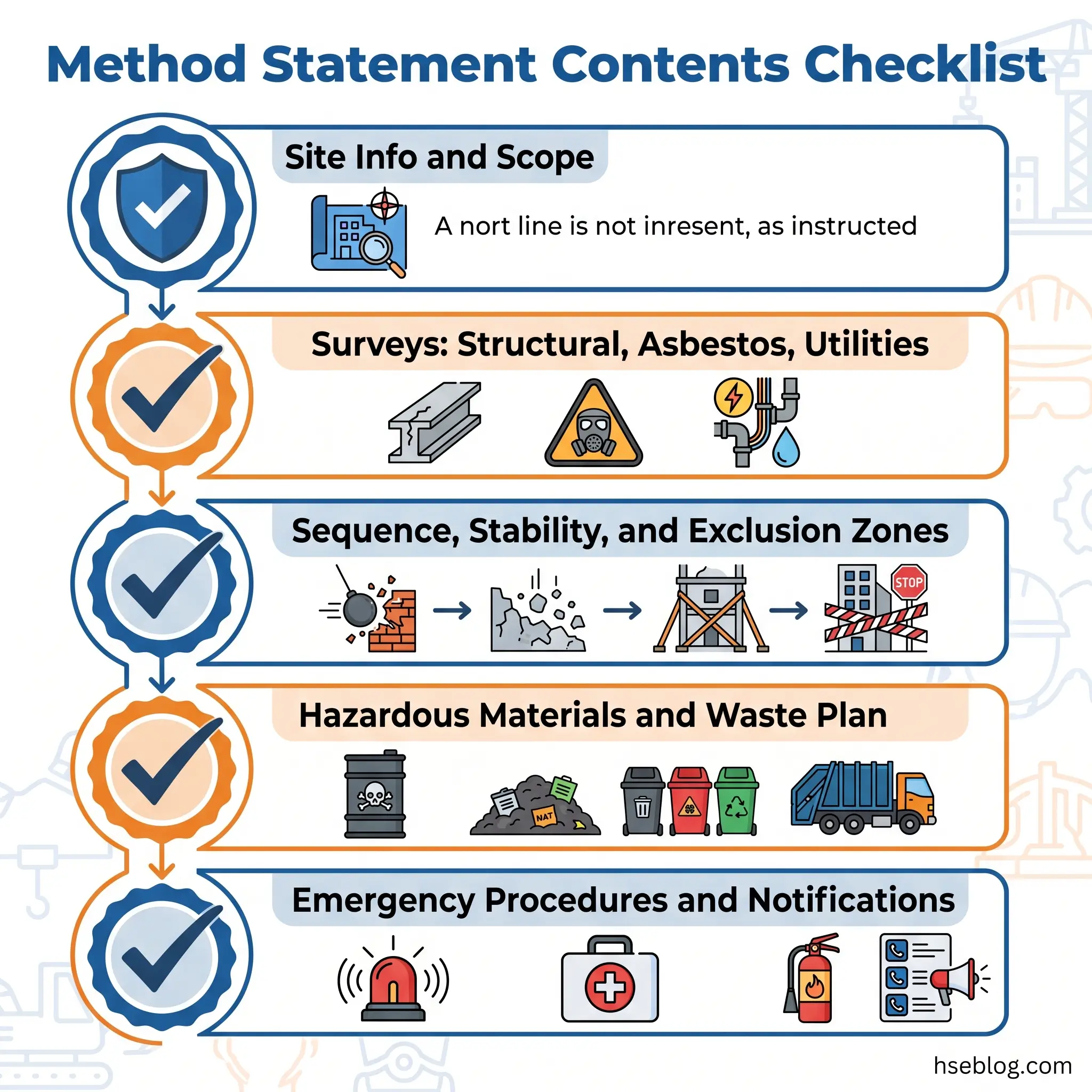
Site Information and Project Description
The opening section identifies the project and establishes scope.
- Project address and location — including grid reference or coordinates where relevant for emergency service access.
- Client, principal contractor, and demolition contractor details — names, contact information, and CDM duty-holder roles.
- Scope of demolition — full demolition, partial demolition, or selective internal strip-out.
- Structure description — construction type (steel frame, reinforced concrete, masonry, timber, composite), number of storeys, age, and any known modifications.
- Adjacent structures and occupied premises — proximity, shared walls, and any occupied buildings within the influence zone.
The judgment call on scope is critical. Describing a project as “full demolition” when basement retention or facade preservation is planned changes every subsequent section of the document. Scope errors propagate through the entire method statement.
Pre-Demolition Surveys and Assessments
Three surveys must be completed before the method statement can be finalized. Skipping or substituting any of them is the most common origin point for demolition fatalities.
- Structural / engineering survey — required by OSHA 1926.850(a) and BS 6187:2011. Determines the condition of the structure, identifies load paths, locates pre-stressed or post-tensioned elements, and assesses the effect of removing each structural member on overall stability. Must be conducted by a competent structural engineer.
- Refurbishment and demolition asbestos survey — required under the Control of Asbestos Regulations 2012 (UK). A management asbestos survey is not sufficient. The refurbishment and demolition survey is intrusive, accessing areas behind walls, above ceilings, and within voids that a management survey does not reach. Mesothelioma deaths from past asbestos exposure totalled 2,218 in the UK in 2023 (HSE, 2025) — a figure driven largely by historic demolition and refurbishment exposures.
- Utilities and services survey — identifies all live services (gas, electricity, water, telecommunications, drainage) entering or crossing the site. Disconnection must be confirmed in writing by the utility provider before demolition begins.
A common misconception: completing these surveys means the method statement is “evidence-based.” It is only evidence-based if the findings are actually integrated into the demolition sequence and controls. A survey report sitting as an appendix, never cross-referenced in the operational sections, adds no safety value.
Demolition Sequence and Methodology
The method statement must specify the chosen demolition technique and the exact sequence of operations — not in general terms, but floor by floor and element by element.
BS 6187:2011 Clause 5.2.4 addresses the determination of methods and sequences. The standard requires an engineering rationale for why the selected sequence maintains structural stability throughout the process. This is where most method statements fail the test of adequacy: they state the technique (e.g., “mechanical demolition, top-down”) without explaining why that technique is appropriate for this structure, or how stability is maintained as each element is removed.
The method statement must address:
- Technique selection — manual demolition, mechanical demolition (long-reach excavator, demolition ball, hydraulic crushers), deliberate controlled collapse, or a combination. Each technique has different exclusion zone requirements, different plant specifications, and different stability implications.
- Sequence of operations — which elements are removed first, second, third. On a multi-storey steel frame, the sequence for removing cross-bracing differs fundamentally from the sequence for a load-bearing masonry structure.
- Floor-by-floor progression — including how materials are dropped or lowered, where debris accumulates, and how floor loading is managed as upper storeys are removed.
The worst-case scenario in demolition sequencing is removing a structural element before the load it carries has been transferred or released. The method statement must demonstrate, element by element, that this cannot happen under the planned sequence.
Structural Stability Measures
Every stage of a demolition generates a structure that never existed in the original design. The partially demolished building is an engineered structure that no architect intended and no structural calculation originally considered.
The method statement must detail:
- Temporary works — propping, shoring, bracing, and facade retention systems where the demolition is partial or adjacent structures must be protected.
- Stage-by-stage stability assessment — signed off by a competent structural engineer, confirming that the structure remains stable at each planned phase of removal.
- Wind loading on partially demolished structures — a partially stripped building often presents greater wind-loading risk than the intact structure, because internal floors and walls that provided lateral restraint have been removed.
HSE structural stability guidance addresses maintaining stability during alteration, demolition, and dismantling. The practical interpretation of this guidance: if the demolition contractor cannot demonstrate — in writing, with engineering justification — that the structure is stable at every intermediate stage, the method statement is not adequate.
Hazardous Materials Management
Asbestos dominates the hazardous materials discussion in demolition, but the method statement must address the full range.
- Asbestos — removal sequence, licensed contractor details (for licensable work in the UK), 14-day notification to the enforcing authority, air monitoring arrangements, waste disposal route.
- Lead paint — particularly in pre-1978 structures (US) and pre-1992 structures (UK). Blood-lead monitoring for workers conducting hot-cutting or grinding on lead-painted steelwork.
- PCBs — found in older electrical equipment, fluorescent light ballasts, and some sealants in buildings constructed before the mid-1980s.
- Synthetic mineral fibres — insulation materials requiring controlled removal and respiratory protection.
- Biological hazards — leptospirosis risk from rodent-infested buildings; anthrax spores in former agricultural, tannery, or hide-processing buildings (rare but documented).
- Stored chemicals and contaminated land — former industrial buildings may contain residual chemicals in sumps, tanks, or contaminated ground beneath foundations.
The method statement must detail identification (linked back to the pre-demolition surveys), removal sequence (hazardous materials removed before general demolition, not during), disposal routes, and waste transfer documentation.
Exclusion Zones and Debris Zones
Exclusion zones are not optional safety margins — they are engineered control measures sized to the demolition technique, the height of the structure, and the fall trajectory of debris.
BS 6187:2011 provides guidance on sizing exclusion zones relative to the technique. Key principles:
- Mechanical demolition — exclusion zone extends at minimum the height of the structure plus a margin for debris scatter, measured from the base of the working face.
- Deliberate collapse — exclusion zones are significantly larger and must account for ground vibration, dust propagation, and projectile debris.
- Scaffolding does not reduce exclusion zones — HSE guidance is explicit that scaffolding may increase them, because a scaffold structure struck by falling debris becomes a secondary collapse hazard.
The method statement must include dimensioned site plans showing exclusion zones at each phase of demolition, because the zones change as the structure height reduces and the demolition face moves.
Plant, Equipment, and Temporary Works
The method statement must specify every item of plant and equipment, not as a generic equipment list, but tied to the specific operation it performs.
- Plant identification — type, model, reach, capacity. For mechanical demolition, the reach of the excavator must exceed the working height by a defined margin.
- Operator competency — CPCS or equivalent certification for each category of plant. Under OSHA 29 CFR 1926.859, specific requirements apply to mechanical demolition including demolition ball weight limits relative to crane capacity.
- Floor-loading assessments — when mechanical plant operates on upper floors (common in top-down reinforced-concrete demolition), the method statement must include an engineering assessment confirming the floor can support the plant’s operating weight plus dynamic loading.
- Temporary works design — any propping, shoring, or access scaffold must be designed by a competent temporary works designer and included in the method statement.
Emergency Procedures and Contingency Planning
Emergency arrangements for demolition are more complex than for general construction because the escape routes and muster points change as the structure is reduced.
The method statement must address:
- Evacuation routes — mapped at each phase of demolition and updated as the work progresses.
- Rescue provisions — specific to the technique. Mechanical demolition requires a different rescue capability than manual demolition at height.
- Fire prevention — arson is a documented and significant risk on derelict demolition sites. The method statement must address site security, combustible-material management, and hot-work permits.
- Unexpected live services — procedures for encountering services that were believed disconnected but remain live.
- Unidentified hazardous materials — stop-work protocol, competent-person assessment, and method statement revision before work resumes.
Waste Management and Environmental Controls
The environmental section of the method statement is often treated as an afterthought. Planning enforcement increasingly treats it as a core requirement.
- Waste segregation — demolition generates mixed waste streams (concrete, steel, timber, hazardous materials, general waste). The method statement must specify segregation points, storage areas, and recycling targets.
- Dust suppression — water sprays, misting systems, or enclosure. Particularly critical where asbestos-containing materials are present or suspected, and near residential boundaries.
- Noise and vibration monitoring — planning conditions frequently impose limits, especially for demolition near residential or sensitive receptors. The method statement must specify monitoring arrangements, trigger levels, and response actions.
- Water run-off control — preventing contaminated water from entering watercourses or drains. Silt fences, settlement tanks, and interceptors.
- Contaminated land protocols — where the site has a history of industrial use, the method statement must address ground contamination management during foundation removal.
A Site Waste Management Plan or Construction Environmental Management Plan (CEMP) may be required by planning conditions and should be cross-referenced in the method statement.
Notifications and Permits
The method statement must record all required notifications and confirm their status.
In the UK:
- Section 80 notice — any person intending to demolish a building must give the local authority at least 6 weeks’ notice under the Building Act 1984 (England and Wales).
- CDM notification — for notifiable projects (lasting more than 30 working days with more than 20 workers, or exceeding 500 person-days), an F10 notification to HSE.
- Asbestos removal notification — 14 days’ notice to HSE for licensed asbestos removal work under the Control of Asbestos Regulations 2012.
- Party wall notices — where demolition affects shared or adjacent walls.
In the US, applicable local demolition permits vary by jurisdiction. OSHA does not require a separate notification for demolition but enforces Subpart T standards through inspection.
In Australia, the principal contractor must notify SafeWork (or the equivalent state regulator) for notifiable construction work.
How a Demolition Method Statement Differs from a Demolition Plan
This distinction generates genuine confusion in practice — and the confusion has operational consequences when different parties on a project assume they are talking about the same document but are not.
The demolition plan is the broader strategic document. It addresses the “what and why”: the overall approach, the major risks, the project timeline, and the resource requirements. On a CDM-notifiable project in the UK, the demolition plan forms part of the construction phase plan.
The demolition method statement is the detailed operational document. It addresses the “how, when, and by whom”: the exact sequence, the specific equipment, the named competent persons, the dimensioned exclusion zones, and the step-by-step procedures for each phase of work.
| Aspect | Demolition Plan | Demolition Method Statement |
|---|---|---|
| Focus | Strategic — what and why | Operational — how, when, by whom |
| When produced | Early planning / tender stage | Before work begins on site |
| Level of detail | Overview of approach and major risks | Step-by-step sequence with specific controls |
| Typical author | Principal contractor / principal designer | Specialist demolition contractor |
| Revision trigger | Major scope or approach change | Any change in site conditions or sequence |
On complex projects, these are two distinct documents. On smaller projects, a single document may serve both purposes — but it must contain the detail level of a method statement, not just the strategic overview of a plan.
The gap between these documents is where planning failures concentrate. A generic demolition plan submitted at tender stage satisfies the early planning requirement. But if nobody produces the site-specific method statement before work actually begins — detailing the exact sequence based on the actual surveys — the crew is operating on assumptions, not on engineering.
BS 6187:2011 Clause 5.2.4 is explicit: the method statement must be revisable. If site conditions change, the method statement must be updated before work continues. New methods must not be applied on site unless agreed by all concerned and documented in the revised statement.
Common Deficiencies in Demolition Method Statements
Reviewing method statements is a significant part of the principal contractor’s CDM duty. Across the published enforcement record and practitioner experience, the same deficiencies recur with troubling consistency.
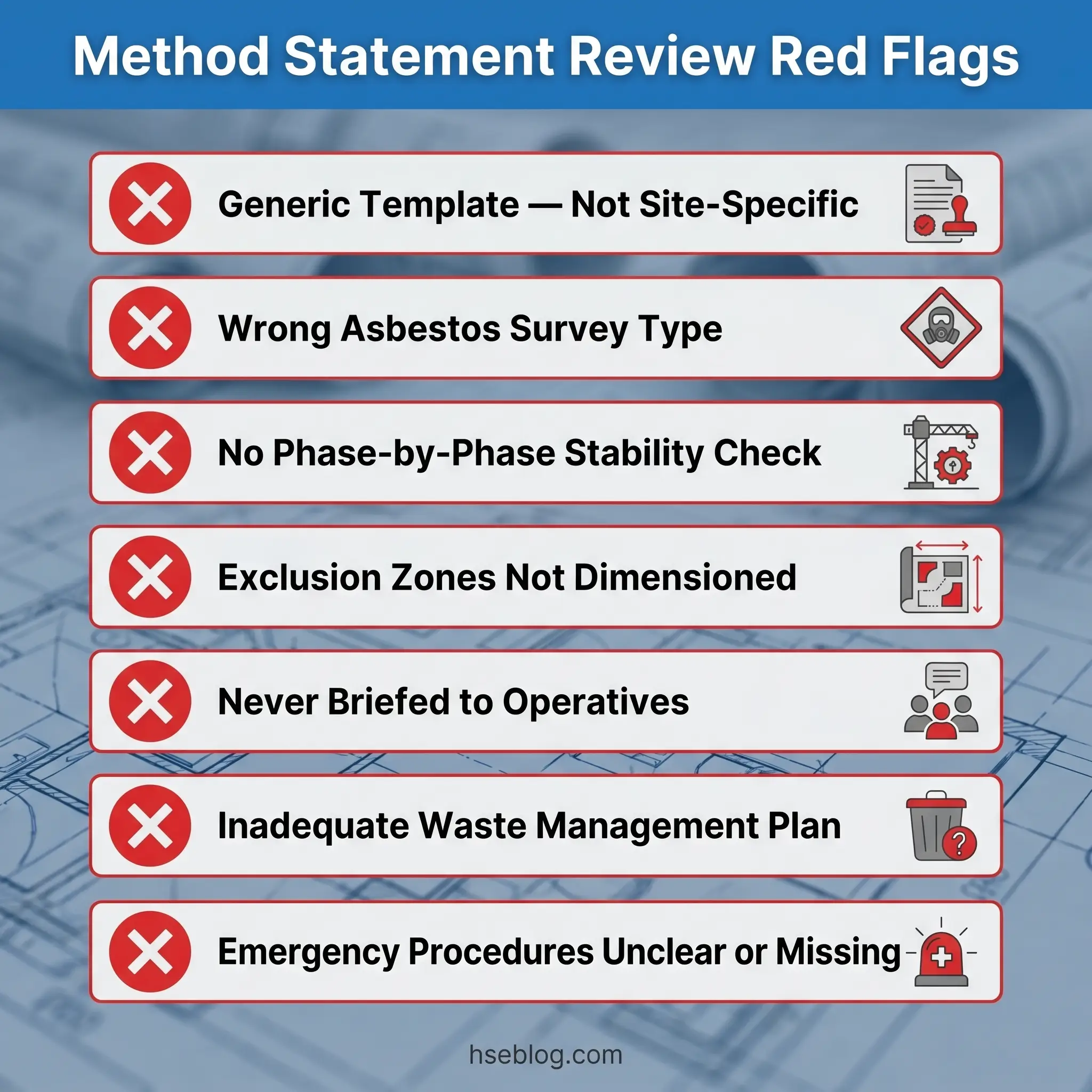
- Generic templates not adapted to site conditions. The document reads like a textbook, not a plan for this building. Project-specific hazards, structural features, and site constraints are absent. Enforcing authorities routinely reject these on sight.
- Management asbestos survey referenced instead of a refurbishment and demolition survey. The management survey identifies presumed asbestos-containing materials in accessible areas. The R&D survey is intrusive — it opens up walls, ceilings, and voids. Using the wrong survey type means the method statement is based on incomplete hazard data.
- No structural stability assessment for each phase. The method statement states the overall technique but does not demonstrate that the structure remains stable at every intermediate stage of demolition. This is the single most dangerous omission.
- Exclusion zones stated but not dimensioned or mapped. The document says “exclusion zones will be established” without specifying their size, location, or how they change as the demolition progresses.
- No contingency for unidentified hazards. The method statement assumes the surveys found everything. Published incident reports consistently show that unexpected services, unrecorded structural modifications, and concealed hazardous materials are discovered during work.
- Method statement produced but never briefed to operatives. The document exists. It sits in the site office. The workers on the demolition face have never read it and have not been briefed on its contents. The gap between the document and the briefing is where fatal incidents cluster.
- No provision for dynamic reassessment. The method statement is treated as a fixed document. It does not include trigger points for review or a process for revising the sequence when conditions change mid-work.
The most dangerous method statement is the one that is technically complete on paper but has never been walked through with the people doing the work.
Reviewing and Updating a Demolition Method Statement
A demolition method statement is not a fixed document. It is a living plan that must keep pace with what is actually happening on site — and the regulatory framework requires exactly that.
BS 6187:2011 requires the cycle of determining methods and sequences to be repeated whenever circumstances change. This includes unforeseen structural conditions, discovery of unrecorded services or hazardous materials, weather events that affect stability, or any deviation from the planned sequence. New methods must not be applied on site unless agreed by all concerned and documented in a revised method statement.
When to Review
- Before work starts — the principal contractor reviews the method statement for adequacy and site-specificity.
- During each phase transition — when the demolition moves from one floor, zone, or technique to the next.
- When conditions change — unexpected structural weakness, concealed asbestos, weather-related stability concerns, or adjacent-site activity that introduces new risks.
- After any near-miss or incident — the method statement must be re-examined against what actually happened.
OSHA 29 CFR 1926.859 requires continuing inspections by a competent person as demolition progresses, specifically to detect hazards resulting from weakened or deteriorated floors, walls, or loosened material.
Worker Consultation
The method statement must be communicated to every operative on the demolition site. Consultation is not a one-way briefing — workers must have the opportunity to raise concerns, ask questions, and confirm their understanding of the safe system of work.
The best-run demolition sites treat the method statement as a daily reference. The morning briefing references the specific phase of work planned for that day, the specific controls in place, and the specific triggers for stopping work. The method statement is not a file in the site office — it is the script for the day’s operations.
Frequently Asked Questions
Conclusion
Pull the method statement you last approved — or the one you’re writing now — and ask a question that most reviewers skip: does this document describe how this specific building will come down, or does it describe how buildings in general come down? If the answer is the latter, the document is not a plan. It is a template wearing a project name, and the crew working under it is operating on assumptions that the structure may not share.
The demolition method statement exists because demolition reverses engineering. Every element removed changes the load paths, the stability, and the risk profile of what remains. The document must track that reversal step by step — anchored to the actual surveys, the actual structural assessment, the actual hazardous materials found, and the actual exclusion zones calculated for the technique in use. CDM 2015 Regulation 20 and OSHA 29 CFR 1926.850(a) do not require this documentation as administrative overhead. They require it because the alternative — demolishing a building without a written, site-specific, competent-person-verified plan — has a body count.
Before signing off on the next demolition method statement that crosses your desk, verify one thing above all others: has every operative on the demolition face been briefed on the specific phase of work planned for that day, using this document as the reference? If the method statement has never left the site office, it has never done its job.