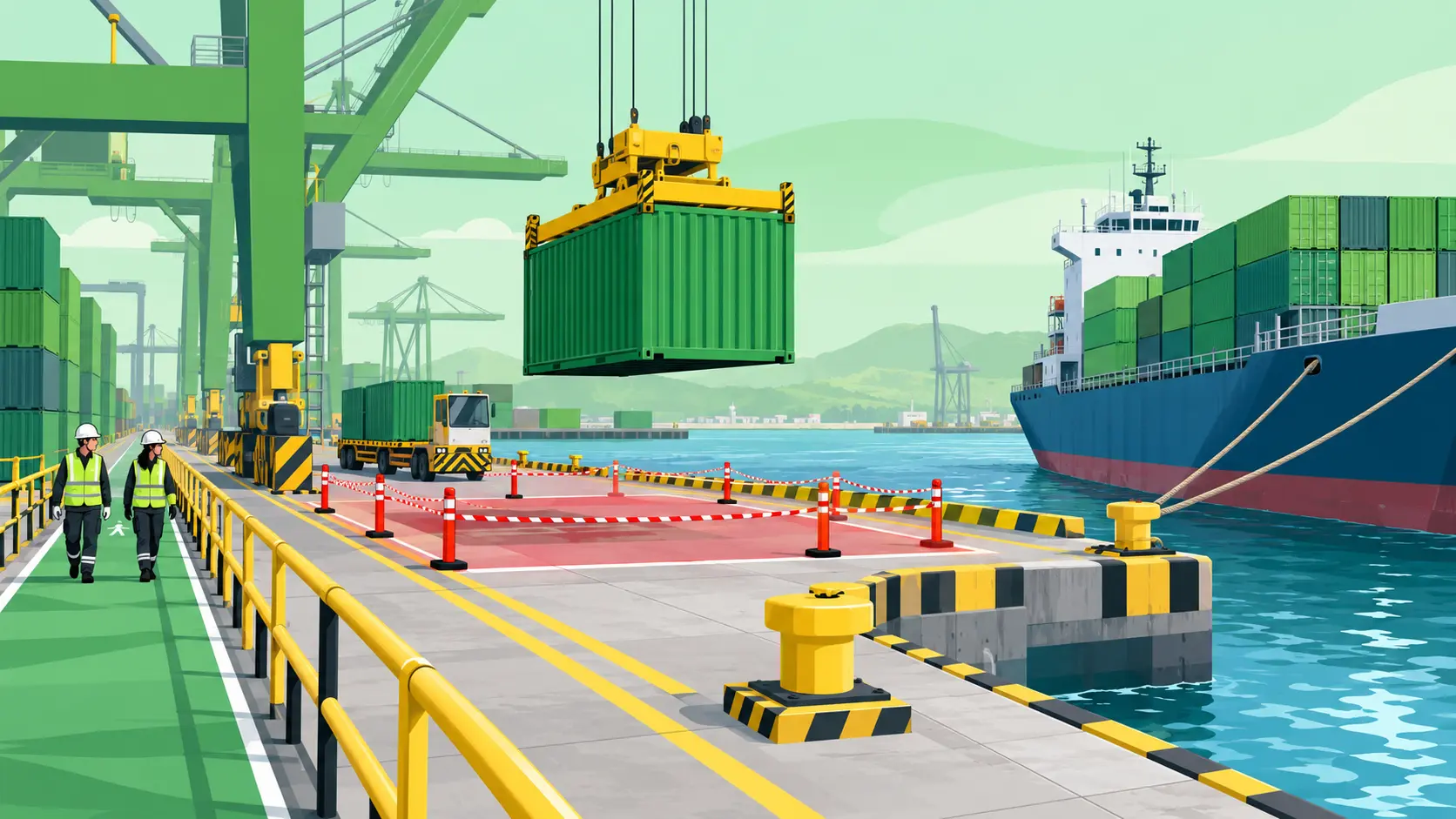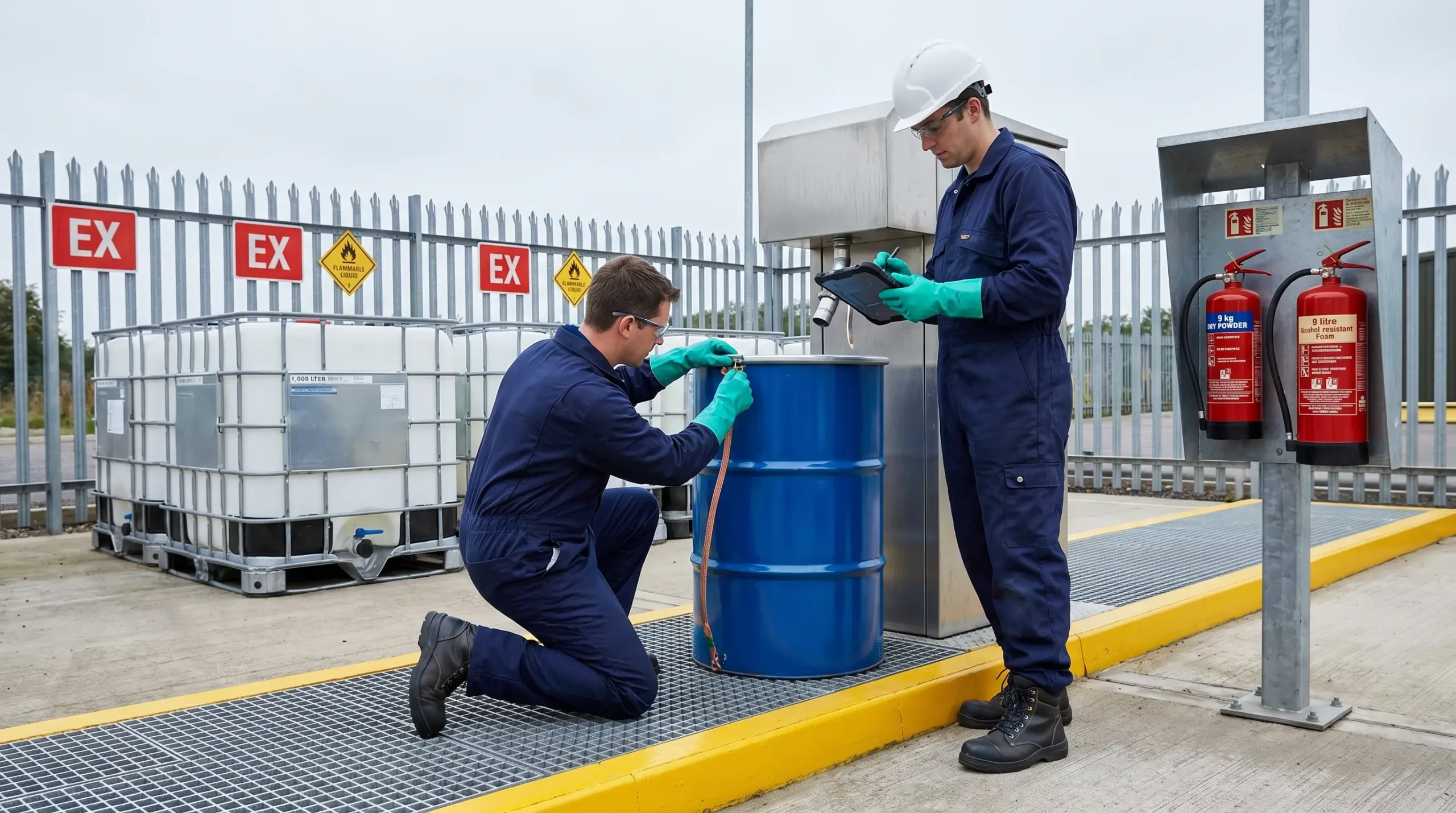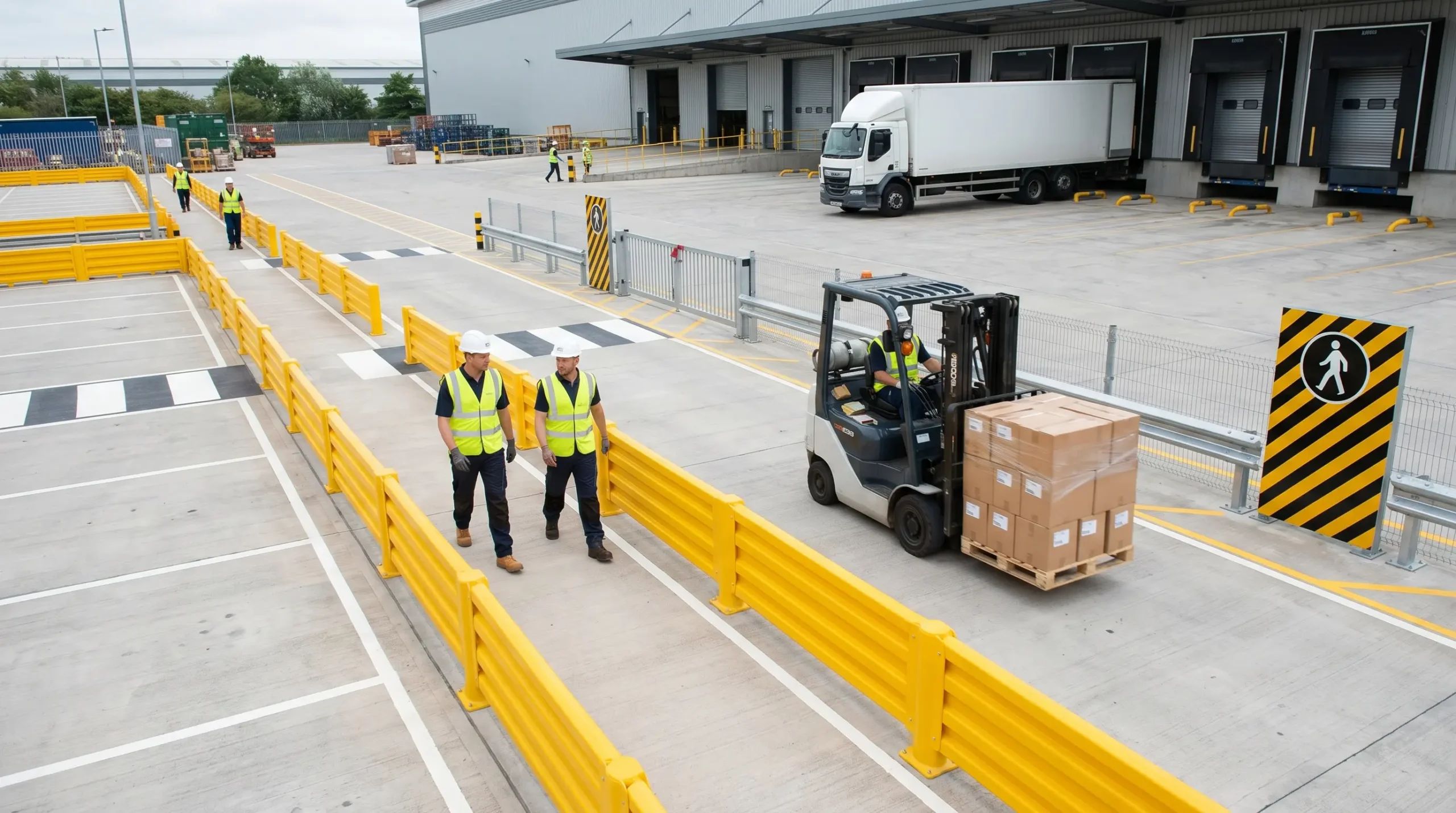
Pedestrian and vehicle segregation is the physical and organisational separation of people on foot from vehicle traffic routes in a workplace. Effective segregation requires conducting a site-specific traffic risk assessment, designing physically separated routes that follow natural pedestrian desire lines, specifying barriers matched to actual vehicle impact energy using frameworks such as PAS 13, installing controlled crossing points where routes must intersect, and establishing ongoing monitoring and review. The legal duty to segregate exists in both UK and US law.
Why Pedestrian and Vehicle Segregation Is a Life-Critical Design Decision
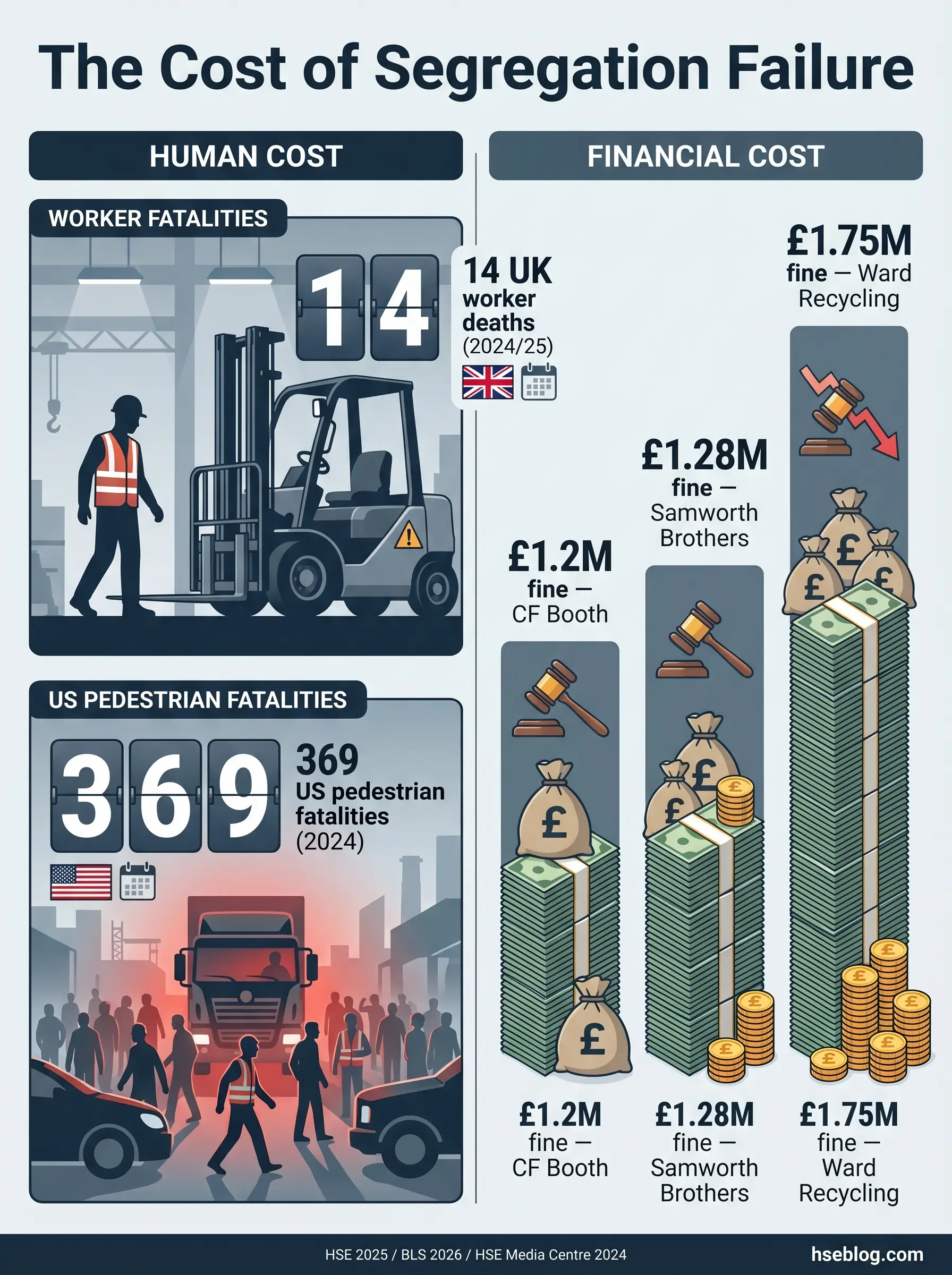
In 2024, three UK prosecutions for pedestrian-vehicle segregation failures resulted in fines that should have ended every boardroom argument about the cost of physical barriers: CF Booth was fined £1.2 million, Samworth Brothers/Ginsters £1.28 million, and Ward Recycling £1.75 million for corporate manslaughter (HSE Media Centre, 2024). Each case followed a fatality. Each involved a site where segregation controls either didn't exist or had been allowed to degrade until they existed only on paper.
The fatality data behind those prosecutions is consistent and unambiguous. In Great Britain, 14 workers were killed by being struck by a moving vehicle in 2024/25, with an average of 15 such deaths per year across the five-year period 2020/21–2024/25 (Health and Safety Executive, 2025). In the United States, pedestrian incidents involving motorised land vehicles in the workplace rose 19% to 369 fatalities in 2024 (US Bureau of Labor Statistics, 2026). Struck-by-vehicle remains the second most common cause of workplace death in the UK, and the dominant pattern identified by the HSE in its October 2025 enforcement review is reversing vehicles in yards where pedestrians and vehicles share space — exactly the scenario that segregation is designed to prevent.
The regulatory duty is explicit. Under Regulation 17 of the Workplace (Health, Safety and Welfare) Regulations 1992 (UK), every workplace must be organised so that pedestrians and vehicles can circulate safely, with traffic routes suitable and sufficient for the persons and vehicles using them. In the US, OSHA's General Duty Clause creates a parallel obligation, reinforced by 29 CFR 1910.176(a), which requires permanent aisles and passageways to be appropriately marked and kept clear where mechanical handling equipment is used. Australia's Model WHS Act places the same duty on PCBUs.
A pattern visible across the published enforcement cases is worth noting directly: segregation failures are rarely about not knowing the rules. They recur because sites design segregation at setup and then allow operational creep — temporary layout changes, delivery pressure, shift-change congestion — to erode it without triggering a reassessment. The gap between the traffic management plan in the office and the reality on the yard is where workers die.
Conducting the Traffic Management Risk Assessment
Every segregation design starts from a site-specific risk assessment — not from a barrier supplier's catalogue. The assessment determines what needs separating, where, and with what level of protection. Skipping this step or treating it as a formality produces layouts that look adequate on a drawing but fail under real operating conditions.
The risk assessment must capture the full picture of vehicle and pedestrian interaction on site. That means identifying inputs that many assessments undercount or miss entirely.
Vehicle inventory goes beyond the obvious. Forklifts and HGVs are accounted for on most sites. What often gets missed are the vehicles that don't feel dangerous: electric buggies, golf carts, autonomous guided vehicles (AGVs), and ride-on cleaning machines. These accelerate quickly and operate near-silently, removing the auditory warning that pedestrians unconsciously rely on. Every vehicle type operating on or visiting the site — including delivery vehicles that arrive on irregular schedules — must be mapped.
Pedestrian populations are equally complex. Employees who work on site daily behave differently from visitors attending a single meeting, contractors working a short-term project, or members of the public accessing a retail or reception area. Each group has different levels of site familiarity, different movement patterns, and different exposure windows. The assessment must identify peak-flow periods — shift changes, lunch breaks, delivery windows — because these are the moments when the highest number of pedestrians and the highest volume of vehicle movements overlap.
Site geometry creates risk that the traffic management plan must address before routes are drawn. Blind spots at building corners, sharp bends in vehicle routes, gradients that affect braking distances, overhead obstructions that force vehicles into unexpected paths, and areas where ambient noise masks vehicle approach all require identification. Access points deserve particular scrutiny: do vehicles cross public roads to enter the site? Do pedestrians and vehicles share the same entrance gate?
The assessment documented in HSG136: Workplace transport safety guide provides the comprehensive UK framework for this process, and it applies with equal practical logic in any jurisdiction.
Mapping Desire Lines and Real Movement Patterns
One of the most consequential failures in traffic route planning is designing pedestrian walkways on a site plan without walking the site. Desire lines — the paths people naturally follow between two points — are governed by convenience, not by painted lines. If the designed pedestrian route adds 200 metres to a journey that a direct path covers in 20 metres, workers will take the shortcut. Every time.
The result is uncontrolled crossing at exactly the points where visibility is worst — between stacked pallets, around building corners, across active loading bays. The walkway exists on the plan; the pedestrian exists on the vehicle route.
Mapping desire lines requires physical observation during operating hours, ideally across multiple shifts. Watch where people actually walk, not where the plan says they should. The walkways that get used are the ones that align with the natural flow between high-traffic origins and destinations: entrance gates to changing rooms, changing rooms to workstations, workstations to canteens, canteens back to workstations.
Watch For: If your site audit reveals a worn path through grass or a gap in a barrier where people clearly squeeze through, that is a desire line speaking louder than the traffic management plan. The design must respond to it — either by routing the walkway along that line or by installing a physical barrier that genuinely prevents passage.
The Hierarchy of Segregation Controls
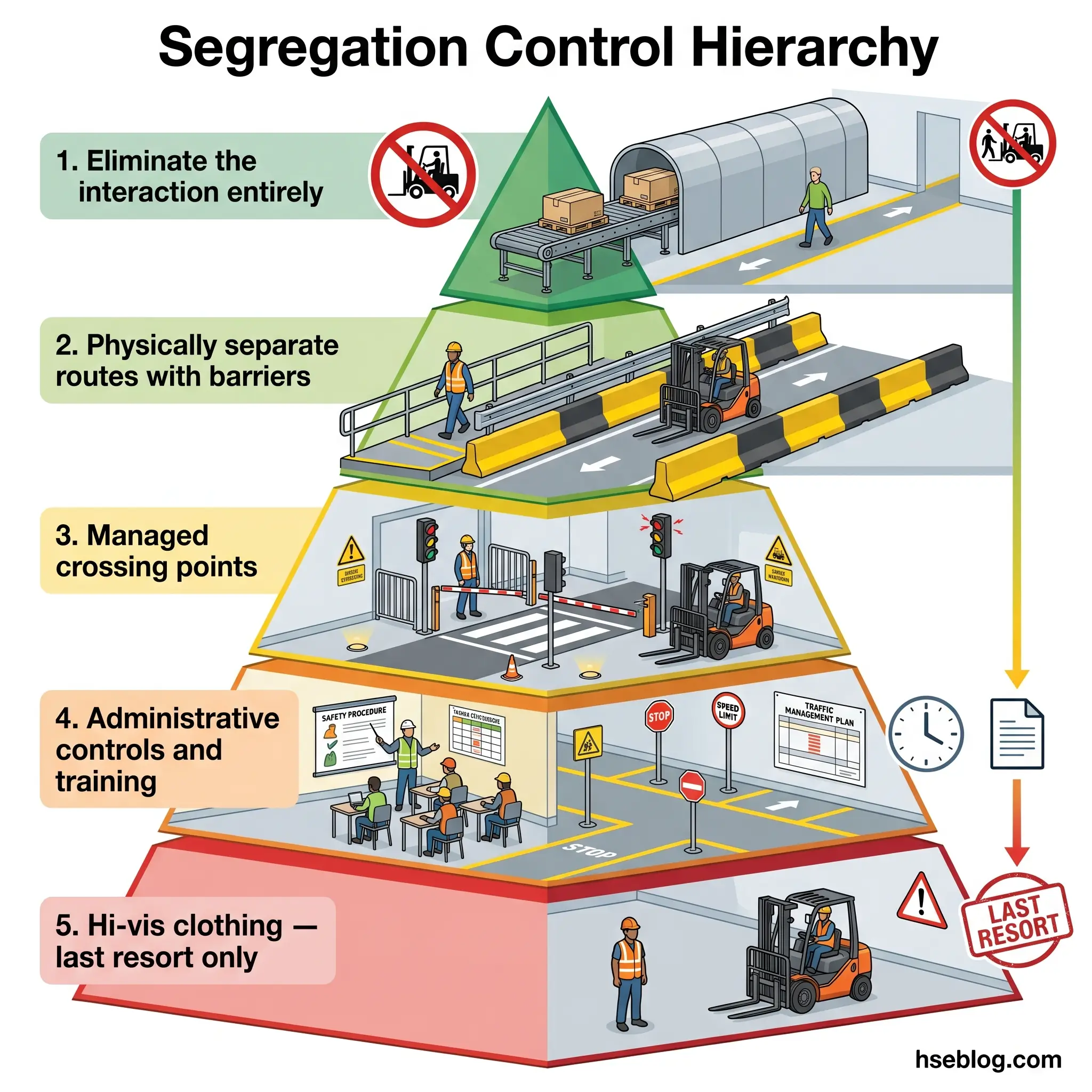
The hierarchy of controls applies to pedestrian and vehicle segregation with a specificity that generic safety training often glosses over. Rather than listing the hierarchy in the abstract, the practical question is: what does each level actually look like when the hazard is a moving vehicle and the person at risk is on foot?
- Elimination — Remove the interaction entirely. Schedule vehicle movements outside pedestrian-heavy periods. Replace forklift transport with conveyor systems, gravity roller systems, or pneumatic transfer where the process allows. Eliminate reversing by designing one-way vehicle routes with drive-through loading bays. This is the most effective control and the one most frequently dismissed as impractical without serious evaluation.
- Physical segregation (engineering controls) — Create entirely separate routes that never intersect. Dedicated pedestrian corridors bounded by physical barriers. Footbridges or subways at high-traffic crossing points. Separate building entrances for vehicles and pedestrians. This is the level that HSE guidance on separating pedestrians and vehicles treats as the baseline expectation wherever reasonably practicable.
- Managed crossing points (engineering + administrative) — Where routes must intersect, install controlled crossings with barriers, traffic signals, pull gates, or time-separation protocols. This acknowledges that total separation isn't always achievable, but the crossing must be designed — never informal.
- Administrative controls — One-way systems, speed limits, banksmen for reversing operations, permit-to-work for vehicle entry into pedestrian zones, induction and ongoing training. Effective as supplementary measures; inadequate as primary protection.
- PPE — High-visibility clothing. The last layer. It makes the pedestrian more visible; it does nothing to stop the vehicle. Under no circumstances should hi-vis be treated as a substitute for physical segregation.
The most common failure pattern across published enforcement cases is jumping directly to levels 4 and 5 — signage, training, and hi-vis — because physical barriers appear expensive or operationally inconvenient, then treating those weak controls as if they deliver the same protection as engineered separation. Every one of the 2024 prosecution cases cited above involved sites where administrative controls were nominally in place but physical segregation was absent or degraded.
Designing Physically Separated Routes: Layout Principles
Physical separation is the engineering backbone of any traffic management plan. When routes are designed so that pedestrians and vehicles never occupy the same space, the opportunity for collision is removed — not reduced, not managed, but removed. Every design decision in this section works toward that objective.
Route placement follows a single governing principle: pedestrian walkways belong where no vehicle traffic occurs. This sounds obvious until you examine how many sites run pedestrian paths along the edge of a vehicle road, separated only by a painted line. A painted line is a visual instruction, not a physical barrier. Route placement means identifying corridors that vehicles cannot access — along building perimeters on the non-loading side, through interior passages, along boundaries separated by level changes or structural elements.
Width must accommodate the realistic pedestrian load, not the minimum body width. HSE guidance and PAS 13 recommend a minimum clear width of 1 metre for individual passage, increasing for high-volume walkways, two-way pedestrian flow, or routes requiring wheelchair accessibility. Peak shift-change flow — not average weekday traffic — determines the design width.
Surface quality on pedestrian routes is often treated as secondary to the vehicle roadway, which is a mistake. Firm, well-drained, slip-resistant surfaces with adequate lighting are essential. A pedestrian who stumbles on a pothole and falls into a vehicle lane faces a compound hazard that neither the walkway nor the roadway design intended.
Separate entry points eliminate the highest-risk moment: the transition from off-site (where no vehicles operate) to on-site (where they do). Different gates or doors for vehicles and pedestrians, wherever site layout permits, prevent the forced mixing that occurs when everyone funnels through a single access point.
Internal building separation requires its own design logic. Separate doors with vision panels prevent pedestrians and forklift operators from colliding at doorway transitions. Floor markings delineate internal vehicle routes, and sufficient overhead clearance at doorways prevents drivers from swerving to avoid obstructions and entering pedestrian zones.
Vertical segregation — footbridges and subways — is the highest-protection option for sites where vehicle and pedestrian volumes are both high and crossing is frequent. Access must be designed for all users, including those with mobility impairments, and structural clearance must accommodate the tallest vehicles on site.
Barrier Selection and Specification
The physical barriers that protect pedestrian walkways from vehicle incursion are only as effective as the specification process that selected them. This is where PAS 13:2017 — the BSI-published code of practice for safety barriers in workplace traffic management — becomes essential.
The core principle of PAS 13 is that barrier selection must be based on the kinetic energy of the vehicles operating in the area. Kinetic energy is a function of vehicle mass and speed. A barrier rated to absorb the impact of a 1-tonne counterbalance forklift at 6 km/h will not stop a 15-tonne HGV at 15 km/h. The barrier's impact-resilience rating must match or exceed the worst-case vehicle scenario in its location.
The practical consequence of ignoring this principle is a barrier that looks protective but fails catastrophically under the impact it was supposed to prevent. Specifying barriers by appearance or cost rather than by tested impact rating is a design error that PAS 13 exists to prevent.
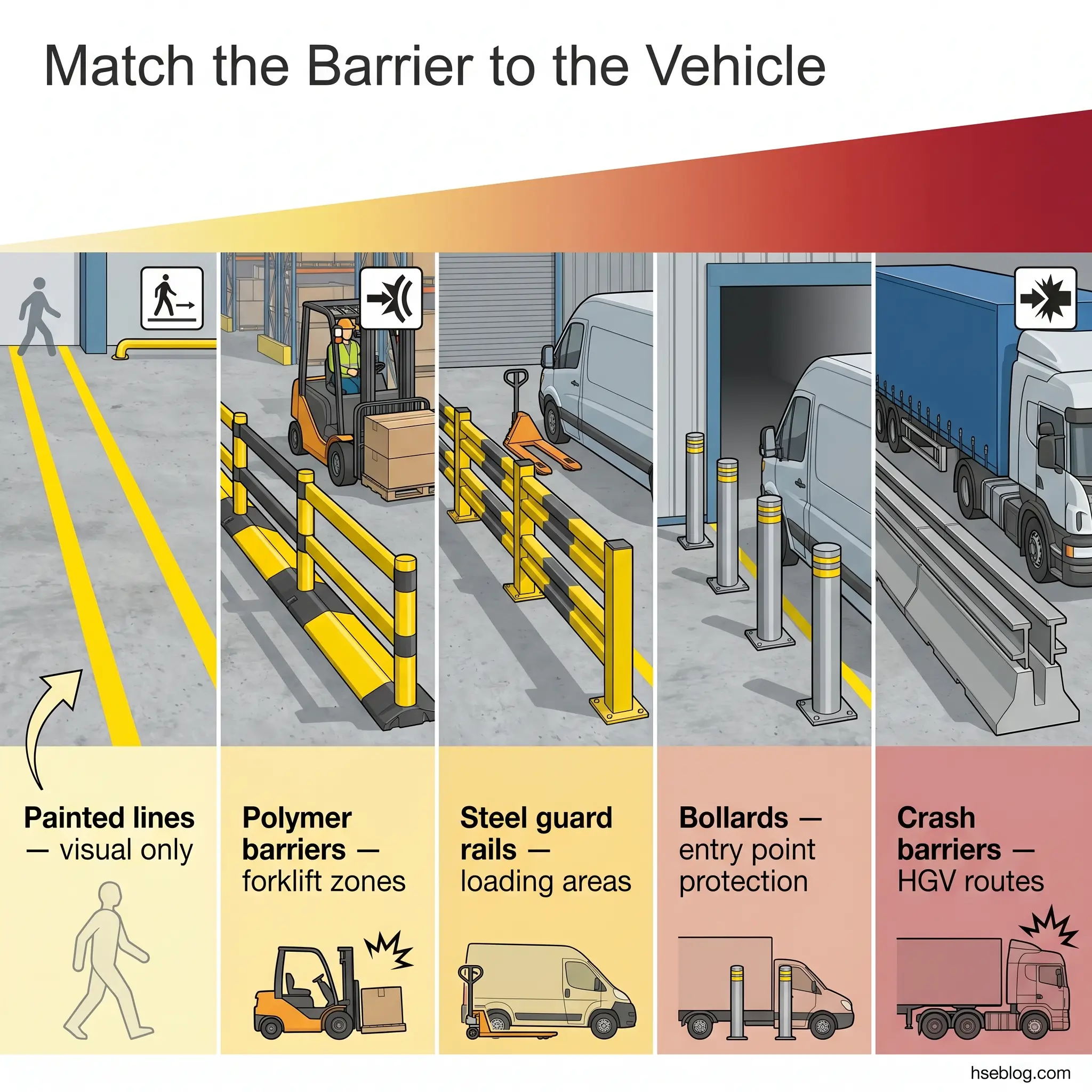
The main barrier categories, matched to their appropriate application, are outlined below.
| Barrier Type | Protection Level | Typical Application | Reconfigurability |
|---|---|---|---|
| Painted floor lines | Visual guidance only | Low-risk pedestrian zone demarcation | High — repaint as needed |
| Polymer impact barriers | Low to moderate impact absorption | Forklift areas, warehouse aisles | High — modular, relocatable |
| Steel guard rails | Moderate to high impact absorption | Loading docks, building perimeters | Low — fixed installation |
| Steel bollards | High point-load resistance | Building entrances, crossing point protection | Low — embedded in concrete |
| Concrete/steel crash barriers | High to very high impact absorption | HGV routes, yard perimeters | Very low — permanent |
Audit Point: When assessing existing barriers, check the specification against the heaviest and fastest vehicle that could realistically approach that barrier — not the vehicle that usually operates nearby. A loading bay barrier rated for forklift impact provides no protection if delivery HGVs also manoeuvre in the same zone.
Designing Safe Crossing Points Where Routes Must Intersect
On most operational sites, total separation of pedestrian and vehicle routes is not achievable everywhere. Routes will cross. The design question is whether those crossings are controlled by intention or created by default.
An uncontrolled crossing — a gap in a barrier, a painted line that fades into a worn floor, a point where the walkway simply ends and the pedestrian steps into a vehicle lane — transfers the entire burden of collision avoidance to the pedestrian's alertness and the driver's reaction time. Controlled crossings transfer that burden to the design.
Positioning is the first decision. Crossing points must be located where visibility is clear in all directions for both the pedestrian and the vehicle operator. That means avoiding blind corners, building exits where doors open directly onto vehicle routes, and areas where stacked materials, skips, or parked vehicles obstruct sightlines. The PAS 13 recommendation that entrance doorways should not be positioned directly opposite crossing points addresses the specific hazard of a pedestrian walking through a door and straight into a vehicle path without a transition that forces awareness.
Design elements at crossing points serve one function: to create a deliberate pause. Pull gates require the pedestrian to stop, look, and physically open a gate before entering the vehicle route. This single intervention changes behaviour more effectively than any painted zebra crossing, because it interrupts the autopilot walking that carries people across open crossings without conscious decision-making.
Additional design elements include dropped kerbs that signal the transition from pedestrian to shared space, high-contrast ground markings that are visible in all lighting conditions, and dedicated crossing lighting that activates as pedestrians approach.
High-traffic crossings — those serving large pedestrian volumes at shift changes or positioned on primary vehicle routes — may require traffic signals that stop vehicle flow while pedestrians cross. Central refuge islands on wide roadways allow pedestrians to cross in two stages, reducing exposure time.
Time-separation is an underused strategy. Restricting vehicle access to specific areas during peak pedestrian periods — the fifteen minutes before and after a shift change, for example — eliminates the interaction entirely during the highest-risk window. This requires scheduling discipline but costs nothing in infrastructure.
The Fix That Works: At crossing points with chronic non-compliance, replace the open painted crossing with a physical pull gate on both sides of the vehicle route. The gate creates a two-second pause that breaks the "walk and hope" behaviour. Compliance with gate-controlled crossings runs significantly higher than with painted-line crossings, because the physical barrier makes the safe behaviour the easiest behaviour.
What Role Does Technology Play in Pedestrian-Vehicle Segregation?
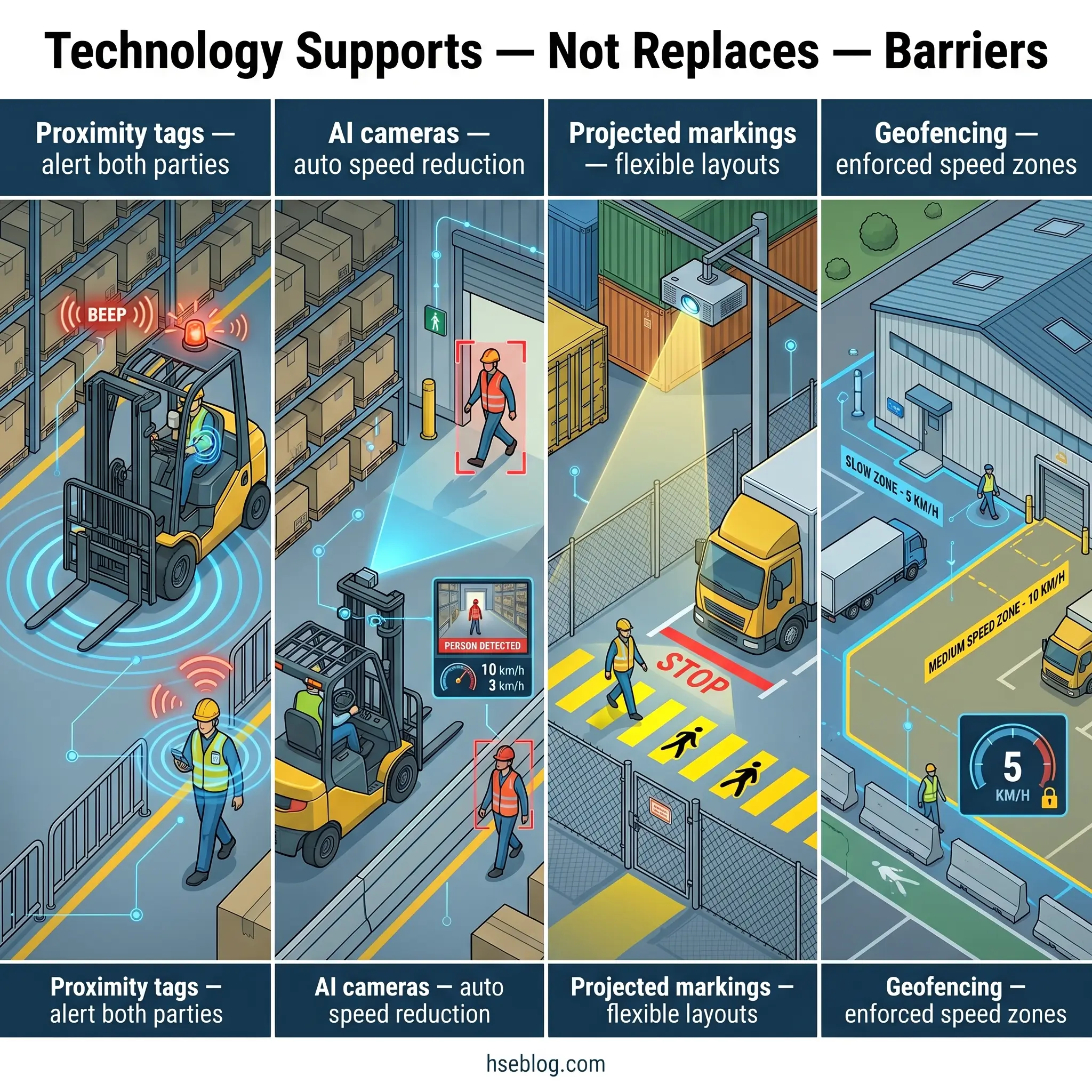
Technology in pedestrian-vehicle segregation occupies a specific and bounded role: it supplements physical design. It does not replace it. Where full physical segregation isn't achievable — in shared loading areas, on sites with frequently changing layouts, or during transitional operations — technology adds a detection and warning layer that physical barriers alone cannot provide.
Proximity warning systems using RFID or ultra-wideband (UWB) tags represent the most established technology category. Pedestrians wear a tag; vehicles carry a detector. When a tagged pedestrian enters a configurable alert zone around the vehicle, both parties receive a warning — typically an audible alarm and a visual alert in the vehicle cab. These systems are effective in enclosed spaces like warehouses where ambient noise levels are manageable and tag discipline can be enforced.
AI-powered camera-based pedestrian detection is growing rapidly. These systems use 360-degree cameras mounted on vehicles, processed by onboard AI to identify pedestrians in the vehicle's path and trigger automatic speed reduction or emergency braking. The forklift pedestrian warning system market grew from USD 1.81 billion in 2024 to USD 2.00 billion in 2025 at an 11.5% compound annual growth rate, with AI detection, LiDAR-based proximity sensors, and 5G-connected sensor networks identified as the next-generation technologies (Research and Markets, 2026).
Projected floor markings using LED or laser systems create virtual walkways and warning zones on floor surfaces. These are particularly useful in environments with frequently changing layouts — leased warehouses, seasonal operations, or sites where racking configurations shift regularly. The markings move with the vehicle, projecting a visible exclusion zone around it during operation.
Geofencing and speed-zone management automatically reduce vehicle speed in designated pedestrian-proximity zones. Vehicles fitted with geofencing hardware slow to a preset maximum when they enter a zone defined around a crossing point, pedestrian corridor, or building entrance.
The critical practitioner judgment with all of these technologies is that each creates a new management obligation. Someone must own the system's maintenance schedule. Calibration must be verified. Alarm-fatigue indicators must be monitored — systems generating excessive false alarms will be silenced or ignored within weeks. And the most dangerous outcome is a site that invests in proximity systems while simultaneously reducing physical barriers on the logic that "the technology will catch it." That site may end up with less protection than it started with.
Field Test: If your site uses a proximity warning system, ask two questions. First, when was the system last calibration-checked? Second, what is the false-alarm rate? If neither answer is immediately available, the system is not being managed — it is being trusted on faith.
Signage, Markings, and Visual Communication
Signage and floor markings serve a supporting function within the segregation design. They communicate the rules that the physical layout enforces. On their own, they are informational — they tell people where to walk and where not to walk. They do not physically prevent anyone from entering a vehicle route. Their effectiveness depends entirely on the quality of the underlying design they support.
Floor markings delineating pedestrian and vehicle zones must be durable under the traffic they'll experience. In warehouse environments, where forklift tyres and heavy loads wear through standard paint within weeks, epoxy or thermoplastic markings provide significantly longer service life. Colour coding should be consistent across the entire site — a fragmented system where different buildings use different colours for pedestrian routes creates confusion during emergencies and for new starters.
Warning signs at crossing points, blind corners, and building entrances must follow a principle that UK legislation makes explicit: workplace traffic signs should match public road sign standards where a suitable sign exists. Workers already understand road signage from daily life. Inventing a novel sign language for the workplace adds a learning burden that reduces immediate comprehension.
Speed limit signs posted on internal vehicle routes must state the specific limit in force, not a generic "drive carefully" instruction. The speed limit itself must be determined by the risk assessment — influenced by vehicle types, proximity to pedestrian zones, surface conditions, and sightlines.
High-visibility clothing for pedestrians in areas where full physical segregation is not achieved is a last-layer control. It increases the pedestrian's visibility to drivers. It provides zero physical protection from a vehicle. Every site induction should communicate this distinction clearly — hi-vis does not make a person safe; it makes them easier to see.
Training, Induction, and Behavioural Enforcement
Physical design carries the primary protective burden. Training carries the behavioural burden — and it fails when it is asked to compensate for design weaknesses it cannot fix.
Driver competency verification is the starting point. In the UK, forklift operators must hold a recognised training certificate (typically from an RTITB or ITTSAR-accredited provider). In the US, OSHA 29 CFR 1910.178 requires operator training and evaluation covering vehicle inspection, operating procedures, and site-specific familiarisation. Beyond formal certification, site-specific training must cover the traffic management plan, pedestrian crossing locations, speed limits, and reversing protocols. A driver competent on one site is not automatically competent on another.
Pedestrian induction for employees must cover the specific routes, crossing points, exclusion zones, and emergency procedures relevant to their work area — not a generic "watch out for vehicles" briefing. Visitors require escorted access or, at minimum, a controlled signing-in process that includes route instruction and high-visibility clothing. Contractors working short-term projects are a particularly high-risk group: they need enough site knowledge to navigate safely but often receive the least detailed induction.
Monitoring and enforcement close the loop. Regular behavioural observation — supervisors walking the site during operating hours, CCTV review of crossing point usage, near-miss reporting analysis — identifies where people are deviating from designed routes before that deviation results in an incident. Enforcement must be consistent: a rule that applies only when a manager is watching is not a rule.
The deepest behavioural challenge is normalisation. Workers observe experienced colleagues shortcutting across vehicle routes every day without visible consequence. Within weeks, the shortcut becomes the route. If the physical design creates a 200-metre detour where a 20-metre shortcut exists, training will not permanently override the shortcut. The design must change, or a physical barrier must block the shortcut. Asking training to solve a design problem is asking the weakest control to do the work of the strongest.
A recent HSE enforcement case involved a worker in his second week on site — a period when site rules haven't been internalised and the worker is most dependent on the physical environment to keep them safe. Induction training creates awareness; physical design creates protection. The two are complementary, not interchangeable.
Reviewing, Maintaining, and Updating Segregation Measures
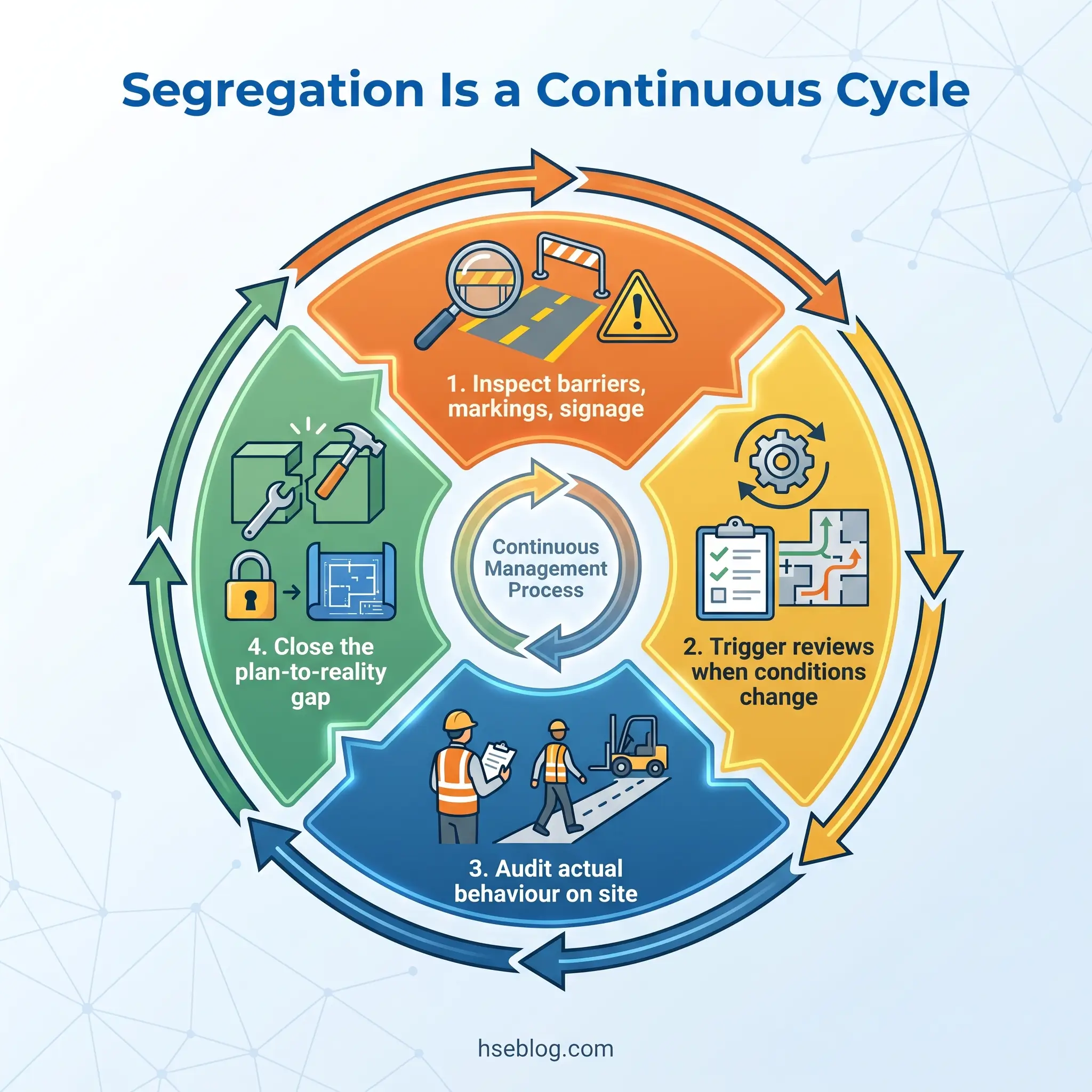
Segregation is not a project with a completion date. It is an ongoing condition that degrades unless it is actively maintained and periodically reassessed.
Physical inspection of barriers, markings, and signage should follow a documented schedule. Polymer barriers crack and shift under repeated minor impacts. Floor markings fade under forklift traffic. Signs obscured by stacked goods or repositioned equipment cease to function. Each element has a service life, and each must be inspected against a condition standard — not just checked for presence.
Review triggers extend beyond the annual cycle. Any of the following should prompt a reassessment of the segregation design:
- Layout changes — new racking configuration, relocated loading bay, additional building access point
- New vehicle types — introduction of heavier vehicles, AGVs, or different forklift models with different turning radii
- Near-miss incidents — any reported near-miss involving a pedestrian and vehicle
- Operational changes — new delivery schedules that alter peak vehicle-movement periods, shift pattern changes that alter pedestrian flow
- Seasonal conditions — reduced daylight affecting visibility, wet or icy surfaces affecting stopping distances
Behavioural auditing is the review method that reveals the gap between the plan and reality. Walking the site at shift change and observing actual pedestrian and vehicle movements — rather than reviewing the traffic management plan document — shows whether the designed routes are being used, whether informal desire lines have emerged, and whether crossing points function as intended.
Document every review, its findings, and the actions taken. Regulatory inspectors assess not just whether segregation exists, but whether the responsible person can demonstrate ongoing monitoring and responsive management.
Audit Point: The most telling question an inspector asks is not "do you have a traffic management plan?" — it is "when was it last reviewed, and what changed as a result?" A plan that has never been amended since its creation date signals a site that has never looked at whether its controls still match its operations.
Frequently Asked Questions
What is the legal requirement for separating pedestrians and vehicles in the workplace?
The duty is explicit in multiple jurisdictions. In the UK, Regulation 17 of the Workplace (Health, Safety and Welfare) Regulations 1992 requires that workplaces be organised so pedestrians and vehicles circulate safely, with traffic routes suitable for the persons and vehicles using them. In the US, OSHA's General Duty Clause creates a parallel obligation, reinforced by 29 CFR 1910.176(a), which requires marked and clear aisles where mechanical handling equipment operates. Australia's Model WHS Act places the equivalent duty on PCBUs. The exact mechanisms aren't prescribed — the duty to achieve effective separation is.
How wide should a pedestrian walkway be in an industrial setting?
HSE guidance and PAS 13 recommend a minimum clear width of 1 metre for individual pedestrian passage. Walkways serving higher volumes, two-way pedestrian traffic, or routes requiring wheelchair accessibility need to be wider. The design width should be determined by peak pedestrian flow — typically at shift change — not by average traffic. A walkway that is adequate at 10 a.m. but creates a bottleneck at 3 p.m. shift change pushes pedestrians into vehicle routes at the worst possible moment.
What is PAS 13 and does it apply to my workplace?
PAS 13:2017 is a code of practice published by BSI covering safety barriers used in traffic management within workplace environments. It provides a framework for selecting barriers based on the kinetic energy of the vehicles they must resist, along with standardised impact-testing methods. While not legally mandatory in any jurisdiction, it is recognised internationally as the best-practice benchmark for barrier specification. UK regulators reference it in enforcement guidance, and its kinetic-energy-matching methodology applies equally to any workplace globally where vehicles and pedestrians interact.
Can painted floor markings replace physical barriers for pedestrian segregation?
No. Painted markings are a visual control — they inform, but they do not physically prevent a vehicle from entering a pedestrian zone or a pedestrian from stepping into a vehicle route. HSE guidance and PAS 13 are clear that physical barriers provide a fundamentally higher level of protection. Markings are appropriate only where the risk assessment determines that vehicle-pedestrian interaction risk is low enough for visual guidance to be sufficient — for example, in very low-speed, low-volume environments with excellent sightlines. In all other cases, physical barriers are the expected control.
How do proximity warning systems complement physical segregation?
Proximity warning systems using RFID, UWB, or AI-camera technology add a detection and alert layer in areas where full physical separation isn't achievable. They warn both the pedestrian and the vehicle operator when they enter each other's proximity zone. Their value is supplementary, not primary. Key management requirements include regular calibration, false-alarm monitoring to prevent alarm fatigue, clear escalation protocols when alerts trigger, and — critically — ensuring that the presence of a warning system is never used to justify removing or downgrading physical barriers.
What are the most common causes of pedestrian-vehicle workplace collisions?
Reversing vehicles dominate the UK fatality data — HSE's 2025 enforcement review specifically identified reversing in yards where pedestrians and vehicles share space as the recurring pattern. Beyond reversing, the most frequent causes are inadequate or absent physical segregation, poor visibility from blind spots or insufficient lighting, absence of a banksman during complex vehicle manoeuvres, pedestrian walkways that are bypassed because route design doesn't follow desire lines, and failure to enforce existing controls after initial implementation. The common thread is not a single cause but a combination of design weakness and operational erosion.
Conclusion
Walk your site at the next shift change. Not the vehicle route you designed — the actual path your people take from the gate to the changing room, from the canteen to the warehouse floor, from the office to the loading dock. Compare what you see with what your traffic management plan says should happen. The distance between those two realities is where your risk lives.
Pedestrian and vehicle segregation is not a compliance exercise completed at site setup and filed. It is an active design problem that demands the same engineering rigour as any other life-critical system. The hierarchy of controls gives you the decision sequence: eliminate the interaction where possible, physically separate where you can, design controlled crossings where routes must intersect, and use training, signage, and technology only as supplementary layers — never as substitutes for the barriers and layout decisions that carry the real protective weight. Barriers must be specified by PAS 13 kinetic-energy matching, not by appearance. Crossings must force a conscious pause, not permit passive drift.
The sites that appear in enforcement reports share a profile: segregation was designed once and then eroded by operational change, time pressure, and the quiet accumulation of shortcuts that nobody flagged because nobody was watching. The question for every reader responsible for a traffic management plan is whether your site is being managed — or merely maintained on paper while the yard tells a different story.