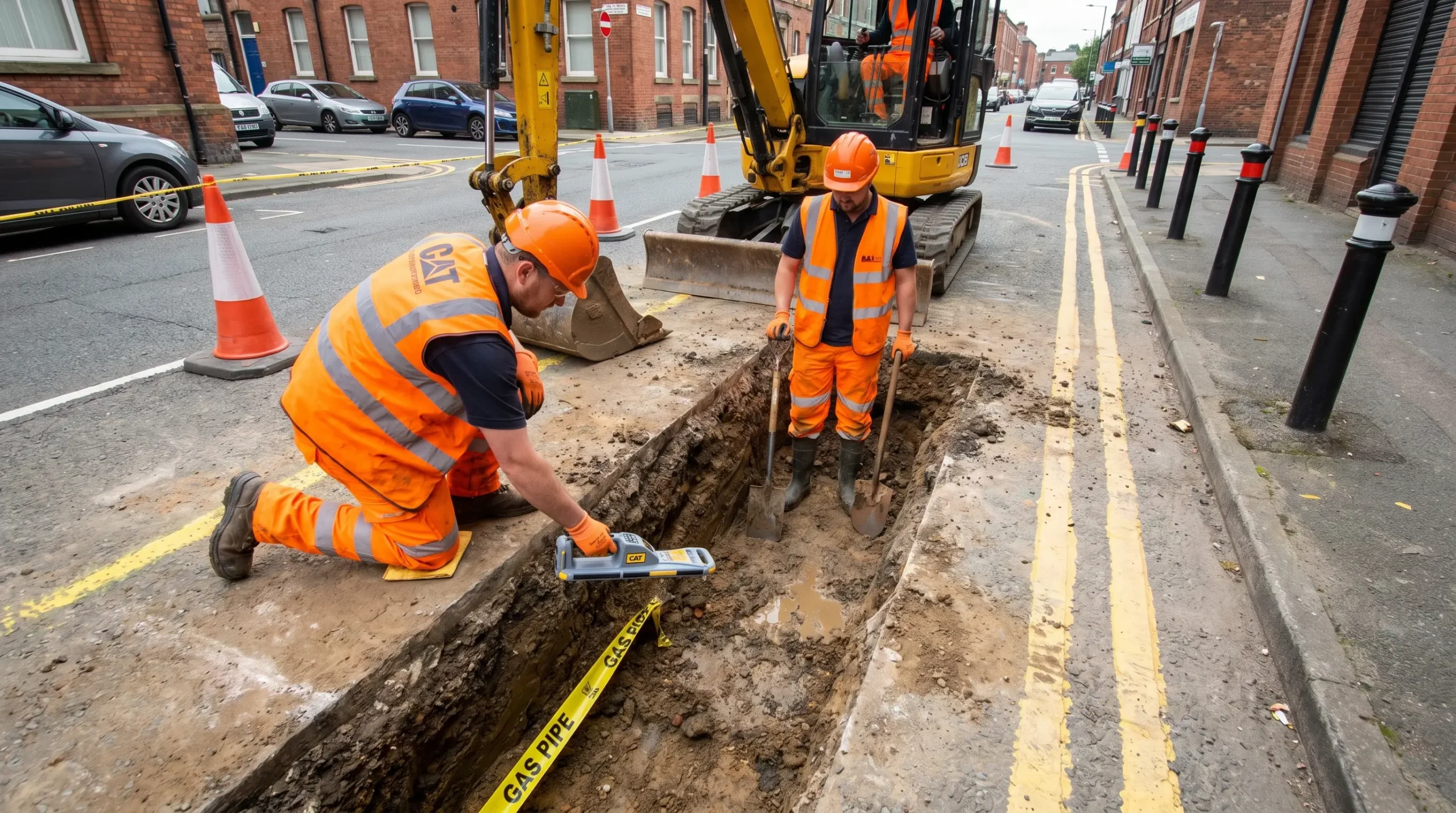
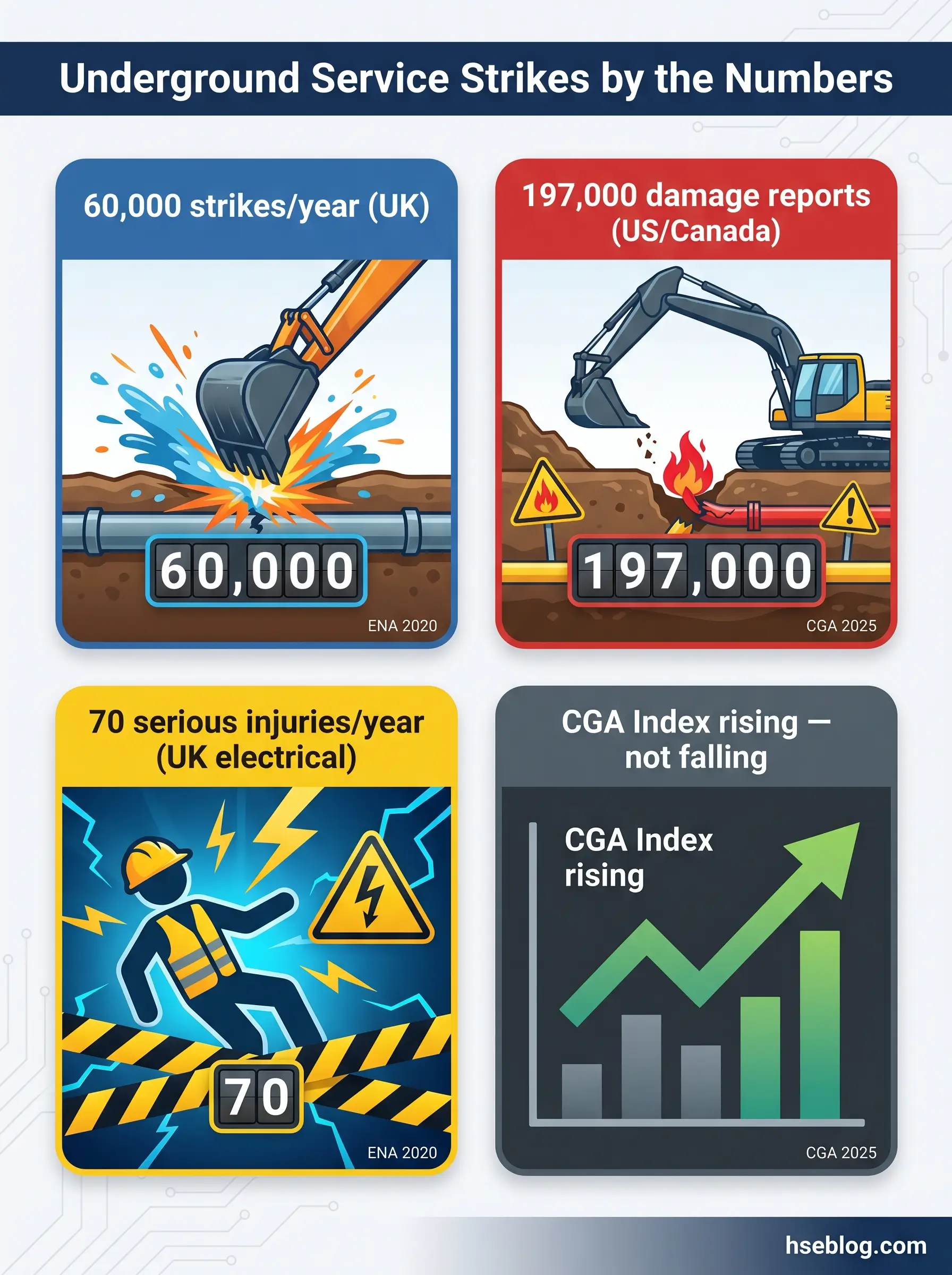
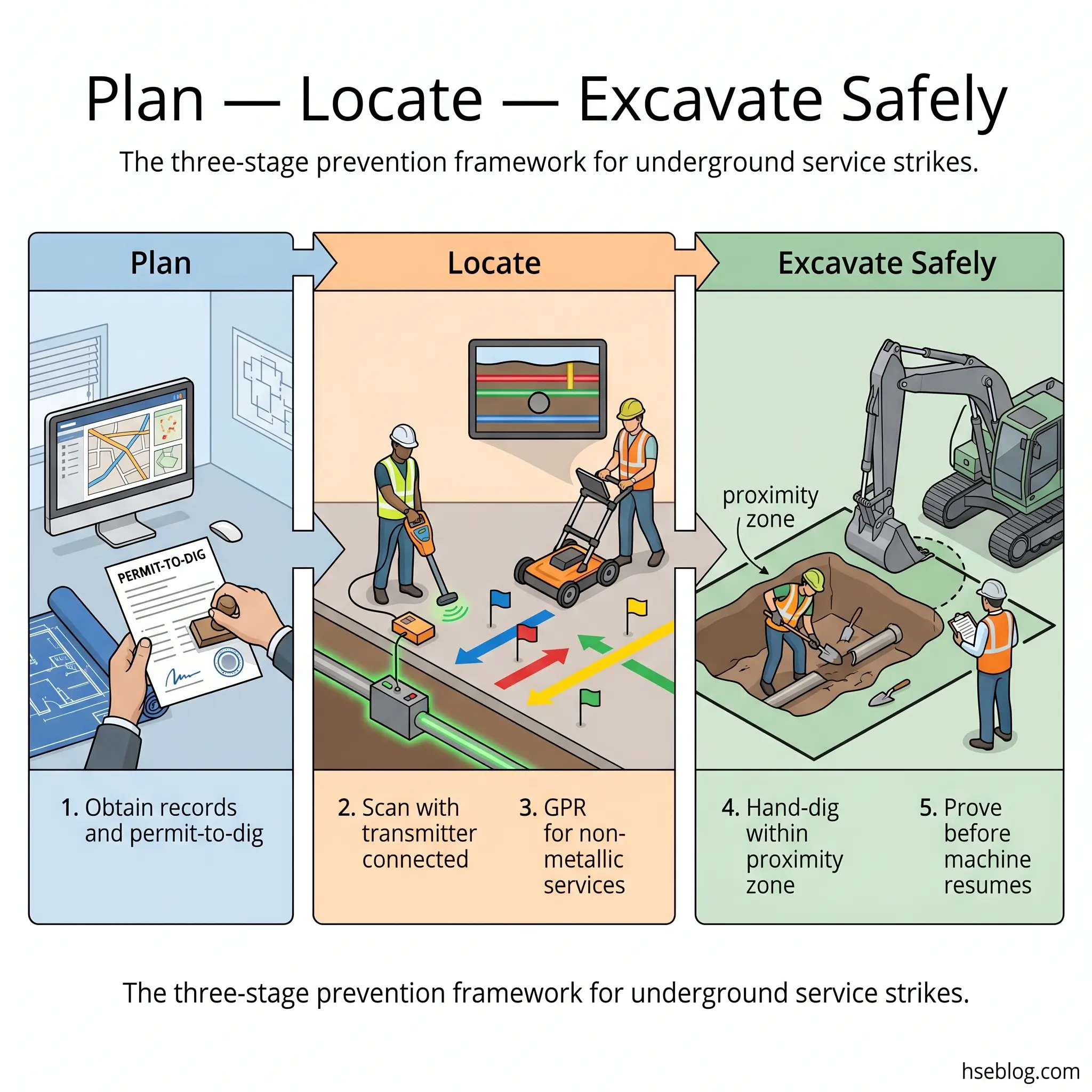
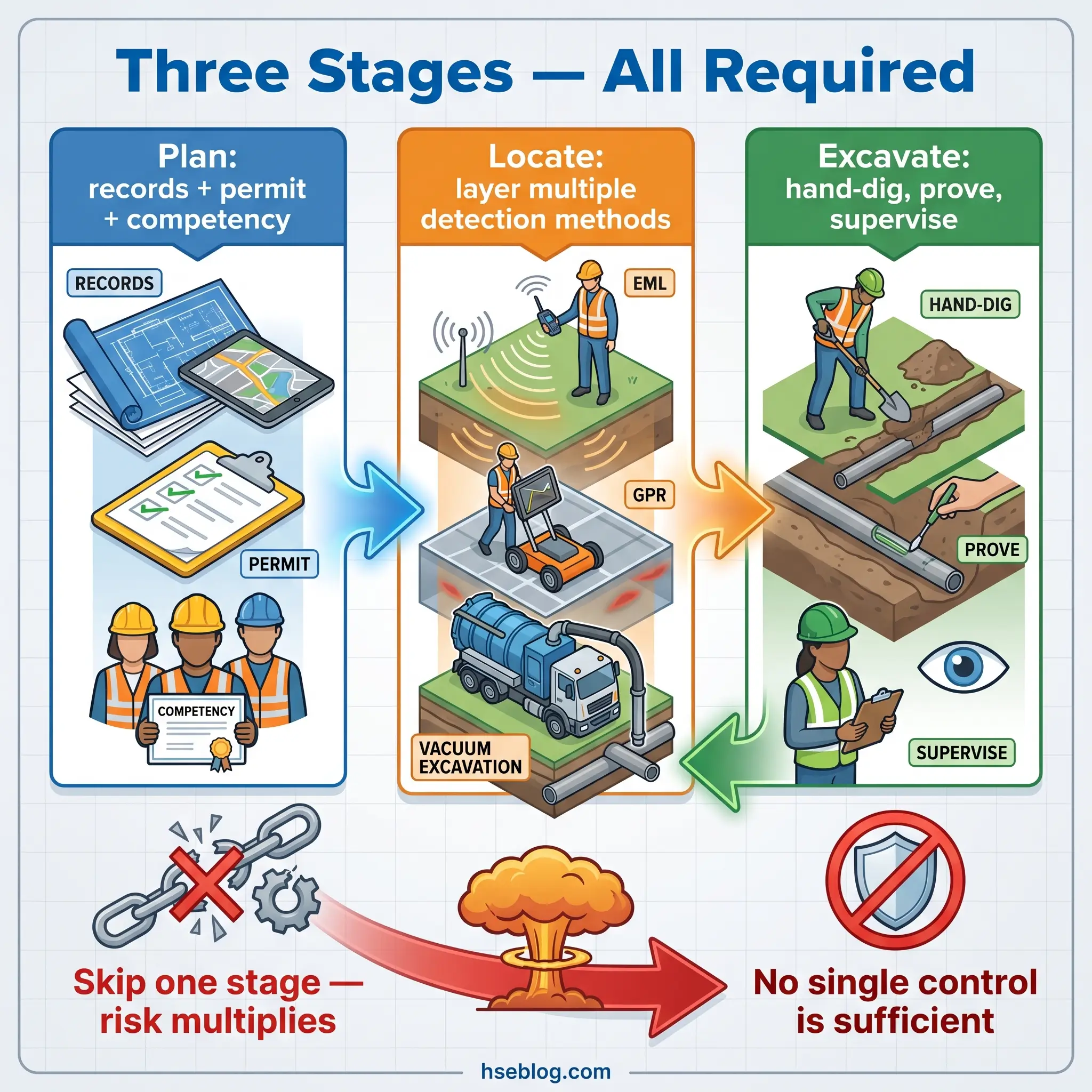
Underground service strikes occur when excavation equipment or hand tools accidentally contact buried utilities — electrical cables, gas mains, water pipes, or telecoms lines. They remain a leading cause of construction-site injuries, with an estimated 60,000 strikes per year in the UK alone (industry estimates) and approximately 197,000 reported damage incidents annually across the US and Canada (CGA, 2025). Prevention follows a three-stage process: planning (obtaining utility records and conducting risk assessments), locating (using detection equipment such as electromagnetic locators and ground penetrating radar), and safe excavation (hand-digging within proximity zones and supervising continuously).
An average of 70 people per year suffer serious injuries from contact with underground electricity cables in the UK (Energy Networks Association, 2020). That figure covers electrical cables only — it excludes gas main ruptures, water main failures, and telecoms damage. Across the Atlantic, the Common Ground Alliance's 2024 DIRT Report recorded approximately 197,000 unique damage incidents to buried utilities (CGA, 2025), and the CGA Index — the industry's primary damage-trend measure — rose from 94.0 in 2023 to 96.7 in 2024. The numbers are moving in the wrong direction.
What makes underground service strikes so frustrating from an HSE standpoint is that the prevention framework is well-established and widely taught. Plan, locate, excavate safely — three stages that appear in guidance documents from HSG47 in the UK to OSHA's excavation standards in the US. Yet the same root causes appear in investigation reports year after year. This article examines why underground utility strikes persist despite decades of published guidance, what causes them at the planning, detection, and behavioural levels, and what a genuinely effective prevention system looks like when it operates under real site pressure.
What Is an Underground Service Strike?
An underground service strike is any unintended contact between excavation equipment and a buried utility. That equipment can range from a 20-tonne tracked excavator to a hand-held pneumatic breaker, crowbar, or pick. The buried utility can be an electrical cable (from low-voltage domestic supply to 132kV transmission), a gas main, a water main, a telecoms or fibre-optic cable, or a sewer.
A common misconception is that "strike" means full severance — a cable cut cleanly in half or a pipe sheared open. In practice, the term covers any unplanned contact, including partial damage to cable sheaths, dents to pipe walls, and displacement of services from their bedding. Even partial damage to an electrical cable can produce an arc flash with temperatures exceeding 20,000°C at the point of fault. The types of buried services at risk include:
- Electrical cables (LV through HV) — arc flash, electrocution, and sustained burns upon contact; severity escalates sharply with voltage
- Gas mains — rupture risks explosion and fire; even a small nick can create a gas migration path that accumulates in confined areas
- Water mains — sudden rupture causes localised flooding, trench wall collapse, and loss of supply to surrounding properties
- Telecoms and fibre-optic lines — no immediate life-safety threat from contact, but service disruption can be extensive and costly
- Sewerage — contamination risk and environmental discharge obligations upon rupture
The severity spectrum runs from a near-miss that goes unrecorded to a fatality. Hand-tool strikes on high-voltage cables are disproportionately dangerous — not because the tool itself is more powerful than an excavator, but because the operative's hands are in direct contact with the tool at the moment of impact, placing them in the arc-flash zone with no separation distance.
How Common Are Underground Service Strikes?
The scale of this problem is routinely underestimated, partly because many minor strikes are repaired and never formally reported. Published data from two of the most mature reporting systems — the UK and the US — gives the clearest picture, though both acknowledge that their figures undercount the true total.
In the US and Canada, the Common Ground Alliance's 2024 DIRT Report documented approximately 197,000 unique reported damage incidents to buried utilities (CGA, 2025). The CGA Index — designed to track the industry's progress in reducing damages — rose from 94.0 in 2023 to 96.7 in 2024, signalling that damage rates are increasing despite sustained investment in prevention programmes.
In the UK, industry estimates put the figure at approximately 60,000 accidental cable and pipe strikes per year, with an estimated total cost of £2.4 billion annually when direct repair costs, project delays, service disruption, and associated economic impacts are combined (Centriforce, 2025). The Health and Safety Executive, through data compiled by LSBUD, recorded 318 injuries and fatalities caused by underground electrical cable strikes over a five-year period from 2012 to 2017 (LSBUD/HSE, 2019). The Energy Networks Association reported an average of 70 serious injuries per year from contact with underground electricity cables since 2015 (ENA, 2020).
| Measure | UK | US / Canada |
|---|---|---|
| Estimated annual strikes/damages | ~60,000 | ~197,000 reported (CGA, 2025) |
| Serious electrical injuries per year | ~70 (ENA, 2020) | Not disaggregated in DIRT data |
| Trend direction | Persistent | CGA Index rising (94.0 → 96.7) |
| Estimated annual cost | £2.4 billion | Not aggregated in a single source |
The practitioner reality behind these numbers is that many organisations track strikes internally as near-misses but never report them externally. An ENA survey found that 31% of UK tradespeople admitted to not always checking for underground cables before digging — yet 93% believed they always dug safely (ENA, 2020). That gap between self-perception and actual behaviour is a pattern that runs through every root-cause analysis in this field.
What Causes Underground Service Strikes?
The root causes of underground utility strikes are well-documented and remarkably consistent. The CGA's DIRT Report has tracked the same top-level failure categories for over a decade, and the ordering barely changes. This consistency is itself the diagnosis: the industry does not have a knowledge problem. It has an execution problem — a systemic gap between knowing the correct procedure and consistently applying it under site conditions.
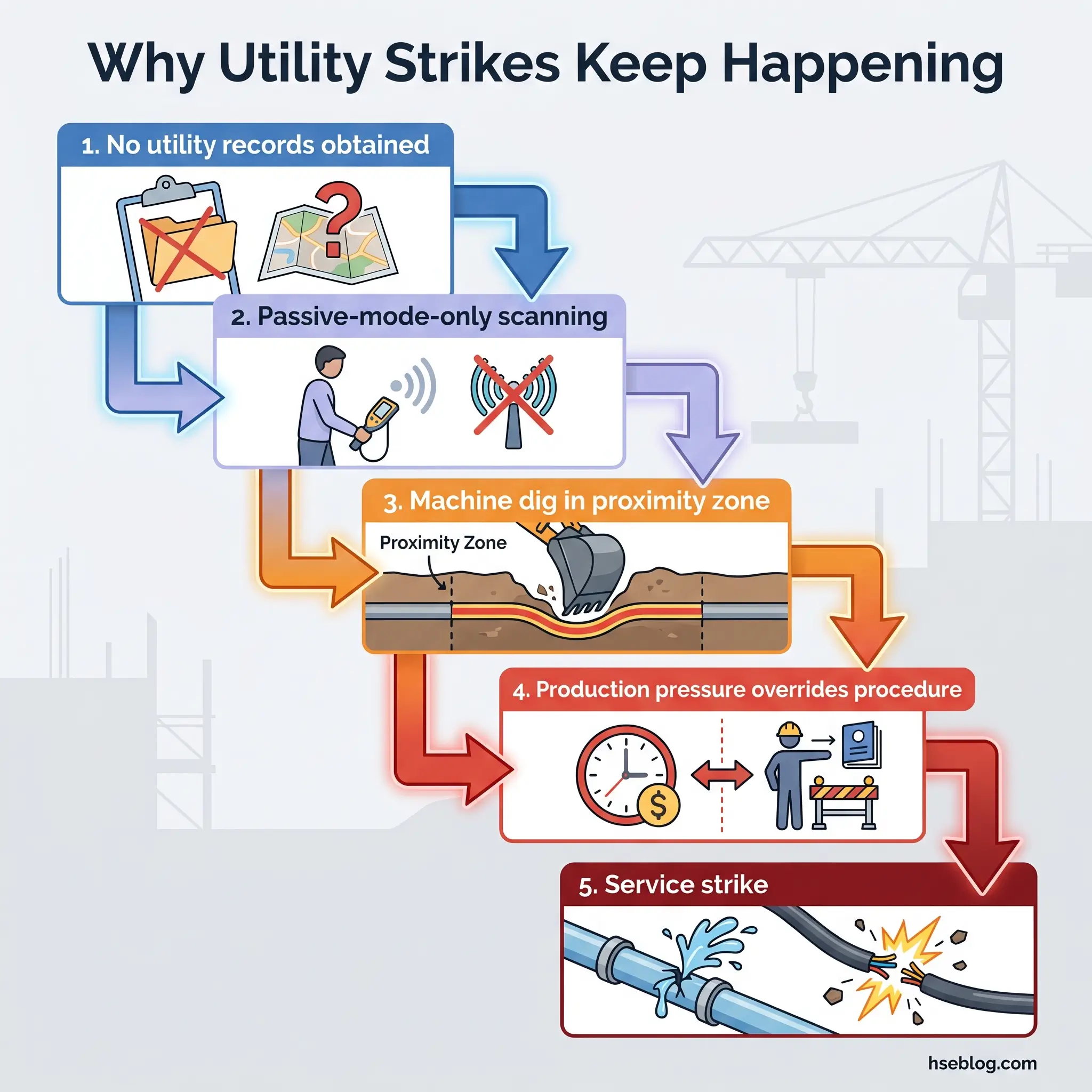
Organising the causes by where they occur in the excavation workflow reveals a clear pattern: failures cascade. A planning failure makes detection harder. A detection failure makes excavation riskier. And production pressure compresses every stage.
Failures in Pre-Work Planning
The upstream cause that multiplies all downstream risk is the failure to request and review utility records before breaking ground. In the US, this means contacting the 811 one-call service. In the UK, it means obtaining records from LSBUD or directly from each utility owner with assets in the area.
Under OSHA 29 CFR 1926.651(b)(1), the estimated location of utility installations must be determined prior to opening an excavation. HSG47, the UK's recognised standard of care for underground service avoidance, establishes a comparable planning duty in its opening chapter. CDM 2015 Regulation 25(4) goes further: no construction work shall be carried out in proximity to any underground service unless suitable and sufficient steps have been taken to prevent risk of injury.
Yet an estimated 44% of excavations in Great Britain have historically been conducted without a thorough search for buried services. The judgment call for site supervisors is straightforward — no excavation begins without records on-site and reviewed with the dig crew. When records are unavailable or delayed, the excavation does not proceed until they are obtained, or until the site is scanned using detection equipment and the results are documented.
Inaccurate or Incomplete Utility Records
Even when records are obtained, they carry inherent positional uncertainty. Services are frequently relocated during maintenance without the maps being updated. Legacy installations from different eras may never have been accurately surveyed. Privately installed services — particularly telecoms and fibre — may not appear on any utility owner's records. In the UK, less than 1% of local councils historically made their asset information available through search services, meaning entire categories of buried infrastructure may be invisible on the records a contractor receives.
The practical reading of this limitation is that utility records should be treated as an indicative starting point — useful for identifying which services are likely to be present, but never sufficient on their own to confirm the ground is clear. PAS 128:2022 and ASCE 38-22 both establish quality-level frameworks that quantify this uncertainty, from desktop records (Quality Level D) through to physical verification by excavation (Quality Level A).
Detection Equipment Misuse and Limitations
The single highest-frequency behavioural failure pattern documented across published incident analyses is an operative who scans in passive mode, sees no response, and starts digging — without ever connecting a signal generator.
Electromagnetic locators such as the CAT and Genny (or RD-series equivalents) operate in multiple modes. Passive modes — Power mode and Radio mode — detect signals that energised cables or metallic pipes naturally emit or pick up. But passive modes cannot detect plastic water pipes, unenergised cables, fibre-optic ducts, or any service that carries no detectable electromagnetic signal. The applied-signal mode, where a transmitter (Genny) is connected to the target service or placed on the ground surface, is the only electromagnetic method that can actively trace a specific service along its route.
Ground penetrating radar adds a second detection layer by sending electromagnetic pulses into the ground and interpreting reflections from subsurface interfaces. GPR can detect both metallic and non-metallic services. Its limitations are significant, however: clay soils, waterlogged ground, and heavily congested service corridors reduce the quality of GPR returns, and interpretation requires trained, experienced operators.
Watch For: No single detection technology is 100% reliable. Best practice uses electromagnetic location as the primary sweep, GPR as a secondary confirmatory method, and vacuum excavation to physically prove critical crossings. Treating any one technology as sufficient on its own is the detection-side equivalent of not scanning at all.
Unsafe Excavation Practices
The critical transition in any excavation near buried services is the shift from machine dig to hand dig. HSG47 guidance establishes that hand-digging or non-destructive excavation methods should be used within 500mm of a detected service. The operative excavates alongside the service — not directly above it — to reduce the risk of a direct downward strike.
A recurring failure mode in published investigation reports is the resumption of machine excavation before the service has been visually confirmed ("proved"). Proving means physically exposing the service so that its exact position, depth, and direction of travel are known — not inferred from a locator reading. The locator tells you where to look. The proving excavation tells you what is actually there.
Human Factors and Production Pressure
The behavioural dimension explains why trained operatives bypass procedures they demonstrably know. Schedule pressure is the most frequently cited contributor. When a groundworking crew is behind programme on a live highway project, the commercial incentive to "just get on with it" directly competes with the time required to scan properly, hand-dig around detected services, and wait for locate responses.
Crew turnover compounds this: a replacement operative arriving mid-shift may not receive the same briefing on service locations that the original crew discussed at the morning toolbox talk. Inadequate supervision — particularly the absence of a designated competent person watching the excavation in real time — removes the last systemic check on individual behaviour.
The normalisation of deviance operates powerfully here. Each time an operative skips a scan step and nothing bad happens, the perceived risk of skipping decreases. Each successful shortcut reinforces the belief that the full procedure is unnecessary. This pattern continues until the day the unscanned ground contains a live 11kV feeder cable.
Consequences of Striking Underground Services
The consequences of an underground utility strike extend across five dimensions — human, operational, financial, legal, and reputational — and the severity depends heavily on what type of service is hit.
Human consequences are most acute with electrical cables and gas mains. Striking a high-voltage cable produces an arc flash that can cause third-degree burns to hands, arms, and face within milliseconds. Electrocution — cardiac arrest from current passing through the body — is a direct fatality mechanism. Gas main rupture creates explosion and fire risk; even a small leak in a confined trench can displace oxygen and cause asphyxiation. Water main rupture introduces drowning risk and can destabilise trench walls, leading to collapse onto workers still in the excavation.
Legal consequences are substantial in both major jurisdictions. In the UK, prosecution under CDM 2015 and the Health and Safety at Work Act 1974 carries unlimited fines. One UK prosecution resulted in a £600,000 fine after a worker suffered life-changing burns from an 11kV cable strike during traffic light replacement work — the court found a breach of CDM 2015 Regulation 25(4). In the US, OSHA citations under 29 CFR 1926.651 carry per-violation penalties, and willful violations involving serious injury attract significantly higher fines and potential criminal referral.
Operational and financial consequences cascade outward: project delays, emergency service mobilisation, utility outages affecting surrounding communities, direct repair costs, increased insurance premiums, and potential loss of future contract eligibility. The reputational damage often outlasts the financial penalty. Clients increasingly audit contractors' strike histories before awarding work, and a pattern of strikes can effectively exclude a contractor from framework agreements.
How to Prevent Underground Service Strikes
Prevention is not a single control measure — it is a system that operates across three sequential stages. The framework used by HSG47 (Plan → Locate → Excavate Safely) maps directly to the general approach recognised internationally, including OSHA's excavation requirements and ASCE 38-22's quality-level methodology. Each stage depends on the one before it. Skip the planning stage and the locate stage operates blind. Rush the locate stage and the excavation stage operates on assumptions.
The most dangerous moment in the entire workflow is the handover between the locate crew and the dig crew. This is where information degrades into assumption — where "the locator operator said it was clear" becomes "I think someone scanned this area." Active supervisory engagement at each transition is what separates a functioning system from a procedural document that nobody follows.
Stage 1: Planning and Records Search
Before any ground is broken, the responsible person must obtain utility records for the excavation area. In the US, this means calling 811 — the national one-call system that notifies utility owners and triggers a locate response. Under OSHA 29 CFR 1926.651(b)(2), utility companies or owners must be contacted within established or customary local response times. In the UK, the equivalent process involves submitting an enquiry through LSBUD or contacting each utility owner directly. HSG47 requires the work planner to obtain utility plans and review them against the proposed dig area.
A competent planning process includes a desktop risk assessment identifying which services are likely to be present, issuance of a permit-to-dig that documents the specific risks and controls for this excavation, and verification that the personnel assigned to locate and excavate hold current competency certification (such as EUSR SHEA in the UK or equivalent recognised training).
Audit Point: A permit-to-dig is not universally required by statute, but it is considered industry best practice and is mandated by most principal contractors and utility owners. The permit should record which utility plans were reviewed, what detection methods will be used, and who holds supervisory responsibility for the excavation.
Stage 2: Locating and Marking Underground Services
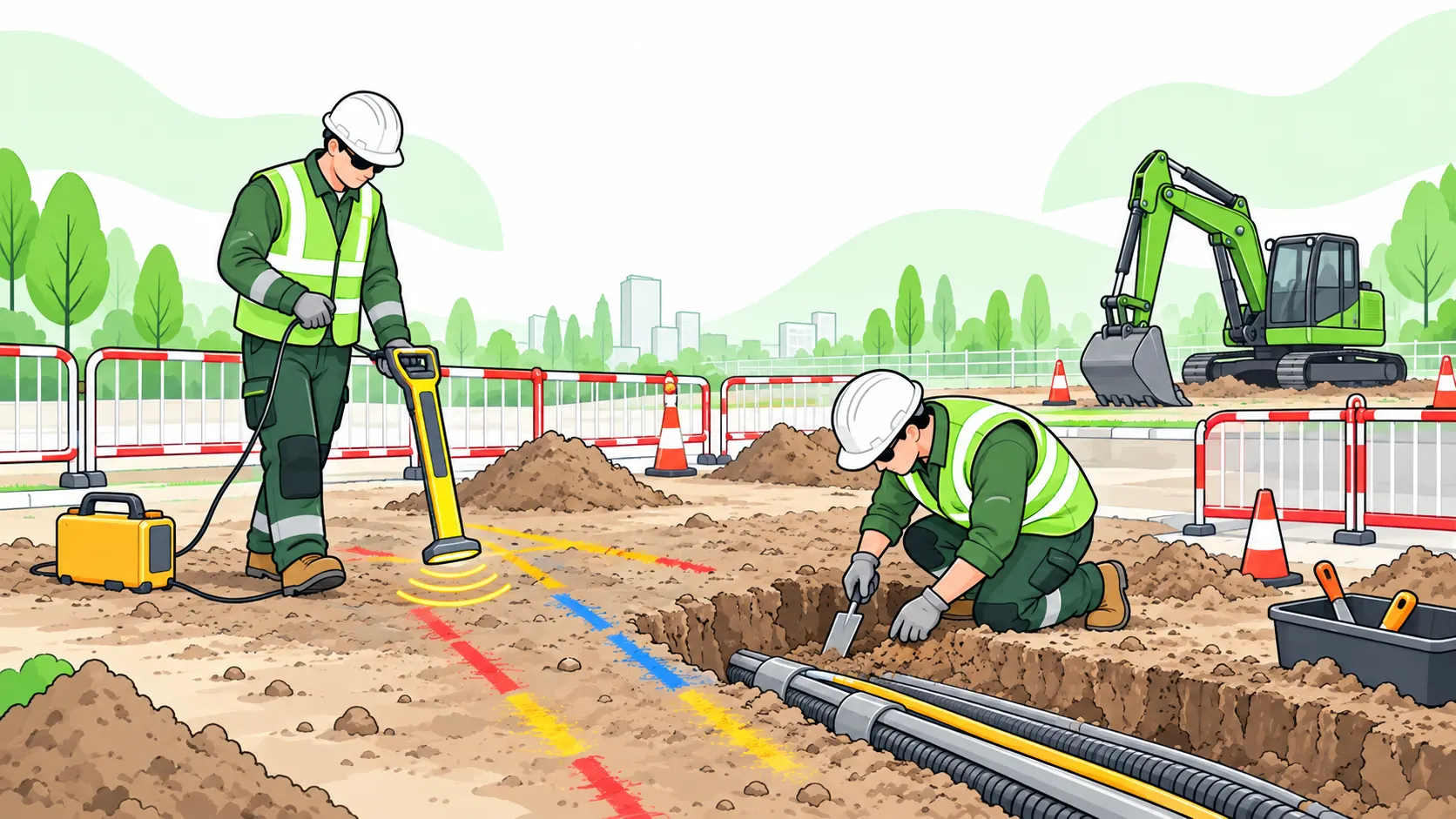
With records reviewed, the locate crew deploys detection equipment across the full excavation corridor — not just the planned dig footprint, but a buffer zone on each side. The standard electromagnetic workflow uses a cable avoidance tool in all available modes: Power (detects mains-frequency signals), Radio (detects re-radiated radio signals on metallic services), and applied signal with a connected transmitter to actively trace specific services.
PAS 128:2022, the UK's specification for underground utility detection, defines four survey categories. A Type D survey uses existing utility records only. Type C adds a site reconnaissance. Type B adds geophysical detection (electromagnetic location and GPR). Type A adds physical verification by exposing the service through excavation. ASCE 38-22 uses a parallel framework — Quality Level D through Quality Level A — with broadly equivalent definitions.
GPR adds significant value on sites where non-metallic services are expected or where electromagnetic results are inconclusive. Its effectiveness varies with soil type and moisture content — clay-heavy or waterlogged ground attenuates radar signals and reduces detection reliability. On congested urban sites, overlapping service returns can be difficult to interpret even for experienced operators.
Once services are detected, their positions must be physically marked on the ground surface using paint, markers, or flags — and those marks must correspond to the information on the excavation plan that the dig crew will use.
Stage 3: Safe Excavation Methods
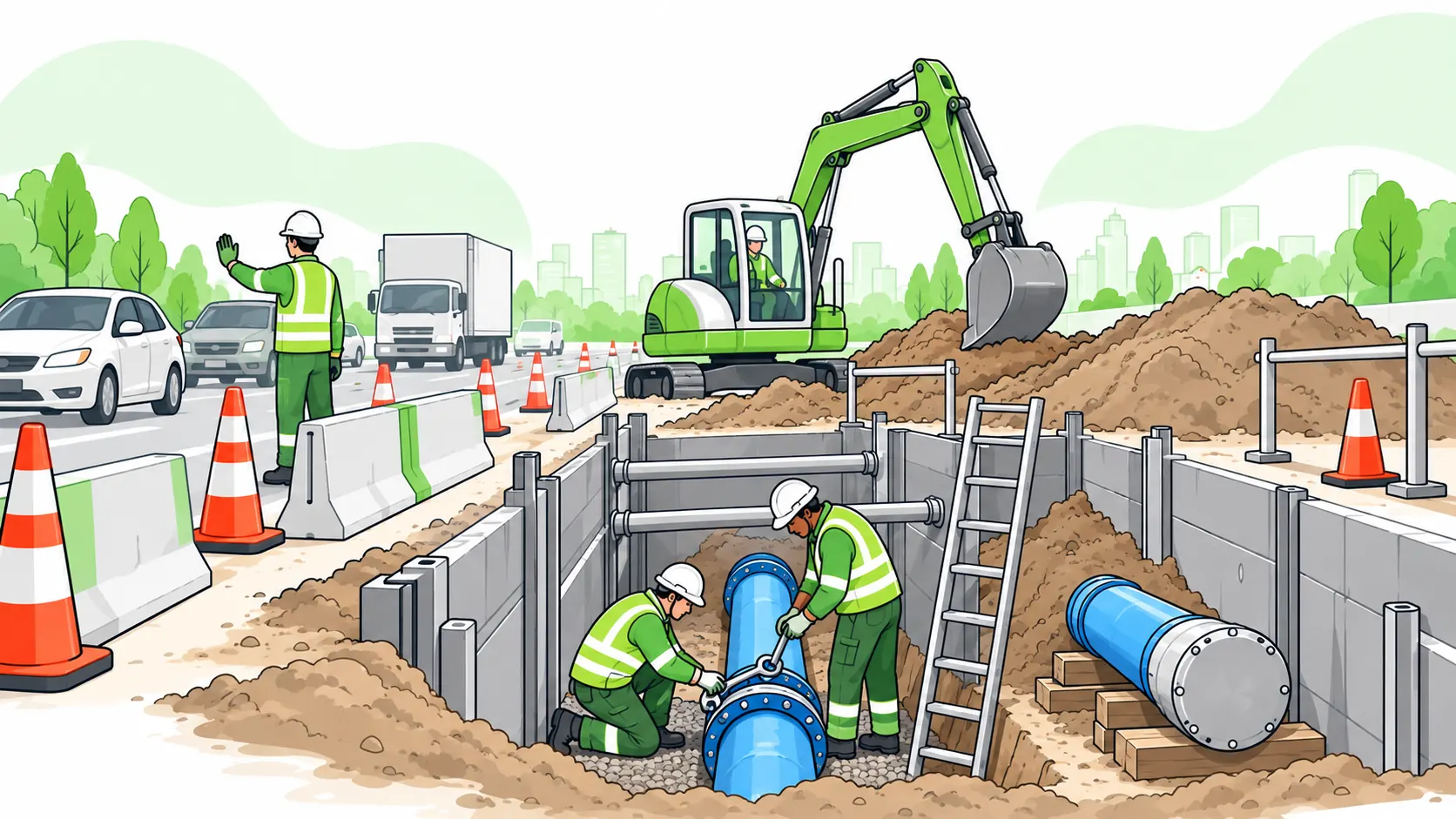
Machine excavation proceeds in areas confirmed clear of services. When approaching a detected or suspected service, the excavation method transitions to hand-digging using insulated tools, or to non-destructive vacuum excavation (air-lance or hydro-excavation). The operative digs alongside the service, not directly above it, until the service is visually exposed and its position confirmed.
Vacuum excavation has become the preferred proving method on higher-risk sites because it removes soil without mechanical force — the air or water jet loosens material while suction extracts it, reducing the risk of damaging the service during exposure. This is the only method that physically confirms what is in the ground, resolving the uncertainty that detection equipment alone cannot eliminate.
Once a service is proved, machine excavation may resume in adjacent areas with appropriate clearances, provided continuous supervision is maintained and the proved service is protected from accidental contact.
Detection Technologies for Underground Services
Selecting the right detection technology — and understanding what it cannot do — is where many organisations' underground service strike prevention programmes succeed or fail. Competitors in this space tend to list technologies as interchangeable options. They are not. Each technology answers a different question, and the decision framework depends on ground conditions, service type, and the confidence level required.
| Technology | What It Detects | Key Limitations | Best Used For |
|---|---|---|---|
| Electromagnetic locator (CAT/Genny, RD-series) | Metallic services, energised cables, services with applied signal | Cannot detect non-metallic services (plastic pipes, fibre) without tracer wire or applied signal | Primary sweep on all excavation sites |
| Ground Penetrating Radar (GPR) | Both metallic and non-metallic services; subsurface anomalies | Reduced effectiveness in clay, wet, or congested ground; requires trained interpretation | Secondary/confirmatory survey; sites with known non-metallic services |
| Vacuum excavation (air/hydro) | Physically exposes and confirms any service | Slow compared to machine excavation; requires specialist equipment | Proving critical crossings; resolving detection ambiguity |
| Acoustic locators | Water and gas pipes (especially for leak detection and line tracing) | Limited to pressurised pipes; not effective for electrical or telecoms | Targeted water/gas line tracing |
An emerging development is reshaping this landscape. Real-time, excavator-mounted GPR systems — sometimes described as "live dig radar" technology — shift the detection paradigm from a pre-dig-only activity to continuous subsurface sensing during active excavation. Rather than relying entirely on a survey conducted hours or days before digging begins, these systems provide the machine operator with a live subsurface feed as the bucket approaches the ground. This represents a fundamental shift from reactive to proactive prevention and is gaining industry attention as of 2025–2026.
The most common error across all technology selection is treating any single method as sufficient. A robust detection strategy layers electromagnetic location as the primary sweep, adds GPR where ground conditions and service types warrant it, and uses vacuum excavation to physically prove any crossing where the risk of a strike would be unacceptable.
What Are the Legal Requirements for Working Near Underground Services?
Regulatory content here reflects general HSE professional understanding of UK and US requirements as of 2025. It is not legal advice. Specific compliance questions, enforcement situations, or prosecution risk should be directed to qualified legal counsel in the applicable jurisdiction.
Both the UK and US regulatory frameworks require that underground services be identified and protected before excavation work begins. The core principle is shared — the specific duties and enforcement mechanisms differ.
UK requirements rest on three pillars. The Health and Safety at Work Act 1974 (Sections 2 and 3) imposes a general duty to ensure the health and safety of employees and others affected by work activities. CDM Regulations 2015, Regulation 25(4), creates a specific duty: no construction work shall be carried out in proximity to any underground service unless suitable and sufficient steps have been taken to prevent risk of injury. HSG47, while guidance rather than legislation, defines the standard of care that courts and the HSE use when assessing whether reasonable precautions were taken. Treating HSG47 as optional is a legal risk, not merely a procedural preference. For highway work, the New Roads and Street Works Act 1991 adds additional requirements. PAS 128:2022 provides the specification for utility detection surveys that clients and designers can reference to define what survey standard is required.
US requirements centre on OSHA 29 CFR 1926.651(b)(1)–(4). Before opening an excavation, the employer must determine the estimated location of utility installations. Utility companies or owners must be contacted and advised of proposed work. When the excavation approaches the estimated location of an installation, the exact location must be determined by safe and acceptable means. While open, underground installations must be protected, supported, or removed as necessary. State-level 811/one-call laws — which vary significantly by state — supplement these federal requirements. ASCE 38-22 provides a professional standard for subsurface utility engineering that specifies quality levels and methods.
A key procedural difference between the two frameworks: OSHA permits the employer to proceed with caution and detection equipment if a utility owner cannot respond within 24 hours; HSG47 requires the work planner to obtain utility plans and does not specify a time-trigger for proceeding without them.
Internationally, EU Directive 92/57/EEC on temporary or mobile construction sites addresses excavation risk within its framework. Australia's AS 5488-2013 and Canada's CSA S250 provide national frameworks with broadly equivalent plan-locate-dig structures. Both UK CDM and US OSHA require that excavation work involving underground services be managed by a competent person — defined as someone with sufficient training and experience to identify hazards and implement controls.
Emergency Response: What to Do After Striking an Underground Service
Site-specific emergency plans should be developed before work begins — not improvised under pressure after a strike has occurred. The correct response depends entirely on which type of service has been struck, and getting it wrong can escalate the severity dramatically.
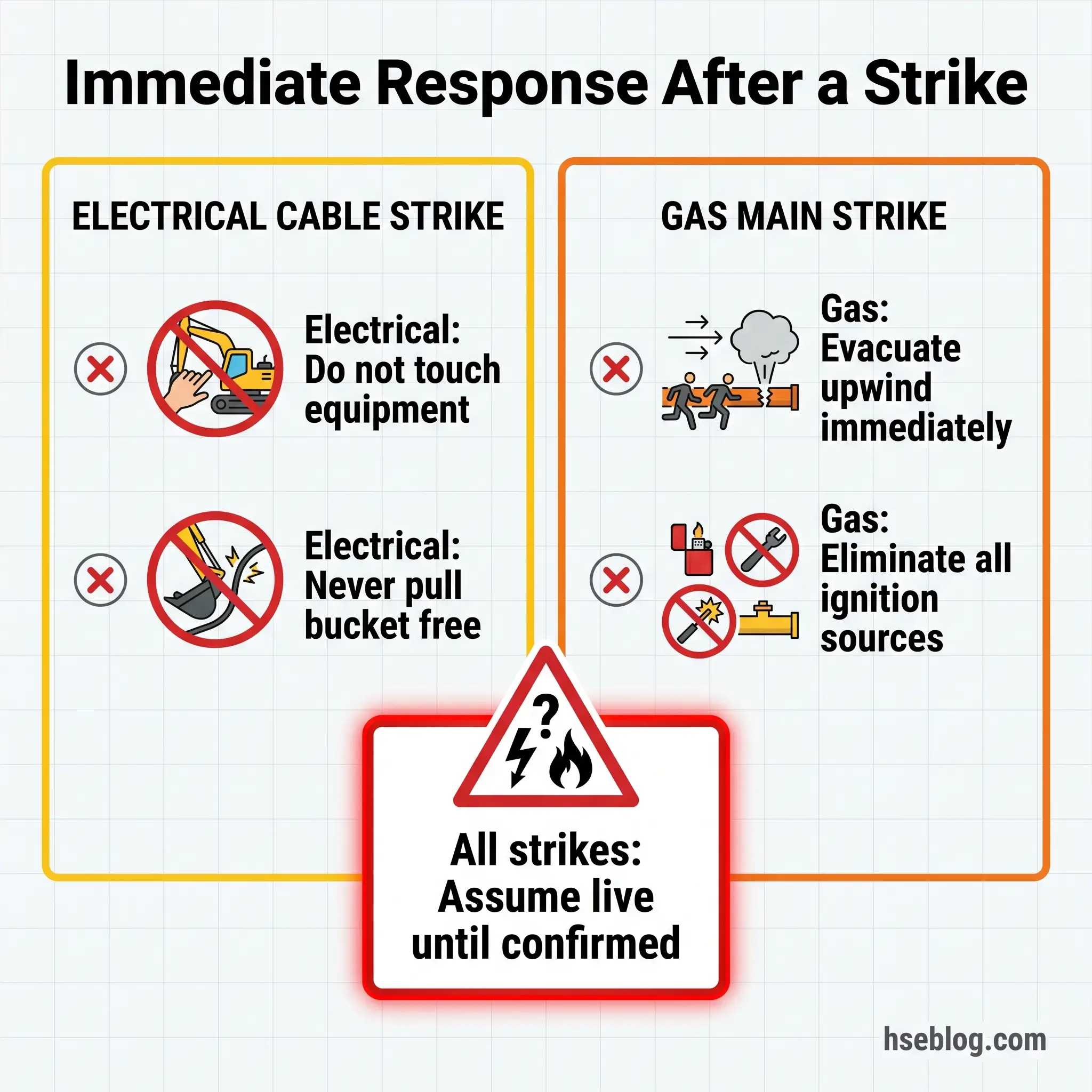
Electrical cable strike: Stop work immediately. Do not touch the excavation equipment, the cable, or anything in contact with either. Do not attempt to pull the excavator bucket free — this is the most dangerous instinct after a cable strike, because withdrawing the bucket can extend the arc-flash zone and expose additional conductors. Keep all personnel clear and establish a safety cordon. Assume the cable is live until the utility operator confirms it is isolated. Call the utility operator and emergency services.
Gas main strike: Evacuate the immediate area upwind. Eliminate all ignition sources — do not operate electrical switches, mobile phones near the leak, or vehicle ignitions. Do not attempt to repair the damage. Call the gas emergency number and emergency services.
Water main rupture: Isolate the flow if a valve is accessible and can be operated safely. Manage flooding risk to the trench and surrounding area — water ingress destabilises trench walls rapidly. Call the water company.
All strikes: Report through RIDDOR (UK) or OSHA incident reporting (US) where the reporting threshold is met. Preserve the scene for investigation. Conduct a post-incident review to identify which stage of the plan-locate-excavate system failed and why.
Frequently Asked Questions
Can you dig without calling 811 or checking for underground services?
No. In the US, OSHA 29 CFR 1926.651(b)(1)–(2) requires the estimated location of utility installations to be determined and utility companies to be contacted before excavation begins. In the UK, CDM 2015 Regulation 25(4) prohibits construction work near underground services unless suitable steps have been taken. State-level 811 laws in the US carry penalties for failure to notify, and even emergency excavation must proceed on the assumption that live services are present.
What is the most common cause of underground cable strikes?
The most consistently documented behavioural failure is scanning in passive mode only — without connecting a signal generator. Passive electromagnetic detection cannot identify non-metallic services, unenergised cables, or services carrying no detectable signal. An operative who gets a "clear" reading in passive mode and begins digging has received a false negative, not a genuine all-clear. CGA DIRT data shows remarkable consistency in top root causes year after year, reinforcing that this is a systemic execution failure, not a knowledge gap.
How deep are underground services buried?
Depth varies by service type, jurisdiction, and site history. Typical UK guidance depths are approximately 450mm minimum cover for electricity cables, 375mm–750mm for gas mains (depending on pressure tier), and 750mm–900mm for water mains. These are nominal installation depths — services may have been displaced by subsequent construction, installed at non-standard depths, or exposed by erosion. Depth should never be assumed; detection and physical proving confirm what is actually in the ground.
What is the difference between PAS 128 and HSG47?
They serve different audiences and purposes. HSG47 is Health and Safety Executive guidance aimed at site workers and supervisors, covering safe working practices when excavating near underground services. PAS 128:2022 is a British Standards Institution specification aimed at survey professionals and clients commissioning utility detection surveys, defining survey categories (Type D through Type A) and the accuracy standards each must achieve. They are complementary — PAS 128 governs the quality of the detection survey; HSG47 governs the safe digging practices that follow.
How accurate are underground utility plans?
Plans provide an indicative position only and should not be treated as precise. Services may have been relocated during maintenance without records being updated, installed by private parties and never registered, or surveyed using methods that carry inherent positional tolerance. Both ASCE 38-22 and PAS 128:2022 address this through quality-level frameworks that quantify the confidence associated with different data sources — from desktop records (lowest confidence) to physical exposure by excavation (highest confidence).
What PPE is required when excavating near underground services?
PPE requirements depend on the service type and the assessed risk. Work near electrical cables requires insulated hand tools and, where arc-flash risk is identified, appropriate arc-flash-rated PPE including face protection. Standard construction PPE — hard hat, high-visibility clothing, safety footwear, gloves — applies to all excavation work. PPE is the last line of defence in the hierarchy of controls and must never substitute for proper detection and safe digging practices.
Conclusion
The underground service strike problem is not mysterious. The causes are well-documented, the prevention framework is straightforward, and the regulatory obligations are clearly stated in every major jurisdiction. What the industry consistently gets wrong is treating the plan-locate-excavate process as a set of paperwork requirements rather than a live operational system that demands active supervision at every transition point. The CGA's 2024 DIRT data — showing the damage index rising, not falling — confirms that awareness campaigns and training courses alone are not closing the gap between knowledge and execution.
The single highest-impact change is also the least glamorous: ensuring that someone competent is watching the handover between the locate crew and the dig crew, confirming that detection results are communicated accurately, that ground markings match the excavation plan, and that the machine operator knows exactly where the proximity zone begins. Every published investigation report that crosses my desk follows a familiar pattern — the procedures existed, the training had been delivered, and the equipment was available. What was missing was the supervisory presence that holds the system together when production pressure pushes against it.
Emerging detection technologies — particularly excavator-mounted real-time radar — offer a systemic improvement by shifting detection from a one-time pre-dig activity to a continuous process. But technology does not replace the human judgment that decides when to stop the machine and pick up a hand tool. That decision, made correctly thousands of times a day on excavation sites around the world, is what keeps the 60,000 annual strikes in the UK and the 197,000 reported damages in the US from being far worse.