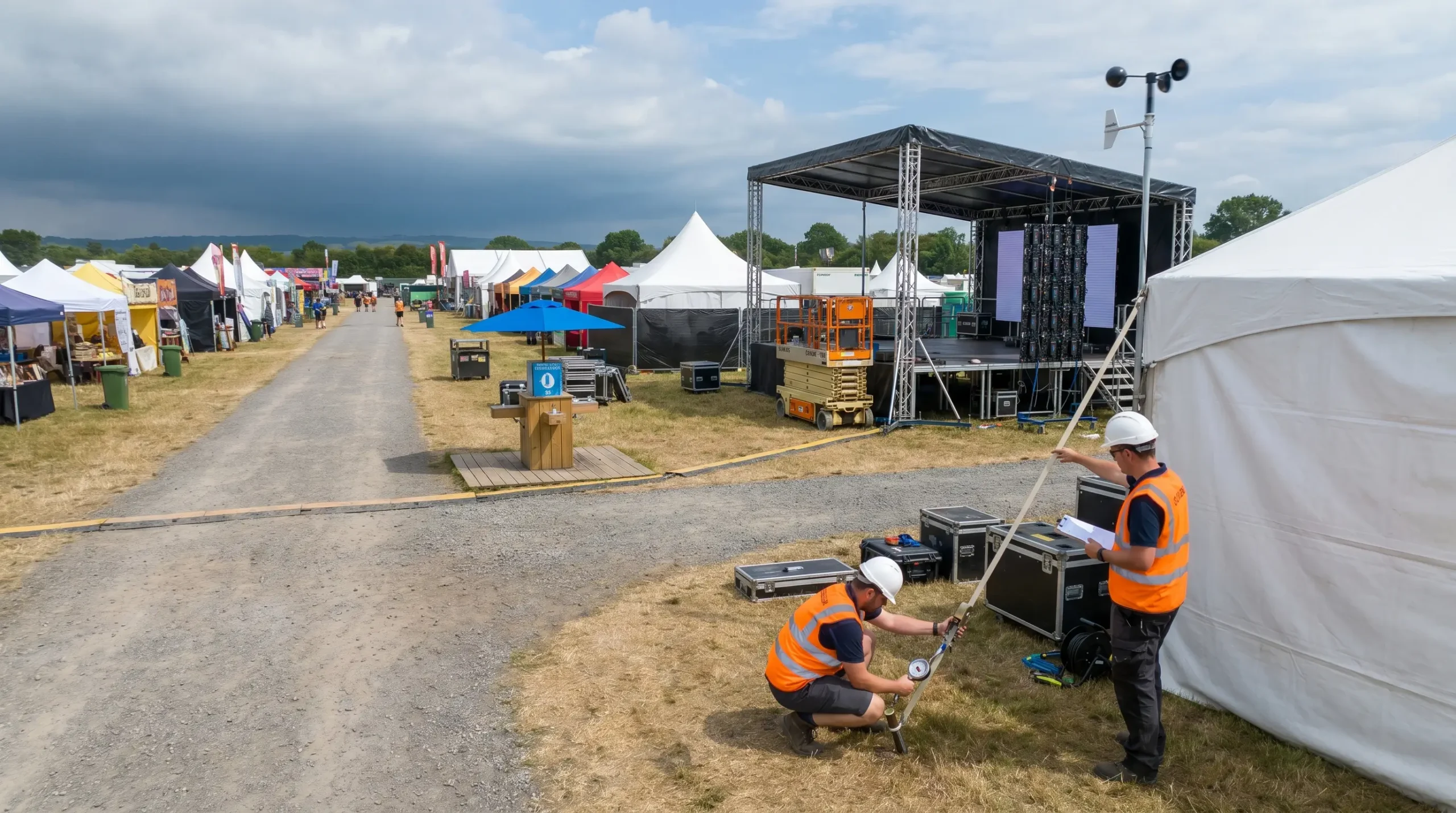
The festival grounds sit wide open under a cloudless sky at 0600, but by 1400 the horizon line darkens in a way that changes everything. Radiant heat bakes the asphalt loading zones where riggers are bolting truss. Dust lifts off unsecured vendor canopies. A cell builds twelve miles out, invisible to anyone not watching a radar feed. This is the operational reality of outdoor events: three weather hazards — wind, lightning, and heat — can converge on a venue holding thousands of people sheltered by nothing more than temporary structures and open ground.
The consequences of delayed action are severe and well documented. The National Weather Service reports that lightning kills approximately 20 people per year in the United States alone, with hundreds more injured. The World Health Organization identifies heat stress as the leading cause of weather-related death globally. Wind collapses of stages and tents have produced mass-casualty events that ended careers, triggered criminal prosecutions, and permanently changed how jurisdictions permit outdoor gatherings. This article delivers a single operational framework — from pre-event planning through live monitoring, trigger thresholds, crowd communication, medical response, and restart criteria — so that every decision point for wind, lightning, and heat is mapped before gates open.
What Weather Hazards Create the Highest Risk at Outdoor Events?
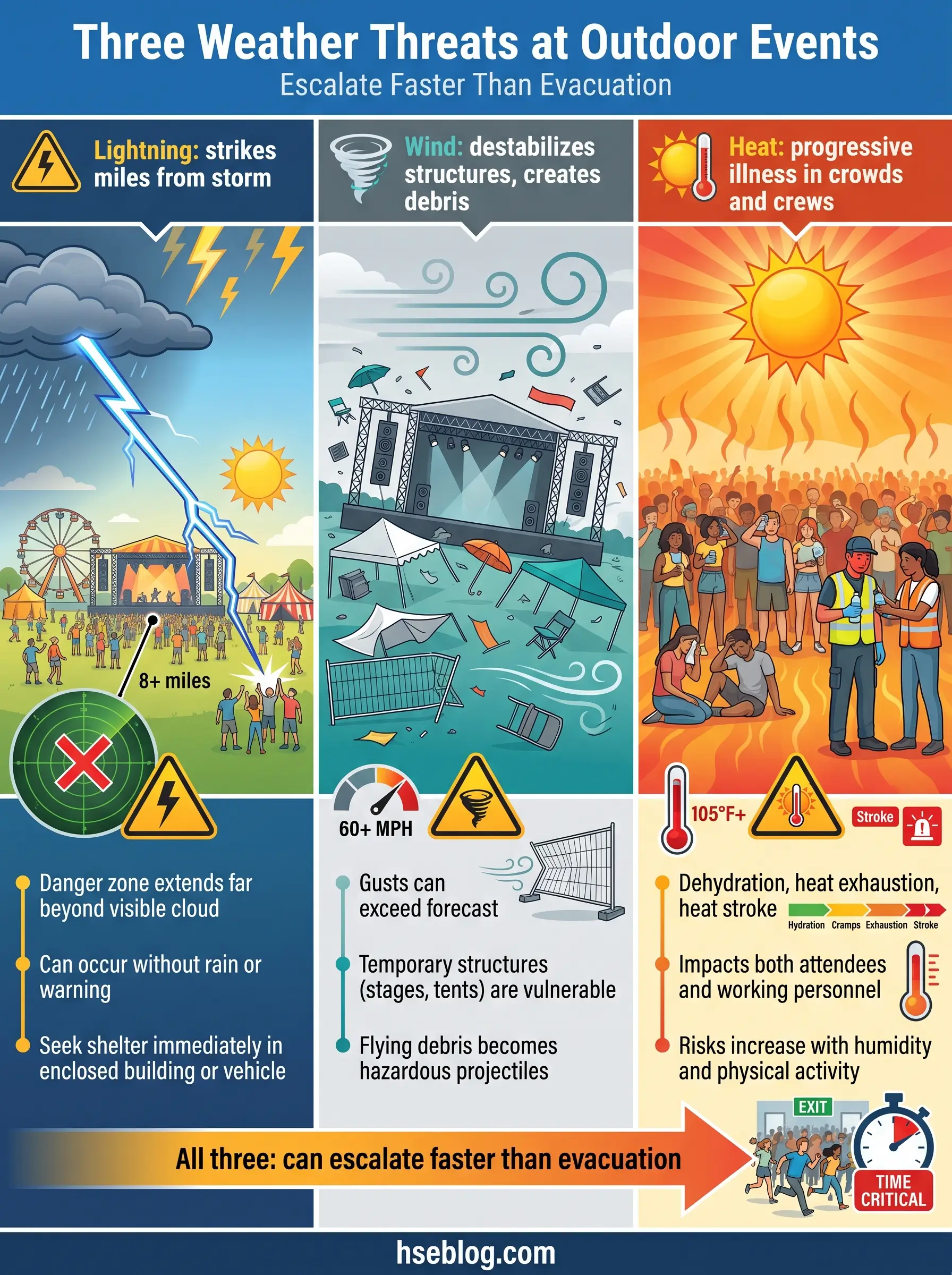
Wind, lightning, and heat are the three hazards most likely to force an event delay, sheltering action, or outright cancellation. Each one operates on a different timescale, targets different vulnerabilities, and demands its own monitoring and control strategy — but all three share a critical characteristic: they can outpace the time needed to protect a large crowd if thresholds are set too late.
Lightning is the warm-season trigger that most frequently stops outdoor events. A strike can occur miles ahead of the parent storm, reaching exposed ground before rain arrives and before most attendees perceive any danger. The threat radius extends well beyond the visible storm cell, which means relying on overhead conditions instead of detection data is already a failure.
Wind threatens the physical infrastructure of an event. Temporary ground-supported structures — stages, tents, truss-supported roofs, LED walls, inflatables, and fencing — are engineered to specific load limits. Once gusts exceed those limits, the structure becomes the hazard. I have watched a vendor tent cartwheel across a festival midway in winds that would barely register as noteworthy on a permanent building. The difference between a permanent structure and a staked canopy is the difference between a controlled environment and a potential projectile.
Heat operates more slowly but affects more people. Attendees standing in direct sun, queuing without shade, or dancing in dense crowds lose thermoregulatory capacity over hours. Event workers — riggers, security, vendors, medical staff — face compounding exposure because their shifts start hours before gates and continue through peak afternoon temperatures. Risk escalates with humidity, direct solar radiation, physical exertion, poor acclimatization, and restricted hydration access.
How Should Organizers Build an Outdoor Event Weather Safety Plan?
ANSI ES1.7-2021, Sections 6 and 7, requires that event organizers conduct risk assessments covering weather forecasting, nowcasting, live monitoring, organizational hierarchy, and documented response actions. That is not a suggestion filed in a best-practices appendix. It is the industry standard for weather preparedness at outdoor events, and it means the plan must exist on paper before any staging begins.
A competent outdoor event weather safety plan addresses six elements in sequence:
- Identify foreseeable hazards by site, season, and crowd profile. A valley venue funnels wind differently than a coastal flat. A summer afternoon event faces heat and convective storms simultaneously. A crowd of 30,000 moves differently than 3,000.
- Set trigger thresholds tied to real evacuation time. If clearing the main stage bowl takes 18 minutes and your lightning alert radius gives you 12 minutes of warning, the math does not work. Thresholds must account for crowd size, mobility limitations, distance to safe refuge, and the speed of approaching hazards.
- Assign monitoring responsibility and stop authority. These are two distinct functions — one person watches data, another holds the authority to halt the show. Both must be documented by name.
- Map shelter capacity and access routes. Every attendee zone needs a designated safe refuge with a realistic capacity number, not an aspirational one.
- Pre-script communication for every scenario. Watch, warning, pause, shelter, evacuation, cancellation, all-clear — each needs a message ready to broadcast.
- Define resumption criteria. Stopping is only half the decision. The plan must specify exactly what conditions allow restart.
Assign a Weather Liaison and Decision Authority
The person monitoring weather data cannot also be managing stage changeovers, coordinating vendors, or responding to medical calls. ANSI ES1.7-2021, Section 7.1, requires a named responsible person with clear authority for weather-related risk assessment and action.
On a multi-stage festival I supported, the production manager initially wanted to handle weather calls himself. By mid-afternoon on day one, he was simultaneously managing a delayed headliner, a catering dispute, and a lighting rig issue. When the lightning alert came through, he did not see it for eleven minutes. We restructured the plan overnight. The weather liaison became a standalone role with one job: watch the sky and the data, and communicate directly with the person who holds stop authority.
Watch For: Decision authority that defaults to the most senior person on site rather than a designated individual. Seniority does not equal situational awareness. The person who makes the stop call must be the person watching the data — or in direct, uninterrupted contact with them.
Base Trigger Distances on Evacuation Time, Not Guesswork
The gap between "hazard detected" and "crowd protected" is the most dangerous window in outdoor event safety. A lightning detection alert 10 miles out means nothing if your venue takes 25 minutes to clear. An anemometer reading of 35 mph is not useful if nobody has calculated how long it takes to deflate inflatables and restrict access to vulnerable structures.
The NWS Event Ready guide stresses that event organizers must match their warning thresholds to actual evacuation and sheltering timelines. This means conducting timed drills or realistic estimates for each crowd zone, not assuming that people will move quickly because an announcement tells them to.
What Weather Monitoring Should Happen Before and During the Event?
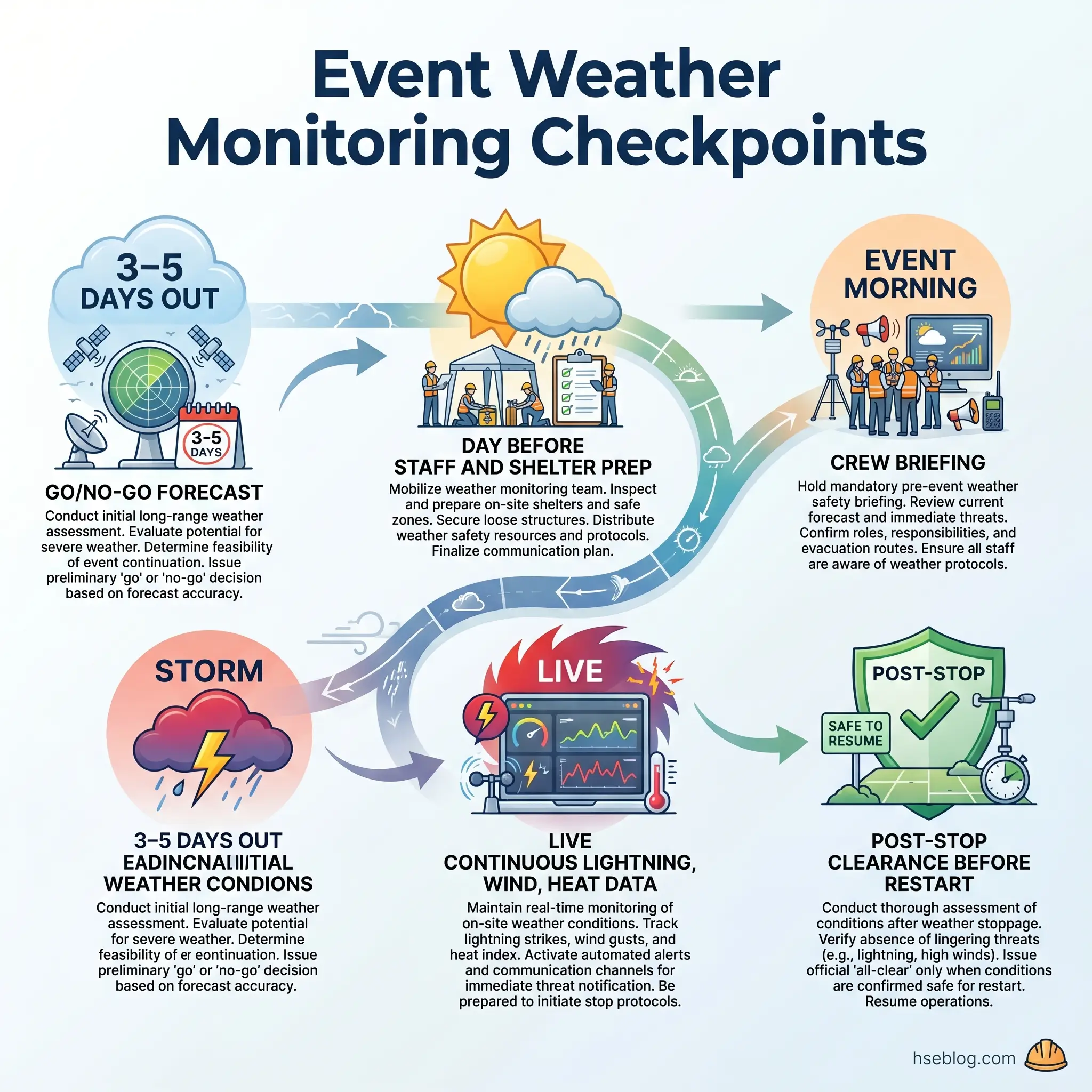
ANSI ES1.7-2021, Sections 6.1–6.2, breaks weather monitoring into forecasting, nowcasting, and live on-site observation. Each serves a different planning horizon, and skipping any one of them creates a blind spot.
Pre-Event Forecast Timeline
Three to five days before the event, pull extended forecasts to assess the probability of severe weather during your event window. This is the go/no-go planning horizon — the point where you decide whether to pre-position extra water and shade, stage additional medical staff, prepare cancellation messaging, or adjust the schedule to avoid peak heat hours.
The day before the event, shift to short-range forecasts. Confidence increases significantly at this range, and decisions about staffing levels, shelter readiness, structure inspections, and vendor briefings should lock in.
Event-day briefings should happen at least twice: once before crew call and once before gates. Every department lead — production, security, medical, vendors, front-of-house — needs to know the forecast, the trigger thresholds, and exactly what they are expected to do if a weather stop is called.
On-Site Monitoring Tools
During the event, three monitoring streams should run continuously:
- Lightning detection or alert service. Subscribe to a professional detection network or a trusted meteorological service that provides real-time strike data with distance and approach speed. The NWS lightning safety guidance is the baseline reference. Do not rely on phone apps alone.
- Anemometers for wind. Place them at exposed positions representative of where temporary structures stand — not behind a loading dock wall. ANSI E1.21-2024 reinforces that temporary outdoor structures must be maintained within their engineered safety parameters, which means knowing the actual wind speed at the structure, not at the nearest airport.
- Heat monitoring. Wet Bulb Globe Temperature (WBGT) instruments provide the most operationally useful heat data because they account for humidity, radiant heat, and air movement simultaneously. Where WBGT is unavailable, heat index monitoring from on-site or nearby weather stations is the minimum.
Lightning Safety for Outdoor Events: When Should You Stop and When Can You Resume?
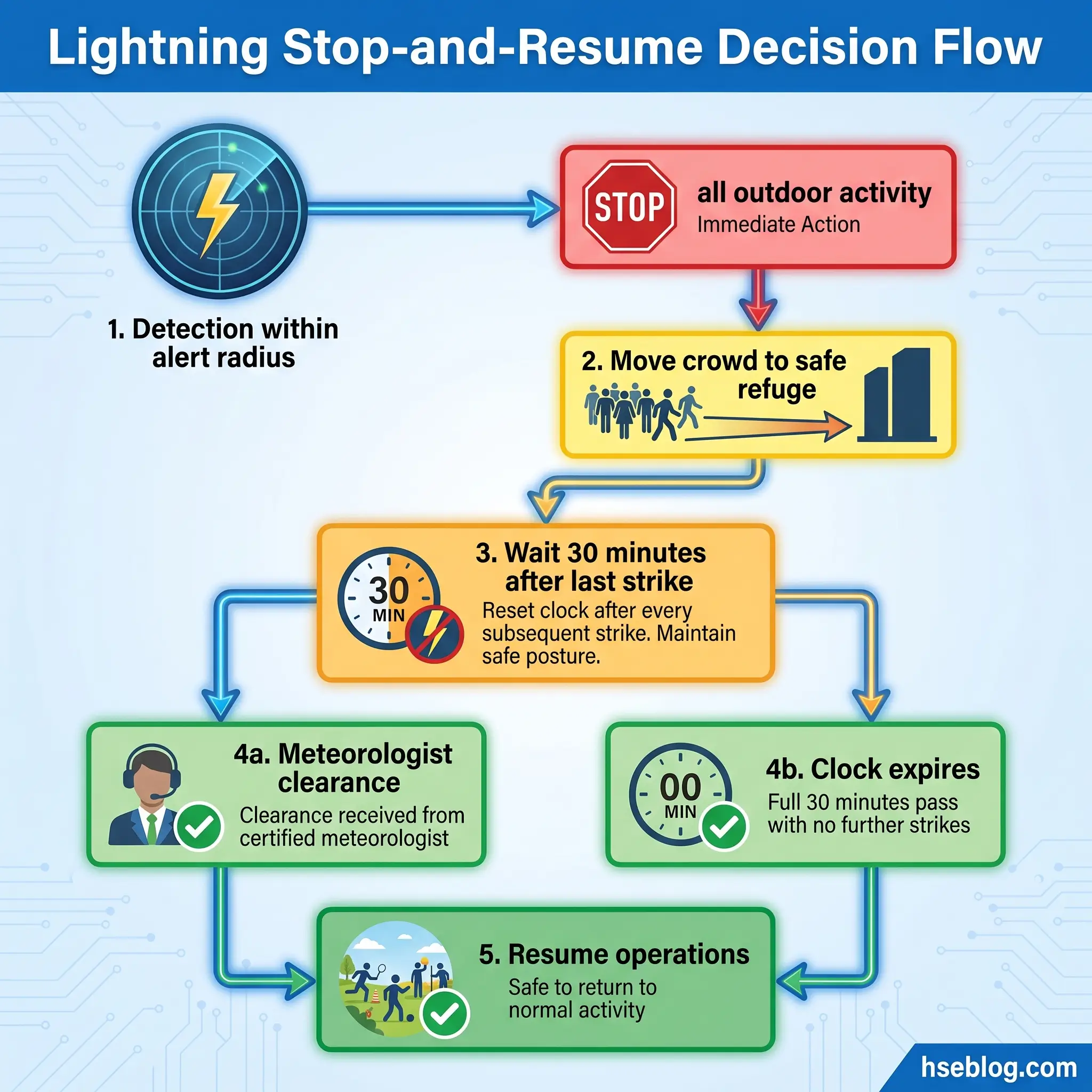
When thunder is heard or lightning is detected within the event's alert radius, all outdoor activity stops. Full stop. Not "let's wait and see," not "the headliner has two songs left." Performers clear the stage. Attendees move to designated safe refuge. Crew in exposed positions — rigging towers, loading docks, open fields — take shelter immediately.
A colleague once told me the hardest decision he ever made was calling a show stop with 40,000 people in the bowl and the headline act mid-set. The promoter was furious. Fourteen minutes later, a bolt struck the main stage lighting tower. Nobody was on it. That was not luck. That was a plan executing exactly as designed.
Safe Shelter for Lightning
This is where most event plans fail quietly. A tent is not safe shelter. A canopy is not safe shelter. An open-sided grandstand is not safe shelter. A picnic pavilion with no walls is not safe shelter.
Safe shelter for lightning means a substantial, fully enclosed building with wiring and plumbing — or an enclosed, hard-topped vehicle. For large-scale events, this typically means on-site permanent buildings, nearby commercial structures, or designated parking areas where attendees can shelter in vehicles. The plan must identify these locations by name, map walking routes to them, and calculate whether the capacity is realistic for the crowd size.
Suggested Event-Specific Lightning Thresholds
Many established event safety plans and campus operations use an alert radius of approximately 8 miles for initiating shelter-in-place or postponement actions. This is not a universal legal threshold — it is an operational practice built around the time needed to clear a large venue before a fast-moving storm arrives.
ANSI ES1.7-2021, Section 8.2.2, specifies that lightning-related show stops should not resume until 30 minutes have passed with no new strikes inside the alert radius, or until a professional meteorologist provides clearance. The 30-minute clock resets with every new detection. At a three-day festival with afternoon convective activity, I have seen the clock reset four times in a single afternoon. Patience is not optional.
Wind Safety for Tents, Stages, Inflatables, and Loose Equipment
Wind is the weather hazard most often underestimated at outdoor events because it is the one people think they can see and feel in real time. They cannot — not accurately, and not fast enough. A gust that exceeds a tent's anchor rating does not give you a warning. It gives you a tent in the air.
What Wind Thresholds Should an Event Use?
There is no single universal wind speed that applies to every outdoor event. The action limit for any temporary structure depends on its engineering design, manufacturer specifications, anchoring method, ballast weight, permit conditions, and jurisdictional requirements. ANSI E1.21-2024 makes this explicit: temporary outdoor structures must operate within their designed safety parameters, which means the manufacturer's rated wind load — not a rule of thumb from the internet — is the governing limit.
That said, many event and venue operations plans use general operational triggers as a starting framework. Common practice calls for heightened awareness and securing of loose items when sustained winds approach moderate levels, restricting access to vulnerable structures like inflatables and open-sided tents when gusts strengthen, and stopping operations and evacuating exposed areas when gusts reach levels that threaten structural integrity. The specific numbers must come from the structure's engineering documentation, not from a generic chart.
Field Test: Walk behind the main stage during load-in and identify every item that is not bolted, strapped, weighted, or staked. Signage panels, cable covers, empty flight cases, trash bins, stacked barriers. Each one is a potential projectile. If the wind picks up and you cannot secure it in under two minutes, it should not be there.
Daily Inspection Points Before Gates Open
Every morning before the event opens, a physical inspection should cover anchors and stakes on all tent and canopy structures, ballast weights on freestanding frames, guy-line tension and connection points, rigging hardware and truss pins, fencing panels and their base connections, signage and banner attachments, inflatables and their tether systems, LED wall bracing, and all loose back-of-house materials including empty cases, pallets, and unsecured waste bins.
Wind risk is not only about the big structures. A loose A-frame sign in a pedestrian corridor becomes a different object at 40 mph.
Heat Safety for Staff, Vendors, Performers, and Attendees
Twelve hours before the crowd arrives, the setup crew is already on site. Riggers are climbing truss in direct sun. Security staff are walking perimeter fencing in full uniform. Vendor teams are unloading trucks across asphalt that will reach surface temperatures far exceeding ambient air. By the time attendees enter, these workers are already hours into heat exposure — and their risk assessment is often an afterthought.
OSHA's heat guidance is clear: employers must provide water, rest, shade, and a written heat illness prevention plan. The HSE UK outdoor working guidance adds rescheduling work to cooler hours and increasing rest break frequency. For event operations, these controls must cover every category of worker — not just permanent employees.
Use Heat Index or WBGT?
Heat index is a useful communication tool for attendees and public messaging because it uses temperature and relative humidity — numbers most people understand. But for operational risk assessment at an outdoor event, WBGT is the stronger metric.
ANSI ES1.7-2021, Sections 9.1–9.2, specify that heatstroke and dehydration risks should be evaluated using the WBGT hazard table. WBGT captures what heat index misses: radiant heat from sun-exposed surfaces, air movement, and the effect of direct solar load. On a festival site where half the crowd is standing on asphalt in full sun and the other half is under shade structures, heat index gives you one number. WBGT gives you a number that reflects what those bodies are actually experiencing. For worker safety decisions — rest cycles, shade requirements, activity restrictions — WBGT is the professional standard.
Hydration, Rest, Shade, and Schedule Changes
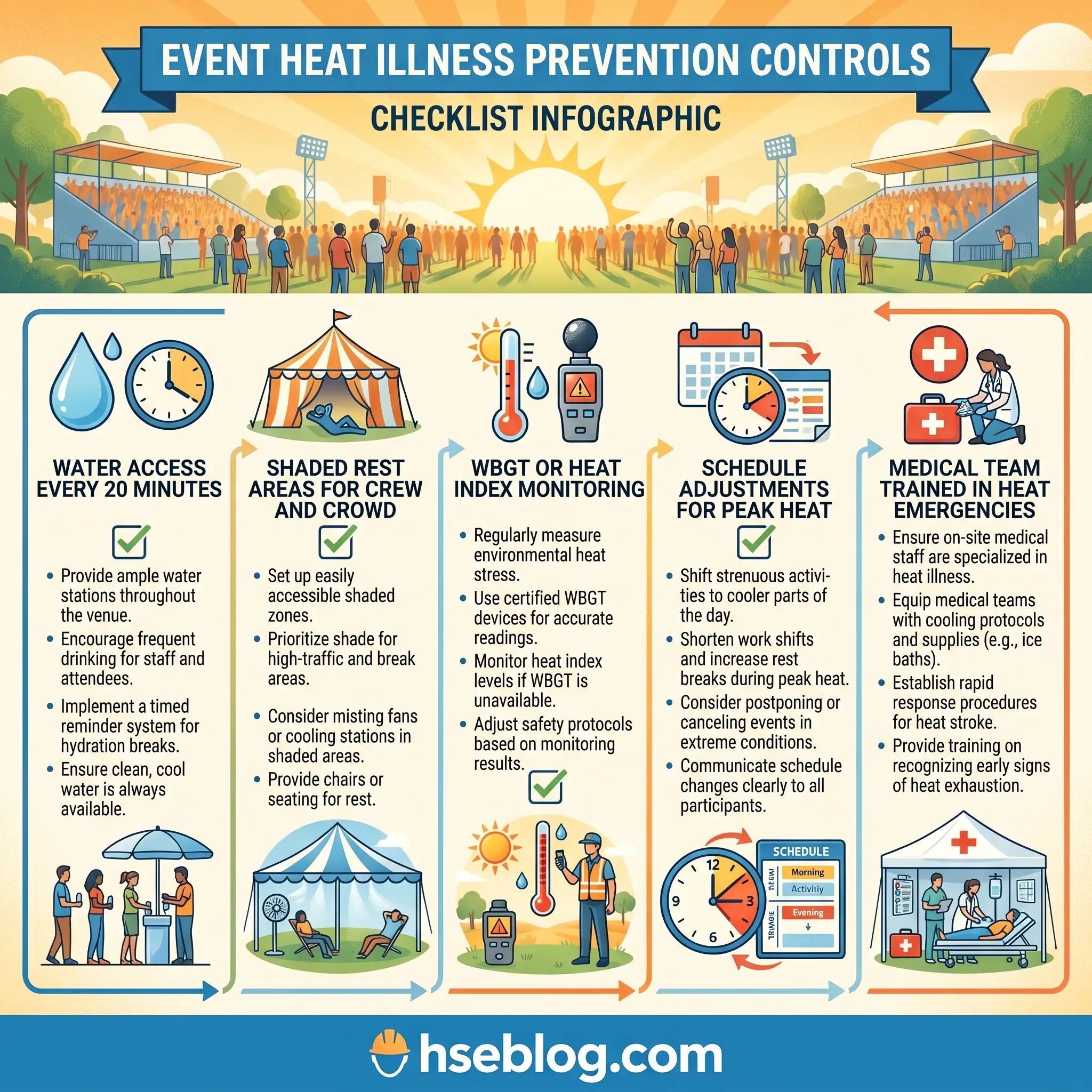
OSHA recommends that workers drink at least one cup of water every 20 minutes during heat exposure. For an event running a 12-hour operational day in high heat, that means hydration infrastructure is not a nice-to-have — it is a medical control.
Practical measures for both workers and attendees include early load-in start times to reduce peak-heat rigging work, shaded queuing areas at entry gates and concession points, free water refill stations distributed across the venue footprint, misting or cooling zones in high-density crowd areas, a buddy system for crew in exposed positions, reduced or rescheduled afternoon programming during extreme heat days, and additional medical staff with heat illness training staged during peak hours.
Higher-risk groups include workers in their first week on site who have not acclimatized, older adults, children, pregnant attendees, people with chronic health conditions, and anyone engaged in strenuous physical activity while wearing heavy clothing or PPE.
How Do You Recognize and Respond to Heat Exhaustion, Heat Stroke, and Lightning Injury?
Event medical teams carry the clinical expertise, but frontline staff — security, stage managers, vendor supervisors, volunteer coordinators — are the first people to see someone in trouble. They need recognition skills, not diagnosis skills.
Heat exhaustion presents as heavy sweating, headache, nausea, dizziness, weakness, and thirst. The person is still sweating and still conscious, but they are deteriorating. Move them to shade, provide cool water, apply cool cloths, and monitor. If symptoms do not improve within 15 minutes, escalate to medical.
Heat stroke is a medical emergency. The person may stop sweating. Confusion, slurred speech, collapse, seizure, or very high body temperature signals that the body's thermoregulation has failed. Call emergency services. Cool the person aggressively — cold water immersion if available, ice packs to neck, armpits, and groin if not. Do not wait. The CDC/NIOSH heat illness guidance and NWS heat illness page provide plain-language recognition steps that should be part of every event staff briefing.
Lightning strike victims are safe to touch — there is no residual charge. Call emergency services immediately. If the person is unresponsive and not breathing, begin CPR if trained. Multiple casualties are possible from a single strike event, so triage may be necessary.
Audit Point: Ask your medical team how many heat-related cases they treated at the last comparable event. Then ask whether frontline staff were briefed on recognition. If the answer to the second question is no, your first-aid response chain has a broken first link.
What Should the Weather Communication Plan Say?
Most event safety plans include the instruction "communicate clearly with attendees." That is not a plan. That is a wish. A communication plan specifies what is said, through which channels, to which audiences, in what order, and who authorizes the message.
Pre-script messages for each escalation level: weather watch, weather warning, operational pause, shelter-in-place, directed evacuation, full cancellation, and all-clear for resumption. Each message must tell people exactly where to go — not just that weather is approaching.
Channels should operate simultaneously: PA system, video screens, two-way radios to staff, SMS or app push notifications to attendees, and direct briefing to vendor and production teams. The staff channel must activate before the public channel. Security and medical need to be in position before 30,000 people start moving.
Watches vs Warnings vs Observed Conditions
A watch means hazardous weather is possible in the area. It is a planning trigger — check readiness, brief staff, confirm shelter access.
A warning means hazardous weather is occurring, imminent, or likely. It is an action trigger — execute the relevant portion of the weather safety plan.
Observed local conditions — a sudden wind gust, a visible wall cloud, a rapid temperature spike, thunder heard on site — may require action even before a formal watch or warning reaches the venue. The weather liaison must have authority to act on local observations, not only on official meteorological products.
When Should an Outdoor Event Be Delayed, Paused, or Canceled?
This is where the entire event weather contingency plan converges into a single operational question: can we keep people safe, or can we not?
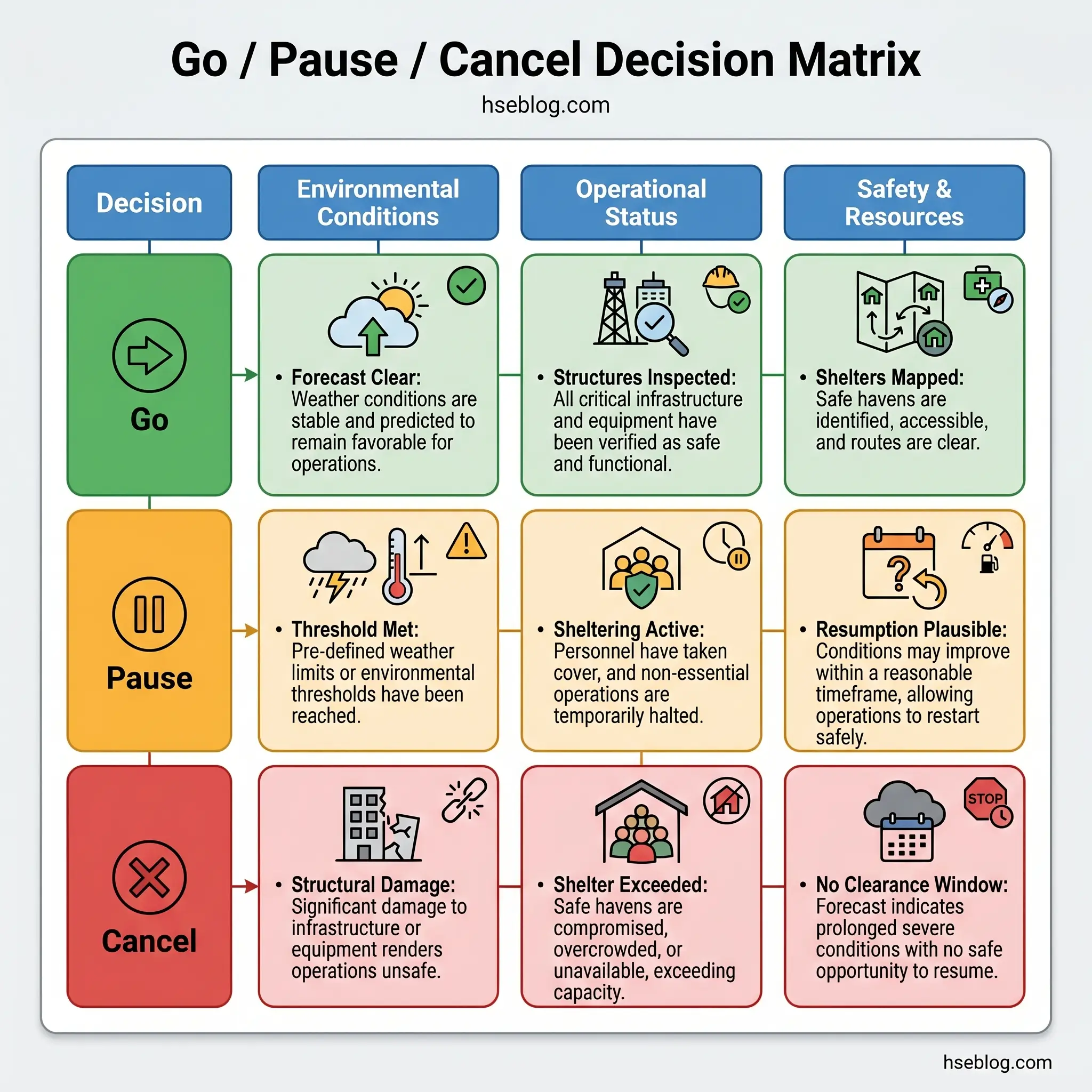
Delay or cancel before gates when forecast severity is high, venue vulnerability is significant, and the ability to shelter or evacuate the expected crowd within the hazard's arrival window is inadequate. A cancellation before gates open is a financial loss. A structural failure with a full venue is a criminal investigation.
Pause operations when a trigger threshold is met — lightning detection inside the alert radius, wind gusts approaching structure limits, WBGT entering high-risk range — but conditions are expected to improve and safe resumption remains plausible. The pause activates sheltering, medical standby, structure checks, and crowd messaging simultaneously.
Cancel during the event when structural damage has occurred, medical capacity is overwhelmed, shelter capacity is insufficient, or meteorological clearance is not achievable within a reasonable window. ANSI ES1.7-2021, Section 8.2.1, specifies that wind-related show stops should not resume until wind speeds remain below trigger thresholds for at least 30 minutes, or a professional meteorologist approves. The same 30-minute principle applies to lightning under Section 8.2.2.
"How long do we wait before canceling?" a stage manager asked me during a two-hour lightning hold at a 20,000-capacity event. The answer was not a number. The answer was: "Until the meteorologist says it is safe, or until we determine it will not be safe tonight." There is no middle ground.
Outdoor Event Weather Safety Checklist for Organizers
This checklist consolidates the operational framework into a scannable reference. It is not a substitute for a site-specific severe weather plan — it is the minimum structure that plan should contain.
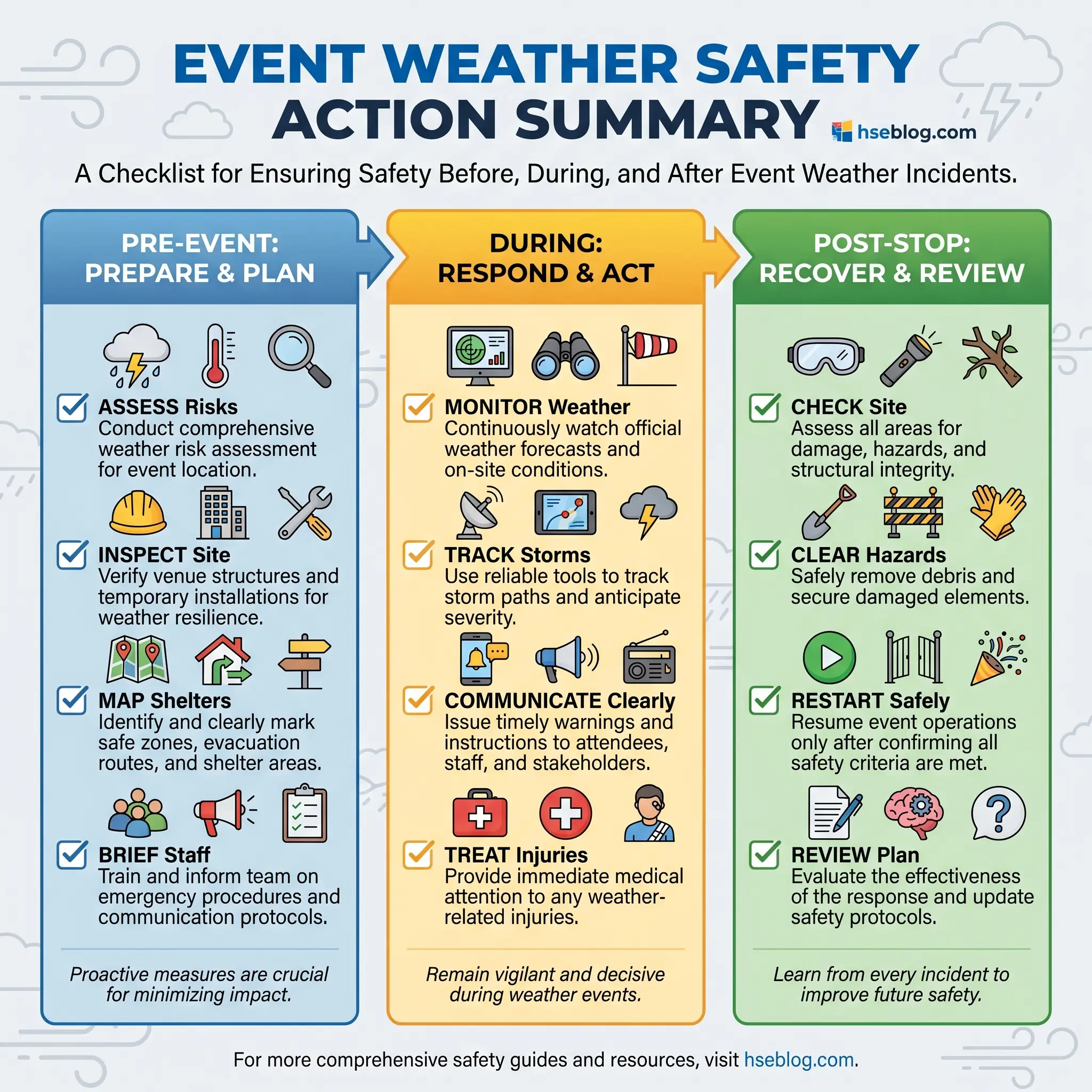
Before the event:
- Site risk review: Identify wind exposure zones, lightning-vulnerable areas, heat-amplifying surfaces, and crowd bottlenecks.
- Forecast checks: Begin 3–5 days out; shift to short-range day-before; lock staffing and shelter prep.
- Structure inspection: Verify anchors, ballast, rigging, guy-lines, inflatables, fencing, signage, and LED walls against manufacturer wind ratings.
- Shelter mapping: Identify, capacity-check, and sign-post all safe refuge locations. Confirm access routes.
- Medical prep: Stage heat illness supplies, brief frontline staff on recognition, confirm emergency service access.
- Communication prep: Pre-script all messages. Test PA, screens, radios, and digital channels.
- Roles assigned: Weather liaison named. Stop authority documented. Chain of communication confirmed.
During the event:
- Active monitoring: Lightning detection, anemometers, and WBGT or heat index running continuously.
- Threshold tracking: Weather liaison confirming status at regular intervals and after any change.
- Staff communication: Immediate radio relay to security, medical, stage management, and vendor leads.
- Crowd messaging: Pre-scripted messages deployed through all channels simultaneously.
- Medical surveillance: Heat casualty tracking and lightning response readiness throughout.
After a weather stop:
- Damage check: Inspect all temporary structures, rigging, electrical systems, and crowd infrastructure before anyone re-enters.
- Meteorological clearance: 30-minute clock satisfied for lightning or wind, or professional meteorologist approval obtained.
- Staged restart: Staff repositioned, medical confirmed, crowd re-entry managed — not a sudden "all clear."
- Incident review: Document what triggered the stop, what worked, what did not, and what changes are needed for the next show day.
Frequently Asked Questions
What is the safest shelter during lightning at an outdoor event?
A substantial, fully enclosed building with internal wiring and plumbing offers the best protection. Enclosed hard-topped vehicles are the next best option. Tents, canopies, open-sided pavilions, and grandstands without walls are not safe lightning shelters, regardless of their size. The plan should map these safe refuge locations and their realistic capacity before the event.
How far away can lightning still be dangerous for an event?
Lightning can strike several miles from the parent thunderstorm, well ahead of visible rain or audible thunder at the storm's core. The NWS emphasizes that waiting for rain overhead is already too late. This is why event plans set alert radii — commonly around 8 miles for initial action — that account for the time needed to move crowds to shelter before the strike zone reaches the venue.
At what wind speed should an outdoor event stop?
There is no single universal threshold. The action limit depends on the engineering design, manufacturer wind rating, anchoring method, and permit conditions of each temporary structure on site. Inflatables typically have lower thresholds than engineered stage roofs. The correct approach is to obtain the rated wind limit for every structure and set escalating response triggers below those limits — not to pick a round number and apply it everywhere.
How can event organizers prevent heat illness?
Prevention requires accessible water — OSHA recommends at least one cup every 20 minutes during heat exposure — along with shaded rest areas, cooling zones, schedule adjustments to reduce peak-heat activity, acclimatization planning for workers new to the site, and trained medical staff. Higher-risk individuals include new workers, children, older adults, pregnant people, and anyone performing strenuous activity in direct sun.
Should outdoor events use heat index or WBGT?
Heat index works well for public-facing communication because it uses temperature and humidity that attendees understand. WBGT is the stronger operational tool because it accounts for radiant heat, air movement, and solar load — factors that make a significant difference on an open festival site. ANSI ES1.7-2021 specifies WBGT for event heat risk assessment. Where possible, use WBGT for operational decisions and heat index for attendee messaging.
Who should make weather stop decisions at an event?
A designated weather liaison or authorized decision-maker with explicit stop authority, documented by name in the event weather safety plan. This person should not be burdened with competing operational duties. ANSI ES1.7-2021, Section 7.1, requires that this organizational hierarchy and named responsible person be established before the event.
Pull your most recent event weather plan off the shelf — the one you actually used, not the one filed for the permit. Open it to the section on trigger thresholds and ask one question: does the time between our earliest detection and our slowest evacuation zone actually work? If the answer requires assumptions about crowd cooperation, favorable wind direction, or storms that conveniently slow down, the plan is a document, not a system. The difference between those two things is the difference between an event that weathers the storm and one that becomes the storm's casualty.
Outdoor event weather safety is not a checklist completed once during permitting. It is a live operating discipline that runs from the first site survey through the final teardown. The OSHA heat rulemaking process — with public hearings concluded in mid-2025 but a final rule still pending — signals that regulatory expectations are tightening, not relaxing. ANSI E1.21's 2024 update to temporary outdoor structure standards reinforces the same trajectory. The organizers who treat weather safety as an integrated operations function, rather than a page in a binder, are the ones whose events run year after year. The ones who do not are the ones whose names appear in investigation reports.