
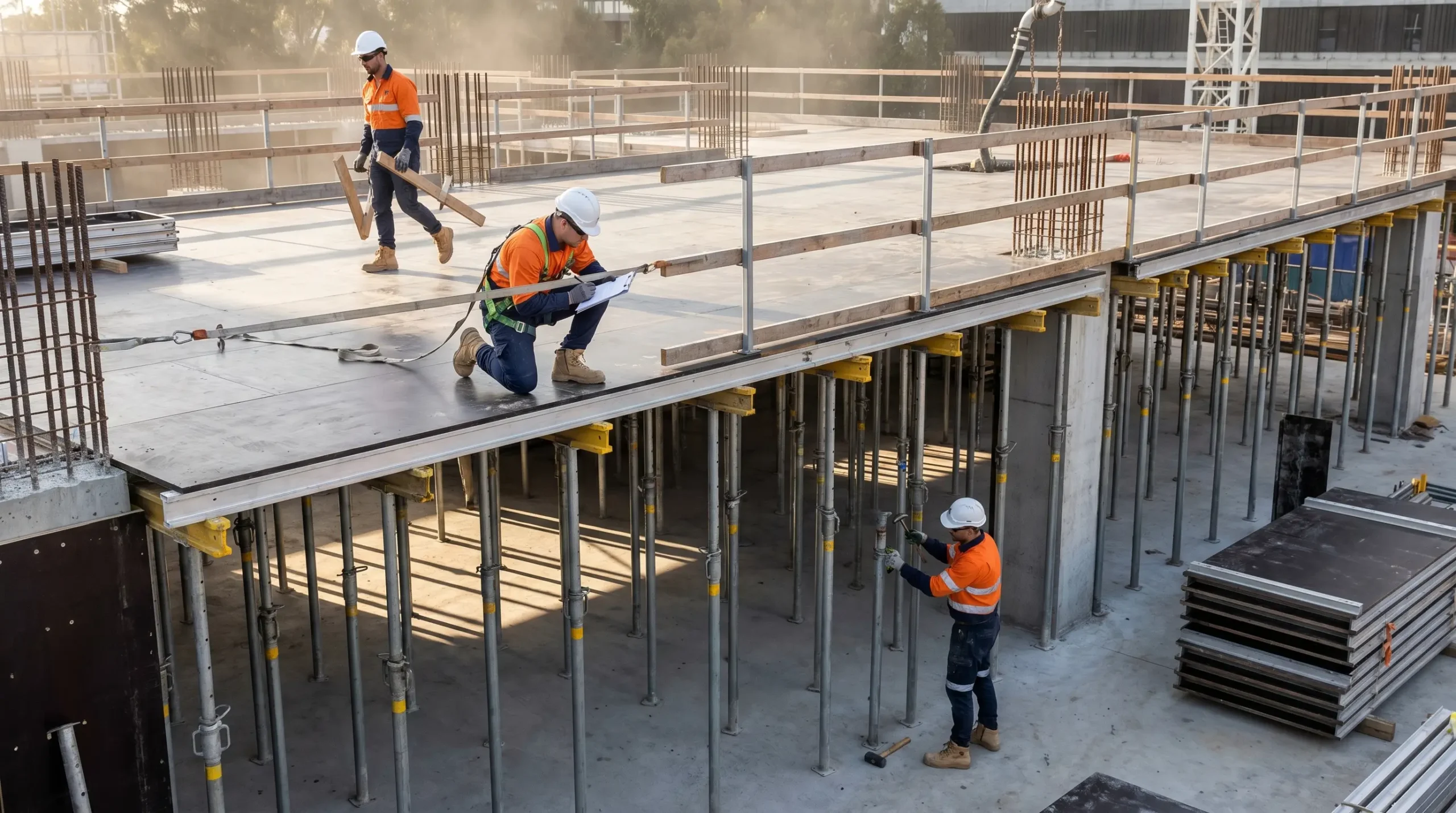
TL;DR — The Numbers That Define This Hazard
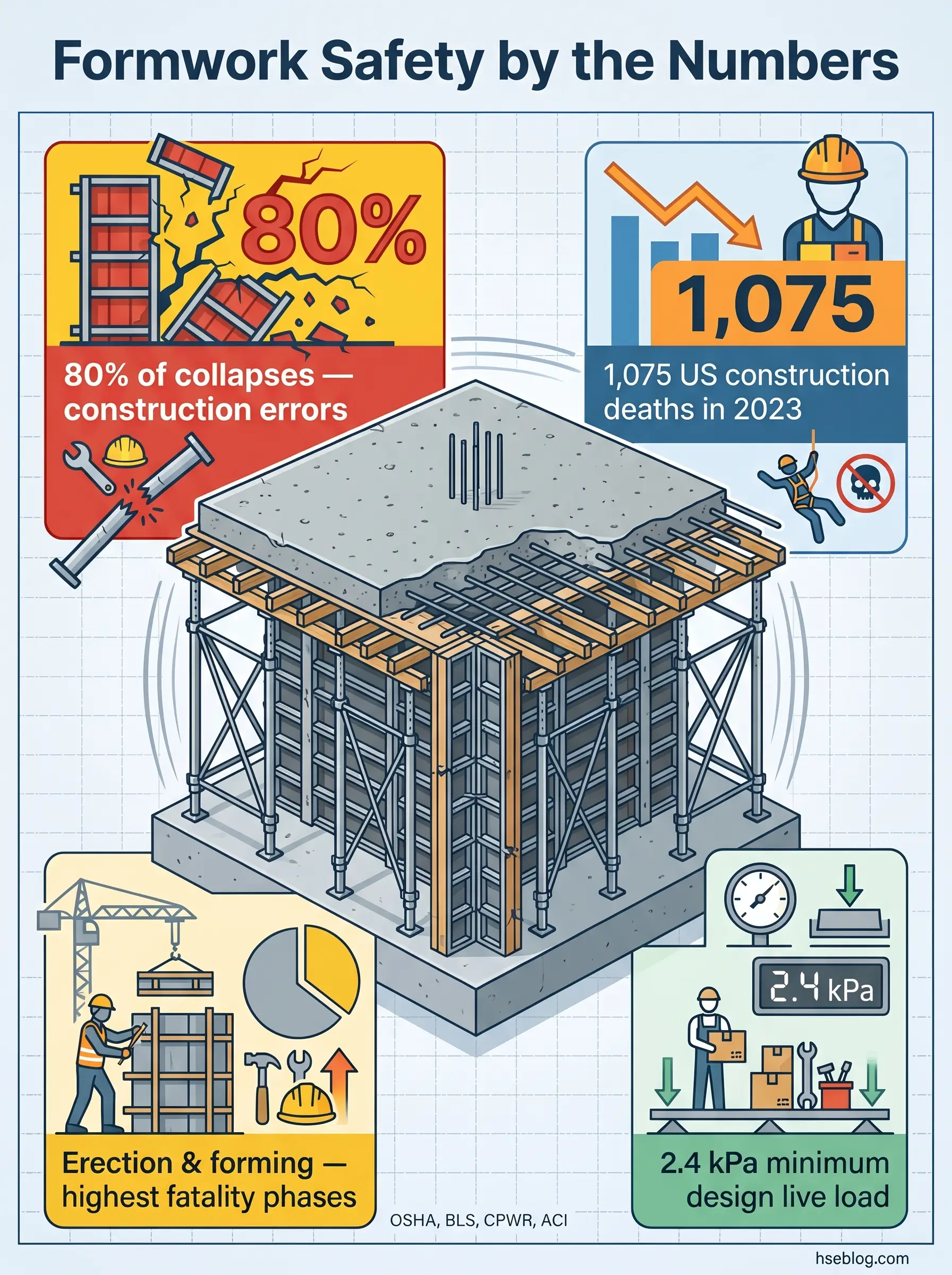
- 1,075 fatal construction injuries recorded in the US in 2023 — the highest count since 2011 (US Bureau of Labor Statistics, 2024).
- 80% of structural collapses during US construction (1990–2008) were attributed to construction errors, not design flaws (OSHA Engineering Reports, 2009).
- 29 of 438 analysed formwork-related fatalities occurred during erection and 22 during forming — the two highest-risk activities in the lifecycle (CPWR, 2017).
- 2.4 kPa (50 psf) minimum live load for slab formwork design, rising to 3.6 kPa (75 psf) with motorised buggies (ACI 347R-14, 2014).
Formwork safety controls the catastrophic hazards of temporary concrete-mould and support structures during erection, placement, and stripping. Collapse, falls from height, struck-by falling objects, and crush injuries dominate the fatality record. Competent engineered design, jurisdictionally compliant inspection at three distinct phases, and disciplined reshoring prevent most of these failures.
Formwork Safety: Why Temporary Structures Carry Permanent Consequences
Formwork holds wet concrete in place — a structural role — but it stops existing the moment the concrete cures. That paradox is where its danger lives. Between the first panel set and the last shore struck, the temporary structure carries the full weight of a permanent one, often with workers standing on top of it, beside it, and underneath it. When it fails, it fails catastrophically. OSHA investigated 96 structural collapses across US construction between 1990 and 2008, and roughly 80 percent were traced to construction errors rather than design flaws (OSHA Engineering Reports, 2009). The pattern is not random. It is the signature of temporary works treated as a carpentry task rather than an engineered deliverable.
Formwork incidents rarely kill one worker. They kill the two on the deck, the three placing below, and the supervisor walking the line — all in the same moment. In 2023, the US construction industry recorded 1,075 fatal injuries, the highest total since 2011 (US Bureau of Labor Statistics, 2024), and temporary-works collapses contribute disproportionately to the cluster-fatality subset of that count. This article maps the full span of formwork safety: the hazards by phase, the engineering drivers of failure, the three principal regulatory regimes you might be working under, and the best practices that consistently prevent catastrophic outcomes on real pours.
Competent-Person Caveat: This article provides general HSE knowledge on formwork and falsework. Design, load verification, and pour supervision are life-critical engineering activities that must be planned, checked, and signed off by a competent designer, qualified engineer, or Temporary Works Coordinator with jurisdiction-specific authorisation. The information here does not replace engineered drawings, site-specific risk assessment, or statutory inspection duties.
What Counts as Formwork? Scope and Common Systems
Formwork is defined under OSHA 29 CFR 1926.701 (US) as the total system of support for freshly placed or partially cured concrete. In UK and Australian practice, the term narrows: formwork is the mould and its immediate contact elements, while falsework is the temporary supporting structure beneath — the props, shores, and towers that carry formwork and its concrete load until the pour becomes self-supporting. OSHA bundles both under one term; CDM 2015, BS 5975-2:2024, and AS 3610 separate them. This article uses the separated terminology except where quoting US regulation directly.
The hazard profile shifts by system type, and any best-practice conversation should be grounded in which system the site is running.
| System Type | Typical Use | Key Safety Consideration |
|---|---|---|
| Timber / plywood | Low-rise, bespoke geometry, small pours | Component variability, reuse degradation, nail injuries |
| Modular proprietary panels | Repetitive walls, columns, slabs | System-specific load ratings; mixing components prohibited without competent-designer authorisation (AS 3610.1:2018) |
| Jump form | High-rise cores | Engineered climbing mechanism; fall-from-platform risk |
| Slip form | Continuous vertical pours (silos, towers) | Continuous supervision required; failure modes include skin friction overload and reinforcement misalignment |
| Climbing form | Tall walls, dam faces | Anchor pull-out failure is the dominant collapse mode |
A recurring failure precursor across every regime is the mixing of components from different proprietary systems — props from system A used to support a deck of system B because they “fit.” Load ratings are certified system by system and do not transfer. AS 3610.1:2018 prohibits this practice without written competent-person authorisation, and the equivalent prohibition operates in BS 5975 through the design verification chain.
The Main Hazards in Formwork Operations
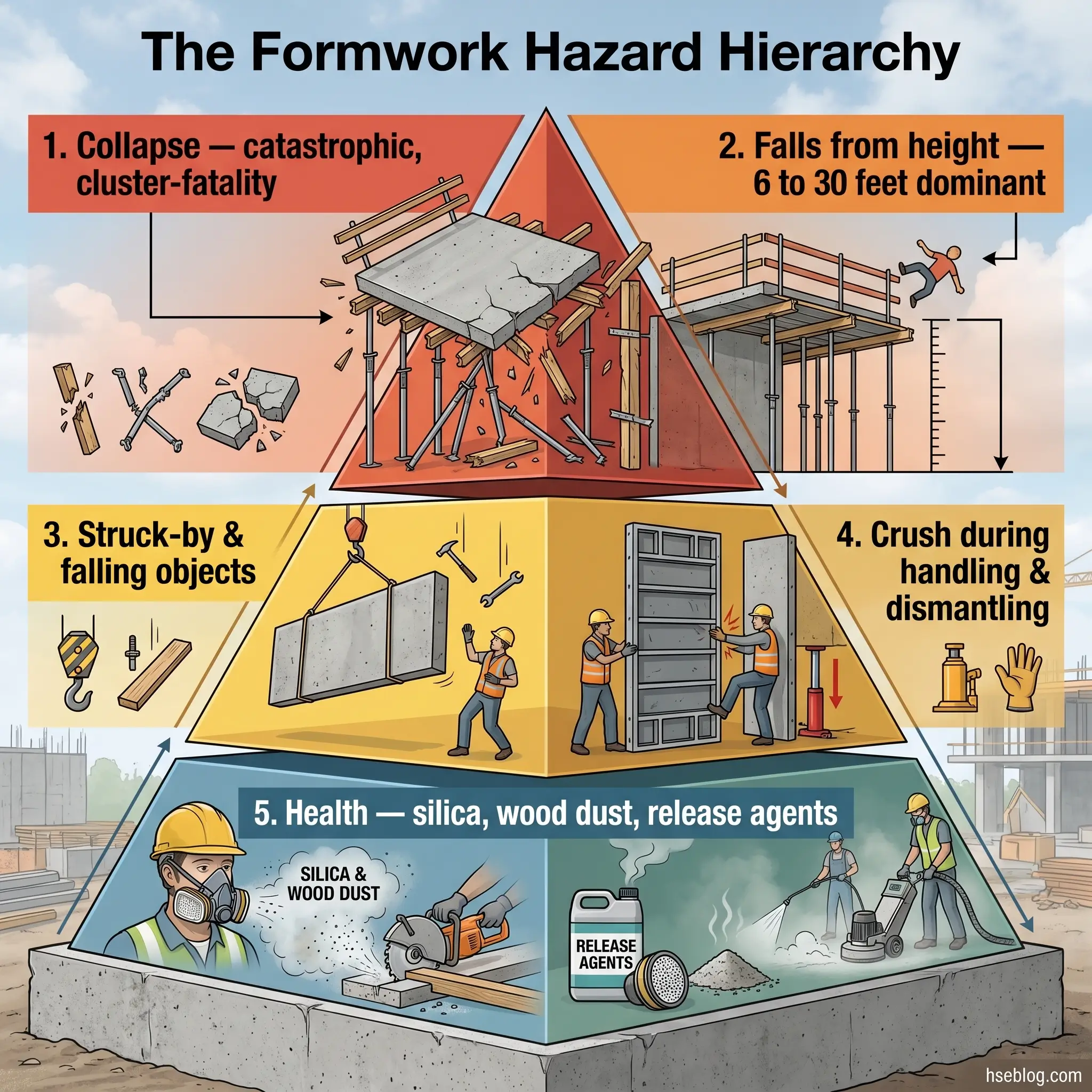
The US construction industry recorded 1,032 fatalities in 2024, with fatal falls, slips, and trips falling to 370 (US Bureau of Labor Statistics, 2026) — still the category that dominates construction death. Within formwork specifically, CPWR analysed 438 formwork-related OSHA fatality reports and found erection (29 fatalities) and forming (22 fatalities) the highest-risk activities (CPWR, 2017). A ranked hazard inventory — not a flat list — reflects that distribution.
Formwork and Falsework Collapse
Collapse is the signature catastrophic hazard. Four mechanisms dominate: overloading beyond design capacity, inadequate bracing (especially lateral), defective or degraded reused components, and uplift during placement when pour rates exceed the assumptions baked into the form design. The pattern consistently flagged in OSHA investigation reports is as-built formwork that deviates from the stamped drawing — a pipe brace omitted, a hold-down anchor downsized to “what was on the truck” — with the deviation neither flagged nor recalculated before the pour. Roughly 80 percent of investigated structural collapses fit this pattern; only 20 percent were attributable to design flaws (OSHA Engineering Reports, 2009). Collapse, in other words, is overwhelmingly an execution problem.
Falls from Height During Erection, Working, and Stripping
Three fall modes run through formwork work: falls from the unguarded deck edge, falls through deck openings around columns or shafts, and falls caused by tying off to formwork bracing that subsequently fails. The third mode is the one that sits badly in field practice — bracing is convenient, it looks solid, and a worker thirty feet up will choose what is within reach. Anchorage for fall-arrest must be independent of the temporary works being erected. The reasoning is simple: if the structure you are tied to collapses, your harness is a passenger, not a safety system.
Within US construction in 2023, 64.4 percent of fatal falls to a lower level occurred from between 6 and 30 feet (US Bureau of Labor Statistics via Safety+Health Magazine, 2024) — the exact height range in which most formwork deck work takes place.
Struck-By and Falling Objects
Loose panels, hand tools, form ties, ejected nails, and dropped debris threaten workers below the deck. Controls include toe-boards, catch platforms or debris nets, exclusion zones clearly barricaded at ground level, and tool lanyards for work above open areas. The exclusion zone is the control most frequently undermined by subsequent trades creeping into the area once initial erection appears complete.
Crush and Entrapment During Handling and Placement
Heavy panels, form tables, and crane-slung wall forms generate hand-crush risks at pinch points during assembly, tipping-crush risks when panels are upended without restraint, and entrapment during uncontrolled dismantling. The dismantling risk is persistently underweighted because the hazard — components no longer under structural load — is assumed to be lower than erection. It is not. Stripped forms retain stored energy from wedges, ties, and jammed interfaces.
Manual Handling and Musculoskeletal Injury
Formwork is heavy, awkward, and handled repeatedly. Mechanical aids, two-person lifts, task rotation, and weight marking on components reduce the cumulative injury load. Erection and stripping are also where workers themselves self-report the highest perceived risk in CPWR’s survey work (CPWR, 2017) — a useful leading indicator that often precedes the lagging indicator of recorded injuries.
Health Hazards: Release Agents, Sawdust, Silica, and Noise
Mineral-oil and solvent-based form-release agents carry dermatitis and respiratory-irritation risk; cutting formwork timber generates wood dust classified as a Group 1 carcinogen for certain hardwoods (IARC); cutting and grinding cured concrete generates respirable crystalline silica; and saws, nail guns, and vibrators drive sustained noise exposure. Each requires its own hierarchy-of-controls assessment — ventilation and tool-based dust extraction dominate at the upper tiers, respiratory PPE at the lower.
Electrical, Slip, and Environmental Hazards
Power tools operated on wet decks require GFCI (US) or RCD (UK/EU) protection. Crane lifts over or near overhead lines demand line-clearance protocols. Decks become slippery from form oil and rain, and tall formwork in high wind becomes unstable before the concrete is placed. Wind-speed stop-work thresholds, rain and ice slip controls, and lightning shutdown triggers belong in the pour plan, not in verbal instruction on the day.
Why Formwork Fails: The Engineering Reality Behind the Incident Reports
A hazard list without engineering grounding produces a checklist mentality. Understanding why formwork fails converts the best-practice section from procedure into judgment.
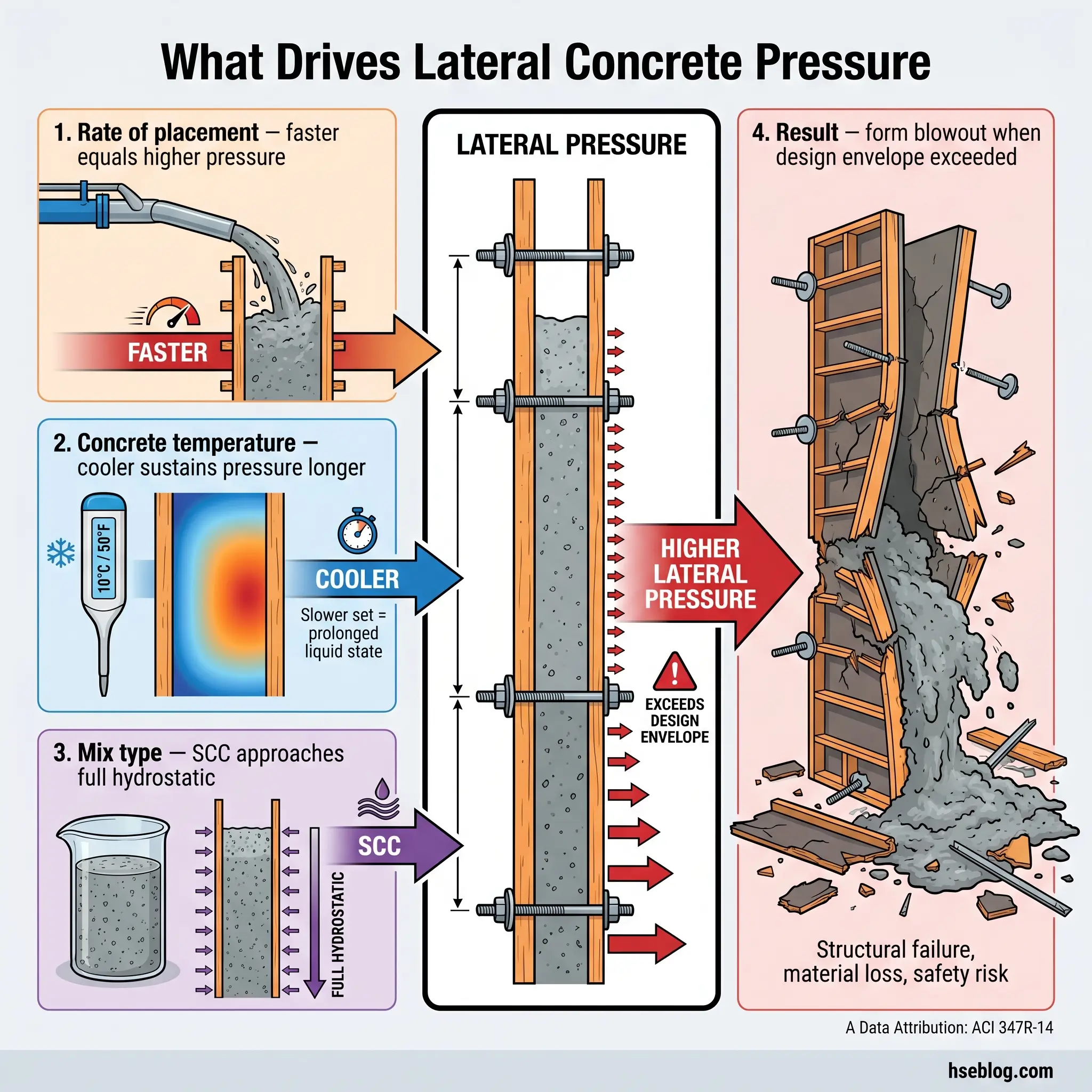
Wet concrete behaves as a fluid and exerts lateral pressure on vertical forms. ACI 347R-14 (2014) predicts that pressure using three primary variables: rate of placement, concrete temperature, and unit weight. Faster pours and cooler concrete produce higher and more sustained pressure before initial set; each variable interacts with the others. Horizontal formwork — slab soffits — carries a dead load of fresh concrete plus formwork self-weight, and a live load of workers, hoses, buggies, and materials. ACI 347R-14 sets the minimum live load at 2.4 kPa (50 psf), rising to 3.6 kPa (75 psf) where motorised buggies are used, with a minimum unfactored combined total of 4.8 kPa (100 psf).
Self-consolidating concrete (SCC) sits outside these conventional-pour assumptions. Because SCC stays fluid longer and consolidates without vibration, it generates near-full hydrostatic pressure against vertical forms. ACI 347R-14 explicitly flags SCC lateral-pressure prediction as an evolving area and recommends applying more than one prediction method and monitoring pressure on site until satisfactory performance is confirmed. Applying conventional-pour design pressures to an SCC pour is a documented failure mode.
Reshoring sequence is the second engineering driver often misunderstood. When shores are removed from a freshly cured slab in a multi-storey sequence, the slab redistributes load to reshores beneath — but the total imposed load can exceed the capacity of a young slab still well short of design strength. The reshoring plan is an engineered sequence, not a site convenience.
Watch For: The commercial pressure to “push the rate” so a pour finishes before dark or before concrete sets in the pump line. Faster placement means higher lateral pressure, which is exactly the assumption the form design was built on. The moment the rate exceeds the design rate, the form is no longer operating within its envelope — regardless of how solid it looks.
Regulatory and Standards Framework by Jurisdiction
Three principal regimes govern formwork safety. Presenting OSHA as the global default — a common failing of generic safety content — misleads readers working outside the US. The substantive differences among them determine accountability, documentation, and enforcement.
| Jurisdiction | Primary Regulation | Design Technical Standard | Required Competent Role |
|---|---|---|---|
| United States | OSHA 29 CFR 1926 Subpart Q (esp. 1926.703) | ACI 347R-14; ANSI/ASSP A10.9 (OSHA Appendix) | Qualified Designer + Competent Person |
| United Kingdom | Construction (Design and Management) Regulations 2015 | BS 5975-2:2024; BS EN 12812:2008 | Temporary Works Coordinator (TWC) + Temporary Works Supervisor (TWS) |
| Australia | WHS Regulations + State Formwork Codes | AS 3610.1:2018; AS 3610.2:2023 | Competent Formwork Designer + certified formwork engineer |
In the US, OSHA 29 CFR 1926.703 requires formwork to support without failure all vertical and lateral loads reasonably anticipated, mandates drawings available on site, and mandates inspection of shoring before erection, immediately before and during placement, and after the pour. The Appendix establishes ANSI A10.9 as a non-mandatory compliance route and ACI 347R-14 as the dominant technical reference. In the UK, CDM 2015 treats formwork and falsework as structures with full designer duties — the shift from “carpentry” to “engineered temporary works” is legal, not advisory. BS 5975-2:2024 now carries the permissible-stress falsework design code and procedural controls; BS EN 12812:2008 carries limit-state design for Class B1 and B2 falsework. In Australia, AS 3610.1:2018 (documentation) and AS 3610.2:2023 (design and construction) underpin the state-level Formwork Codes of Practice that enforce WHS Regulation duties.
Jurisdiction Note: Design live loads differ between regimes. ACI 347R-14 sets 2.4 kPa minimum (3.6 kPa with motorised buggies); BS EN 12812 and BS 5975 approach loading through limit-state load combinations rather than a single minimum value. Where a project sits under both regimes — US-owned firm on a UK site, or a UK contractor building to a US specification — the stricter applicable value governs. Design must be checked under both frameworks, never averaged.
Accountability sits differently in each regime. OSHA places primary duty on the employer and qualified designer. The UK CDM / BS 5975 model pushes accountability into a named Temporary Works Coordinator with a documented register and formal design check categories. Multinational contractors should operate to the stricter framework across all sites rather than toggling per jurisdiction — a practice that consistently produces the cleanest incident record.
Best Practices: Engineering Design and Pre-Construction Planning
A consistent pattern across published formwork collapse investigations is that failure is set months before the concrete arrives. Design and pre-construction planning is where the incident is most reliably prevented.
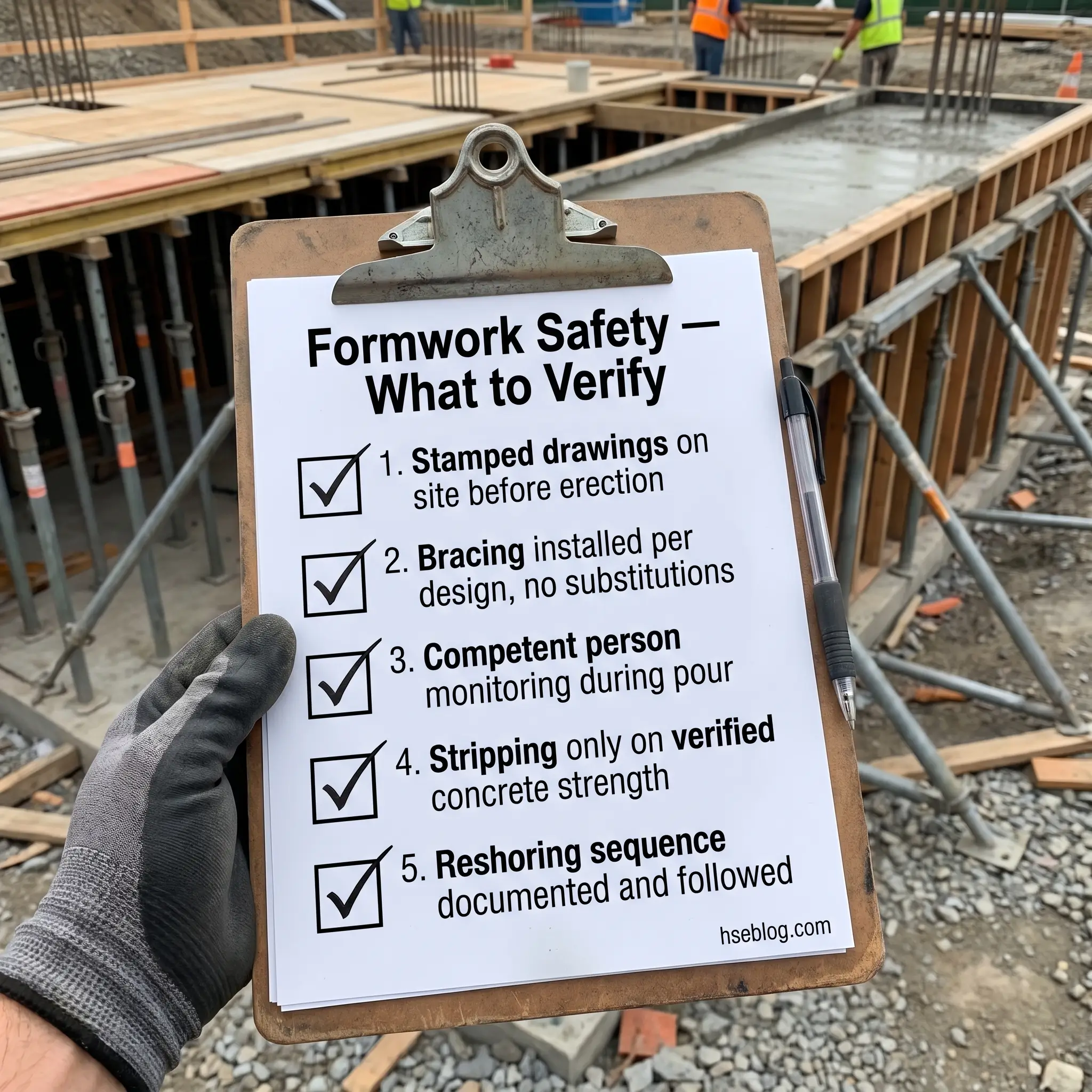
Engineered, stamped formwork and shoring drawings must exist before erection begins — OSHA 1926.703(a)(2) requires drawings available on site, and the equivalent requirement sits in BS 5975 and AS 3610. Drawings must specify vertical and lateral loads, materials and proprietary system references, erection sequence, and stripping criteria tied to concrete strength gain. A formwork register logs every temporary works element, its design status, its independent check category, and its sign-off trail. BS 5975 formalises this through design check categories 1 to 3 keyed to complexity; comparable verification occurs under AS 3610 through competent-person certification.
A pre-pour hold-point sits at the end of that chain. No concrete arrives until the formwork is formally signed off against the following criteria:
- Drawings match the as-built configuration — no undocumented substitutions
- All load paths through shores, towers, and foundations are continuous and verified
- Bracing is installed per drawing, not improvised
- Ties, anchors, and splices are installed to specification, not “to what was available”
- Pour plan — rate of placement, placement method, temperature range, vibration control — is signed off by the pour supervisor and the competent person
- Emergency response and stop-work authority are communicated to every crew on the pour
The weakest link in this chain is always the unrouted change. A substituted brace, an added perimeter screen, a last-minute concrete mix substitution — anything that alters the loading assumption must go back to the designer before placement. Robust practice treats any deviation as a formal re-check trigger.
Best Practices: Safe Erection and Fall Protection
Moving from the design deliverable to the erection crew requires a second layer of controls grounded in fall protection, stability, and weather.
Safe access means ladders extending at least 3 feet above the landing under OSHA 1926.1053(b)(1), and stair towers on formwork tall enough to justify them. Perimeter edge protection — guardrail at approximately 42 inches, mid-rail, and toe-board — is installed as forms rise, not after. Fall-arrest anchorage is independent of the temporary works being erected; this single rule, consistently applied, removes the failure mode that killed a worker at a West Palm Beach project in 2016 when a harness was tied to bracing that subsequently collapsed.
Stability must be verified at every intermediate stage of erection, not only the completed state. Both AS 3610 and BS 5975 require this explicitly. A partially erected form left braced only for working-day conditions will not survive a weekend wind event that the site response crew isn’t there to manage. Practical control: partial erection must be stable against credible overnight and weekend weather, with a documented stop-if-exceeded wind threshold.
Exclusion zones below active erection areas are barricaded, not painted lines. The distinction matters: trades walk over paint.
Best Practices: Inspection Before, During, and After the Pour
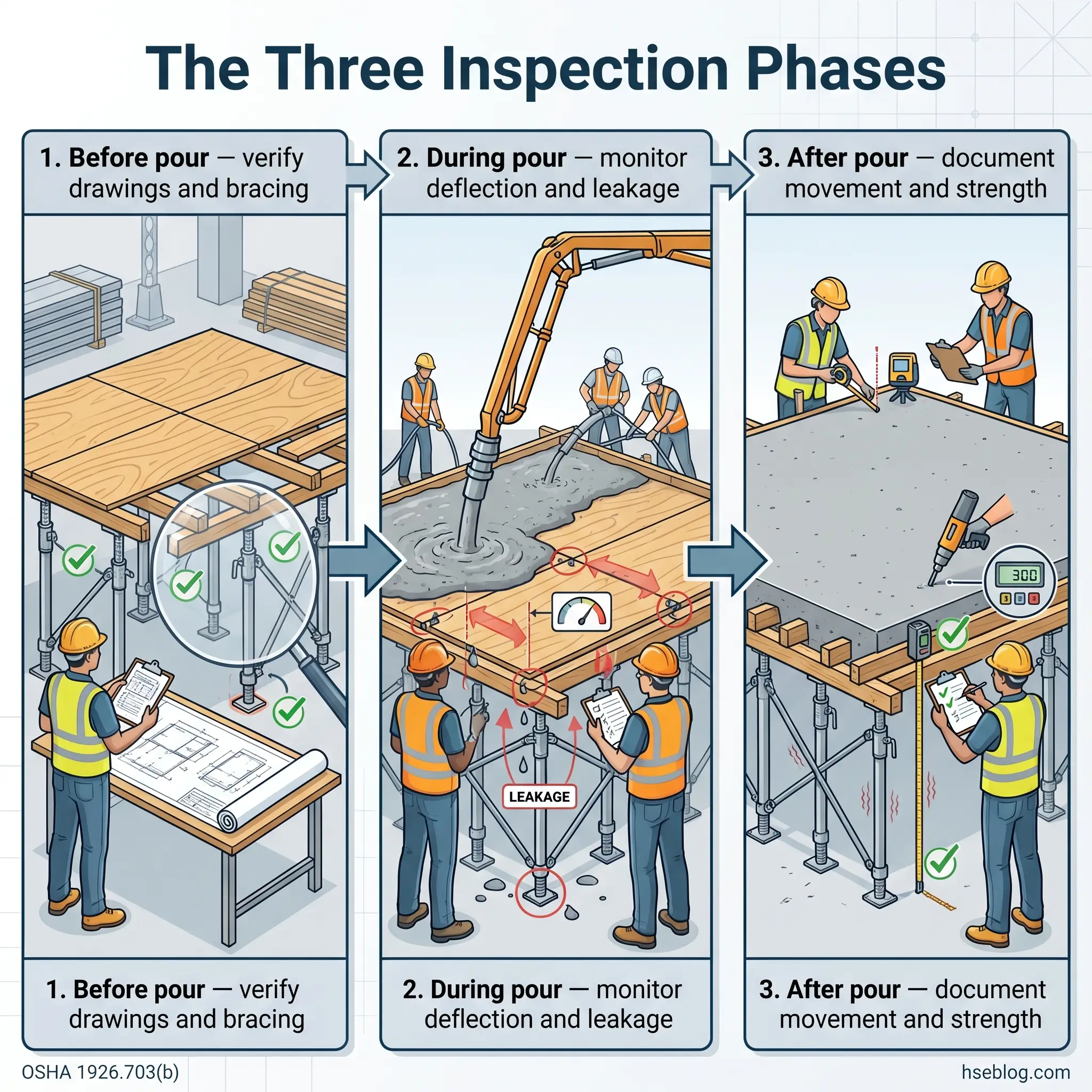
OSHA 1926.703(b) requires formwork inspection at three distinct phases, and this triple-phase discipline is the single most under-executed control in field practice.
Before the pour: Verify drawings match as-built. Confirm base plates, sole plates, wedges, plumb, bracing continuity, ties, and splices. Inspect reshore damage from previous cycles. Confirm the reshoring sequence if the project is multi-storey. This is the inspection that catches substitutions and configuration errors before they matter.
During the pour: A competent person monitors the forms while concrete is placed. The look-fors are deflection against a reference, leakage at seams or tie penetrations, shore movement, and sill settlement. Stop-work authority is not conditional — anomalies trigger a halt, not a discussion. The during-pour inspection is the one that most commonly degrades to “the super walks past once or twice.” It needs a named monitor whose only job during the pour is form observation. That person cannot also run the pump, direct the crew, or manage the finishing team.
Immediately after the pour: Re-inspect for any post-pour movement. Document strength gain through specification or ASTM-standard compressive-strength testing before any shore adjustment or stripping.
Audit Point: On a post-incident investigation, the first documents requested are the three inspection records. An auditor reviewing 1926.703(b) compliance will compare the named inspector, the time stamp, and the recorded observations against the placement log. Missing, duplicated, or copy-pasted entries across the three phases are a reliable signal that the inspection regime is nominal rather than real.
Best Practices: Stripping, Reshoring, and Reuse
Dismantling is a distinct hazard phase, not an afterthought to erection. Forms and shores cannot be removed until concrete has gained sufficient strength — OSHA 1926.703(e) requires verification by project specification or by ASTM-standard compressive-strength testing. Stripping too early is a leading cause of partial collapse; the slab either sags under its own weight or loses its ability to transfer load to the reshore sequence.
Reshoring must be installed as original shores are removed where imposed loads still exceed the capacity of the early-age slab. The reshore line cannot itself be removed until the supported concrete has reached adequate strength across the full sequence. This is engineered, not judged by eye.
The reuse problem deserves a separate line. CPWR’s review found no meaningful regulatory framework governing how many cycles a formwork component can carry before retirement (CPWR, 2017). Components under repeated load lose capacity silently — plywood faces delaminate, steel props develop micro-cracks at welds, timber soldiers absorb moisture and lose section, plastic panels fatigue from UV. A prop set that has been on a job for 18 months, through multiple pours and one winter, has not been re-evaluated against its original safety factor unless someone deliberately does so. Reuse degrades reliability quietly. Best practice is a documented reuse log with cycle counts where feasible, rejection criteria for visible damage, and protected storage to slow weather-driven degradation.
Best Practices: PPE and Training
PPE is the last layer of the hierarchy of controls, not the first. It belongs in a formwork safety conversation as the final line of defence after design, planning, supervision, and engineering controls.
The baseline PPE for formwork work is hard hat (ANSI Z89.1 or EN 397), impact eye protection (ANSI Z87.1 or EN 166), cut-resistant handling gloves, steel-toe footwear (ASTM F2413 or EN ISO 20345), high-visibility clothing (ANSI/ISEA 107 or EN ISO 20471), and a full-body harness with fall-arrest system (ANSI/ASSP Z359 in the US, EN 361 and EN 363 in the EU) wherever fall exposure exists. Respiratory protection is selected against the specific form-release agent SDS and against exposure assessments for silica and wood dust.
Training, not issuance, is where PPE compliance succeeds or fails. OSHA 1926.21 and the CDM 2015 competence duty both require hazard-recognition training, and the recurring pattern across published prosecutions is that harnesses were issued but not consistently worn during erection — the phase with the highest fall exposure — because they “slow the job down.” Enforcement at the erection face is where the training turns real.
Recent Developments Shaping Formwork Safety
The temporary works landscape continues to evolve. In 2024, BSI published BS 5975-2:2024 “Temporary works. Falsework: Design and implementation — code of practice,” superseding BS 5975:2019 and moving the technical falsework design guidance into a dedicated Part 2 with procedural controls handled separately (British Standards Institution, 2024). UK contractors and multinationals working to UK specifications should be auditing their design checking procedures against the updated Part 2 rather than the superseded single-volume standard.
Enforcement has kept pace. In December 2025, the UK Health and Safety Executive prosecuted Matrod Frampton Limited, which was fined £100,000 after a worker was crushed by a collapsing wall in a temporary-works-related incident, cited under CDM 2015 Regulations 13(1) and 19(1) (HSE Media Centre, 2025). The prosecution trajectory continues to reinforce that CDM 2015 temporary works duties are not advisory — failure to plan, check, and manage temporary works produces financial and criminal exposure beyond the incident itself.
Frequently Asked Questions
The Lesson the Industry Keeps Relearning
Formwork is not a carpentry activity with a safety overlay. It is a temporary engineered structure carrying a permanent structure’s full weight, and every credible fatality pattern in the record — from the 80 percent construction-error share of OSHA’s 1990–2008 collapse investigations (OSHA Engineering Reports, 2009) to CPWR’s erection-and-forming fatality concentration (CPWR, 2017) — points at the same root cause. When temporary works are treated as a lesser discipline than the concrete they support, they fail first and fail worst.
The single highest-impact change most sites could make is not a new control — it is a reassignment of status. Route every deviation from stamped drawings back to the designer. Name the person who monitors the forms during the pour and give them no other job. Log reuse cycles. Appoint a Temporary Works Coordinator on any site where the UK model offers a clearer accountability chain than the local regime provides. These are unglamorous administrative controls, and they are the controls that consistently separate the sites that pour safely from the sites that appear in the prosecution reports.
The concrete is going to be poured either way. Formwork safety is the discipline that determines what is still standing when the pour is done.