
TL;DR
- 15.9 fatal injuries per 100,000 full-time workers per year — the rate for US marine terminal and water-transport support workers, roughly five times the US all-industry average (NIOSH, 2024; data period 2011–2017).
- 204+ deaths, 7,000+ injuries, 300,000 displaced from the 2020 Beirut port explosion of 2,750 tonnes of ammonium nitrate — the reference case for dangerous-goods storage failure in harbour areas (Journal of Loss Prevention in the Process Industries, 2021).
- 7% of sampled shipping containers arriving in Sweden carried volatile chemical levels above the national 8-hour occupational exposure limit; carbon monoxide was detectable in 45% (Annals of Work Exposures and Health, 2017).
- April 2025 — the UK Ports & Marine Facilities Safety Code was revised and republished, broadening scope to all marine facilities and strengthening Marine Safety Management System governance expectations (UK Department for Transport, 2025).
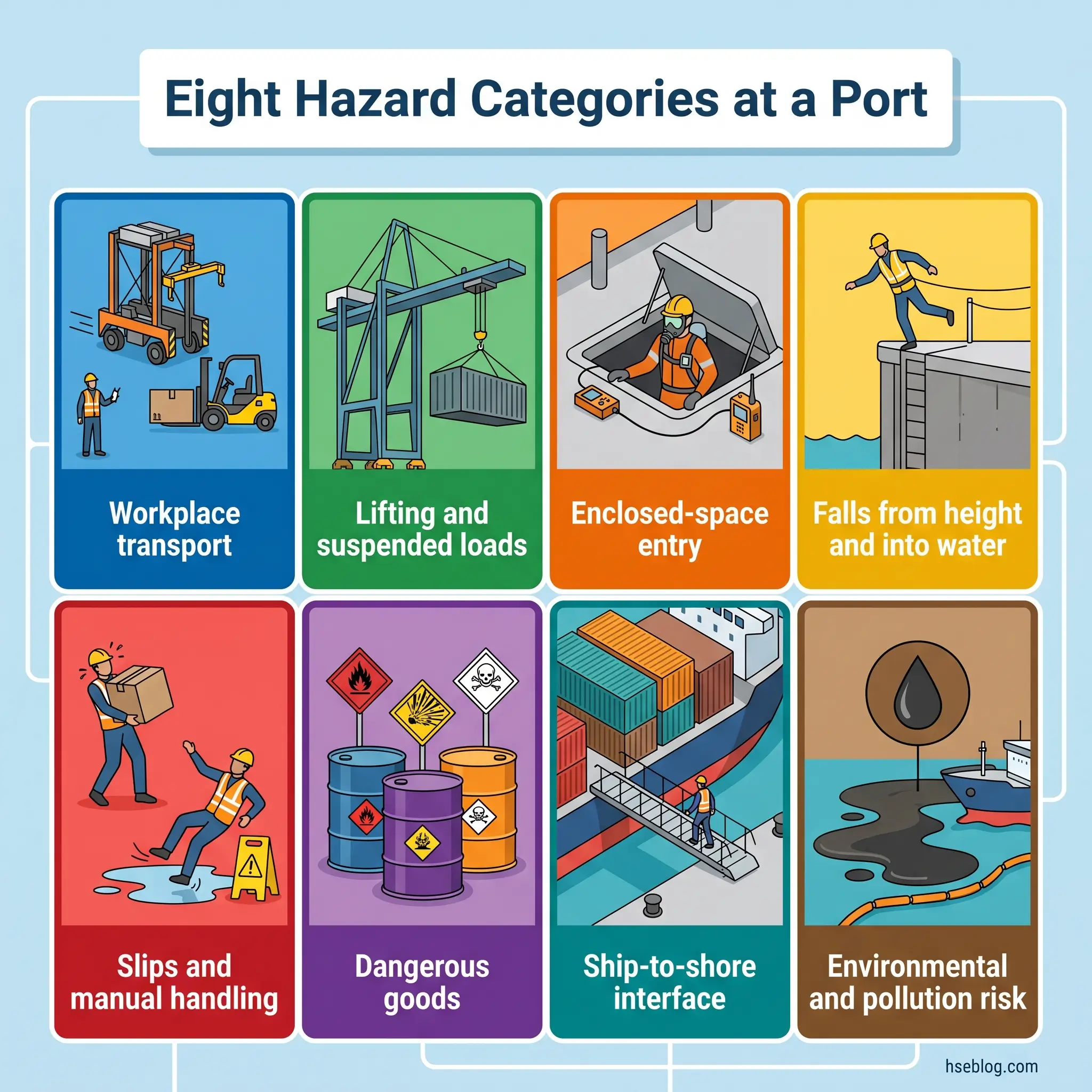
Port and harbour safety covers eight core hazard categories — workplace transport, lifting operations, enclosed-space entry, falls from height and into water, slips and manual handling, dangerous goods, ship-to-shore interface risks, and environmental pollution — managed through jurisdictional frameworks like OSHA 29 CFR 1917, HSE Safety in Docks ACOP L148, the ILO 2016 Code of Practice, and an active Marine Safety Management System.
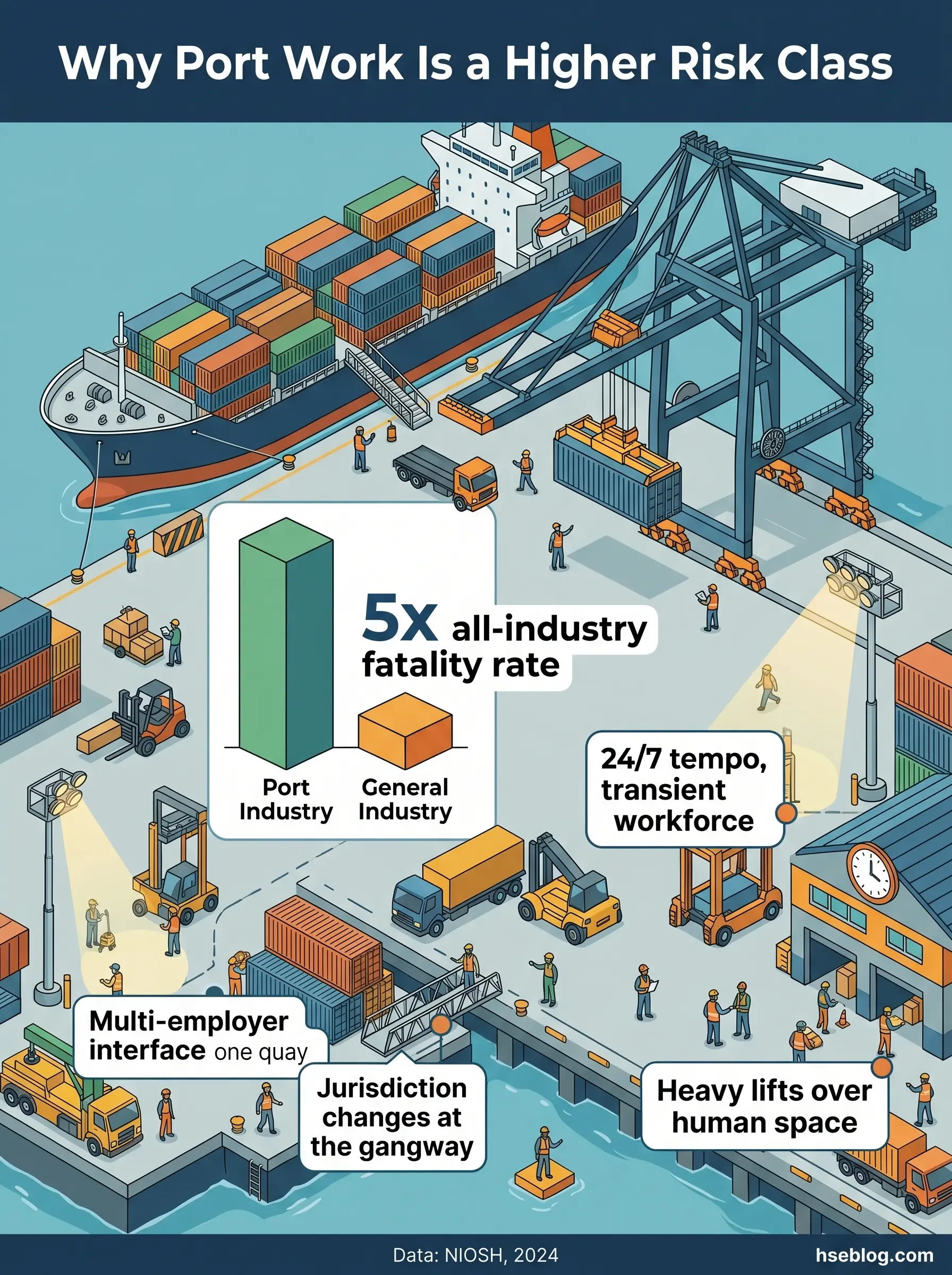
US marine terminal and water-transport support workers died at a rate of 15.9 per 100,000 full-time equivalents per year between 2011 and 2017 — roughly five times the all-industry fatality rate over the same period (NIOSH, 2024). That gap is not a rounding issue. It reflects a workplace where heavy lifts swing over human heads, where vessels and vehicles share space without natural segregation, and where the law that applies changes depending on which side of the gangway a worker stands on.
Vessel turnaround economics, multi-employer shift patterns, and a transient workforce keep the margin for drift narrow at any working port. This article maps the specific hazard categories port and harbour safety practitioners manage day to day, the controls that address them, and the jurisdictional frameworks — OSHA 29 CFR 1917 and 1918 in the US, HSE’s Safety in Docks ACOP L148 and the revised 2025 Ports & Marine Facilities Safety Code in the UK, the ILO 2016 Code of Practice internationally, and IMO instruments at the ship/shore boundary — that shape how each control is enforced.
This article provides general HSE knowledge. Life-critical port work — enclosed-space entry into ship’s holds, lifting operations over suspended loads, dangerous-goods handling, oil spill response — must be planned and supervised by a competent person with relevant training, jurisdiction-specific authorization, and site-specific risk assessment. The information here does not replace that.
Why Ports and Harbours Are High-Risk Workplaces
The structural features matter more than any single hazard. A port is not one workplace — it is the overlapping footprint of the harbour authority, terminal operator, shipping line, stevedoring contractor, haulier, port services, ship’s crew, and inspection agencies, all working the same quay at the same time. The legal environment shifts within a few metres: on the quay, national dock law applies; on the vessel, flag state and SOLAS apply; at the gangway, both.
Commercial tempo compounds this. Vessel turnaround is priced in hours, and delay propagates through downstream port calls. That pressure sits on top of a 24/7 operating cycle with transient stevedore labour, multi-lingual crews, and weather exposure that no roof mitigates. NIOSH places the nonfatal injury rate for this sector at roughly 4,916 per 100,000 workers per year — close to twice the US all-industry rate (NIOSH, 2024).
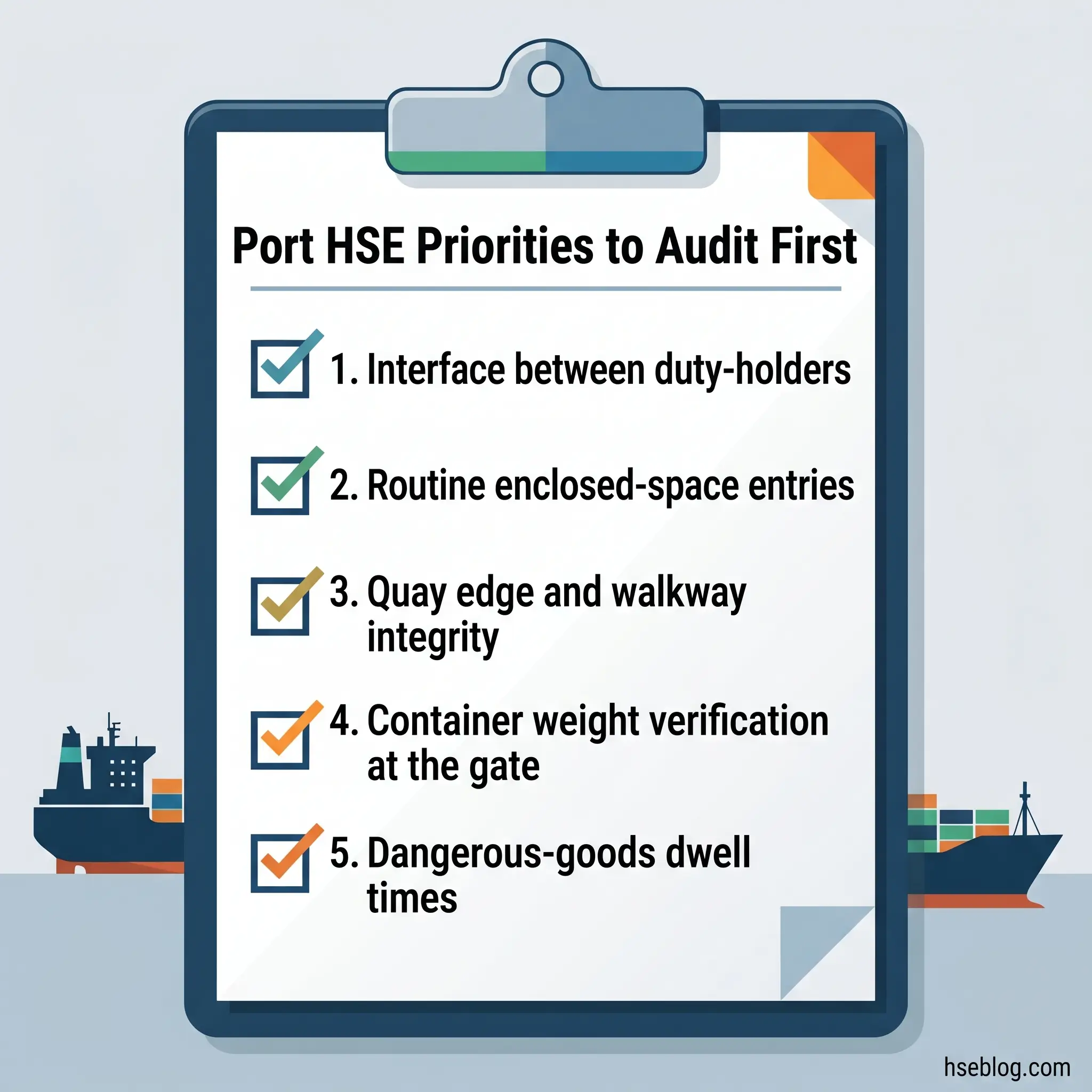
The pattern worth sitting with is this: the highest-consequence port incidents, across published investigations, tend to occur where two duty-holders’ systems meet without a clean handshake. Ship’s crew and stevedore crew on the same hold. Terminal traffic management and external haulier at the same trailer. Harbour master and vessel officer on bunkering. Each party’s system is often competent in isolation. The failure is usually at the interface.
The Main Hazard Categories in Port and Harbour Operations
Port hazards resist tidy listing. What follows is a functional grouping — each category tied to an actual operational activity — rather than a “top five” ranked by gut feeling. Core controls appear at the end of each subsection for quick reference.
Workplace Transport: Vehicles, Forklifts, and Pedestrian Interface
Port workplace transport is the single most frequent fatality mechanism in the published record. The mix is unusual: straddle carriers and reach stackers lift containers at height, which puts the cab driver’s sight line above a pedestrian’s head. Terminal tractors move at pace between stacking blocks. External hauliers arrive on contracts measured in drops per day and often see each specific terminal once. Ro-ro ramps add gradient and confined geometry. Lashing gangs work at ground level between moving equipment.
The controls that actually hold are engineered, not instructed:
- Physical segregation by design — barriers, dedicated walkways, one-way traffic systems, and demarcated pedestrian refuges near active working zones
- Banksman or spotter requirements for reversing and lifting operations, with eye-contact protocols enforced
- External haulier management — induction, clear routing, speed limits enforced by signage and physical calming, not trust
- High-visibility clothing and lighting sized for 24-hour and low-visibility operations
The failure pattern to watch is the walkway that exists on the site plan but not on the ground, or that used to exist and got removed for an operation and never went back. Enforcement of segregation against time-pressured stevedores is where most transport controls quietly erode.
Lifting Operations: Cranes, Falling Loads, and Suspended Cargo
Ship-to-shore gantry cranes, mobile harbour cranes, rubber-tyred gantries, and ship’s own gear — each with a lift plan, a rated capacity, a wind threshold, and an exclusion zone under the load. TT Club has consistently identified quayside crane incidents as among the most costly categories in the cargo-handling insurance record, which tracks with the asset value at risk and the rescue difficulty when a cab is elevated.
The control set:
- Competent lift planning, including wind-speed thresholds for containers (a high-sided load catches wind long before the crane reaches its mechanical limit)
- Verified Gross Mass (VGM) under SOLAS — the container weight declaration required before loading
- Planned preventive maintenance with safety-critical components explicitly identified in the regime
- Enforced exclusion zones under load paths — no pedestrian crossing, no work beneath
Misdeclared container weight is a recurring catastrophic mechanism. The interpretation worth passing to newer practitioners is that the person who mis-declares a container is almost never the person who gets hurt. The incentive structure pushes the risk downstream onto the crane operator and the lashing gang. Terminals that manage this well verify weights at the gate, not on trust, and treat a significant VGM mismatch as an operational hold — not an administrative note.
Enclosed Space and Hazardous Atmosphere Entry
Ship’s holds, tanks, cofferdams, chain lockers, pump rooms — and the increasingly significant category of fumigated or off-gassing shipping containers. The atmospheric hazards are four: oxygen depletion, toxic atmosphere, flammable atmosphere, and engulfment. Published sampling puts hard numbers on what many practitioners suspected. An Annals of Work Exposures and Health study found that 7% of sampled containers at the Port of Gothenburg exceeded the Swedish 8-hour occupational exposure limit, with detectable methanol in 78%, hydrocarbons in 47%, carbon monoxide in 45%, and ammonia in 15% (Annals of Work Exposures and Health, 2017). Benelux sampling referenced in the same review found roughly 11% of non-food and 20% of food containers above OEL (Annals of Work Exposures and Health, 2017).
On the ship side, IMO Resolution MSC.581(110) — adopted 27 June 2025 and in force 3 December 2025 — revised the enclosed-space entry framework, introducing a ship-specific Enclosed Spaces Register, reinforced portable gas-detection requirements, and updated rescue procedures (Lloyd’s Register, 2025). On the shore side in the US, 29 CFR 1915 subpart B governs shipyard confined-space entry, while container and terminal confined spaces fall under permit-to-work frameworks drawn from general industry standards.
Core controls:
- Permit-to-work issued by an authorised person, with defined scope, duration, and rescue plan
- Pre-entry atmospheric testing at the working level, not only at the entry point, and continuous monitoring during occupancy
- Mechanical ventilation sized to the space — dilution ventilation that works in a small container does not work in a bulk-carrier hold
- Rescue capability that does not require would-be rescuers to enter without their own air supply
Watch For: The fatality pattern in enclosed-space incidents is not “didn’t know it was a confined space.” It is almost always “knew, but underestimated.” The more familiar the space, the more the testing ritual gets compressed. Audit the routine entries, not the dramatic ones.
Falls from Height and Falls into Water
Port falls have a distinct feature — a fall from the quay, gangway, or mooring boat carries drowning risk on top of impact trauma. The fall points are specific: gangways, ship’s deck access via vertical ladders, lashing platforms on container vessels, crane cab access routes, work on top of stacked containers during inspection, and the unguarded quay edge itself.
Controls need to pair fall prevention with water rescue capability:
- Gangway standards — correct angle, handrails on both sides, safety net below, adequate lighting
- Fall restraint preferred over fall arrest when working on stacked containers, given the irregular fall zone below
- Rescue planning — recovery from water is a separate capability from fall arrest; lifebuoys with lines, throwing distance, and trained retrieval
- Man-overboard procedures for mooring boat crews and workers near the water
The control that most commonly erodes is the quay edge itself. Temporary barriers get removed for a specific operation and quietly don’t go back. A useful informal marker of port safety culture is whether any worker on the quay can state, without looking it up, where the nearest lifebuoy is positioned.
Slips, Trips, and Manual Handling
Environmental conditions make slips and trips far more frequent at ports than their stereotype as “low consequence” suggests. Wet steel decks, hydraulic oil traces, lashing gear left on walkways, and weather-slicked quays account for a large share of the reportable dock injuries logged by international regulators. Manual handling claims sit alongside them — twistlock handling and lashing bar work over long shifts load spinal and shoulder structures repeatedly.
The intervention order matters. Task redesign and mechanisation sit above PPE in the hierarchy: automated twistlock handling stations, lashing gear staging areas that keep walkways clear, and rotation patterns that reduce cumulative load — all before selecting gloves and footwear.
Dangerous Goods and Major-Accident Hazards
The catastrophic-risk category. The reference case is Beirut: approximately 2,750 tonnes of ammonium nitrate detonated on 4 August 2020, with 204 or more deaths, 7,000-plus injuries, and roughly 300,000 people displaced (Journal of Loss Prevention in the Process Industries, 2021). The lesson that transferred into subsequent UNECE and OECD reviews is not “it was stored badly” — that is obvious after the fact. The lesson is that a dangerous-goods consignment without a time-bound disposal or re-export decision is a decaying control, and that port authorities need systems surfacing long-dwell dangerous-goods inventories to senior decision-makers rather than leaving them visible only to a manifest clerk.
The regulatory anchors here are the International Maritime Dangerous Goods (IMDG) Code for the sea-carriage interface, and jurisdiction-specific port regimes for storage and movement. In the UK the Dangerous Goods in Harbour Areas Regulations 2016 (DGHAR), supported by ACOP L155, require pre-notification to the harbour master, licensing for explosives handling, and mandatory emergency plans. EU ports storing major quantities additionally sit under SEVESO III thresholds.
Core controls:
- Pre-notification of dangerous goods to the harbour master, with manifest detail adequate for emergency response
- IMDG segregation in storage and during handling
- Designated storage areas with separation distances from populated zones and hot-work prohibitions
- Emergency plans specific to dangerous-goods incidents, rehearsed with local civil response
Ship-to-Shore Interface Hazards
This is the zone where the ship’s SOLAS and ISM regime meets the port’s OSHA 1917 or HSE L148 regime, and where duty-holder ambiguity does its quiet damage. Specific hazards concentrate here: mooring line snap-back during berthing and unberthing, gangway positioning and load, lashing and unlashing at the ship/shore boundary, bunkering with its combined fire and spill risk, and allision risk for vessels on berth.
The enduring misconception worth correcting: modern synthetic mooring lines do not have fixed “snap-back zones” painted on the deck. High-modulus synthetic ropes can whip in trajectories that traditional natural-fibre line diagrams do not predict. Current mooring arrangement drawings treat the full deck area around a line as a potential exposure zone during loading, not just the straight-line path.
Control emphasis:
- Ship/shore safety checklists completed jointly before operations begin, including bunkering
- Defined duty-holder handshake at the gangway, hatch coaming, and hold — who is responsible where, with names
- Real-time communication protocols between the vessel’s officer on watch and terminal operations
- Bunkering fire watch and spill containment with equipment pre-staged, not summoned
Environmental and Pollution Risks
Oil spill response sits on the OPRC convention’s tiered framework — Tier 1 on-site, Tier 2 regional mutual aid, Tier 3 national or international resources. On the vessel side, the Shipboard Oil Pollution Emergency Plan (SOPEP) is required under MARPOL. The practical control question is rarely whether the plan exists — it almost always does — but whether it has been rehearsed against the port’s plan within the past twelve months, and whether the equipment referenced in the plan has been inspected. Ballast water, noise affecting neighbouring communities, and emissions from vessels at berth round out the environmental hazard set, with shore power (cold ironing) emerging as a significant emissions control.
How Ports Control These Risks: The Safety Management System Approach
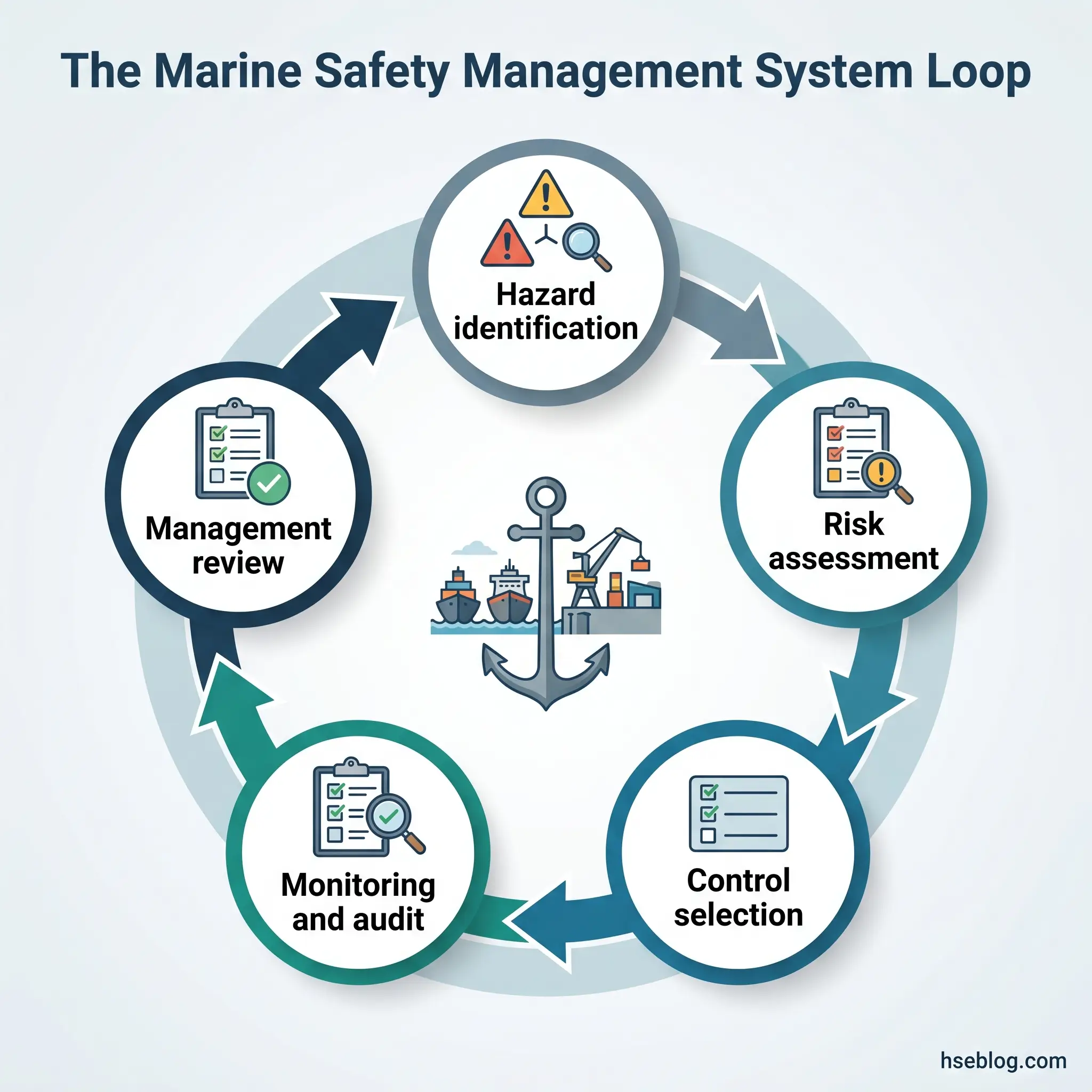
Shifting from hazard-by-hazard to the system-level answer: the consistent international expectation is a formal safety management system. The UK calls it a Marine Safety Management System under the Ports & Marine Facilities Safety Code, revised and republished in April 2025 (UK Department for Transport, 2025). The ILO 2016 Code of Practice on Safety and Health in Ports frames it as an occupational safety and health management system. The IMO ISM Code sits on the ship side. Each has the same skeleton.
The skeleton runs: hazard identification → risk assessment → control selection against the hierarchy → implementation → monitoring and audit → management review and change → back to hazard identification. It is the PDCA loop with port-specific inputs.
The 2025 revision of the UK code sharpened two expectations worth flagging. First, it broadened scope to include all marine facilities explicitly, not only statutory harbour authorities — closing a gap that smaller terminals and private jetties sometimes relied on. Second, it strengthened the independence expectation on the Designated Person who provides assurance to the duty-holder. The Designated Person is not a compliance signature. They are the audit conscience of the system, and the 2025 revision makes this harder to dilute into a dual role.
Audit Point: The Marine Safety Management System that sits on a shelf is the defining failure pattern. An MSMS is real only if the Designated Person audits it against live operations, and if audit findings reach the duty-holder — not just the harbour master’s desk drawer.
The systems-safety insight from academic work on port incidents is worth keeping in view. Systemic failures in port operations emerge from misaligned control structures between duty-holders — the harbour authority’s rules not quite matching the terminal operator’s procedures not quite matching the ship’s ISM routines — rather than from any single individual error. Audit the seams between organisations, not only the procedures inside one.
The Hierarchy of Controls Applied to Port Hazards
The hierarchy is abstract until it is grounded. Mapped to port hazards, each tier has specific operational expression.
| Hierarchy Level | Port-Specific Example |
|---|---|
| Elimination | Automated stacking cranes remove people from the container yard during routine stacking |
| Substitution | High-modulus synthetic mooring lines replace older materials where overall snap-back and handling profile improves |
| Engineering | Segregation barriers between vehicles and pedestrians; proximity sensors on crane booms; mechanical ventilation in enclosed spaces |
| Administrative | Permit-to-work systems; exclusion zones under load paths; dangerous-goods pre-notification; ship/shore safety checklists |
| PPE | High-visibility clothing, personal flotation devices, respiratory protection, hearing protection, fall arrest harnesses |
PPE at ports is often the control that gets pointed to first in the immediate aftermath of an incident because it is the most visible variable. That visibility is misleading. In the majority of published port fatality investigations, the engineering or administrative control further up the hierarchy is what actually failed — the barrier that wasn’t there, the permit that wasn’t raised, the exclusion zone that wasn’t enforced. PPE caught the blame because PPE was the last thing the worker touched.
Key Regulatory Frameworks: OSHA, HSE, ILO, and IMO
The jurisdictional map. What follows is orientation for practitioners working across port environments — not a substitute for legal authority in any specific case.
Jurisdiction Note — Legal: Regulatory content here reflects general HSE professional understanding of international, UK, and US requirements as of 2026. It is not legal advice. Specific compliance questions, enforcement situations, or prosecution exposure should be directed to qualified legal counsel in the applicable jurisdiction.
United States: OSHA 29 CFR 1917 and 29 CFR 1918
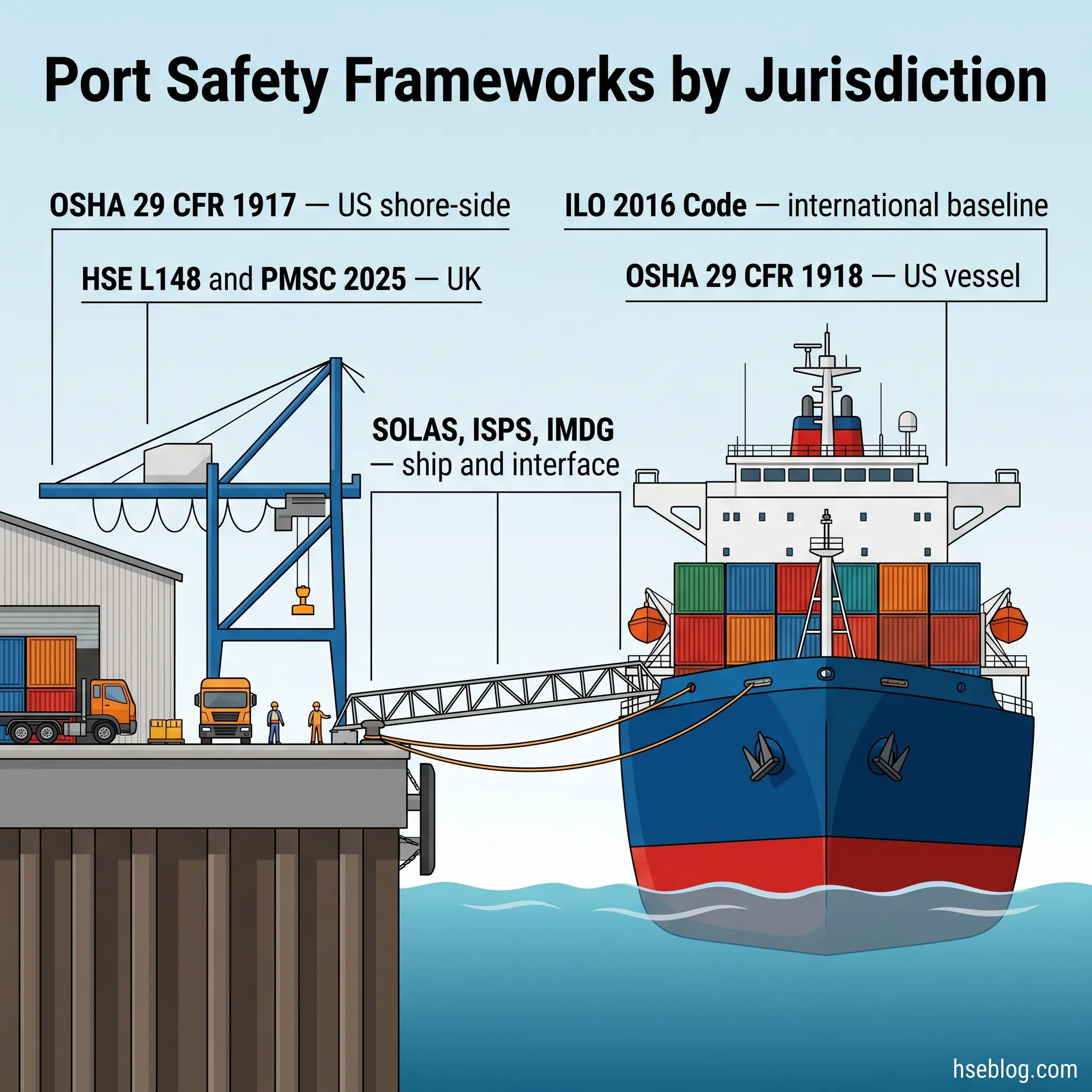
The practical reading of 29 CFR 1917 is that it governs marine-terminal cargo operations ashore — the quay, the yard, the terminal gate, the rail interface. 29 CFR 1918 covers longshoring on the vessel itself — the hold, the deck, the hatch coaming, the ship’s gear. The definitional boundary matters because the same worker can move between scopes during a single shift, and the controls required (fall protection on stacked containers versus on the vessel’s deck, for example) are not identical under each part.
United Kingdom: Safety in Docks ACOP L148 and the Ports & Marine Facilities Safety Code 2025
L148 (2014) is the Approved Code of Practice supporting the Health and Safety at Work etc Act 1974 as it applies to dock operations. An ACOP has a specific legal standing: following it provides one way — not the only way — of complying with the underlying duties, and failure to follow it shifts the evidential burden to the duty-holder to demonstrate equivalent control. The Ports & Marine Facilities Safety Code, revised April 2025, governs the marine-operations side — navigation, pilotage, hydrography, marine emergency response — and requires the Marine Safety Management System described above. The Dangerous Goods in Harbour Areas Regulations 2016 with ACOP L155 cover the dangerous-goods dimension.
International: ILO Code of Practice on Safety and Health in Ports (Revised 2016)
Non-binding guidance aligned with ILO Convention No. 152 and Recommendation No. 160. Many national regulators treat it as the operational baseline, and auditors looking at a port in a less-regulated jurisdiction will often pull the ILO Code as the reference against which to test local practice. It covers hazard identification, safety management, training, PPE, and specific port operations with sufficient granularity to sit on a terminal operator’s shelf as a working reference.
IMO Frameworks: SOLAS, ISPS Code, IMDG Code, and MSC.581(110)
SOLAS Chapter XI-2 and the ISPS Code cover ship and port-facility security, with mandatory security risk assessments, security plans, and the appointment of Port Facility Security Officers. The IMDG Code covers dangerous-goods classification, packaging, marking, documentation, and segregation for sea carriage, with current edition Amendment 42-24 entering force progressively through 2025–2026. IMO Resolution MSC.581(110), in force 3 December 2025, revised enclosed-space entry recommendations (Lloyd’s Register, 2025).
The confusion worth resolving for practitioners moving into port HSE: none of these frameworks fully governs the ship/shore boundary on its own. The ILO Code and national dock law apply ashore; SOLAS, ISM, and flag-state rules apply aboard; the interface is managed by the joint ship/shore safety checklist, by local port by-laws, and by whatever duty-holder agreement the port has engineered. If the interface management looks thin in any given port, that is where to concentrate audit attention.
Emerging Risks: Automation, Cyber, and Climate
Automation and the Changing Pedestrian Interface
Automated stacking cranes, automated guided vehicles, and increasingly automated quay cranes are reshaping the pedestrian-interface hazard map. The obvious gain is removing people from routine proximity to suspended loads and moving equipment. The less obvious cost is that maintenance access becomes the new concentration point — technicians working inside or beneath systems that assume nobody is there. The controls that work are physical (lockout of automated zones before entry) and procedural (permit regimes that override automation controls). The design principle is the one the hierarchy implies: if automation removes the person from routine operation, the residual hazard shifts to maintenance, fault clearance, and commissioning — where automation is overridden and the human is in the middle of it.
Cyber as a Safety Discipline
The ISPS Code now incorporates cyber dimensions into port facility security assessments and plans. ANSI/A3 R15.06-2025 on the robotics side treats cyber exposure as a functional safety input — a signal that the siloed treatment of physical safety and cyber security is collapsing in regulatory thinking. For port HSE practitioners, the practical consequence is that a cyber incident affecting terminal operating system scheduling, gantry crane control, or access control now sits inside the safety risk register, not outside it.
Climate and Operational Resilience
Stronger storm events, increased heat stress on quay workers, and rising sea levels are changing the operating envelope. Relevant control developments include updated wind-speed thresholds for crane operations, heat-stress management programmes for outdoor dock labour, and infrastructure resilience planning against storm surge. The safety management system is the natural home for this work — it is the framework built to handle changed risk, which is precisely what climate exposure introduces.
Frequently Asked Questions
Conclusion
Port and harbour safety is moving into a denser regulatory and technical landscape than it has occupied at any point in the past two decades. The April 2025 revision of the UK Ports & Marine Facilities Safety Code, the December 2025 entry into force of IMO Resolution MSC.581(110) on enclosed-space entry, and the integration of cyber exposure into the ISPS security framework all signal the same direction: port safety is being pulled out of its discipline silos and reframed as an interface-management problem — across duty-holders, across physical and digital systems, and across the ship/shore boundary.
The practical implication for port HSE practitioners is that audit focus has to shift. Auditing a permit-to-work system in isolation, or a lifting regime in isolation, or an enclosed-space programme in isolation, misses the class of failure the published investigation record keeps surfacing — the failure that sits in the handshake between two competent systems. The practitioners who do this well over the next cycle will be the ones treating their Marine Safety Management System as a live document that explicitly maps interfaces, not as a compliance artefact reviewed annually because the calendar says so.
For anyone stepping into a port HSE role for the first time, the most useful orientation is that the ILO 2016 Code of Practice, HSE’s L148, OSHA 29 CFR 1917 and 1918, and the PMSC 2025 are not competing frameworks. They address the same hazards from different jurisdictional angles, and practitioner competence in a port environment increasingly means being able to read all four against a single operation.