
TL;DR
- 18.4 fatalities per 100,000 US marine transportation workers (2011–2017) — roughly six times the all-industry US rate, per NIOSH (reviewed February 2024).
- 650 lives lost across 444 marine casualties in EU waters over ten years (2014–2023) — 89.7% of 2023 victims were crew (EMSA, 2024).
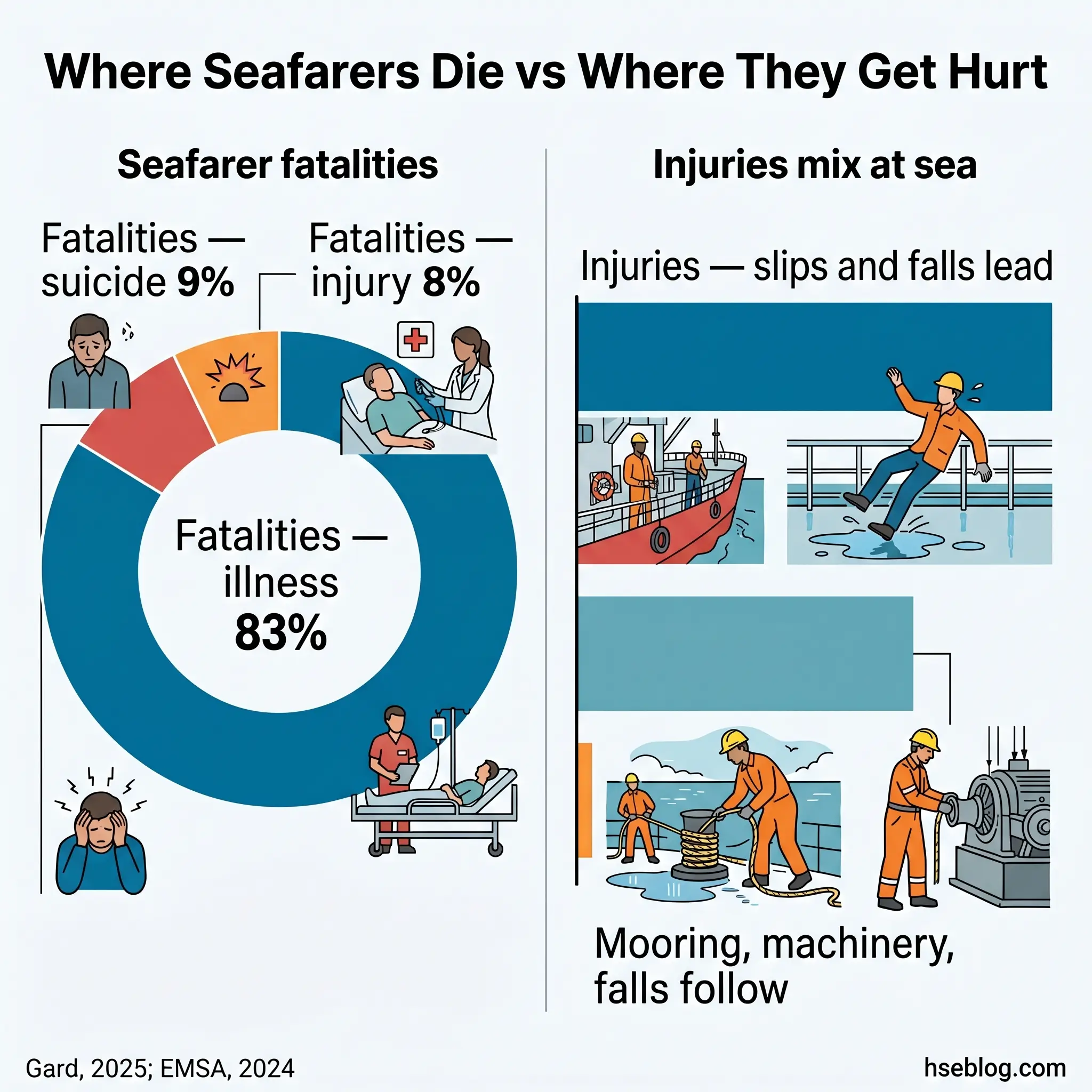
- 90 crew deaths on Gard-entered tonnage in 2024: 83% illness, 9% suicide, 8% injury — medical and mental-health causes now outweigh accidents (Gard, 2025).
- Four pillars govern the field: SOLAS, MARPOL, STCW, and MLC 2006 — three IMO instruments and one ILO convention, enforced through flag-state certification and port state control.
Maritime safety addresses shipboard hazards ranging from slips and falls to enclosed-space fatalities, fire, collision, mooring injuries, and seafarer illness. It is governed primarily by four international instruments — SOLAS, MARPOL, STCW, and MLC 2006 — supported by the ISM, ISPS, COLREG, and IMDG Codes, and enforced through flag-state certification and port state control inspection.
US marine transportation workers died at a rate of 18.4 per 100,000 between 2011 and 2017 — nearly six times the rate for all US workers over the same period (NIOSH, reviewed 2024). That gap is not a reporting artefact. It reflects a working environment where the deck is moving, escape routes are finite, the nearest trauma centre may be days away by helicopter, and a single confined-space misjudgement routinely kills the rescuer as well as the victim.
Shore-based HSE thinking does not transfer cleanly to this environment. A vessel in international waters operates under flag-state law, its certificates issued under IMO conventions, its crew protected under an ILO convention, its cargo segregated under a code that cross-references a convention, and its port call governed by whichever regional MoU the port belongs to. This article maps the key maritime safety hazards and regulations a practitioner needs to hold in working memory — organised as two spines: the hazards that actually kill and injure seafarers, and the specific IMO, ILO, national, and regional instruments that govern each.
Why Maritime Safety Is a Distinct Discipline
Roughly 80% of world trade by volume moves by sea, and the people moving it work under legal and operational conditions unlike any land-based industry. Maritime safety is the body of technical standards, management systems, and competence requirements that protects seafarers, ships, cargo, and the marine environment. It exists as a distinct discipline because no single national regulator can cover a workforce that crosses jurisdictions every voyage.
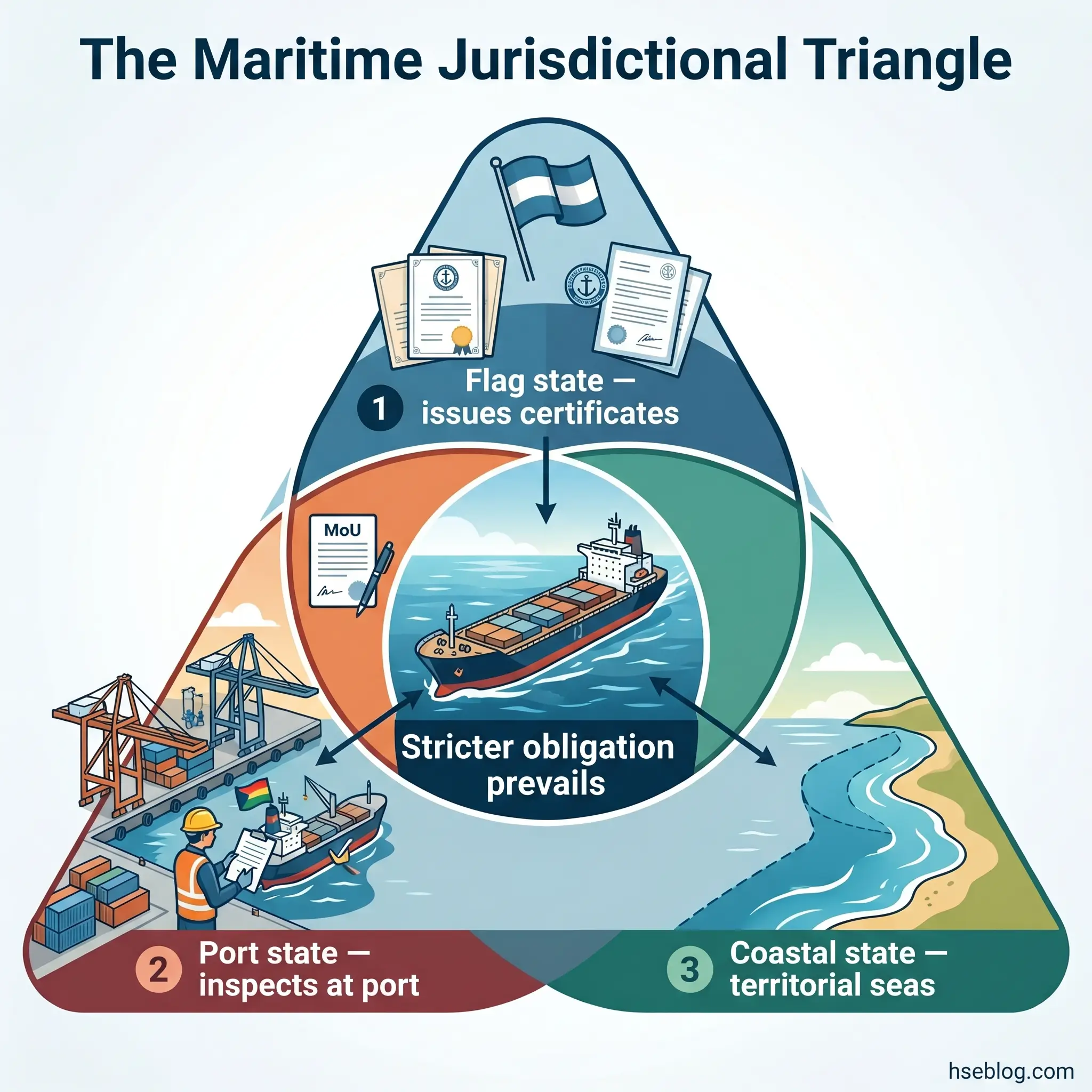
The framing that matters for newcomers is the jurisdictional stack. A tanker under Panamanian registry sailing from Rotterdam to Houston is simultaneously subject to flag-state law (Panama), coastal-state jurisdiction across every territorial sea it transits, port-state inspection (Paris MoU at Rotterdam, USCG at Houston), and the international conventions its flag has ratified. There is no land-based parallel to this four-layer overlap.
A common misconception among shore-based HSE professionals transitioning into marine work is that OSHA-style prescriptive standards govern on board. In international waters they generally do not. Confusing flag-state jurisdiction with coastal-state authority is the most frequent early-career error in this field. On a US-flag vessel at sea, USCG regulation typically pre-empts OSHA. On a foreign-flag vessel alongside in a US port, IMO instruments govern vessel operations while OSHA’s 29 CFR 1915, 1917, and 1918 apply to the shoreside work touching that vessel.
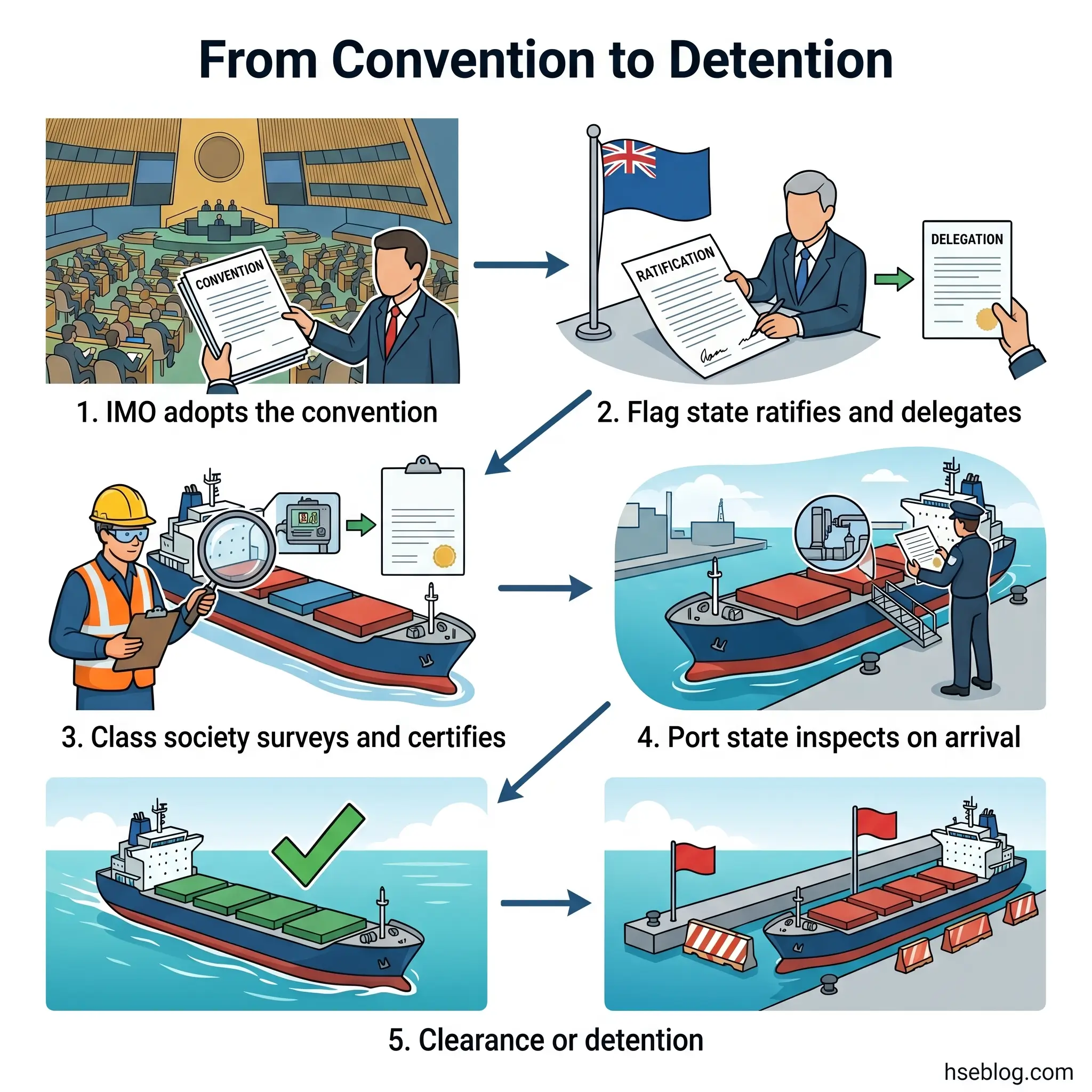
Jurisdiction Note: The International Maritime Organization does not inspect or enforce. IMO adopts conventions; flag states ratify and implement them; classification societies frequently issue certificates under delegated authority; port state control inspects foreign-flag ships. Treating IMO as a regulator in the OSHA sense misreads the compliance landscape.
The Key Hazards on Ships and at Sea
A striking feature of the casualty record is that the hazards killing seafarers differ from those injuring them. Over 2014–2023, EMSA recorded 650 lives lost across 444 casualties in EU waters and 7,604 injuries across 6,623 incidents — an injury-to-fatality ratio concealing a different causal mix at each end (EMSA, 2024). Gard’s 2025 report sharpens the point: on its entered tonnage, 83% of 2024 crew deaths came from illness and only 8% from injury (Gard, 2025). Treating the injury profile as a proxy for the fatality profile — a common analytical shortcut — causes safety programmes to under-invest in the medical and psychosocial controls that now dominate the death data.
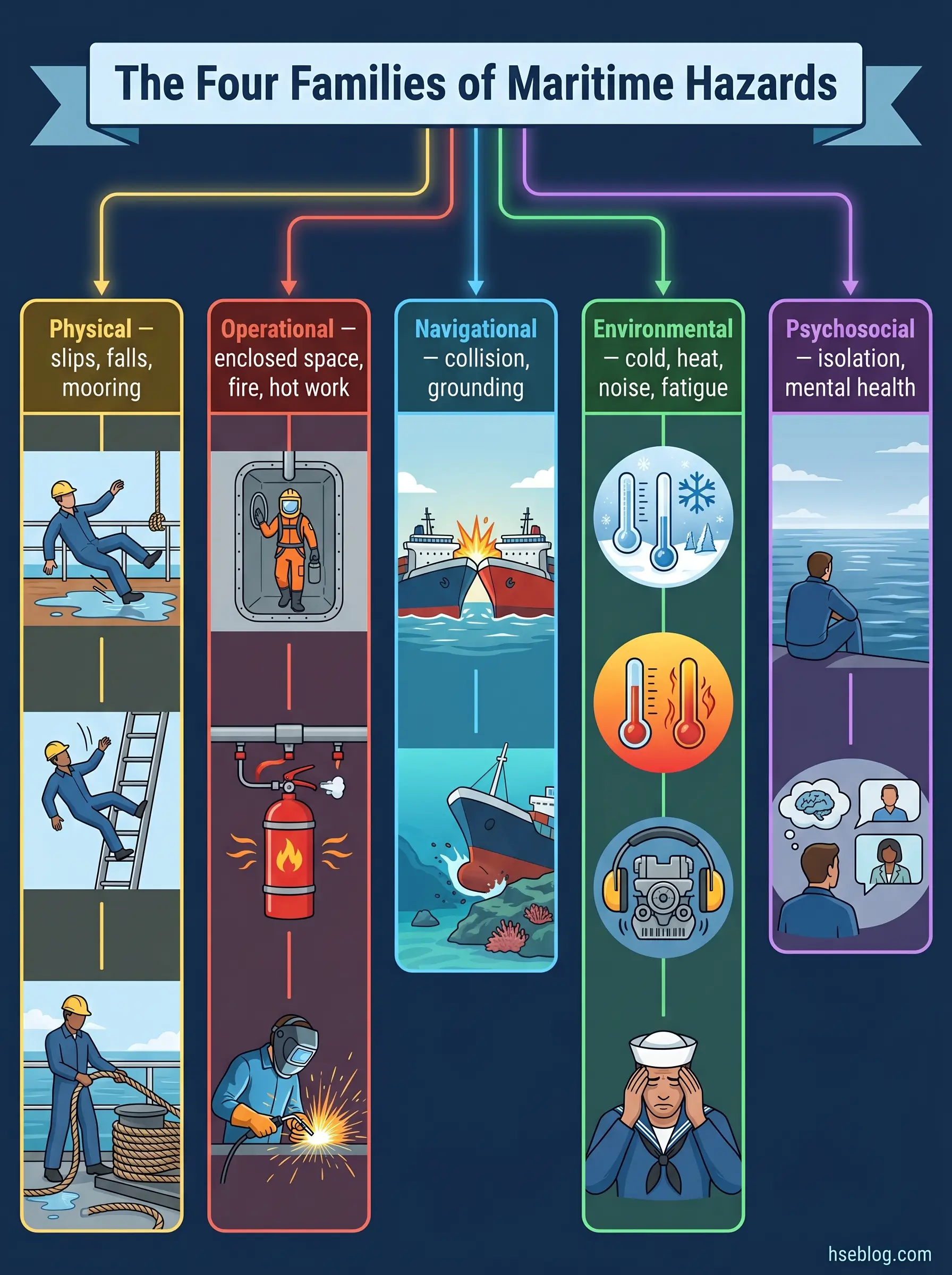
The taxonomy below groups ship safety hazards by mechanism rather than workstation, because the same mechanism — atmospheric hazard, for instance — recurs in tanks, chain lockers, ballast voids, and holds.
Physical and Slip/Fall Hazards
Slipping, stumbling, and falling is the single leading cause of fatalities in persons-based marine casualty incidents over 2014–2023, per EMSA’s most recent Annual Overview (EMSA, 2024). The mechanism is mundane and under-respected: wet steel, hydraulic oil tracked onto a walkway, ice on a forward deck in winter transit, a badly rigged gangway at berth with tidal range shifting through the shift. Governing instruments: MLC 2006 Regulation 4.3 (occupational safety and health), SOLAS II-1 on construction, and at operational level the UK MCA’s Code of Safe Working Practices for Merchant Seafarers (COSWP, 2024 revision). On US-flag vessels in shipyard periods, OSHA 29 CFR 1915 Subpart E adds fall-protection requirements that generally exceed international operational minima.
Enclosed-Space Entry
Enclosed-space fatalities follow a signature pattern. One crew member enters an unventilated space — a ballast tank, chain locker, cargo hold after inerting, pump room after a leak — and collapses from oxygen deficiency or toxic residue. Responding crew enter without atmospheric testing or breathing apparatus and die beside the first victim. Rescuer fatalities frequently exceed the count of the original casualty. Governing instruments: IMO Resolution A.1050(27), “Revised Recommendations for Entering Enclosed Spaces Aboard Ships” (2011); SOLAS Chapter III Regulation 19 on drill and training; and on tankers, ISGOTT 6 (2020) Chapter 10, which sets stricter continuous-monitoring and rescue-preparation expectations than A.1050(27).
Fire, Explosion, and Hot Work
Shipboard fires kill by heat, smoke, and by trapping crew in compartments that cannot be evacuated at sea. Engine-room fires originate at fuel and lubricating-oil leaks onto hot surfaces; galley fires follow unattended cooking; cargo fires are increasingly lithium-ion-driven on Ro-Ro and container vessels as battery-electric vehicle cargoes expand. Governing instruments: SOLAS Chapter II-2 (fire protection, detection, extinction) and the FSS Code (technical detail on fire-safety systems). For hot work in US shipyard periods, OSHA 29 CFR 1915.11 through 1915.16 apply. SOLAS amendments under MSC.550(108), in force 1 January 2026, refresh Chapter V framework on danger and position reporting that applies when a fire becomes a casualty requiring assistance.
Navigation, Collision, and Grounding
Navigation casualties are overwhelmingly human-factor events. EMSA analysis of casualty investigations 2014–2023 finds that 80.1% of investigated marine casualties are linked to the human element, with 49.8% involving a human-behaviour contributing factor (EMSA, 2024). Governing instruments: COLREG 1972 — the rules of the road — and STCW 1978 as amended, which mandates Bridge Resource Management as a competence standard. The pattern in collision investigations is rarely a bridge officer who did not know the rules. It is a bridge team whose communication and cross-checking broke down under fatigue, poor handover, or over-reliance on ECDIS route confirmation.
Occupational Health: Fatigue, Illness, Mental Health
The shift in the fatality profile is the most important development in the field. Gard’s 2025 Crew Claims Report attributed 83% of 2024 crew deaths on entered tonnage to illness, 9% to suicide, and 8% to injury — a 25% rise in crew claims versus the pre-pandemic three-year average (Gard, 2025). The ILO’s first global data collection on seafarer fatalities, reporting 2023 data from 51 countries, echoes the pattern: 403 deaths with illness and disease leading, persons overboard second, and occupational accidents third (ILO, 2026). Governing instruments: MLC 2006 Regulation 2.3 on hours of work and rest (minimum ten hours in any 24-hour period, 77 hours in any seven-day period) and MLC 2022 amendments in force 23 December 2024 requiring flag states to investigate, record, and report every seafarer death annually to the ILO Director-General.
Watch For: Fatigue rarely presents in incident reports as “fatigue.” It presents as a bridge officer who missed a pilot’s instruction, a deck rating who left a hatch unsecured, a chief engineer who signed off a permit without completing a tank inspection. Investigators who do not reconstruct the 72-hour rest pattern before an incident systematically under-identify fatigue as a contributing factor.
| Hazard family | Primary governing instrument | Operational reference |
|---|---|---|
| Slips/falls on deck | MLC Reg 4.3 | COSWP (UK, 2024) |
| Enclosed-space entry | IMO A.1050(27); SOLAS III/19 | ISGOTT 6 Ch. 10 |
| Fire and hot work | SOLAS II-2; FSS Code | OSHA 1915.11–16 (US shipyard) |
| Collision/grounding | COLREG 1972; STCW BRM | Flag-state navigation rules |
| Fatigue/mental health | MLC Reg 2.3, Reg 4.3 | MLC 2022 amendments |
The International Regulatory Framework: The Four Pillars
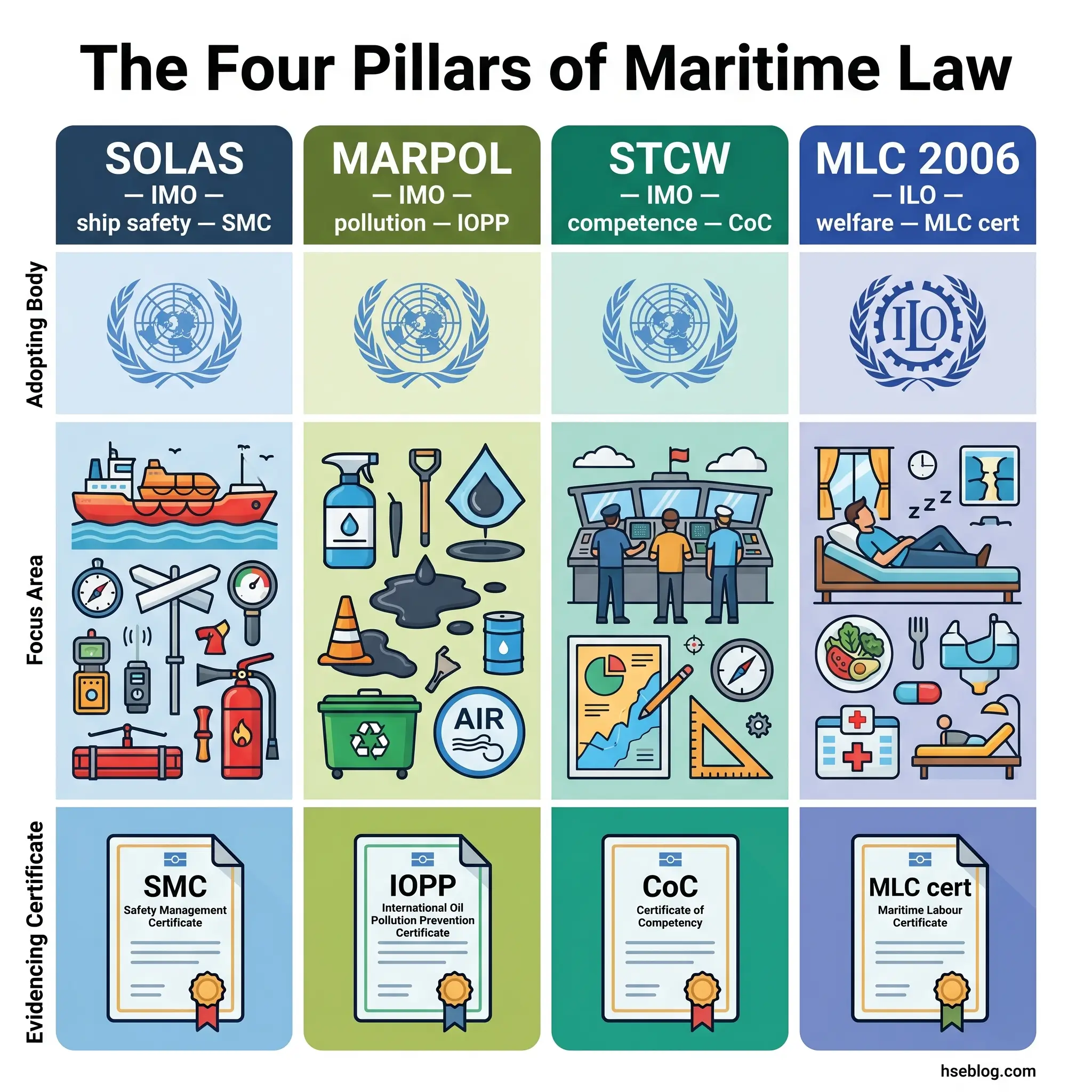
Ask any cadet what the four pillars of maritime law are and the expected answer is SOLAS, MARPOL, STCW, and MLC 2006. The framing is useful but misleading if read as four parallel structures. Three are IMO instruments governing the ship; one is an ILO convention governing the seafarer. Their enforcement teeth differ sharply. SOLAS non-conformity gets ships detained faster than any other instrument. MARPOL Annex VI violations attract the largest civil penalties. STCW failures attach to the individual seafarer as well as the company. MLC has historically been the weakest-enforced pillar, though the 2022 amendments are changing that calculus.
SOLAS — Safety of Life at Sea
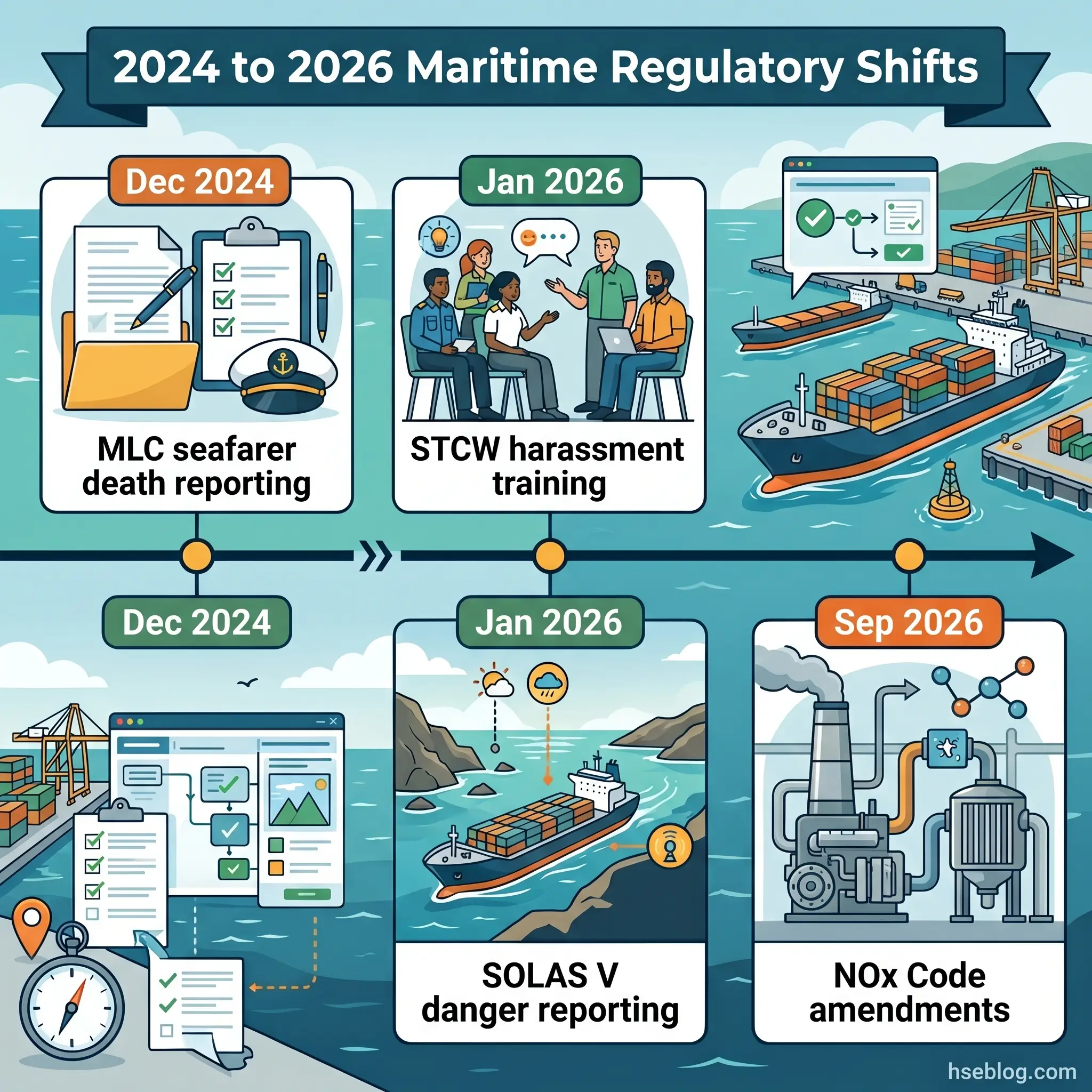
SOLAS 1974, as amended, is the dominant safety convention, with 167 contracting states as of April 2022. The operational chapters a practitioner should be able to locate from memory are II-1 (construction, subdivision, stability, machinery), II-2 (fire protection), III (life-saving appliances and arrangements), IV (radiocommunications), V (safety of navigation), VII (dangerous goods), IX (management for safe operation — where the ISM Code is incorporated), XI-2 (maritime security — where the ISPS Code sits), and XIV (the Polar Code). SOLAS Chapter V amendments under MSC.550(108) entered into force 1 January 2026, refining the regulations on danger messages (V/31) and position reporting (V/32). The IMO’s SOLAS chapter-by-chapter overview remains the authoritative primary reference.
MARPOL — Pollution Prevention
MARPOL 73/78 covers six annexes — oil (I), chemicals in bulk (II), packaged harmful substances (III), sewage (IV), garbage (V), and air emissions (VI). Annex VI carries the heaviest post-2020 documentation burden following the global 0.50% sulphur cap for marine fuel, with 0.10% inside Emission Control Areas. MARPOL crosses into safety because pollution incidents often originate in engine-room or cargo-handling safety failures: an oily-water separator mis-rigged, a ballast transfer with valves cross-lined, an overfilled bunker tank. MEPC.384(81) amendments entered into force in 2026, with further NOx Technical Code amendments following on 1 September 2026. The evidencing certificate for Annex I is the International Oil Pollution Prevention (IOPP) certificate.
STCW — Training, Certification, Watchkeeping
STCW 1978, as amended by the Manila 2010 diet and the MSC.560(108) 2026 package, sets minimum competence standards for seafarers. The critical framing is that STCW certificates attach to individual seafarers — a Certificate of Competency belongs to the officer, not the ship. Flag states issue the CoC and port state control can verify it. The 2026 amendments, in force 1 January 2026, added mandatory training on the prevention of violence, harassment, and sexual harassment — the first welfare-driven competence requirement written into certification, and a precedent for what mental-health competence standards are likely to look like.
MLC 2006 — Maritime Labour Convention
The Maritime Labour Convention 2006 is often described as the seafarers’ bill of rights. Regulation 4.3 on occupational safety and health is the most safety-relevant clause for HSE practitioners, setting general obligations for shipboard risk assessment, reporting, and investigation. The 2022 amendments in force 23 December 2024 introduced mandatory reporting of all seafarer deaths by flag states to the ILO Director-General — the first step toward a global register of seafarer fatalities. The evidencing certificate is the Maritime Labour Certificate, accompanied by a Declaration of Maritime Labour Compliance Parts I and II.
This article provides general HSE knowledge. Life-critical maritime work — enclosed-space entry, hot work, working aloft, mooring operations, navigation in restricted visibility — must be planned and supervised by a competent person with flag-state-recognised certification, shipboard authorisation, and a documented risk assessment specific to the vessel and voyage. The information here does not replace that planning or supervision. Recognised training pathways include NEBOSH, IOSH, OSHA outreach, and equivalent regional programmes.
Supporting Codes and Conventions That Close the Gaps
The four pillars are the spine; the operational vertebrae are the codes that sit beneath them. Day-to-day shipboard disputes rarely turn on a top-level SOLAS failure — they turn on an IMDG segregation error, an ISM non-conformity noted in an internal audit, or a COLREG Rule 15 miscall in a crossing situation.
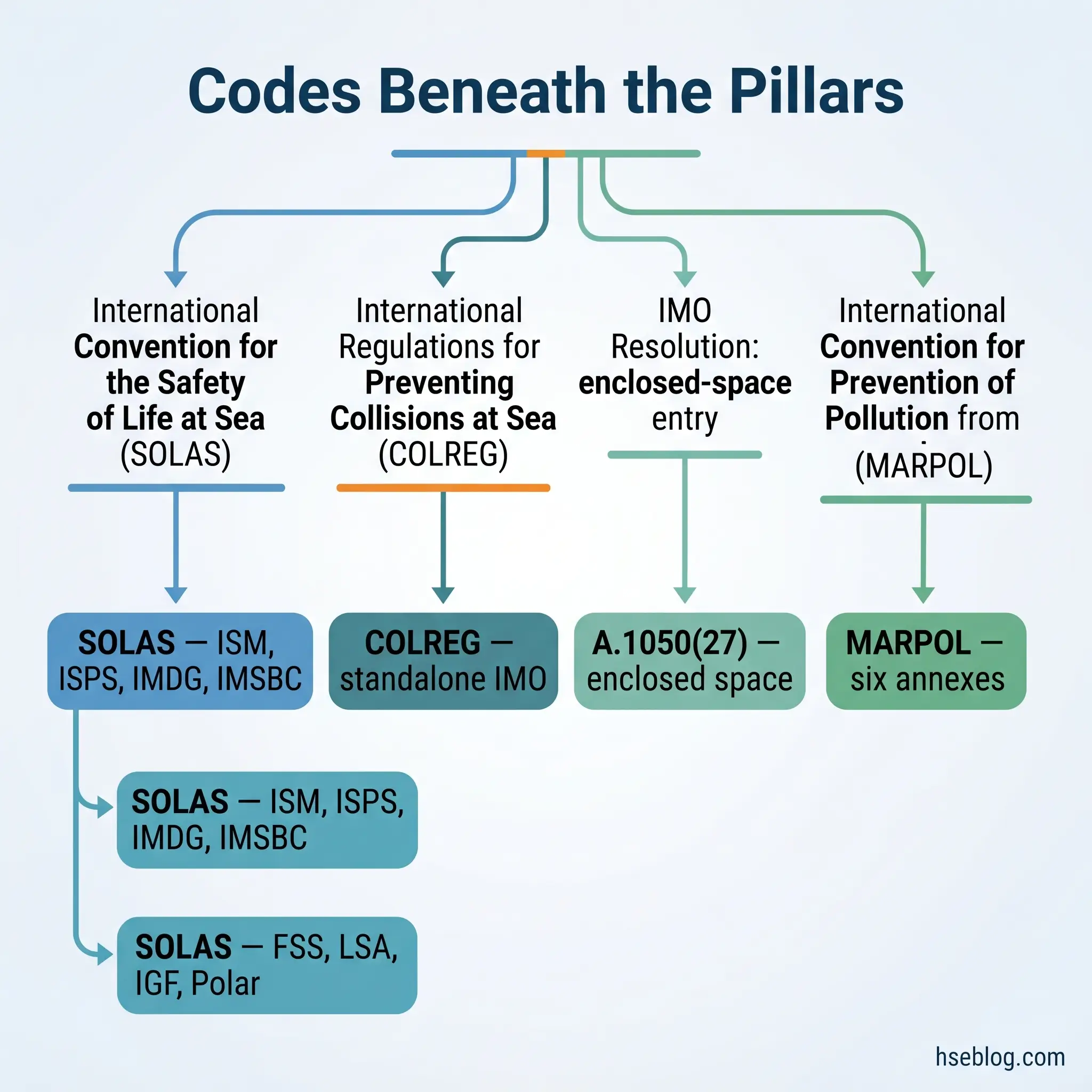
| Code | Parent / authority | Year | What it covers |
|---|---|---|---|
| ISM Code | SOLAS Chapter IX | 1993 (mandatory 1998) | Safety Management System; DOC and SMC certificates |
| ISPS Code | SOLAS Chapter XI-2 | 2004 | Maritime security; inspected alongside safety |
| COLREG 1972 | IMO (standalone) | 1977 (in force) | Rules of the road, lights and shapes, sound signals |
| IMDG Code | SOLAS Chapter VII | Mandatory 2004 | Dangerous goods in packaged form |
| IMSBC Code | SOLAS Chapter VI/XII | Mandatory 2011 | Solid bulk cargoes |
| FSS / LSA Codes | SOLAS II-2 / III | Various | Technical detail on fire-safety and lifesaving appliances |
| IGC / IBC / IGF Codes | SOLAS II-1 / II-2 | Various | Gas carriers, chemical tankers, alternative-fuel ships |
| Polar Code | SOLAS XIV | 2017 | Additional safety layer for Arctic/Antarctic waters |
| IMO A.1050(27) | Non-mandatory resolution | 2011 | Enclosed-space entry (widely acknowledged as overdue for revision) |
A practitioner read: the non-pillar codes can be as operationally important as the pillars themselves. ISM non-conformities are the most frequently cited deficiency in Paris MoU and Tokyo MoU detention data. A misstowed IMDG-classified package on a container vessel is a routine detention. The “soft” instruments are where the audit findings actually land.
National and Regional Layers: OSHA, MCA, EMSA, USCG
International conventions do not regulate directly — they are implemented through national law. The operator who drafts a single global Safety Management System and assumes it satisfies every port call is the operator who gets detained. National layers add real, overlapping obligations, and port state control regimes specifically target known flag-state weaknesses.
United States. OSHA 29 CFR Part 1915 (Shipyard Employment), 1917 (Marine Terminals), and 1918 (Longshoring) apply to shoreside work touching vessels. On US-flag vessels in navigation, the United States Coast Guard — under the Department of Homeland Security — is the primary regulator, and USCG regulation typically pre-empts OSHA at sea. The split is operational: OSHA at the shipyard, USCG once underway.
United Kingdom. The Maritime and Coastguard Agency (MCA) is the UK flag-state authority. Its Code of Safe Working Practices for Merchant Seafarers (COSWP), most recently updated in 2024, is the operational HSE reference for UK-flagged ships and is widely adopted as a reference by other flag administrations. COSWP is more prescriptive than MLC Reg 4.3 and often sets the benchmark for shipboard safety procedures.
European Union. The European Maritime Safety Agency (EMSA) does not issue ship certificates but publishes the most granular casualty data in the field and administers the European Marine Casualty Information Platform (EMCIP). Directive 2009/18/EC governs casualty investigation in EU waters.
Flag state vs port state vs coastal state. A ship’s flag state issues certificates and carries primary regulatory responsibility. The port state inspects foreign-flag ships calling in its ports under the relevant regional MoU. The coastal state exercises jurisdiction in its territorial sea. Where obligations overlap, the stricter prevails.
How Maritime Regulation Is Actually Enforced
The enforcement chain is the reason the certificates matter. A flag state — or, more typically, a classification society acting as a Recognised Organisation under delegated authority — surveys the ship, verifies compliance with SOLAS, MARPOL, and the ISM Code, and issues certificates. Those certificates travel with the ship. When the ship calls at a foreign port, the port’s state control apparatus — USCG in the United States, Paris MoU member authorities across most of Europe and North Atlantic, Tokyo MoU in Asia-Pacific, Indian Ocean MoU, Mediterranean MoU — selects ships for inspection using risk-based targeting and checks the certificates, the crew’s STCW documentation, and a sample of operational systems.
EMSA’s most recent analysis finds that the human element accounts for 80.1% of investigated marine casualties over 2014–2023, with 58.4% involving a human action event and 49.8% involving a human behaviour contributing factor (EMSA, 2024). That finding drives how inspections are targeted — at systems and competence, not at bent metal.
Audit Point: The recurring pattern in Paris MoU and Tokyo MoU detention data is that detentions concentrate in four areas: ISM Safety Management System documentation, fire safety, lifesaving appliances, and MARPOL Annex I Oil Record Book entries. A ship that arrives with current paperwork matching on-board reality usually walks. A ship with an expired SMC, a missing Oil Record Book entry, or a lifeboat that will not lower is detained.
Criminal prosecution and civil penalties sit above detention as the escalation path. MARPOL Annex I violations — magic-pipe cases, falsified Oil Record Books — have produced the largest criminal fines in the history of the industry, frequently exceeding USD 30 million per case in US federal prosecutions under the Act to Prevent Pollution from Ships. The 2022 MLC amendments, in force since 23 December 2024, add a reporting consequence for seafarer deaths: each flag state must investigate and report every death annually to the ILO, creating for the first time a visible global register.
Emerging Hazards and Regulatory Developments (2024–2026)
Three live developments deserve space in any current marine safety compliance programme, because they are already reshaping inspection focus.
2026 IMO amendment package (in force 1 January 2026). STCW MSC.560(108) adds mandatory training on the prevention of violence, harassment, and sexual harassment — the first welfare-competence standard written into certification. SOLAS MSC.550(108) refines danger-reporting and position-reporting under Chapter V/31 and V/32. MARPOL MEPC.384(81) amendments accompany the package, and further NOx Technical Code amendments follow on 1 September 2026. The operational read: 2026 is the first wave of welfare-driven amendments appearing in certification. Mental-health competence standards and alternative-fuel safety competencies are the probable next waves.
MLC 2022 amendments in force 23 December 2024. For the first time, every flag state must investigate and report every seafarer death. The ILO’s experimental first-year data collection (2023 reference year, published 2026) recorded 403 deaths from 51 reporting countries, with illness leading, persons overboard second, and occupational accidents third (ILO, 2026). The dataset is incomplete — only 51 states reported — but it establishes the register. Expect coverage and analytical demands on reporting to grow.
Alternative-fuel safety and the “shadow fleet.” Two pressures are operating in opposite directions. On one side, IMO is moving from prescriptive to goal-based regulation to accommodate LNG, methanol, ammonia, hydrogen, LPG, and fuel-cell propulsion under the IGF Code framework — each fuel carrying a different fire, toxicity, and cryogenic profile. On the other, the so-called shadow fleet — aging tankers with opaque ownership, disabled AIS transponders, and unclear P&I cover — generates casualty risk outside conventional regulatory reach. DNV and Lloyd’s List Intelligence found 2,615 safety incidents involving vessels over 100 gross tons in 2022 alone, a 9% annual increase (DNV, 2023). The trend line is not encouraging.
Cyber safety sits alongside as a quieter fourth development. Ships are increasingly networked — ECDIS, engine-management systems, cargo-monitoring, crew welfare networks — and IMO MSC-FAL.1/Circ.3 guidance brings cyber risk into the ISM Code’s scope.
Frequently Asked Questions
Conclusion
Regulatory content here reflects general HSE professional understanding of international, US, UK, and EU requirements as of April 2026. It is not legal advice. Specific compliance questions, detention or prosecution situations, or flag-state authorisation questions should be directed to qualified legal counsel or a designated flag-state authority in the applicable jurisdiction.
The direction of maritime safety hazards and regulations over the next five years is already visible in the 2024–2026 amendment record. The MLC 2022 amendments in force since December 2024 put a death-reporting obligation on every flag state and will, over time, produce the first credible global picture of seafarer fatality causation — a picture in which illness and mental health already outweigh the traditional machinery-and-fall hazards on significant tonnage. The 2026 STCW harassment-training amendment is the first welfare-driven competence requirement written into certification, and it will not be the last. Mental-health competence and alternative-fuel safety competence are the probable next-wave additions to the individual seafarer’s Certificate of Competency.
For the HSE professional, that shift changes where the attention should sit. Traditional programmes built around lifeboat drills, enclosed-space permits, and hot-work isolation remain necessary — the EMSA casualty data says slipping and falling still leads occupational fatalities — but they are no longer sufficient. Rest-hour compliance under MLC 2.3, the quality of welfare provision, the presence of a genuine mental-health pathway, and the company’s readiness to investigate a suicide under MLC Reg 4.3 and the 2022 amendments are now compliance questions with audit consequences. Ships still sink and still catch fire, and SOLAS, MARPOL, STCW, and MLC remain the spine. What has changed is that the welfare edge of the pillar structure has grown teeth — and the practitioners who map this year’s amendments onto their Safety Management System will spend less time responding to detentions than those who do not.