A permit to work (PTW) is a formal documented system that authorizes specific people to carry out defined high-risk work within a set time frame and location. It identifies hazards, specifies required safety controls, assigns responsibilities, and ensures all precautions are verified before work begins. The ten major permit types — hot work, cold work, confined space entry, electrical isolation, working at height, excavation, lifting operations, chemical handling, radiation work, and energy isolation — each target a distinct hazard mechanism requiring specific controls.
What Is a Permit to Work System and Why Does It Matter?
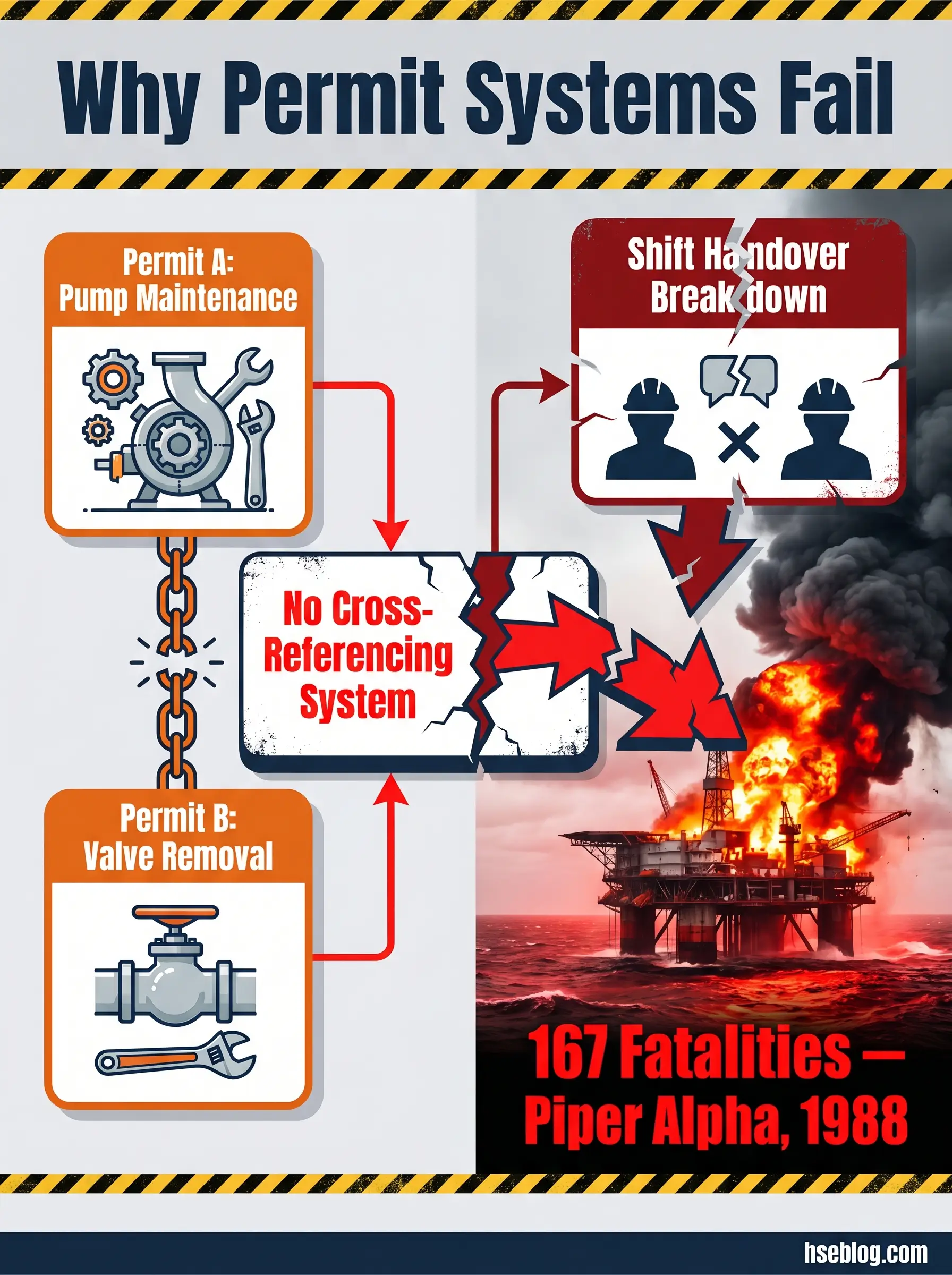
On 6 July 1988, a condensate pump on the Piper Alpha platform in the North Sea was undergoing maintenance. A separate permit had authorized the removal of a pressure safety valve on the same system. When the night shift started the backup pump — unaware the safety valve had been removed — liquid hydrocarbon released under pressure, ignited, and triggered a chain of explosions that killed 167 people. The permits existed. The failure was that no mechanism connected them. The shift handover did not communicate that the safety valve was absent, and no cross-referencing system flagged the conflict between the two active permits. Lord Cullen's Public Inquiry (1990) identified the PTW breakdown as a direct causal factor.
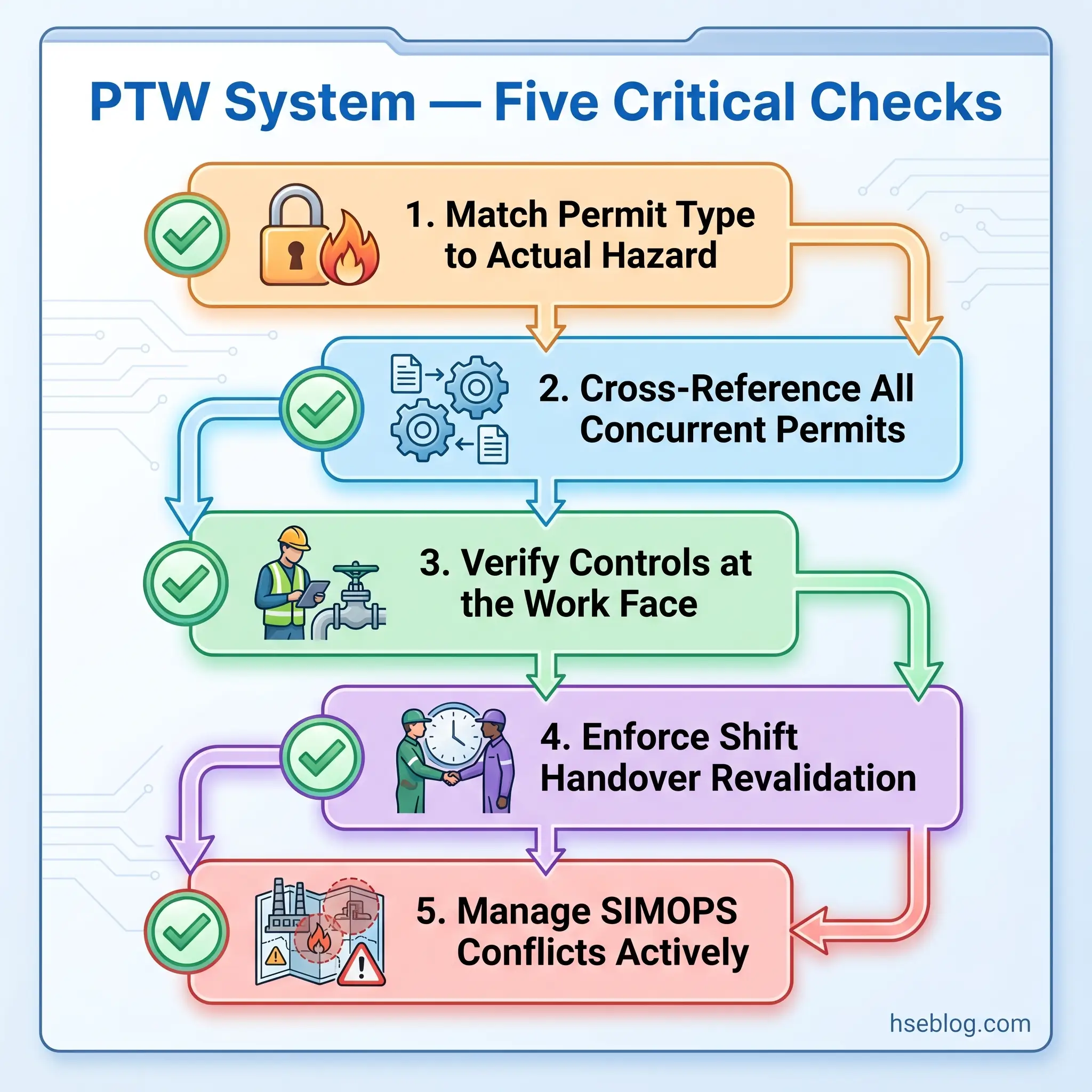
That disaster reshaped how every high-hazard industry thinks about permit-to-work systems. A PTW is not simply a form granting authorization to perform work. It is a structured communication system that forces a documented conversation between the people who control the work area, the people who will perform the work, and the people who must verify that safety controls are in place before work begins. HSE UK's guidance on permit-to-work systems states this plainly: the permit does not make the job safe — the system around it does. A risk assessment identifies hazards and determines controls. A method statement describes how the task is performed. The PTW adds a layer above both: formal authorization, verification of controls, defined validity, communication of status, and controlled closure. When organizations treat the permit as a tick-box document rather than a live communication tool between the permit issuer, the performing authority, and the area authority, the system degrades to paperwork — and paperwork has never stopped a gas release.
How Permit Types Are Categorized: Matching the Permit to the Hazard
Permits are not categorized by the trade performing the work. They are categorized by the dominant hazard the work introduces or encounters. This distinction matters because a single task can trigger multiple permit types simultaneously — and the most frequent PTW audit finding across sites is not a missing permit, but the wrong permit type applied to the task.
A pipefitter grinding a weld inside a process vessel needs three permits: a confined space entry permit (atmospheric and engulfment hazards), a hot work permit (sparks from the grinder in a potentially flammable atmosphere), and an isolation certificate (ensuring process energy is locked out). Each permit addresses a distinct hazard mechanism with its own specific controls. Issuing only a confined space entry permit and treating the grinding as incidental misses the ignition source entirely.
The organizing principle works across hazard categories. Thermal hazards trigger hot work permits. Atmospheric and engulfment hazards trigger confined space permits. Gravitational energy triggers working at height permits. Electrical and mechanical stored energy trigger isolation permits. Ground instability and buried services trigger excavation permits. The table below maps the ten major permit types to their trigger hazards and the primary controls each requires.
| Permit Type | Trigger Hazard | Key Controls | Typical Validity | Common Regulatory Reference |
|---|---|---|---|---|
| Hot Work | Fire, explosion, thermal burns | Gas testing, fire watch, combustible clearance | One shift / 8–12 hrs | OSHA 1910.252; HSG250 (UK) |
| Cold Work | Mechanical, chemical, physical | Isolation, PPE, barricading | One shift / 12 hrs | Site-specific PTW procedure |
| Confined Space Entry | Atmospheric, engulfment | Gas testing, ventilation, standby, rescue plan | One shift / 8–12 hrs | OSHA 1910.146 (US); CS Regs 1997 (UK) |
| Electrical Isolation (LOTO) | Electrocution, arc flash | LOTO, zero-energy verification, arc flash PPE | Duration of task | OSHA 1910.147 (US); NFPA 70E |
| Working at Height | Falls | Edge protection, harness, rescue plan | One shift / 12 hrs | WAH Regs 2005 (UK); OSHA 1926 Subpart M |
| Excavation | Collapse, buried services | Utility survey, shoring, daily inspection | One shift / 12 hrs | OSHA 1926 Subpart P (US) |
| Lifting / Crane | Dropped load, crush | Lift plan, exclusion zone, signal person | Per lift operation | OSHA 1926 Subpart CC; LOLER 1998 (UK) |
| Chemical / Hazmat | Toxic exposure, chemical burns | SDS review, substance-specific PPE, spill containment | One shift / varies | OSHA 1910.1200; COSHH 2002 (UK) |
| Radiation | Ionizing radiation exposure | Exclusion zone, dosimetry, licensed supervisor | Per exposure window | NRC 10 CFR Part 20 (US); IRR17 (UK) |
| Energy Isolation | All stored energy types | Isolation register, try-test, energy dissipation | Duration of task | OSHA 1910.147 (US) |
The exact permit titles and the number of categories vary between organizations and jurisdictions. Saudi Aramco's PTW system defines fourteen or more permit types. Many UK petrochemical sites operate with five to seven. OSHAD SF Mechanism 7.0 (Abu Dhabi) mandates specific permit types for hot work, confined space, excavation, electrical isolation, and working at height. What matters is not the naming convention — it is whether the permit system captures every hazard the task introduces.
1. Hot Work Permit
Hot work permits govern any activity that produces sparks, open flame, or heat sufficient to ignite flammable atmospheres or combustible materials. This is the most universally required permit type across industrial sectors, and it is the permit type most frequently implicated in fire investigations — not because the permit was absent, but because controls degraded during execution.
Activities requiring a hot work permit include welding, oxy-fuel cutting, grinding, brazing, soldering, and torch-applied roofing. The trigger threshold is straightforward: if the task generates an ignition source, the permit is required whenever flammable materials or atmospheres could be present in the work zone.
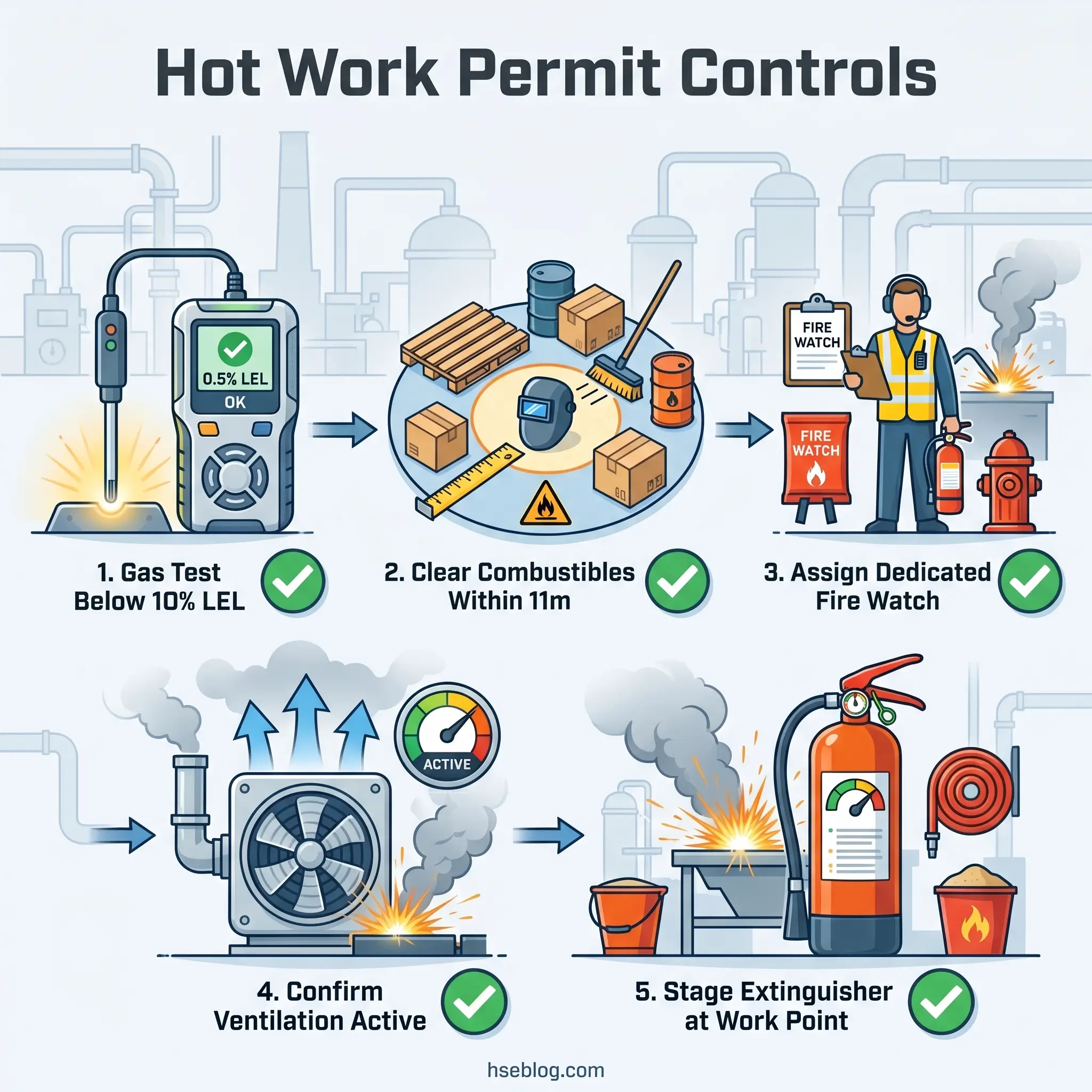
The controls that make a hot work permit effective are specific and sequential:
- Pre-work gas testing — LEL (Lower Explosive Limit) monitoring to confirm the atmosphere is below 10% LEL before work begins. Some organizations apply a stricter 5% LEL threshold as best practice.
- Combustible clearance — Removal or fire-resistant covering of all combustible materials within a defined radius, typically 11 meters (35 feet).
- Fire watch assignment — A dedicated person equipped with extinguishing equipment who monitors for fire during work and for a post-work period, typically 30 to 60 minutes after the last spark-producing activity.
- Ventilation — Forced or natural ventilation to prevent accumulation of flammable vapors.
- Fire extinguisher placement — Appropriate extinguisher staged at the work location, not in a cabinet down the corridor.
Consider a welding repair on a pipeline flange in a process plant. The hot work permit requires a gas test confirming the surrounding atmosphere is safe, combustible materials cleared from the welding radius, a fire watch assigned for the duration plus 30 minutes post-completion, and the fire extinguisher physically present at the work point. OSHA references hot work permits under 29 CFR 1910.252 (US) for general welding requirements, and within 29 CFR 1910.146 when hot work occurs inside a confined space. HSG250 addresses hot work within the broader UK PTW framework.
Watch For: The most common hot work failure is not the permit itself — it is the fire watch being terminated prematurely. Production pressure routinely compresses the post-work monitoring period. A fire that smolders for 45 minutes before igniting will not be caught by a fire watch that was pulled after 20.
2. Cold Work Permit
A cold work permit covers maintenance and operational tasks that do not generate ignition sources but still carry hazards — mechanical injury, chemical exposure, physical harm from moving parts or pressurized systems. In many organizations, this functions as the general-purpose permit, and that dual identity creates a specific risk.
Activities under a cold work permit include mechanical maintenance on de-energized equipment, valve operations, instrument calibration, insulation removal, painting, scaffolding erection, and pipeline flushing. The controls are task-specific but typically include isolation verification, required PPE, area barricading, and a task-specific risk assessment reviewed by the permit issuer.
For example, replacing a gasket on a non-energized flange requires a cold work permit with an isolation certificate attached confirming the line is depressurized and drained. The permit specifies the PPE (face shield for residual fluid, chemical-resistant gloves matched to the process fluid), the isolation points, and the expected duration.
The critical boundary that separates cold work from hot work is the incidental ignition source. If a cold work task could generate sparks — using a pneumatic grinder to remove a corroded bolt, for instance — the permit must escalate to hot work. This is the judgment call that gets missed most often. The task is "mechanical maintenance," so the default is a cold work permit. But the tool selection introduces an ignition source, and the permit type must follow the hazard, not the job title.
Audit Point: Cold work permits are the permit type most likely to be treated as routine. When auditing a PTW system, check whether cold work permits are receiving the same level of hazard review as specialized permits — or whether they have become a default checkbox that avoids the scrutiny of a hot work or confined space permit.
3. Confined Space Entry Permit
Confined space entry is one of the highest-fatality work categories governed by PTW systems. OSHA estimates approximately 100 confined space fatalities occur per year in the United States, with nearly 60% caused by hazardous atmospheres (OSHA, ongoing estimate). The confined space entry permit exists because the hazards inside these spaces are invisible, fast-acting, and lethal.
A confined space, as defined under OSHA 29 CFR 1910.146 (US), meets three criteria: it is large enough for a worker to enter and perform work, it has limited or restricted means of entry and exit, and it is not designed for continuous human occupancy. The UK's Confined Spaces Regulations 1997 apply a similar functional definition. The critical regulatory distinction under OSHA is between permit-required and non-permit-required confined spaces — the former presents or has the potential to present a hazardous atmosphere, engulfment risk, converging walls, or any other recognized serious hazard.
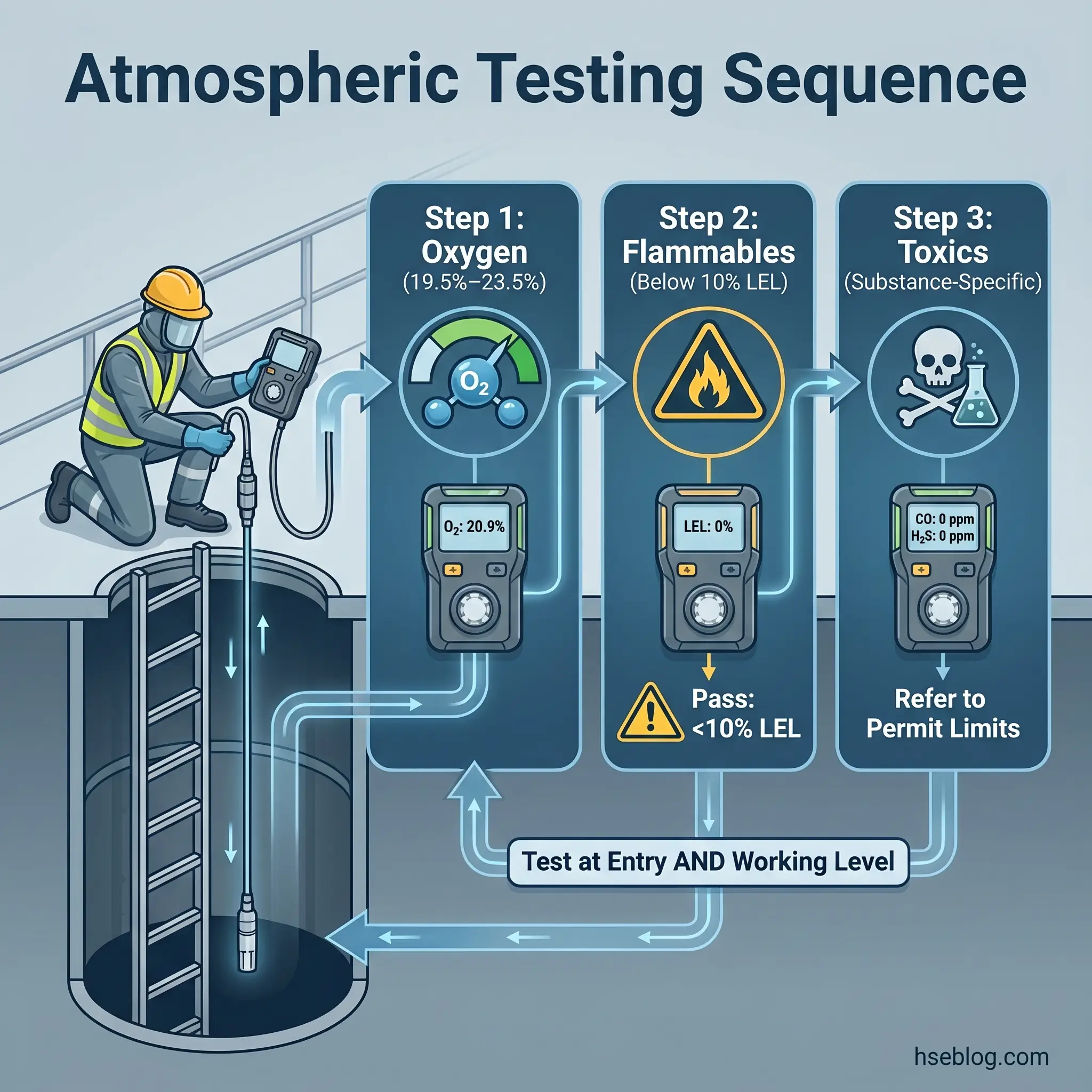
Atmospheric testing follows a mandatory sequence, and the order is not arbitrary:
- Oxygen first — Test oxygen concentration before introducing a catalytic LEL sensor, which requires oxygen to function accurately. Acceptable range under OSHA is 19.5% to 23.5%. Some GCC standards adopt slightly different thresholds; when jurisdictions conflict, apply the stricter limit.
- Flammables second — LEL reading must be below 10% of the lower explosive limit for entry. Some organizations enforce a stricter 5% LEL policy.
- Toxics third — Test for specific toxic substances based on the space's prior contents and adjacent processes. Hydrogen sulfide and carbon monoxide are the most common targets.
Beyond atmospheric monitoring, the permit mandates continuous or forced ventilation, a standby attendant at the entry point who does not enter the space, a rescue plan with equipment staged and a team identified, and a communication system between the entrant and the attendant.
Consider a storage tank cleaning operation at a chemical facility. The confined space entry permit requires full atmospheric testing at the entry point and at the working level inside the tank — not just at the opening. A standby person is stationed at the entry with a rescue tripod deployed. Communication is maintained throughout. The rescue plan specifies how the entrant will be extracted if incapacitated, and the rescue team has practiced the procedure.
Field Test: The most dangerous assumption in confined space work is that the atmosphere tested safe at entry remains safe throughout. Atmospheric conditions change during work. Welding consumes oxygen and generates fumes. Adjacent process lines can release gases. Rust on steel surfaces consumes oxygen through oxidation. Biological decomposition in sludge generates hydrogen sulfide. Continuous or frequent re-testing is the control that degrades first in practice — and the one most directly linked to fatalities.
4. Electrical Work Permit (Isolation/LOTO Permit)
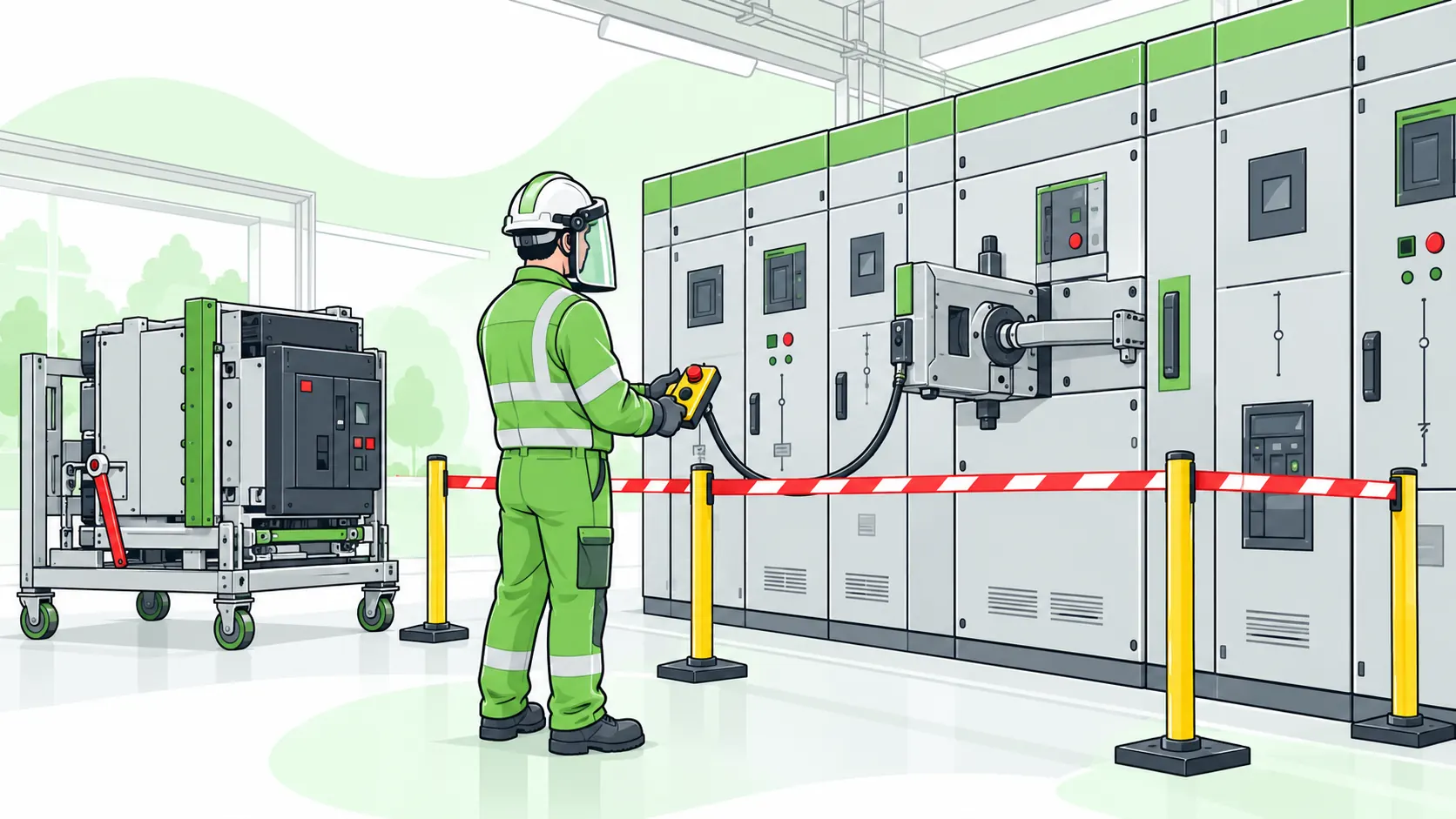
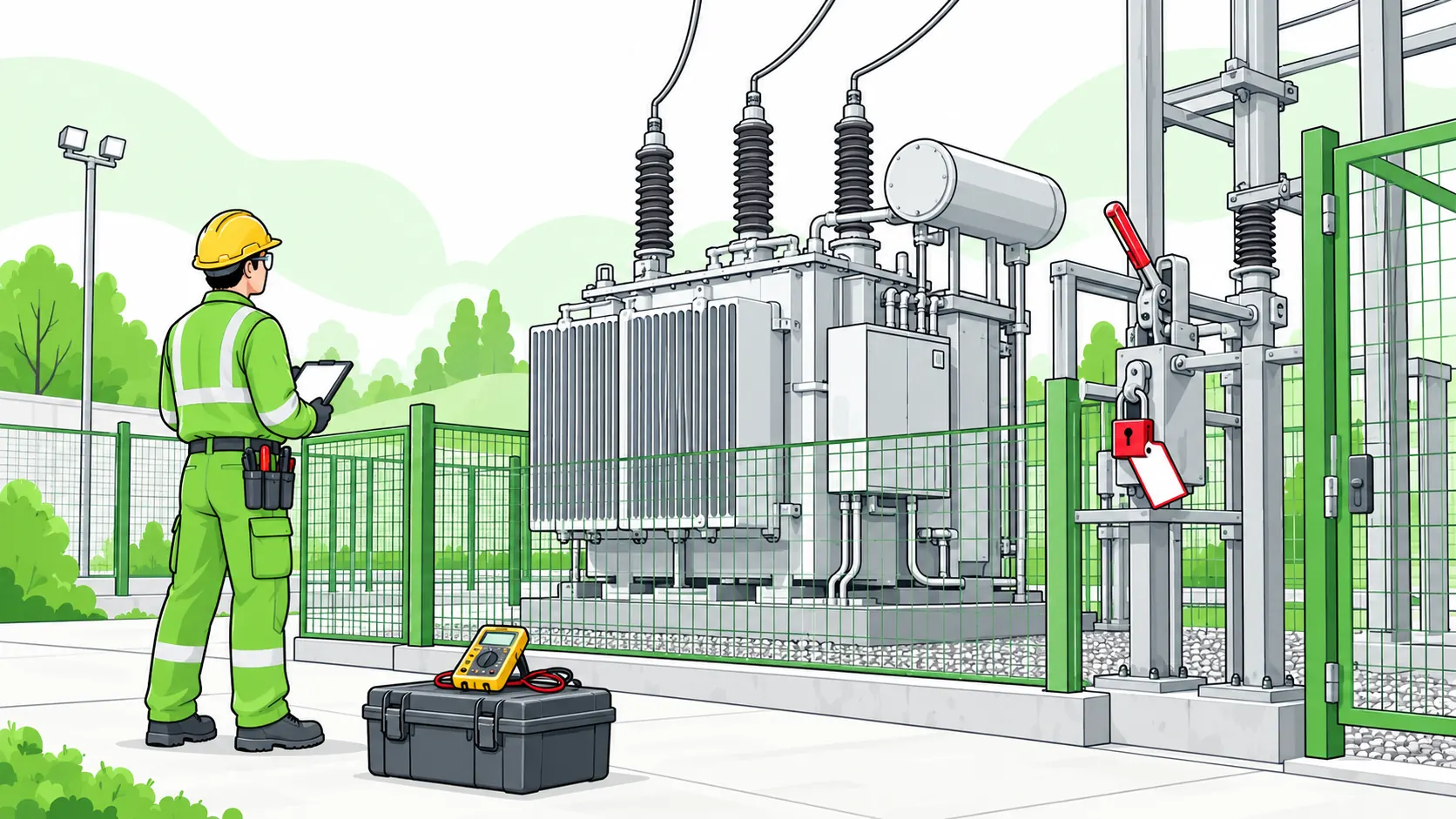
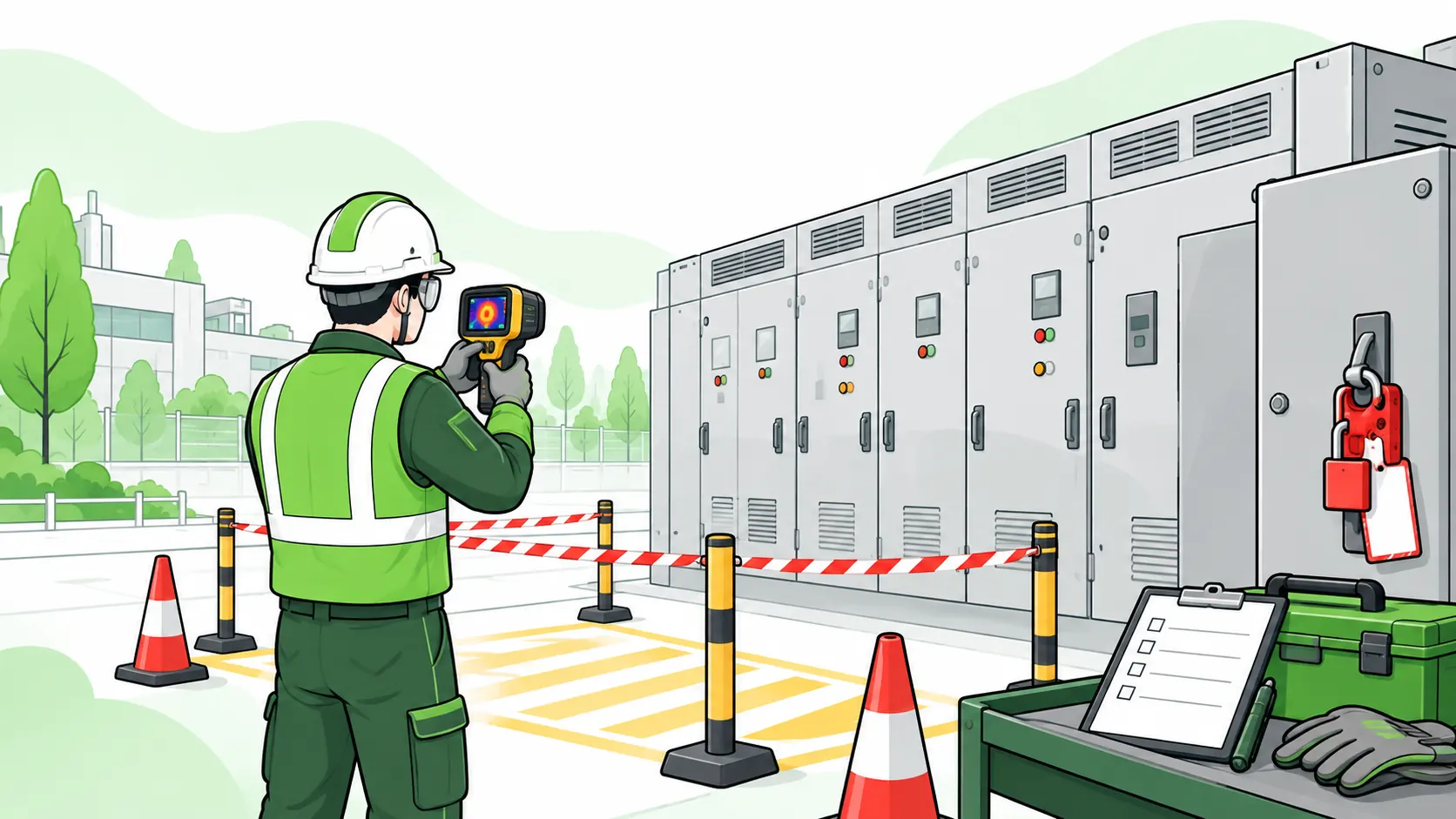
Electrical work permits govern tasks on or near energized electrical systems where contact or arc flash could cause electrocution, burns, or blast injury. This permit type is inseparable from lockout/tagout (LOTO) procedures — the permit authorizes the work, and LOTO physically secures the zero-energy state.
The activities requiring an electrical work permit include maintenance and repair of switchgear, panel modifications, cable pulling in energized environments, transformer work, and testing and commissioning. The permit's controls center on achieving and verifying a zero-energy state before any hands-on work begins.
OSHA 29 CFR 1910.147 (US) establishes the requirements for the control of hazardous energy through lockout/tagout. OSHA 29 CFR 1910.333 specifies electrical safe work practices. NFPA 70E provides the arc flash hazard analysis and PPE selection framework. Under these combined requirements, the controls include isolation and LOTO application by an authorized person, stored energy discharge (capacitors, springs), absence-of-voltage verification at the point of work using a properly rated voltage tester, arc flash PPE selected per the incident energy analysis, and insulated tools rated for the voltage class.
Take a circuit breaker replacement in a motor control center as a practical example. The electrical work permit requires the feeder breaker to be locked out, stored energy in any capacitors discharged, and an absence-of-voltage test performed at the specific compartment where the worker's hands will be — not at the upstream panel. The person performing the task verifies zero energy themselves. They do not rely on someone else's test.
The Fix That Works: The critical failure pattern in electrical permits is "procedural LOTO" — where isolation is documented on paper but the physical verification step is rushed or delegated. The permit must require point-of-work verification by the person who will perform the task. Multiple fatalities have resulted from workers relying on an isolation status communicated verbally or documented on a permit form, when the physical state of the equipment did not match.
5. Working at Height Permit
Falls remain the single largest cause of workplace fatalities in construction and a leading cause across all industries. The Bureau of Labor Statistics reported 844 fatal falls, slips, and trips in the United States in 2024, down 4.6% from 2023 (Bureau of Labor Statistics, 2026). Working at height permits exist to impose the hierarchy of controls onto every task where a fall could cause injury.
The trigger threshold varies by jurisdiction. The UK Work at Height Regulations 2005 apply to any work where a person could fall a distance liable to cause personal injury — there is no minimum height. OSHA 1926 Subpart M (US construction) triggers fall protection at 6 feet (1.8 meters). Many organizations adopt a 2-meter threshold as standard policy. Some set their threshold lower for specific high-consequence environments.
The controls follow a hierarchy that the permit must enforce, not merely reference:
- Eliminate — Can the work be done from the ground? Can the component be assembled at ground level and lifted into position?
- Prevent — Guardrails, safety nets, fixed platforms, scaffolding with edge protection. These are collective protection measures that do not require individual worker action.
- Mitigate — Fall arrest harnesses with certified anchor points. These accept that a fall may occur and limit its consequences.
An example: installing solar panels on a commercial roof. The working at height permit specifies an edge protection system around the roof perimeter, harness tie-off to certified anchor points for any worker within 2 meters of an unprotected edge, and — critically — a rescue procedure for a worker who falls into a harness and is suspended.
That last element is the gap in most working at height permits. Suspension trauma is the under-addressed risk. A worker suspended in a fall arrest harness can develop orthostatic intolerance within 10 to 15 minutes as blood pools in the legs. The permit mandates the harness but frequently omits the rescue plan for recovering a suspended worker within that window. A fall arrest system without a rescue plan is half a control.
6. Excavation Work Permit
Excavation permits address two distinct hazard profiles operating simultaneously: the collapse and engulfment risk from unstable soil, and the risk of striking underground utilities — gas mains, electrical cables, water pipes, telecommunications lines.
Activities covered include trenching, foundation digging, utility installation, ground investigation, and any mechanical ground disturbance. The pre-dig requirements are the first layer of control. Before any excavation begins, a utility survey must be completed — dial-before-you-dig programs in most jurisdictions provide records of buried services, supplemented by cable and pipe locator scans on site.
OSHA 29 CFR 1926 Subpart P (US) requires protective systems — shoring, benching, or sloping — for excavations over 5 feet (1.5 meters) deep, or at shallower depths where hazardous conditions exist. A competent person must inspect the excavation daily and after every rain event, as soil stability changes with water content. HSE UK guidance mirrors these principles with similar requirements for shoring and daily inspection.
For a practical scenario, consider a sewer line installation requiring a 2-meter-deep trench in an urban area. The excavation permit requires a completed utility locate with the results documented on the permit, a trench box installed to protect against sidewall collapse, barricading and edge protection to prevent falls into the trench, and a daily inspection protocol that includes post-rainfall checks.
Watch For: The hazard that excavation permits most frequently underestimate is the atmospheric risk in deep trenches. A trench deeper than 1.2 meters in contaminated ground — former industrial sites, landfill areas, ground near leaking gas mains — can accumulate toxic or oxygen-depleted air at the bottom. Gas testing is often omitted because the permit treats the work as a "ground works" task, not a confined space analogue. Deep, narrow excavations with poor natural ventilation present atmospheric hazards functionally identical to confined spaces, and the permit should address this.
7. Lifting and Crane Work Permit
Lifting permits govern crane operations and heavy rigging activities where a dropped or swinging load could cause fatal injury or significant property damage. The permit scope distinguishes between routine lifts — repetitive, within the crane's charted capacity, with clear sightlines — and critical or non-routine lifts that require additional engineering controls.
Critical lifts include any lift exceeding 80% of the crane's rated capacity, tandem lifts using two or more cranes, blind lifts where the operator cannot see the load, lifts over operating process equipment, and personnel basket operations. These require an engineered lift plan with load calculations, rigging configuration, ground bearing pressure assessment, and a detailed sequence of operations.
The controls on a lifting permit include the lift plan itself (load weight, crane capacity at the required radius, rigging inspection, and ground conditions assessment), crane certification and operator competency verification, signal person assignment for directing the crane operator, an exclusion zone under and around the load path, and wind speed limits — typically operations cease above 20 mph (30 km/h) for mobile cranes, though specific limits depend on the crane type and load characteristics.
OSHA 1926 Subpart CC (US) governs cranes and derricks in construction. The UK's Lifting Operations and Lifting Equipment Regulations 1998 (LOLER) and BS 7121 provide the framework for lift planning and crane operation.
The most common failure in crane permits is the gap between the lift plan on paper and the actual ground conditions. Lift plans are produced in an office using assumed ground bearing pressures. Outrigger pads are specified on paper based on those assumptions. The permit issuer's site walk-through should physically verify that outrigger positioning matches the plan and that the actual ground can support the imposed loads — especially on backfilled ground, near excavation edges, or after heavy rain. The paper plan is a model. The ground is the reality.
8. Chemical/Hazardous Materials Work Permit
Chemical work permits govern tasks involving the handling, transfer, storage, or disposal of hazardous substances. Unlike other permit types where the controls are broadly standardized, chemical permit controls must be substance-specific — driven by the Safety Data Sheet (SDS) for the actual materials involved.
Covered activities include chemical transfers between tanks or containers, tank cleaning where residual chemicals remain, handling of corrosives and toxics, laboratory chemical disposal, and line-breaking on chemical-service pipework. The mandatory first step before any control selection is the SDS review. The SDS provides the specific hazard data — toxicity thresholds, exposure routes, incompatible materials, required PPE type and material — that determines every other control on the permit.
The controls include substance-specific PPE (chemical-resistant gloves matched to the actual substance, face shield or splash goggles, respiratory protection if inhalation exposure exceeds permissible limits), spill containment (bunding, drip trays, secondary containment), ventilation to prevent vapor accumulation, and confirmed proximity of emergency shower and eyewash stations. OSHA's Hazard Communication Standard (29 CFR 1910.1200, US) and the COSHH Regulations 2002 (UK) establish the frameworks. The EU CLP Regulation governs classification and labeling.
As a practical example, transferring sulfuric acid between storage tanks requires the chemical work permit to reference the SDS, specify acid-resistant suit material (not generic "chemical suit"), mandate a face shield rated for corrosive splash, stage a spill kit with appropriate neutralizing agent, and confirm the emergency shower location and test status.
Audit Point: The failure pattern in chemical permits is generic PPE specification. A permit that mandates "chemical gloves" without identifying the glove material is operationally dangerous. Butyl rubber protects against ketones but degrades rapidly with halogenated solvents. Nitrile works for many organics but fails against strong oxidizers. The SDS permeation data must drive glove selection — not a one-size-fits-all checklist.
9. Radiation Work Permit
Radiation permits govern work involving ionizing radiation sources. In general industry, the most common encounter is industrial radiography — non-destructive testing (NDT) of welds using gamma-ray sources. Nuclear facility maintenance and industrial/medical source handling are the other primary applications. Most general industry sites will encounter this permit type only during NDT campaigns, but its impact on all other concurrent work makes it disproportionately significant.
The controls are defined by regulation. The US Nuclear Regulatory Commission (NRC) 10 CFR Part 20 governs radiation protection standards. The UK Ionising Radiations Regulations 2017 (IRR17) set the framework for the UK. Both require establishment of an exclusion zone with physical barriers and signage, personal dosimetry for all workers within the controlled area, a licensed radiation protection supervisor present during the exposure, and notification of all adjacent work parties.
A practical scenario: radiographic weld inspection on a pipeline, typically scheduled at night to reduce personnel exposure. The radiation permit requires the exclusion zone to be cordoned and signed, gamma alarm monitors deployed at the boundary, and — critically — all adjacent permits to be suspended during the exposure window.
This last point is the critical interface issue. When a radiation permit is active, all work within the exclusion zone must cease. The exclusion radius depends on the source activity and shielding, and it is frequently larger than anticipated. If the notification to adjacent work parties is delayed, or if the exclusion radius is underestimated, workers on other permits may be unknowingly exposed. The radiation permit does not exist in isolation — it overrides every other active permit within its zone.
10. Isolation Permit (Energy Isolation Certificate)
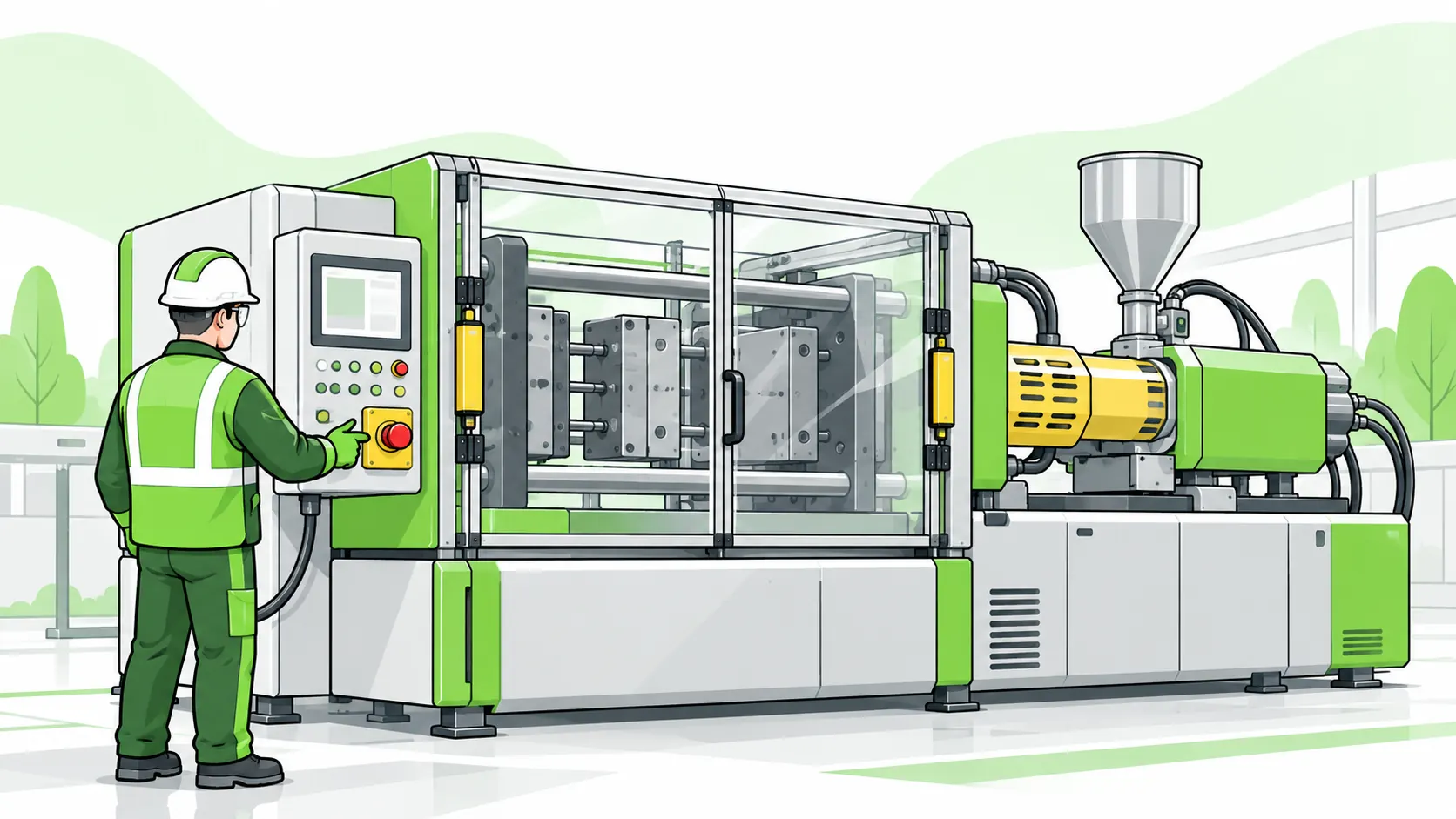
Some organizations treat energy isolation as a standalone permit. Others embed it within electrical or mechanical work permits. Regardless of the organizational structure, the isolation permit serves a distinct function: it is the formal system-level authorization to isolate hazardous energy sources and verify that equipment has reached a zero-energy state before any work begins.
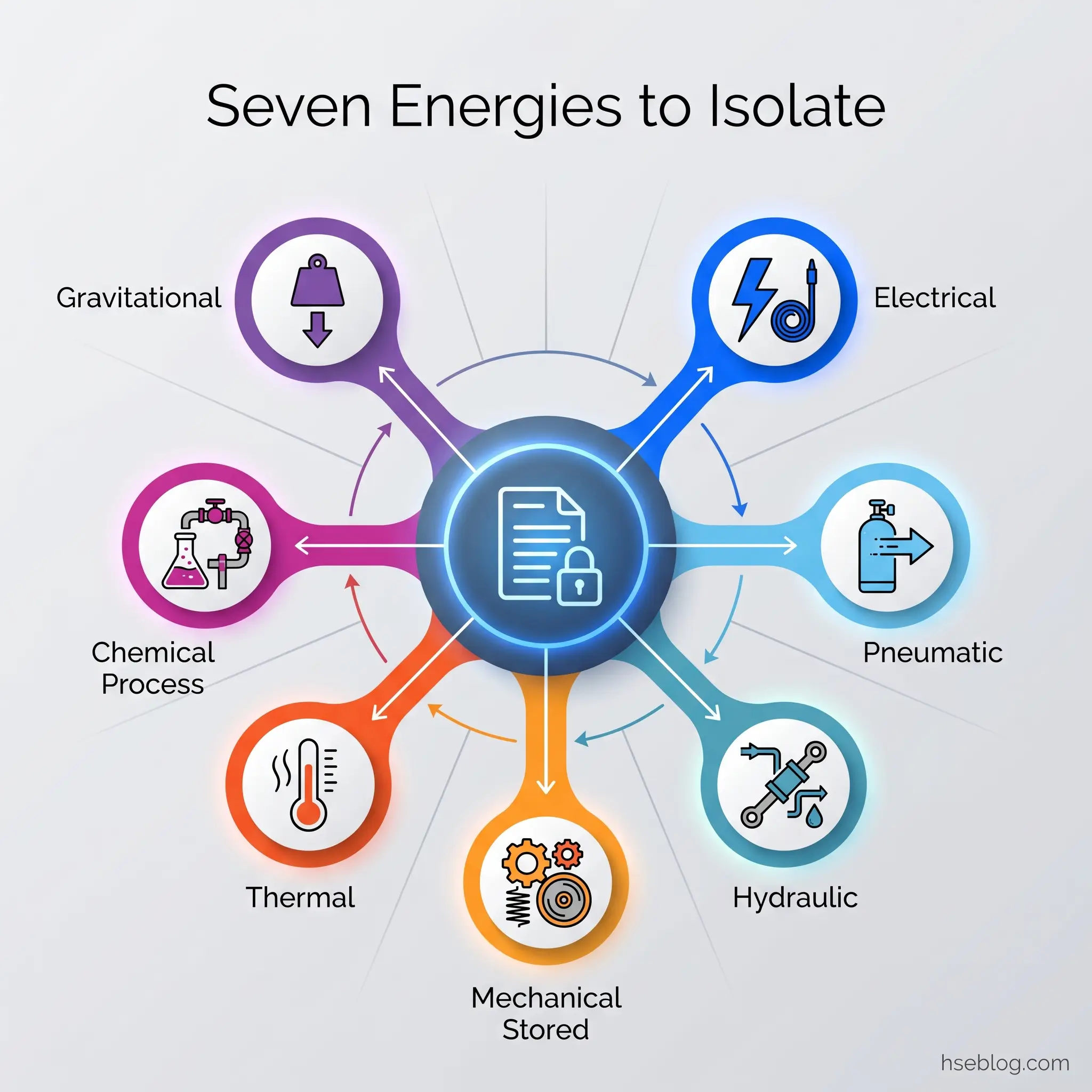
The energy sources covered extend far beyond electrical. An isolation permit addresses electrical energy, pneumatic pressure, hydraulic pressure, mechanical stored energy (springs, counterweights, flywheels), thermal energy (steam, heated surfaces), chemical energy (process fluids under pressure), and gravitational energy (suspended loads, elevated components). OSHA 29 CFR 1910.147 (US) provides the framework. HSE UK guidance on safe isolation of plant and equipment establishes equivalent principles.
The controls include an isolation register documenting every isolation point, lock and tag application at each point, stored energy dissipation and verification (bleeding pressure lines, draining accumulators, blocking mechanical components), and a try-test — physically attempting to operate the equipment at the operator station to confirm it does not respond.
For example, isolating a hydraulic press for bearing replacement requires the hydraulic pressure to be bled to zero, the accumulator drained, a mechanical block applied to prevent gravity-driven movement of the ram, and a try-test performed at the operator controls to confirm no movement occurs. Only after this sequence is complete does the isolation permit authorize work to proceed.
The distinction between the isolation permit and LOTO is important. LOTO is the physical act — applying the lock and tag to the energy isolation device. The isolation permit is the system-level authorization that governs the process: which energy sources must be isolated, who is authorized to apply locks, what verification steps are required, and when locks may be removed. The permit provides the management framework. LOTO provides the physical security.
Field Test: The most dangerous isolation failure is the "assumed isolation" — where the permit states the equipment is isolated, but the try-test is skipped because the isolator was seen in the open position, or because the isolation register says it is done. The try-test is not a formality. It is the last physical barrier between the worker and uncontrolled energy. Multiple fatalities have resulted from workers entering equipment that was documented as isolated but was not physically verified.
How Permits Interact: Managing Simultaneous Operations (SIMOPS)
The permit types discussed above do not exist in isolation. On any active work site, multiple permits are live simultaneously — often in overlapping or adjacent areas. When those permits create hazard interactions that neither permit addresses individually, the result is an uncontrolled risk that no single permit holder is managing.
This is the SIMOPS problem, and it is the gap that most PTW systems fail to close. Hot work adjacent to a confined space entry can ignite vapors venting from the space. A crane lift over an active excavation puts the crane load path directly above unprotected workers. Gas venting operations in the same zone as hot work create an ignition-atmosphere overlap. None of these interactions appear on any individual permit. They emerge from the combination.
The control mechanism is an incompatible operations matrix — a documented reference that identifies which permit types must not coexist in the same zone at the same time. A simplified example:
| Active Permit | Incompatible With |
|---|---|
| Hot Work | Gas venting, confined space purging, painting (flammable solvents) |
| Radiation (NDT) | All work within exclusion zone |
| Crane lift over process area | Hot work, confined space entry, excavation within load path |
| Gas venting / purging | Hot work, any ignition-source activity |
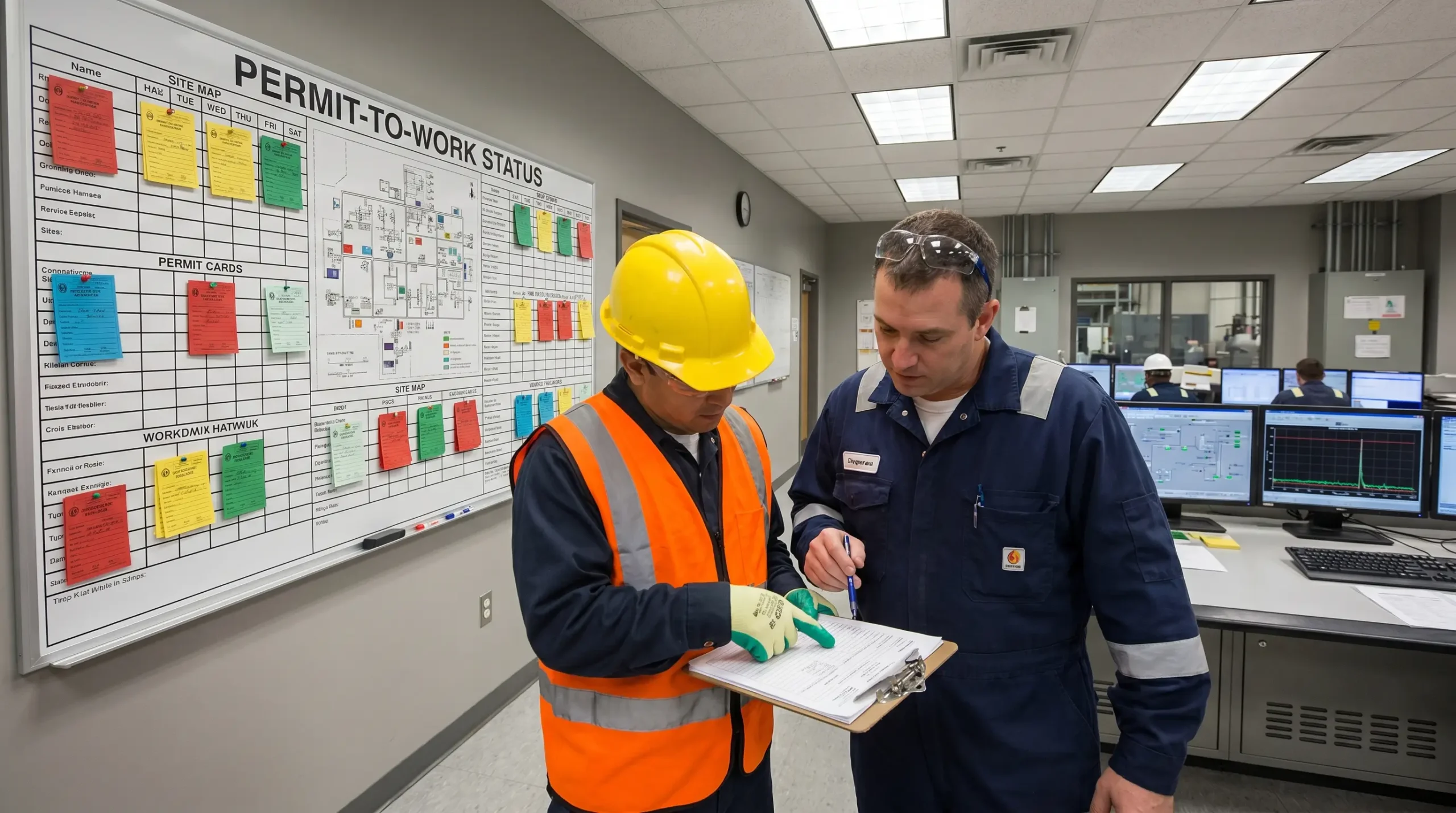
Managing these interactions requires a controlling authority — typically the area authority or site operations controller — who has visibility over all active permits in a given zone. Permit display boards (physical whiteboards or digital dashboards) make active permits visible at a glance. The controlling authority reviews new permit requests against the active permit register and rejects or sequences work to prevent conflicts.
The Piper Alpha investigation concluded that the absence of any mechanism to cross-reference related permits was a direct causal factor in the disaster. Thirty-eight years later, many organizations still manage permit interactions manually — through verbal communication between supervisors, or by relying on permit holders to notice adjacent hazards. This is the operational gap where digital PTW systems offer their most significant advantage, a point addressed in the next section.
Paper vs. Digital Permit to Work Systems (ePTW)
The transition from paper-based to electronic permit-to-work systems is accelerating, driven both by operational advantages and by regulatory direction. Singapore mandated electronic PTW systems for all public sector construction projects valued over S$3 million from April 2024 (Singapore WSH Council, 2024) — a concrete signal that digital permit management is becoming a regulatory expectation, not just a convenience.
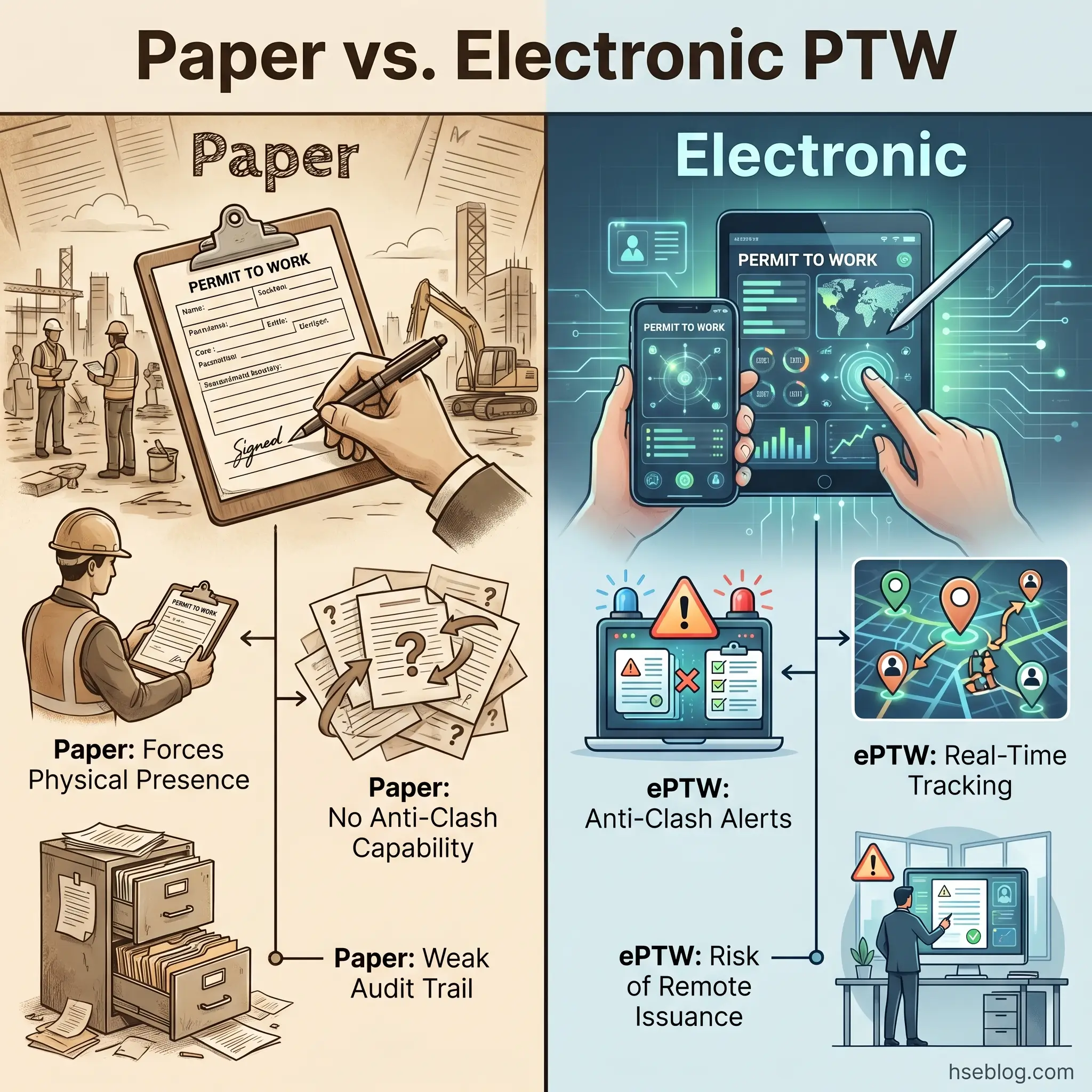
The operational advantages of ePTW systems are significant. Real-time dashboards show all active permits by location. Automated workflows route permit requests through the correct approval chain without paper handoffs. Timestamped audit trails record every issuance, amendment, suspension, and closure. Anti-clash logic flags when two conflicting permits — hot work and gas venting in the same zone, for example — are requested simultaneously. Mobile access allows permit holders to view and update permits at the work face rather than returning to a control room.
These advantages are real. But HSG250 — the UK's definitive guidance on PTW system design — warns explicitly about the risks that accompany electronic systems. Three deserve attention.
First, remote issuance. An ePTW system can allow a permit to be issued from an office without the issuer visiting the work location. The permit exists digitally, but the site conditions have not been verified. HSG250 requires that the issuer conduct a site visit regardless of the system format.
Second, generic templates. Digital systems make it easy to copy a previous permit and modify it slightly. The risk is that task-specific hazard identification degrades — the permit reflects the last similar job rather than the actual conditions of this job.
Third, false confidence from autopopulated checklists. When the system pre-fills control measures based on the permit type, the permit holder may accept defaults without evaluating whether they match the specific task. The hazard thinking shifts from "what does this job need?" to "what did the system suggest?"
Jurisdiction Note: HSG250 requires that electronic PTW systems prevent unauthorized issuance, maintain a paper backup capability, mandate site visits before permit issuance, and ensure training covers the PTW process and principles — not just the software interface. Organizations implementing ePTW should audit against these requirements, not just the software vendor's feature list.
The practitioner judgment here is straightforward: digitize a good process and you get a better process. Digitize a bad process and you get a bad process that runs faster, looks more professional, and is harder to challenge because it appears systematic. The PTW process must be sound before the software is selected.
Frequently Asked Questions
What is the difference between a permit to work and a risk assessment?
A risk assessment identifies hazards associated with a task and determines the control measures needed to manage them. A permit to work goes further — it formally authorizes specific people to proceed with defined high-risk work at a specified location for a limited time, but only after verifying that the identified controls are physically in place. The PTW presupposes a completed risk assessment and adds authorization, role assignment, communication of hazard status, and controlled closure. Every PTW requires a risk assessment, but not every risk assessment requires a PTW.v
Who is authorized to issue a permit to work?
A permit can only be issued by a competent person formally authorized by the organization — typically designated as the area authority or permit issuer. Competence must cover both the hazards of the work being performed and the hazards present in the work area. Under HSG250 (UK), the issuer must physically visit the work site before issuing the permit. Qualification requirements vary by jurisdiction and organizational procedure, but the principle of demonstrated competence is universal.
Can a single task require more than one permit to work?
Yes, and it frequently does. A welder performing repairs inside a storage vessel may need a confined space entry permit, a hot work permit for the welding itself, and an isolation certificate to confirm the vessel's energy sources are locked out. These permits must cross-reference each other so that all parties are aware of the combined hazard profile. Managing multiple concurrent permits on a single task is one of the core functions a PTW system must support.
What happens if work starts without a valid permit?
Starting high-risk work without a valid permit constitutes a permit violation and, in most jurisdictions, a breach of the employer's duty-of-care obligations. It should trigger immediate work stoppage, an investigation into why the system failed, and corrective action. Regulatory enforcement can follow — HSE UK has prosecuted organizations where unpermitted work led to injury or death, and OSHA citations for failure to implement required permit programs carry significant penalties.
How long is a permit to work valid?
Validity periods are set by the organization's PTW procedure and vary by permit type. Most permits are valid for one shift or a maximum of 12 hours. At shift handover, the permit must be formally revalidated by the incoming permit issuer — not simply carried over. Work that exceeds the permit's validity period must stop until the permit is renewed. The Piper Alpha investigation highlighted shift handover as the most vulnerable point in a permit's lifecycle precisely because revalidation was not enforced.
How does an electronic PTW system prevent permit conflicts?
Electronic PTW (ePTW) systems use geographic mapping tied to permit locations and an incompatible-operations logic matrix to flag when two conflicting permits are requested in the same zone. For example, if a hot work permit is active in a process area and a gas venting permit is requested for the adjacent zone, the system alerts the controlling authority to the conflict before the second permit is issued. This anti-clash capability was a primary driver for ePTW adoption in oil and gas following lessons from the Piper Alpha disaster.
Conclusion
The permit-to-work system is only as strong as the weakest link in its execution — and across the published incident record, that weak link is consistently communication, not documentation. Organizations that have the right permit types in their system but fail to cross-reference concurrent permits, verify controls at the work face, or enforce revalidation at shift handover are running a system that looks complete on audit but fails under operational pressure. The 5,070 workplace fatalities recorded in the United States in 2024 (Bureau of Labor Statistics, 2026) represent the aggregate consequence of control failures across every category these permits are designed to prevent.
The ten permit types covered here — hot work, cold work, confined space entry, electrical isolation, working at height, excavation, lifting operations, chemical handling, radiation, and energy isolation — each address a specific hazard mechanism. But the permit categories are the starting structure, not the finish line. The judgment call that separates a functional PTW system from a paper exercise is whether the permit issuer, the performing authority, and the area authority treat every permit as a live communication tool — one that changes when conditions change, that triggers additional permits when the hazard profile expands, and that is closed only when the work area is verified safe for normal operations.
If you audit your PTW system and find that cold work permits receive less scrutiny than hot work permits, that fire watches are routinely cut short, that isolation try-tests are documented but not physically performed, or that no one is managing the interactions between concurrent permits — those are the gaps where the next incident lives. The permit form cannot close them. The system around the form can.