TL;DR
- OJT is how workers actually learn to stay alive on site: On-the-job training is structured, supervised skill transfer that happens where the hazards are — not in a classroom disconnected from reality.
- Classroom training alone kills people: Workers who receive only theoretical instruction routinely fail to recognize real hazards, use equipment incorrectly, and freeze during emergencies.
- Effective OJT follows a system, not improvisation: Without documented objectives, competent mentors, and verified skill checks, OJT becomes “follow that guy around” — which transfers bad habits as efficiently as good ones.
- Every serious incident I’ve investigated traces back to a training gap: Not the absence of a training certificate, but the absence of verified, hands-on competency in the actual task under actual conditions.
- OJT is a legal obligation, not a nice-to-have: OSHA, HSE UK, ISO 45001, and virtually every regulatory framework require employers to ensure workers are competent through practical, supervised training — not just informed.
I was standing on a pipe rack thirty meters above grade at a gas processing facility in the Gulf when I watched a newly mobilized rigger clip his safety harness lanyard to a pneumatic air line instead of the structural steel anchor point directly beside it. He had his OSHA 30-Hour card. He had passed the contractor’s online induction. He had signed three toolbox talk attendance sheets that week. And he was one gust of wind away from a fatality, connected to a line rated for 150 PSI — not 900 kilograms of dynamic fall arrest force. His supervisor grabbed him before anything happened. When I asked the rigger why he clipped to the air line, he said nobody had ever shown him the difference on an actual pipe rack. He had only seen anchor points in photographs during a PowerPoint presentation.
That moment captures everything wrong with how most organizations approach worker training — and everything that on-the-job training exists to fix. OJT is the bridge between knowing a rule and surviving by it. Across heavy industry, construction, energy, and chemical operations, the gap between classroom certification and field competency is where people get hurt, where equipment gets destroyed, and where regulatory enforcement finds its easiest targets. This article breaks down what on-the-job training actually means in safety-critical environments, how it works when done properly, where it fails, and why every HSE professional must treat it as a frontline defense — not an HR formality.
What Is On-the-Job Training? A Field-Level Definition
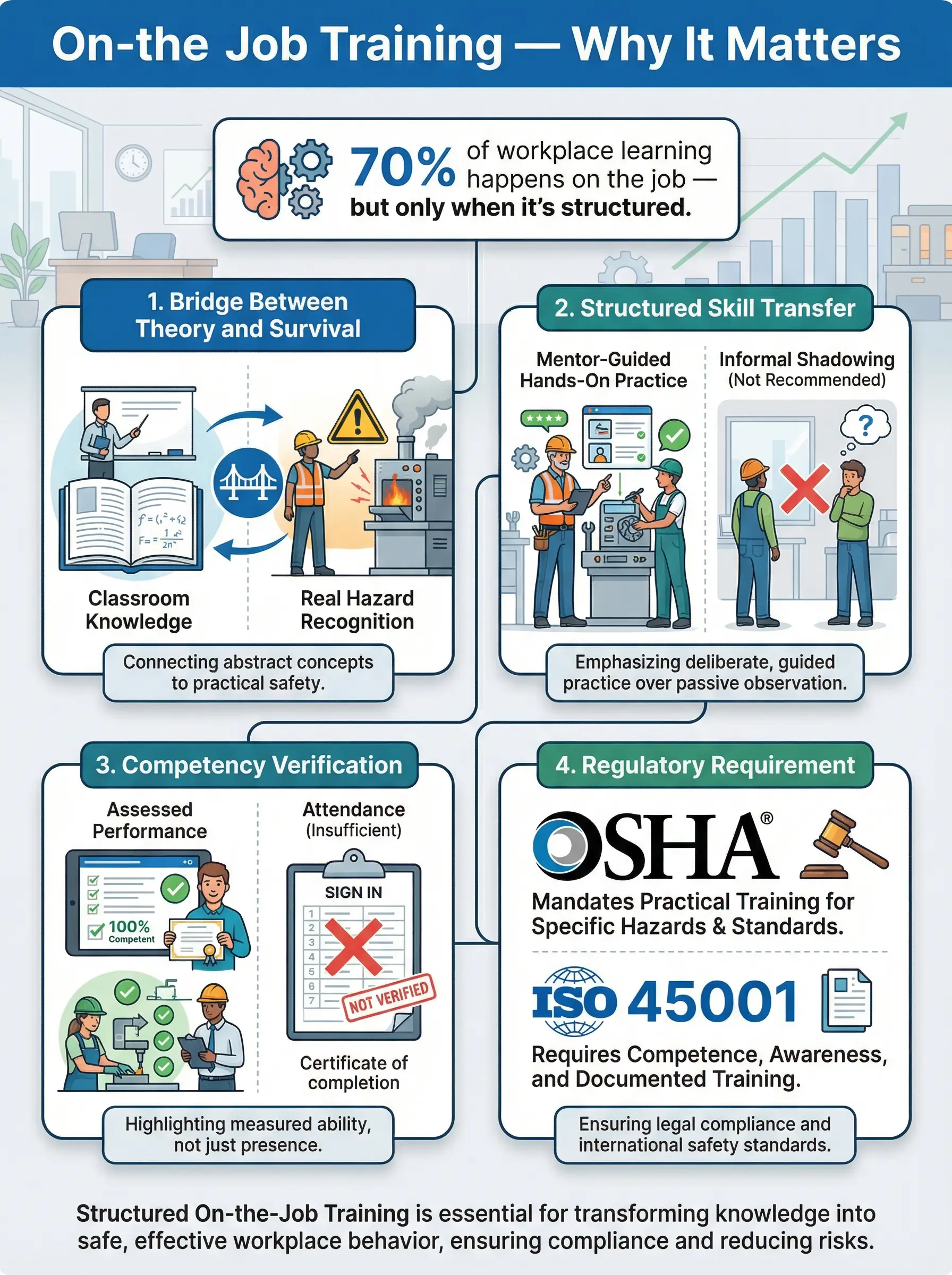
On-the-job training is the structured process of teaching a worker how to perform a specific task safely and competently at the actual work location, using real equipment, under real operating conditions, with direct supervision from a qualified mentor or trainer. It is learning by doing — but with a system behind it.
The distinction matters because “learning by doing” without structure is just exposure to risk. I have audited training programs across four continents, and the single most common failure is organizations that confuse proximity to work with training. Putting a new worker next to an experienced one and hoping competency transfers through observation is not OJT. It is uncontrolled risk.
A properly designed OJT program contains specific elements that separate it from informal on-site experience. These are the core components that every effective program shares:
- Defined learning objectives: Each OJT session targets a specific skill or task — not a vague goal like “learn the job.” The trainee knows exactly what they must demonstrate by the end.
- Qualified trainer or mentor: The person delivering OJT is verified as competent in both the task itself and the ability to teach it. Technical skill alone does not make someone a trainer.
- Real work environment: Training happens at the actual worksite, with the actual tools, equipment, hazards, and conditions the worker will face independently.
- Progressive skill building: Tasks are broken into steps, taught sequentially, and practiced with increasing independence — not dumped on the trainee all at once.
- Observed practice with feedback: The trainee performs the task while the trainer watches, corrects, and confirms. Passive observation by the trainee is only the first stage, never the whole program.
- Documented competency assessment: The trainer formally verifies that the trainee can perform the task safely and independently before sign-off. This is not a signature on an attendance sheet — it is a skills-based evaluation.
OSHA 29 CFR 1926.21(b)(2): “The employer shall instruct each employee in the recognition and avoidance of unsafe conditions and the regulations applicable to his work environment to control or eliminate any hazards or other exposure to illness or injury.” This instruction must be practical and task-specific — not generic awareness.
Pro Tip: When I review a contractor’s training records during a pre-mobilization audit, the first thing I check is whether their OJT documentation shows what the trainee did — not just what they attended. A record that says “Trainee observed scaffold erection — 4 hours” tells me nothing. A record that says “Trainee erected a 3-lift scaffold under direct supervision, demonstrated brace placement, base plate leveling, and tie-in spacing — assessed competent by [Trainer Name]” tells me the worker might actually survive their first week on my site.
The Difference Between OJT and Classroom Training
Most organizations run both classroom and on-the-job training, but too many treat them as interchangeable — or worse, treat classroom completion as proof of competency. They are fundamentally different tools that serve different purposes, and understanding the gap between them is critical to preventing incidents.
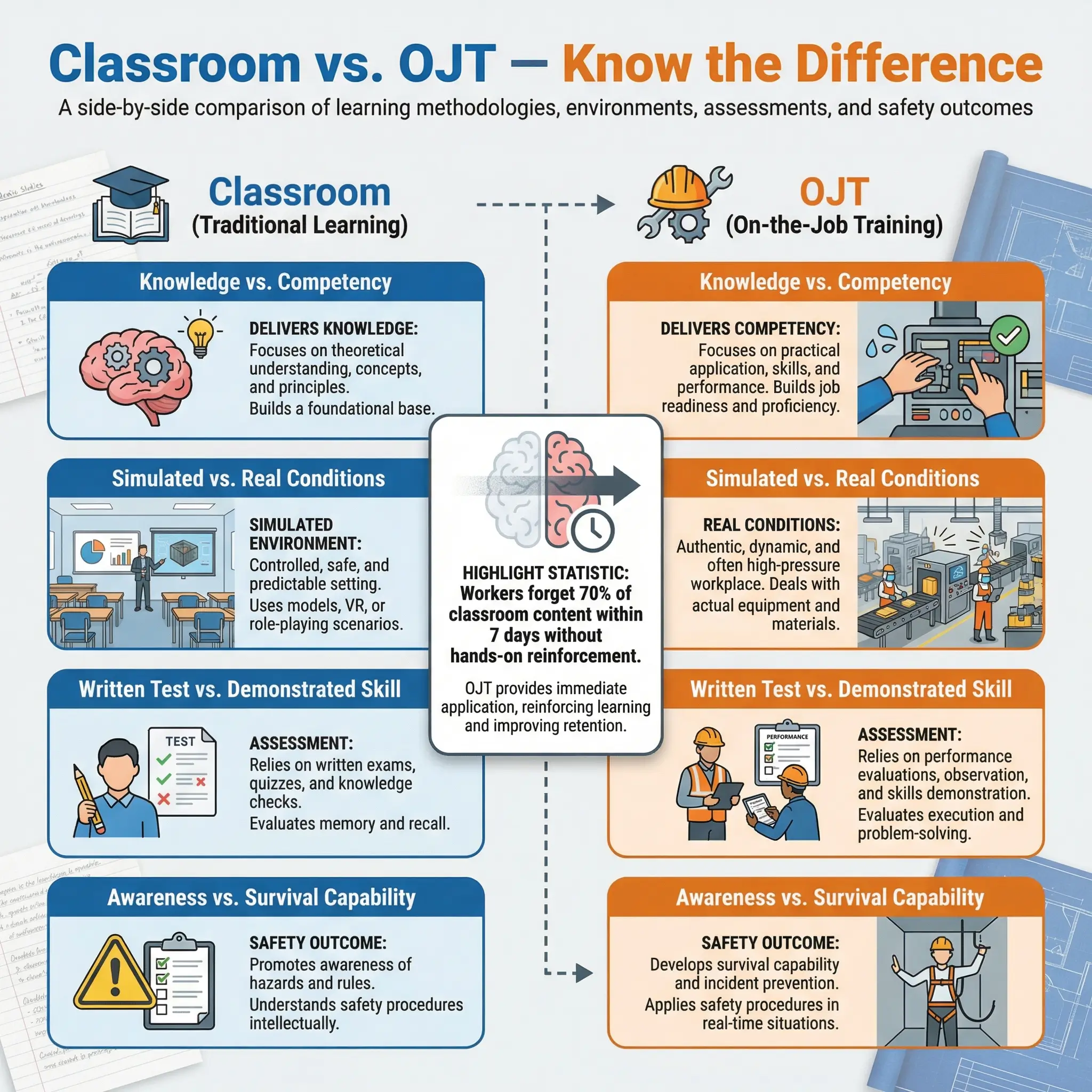
Classroom training builds knowledge. OJT builds competency. Knowledge is knowing that a confined space requires atmospheric testing before entry. Competency is being able to calibrate a four-gas detector, interpret the readings, and make a go/no-go decision while standing at a manhole with a production supervisor pressuring you to get inside. I have met workers who could recite the permissible exposure limits for hydrogen sulfide from memory but had never held a gas detector in their hands. That is a classroom success and a field failure.
The following table clarifies where each training method fits and where relying on one without the other creates risk:
| Dimension | Classroom Training | On-the-Job Training |
|---|---|---|
| Learning environment | Training room, simulated | Actual worksite, real conditions |
| Primary outcome | Knowledge and awareness | Skill and competency |
| Hazard exposure | Theoretical, described | Direct, physical, real-time |
| Feedback mechanism | Tests, quizzes, discussions | Observed performance, correction |
| Assessment method | Written exam or attendance | Demonstrated task execution |
| Trainer requirement | Subject matter expert, instructor | Competent practitioner and mentor |
| Retention rate | Drops significantly after 30 days without reinforcement | High — muscle memory and situational recall |
| Regulatory value | Necessary but not sufficient | Required for competency verification |
Neither method works alone. Classroom training without OJT produces workers who know the rules but cannot apply them. OJT without classroom training produces workers who can perform tasks mechanically but do not understand why the controls exist — and will shortcut them the moment conditions change.
Pro Tip: The best training programs I have implemented use a “classroom-then-field” sequence with a time gap of no more than 48 hours between the two. The longer the gap, the more theoretical knowledge fades before it gets anchored by physical practice. On a pipeline construction project in Central Asia, we reduced first-month incident rates by 40% simply by moving OJT sessions to within 24 hours of classroom modules — same content, same trainers, different sequence.
Why On-the-Job Training Matters for Workplace Safety
Every fatality investigation report I have ever written — every single one — contains a finding related to inadequate practical training. Not missing certificates. Not expired induction cards. Inadequate hands-on, supervised, task-specific training where someone should have shown the deceased worker how to do the job safely in the actual environment where they died.
OJT is not one of many safety tools. It is the mechanism through which all other safety tools become functional. A permit-to-work system is worthless if the workers do not know how to read, interpret, and comply with the permit conditions in practice. A lockout-tagout procedure is a death sentence if the worker has never physically applied a lock to the specific energy isolation point on the specific equipment they are about to service.
The reasons OJT is irreplaceable in safety-critical work break down into distinct categories that every HSE professional and operations manager should internalize:
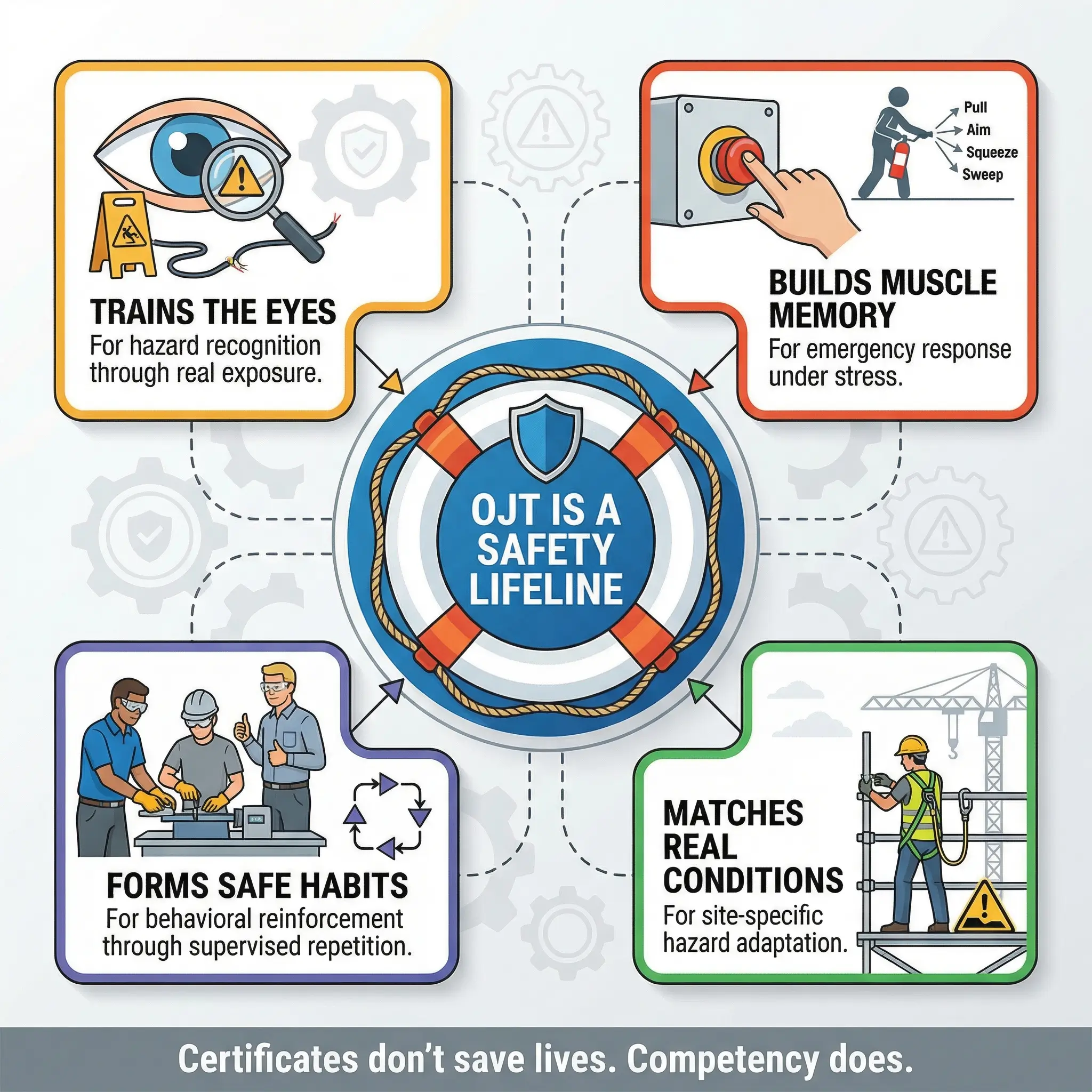
- Hazard recognition is a learned perceptual skill, not a memorized list. Workers develop the ability to see hazards through repeated, guided exposure to real work environments — not through photographs in a slide deck. OJT trains the eyes, not just the brain.
- Muscle memory prevents hesitation in emergencies. When a worker has physically practiced donning an emergency escape respirator twelve times under supervision, they will execute it under stress. A worker who watched a video will fumble.
- Site-specific conditions cannot be replicated in a classroom. Every worksite has unique hazards — specific equipment configurations, environmental factors, traffic patterns, atmospheric conditions. OJT is the only way to train for the site the worker will actually occupy.
- Behavioral safety habits form through supervised repetition. Workers do not adopt safe behaviors because they were told to. They adopt them because a mentor stood beside them, corrected them in real time, and reinforced the behavior until it became automatic.
- OJT exposes the gap between procedure and practice. During OJT, trainers and trainees frequently discover that written procedures do not match actual site conditions — missing anchor points, inaccessible isolation valves, inadequate lighting. This feedback loop improves the system.
ISO 45001:2018, Clause 7.2 — Competence: Organizations must ensure workers are competent on the basis of appropriate education, training, or experience — and must take actions to acquire and maintain the necessary competence, evaluating the effectiveness of those actions. Competence is outcome-based, not input-based.
Types and Examples of On-the-Job Training in HSE
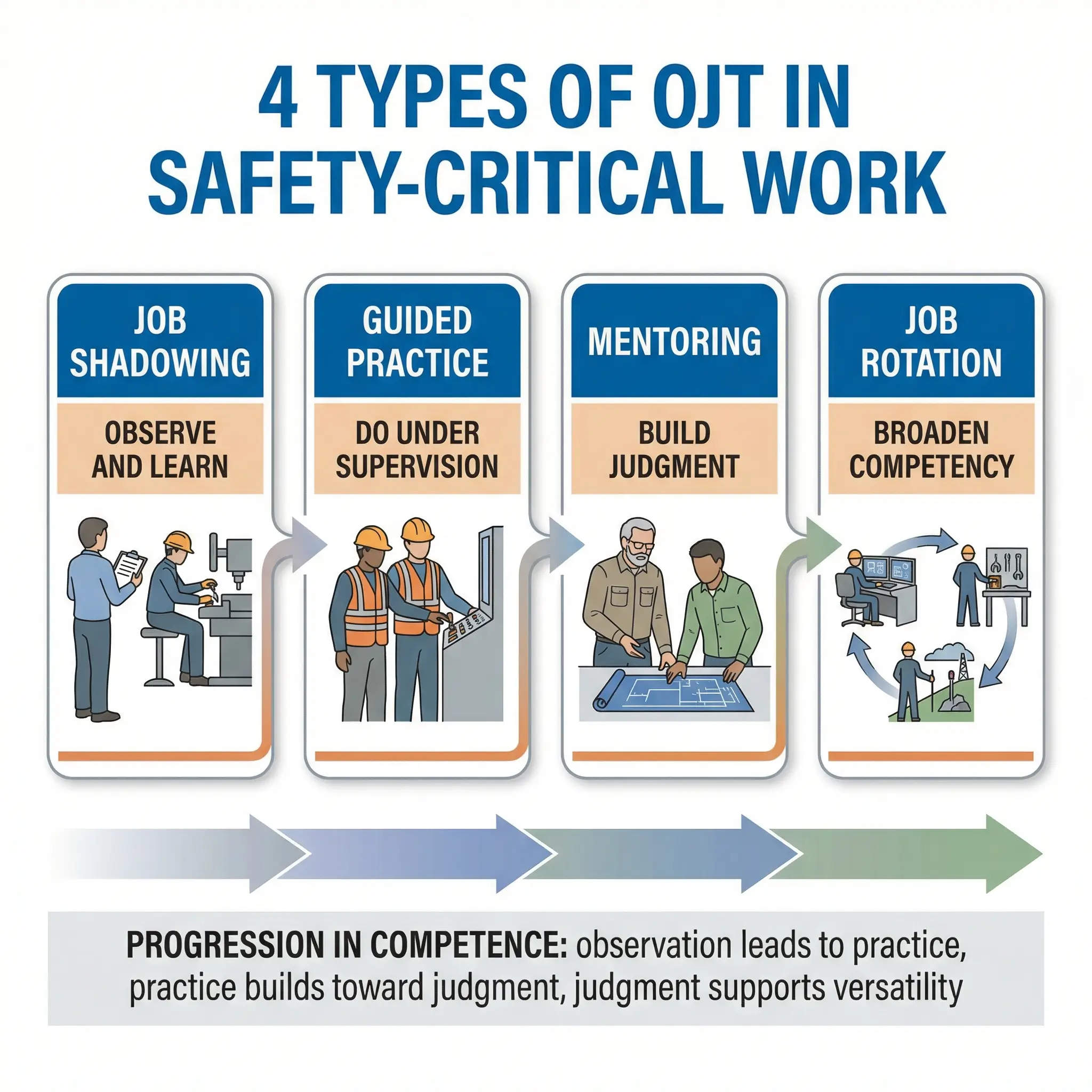
OJT is not a single method — it is a family of approaches, each suited to different tasks, risk levels, and learning stages. The mistake I see most often is organizations using only one type of OJT for every situation, usually informal shadowing, and calling it a complete program. Different hazards demand different training structures.
The following types represent the most common and effective OJT methods used across high-risk industries. Each serves a specific purpose in building worker competency:
Job Shadowing (Structured Observation)
Job shadowing places the trainee alongside a competent worker to observe task execution in real time. When structured properly, it is the first stage of OJT — not the entire program. The trainee watches, asks questions, and begins to build a mental model of the task before they touch anything.
- Best used for: Initial familiarization with complex tasks, understanding workflow sequences, learning site layout and navigation
- Risk level suitability: Low to moderate risk tasks during the observation phase; high-risk tasks only when combined with subsequent hands-on stages
- Common failure: Treating shadowing as complete training. I audited a chemical plant where new operators spent two weeks “shadowing” experienced operators — then were left alone on a reactor panel. Shadowing taught them what buttons to push. It did not teach them what to do when an exothermic reaction exceeded the temperature setpoint at 2 AM.
- Field example: On a refinery turnaround, I structured shadowing so trainees carried a checklist of 15 specific observations they had to document and discuss with their mentor by end of shift — forced active observation instead of passive following
Hands-On Guided Practice
This is the core of effective OJT. The trainee performs the task while the trainer observes, coaches, and corrects in real time. The trainer’s hands stay off the equipment unless intervention is needed for safety. The trainee does the work. The trainer ensures it is done safely and correctly.
- Best used for: All safety-critical tasks — equipment operation, PPE donning and doffing, energy isolation, scaffold erection, rigging and lifting, hot work preparation
- Risk level suitability: All risk levels, with trainer-to-trainee ratios adjusted upward for higher-risk activities (1:1 for high risk, 1:2 or 1:3 for moderate risk)
- Common failure: Trainers who take over when the trainee struggles instead of coaching through the difficulty. The learning happens in the struggle — not in watching the trainer do it for them.
- Field example: During a pipeline tie-in project in West Africa, I required every welder to perform three supervised test welds on site-matched material before being authorized for production welding. Two welders who had passed their coded welder certifications in a workshop failed their first on-site attempt because they had never welded in a fixed overhead position on a live pipeline with residual product vibration. OJT caught what certification missed.
Mentoring and Coaching Programs
Mentoring extends beyond task-specific training into professional development, judgment building, and safety culture transfer. A mentor is not just teaching a worker how to do a task — they are teaching them how to think about risk, how to make decisions under uncertainty, and how to challenge unsafe conditions.
- Best used for: Developing supervisors, training safety officers, building leadership capability in experienced workers being promoted to oversight roles
- Risk level suitability: All levels — mentoring addresses decision-making quality, which affects every risk level
- Common failure: Assigning mentors who are technically excellent but have poor safety attitudes. I watched a mentoring program at a mining operation transfer fifteen years of shortcut habits from experienced operators to new hires in under three months. The mentor’s production-first mindset overrode every safety message the induction program had delivered.
- Field example: On a large EPC project in Southeast Asia, I paired every new HSE officer with a senior HSE professional for their first 90 days. The mentor did not tell them what to inspect — they walked sites together, and the mentor asked questions: “What do you see? What’s the risk? What would you do?” This built judgment, not just checklist compliance.
Job Rotation and Cross-Training
Job rotation moves workers through different roles, tasks, or work areas to broaden their competency and hazard awareness. Cross-training ensures that multiple workers can perform critical safety functions — so the team is never dependent on a single person for an essential skill.
- Best used for: Emergency response teams, permit-to-work roles, multi-skilled maintenance crews, control room operators who must understand upstream and downstream processes
- Risk level suitability: Moderate to high — requires careful sequencing so workers are not rotated into high-risk tasks before foundational competency is established
- Common failure: Rotating workers too quickly. Competency in one role takes weeks or months. Rotating every few days creates workers who are partially competent in many tasks and fully competent in none.
- Field example: At an LNG terminal, we cross-trained all control room operators on both liquefaction and regasification systems. When a critical alarm sequence occurred during a shift change, the incoming operator — who had been cross-trained on the outgoing operator’s panel — recognized the developing scenario and initiated emergency shutdown. Without cross-training, that alarm would have been handled by someone seeing the panel for the first time under emergency conditions.
How to Design an Effective OJT Program for Safety-Critical Work
A poorly designed OJT program is more dangerous than no program at all — because it creates a false record of competency. The organization believes the worker is trained. The supervisor believes the sign-off means the worker is ready. The worker believes they know what they are doing. And then the incident happens, and everyone discovers that the “training” was a signature exercise with no substance behind it.
I have built OJT programs from scratch for greenfield projects and rebuilt broken ones during incident investigations. The following design process reflects what actually works in the field — not what looks good in a management system manual.
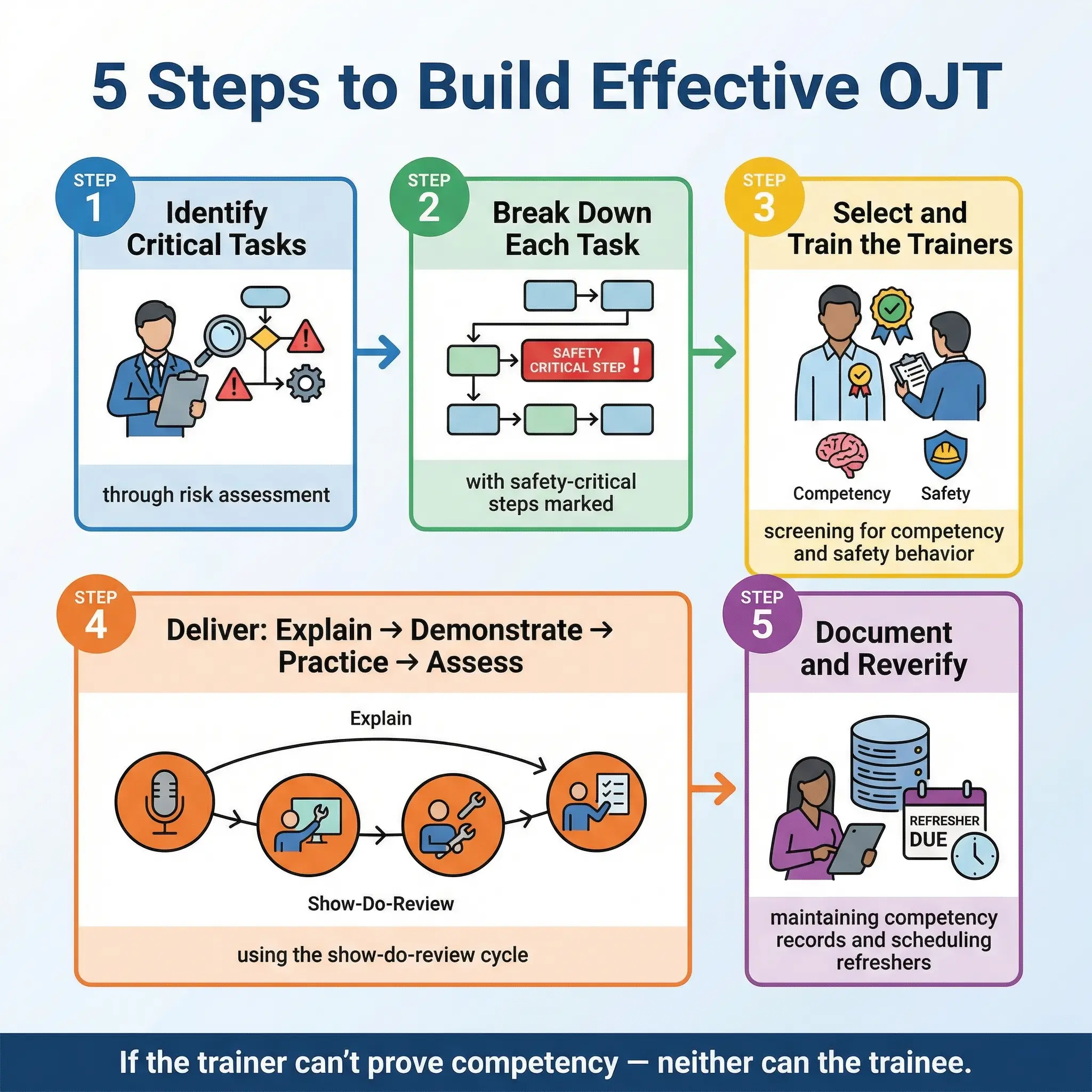
Step 1: Identify Critical Tasks Through Risk Assessment
Not every task requires formal OJT. The starting point is identifying which tasks carry enough risk that a competency failure could result in injury, environmental harm, or asset damage. This is a risk-based decision, not a blanket policy.
- Conduct a task inventory for each role, listing every activity the worker will perform independently
- Apply a risk ranking to each task based on hazard severity and the consequence of incorrect execution
- Prioritize OJT resources for high-risk and medium-risk tasks — low-risk tasks may be adequately covered by written instructions and basic orientation
- Review incident history and near-miss data to identify tasks where competency failures have already occurred — these get immediate OJT priority regardless of initial risk ranking
Step 2: Develop Task Breakdowns with Safety-Critical Steps
Every task selected for OJT must be broken down into sequential steps, with safety-critical steps explicitly identified. A safety-critical step is any point in the task where an error could directly cause harm.
- Write each step as an observable action — “Verify isolation by attempting to start the equipment” not “Ensure isolation is effective”
- Mark safety-critical steps visually in the OJT guide so trainers know where to increase observation intensity
- Include decision points — where the worker must assess conditions and choose a course of action, not just follow a sequence mechanically
- Validate task breakdowns with experienced workers — not just supervisors or engineers. The people who do the job daily will catch steps that the procedure writer missed.
Step 3: Select and Train the Trainers
This is where most OJT programs fail. Organizations assume that any experienced worker can train a new one. That assumption ignores two realities: some experienced workers have deeply embedded unsafe habits, and teaching is a skill that must be learned separately from task execution.
- Screen potential trainers for both technical competency and safety behavior — a trainer who routinely bypasses controls will teach the trainee to do the same
- Provide train-the-trainer instruction covering adult learning principles, demonstration technique, feedback delivery, and competency assessment methods
- Limit trainer-to-trainee ratios based on task risk: 1:1 for high-risk tasks, never exceeding 1:3 for any task
- Rotate trainers periodically to prevent single-source knowledge transfer and to expose trainees to different approaches and perspectives
Pro Tip: On a shutdown project at a petrochemical complex in the Gulf, I introduced a “trainer observation” step where I or a senior HSE team member observed the trainer delivering OJT — not the trainee. We found that 30% of our designated trainers were skipping safety-critical steps during demonstrations because they had internalized shortcuts over years of experience. We retrained the trainers before they trained anyone else.
Step 4: Deliver OJT Using the “Show-Do-Review” Method
The most effective and widely validated OJT delivery method in high-risk industries follows a four-phase cycle. This sequence has been used consistently across every successful program I have designed or evaluated:
- Explain — The trainer describes the task, its purpose, and the specific hazards involved. This is a brief verbal briefing at the worksite — not a classroom lecture.
- Demonstrate — The trainer performs the complete task at normal pace while the trainee observes. Then the trainer repeats it at a slower pace, narrating each step and each safety-critical decision.
- Practice — The trainee performs the task under direct observation. The trainer intervenes only for safety — otherwise, they coach verbally and allow the trainee to self-correct.
- Assess — The trainee performs the task independently while the trainer observes without coaching. The trainer evaluates against the documented task breakdown and signs off only if all safety-critical steps are performed correctly without prompting.
If the trainee fails the assessment, they cycle back to the practice phase — not the classroom.
Step 5: Document, Verify, and Maintain Competency
OJT documentation is not administrative overhead — it is legal evidence that the organization fulfilled its duty to ensure worker competency. When an incident occurs, the first thing a regulator or investigator requests is the training record for the worker involved.
- Record what was trained, who trained, when, where, and the assessment outcome — not just a signature and date
- Store OJT records as part of the worker’s competency file, linked to the specific tasks they are authorized to perform
- Schedule competency re-verification at defined intervals — annual for standard tasks, more frequent for high-risk or infrequently performed tasks
- Trigger retraining automatically after any incident, near-miss, procedural change, or equipment modification that affects the trained task
Common OJT Failures That Lead to Incidents
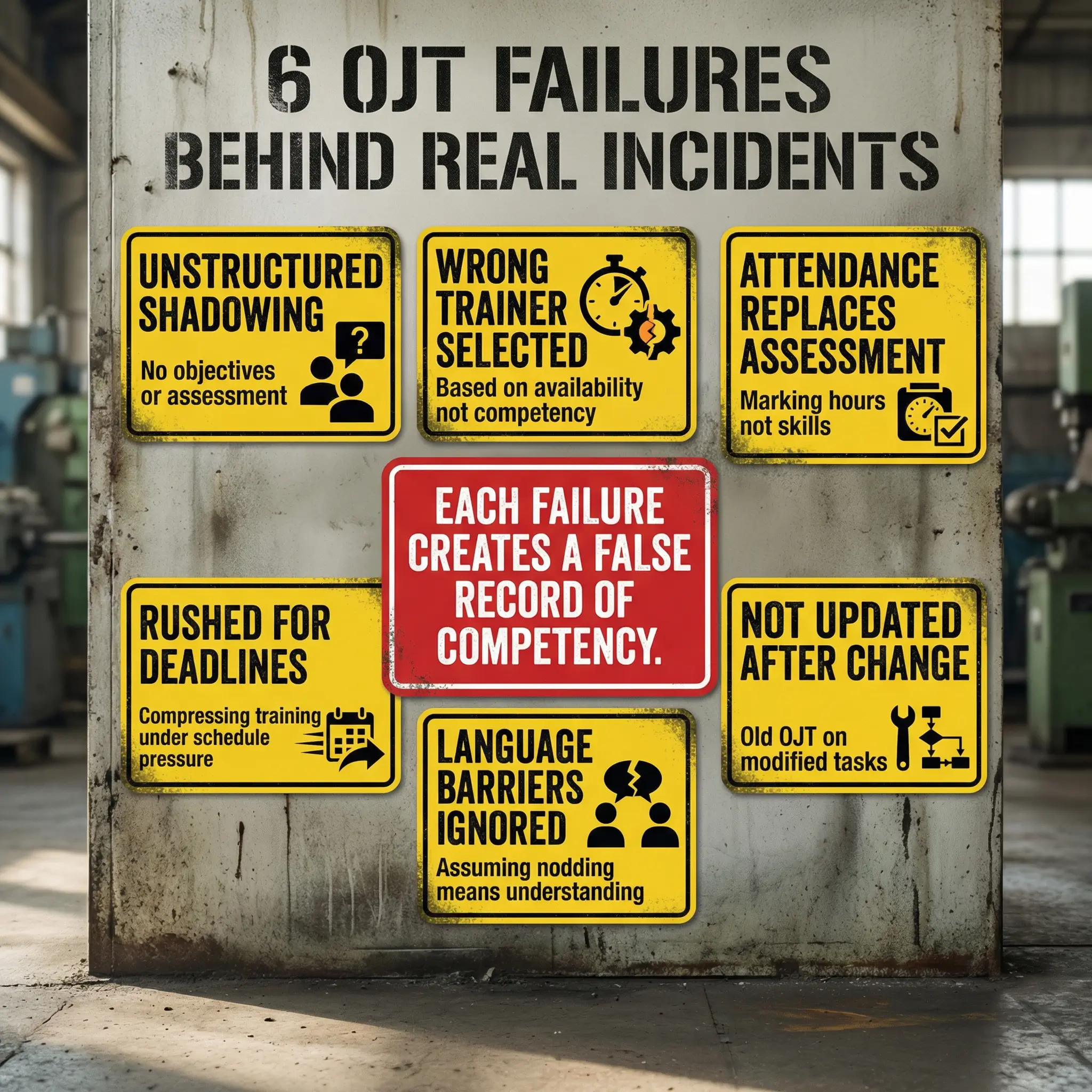
Understanding how OJT fails is as important as understanding how to design it. I have investigated enough incidents to recognize the patterns. These failures repeat across industries, geographies, and company sizes — and every one of them is preventable.
The following failures are not theoretical risks. Each one comes from real investigations, audits, or operational reviews where the breakdown in OJT was a direct contributing factor to harm:
- “Follow Ahmed around for a week” syndrome: The most common OJT failure globally. A new worker is assigned to an experienced worker with no structured objectives, no task breakdown, no assessment criteria, and no verification. The experienced worker may be competent, incompetent, or actively unsafe — and the organization has no way to know what was transferred. I have seen this arrangement described as “OJT completed” in training records on three continents.
- Trainer selection based on availability, not competency: Assigning whoever is free to train the new worker, regardless of their skill level, safety record, or teaching ability. During an investigation at a mining operation in Southern Africa, we traced a mobile equipment collision to OJT delivered by an operator who had three previous at-fault incidents — none of which disqualified him from being a trainer because the system only checked for certification, not performance history.
- No assessment — only attendance: The trainee is marked as “trained” because they were present for a defined number of hours or shifts. No one verified whether they can actually perform the task. This is the training equivalent of issuing a driving license based on how many hours someone sat in a parked car.
- OJT rushed to meet mobilization deadlines: Project timelines pressure supervisors to compress or skip OJT so workers can start producing. I have had project managers tell me, “They’ll learn as they go.” Workers who “learn as they go” on a live construction site with overhead crane lifts, open excavations, and high-voltage systems do not learn — they survive by luck until luck runs out.
- Language barriers ignored during OJT: On multinational projects, trainers and trainees frequently do not share a common language. The trainer demonstrates. The trainee nods. Neither confirms understanding. I once stopped a lifting operation on an offshore platform because the banksman had received his OJT in English from a Scottish supervisor, and the banksman spoke only Tagalog. He had learned the hand signals by mimicry — without understanding what any of them meant or when to use the emergency stop signal.
- OJT not updated after change: Equipment modifications, procedural changes, and new hazard assessments invalidate previous OJT. Workers trained on the old version of a task are performing a different task than the one they were assessed on — but the training record still shows them as competent.
HSE UK — Managing Competence (HSG65): “Competence is not just about training. It involves the ability to apply knowledge and skills in practice, to recognize the limits of one’s competence, and to be able to work safely.” A worker who completed OJT on a previous version of a task is not competent on the current version.
The Legal and Regulatory Foundation of OJT
OJT is not optional in any regulated jurisdiction. The specific legal language varies, but the obligation is universal: employers must ensure workers are competent to perform their tasks safely, and competence must be demonstrated through practical training — not just information transfer.
Understanding the regulatory basis matters for two reasons. First, it establishes the legal liability that falls on the employer — and often on the supervisor personally — when a worker is injured performing a task they were not competently trained for. Second, it provides HSE professionals with the authority to stop work, refuse mobilization, and demand training resources when management pushes back.
The following regulatory frameworks each establish clear OJT obligations. I have referenced these in enforcement discussions, audit findings, and legal proceedings across multiple jurisdictions:
- OSHA (United States) — General Duty Clause and Specific Standards: OSHA requires employers to provide training that is specific to the hazards workers face. Standards like 29 CFR 1910.146 (Confined Spaces), 1910.147 (Lockout-Tagout), and 1926.501 (Fall Protection) each mandate task-specific training with demonstrated competency. OSHA citations for inadequate training consistently rank among the top ten most-cited violations annually.
- HSE UK — Health and Safety at Work Act 1974, Section 2: Employers must provide “such information, instruction, training and supervision as is necessary to ensure, so far as is reasonably practicable, the health and safety at work of employees.” The word “instruction” in UK law specifically implies practical, task-level guidance — not just classroom awareness.
- ISO 45001:2018 — Clause 7.2 (Competence): Requires organizations to determine competence requirements, ensure workers meet them through training or experience, take action where gaps exist, and retain documented evidence of competency. This standard explicitly requires evaluation of training effectiveness — not just delivery.
- EU Framework Directive 89/391/EEC — Article 12: Mandates that workers receive adequate safety and health training upon hiring, transfer, introduction of new equipment, and introduction of new technology. Training must be adapted to new or changed risks and repeated periodically.
- IFC/World Bank EHS Guidelines: For projects financed by international development institutions, IFC/World Bank EHS Guidelines require competency-based training programs proportional to the project’s risk profile. Non-compliance can trigger loan covenant violations — a financial enforcement mechanism that often moves management faster than safety arguments alone.
Pro Tip: When I need to justify OJT budget to a project director who sees training as a cost center, I pull the enforcement data. In the US alone, OSHA training-related citations carry penalties averaging $15,000–$16,000 per violation — and willful violations exceed $150,000 each. A single fatality investigation that finds inadequate OJT can result in criminal prosecution of the responsible supervisor in the UK and EU jurisdictions. The cost of OJT is always less than the cost of not doing it.
Measuring OJT Effectiveness — How to Know If It Actually Worked
Running an OJT program and running an effective OJT program are two completely different things. Most organizations measure training by inputs — hours delivered, sessions completed, records signed. These metrics tell you what you did. They tell you nothing about whether it worked.
During a management system audit at a logistics hub in Northern Europe, I reviewed an OJT program that had perfect records: every worker trained, every module completed, every assessment signed. The incident data for the same period showed a rising trend in manual handling injuries among the exact workers who had been “trained.” The OJT program was checking boxes. It was not building competency. The assessment consisted of the trainer asking, “Do you feel confident to do this on your own?” — and recording “Yes” as a competency verification.
Effective OJT measurement requires both leading and lagging indicators tied to observable outcomes. The following metrics distinguish real training effectiveness from paperwork compliance:
- First-time pass rate on practical assessments: What percentage of trainees demonstrate competency on their first assessment attempt? A rate below 70% indicates either poor training delivery or unrealistic assessment criteria. A rate of 100% suggests the assessment is not rigorous enough.
- Time-to-competency by task: How long does it take a new worker to reach independent, assessed competency on each critical task? Tracking this across trainers reveals which trainers are more effective — and which are rushing.
- Incident and near-miss rates among recently trained workers: Compare the 90-day post-OJT incident rate against the site average. If newly trained workers are having more incidents than the baseline, the OJT is failing.
- Behavioral observation results: Conduct structured behavioral observations of workers who completed OJT. Are they performing the task as trained, or have they reverted to shortcuts? Reversion within 30 days indicates that OJT reinforcement is inadequate.
- Trainer feedback and assessment consistency: Compare assessment outcomes across different trainers for the same task. If one trainer passes everyone and another fails 40%, the assessment criteria are being applied inconsistently — a systemic problem, not a trainer problem.
| Metric | What It Measures | Red Flag Threshold |
|---|---|---|
| First-time assessment pass rate | Training quality and assessment rigor | Below 70% or above 95% |
| Time-to-competency | Training efficiency and consistency | Varies more than 50% between trainers |
| 90-day post-OJT incident rate | Real-world training effectiveness | Higher than site average |
| Behavioral observation compliance | Long-term behavior change | Below 80% compliance at 30 days |
| Trainer assessment consistency | Standardization of evaluation | Pass rate variance exceeds 20% between trainers |
OJT for Contractors and Multi-Employer Worksites
Contractor OJT is where the system breaks down most frequently — and most dangerously. On multi-employer worksites, the principal contractor or site owner typically assumes the subcontractor has trained their workers. The subcontractor assumes the site induction covered everything. The worker arrives having received neither task-specific OJT for the site’s actual conditions nor any verification that their previous training applies to this project.
I managed contractor HSE on a major infrastructure project with 14 subcontractors and over 3,000 workers from nine countries. Within the first month, we stopped work three times for competency failures — a crane operator who had never operated the specific crane model on site, an electrician who could not identify the isolation points on the switchgear he was assigned to work on, and a confined space attendant who did not know how to activate the emergency alarm system. All three had “valid training certificates.” None had received site-specific OJT.
Managing contractor OJT requires contractual controls and verification systems that go beyond trust. These measures have proven effective across every multi-employer project I have managed:
- Contractual OJT requirements: Include specific OJT obligations in the subcontract — not just “the contractor shall train their workers” but detailed requirements for task breakdowns, trainer qualifications, assessment methods, and documentation standards. Make OJT deliverables a contract milestone.
- Pre-mobilization competency verification: Before any contractor worker begins work, verify their competency for their assigned tasks through practical demonstration — not document review. If they cannot demonstrate the skill on site, they do not start work until OJT is completed.
- Site-specific OJT bridging: Even if the worker has completed OJT at their home base, they need a bridging session covering this site’s specific equipment, layout, emergency procedures, and permit system. A competent scaffolder on one project is not automatically competent on a different project with different scaffold systems and different access requirements.
- OJT audit and spot checks: Include contractor OJT records in regular site audits. Conduct unannounced competency spot checks — pull a random worker and ask them to demonstrate a safety-critical task. If they cannot, stop their work authorization and investigate the training failure.
- Shared OJT tracking system: On large multi-employer sites, implement a centralized competency tracking system that all contractors feed into. This prevents duplication, identifies gaps, and provides real-time visibility into who is authorized for what.
IFC Performance Standard 2 — Labor and Working Conditions: Requires that contracted workers receive training comparable to direct employees, proportional to the nature and scope of their work. The client organization retains responsibility for verifying contractor competency.

Building a Culture Where OJT Is Valued — Not Just Required
The hardest part of OJT is not designing the program. It is getting people to take it seriously. On too many sites, OJT is treated as an administrative hurdle between hiring and productive work — something to get through as fast as possible so the worker can start contributing to the schedule. This attitude comes from the top. When project managers pressure supervisors to “get people trained and working,” and when training budgets are the first line item cut during cost reviews, workers and supervisors receive a clear message: training is a formality, production is the priority.
Changing this requires deliberate, sustained effort that connects OJT to outcomes people care about — not safety slogans, but operational performance, incident reduction, regulatory compliance, and career development.
The following culture-building practices have shifted OJT from an obligation to a valued activity on projects I have led or advised:
- Make OJT a line management responsibility, not an HR or training department function. When supervisors own OJT — selecting trainers, scheduling sessions, verifying competency — they invest in its quality. When it is delegated to a training coordinator the supervisor has never met, it becomes someone else’s problem.
- Recognize and reward effective trainers. On a construction megaproject in the Middle East, we introduced a “Master Trainer” designation with a visible hard hat sticker, a pay differential, and priority consideration for supervisory promotion. Within six months, the competition to become a Master Trainer was intense — and training quality rose with it.
- Include OJT completion and effectiveness in supervisor KPIs. If a supervisor’s performance evaluation includes the competency development rate of their crew and the post-OJT incident rate for new workers they trained, OJT stops being optional paperwork.
- Involve workers in OJT improvement. Ask recently trained workers what worked and what did not. Their feedback identifies gaps that trainers and managers cannot see. A new rigger on an offshore platform told me his OJT never covered how to communicate with the crane operator during radio failure — because the trainer had never experienced a radio failure. We added it to the OJT module that week.
- Make the consequence of poor OJT visible. Share incident investigation findings — anonymized but detailed — where OJT failures were a root cause. When workers and supervisors see real outcomes of training gaps, the abstract concept of “competency” becomes concrete.
Conclusion
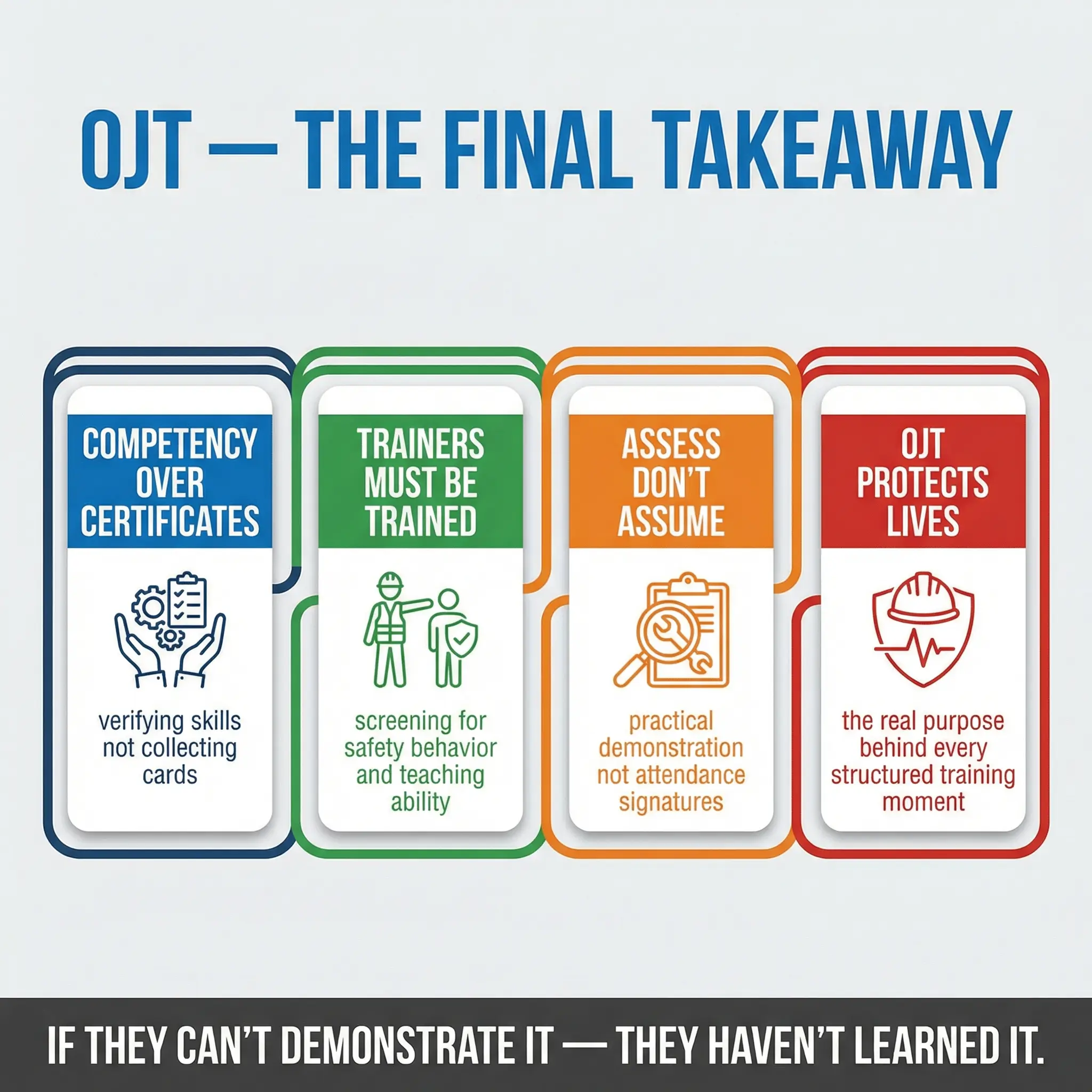
On-the-job training is not a line item on a training matrix. It is the mechanism through which a worker transitions from knowing safety rules to surviving by them. Every control measure, every procedure, every permit system in an organization is only as strong as the competency of the worker executing it — and that competency is built, verified, and maintained through structured OJT. Not through classroom hours. Not through certificate collection. Through supervised, assessed, hands-on practice in the environment where the hazards are real.
The organizations that take OJT seriously — that invest in qualified trainers, that build task-specific programs, that verify competency instead of attendance, and that treat training as a line management responsibility — are the organizations where fewer people get hurt. This is not a correlation I am speculating about. It is a pattern I have observed across decades of field work in mining, oil and gas, construction, chemical processing, and energy operations. The pattern is consistent and the evidence is clear.
If a worker on your site cannot demonstrate the safe execution of their assigned task to a competent assessor, they are not trained — regardless of what the training record says. And if they are not trained, the responsibility for whatever happens next belongs to every person in the chain who signed off on a competency that was never verified. OJT done right is an investment in human life. OJT done wrong — or not done at all — is a decision to gamble with it.