TL;DR
- If your workforce is DOT-regulated, random drug testing is not optional — 49 CFR Part 40 (US Federal) mandates testing at agency-specific annual rates (25–50%), using certified labs, MRO-verified results, and a fixed panel that still includes marijuana regardless of state legalization.
- If you operate a voluntary (non-DOT) program, your legal authority and constraints come from state law, not federal mandate — and a growing number of states now prohibit adverse action based solely on a positive marijuana metabolite in non-safety-sensitive roles.
- If a random test comes back positive, the procedural chain that follows determines whether the result is legally defensible — premature employer action before MRO verification is the single most common compliance failure in non-DOT programs.
- If your policy lacks signed employee acknowledgments, documented selection records, or chain-of-custody forms, no laboratory result will survive a legal challenge or regulatory audit, regardless of what substance was detected.
Random drug testing is a workplace testing method where current employees are selected through a statistically valid, non-discriminatory process — typically a computer-based random number generator — and required to undergo unannounced drug screening. In the US, DOT-regulated employers must test safety-sensitive employees at federally mandated annual rates (25–50% depending on the agency), while non-DOT employers implement voluntary programs governed by state law and company policy.
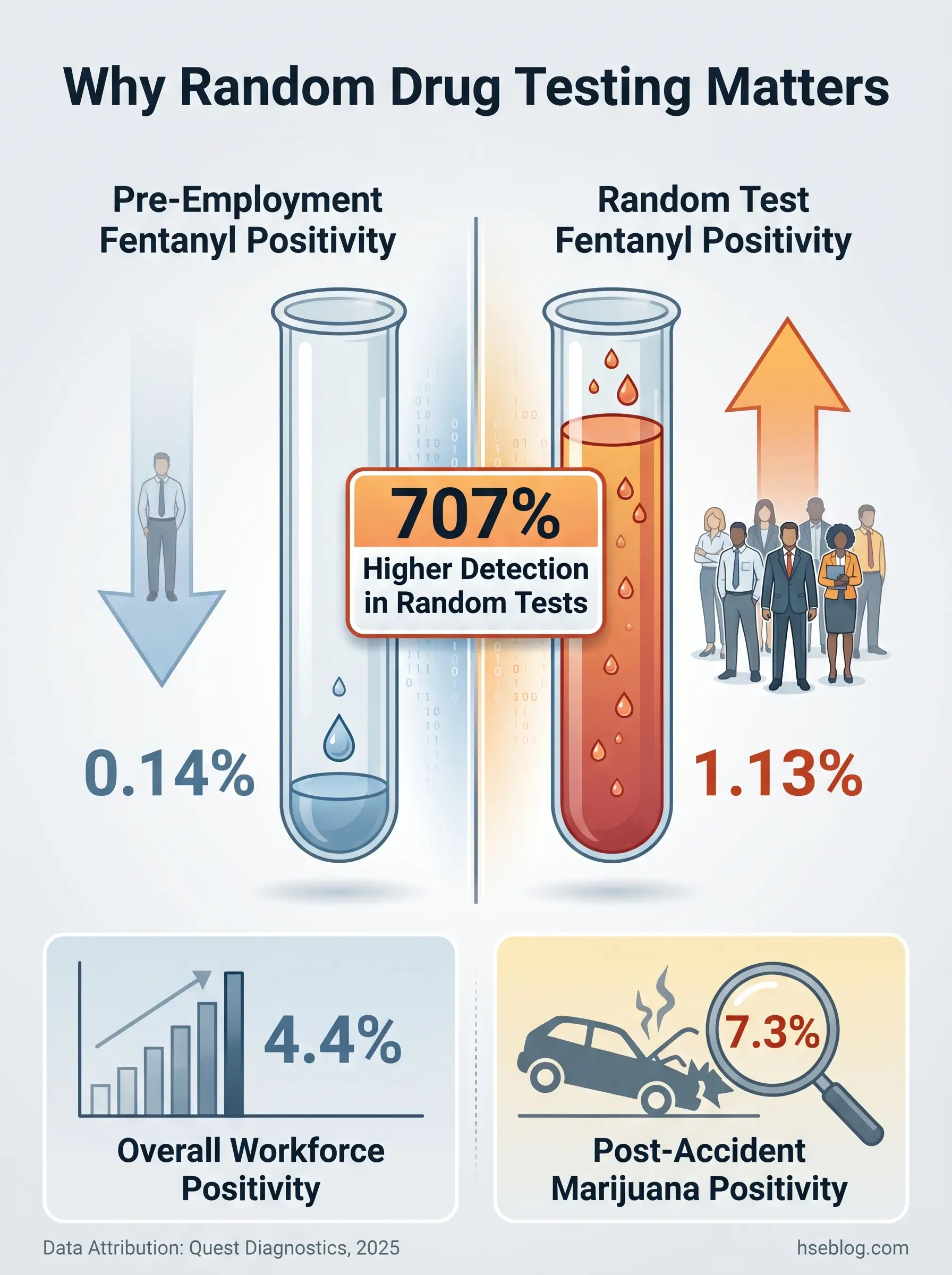
Fentanyl positivity in random drug tests ran 707% higher than in pre-employment screening across the general US workforce in 2024 (Quest Diagnostics, 2025). That single data point captures the core problem random testing exists to solve: workers who pass initial screens may begin using substances afterward, and only unannounced, ongoing testing detects that shift before it reaches the incident report.
The legal and procedural landscape around random drug testing has grown more complex in recent years, not less. Federal rescheduling discussions around marijuana, a pending DOT rule to add fentanyl to the standard testing panel, and a patchwork of state employment protections for off-duty cannabis use have created a compliance environment where employers, HR professionals, and safety officers need more than a surface-level understanding of what the law requires. This article breaks down the federal and state legal frameworks, the step-by-step testing procedure from selection through post-positive outcomes, the UK’s fundamentally different approach, and the marijuana legalization collision that is currently generating the most confusion — and the most legal exposure — for employers across industries.
What Is Random Drug Testing and Why Do Employers Use It?
A random drug test is an unscheduled, unannounced screening of a current employee who has been selected through a statistically valid method — one that gives every eligible person in the testing pool an equal probability of being chosen on every draw. That definition matters because it separates random testing from the five other recognized testing categories: pre-employment, post-accident, reasonable-suspicion, return-to-duty, and follow-up.
The operational purpose is twofold. First, deterrence — employees who know they could be tested on any working day, without warning, are less likely to use prohibited substances. Second, detection — identifying active substance use that a one-time pre-employment screen cannot catch. The 2025 Quest Diagnostics Drug Testing Index made the detection gap impossible to ignore: fentanyl positivity was 707% higher in random tests (1.13%) compared to pre-employment tests (0.14%) across the general US workforce in 2024 (Quest Diagnostics, 2025). Workers pass initial screens and begin using afterward. Pre-employment testing alone does not maintain a safe workforce.
In safety-sensitive environments — transportation, oil and gas, heavy construction, utilities — the risk calculus is straightforward. An impaired operator of a commercial vehicle, an aircraft, or heavy machinery does not create a human resources issue. They create a fatality risk.
Watch For: Organizations that run random testing at predictable intervals — always on Monday mornings, always in the first week of the quarter, always during a particular shift rotation. Predictability defeats the entire deterrent mechanism. Truly random means spread across all days and all shifts when safety-sensitive work is performed.
Federal Laws Governing Random Drug Testing in the United States
The most common misconception in workplace drug testing compliance is that federal law requires employers to drug test their workers. For most private employers, it does not. The federal framework is a three-tier system, and understanding what each tier actually mandates — versus what employers assume it mandates — is the first compliance step.
Tier 1 — The Drug-Free Workplace Act of 1988 (41 U.S.C. Chapter 81, US Federal) requires federal contractors with contracts valued at $100,000 or more and all federal grantees to maintain a drug-free workplace policy. The critical distinction: this Act mandates a policy, not a testing program. Employers must publish a statement prohibiting controlled substance manufacture, distribution, dispensation, possession, or use in the workplace. They must establish a drug-free awareness program. They do not have to test employees. Treating this Act as a testing mandate is the most frequent overreach error in compliance — employers build testing programs citing the Drug-Free Workplace Act as authority when the Act itself requires no testing whatsoever. SAMHSA’s federal laws governing workplace drug testing resource provides the full statutory scope.
Tier 2 — DOT Agency Regulations under 49 CFR Part 40 (US Federal) do mandate testing — specifically, for safety-sensitive employees in transportation industries regulated by the six DOT operating administrations. The Omnibus Transportation Employee Testing Act of 1991 provides the statutory authority; 49 CFR Part 40 establishes the uniform procedural requirements across all modes.
Tier 3 — SAMHSA (HHS) Mandatory Guidelines (US Federal) set the scientific and technical standards for laboratory drug testing in federal workplace programs — cutoff levels, analyte panels, laboratory certification under the National Laboratory Certification Program (NLCP). HHS finalized adding fentanyl to the authorized testing panels in its Mandatory Guidelines in January 2025 (HHS, 2025).
Beyond these three tiers, the ADA (US Federal), Title VII of the Civil Rights Act (US Federal), and the FCRA (US Federal) function as constraint frameworks — they do not authorize testing, but they limit how it can be implemented, who can be tested, how results are used, and what disclosures and consent must be obtained.
| Law / Framework | Jurisdiction | Scope | What It Actually Requires |
|---|---|---|---|
| Drug-Free Workplace Act 1988 | US Federal | Federal contractors ($100K+), all federal grantees | Drug-free workplace policy — not testing |
| Executive Order 12564 (1986) | US Federal employees | Federal agency employees | Conditions of employment; agencies may test |
| 49 CFR Part 40 (DOT) | US Federal | Safety-sensitive transportation employees | Mandatory testing: pre-employment, random, post-accident, reasonable suspicion, return-to-duty, follow-up |
| SAMHSA Mandatory Guidelines | US Federal | Federal workplace testing programs | Laboratory standards, panels, cutoff levels |
| ADA / Title VII / FCRA | US Federal | All employers | Constraints on testing implementation, consent, adverse action |
DOT-Regulated Random Drug Testing Requirements
For employers regulated by DOT, random drug testing is not discretionary — it is a federal compliance obligation enforced through audits, fines, and operating authority consequences. The requirements are codified in 49 CFR Part 40 and agency-specific regulations, and the procedural specificity is far greater than most employers initially expect.
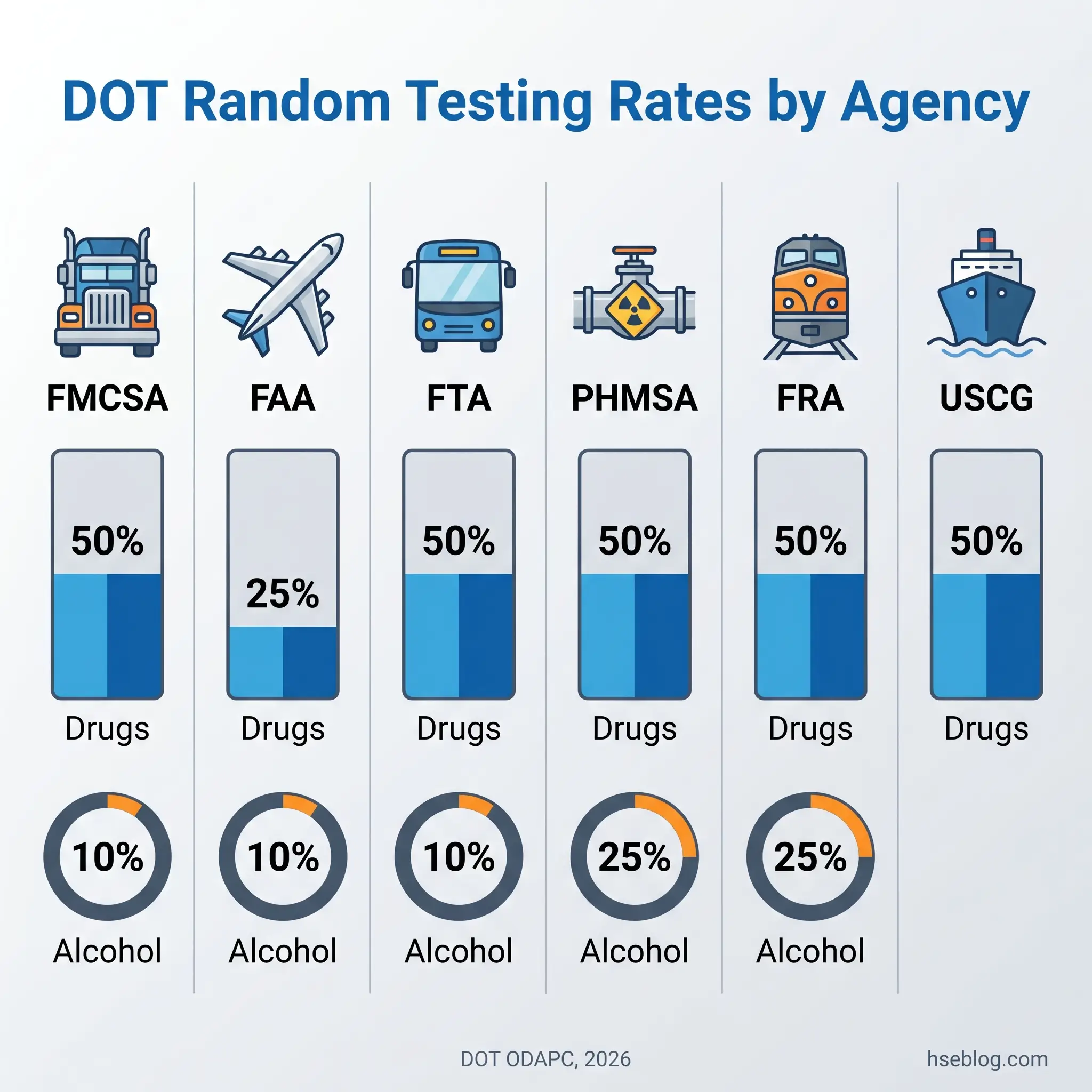
Six DOT operating administrations regulate safety-sensitive positions, each setting its own annual minimum random testing rate. For 2026, the current DOT random testing rates are:
- FMCSA (commercial motor vehicles): 50% for drugs, 10% for alcohol
- FAA (aviation): 25% for drugs, 10% for alcohol
- FTA (transit): 50% for drugs, 10% for alcohol
- PHMSA (pipeline and hazardous materials): 50% for drugs, 25% for alcohol
- FRA (railroads): Varies by employee type — see FRA-specific regulations
- USCG (maritime): 50% for drugs, varies for alcohol
The standard DOT drug panel currently tests five substance categories: amphetamines, cocaine, marijuana (THC), opioids (including expanded opioid testing), and phencyclidine (PCP). A significant regulatory development is underway: DOT published a Notice of Proposed Rulemaking (NPRM) on September 2, 2025 (Docket DOT-OST-2025-0049), proposing to add fentanyl and norfentanyl to the standard testing panel. The comment period closed October 17, 2025, and implementation for regulated employers is expected in late 2026 pending the final rule. Notably, 84% of HHS-certified laboratories already test for fentanyl in non-regulated programs (HHS/DOT NPRM, 2025), meaning laboratory capacity is not the bottleneck — regulatory finalization is.
The selection method must be “scientifically valid” — in practice, this means a computer-based random number generator matched to employee identifiers, not a supervisor drawing names from a hat. Selection must be spread throughout the calendar year, and the employee must proceed to the collection site immediately upon notification. FMCSA-regulated employers face the additional obligation of querying and reporting to the Drug and Alcohol Clearinghouse.
Oral fluid testing became an authorized specimen type for DOT testing under the May 2023 Final Rule, though implementation awaits sufficient laboratory certification under the NLCP. This is a practical expansion that will matter operationally — observed oral fluid collection is less invasive than directly observed urine collection, which becomes relevant in certain return-to-duty and follow-up testing scenarios.
Audit Point: Many smaller DOT-regulated employers — owner-operators, small transit agencies with 5–10 safety-sensitive employees — struggle with pool-size mathematics. A 50% annual rate applied to a pool of 6 means selecting 3 employees across the year. With truly random selection, the same individual may be drawn more than once while another is never selected. This is statistically expected and legally compliant. The critical documentation requirement is proving the selection was random, not proving it was evenly distributed.
Non-DOT Random Drug Testing: Employer-Voluntary Programs
For employers outside DOT-regulated industries, random drug testing is a voluntary decision governed primarily by state law — and the permissibility, scope, and procedural requirements vary dramatically across jurisdictions.
Some states actively encourage workplace drug testing through workers’ compensation premium discount programs — employers who implement certified Drug-Free Workplace programs receive reduced insurance costs, which creates a financial incentive to test. Other states restrict random testing to safety-sensitive positions only, or require that testing be collectively bargained where unions are present. A few jurisdictions impose conditions that make truly random programs impractical for general-population employees.
The FCRA (US Federal) adds a procedural layer when employers use third-party administrators (TPAs) to manage testing. Written disclosure that a drug test will be conducted, separate from all other documents, is required. Employee consent must be obtained. If a test result leads to adverse employment action, FCRA adverse-action procedures — including pre-adverse action notice and a reasonable waiting period — must be followed.
Jurisdiction Note: Employers operating across multiple US states face a patchwork problem. A testing program that is fully compliant in Texas may violate employee protections in California or Connecticut. The practical pattern is that employers who build non-DOT programs without jurisdiction-specific legal review typically make one of two errors — testing too broadly (all employees, including in states that restrict testing to safety-sensitive roles) or failing to obtain proper consent, creating exposure in both directions. Many employers voluntarily adopt DOT-style procedures as a compliance safe harbor even when not federally required, because the 49 CFR Part 40 framework is well-documented and litigation-tested.
How Does the Random Selection Process Work?
The defensibility of any random drug testing program lives or dies in the selection process. A positive test result from a flawed selection is worthless in arbitration, litigation, or regulatory audit.
A legally defensible selection process follows a specific chain, and every step requires documentation:
- Establish the testing pool. Identify all employees subject to random testing. In DOT programs, this means every employee who performs or could be called to perform a safety-sensitive function. Pool composition must be current — add new hires, remove terminated employees, and account for employees on extended leave.
- Determine the selection rate. For DOT-regulated employers, the annual minimum rate is set by the relevant operating administration (e.g., 50% for FMCSA). The rate applies to the average pool size across the year, not to individual employees. A pool averaging 100 employees at a 50% rate requires 50 selections across the year — not 50 unique individuals.
- Use a scientifically valid selection method. Computer-based random number generators matched to employee identification numbers are the standard. Each employee must have an equal probability of selection on every draw. Manual methods (drawing names, alternating by last name) are not scientifically valid and will not survive challenge.
- Spread selections throughout the year. Quarterly draws are common, but selections should be reasonably distributed across months, weeks, and days — not clustered.
- Notify the employee immediately and confidentially. Notification is in-person, and the employee must proceed to the collection site as soon as practicable. Under DOT regulations, “immediately” means just that — no returning to finish a task, no going home first.
- Document everything. Record the date and time of the selection draw, the method used, the names selected, the notification time, and the collection time. Retain records per your regulatory and company requirements.
The question employees ask most frequently: can I be selected more than once? Yes. Random selection is per-draw, not per-person. Statistically, in a pool of 20 employees tested at a 50% rate with quarterly draws, the probability of one person being selected twice in a year is significant. Re-selection is not evidence of targeting — it is evidence that the process is genuinely random.
The pattern that undermines more programs than any flawed algorithm is human, not technical: supervisors who learn about selections before formal notification and inadvertently — or deliberately — tip off selected employees. Separating the person who receives the selection list from the selected employee’s direct supervisor is the single most effective structural safeguard against advance-notice leaks.
Random Drug Testing Procedures: Step-by-Step Process
The procedural chain from notification to reported result is what makes a drug test legally defensible. A broken chain of custody, a collection-site error, or a premature employer action can invalidate results regardless of what substance was detected.
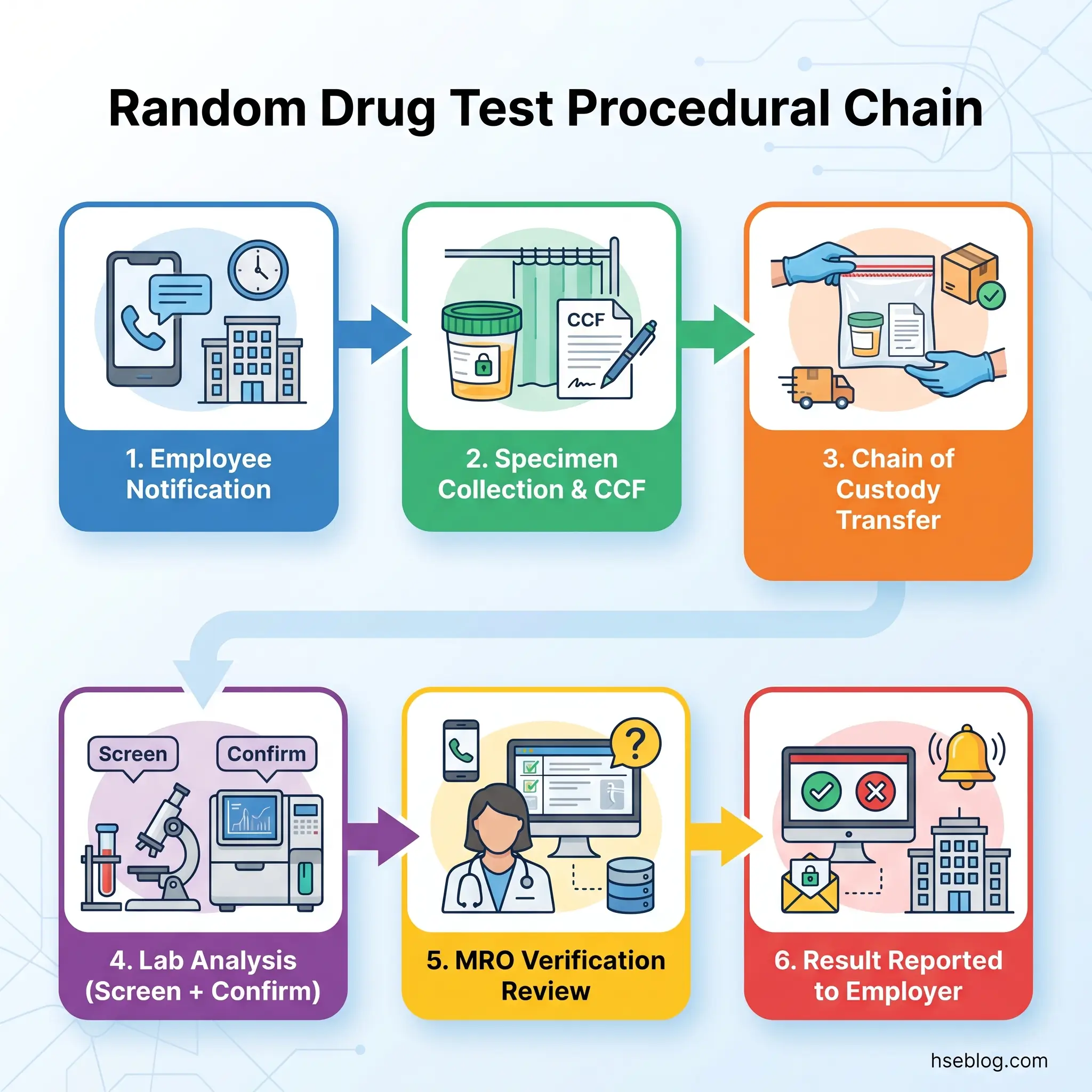
Specimen Collection
The standard specimen for DOT and most non-DOT programs is urine. Oral fluid testing was authorized for DOT programs under the May 2023 Final Rule, though implementation depends on laboratory certification progress. Hair and blood testing are available for non-DOT programs but are not authorized under 49 CFR Part 40.
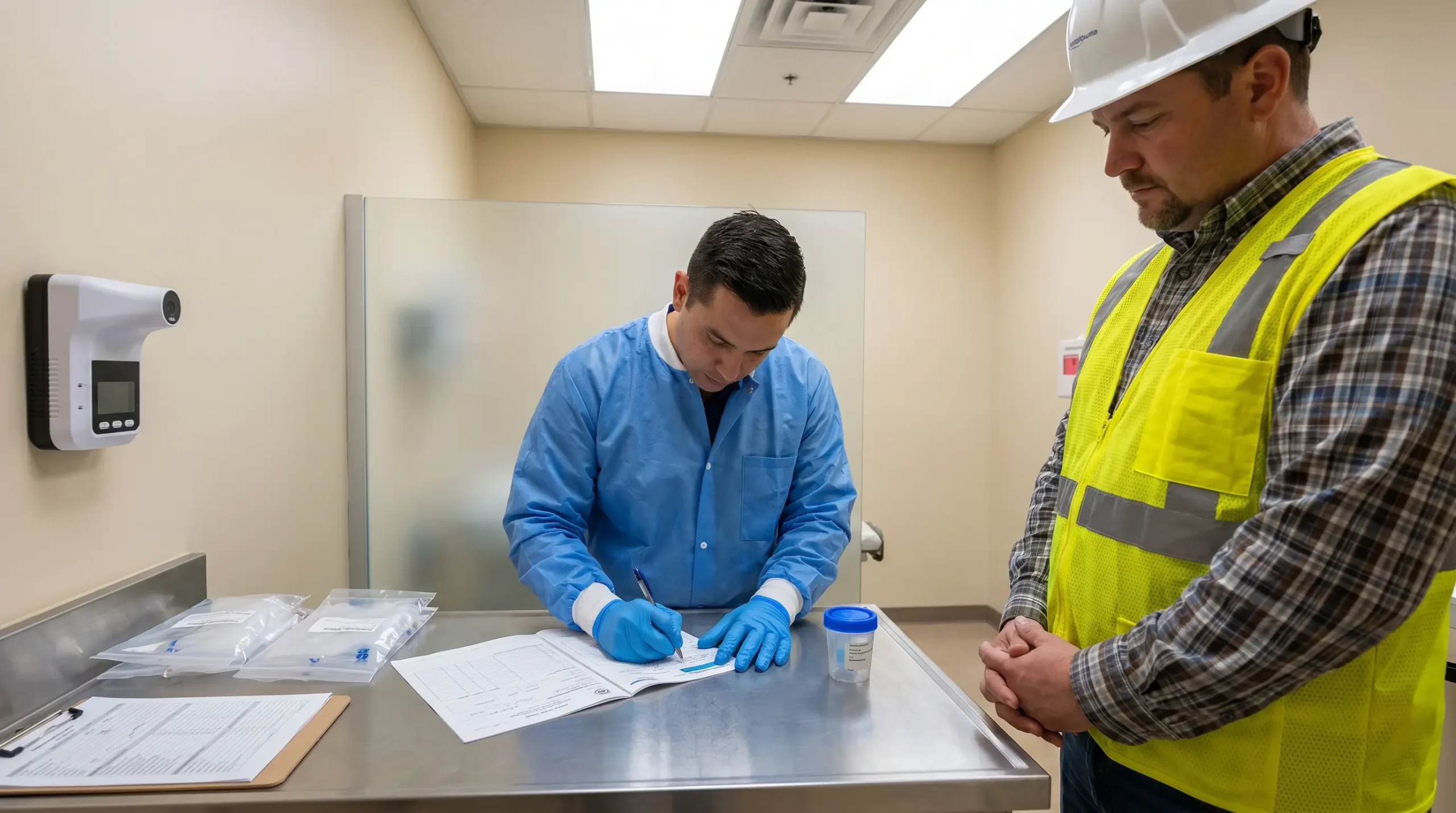
Collection occurs at an approved collection site by a trained collector. For urine, the donor provides a specimen that is split into Bottle A (primary) and Bottle B (split). The Chain of Custody and Control Form (CCF) — or the Oral Fluid Chain of Custody and Control Form (OFCCF) for oral fluid — documents every transfer of the specimen from collection through laboratory receipt. The CCF is not a formality. It is the legal proof that the specimen tested in the laboratory is the specimen collected from the identified employee. A gap in the chain invalidates everything downstream.
Laboratory Analysis
The laboratory performs a two-stage analysis. The initial screen uses immunoassay technology to identify specimens that are presumptively positive. Any specimen that screens positive undergoes confirmatory testing using gas chromatography-mass spectrometry (GC-MS) or liquid chromatography-tandem mass spectrometry (LC-MS/MS). Confirmatory testing eliminates false positives from cross-reacting substances and provides quantitative results against established cutoff levels.
Only specimens confirmed positive at or above the established cutoff proceed to the Medical Review Officer.
MRO Verification
The Medical Review Officer (MRO) step is where the largest number of employer errors occur — and the step most non-DOT employers either skip or misunderstand.
The MRO is a licensed physician with specialized training in substance abuse testing. The MRO receives laboratory-confirmed positive results, reviews them, and conducts a confidential interview with the employee. The purpose is to determine whether a legitimate medical explanation exists — most commonly, a valid prescription for the detected substance. If the employee holds a verified prescription for a medication that would produce the positive result, the MRO downgrades the result to negative and reports it to the Designated Employer Representative (DER) as negative. No adverse action follows.
The compliance failure pattern: employers receive a “positive” from the laboratory and take immediate disciplinary action — sometimes including termination — before the MRO has completed verification. An employee with a valid oxycodone prescription who tests positive for opioids should have that result verified as negative by the MRO. If the employer terminates before verification, they face wrongful termination exposure.
Result Reporting
The MRO reports verified results — positive, negative, or cancelled — to the employer’s DER. Confidentiality requirements govern who within the organization may receive results. Under DOT regulations, results are also reported to the Drug and Alcohol Clearinghouse (for FMCSA-regulated employers) and recorded per agency-specific retention requirements.
The employee has the right to request testing of Bottle B (the split specimen) at a second NLCP-certified laboratory. This right exists under both DOT and most well-constructed non-DOT policies.
What Happens After a Positive Random Drug Test?
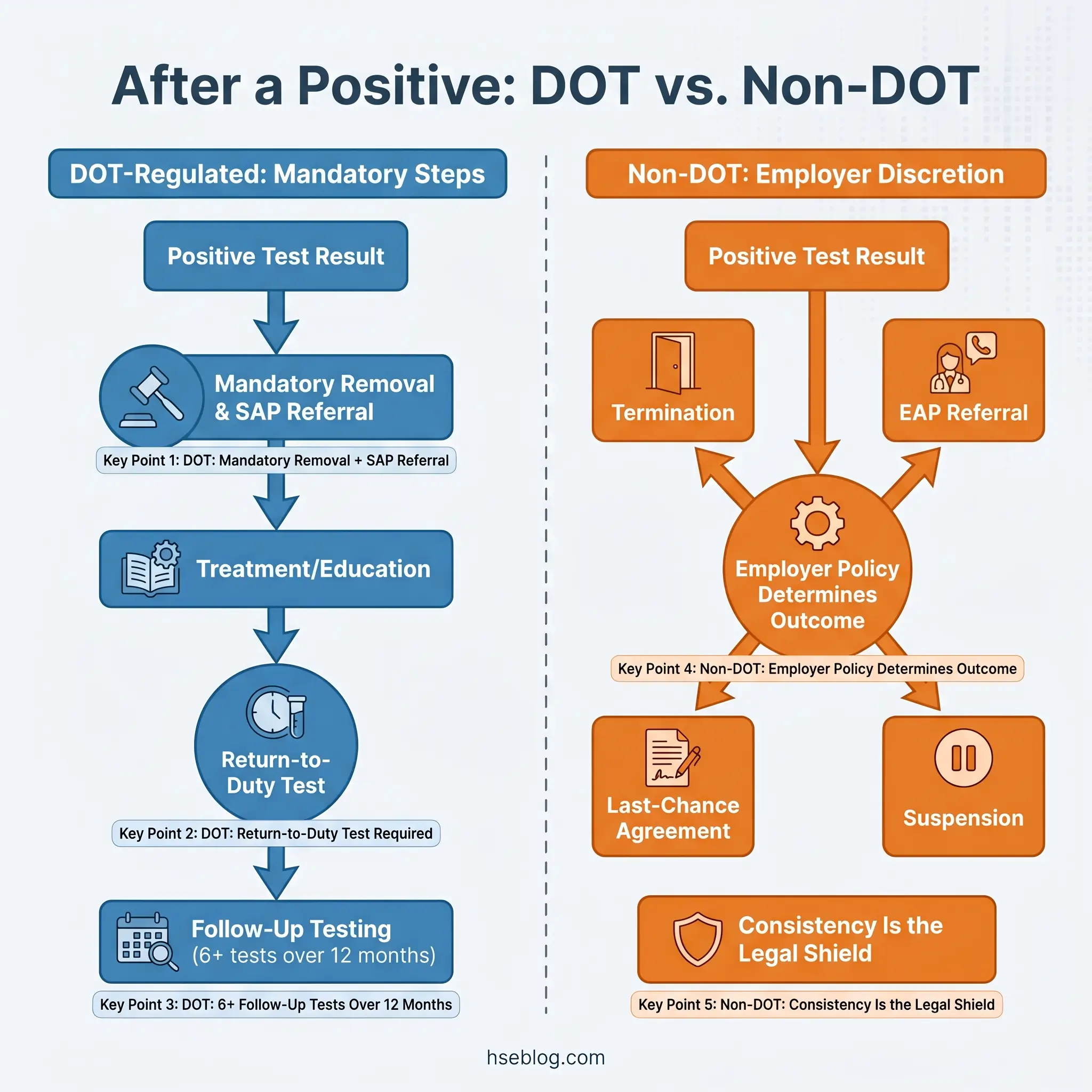
The post-positive pathway diverges sharply between DOT-regulated and non-DOT programs, and confusing the two creates compliance risk in both directions.
DOT-regulated employees face a mandatory, non-negotiable sequence under 49 CFR Part 40 Subpart O (US Federal):
- Immediate removal from all safety-sensitive functions. No exceptions, no temporary accommodation, no “finish the shift.”
- Referral to a Substance Abuse Professional (SAP) — a qualified professional who conducts a clinical evaluation and determines what treatment or education the employee must complete before being considered for return to duty.
- Completion of SAP-recommended treatment/education.
- Return-to-duty testing — a directly observed test with a verified negative result required before the employee may resume safety-sensitive functions.
- Follow-up testing plan — a minimum of six unannounced, directly observed tests in the first 12 months after returning to duty. The SAP may extend this for up to 60 months.
- FMCSA Clearinghouse reporting — the employer must report the violation, and the record remains in the Clearinghouse. Subsequent employers must query the Clearinghouse before allowing the employee to perform safety-sensitive functions.
The pathway exists because DOT’s framework is not purely punitive — it provides a structured return-to-duty process. But the requirements are rigid, and employers cannot waive or modify them.
Non-DOT employees face outcomes determined entirely by employer policy. Options commonly include termination, mandatory Employee Assistance Program (EAP) referral, last-chance agreements with follow-up testing conditions, or suspension without pay. The critical compliance requirement is consistency — employers who terminate one employee for a positive result but offer another a second chance without a documented policy basis for the distinction create discrimination exposure under Title VII, the ADA (for employees in recovery programs), or state anti-discrimination statutes.
Refusal to test carries the same weight as a positive result under DOT regulations (49 CFR Part 40, US Federal). Refusal includes failure to appear at the collection site within a reasonable time, leaving the site before collection is complete, failing to provide a sufficient specimen without a verified medical explanation, and tampering with or substituting a specimen.
| Procedural Step | DOT-Regulated | Non-DOT (Employer Policy) |
|---|---|---|
| Removal from duties | Mandatory, immediate | Per policy — may include suspension or reassignment |
| SAP evaluation | Required (49 CFR Part 40) | Optional — EAP referral common |
| Return-to-duty test | Mandatory, directly observed | Per policy — if included |
| Follow-up testing | Minimum 6 tests / 12 months | Per policy — if included |
| Clearinghouse reporting | Required (FMCSA) | Not applicable |
| Refusal = Positive | Yes, by regulation | Per policy — recommended |
How Does Marijuana Legalization Affect Random Drug Testing?
This is the area generating the most employer confusion — and the most legal exposure — in 2025–2026. The collision between state marijuana legalization, pending federal rescheduling, and unchanged DOT testing requirements has created a three-way conflict that no employer can navigate on assumptions alone.
For DOT-regulated employers, the answer is unambiguous. DOT published a compliance notice on December 19, 2025, confirming that marijuana testing remains unchanged for safety-sensitive transportation employees regardless of state legalization status or pending federal rescheduling. Marijuana is on the DOT five-panel test. A positive THC result is a DOT violation. State law does not override this.
For non-DOT employers, the answer depends on the state — and the state landscape is shifting. Over 40 US states have legalized marijuana in some form, and a growing number have enacted employment protections specifically addressing off-duty cannabis use. Minnesota’s SF 2370 (effective May 2025) requires employers to provide 14 days’ written notice before taking adverse action based on a positive cannabis test. Other states prohibit adverse action based solely on metabolite detection (which indicates past use) rather than impairment-based testing (which indicates current impairment). The distinction matters because standard urine immunoassay testing detects THC-COOH metabolites that may persist for weeks after use — long past any impairing effect.
The pending federal rescheduling of marijuana from Schedule I to Schedule III adds a layer of uncertainty that employers must acknowledge without acting on prematurely. Under the current statutory language of the Omnibus Transportation Employee Testing Act, DOT’s testing authority references Schedule I substances. If marijuana moves to Schedule III, a literal reading could remove it from DOT testing authority — but no employer should modify testing programs based on this possibility until a final rule is published. DOT’s December 2025 notice was issued precisely to prevent premature action.
The marijuana post-accident positivity rate reached 7.3% in 2024, near the record high of 7.5% set in 2023 (Quest Diagnostics, 2025). This figure reinforces the safety argument for continued testing, even as the legal argument becomes more complex. Additionally, hemp-derived THC products — legally available under the 2018 Farm Bill — are creating false-positive complications for employees who consume products they reasonably believe to be non-intoxicating.
The practical operational risk right now is at the supervisor level. Supervisors hear news about rescheduling and assume it changes company policy. The fix is refreshing supervisor training specifically on the distinction between federal regulatory status, state legalization, and the company’s own written policy. These are three separate questions with potentially three different answers, and line supervisors need to understand that only the company’s written policy — reviewed by legal counsel — governs their actions.
The Fix That Works: Update your written drug testing policy to explicitly address marijuana legalization and state-specific employee protections. Document the policy review date. Train supervisors on the policy — not on news headlines. If you operate across multiple states, your policy must account for the strictest applicable employee protections or include state-specific addenda.
Random Drug Testing in the United Kingdom
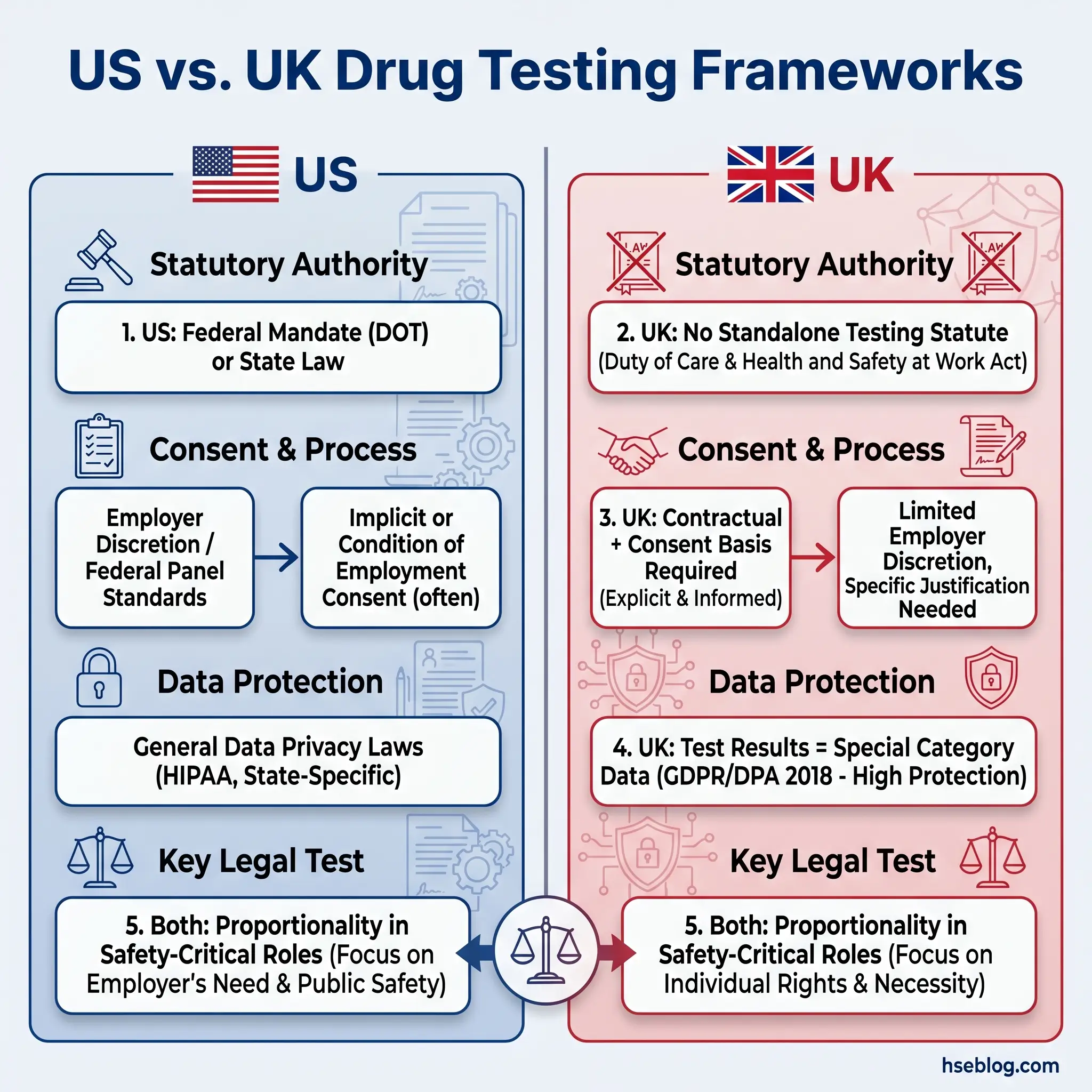
The UK framework for workplace drug testing differs fundamentally from the US model. There is no single statute mandating or authorizing workplace drug testing. Instead, the legal basis is assembled from several overlapping authorities, and the concept of proportionality governs everything.
The Health and Safety at Work etc. Act 1974 (UK) places a general duty on employers to ensure, so far as reasonably practicable, the health, safety, and welfare of employees. Where substance impairment creates a foreseeable safety risk — transport, construction, oil and gas, nuclear, safety-critical manufacturing — this duty provides the foundational justification for drug testing. But the Act does not mention drug testing. The employer must demonstrate that testing is a proportionate and necessary measure to discharge the duty of care.
Employment authority to test comes from the contract of employment. If drug testing is not written into the employment contract (or incorporated through a referenced workplace policy), the employer has no contractual authority to require it. Disciplining or dismissing an employee for refusing a test that has no contractual basis creates exposure for unfair dismissal claims under UK employment law.
Drug test results are classified as “special category personal data” under the UK GDPR and the Data Protection Act 2018 (UK). Processing this data requires explicit consent from the employee and a lawful basis — typically that testing is necessary for reasons of substantial public interest (safety) or for compliance with employment law obligations. Appropriate security measures for storage and handling are mandatory.
The Equality Act 2010 (UK) adds a further constraint. If an employee’s substance use is connected to a protected characteristic — for example, an addiction recognized as a disability under certain circumstances — the employer must consider reasonable adjustments before taking adverse action. This does not mean an employer cannot act on safety grounds, but the process must be documented and proportionate.
Trade union consultation is an important practical step in the UK. Introducing a random testing program without consulting recognized unions can create industrial relations disputes and weaken the program’s defensibility at tribunal.
The judgment call for UK employers is that random drug testing is legally permissible in safety-critical roles when properly supported by contractual terms, consent, proportionality, and data protection compliance. Outside safety-critical roles, the justification threshold is significantly higher and the risk of successful challenge is real.
How to Build a Legally Defensible Random Drug Testing Policy
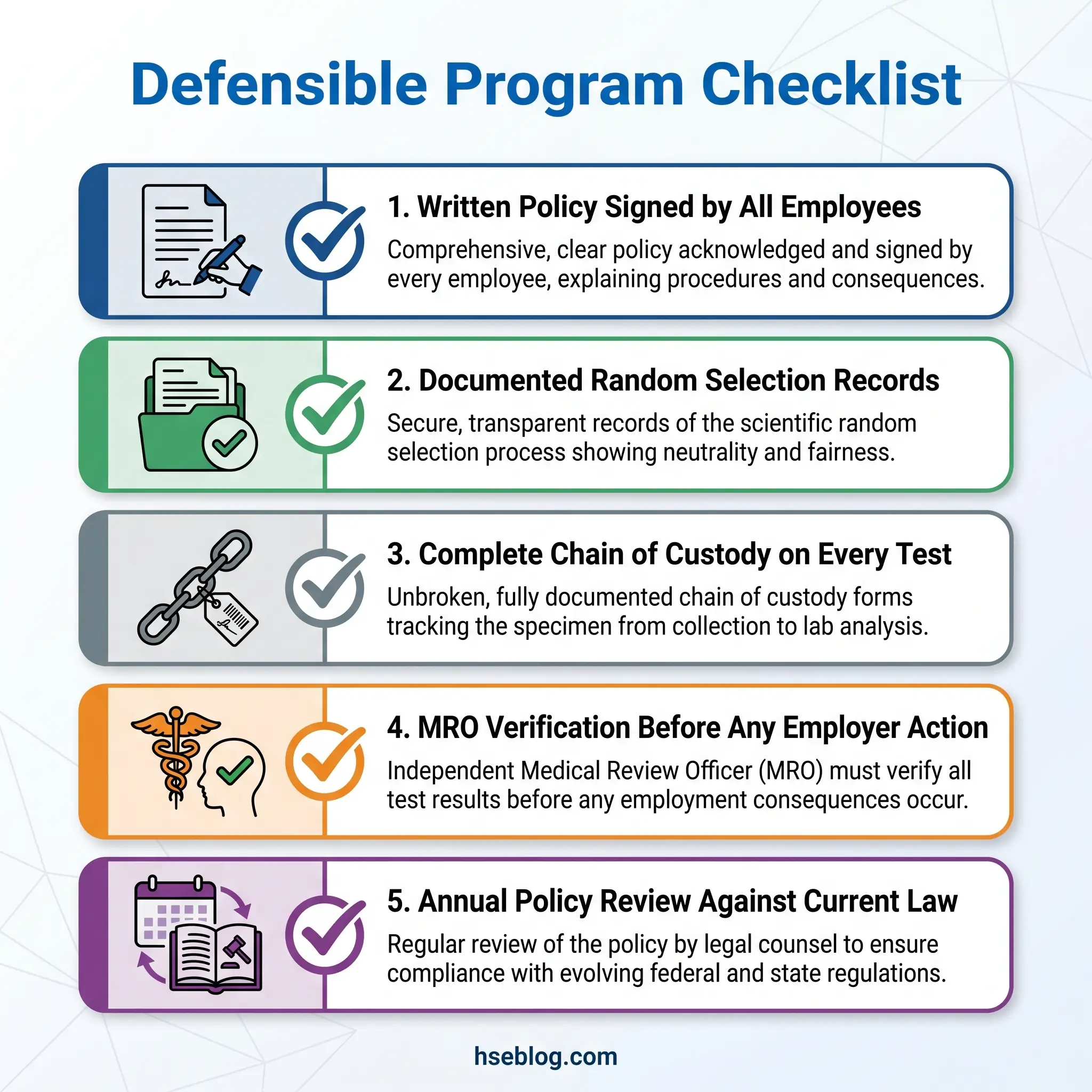
A testing program without a written, distributed, and acknowledged policy is indefensible in every jurisdiction. The written policy is not a supporting document — it is the structural foundation that every test result, every disciplinary action, and every legal defense relies on.
The most audit-failed element across the programs I have reviewed is not the selection algorithm or the laboratory certification. It is the documentation trail. Organizations that cannot produce signed employee acknowledgment forms, documented selection records, or chain-of-custody documentation for a specific test have no defense in litigation or regulatory audit — regardless of what substance was detected.
A defensible policy includes the following essential elements, each of which must be clearly written and internally consistent:
- Scope and applicability. Define exactly which employees or positions are subject to random testing. In DOT programs, this tracks to safety-sensitive function definitions. In non-DOT programs, ensure scope complies with state-law limitations.
- Substances tested. List the specific substances and the testing panel. For DOT, this is the federally mandated panel. For non-DOT, ensure the panel does not include substances restricted from testing by state law.
- Selection method. State that selection uses a computer-based random number generator providing equal probability, and identify the third-party administrator if used.
- Notification and reporting procedures. Define how employees are notified, the timeframe for reporting to the collection site, and the chain of authority for notification.
- Collection and laboratory standards. Reference the specimen type, collection protocols, and laboratory certification requirements.
- MRO review process. Describe the MRO’s role, the employee interview, and the verification process for legitimate prescriptions.
- Consequences for positive results. Specify outcomes — termination, SAP/EAP referral, last-chance agreement conditions. For DOT, reference the mandatory 49 CFR Part 40 pathway. For non-DOT, ensure consequences are applied consistently.
- Consequences for refusal. Define what constitutes refusal and state that refusal is treated equivalently to a positive result.
- Employee rights. Document the right to split specimen testing, the right to contest results through the MRO, confidentiality protections, and any appeal procedures.
- Confidentiality. Specify who receives results, how they are stored, and the retention period.
- EAP or SAP referral information. Provide access information for employee assistance resources.
Distribution requires documented employee acknowledgment — a signed form confirming receipt and understanding of the policy. Verbal briefings alone are insufficient for legal defense.
Policy review should occur on a fixed annual cycle and be triggered by specific events: changes in applicable law, addition of new testing methods or substances, changes in DOT agency testing rates, or state enactment of new employment protections. The December 2025 DOT marijuana compliance notice and the pending fentanyl panel addition are both current trigger events that should prompt a policy review.
Field Test: Pull a random completed test file from your records. Can you produce, in sequence: the signed policy acknowledgment form, the selection record showing the draw method and date, the notification documentation, the CCF, the laboratory report, and the MRO verification? If any link in that chain is missing, the result is legally vulnerable.
Frequently Asked Questions
Conclusion
Three decisions determine whether a random drug testing program protects an organization or exposes it. First, the written policy: without a signed, distributed, annually reviewed document that specifies scope, substances, selection method, consequences, and employee rights — no test result is defensible, no matter what it finds. Second, the procedural chain: every step from random number generation through MRO verification must be documented and unbroken. Employers who act on laboratory results before MRO verification is complete are creating wrongful-termination exposure that the positive result itself will not cure. Third, the jurisdictional alignment: a program that is compliant in one state may violate employee protections in the next state over, and the marijuana legalization collision is making this gap wider every legislative session.
The regulatory environment around random drug testing is actively shifting. The pending addition of fentanyl to the DOT panel, the December 2025 DOT compliance notice on marijuana, and the growing list of states enacting off-duty cannabis employment protections all mean that a program built in 2020 and never reviewed is a program built for a legal landscape that no longer exists. The 2025 Quest Diagnostics data showing fentanyl positivity 707% higher in random tests than pre-employment screens (Quest Diagnostics, 2025) confirms that random testing remains the most effective detection tool available — but only when the program behind it is as rigorous as the laboratory science inside it.
Review your policy against current law in every jurisdiction where you operate. Refresh your supervisor training on the distinction between federal regulation, state legalization, and company policy. Pull a random test file and verify the documentation chain is complete. These are not aspirational recommendations — they are the minimum actions that separate a defensible program from a liability.