
TL;DR
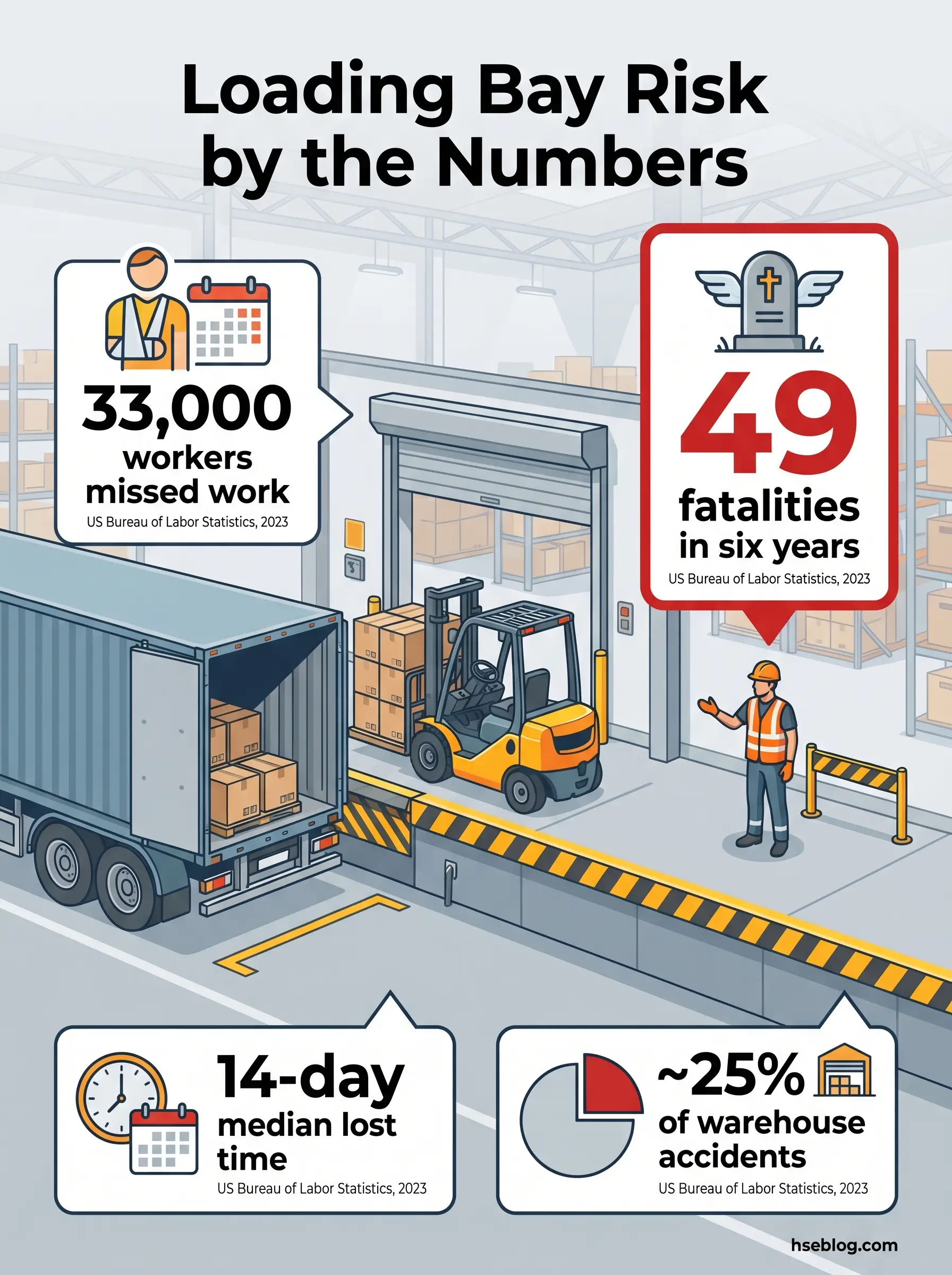
- ~33,000 workers missed work on US loading docks, dock plates, and ramps between 2015 and 2020, with a median 14 days away (US Bureau of Labor Statistics, 2023).
- 49 loading dock fatalities were recorded in the same six-year window (US Bureau of Labor Statistics, 2023) — roughly one every six weeks.
- 4 feet is the fall protection trigger under 29 CFR 1910.28, which nearly every open dock door crosses because US docks typically stand 48–52 inches high.
- Approximately 25% of warehouse accidents occur at or near the loading dock, a figure widely cited in OSHA publications and industry literature.
- The hierarchy of controls — not a tips checklist — is what separates sites where procedures hold under throughput pressure from sites where they don’t.
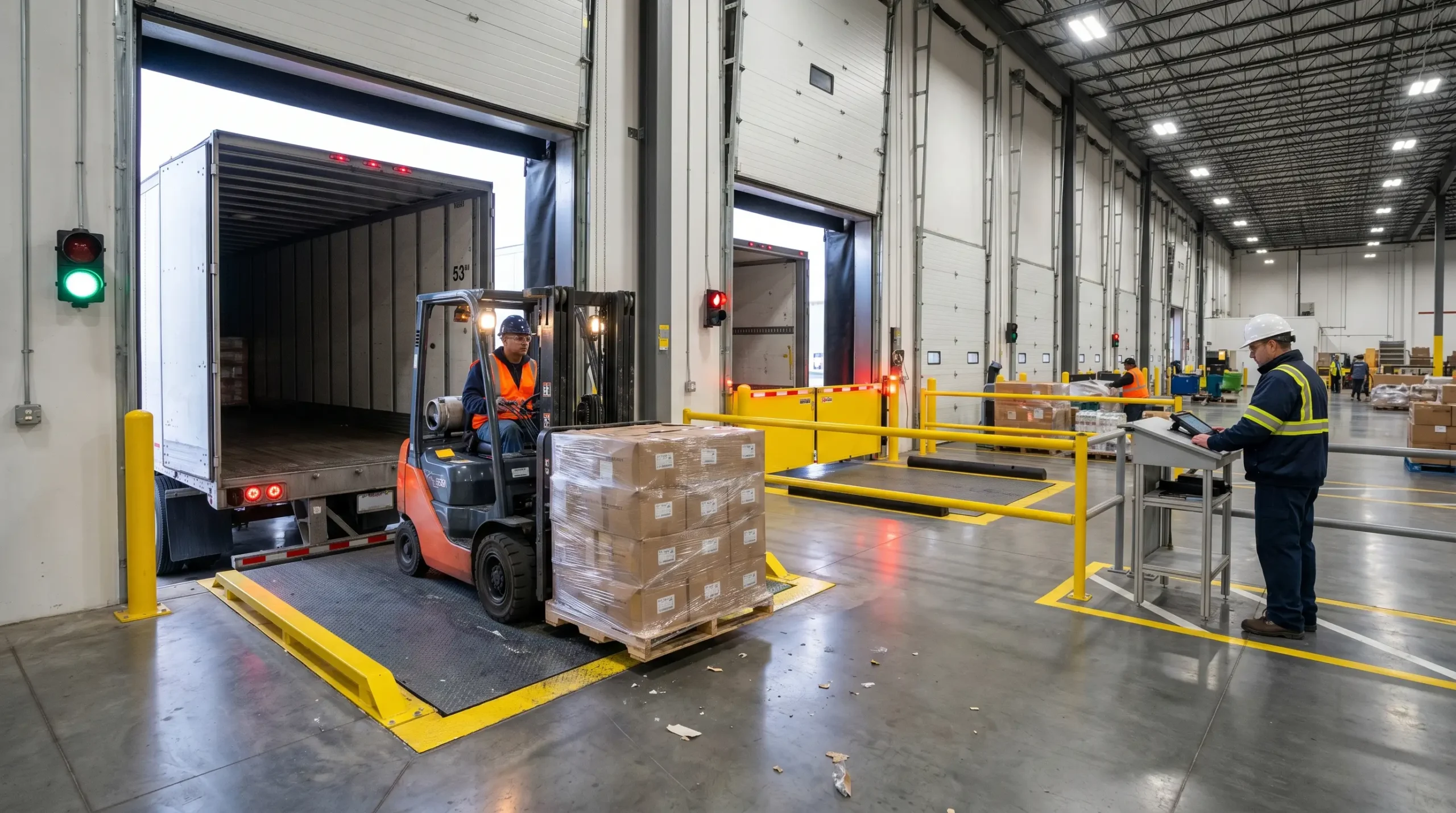
Loading bay safety is the framework of engineering controls, procedures, and training that protects workers where vehicles, powered industrial trucks, and manual handling converge. Core hazards include falls from dock edges, trailer creep, forklift rollovers, and crush injuries. Prevention depends on applying the hierarchy of controls — prioritising engineering safeguards like vehicle restraints and interlocks over administrative measures alone.
Between 2015 and 2020, approximately 33,000 US workers missed work because of injuries on loading docks, dock plates, and ramps, and 49 workers died in the same period (US Bureau of Labor Statistics, 2023). That is a fatality every six weeks on a single piece of warehouse infrastructure most sites treat as transitional — the zone between the secure interior and the arriving transport. The injury count sits alongside a widely repeated figure in OSHA publications and industry literature that places roughly 25% of warehouse accidents at or near the dock.
Loading bays concentrate almost every category of warehouse hazard into one small area. Vehicles arrive and depart. Forklifts cross the boundary between trailer and dock dozens of times per shift. Pedestrians walk through zones designed for rolling stock. The floor drops four feet or more the moment a trailer pulls away. Throughput targets push all of it to happen faster. This article covers the specific hazards loading bays generate, the regulatory framework in the US and UK, and the hierarchy-of-controls approach that gives loading bay safety a defensible structure rather than a checklist of tips.
What Is Loading Bay Safety and Why Does It Matter?
Most warehouse safety budgets concentrate inside the building. Rack protection, aisle markings, pick-zone lighting, pallet integrity, PPE distribution — these absorb attention and spend. The loading bay, which is the transition zone where the secure interior meets the external transport network, typically receives a smaller share of that investment despite a disproportionate share of the injury record.
The terminology itself varies by region. In US practice, “loading dock” refers specifically to the elevated structure at a building’s perimeter where trailers back up for loading and unloading. “Loading bay” is used more broadly in UK and Commonwealth practice to describe the entire area that includes the dock structure, the approach, the parked-trailer position, and any staging zone. The distinction matters because hazard categories shift depending on which part of the bay a worker occupies — an approach driver faces different risks than a forklift operator crossing the dock threshold.
The scale of the problem is clear in the data. In 2018 alone, nearly 6,600 US workers missed work because of injuries and illnesses incurred on loading docks, dock plates, and ramps (US Bureau of Labor Statistics, via Safety+Health Magazine, 2020). The transportation and warehousing sector recorded 930 fatalities in 2023, with the fatal injury rate falling to 12.9 per 100,000 FTE workers (US Bureau of Labor Statistics, 2024) — a sector broader than docks alone, but the one that contains most dock operations.
The reason for the concentration is compound exposure. In a single location, you have heavy vehicles moving in reverse, powered industrial trucks operating on elevated surfaces, manual handling of awkward loads, pedestrians moving through vehicle paths, weather ingress affecting floor condition, and time pressure from delivery schedules. No other warehouse zone layers so many hazard categories in one spot. And with e-commerce throughput pressure driving more dock turns per shift, the exposure window stretches across more operating hours than it did a decade ago.
Common Loading Bay Hazards and Their Causes
Across published loading dock incident reports and BLS injury summaries, a short list of hazard mechanisms accounts for most serious outcomes. Treating them as a flat list obscures what actually matters — the specific conditions that allow each mechanism to fire. The categories below are organised by causal mechanism rather than injury type, so the controls map directly onto how the harm occurs.
Premature Drive-Away and Trailer Creep
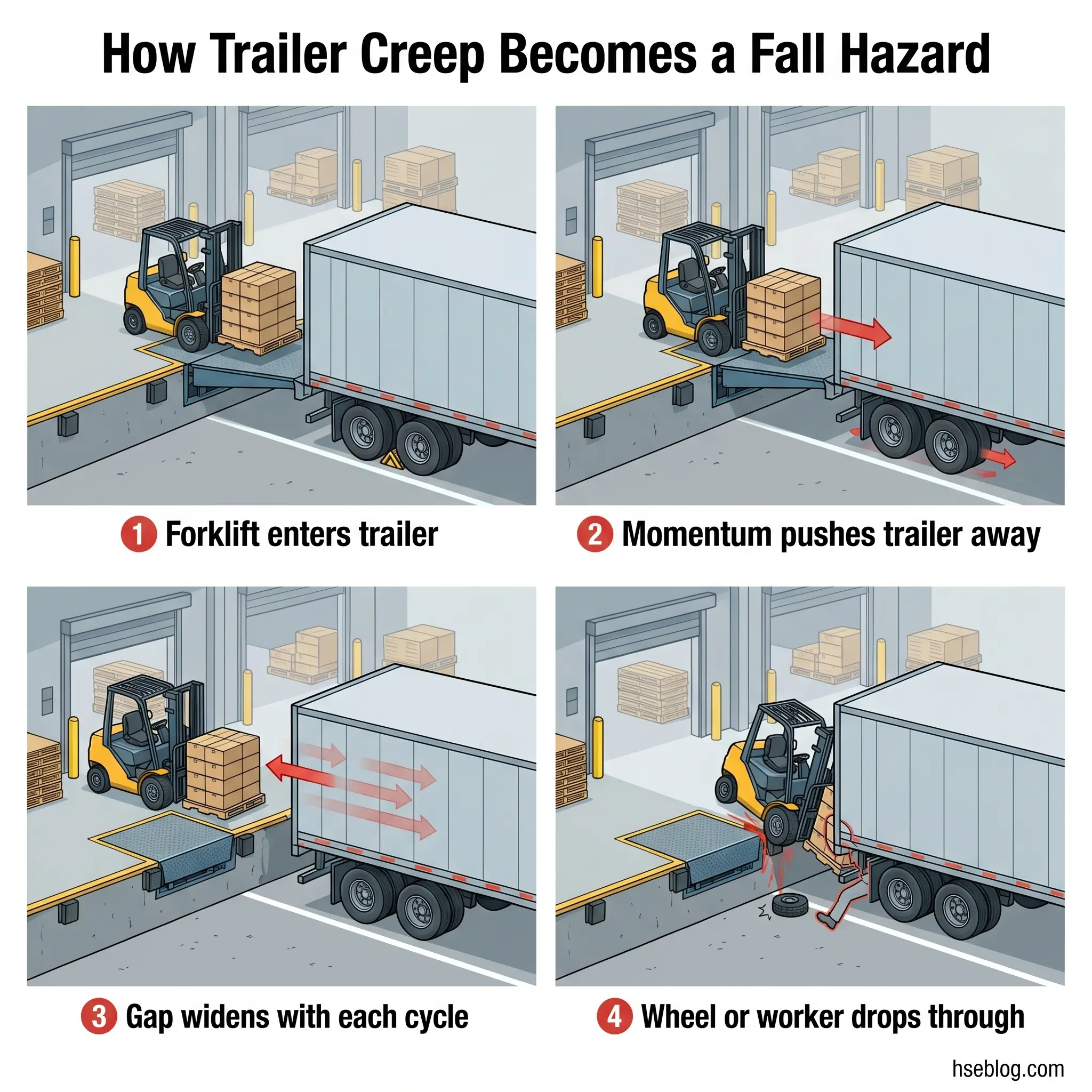
Premature drive-away is the scenario loading bay safety was largely built to prevent. A driver pulls the trailer away from the dock while a forklift is still inside or while workers are loading, and the forklift drops through the gap or a worker falls from the dock edge. Trailer creep is the slower-moving cousin: the trailer separates from the dock in small increments over the course of a loading cycle, driven by the repeated momentum of a forklift entering and exiting. An inch becomes three inches becomes six inches, and the gap becomes lethal only when something or someone falls through it.
The condition that makes both hazards persistent is communication failure. The dock worker assumes the driver knows loading is still in progress. The driver interprets a pause as completion. No one is looking at the trailer gap because attention is on the pallet count. A consistent pattern in US OSHA enforcement of vehicle restraint rules is that the restraint equipment was present on site but was not engaged at the time of the incident — the equipment existed, but the forced-sequence logic that would have required its engagement did not.
Falls from Dock Edges and Through Gaps
An open dock door with no trailer in position is an unprotected edge with a drop of roughly 48 to 52 inches — above the 4-foot threshold that triggers OSHA fall protection requirements under 29 CFR 1910.28. The same standard treats dock edges as walking-working surfaces, which means the fall protection obligation applies whenever a worker could be exposed to the unguarded edge. Under UK law, the obligation arises from the Work at Height Regulations 2005, which uses a lower threshold — any work at height where injury could result from a fall.
The gap-between-trailer-and-dock scenario is the other edge hazard. When a trailer sits slightly away from the dock bumper, or when the trailer floor drops below dock level, a worker stepping across can roll an ankle or fall through. Dock levelers close this gap when deployed correctly — but only when deployed correctly, and only when their lip engages the trailer floor securely.
Forklift and Powered Equipment Incidents
Forklift incidents at the dock concentrate around three patterns. First, the truck drives off the dock edge when a trailer pulls away prematurely or fails to stop short of the dock. Second, the truck tips inside a trailer when the trailer floor is damaged, rotted, or undermined by weak landing gear. Third, the truck strikes a pedestrian in a congested dock area where traffic separation has broken down. Among US forklift operators in 2018, falls to a lower level accounted for 1,030 of 7,940 nonfatal injuries requiring days away from work — about 13% — and 16 of 85 operator fatalities, or 18.8% (US Bureau of Labor Statistics and National Safety Council, via Safety+Health Magazine, 2020). Many of those falls occur at docks. OSHA’s eTool on powered industrial trucks at loading docks provides practical guidance on the specific hazard patterns.
Other Recurring Hazards
Several hazards show up less dramatically but with high frequency. Slips, trips, and falls at the same level are driven by wet surfaces, spilled product, debris from packaging, and weather ingress through open doors. Manual handling overexertion concentrates in the final metre of unloading, where loads shift and awkward postures become unavoidable. Carbon monoxide accumulates in enclosed or semi-enclosed bays where diesel and propane forklifts idle alongside trailers with running engines — OSHA’s permissible exposure limit for CO is 50 ppm as an 8-hour time-weighted average under 29 CFR 1910.1000. Falling objects round out the short list, typically from poorly-secured loads that shifted during transit or from top-heavy stacks destabilised during unloading.
Field Test: Walk a loading bay at shift change without announcing yourself. Count how many open dock doors have no trailer and no edge guard. Count how many trailers are parked without a visible restraint engaged. Count how many pedestrians cross forklift paths without eye contact. The number you find is the gap between the written procedure and the operational reality.
What Are the Regulatory Requirements for Loading Bay Safety?
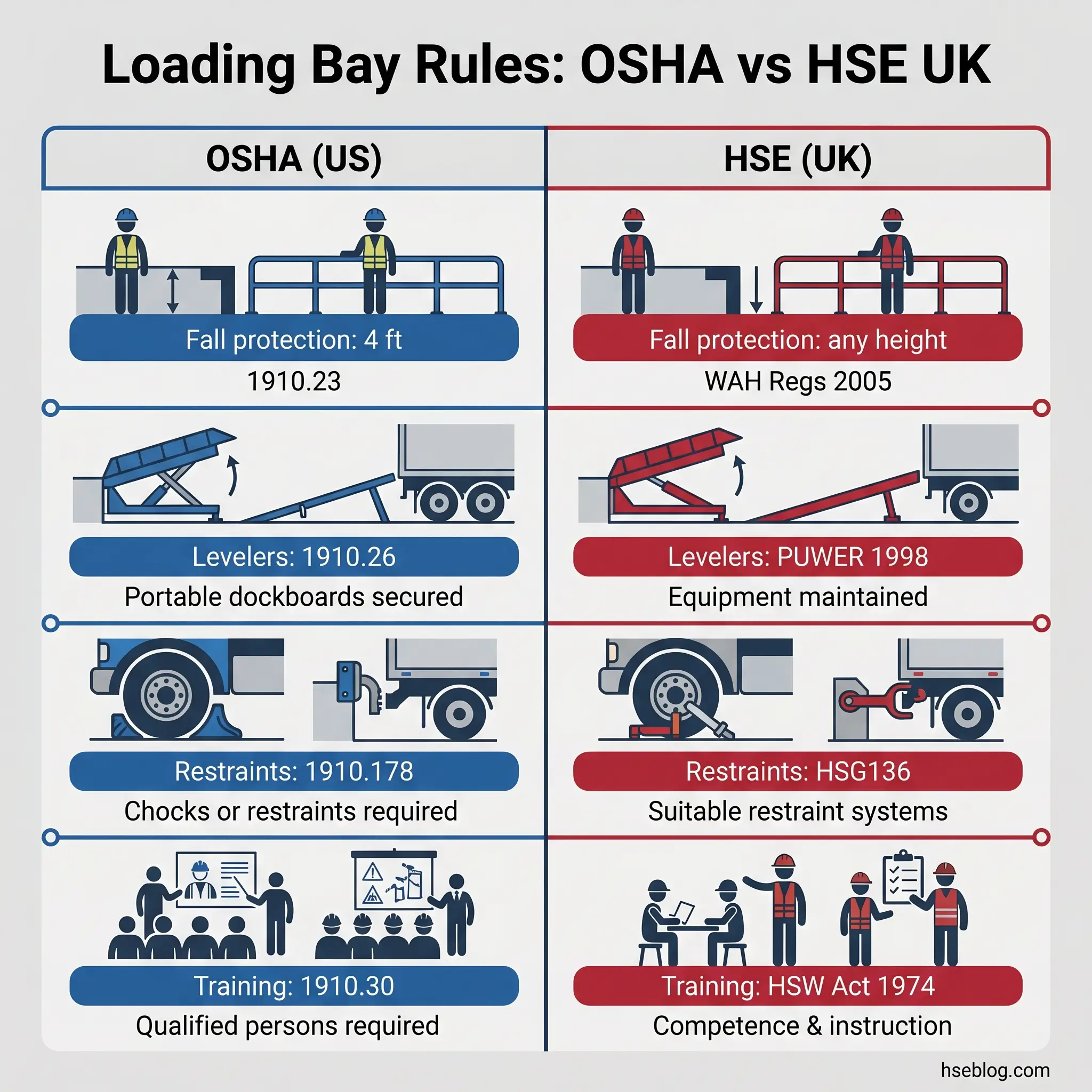
No single OSHA standard covers the loading dock end-to-end. Compliance is assembled from several standards across Subpart D (walking-working surfaces), Subpart N (materials handling), and Subpart O (machinery). The same fragmentation exists in UK law, where loading bay safety sits inside a general workplace transport framework governed primarily by HSE guidance documents rather than a single regulation. The table below summarises the key obligations by jurisdiction.
| Obligation | US (OSHA) | UK (HSE) |
|---|---|---|
| Fall protection trigger at dock edges | 4 feet above lower level (29 CFR 1910.28) | Any height where injury could result (Work at Height Regulations 2005) |
| Dockboard / dock leveler rules | 29 CFR 1910.26 — capacity, run-off protection (post-Jan 2017), secured against displacement | PUWER 1998; HSG136 workplace transport guidance |
| Vehicle restraint / chocking | 29 CFR 1910.178(k)(1) — wheel chocks or mechanical restraint during loading | HSE workplace transport guidance — safeguards against premature departure |
| Traffic / pedestrian management | 29 CFR 1910.176 — safe clearances, housekeeping | Workplace (Health, Safety and Welfare) Regulations 1992, Reg. 17 |
| Training | 29 CFR 1910.30, 1910.178(l) | Health and Safety at Work Act 1974, Sections 2 and 7 |
Beyond the enforceable regulations, US industry standard ANSI MH30.1-2022 defines performance and testing requirements for dock leveling devices, and ANSI MH30.2-2022 covers portable dockboards. These are not regulations, but they are the performance specifications that OSHA inspectors and insurers typically reference when determining whether equipment meets acceptable industry practice. The HSE’s dedicated guidance on loading area safety is the UK equivalent operational reference, sitting on top of HSG136.
Direct link to OSHA’s dockboard standard at 29 CFR 1910.26 is useful for a detail that catches many employers off guard: the standard’s definition of “dockboard” encompasses dock levelers, while ANSI MH30 standards treat dock levelers and portable dockboards as separate device categories with different run-off guard requirements.
Jurisdiction Note: Compliance should be built on the OSHA standard as the enforceable requirement, with ANSI specifications used for equipment selection and performance verification. Where operations span both US and UK jurisdictions, the stricter reference should govern — the UK’s Work at Height Regulations 2005 trigger fall protection at a lower threshold than OSHA’s 4-foot rule, so a site applying UK standards in the US is automatically compliant on that dimension, not the reverse.
This article provides general HSE knowledge. Loading bay operations — particularly around dock-edge fall protection, vehicle restraint system design, and forklift operations near dock edges — must be planned and supervised by a competent person with relevant training, jurisdiction-specific authorisation, and a site-specific risk assessment. Recognised training pathways include NEBOSH, IOSH, OSHA outreach programmes, and equivalent regional qualifications. The information here does not replace competent supervision.
Loading Bay Safety Best Practices: A Hierarchy of Controls Approach
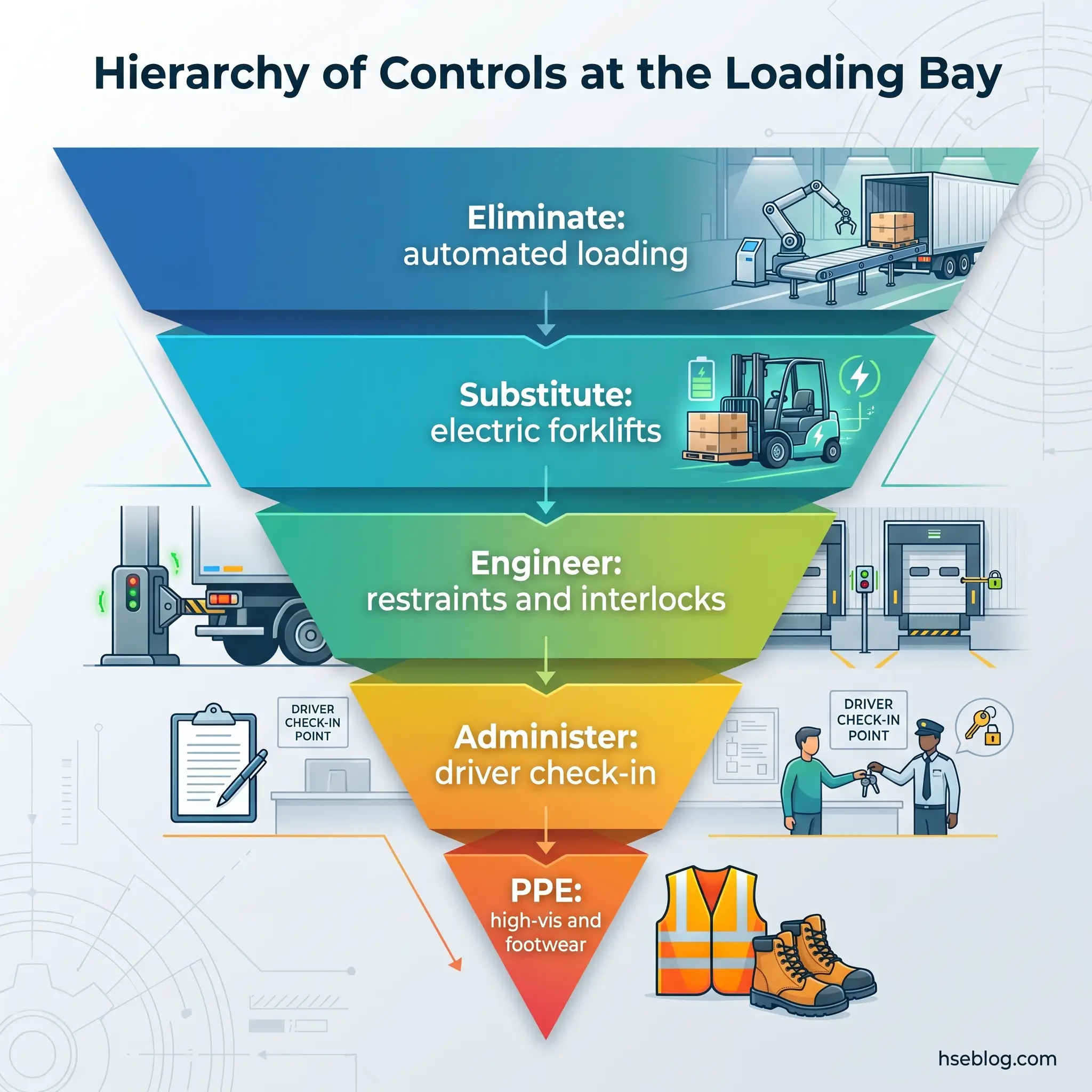
A best-practices list organised as unranked bullet points implies all controls are equally useful. They are not. The hierarchy of controls places measures in order of reliability — elimination of the hazard is most effective; reliance on worker behaviour through PPE is least effective. Loading bay controls applied in that order produce a defensible safety system. Applied out of order, they produce paperwork that fails under production pressure.
Elimination and Substitution
Elimination removes the hazard from the work entirely. At the dock this is usually impossible — you cannot eliminate the vehicles — but specific tasks can be removed from human exposure. Automated trailer loading systems, ground-level drive-through loading for certain cargo types, and roller-bed unloading remove the worker from the path of moving equipment. Substitution replaces a hazard with a lower one: replacing diesel forklifts in enclosed dock areas with electric models eliminates the CO exposure pathway altogether.
Engineering Controls for Loading Bay Safety
This is where loading bay safety is actually won or lost. Engineering controls change the physical system so the hazard cannot reach the worker even if someone fails to follow procedure. The key engineering measures:
- Vehicle restraint systems — ICC-bar hooks or wheel-based restraints that physically hold the trailer against the dock until released. Wheel chocks alone are a secondary measure; they can be displaced by loading force.
- Dock levelers with run-off protection — hinged or hydraulic plates bridging the gap between dock and trailer, meeting the run-off protection requirement under 29 CFR 1910.26 for devices in service after January 17, 2017.
- Safety gates and guardrails at open dock doors — fall protection that deploys automatically when no trailer is present. A single chain does not meet guardrail requirements unless it satisfies the 42-inch top rail and 200-lb load capacity under 29 CFR 1910.29.
- Dock communication systems — traffic light signals (red/green) that tell the driver when it is safe to depart, sequenced with the restraint system.
- Adequate lighting — dock area lighting and trailer-interior lighting that ensures forklift operators can see trailer floor, load positions, and pedestrians.
- Ventilation — forced ventilation in enclosed bays to manage CO accumulation from idling vehicles and diesel forklifts.
The most durable engineering design is interlocked. A properly interlocked system sequences the operation: the restraint must engage before the dock leveler deploys; the leveler must be deployed before the dock door opens to the trailer; the safety gate must close before the traffic light turns green for the driver. Each step physically prevents the next until its predecessor is complete. This is the control architecture that closes the bypass gap — the single most common failure pattern identified in published loading dock investigation literature, where the equipment existed but was not engaged because engaging it cost 30–60 seconds per trailer on a busy shift.
Administrative Controls and Safe Systems of Work
Administrative controls depend on workers doing the right thing. They matter, but they should support engineering controls rather than substitute for them. The core measures are written loading bay procedures, driver check-in protocols, key-control systems where driver keys are surrendered to the dock office during loading, traffic management plans for the yard and dock approach, pre-shift dock inspections, communication protocols between dock workers and drivers, and near-miss reporting systems.
These work best when the procedures acknowledge actual operational tempo. A procedure that requires 45 seconds of additional handling per trailer is a procedure that will be bypassed on a busy day — unless an engineering control makes the procedure the physical path of least resistance. Key-control systems are a useful example: when the driver’s key sits in the dock office during loading, the “wait for green light” rule is not a procedural choice but a physical requirement.
PPE
PPE is the final layer. High-visibility clothing wherever vehicle movements occur. Safety footwear with toe protection and slip resistance. Gloves for manual handling. Hearing protection where noise exposure warrants. PPE does not prevent the hazard from occurring — it reduces the severity of contact if everything above has already failed.
Audit Point: When auditing loading bay safety, do not start with PPE. Start with the engineering layer. If vehicle restraints are not interlocked with the dock leveler, if safety gates do not deploy automatically on open doors, if communication systems do not sequence the release — the PPE audit is premature, because the controls below it have already failed.
Loading Bay Inspection and Maintenance Requirements
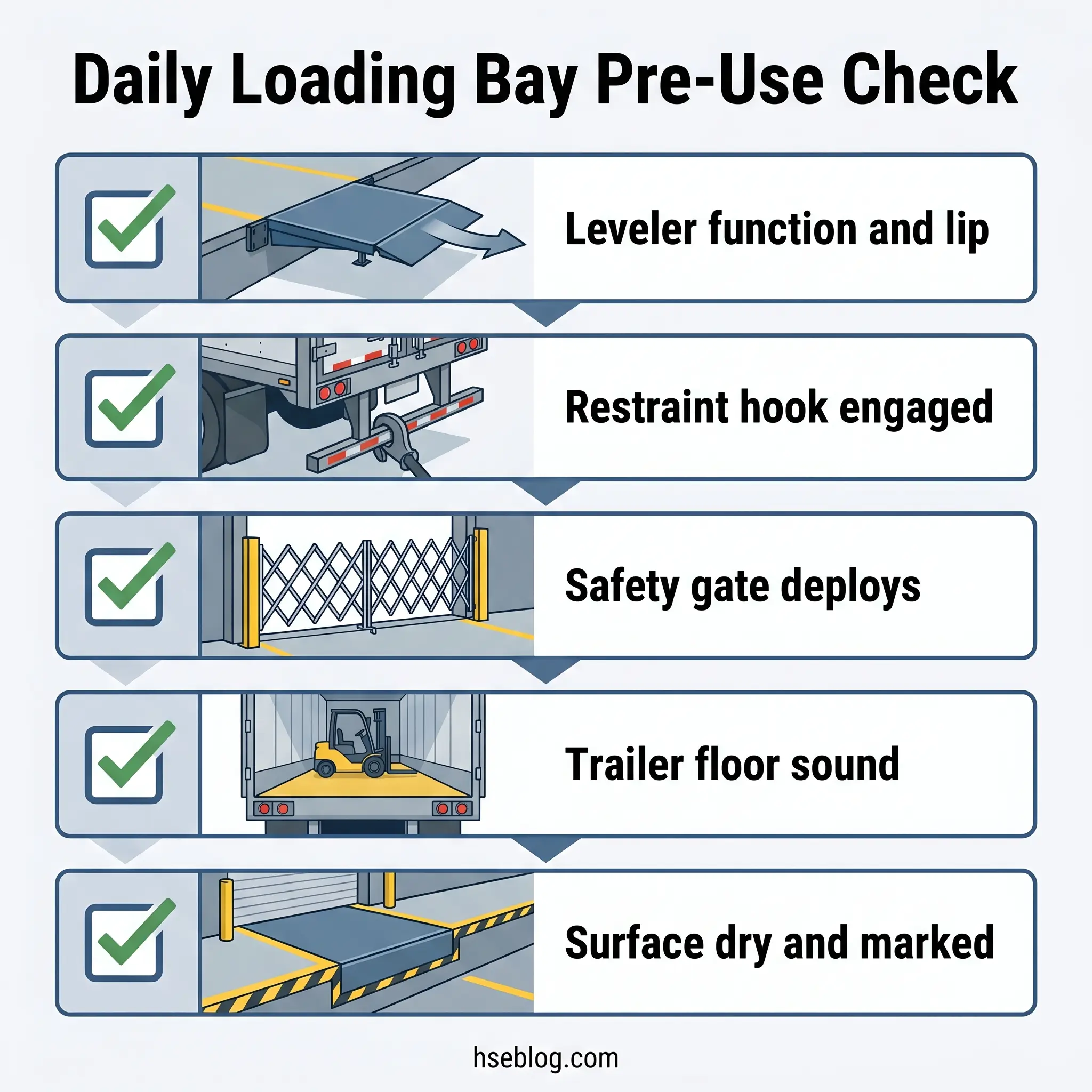
A daily pre-use check takes roughly 90 seconds at a well-organised loading bay. Monthly preventive maintenance on dock levelers runs 30 to 45 minutes per bay depending on equipment age. Annual load-testing against ANSI MH30.1-2022 performance criteria takes longer and usually requires planned downtime. Together, those three intervals cover the full inspection burden for most dock equipment without requiring anything that is not already achievable on a normal operating schedule.
The structure that works is two-layered. Pre-shift or pre-use inspection is a quick visual check by the dock worker or shift supervisor — dock leveler in good condition, restraint engages, safety gate deploys, no obvious damage to the trailer approach. Preventive maintenance is a scheduled technical inspection by a qualified technician, typically monthly or quarterly depending on throughput, covering the mechanical and hydraulic systems that pre-shift checks cannot assess. The key inspection items:
- Dock leveler — hydraulic or mechanical function, hinge and lip condition, pit cleanliness, visible structural damage, load capacity decal visibility
- Vehicle restraint system — hook engagement at multiple trailer heights, sensor calibration, interlock function with the dock leveler and traffic light
- Dock bumpers — compression, cracking, secure mounting, replacement when compression reaches the manufacturer’s limit
- Safety gates and guardrails — deployment function, mounting condition, latch integrity
- Dock door and shelter — seals, entrapment hazards from dock shelters, operation of the door mechanism
- Surface condition — anti-slip treatment, crack repair, drainage, edge marking visibility under current lighting conditions
- Lighting and signage — operational checks on dock area lights, trailer-interior lights, and traffic signal systems
The maintenance conflict at most sites is operational — a dock leveler taken out of service costs throughput. A practical response is to schedule preventive maintenance against lower-volume shifts or planned downtime windows rather than deferring it until failure forces the issue. Recordkeeping matters here too. Inspection logs, defect reports, and repair records are the documentation trail that proves duty of care. Sites cited under 29 CFR 1910.26 for inadequate dockboard maintenance often show the same evidence gap: the equipment problem was known informally but never recorded, and the absence of records transforms a reactive failure into a willful violation finding.
Training Requirements for Loading Bay Workers
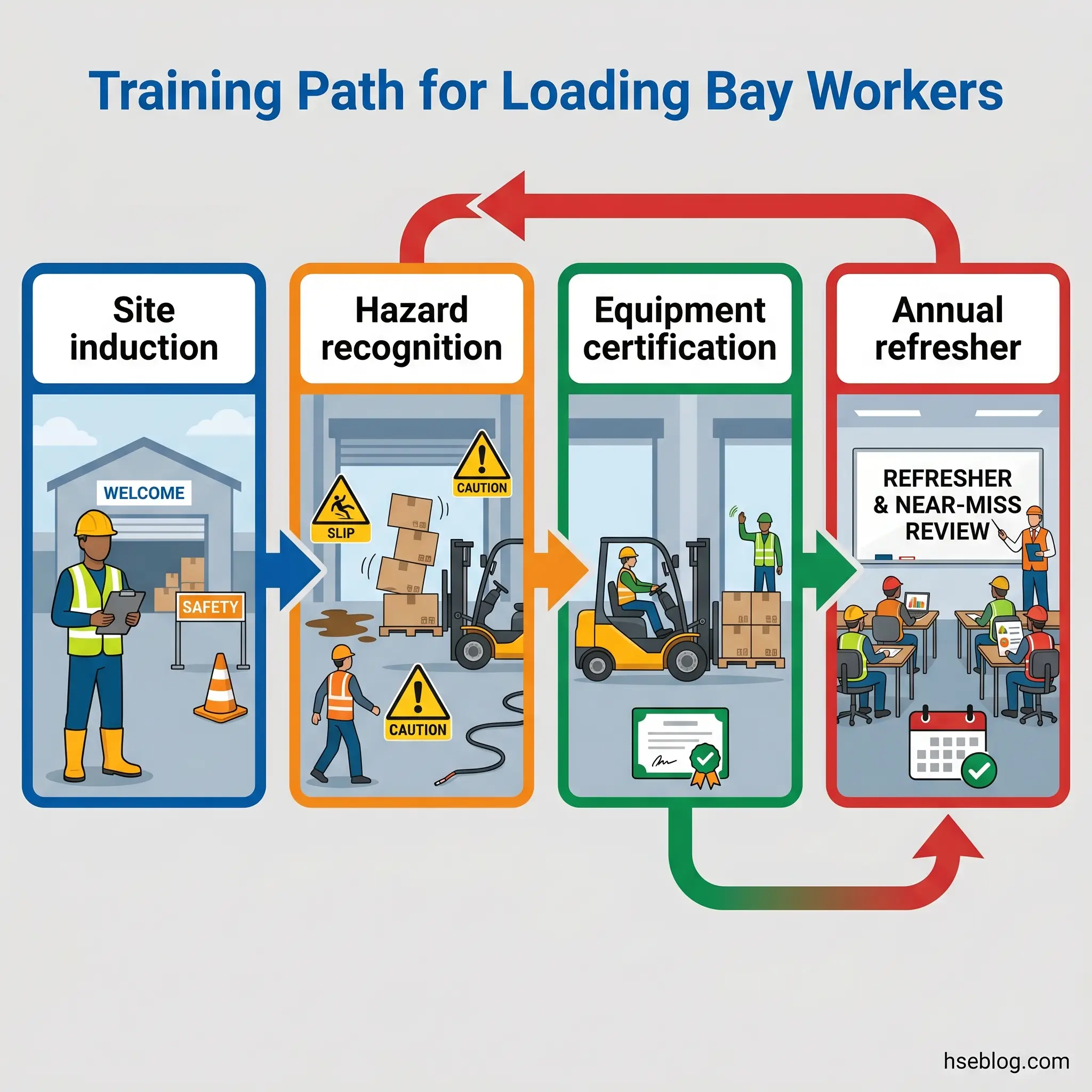
OSHA’s training obligations for loading bay workers sit across several standards rather than one. 29 CFR 1910.30 requires training for employees exposed to fall hazards — which includes dock-edge exposure. 29 CFR 1910.178(l) mandates formal and practical training plus evaluation for powered industrial truck operators, with refresher training every three years or after unsafe operation, an incident, or an equipment change. Under UK law, Sections 2 and 7 of the Health and Safety at Work Act 1974 and the Management of Health and Safety at Work Regulations 1999 impose the general duty to provide information, instruction, training, and supervision sufficient for safety.
The training content that actually reduces loading bay incidents goes beyond the regulatory minimum. Hazard recognition — specifically, recognising trailer creep as it develops, spotting a weakened trailer floor before driving onto it, identifying when dock lighting is inadequate. Equipment operation — dock levelers, vehicle restraints, safety gates, and the communication systems that link them. Emergency procedures — what happens if a trailer pulls away during loading, if a forklift goes over the dock edge, if a worker is struck. Communication protocols — specifically the call-and-response or light-based signalling that prevents the driver-worker miscommunication at the core of most drive-away incidents.
Visiting drivers are the training gap most sites under-invest in. A driver arrives from another carrier, receives a brief site induction that may or may not cover dock-specific procedures, and is expected to operate correctly within the site’s safety system. The failure mode is well-documented across published workplace transport incident summaries: the driver pulls the truck forward before the load is secure because the signalling protocol was not understood. The practical response is to treat driver induction as a precondition for backing to the dock rather than a paperwork step completed afterwards. Key-control systems convert this from a procedural rule into a physical one.
Refresher training frequency should reflect operational pattern. High-throughput sites with frequent driver turnover benefit from annual refreshers even where the regulatory floor is three-yearly. Toolbox talks and near-miss debriefs sustain the safety knowledge between formal sessions — they are where workers discuss what nearly went wrong this week and how the procedure could have prevented it.
Emerging Technologies Improving Loading Bay Safety
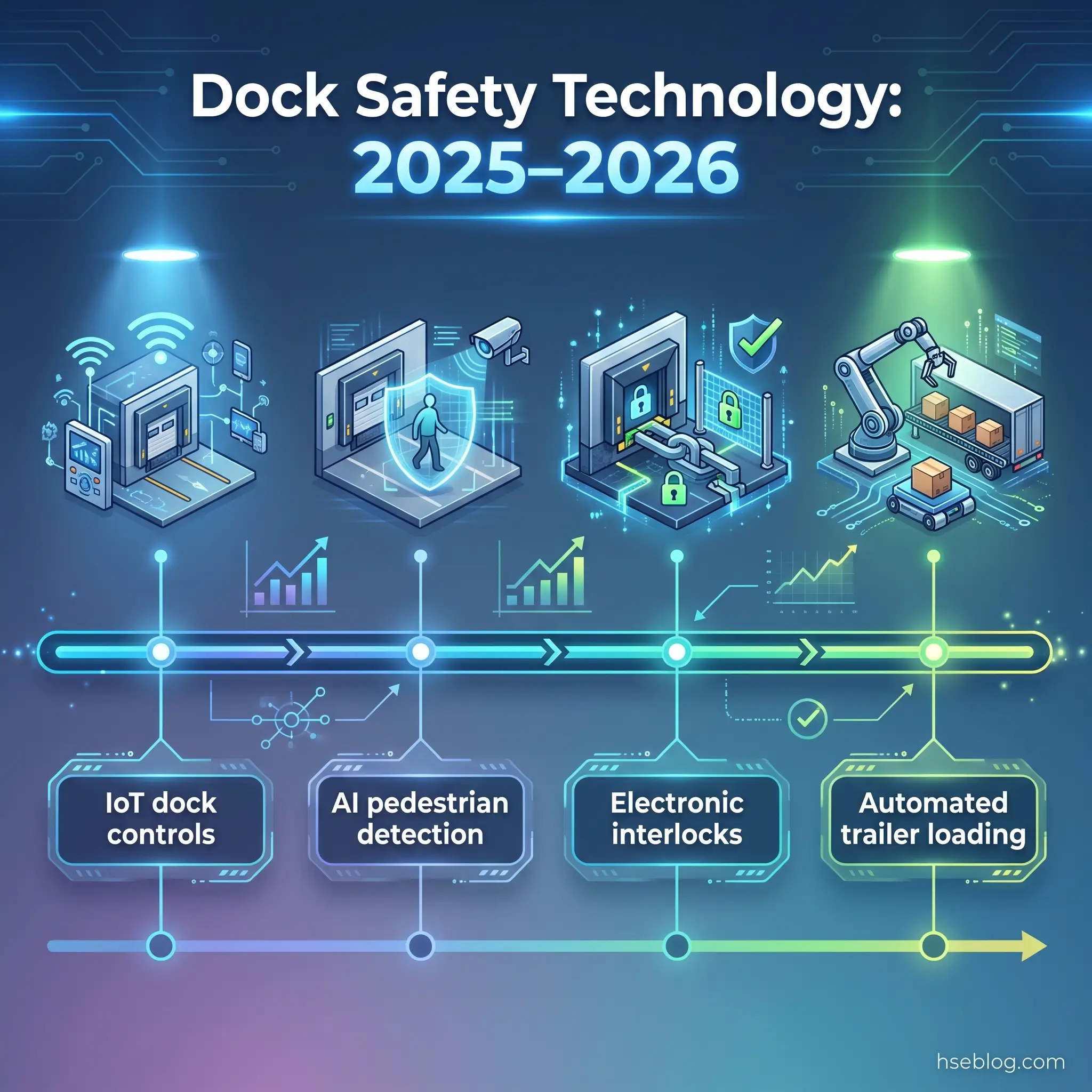
Through 2025 and into 2026, major logistics operators have begun scaling automated trailer-loading and unloading systems at meaningful volume — most visibly UPS’s commitment to 400 units from Pickle Robot Co. and Slip Robotics deployments across distribution networks (industry reporting, 2026). This is the first significant wave of automation to address the hazard profile of the dock itself, rather than the zones adjacent to it. Alongside it, HSE UK reported 14 workers killed when struck by a moving vehicle in UK workplaces during 2024/25 (Health and Safety Executive, 2025) — a figure that sets the baseline the current automation wave will eventually be measured against.
Beyond trailer-loading robots, four technology categories are changing the control landscape:
- Smart dock control systems — IoT-integrated platforms that link restraints, levelers, doors, and the warehouse management system into a single sequenced controller. The safety benefit is that bypass becomes visible at management level rather than invisible at dock level.
- AI-powered proximity and pedestrian detection — camera- and LiDAR-based systems at dock edges and forklift paths that trigger alerts or interlocks when a pedestrian enters a protected zone during vehicle movement.
- Electronic interlock systems — networked electronic equivalents replacing mechanical trapped-key interlocks, allowing more complex sequencing and centralised auditing.
- Digital dock management platforms — cloud systems for inspection tracking, defect reporting, and compliance documentation, which close the paper-trail gaps that consistently show up in OSHA citation patterns.
The transitional risk to watch in this period is mixed-mode operation. When some dock bays are automated and others are manual, workers habituated to automated sequencing in one bay may carry assumptions about safety interlocks into a manual bay that does not have them. Mixed-mode sites require explicit re-orientation at each bay — separate signage, separate pre-use checks, and often separate operator training for the two environments. Technology at the dock is not a substitute for the control architecture; it is a new tool inside it.
Frequently Asked Questions
Conclusion
The industry’s consistent error at the loading dock is ranking the controls wrong. Sites invest in PPE programmes, toolbox talks, and written procedures — all valuable — while the engineering layer that actually stops the fall, the rollover, and the drive-away is underbuilt or non-interlocked. A vehicle restraint that sits in the wall but never engages because no forced sequence requires it is not a control; it is a prop. A safety gate that is manually closed only when time allows is a procedure, not a barrier.
The highest-impact change available to most sites is not adding a new checklist. It is interlocking the controls that already exist — sequencing the restraint, the leveler, the gate, and the traffic light so that loading bay safety becomes the physical path of least resistance rather than a set of steps to remember. That single design shift is what separates sites where the procedure holds on a busy Friday afternoon from sites where the procedure lives in a binder while the dock operates without it.
Loading bay safety is ultimately a design problem before it is a training problem. Design the system so the right thing happens by default, and the training reinforces what the equipment is already enforcing. Design the system so the right thing depends on a tired worker making the right call under throughput pressure, and the incident reports will eventually write themselves.