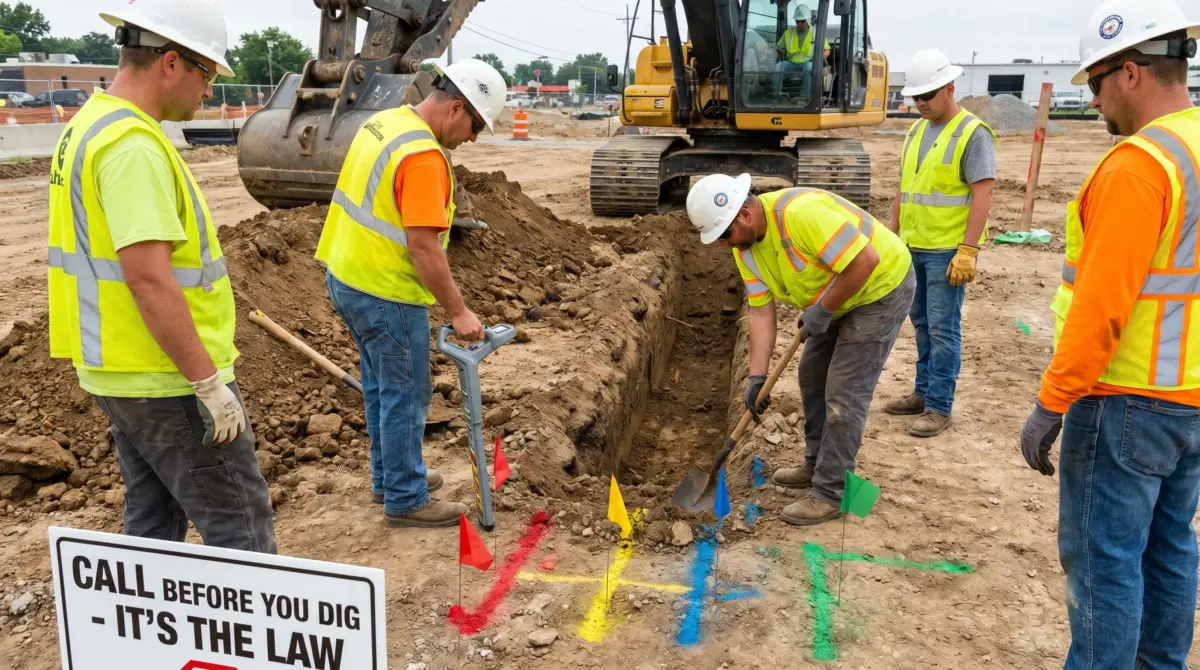
Safe digging practices are a coordinated set of controls that protect construction workers from excavation hazards — primarily trench cave-ins and underground utility strikes. They encompass pre-excavation planning (locating buried services, assessing soil conditions, selecting protective systems), in-excavation controls (spoil management, safe access, atmospheric testing), and ongoing inspection by a competent person. These practices are legally required under OSHA 29 CFR 1926 Subpart P in the US and CDM 2015 in the UK.
What Are Safe Digging Practices and Why Do They Matter?
One cubic yard of soil weighs approximately 3,000 lbs — roughly the mass of a small car (OSHA/NIOSH educational materials). When a trench wall fails, that weight drops onto a worker in seconds. There is no dodging it, no bracing against it, no surviving it without immediate rescue and extraordinary luck. Between 2011 and 2016, 130 workers died in US trenching and excavation operations, with construction accounting for 80% of those fatalities (Bureau of Labor Statistics / OSHA NEP Directive, 2018). Every one of those deaths was preventable.
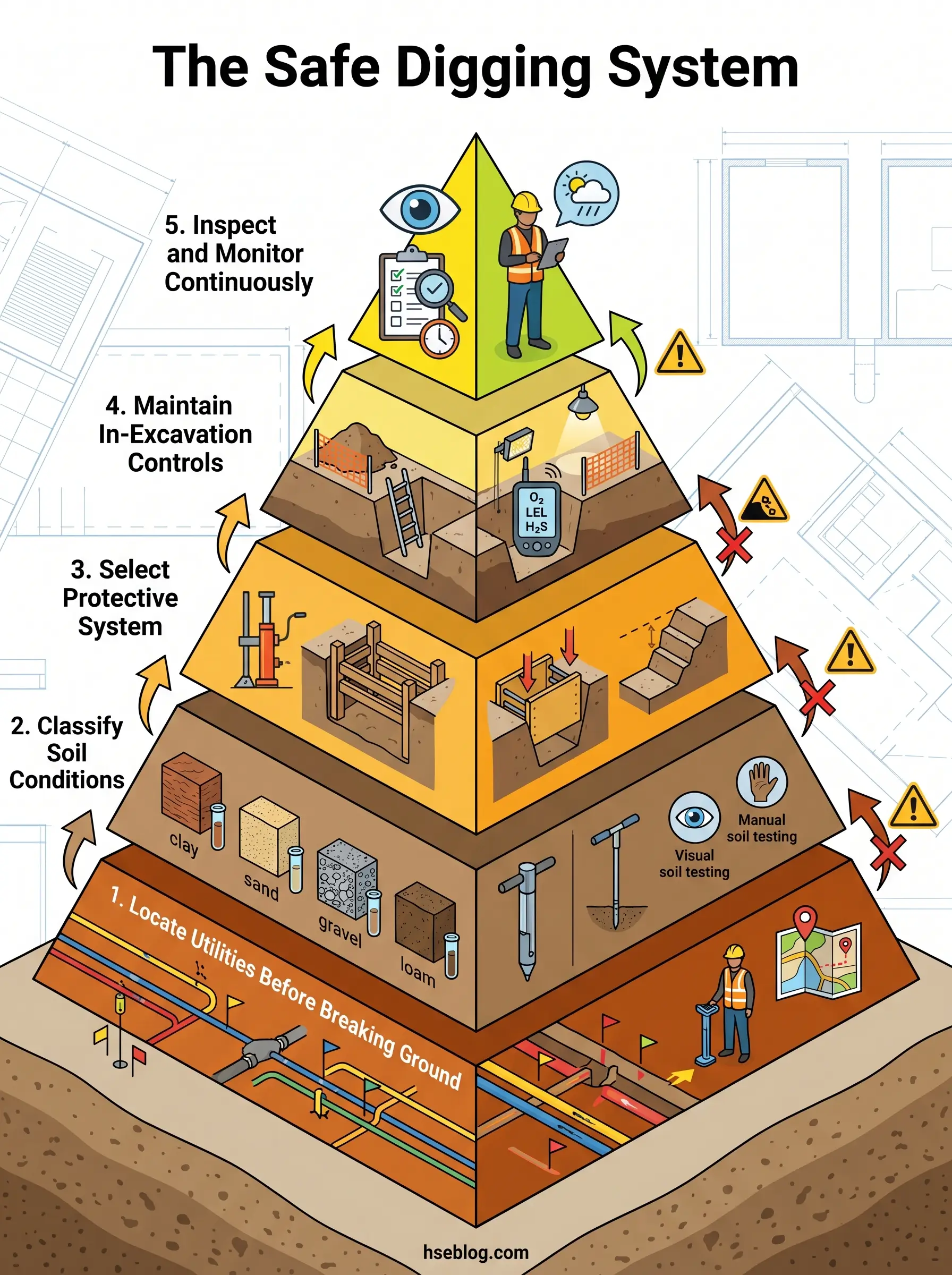
Safe digging practices are not a single action — not just calling 811, not just dropping a trench box into the hole. They are a layered system covering two distinct but interlocking hazard domains: ground stability (preventing cave-ins and collapses) and underground utility protection (preventing strikes on buried gas, electric, water, and telecom lines). Approximately 540+ underground utility strikes occur every day across the US (Common Ground Alliance, 2024). When teams treat safe digging as a checkbox — one call, one piece of equipment — they leave entire hazard categories unaddressed. Each layer of the system depends on the one before it: locate services before you plan the dig, classify the soil before you select a protective system, inspect conditions before anyone enters. Skip any layer, and the risk cascades forward.
Pre-Excavation Planning and Risk Assessment
The highest-leverage intervention in excavation safety happens before the first bucket of soil is moved. Reviewing published trench-collapse investigations reveals a consistent pattern: the failures that killed workers were identifiable during the planning phase. Ground conditions were known. Utility records were available but not requested. Protective systems were on-site but not installed because "the job was quick."
A pre-excavation risk assessment must evaluate the site as a whole system — not just the hole being dug. That assessment covers several interdependent factors:
- Soil conditions and ground stability — Visual and manual soil tests (thumb penetration, pocket penetrometer, visual analysis of fissures, grain structure, and water seepage) feed directly into soil classification, which determines protective system requirements under OSHA Subpart P Appendix A (US). Cohesive soils classified as Type A permit gentler slopes; granular, saturated, or previously disturbed soils fall to Type C, demanding the most aggressive protection.
- Underground utility identification — Obtain service plans through 811/One Call (US) or LinesearchBeforeUdig/LSBUD (UK) and cross-reference with as-built drawings. These are the starting point, not the final answer.
- Proximity to structures, roads, and surface loads — Adjacent foundations, vehicle traffic, heavy equipment staging, and stockpiled materials impose surcharge loads that increase lateral earth pressure on trench walls.
- Water table and drainage — Groundwater destabilizes soil cohesion. Plan de-watering before mobilizing, not after water appears in the hole.
- Protective system selection — Decide on sloping, benching, shoring, or shielding based on soil classification, depth, and site constraints before equipment arrives.
- Competent person appointment — Under OSHA §1926.650(b), this is the person capable of identifying existing and predictable hazards and authorized to take prompt corrective measures, including stopping work. Under UK CDM 2015, a competent person must be appointed to inspect all excavations before every shift.
- Permit-to-dig systems — Formalize the planning sequence in a written document that forces each step to be verified before the next begins.
Audit Point: On small contractor jobs, the excavation permit is often the first document an inspector requests. Its absence signals that the planning sequence was either skipped or informal — and informal planning is where most excavation fatality investigations trace the failure.
Locating Underground Utilities Before You Dig
The call-before-you-dig process is legally required in every US state and is the single most effective intervention against utility strikes. Yet failure to notify 811 accounts for approximately 21–25% of all reported utility damages — the single largest root cause of excavation damage incidents (Common Ground Alliance, 2024).
The US process operates through 811/One Call centers: the excavator calls at least 2–3 business days before digging, receives a ticket number, and utility operators mark their facilities with paint or flags. The critical detail that less experienced crews miss is confirming that every utility operator has responded to the ticket. An incomplete response means unmarked lines may still be present.
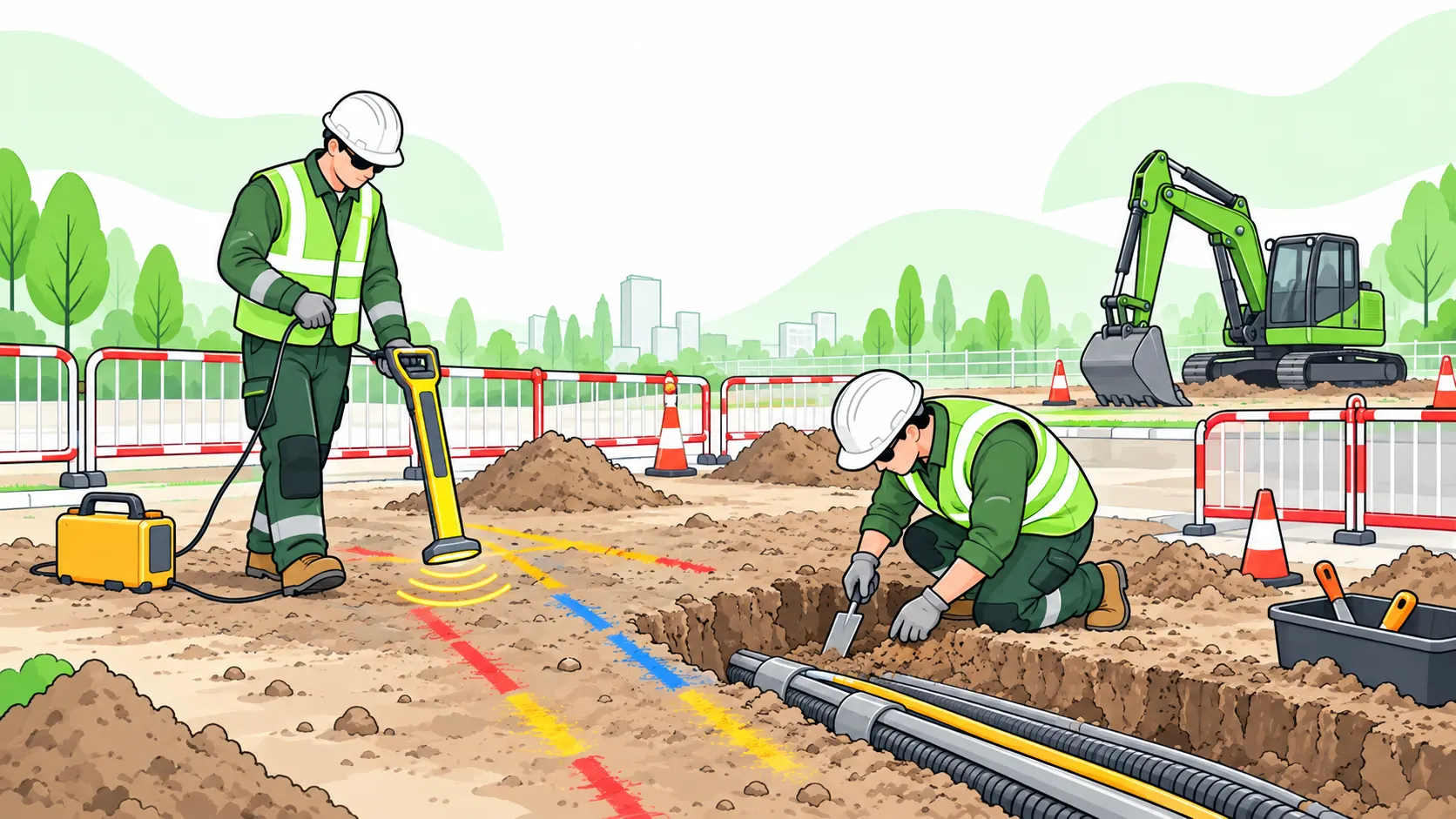
In the UK, the equivalent starting point is a LSBUD (LinesearchBeforeUdig) request to obtain utility records, followed by the three-step safe system of work established by HSG47: plan (obtain and study service records), locate (use cable avoidance tools — CAT and Genny — and ground-penetrating radar), excavate (hand-dig near marked services, use insulated tools near electrical cables).
On-site verification is essential because service plans are frequently inaccurate. Lines shift over time due to ground movement, frost heave, and previous excavation work. Visual indicators — manholes, valve covers, pavement patches, pedestals, risers — provide secondary confirmation but do not replace instrument survey.
Within the tolerance zone (typically 18–24 inches on either side of a marked utility in the US; varies by state), mechanical excavation must stop. Hand tools, insulated tools, or vacuum excavation are required within that zone. A critical limitation: private utilities — lines installed by property owners, previous tenants, or non-member utilities — are frequently absent from the 811 system entirely. Experienced supervisors treat marked-and-clear areas with healthy skepticism and probe carefully during initial mechanical passes.
What Are the Main Hazards of Digging on Construction Sites?
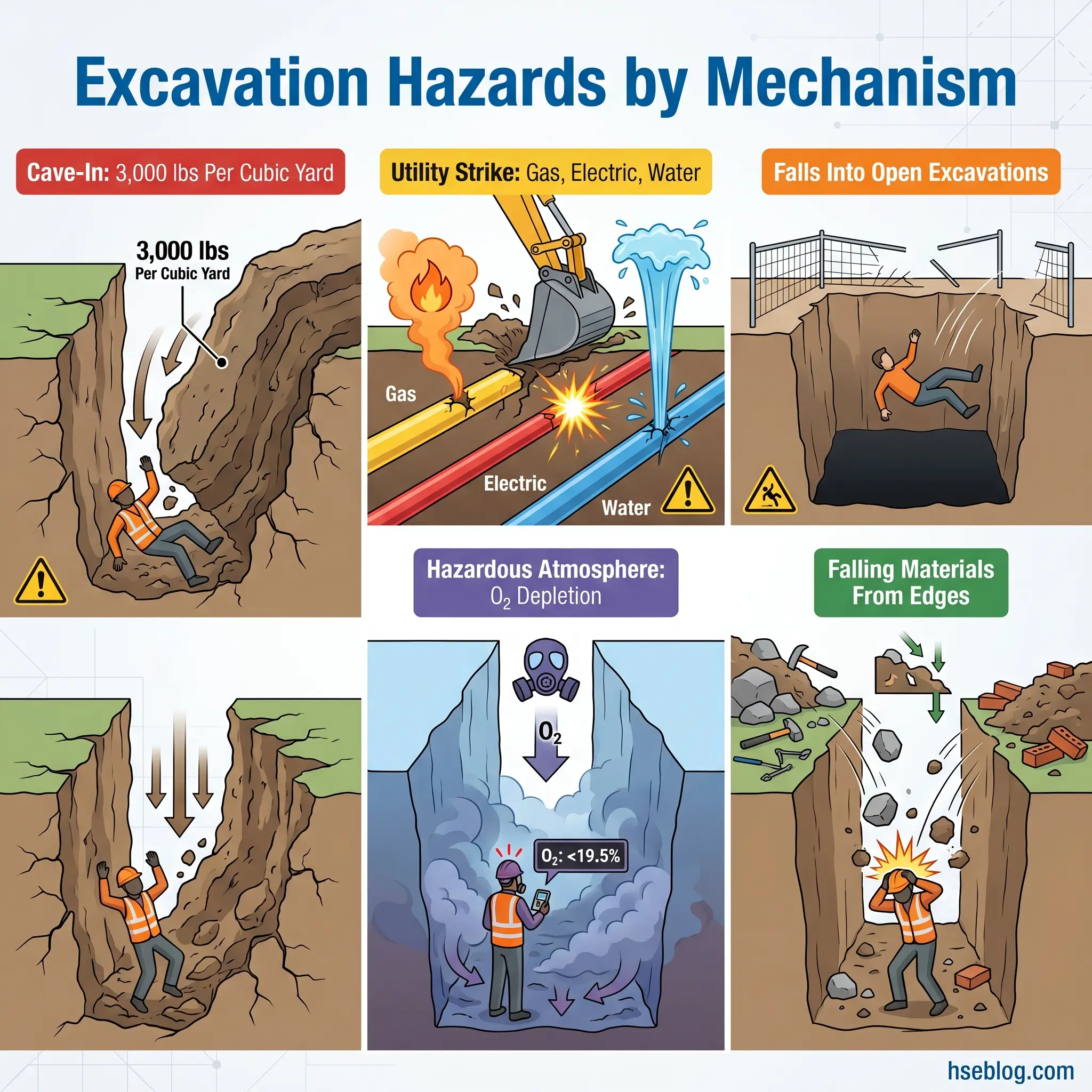
Each excavation hazard operates through a distinct mechanism. Naming them as a list obscures the differences in how they injure and kill. Understanding the mechanism is what drives effective control selection.
Cave-ins and trench collapse remain the dominant killer. Soil is a fluid under specific conditions — when the lateral support provided by the opposing trench wall is removed by excavation, the remaining wall is held in place only by its internal cohesion and friction angle. When those forces are exceeded by the soil's weight, the wall shears along a failure plane and collapses. In Type C soil (granular, submerged, or previously disturbed), this can happen without warning. The weight involved — approximately 3,000 lbs per cubic yard (OSHA/NIOSH) — means burial of even the lower extremities can cause crush syndrome, asphyxiation, or traumatic death within minutes.
Underground utility strikes produce hazard-specific consequences depending on the service hit. A severed gas line creates an immediate explosion and fire risk. Contact with a live electrical cable causes electrocution — often fatal at distribution voltages. A ruptured high-pressure water main can flood an excavation rapidly enough to drown a trapped worker. Fiber-optic cable strikes carry lower immediate physical risk but can trigger significant financial and legal consequences.
Hazardous atmospheres develop in excavations deeper than four feet, particularly near landfills, sewers, gas pipelines, and industrially contaminated land. Oxygen displacement by heavier-than-air gases (CO₂, methane, H₂S) creates immediately dangerous to life or health (IDLH) conditions. Because these gases are often odorless at lethal concentrations, workers may lose consciousness before recognizing the danger.
Falls into excavations affect both workers and the public, especially on sites adjacent to pedestrian routes. Falling materials — tools, spoil, equipment — from excavation edges strike workers below. Water ingress destabilizes walls and can cause sudden collapse of previously stable soil. Mobile equipment operating near trench edges imposes surcharge loads and creates struck-by hazards when no physical barriers are in place.
Protective Systems for Trench and Excavation Safety
Under OSHA §1926.652 (US), protective systems are mandatory for all excavations five feet deep or greater, unless the excavation is made entirely in stable rock. The UK applies a stricter threshold: CDM 2015 Regulation 22 requires a risk-based assessment of every excavation regardless of depth, with support or battering required whenever there is risk of collapse. For international audiences, the UK approach — assess and protect all excavations — is the more conservative and recommended reference standard.
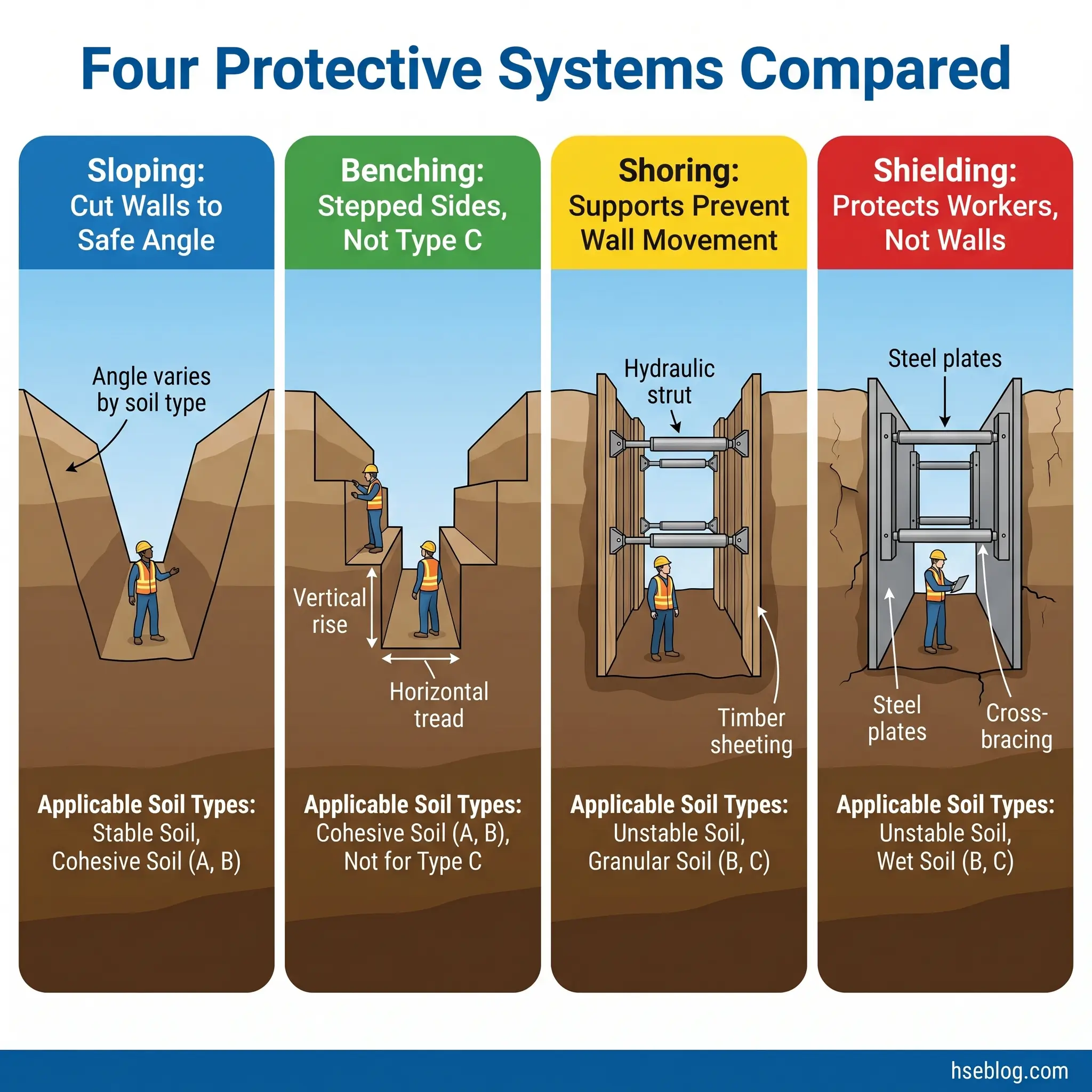
The choice of protective system is driven by soil classification. OSHA Subpart P Appendix A classifies soil into four categories: Stable Rock, Type A (cohesive, unconfined compressive strength ≥1.5 tsf), Type B (medium cohesion), and Type C (granular, submerged, or previously disturbed). Misclassifying soil is one of the most consequential errors a competent person can make — selecting a system rated for Type A soil when the actual conditions are Type C leaves workers in an under-protected trench.
| Protective System | Method | Suitable Soil Types | Max Depth Without Engineer Design (OSHA) | Key Limitation |
|---|---|---|---|---|
| Sloping | Cutting back trench walls to a safe angle | All types (angle varies) | 20 ft | Requires wide surface footprint; impractical on congested sites |
| Benching | Stepped excavation sides | Type A and B only | 20 ft | Not permitted in Type C soil; steps must match soil class angles |
| Shoring | Hydraulic, timber, or mechanical support of walls | All types | 20 ft (timber); varies by system | Requires installation from outside or above; system must match soil load |
| Shielding | Trench box or shield placed inside excavation | All types (matched to depth/load) | Per manufacturer tabulated data | Does not prevent collapse — protects workers only within the shield |
For excavations exceeding 20 feet, all protective systems must be designed by a registered professional engineer under OSHA requirements.
Maximum allowable slopes under OSHA Subpart P Appendix B are Type A at ¾:1 (53°), Type B at 1:1 (45°), and Type C at 1½:1 (34°). In practice, these ratios govern how much ground must be cut back — Type C soil requires the gentlest slope, consuming the most surface area.
Watch For: Trench boxes protect workers positioned within them, but they do not stabilize the trench itself. A persistent misconception leads crews to work outside the shield's protection zone — retrieving tools, measuring pipe runs, or staging materials — under the assumption that "the trench box is holding the walls." It is not. The walls can still collapse outside and around the shield. Workers must remain inside the shielded area at all times during trench occupancy.
In the UK, the equivalent approach under CDM 2015 and HSE excavation guidance involves battering (sloping) to a safe angle of repose and installing temporary support systems (trench sheets, props, walings) where battering is not feasible. The principles are parallel; the regulatory structure and terminology differ.
Safe Digging Procedures During Excavation Work
Once the trench is open and the protective system is in place, operational discipline determines whether those controls remain effective. The following procedures are non-negotiable during active excavation — and the first two are among the most frequently violated requirements on small jobs:
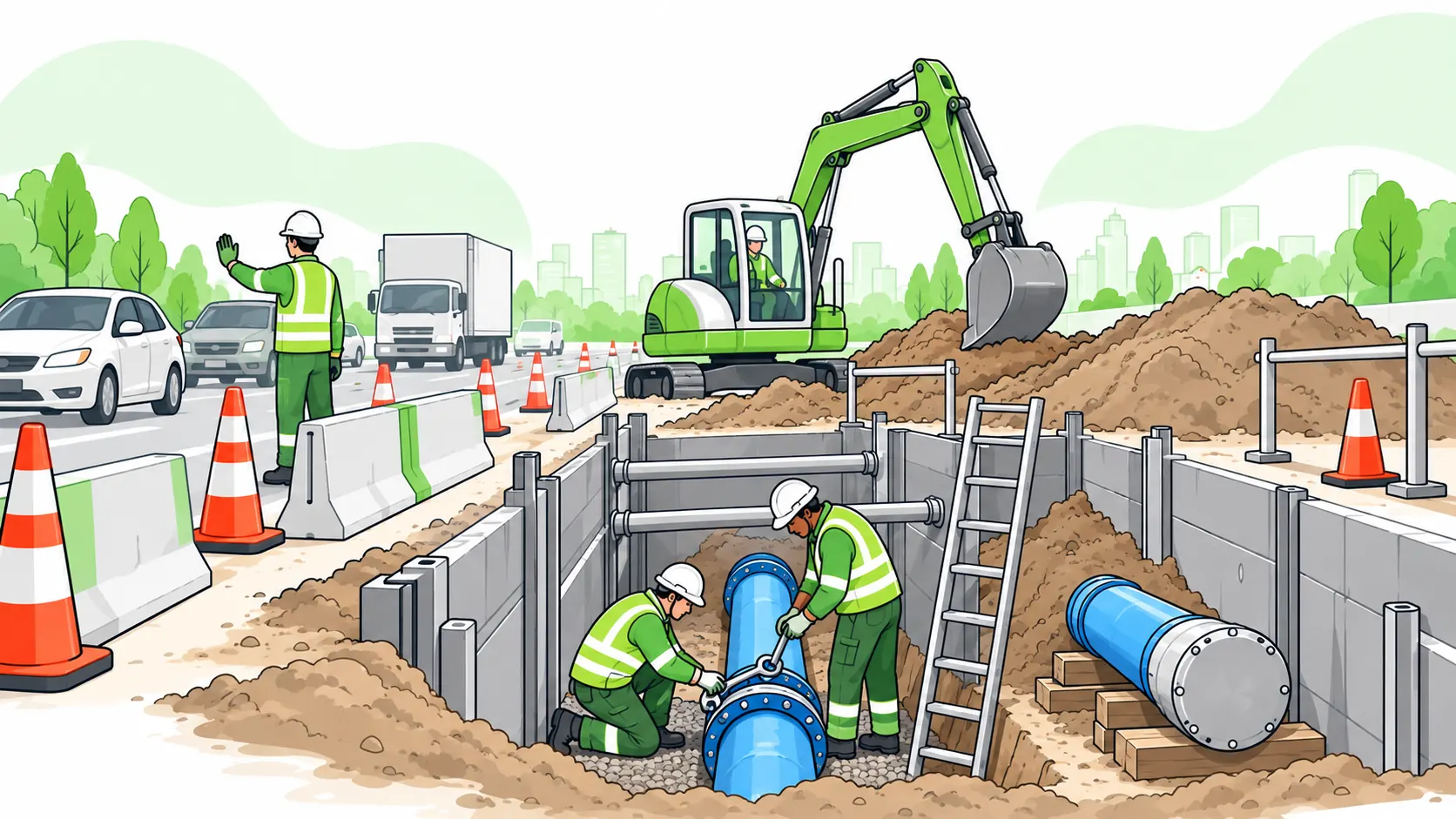
- Maintain spoil piles at least 2 feet (0.61 m) from all trench edges. Spoil stacked on the trench lip introduces surcharge loading on the very wall it sits above and creates a falling-material hazard for workers below. Site space constraints on urban jobs make this rule difficult to follow — but the physics does not negotiate with site layouts.
- Provide safe access and egress within 25 feet of lateral travel for any trench four feet deep or greater. Ladders, ramps, or structural steps — positioned so no worker must travel more than 25 feet laterally to reach one. Under OSHA §1926.651(c)(2), this is a hard requirement, not guidance.
- Keep heavy equipment back from trench edges using barricades, stop logs, and soil berms. Equipment weight imposes surcharge loads that can exceed the soil's shear strength, triggering collapse even in otherwise stable ground.
- Never work under suspended or raised loads. Pipes, pre-cast sections, and equipment lifted over an occupied trench must be moved clear before anyone enters the fall zone.
- Manage water actively. Pumping, diversion, and de-watering must be planned and monitored — water accumulation changes soil classification in real time, potentially downgrading a Type A trench to Type C conditions.
- Hand-dig near marked utilities. Within the tolerance zone, mechanical equipment must stop. Use hand tools or insulated tools (UK HSG47 requires insulated tools near electrical cables) and excavate alongside services, not directly above them.
- Establish traffic management around all excavation zones, including signage, barricades, and designated crossing points. Open trenches near public areas require physical barriers, not just tape.
Field Test: Walk the trench perimeter before the crew enters each morning. Check three things in under 60 seconds: spoil distance from the edge, egress point accessibility, and the condition of the protective system. If any of the three has changed overnight — rain, equipment movement, material delivery — the competent person must re-evaluate before entry is permitted.
Atmospheric Testing and Monitoring in Excavations
Atmospheric hazards in excavations are deceptive. A trench that appears routine — dry, shallow, in open ground — can harbor lethal gas concentrations if the soil provides a migration path from a source outside the excavation boundary. Landfills, sewer lines, abandoned fuel tanks, and naturally occurring methane deposits can release gases that travel laterally through porous or fractured soil and accumulate in the low point of an excavation.
Under OSHA §1926.651(g), atmospheric testing is required for excavations where oxygen deficiency or a hazardous atmosphere exists or could reasonably be expected to develop. In practice, any excavation exceeding four feet in depth near a potential contamination source warrants testing.
The testing sequence matters and is not arbitrary: oxygen first, then combustible gases, then toxic gases. Oxygen concentration below 19.5% is IDLH. Combustible gas readings are meaningful only after confirming adequate oxygen — a depleted-oxygen environment gives false low readings on catalytic combustion LEL sensors. Hydrogen sulfide (H₂S) and carbon monoxide (CO) are the most common toxic gas concerns in excavation work.
When testing reveals hazardous conditions, ventilation must be provided before entry. Forced-air ventilation using explosion-proof blowers is standard. If ventilation cannot reduce concentrations to safe levels, respiratory protection becomes mandatory — and the excavation may need to be reclassified as a permit-required confined space, activating an entirely different set of controls under OSHA 29 CFR 1910.146.
Emergency rescue equipment — including retrieval systems, self-contained breathing apparatus, and communication devices — must be staged at the excavation whenever a hazardous atmosphere exists or is expected. The worst-case response to an atmospheric event is one where rescue equipment has to be located and transported to the trench after a worker has already collapsed.
Inspection, Monitoring, and the Role of the Competent Person
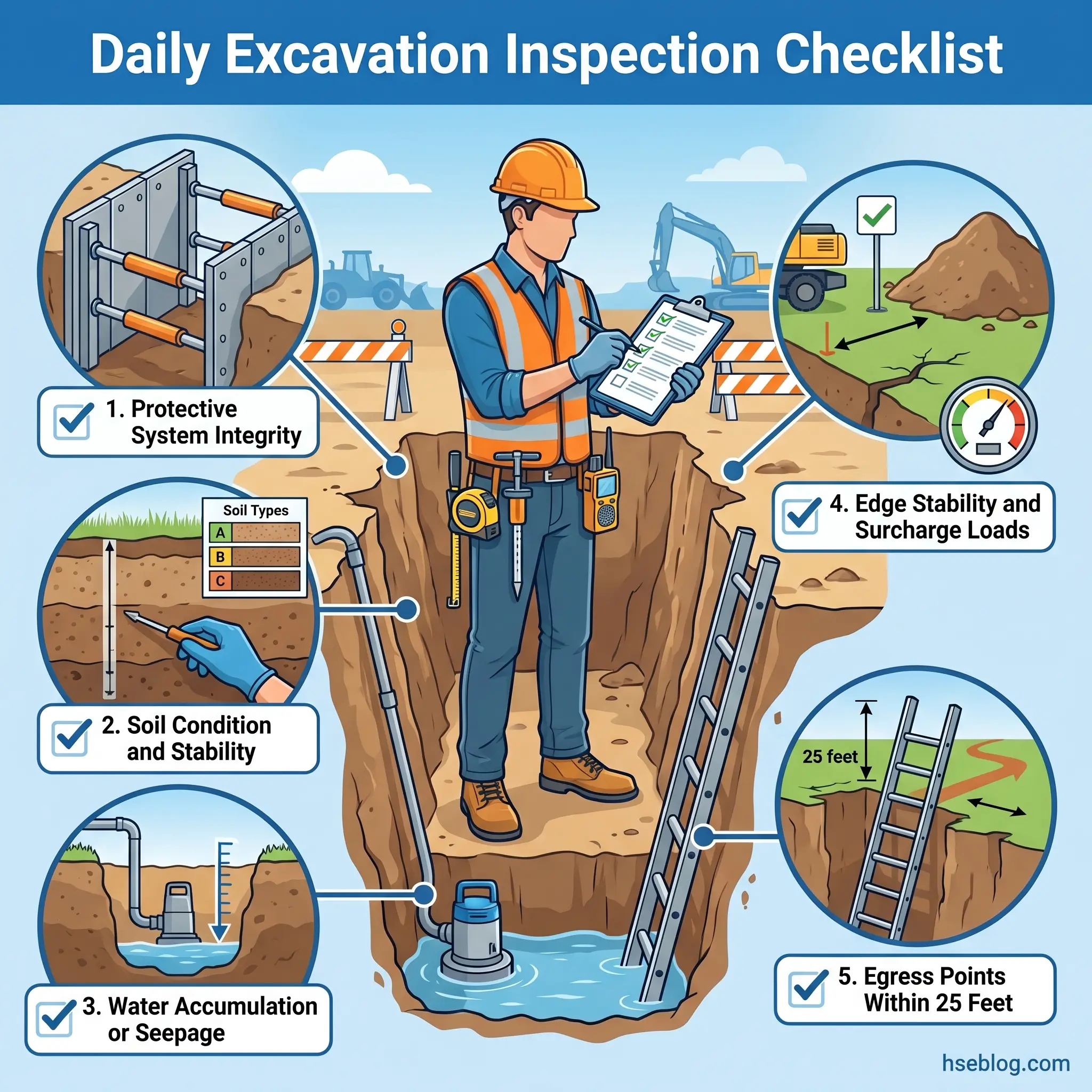
OSHA §1926.651(k) requires a competent person to inspect excavations daily before the start of work, after every rainstorm, and after any occurrence that could have changed conditions — equipment movement, adjacent blasting, water main breaks, temperature shifts that affect frost stability. The inspection covers protective system integrity, soil condition changes, water accumulation, edge stability, atmospheric conditions, and adequacy of egress points.
Under UK CDM 2015 Regulation 22, a competent person must inspect excavations at the start of every shift. Regulation 24 adds a written reporting requirement: inspection results must be documented and retained. This creates an auditable trail that OSHA's framework does not explicitly mandate (though most serious employers maintain written inspection logs regardless of jurisdiction).
Jurisdiction Note: The key regulatory difference — OSHA ties inspections to events (daily + after conditions change), while CDM 2015 ties them to every shift regardless of conditions. On multi-shift operations, the UK approach generates more inspection touchpoints. For international operations, adopting the per-shift model provides the stronger compliance position.
The competent person's most critical function is the authority to stop work when conditions deteriorate. In the published record of trench-collapse fatalities, a recurring finding is that the designated competent person either lacked the authority to halt operations, lacked the confidence to exercise it, or was pressured by schedule demands to allow work to continue despite visible warning signs — tension cracks, seepage, bulging walls. The role functions only when the person holding it has genuine organizational backing to shut down work. Without that, the competent person designation is paperwork without substance.
Training pathways to competent-person status are not standardized as a single certification. OSHA requires demonstrated knowledge of soil classification, protective systems, and hazard recognition — typically achieved through a combination of formal training (OSHA Outreach, OSHA 3015, manufacturer-specific shoring/shielding training) and documented field experience. The UK approach under CDM 2015 similarly defines competence through a combination of training, knowledge, and experience rather than a single credential.
Vacuum Excavation: Non-Destructive Digging Technology
Where traditional mechanical excavation creates the conditions for utility strikes — a steel bucket tearing through soil with no ability to distinguish dirt from a buried gas line — vacuum excavation removes the soil without that risk. The technology uses pressurized water (hydro-excavation) or compressed air (air excavation) to loosen soil, which is then extracted by industrial vacuum into a debris tank.
The most valuable application in safe digging practice is potholing — also called daylighting. Before committing to full mechanical excavation, crews use vacuum excavation to dig small exploratory holes at marked utility locations, visually confirming the actual position, depth, and condition of buried services. This eliminates the gap between approximate surface markings and actual utility positions — a gap that, in practice, can be 12 inches or more even on accurately marked sites.
Vacuum excavation is increasingly referenced in regulatory and industry guidance. Nineteen US states now reference vacuum excavation in their safe digging guidance, and the Common Ground Alliance identifies it as a best practice for excavation within tolerance zones. For congested urban environments where multiple utilities run in close proximity, vacuum excavation reduces the risk profile of the entire dig.
The technology has limitations. Dense rock and heavy clay resist water and air loosening. Large-volume excavation remains more efficient with mechanical methods. Equipment cost is higher than a backhoe and trailer, which limits adoption on small, budget-constrained jobs. The judgment call for most projects is not vacuum excavation instead of mechanical digging, but vacuum excavation before it — using the technology to verify and expose, then switching to mechanical methods once utility positions are confirmed and safe clearances established.
Emergency Response and Trench Rescue Planning
Emergency response for excavation incidents must be planned before work begins, not improvised after a collapse. Trench rescue is a specialized technical operation requiring trained personnel, specific equipment (shoring for secondary collapse prevention, air monitoring, patient packaging for confined extraction), and rehearsed procedures. Untrained rescue attempts are not just ineffective — they are historically deadly.
A significant proportion of trench-collapse fatalities involve would-be rescuers. The mechanism is predictable: a worker is buried, coworkers jump into the trench to dig them out, and a secondary collapse buries the rescuers as well. The instinct to help is powerful and entirely human. It is also, without training and protection, one of the most dangerous actions a person can take on a construction site.
Pre-planning means three things. First, know the nearest emergency services with trench rescue capability — not every fire department is equipped or trained for it. Contact them during the planning phase, not during the emergency. Second, stage rescue equipment (retrieval harnesses, lifelines, SCBA) at the excavation whenever a hazardous atmosphere exists or workers are in a trench that could trap them. Third, establish and communicate a clear emergency procedure: call emergency services immediately, prevent additional personnel from entering the collapsed trench, secure the scene, and keep bystanders clear.
The Fix That Works: Brief the crew on the emergency procedure every time the excavation conditions change — new depth, new protective system, new crew members. The briefing takes 90 seconds. The cost of not doing it is measured in lives.
Frequently Asked Questions
What depth of excavation requires a protective system?
Under OSHA §1926.652 (US), protective systems are required for all excavations five feet deep or greater, unless the excavation is made entirely in stable rock. In the UK, CDM 2015 Regulation 22 takes a stricter approach — it requires a risk-based assessment of every excavation regardless of depth, and mandates support or battering whenever there is risk of collapse. Shallow trenches in weak or disturbed soil can be just as dangerous as deep ones, making the UK's depth-independent approach the more protective standard.
Do I need to call 811 for shallow digging projects?
Yes. Many utilities are buried at shallow depths — gas lines as little as 12 inches, fiber-optic cables at 6 inches in some installations. In most US states, 811 notification is legally required for any excavation that disturbs the ground, regardless of depth. The UK equivalent is submitting a LSBUD request and obtaining service records. Depth assumptions are one of the leading causes of utility strikes on residential and light commercial projects.
What is a competent person for excavation work?
Under OSHA, a competent person is someone capable of identifying existing and predictable hazards and authorized to take prompt corrective measures, including stopping work. CDM 2015 (UK) defines a similar role with the added requirement that written inspection reports be produced and retained. This is not a formal certification — it is a demonstrated competency built through training in soil classification, protective systems, and hazard recognition combined with documented field experience.
What is the difference between shoring and shielding?
Shoring actively supports trench walls to prevent movement — hydraulic, timber, or mechanical systems push against the soil to hold it in place. Shielding (trench boxes or shields) does not prevent the soil from collapsing; it creates a protective structure inside the trench that workers occupy. The operational distinction matters: with shoring, the walls are stabilized; with shielding, workers must remain inside the shield at all times because the walls can still fail outside it.
Can I use a mechanical excavator near underground utilities?
Not within the tolerance zone, which is typically 18–24 inches on either side of a marked utility (varies by US state). Within that zone, hand tools, insulated tools, or vacuum excavation must be used. UK HSG47 recommends hand digging for the final exposure of all buried services. Mechanical excavation can resume outside the tolerance zone, but operators must remain alert for unmarked or inaccurately located utilities.
What should I do if I hit a gas line while digging?
Stop all work immediately. Do not attempt to repair the damage. Evacuate all personnel to a safe upwind distance. Do not restart engines, operate electrical switches, or use mobile phones near a suspected gas release — any ignition source can trigger an explosion. Call 911 (US) or 999 (UK) and the gas utility's emergency line. Secure the area to prevent public access. Work must not resume until the utility provider has made the line safe and cleared the site.
Conclusion
The enforcement record tells a clear story about where the industry stands on excavation safety. OSHA reported a significant decline in trench-collapse fatalities from 39 in 2022 to 13 in 2024 (U.S. Department of Labor, November 2024), driven largely by zero-tolerance enforcement under the 2018 National Emphasis Program on Trenching and Excavation. But 2025 data shows a concerning rebound — at least 17 deaths reported — and a Massachusetts contractor received $4.7 million in proposed OSHA penalties after a November 2025 collapse killed one worker and injured another (EHSLeaders, 2026). OSHA issued 629 excavation-related citations and $4.5 million in penalties in fiscal year 2024 alone (Equipment World, 2024). The regulatory system is enforcing. The question is whether every crew on every site is actually implementing.
Safe digging practices are not complex in concept. Locate the utilities. Classify the soil. Select and install the right protective system. Keep spoil back from the edge. Provide egress. Test the atmosphere. Inspect before every shift. Give the competent person genuine authority to stop work. Each step is straightforward. Each step depends on the one before it. And each step that gets skipped — because the job is small, because the schedule is tight, because the trench will only be open for an hour — reintroduces the full, unmitigated risk that kills workers in seconds.
Every trench is a test of whether an organization treats safe excavation procedures as a system or as a suggestion. The soil does not distinguish between the two. The weight of a cubic yard falls the same way whether the paperwork was done or not. The difference is whether a worker climbs out at the end of the shift.