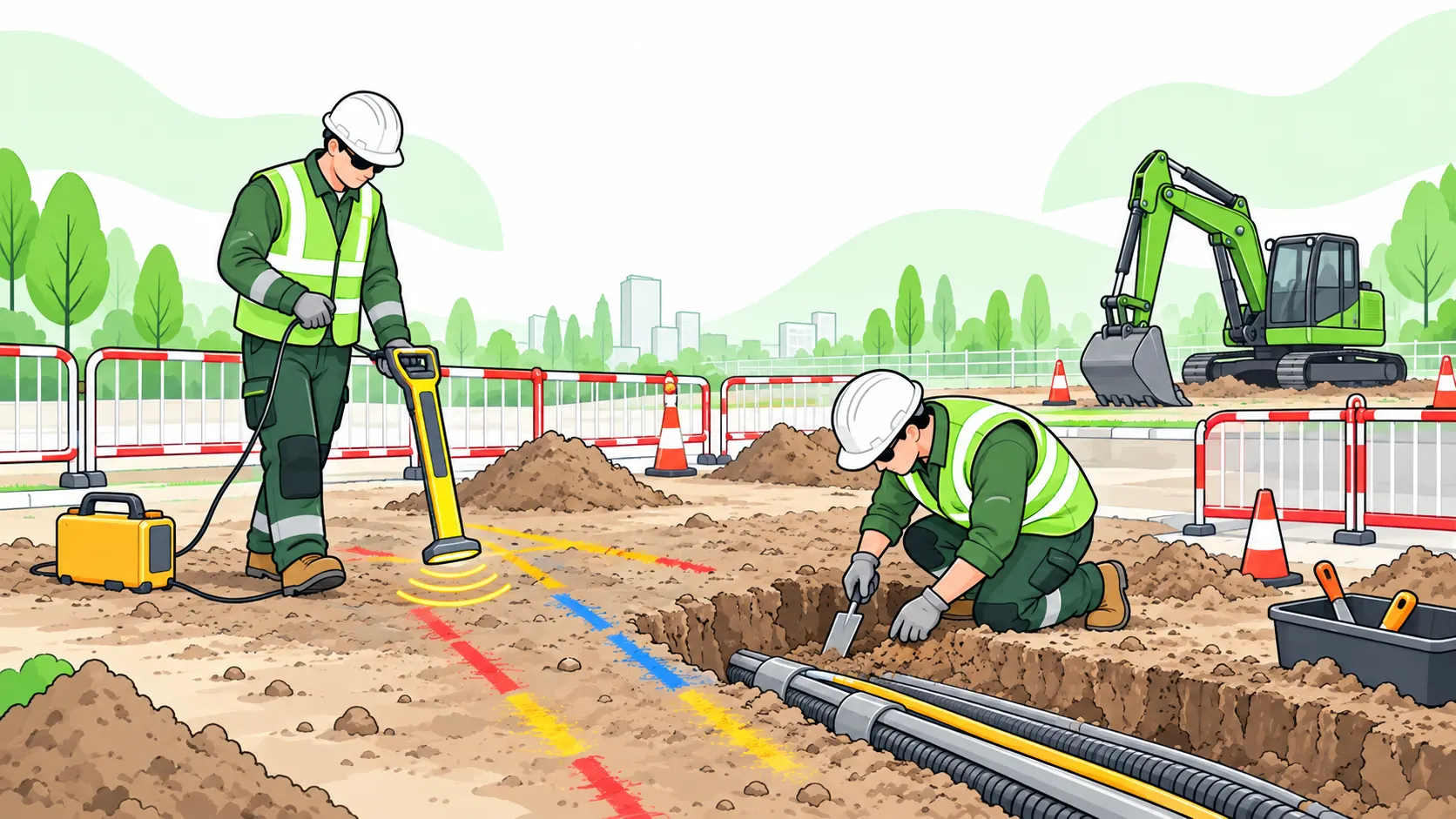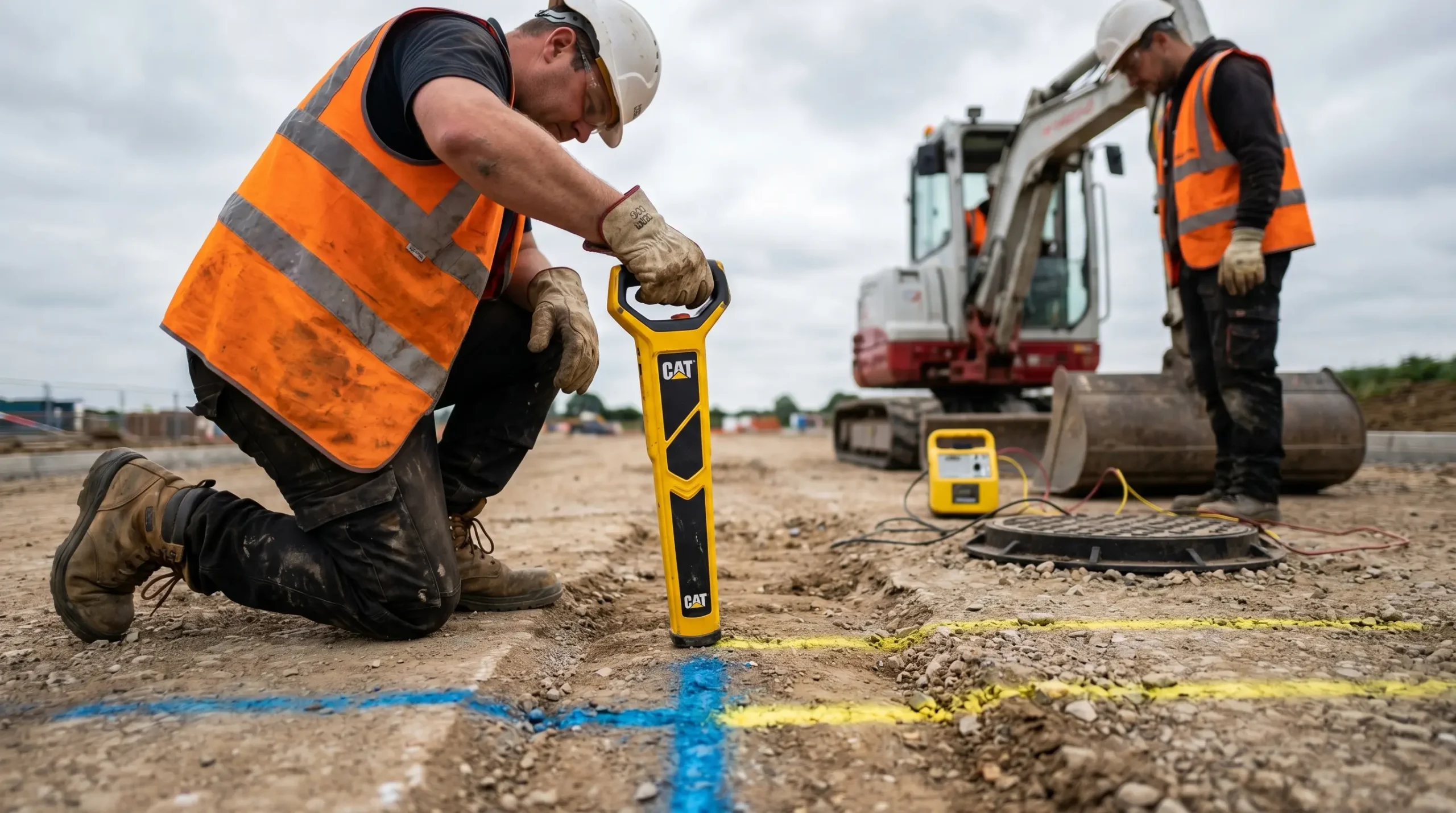
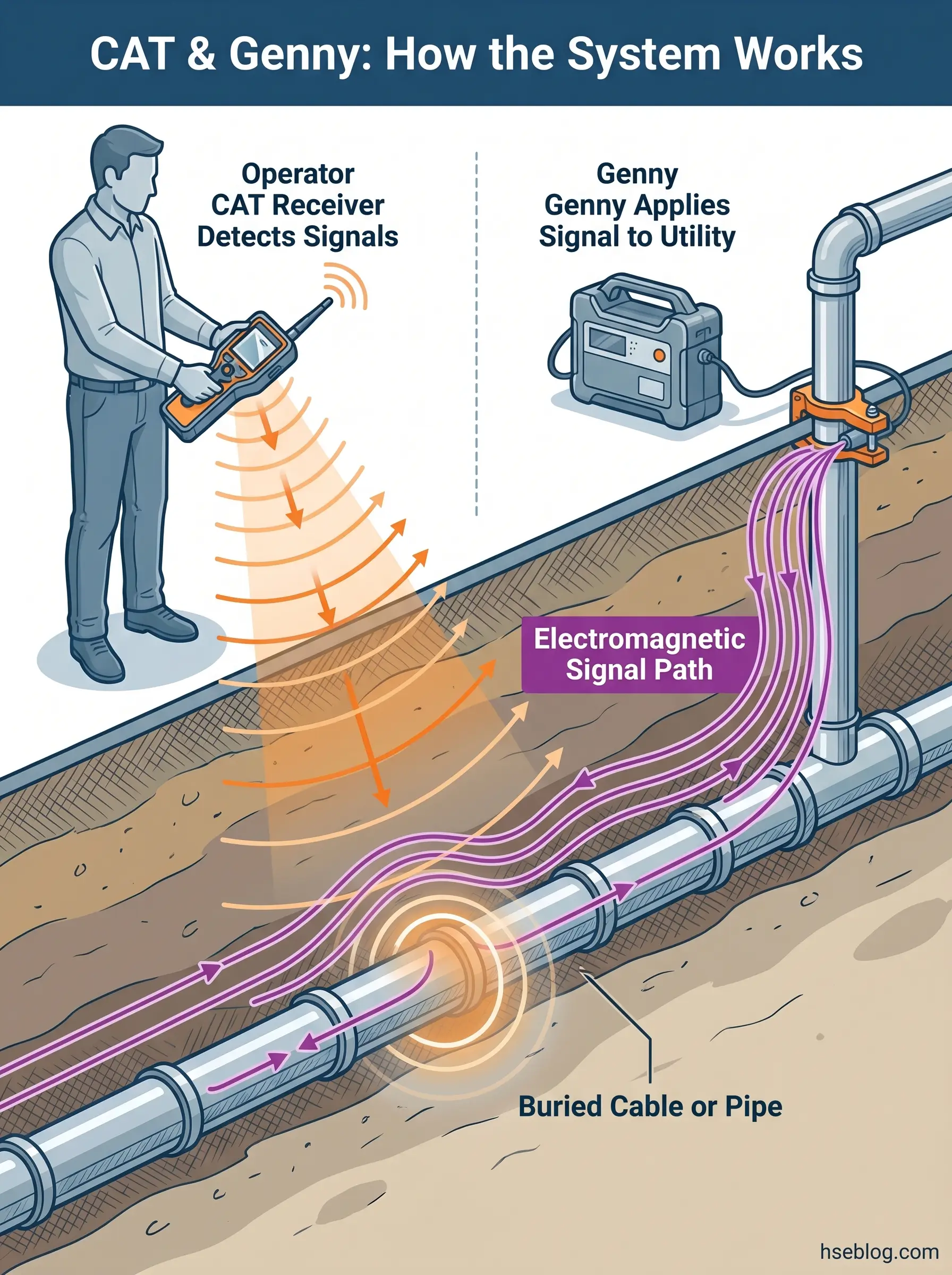
A cable avoidance tool (CAT) is a handheld electromagnetic receiver that detects signals from buried cables and metallic pipes, while the Genny (signal generator) applies a traceable signal to underground utilities so the CAT can locate them. Together they form the industry-standard system for identifying underground services before excavation, as outlined in HSE guidance HSG47. Using both instruments across all detection modes — Power, Radio, Genny, and Avoidance — is essential for a thorough pre-dig survey.
Approximately 60,000 utility strikes occur every year in the United Kingdom, costing the industry an estimated £2.4 billion annually (UK Government estimates, widely cited in industry). Behind those figures sit approximately 12 deaths and 600 serious injuries per year from contact with underground electricity cables alone (HSE). The Energy Networks Association reported 354 life-changing injuries from live cable strikes over a five-year period, with four out of five incidents involving a tradesperson rather than a specialist utility worker (ENA, 2020). These are not freak events. They are predictable consequences of inadequate location procedure.
This article covers the full operational workflow for using a cable avoidance tool and Genny safely — from pre-survey planning through detection mode theory, equipment limitations, step-by-step scanning procedure, calibration, competence requirements, and the legal framework under HSG47. The aim is to bridge the gap that most guides leave open: explaining not just what the equipment does, but how to use it within a safe system of work that actually prevents strikes.
What Is a Cable Avoidance Tool (CAT & Genny)?
A CAT and Genny is a paired system designed to locate buried metallic utilities before excavation begins. The CAT is a handheld receiver that detects electromagnetic signals radiating from or applied to underground conductors — power cables, telecoms lines, metallic water and gas mains. The Genny is a portable signal generator (transmitter) that applies a known electromagnetic signal to a buried conductor, making it detectable by the CAT even when the conductor carries no live current.
The current industry-standard platform is the Radiodetection CAT4/Genny4 range, manufactured in the UK under ISO 9001. The range includes several model variants, each adding progressively more data capture and safety features. Understanding the differences matters when specifying equipment for a project or interpreting what the instrument can and cannot tell you.
| Feature | CAT4 | CAT4+ | eCAT4+ | gCAT4+ |
|---|---|---|---|---|
| Depth Estimation | No | Yes (Genny mode) | Yes (Genny mode) | Yes (Genny mode) |
| StrikeAlert | Yes | Yes | Yes | Yes |
| Data Logging | No | No | Yes (12+ months) | Yes (12+ months) |
| GPS Positioning | No | No | No | Yes |
| CALSafe (calibration lock) | Yes | Yes | Yes | Yes |
| Avoidance Mode | Yes | Yes | Yes | Yes |
"CAT and Genny" are Radiodetection trade names that have become generic industry shorthand. Alternative manufacturers — C.Scope, Vivax-Metrotech, Cable Detection/Leica — produce equivalent electromagnetic locators. The operating principles and detection modes described in this article apply across platforms, though feature sets and interface details vary.
One distinction worth flagging early: on many sites, the term "CAT scan" is used colloquially to mean any pre-dig electromagnetic survey. That shorthand masks a critical difference. A CAT-only scan in Power mode detects far fewer services than a full multi-mode survey using both CAT and Genny. Treating those two activities as interchangeable is where a significant proportion of cable strikes begin.
Why Cable Avoidance Matters: The Scale of Utility Strikes
The ENA's "Think Before You Dig" campaign data revealed that 31% of tradespeople do not always check for underground cables before digging (ENA, 2020). That figure alone explains much of the injury toll. But what makes it worse is the post-lockdown spike — a 46% increase in cable strike incidents following the end of national lockdown restrictions (ENA, 2020), driven by a rapid return to groundworks with insufficient re-engagement of safety procedures.
The human cost concentrates disproportionately on smaller projects. Extensions, driveways, garden landscaping, domestic gas connections — these account for a share of cable strikes that far outweighs their proportion of total excavation activity. The pattern across published incident reports is consistent: operatives on smaller domestic or minor civil works assume the absence of visible infrastructure means the absence of buried services. No substations nearby, no valve covers in the pavement, so surely nothing is down there. That assumption has been fatal repeatedly.
The 7 worker fatalities from contact with electricity or electrical discharge reported under RIDDOR in 2024/25 (HSE, provisional figures) span all sectors, but construction and utilities work remain the dominant exposure context. When a 230V domestic supply cable is struck by a breaker or excavator tooth, the arc flash can reach temperatures exceeding 5,000°C. There is no PPE that makes this survivable at close range. Prevention — accurate location before the ground is broken — is the only reliable control.
How Does a CAT and Genny Work? Detection Modes Explained
The CAT operates on the principle that any conductor carrying alternating current, or any metallic conductor exposed to electromagnetic fields, radiates a detectable signal. Each detection mode targets a different signal source, and each has specific blind spots. Using all modes in sequence is not optional best practice — it is the minimum standard for a competent survey.
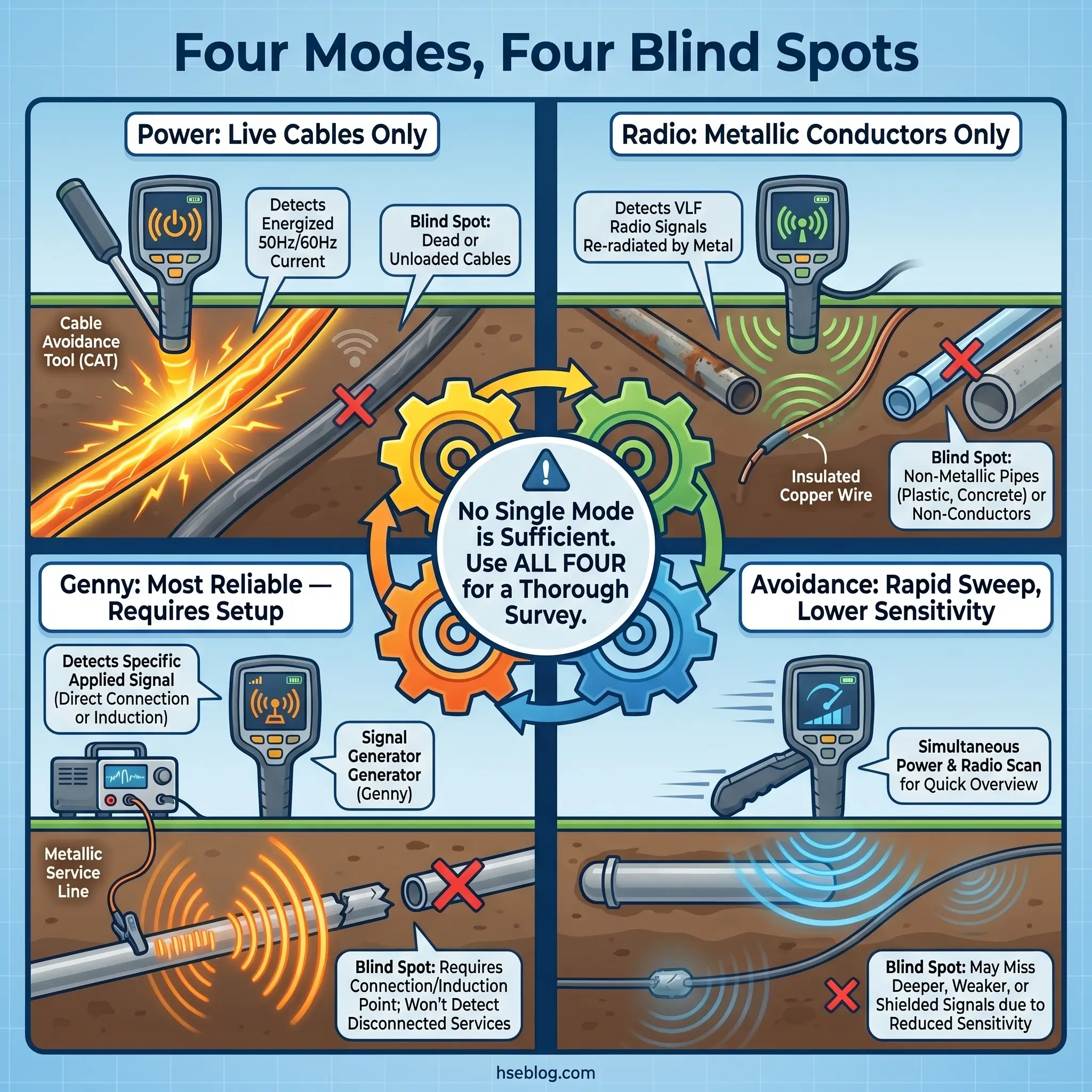
Power Mode (P) detects the 50 Hz electromagnetic field radiated by live power cables carrying current. This is the mode most operatives default to, and the mode most likely to give false confidence. It cannot detect dead cables, unloaded cables (streetlighting circuits during daylight hours, for instance), or "balanced" high-voltage cables specifically designed to suppress external electromagnetic radiation. A cable that reads clearly in Power mode at 8 a.m. may be silent by 10 a.m. if the load changes.
Radio Mode (R) detects very low frequency radio signals that are re-radiated by buried metallic conductors acting as unintentional aerials. This picks up metallic gas mains, water pipes, and telecoms ducts that carry no electrical current. However, radio signals are not always present — signal strength depends on the conductor's length, depth, soil conditions, and proximity to other conductors.
Genny Mode (G) detects the specific signal — typically at 8 kHz and 33 kHz — applied by the Genny to a target utility. This is the most reliable detection method because the operator controls the signal source. The Genny4 transmits dual frequencies simultaneously, improving detection of small-diameter cables that might not re-radiate a single-frequency signal effectively.
Avoidance Mode (available on all CAT4 models) scans for Power, Radio, and Genny signals simultaneously in a single sweep. It is designed as the initial pass across the excavation area — a rapid screen before mode-specific detailed scans follow. Avoidance mode is efficient for area coverage but less sensitive than dedicated single-mode scans for individual services.
| Mode | Detects | Cannot Detect | Best Used For |
|---|---|---|---|
| Power (P) | Live power cables under load | Dead/unloaded cables, balanced HV cables | Initial check for energised supplies |
| Radio (R) | Metallic pipes and cables re-radiating VLF | Non-metallic utilities, deeply buried conductors | Finding metallic gas, water, telecoms |
| Genny (G) | Any conductor the Genny signal is applied to | Services the signal cannot reach | Targeted location — most reliable mode |
| Avoidance | Combined P + R + G simultaneously | Same blind spots as individual modes | Rapid initial area sweep |
Signal Application Methods for the Genny
The Genny signal reaches a buried conductor through one of three methods, and the choice directly affects detection accuracy.
Induction is the fastest approach — the Genny is placed on the ground surface and its signal couples onto nearby buried conductors through the soil. The trade-off is that the signal spreads to multiple conductors simultaneously, making it harder to isolate a single service. Induction is appropriate for a general area scan, not for confirming the route of a specific utility.
Direct connection delivers the most accurate results. The Genny is connected to a known access point — a valve, junction box, or plug socket via a live plug connector — using crocodile clips or a magnet, with an earth spike completing the circuit. Because the signal enters a single conductor at a known point, the CAT can trace that specific service with minimal interference from adjacent utilities.
Signal clamp is the intermediate option. A clamp is placed around an exposed section of pipe or cable, inductively coupling the Genny signal onto that conductor without needing a galvanic earth connection. This is useful when direct connection is impractical — when no access point exists or when the exposed service cannot be safely disconnected.
The most common competence failure across the published strike record is reliance on Power and Radio modes alone, without deploying the Genny at all. One contractor programme measured a 45% reduction in utility strikes simply by mandating Genny use on all location activities (University of Birmingham research, cited 2026). That single procedural change — making the Genny non-optional — delivered nearly half the strike reduction on its own.
What a CAT and Genny Cannot Detect: Critical Limitations
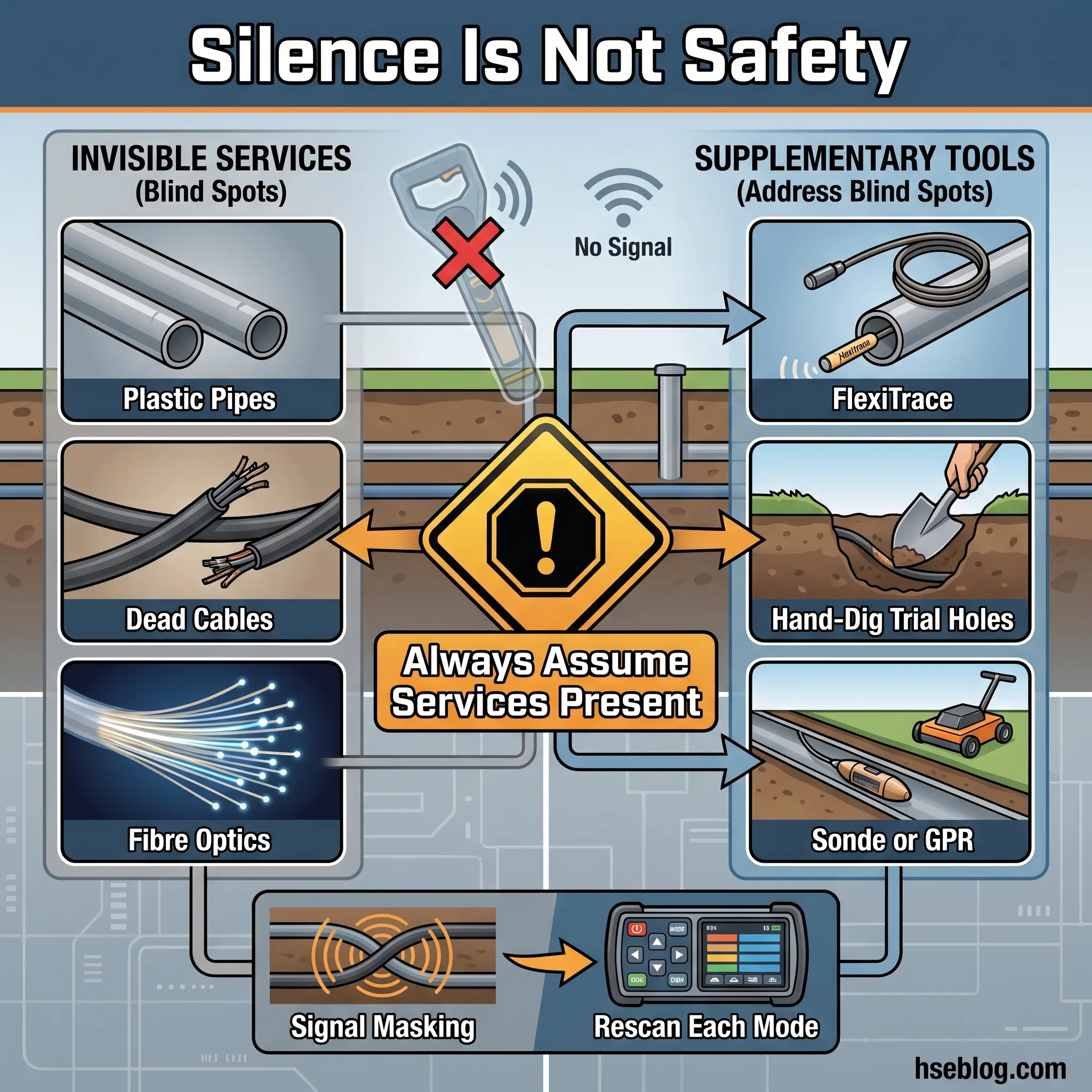
Overconfidence in what the equipment can do is the single most dangerous knowledge gap in cable avoidance work. A CAT and Genny is an electromagnetic locator. If a buried service does not conduct electricity or is not exposed to an electromagnetic field, the CAT will not see it. The silence on the display is not a clearance — it is an absence of information.
Non-metallic utilities — plastic water pipes (MDPE), plastic gas mains, clay drainage, and fibre-optic cables without a metallic trace wire — produce no electromagnetic signal. They are invisible to every standard CAT mode. Given that modern water and gas networks increasingly use plastic pipe, this blind spot grows larger with every year of network renewal.
Dead or "pot-ended" cables are among the most dangerous items underground. A live cable that has been cut and capped for future connection carries no current and produces no electromagnetic field. In Power mode, it is silent. But it remains energised up to the cut point — and striking it delivers the same lethal current as any live supply. Published investigation reports identify pot-ended cables as a recurring factor in fatal cable strikes precisely because operatives trusted a silent CAT reading.
Signal masking occurs when a strong electromagnetic field from a large, heavily loaded cable overwhelms the weaker signals from adjacent smaller cables or services. The CAT shows one clear response, and the operator marks one service. The second, third, or fourth service — directly alongside — goes undetected until a machine bucket finds it.
Depth estimation limitations apply even on CAT4+ and gCAT4+ models equipped with depth measurement in Genny mode. Accuracy is approximately ±10% of depth, and that figure assumes ideal conditions — homogeneous soil, no interference, signal applied by direct connection. Depth estimation must never be used to decide whether mechanical excavation is safe. A reading of "0.8 m depth" does not mean a machine bucket at 0.7 m is clear — it means the service could be anywhere between roughly 0.7 m and 0.9 m, and possibly shallower if conditions are not ideal.
Bundled services — multiple cables or pipes laid in the same trench — present as a single response on the CAT. The instrument cannot distinguish between one conductor and four conductors in close proximity.
Watch For: The absence of a CAT signal where utility plans indicate a service is present. The most likely explanation is that the service is non-metallic or de-energised — not that it is absent. The default assumption must always be that the service exists until physically confirmed otherwise.
How to Locate Non-Metallic Utilities
When the CAT returns silence but plans indicate a service, three supplementary tools address the gap.
FlexiTrace is a flexible fibreglass rod with embedded copper conductors. It is threaded into a plastic pipe or duct through an access point, and the Genny signal is then applied to the rod. The CAT detects the FlexiTrace signal, allowing the operator to trace the route of a pipe that would otherwise be completely invisible. FlexiTrace can trace pipes as small as 12.5 mm diameter to approximately 3 m depth.
Sondes are self-contained, battery-powered signal transmitters. A sonde is pushed into a duct or pipe, and the CAT detects its signal as it travels along the service. Sondes are available in various sizes to suit different duct diameters and are particularly useful for tracing drainage runs and telecoms ducts.
Ground-penetrating radar (GPR) detects differences in ground density rather than electromagnetic signals. It can identify non-metallic objects — plastic pipes, voids, backfilled trenches — that electromagnetic locators cannot see. GPR complements the CAT but has its own limitations: heavy clay soils, rubble-filled ground, and high water tables all reduce its effectiveness. Under PAS 128:2022, GPR alongside electromagnetic location (EML) is the minimum requirement for a Type B detection survey.
The judgment call is straightforward: if utility plans show a service and the CAT shows nothing, you do not assume the plans are wrong. You deploy FlexiTrace, a sonde, or GPR — or you hand-dig trial holes along the indicated route.
How to Use a CAT and Genny Safely: Step-by-Step Procedure
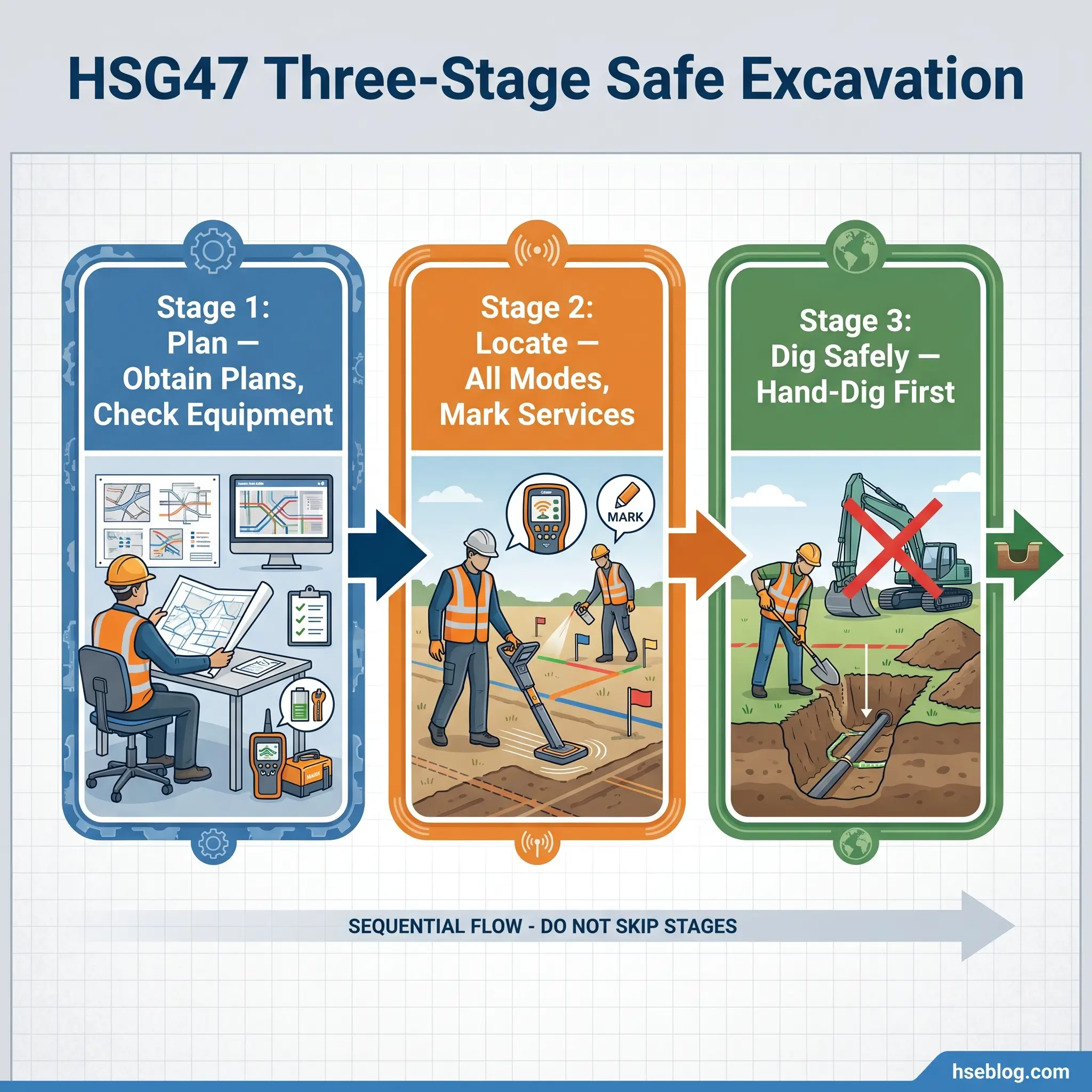
HSG47 structures safe excavation around three stages: plan the work, locate and identify services, excavate safely. The procedure below follows that framework, applied specifically to a CAT and Genny survey. Each stage depends on the one before it — skipping the planning stage and going straight to scanning is the procedural shortcut that investigation reports cite most frequently.
Stage 1: Planning the Work
Before the CAT is switched on, the groundwork for a safe survey is already complete — or it isn't, and the survey starts compromised. Planning failures do not announce themselves until a cable is struck.
- Obtain utility plans from all relevant utility owners (electricity, gas, water, telecoms, drainage). In the UK, this is typically done through a utility search service. Treat these plans as indicative — they show what was recorded at installation, not necessarily what exists now or where it has moved since.
- Conduct a site-specific risk assessment covering all identified and suspected underground services. Walk the site and look for surface indicators: valve covers, junction boxes, cable markers, changes in ground surface, overhead lines (which must enter the ground somewhere nearby).
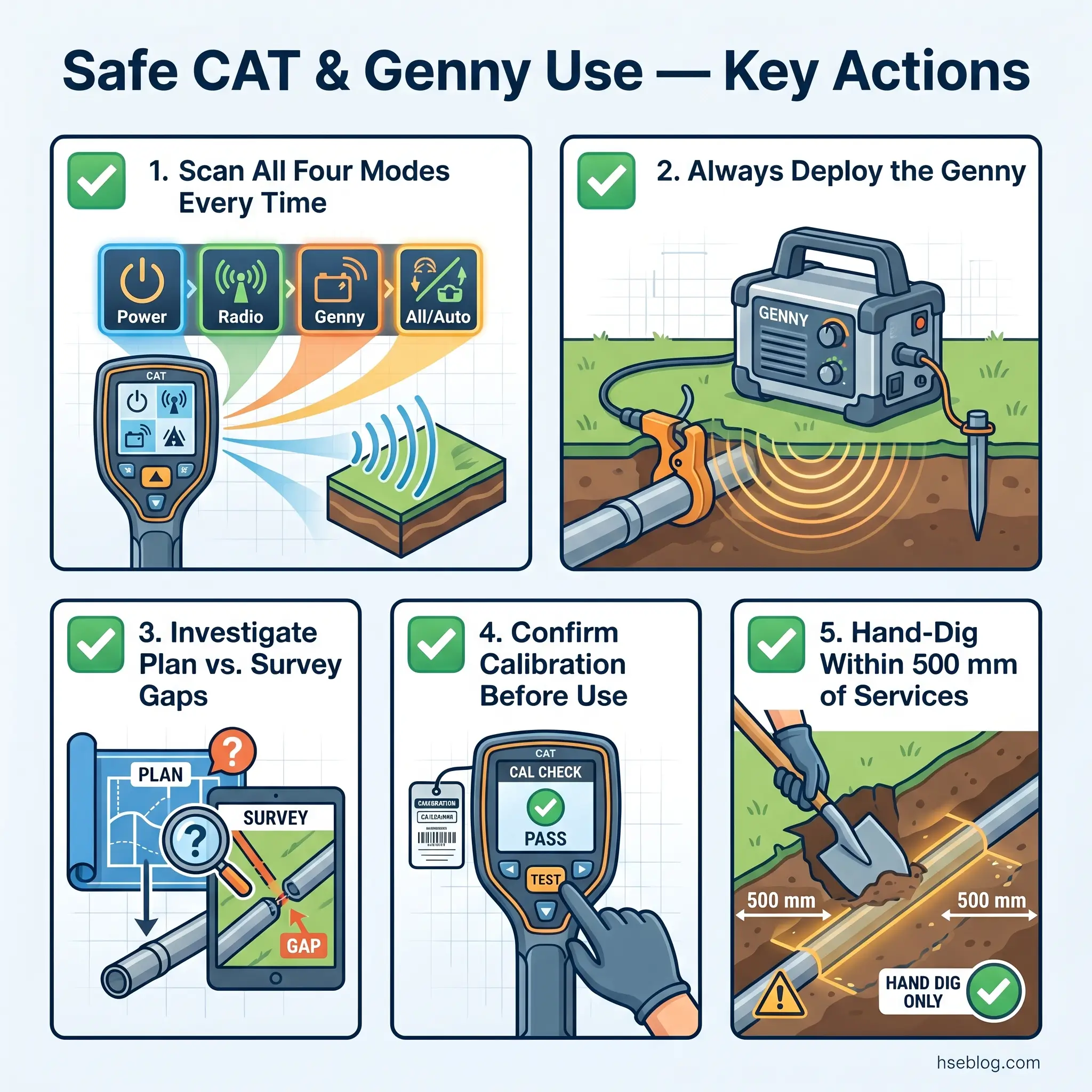
- Check equipment calibration. Confirm the CAT is within its 12-month calibration date. On CAT4 models, the CALSafe feature can be configured to prevent the instrument from operating beyond its calibration due date — if the startup screen shows a calibration warning, the unit must be recalibrated before use.
- Perform a pre-use functional check. Listen for the startup bleep, visually inspect the housing and connectors for damage, and confirm all modes respond to a test signal. Battery condition should be checked — a low battery degrades detection sensitivity before it triggers the low-battery warning.
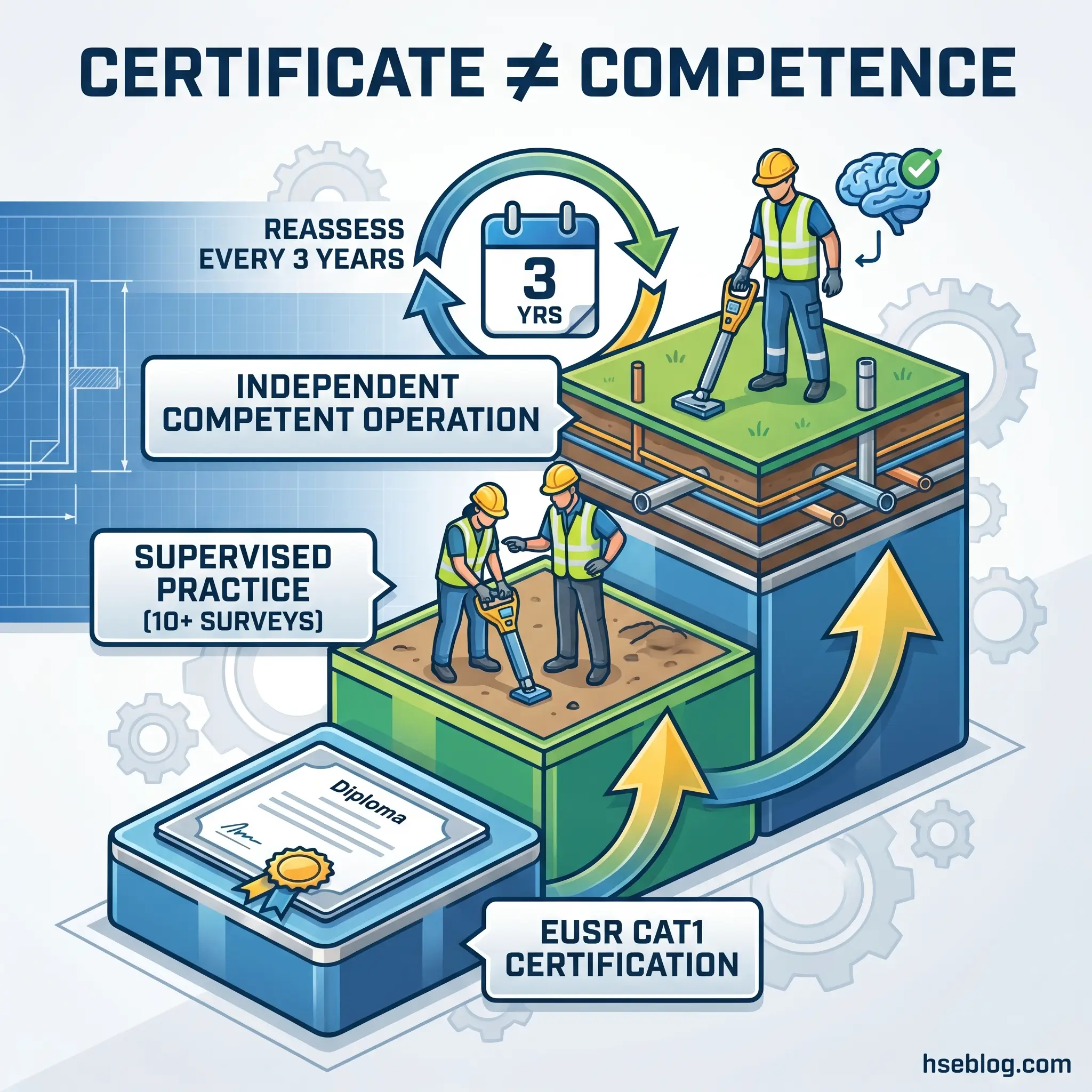
- Verify operator competence. The person operating the CAT must hold a current competence certification — EUSR CAT1, ProQual CAT1, or equivalent in-house certification. EUSR CAT1 is valid for 3 years.
- Confirm Genny accessories are available. Signal clamp, direct connection leads, earth spike, live plug connector, and spare batteries. Arriving on site with the CAT but without the Genny or its accessories is a common logistical failure that forces operatives into a Power-and-Radio-only survey.
Stage 2: Locating and Identifying Buried Services
This is the core scanning procedure. The sequence matters — it moves from broadest coverage to most targeted detection.
- Begin with an Avoidance Mode sweep of the full excavation area. Walk the perimeter first, then internal parallel sweeps approximately 0.5 m apart. This simultaneous scan of Power, Radio, and Genny signals gives a rapid overview of what is present.
- Hold the CAT upright and vertical at all times. The instrument is designed to detect signals perpendicular to the buried conductor. Tilting or swinging the CAT alters the antenna orientation and produces inaccurate readings. CAT4 models display a SWING warning when they detect incorrect operator technique — if this appears, stop and correct your grip and walking pace.
- Follow with dedicated mode scans. After the Avoidance mode sweep, repeat the survey area in each mode individually: Power mode first, then Radio mode, then Genny mode. For the Genny scan, start with induction (Genny placed on the ground surface), then progress to direct connection where access points exist (valves, junction boxes, exposed conductors). Direct connection gives the most specific and reliable results.
- Mark all detected services on the ground using paint, chalk, or marker pegs. Use a consistent colour code if one is specified in the site safety plan. Record the mode in which each service was detected — a service found only in Power mode may be a different utility than one found in Genny mode at the same approximate location.
- Respond to StrikeAlert. If StrikeAlert activates, it indicates a cable at very shallow depth — elevated strike risk. Mark the location prominently, extend the hand-dig zone, and brief all operatives in the area before any excavation proceeds.
- Record depth estimates with appropriate caution. On CAT4+, eCAT4+, and gCAT4+ models, depth estimation is available in Genny mode only. Record the reading but annotate it clearly: depth accuracy is ±10% under ideal conditions, and conditions on site are rarely ideal.
- Cross-reference detected services against utility plans. Any service shown on plans but not detected by the CAT requires further investigation. Deploy FlexiTrace, a sonde, or GPR, or hand-dig trial holes along the indicated route. Never assume the plans are wrong simply because the CAT showed nothing.
Audit Point: The most reliable indicator of a competent CAT survey is the operator's documentation of what was not found. If utility plans show five services and the CAT detected three, the survey record should identify the two undetected services by name and state the follow-up action taken. A survey record that lists only positive detections without addressing plan discrepancies is incomplete.
Stage 3: Safe Excavation Practices
Location is complete. The ground is marked. The excavation itself must now respect what has been found — and account for what may not have been.
- Hand-dig trial holes to physically confirm service positions before any mechanical excavation begins. A trial hole exposes the actual service, confirming its depth, direction, and type. This is the only verification method that produces certainty.
- Maintain safe clearance zones. HSG47 recommends hand-digging only within 500 mm of a confirmed buried service. No mechanical excavator bucket, breaker, or attachment should operate within that clearance zone. HSE guidance on excavation near underground cables provides detailed requirements for working near electricity supplies specifically.
- Excavate alongside, not directly above, buried services. Where possible, expose services by horizontal digging from the side rather than digging vertically down onto them.
- Use insulated hand tools when working near electricity cables. Standard steel spades and shovels can conduct current if they contact a damaged cable.
- Assume all cables are live and all pipes are pressurised until confirmed otherwise by the asset owner. Visual inspection cannot determine whether a cable is energised.
- Never use picks, forks, or pointed tools directly over the line of a buried service. These concentrate force on a small area and are the tool type most associated with cable penetration.
- Re-scan periodically as excavation progresses. Services can be at unexpected depths or follow unexpected routes. A CAT survey done at ground level before excavation may not reflect what exists at the depth you are now working. Re-scanning the excavation walls and floor at intervals catches services that the surface-level survey missed.
Field Test: After completing a CAT and Genny survey, ask yourself one question before authorising mechanical excavation: "For every service shown on the utility plans, can I account for it — either as a marked detection or as a confirmed follow-up action?" If the answer is no, the survey is not complete. Following Radiodetection's official CAT4 operating instructions alongside this workflow provides the manufacturer's specific guidance on sweep patterns and Genny positioning.
CAT and Genny Calibration and Maintenance
A cable avoidance tool is a safety-critical instrument. Its readings inform decisions that determine whether workers live or die. An uncalibrated or poorly maintained unit does not announce its degradation — it simply becomes less sensitive, misses signals it should detect, and gives depth readings that are further from reality than its specifications promise.
The manufacturer-recommended calibration interval is 12 months. During calibration, the unit is tested against known reference signals across all modes, and sensitivity, frequency response, and depth accuracy are verified and adjusted. A calibration certificate is issued, and on CAT4 models, the CALSafe feature can be configured to lock the instrument entirely if it is operated beyond its calibration due date. This is not a suggestion — an increasing number of principal contractors and utilities companies now require a current calibration certificate before an operative is permitted on site. An out-of-date certificate means the operative cannot work, regardless of their competence or training status.
The eCert online system offers an alternative to full bench calibration for units that are otherwise functioning correctly. eCert allows users to validate a CAT4's calibration remotely via the internet, extending calibration validity for one year without returning the unit to a service centre. This is useful for fleet management but does not replace physical calibration when the instrument has been dropped, damaged, or is producing anomalous readings.
Pre-use checks should be performed before every shift. The checklist is short but non-negotiable:
- Battery condition — listen for the startup bleep and check the battery indicator; low voltage degrades sensitivity before the warning triggers
- Visual inspection — check housing for cracks, connectors for corrosion, and the display for dead pixels or screen damage
- Functional test — confirm all modes respond to a known signal source (the Genny, placed at a measured distance, serves as a ready-made test source)
- Genny accessories — confirm leads, clamp, earth spike, and connectors are present and undamaged
For storage, keep the unit dry, remove alkaline batteries during prolonged storage to prevent leakage, and protect from excessive heat. The eCAT4 and gCAT4 models store over a year of usage data; the gCAT4+ adds GPS positioning to each record. Data is exportable via Radiodetection's C.A.T Manager software, which supports fleet-wide compliance auditing — a capability that larger contractors are increasingly using to demonstrate due diligence in cable strike prevention.
Do You Need Training to Use a CAT and Genny?
HSG47 requires that anyone using cable-locating equipment must be "competent" — meaning they possess the knowledge, skills, and experience to use the equipment correctly, interpret results accurately, and make safe decisions based on what the equipment tells them and, critically, what it does not tell them. HSG47 does not mandate a specific qualification. The word "competence" is used deliberately rather than "certification" because the two are not synonymous.
The industry standard certification is EUSR CAT1 (also referred to as EUS CAT1), valid for 3 years. The typical course format is a one-day programme covering electromagnetic theory, all four detection modes, signal interpretation, practical on-site assessment with live equipment, and safe digging practices. EUSR CAT2 (Safe Dig) is a separate qualification that covers safe excavation procedures near buried services. The two can be combined into a single training day but assess different competencies. For those who supervise and assess CAT operators, the EUS Super User qualification provides a higher level of verified competence.
Alternative qualifications — ProQual CAT1 and manufacturer-specific or in-house certifications — exist and are accepted by many clients, though EUSR remains the most widely recognised across UK construction and utilities sectors.
The gap between holding a certificate and being genuinely competent is where the real risk sits. A one-day course delivers the theoretical foundation and basic practical skills. Genuine competence develops through supervised practice — scanning different ground conditions, encountering real-world signal interference, learning to interpret ambiguous readings, and making judgment calls under pressure. The most consistent post-training failure pattern is regression to Power-mode-only scanning once the operative is working unsupervised. The course teaches all four modes. The site, without oversight, reverts to the quickest one.
The Fix That Works: Pair newly certified operatives with experienced CAT operators for a supervised practice period of at least 10 surveys before they operate independently. Track Genny deployment rates per operative using eCAT4/gCAT4 data logging — if an operative's logs show consistent Power-mode-only scans, the competence conversation needs to happen before a strike does.
HSG47 and the Legal Framework for Cable Avoidance
The regulatory framework for cable avoidance in the UK is layered. No single document covers everything, and the relationship between guidance and law is a source of genuine confusion on site — particularly the status of HSG47, which is the document most frequently cited but least frequently understood in legal terms.
HSG47: Avoiding danger from underground services (3rd edition, 2014) is HSE guidance, not legislation. That distinction matters — and it doesn't. HSG47 describes what the HSE considers good practice for managing the risk of striking underground services. Courts routinely reference it as the benchmark against which an employer's actions are judged. In enforcement terms, failure to follow HSG47 is treated as evidence of inadequate risk management. The practical reading, across multiple HSE prosecutions, is that an employer who cannot demonstrate compliance with HSG47's three-stage framework will struggle to defend a claim that they did what was reasonably practicable. The guidance-versus-law distinction gives some operatives and smaller contractors a false sense that compliance is optional. It is not. HSG47's full text is available from the HSE publication page.
Health and Safety at Work etc. Act 1974 provides the overarching duty of care. Employers must ensure, so far as is reasonably practicable, the health, safety, and welfare of their employees. This is the legislation under which a fatal cable strike prosecution will ultimately be brought.
Electricity at Work Regulations 1989 (EAWR) (UK) require that precautions be taken to prevent danger from electricity. This applies directly to work near buried electrical cables. The obligation is absolute for certain provisions — "no person shall be placed at risk of injury" — making the absence of a CAT survey near known or suspected cables a clear regulatory breach.
Construction (Design and Management) Regulations 2015 (CDM 2015) (UK) distribute duties across the project. Clients must provide pre-construction information including records of underground services. Designers must eliminate or reduce risks from damage to services through design decisions. Contractors must prepare safe systems of work — which, for excavation, means implementing the HSG47 framework.
PAS 128:2022 (BSI) is the specification for underground utility detection, verification, and location. Revised in 2022, it introduced updated guidance on detection survey accuracy, new specification for permits to break ground, and practitioner training guidance. PAS 128 defines four survey types (A through D) with increasing levels of confidence. A CAT and Genny survey forms part of a PAS 128 Type B detection survey, but PAS 128 requires GPR as a minimum alongside electromagnetic location — a CAT and Genny alone does not satisfy PAS 128 Type B. PAS 128 is not a legal requirement, but it is increasingly specified by clients, local authorities, and utilities companies as a contractual obligation.
Reporting obligations under RIDDOR may apply to cable strikes. A strike may be reportable as a dangerous occurrence if the resulting explosion had the potential to cause fatal injuries, the cable voltage could cause electrocution, or repairs exceeded 24 hours. Judgment is required, and the threshold is lower than many site teams assume.
| Regulation / Guidance | Jurisdiction | Year | Practical Requirement |
|---|---|---|---|
| HSG47 (3rd edition) | UK | 2014 | Three-stage framework: plan, locate, dig safely |
| Health and Safety at Work Act | UK | 1974 | General duty of care on employers |
| Electricity at Work Regulations | UK | 1989 | Precautions to prevent danger from electricity |
| CDM 2015 | UK | 2015 | Duties on clients, designers, contractors for underground services |
| PAS 128:2022 | UK (BSI) | 2022 | Detection survey specification — EML + GPR minimum for Type B |
Jurisdiction Note: The regulations above apply to England, Scotland, and Wales. Readers in other jurisdictions should consult locally applicable standards. US guidance under OSHA 29 CFR 1926 Subpart P covers excavation safety but does not replicate the HSG47 three-stage framework; Australian standard AS 5488 provides a comparable but structurally different approach. These are not interchangeable.
Frequently Asked Questions
How often should a CAT and Genny be calibrated?
The manufacturer recommends a 12-month calibration cycle. On CAT4 models, the CALSafe feature can be configured to lock the instrument if it is operated past its due date — the unit simply will not start. The eCert online system allows remote validation to extend calibration by one year without returning the unit for bench calibration. Most principal contractors and utilities companies now require a current calibration certificate before permitting an operative on site, making this an access-to-work issue as much as a safety one.
Can you use a CAT without a Genny?
Power and Radio modes operate independently of the Genny, so technically the CAT functions alone. In practice, a CAT without a Genny can miss approximately half of buried services — those that carry no current, re-radiate no radio signal, or are too small to produce a detectable field. HSG47 and industry best practice require a signal generator alongside the CAT. One measured programme found a 45% reduction in strike rates when Genny use was made mandatory (University of Birmingham research, cited 2026). Operating without one is a procedural shortcut, not a viable survey method.
What is the difference between EUSR CAT1 and CAT2?
CAT1 covers the location and identification of underground services using electromagnetic detection equipment — the CAT and Genny operation itself. CAT2 (Safe Dig) covers safe excavation techniques near buried services, including hand-dig procedures, tool selection, and clearance zones. They are separate qualifications assessing different competencies, though they can be combined into a single training day. Both are valid for 3 years and require renewal through reassessment.
Can a CAT and Genny detect plastic pipes?
No. Standard CAT modes detect electromagnetic signals, and plastic (MDPE, PVC), clay, and concrete pipes do not conduct electricity. To locate non-metallic services, an operator must use supplementary tools: a FlexiTrace rod threaded into the pipe and detected via Genny mode, a sonde pushed through the duct, or ground-penetrating radar (GPR) that detects density differences rather than electromagnetic signals. If utility plans show a service but the CAT detects nothing, the service is most likely non-metallic — not absent.
Is a cable strike reportable under RIDDOR?
It depends on the outcome and circumstances. A cable strike may be reportable as a dangerous occurrence under RIDDOR if the resulting explosion or arc flash had the potential to cause fatal injury, if the cable operated at a voltage capable of causing electrocution (above 50V AC or 125V DC), or if the repair took longer than 24 hours. The threshold is based on potential for harm, not just actual injury. When in doubt, report — under-reporting cable strikes as routine maintenance events rather than dangerous occurrences is a known pattern across the industry.
What is StrikeAlert on a CAT4?
StrikeAlert is a built-in safety feature that activates when the CAT detects a signal from a cable at very shallow depth — indicating an elevated risk of striking the service during excavation. It triggers a specific audible and visual warning distinct from the normal detection response. StrikeAlert does not guarantee detection of all shallow cables and should not be relied upon as the sole indicator of strike risk. It is one additional warning within a multi-mode survey — not a substitute for the survey itself.
Conclusion
The industry gets one thing consistently wrong with cable avoidance: treating the CAT as a clearance device rather than an information-gathering tool. A single Power-mode sweep that returns no signal is not a green light for the excavator. It is a partial reading from one mode of one instrument, covering one category of signal. The operative who acts on that reading alone — and many do — is working on an assumption that the published fatality record repeatedly disproves.
The highest-impact change any site can make is simple in principle and demanding in discipline: mandate Genny use on every survey, enforce all-mode scanning as a non-negotiable procedure, and require operators to document what was not detected as rigorously as what was found. The 45% reduction in strikes achieved by one contractor through mandatory Genny deployment is not a theoretical benefit — it is a measured outcome of closing the gap between what the equipment can do and what operatives are allowed to skip.
A cable avoidance tool is only as reliable as the person holding it, the procedure they follow, and the judgment they apply when the instrument falls silent. Equipment capability, operator competence, and procedural discipline are three legs of the same system. Remove any one, and the system fails in exactly the way the next cable strike investigation will describe.