
The call came in at 5:47 AM. Our US plant's EHS lead wanted to know whether Thursday's wrist fracture — a press-line operator caught by a returning tool on our Midwest stamping line — was reportable under federal OSHA, and whether the 24-hour window had already passed. An hour later, on the same bridge call, our Midlands site manager asked effectively the same question about a wrist fracture at our UK pressings facility: different worker, same mechanism, 14 days off work and still running. Two identical injuries, two regulatory regimes, two completely different answers sitting on the call in front of us.
For safety managers running operations on both sides of the Atlantic, treating RIDDOR vs OSHA reporting as a translation exercise will eventually produce a missed notification, a late filing, or a penalty letter. The two systems share a regulatory purpose — giving enforcement authorities visibility into serious workplace harm — but their legal structures, trigger thresholds, timeframes, and even their definitions of "reporting" diverge at almost every decision point. What follows is a practitioner's side-by-side breakdown: what each regime captures, how the clocks run, who carries the duty, what the penalties look like, and how multinational employers can run both compliantly without folding them into a single pipeline.
Three highest-level anchors are worth fixing in view before the detail:
| Anchor | RIDDOR | OSHA |
|---|---|---|
| Legal basis | Statutory Instrument 2013/1471 under HSWA 1974 | 29 CFR Part 1904 under OSH Act 1970 |
| Geographic scope | Great Britain (NI uses its own RIDDOR 1997) | US employers with 11+ employees; 22 state-plan variants |
| Enforcement | HSE, local authorities, Office of Rail and Road | Federal OSHA or state OSHA agency |
What Is RIDDOR? The UK Reporting Regime in Brief
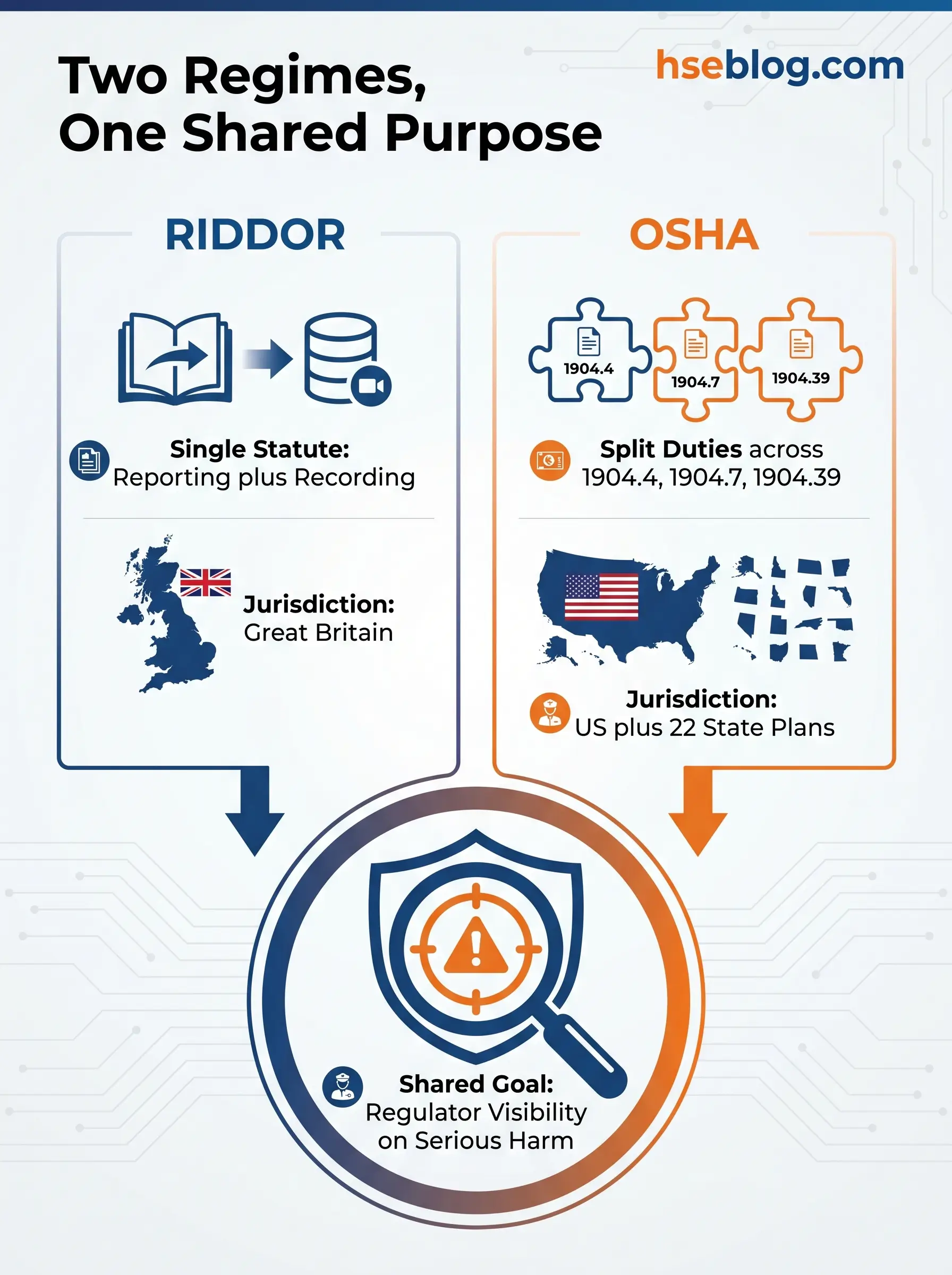
The Reporting of Injuries, Diseases and Dangerous Occurrences Regulations 2013 — formally SI 2013/1471 — replaced the 1995 version on 1 October 2013 and sits under the Health and Safety at Work etc. Act 1974. It is enforced by the Health and Safety Executive for most industrial sites, by local authorities for commercial and retail premises, and by the Office of Rail and Road for rail incidents. The duty falls on what the regulations call the "responsible person" — usually the employer, the self-employed worker, or the person in control of premises where an incident occurs.
RIDDOR is unusual in pulling reporting and recordkeeping into a single instrument: specified injuries, over-seven-day incapacitations, certain occupational diseases, dangerous occurrences, gas-related incidents, and work-connected hospitalisations of members of the public all flow through one reporting channel. In 2024/25, HSE recorded 59,219 reported employee injuries and 124 worker fatalities in Great Britain, with workplace injuries and new ill-health estimated at £22.9 billion in annual cost. Failure to report is a criminal offence — not an administrative one — and that framing shapes how HSE inspectors treat non-reporting during site visits.
What Is OSHA Recordkeeping and Reporting? The US Regime in Brief
Two duties live inside the US system, and safety managers coming from a RIDDOR background often collapse them into one. Recording — the continuous logging of work-related injuries and illnesses on OSHA Form 300 — is governed by 29 CFR 1904.4 and 1904.7. Reporting — the acute notification of severe incidents directly to OSHA — is governed by 29 CFR 1904.39. A third layer, annual electronic submission under 29 CFR 1904.41, requires qualifying establishments to send case-level data to the Injury Tracking Application.
OSHA recordkeeping applies to employers with 11 or more employees across most industries, with partial exemptions for establishments in low-hazard NAICS codes. Enforcement is split between federal OSHA and the 22 state-plan states, which must operate rules "at least as effective" as federal standards. Recordable injuries are logged on Form 300 and summarised annually on Form 300A; severe incidents — fatalities, in-patient hospitalisations, amputations, loss of an eye — must be called in separately under 1904.39. The Bureau of Labor Statistics reported roughly 2.6 million nonfatal workplace injuries and illnesses across US private industry in 2022, drawn from this recordkeeping base.
Recordable vs Reportable vs RIDDOR-Reportable: The Terminology That Trips Everyone Up
The first thing I correct when briefing new safety coordinators transferring between our UK and US sites is the terminology itself. Three words sound interchangeable, and they are not.
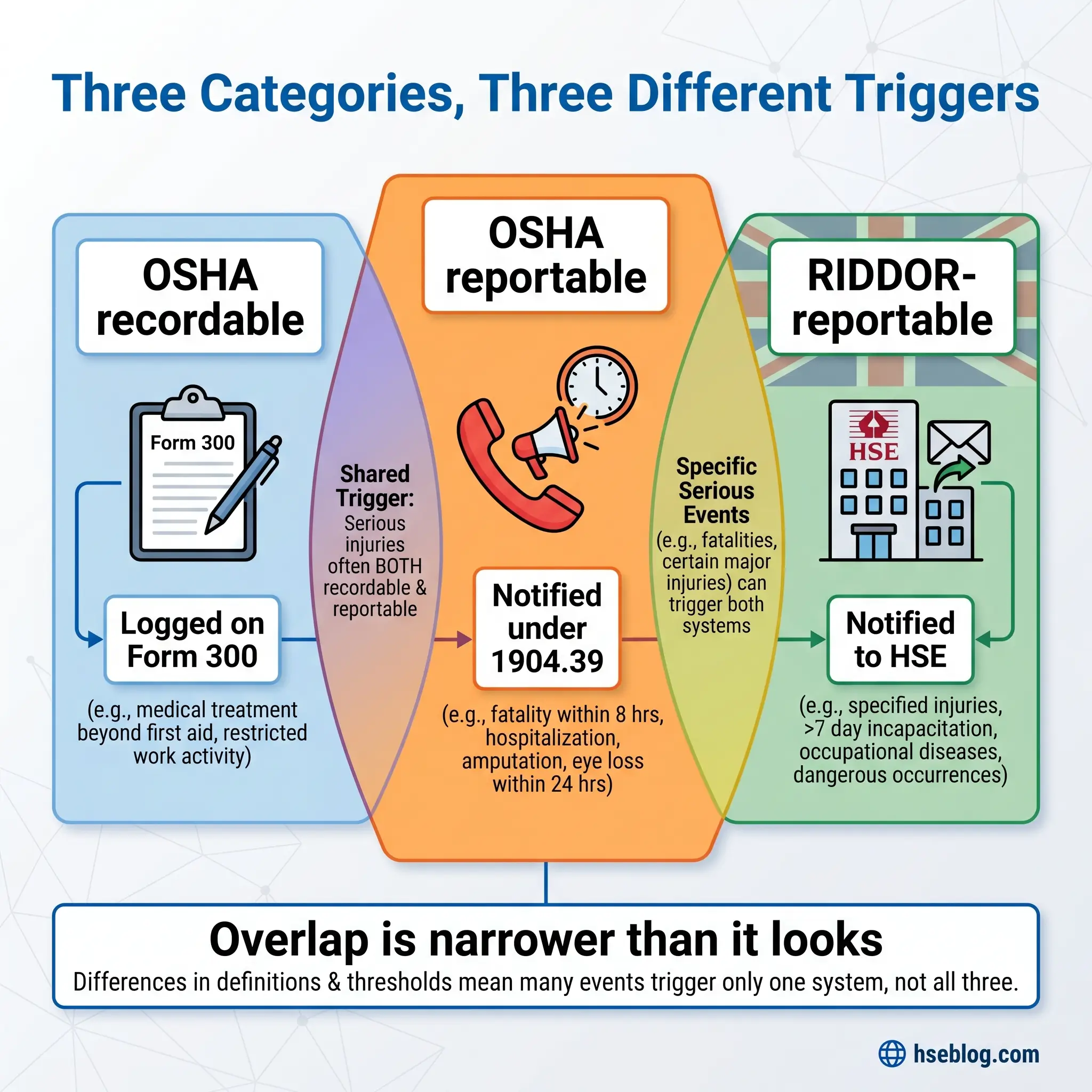
- OSHA "recordable": Any work-related injury or illness meeting the general recording criteria in 29 CFR 1904.7 — death, days away from work, restricted work or job transfer, medical treatment beyond first aid, loss of consciousness, or a significant injury/illness diagnosis by a licensed healthcare professional. This gets logged on Form 300 and summarised on Form 300A. Most injuries that qualify never need to be called in to OSHA.
- OSHA "reportable": The narrower 1904.39 category that must be notified to OSHA directly by phone or online form — fatalities (within 30 days of the incident), in-patient hospitalisations, amputations, and loss of an eye.
- RIDDOR-reportable: The broader set of triggers in RIDDOR Regulations 4–9 — specified injuries listed in Schedule 1, over-seven-day incapacitations, certain occupational diseases, the 27 dangerous occurrences in Schedule 2, gas incidents, and hospitalisations of non-workers connected to work activity.
A worked example sharpens the distinction. A warehouse worker breaks a wrist in a pallet strike and is off work for 10 days. Under OSHA, the injury is recordable — it meets the days-away-from-work criterion in 1904.7 — and gets entered on Form 300, but it is not reportable under 1904.39 because a wrist fracture is neither an amputation nor an in-patient hospitalisation. Under RIDDOR, the same injury is reportable twice over: as a specified injury (fracture other than finger, thumb or toe) under Schedule 1, and as an over-seven-day incapacitation.
Side-by-Side Comparison: RIDDOR vs OSHA at a Glance
With the terminology settled, the operational differences line up cleanly in a row-by-row comparison. Each row below reflects a decision point a compliance manager actually faces in practice.
| Decision point | RIDDOR | OSHA |
|---|---|---|
| Legal instrument | RIDDOR 2013 (SI 2013/1471) | 29 CFR Part 1904 |
| Parent statute | Health and Safety at Work etc. Act 1974 | Occupational Safety and Health Act 1970 |
| Duty holder | "Responsible person" (employer, self-employed, or controller of premises) | Employer with day-to-day supervision |
| Jurisdiction | Great Britain (NI: RIDDOR 1997) | US federal plus 22 state plans |
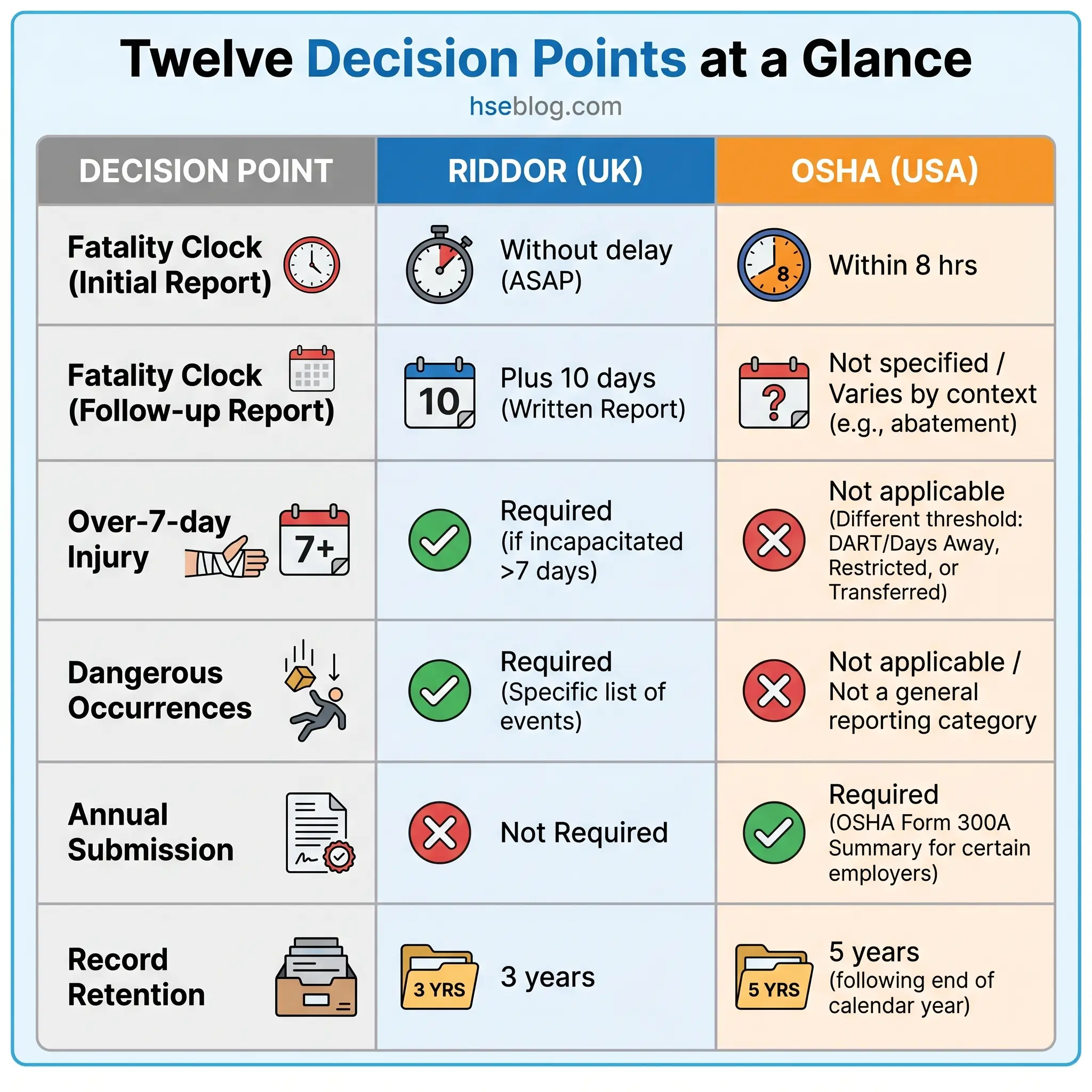
| Fatality reporting | "Without delay" plus written report within 10 days | Within 8 hours (deaths within 30 days of incident) |
| Specified/severe injury | "Without delay" plus 10-day written report | Within 24 hours (hospitalisation, amputation, eye loss) |
| Over-7-day absence | Reportable within 15 days of the accident | No equivalent — recorded on Form 300 only |
| Dangerous occurrences | 27 categories reportable regardless of injury | No federal general-duty reporting |
| Occupational disease | Closed list (e.g., HAVS, occupational asthma, cancers) | Recorded on Form 300 if general criteria met |
| Non-worker injuries | Reportable if taken to hospital from the scene | Generally not required |
| Record retention | 3 years | 5 years |
| Annual data submission | None — HSE aggregates filings | Form 300A by 2 March; Appendix B adds case-level Forms 300 and 301 |
Reporting Timeframes: The Clock Starts in Very Different Places
In practice, deadlines are where compliance fails. Same injury, two clocks, two starting points.
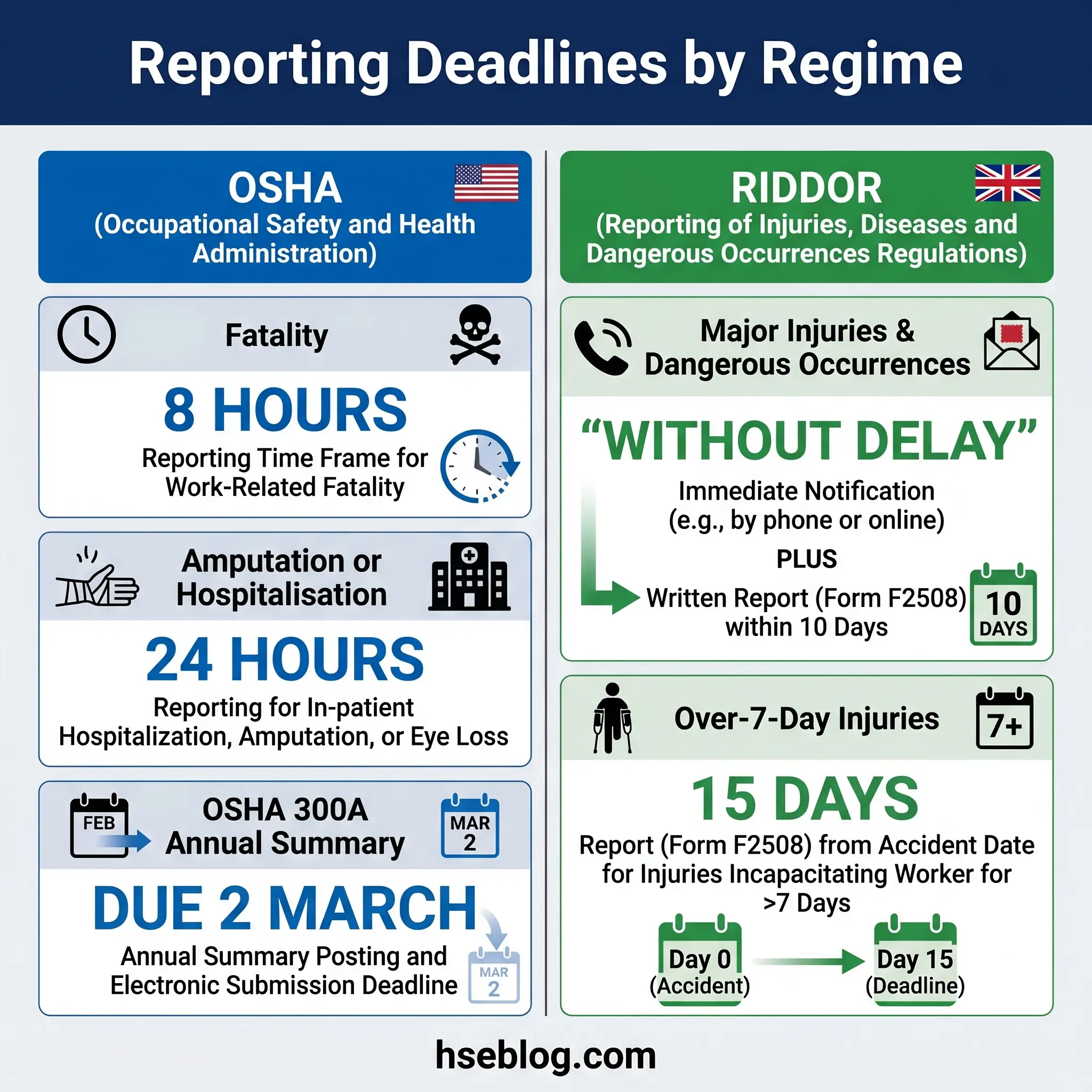
OSHA's 1904.39 clock runs from the moment the employer learns of the qualifying event: 8 hours for a work-related fatality, and 24 hours for an in-patient hospitalisation, amputation, or loss of an eye. Fatalities that occur within 30 days of the incident trigger the duty; hospitalisations that occur within 24 hours of the incident trigger theirs.
RIDDOR's clock behaves differently. Specified injuries, fatalities, dangerous occurrences, and non-worker hospitalisations must be notified "without delay" — in practice, the same working day — followed by a written report to HSE within 10 days. Over-seven-day injuries carry a 15-day deadline measured from the date of the accident, not the date the 7-day threshold was crossed. That distinction has caught out more than one of my UK site leads, and I've watched a 10-day-absence injury quietly drift past the filing window while the controller assumed the clock started on day eight.
Watch For: The RIDDOR 15-day clock runs from the accident, not from when a worker's absence passes the 7-day threshold. By the time the threshold is reached, you've already used 7 of your 15 days — and if the worker then takes another week before the absence is logged internally, you're late.
What Must Actually Be Reported: Injury Categories Compared
Six incident types account for almost every judgment call a safety manager has to make: fatality, amputation, fracture, burn, hospitalisation, and occupational disease. Each is handled differently across the two regimes.
| Incident type | RIDDOR treatment | OSHA treatment |
|---|---|---|
| Fatality | Reportable; captures deaths up to 1 year after the accident | Reportable within 8 hours; captures deaths up to 30 days after |
| Amputation | Specified injury — reportable | 1904.39 reportable within 24 hours |
| Fracture (non-finger/thumb/toe) | Specified injury — reportable | Recordable on Form 300; not independently reportable |
| Serious burn | Reportable if >10% body surface or damage to vital organs/eyes | Recordable if meeting general criteria; no burn-specific threshold |
| In-patient hospitalisation | Non-workers reportable; worker hospitalisations fall under specified-injury rules | Reportable within 24 hours for workers |
| Occupational disease | Closed list in RIDDOR Schedule 2 (HAVS, asthma, dermatitis, occupational cancers) | Recorded on Form 300 if general criteria met; no prescribed disease list |
The HSE reportable incidents page lists Schedule 1 and Schedule 2 in full; anything outside those lists is not RIDDOR-reportable even if it sounds serious. That closed-list structure is itself a key difference from OSHA's principle-based recording criteria, which capture any work-related condition meeting general thresholds rather than matching a named category.
Dangerous Occurrences and Near-Misses: A Genuine Gap Between the Regimes
A forklift overturned against a racking run in our Midlands warehouse last winter. No one was hurt. The UK site controller filed a RIDDOR dangerous-occurrence report within the week. My US counterpart visiting at the time was genuinely surprised we were reporting it externally at all — no injury, no hospitalisation, in his world that was an internal investigation and nothing more.
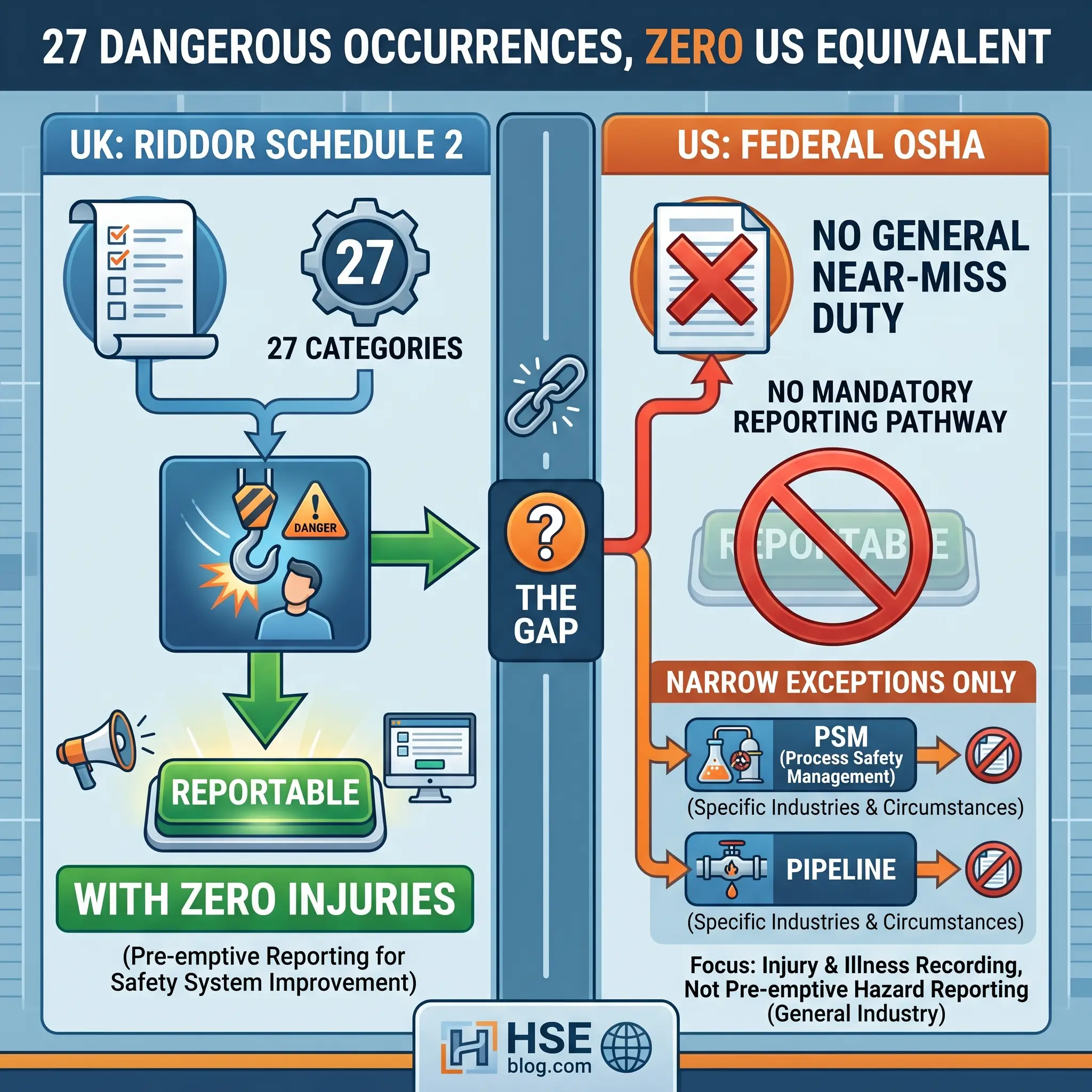
He wasn't wrong about the US side. Federal OSHA has no general near-miss or dangerous-occurrence reporting duty. Specific sectors have narrow variants — 29 CFR 1910.119 requires process safety management incident investigation for highly hazardous chemical releases, and some pipeline and rail incidents trigger separate agency reports — but there is nothing in 29 CFR 1904 that parallels RIDDOR's Schedule 2.
RIDDOR Schedule 2 lists 27 dangerous-occurrence categories that must be reported regardless of whether anyone was injured. The ones that come up most often across industrial sites include:
- Lifting equipment collapse or failure — overturning cranes, failed hooks, failed lifting operations
- Overhead power line contact — any plant or equipment contact with an energised overhead line
- Scaffold collapse — partial or full collapse of a scaffold over 5 metres high
- Pressure system failure — failure of a pressure vessel with the potential to cause serious harm
- Dangerous substance release — unintended release of a substance likely to cause damage to health
- Electrical incidents causing fire or explosion — electrical short-circuits or overloads with fire or explosion potential
Construction sites carry additional dangerous-occurrence categories covering piling collapse and structural failure during the work.
Audit Point: HSE inspectors routinely cross-reference maintenance records, lifting equipment inspection logs, and permit-to-work registers against submitted RIDDOR filings. A lifting-gear failure noted in maintenance records but absent from the RIDDOR log tends to surface during an inspection.
Who Has the Reporting Duty: "Responsible Person" vs "Employer"
The duty-holder definitions look similar on paper and behave quite differently on a mixed-contractor site.
Under RIDDOR, the "responsible person" shifts with the scenario. For employees, it is their employer. For self-employed workers, it is either themselves or, where they are working under someone else's control of premises, the controller. For non-workers — visitors, contractors' staff, members of the public — it is the person in control of the premises where the incident occurred. Since 2015, self-employed workers in low-risk activities are exempt from RIDDOR when working for themselves alone, but that exemption narrows fast once they enter a host employer's premises.
OSHA's reporting duty sits with the employer that provides day-to-day supervision under 29 CFR 1904.31. That matters for agency workers and staffing arrangements: the host employer supervising the worker carries the recordkeeping duty, not the agency on the paperwork. OSHA doesn't cover self-employed workers at all — they're not "employees" under the OSH Act, and they don't sit within anyone's recordkeeping universe.
A worked scenario sharpens the edges. An agency technician is seriously injured on a host employer's site in the UK: the host employer, as controller of the premises, is the RIDDOR responsible person. The same incident on a US site: the host employer supervising the technician's day-to-day work is the OSHA recordkeeping and reporting duty holder. The agency contract rarely changes either answer — and that is something our legal teams have had to explain to more than one plant manager who assumed the staffing firm would handle it.
How to Report: Mechanisms, Forms, and Systems
Both regimes have moved most reporting online, but the routes are different.
RIDDOR reports flow through the HSE online portal as the default route for all incident types. The telephone line (0345 300 9923) is restricted to fatal and specified-injury reports during office hours. Paper F2508 forms have been largely phased out. Internal RIDDOR records must be kept for 3 years and made available to HSE on request.
OSHA reporting uses three routes depending on the event. For 1904.39 severe incidents, employers can call the nearest OSHA Area Office, the 24-hour hotline (1-800-321-OSHA), or submit through the OSHA recordkeeping portal online form. Annual ITA submissions are electronic only. OSHA records must be retained for 5 years following the year they cover.
| Form / system | Purpose | Retention |
|---|---|---|
| OSHA Form 300 | Log of recordable injuries and illnesses | 5 years |
| OSHA Form 300A | Annual summary, posted 1 February to 30 April | 5 years |
| OSHA Form 301 | Incident report (detailed) | 5 years |
| OSHA ITA | Electronic annual submission | Ongoing |
| RIDDOR internal record | Log of reported incidents plus relevant near-miss records | 3 years |
Annual Data Submission and Electronic Reporting
29 CFR 1904.41 adds a layer OSHA uniquely carries: annual electronic submission to the Injury Tracking Application. Three tiers exist:
- Establishments with 250 or more employees in industries required to keep 1904 records must submit Form 300A annually by 2 March
- Establishments with 20–249 employees in Appendix A designated industries must also submit Form 300A annually
- Establishments with 100 or more employees in Appendix B high-hazard industries have, since 1 January 2024, been required to submit case-level data from Forms 300 and 301 annually
The Appendix B expansion took effect on 1 January 2024 and is the most substantive OSHA recordkeeping change in recent years. Case-level submission means injury narratives, body parts affected, and event sequence are now going to the agency directly, not just aggregate counts.
RIDDOR has no annual submission equivalent. Each reportable incident is notified individually as it occurs, and HSE aggregates the data itself — supplemented by the Labour Force Survey, which HSE uses partly because employer under-reporting of non-fatal injuries is estimated at roughly 50%. That under-reporting gap is one reason HSE's 10-year strategy to 2032 keeps RIDDOR data quality and enforcement under active review.
Penalties for Failing to Report
OSHA's 2025 penalty schedule runs to $16,550 per serious or other-than-serious violation and $165,514 per willful or repeat violation, with annual inflation adjustments under the Federal Civil Penalties Inflation Adjustment Act. Failure to report a 1904.39 event strips the employer of penalty adjustment factors under OSHA's Field Operations Manual — meaning the full penalty range sits on the table without the usual reductions for size, history, or good faith. Repeat non-reporting can also feed into OSHA's Severe Violator Enforcement Program, which targets employers with willful, repeated, or failure-to-abate citations for enhanced follow-up inspections. Knowingly false entries in OSHA records carry up to $10,000 in fines and six months' imprisonment under Section 17(g) of the OSH Act.
RIDDOR enforcement runs through the criminal courts, not a civil penalty schedule. Magistrates' court fines are unlimited for most RIDDOR offences following the Health and Safety (Offences) Act 2008, and Crown Court cases can impose custodial sentences of up to 2 years for responsible persons. A pattern of non-reporting typically surfaces during follow-up HSE enforcement on the underlying safety failure, compounding the exposure.
| Failure type | RIDDOR consequence | OSHA consequence |
|---|---|---|
| Single missed report | Criminal offence; magistrates' unlimited fine | Up to $16,550 per violation |
| Repeated/willful non-reporting | Indictable offence; up to 2 years' custody | Up to $165,514 per violation; SVEP exposure |
| False records | Criminal offence; unlimited fine | Up to $10,000 plus 6 months under Section 17(g) |
A Head-to-Head Scenario Walkthrough: Same Incident, Two Regimes
Three scenarios show how the theory plays out when a real incident lands on the desk.
Scenario 1 — Warehouse leg fracture, 12 days off. A worker breaks a leg in a forklift collision in a distribution centre; no hospitalisation beyond X-ray and casting; 12 days absent. RIDDOR: reportable as a specified injury under Schedule 1 and separately under the over-seven-day rule, with the 15-day clock running from the accident. OSHA: recordable under 1904.7 on Form 300; not reportable under 1904.39 because it is neither an amputation nor an in-patient hospitalisation.
Scenario 2 — Maintenance fatality, 14 days after the fall. A fitter falls from a mezzanine during a planned shutdown and dies 14 days later from complications. RIDDOR: reportable as a fatal injury — the 1-year window for work-related deaths applies, so the 14-day gap is well within scope; notification "without delay" and written report within 10 days. OSHA: reportable under 1904.39 within 8 hours of the employer learning of the death, because the fatality occurred within 30 days of the incident.
Scenario 3 — Scaffold collapse, no injuries. A partial scaffold collapse over 5 metres high during steel erection; no one struck. RIDDOR: reportable as a dangerous occurrence under Schedule 2, with a construction-sector add-on category. OSHA: no federal reporting duty — investigated internally, recorded in the company's own incident tracking system, but not submitted to OSHA. The same event triggers a mandatory external filing in one jurisdiction and nothing in the other.
What Multinational Employers Need to Do
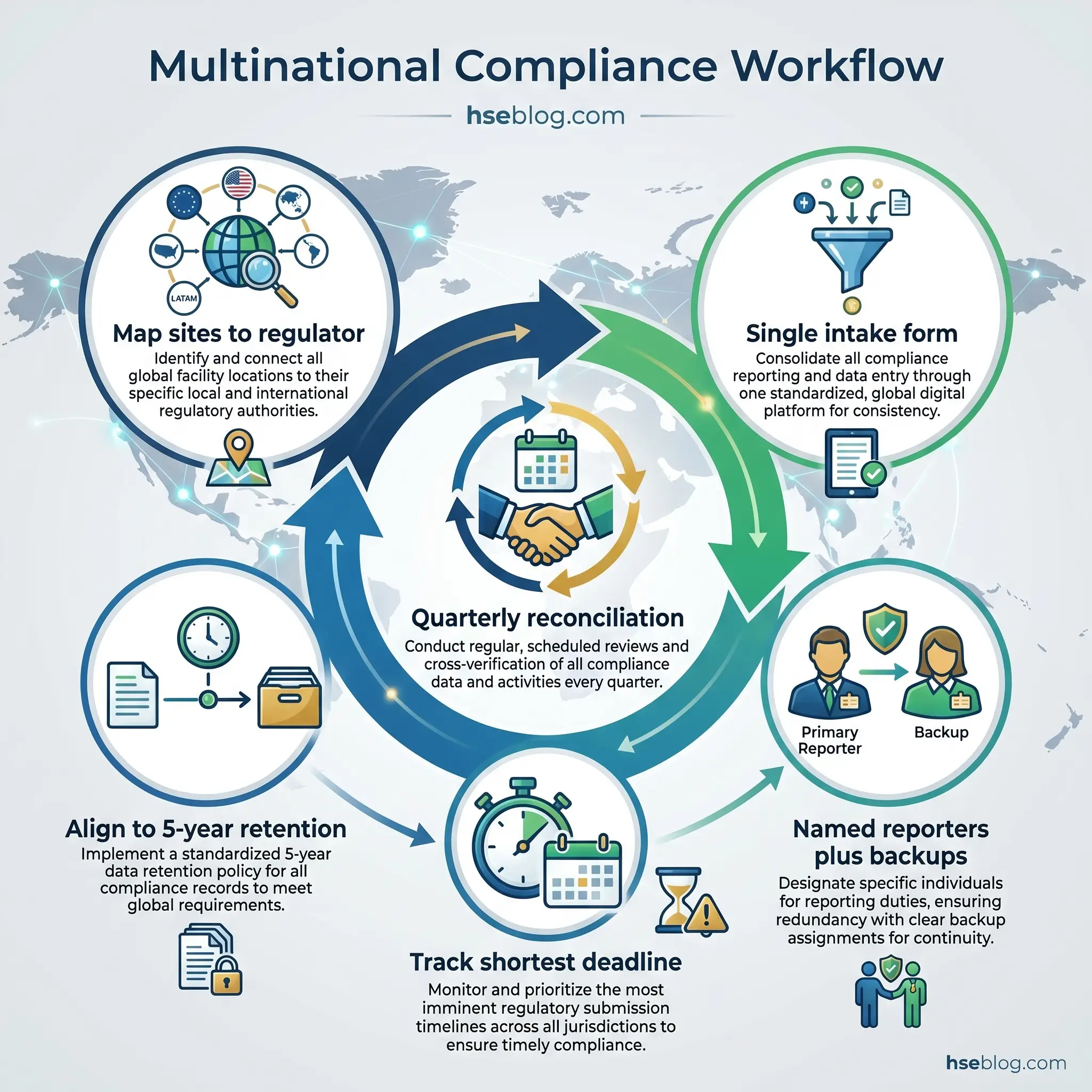
Running both regimes compliantly requires discipline, not a single merged workflow. The approach that has held up across our UK and US sites comes down to seven practical steps:
- Map each operating site to its regulator. Great Britain to RIDDOR via HSE (or ORR/local authority). US federal states to federal OSHA. US state-plan states to the state agency. Document this on a one-page jurisdictional register reviewed annually.
- Build a single internal incident intake form that captures the data points both regimes need: date and time, location, severity, medical treatment, days away or restricted, work-relatedness nexus, and dangerous-occurrence category if applicable.
- Name responsible persons and designated reporters site by site. A RIDDOR responsible person at each UK site; a designated 1904.39 reporter at each US site. Backups for each, because the 8-hour clock does not wait for anyone to be in the office.
- Track the shortest applicable deadline. If an incident could conceivably be reportable in either jurisdiction — a cross-border investigation, a contractor incident involving both entities — default to the tighter clock until the jurisdictional question is resolved.
- Align records to the longer retention period. Keep incident files for 5 years minimum — OSHA's rule — even for UK sites where RIDDOR only demands 3. ISO 45001 Clause 10.2 aligns usefully as a unifying operational baseline for both.
- Run a quarterly reconciliation between maintenance logs, near-miss reports, and filed notifications. The commonest failure pattern I see is dangerous-occurrence-level events staying internal because no one connected them to Schedule 2.
- Brief line managers annually on what triggers a call-out to HSE or OSHA. Not the legal text — the operational triggers. At 3 AM, a plant manager needs to know what to do, not what statute applies.
The Fix That Works: Build a decision matrix that takes incident severity, location, and work-relatedness as inputs and outputs which regime's clock starts first, which form applies, and who the designated reporter is. It turns the decision from a judgement call into a lookup.
Frequently Asked Questions
Is RIDDOR the same as OSHA?
No. RIDDOR is a UK statutory instrument covering specific reporting and recordkeeping duties; OSHA is the US federal agency that administers a different set of rules under 29 CFR 1904. They share a regulatory goal, but the triggers, timeframes, and enforcement routes differ throughout.
What is the US equivalent of RIDDOR?
There isn't a single direct equivalent. The closest functional counterparts are OSHA's recordkeeping rules under 29 CFR 1904.4 and 1904.7, combined with the severe-incident reporting duties under 1904.39. Even together, those rules cover a narrower band than RIDDOR — OSHA has no general dangerous-occurrence reporting, no over-seven-day injury reporting, and no reporting duty for non-worker injuries.
How long do employers have to report a fatality under RIDDOR vs OSHA?
OSHA requires notification within 8 hours of the employer learning of a work-related fatality, provided the death occurs within 30 days of the incident. RIDDOR requires notification "without delay" — in practice the same working day — followed by a written report to HSE within 10 days. RIDDOR also captures deaths up to 1 year after the accident, whereas OSHA's 30-day window is much shorter.
Are near-misses reportable under OSHA like they are under RIDDOR?
Federal OSHA has no general near-miss reporting duty. Specific exceptions exist — for example, process safety management incidents involving highly hazardous chemicals under 29 CFR 1910.119 — but most near-misses are handled internally. RIDDOR, by contrast, requires reporting of 27 specified dangerous occurrences listed in Schedule 2, regardless of whether anyone was injured.
Which injuries are RIDDOR-reportable but not OSHA-reportable?
Over-seven-day incapacitations, most fractures outside the narrow 1904.39 categories, certain occupational diseases on RIDDOR's prescribed list, and dangerous occurrences with no injury are all RIDDOR-reportable but not OSHA-reportable. The reverse asymmetry is narrower — most OSHA 1904.39 triggers (fatality, amputation, hospitalisation, eye loss) are also RIDDOR-reportable as specified injuries.
What are the penalties for failing to report under RIDDOR vs OSHA?
OSHA's 2025 maxima are $16,550 per serious violation and $165,514 per willful or repeat violation, with false records carrying up to $10,000 and 6 months' imprisonment under OSH Act Section 17(g). RIDDOR non-reporting is a criminal offence with unlimited fines and custodial sentences of up to 2 years for responsible persons.
Conclusion
Running compliance across both regimes comes down to four non-negotiables. Keep the jurisdictional register current so every site is mapped to its regulator. Start the correct clock at the moment an incident lands — the 8-hour OSHA window and the RIDDOR "without delay" duty don't wait for a meeting to convene. Preserve both sets of records to the longer retention standard. And build an intake form that captures the data points both regimes need rather than shoehorning a single-regime template into a dual-regime operation.
The regulatory direction of travel matters here too. OSHA's 2024 Appendix B expansion has shifted case-level injury data directly to the agency for high-hazard industries with 100 or more employees — a level of enforcement visibility RIDDOR has never required but which HSE has arguably achieved indirectly through its Labour Force Survey cross-check against employer-reported filings. The two regimes are converging on the same principle: regulators want structured, comparable data on serious workplace harm, and they're less willing than they once were to accept self-interpreted thresholds as a substitute.
RIDDOR vs OSHA reporting isn't a choice between systems — for anyone operating across both jurisdictions, it's a dual obligation with different mechanics. Treat each one on its own terms and the compliance work becomes manageable. Collapse them into one and something important will eventually slip through.