
Regulation 4(4) of the Construction (Design and Management) Regulations 2015 is eight lines long. It contains no schedule, no appendix, no weighting formula — just a flat instruction that the client must provide pre-construction information to every designer and contractor being considered for appointment, as soon as is practicable. On the refurbishment projects I work on as a principal designer, those eight lines are the most frequently breached client duty I encounter. They are also the eight lines HSE inspectors read first when they arrive after an incident and ask who knew what, and when.
Pre-construction information — PCI — is the legal foundation of CDM compliance in Great Britain. It is the information package the client must pass to designers and contractors before construction begins, so that foreseeable hazards are eliminated in the design and priced properly into the build. On the 1970s office-to-residential conversion I am currently running as principal designer in a temperate urban corridor, the PCI has already prevented two potentially serious incidents during soft strip — and it is not yet complete. This guide walks through exactly what pre-construction information is under UK law, who owns it, what belongs inside the pack, how it feeds the Construction Phase Plan and Health and Safety File, and how the 2023 Building Safety Act reforms have changed the picture for English projects.
What Is Pre-Construction Information?
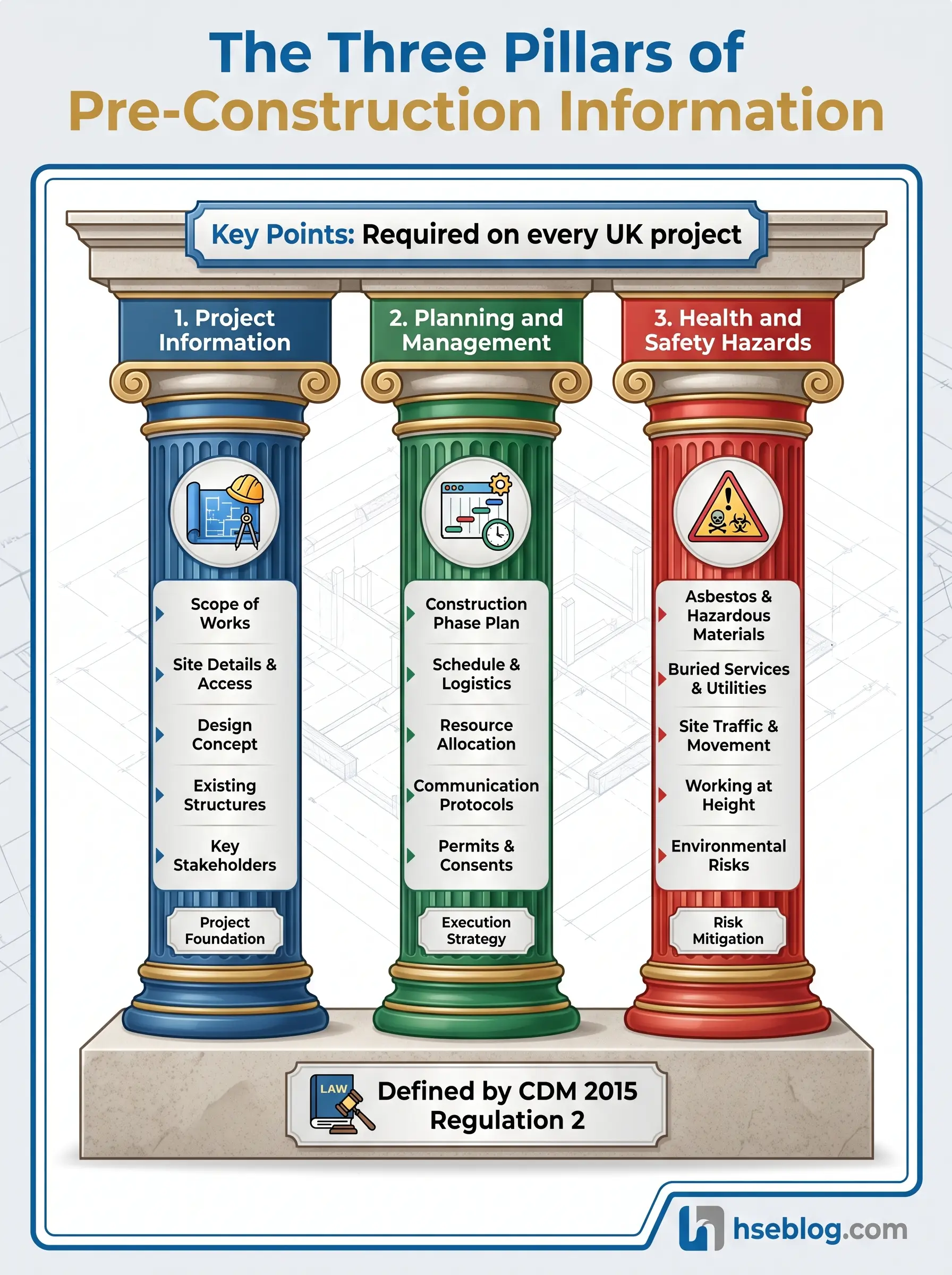
Regulation 2 of CDM 2015 defines pre-construction information as information in the client's possession, or which is reasonably obtainable, that is relevant to the project and proportionate to the risks. The regulation groups that information under three statutory categories: information about the project; information about the planning and management of the project; and information about health and safety hazards, including those arising from design and construction work.
"Pre-construction information means information in the client's possession or which is reasonably obtainable by or on behalf of the client, which is relevant to the construction work and is of an appropriate level of detail and proportionate to the risks involved…" — Regulation 2, CDM 2015
In practice, PCI is a structured document — often called a Pre-Construction Information Pack, or PCIP — that collects everything a designer or contractor needs to know about the site and the project before making decisions that commit resources, methods, or money. The pack is legally required on every construction project in Great Britain, whether it is a loft conversion in a domestic house or a £200 million hospital build. Size, duration, and notifiability do not change the duty; they change only the proportionality of the content.
PCI is also dynamic. It starts with whatever the client already holds — existing drawings, a previous Health and Safety File, an asbestos register, a lease with site-access restrictions — and grows as pre-construction surveys and design decisions generate new information. The version issued at tender stage is rarely the version issued to the successful principal contractor three months later. Treating PCI as a one-off form filled in once and forgotten is the single most common failure pattern I see on poorly run projects.
Why Pre-Construction Information Matters
Construction remained the sector with the highest absolute number of worker fatalities in Great Britain in 2024/25, with 35 deaths recorded by HSE — down from 51 the previous year but still disproportionate to the industry's six per cent share of the GB workforce. The construction fatal injury rate sits at 1.92 per 100,000 workers, roughly 4.8 times the all-industry rate. Falls from height alone accounted for 35 worker fatalities across all sectors in 2024/25, more than a quarter of every work-related death in the country.
What those numbers hide is how many of the hazards behind them were, in principle, knowable before anyone stepped onto site. Asbestos lagging in a pre-2000 plant room. A fragile cement-fibre roof above an access route. Live overhead power lines crossing a crane radius. A cellar that had been a 1950s solvent store. These are not surprises on competent projects. They are surveyed, mapped, and passed down the supply chain as PCI. When a refurbishment and demolition asbestos survey is not commissioned — or is commissioned but never reaches the demolition contractor — the preventable becomes the fatal. Around 5,000 people die in the UK each year from past asbestos exposure, and roughly 40 tradespeople a week die from asbestos-related disease, many of them construction workers who encountered unexpected material on site decades earlier.
PCI earns its place for three practical reasons. It enables designers to eliminate foreseeable risks at the design stage, which is the highest tier of the hierarchy of control. It allows bidding contractors to price the resources, welfare, and programme time needed to manage the site's specific hazards, reducing change orders and disputes once work starts. And it creates an evidential baseline that clients, principal designers, and principal contractors all rely on when an HSE inspector asks, six months later, why a hazard went unmanaged.
The Legal Framework: CDM 2015 and Beyond
Five provisions of CDM 2015 carry the weight of the PCI system, and they need to be read together to understand how the duty operates.
Regulation 4(4) places the primary duty on the client: PCI must be provided as soon as is practicable to every designer and contractor appointed or being considered for appointment. Regulation 11(6) makes the principal designer responsible for assisting the client in compiling PCI and for ensuring it reaches every designer and contractor who needs it. Regulation 8(6) creates the reciprocal duty — designers and contractors must take account of the information they receive, rather than filing it and forgetting it. Regulation 12 ties PCI to the downstream documents it feeds: the Construction Phase Plan and the Health and Safety File. Schedule 3 lists the ten categories of particularly high-risk work — including work with risk of falls of more than two metres, specified asbestos activities, and diving work — that PCI must flag so the principal contractor can plan them properly.
Sitting alongside the regulations is HSE L153, the Approved Code of Practice to CDM 2015. L153 is the practical compass. Its Appendix 2 is the authoritative checklist for PCI content, and competent principal designers use it as the structural skeleton for every pack they compile. A PCI that cannot be mapped section-by-section back to L153 Appendix 2 is almost always missing something.
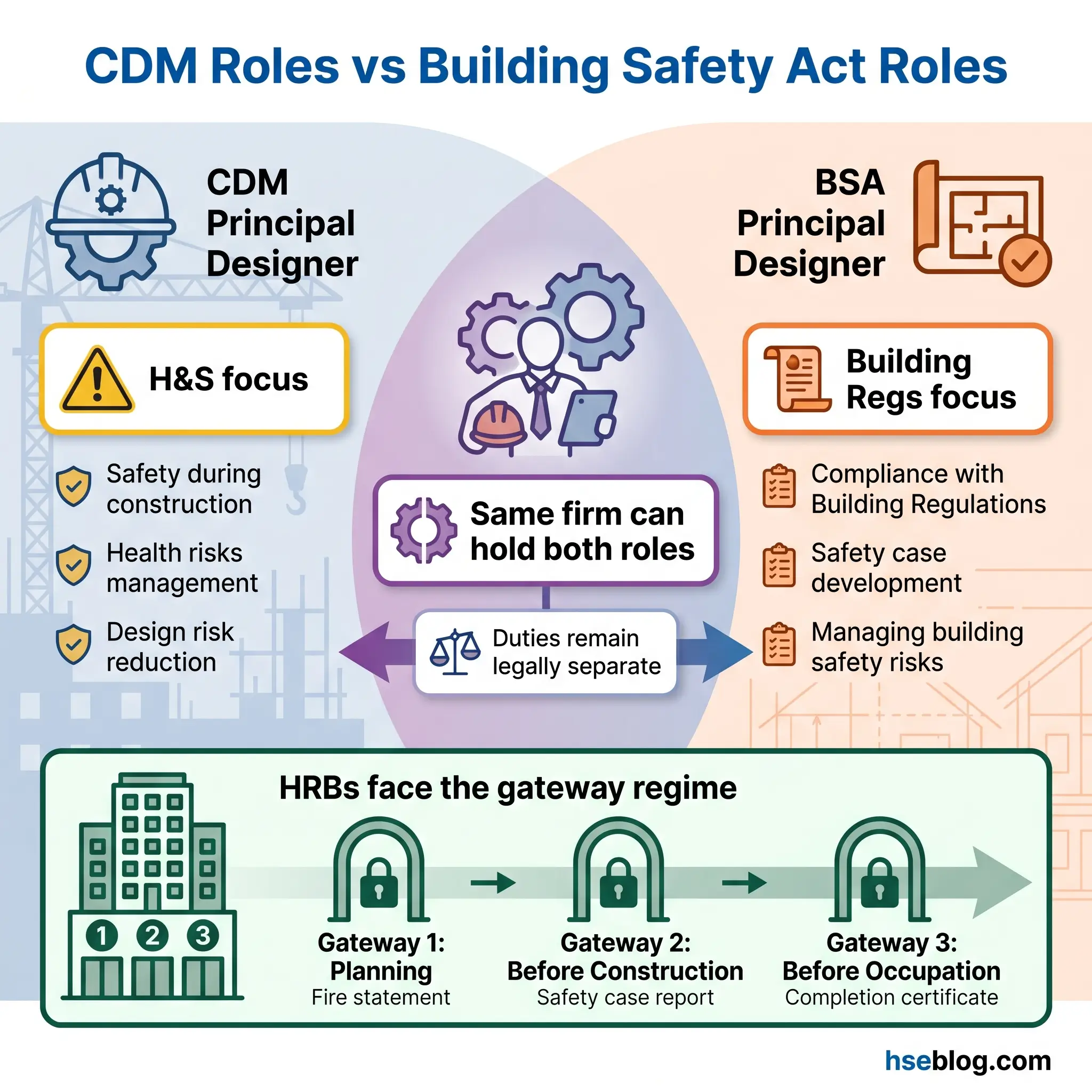
Since 1 October 2023, the Building Safety Act 2022 and the Building Regulations etc. (Amendment) (England) Regulations 2023 have layered a parallel dutyholder regime on top of CDM for projects in England that require Building Regulations approval. The new regime creates Building Regulations Principal Designer and Building Regulations Principal Contractor roles, focused specifically on Building Regulations compliance. The same person or organisation can be appointed to both the CDM and BSA roles — and often should be, for coordination — but the duties are legally distinct and need to be discharged separately.
Who Is Responsible for Pre-Construction Information?
Three misunderstandings about PCI responsibility come up repeatedly in tender meetings. The first is that the client can delegate the duty entirely to the principal designer. They cannot. The second is that the principal designer authors the PCI; in reality they assist, but the client remains legally accountable for providing it. The third is that domestic clients have no CDM duties at all. They do, but most of those duties transfer by default.
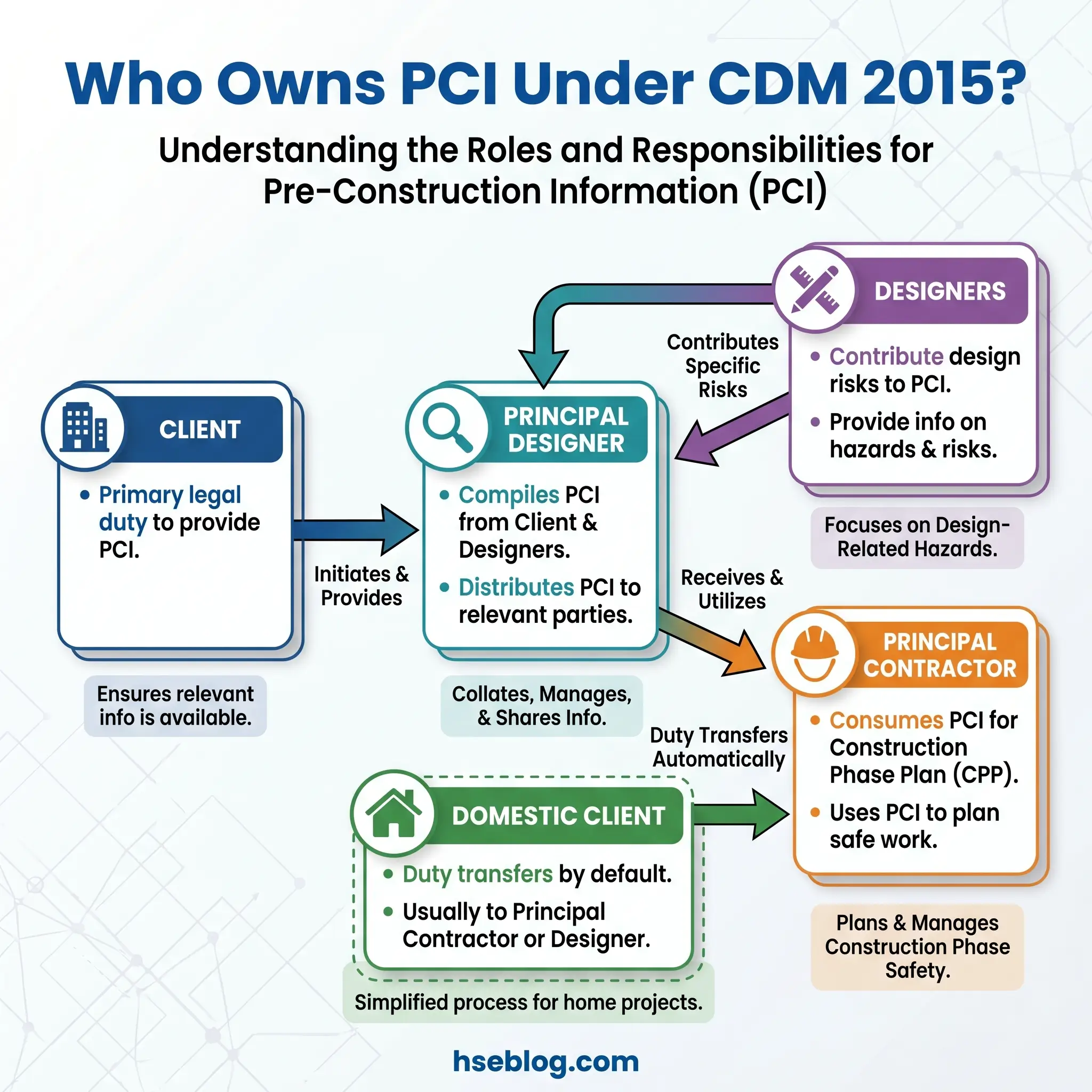
The client carries the primary legal duty under Regulation 4(4). On most commercial projects, the client does not physically compile the pack — a principal designer or CDM consultant does — but the client signs off its sufficiency, funds the surveys that populate it, and takes the legal hit if it is inadequate. The principal designer must be appointed in writing wherever more than one contractor is, or is likely to be, engaged on the project. Their role under Regulation 11(6) is to plan, manage, and monitor the pre-construction phase, which in practice means driving PCI compilation and making sure it reaches the right people at the right time.
Designers — architects, structural engineers, M&E consultants, specialists — have a direct duty under Regulation 9 to eliminate foreseeable health and safety risks so far as is reasonably practicable, and to communicate any significant residual risks back up to the principal designer for inclusion in the PCI. A design-risk register that a designer keeps to themselves is not CDM-compliant; it is a liability waiting to be discovered in disclosure.
Contractors and principal contractors sit downstream. They are consumers of PCI who use it as the evidential base for their Construction Phase Plan. A principal contractor who produces a CPP without apparent reference to the PCI — generic method statements, no acknowledgement of site-specific hazards — is a significant red flag that HSE inspectors are trained to spot.
For domestic clients, Regulation 7 transfers the client's CDM duties by default. On a single-contractor domestic project, the sole contractor picks up the PCI function. On a multi-contractor domestic project, the principal contractor does — unless the domestic client has signed a written agreement placing the duty on the principal designer. The domestic client is still allowed to appoint duty holders in writing, but the law does not expect them to run CDM themselves.
When Must Pre-Construction Information Be Provided?
"As soon as is practicable" is not a placeholder phrase. It is the regulatory trigger that decides whether PCI is delivered early enough to do any good. The test HSE and the courts apply is whether the information was available before the decisions it should have informed were made.
That means PCI must reach designers before they commit the project to a particular method or form of construction. It must reach contractors being considered for appointment — not only those already appointed — so that tender returns are based on accurate information. And it must be complete enough before construction starts for the principal contractor to produce a suitable Construction Phase Plan. A PCI pack delivered to the principal contractor on the morning of the pre-start meeting is, almost by definition, late.
Regulation 4(1) backs this up with a separate client duty: the client must ensure that sufficient time and resources are allocated to each phase of the project. In plain English, if the programme does not allow time for a refurbishment and demolition asbestos survey to be commissioned, completed, and reviewed before tender returns are due, the client has already breached CDM before a single brick has been touched. On one recent commercial refit I reviewed, the client had squeezed the pre-construction phase by twelve weeks to hit a leasing deadline. The PCI issued at tender was a redacted version of the landlord's generic estate information, with no asbestos survey attached. The successful contractor priced on clean assumptions and hit a buried chrysotile service riser on day three of strip-out. That incident did not need to happen.
PCI is iterative by design. A first version goes out at tender stage, containing the client's existing information and any surveys that have been commissioned. As the design develops, as further surveys land, as ground investigations report, the pack is updated and re-issued under version control. The final version is the one the principal contractor uses to build the Construction Phase Plan, and the residual-risk content of it feeds the Health and Safety File at completion.
What to Include in a Pre-Construction Information Pack
HSE L153 Appendix 2 provides the definitive practical checklist. The structure below follows Regulation 2's three statutory categories, populated with the content types Appendix 2 calls for and the details I have found make the difference between a PCI that works and one that gets filed and forgotten.
Project Information
The front matter of the pack — the "what, where, when, who" that sets context for everything that follows.
- Project description and scope: What is being built or altered, intended use after completion, and any phasing or partial handovers.
- Location and boundaries: Site address, red-line boundary, adjoining land uses, and any access restrictions created by those adjacencies.
- Programme: Key dates including the length of the pre-construction phase, target start on site, and planned completion.
- Duty holder details: Client, designers, principal designer, principal contractor, and other consultants, with contact details and scope of appointment.
- Existing records: Where drawings, historic Health and Safety Files, O&M manuals, and survey archives can be located.
Planning and Management of the Project
The governance layer — how the project will be run for health and safety purposes.
- Client's health and safety goals: Specific, measurable targets rather than generic aspirations.
- Cooperation and coordination arrangements: How duty holders will share information and resolve conflicts between design and construction decisions.
- Design change management: The process for assessing and communicating the H&S implications of design changes during the build.
- Communication and meeting structure: Frequency and attendance for progress meetings, design team meetings, and health and safety reviews.
- Site rules: Especially critical where the project is inside occupied premises such as hospitals, schools, laboratories, or working industrial sites.
- Welfare and site set-up expectations: What the client expects, what the site can accommodate, and where welfare units can be located.
- F10 notification status: Confirmation of whether the project is notifiable (construction expected to last more than 30 working days with more than 20 workers on site simultaneously at any point, or to exceed 500 person-days), who will submit the F10, and the reference number once issued.
Health and Safety Hazards — Site Information
The longest and most consequential sub-section. It is where PCI either succeeds or fails as a risk-elimination tool.
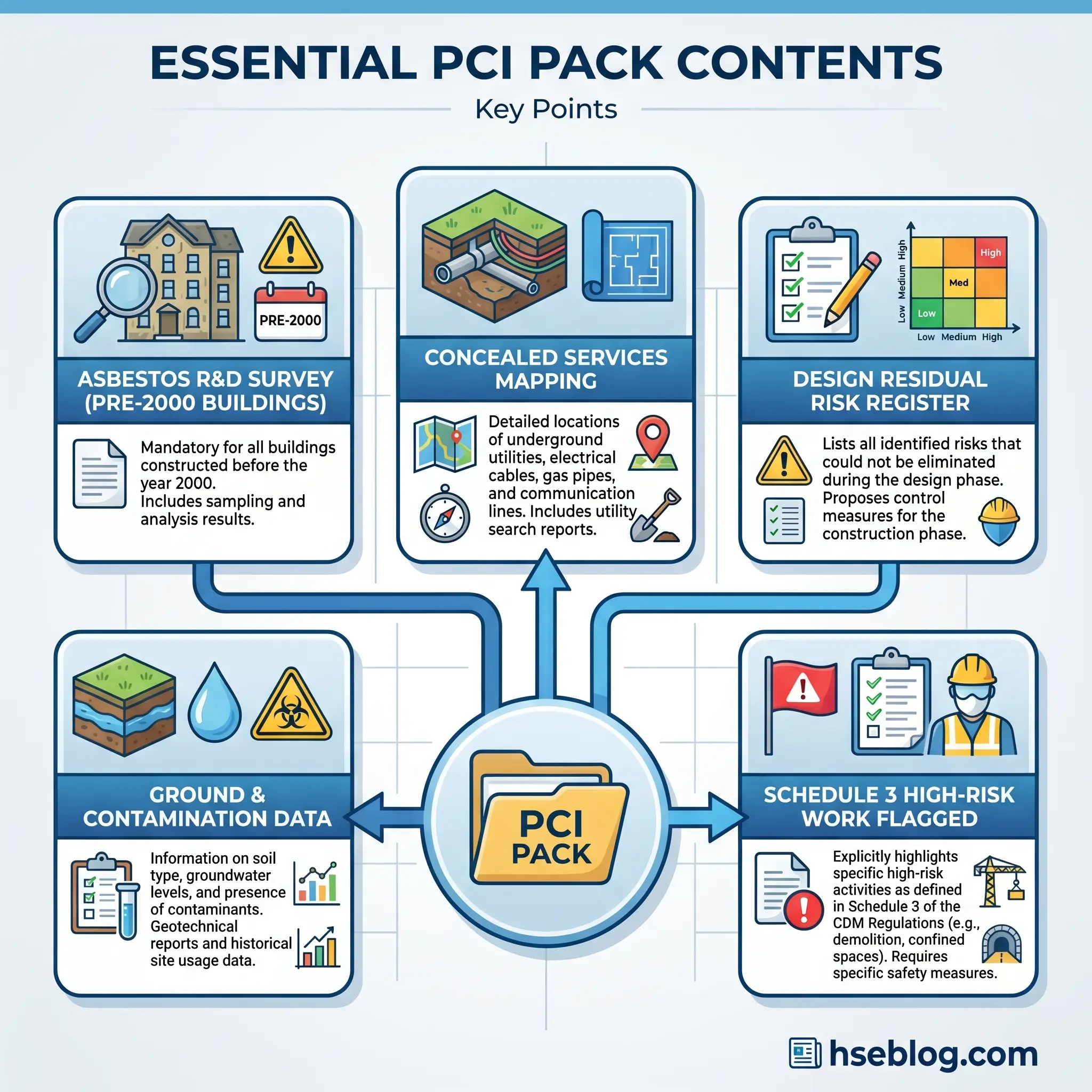
- Asbestos: A management survey as a minimum for any pre-2000 building; a refurbishment and demolition survey is required wherever the planned work will disturb the fabric. The R&D survey is the single most consequential pre-construction deliverable on any older building.
- Ground conditions and contamination: Previous industrial use, made ground, unexploded ordnance risk in areas subject to historic bombing, landfill gas, hydrocarbon contamination, and Japanese knotweed.
- Existing and concealed services: Overhead power lines, buried cables, gas, water, telecoms, and redundant services that may not appear on current drawings. CAT-and-genny limits mean little without service drawings issued as part of the PCI.
- Existing structures: Condition, load-bearing capacity, known defects, records of previous alteration, and any structural monitoring in place.
- Boundaries and neighbouring uses: Schools, railways, busy roads, occupied offices above or beside the works, with specific emphasis on public interface risks.
- Fire strategy for existing buildings: Means of escape during works, temporary fire compartmentation, and interaction with live fire alarm systems.
- Hazardous materials on site: Particularly relevant on COMAH establishments or sites with existing chemical stores, process residues, or bulk fuel storage.
- Biological hazards: Bird and rodent droppings, Legionella risk in existing water systems, and clinical waste legacy on hospital sites.
- Environmental constraints: Noise, dust, and vibration limits imposed by the operating environment or planning conditions.
Health and Safety Hazards — Design and Construction Hazards
The design team's contribution to the PCI. Designers are not expected to produce method statements, but they are expected to communicate the residual risks their design creates.
- Significant residual design risks: Hazards that could not be eliminated at design stage and must therefore be managed during construction, use, maintenance, or demolition.
- Unusual construction methods: Sequences or techniques the design requires that go beyond standard practice.
- Special materials: Materials that demand specific handling, installation, or disposal precautions.
- Temporary works and stability: Construction and dismantling sequences, propping requirements, and any known constraints on future demolition.
- Schedule 3 work: Explicit flagging of any work falling within the ten categories of particularly high-risk work in CDM 2015 Schedule 3.
How Pre-Construction Information Flows Into Other CDM Documents
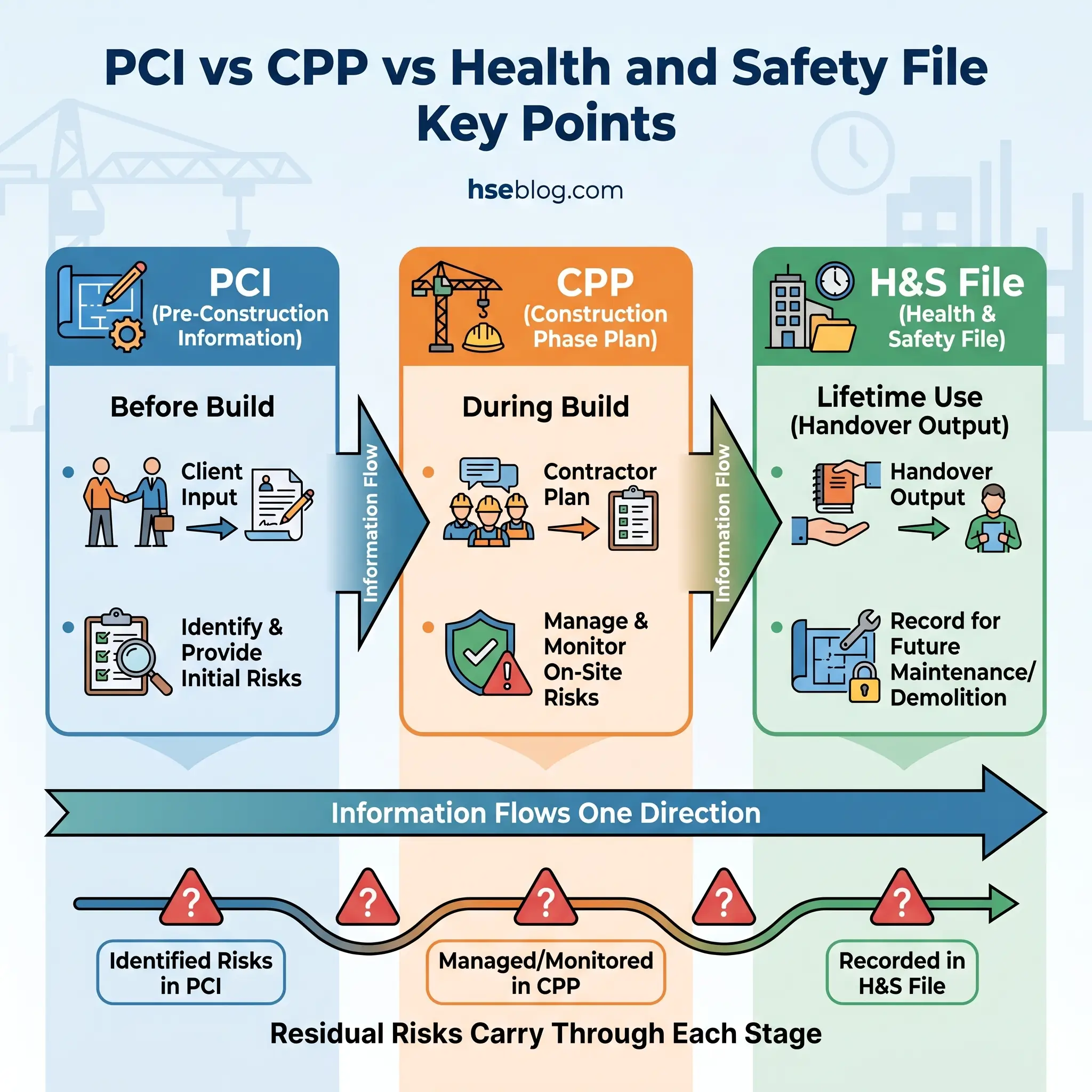
PCI is one of three CDM documents that get confused with each other on almost every project I audit. Clearing up the confusion starts with the information flow: PCI feeds the Construction Phase Plan during the build, and the residual hazards in both feed the Health and Safety File at completion.
The Pre-Construction Information is the input. The client provides it, the principal designer assists in compiling it, and it exists before construction starts. Its purpose is to describe what is known about the site, the project, and the hazards so that designers and contractors can make informed decisions.
The Construction Phase Plan is the principal contractor's operational response to that input. It is a live, site-specific document that sets out how the principal contractor will manage the hazards identified in the PCI throughout construction. Generic CPPs copied between projects are the tell-tale sign of a principal contractor who has not engaged with the PCI at all.
The Health and Safety File is the post-construction output. The principal designer prepares it (or, where no principal designer is in place at completion, the principal contractor) and hands it to the client at project close-out. It contains the residual hazard information future duty holders — maintenance contractors, refurbishment designers, demolition contractors — will need for the life of the asset. Asbestos left in situ, structural restrictions, hidden services, maintenance access points: these are the contents that justify the document's existence.
One of the clearest lessons from HSE L153 is that PCI should be proportionate to risk. Padding a PCI with irrelevant generic boilerplate — copied health and safety policies, marketing brochures, non-project-specific risk assessments — does not demonstrate diligence. It dilutes the document and makes the genuinely important content harder to find. A thirty-page PCI that covers the real hazards precisely is always better than a three-hundred-page PCI that covers everything vaguely.
Pre-Construction Information for Domestic Clients
A domestic client is someone having construction work done on their own home, or the home of a family member, that is not connected with a business. The homeowner commissioning a loft conversion, the family extending their kitchen, the self-build project on an inherited plot — all domestic clients under CDM.
Regulation 7 handles this cleanly. The domestic client has CDM client duties, including the duty to provide PCI, but those duties transfer by default. On a single-contractor project, the sole contractor inherits them. On a multi-contractor project, the principal contractor does, unless the client has signed a written agreement passing the duty to the principal designer instead.
In field terms, this means the architect on a domestic extension should expect to hold the PCI function whenever a written agreement is in place, and the builder should expect to hold it by default when one is not. I have had more than one conversation with a domestic builder who has said, in good faith, "I don't need to worry about CDM — it's a homeowner project." That is precisely the scenario where the CDM duties have defaulted onto their shoulders. The regulator's position is unambiguous: someone is always responsible, and on domestic projects it is almost always the construction professional, not the homeowner.
Practically, the PCI on a domestic project does not need to be the same document you would produce for a £50 million scheme. It needs to be proportionate — a short structured pack covering the property, the scope, the known hazards (is the house pre-2000? is there known asbestos? are there structural limitations?), and the design-risk information the contractor needs to work safely. Appendix 2 of L153 still applies as the content guide; what changes is the depth, not the scope.
Pre-Construction Information Under the Building Safety Act 2022
The Building Safety Act 2022 is the most significant legislative change affecting PCI practice since CDM 2015 itself. For English projects requiring Building Regulations approval, the October 2023 reforms introduced Building Regulations Principal Designer and Building Regulations Principal Contractor dutyholders, who sit in parallel to their CDM counterparts.
The distinction between the two regimes is easy to state and easy to muddle in practice. CDM Principal Designer and CDM Principal Contractor are focused on managing health and safety during the pre-construction and construction phases. The BSA equivalents are focused on securing compliance with the Building Regulations — fire safety, structural integrity, ventilation, energy performance. The same firm can be appointed to both roles, and on most projects that alignment makes coordination easier. But the duties are separate, the competence tests are separate, and the documentation expectations are separate.
For higher-risk buildings — structures of at least 18 metres in height or at least seven storeys, containing two or more residential units — the Building Safety Regulator within HSE runs a stricter "gateway" regime. Gateway 2 sits before construction and requires detailed information to be submitted and approved before work can start. Gateway 3 sits at completion and requires evidence of compliance before the building can be occupied. The "golden thread" of information requirement for HRBs runs across the full project lifecycle and effectively elevates the quality, traceability, and digital accessibility of what used to live in separate PCI, CPP, and H&S File documents.
The Grenfell Tower Inquiry Phase 2 Final Report in September 2024 recommended an urgent review of the HRB definition, arguing that the current 18-metre / seven-storey threshold captures fewer buildings than public safety requires. Anyone producing PCI for English residential or mixed-use projects close to those thresholds should expect the scope of the HRB regime to expand within the next regulatory cycle.
What Happens If Pre-Construction Information Is Missing or Inadequate
HSE has three enforcement routes when PCI is found to be deficient. The first is an improvement notice, requiring the duty holder to remedy the breach within a specified period. The second is a prohibition notice, stopping work immediately where the breach creates risk of serious personal injury. The third is prosecution — corporate in character for companies, criminal for individuals — under the Health and Safety at Work etc. Act 1974, which is the parent legislation CDM sits beneath.
Penalties under CDM 2015 include unlimited fines for corporate defendants and, for individuals convicted on indictment, custodial sentences of up to two years under HSWA 1974 Section 33. Enforcement notices stay on the HSE public register for five years and feed into the regulator's picture of an organisation's safety track record. On any significant tender thereafter, those notices will surface.
The enforcement picture has shifted over successive iterations of CDM. Analysis published through the British Safety Council traces CDM prosecutions from just eight under CDM 1994 to several hundred under CDM 2015, with principal designers and principal contractors increasingly prosecuted jointly with clients for pre-construction planning failures. HSE's own research on principal designer implementation makes clear that deficient pre-construction information is a recurring finding in fatal-accident investigations.
The costs that do not show up in the prosecution statistics are arguably the larger ones. Inadequate PCI drives tender disputes when the winning contractor discovers hazards that were not priced. It drives design re-work when a risk surfaces late that should have been flagged at concept stage. It drives programme delays and compensation claims. And it lifts professional indemnity premiums for firms who have had to notify their insurers of a CDM-related claim.
Building a Pre-Construction Information Pack: A Practical Workflow
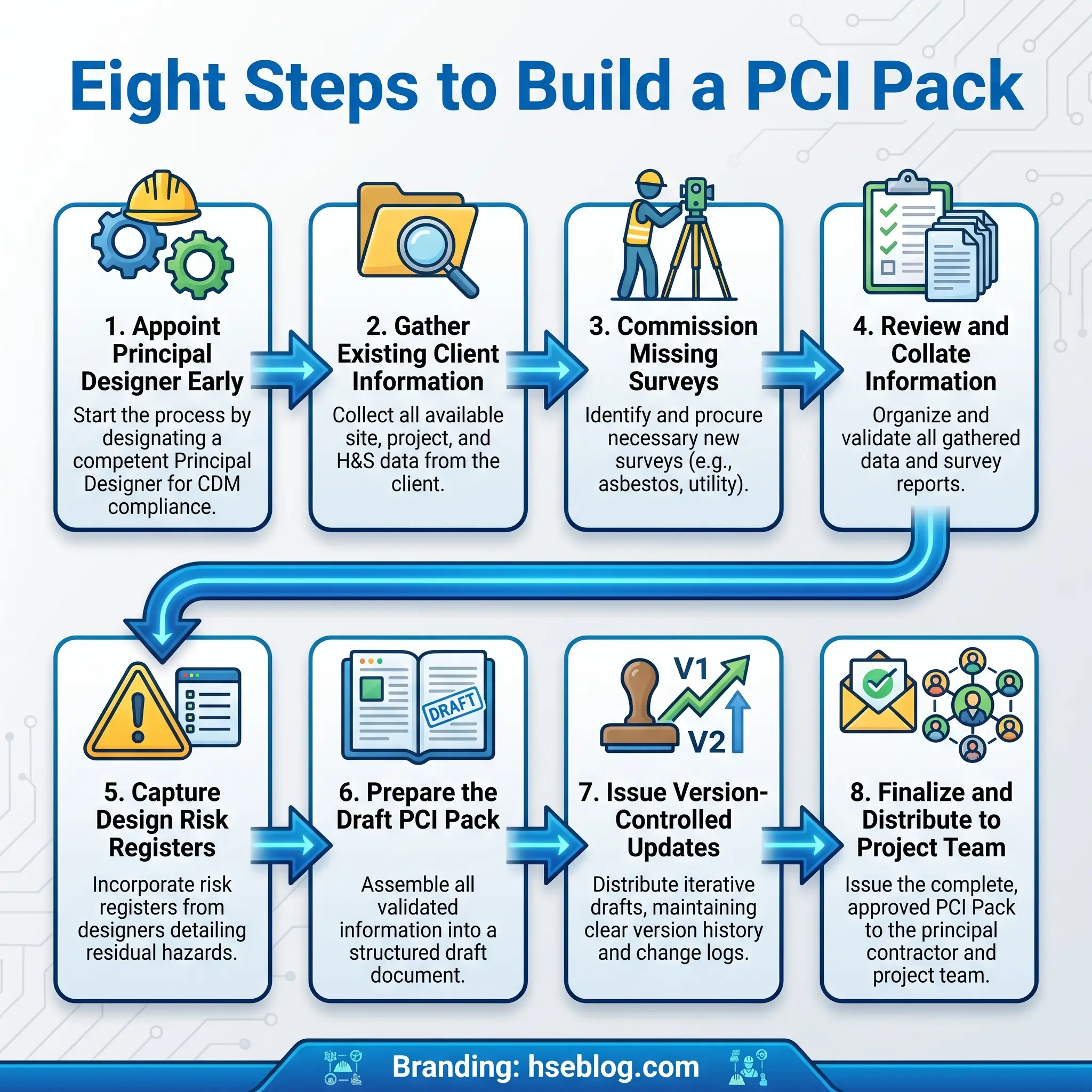
Every principal designer develops their own cadence for compiling PCI, but the sequence below reflects what works on commercial projects where the pre-construction phase is measured in weeks rather than months.
- Appoint the principal designer early. Ideally before concept design and certainly before any contractor is considered for appointment. The earlier the PD is in place, the more design-stage hazard elimination becomes possible.
- Gather existing client information. Landlord drawings, any previous Health and Safety File, asbestos register, lease conditions, warranty packs, ground investigation reports from earlier projects, and any historical site records the client holds.
- Commission missing surveys. Refurbishment and demolition asbestos survey on any pre-2000 building where the fabric will be disturbed; ground investigation where excavation is planned; structural survey where alteration to load-bearing elements is proposed; measured surveys where existing drawings are inadequate; utility mapping from statutory undertakers.
- Capture designer-generated risk information. Design-risk registers from each design discipline, design assumptions, known residual risks, and flagged Schedule 3 work.
- Structure the document against L153 Appendix 2. Use the ACoP headings as the skeleton so that the PCI is auditable against the statutory checklist.
- Distribute the first complete version at tender stage. Not to appointed parties only — to every contractor being considered for appointment, so tender returns are priced on common information.
- Re-issue under version control as new information emerges. Each update dated, referenced, and accompanied by a change log so recipients know what has changed since the last issue.
- Transfer residual-risk content to the Health and Safety File at completion. The PCI does not simply disappear when construction starts — the hazards that remain at handover become the backbone of the H&S File for the life of the building.
The most competent CDM consultant I have worked with described this workflow to a new principal designer in one sentence: PCI is not a document you finish, it is a document you maintain. That framing is worth adopting.
Frequently Asked Questions
What should be included in a pre-construction information pack?
A PCI pack must cover the three statutory categories set out in Regulation 2 of CDM 2015: information about the project, information about its planning and management, and information about health and safety hazards including design and construction hazards. The authoritative practical checklist is Appendix 2 of HSE L153, which sets out the expected content under each category — from asbestos survey results to design-risk registers to site rules for occupied premises.
When must pre-construction information be provided to contractors?
As soon as is practicable under Regulation 4(4) — which in operational terms means before contractors make decisions the PCI should have informed. PCI must be available to contractors being considered for appointment, not only to those already appointed, so it needs to exist at tender stage. A PCI pack delivered at the pre-start meeting is legally late.
Is pre-construction information required for small or domestic projects?
Yes. CDM 2015 applies to every construction project in Great Britain regardless of size, duration, or notifiability. What changes is proportionality — a small project has a shorter, focused pack — and responsibility. On domestic projects, Regulation 7 transfers the PCI duty from the homeowner to the contractor, or to the principal contractor where there is more than one contractor, unless the client has signed a written agreement placing it on the principal designer.
What is the difference between pre-construction information and a construction phase plan?
PCI is the input; the Construction Phase Plan is the operational response. The client provides PCI before construction, describing the site, project, and hazards. The principal contractor then produces the CPP, setting out how those hazards will be managed during construction. PCI is shared across all duty holders; the CPP is owned by the principal contractor and kept live throughout the build. Both then feed the Health and Safety File at completion.
Does the Building Safety Act 2022 change pre-construction information duties?
For English projects requiring Building Regulations approval, yes. Since 1 October 2023, the Building Regulations etc. (Amendment) (England) Regulations 2023 have introduced Building Regulations Principal Designer and Building Regulations Principal Contractor dutyholders who sit in parallel to their CDM equivalents. The CDM PCI duty continues unchanged, but the BSA regime adds its own information and compliance expectations — and for higher-risk buildings, the Building Safety Regulator's gateway regime imposes significantly more rigorous documentation requirements.
What are the consequences of failing to provide adequate pre-construction information?
HSE can issue improvement notices, prohibition notices stopping work immediately, or pursue prosecution under the Health and Safety at Work etc. Act 1974. Companies face unlimited fines; individuals convicted on indictment face custodial sentences of up to two years. Enforcement notices remain on the HSE public register for five years. Beyond the legal sanctions, deficient PCI drives tender disputes, design re-work, programme delays, insurance claims, and reputational damage that reaches far beyond the project in question.
Conclusion
Pre-construction information is the most leveraged document in the CDM system. Every hour spent getting it right saves days of rework, days of dispute, and — in the cases that matter most — lives. The clients, principal designers, and contractors who treat PCI as a compliance chore produce packs that are technically present and practically useless. The ones who treat it as the operational foundation of the project produce packs that change how the build actually happens.
The three shifts that separate competent PCI from the rest are worth naming directly. Start earlier than you think you need to, because "as soon as is practicable" is interpreted against what was available when decisions were made, not against the programme the client wished they had. Structure the pack against L153 Appendix 2 rather than against a generic template, so that the document can be audited against the statute it answers to. Update it continuously through the pre-construction phase and re-issue under version control, so that every recipient is working from the same information at the same moment.
The regulatory ground is still shifting. The Building Safety Act dutyholder regime, the higher-risk buildings gateway, and the recommendations from the Grenfell Inquiry Phase 2 Final Report will continue to reshape what a compliant PCI looks like on English projects over the next two years. What will not change is the underlying logic of pre-construction information: it exists to make foreseeable hazards visible before they become incidents. Every project starts with an opportunity to do that well. The duty holders who take the opportunity seriously are the ones who will not be standing in a coroner's court explaining what they did not know.