TL;DR
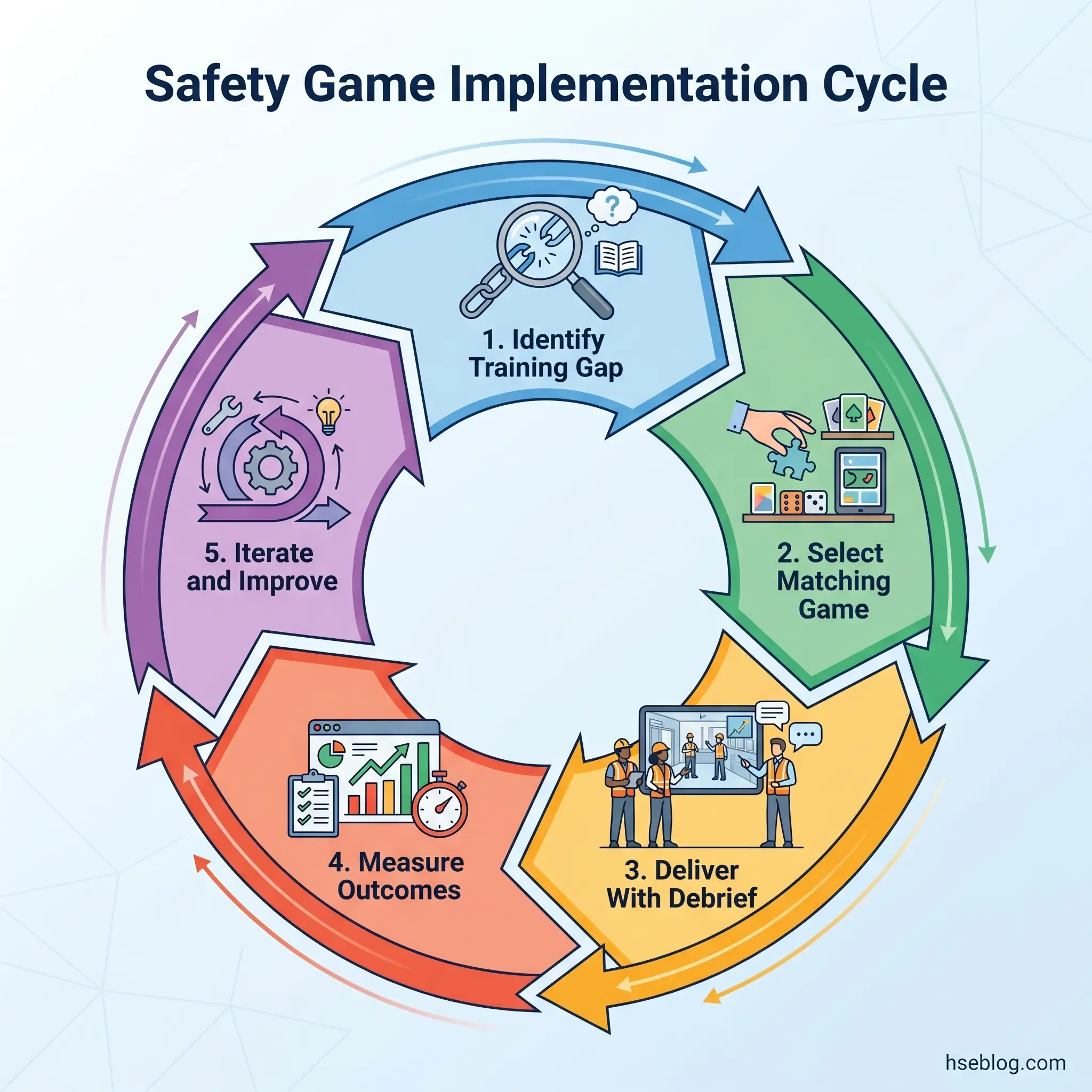
- Match the game to the gap — select safety games based on the specific training objective (hazard recognition, procedural recall, emergency response), not because they sound entertaining
- Debrief every game — a safety game without a structured debrief is recreation, not training; the learning happens in the conversation afterward
- Games supplement, never replace — no safety game satisfies formal compliance training requirements under OSHA 29 CFR standards or equivalent jurisdictional mandates
- Measure what changes — track near-miss reporting rates, pre/post knowledge scores, and incident trends over a minimum six-month window to determine whether games are actually shifting safety behaviour
- Start simple, scale deliberately — zero-cost games like safety trivia and scenario cards deliver strong results before investing in escape rooms or digital platforms
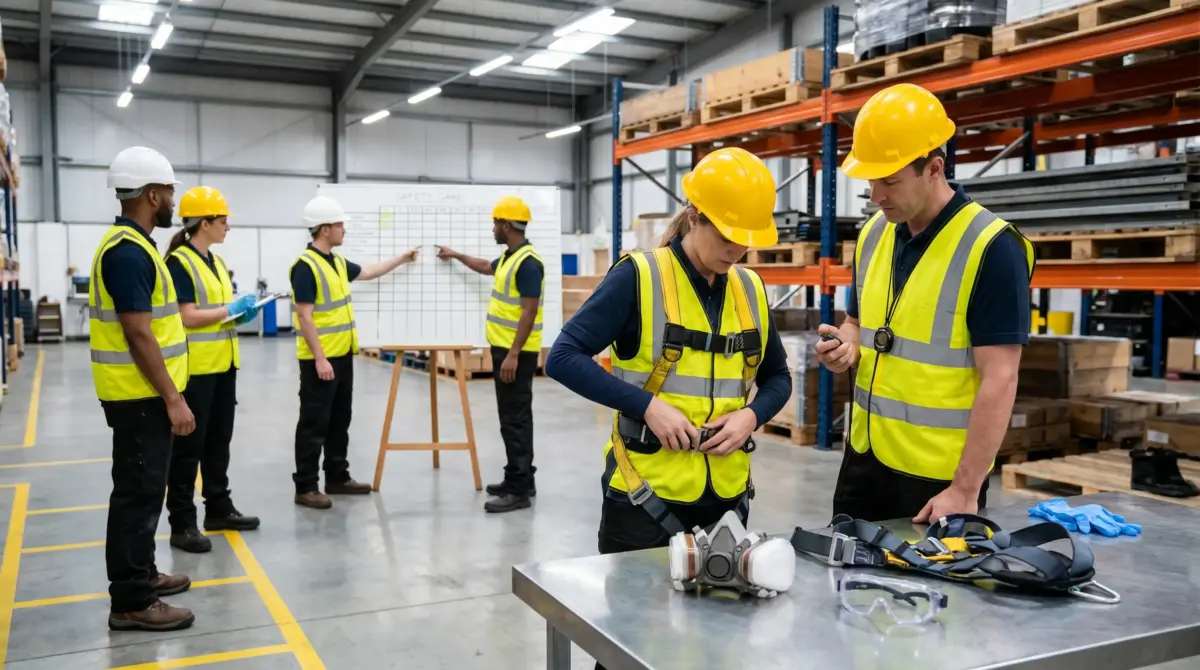
Workplace safety games are interactive training activities that teach employees about hazards, emergency procedures, and safe work practices through active participation rather than passive instruction. The most effective formats include trivia challenges, hazard scavenger hunts, PPE relay races, and scenario-based role-plays. They function best as reinforcement tools embedded within a structured safety training programme — not as stand-alone replacements for regulatory-required training.
Why Safety Games Work: The Science Behind Gamified Safety Training
A worker in the United States died every 104 minutes from a work-related injury in 2024 — 5,070 fatal work injuries total (US Bureau of Labor Statistics, 2026). That number exists despite decades of regulatory frameworks and mandatory training programmes. The problem is not a shortage of safety rules. The problem is that traditional training delivery — slide decks, read-and-sign documents, annual refresher lectures — consistently fails to produce the kind of knowledge retention that keeps people alive on the job.
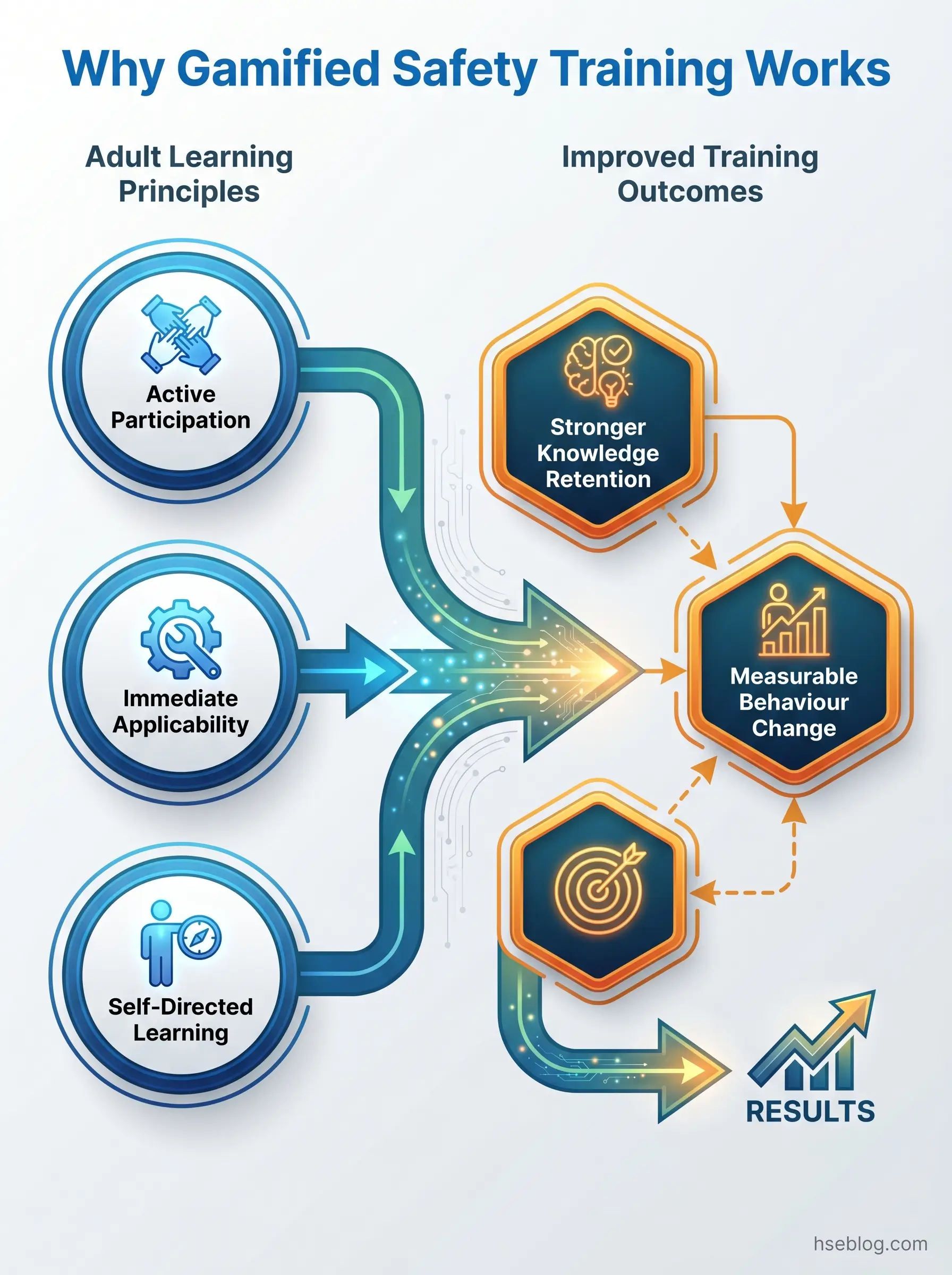
Adult learning theory, particularly Malcolm Knowles’ principles of andragogy, explains why. Adults retain information best when it is immediately applicable, grounded in experience, and self-directed. Passive lecture-based delivery violates all three conditions. Gamification addresses them directly: competition creates urgency, scenario-based play creates experience, and voluntary engagement creates ownership. A 2025 randomised controlled trial by La Torre et al., published in Annali di Igiene, Medicina Preventiva e di Comunità, found a positive effect of gamified training on occupational health and safety knowledge enhancement among 77 participants compared to standard OHS training methods.
None of this means that running a quiz show during lunch counts as a safety programme. The failure mode practitioners see repeatedly is safety games becoming annual “fun days” — disconnected from ongoing training objectives, unlinked to actual workplace hazards, and abandoned after a single session. Effective gamification treats every game as a reinforcement tool within a structured training calendar, targeted at a specific learning gap, with outcomes tracked over time.
How to Choose the Right Safety Game for Your Workplace
Most teams pick a safety game because someone found it on the internet and it looked fun. That selection process is precisely why so many gamified training efforts fail. The game itself is not the variable that matters — the match between the game and the training objective is.
A safety trivia challenge is excellent for reinforcing hazard communication knowledge or testing procedural recall after a formal training session. It is useless for teaching someone to visually identify fall hazards on a live construction site. A hazard identification scavenger hunt does that job. Mixing up these applications is how organisations waste training hours on activities that feel productive but change nothing.
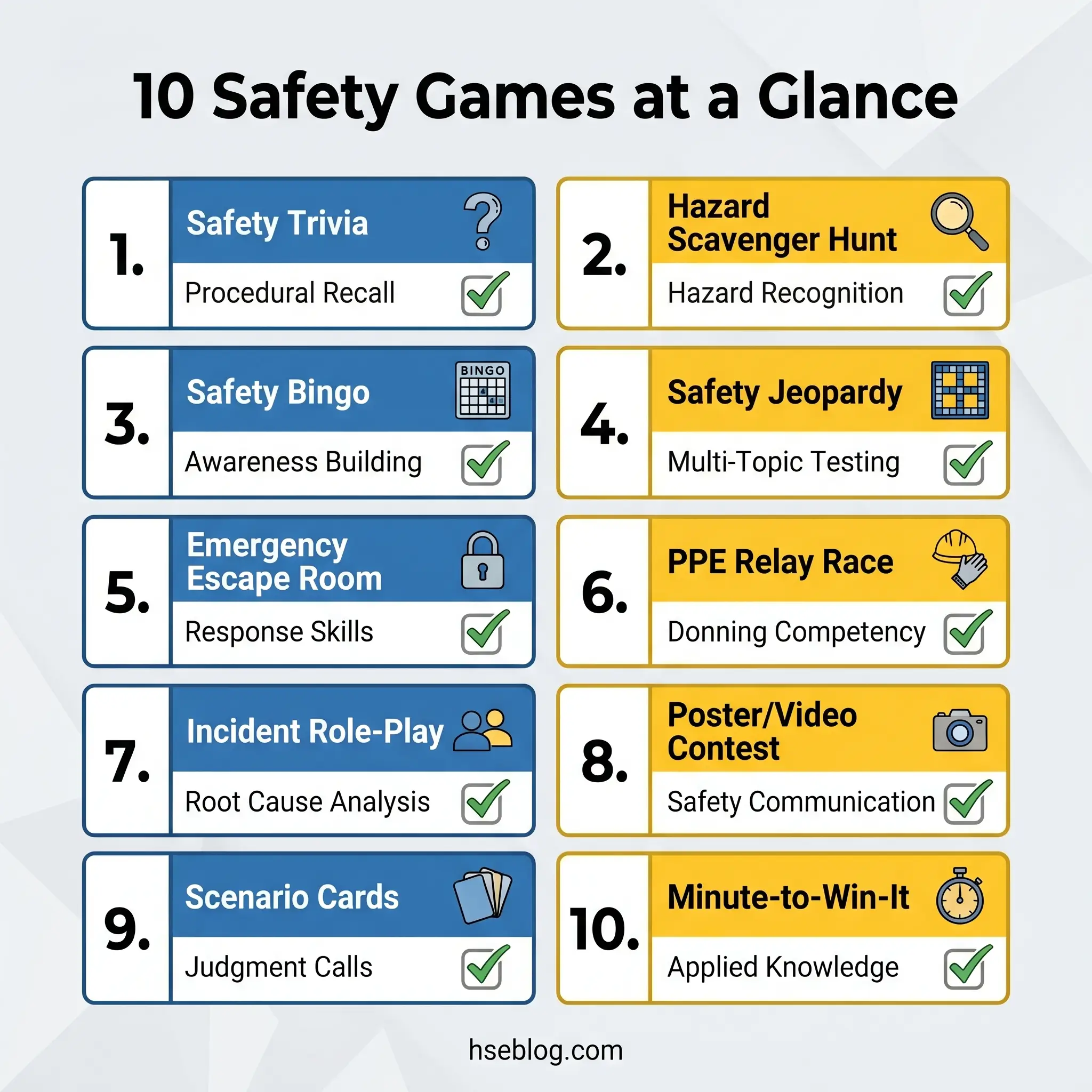
| Game Type | Best Learning Objective | Ideal Group Size | Setup Time | Cost Level | Best Industry Fit |
|---|---|---|---|---|---|
| Safety Trivia | Procedural recall, regulatory knowledge | 5–50+ | 15 min | Zero–Low | All industries |
| Hazard Scavenger Hunt | Hazard recognition, inspection skills | 5–20 | 30–45 min | Zero | Construction, manufacturing |
| Safety Bingo | Terminology recognition, awareness | 10–50+ | 10 min | Low | All industries |
| Safety Jeopardy | Multi-topic knowledge testing | 10–30 | 30 min | Zero–Low | All industries |
| Emergency Escape Room | Emergency response, SDS application | 4–6 per round | 60+ min | Moderate | All industries |
| PPE Relay Race | PPE donning/doffing competency | 10–30 | 20 min | Low | Construction, manufacturing, warehousing |
| Incident Investigation Role-Play | Root-cause analysis, investigation skills | 5–15 | 30 min | Zero | All industries |
| Safety Poster/Video Contest | Safety communication, creative engagement | Any | Varies | Low | All industries |
| Scenario “What Would You Do?” Cards | Decision-making, grey-area judgment | 5–15 | 5 min | Zero | All industries |
| Minute-to-Win-It Challenge | Applied knowledge under pressure | 10–30 | 10 min | Zero–Low | All industries |
Matching Games to Training Objectives
The table above functions as a selection filter, not a menu. Start with the training gap, not the game. If your last incident investigation revealed that workers could not correctly identify the right fire extinguisher class for an electrical fire, a Minute-to-Win-It challenge targeting extinguisher classification addresses that gap directly. If near-miss reporting has stalled, an observational Safety Bingo running across shifts re-engages workers with active hazard monitoring. The discipline is in selecting from the gap backward, not from the game forward.
10 Workplace Safety Games That Actually Improve Safety Outcomes
Each game below is described with setup guidance, the specific safety skill it reinforces, and practical deployment notes. They are sequenced from simplest setup to most resource-intensive, so teams with zero budget can start at the top and scale when ready.
1. Safety Trivia Challenge
A quiz-format game that tests employees on safety rules, hazard communication, emergency procedures, and PPE requirements. Teams compete across rounds, scoring points for correct answers. The format is flexible — run it with a whiteboard and index cards during a toolbox talk, or use digital platforms like Kahoot or Mentimeter for real-time scoring across multiple shifts and remote locations.
The key to a trivia game that actually teaches is question sourcing. Pull questions from your own incident data and near-miss reports, not generic internet question banks. A question about a lockout/tagout failure that actually happened at your facility carries different weight than a textbook definition. Rotate question banks monthly — repeated exposure to the same bank produces memorisation without comprehension.
Watch For: The teams that extract the most training value from safety trivia are the ones that debrief wrong answers. A missed question about confined-space atmospheric testing is a diagnostic signal pointing to a knowledge gap — not just a lost point. If three teams miss the same question, that topic needs formal retraining, not another round of trivia.
Best for: Reinforcing procedural knowledge after formal training, multi-shift or remote workforces, regular safety meeting integration.
2. Hazard Identification Scavenger Hunt
Teams walk through the actual workplace — production floor, warehouse, jobsite — with checklists, competing to identify as many potential hazards as possible within a set time limit. Points are scored for correctly identified hazards, with bonus points for hazards not previously documented.
This is one of the highest-value safety games because it builds genuine hazard-recognition skills in the environment where those skills matter. The game connects directly to OSHA’s recommended safety walkaround practice and aligns with the “Eyes on Safety” challenge from OSHA’s Safe + Sound campaign activities.
Two non-negotiable rules apply. First, supervisors must pre-walk the route to document both planted and real hazards — this creates the scoring baseline. Second, any genuine hazards identified during the game must be corrected immediately. A scavenger hunt that discovers a blocked emergency exit and then leaves it blocked has failed at the most fundamental level.
A consistent pattern across organisations that run this game: it surfaces real hazards that routine inspections miss. Workers who are actively hunting for problems see things they walk past every day. Treat findings as genuine inspection data and feed them into your corrective-action tracking system.
Best for: Construction sites, manufacturing floors, warehousing — any environment where physical hazards are visually identifiable.
3. Safety Bingo
Bingo cards populated with safety terms, procedures, or safe behaviours. A facilitator calls out definitions or describes scenarios; players mark the corresponding term. The game reinforces safety vocabulary and builds terminology recognition with minimal setup — printable cards and a list of definitions.
The variant worth investing in is observational bingo. Instead of a single-session game, distribute bingo cards where each square describes a safe behaviour (“worker performing pre-use equipment check,” “correct lifting technique observed,” “near-miss reported”). Workers mark squares as they observe behaviours over the course of a week or shift rotation.
The Fix That Works: Observational bingo is the variant that changes daily behaviour. It converts passive awareness into active monitoring across the entire workday, not just the 15 minutes of a toolbox talk game.
Best for: Ongoing engagement across shifts, reinforcing safety terminology, scalable to any group size.
4. Safety Jeopardy
A game board with safety categories — Fire Safety, PPE, First Aid, HazCom, Ergonomics — and questions of varying difficulty and point values. Teams select categories and difficulty levels, competing for points.
The judgment call that separates a useful Jeopardy game from a generic one is category design. Categories should mirror your workplace’s actual risk profile, not a textbook table of contents. If your site’s top hazards are chemical exposure and machine guarding, those categories should dominate the board. A manufacturing facility running Jeopardy with a “Working at Height” category it copied from a construction template is wasting training time on the wrong risks.
Run it with a whiteboard and sticky notes, or use a free digital Jeopardy template projected on a screen. Works particularly well as a toolbox-talk closer or a safety stand-down activity where energy tends to dip.
Best for: Multi-topic knowledge testing, team competition, safety meeting engagement.
5. Emergency Response Escape Room
Teams of four to six are placed in a room with safety-related puzzles they must solve to “escape” a simulated hazardous scenario within a time limit. Puzzles require applying actual emergency procedures: reading a Safety Data Sheet to identify the correct spill response, selecting the right fire extinguisher class, assembling required PPE for a given hazard.
This game demands more setup time and budget than anything else on this list — realistic props, scenario design, physical space. The investment is justified only if the debrief is treated with equal seriousness.
Audit Point: The escape room’s real training value lives in the debrief, not the game. Teams that rush to “win” without examining their reasoning miss the point entirely. Facilitators should time-box the debrief at minimum equal to play time. Ask: “Why did you choose that extinguisher? What would have happened if you’d chosen wrong?”
Best for: Emergency response skills, SDS application, teams of 4–6, organisations willing to invest in experiential learning.
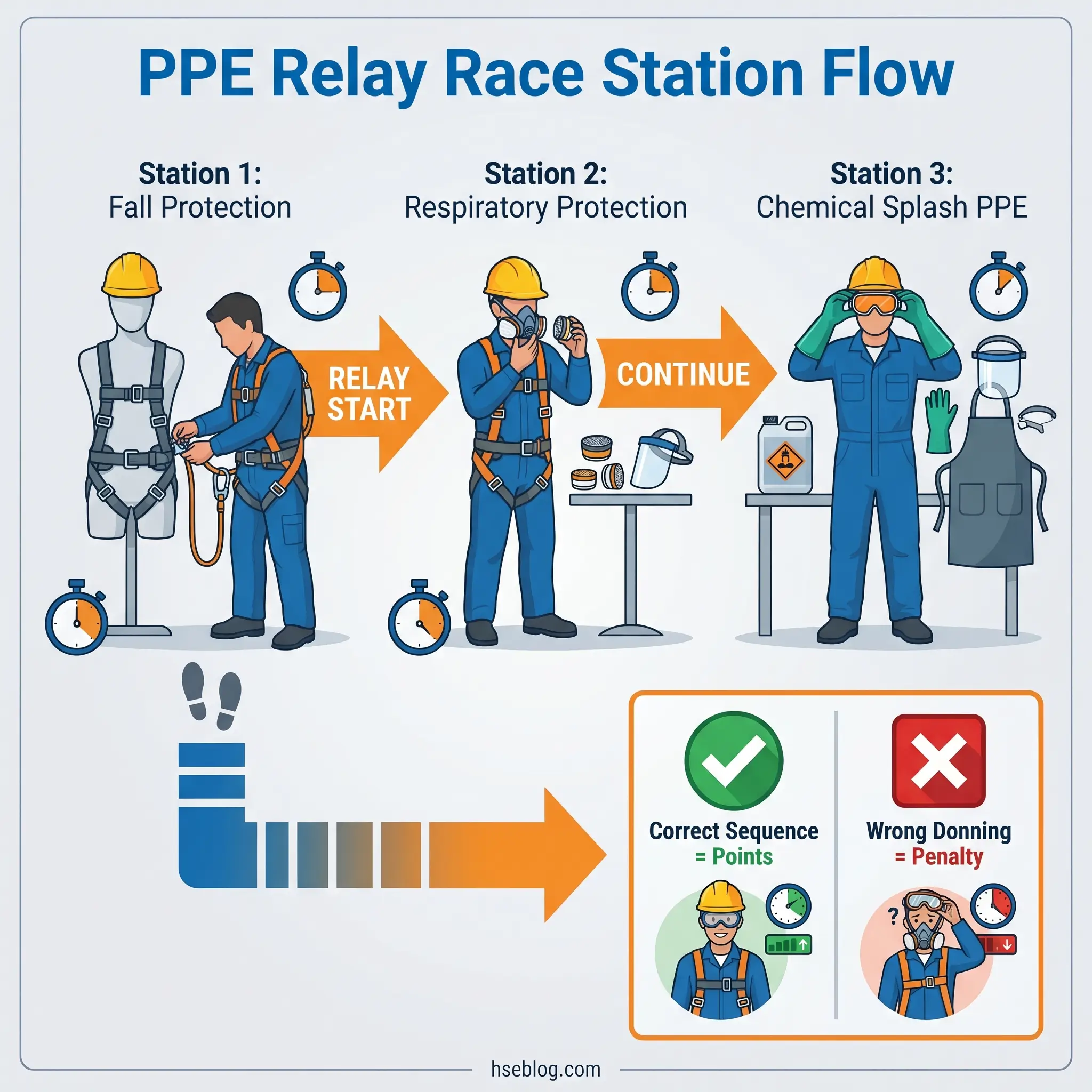
6. PPE Relay Race
A timed relay race where team members must correctly don and doff specific PPE at stations representing different hazard scenarios. One station requires a hard hat and full-body harness for fall protection. Another requires a half-face respirator for confined-space entry. A third requires chemical splash goggles and nitrile gloves for hazardous substance handling. Scoring rewards both speed and correctness — incorrect donning or wrong sequence deducts points.
Under OSHA 29 CFR 1910.132(f) (US), employers must train employees on proper PPE donning, doffing, limitations, and maintenance, with retraining required when an employee demonstrates inadequate knowledge. A PPE relay race, when scored on correctness rather than speed alone, functions as both a training reinforcement and a competency diagnostic.
The consistent finding from running this format is that workers who believe they know how to don a harness often get the leg-strap sequence wrong when timed. The time pressure strips away rehearsed confidence and exposes genuine competency gaps that classroom demonstrations mask. Treat every incorrect donning as a retraining trigger, not a game penalty.
Best for: Construction, manufacturing, warehousing — any workforce requiring regular PPE competency verification.
7. Incident Investigation Role-Play
Teams receive a fictional but realistic incident report — based on real industry patterns without identifying details — and must identify root causes, contributing factors, and corrective actions. Each team presents findings to a panel that evaluates completeness and analytical depth.
Structure the exercise around a recognised root-cause-analysis framework. Give teams a 5 Whys template or a fishbone diagram scaffold. Without a framework, discussions default to surface-level blame attribution: “the worker didn’t follow procedure.” With a framework, teams are forced to ask why the procedure wasn’t followed, why the system allowed deviation, and whether the procedure itself was adequate.
The game reveals something important about safety culture maturity. Teams that immediately identify the individual at fault and stop there are thinking in terms of personal blame. Teams that reach systemic factors — inadequate supervision, conflicting production pressure, unclear procedures — are thinking in terms of system failure. The distribution of responses across your workforce tells you where your safety culture actually sits, not where your safety policy says it should be.
Best for: Building investigation skills, diagnosing safety culture maturity, all industries.
8. Safety Poster or Video Contest
Individuals or teams design safety posters, produce short safety videos, or write safety slogans addressing a specific theme assigned by the facilitator. Entries are judged on accuracy of safety content, creativity, and clarity of message. Winning entries are displayed in break rooms, projected on digital screens, or shared through internal communications channels.
Assign themes that align with current workplace priorities — not open-ended “safety” topics. If you have just completed a HazCom refresher, the theme is chemical labelling. If fall-protection incidents are trending upward, the theme targets working-at-height awareness.
User-generated safety content resonates more with peers than corporate-produced materials, precisely because it speaks in the workforce’s own language. The training value extends well beyond the contestants — every worker who sees a winning poster in the break room receives a passive reinforcement touchpoint.
Best for: Any industry, any group size, sustained engagement through displayed winning entries.
9. Safety Scenario “What Would You Do?” Cards
A card-based discussion game. Workers draw cards describing workplace situations and must articulate the correct response. Scenarios range from straightforward — chemical spill response steps — to ethically complex — observing a colleague skipping PPE under production pressure.
Write scenarios from your facility’s own incident and near-miss data. Generic scenarios from the internet produce generic discussions. Scenarios rooted in situations your workforce has actually encountered generate the kind of engaged debate that rewires decision-making.
Field Test: The highest-value scenarios are the ones that generate genuine disagreement among the group. If the “correct” response is immediately obvious to every participant, the scenario is too simple to teach anything. Deliberately include grey areas — situations where two reasonable safety professionals might choose differently — because those are the decisions workers face on the floor.
Best for: Toolbox talks, safety stand-downs, shift-change meetings, small groups of 5–15.
10. Safety Minute-to-Win-It Challenge
A series of one-minute timed challenges with a safety application: correctly identify every item in a first aid kit, match GHS pictograms to their hazard meanings, demonstrate the P.A.S.S. technique for fire extinguisher use, or accurately complete an incident report form against the clock.
The format builds confidence for real emergency situations where time pressure is not simulated but actual. Rotate challenges across sessions to cover different safety domains — one meeting targets fire safety, the next targets chemical identification, the next targets first-aid response.
This game integrates into existing safety meetings as a 10–15 minute energiser without requiring separate scheduling, dedicated space, or significant budget. Challenges can be written for any industry’s specific hazards, making it one of the most adaptable formats on this list.
Best for: Quick integration into existing meetings, applied knowledge under time pressure, all industries.
What Makes a Safety Game Effective: Avoiding Common Mistakes
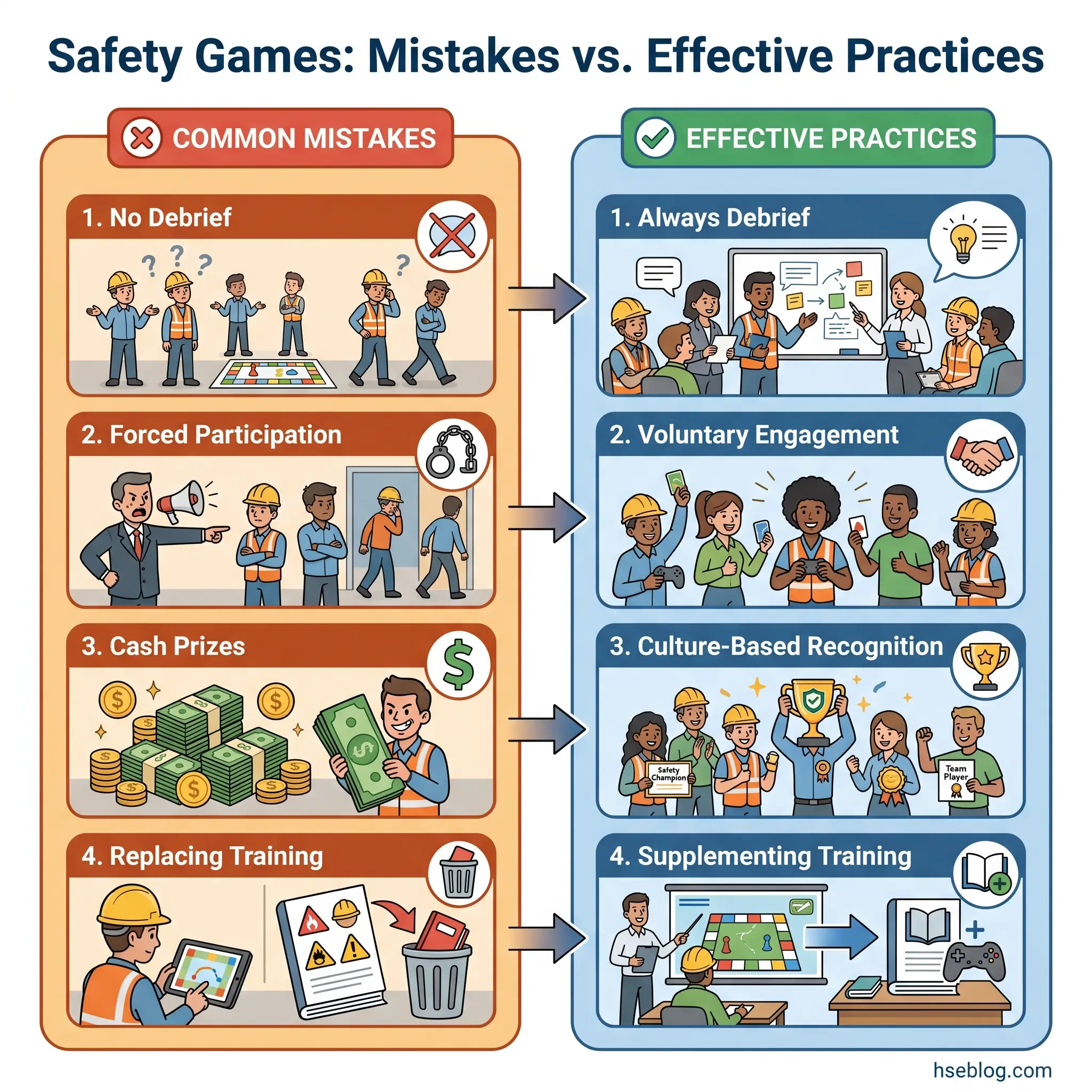
The distinction between a safety game that changes behaviour and one that wastes 30 minutes of paid time comes down to four practitioner decisions, all made before the game starts.
First, every game needs a structured debrief. A PPE relay race without a post-game discussion about why a specific donning error matters under real exposure conditions is exercise, not training. The debrief is where the game’s experiential value converts into retained knowledge. Skip it, and the activity registers as entertainment in workers’ memories — not as a safety lesson.
Second, mandatory participation destroys intrinsic motivation. The moment a safety game becomes “the thing HR makes us do,” its engagement value collapses. Design games that are genuinely appealing — competitive, social, brief, relevant — and let voluntary participation do the recruiting.
Third, prizes should reinforce safety culture, not undermine it. Gift cards and cash prizes train workers to associate safety engagement with extrinsic reward. Safety gear, recognition on safety boards, and peer-nominated awards reinforce the identity connection between the worker and their safety competence.
Fourth — and this is the caveat that separates responsible HSE practice from generic advice — safety games must never replace formal compliance training. Under OSHA’s training compliance guidance, specific standards mandate training content, competent-person delivery, documentation, and retraining triggers that no game format satisfies on its own. Games reinforce. They do not replace.
Pro Tip: The single most reliable indicator that a safety game programme is failing is language. When workers describe games as something done to them rather than something they’d recommend to a new colleague, the programme has become compliance theatre — not engagement.
How to Measure the Impact of Safety Games on Training Outcomes
Running safety games without measuring their impact is a common failure pattern — organisations invest time in engagement activities but never determine whether those activities produced a measurable training outcome. The fix requires tracking both knowledge and behaviour.
Pre- and post-game knowledge assessments provide the most immediate evidence. A ten-question quiz administered before and after a safety trivia session or escape room quantifies knowledge gain in that session. Over time, aggregate scores reveal which topics are being retained and which need formal retraining.
Leading indicators tell a more important story than lagging ones. Track near-miss reporting frequency, voluntary safety suggestion submissions, and participation rates in non-mandatory safety activities. A spike in near-miss reporting after implementing a hazard scavenger hunt programme is a positive signal — workers are observing more and reporting more, which is precisely the behaviour change the game targeted.
Compare incident rates and severity across a minimum six-month window before and after gamified training implementation. Shorter windows produce misleading noise. Collect qualitative feedback directly from workers — ask what they learned, what they would change, and whether the game addressed a real gap in their knowledge. The Bureau of Labor Statistics Injuries, Illnesses, and Fatalities programme provides the national benchmarks against which your facility’s trends can be compared. In 2024, US private industry recorded 2.5 million nonfatal workplace injuries and illnesses — the lowest since 2003 (US Bureau of Labor Statistics, 2026). Your internal data should show a trajectory at least consistent with that national improvement, and ideally better.
Frequently Asked Questions
Conclusion
The question worth sitting with is not “which safety game should we try?” but “what specific training gap are we trying to close — and is a game the right tool for closing it?” Every game on this list works when matched to the right objective, delivered with a structured debrief, and measured against actual outcomes. Every game on this list wastes time when picked for entertainment value, run without follow-up, and never connected to your facility’s real hazard profile.
Run a quick diagnostic on your current safety training programme. Identify the one topic where knowledge retention is weakest — the question workers consistently miss on refresher assessments, the procedure that keeps appearing in near-miss reports. Select the game format that targets that specific gap. Run it once, debrief it properly, assess pre/post knowledge, and track leading indicators over the next quarter.
Safety games earn their place in a training programme when they produce workers who recognise hazards faster, respond to emergencies more accurately, and report near-misses more willingly. That is a measurable standard, not a feeling. Hold your games to it.