
TL;DR
- Treat UV as a carcinogen, not a comfort issue — it harms outdoor crews (solar) and workers near welding arcs and curing lamps (artificial).
- Act at UV Index 3 or higher — protection is warranted regardless of temperature or cloud cover.
- Lead with engineering and scheduling — shade, cab glazing, and rota changes beat relying on sunscreen alone.
- Supply and mandate PPE — UPF clothing, wide-brim hats, UV400 eyewear, and broad-spectrum SPF30+ on uncoverable skin.
- Know your legal instrument — solar UV usually falls under general duties; artificial UV often has its own standard with exposure limits.
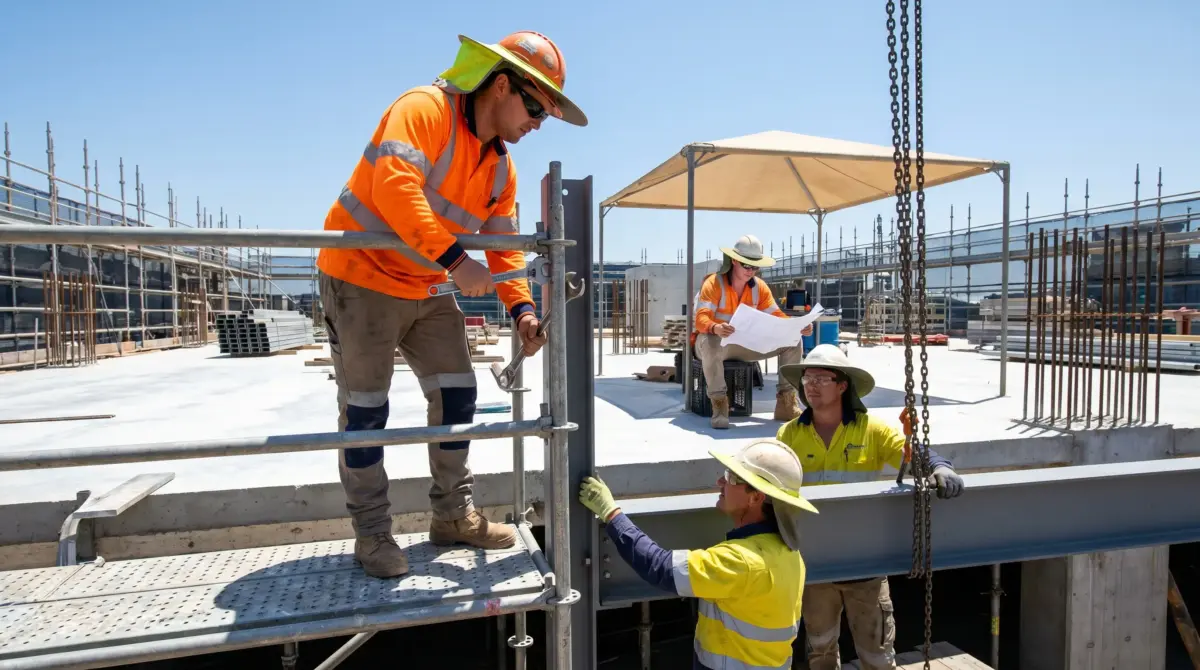
UV exposure at work is a recognised occupational carcinogen affecting both outdoor workers (solar UV) and those near artificial sources such as welding arcs or UV-curing lamps. It causes skin cancer, eye damage, and premature ageing. Employers reduce the risk through the hierarchy of controls — shade and scheduling first, protective clothing and eyewear next, and SPF30+ sunscreen as the last line.
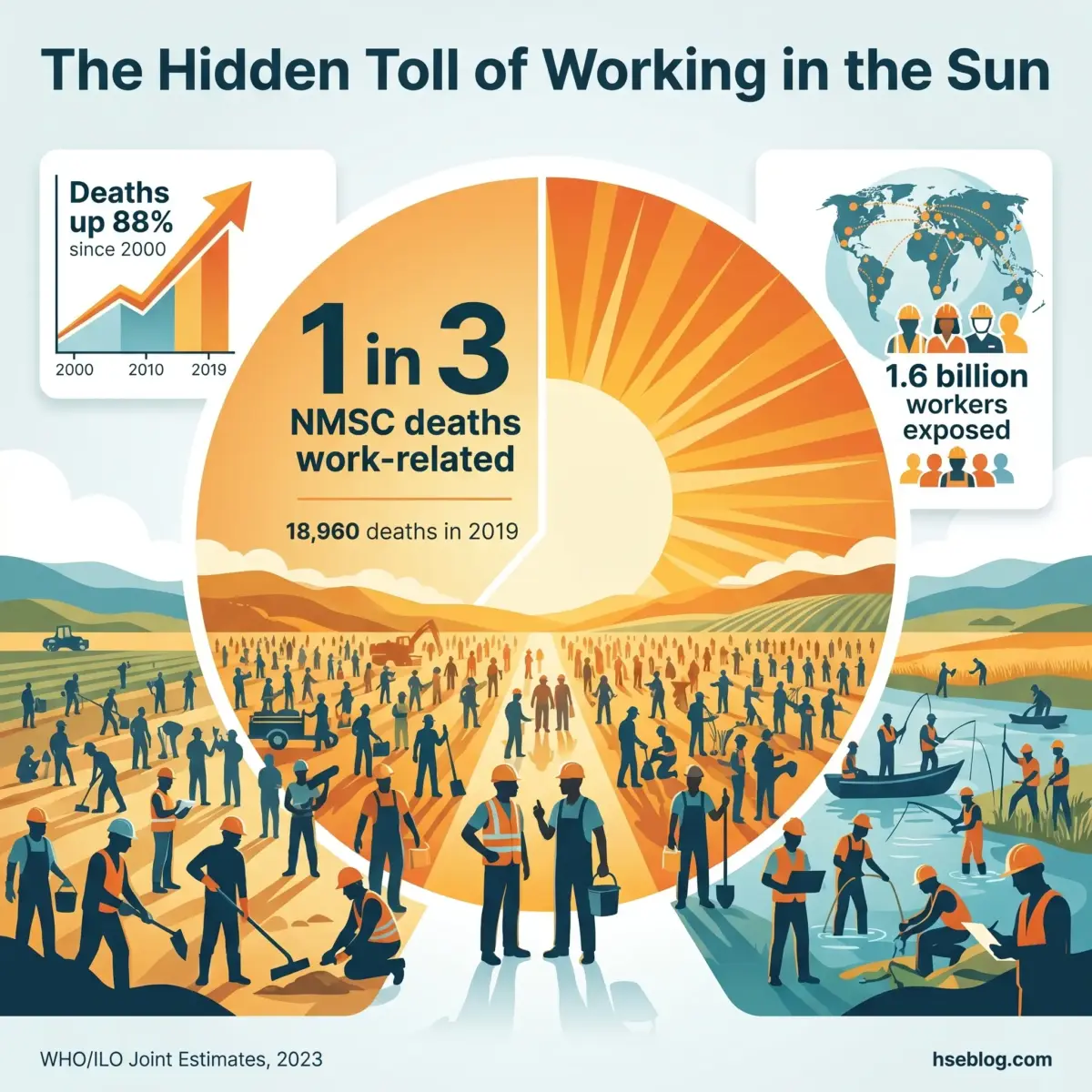
Roughly 18,960 people died in a single year from non-melanoma skin cancer caused by working under the sun (WHO/ILO Joint Estimates, 2023). That figure places solar radiation among the deadliest occupational carcinogens on record, yet most worksites still log it as weather rather than as a health hazard.
UV exposure at work is unusual because the harm is silent and delayed — there is no spark, no loud bang, and often no same-day symptom. This guide covers both source families that competitors usually split or ignore: natural solar UV for outdoor crews, and artificial UV from welding, curing, and germicidal systems. It then maps the controls and the very different legal duties that apply across the US, UK, and EU.
What Counts as UV Exposure at Work? (Solar vs Artificial Sources)
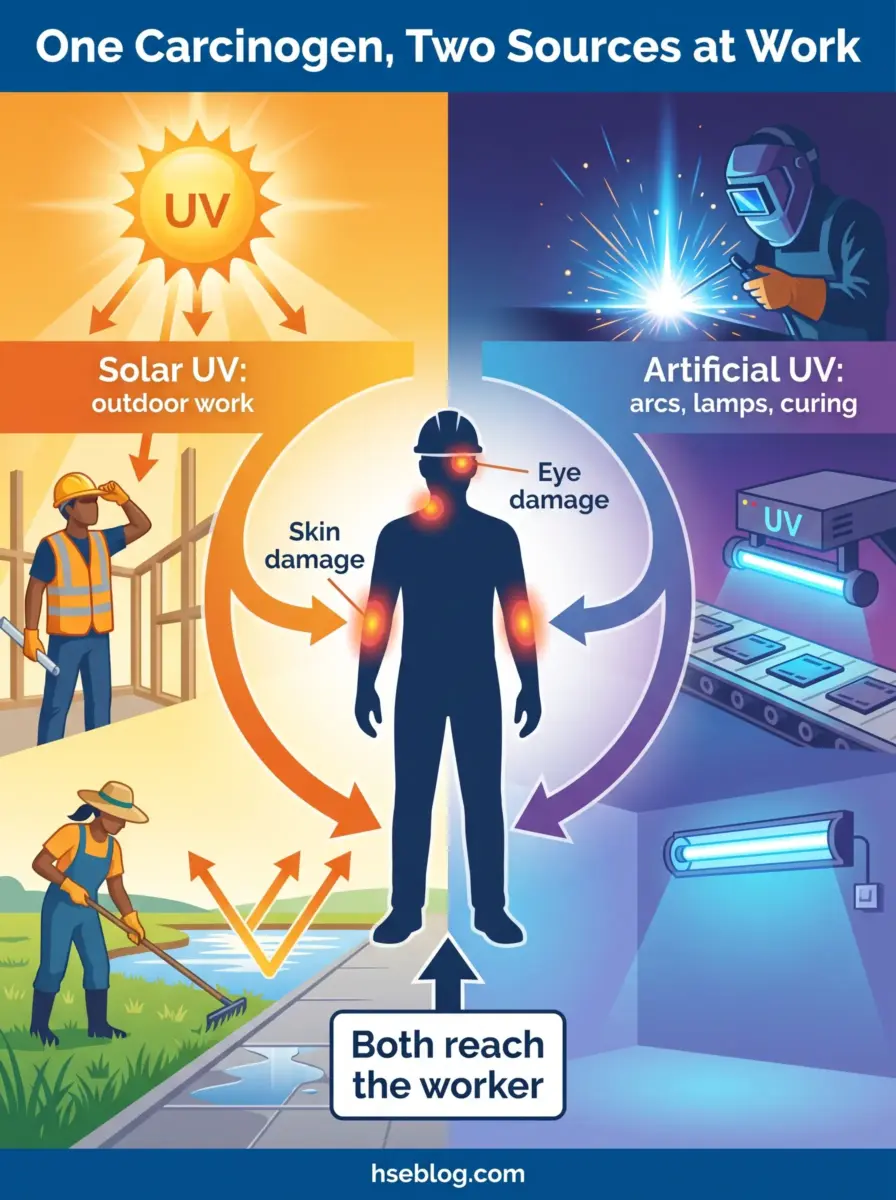
Occupational UV splits into two source families, and a risk assessment that covers only one is incomplete. Outdoor work delivers solar UV; welding, curing, and disinfection deliver artificial UV — and the International Agency for Research on Cancer (IARC) classifies solar radiation and all three UV bands as carcinogenic to humans.
Ultraviolet light divides into three bands by wavelength. Which band actually reaches the worker depends entirely on the source.
| Band | Wavelength | Reaches the worker? | Primary harm |
|---|---|---|---|
| UVA | ~315–400 nm | Yes — solar and artificial; passes through glass | Deep penetration, photoaging, melanoma role |
| UVB | ~280–315 nm | Yes — solar and artificial | Sunburn, DNA damage, non-melanoma skin cancer |
| UVC | ~100–280 nm | Solar UVC is absorbed by the atmosphere; artificial UVC reaches skin and eyes | Acute skin/eye burns from welding and germicidal lamps |
Where solar UV shows up: construction, agriculture, grounds and landscaping, waste collection, postal and delivery, road work, and water or leisure settings. Reflection from snow, water, sand, and light concrete adds dose from below, so a wide-brim hat alone never tells the whole story.
Where artificial UV shows up: arc welding and brazing, UV-curing of adhesives, inks, and coatings, germicidal UV-C disinfection, and various lab and medical lamps.
Two failure modes show up repeatedly in the published record and in practice. Employers risk-assess solar UV only for “hot sunny days,” missing cumulative dose on overcast days where UV still penetrates cloud — and they underestimate artificial UVA, which never feels hot and does not trigger the eye’s blink or aversion reflex, so workers do not self-limit.
How UV Damages Skin and Eyes
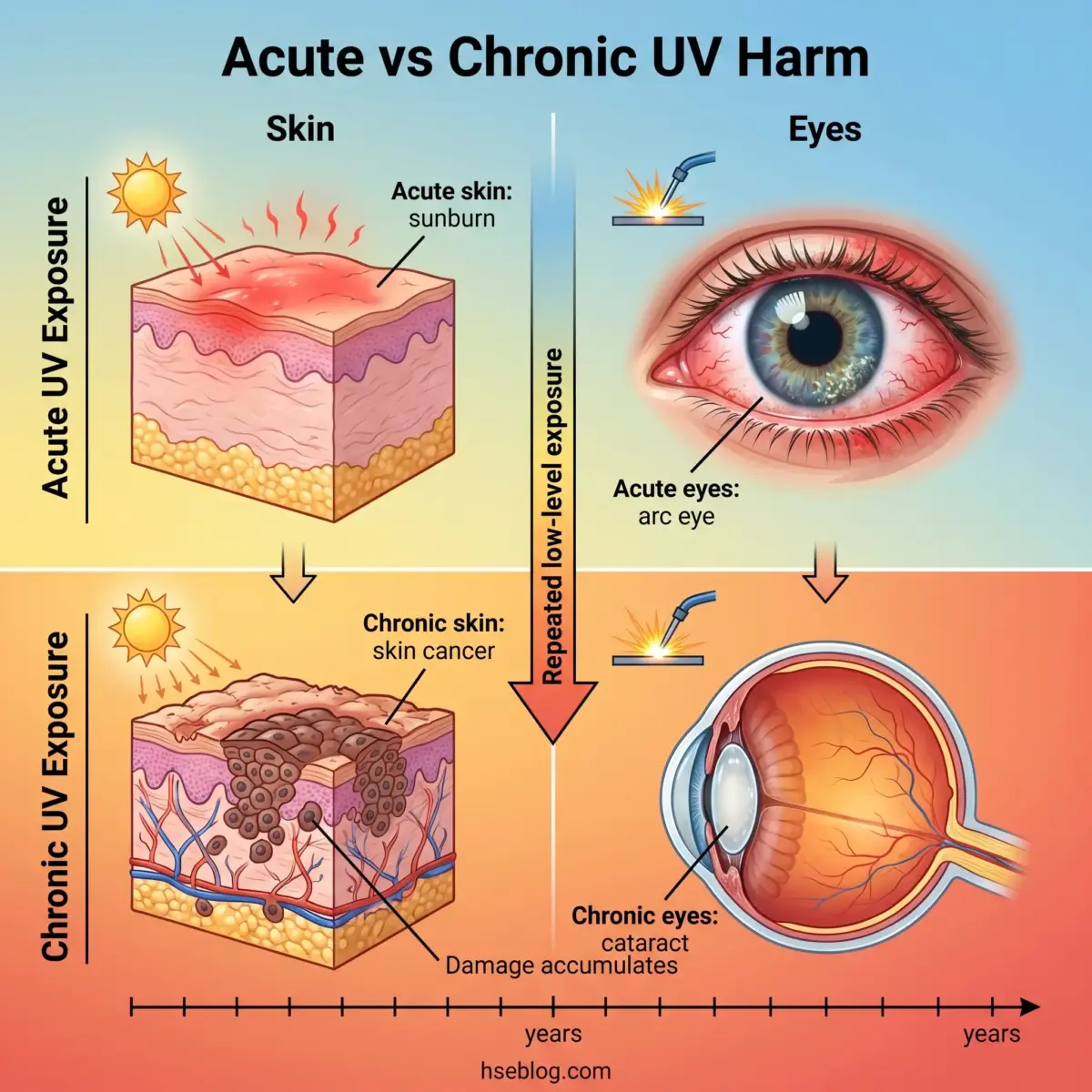
UV harm runs on two timescales — acute injury you feel within hours, and chronic damage that accumulates silently over decades. The cancer risk is driven by cumulative lifetime dose, which is exactly why steady outdoor work matters even without a single dramatic burn.
| Skin | Eyes | |
|---|---|---|
| Acute | Sunburn / erythema | Photokeratitis (“arc eye”) |
| Chronic | DNA damage, photoaging, non-melanoma skin cancer, melanoma | Cataract, pterygium |
The teaching point that workers most often miss: a comfortable, sunburn-free shift can still add to a lifetime dose that ends in cancer years later. Damage banks quietly.
How Serious Is the Risk? The Occupational Skin Cancer Burden
The scale is large and getting worse, not better. The WHO/ILO Joint Estimates rank occupational solar UV as the third-highest occupational-carcinogen death burden globally.
The headline figures anchor the case:
- 1.6 billion workers — 28.4% of working-age people — were occupationally exposed to solar UV in 2019 (WHO/ILO Joint Estimates, 2023).
- ~18,960 deaths from non-melanoma skin cancer were attributable to occupational solar UV in 2019 — roughly 1 in 3 of all such deaths (WHO/ILO Joint Estimates, 2023).
- Attributable deaths rose 88%, from 10,088 in 2000 to 18,960 in 2019 (WHO/ILO Joint Estimates, 2023).
A pooled analysis adds the relative-risk picture. Outdoor workers carry roughly 60% higher non-melanoma skin cancer risk than indoor workers (WHO systematic review, 2021).
National data sharpens the point. In Britain, occupational solar radiation was linked to about 48 melanoma deaths (2012) and 241 melanoma registrations (2011) (Rushton & Hutchings, British Journal of Cancer, 2017) — the basis of the often-quoted “about one death and several new cases each week.”
For baseline scale, IARC’s global totals show non-melanoma skin cancer’s large absolute toll despite its dismissive name: over 1.2 million cases and ~69,000 deaths, alongside ~332,000 melanoma cases and ~59,000 deaths (IARC / Global Cancer Observatory, 2022 data). You can read the full WHO/ILO joint estimates on occupational sun exposure for the methodology behind these figures.
One honest caveat practitioners and researchers both flag: these numbers almost certainly understate reality. Skin cancer latency runs for decades, and few cases are ever traced back to a specific job, so occupational attribution is chronically under-reported.
A misconception worth killing here: darker skin is not immune. Risk is lower for people with more melanin, but it is real and lower-not-zero — all skin types accumulate UV damage.
When Do Workers Actually Need Sun Protection? (The UV Index Trigger)
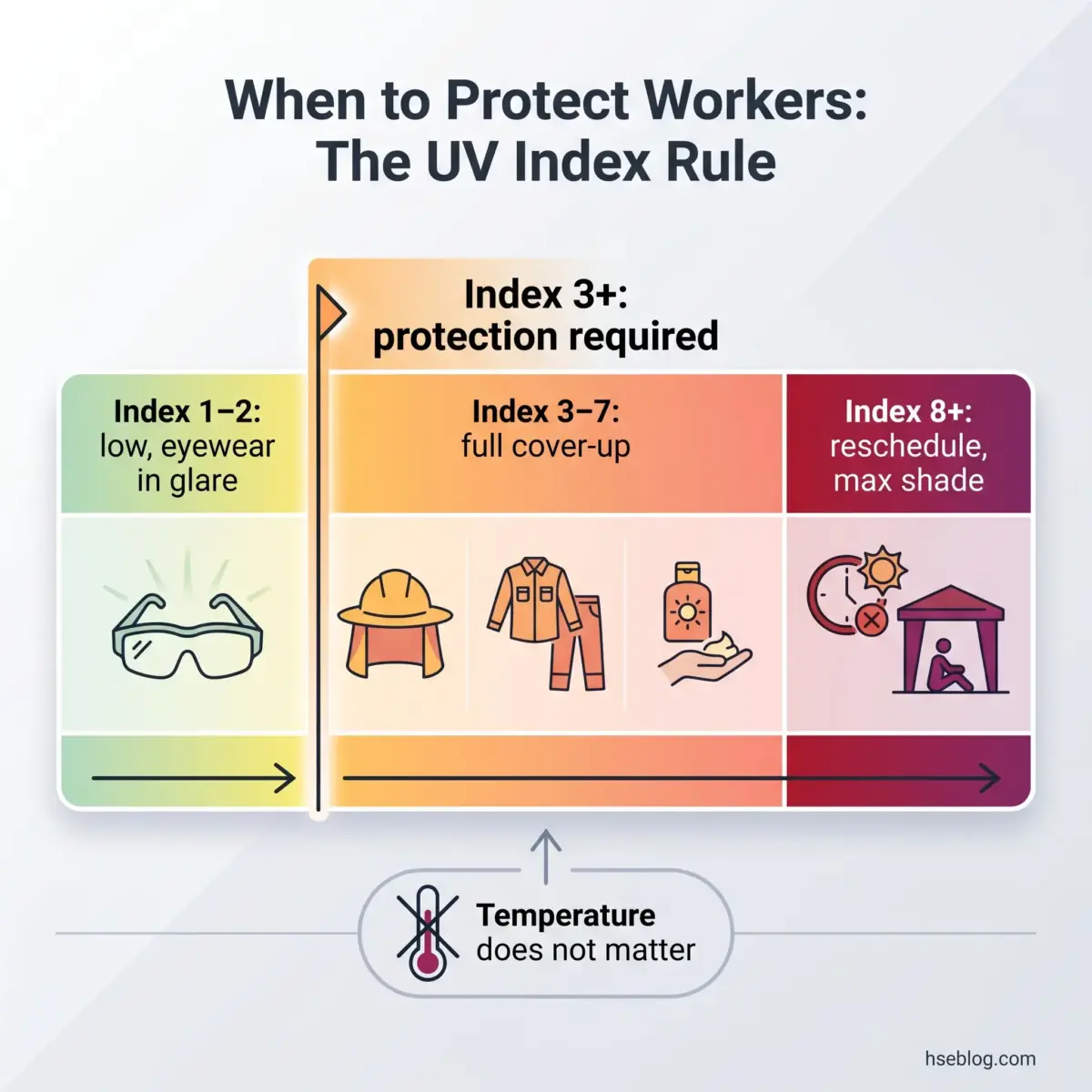
Protection is warranted whenever the UV Index reaches 3 or higher — full stop, regardless of temperature or cloud. That single threshold turns vague “use your judgment” advice into a control rule you can build into a daily risk assessment.
The decision logic is straightforward:
- Check the forecast UV Index, not the temperature. The WHO/WMO/UNEP/ILO SunSmart Global UV app gives location-based estimates (promoted 2023–2024 as the recommended tool).
- If UV Index ≥ 3, activate protection for the shift — shade, cover-up, eyewear, and sunscreen on uncoverable skin.
- Tighten controls in the peak window, typically late morning to mid-afternoon when the index runs highest.
- Add a margin for reflective surfaces — snow, water, sand, and light concrete raise the effective dose well above the forecast number.
A quick action band keeps it usable on site:
- UV Index 1–2 (Low): minimal measures; reflective settings still warrant eyewear.
- UV Index 3–7 (Moderate–High): full protection required; this is most working days in many regions.
- UV Index 8+ (Very High–Extreme): maximise shade, reschedule heavy outdoor tasks, enforce all PPE.
The recurring control failure is running sun safety as a summer-only or “feels hot” program. UV is independent of heat — cool, cloudy, or winter days can still cross the threshold — so the discipline is to track it like noise or chemical dose, by cumulative exposure rather than perceived weather. The 2025 British Safety Council campaign, drawing on a 2024 HSE study that flagged construction workers as a significant at-risk group, pushes exactly this shift toward year-round protection.
Protection Measures: Applying the Hierarchy of Controls to UV
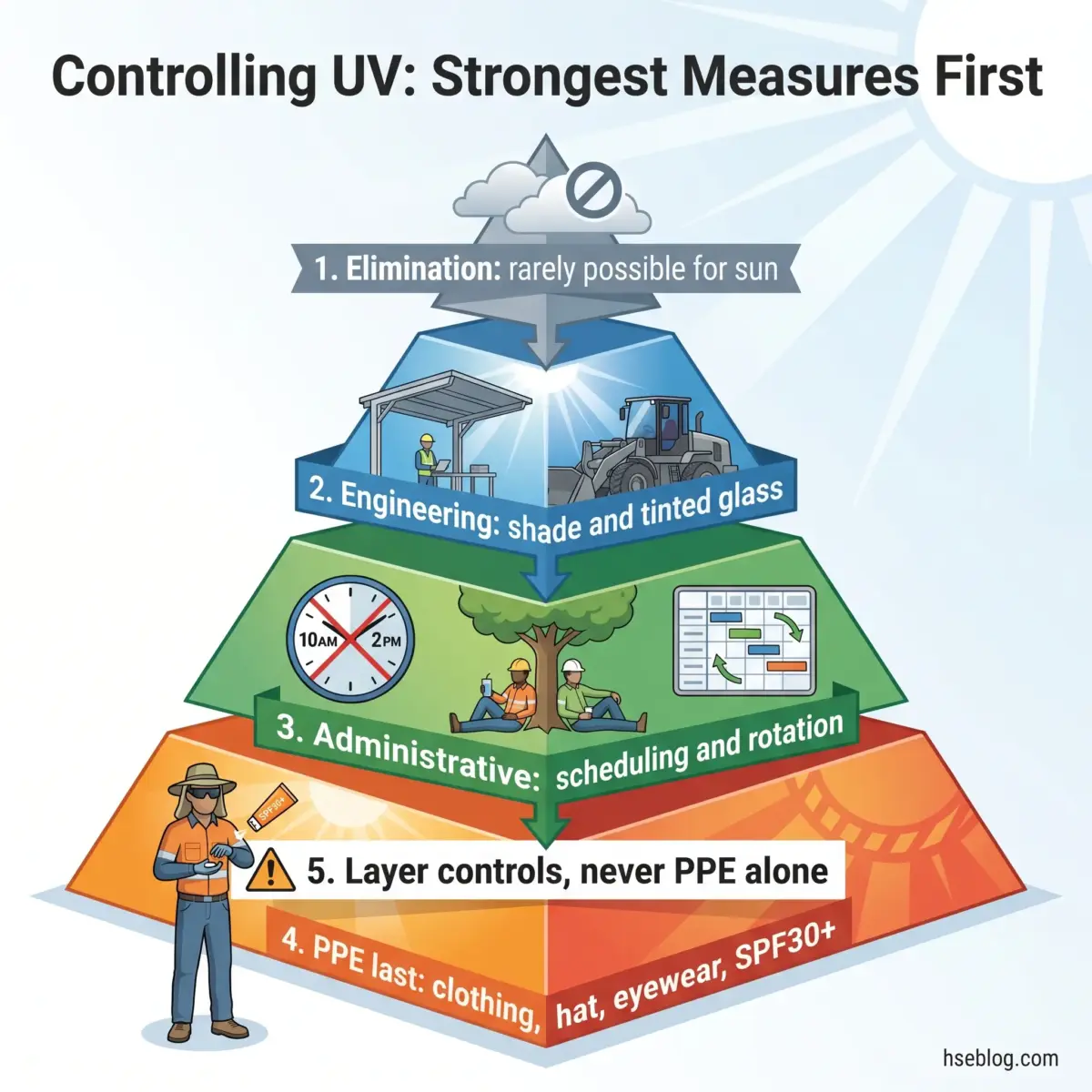
The strongest UV programs layer engineering, administrative, and PPE controls together — never PPE alone. There is an honest limit most pages skip: for solar UV, elimination and substitution are largely impossible because you cannot remove the sun or swap it for a safer source, so the real work sits in the lower tiers.
| Control tier | Solar UV measure | Artificial UV measure |
|---|---|---|
| Elimination / Substitution | Rarely possible for outdoor work | Substitute a non-UV process where feasible (e.g., alternative curing) |
| Engineering | Fixed shade, canopies, tinted/UV-filtering cab glazing, indoor task rotation | Interlocks, shielding, enclosures, filters, screens; verify with a radiometer |
| Administrative | Reschedule away from solar noon, job rotation, rest in shade, toolbox talks, exposure-time tracking | Restricted zones, signage, occupied-vs-unoccupied operation, training |
| PPE (last line) | UPF/long-sleeve clothing, wide-brim hats, UV400 wraparound sunglasses, SPF30+ sunscreen | Welding helmets/filters to correct shade, UV-blocking face and eye protection, gloves |
Two patterns quietly defeat otherwise good programs. First, sunscreen gets treated as a personal-comfort item rather than supplied, mandated PPE — and uptake collapses the moment it is optional. Second, “PPE-first” thinking skips cheap, durable engineering wins like fixed shade and cab tinting that protect everyone, every shift, with no daily compliance burden.
The judgment call worth naming: when budget is tight, the instinct is to buy a box of sunscreen. The stronger spend is usually a fixed shade structure or UV-filtering glazing, because engineering controls do not depend on a tired worker remembering to reapply. NIOSH guidance on sun exposure for outdoor workers lays out the practical employer measures behind this tier.
Sunscreen, Clothing, and Eyewear: Getting the Details Right
Buying the wrong product is a common, avoidable waste. A few specifics prevent it:
- Sunscreen: broad-spectrum, SPF30+ minimum (HSE guidance), applied generously and reapplied — it rubs and sweats off through a shift. It supplements, never replaces, clothing and shade.
- Clothing: close-weave or rated UPF fabric; remember many fabrics lose protection when wet and stretched, so a thin wet shirt is weaker than it looks.
- Eyewear: UV400, wraparound styles that block side entry; standard frames leave a gap.
- Standards matter: specify clothing and eyewear that meet recognised UPF and sunglasses standards rather than unverified marketing claims.
Protecting Workers From Artificial UV (Welding, Curing, Germicidal UV-C)
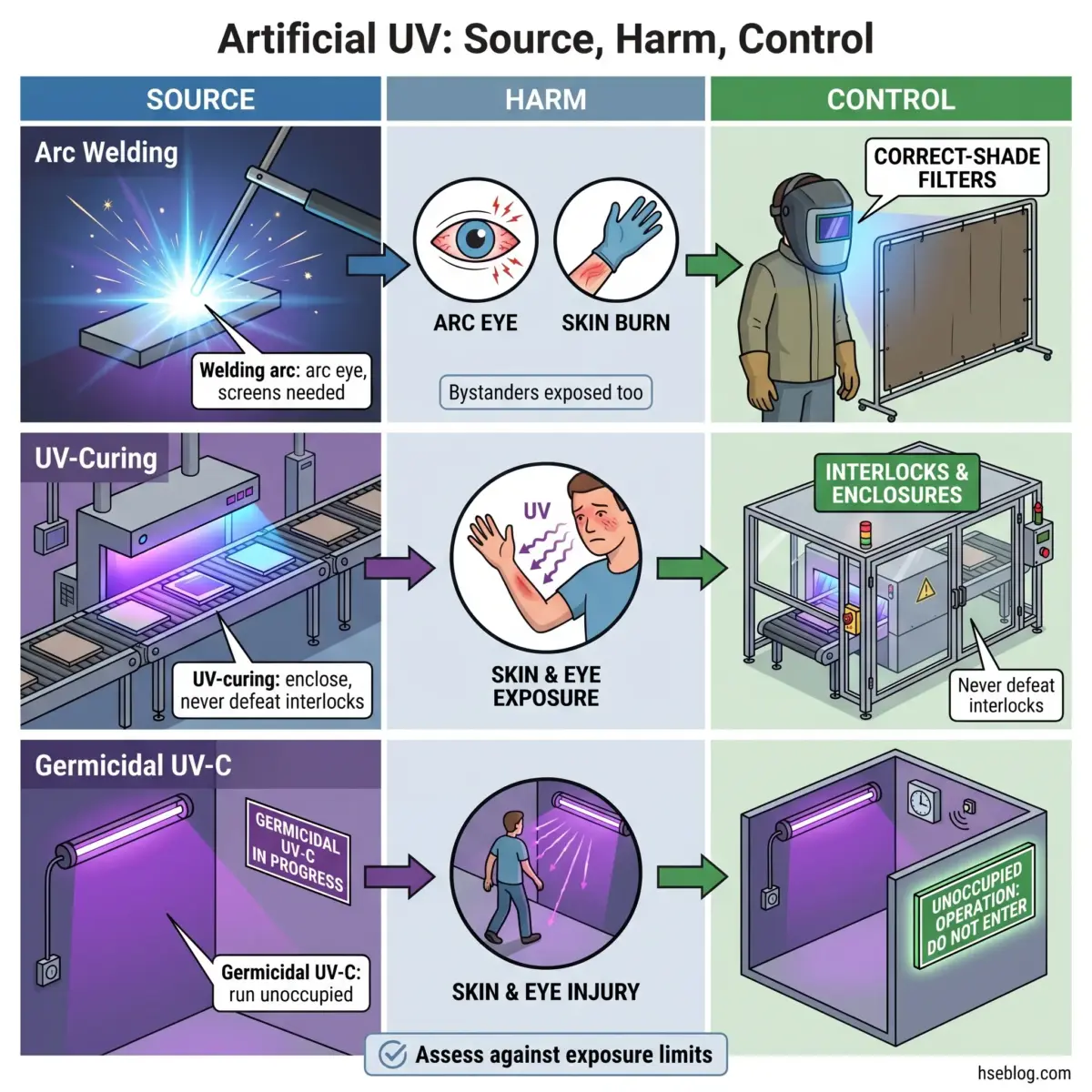
What consistently goes wrong with artificial UV is the “invisible bright light” misjudgment — workers assume the danger is the visible glare and underestimate the UVA and UVC they cannot see. Unlike solar UV, these sources come with measurable exposure limits and their own legal instruments, so the employer duty is to assess against those limits and shield accordingly.
Arc welding and brazing
This is the dominant artificial-UV source, producing both photokeratitis (“arc eye”) and skin erythema.
- The hazard is not confined to the welder. Adjacent and passing workers get unprotected secondary exposure from unscreened arcs, which is why fixed screens and welding curtains are part of the control set, not an optional extra.
- Eye protection must match the correct filter shade for the process; under-rated shades are a frequent inspection finding.
UV-curing systems
Industrial curing of adhesives, inks, and coatings is typically UVA-dominant.
- Protection relies on interlocks, shielding, and enclosures built into the equipment.
- The repeat failure mode is defeating those safety controls to clear a jam or speed a line — at which point a sealed system becomes an open exposure.
Germicidal UV-C
Post-pandemic disinfection put far more UV-C lamps into workplaces.
- UV-C is a direct skin and eye hazard; systems must run unoccupied, with interlocks and clear signage where occupancy is possible.
On limits, the frameworks diverge. EU exposure limit values under Directive 2006/25/EC (ICNIRP-derived) sit alongside ACGIH TLVs in the US — but ACGIH TLVs are voluntary guidance, and OSHA enforces no UV permissible exposure limit. Where both could apply, reference the stricter value and treat the TLV as guidance, not law.
Employer Legal Duties and Worker Rights (By Jurisdiction)
The legal headline surprises most people: there is rarely a UV-specific law for solar exposure, while artificial UV often has its own dedicated instrument. The same carcinogen is named as a hazard in one jurisdiction and only implied in another — which is why a cross-border employer cannot copy one country’s program wholesale.
| Jurisdiction | Solar UV instrument | Artificial UV instrument | Core duty |
|---|---|---|---|
| US | No OSHA UV standard | No UV-specific standard | OSH Act General Duty Clause §5(a)(1) + 29 CFR 1910.132 (PPE) |
| UK | HSWA 1974 + Management of H&S at Work Regs 1999; HSE INDG147 / INDG337 | Control of Artificial Optical Radiation at Work Regs 2010 | Assess and control; treat solar UV as an occupational hazard |
| EU | Framework Directive 89/391/EEC | Directive 2006/25/EC (explicitly excludes sunlight) | Risk assessment and action plans; ELVs for artificial UV |
| Australia / Canada | WHS duty of care | WHS duty of care | Safe Work Australia / CCOHS model sun-safety programs |
A few clause-level points sharpen the table:
- US — context-first: because no UV standard exists, OSHA reaches sun exposure through the General Duty Clause’s requirement for a workplace free of recognised hazards, applying 29 CFR 1910.132 where PPE such as hats, sleeves, or sunscreen is the only effective control.
- EU — comparison-first: Directive 2006/25/EC sets artificial-UV exposure limit values but deliberately carves out natural sunlight, so solar UV falls back to the general duty in Framework Directive 89/391/EEC. You can review EU Directive 2006/25/EC on artificial optical radiation directly.
- UK — practical-first: the field procedure most aligned with HSE guidance is to put outdoor work on the risk register and apply INDG337’s advice — shade, cover-up, SPF30+, and skin self-checks — under the general HSWA duty. HSE’s advice on health risks from working in the sun sets the SPF30+ and “occupational hazard” framing.
The emerging shift is toward UV as a managed, compensable occupational disease. A 2025 narrative review in Occupational Medicine documented the long-established “dates of knowledge” for British occupational skin cancer and argued that outdoor workers should receive health surveillance and be eligible for compensation — a direction worth watching wherever you operate.
The practical synthesis: put UV on the occupational-risk register everywhere, even in jurisdictions where no statute names it. The carcinogen does not care which legal instrument applies.
Frequently Asked Questions
Conclusion
UV exposure at work is moving out of the “weather” category and into the occupational-disease register, and the next few years will likely formalise that shift. The 2025 British Safety Council campaign, the 2024 HSE study naming construction crews as a priority group, and the Occupational Medicine push toward health surveillance and compensation all point the same way — toward UV being assessed, recorded, and controlled like any other carcinogen rather than tolerated as a seasonal nuisance.
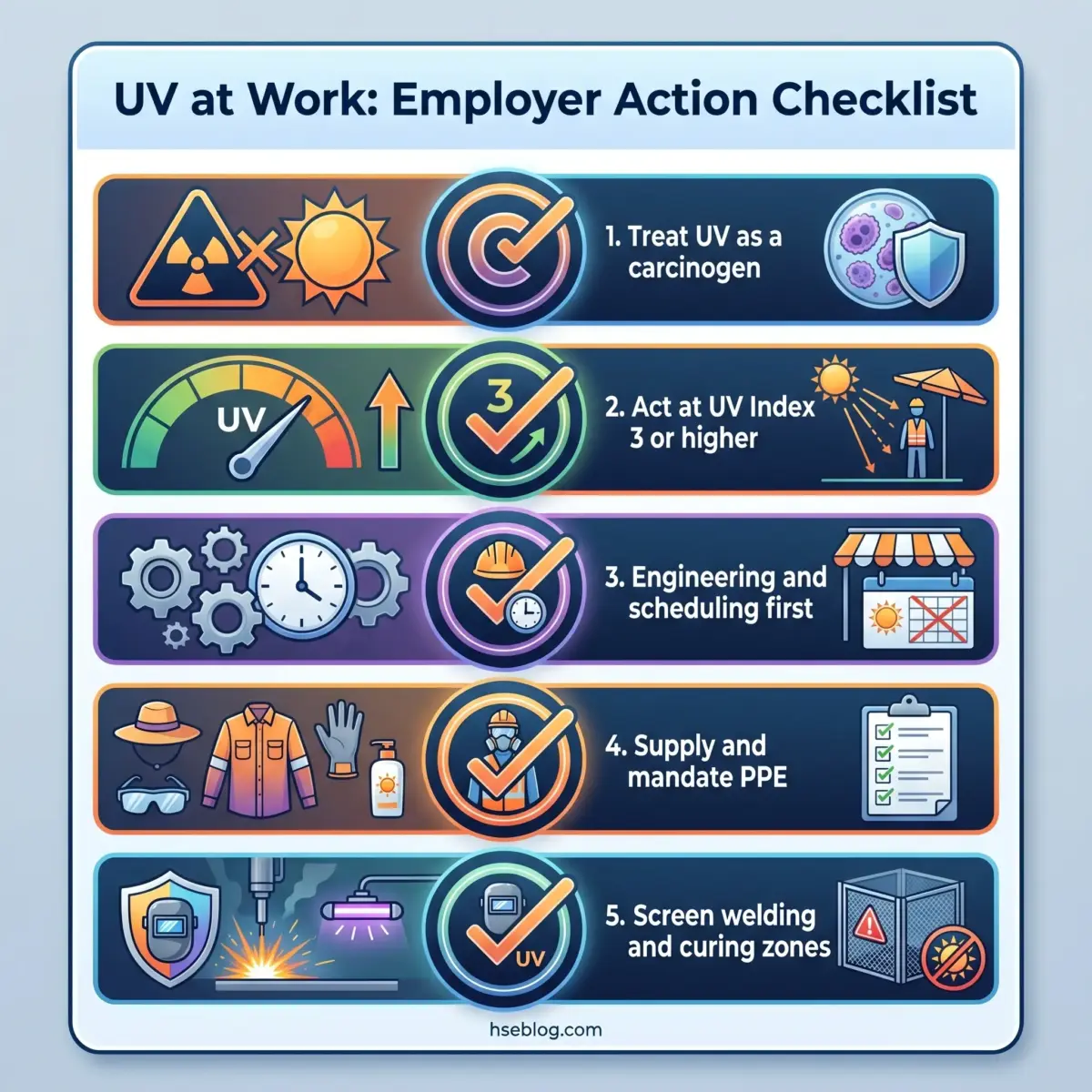
For HSE teams, the practical direction is clear even before the law catches up everywhere. Build the UV Index ≥ 3 trigger into your risk assessments, invest first in fixed engineering controls that protect every worker without daily effort, supply and mandate the clothing, eyewear, and SPF30+ that PPE programs too often leave optional, and screen your welding and curing zones so adjacent workers stop absorbing what the operator is shielded from.
Whichever jurisdiction you sit in, the smartest move is to stop waiting for a UV-specific statute to tell you the hazard is real. A worker’s skin and eyes accumulate the same dose whether or not the regulation names it — so put UV exposure at work on the register now, and manage it like the silent carcinogen it is.