

TL;DR
- Hand-arm thresholds: The action value is 2.5 m/s² A(8) (100 points) and the limit value is 5 m/s² A(8) (400 points) (UK HSE, 2025).
- Whole-body thresholds: The action value is 0.5 m/s² A(8) and the limit value 1.15 m/s² A(8) — far lower numbers, and a different calculator entirely.
- The disease is still arriving: 220 new Hand-Arm Vibration Syndrome cases were assessed for disablement benefit in Great Britain in 2024 (UK HSE, 2025), two decades after the regulations landed.
- Two inputs decide the answer: Vibration magnitude and trigger time drive every output — and both are routinely entered wrong in the field.
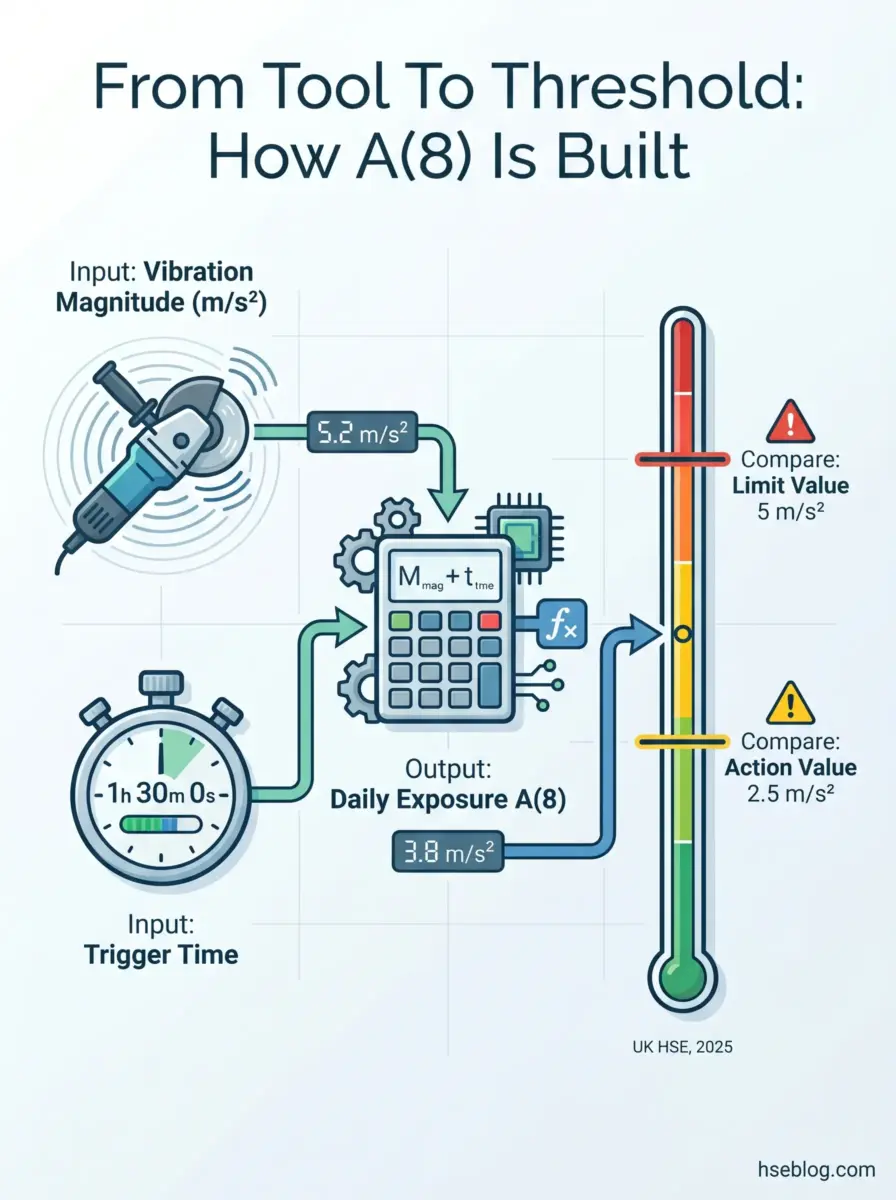
A vibration exposure calculator converts a tool’s vibration magnitude in m/s² and its trigger time into a daily exposure value, A(8), expressed in m/s² and in exposure points. It then compares that value against the hand-arm action value of 2.5 m/s² and the limit value of 5 m/s², flagging the moment each threshold is reached or likely reached.
In Great Britain, 220 new cases of Hand-Arm Vibration Syndrome were assessed for Industrial Injuries Disablement Benefit in 2024 (UK HSE, 2025). Those are the worst-end, clinically confirmed cases — permanent nerve and vascular damage in the hands — and they were still arriving two decades after the Control of Vibration at Work Regulations 2005 set enforceable limits.
A vibration exposure calculator is the tool most safety teams reach for to keep workers below those limits. The catch is that the calculator only answers correctly when its inputs are correct, and in practice the inputs are where assessments quietly fail. This article walks through how to use the HSE hand-arm and whole-body calculators properly, how to read what they return, and where the same number can mean compliance in one jurisdiction and nothing at all in another.
What does a vibration exposure calculator actually tell you?
A vibration exposure calculator tells you one thing: the estimated daily vibration dose a worker receives, scaled to an 8-hour reference period and measured against legal trigger points. It is an exposure-estimation tool, not a diagnosis and not a legal verdict.
There are two calculator families, and confusing them is the first common error:
- Hand-arm vibration (HAV) calculator — for vibration entering through the hands from powered tools.
- Whole-body vibration (WBV) calculator — for vibration entering through the seat or feet, mostly from mobile plant.
They use different inputs and different thresholds, so a number from one means nothing in the other.
The HSE hand-arm vibration calculator produces several outputs from each entry:
| Output | What it means | Units |
|---|---|---|
| Partial exposure | The contribution of a single tool or process | points or m/s² |
| Total daily exposure | The combined A(8) across all tools used | m/s² A(8) |
| Exposure points | An additive score read against 100 and 400 | points |
| Exposure points per hour | The rate a tool accrues points | points/hour |
| Time to reach EAV | Maximum trigger time before the action value | hours:minutes |
| Time to reach ELV | Maximum trigger time before the limit value | hours:minutes |
For hand-arm vibration, the Exposure Action Value (EAV) is 2.5 m/s² A(8), or 100 points, and the Exposure Limit Value (ELV) is 5 m/s² A(8), or 400 points (UK HSE, 2025). The calculator flags when each is reached, and when it is potentially reached once estimation uncertainty is allowed for.
This content covering Hand-Arm Vibration Syndrome and health surveillance is for HSE practitioner reference. It is not medical advice. Workers with numbness, tingling, blanching fingers, or other symptoms should consult an occupational physician or qualified medical professional.
A reading below the EAV is not the same as a clean bill of health. The HSE is explicit that below-action-value exposures are not automatically “safe” — some workers still develop injury over years of daily use. A green result narrows the question; it does not close it.
The two inputs that decide everything: magnitude and trigger time
Every calculator result is only as honest as its two inputs, and both are wrong far more often than safety teams assume. Get the vibration magnitude or the trigger time wrong, and the calculator returns a confident, defensible-looking number built on indefensible data.
Reviewing the pattern across published HAVS enforcement, the same two input failures recur: a magnitude pulled from a sales catalogue, and a trigger time guessed from the length of the shift. Both push the answer downward, which is exactly the wrong direction for a tool meant to protect health.
Where to find a reliable vibration magnitude
Vibration magnitude is the frequency-weighted r.m.s. acceleration in m/s², and ISO 5349-1 defines how it is measured. Sources rank in a clear order of reliability:
- Actual in-use measurement with a vibration meter on the real task — the gold standard.
- HSE recommended database values for that tool type and task — a defensible default.
- Manufacturer-declared emission values — the weakest source, and the most common trap.
Where this goes wrong: Manufacturer and marketing figures are measured under controlled test conditions and are commonly far lower than real in-use values. Treat them as a starting estimate only, and measure directly where exposure sits anywhere near a threshold.
Take a reciprocating saw quoted at roughly 18 m/s² in the catalogue. The same saw cutting hard material at the top of its range can sit near 27 m/s². On the calculator the lower figure can read comfortably below the ELV while the real exposure breaches it by nearly a factor of two — same trigger time, different number, opposite decision.
Trigger time: why clock time wildly overstates safe use
Trigger time is only the time the tool is actively vibrating in the hand. It is not shift length, and it is not total job time — a worker on a tool for an eight-hour shift may have a true trigger time of ninety minutes.
Operators consistently overestimate it, because the gaps — repositioning, fetching materials, waiting — feel like part of “using the tool” but contribute no vibration.
- Don’t ask the operator. Self-reported trigger time is almost always inflated.
- Do observe and time it. Estimate trigger time by stopwatch over a representative sample of the actual task.
- Use the real rhythm of the work. A continuous cut and an intermittent fixing task with the same tool produce very different daily doses.
How to use the HSE hand-arm vibration calculator, step by step
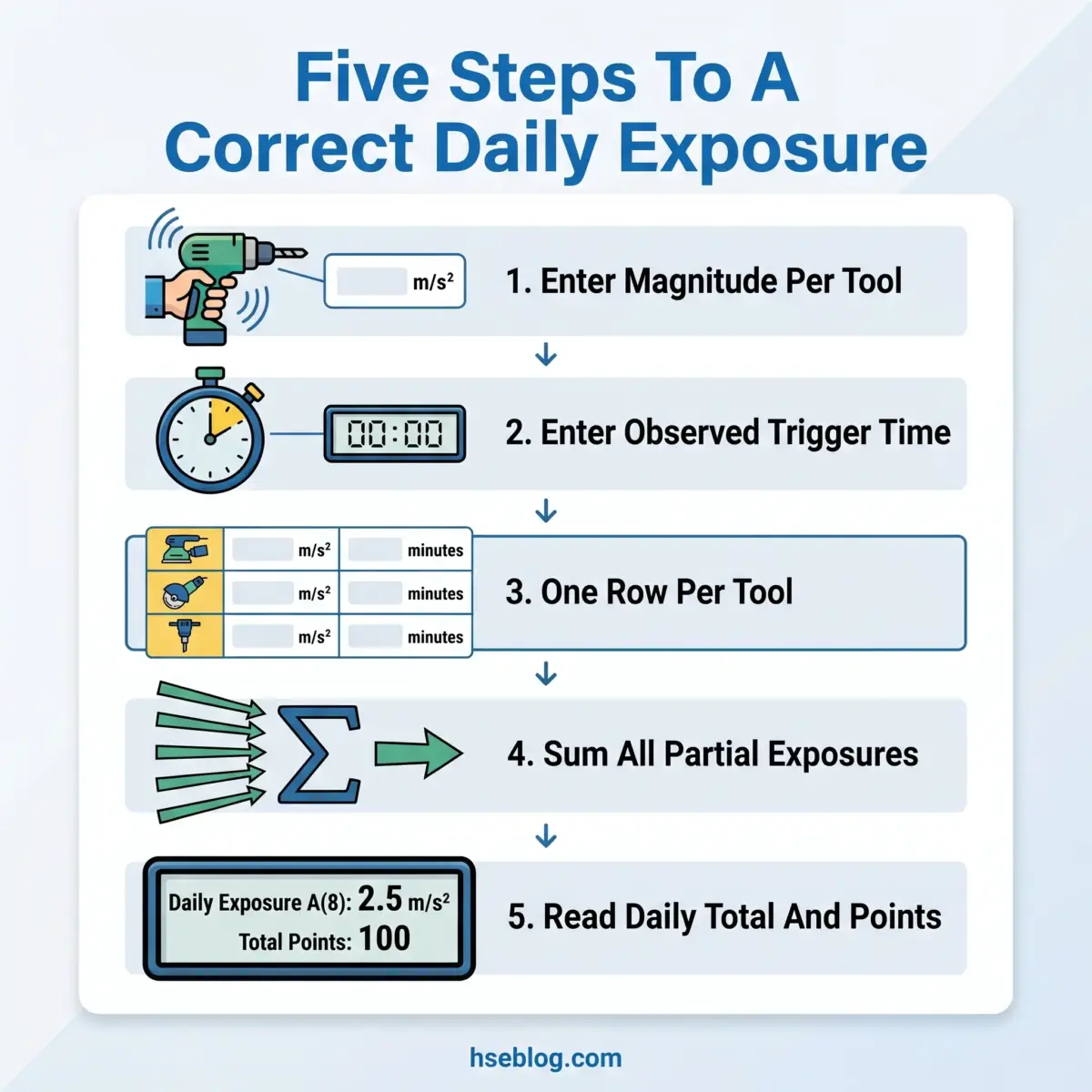
To use the HSE hand-arm vibration calculator, you enter a representative magnitude and trigger time for each tool, and the spreadsheet sums the partial exposures into a daily total. The official tool and its field definitions live on the HSE hand-arm vibration exposure calculator guidance, and compliant online versions follow the same method.
Life-critical decisions about vibration exposure must be planned and signed off by a competent person with relevant training, jurisdiction-specific authorisation, and a site-specific risk assessment. The calculator informs that judgement; it does not replace it. Recognised training routes include NEBOSH, IOSH, and equivalent regional qualifications.
Work through it in order:
- Open the white input cells. The HSE spreadsheet provides up to six rows, one per tool or process.
- Enter a representative vibration magnitude in m/s² for each tool — measured, database, or declared, in that order of preference.
- Enter the trigger time in hours and minutes for each tool, based on observation rather than the operator’s estimate.
- Use a separate row per tool when a worker uses several tools in one shift; the calculator sums the partial exposures into one daily figure.
- Note the drop-down auto-fill. Selecting a tool populates an HSE recommended starting magnitude — treat that as an estimate, not a measurement.
- Read the result cells for partial exposures, total A(8), points, and time-to-threshold; use Reset to clear before the next assessment.
Here is a worked daily exposure for a single worker across three tools (points ≈ 2 × magnitude² per hour of trigger time):
| Tool | Magnitude (m/s²) | Trigger time | Partial points |
|---|---|---|---|
| Angle grinder | 6 | 45 min | 54 |
| Impact wrench | 9 | 30 min | 81 |
| Rotary hammer drill | 11 | 15 min | 60 |
| Daily total | — | 1 h 30 min | 195 |
Each tool on its own sits below 100 points — apparently fine. Summed, the day reaches 195 points: above the EAV, below the ELV, and squarely in control-and-surveillance territory. The whole purpose of the multi-row daily vibration exposure calculator is that summation; assessing tools one at a time and never adding them up is a structural under-assessment.
Reading the results: points, A(8), and time-to-limit
A result of 195 points means a worker is between the action and limit values — control measures and health surveillance are legally required, and the day must not creep upward. Each output translates into a defined decision, not just a colour.
The points system has a practical advantage over raw A(8) values:
- Points are additive. You can sum exposure points across tools with simple arithmetic; the per-hour rate makes the exposure points per hour calculation straightforward.
- A(8) values are not additive. Combining A(8) figures requires energy-summation, not simple addition — which is why the points system exists.
Read the result against three tiers:
- Below 100 points / 2.5 m/s² — below the EAV. Not automatically safe, but no statutory action triggered.
- 100–400 points / 2.5–5 m/s² — between EAV and ELV. Control measures and health surveillance are required.
- Above 400 points / 5 m/s² — ELV exceeded. Exposure must not continue at that level.
The “time to reach EAV” and “time to reach ELV” outputs are planning figures, not pass/fail stamps. They tell you the maximum trigger time per tool before the threshold is hit — useful for scheduling job rotation across a crew.
A frequent failure mode is reading “time to reach ELV” as daily permission to run a tool right up to that ceiling. That figure assumes idealised inputs, and cumulative daily use across the working week is what drives the disease. The ceiling is a planning limit, not a target.
One more nuance worth respecting: ISO 5349-1’s frequency weighting has been criticised for under-weighting mid- and high-frequency vibration relative to observed HAVS risk. Treat the A(8) calculator output as a conservative-leaning estimate, not a precise risk score.
Calculating whole-body vibration exposure: a different calculator, different rules
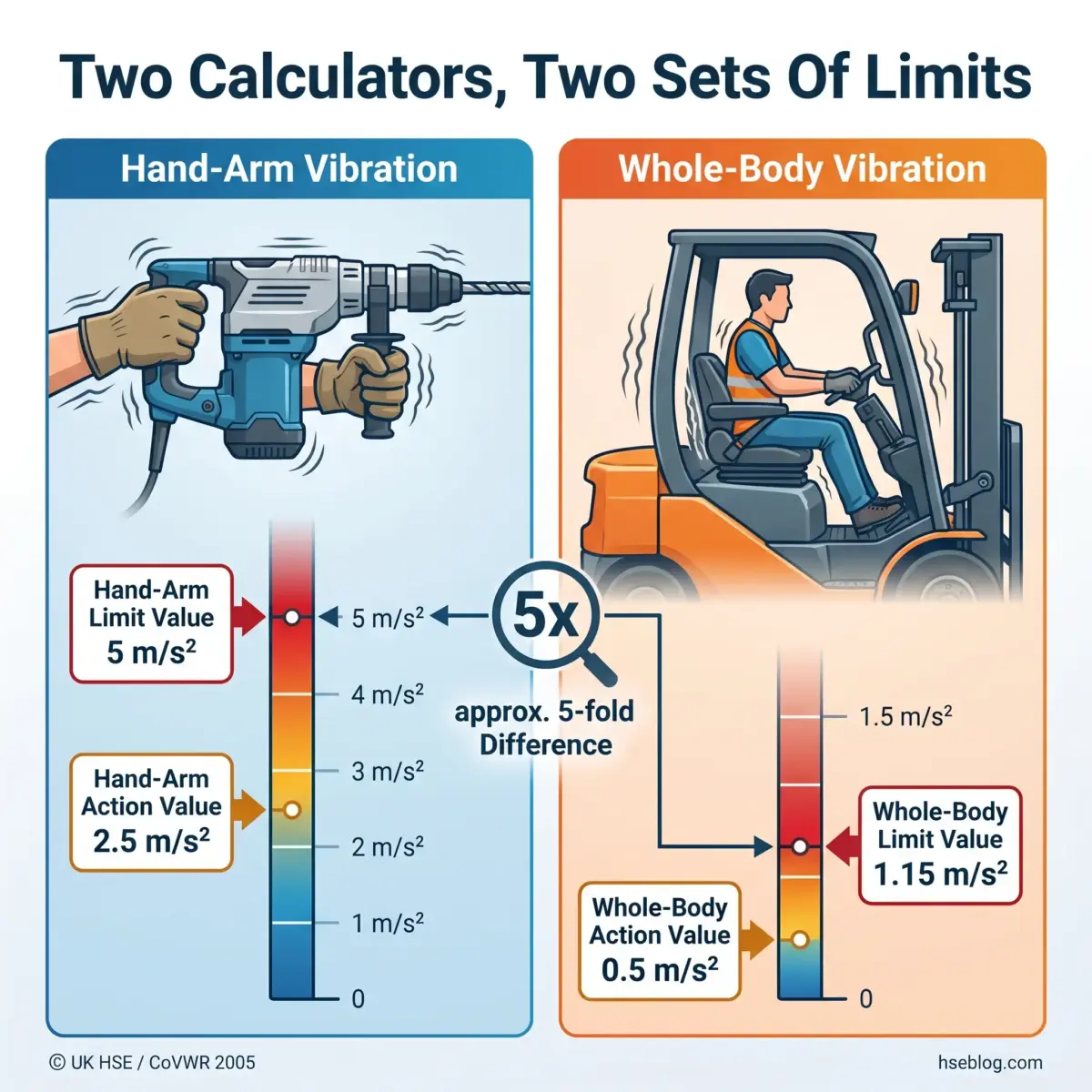
Whole-body vibration uses a separate calculator with genuinely different rules, and the most damaging mistake is carrying hand-arm habits across to it. Under the Control of Vibration at Work Regulations 2005, the WBV action value is 0.5 m/s² A(8) and the limit value 1.15 m/s² A(8) — roughly a fifth of the hand-arm numbers.
The whole-body vibration calculator differs in three ways that change the answer:
- The highest-axis rule. WBV is measured on three axes (x, y, z). You take the single highest k-factor-adjusted partial A(8) — not an average, not a sum.
- The k-factor. A multiplier of 1.4 applies to the x and y axes for a seated or standing worker. Forgetting it can under-assess by around 40%.
- The VDV alternative. ISO 2631-1 also defines a Vibration Dose Value (VDV) method. The UK HSE recognises a single VDV threshold of 17 m/s¹·⁷⁵ and does not adopt the EU Directive’s separate VDV action and limit values.
Here is the side-by-side that searchers most often conflate:
| Vibration type | EAV | ELV | Governing standard | Typical exposure source |
|---|---|---|---|---|
| Hand-arm | 2.5 m/s² A(8) | 5 m/s² A(8) | ISO 5349-1 / CoVWR 2005 | Powered hand tools |
| Whole-body | 0.5 m/s² A(8) | 1.15 m/s² A(8) | ISO 2631-1 / CoVWR 2005 | Off-road mobile plant seats |
Whole-body vibration mainly affects drivers of off-road mobile plant, and the long-term risk is to the lower back and spine. The recurring error is plugging a seat-vibration value into a hand-arm calculator — the thresholds differ by roughly a factor of five, so the risk picture comes out wildly wrong in either direction. The EU framework behind these figures sits in Directive 2002/44/EC on vibration, which the UK values implement.
Common calculator mistakes that under-assess real risk
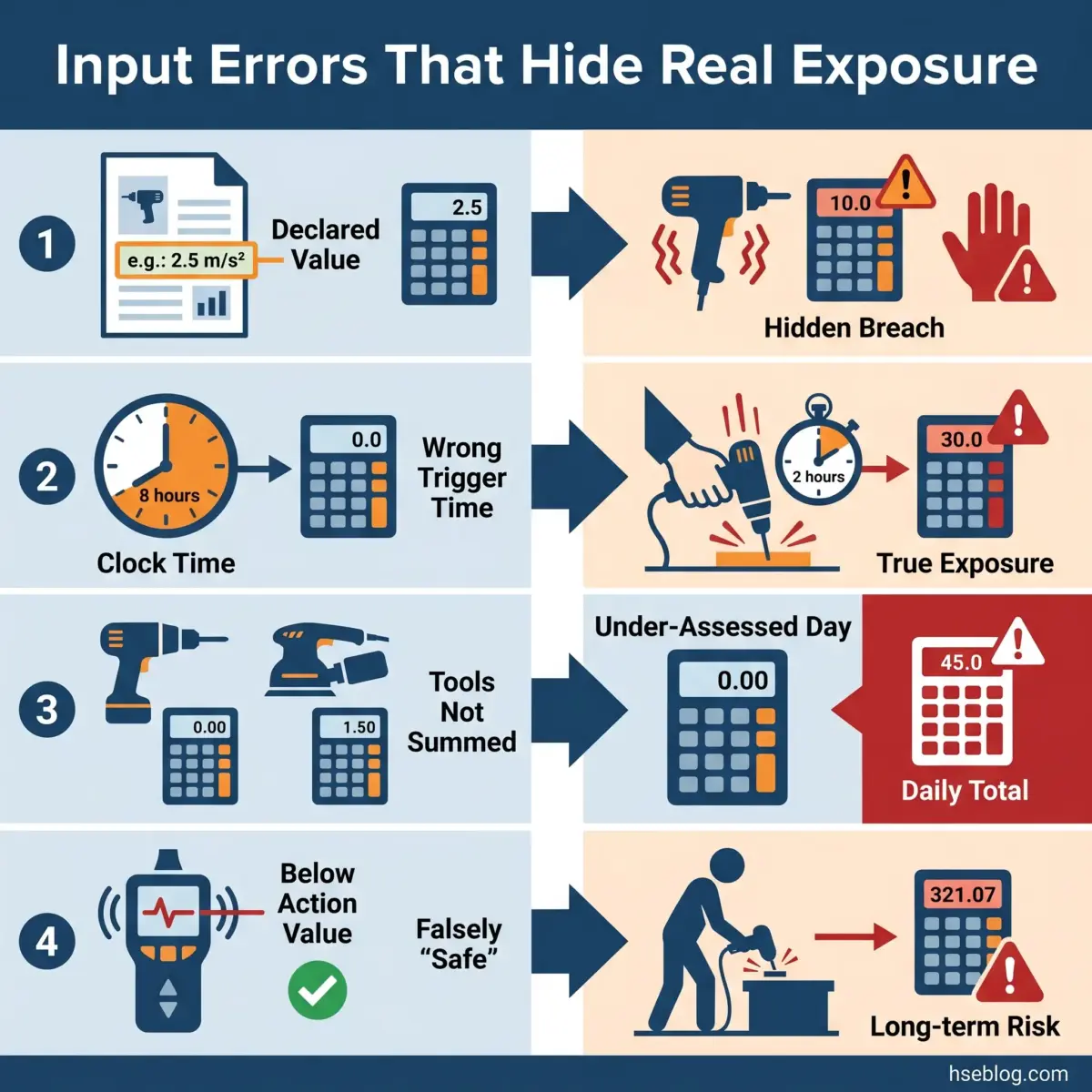
The defining pattern in vibration enforcement is “compliant on paper, exposed in reality” — a calculator returning a tidy number from inputs that were never sound. Each of these mistakes points the result the wrong way, and a competent person can audit against the list directly.
- Using declared magnitudes instead of in-use values → the result reads low and a real breach stays hidden → measure, or use HSE database values, where exposure is near a threshold.
- Counting clock time or job time instead of trigger time → exposure is overstated as duration but the dose-per-tool is misjudged → time the actual vibrating contact by observation.
- Assessing tools individually and never summing them → each tool looks fine while the day sits above the EAV → use one row per tool and read the combined total.
- Treating a below-EAV result as “safe” → surveillance is skipped and early HAVS goes undetected → keep monitoring below the action value where exposure is regular.
- Ignoring the k-factor or wrong axis on WBV → the seat dose is under-assessed by up to 40% → apply the 1.4 factor and take the highest axis.
- Treating the output as the risk assessment → controls and health surveillance never get built → use the calculator as one input feeding a full assessment.
Does the calculator prove legal compliance? Jurisdiction and its limits
The calculator output is evidence toward compliance, never proof of it — and what counts as compliance depends entirely on where the work happens. The single most common cross-border error is assuming the EAV and ELV are universal numbers. They are not.
Regulatory content here reflects general HSE professional understanding of UK, EU, and US requirements as of 2025. It is not legal advice. Specific compliance questions, enforcement situations, or prosecution risk should be directed to qualified legal counsel in the applicable jurisdiction.
Where the work sits under UK or EU law, the figures bite. The action and limit values are legally enforceable under the Control of Vibration at Work Regulations 2005 and Directive 2002/44/EC, but a sub-ELV result alone does not discharge the duty — the full risk assessment, control measures, and health surveillance must also be in place.
The United States works on a different logic entirely:
- No numeric limit exists. There is no OSHA HAV or WBV figure. Employers are held to the OSHA General Duty Clause, Section 5(a)(1), to provide a workplace free of recognised hazards.
- References are voluntary. ACGIH Threshold Limit Values, ISO 5349, and ANSI S3.34 sit as guidance, not law.
- No number is not the same as no duty. A US site is not automatically safe because no federal figure applies; General Duty Clause liability still attaches to a known vibration hazard.
| Region | Enforceable numeric limit? | Governing instrument | Status of EAV/ELV |
|---|---|---|---|
| UK | Yes | CoVWR 2005 | Legally enforceable |
| EU | Yes | Directive 2002/44/EC | Legally enforceable once transposed |
| US | No | OSH Act General Duty Clause 5(a)(1) | Not applicable; ACGIH TLV voluntary |
For multinational programmes, the UK/EU values are the stricter, clearer reference and a sensible internal standard. The error to avoid is running every site through the HSE vibration calculator and reading a sub-ELV result as global compliance — true across the EU, but it neither maps onto US law nor settles a General Duty Clause obligation. Enforcement commentary in 2024–2025 has increasingly targeted management and assessment failure over acute injury alone, including a £140,000 grounds-maintenance fine in 2025 (UK HSE). The regulatory content above was reviewed against current HSE and OSHA guidance in 2025.
Frequently Asked Questions
Conclusion
The industry treats the vibration exposure calculator as the assessment when it is only the arithmetic. Two decades of regulation cut newly assessed HAVS cases from 1,210 in 2010 to around 220 in 2024 (UK HSE, 2025), yet the cases still arrive — and when they do, the file almost always shows a calculator output that looked fine on paper.
The one change that moves the needle most is input honesty. Measure or source the real in-use magnitude instead of the catalogue figure, time the actual trigger time instead of guessing from the shift, and sum every tool a worker touches into one daily total. Those three corrections separate a number that protects someone from a number that merely documents the moment before the damage was found.
Treat the output as one input into a competent person’s risk assessment, keep the hand-arm and whole-body tools and thresholds firmly apart, and remember that a clean result under the UK calculator answers a UK question — not a US one. Used that way, a vibration exposure calculator does exactly what it should: it narrows the question down to the decisions that actually keep hands and spines intact.