
TL;DR
- If you employ outdoor workers in winter, you owe them a legal duty — even though neither OSHA nor HSE sets a cold-temperature limit for outdoor work.
- If there is no numeric threshold, the burden shifts to your risk assessment — you must show defensible controls, not point to a number.
- If a worker slips on un-gritted ground you control, liability turns on whether your gritting regime was reasonable and recorded — not on bad luck.
- If roof snow must be cleared, treat it as planned work at height under a competent person — never a quick errand sent up a ladder.
Employers must protect workers from snow and ice hazards even though neither OSHA nor HSE sets a specific cold-temperature limit. In the US the duty flows from the OSH Act’s General Duty Clause; in the UK it flows from the duty to carry out a suitable risk assessment. Both require identifying hazards, applying controls, and documenting the decisions behind them.
Across published HSE prosecutions and OSHA citations, one winter misconception does more damage than any single missing control: the belief that “no legal temperature limit” means “no legal duty.” Both regulators reject that reading — the absence of a number raises the evidential bar rather than removing it.
Snow and ice injure tens of thousands of workers in a heavy winter, and the duty to prevent that harm is enforceable in both countries. This guide sets out employer duties for working in snow and ice across two jurisdictions, then pairs each duty with the practitioner judgment that makes it hold up under scrutiny.
Regulatory content here reflects general HSE professional understanding of US (OSHA) and UK (HSE) requirements as of 2025–2026. It is not legal advice. Specific compliance questions, enforcement situations, or prosecution risk should be directed to qualified legal counsel in the applicable jurisdiction.
What Are an Employer’s Legal Duties When Workers Are Exposed to Snow and Ice?
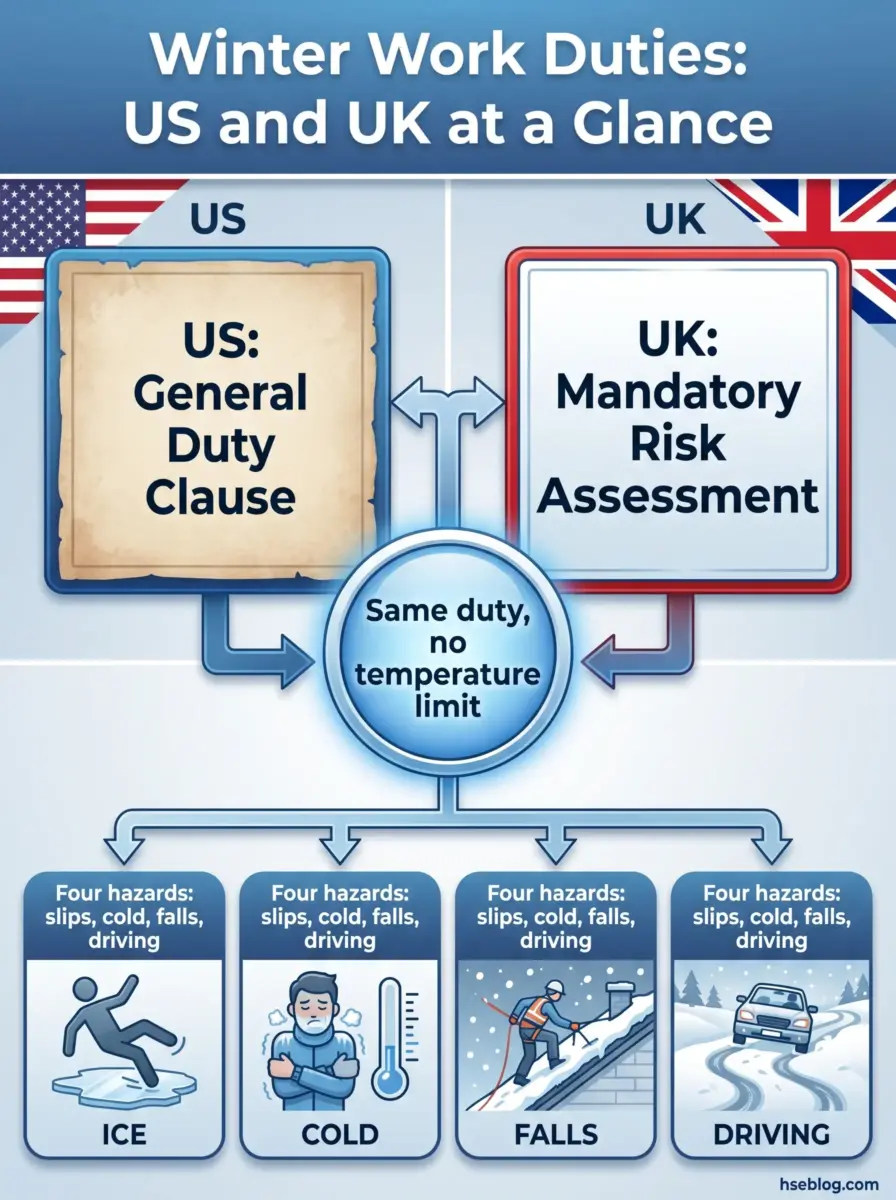
You owe a duty in both jurisdictions, and neither one lets you off the hook because the thermometer hasn’t hit a magic number. The two systems simply prove that duty differently — one through a catch-all obligation, the other through a mandatory assessment.
In the US, there is no dedicated cold or winter standard. The duty flows from the General Duty Clause, Section 5(a)(1) of the OSH Act 1970 (US), which requires a workplace free from recognized hazards likely to cause death or serious physical harm — and OSHA applies this directly to cold-stress and winter-weather exposure.
In the UK, the route is different but no weaker. Under the Management of Health and Safety at Work Regulations 1999, Regulation 3 (UK), employers must carry out a suitable and sufficient risk assessment, and the Workplace (Health, Safety and Welfare) Regulations 1992, Regulation 7 (UK) require a “reasonable” temperature — with the ACOP naming 16°C indoors (13°C for strenuous work) but no statutory minimum for outdoor work.
| Duty element | US (OSHA) | UK (HSE) |
|---|---|---|
| Legal basis | General Duty Clause, OSH Act §5(a)(1) | MHSWR 1999 Reg 3 + Workplace Regs 1992 Reg 7 |
| Temperature threshold | None (no numeric cold limit) | 16°C / 13°C indoor ACOP only; no outdoor figure |
| What you must prove | You recognized and controlled the hazard | You hold a suitable and sufficient risk assessment |
| Enforcement | Citation under the General Duty Clause | Improvement/prohibition notices, prosecution |
The recurring failure mode is treating “there’s no legal temperature limit for outdoor work” as “there’s no obligation.” In practice the opposite is true: with no number to hide behind, you have to show a defensible risk assessment instead, and that is a higher evidential bar, not a lower one. HSE’s own guidance on outdoor working — refreshed on 19 November 2025 — reaffirms exactly this risk-assessment duty while confirming no outdoor minimum exists.
Where International Standards Fit (ISO and EU-OSHA)
Because neither regulator prescribes a method, international standards give you the technical backbone to demonstrate compliance in either country.
- ISO 11079:2007 (IREQ method) — derives required clothing insulation and safe exposure-time limits from temperature, wind, humidity, and work rate. (Now under revision as ISO/CD 11079.)
- ISO 15743:2008 — supplies a structured cold-risk assessment and management strategy, including a usable checklist. The ISO 15743 cold-workplace standard is a Tier 1 method you can cite to evidence a defensible assessment.
- EU-OSHA materials — practical reference for European operations and a useful cross-check for multinational employers.
The Main Hazards of Working in Snow and Ice (Beyond Just “It’s Cold”)
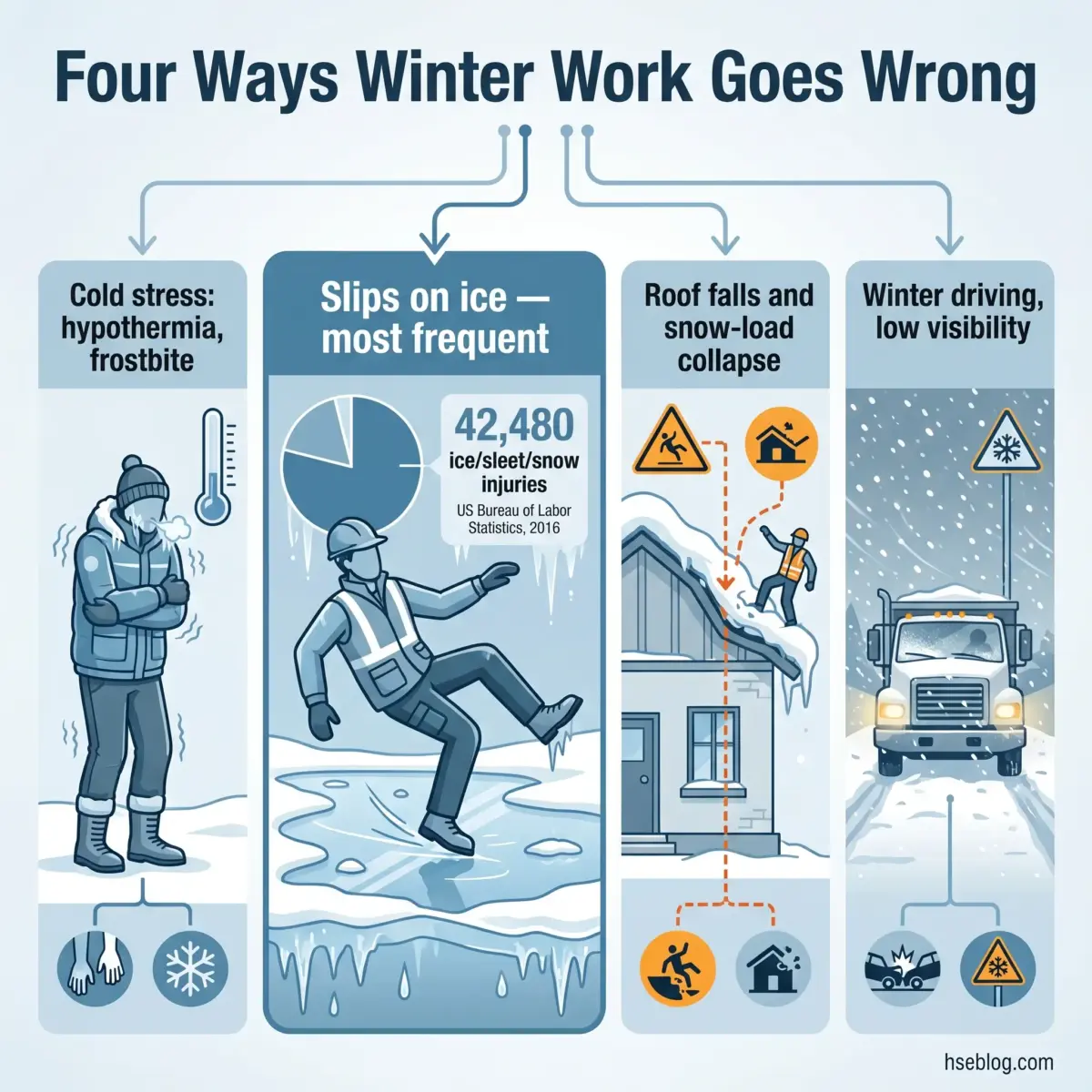
The injury data points to an uncomfortable truth: the most frequent harm is the least dramatic one. The largest single category is not hypothermia — it’s a same-level slip.
In a single severe winter, the scale is significant. In 2014, 42,480 work injuries involved ice, sleet, or snow, with the incidence rate peaking at 3.9 per 10,000 full-time workers (US Bureau of Labor Statistics, 2016). By 2017 the count had fallen to 20,460 such injuries involving at least one day away from work, a rate of 1.8 per 10,000 — down from 2.1 in 2016 (US Bureau of Labor Statistics, 2019). These remain the most recent official figures of their kind; read them as a marker of scale and year-to-year volatility tied to winter severity, not as a current annual count.
Map your controls to four distinct hazard families:
- Slips, trips and falls on ice and snow — statistically the largest category. Most exposed: anyone crossing car parks, steps, slopes, and entrances, plus indoor staff near tracked-in slush.
- Cold stress as a cluster — hypothermia (core temperature below ~95°F / 35°C), frostbite, and trench foot from wet-cold even above freezing. Most exposed: prolonged outdoor and lone workers.
- Elevated and structural hazards — falls during roof snow clearing, and snow-load roof collapse. Most exposed: maintenance crews and anyone tasked with “just clearing the roof.”
- Reduced visibility and winter driving — shorter daylight, glare, and ice on roads. Most exposed: at-work drivers, delivery and utility teams.
The pattern worth flagging: prevention attention defaults to the dramatic risk — hypothermia — while the highest-frequency harm gets the least planning. A slip in a poorly gritted car park, between vehicle and entrance, rarely makes it into the toolbox talk. The BLS data on ice, sleet, and snow injuries keeps putting that category at the top.
How to Build a Snow and Ice Risk Assessment That Holds Up
A defensible snow and ice risk assessment is the single document that satisfies both UK regulation and an OSHA inspector’s “did you recognize the hazard?” question. Build it as a live planning tool, not a filing-cabinet artifact.
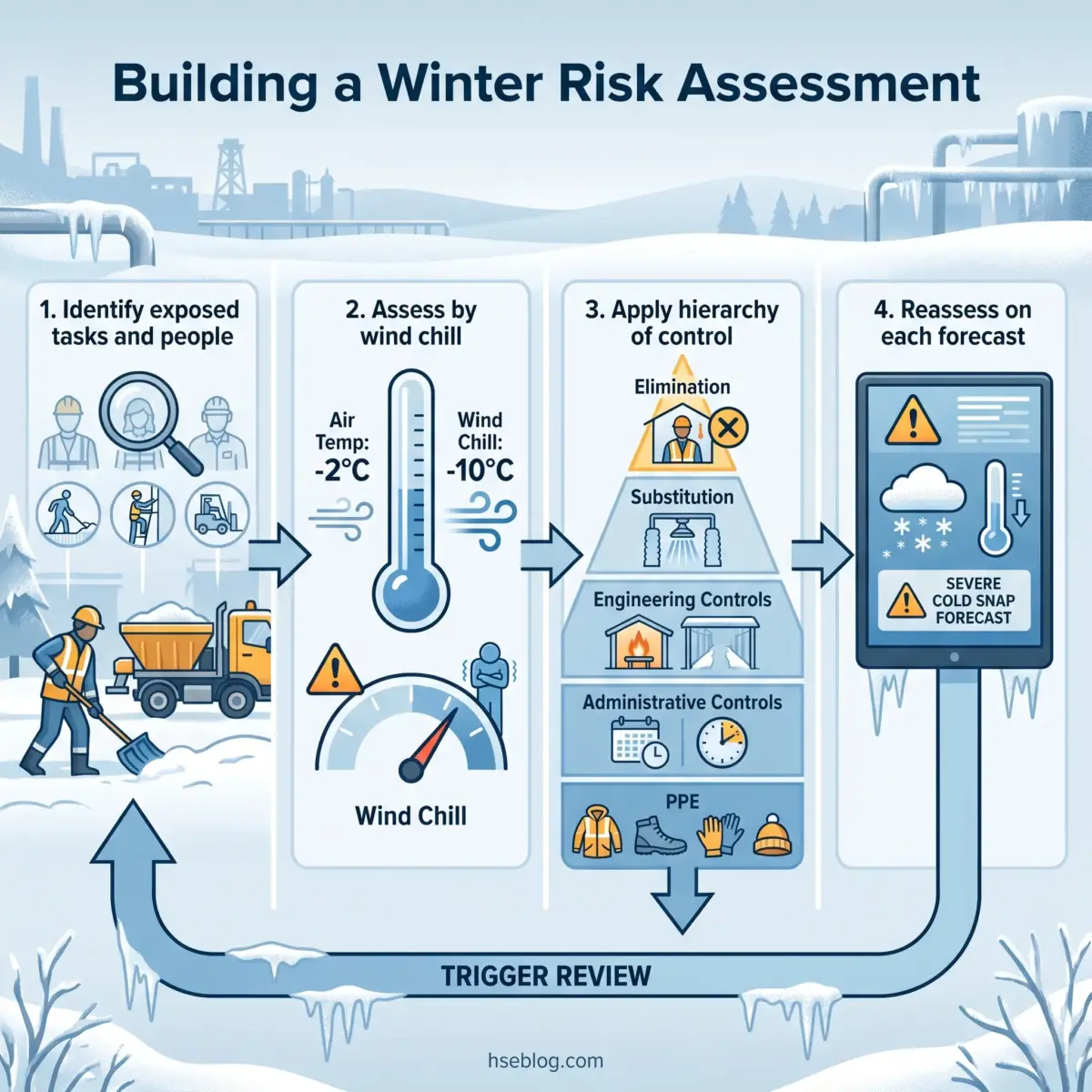
Under MHSWR 1999 Reg 3 (UK), the assessment must be suitable and sufficient; under the General Duty Clause (US), it is the evidence that you recognized the hazard before someone was hurt. Work through it in order:
- Identify exposed tasks and people — outdoor, lone, driving, at-height, and entrance-adjacent indoor workers all count.
- Plan against wind chill, not air temperature — use ISO 11079 (IREQ) to set required clothing insulation and exposure-time limits for the actual conditions.
- Apply the hierarchy of control to this hazard — see the table below.
- Set review triggers — reopen the assessment on forecast severe-weather days, not once a year.
| Control level | Applied to snow and ice |
|---|---|
| Eliminate | Reschedule or postpone non-urgent outdoor work in severe conditions |
| Substitute | Mechanize snow removal; use ground-based tools instead of roof access |
| Engineering | Heated shelters, wind shielding, anti-slip surfacing |
| Administrative | Task rotation, warm-up breaks, buddy system, lone-worker check-ins |
| PPE | Insulated waterproof boots with traction, layered clothing, gloves |
The judgment call that separates a real assessment from a tick-box is timing. Teams commonly write the winter assessment in October and never reopen it — yet the genuine control is dynamic reassessment triggered by each forecast cold snap or storm warning. A static autumn document is exactly what an investigator picks apart after an incident.
Clearing Snow and Ice: Gritting, De-icing and Walkway Management
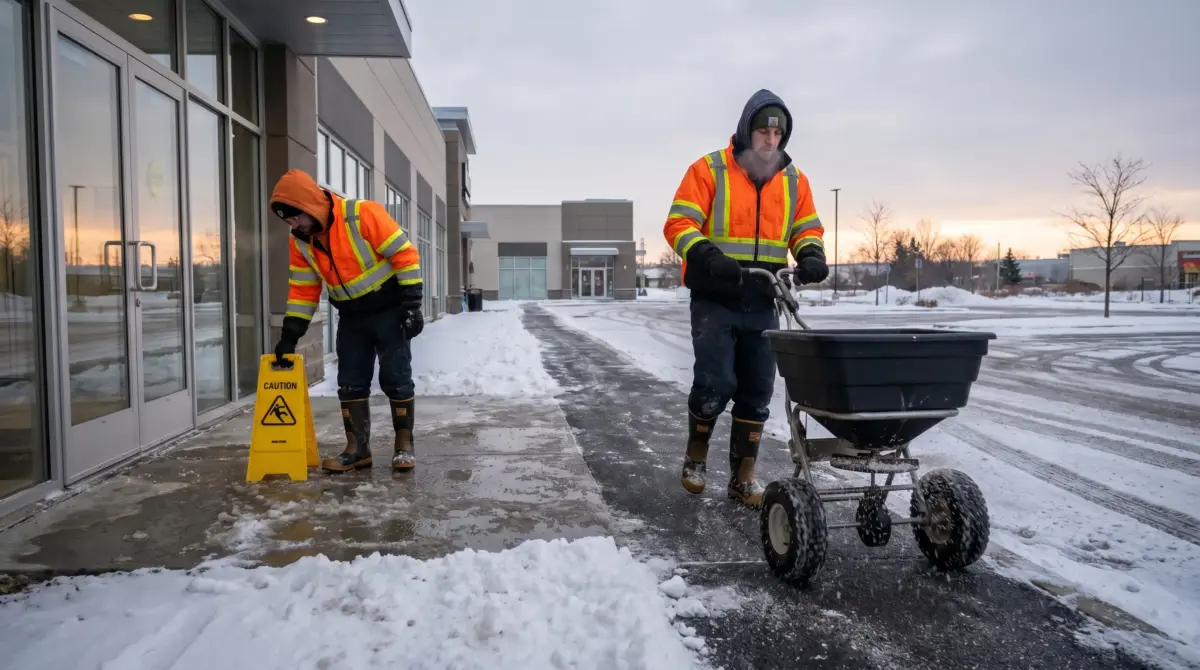
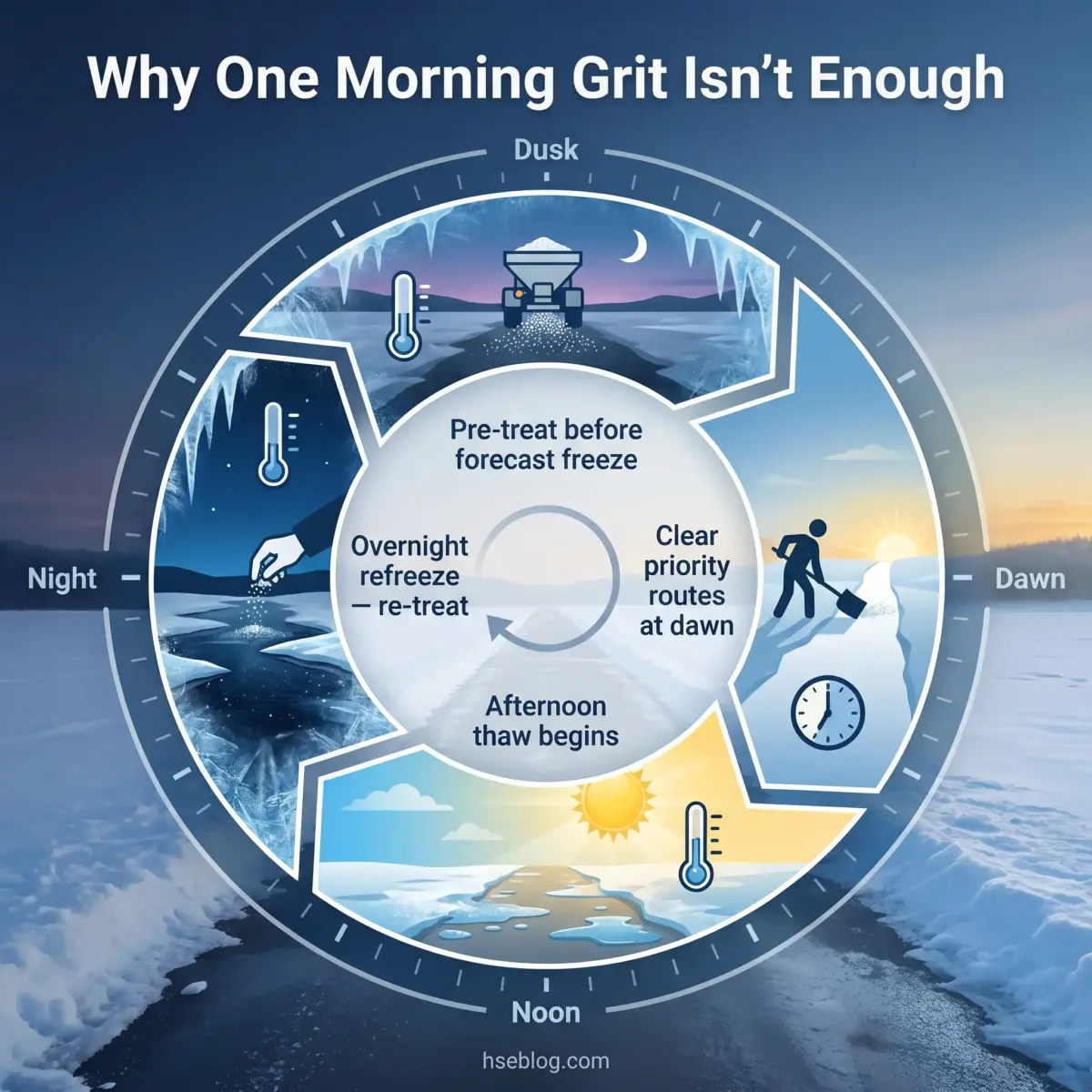
Gritting is the highest-frequency control you operate all winter, and it fails most often on timing, not material. The walkways most people slip on are the ones nobody assigned to anybody.
- Clear and de-ice surfaces as fast as practicable after a storm, and pre-grit ahead of a forecast freeze rather than reacting to ice already formed.
- Prioritize the routes that actually carry people — car-park-to-entrance paths, slopes, ramps, and steps. Cordon and mark any area you cannot clear.
- Manage tracked-in slush at entrances with matting and mopping; melted slush on hard indoor floors is a leading slip source that gritting outside never touches.
- Stock grit and rock salt before the season, and assign named responsibility with a defined cadence — never “as needed.”
High-priority zones to grit first:
- Entrance and exit approaches where foot traffic concentrates
- Slopes, ramps, and external stairs
- Loading bays and pedestrian-vehicle crossing points
- Any north-facing or shaded surface that refreezes early
The applied reading of a “reasonable” gritting regime is where most programs fall short. Gritting is treated as a single morning task, when the refreeze in late afternoon and overnight is precisely when many slips occur. The cadence has to match the thaw-refreeze cycle, not the work shift — and if a slip claim lands, that documented cadence is what stands between you and a finding that your steps weren’t reasonable.
Preventing Cold Stress: PPE, Layering and Warm-Up Breaks
Cold-stress control is two jobs running together: keep workers warm, and make sure someone can recognize when warmth is failing. The PPE duty here is also where the “who pays for the coat” question gets answered honestly.
Content covering cold-stress recognition is for HSE practitioner reference. It is not medical advice. Workers with symptoms such as confusion, persistent shivering, numbness, or skin changes should be removed from the cold and assessed by an occupational physician or qualified medical professional.
The controls that keep workers warm
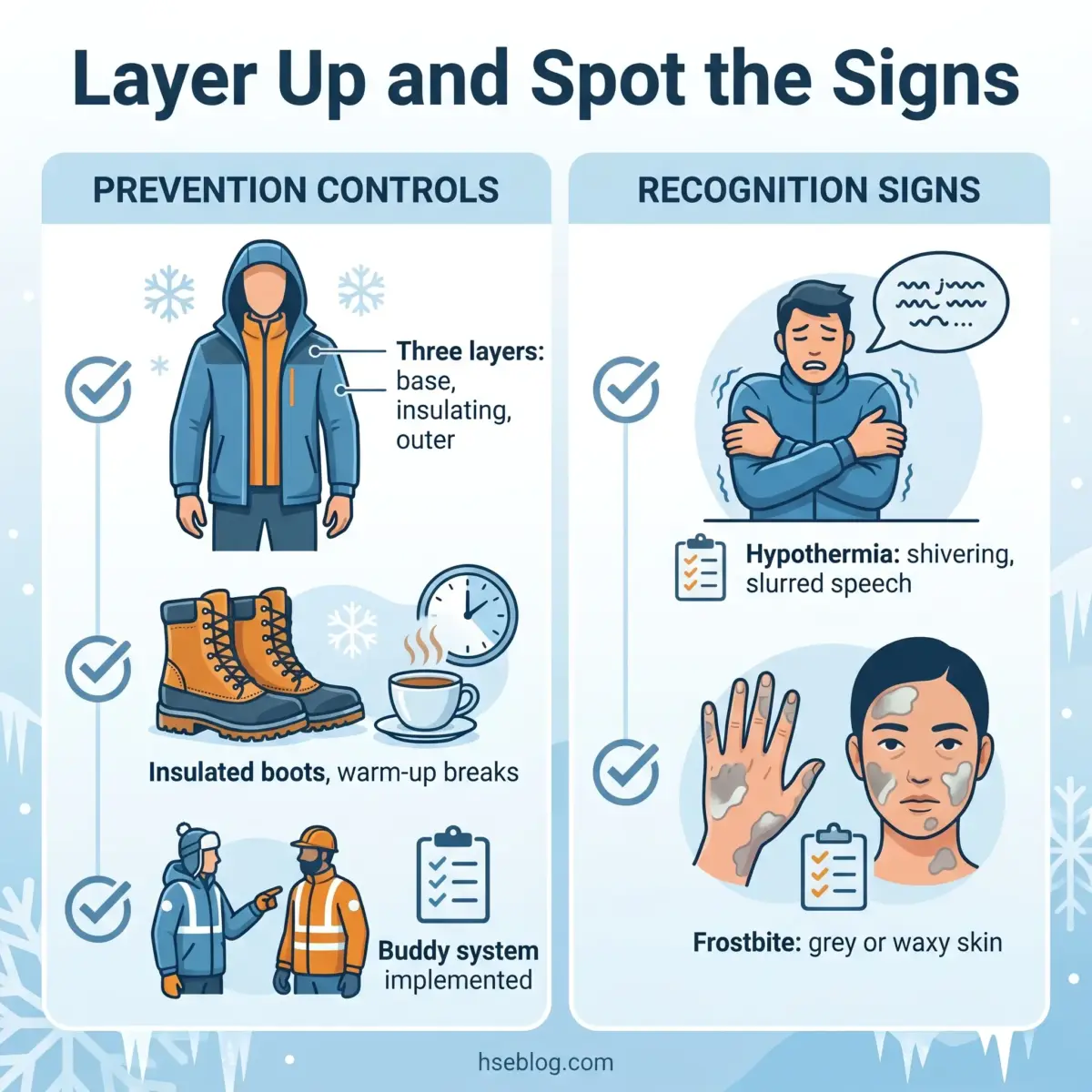
- Three-layer clothing system — a moisture-wicking base, an insulating mid-layer, and a wind- and water-resistant outer, as set out in OSHA’s cold stress guidance.
- Traction and extremity protection — insulated waterproof boots with grip, gloves, and head and face cover.
- Scheduled warm-up breaks in heated shelters, with warm sweetened (non-alcoholic) fluids.
- Smarter scheduling — heavy work in the warmest part of the day, plus a buddy system so no one is monitored only by themselves.
The warning signs to act on
- Hypothermia — shivering, slurred speech, numbness, loss of coordination, and (a danger sign) shivering that stops as the body deteriorates.
- Frostbite — grey, white, or waxy patches on fingers, toes, ears, and nose, often with numbness.
- Trench foot — from prolonged wet-cold, sometimes above freezing; cold, numb, mottled feet.
Seek medical attention promptly for any of these — early recognition is the control that matters most.
Here is the interpretation that catches employers out. Under OSHA’s 29 CFR 1910.132(h)(4) (US), employers are not required to provide ordinary weather clothing such as coats and gloves used solely for protection from the weather — so many provide nothing at all. A competent program reads the standard correctly: the general winter coat may be the worker’s own, but task-specific protection such as traction footwear and impermeable gloves is risk-control PPE, and that you must provide.
Working at Height in Winter: Roof Snow Removal and Snow-Load Collapse
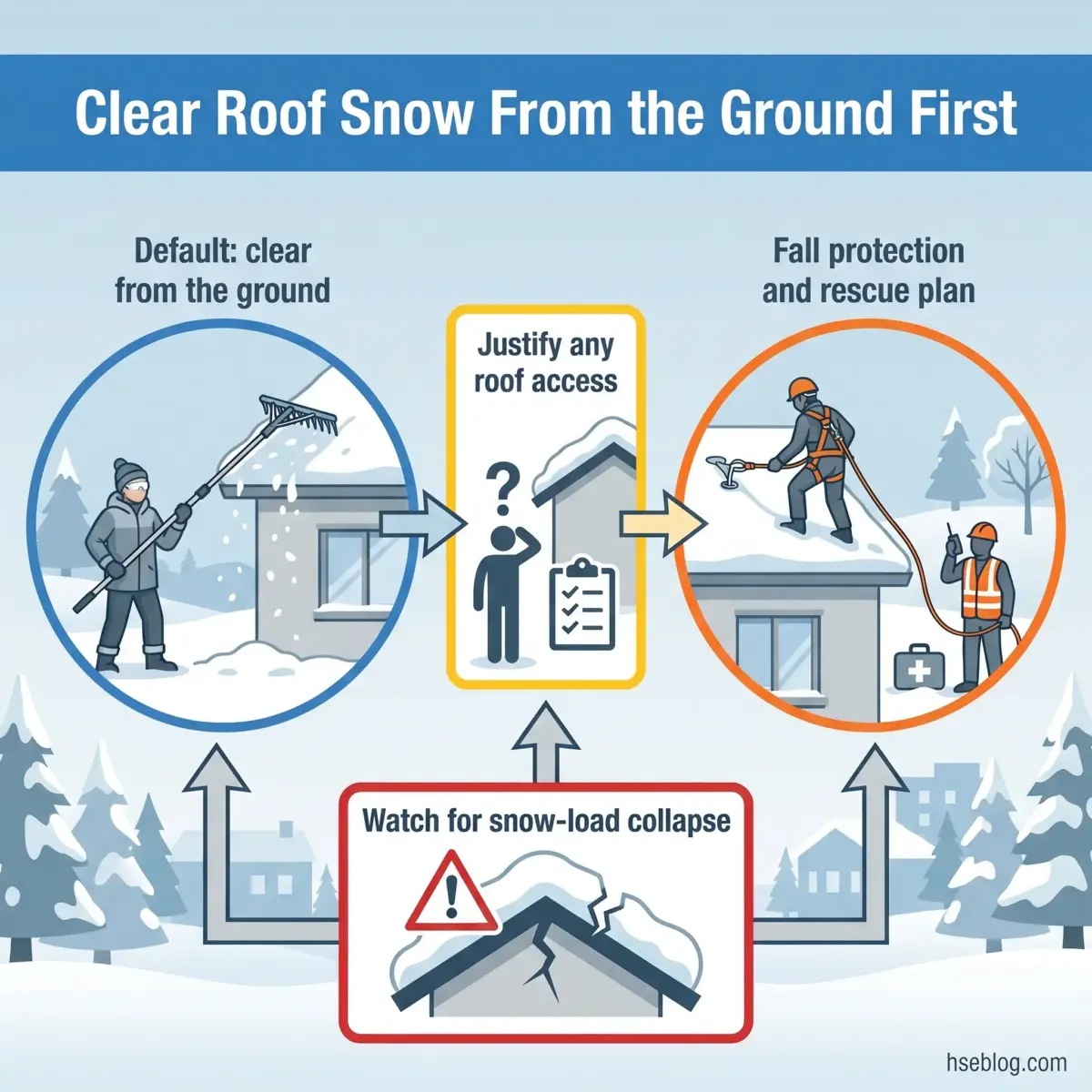
The safest roof snow job is the one nobody climbs onto. Default to clearing from the ground, and treat any unavoidable roof access as a planned work-at-height task — not a chore.
This article provides general HSE knowledge. Life-critical work such as roof snow clearing must be planned and supervised by a competent person with relevant training, jurisdiction-specific authorization, and a site-specific risk assessment. The information here does not replace that.
Work through the decision in order:
- Clear from the ground first — use snow rakes, drag lines, and de-icing reached from ladders or ground level wherever the roof allows it.
- Justify any roof access — only put a person on the roof when no ground-based method will do, and record why.
- Control the at-height work — fall-protection systems, surfaces cleared before ladder placement, a trained competent person in charge, and rescue provision planned before anyone goes up.
- Watch the structure itself — snow-loaded roofs carry collapse risk; treat weakened or sagging surfaces as no-go until assessed.
- Consider specialist vendors — for large or steep roofs, trained contractors with the right access equipment are often the defensible choice.
The dangerous framing is almost always the same: “just send someone up quickly.” The competent-person discipline is to refuse that framing — every roof snow task is a planned work-at-height job with fall protection and a rescue plan, or it doesn’t happen. Speed pressure is exactly what investigation reports cite when a clearing job becomes a fatality.
Winter Driving Duties for At-Work Drivers
Your duty over work-related driving does not stop at the depot gate. Road conditions are outside your control, but vehicle readiness, driver competence, and the journey decision are squarely your responsibility.
- Train drivers for winter conditions — skid awareness, stopping distances on ice, and managing reduced visibility and glare.
- Maintain and inspect vehicles — brakes, tires, lights, wipers, washer fluid, and battery checked before the cold sets in.
- Equip for the worst case — an emergency kit (warm layers, traction aid, light, charged phone, food and water) in every vehicle.
- Set and enforce a winter driving policy — clear rules on when journeys are delayed or stood down.
- Give drivers genuine authority to abandon an unsafe journey — without penalty, target loss, or comeback.
That last point is where the control most often breaks. Journey-abandonment authority exists on paper in many fleets, then gets quietly undermined by delivery targets and arrival-time pressure. The control only works if a driver who stands a vehicle down in dangerous conditions faces no detriment for it — anything less turns a stated policy into a hazard.
Training, Supervision and Emergency Response
Controls are only defensible if your people are trained to use them and your emergencies are planned for in advance. This is the section an inspector or claims investigator tests first — and where records, not intentions, decide the outcome.
What to train and document
- Recognition and response — train workers and supervisors to spot cold stress and act, and keep the training records.
- Lone and remote workers — set check-in procedures for cold or isolated settings, where a delayed rescue turns a manageable problem into a fatal one.
- Emergency procedures — warming, first aid, and clear escalation to medical care, rehearsed rather than assumed.
The gap that catches employers out
Training records are usually the first thing requested after an incident, and the common failure is delivery without retention. A one-off induction slide in someone’s first week does not survive a hard winter — refresher timing before each season is what an investigator actually credits. Both the US training expectation under the General Duty Clause and the UK duty to provide adequate information and training point the same way: trained, and able to prove it.
Frequently Asked Questions
Conclusion
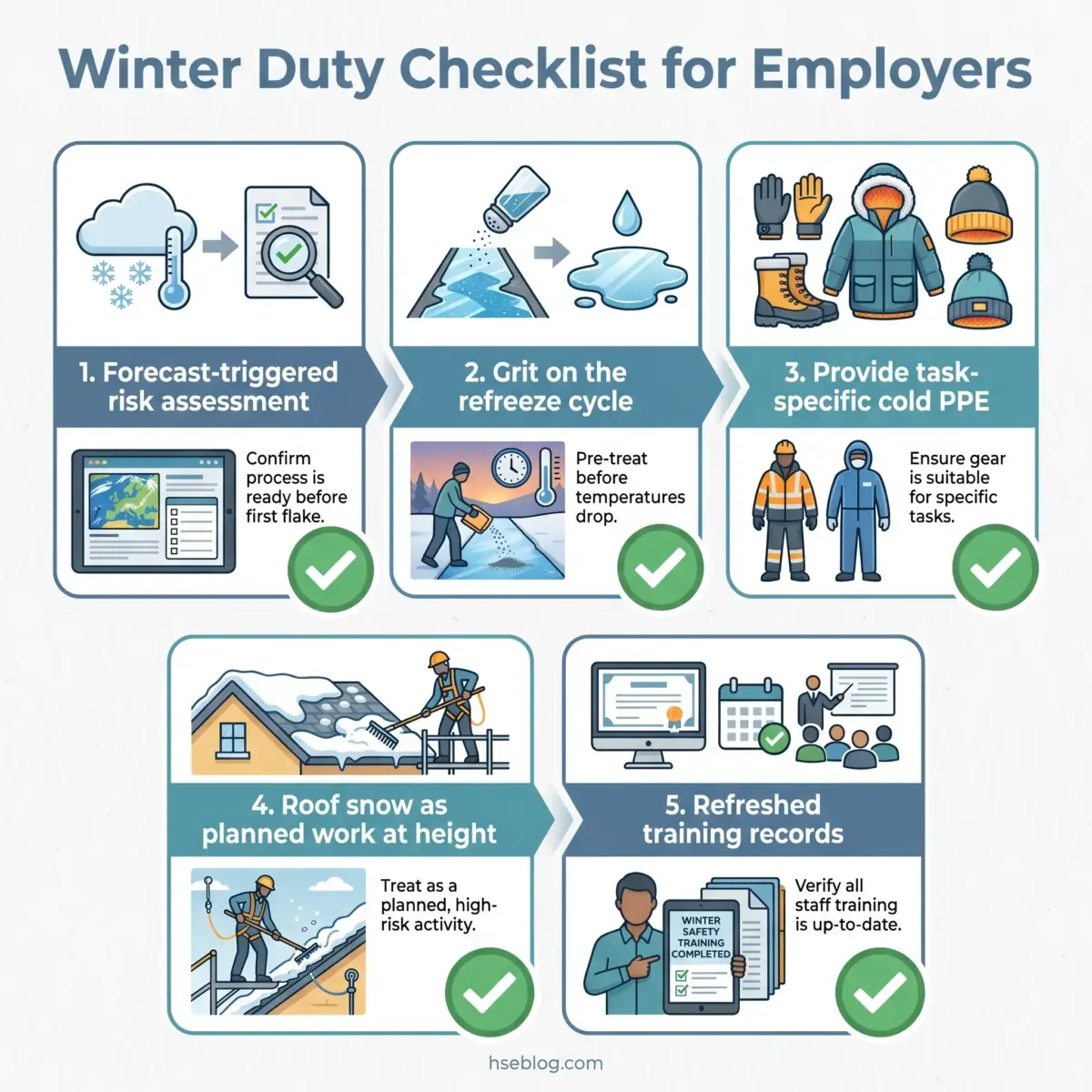
Strip away the jurisdiction-specific wording and the employer’s job in snow and ice comes down to four decisions. Hold a risk assessment you reopen on every severe forecast, not once each autumn. Grit on the thaw-refreeze cycle with named responsibility, provide the task-specific PPE the standard actually requires, and treat roof snow as planned work at height under a competent person.
The thread running through all of it is that no temperature number will rescue you — and that is becoming more pronounced, not less. The heat-cold regulatory gap widened over 2025–2026 as OSHA’s heat enforcement expanded while no comparable federal cold standard emerged, and Colorado’s HB25-1286, which would have mandated cold-stress protections, was postponed indefinitely in March 2025 (OSHA / state legislative tracking, 2025–2026). Working in snow and ice will keep being governed by the duty to assess and control, which means the quality of your documented judgment is the compliance.
So the question to take into winter is uncomfortable but simple: if a worker slipped tomorrow on a surface you control, could you produce a gritting record, a live risk assessment, and a training log dated this season? If the honest answer is no, that is the gap to close before the first hard freeze.