
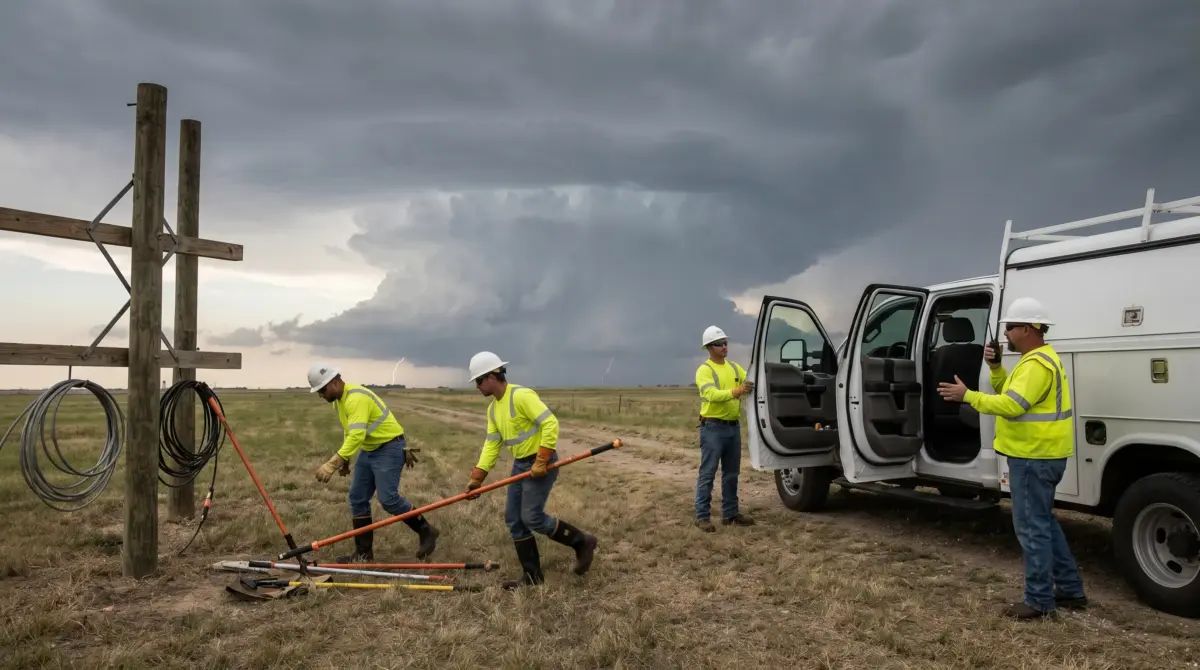
TL;DR — The Stop-Work Decision in Four Rules
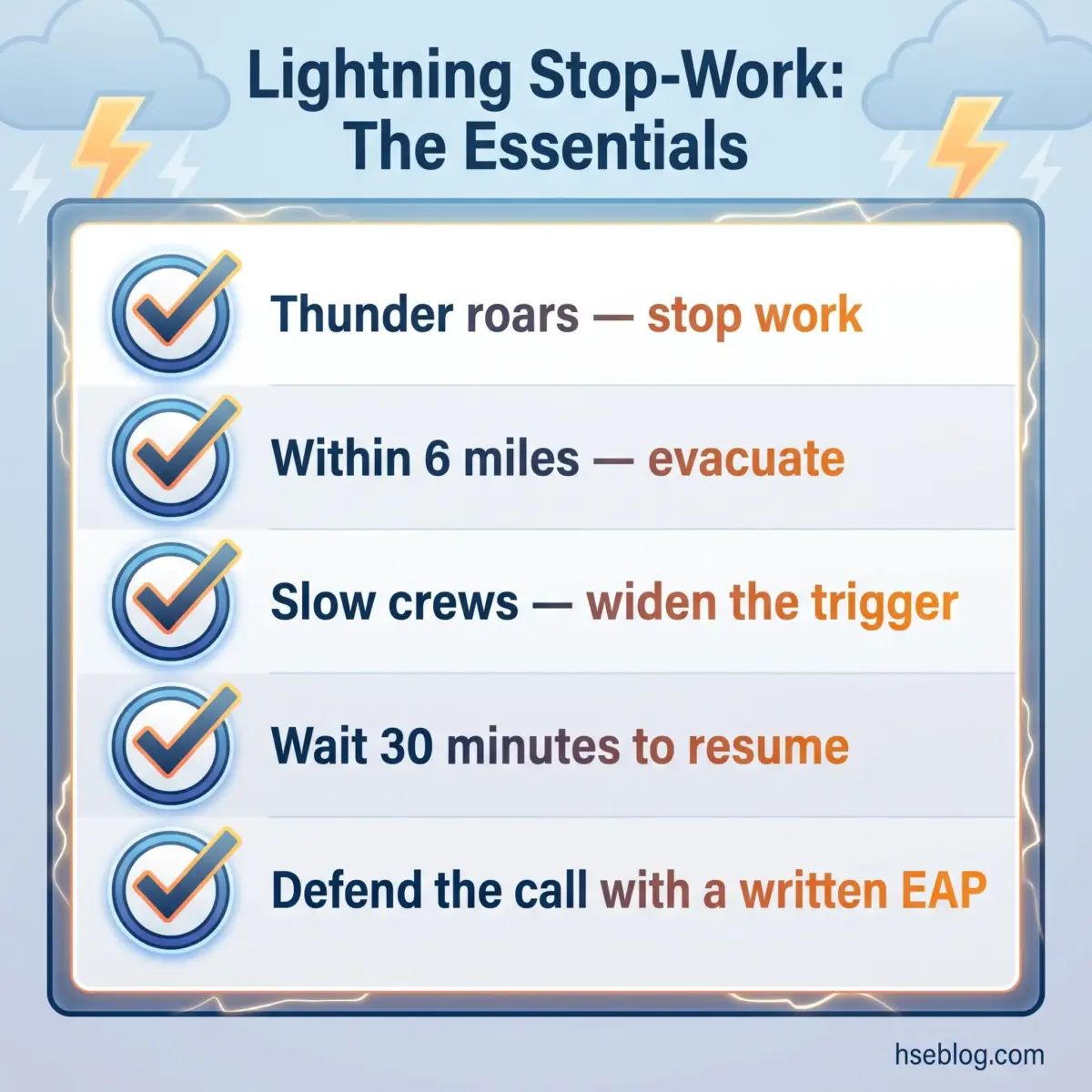
- If you hear thunder or see lightning, stop outdoor work now. Any audible thunder means lightning is already within strike range — there is no “still far off” margin.
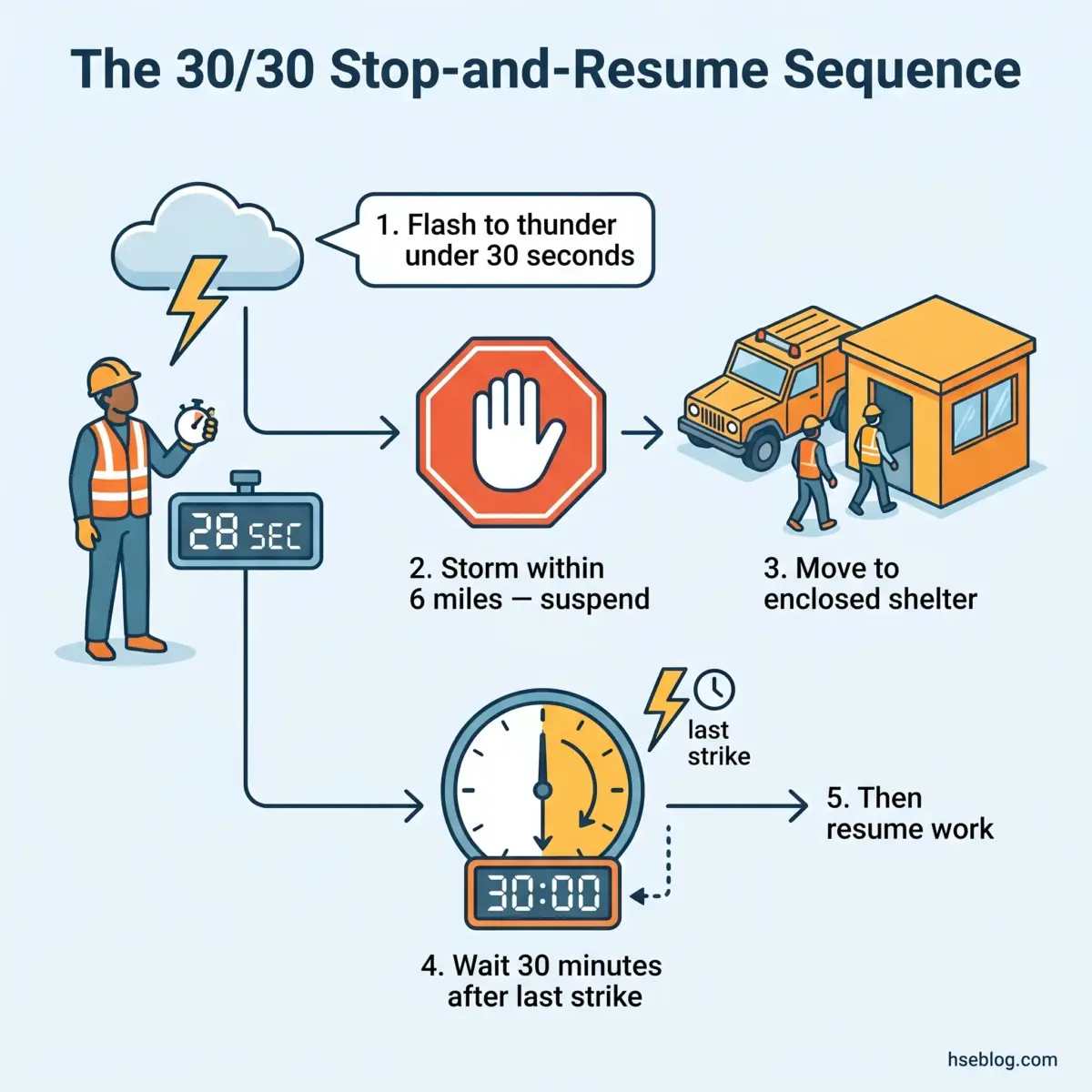
- If thunder follows a flash by 30 seconds or less, the storm is within ~6 miles. That is your suspend trigger; evacuate to safe shelter immediately.
- If your crew is slow to clear the area, widen the trigger. Use an 8–10 mile detection radius, not the generic 6-mile number, so the threshold accounts for evacuation time.
- If you are restarting, wait a full 30 minutes after the last thunder or flash. Trailing and “bolt from the blue” strikes kill returners who counted from the last close strike instead.
Stop all outdoor work the moment you hear thunder or see lightning. If thunder follows a flash by 30 seconds or less, the storm is within about six miles — evacuate to a fully enclosed building or hard-topped vehicle. Do not resume work until a full 30 minutes have passed after the last thunder or flash.
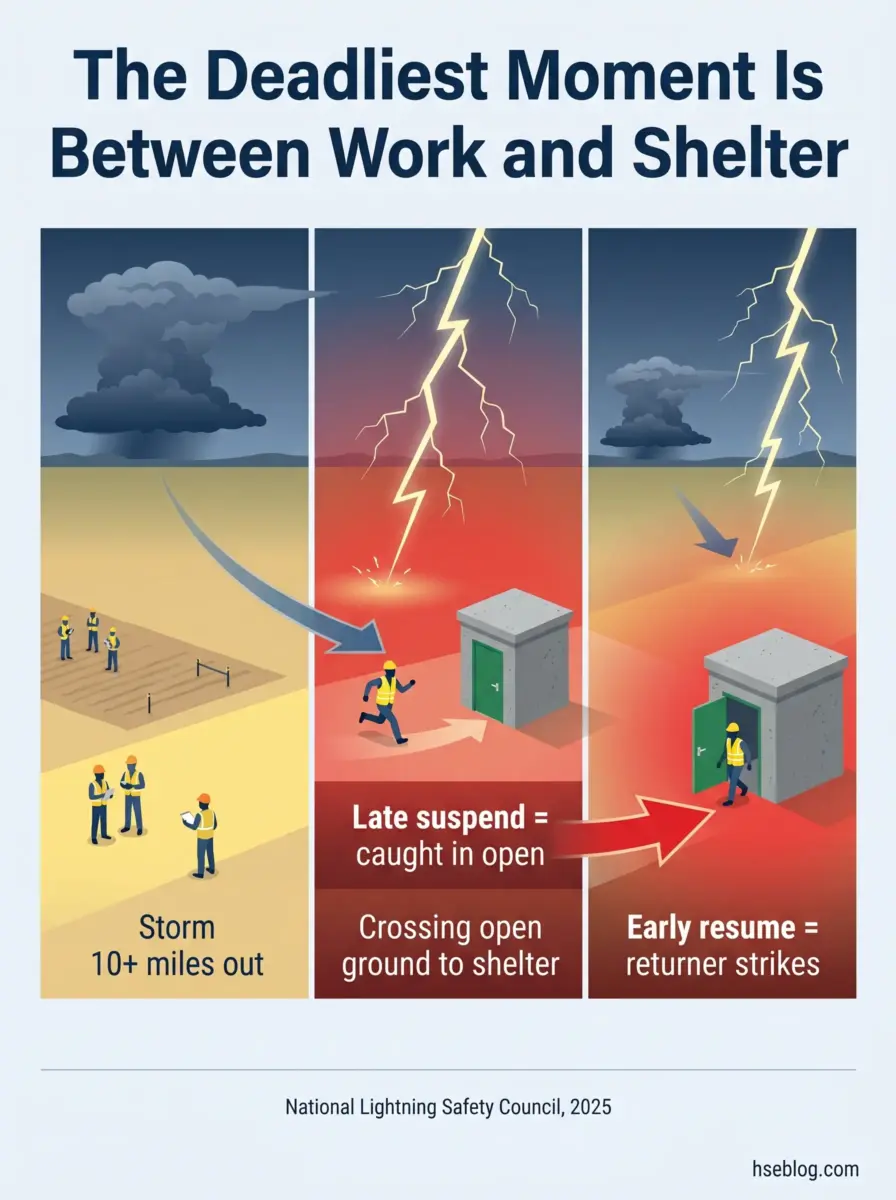
Between 2006 and 2024, lightning killed 492 people in the United States (National Lightning Safety Council, 2025). The detail that should reshape how every outdoor crew runs a storm day is buried in that dataset: a large share of victims were not surprised in the open — they were moving toward safety, or had just stepped back out from it.
That is what makes lightning safety at work a timing problem more than a weather problem. This article gives you the exact suspend and resume thresholds, the US and UK legal positions that sit behind them, and the failure modes — flash-to-bang collapsing mid-storm, the resume call under production pressure, the evacuation itself — that the standard “30/30” recital never warns you about.
Competent-person caveat: This article provides general HSE knowledge. Life-critical stop-work decisions for lightning must be planned and supervised by a competent person with relevant training, jurisdiction-specific authority, and a site-specific risk assessment. The thresholds here inform that judgment; they do not replace it.
Why Lightning Is an Underestimated Workplace Hazard
Lightning is a recognized occupational hazard your employer is legally expected to control — not an “act of God” that sits outside the duty of care. Roughly 25 million cloud-to-ground strikes hit the US each year (NOAA / National Weather Service, 2025), and outdoor work puts crews directly inside that exposure.
The fatality record tells you where the risk concentrates. Two-thirds of US lightning deaths occur during outdoor or leisure exposure, and work activities form a distinct cluster within the rest.
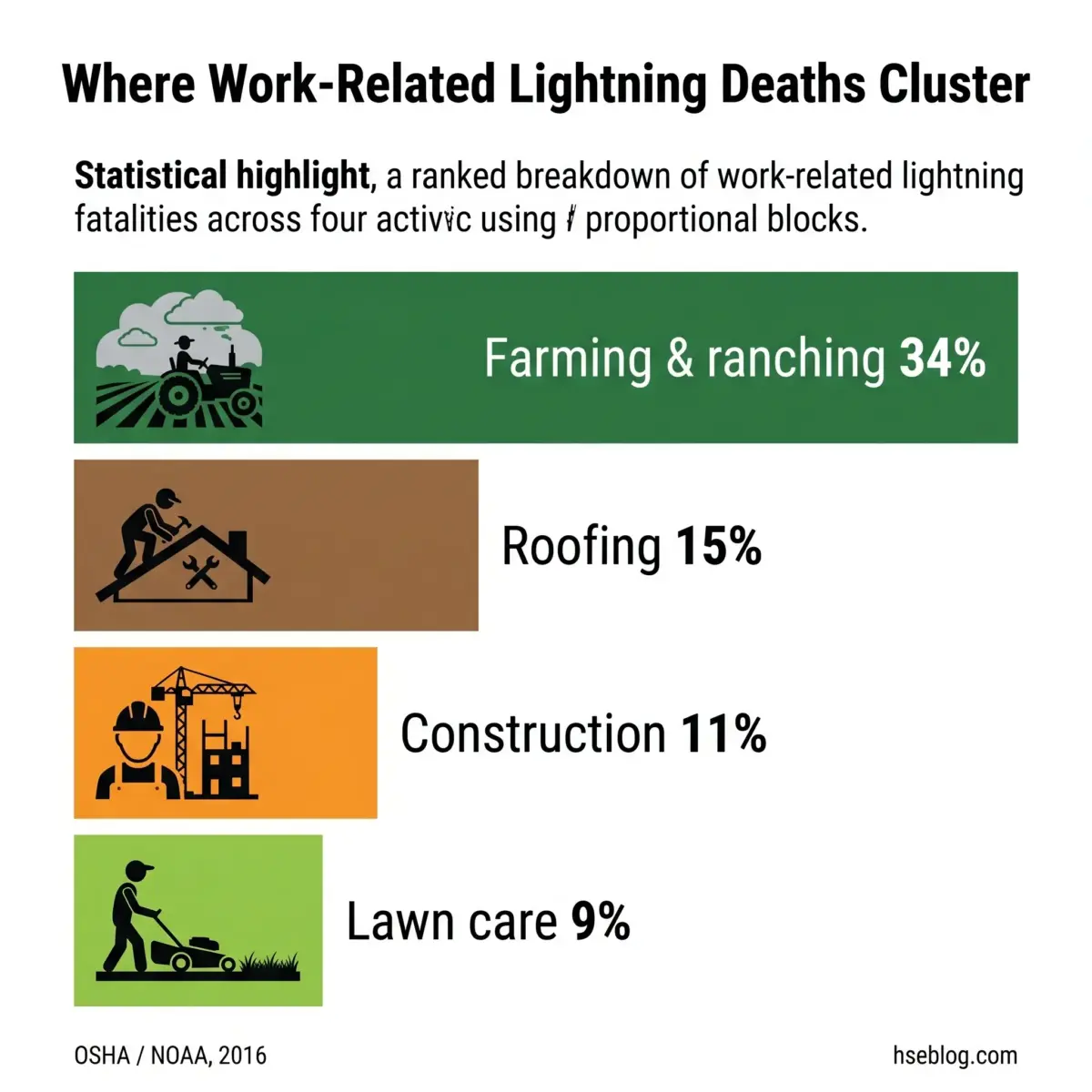
Reviewing the work-related breakdown, the pattern is consistent across the published data:
- Farming and ranching — 34% of work-related lightning fatalities (OSHA / NOAA, 2016).
- Roofing — 15%, the highest single construction trade.
- Construction — 11%, broad exposure across elevated and open-site tasks.
- Lawn care — 9%, open-ground work with no fast shelter.
The recurring failure mode behind these numbers is a rationalization, not a knowledge gap. Crews look up, see clear sky overhead, and conclude they are safe — while an anvil-shaped storm 10 or more miles away is already throwing cloud-to-ground strikes.
That phenomenon has a name: the “bolt from the blue.” Lightning can strike up to about 10 miles from its parent storm’s rainfall (CDC, 2024), which is why distance from the visible rain is never a safety margin. If you can hear thunder, the storm can reach you.
When Should Outdoor Work Stop for Lightning?
Stop the moment thunder is audible or lightning is visible — that single rule prevents most exposure, and everything else is refinement. The widely taught version is the 30/30 lightning rule, and it carries two distinct numbers that do two different jobs.
Here is the decision, in order:
- Watch the flash-to-bang gap. Count the seconds between seeing a flash and hearing the thunder. Thirty seconds equals roughly six miles.
- Suspend at 30 seconds or less. If the gap is 30 seconds or shorter, the storm is within ~6 miles. Stop work and move to safe shelter immediately.
- Prefer the simpler rule under pressure. “When thunder roars, go indoors.” Any thunder you can hear means lightning is in strike range — you do not need a stopwatch to justify the call.
- Hold the resume line. Wait a full 30 minutes after the last thunder or flash before anyone returns to open ground.
Resume rule callout: The 30-minute clock resets every time you hear thunder or see lightning — not from the last close strike. Counting down from a near miss while the storm trails away is how returners get killed. Reset to zero on the most recent flash or rumble, full stop.
The second “30” is the one that quietly kills people. Storms do not end cleanly; trailing cells and re-energizing channels keep producing strikes after the rain has moved on, and the back edge of a system can still throw a bolt miles ahead of itself (NWS lightning safety guidance).
There is also a silent failure in the method itself. Flash-to-bang counting only works while there is a countable gap — once a storm is overhead or moving fast, the flash and the bang arrive almost together, and the technique you trained on collapses exactly when the danger is highest. Mature programs do not gamble on a supervisor counting accurately in that moment; they pre-commit to a detection or alert threshold so the stop call does not depend on human judgment under production pressure.
Flash-to-Bang vs. Lightning Detection Systems
The judgment call here is between human observation and automated detection, and it turns on how fast your site can clear.
| Method | How it works | Best for | Where it fails |
|---|---|---|---|
| Flash-to-bang counting | A person estimates distance from the flash-to-thunder gap | Small crews, fast shelter, clear line of sight | Storm overhead, fast-moving cells, noisy sites, no clear sky view |
| On-site / app detection | Sensors or apps alert at a set radius (commonly 8–10 miles) | Slow-to-evacuate sites, large footprints, multiple crews | Needs maintenance, power, and a pre-agreed action threshold |
Larger venues, multi-crew sites, and slow-to-evacuate operations cannot defend a manual-only approach. An 8–10 mile detection radius gives the warning margin that a six-mile flash-to-bang trigger does not — and it removes the single point of failure that is one person’s count.
Does OSHA Have a Lightning Standard? (US Legal Position)
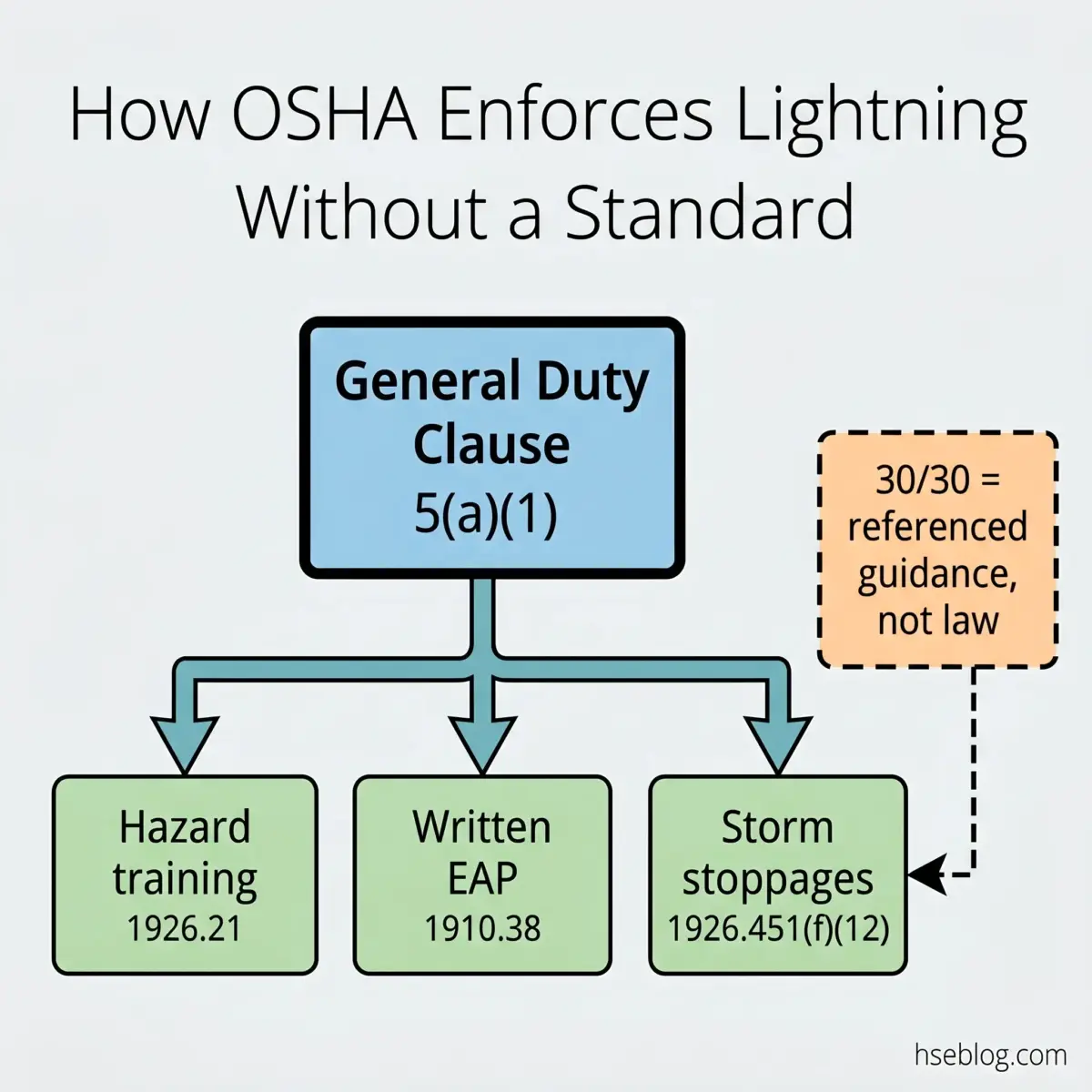
No — there is no standalone OSHA lightning standard, and getting this wrong is the most common error in competitor content. OSHA enforces lightning hazards through the General Duty Clause, Section 5(a)(1) of the OSH Act, which requires employers to provide a workplace free from recognized hazards likely to cause death or serious harm.
The enforcement chain is real even without a numeric rule. Read the citations the way an OSHA inspector builds a case:
- General Duty Clause, §5(a)(1): the primary route when a feasible way to abate a recognized lightning hazard existed and was not taken.
- 29 CFR 1926.21 (US, construction): employers must instruct workers to recognize and avoid hazardous conditions — the basis for mandated lightning-hazard training.
- 29 CFR 1910.38 / 1926.35 (US): a written Emergency Action Plan must specify evacuation procedures and response — the vehicle for documenting your suspend/resume thresholds, shelter locations, and notification method.
- 29 CFR 1926.451(f)(12) (US, construction): scaffold work is prohibited during storms or high winds unless a competent person determines it is safe — an equipment-specific stoppage that bites directly in lightning conditions.
The 30/30 figure itself is a NOAA / NWS recommendation that OSHA references in its OSHA/NOAA fact sheet on lightning safety for outdoor workers (OSHA 3863) — endorsed best practice, not a numeric OSHA mandate.
The practical consequence supervisors miss is about defensibility. Because there is no numeric OSHA threshold to cite, the strength of a stop-work call rests on a documented EAP and consistent enforcement of it — an undocumented “we use 30/30” defends far worse than a written, drilled procedure that everyone on site actually follows.
Regulatory currency note: Regulatory content here reflects general HSE professional understanding of the cited US and UK requirements as of 2025–2026. It is not legal advice. Specific compliance questions or enforcement situations should go to qualified counsel in the applicable jurisdiction.
How the UK and Other Jurisdictions Handle Outdoor Lightning Risk
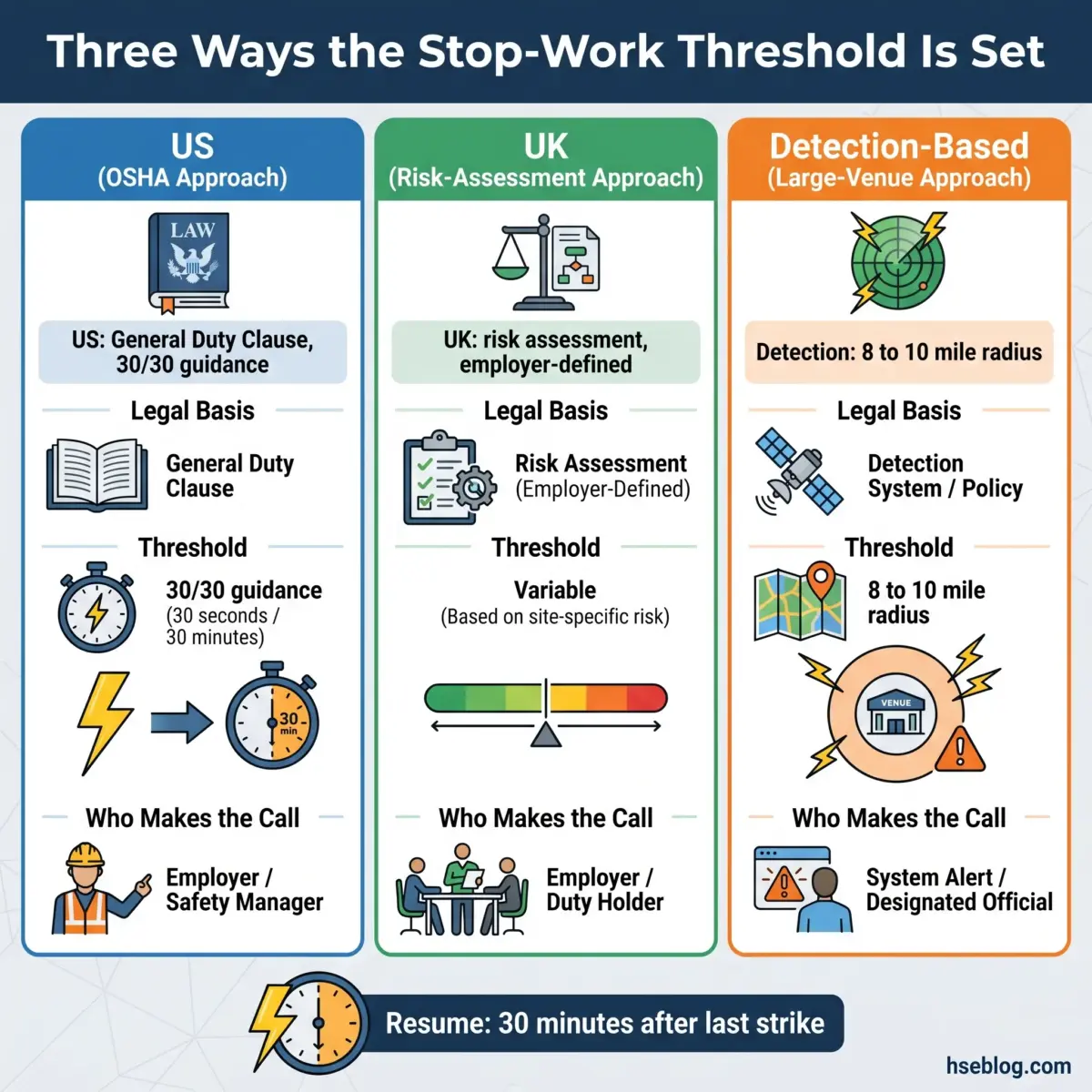
Outside the US, the stop-work threshold is something the employer must define and justify — not a number you look up in a statute. The UK has no codified 30/30 work rule; the duty sits inside general risk-assessment law, under Regulation 3 of the Management of Health and Safety at Work Regulations 1999, which requires a suitable and sufficient risk assessment covering adverse weather per activity.
One conflation worth killing early: BS EN 62305 governs structural and building lightning protection — the rods, conductors, and earthing on a building — and has nothing to do with the when-to-stop-work decision for a crew. Do not let a contractor’s structural-protection certificate stand in for a worker-stoppage procedure.
Here is the cross-jurisdiction picture competitors rarely assemble:
| Jurisdiction | Legal basis | Defined threshold | Who decides | Resume rule |
|---|---|---|---|---|
| US (OSHA) | General Duty Clause §5(a)(1); EAP and training standards | No numeric standard; NOAA 30/30 referenced as best practice | Employer, via written EAP | 30 min after last thunder/flash |
| UK (HSE) | MHSWR 1999, Reg. 3 — risk assessment duty | Employer-defined and documented (no codified 30/30) | Employer / competent person | Employer-defined (30 min widely adopted) |
| Large-venue / detection-based | Voluntary protocol or venue policy | 8–10 mile lightning-detection radius | Designated weather monitor | 30 min after last strike inside radius |
The NOAA / NWS / National Lightning Safety Council guidance on the suspend-and-resume principle is widely adopted worldwide, even where it is not legislated. The common cross-border error is importing the 30/30 number as if it were law everywhere — in a risk-assessment jurisdiction it is a defensible threshold you choose and document, not a clause you cite.
Building a Lightning Suspend/Resume Procedure Into Your EAP
A compliant procedure makes the stop-work decision before the storm arrives — improvising it under a darkening sky is where programs fail. Your written Emergency Action Plan (29 CFR 1910.38 in the US, or the risk-assessment record in the UK) is where this lives.
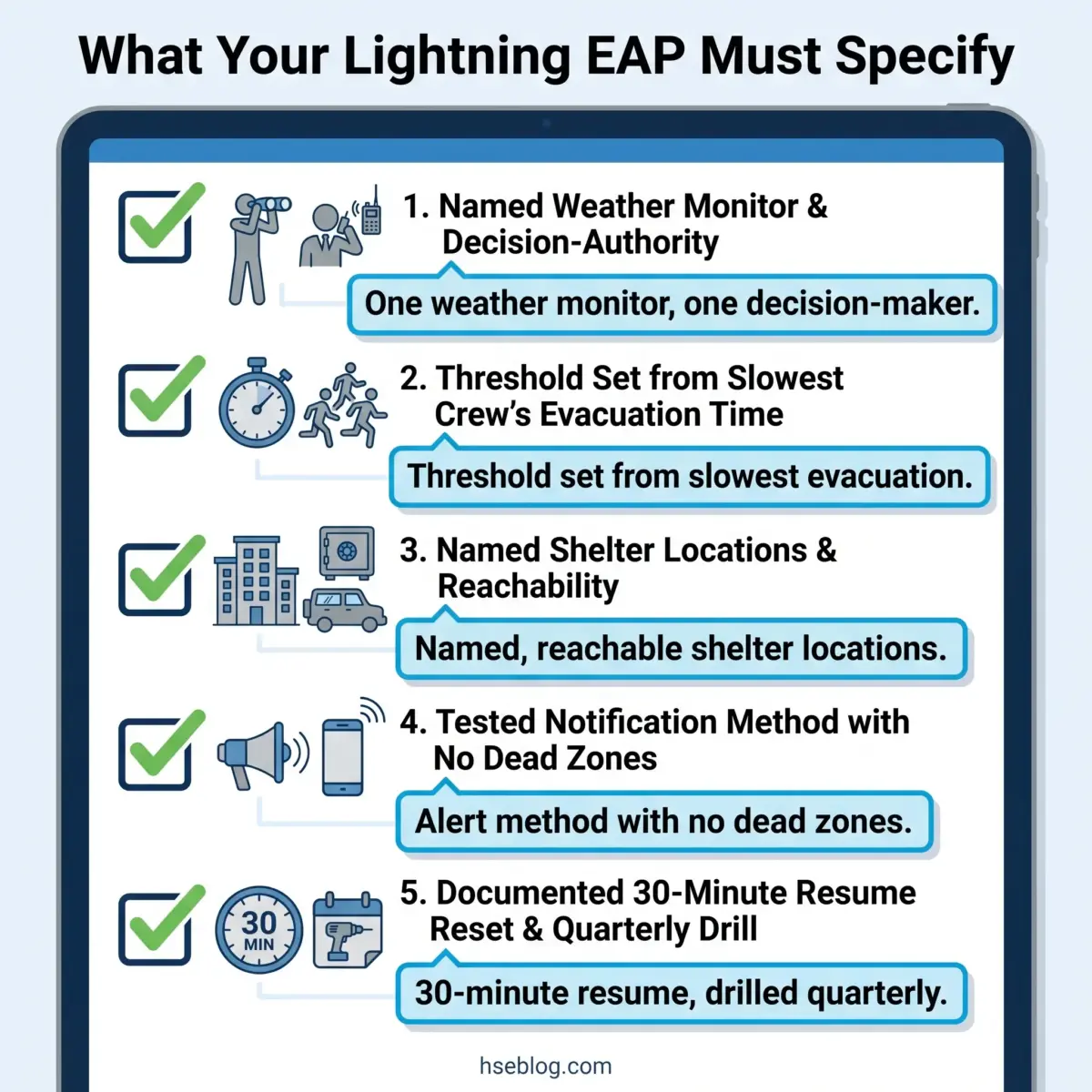
Build it in this order:
- Assign one weather monitor and one decision-authority. The monitor watches conditions; a single named person owns the stop call. Splitting that authority invites hesitation.
- Set the threshold backward from your slowest crew’s evacuation time. A six-mile trigger is useless if it takes 12 minutes to get a crane crew and the public to shelter — measure the real time, then pick a radius that beats it.
- Name the shelter locations and confirm they are reachable in time. List them by name and walk the route; an unreachable shelter is not a shelter.
- Define the notification method and test for dead zones. Horn, radio, or mass alert — then confirm every corner of the site actually receives it.
- Document the resume authority and the 30-minute reset. Same single owner, same hard 30-minute clock from the last thunder or flash.
- Drill it quarterly. A plan no one has rehearsed becomes a debate at the worst possible moment.
The discipline that separates real programs from paper ones is the back-calculation in step 2. Copying a generic six-mile number without working from your own site geometry is the most common, and most defensible-looking, way to get someone hurt.
Safe Shelter: What Actually Counts
Two things qualify as safe shelter, and almost everything on a typical worksite does not:
- A fully enclosed building with wiring and plumbing. The metal framing, wiring, and pipes route current safely to ground. Stay off corded equipment and away from plumbing while inside.
- A hard-topped metal vehicle with the windows up. The metal shell — not the tyres — carries the charge around the occupants. Keep hands off metal surfaces and do not lean on the door.
What does not count: open-sided structures, picnic shelters, bus stops, sheds, tents, dugouts, the cab of an open tractor or excavator, or anything with a fabric or open roof. If it does not fully enclose you in metal or a wired-and-plumbed building, treat it as exposed.
Higher-Risk Outdoor Work and Equipment
Some tasks raise the stakes enough that stopping is non-negotiable and may be separately regulated. The work-related fatality breakdown — farming and ranching 34%, roofing 15%, construction 11%, lawn care 9% (OSHA / NOAA, 2016) — maps almost exactly onto exposure: elevation, conductive materials, and open ground with no fast shelter.
The higher-risk categories to flag in any outdoor program:
- Elevated and conductive work: roofing, scaffolding, ladders, tower and telecom work, and power-line work. Height and metal both pull current.
- Cranes and tall equipment: these act as lightning magnets. Under the scaffold and crane provisions, resume only on a qualified or competent person’s determination — not on a supervisor’s hunch that the rain has eased.
- Water-adjacent and open-field work: lifeguarding, agriculture, grounds and event staff, where the nearest building can be a long sprint away. Here the threshold must be widest, because evacuation time is longest.
The CDC’s worker lightning-safety recommendations reinforce the same priority list and add the rule crews forget mid-evacuation: how you move matters as much as the decision to move.
The riskiest moment is often the retreat itself — crews crossing open ground carrying conductive tools, or sheltering under the nearest tall tree. During evacuation:
- Drop or set down long conductive tools — poles, rebar, antennas, golf-style equipment.
- Stay off and away from metal fencing, isolated trees, and high ground.
- Spread out rather than clustering, so a single strike cannot take a whole crew.
“Stop work” is therefore a route, not just a decision. Your plan has to tell people how to get to shelter, not only when.
If a Worker Is Struck: Immediate Response
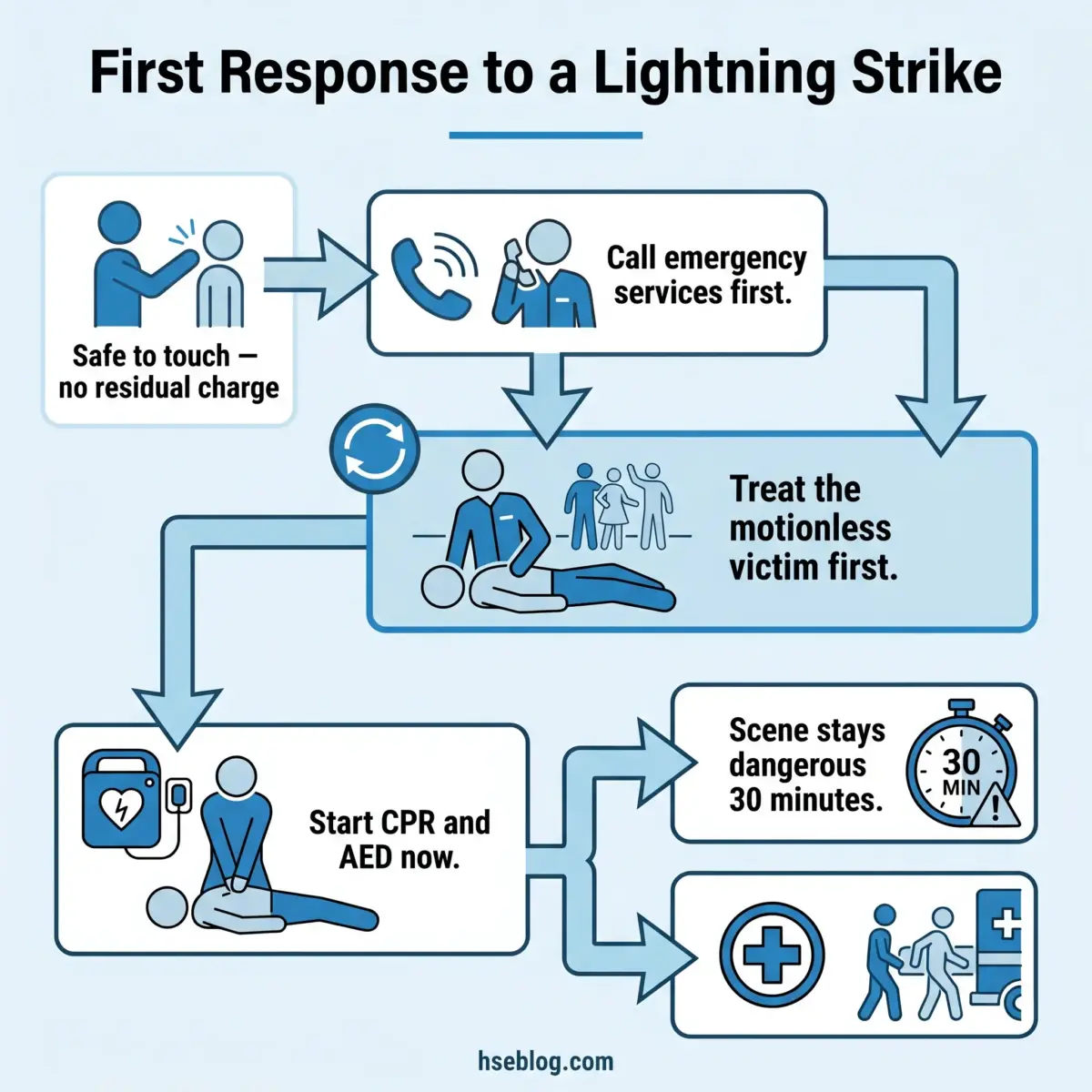
A person struck by lightning carries no residual charge — it is completely safe to touch and treat them immediately. The belief that a victim is “still electrified” is a lethal myth that costs lives by delaying CPR in the only minutes that matter.
Medical disclaimer: This first-response guidance is for HSE practitioner reference. It is not medical advice and does not replace emergency medical services or a trained first-aider. Call emergency services first, and have anyone struck — even if they appear fine — assessed by a qualified medical professional.
The response priorities, in order:
- Call emergency services immediately. Cardiac and respiratory arrest are the primary causes of lightning death; the clock starts now.
- Apply reverse triage. In a multi-casualty strike, prioritize the apparently “dead” — the ones in arrest — first. They are the ones CPR and an AED can actually save; the moving, moaning victims are usually the stable ones.
- Begin CPR / AED without delay. Start compressions on an arrested victim at once; a defibrillator works normally on a struck person.
- Protect the rescuers. The scene remains dangerous for 30 minutes after the last strike. Move the casualty to safer ground if you can do so quickly, and do not let a rescuer become the second casualty.
- Insist on medical evaluation for delayed effects. Keraunoparalysis (temporary paralysis, usually of the legs) and neurological symptoms can appear or persist even when the worker seems fine. Every struck person needs assessment.
The counterintuitive point responders get wrong is the triage order. Normal triage moves past the silent, motionless casualty; with lightning you do the opposite, because that motionless person is the one a fast CPR start can bring back. The Red Cross lightning strike first-aid guidance is a solid reference to build your site first-aiders’ training around.
Frequently Asked Questions
Conclusion
The industry keeps treating lightning as a forecast problem when it is a discipline problem. The data is blunt about it: most victims were not ambushed in the open — they were caught in the suspend-too-late or resume-too-early window, often within sight of shelter, which is the failure that good lightning safety at work is built to close.
If you change one thing, change where your threshold comes from. Stop copying the generic six-mile number and set it backward from your slowest crew’s real evacuation time, then write that threshold, its owner, and the 30-minute resume reset into your EAP and drill it. A documented, rehearsed procedure outperforms a quoted rule every time — because the call that saves a life is the one already made before the first rumble, not the one being argued under a black sky.
And keep the two numbers straight: 30/30 is sound guidance, not US law, and outside the US it is a threshold you must define and defend yourself. The crews who survive storms are not the ones who memorized the rule — they are the ones who decided, in advance, exactly when they would walk away.