
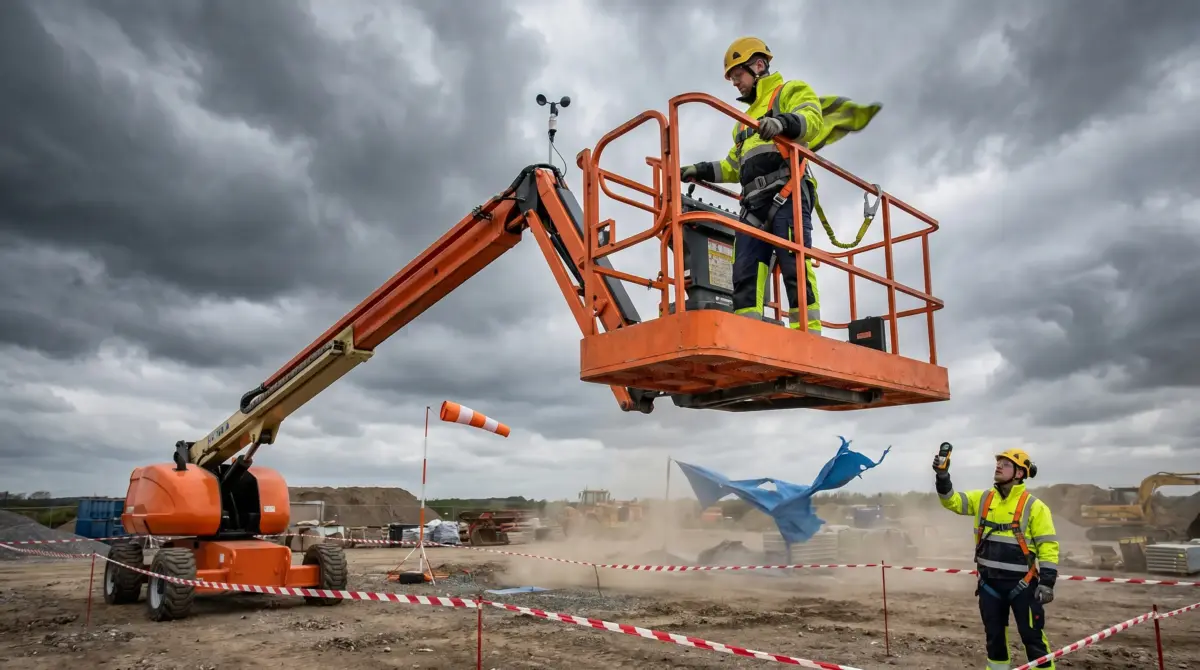
TL;DR — The Numbers That Set the Trigger
- 20 mph (OSHA, 1926.1431): Once personnel-lift wind hits this — sustained or gust, measured at the platform — a qualified person must decide whether to lift at all.
- ~23 mph (Beaufort Force 5): The point HSE practice treats as the limit for roof and general work at height in Great Britain, because balance starts to go.
- ~28 mph / 12.5 m/s (ANSI A92.22, BS EN 280): The design wind limit for most outdoor MEWPs unless the machine is specifically rated higher.
- Up to 50% greater at 20 m than at ground level (IPAF): Wind climbs with height, so the platform always sees worse than the ground forecast.
- 35 fatal falls from height, Great Britain 2024/25 (HSE, 2025): Down from 50 the year before, yet still the country’s leading cause of workplace death.
Direct answer: There is no single wind limit for working at height — it depends on the equipment and the jurisdiction. UK practice generally stops roof and general work near 23 mph (Beaufort Force 5); OSHA requires a qualified-person decision once personnel-lift winds exceed 20 mph; most MEWPs are limited to about 28 mph. Always measure wind at working height, and treat gusts, not averages, as the trigger.
Falls from height killed 35 workers in Great Britain in 2024/25, down from 50 the previous year but still the single largest cause of workplace death (HSE, 2025). Wind does not appear as a tidy line in that dataset, because falls, struck-by events and tip-overs are recorded by outcome rather than by the gust that precipitated them — but anyone who has planned work at height knows how often wind sits behind the outcome.
That gap is exactly why working in high winds needs its own risk assessment and its own stop-work criteria, not a footnote in a generic weather plan. This article reconciles the OSHA, HSE, ANSI and BS EN thresholds into one decision framework, then turns it into a written procedure you can defend: how to set trigger speeds below the regulatory ceiling, where to measure wind, who owns the stop call, and what a restart actually requires.
Competent/qualified-person caveat: This article provides general HSE knowledge. Life-critical work such as personnel hoisting, MEWP operation, crane lifting and scaffold work in wind must be planned and supervised by a competent or qualified person with relevant training, jurisdiction-specific authorisation, and a site-specific risk assessment. The information here does not replace that.
Why High Winds Are a Distinct Work-at-Height Hazard (Not Just “Bad Weather”)
The pattern worth naming first: most teams treat wind as a single morning gate. They check a regional forecast at 7 a.m., decide the day is workable, and never read it again — even as a boom extends, a wall rises, or a front moves through at lunchtime.
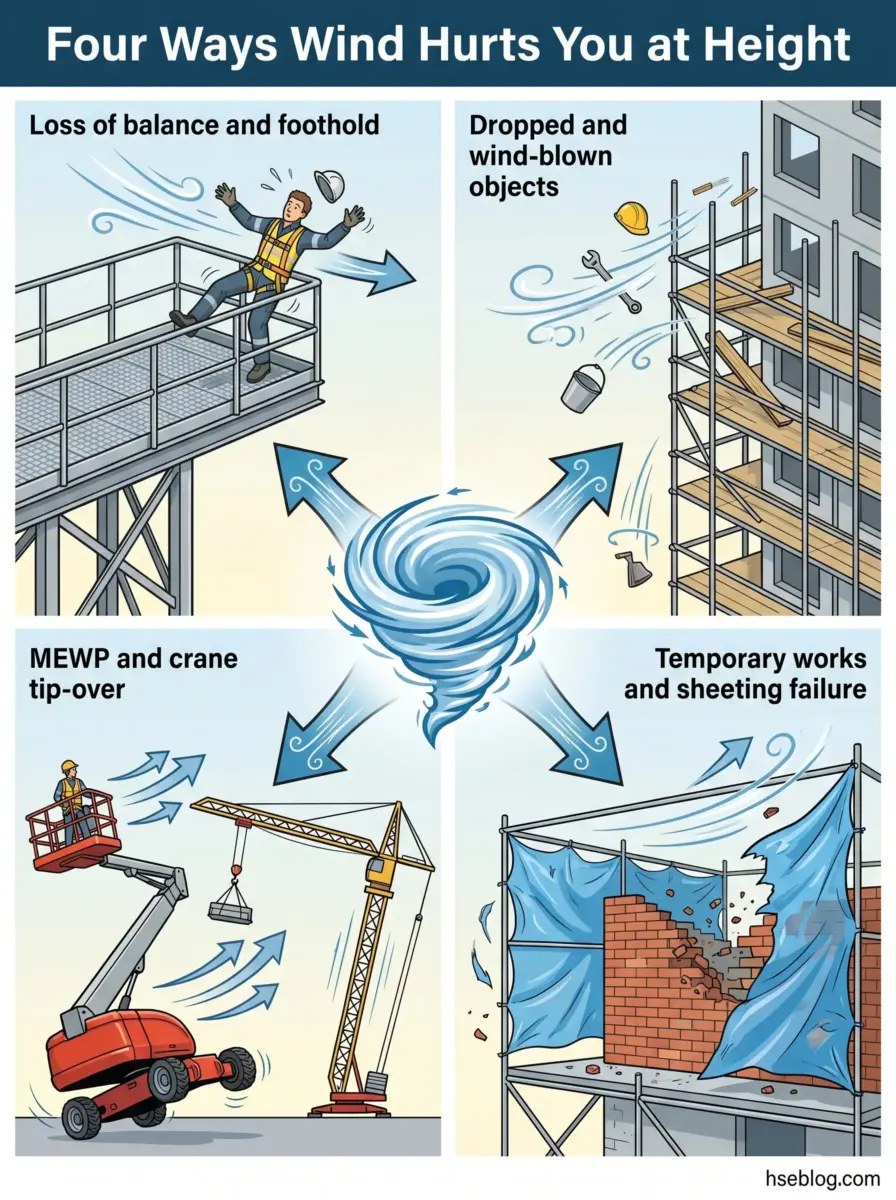
Wind earns separate treatment because it acts on four different things at once, and each has its own failure mode:
- Loss of balance and foothold — a gust at the working level can pull a person off line on a leading edge, a scaffold platform, or a roof, where there is no margin for a stumble.
- Loss of control of materials — sheet goods, cladding panels, tools and offcuts become projectiles; a board carried up two flights becomes a sail in a gust.
- Equipment instability and tip-over — MEWPs, mobile towers and cranes have a sail area; wind load adds to the load on the chart and shifts the centre of gravity toward the tipping line.
- Temporary works and structural failure — scaffold sheeting and netting multiply wind load enormously, and partially built walls or roofs have not yet gained their designed restraint.
Two features make wind dynamic rather than static. It rises with elevation — IPAF notes it can be up to 50% greater at 20 m than at ground level (IPAF), so the platform always sees worse than the ground reading. And local terrain matters: gusts, turbulence and “tunnelling” between buildings routinely push on-site wind well past the regional forecast.
This is why the rest of the article never relies on one number. The hazard changes with height, equipment and the minute-by-minute weather, so the controls have to track it. HSE’s own construction work-at-height guidance frames strong and gusting wind as a reason not to access a roof at all — a duty to re-read conditions, not a box ticked at dawn.
What Counts as “High Wind”? Thresholds by Jurisdiction and Equipment
There is no universal “high wind” number — the trigger depends on what you are doing and where. The honest answer is a matrix, not a figure, and the common error is reading any published number as permission to work right up to it.
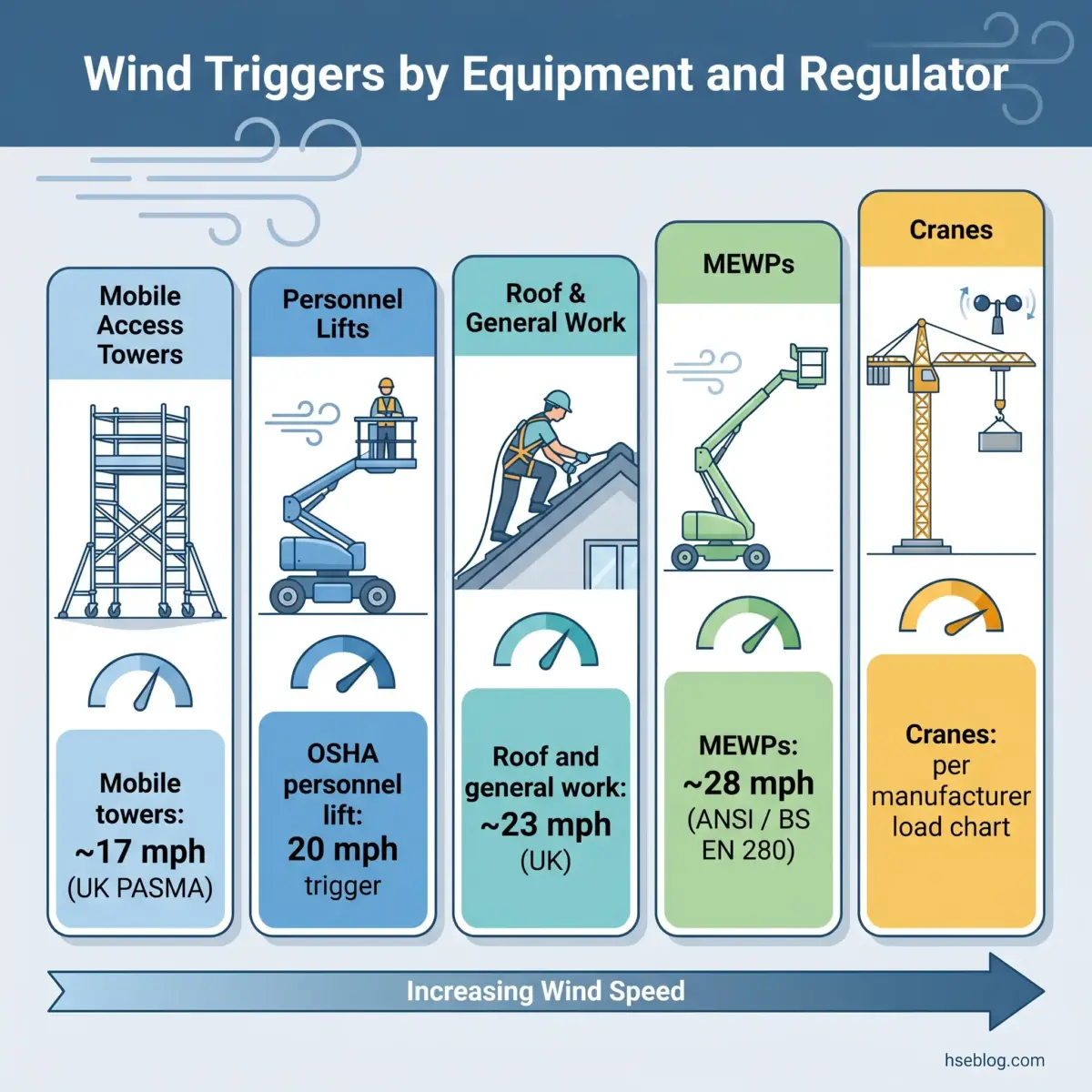
The table below consolidates the thresholds that competitors usually publish one at a time. Every figure carries its source and whether it is a hard limit or a point at which a qualified or competent person must make a documented call.
| Equipment / activity | Jurisdiction & standard | Trigger speed (sustained / gust) | Hard stop or person-must-assess |
|---|---|---|---|
| Personnel hoisting (suspended platform / man basket) | US — OSHA 1926.1431(k)(8)(i) | Wind over 20 mph at the platform, sustained or gust | Qualified-person assessment; lift must not start or must stop if unsafe |
| Scaffolds | US — OSHA 1926.451(f)(12) | “Storms or high winds” (no fixed mph) | Competent-person decision + PFAS or wind screen required |
| General work / materials handling | US — OSHA 1926.968 (Subpart V) | 40 mph generally; 30 mph when handling materials | Restricted unless protective precautions taken |
| MEWP (boom / scissor lift) | US ANSI/SAIA A92.22 · UK-EU BS EN 280 | ~28 mph (12.5 m/s) unless rated higher | Hard stop at the machine’s rated limit |
| Roof / general work at height | UK — HSE practice, Beaufort Force 5 | ~23 mph | Stop — balance affected |
| Mobile access towers | UK — PASMA practice, Beaufort Force 4 | ~17 mph | Stop |
| Crane lifting operations | US/UK — manufacturer load chart | Per chart / rated in-service wind | Hard stop at chart limit |
A few readings of this table matter on site. OSHA’s personnel-hoisting rule does not ban the lift at 20 mph; under 1926.1431(k)(8)(i) it hands the judgement to a qualified person, who must decide whether it is unsafe — and stop or not start if it is.
For mobile towers, the stricter UK figure governs: where two numbers could apply to a comparable activity, the lower one becomes your working trigger. And these standards are not contradicting each other — they are equipment- and jurisdiction-specific by design, which is precisely why one number cannot cover the site.
The judgement layer competitors skip: treat every published figure as a planning ceiling, not a working target. Gusts routinely run 5–10 mph above the sustained figure, and the anemometer is rarely sitting at the most exposed point, so a working trigger set comfortably below the ceiling absorbs both.
Sustained Wind vs Gusts: Which Number Governs
Both govern, but the gust usually decides. OSHA’s personnel-lift trigger is explicit that it covers wind “sustained or gusts” at the platform — and it is the peak gust, not the ten-minute average, that lifts a load off the deck or tips a machine past its line.
This has a practical consequence for how you write a limit into a method statement:
- State the basis, not just the number. “Cease at 23 mph” is ambiguous; “cease when a peak gust reaches 23 mph at platform height” is auditable.
- Default to gust where the standard allows it. A sustained average can sit comfortably under the limit while individual gusts blow past it — and those are the ones that cause harm.
- Match the averaging period to the instrument. A handheld reading over a few seconds and a logged ten-minute mean are different measurements; say which one your trigger uses.
How to Measure Wind Speed at the Actual Work Height
Measure where the work is, not at grade. A ground-level anemometer on an open or high site systematically understates conditions at the boom tip, the roof edge or the top lift — and that understatement is the gap that catches people out.
- Site the sensor at or near the work zone — the boom tip, the jib, or the highest exposed platform — rather than in the site cabin’s lee.
- Use the right tool for the duration of exposure. A handheld anemometer answers a spot question; fixed or remote monitoring answers “what is it doing all shift.”
- Account for the height effect. With wind up to 50% stronger at 20 m than at ground (IPAF), a 16 mph ground reading can mean conditions well into the stop band where the crew actually is.
This is one area genuinely moving in 2025–2026. Cloud-connected anemometers mounted on the jib or boom now push real-time, logged readings with automatic threshold alerts, shifting sites away from a single morning forecast toward continuous data — which also strengthens the documentary record behind a stop-work call. IPAF’s guidance on MEWP wind limits remains the clearest industry anchor for both the 28 mph figure and the height effect.
Building a High-Wind Risk Assessment
The legal duty comes first: work at height must be planned, supervised and carried out safely, including in weather that could endanger people. In Great Britain that is Regulation 4 of the Work at Height Regulations 2005; in the US it runs through the qualified-person duties in Subpart CC and, where no specific standard fits, the General Duty Clause. A defensible wind assessment is how you discharge it.
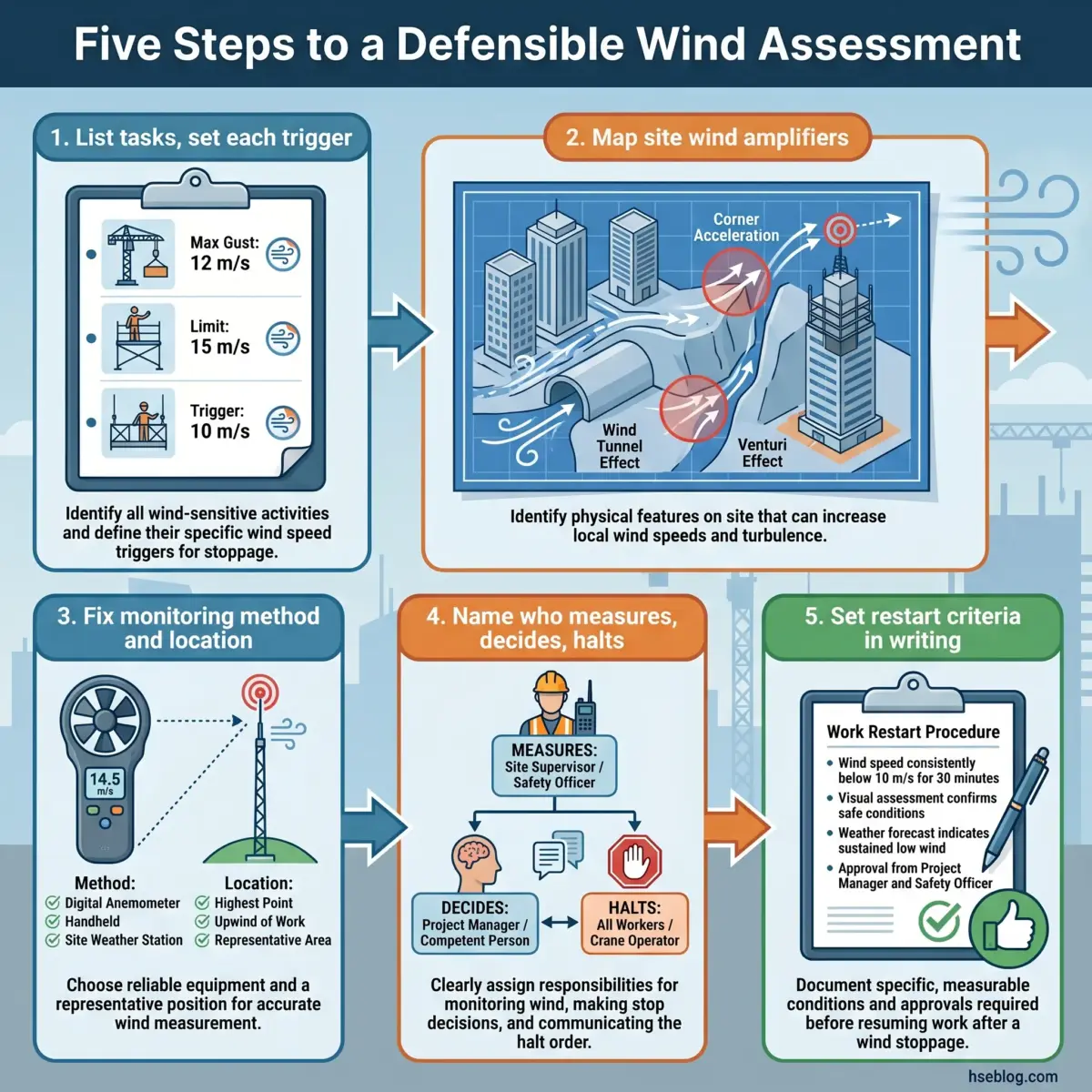
A repeatable method a supervisor can stand behind in an inspection:
- List the wind-sensitive activities and pre-set each trigger. Tie every one to its equipment limit, the sail area of the loads, and any sheeting or netting — before the shift, not during it.
- Map the site amplifiers. Conditions on your site rarely match the regional forecast (see sub-list below).
- Fix the monitoring method and location. Decide the instrument, where it sits, and the re-assessment interval — continuous once readings approach the trigger.
- Name the people, in writing. State who measures, who decides, and who can halt the work — with a named backup.
- Set the restart criteria now. Define the speed and the inspections required before work resumes, so the decision is not improvised under pressure.
The site amplifiers to weigh in step 2:
- Building height and exposure — open ground and tall structures both raise platform-level wind.
- Funnelling between buildings — narrow gaps accelerate flow and create sharp local gusts.
- Forecast trend and frontal timing — a front due at midday means a rising profile, not a stable one.
- Sail area added on the day — sheeting, panels, banners and netting can transform a marginal day into a stop.
The failure pattern across assessments is quiet but common: a threshold is written down, the decision owner is not. When wind rises, everyone assumes someone else will make the call — so no one does. The strongest assessments name a single person with stop authority, plus a backup, before work starts.
Hierarchy of Control Applied to Wind
Mapped onto the hazard, the hierarchy puts the strongest controls first and PPE last — the reverse of how stressed sites tend to reach for them:
- Eliminate — reschedule the wind-sensitive task to a calmer window, or sequence the build so the exposed work avoids the forecast peak.
- Substitute — assemble at ground level and lift the finished unit, or use a MEWP rated for higher wind.
- Engineering — add ballast, fit wind screens, reduce boom length or working radius, and physically secure loads, sheeting and loose materials.
- Administrative — pre-set trigger speeds, continuous monitoring, exclusion zones beneath the work, and clear stop authority.
- PPE — chin-strap hard hats, eye protection against wind-blown debris, and personal fall arrest as the last line.
PPE is the weakest control here, not the answer. A harness does not stop a tip-over and a chin strap does not steady a dropped load — they limit consequences after the higher controls have done their work.
Stop Work Criteria: Setting and Enforcing the Trigger
A stop-work criterion is the promise the title makes, so make it concrete. A usable one names six things: the activity, the trigger value, whether it is sustained or gust, the measurement location, the decision owner, and the restart threshold.
Set that trigger below the regulatory ceiling. The standards give you a ceiling; your criterion gives you the margin that absorbs gusts, instrument placement and the height effect — which is the difference between a number that looks compliant and one that keeps people on the deck.
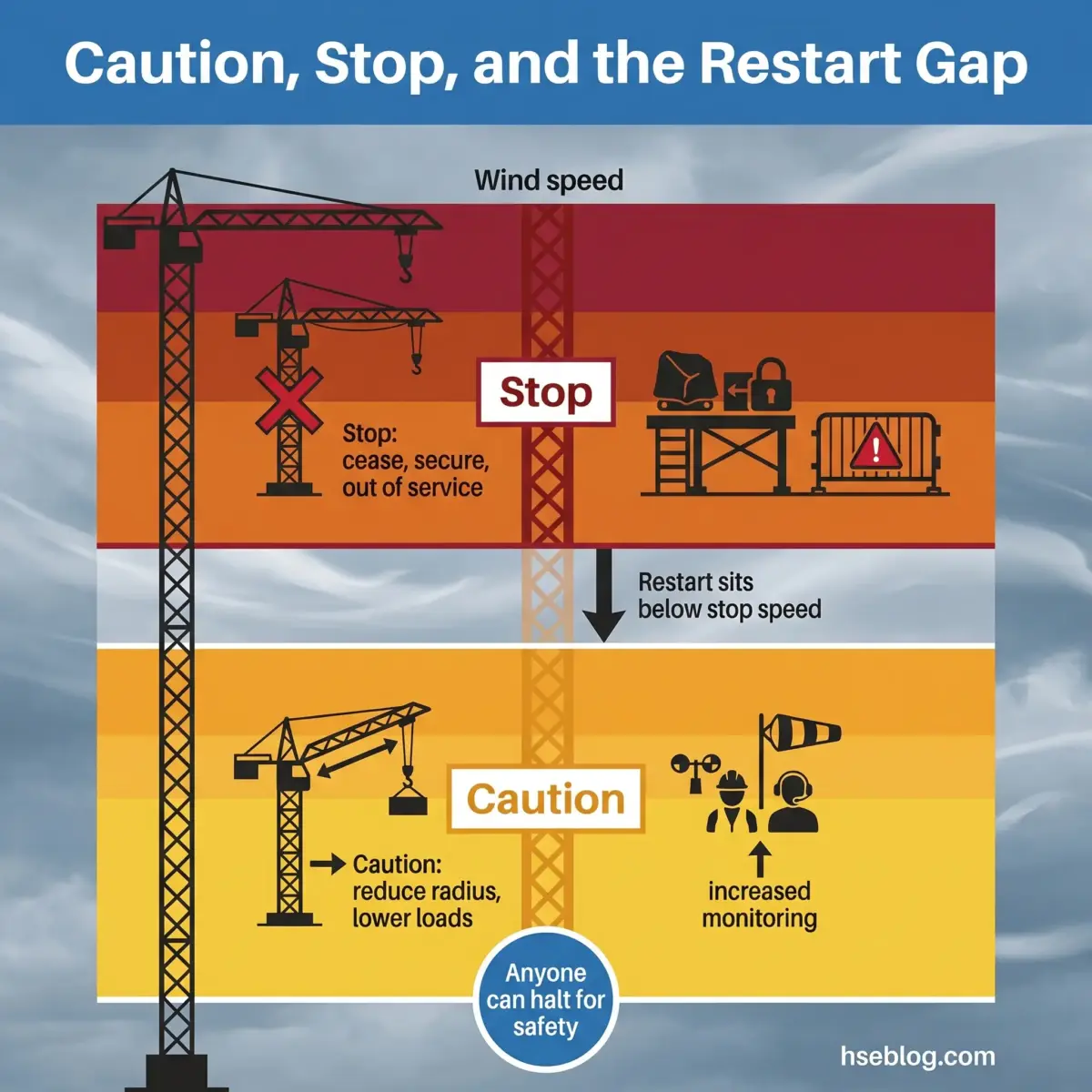
Run a two-band response rather than a single on/off switch:
- Caution band (de-rate, don’t stop): pause non-essential lifts, reduce radius or boom length, lower suspended loads, and increase monitoring to continuous. The work continues under tighter control.
- Stop band (cease and secure): stop the activity, land and secure loads, lower the platform or boom, place equipment in its out-of-service state, clear the exclusion zone, and record the decision and the conditions that triggered it.
Restart discipline is where the second failure pattern lives. Many sites set a stop threshold but no restart threshold, so work resumes the instant a single gust drops — then halts again minutes later, and the temptation grows to “wait out” each lull on the platform.
Mature sites build in hysteresis: the restart speed sits below the stop speed, so conditions must genuinely settle before work resumes, not merely dip. That gap kills the stop-start whiplash and removes the incentive to gamble on a lull.
On authority: the named person owns the routine call, but the right to stop must reach every worker. No schedule, production target or supervisor’s reassurance overrides a stop made for safety — and that should be stated, not assumed.
Post-Event Checks Before Resuming Work
A storm or high-wind episode resets the equipment to “unknown” — it cannot be assumed safe just because the wind dropped. Before anything goes back into service, the relevant assets get inspected against the conditions that just passed.
| Asset | What to check | Who confirms |
|---|---|---|
| Scaffold | Ties, anchorage, sheeting/netting, bracing, level | Competent person, before re-use |
| Crane | Structure, rigging and function per the manufacturer manual | Per manufacturer / appointed person |
| MEWP and mobile towers | Stability, outriggers, levelling, components | Trained operator / competent person |
| Roofs and fragile surfaces | Damaged, lifted or displaced fragile coverings | Competent person, before access |
| Materials and site | Displaced loads, loose debris, downed power lines | Site supervisor before work restarts |
Treat downed or damaged power lines as the priority hazard, not a tidying job — clear the area and bring in the competent authority before any other inspection begins.
Frequently Asked Questions
Conclusion
Pull your own wind risk assessment up and ask one uncomfortable question: does it name a single person with authority to stop, and does it set a restart speed below the stop speed? If the threshold is written but the decision owner is implicit — or if there is a stop number and no restart number — then the document is regulation-shaped but not decision-ready, and that is the gap most enforcement findings expose.
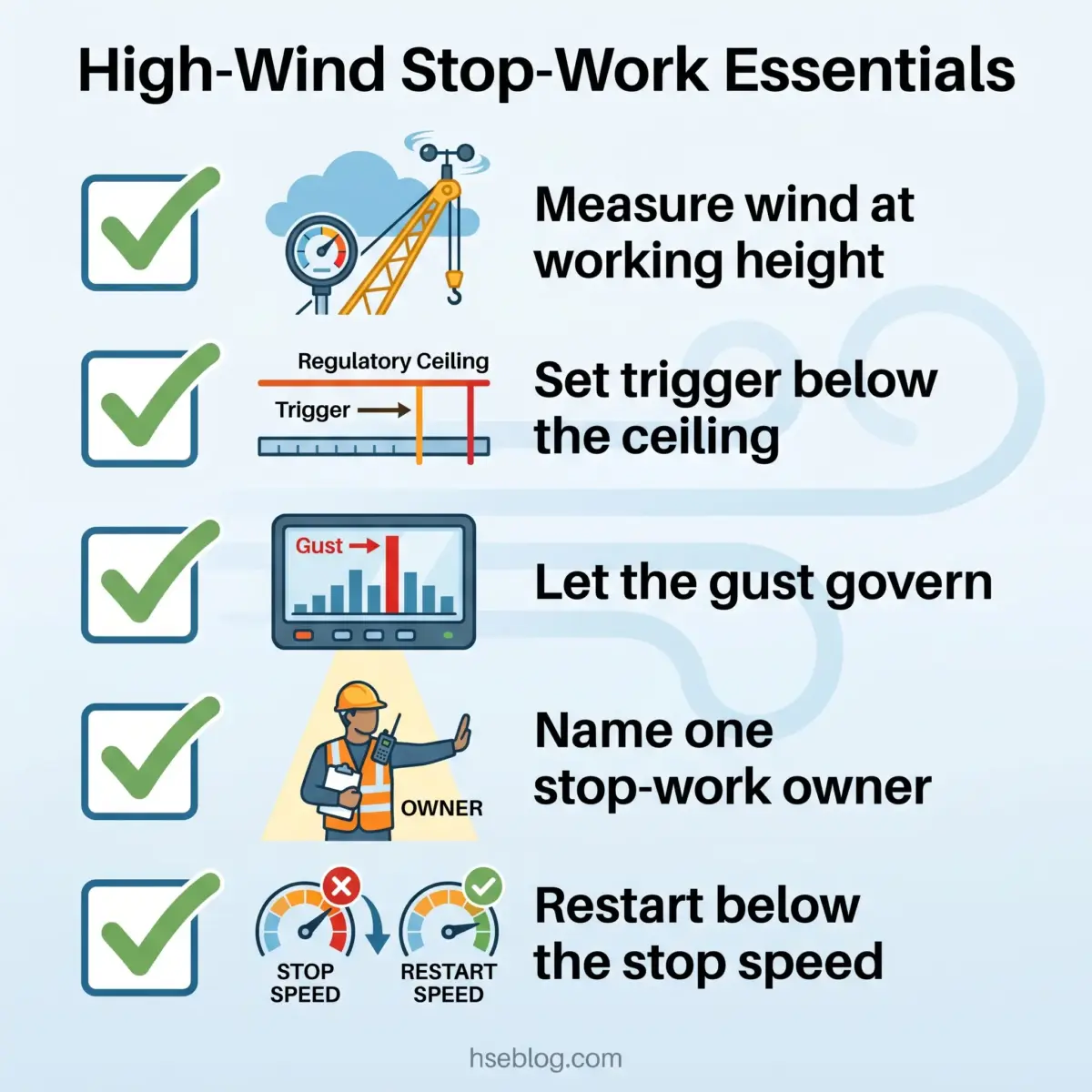
The figures that matter when working in high winds are not hard to find; the discipline is in how you use them. Treat the published threshold as a planning ceiling, set your working trigger below it, measure at the height where the work happens, let the gust govern, and write the restart conditions before anyone leaves the ground. Falls from height fell to 35 in Great Britain in 2024/25 (HSE, 2025), and enforcement under the Work at Height Regulations stayed active through 2025 — the direction of travel rewards sites that decide in advance rather than in the moment.
Not legal advice: Regulatory content here reflects general HSE professional understanding of US (OSHA) and Great Britain (HSE) requirements as of 2025. It is not legal advice. Specific compliance questions, enforcement situations or prosecution risk should be directed to qualified legal counsel in the applicable jurisdiction. Where life-critical work is planned, route operators and supervisors through recognised training — NEBOSH, IOSH, OSHA outreach, IPAF or PASMA as relevant — and confirm the regulatory position is current before relying on it.