
TL;DR — The Numbers That Should Drive Your Heat Program
- 48 US workers died from environmental heat in 2024 — and most heat deaths strike in a worker’s first days, before the body adapts (US Bureau of Labor Statistics via National Safety Council Injury Facts, 2026).
- 7,100 nonfatal heat cases involved days away, restriction, or transfer across 2023–2024 combined (US Bureau of Labor Statistics via National Safety Council Injury Facts, 2026).
- 80°F heat index is the screening trigger in OSHA’s proposed US rule; the UK sets no maximum workplace temperature at all.
- Acclimatization takes 1–2 weeks — the single most under-managed control behind first-week fatalities.
Keeping people safe in extreme heat means controlling the total heat load, not toughening up workers. Assess heat using WBGT or the heat index, apply engineering and administrative controls before PPE, acclimatize new and returning workers over one to two weeks, and treat any confusion with hot skin as a heat-stroke emergency.
Environmental heat killed 48 US workers in 2024, and the deaths share a brutal pattern — most struck early, before bodies adapted to the load (US Bureau of Labor Statistics via National Safety Council Injury Facts, 2026). Heat is the deadliest weather-related hazard, yet these fatalities sit among the most preventable in the entire safety record.
Working in extreme heat is an exposure problem, governed by the same control logic as any chemical or physical hazard — not a test of individual toughness. This guide covers how to measure the hazard, recognize heat illness, apply the right controls, and meet the very different obligations the US, UK, and international frameworks impose.
Why Working in Extreme Heat Is a Serious Workplace Hazard
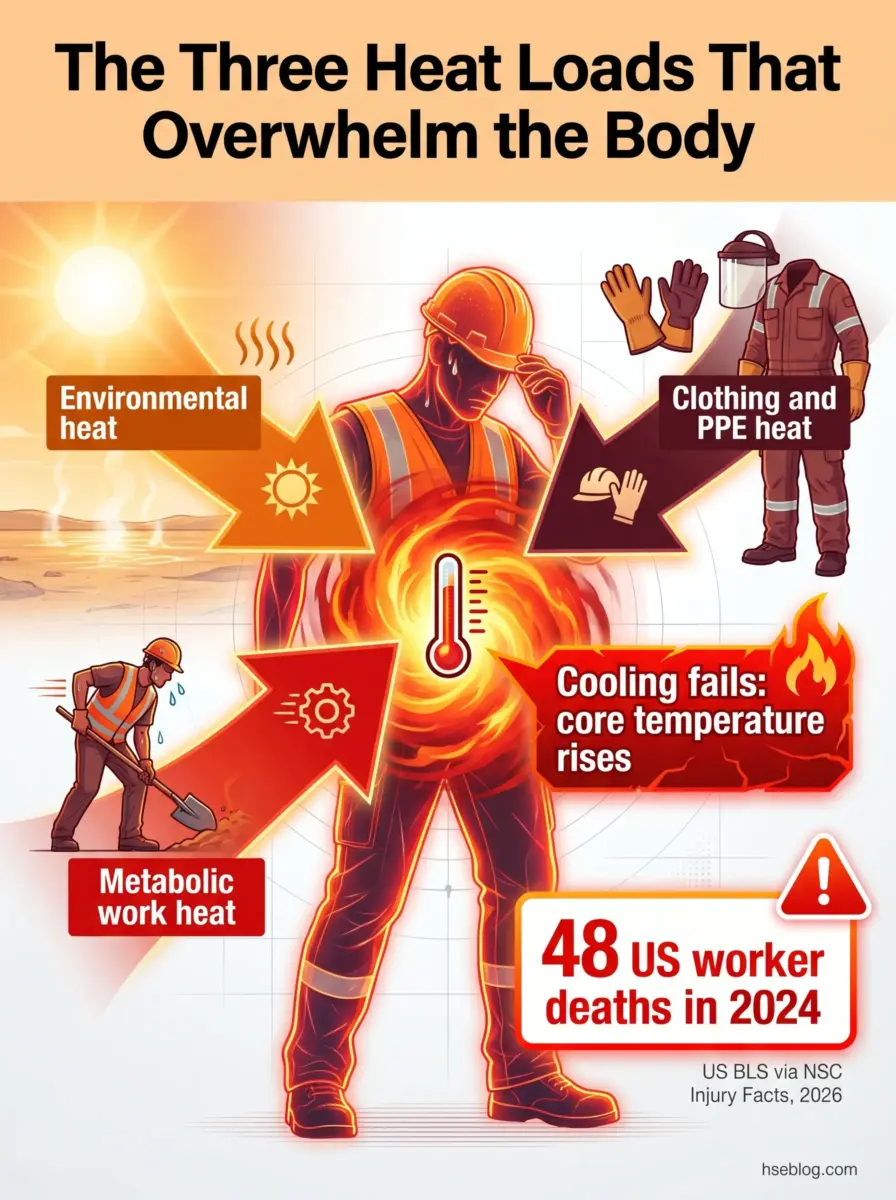
Occupational heat stress is the combined load of three heat sources: environmental heat, metabolic heat from the work itself, and the heat trapped by clothing or PPE. When that combined load outpaces the body’s ability to shed heat, core temperature climbs — and the outcomes scale from cramps to death.
The body cools itself two main ways. Sweating moves heat out through evaporation, and blood flow to the skin carries warmth to the surface. Both fail fast in high humidity or when heavy clothing blocks evaporation.
Heat risk is not confined to one industry, and it is not confined outdoors.
- Construction and agriculture — high-exertion outdoor work in direct sun, consistently the highest-fatality sectors.
- Manufacturing and foundries — radiant heat from furnaces and machinery keeps indoor risk high year-round.
- Warehousing and logistics — large, poorly ventilated spaces combined with physical loads.
- Utilities and emergency response — heavy or sealed PPE stacks heat onto already-demanding tasks.
The longer-term record underlines how routine this is. OSHA’s enforcement baseline showed an average of 38 heat fatalities and roughly 2,700 days-away cases per year across 2011–2019 (US Bureau of Labor Statistics, cited in OSHA Heat Initiative Inspection Guidance, 2021).
The recurring failure pattern is one of framing. When a worker collapses, the instinct is to ask what that person did wrong — but the more useful question is what the environment demanded, which controls were absent, and whether acclimatization time was genuinely built into the schedule or just written into a policy nobody operated.
What Counts as “Extreme Heat” at Work? Measuring the Hazard
There is no single temperature that marks “extreme heat” at work, because the number that matters is the combined heat load on the body — not the reading on a wall thermometer. Three measurement approaches exist, and choosing the wrong one understates real risk.
| Metric | What it measures | Best use | Limitation |
|---|---|---|---|
| Ambient temperature | Air temperature only | Quick first glance | Ignores humidity, sun, and airflow — crude and often misleading |
| Heat index | Air temperature + humidity | General outdoor work without radiant sources | Misses radiant heat and metabolic load |
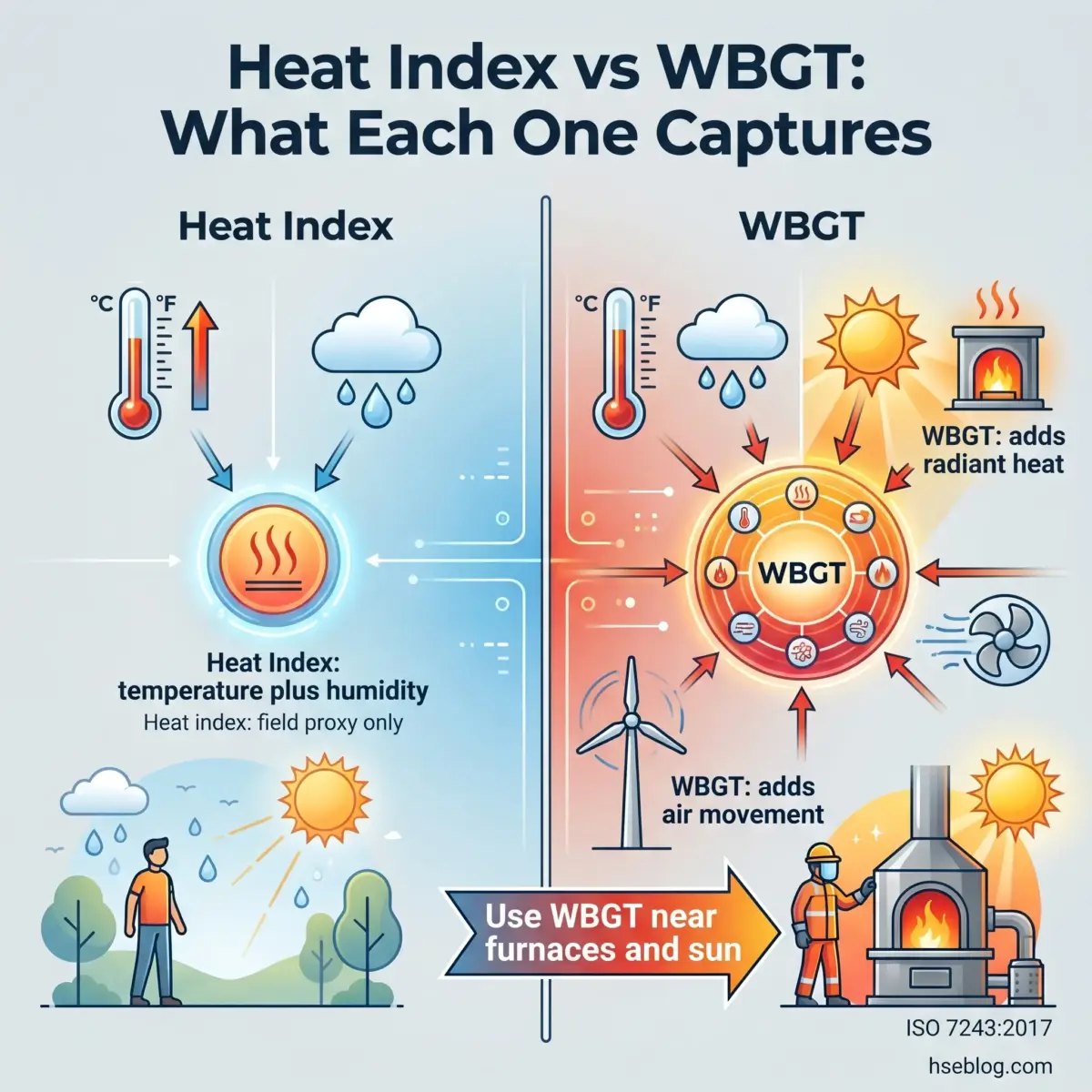
| WBGT | Air temperature, humidity, radiant heat, and air movement | Gold-standard assessment, especially near heat sources | Needs instruments and trained interpretation |
WBGT is the preferred metric precisely because it captures all four environmental factors that drive heat stress, and ISO 7243:2017 (international) standardizes how it is calculated over an exposure of up to eight hours. The NIOSH overview of occupational heat stress treats the heat index as the accessible field proxy when WBGT instruments are not available.
Two reference lines anchor the field judgment. The 80°F heat index works as a screening trigger, while a WBGT-equivalent around 85°F marks a research-backed hazard line for moderate work.
The common mistake is treating a single morning temperature reading as the day’s risk level. WBGT and exertion both climb through the afternoon, and PPE-heavy tasks — spray suits, turnout gear, asbestos work — can push someone into danger at “moderate” ambient readings. A number on a screen is a screening trigger, not a clearance to work.
Heat Index vs. WBGT: Which Should You Use?
Use WBGT wherever radiant or process heat exists — furnaces, hot machinery, direct sun on metal decking. The heat index is acceptable for general outdoor work with no extra radiant source, but it under-reads risk badly near a heat source, so it should never be the only metric in a foundry, a roofing job, or beside running engines.
Heat-Related Illnesses Every Worker and Supervisor Must Recognize
One distinction decides whether a heat case ends in a water break or a fatality: is the body still cooling itself, or has cooling failed? Heat exhaustion means the system is straining but working — sweating, clammy skin. Heat stroke means cooling has collapsed — confusion, altered consciousness, often hot skin.
Medical disclaimer: Recognition guidance here is for HSE practitioner reference and is not a substitute for professional medical care. Workers with symptoms or exposure concerns should be assessed by an occupational physician or emergency services, and cooling protocols should follow local emergency-services direction.
Heat illness runs along a spectrum, and the early stages are easy to dismiss.
| Illness | Key signs | Severity | First response |
|---|---|---|---|
| Heat rash / cramps | Skin irritation; painful muscle spasms | Mild | Cool down, rest, hydrate with electrolytes |
| Heat syncope / edema | Fainting on standing; swollen ankles | Mild–moderate | Sit or lie down, cool, rehydrate |
| Heat exhaustion | Heavy sweating, weakness, nausea, headache | Serious — stop work | Move to cool area, cool actively, monitor closely |
| Heat stroke | Confusion, hot skin, collapse | Life-threatening | Call emergency services, cool aggressively now |
| Rhabdomyolysis | Muscle pain, dark urine, weakness | Serious exertional complication | Stop work, seek medical assessment urgently |
The CCOHS reference on heat illness health effects sets out the illness-by-illness breakdown clearly, and the practical lesson is the same everywhere: heat exhaustion is a precursor to heat stroke, not a minor event.
The red flags that mean heat stroke — and 911:
- Mental status change — confusion, slurred speech, disorientation, agitation.
- Hot skin — may be dry or sweaty; never rely on “dry skin” alone.
- Loss of consciousness — collapse, unresponsiveness, seizures.
The judgment call that costs lives is the “just needs a minute” dismissal — letting a worker “walk it off” while early heat exhaustion silently advances. Any symptomatic worker stops work immediately, and confusion is never written off as dehydration someone can sleep off.
Heat Stroke First Aid: The First 10 Minutes
Competent-person caveat: This article provides general HSE knowledge. Life-critical response such as heat-stroke first aid must be planned and supervised by a competent person with relevant training, jurisdiction-specific authorization, and a site-specific emergency plan. The information here does not replace that.
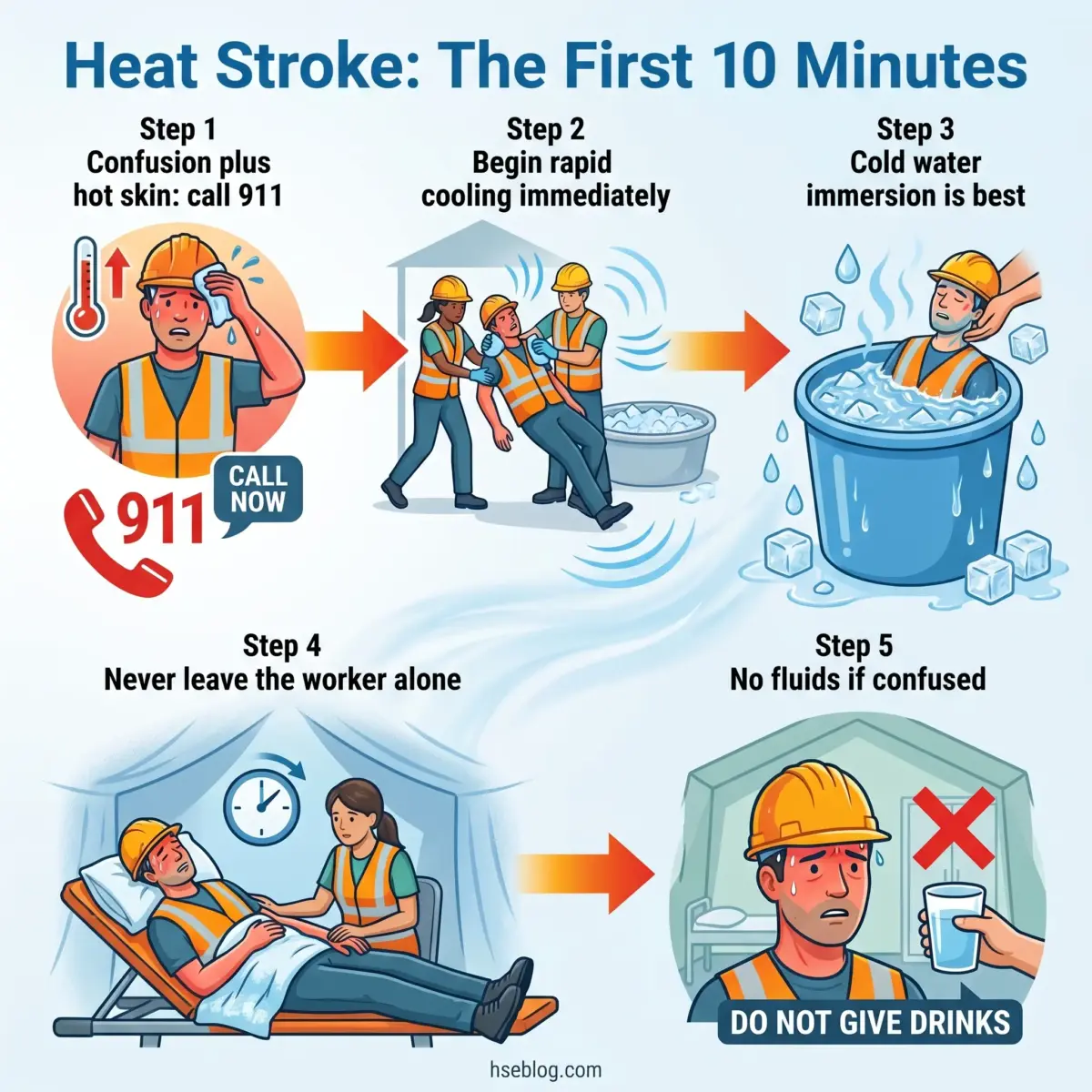
Speed of cooling decides survival. Run these steps in order:
- Call emergency services immediately — treat confusion plus hot skin as a 911 (or local equivalent) emergency, not a wait-and-see.
- Begin rapid whole-body cooling — cold-water immersion is the gold standard; if unavailable, apply ice packs to the neck, armpits, and groin while wetting and fanning the skin.
- Stay with the worker — never leave a heat-stroke casualty alone; monitor breathing and responsiveness continuously.
- Do not give fluids to anyone confused or unconscious — aspiration risk makes this dangerous; conscious heat-exhaustion casualties may sip water.
The Hierarchy of Controls Applied to Heat
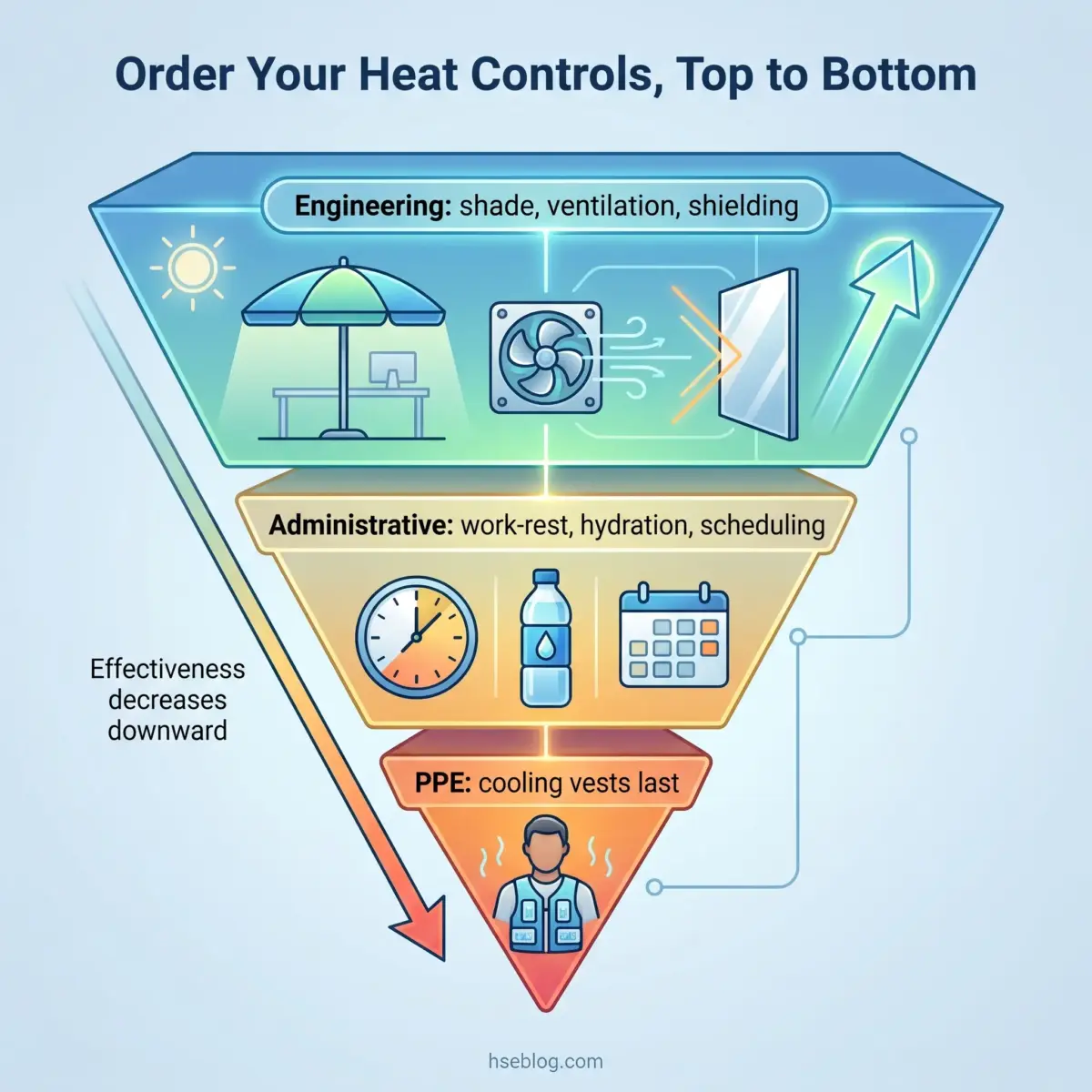
Heat controls are required to run in sequence, not in parallel by convenience: engineering first, administrative second, PPE last. This ordering reflects OSHA and NIOSH guidance (US), and several state standards — Nevada among them — make the sequence a legal expectation rather than a suggestion.
Engineering controls — remove or reduce the heat
- Air conditioning and ventilation — cool indoor spaces and increase air movement to aid evaporation.
- Radiant-heat shielding — barriers between workers and furnaces, engines, or hot surfaces.
- Shade structures — canopies and tents for outdoor crews, positioned at the work area.
- Mechanization — machinery that cuts the physical exertion driving metabolic heat.
Administrative controls — change how the work is done
- Work/rest scheduling — breaks that lengthen as heat rises, taken in genuinely cooled areas.
- Cooler-hour scheduling — heavy tasks moved to early morning or evening where feasible.
- Buddy system and monitoring — workers watch each other for early symptoms.
Hydration — the administrative floor
- Cool water within reach — roughly one cup every 20 minutes during heat exposure.
- Electrolytes — added for prolonged or heavy exertion, not as a soft-drink substitute.
PPE — a supplement, never the primary control
- Cooling vests and wraps — useful additions, but protective clothing itself adds heat load, which is the paradox of relying on PPE here.
The dominant failure mode is inverting this hierarchy — handing out cooling vests and water while leaving the heat source and the schedule untouched, because PPE is cheap and visible while engineering controls cost money and downtime. “Water, rest, shade” is necessary, but it is the administrative floor, not a complete program.
Acclimatization: The Most Under-Managed Control
Acclimatization deserves its own treatment because the data shows it is where workers die. In an evaluation of 66 heat-related enforcement investigations across 2011–2016, the large majority of fatalities occurred in workers during their first days on the job (OSHA, NPRM background, 2024).
New and returning workers must build heat tolerance gradually over one to two weeks. OSHA’s guidance on acclimatizing new and returning workers describes the “Rule of 20 percent” — start at roughly 20% of normal duration on day one, then increase by about 20% each day.
The point most programs miss: “returning” is broad.
- Post-vacation or post-illness returns.
- The season’s first heat wave.
- A sudden temperature spike for an existing crew.
Tolerance is lost after a week or more away, and over winter — so the acclimatization clock resets far more often than schedules assume.
Workplace Heat Regulations: What the Rules Actually Require
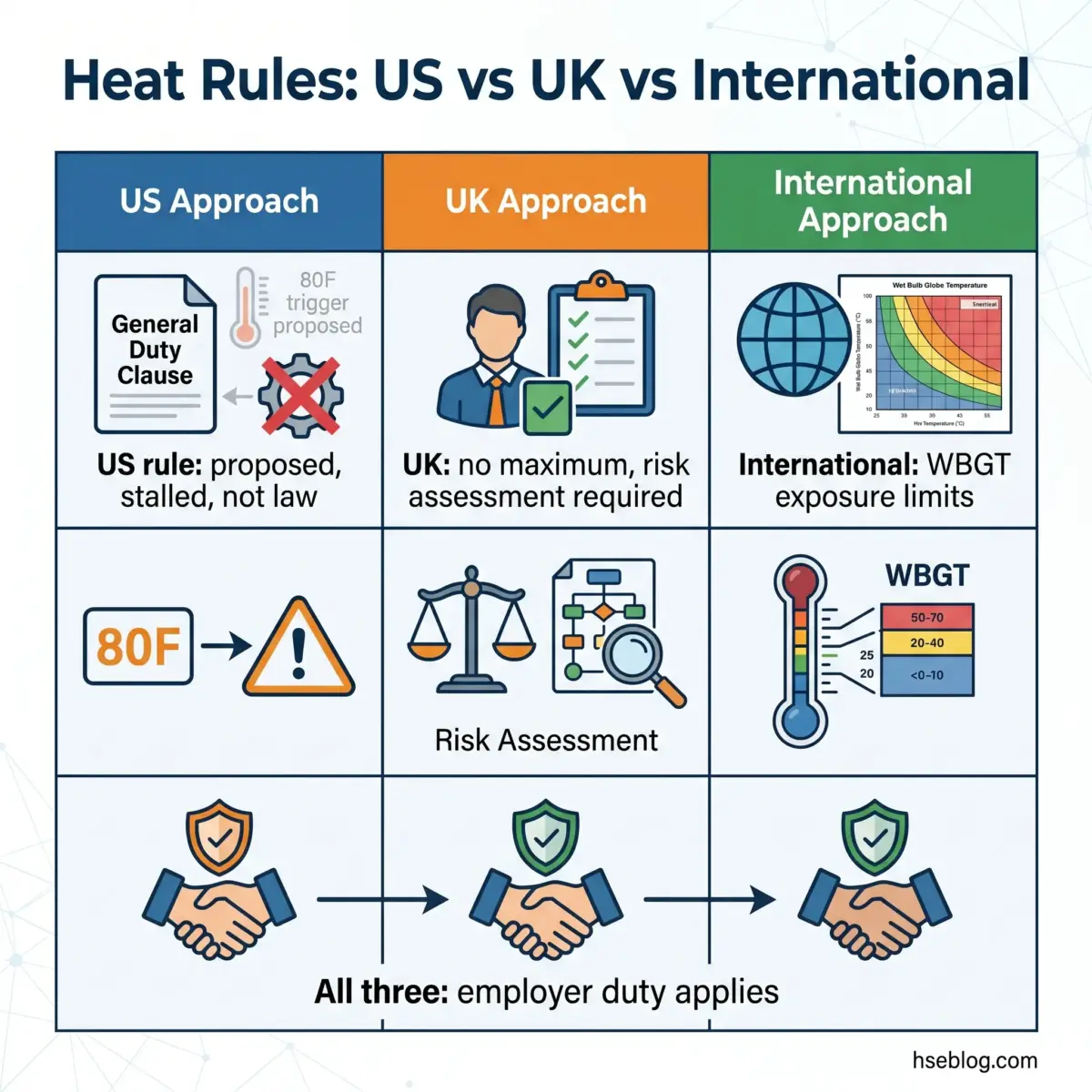
No country sets a universal legal maximum working temperature. The enforceable duty is to assess and control heat risk — and that duty bites whether or not a fixed number exists.
Legal disclaimer: This regulatory summary reflects general HSE professional understanding of the cited jurisdictions’ requirements as of 2026. It is not legal advice. Specific compliance questions, enforcement situations, or prosecution risk should be directed to qualified counsel in the applicable jurisdiction. Regulatory content was last reviewed at the date shown in the byline block.
| Jurisdiction | Legal basis | Trigger / threshold | Employer obligation | Status |
|---|---|---|---|---|
| US federal | OSH Act §5(a)(1), General Duty Clause | No numeric standard | Provide a workplace free from recognized heat hazards | In force; sole federal hook |
| US federal (proposed) | Heat Injury and Illness Prevention rule (NPRM) | 80°F initial, 90°F high heat (heat index) | Written HIIPP, monitoring, triggered controls | Proposed Aug 2024; stalled, not finalized |
| US states | e.g. Cal/OSHA (incl. indoor heat) | Commonly ~80°F | Water, shade, rest, acclimatization, plan | In force in a patchwork of states |
| UK | Workplace Regs 1992, Reg 7; Management Regs 1999 | No statutory maximum | “Reasonable” temperature; thermal risk assessment | In force |
| International | ISO 7243:2017; NIOSH 2016-106 (advisory) | WBGT-based RELs / RALs | Standardized assessment and exposure limits | Advisory reference |
The US numeric thresholds are best read in context. When the heat index reaches 80°F, OSHA’s proposed Heat Injury and Illness Prevention rule (US federal) would trigger initial protections, with heightened steps at 90°F — but the rule completed its post-hearing comment period (closed October 2025) and has stalled with no finalization date (OSHA Rulemaking, 2025–2026).
Enforcement, however, has not waited for a final rule. Sites in roughly 55 targeted industries now face inspection under the revised Heat National Emphasis Program (US federal), which replaced the expired program in April 2026 — OSHA heat inspections have multiplied under this initiative even with the permanent standard stalled.
The UK runs a different philosophy entirely. The practical reading of Regulation 7 of the Workplace (Health, Safety and Welfare) Regulations 1992 (UK) is that there is no maximum, but the Management of Health and Safety at Work Regulations 1999 (UK) still require a thermal-comfort risk assessment — set out in HSE guidance on managing heat stress.
For the numeric limits the US framework leans on, ISO 7243:2017 (international) sets the WBGT method, while NIOSH 2016-106 (US advisory) defines WBGT-based Recommended Exposure Limits for acclimatized workers and stricter Recommended Alert Limits for unacclimatized workers. Where they diverge, the unacclimatized RAL is the more protective reference and should govern.
Two myths get people prosecuted. The UK “no maximum temperature, no obligation” belief and its US cousin, “no federal standard, nothing to comply with,” are both wrong — the risk-assessment duty and the General Duty Clause make inaction citable.
Building a Heat Illness Prevention Plan (HIIPP)
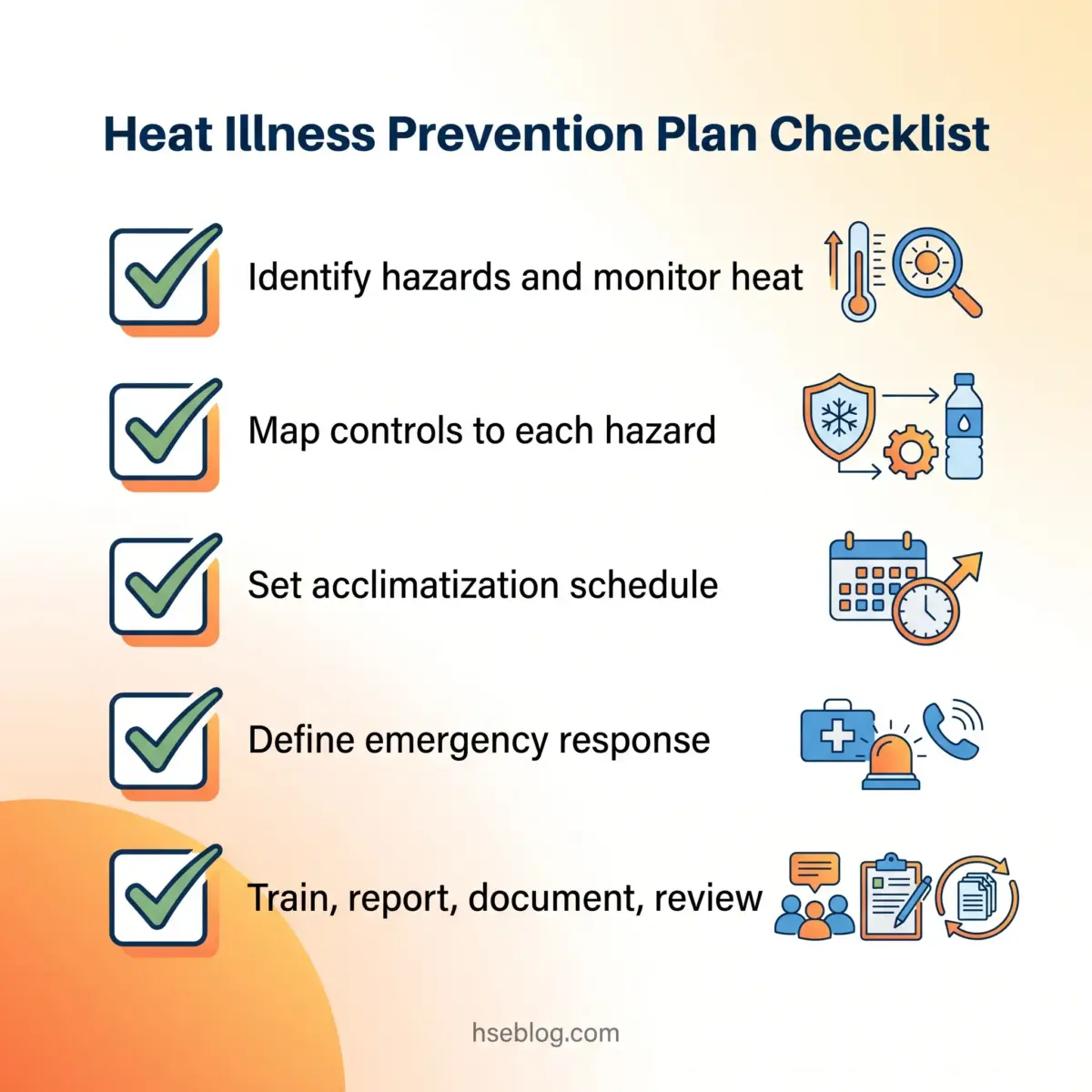
A HIIPP turns everything above into an auditable, site-specific written program — the deliverable that OSHA’s proposed rule (US federal) and existing state standards both demand. Treat it as assigned, testable components, not a generic downloaded template.
- Hazard identification and monitoring — name where heat builds and set a WBGT or heat-index measurement procedure with action thresholds.
- Controls mapped to each hazard — assign named engineering, administrative, and PPE controls in that order, not a generic list.
- Acclimatization schedule — a written ramp for new and returning workers, with triggers for heat waves and post-absence returns.
- Emergency response protocol — who calls emergency services, where cooling supplies sit, and the designated cool-down area.
- Training and reporting — worker and supervisor training on recognition and response, plus a no-blame symptom-reporting pathway.
- Documentation and review — a set cadence to review the plan against what actually happens on site.
Training reference: Build competence through recognized pathways — NEBOSH and IOSH qualifications, OSHA outreach training in the US, or the equivalent regional certification — rather than informal toolbox briefings alone.
The failure auditors meet again and again is the “binder plan” — a compliant-looking document with an acclimatization schedule nobody operates, breaks that exist on paper but get skipped under production pressure, and supervisors who have never run the emergency drill. The plan’s real value sits in the supervisor tabletop exercise, not the binder on the shelf.
Frequently Asked Questions
Conclusion
The industry’s biggest mistake with working in extreme heat is mistaking visible effort for actual protection — distributing water and cooling vests while the heat source, the workload, and the schedule stay exactly as they were. That inverts the control hierarchy and leaves the real exposure untouched.
If one change carries the most weight, it is operating acclimatization for real. The fatality record points to a worker’s first days again and again, yet acclimatization is the control most often written down and least often run — skipped for new hires, ignored for returning crews, and forgotten when the first heat wave lands.
Heat is an exposure hazard, and exposure hazards respond to controls applied in the right order, audited against what happens on the floor, and supervised by someone who has practiced the emergency before it arrives. The number on the thermometer never defines the duty — the heat load on the body does.