
TL;DR
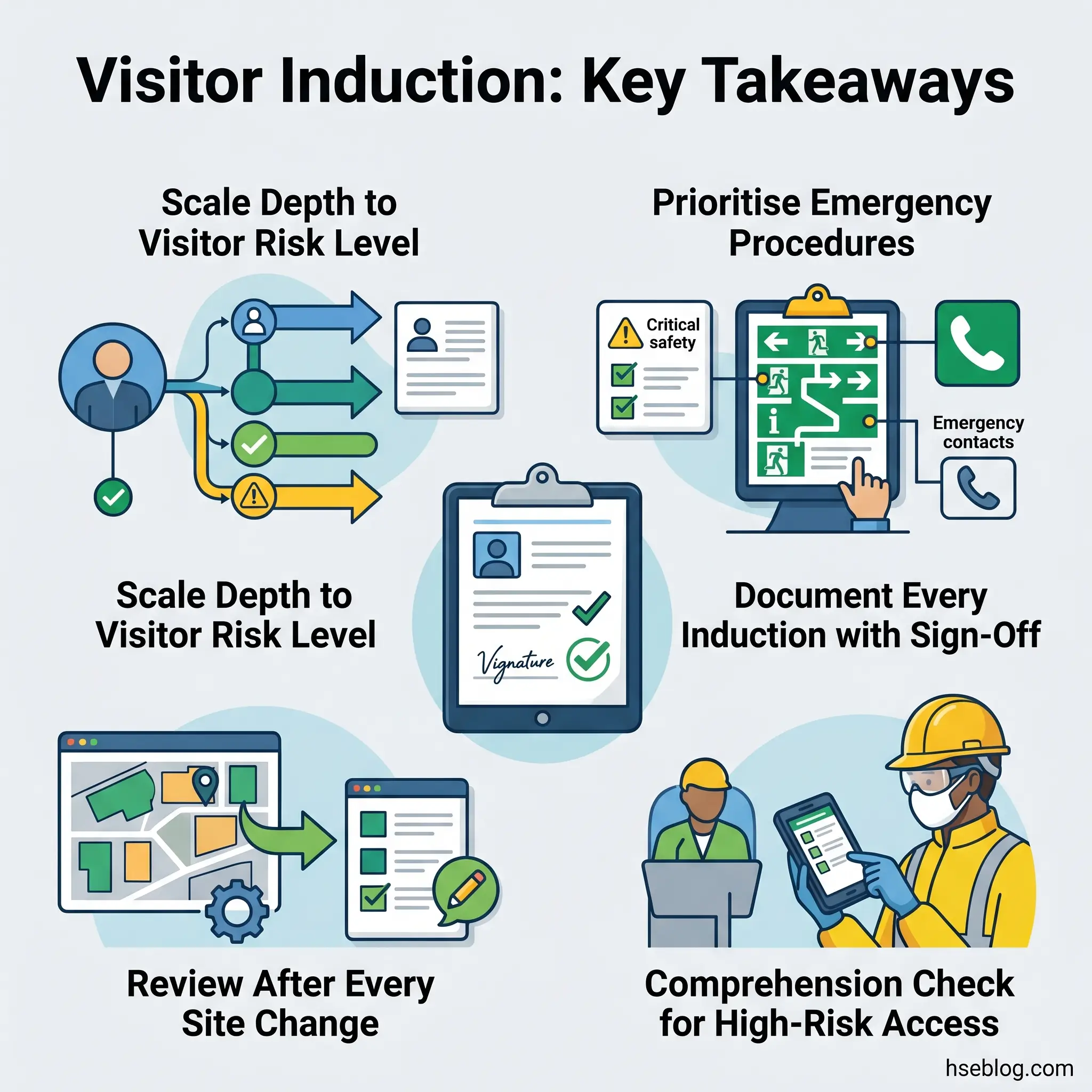
- Match induction depth to risk exposure — a five-minute briefing suits a meeting-room visitor; an unescorted walk through a process plant demands a full structured induction with comprehension check and PPE issuance.
- Cover emergency procedures first, not last — visitors are most vulnerable during evacuations because they don’t know the routes, the alarm sounds, or the muster points.
- Document everything — if a visitor is injured and you can’t produce an induction record, the legal and regulatory exposure multiplies.
- No jurisdiction uses the phrase “visitor induction” in legislation — but the duty to protect non-employees is legally embedded across every major framework, and enforcement agencies treat missing induction as a foreseeable failure.
- Review content after every site change, not just annually — a new hazard, a relocated muster point, or a revised evacuation route makes yesterday’s induction wrong today.
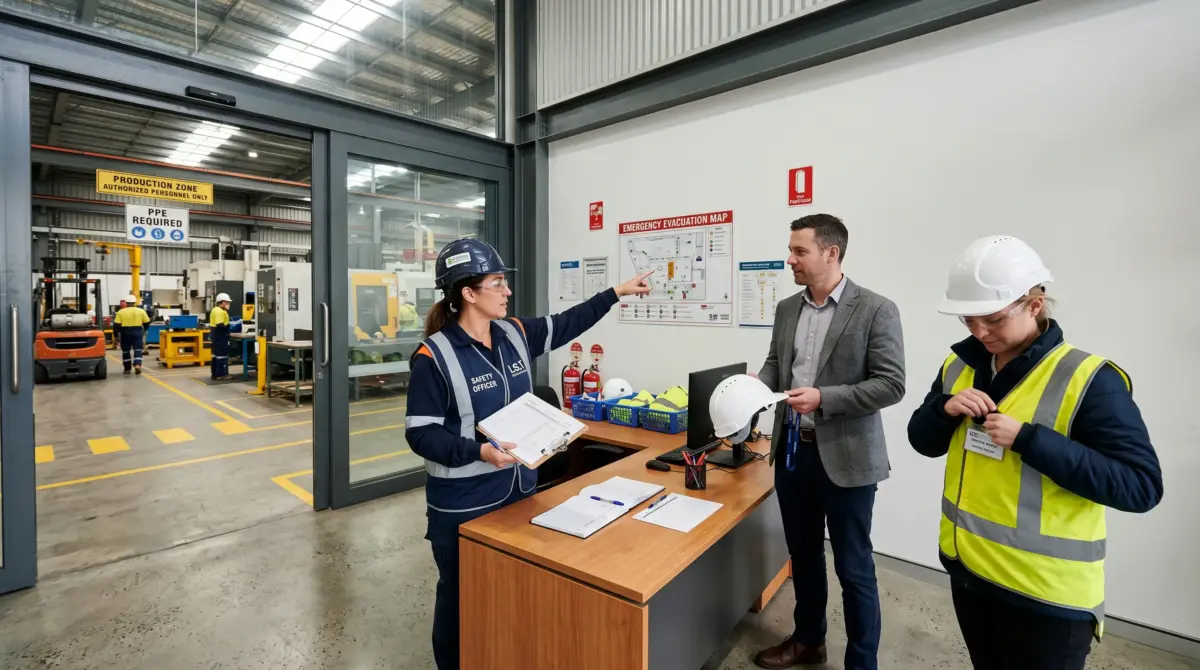
A visitor induction is a structured safety briefing given to any non-employee before they access a workplace. It covers site-specific hazards, emergency procedures, PPE requirements, restricted areas, and behavioural expectations. While no jurisdiction names “visitor induction” in legislation, the obligation to protect visitors is legally established under duty-of-care provisions in the UK (HSWA 1974 Section 3), the US (OSHA General Duty Clause), and Australia (Model WHS Act).
What Is a Visitor Induction and Who Needs One?
A visitor induction is the structured process of communicating essential safety information to any person entering a workplace who is not a regular employee. That definition is broader than most organisations realise. It covers clients attending a meeting, delivery drivers entering a loading bay, regulatory inspectors, students on educational visits, family members at open days, and contractors making short visits that don’t warrant a full contractor induction.
The distinction between visitor induction and contractor or employee induction matters. Employee induction is comprehensive — it covers job-specific hazards, training requirements, competency verification, and ongoing supervision. Contractor induction extends into task-specific risk, permit-to-work systems, and equipment management. Visitor induction is narrower in scope: general site awareness, emergency procedures, and behavioural expectations for someone who is not performing work. Treating these as interchangeable wastes time on low-risk visits and fails to prepare high-risk ones.
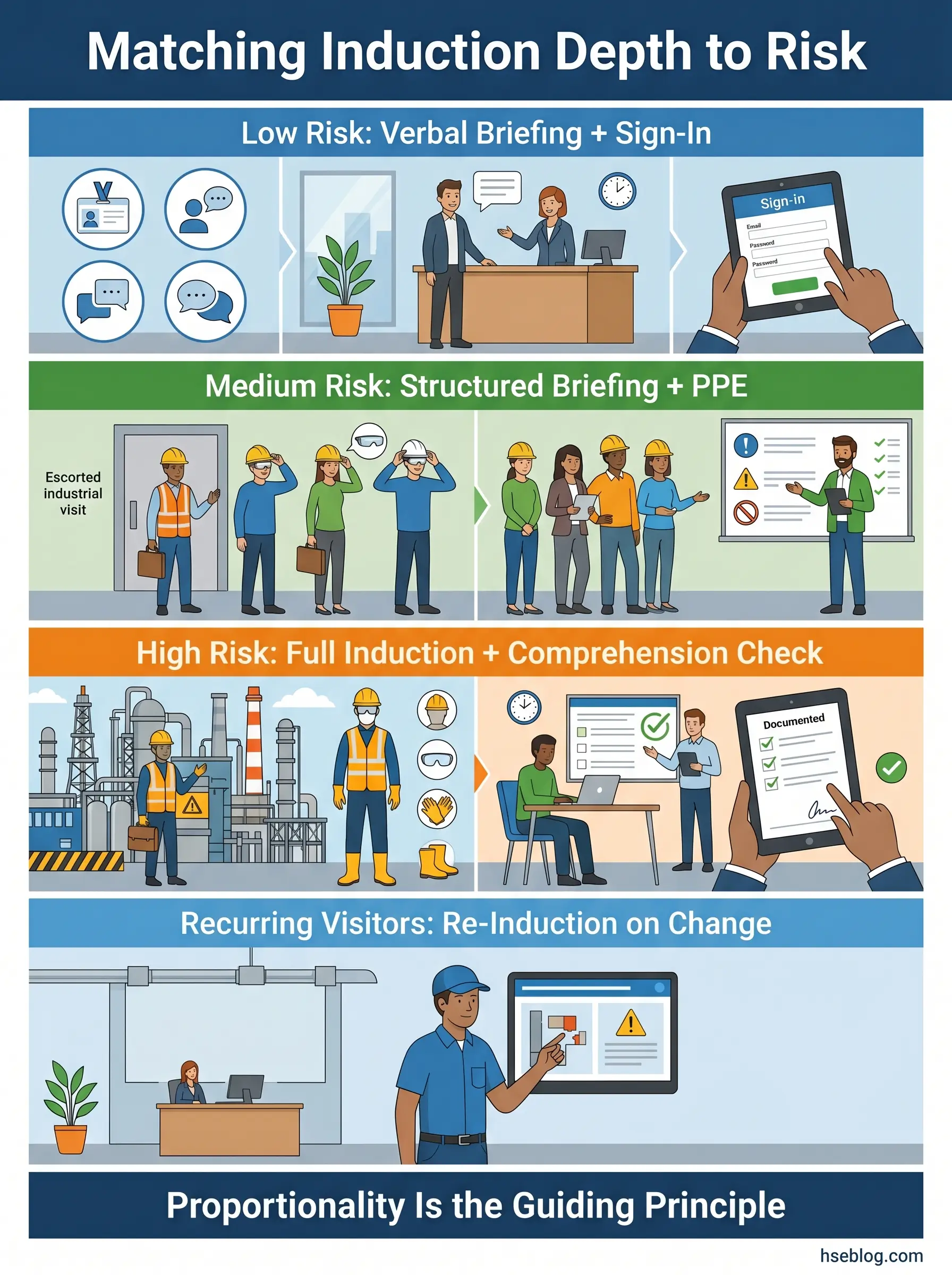
The organising principle that separates an effective programme from a box-ticking exercise is proportionality. A one-size-fits-all approach — the same induction for a client visiting a boardroom and an engineer walking through an active construction zone — is the most common systemic failure in visitor induction programmes. Induction depth should be driven by the nature, duration, and risk exposure of the visit.
| Visitor Type | Risk Profile | Induction Depth |
|---|---|---|
| Office meeting guest | Low | Brief verbal briefing + sign-in + emergency info |
| Escorted warehouse walkthrough | Medium | Structured briefing + PPE + escort protocol + sign-off |
| Unescorted access to production floor | High | Full induction + comprehension check + PPE issuance + documented sign-off |
| Recurring professional visitor | Variable | Initial full induction + periodic re-induction triggered by change or expiry |
Why Visitor Induction Matters: Legal, Safety, and Business Reasons
In Great Britain during 2024/25, 92 non-workers were killed in work-related incidents (HSE UK, 2025). These were members of the public — visitors, bystanders, people who were present in a workplace but not employed there. That figure is not buried in a footnote; it represents the single most direct measure of how well organisations protect the people they invite onto their premises.
The case for visitor induction rests on three pillars, and the weakest programmes typically collapse because they only take one of them seriously.
The safety case is the most intuitive. Visitors are at heightened risk precisely because they lack the familiarity that employees develop over time. They don’t know the layout. They can’t distinguish a routine alarm from an evacuation signal. They don’t recognise which areas are restricted or why a particular corridor is off-limits during certain operations. Every piece of information an employee absorbs through months of working on site, a visitor needs to receive in minutes — and the most critical of that information is what to do when something goes wrong.
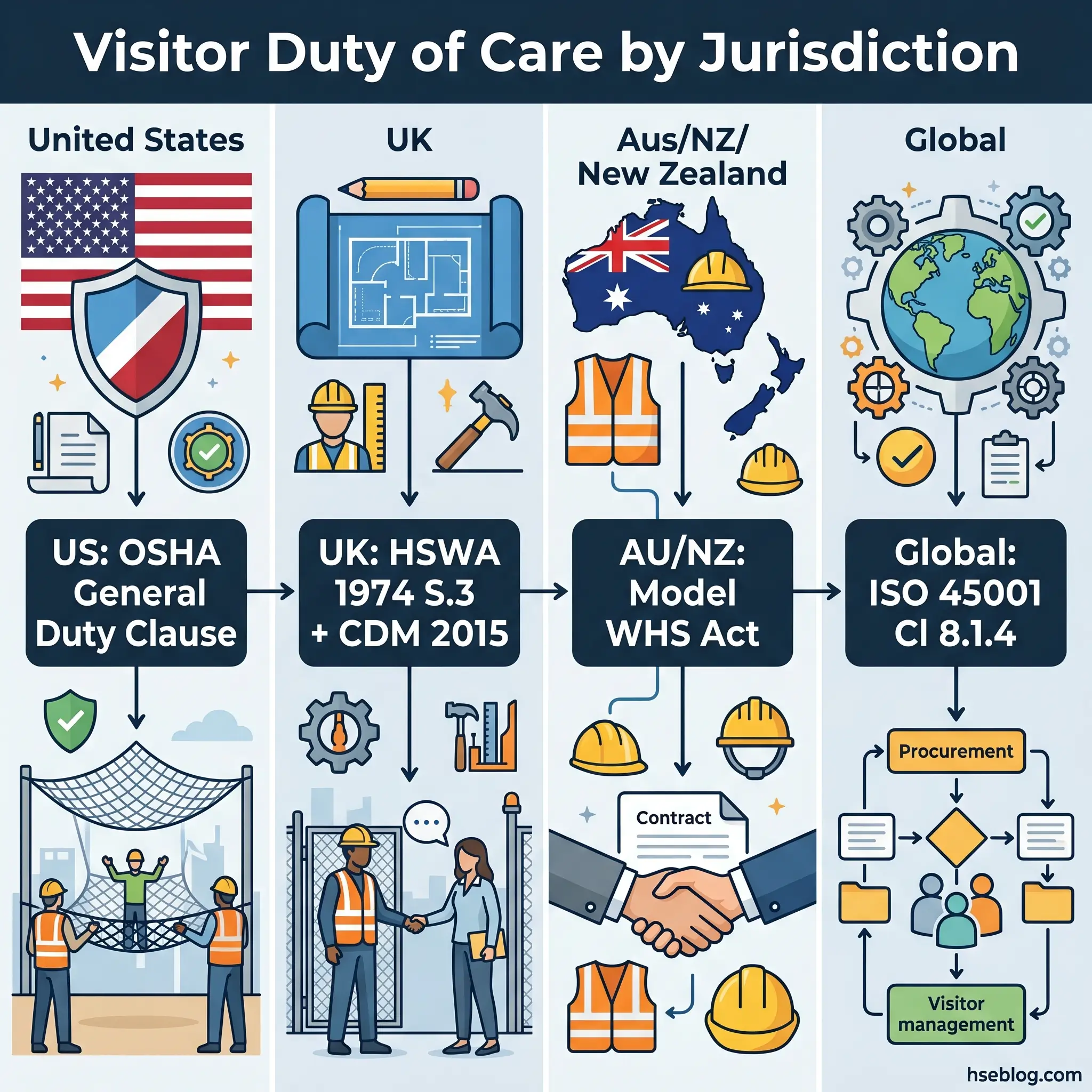
The legal case extends the duty of care beyond the employment relationship. Under Section 3 of the Health and Safety at Work Act 1974 (UK), employers must conduct their undertaking so that non-employees are not exposed to risks to their health or safety, so far as is reasonably practicable. The OSHA General Duty Clause — Section 5(a)(1) of the OSH Act 1970 (US) — requires employers to furnish a workplace free from recognised hazards causing or likely to cause death or serious physical harm; this extends to all persons on the premises. Australia and New Zealand’s Model WHS Act places the same obligation on any person conducting a business or undertaking. These provisions are not suggestions. They are enforceable duties, and enforcement agencies assess compliance partly by examining what information was provided to non-employees before they accessed the site.
The business case follows from the first two. An incident involving an uninducted visitor creates compounding exposure: civil liability, regulatory investigation, potential prosecution, insurance complications, and reputational damage that can affect client relationships and contract eligibility for years. A pattern observed across enforcement actions is that organisations most often formalise their visitor induction programme after a near-miss or an enforcement notice — at which point the retrospective cost of building the system is orders of magnitude higher than doing it from the start.
Legal Requirements by Jurisdiction
No jurisdiction uses the exact phrase “visitor induction” in its legislation. The obligation derives from broader duties of care, and this distinction matters because some organisations use the absence of the literal phrase as a reason to skip it. Enforcement agencies and courts do not share that interpretation.
In the United States, the OSHA General Duty Clause — Section 5(a)(1) of the OSH Act 1970 — does not prescribe a specific visitor induction process, but it establishes the duty to protect all persons on site from recognised hazards. When a visitor is injured and the employer cannot demonstrate that hazard information was communicated, the General Duty Clause provides the enforcement basis.
The United Kingdom comes closest to an explicit requirement. HSWA 1974 Section 3 establishes the general duty to non-employees. For construction, CDM 2015 Regulation 14 requires the principal contractor to provide site induction to every worker and any person visiting the site. HSE guidance document L153 confirms that this includes occasional and one-off visitors, with induction proportionate to the nature of the visit.
Under Australia and New Zealand’s Model WHS Act, a person conducting a business or undertaking must ensure, so far as is reasonably practicable, the health and safety of all persons affected by the work — including visitors. The framing is deliberately broad, placing the obligation on the organisation to determine what protection measures are proportionate.
ISO 45001:2018 — a voluntary global standard, not legislation — addresses visitors through Clause 4.2 (interested parties) and Clause 8.1.4 (operational controls for outsourcing and procurement). Organisations certified to ISO 45001 are expected to demonstrate that visitor access is controlled and that visitors are informed of relevant risks. The standard is currently in its revision process, initiated in May 2024, with a Draft International Standard expected around mid-2026 (ISO, 2024).
Jurisdiction Note: The legal obligation to protect visitors exists in every major framework. The mechanism varies — explicit induction requirement (UK CDM), general duty (OSHA, Model WHS Act), or management system expectation (ISO 45001) — but the practical outcome is the same: if a visitor is harmed and no induction was delivered, the host organisation is legally exposed.
What Should a Visitor Induction Cover? Core Content Elements
The most consistent gap across visitor induction programmes is not a missing topic — it’s the wrong emphasis. Organisations routinely cover site rules and PPE in granular detail but reduce emergency procedures to a single sentence, despite evacuations being the scenario where a visitor is most vulnerable and least prepared.
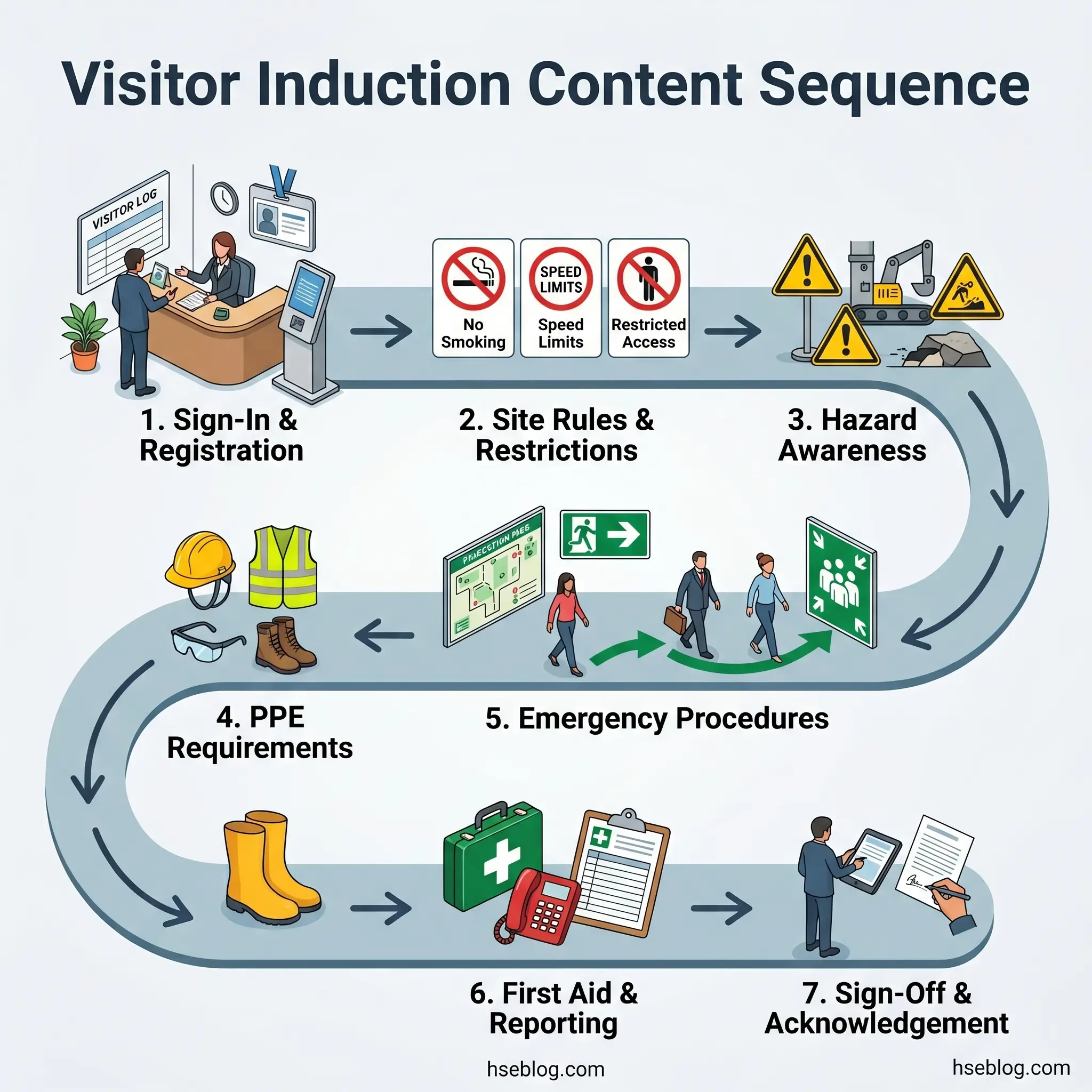
The content below follows the logical sequence of what a visitor needs to know, ordered by when they need it — from arrival through to emergency response.
- Arrival and sign-in procedures. Registration, identification, badge or pass issuance, and confirmation of who the visitor’s host is. This is also the point where induction delivery begins — not after the visitor has already walked through the site.
- Site rules and behavioural expectations. Restricted areas and why they’re restricted. Escort requirements — whether the visitor must be accompanied at all times or may move independently within defined zones. Prohibited items, photography policy, drug and alcohol policy. These vary significantly between a corporate office and an active process plant, and the induction must reflect the actual site, not a template.
- Hazard awareness. The specific hazards the visitor may encounter during their particular visit — not a generic list of all hazards on site. A visitor touring a warehouse needs to know about forklift traffic and racking hazards. A visitor entering a chemical storage area needs to know about substance-specific risks. Relevance drives retention.
- PPE requirements. What is mandatory for the areas the visitor will access, where PPE is supplied, and how to wear it correctly. Handing a hard hat to someone who has never worn one and assuming compliance is a common failure. A ten-second fit check prevents it.
- Emergency procedures. Evacuation routes from the specific areas the visitor will be in. Muster point locations. Alarm sounds and what each means. Who to follow if an alarm activates. What to do if separated from the host or escort. This section deserves the most time and the clearest communication — it addresses the highest-consequence scenario.
- First aid and incident reporting. Location of first aid facilities, emergency contact numbers, and how to report an injury or observed hazard. Visitors should know that reporting is expected, not optional.
- Sign-off and acknowledgement. Documented confirmation that the visitor has received and understood the induction. For high-risk visits, this includes a comprehension check — not just a signature confirming receipt.
Watch For: The gap between what an induction form says was covered and what the visitor can actually recall five minutes later. If the induction is a speed-read-and-sign exercise, it’s a compliance artefact, not a safety control.
How to Scale Visitor Induction by Risk Level
The biggest practical tension in visitor management is between thoroughness and visitor patience. A 45-minute induction for a client visiting a site office creates friction and compliance fatigue. A five-minute briefing for someone entering a live construction zone creates real danger. The skill is in matching depth to exposure — and that judgement is where most programmes fail.
HSE guidance document L153, supporting CDM 2015 in the UK, confirms that escorted visitors need only be made aware of the main hazards and control measures relevant to their visit. The escort provides active supervision, reducing the depth of structured induction required — but not eliminating it entirely. This principle of proportionality applies beyond UK construction; it’s the most defensible operational approach across any jurisdiction.
The three-tier framework below provides practical structure.
| Risk Level | Visit Type Examples | Induction Elements | Approximate Duration |
|---|---|---|---|
| Low | Office meeting, reception area visit | Verbal briefing, sign-in, emergency exit/muster point, host identified | 5–10 minutes |
| Medium | Escorted walk through warehouse, manufacturing tour, lab visit with host | Structured briefing, hazard overview for route, PPE issuance, escort protocol, sign-off | 15–30 minutes |
| High | Unescorted access to construction site, process plant, or confined-space-adjacent areas | Full visitor induction, site-specific hazard briefing, PPE issuance and fit check, comprehension check, escort assignment or authorised-zone map, documented sign-off | 30–60 minutes |
Recurring visitors introduce a separate consideration. A supplier representative who visits weekly doesn’t need the full induction every time — but they do need re-induction when conditions change. Effective programmes set expiry periods (typically 6–12 months) and trigger re-induction when site hazards, layouts, or emergency procedures are modified, or after any incident involving a visitor.
The Fix That Works: Build re-induction triggers into the visitor management system rather than relying on calendar-based expiry alone. A time-based review catches slow drift; a change-based trigger catches the updates that actually affect safety.
Are Visitor Inductions a Legal Requirement?
The direct answer: no jurisdiction uses the exact phrase “visitor induction” in its legislation, but the obligation to protect non-employees from workplace hazards is legally established across every major safety framework. Visitor induction is the recognised practical mechanism for discharging that duty.
In the UK, CDM 2015 comes closest to an explicit requirement. Regulation 14 mandates site induction for every worker and visitor on a construction site. HSE guidance L153 clarifies that this applies to occasional and one-off visitors, with induction depth proportionate to the visit. Outside construction, HSWA 1974 Section 3 provides the general duty — it doesn’t prescribe the method, but enforcement agencies assess whether the employer took reasonable steps to inform non-employees of risks.
The US framework under OSHA’s General Duty Clause operates differently. There is no prescriptive visitor induction regulation. The enforcement mechanism activates after an incident: if a visitor is harmed and the employer cannot demonstrate that hazard communication was provided, the absence of induction becomes evidence of a recognised-hazard failure.
Under Australia and New Zealand’s Model WHS Act, the duty extends to all persons affected by work activities, placing the burden on the organisation to determine what controls — including information provision — are reasonably practicable.
ISO 45001:2018 recommends, but does not legally require, that certified organisations control visitor access and inform visitors of relevant risks. Certification auditors assess this as part of operational control (Clause 8.1.4), but non-compliance is a conformity gap, not a prosecutable offence.
The practical judgment call is this: the distinction between “legal requirement” and “best practice recommendation” narrows to almost nothing when enforcement follows an incident. Organisations that treat visitor induction as optional are reading the law at its thinnest — and that reading does not survive contact with an investigation.
Common Mistakes in Visitor Induction Programmes
Reviewing the published record of enforcement actions and workplace injury investigations reveals a consistent set of failures. These are not edge cases — they are the recurring patterns that auditors find on site after site.
The first and most widespread failure is generic content. The induction describes hazards that exist somewhere on the site but bear no relationship to what a specific visitor will actually encounter. A visitor heading to a second-floor office receives the same briefing as one entering a ground-level fabrication shop. The result is information overload for one and inadequate preparation for the other.
Closely related is the absence of a meaningful comprehension check. Many programmes treat the visitor’s signature as proof of understanding. It proves only that they held a pen. For medium- and high-risk visits, a brief verbal confirmation — “Can you tell me where the muster point is?” — takes seconds and reveals whether the induction transferred any usable knowledge.
Failure to update content is the slow-acting version of the same problem. Site hazards change. Evacuation routes are revised. Muster points move. A visitor induction that was accurate six months ago may direct someone toward a blocked exit or an obsolete assembly area. The HSE UK 2024/25 statistics reported 92 non-worker fatalities in work-related incidents (HSE UK, 2025) — while causation data at that level of detail is not publicly disaggregated, every investigation that finds outdated safety information in circulation identifies a foreseeable failure.
Tracking failures compound the risk at high-traffic facilities. Without a record of who was inducted, when, and by whom, the organisation cannot demonstrate due diligence after an incident. This is not an administrative inconvenience — it is a legal exposure gap.
Language and literacy barriers are consistently underaddressed. A visitor who does not speak the site’s primary language or who cannot read printed materials requires an alternative delivery method — visual aids, translated materials, or interpreter-supported briefing. Assuming literacy and language proficiency without checking is a failure of the induction system, not the visitor.
Digital vs. Paper-Based Visitor Induction: Choosing the Right Approach
The shift toward digital visitor induction systems solves some persistent problems while introducing new ones. The judgment call is not which format is inherently better — it’s which combination matches the organisation’s risk profile, visitor volume, and operational reality.
| Factor | Paper-Based | Digital | Hybrid |
|---|---|---|---|
| Consistency of delivery | Variable — depends on who delivers | High — every visitor gets same content | High for core content; variable for site-specific briefing |
| Ease of updating | Slow — requires reprinting and redistribution | Fast — central update applies immediately | Mixed — digital core updates quickly; face-to-face element needs retraining |
| Record-keeping | Manual — sign-in books, filing | Automatic — timestamped, searchable | Automatic for digital; manual for face-to-face confirmation |
| Multilingual support | Requires pre-translated printed versions | Built-in language selection | Partial — digital portion multilingual; face-to-face depends on personnel |
| Visitor demographics | Accessible to all — no tech required | Requires tablet, kiosk, or pre-arrival email | Balances tech and accessibility |
| Audit readiness | Dependent on filing discipline | High — data readily exportable | High for digital records; moderate for face-to-face sign-off |
Digital induction delivers consistency — every visitor receives the same message — and eliminates the variability that comes from different staff delivering the same briefing with different emphasis or omissions. Pre-arrival online modules allow visitors to complete general content before they arrive, shortening on-site time.
The limitation that digital-only approaches share is the absence of a human touchpoint to confirm that the visitor has genuinely understood the content for their specific visit context. A visitor can click through a digital module and pass an automated quiz without absorbing the site-specific information that would keep them safe if an alarm sounded. For low-risk office visits, this gap is tolerable. For medium- and high-risk access, a face-to-face confirmation on arrival remains necessary.
Data privacy considerations apply to all digital systems. Visitor personal data — name, organisation, contact details, photographs — must be handled in accordance with applicable data protection legislation (including GDPR in the EU/UK). Retention periods, access controls, and data deletion processes need to be defined before the system goes live, not after a subject access request arrives.
Audit Point: During management system audits, assessors often check whether the digital induction content matches the current site conditions. An outdated video or slide deck stored in a self-service kiosk is the digital equivalent of a yellowed paper booklet — it looks systematic while delivering inaccurate information.

How to Build a Visitor Induction Checklist
A checklist that works in practice is built backwards from one question: if this visitor were involved in an incident, what information would we need to prove they were given? That framing forces the checklist to cover what actually matters rather than what’s easy to include.
Step 1 — Identify visitor types and their likely exposure areas. Map out who visits the site and where they go. A manufacturing facility might receive office-only visitors, escorted production-floor visitors, delivery drivers accessing the loading dock, and external auditors with broad site access. Each category has a different risk profile and a different induction need.
Step 2 — Map site-specific hazards to each visitor pathway. Walk the routes visitors actually take. Note the hazards they will encounter or pass through — moving vehicles, chemical storage, noise zones, height-work areas, confined spaces. The checklist content for each visitor category flows directly from this mapping.
Step 3 — Define mandatory vs. conditional content. Mandatory content applies to every visitor regardless of category: emergency procedures, muster points, reporting requirements. Conditional content depends on exposure: permit-to-work awareness for visitors entering controlled zones, chemical hazard information for those accessing storage areas, noise protection for anyone entering marked zones.
Step 4 — Build in a comprehension check. For low-risk visits, a verbal confirmation is proportionate. For medium- and high-risk access, two or three targeted questions — “Where is your nearest muster point?” / “What do you do if you hear the continuous alarm?” — provide evidence that the induction transferred knowledge, not just paper.
Step 5 — Establish a review cycle. Reviews should be triggered by three conditions: any incident involving a visitor, any change to site hazards or emergency procedures, and a time-based interval (annually at minimum). The review cycle must be documented, including who reviewed, what changed, and when.
Record-keeping closes the loop. Every induction record should capture: visitor name and organisation, date and time, who delivered the induction, topics covered, any PPE issued, and the visitor’s sign-off or comprehension-check result. These records need a defined retention period and must be accessible for audit or investigation without delay.
Frequently Asked Questions
Conclusion
Ask yourself one question about your current visitor induction programme: if a visitor were injured on site tomorrow, could you produce a record showing exactly what safety information they received, when, from whom, and evidence that they understood it? If the answer is anything less than an immediate yes, the programme has a gap — and that gap is the one investigators will find first.
The organisations that get visitor induction right are not the ones with the longest checklists or the most expensive digital kiosks. They are the ones that match induction depth to actual risk exposure, prioritise emergency procedures over administrative content, and treat the comprehension check as the measure of success rather than the signature at the bottom of a form. Every element in this article — from the proportionality principle to the re-induction triggers to the record-keeping requirements — serves a single purpose: ensuring that when someone enters your workplace, they leave it the same way they arrived.
That obligation does not diminish because the visitor is only there for twenty minutes, or because they’re a senior client, or because it’s the third time they’ve visited this month. The duty of care under HSWA 1974, the OSHA General Duty Clause, and the Model WHS Act does not contain an exemption for convenience. Neither should your induction programme.