
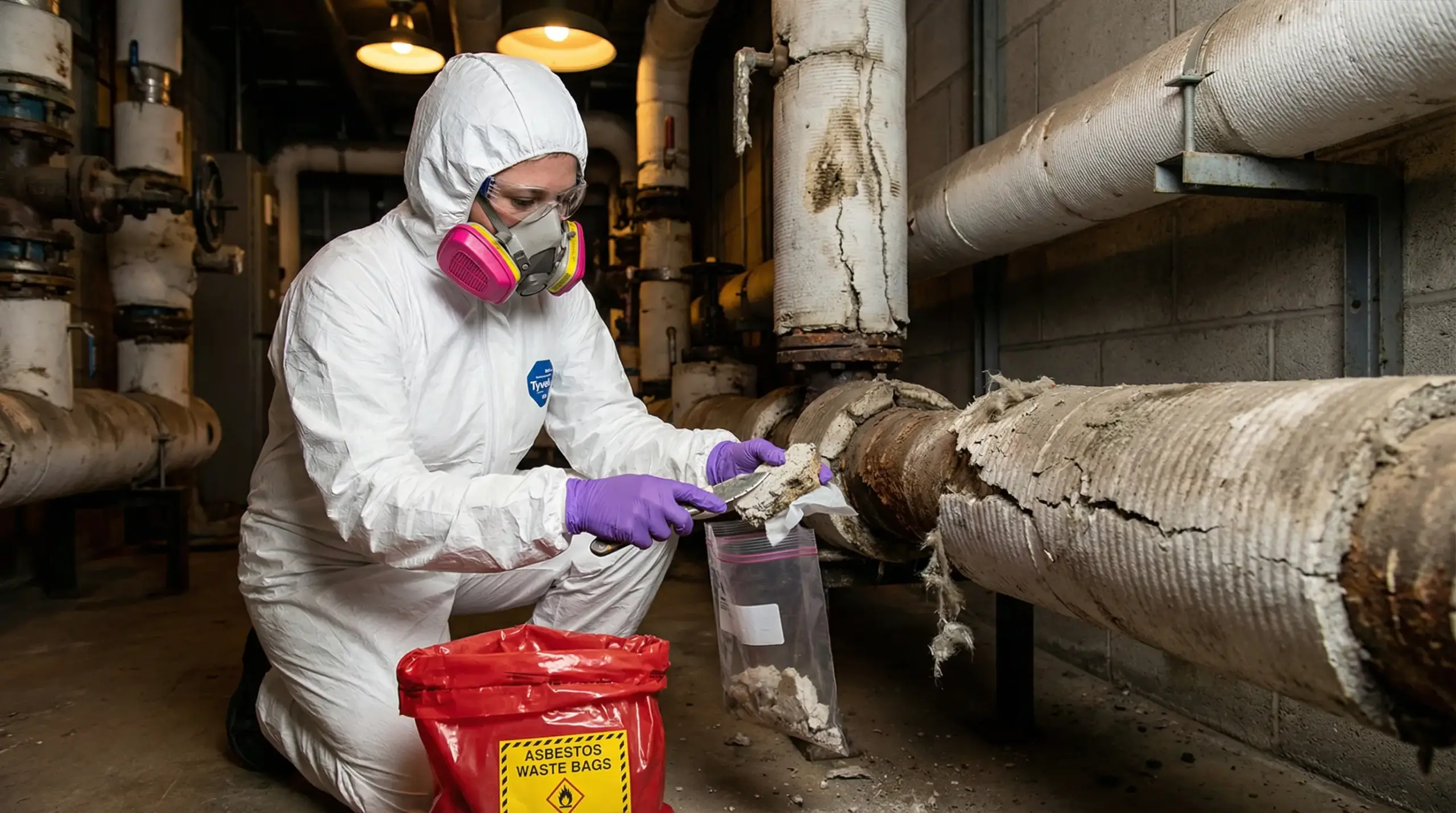
TL;DR
- You cannot confirm asbestos by sight alone. Visual inspection narrows suspicion, but only accredited laboratory analysis of a bulk sample can confirm whether a material contains asbestos fibers.
- Asbestos hides in plain sight. It was mixed into over 3,000 building products — from floor tiles and pipe insulation to textured coatings and roof sheets — making visual familiarity with common asbestos-containing materials (ACMs) a critical field skill.
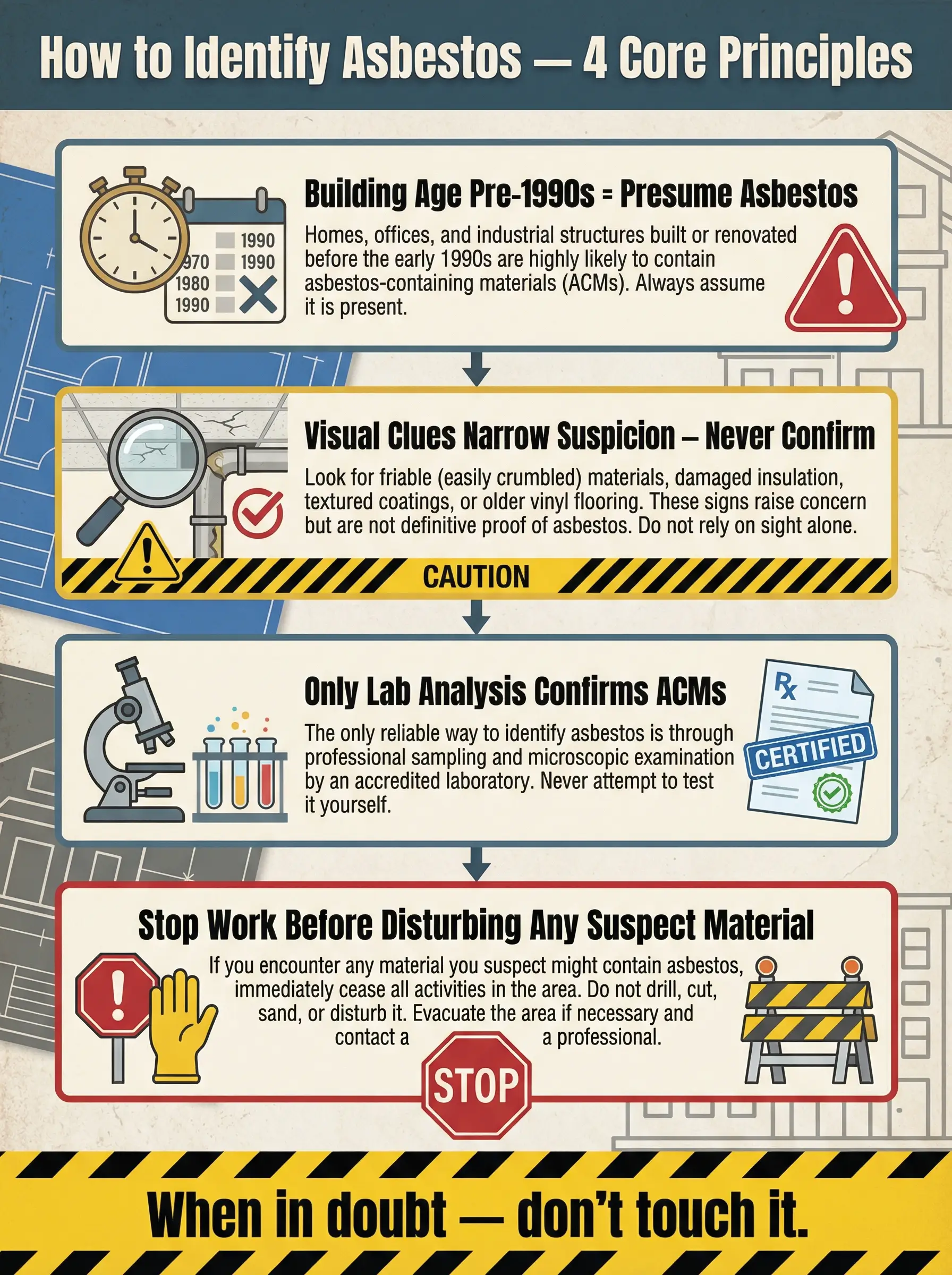
- The building’s age is your first clue. Any structure built or renovated before the mid-1990s (and in some regions, early 2000s) should be treated as presumed to contain asbestos until a qualified survey proves otherwise.
- Disturbing suspected ACMs without testing kills. Cutting, drilling, sanding, or demolishing asbestos-containing materials releases microscopic fibers that cause mesothelioma, asbestosis, and lung cancer — diseases with no cure and decades-long latency.
- Stop work, isolate, and sample. If you suspect asbestos during any maintenance, renovation, or demolition activity, the only correct response is to stop the task, restrict access, and arrange professional sampling and analysis.
I was called to a renovation project at an aging office complex — built in the late 1970s — where a maintenance crew had already ripped out ceiling tiles and stripped pipe insulation across an entire floor. The debris was piled in open heaps. No one was wearing respiratory protection. When I asked who had checked for asbestos before demolition started, the site foreman looked at me and said, “We looked at it. It’s just old fiberglass.” It wasn’t. The lab results came back four days later confirming chrysotile asbestos in both the ceiling tiles and the pipe lagging. By then, a dozen workers had been breathing contaminated dust for nearly a week without a single control in place.
That incident sits with me because it captures the most dangerous assumption people make about asbestos: that you can identify it — or rule it out — just by looking at it. The truth is, asbestos was deliberately engineered to blend into ordinary building materials. It looks like insulation. It looks like cement sheet. It looks like floor tile. This article breaks down what asbestos-containing materials actually look like in the field, where they hide, how to recognize warning signs, and — most critically — what to do when you suspect you’ve found them. If you’ve ever searched “what does asbestos look like,” the answer you need is not a single photograph. It’s a systematic identification approach grounded in material knowledge, building age, and professional testing.
What Is Asbestos and Why Was It Used in So Many Materials?
Asbestos is not a single substance — it is a group of six naturally occurring silicate minerals that share one defining characteristic: they form microscopic, needle-like fibers that are extraordinarily resistant to heat, fire, chemicals, and electrical conductivity. These properties made asbestos one of the most commercially valuable industrial minerals of the 20th century.
Understanding why asbestos was so widely used helps explain why identifying it today is so difficult. Manufacturers didn’t use asbestos as a standalone product — they blended it into thousands of existing materials to enhance their performance. The result is that asbestos-containing materials often look, feel, and behave exactly like their non-asbestos equivalents.
The six regulated types of asbestos fall into two mineral families, but three types dominated commercial use across construction and industrial applications:
- Chrysotile (white asbestos): Accounted for roughly 90–95% of all asbestos used commercially worldwide. Fine, curly fibers that were woven into textiles, mixed into cement products, brake linings, gaskets, and building insulation. Its white-to-grey color often makes it invisible within composite materials.
- Amosite (brown asbestos): Straight, brittle fibers commonly found in thermal insulation boards, pipe lagging, ceiling tiles, and cement sheet products. Recognizable in raw form by its brown-to-grey coloring, but nearly impossible to distinguish once mixed into finished materials.
- Crocidolite (blue asbestos): The most hazardous type due to its extremely fine, straight fibers that penetrate deep into lung tissue. Used in spray-on coatings, pipe insulation, and some cement products. Raw fibers have a distinctive blue tint, but this color disappears when mixed into composite products.
OSHA defines any material containing more than 1% asbestos by weight as an asbestos-containing material (ACM). Even materials that appear completely normal may contain regulated levels of asbestos fibers. (29 CFR 1926.1101)
Pro Tip: On demolition and renovation projects, I always start with the building’s construction date — not a visual inspection. If the structure was built before the mid-1990s, I treat every suspect material as ACM until laboratory analysis says otherwise. The date alone triggers the duty to survey.
What Does Asbestos Look Like? Visual Characteristics of Common ACMs
This is the question most people are searching for — and it deserves an honest answer. Asbestos-containing materials do not have a single “look.” There is no universal color, texture, or pattern that reliably identifies asbestos across all products. However, experienced inspectors develop visual familiarity with the types of materials that commonly contained asbestos and the subtle clues that raise suspicion.
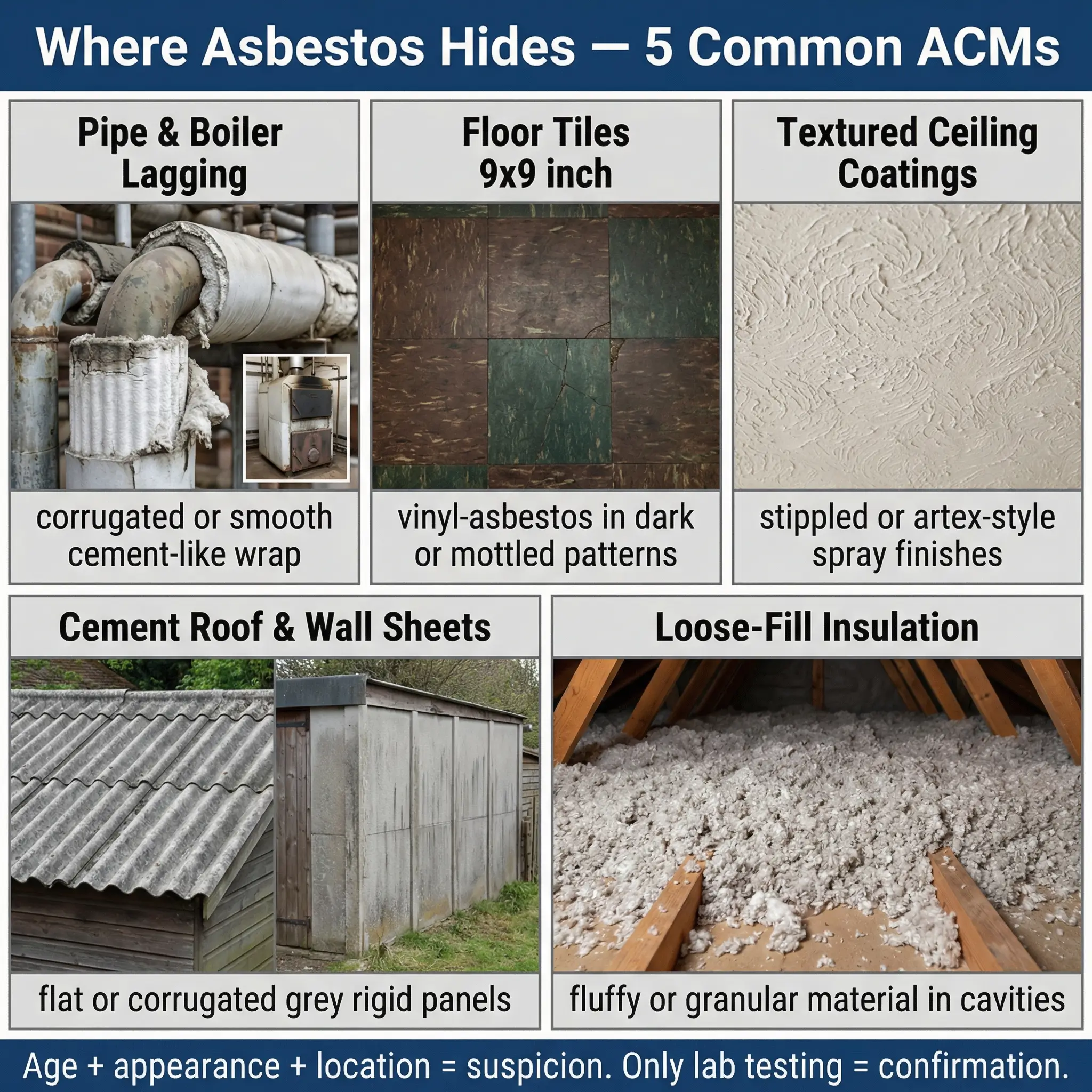
The following breakdown covers the most frequently encountered ACMs by material category. Each description reflects what these materials actually look like in the field — aged, weathered, and in situ — not in a laboratory or manufacturer’s catalog.
Pipe Insulation and Boiler Lagging
This is one of the most recognizable ACMs in the field, especially in older industrial facilities, boiler rooms, and mechanical plant areas. Asbestos pipe insulation typically appears as a thick, rigid or semi-rigid wrap around pipes, elbows, and flanges. Key visual characteristics that raise suspicion include:
- Corrugated or layered texture: Older asbestos pipe lagging often has a distinctive corrugated cardboard-like texture on the outer surface, sometimes covered with a canvas or hessian cloth jacket that has yellowed or deteriorated with age.
- White-to-grey coloring with a chalky surface: When the outer jacket is damaged or missing, the underlying insulation material is usually white, grey, or off-white with a chalky, powdery texture that crumbles easily when disturbed — a strong indicator of friable ACM.
- Hardened cement-like sections: Some pipe insulation used pre-formed asbestos cement half-shells — rigid, grey sections clamped around pipes. These look like smooth or slightly rough cement and are common on larger-diameter pipework in boiler plants and refineries.
- Deterioration pattern: Asbestos pipe lagging deteriorates differently from modern fiberglass. It tends to crack, flake, and produce a fine dust rather than pulling apart in fibrous tufts the way fiberglass does.
Pro Tip: During a boiler room inspection at an old district heating plant, I found pipe insulation that the maintenance team had been patching with duct tape for years. Every time they peeled tape to re-patch, they released fibers. If you see repeatedly patched or damaged pipe insulation in a pre-1990s building, stop and sample before any further maintenance.
Floor Tiles and Vinyl Sheet Flooring
Asbestos-containing vinyl floor tiles are among the most common ACMs in commercial buildings, schools, hospitals, and residential properties built between the 1950s and 1980s. They are also among the hardest to identify visually because they look nearly identical to non-asbestos vinyl tiles.
Several characteristics help narrow suspicion when assessing floor tiles in older buildings:
- 9×9 inch tile size: This is the single most reliable visual indicator. The standard 9×9 inch (229mm × 229mm) floor tile format was overwhelmingly associated with vinyl-asbestos tile (VAT) production. While 12×12 inch tiles can also contain asbestos, the 9×9 format is a strong presumptive flag.
- Dark or mottled color patterns: Asbestos vinyl tiles frequently came in dark colors — brown, dark green, black, maroon, and grey — often with a mottled, streaked, or marbled pattern. Solid black tiles in particular have a high probability of containing asbestos.
- Brittle, not flexible: Asbestos vinyl tiles tend to become hard and brittle with age. They crack and snap rather than bending. Modern vinyl tiles are more pliable.
- Black adhesive (cutback mastic): The black or dark brown adhesive used to glue down asbestos-era floor tiles — known as cutback mastic — frequently contained asbestos itself. Even if the tile is non-asbestos, the glue beneath it may be an ACM.
HSE UK guidance (HSG264) states that floor tiles, textured coatings, and cement products should be presumed to contain asbestos unless analytical evidence proves otherwise in any building constructed before 2000.
Textured Coatings and Spray-On Finishes
Textured decorative coatings applied to ceilings and walls — commonly known by brand names like Artex in the UK — are one of the most widespread ACMs in residential and commercial properties built before the mid-1980s. These coatings were sprayed or troweled onto surfaces to create stippled, swirl, or comb patterns.
The following visual indicators help identify potentially asbestos-containing textured coatings:
- Stippled, swirled, or combed surface pattern: Any textured ceiling or wall finish in a pre-1985 building should be treated with high suspicion. The texture itself does not distinguish asbestos from non-asbestos versions — both look identical.
- Hard, cement-like feel: Asbestos-containing textured coatings tend to feel harder and more cement-like than modern acrylic-based texture products, which are softer and more paint-like.
- Age and condition: If the coating is original to a building constructed before the mid-1980s and has never been confirmed as asbestos-free by testing, it must be presumed to be ACM before any sanding, scraping, drilling, or removal work begins.
Cement Sheets, Roofing, and Cladding
Asbestos cement (AC) products were manufactured in enormous quantities worldwide from the 1940s through the 1980s. They were used for roofing sheets, wall cladding, soffits, fascias, water tanks, flue pipes, and guttering. Asbestos cement typically contains 10–15% chrysotile asbestos mixed with Portland cement.
Visual recognition of asbestos cement products depends on recognizing the material type and context rather than a distinctive appearance:
- Grey, rigid, and cement-like: Asbestos cement sheets are hard, rigid panels — either flat or corrugated — that look and feel like thin concrete. They produce a dull thud when tapped, not a metallic ring.
- Corrugated roofing and wall panels: Large corrugated sheets on industrial buildings, agricultural structures, and older warehouses are very commonly asbestos cement. They weather to a light grey-green color and often develop moss or lichen growth on exposed surfaces.
- Smooth flat panels: Used as interior wall linings, ceiling panels, and soffits. They resemble thin cement board and may be painted over, making visual identification even harder.
- Weathering pattern: Asbestos cement weathers by surface erosion — the cement matrix gradually wears away, potentially exposing asbestos fibers on the surface. Heavily weathered AC sheets often have a rough, granular surface texture.
Pro Tip: During a warehouse demolition assessment in Southeast Asia, I found corrugated roofing that the contractor had already scheduled for mechanical demolition with an excavator. The sheets were classic asbestos cement — light grey, corrugated profile, brittle on the edges. Breaking AC sheets with machinery is one of the fastest ways to generate massive fiber release. We stopped the job, sampled, confirmed ACM, and brought in a licensed asbestos removal contractor. That single decision protected an entire demolition crew.
Loose-Fill and Sprayed Insulation
Loose-fill asbestos insulation and sprayed asbestos coatings represent the highest-risk ACM categories because they are friable — meaning the material can be crumbled, pulverized, or reduced to powder by hand pressure, releasing massive quantities of airborne fibers.
These materials are most commonly found in ceiling voids, wall cavities, around structural steelwork, and in attic spaces of older buildings:
- Loose-fill insulation: Appears as fluffy, fibrous, or granular material — often white, grey, or blue-grey — loosely packed into cavities. It can resemble shredded cotton, coarse vermiculite, or blown cellulose. In some older properties, raw asbestos fiber was simply poured into wall and ceiling cavities as thermal insulation.
- Sprayed coatings on structural steel: Used for fire protection and thermal insulation on steel beams, columns, and decking in commercial and industrial buildings. Appears as a rough, fibrous, plaster-like coating — grey, white, or brown — applied directly to steelwork. Often visible in ceiling voids, risers, and plant rooms.
- Condition indicator: Any friable material that appears fibrous, dusty, and easily disturbed in a pre-1990s building should be treated as presumed asbestos and isolated immediately. The risk from friable ACMs is orders of magnitude higher than from bonded products like floor tiles or cement sheets.
Where Asbestos Is Most Commonly Found — Location Guide by Building Type
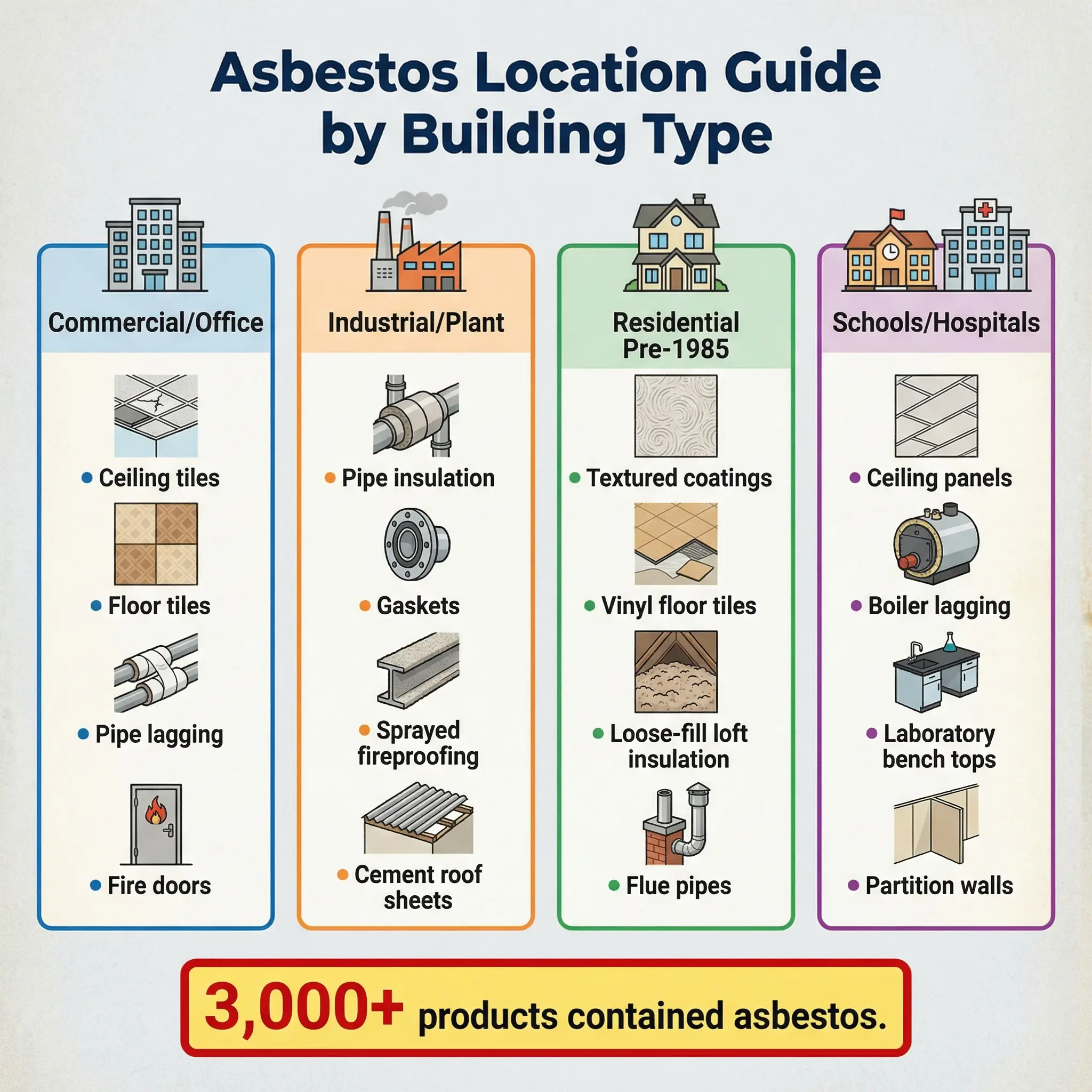
Knowing what asbestos looks like is only half the identification equation. Knowing where to look — based on building type and construction era — dramatically increases detection accuracy. Asbestos-containing materials were not randomly distributed. They were specified for particular functions, and those functions dictate where ACMs concentrate within a structure.
Commercial and Office Buildings
Older commercial buildings — particularly those constructed between the 1950s and 1980s — are among the highest-density ACM environments. The materials that most commonly contain asbestos in these settings include:
- Suspended ceiling tiles and panels: Mineral fiber ceiling tiles in lay-in grid systems were frequently manufactured with asbestos content. They look like standard acoustic ceiling tiles — white or off-white, square or rectangular, with a patterned or textured face.
- Floor tiles and mastic adhesive: Vinyl composition tiles throughout corridors, offices, and common areas — especially 9×9 inch format or dark-colored tiles.
- Pipe and duct insulation: Heating, ventilation, and plumbing systems in mechanical rooms and above-ceiling spaces frequently used asbestos lagging on pipes, elbows, and boiler connections.
- Fire doors and partitions: Some fire-rated doors and partition panels used asbestos insulation boards as a core material. These are invisible without destructive inspection.
- Electrical switchboard backings: Asbestos insulation board was used as a backing material in electrical distribution panels due to its electrical resistance and fire properties.
Industrial Facilities and Process Plants
Industrial environments typically contain the widest variety and highest volume of ACMs because asbestos was prized for its heat resistance and chemical inertness — both critical in process operations.
High-priority inspection locations in industrial settings include:
- Thermal insulation on process piping, vessels, and heat exchangers: The single largest ACM volume in most industrial plants. Includes pipe lagging, vessel cladding, and insulation on valve bodies and flanges.
- Gaskets, packing, and sealing materials: Asbestos gaskets were standard in flanged pipe connections, pump housings, and valve bonnets across chemical, petrochemical, and power generation plants. They look like compressed fiber sheet — grey or dark grey — and are often only visible when a flange is unbolted.
- Sprayed fireproofing on structural steel: Common in older industrial buildings for fire rating on steel columns, beams, and deck undersides.
- Corrugated cement roofing and cladding: Widespread on industrial sheds, warehouses, and auxiliary buildings.
- Brake and clutch linings: In older cranes, hoists, and mechanical equipment, friction materials frequently contained asbestos.
Residential Properties
Homes built before the mid-1980s may contain asbestos in locations that homeowners and maintenance workers routinely disturb without awareness. The most common residential ACMs include:
- Textured ceiling and wall coatings: Stippled, swirled, or patterned decorative finishes — the most common residential ACM.
- Vinyl floor tiles and sheet flooring: Particularly in kitchens, bathrooms, and utility rooms.
- Loose-fill loft insulation: Granular or fluffy insulation poured between ceiling joists in attic spaces.
- Cement flue pipes and chimney linings: Asbestos cement was widely used for flue pipes, particularly for gas appliance venting.
- Soffits, fascia boards, and guttering: Asbestos cement flat board was used for exterior trim elements on many residential properties.
How to Identify Asbestos — The Systematic Field Approach
Visual recognition gets you to suspicion. Only a systematic identification process gets you to confirmation. I’ve seen too many situations where someone with partial knowledge — a contractor, a building manager, a maintenance supervisor — made a material judgment based on appearance alone and got it catastrophically wrong. The identification process has clear steps, and skipping any of them creates unacceptable risk.
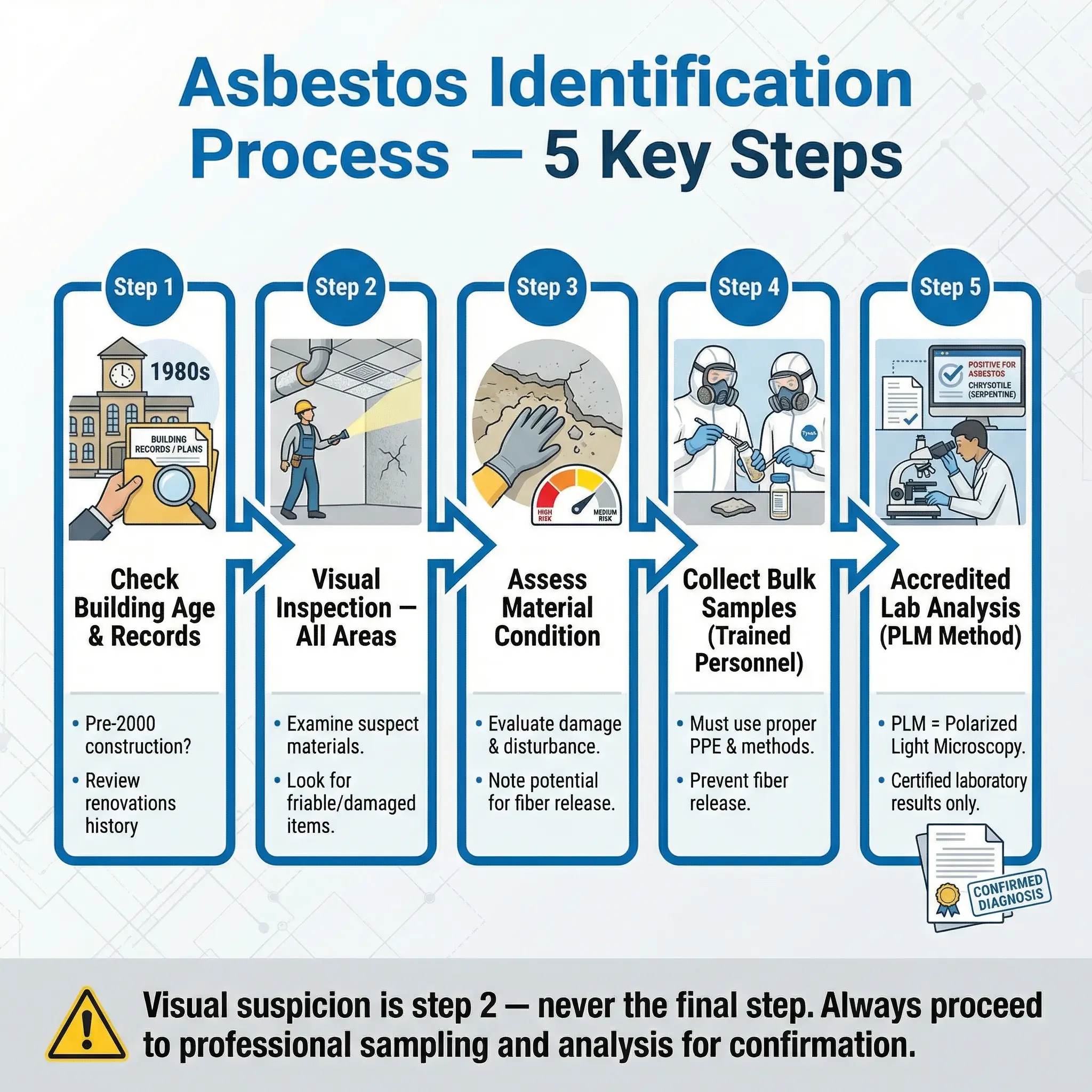
The following procedure reflects the approach used by competent asbestos surveyors and industrial hygienists worldwide, aligned with HSE UK HSG264, OSHA 1926.1101, and EPA AHERA requirements:
- Establish the building’s age and renovation history. Obtain construction drawings, renovation records, and any previous asbestos survey reports. A building constructed or significantly renovated before the mid-1990s triggers the presumption of ACM presence.
- Conduct a visual inspection of all accessible areas. Walk the entire building systematically — including ceiling voids, risers, plant rooms, and below-floor spaces — looking for materials matching the descriptions in the previous sections. Document every suspect material with photographs and location notes.
- Assess the condition of suspect materials. Record whether each suspect material is in good condition (intact, undamaged, sealed), damaged (cracked, broken, surface wear), or deteriorated (crumbling, friable, releasing debris). Condition determines immediate risk level.
- Collect representative bulk samples. This step must be performed by a trained, competent person using appropriate PPE (minimum P100/FFP3 respirator, disposable coveralls, gloves). Samples are taken using wet methods to minimize fiber release and placed in sealed, labeled containers.
- Submit samples to an accredited laboratory. Samples must be analyzed using Polarized Light Microscopy (PLM) per EPA Method 600/R-93/116 or equivalent. Only NVLAP-accredited (US), UKAS-accredited (UK), or nationally recognized laboratories should be used. Results typically take 2–5 working days.
- Record findings in an asbestos register. All confirmed and presumed ACMs must be documented in a formal asbestos register that records location, material type, condition, risk rating, and management recommendations. This register becomes the basis for all future maintenance and renovation decisions.
Asbestos surveying and knowing the best places to look and the best way to identify asbestos is a highly skilled occupation. It’s a skill that requires many years of experience and training to learn. I’ve worked alongside surveyors who could walk into a 1970s boiler room and immediately flag six suspect materials that a general contractor would walk straight past — not because they had better eyesight, but because they had thousands of hours of fieldwork behind every judgment call. This is exactly why the identification process above should never be compressed or handed to untrained personnel, regardless of schedule pressure.
Under the Control of Asbestos Regulations 2012 (UK), the duty holder of any non-domestic building has a legal duty to manage asbestos — which includes identifying ACMs through survey before any refurbishment or demolition work. Similar legal duties exist under OSHA 1926.1101 in the US and EU Directive 2009/148/EC across European member states.
Pro Tip: Never allow anyone to collect asbestos samples without proper training and PPE. On a hospital refurbishment project, I found a building manager who had been snapping off pieces of suspect ceiling tile with his bare hands and putting them in sandwich bags for “testing.” He had no respiratory protection, no wet methods, no containment. He had been doing this across the building for three days. Sampling without controls can cause the very exposure the testing is meant to prevent.
What Asbestos Does NOT Look Like — Clearing Up Common Misconceptions
One of the biggest obstacles to correct asbestos identification is the set of myths and misconceptions that circulate among workers, homeowners, and even some construction professionals. These false beliefs lead to two equally dangerous outcomes: disturbing actual ACMs because “it doesn’t look like asbestos,” or unnecessarily panicking over materials that are clearly not asbestos.
The most common misconceptions I encounter during training sessions and site surveys fall into predictable patterns:
- “Asbestos is always white and fluffy.” This is the single most dangerous myth. While raw chrysotile fibers are white and fibrous, the vast majority of asbestos in buildings is hidden inside solid, colored, non-fibrous-looking materials — floor tiles, cement sheets, textured coatings, gaskets. Most ACMs look nothing like the fluffy white insulation people imagine.
- “If it’s hard and solid, it can’t be asbestos.” Asbestos cement products — roofing sheets, wall panels, flue pipes, water tanks — are extremely hard and rigid. Their solid, cement-like feel gives false reassurance. These materials absolutely contain asbestos, typically 10–15% chrysotile by weight.
- “Modern-looking materials are safe.” Some ACMs were manufactured as recently as the late 1990s and early 2000s in certain jurisdictions. Materials that look “modern” — clean vinyl tiles, smooth cement board, undamaged textured coatings — can still contain asbestos. Appearance of newness is not a reliable exclusion criterion.
- “Pink or yellow fiberglass insulation is asbestos.” Modern fiberglass batt insulation — pink, yellow, or white, with a consistent fibrous texture that pulls apart in tufts — is not asbestos. It is glass fiber. While it can cause skin and respiratory irritation, it is not the same hazard category. However, in some buildings, fiberglass has been installed alongside or on top of older asbestos insulation, so finding fiberglass does not rule out asbestos beneath it.
- “I can identify asbestos by burning it.” This field myth suggests that “real asbestos won’t burn.” While asbestos fibers are indeed fire-resistant, attempting to burn suspected materials is extremely dangerous — it can release fibers, generate toxic fumes, and is utterly unreliable as a test method. Never attempt flame testing.
| Misconception | Reality | Correct Action |
|---|---|---|
| “It’s not fluffy, so it’s not asbestos” | Most ACMs are solid, bonded materials — tiles, cement, coatings | Presume ACM if pre-1990s; test before disturbing |
| “It’s too hard to be asbestos” | Asbestos cement is rigid and strong by design | Sample and test — hardness means nothing |
| “It looks too new” | ACMs were used through the late 1990s in some regions | Building age and records, not appearance, determine risk |
| “I can tell by the color” | Asbestos was mixed into every color of tile, coating, and sheet | Color is not a diagnostic criterion |
| “Fiberglass = asbestos” | Fiberglass is glass fiber, not asbestos mineral fiber | Different material, different hazard — but check what’s behind it |
Health Consequences of Asbestos Exposure — Why Identification Matters
The reason asbestos identification is treated with such seriousness across every regulatory jurisdiction in the world is not because of the material itself — it’s because of what happens inside the human body when microscopic asbestos fibers are inhaled. The diseases caused by asbestos exposure are severe, progressive, and in most cases, fatal. And they can take 15 to 50 years to appear after the original exposure.
This latency period is what makes asbestos so insidious. A worker who inhales asbestos fibers today will feel completely fine — for decades. By the time symptoms develop, the damage is irreversible.
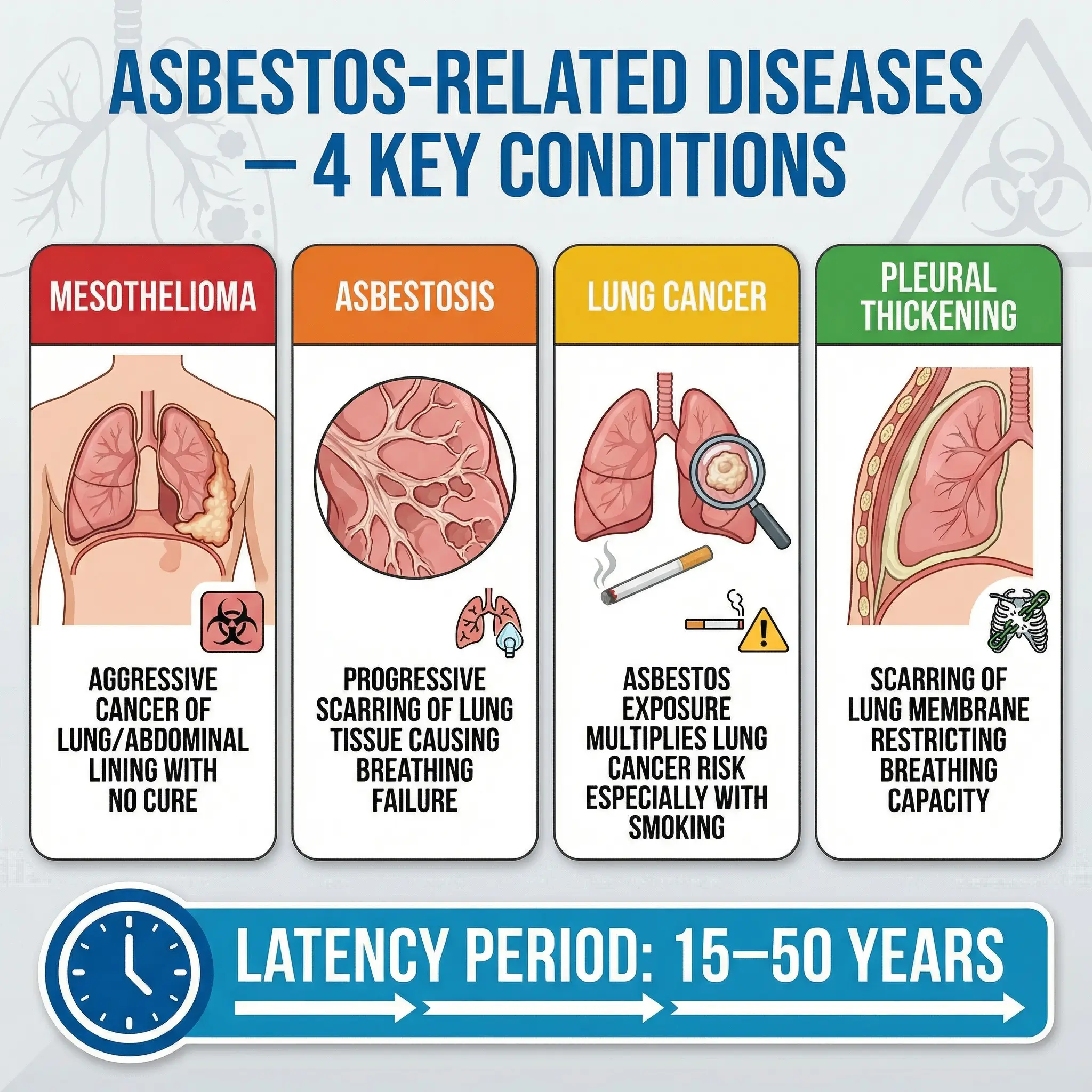
The four primary diseases associated with asbestos fiber inhalation present a clear picture of why every identification failure carries life-or-death consequences:
- Mesothelioma: An aggressive, incurable cancer of the mesothelial lining — most commonly the pleura (lungs) or peritoneum (abdomen). Almost exclusively caused by asbestos exposure. Median survival after diagnosis is 12–21 months. There is no safe threshold of exposure — a single significant exposure event can be sufficient to cause mesothelioma decades later.
- Asbestosis: A chronic, progressive fibrotic lung disease caused by prolonged inhalation of asbestos fibers. The fibers lodge deep in lung tissue and trigger irreversible scarring (fibrosis) that progressively reduces lung capacity. There is no cure — only supportive management.
- Asbestos-related lung cancer: Asbestos exposure is a confirmed carcinogen for lung cancer, independent of smoking. The risk multiplies dramatically in workers who both smoke and have asbestos exposure — a synergistic effect documented across multiple epidemiological studies.
- Pleural plaques and thickening: Calcified deposits and fibrous thickening of the pleural membrane. While pleural plaques alone may not cause significant symptoms, diffuse pleural thickening can progressively restrict lung expansion and reduce breathing capacity.
How Much Is Asbestos Exposure Harmful?
It generally takes many exposures to asbestos for related diseases to form, and it’s rare for someone to develop illness from a single brief encounter with asbestos-containing products in a residential setting — but it remains possible. Many people who develop asbestos-related illnesses have been exposed in occupational environments over extended periods, with roughly 20% of heavily exposed workers eventually developing a related condition. That statistic alone should reframe how seriously we treat workplace identification failures. Yet severe short-term exposures to asbestos have also been proven to trigger disease. According to a National Institute for Occupational Safety and Health report, no evidence of a threshold or safe exposure level has been identified. I’ve carried that line with me on every project — because it eliminates the excuse I hear most often on site: “It was only a small amount” or “They were only exposed for a few minutes.” There is no validated safe dose. That single fact is why every suspect material must be tested before it is disturbed, regardless of how minor the planned work appears.
The World Health Organization estimates that over 100,000 people die annually from asbestos-related diseases worldwide. Every one of those deaths traces back to a fiber exposure that could have been prevented by correct identification and management of ACMs. Check WHO Asbestos Fact Sheet for more information.
Common Mistakes That Lead to Asbestos Exposure on Site
In over a decade of conducting asbestos awareness training, management surveys, and refurbishment/demolition assessments, the same mistakes show up with disturbing consistency. These are not obscure edge cases — they are routine, everyday failures that expose workers to lethal fibers on projects across the world.
Recognizing these patterns is just as critical as knowing what asbestos looks like, because most exposure incidents are not caused by ignorance of asbestos itself — they are caused by procedural and management failures that allow ACMs to be disturbed without controls:
- No pre-work asbestos survey. The single most common failure. Renovation, maintenance, or demolition work begins without anyone checking whether ACMs are present. This violates regulations in virtually every developed jurisdiction, yet it happens constantly — especially on smaller projects, emergency repairs, and maintenance callouts.
- Relying on visual identification instead of testing. A supervisor, contractor, or building manager looks at a material, decides “that’s not asbestos,” and authorizes work to proceed. No sample. No lab analysis. No competent person assessment. This is the exact scenario that opened this article.
- Assuming the asbestos register is complete. Building asbestos registers are only as good as the survey that produced them. Many registers are based on management surveys that only assessed accessible areas — not behind walls, above ceilings, under floors, or inside sealed risers. Refurbishment and demolition work penetrates into areas that a management survey never reached.
- Disturbing ACMs during “minor” maintenance. Drilling into asbestos-containing walls to mount a bracket. Sanding textured coatings to repaint a ceiling. Cutting through asbestos cement sheets to run new cabling. These “small” tasks generate localized but intense fiber release — often without any respiratory protection in place.
- Failing to communicate ACM locations to contractors. The duty holder knows where asbestos is. The contractor doing the work does not. This information gap is a direct regulatory violation and a consistent root cause in exposure incidents. Every contractor must receive the asbestos register and be briefed on ACM locations before starting work.
- Inadequate or absent respiratory protection during sampling. Even the act of taking a small sample for testing can release fibers. Using surgical masks, dust masks, or no mask at all during sampling is a failure I’ve personally witnessed on multiple occasions.
Most of these failures share a common root — lack of basic awareness. Asbestos awareness training provides participants with the knowledge to recognise the appearance of asbestos-containing materials (ACMs). This training educates individuals about the various forms and textures of ACMs, enabling them to identify potential asbestos hazards in their workplace.
On every project I’ve managed, mandatory asbestos awareness training was a non-negotiable prerequisite before anyone set foot on a refurbishment or demolition site — not because the regulation demanded it, but because an untrained worker cannot recognise what they’ve never been taught to look for. A two-hour awareness session doesn’t make someone a surveyor, but it absolutely makes them the kind of person who stops and asks the right question before picking up a drill.
Pro Tip: On every refurbishment project I manage, I require the contractor to physically sign a receipt confirming they have received, read, and understood the building’s asbestos register before any work permit is issued. It takes two minutes. It closes the information gap. And it creates a documented chain of responsibility that protects everyone.
Asbestos Survey Types — Which One Do You Need?
Understanding the different types of asbestos surveys is essential for anyone managing a building, planning renovation work, or overseeing demolition. The survey type determines what gets inspected, how deep the assessment goes, and what decisions can be made based on the findings.
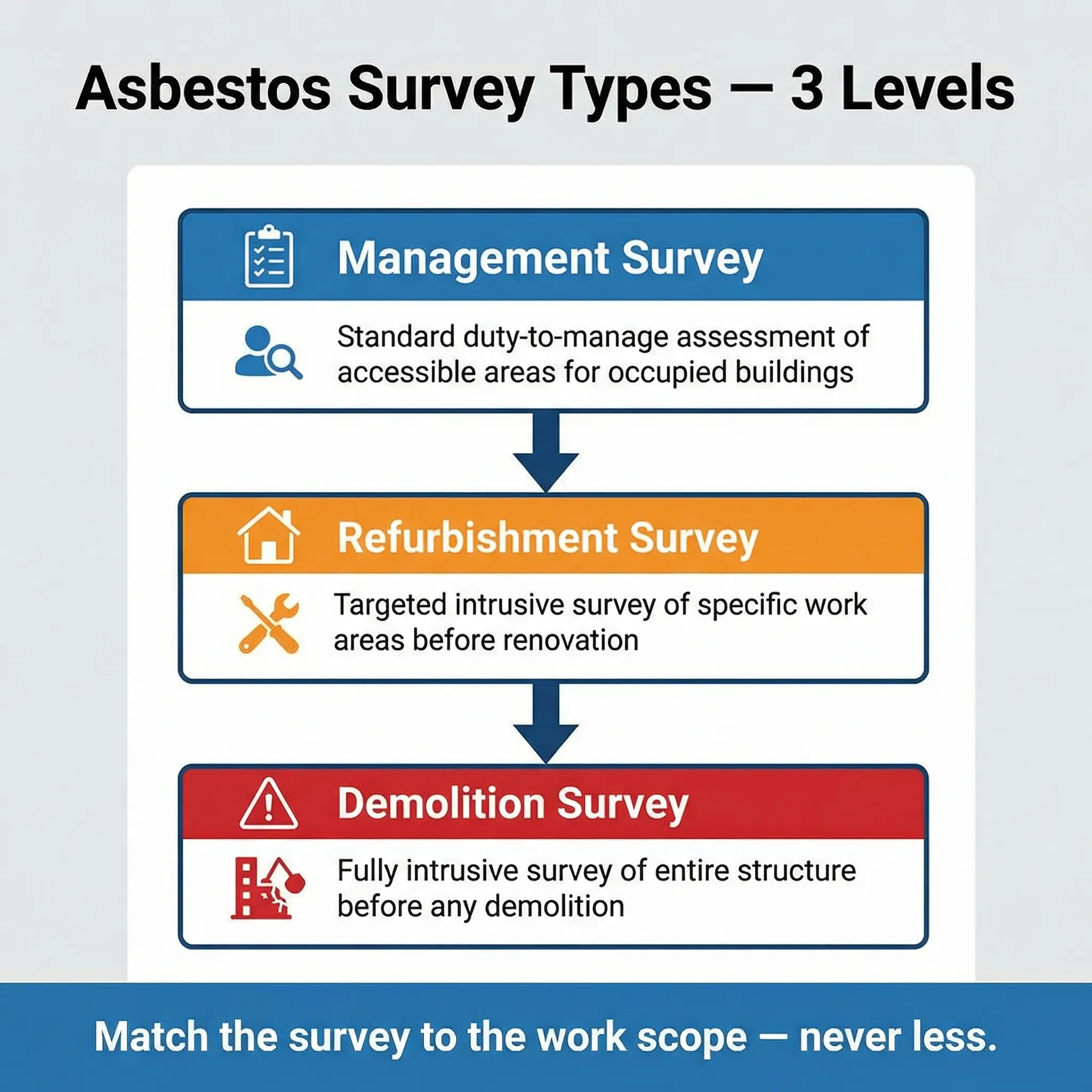
Two primary survey types are recognized across most regulatory frameworks, with a third hybrid approach used in specific situations:
- Management Survey (formerly Type 2): The standard survey for fulfilling the duty to manage asbestos in occupied buildings. It assesses all reasonably accessible areas and identifies ACMs that could be disturbed during normal occupancy, routine maintenance, and foreseeable activities. It does NOT involve destructive inspection — surveyors do not break through walls, lift floors, or open sealed voids. This survey type is sufficient for day-to-day building management but is NOT adequate for refurbishment or demolition planning.
- Refurbishment and Demolition Survey (formerly Type 3): A fully intrusive survey that requires access to all areas within the scope of planned work — including behind walls, above ceilings, below floors, inside risers, and within structural cavities. It is mandatory before any refurbishment or demolition work begins. The area being surveyed must be vacated and, where necessary, the survey itself may require controlled destructive access. This survey identifies all ACMs — not just those in accessible locations.
- Re-inspection Survey: A periodic re-assessment of previously identified ACMs to monitor changes in condition, update risk ratings, and confirm that management controls remain effective. Typically conducted annually or as required by the asbestos management plan.
| Survey Type | When Required | Scope | Intrusive? |
|---|---|---|---|
| Management Survey | Ongoing duty to manage (all non-domestic buildings) | Accessible areas — normal occupancy and routine maintenance | Non-destructive |
| Refurbishment Survey | Before any renovation, alteration, or upgrade work | Specific areas affected by planned work | Yes — targeted intrusion |
| Demolition Survey | Before any partial or full demolition | Entire structure — every area, every material | Yes — fully intrusive |
HSE UK guidance is unambiguous: a management survey is never sufficient for refurbishment or demolition work. A refurbishment and demolition survey must be carried out in the specific areas where intrusive work is planned. (HSG264, Chapter 4)
What to Do If You Find Suspected Asbestos — Emergency Field Protocol
This is the section that saves lives. Knowing what asbestos looks like means nothing if the response to finding it is wrong. I’ve been called to sites where workers discovered suspect material mid-task — and the difference between those who stopped immediately and those who “just finished the job” was the difference between controlled management and uncontrolled exposure.
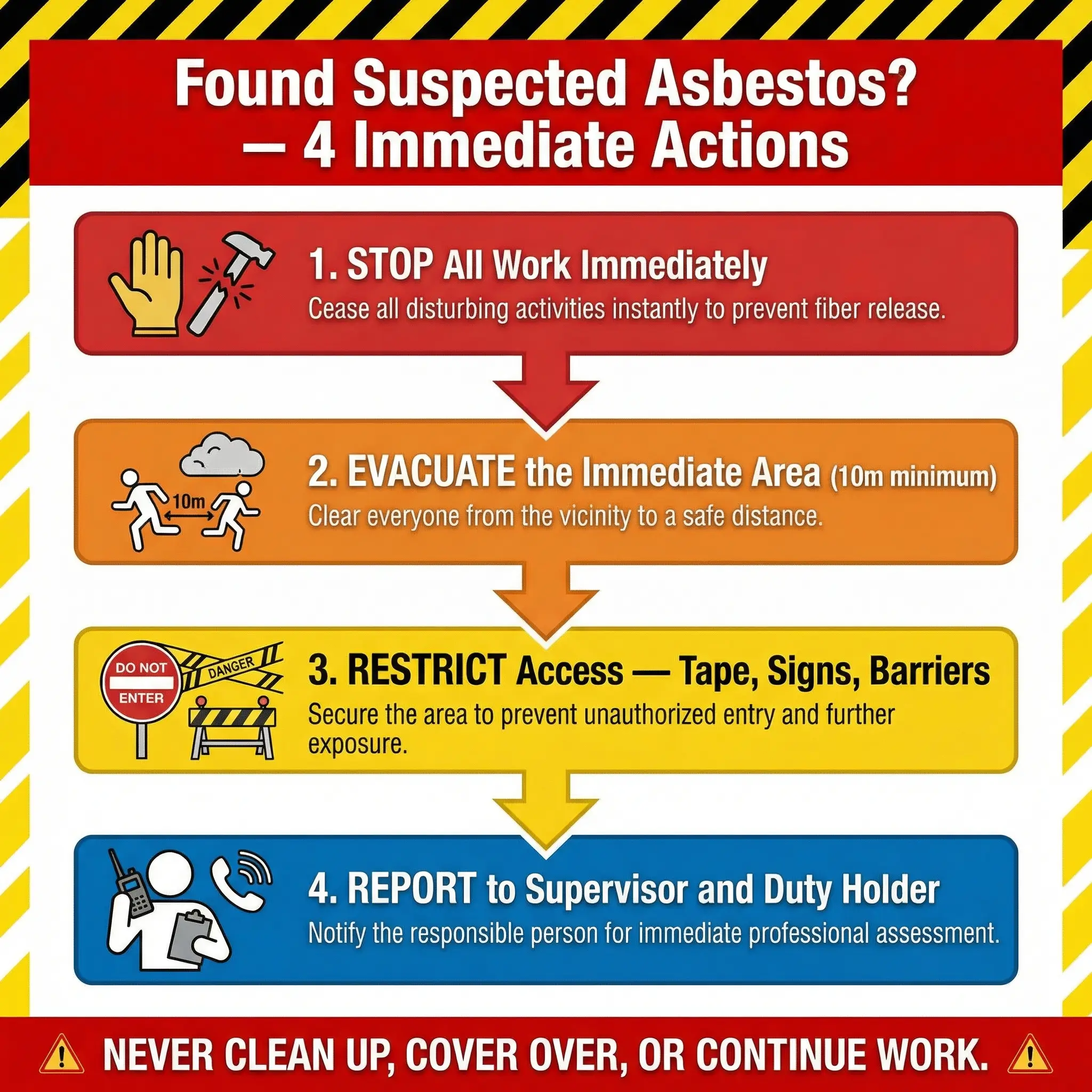
The correct response when suspected ACM is encountered during any work activity follows a clear, non-negotiable sequence:
- Stop work immediately. Do not attempt to clean up, cover over, or “finish quickly.” Stop the activity that disturbed or may disturb the suspect material. Put tools down.
- Evacuate the immediate area. Move all workers away from the suspect material — establish a minimum 10-meter exclusion zone, or larger if dust or debris has visibly spread.
- Restrict access. Use barrier tape, signage, or a physical barrier to prevent anyone from entering the area. Post a responsible person at the exclusion boundary if necessary.
- Do NOT attempt to clean up debris. Do not sweep, vacuum (unless using a HEPA-filtered Type H vacuum), or wipe up dust or debris from suspected ACMs. These actions dramatically increase fiber release.
- Report immediately. Notify the site supervisor, project manager, and the building’s duty holder or asbestos coordinator. Formal notification triggers the assessment and sampling process.
- Arrange competent sampling and analysis. Only a trained, competent person with appropriate PPE should take samples. Submit to an accredited laboratory for PLM analysis.
- Do not resume work until results confirm the material is non-asbestos or a licensed removal plan is in place. If the material is confirmed as ACM, licensed asbestos removal contractors must be engaged before any further work in the affected area.
Pro Tip: I keep laminated “STOP — Suspected Asbestos” cards in my site kit. When a worker reports suspected ACM, I hand them one to tape at the area entrance immediately. It sounds simple, but a physical visual barrier changes behavior faster than a verbal instruction. People walk past tape. They don’t walk past a sign that says the word “asbestos.”
Regulatory Framework for Asbestos Identification and Management
Asbestos is one of the most heavily regulated substances in occupational health worldwide. The regulatory framework is mature, detailed, and broadly harmonized across major jurisdictions — reflecting decades of epidemiological evidence linking asbestos exposure to fatal diseases. Understanding the regulatory landscape helps HSE professionals, building managers, and contractors meet their legal obligations and protect workers.
The following table summarizes key regulatory requirements across major jurisdictions — focused specifically on the duty to identify and manage asbestos before it is disturbed:
| Jurisdiction | Primary Regulation | Key Requirement |
|---|---|---|
| United States | OSHA 29 CFR 1926.1101 | Employer must identify all ACMs and PACM before construction/demolition. Exposure assessments required. |
| United Kingdom | Control of Asbestos Regulations 2012 | Duty to manage asbestos in all non-domestic buildings. Management survey mandatory; R&D survey before intrusive work. |
| European Union | Directive 2009/148/EC | Employers must assess asbestos risk before demolition or maintenance. Worker exposure limits: 0.1 fibers/cm³ (8-hr TWA). |
| Australia | WHS Regulations (Safe Work Australia) | Workplace asbestos register required. Identification and risk assessment before any work that may disturb ACMs. |
| International | IFC/World Bank EHS Guidelines | Asbestos-containing materials must be identified and managed in all financed projects. Removal by licensed contractors. |
OSHA requires that in the construction industry, the building or facility owner must inform employers and employees of the presence, location, and quantity of ACMs or presumed ACMs (PACM) before renovation or demolition work begins. (29 CFR 1926.1101(k)(2))
The regulatory principle across all these frameworks is consistent: the duty to identify asbestos exists before work begins — not after exposure has occurred. Failure to survey, test, and manage ACMs is not just a procedural gap. It is a legal violation that carries criminal penalties in most jurisdictions.
Conclusion
Asbestos identification is not a visual skill — it is a systematic process. The materials that contain asbestos were designed to look ordinary, to blend into floors, ceilings, walls, pipes, and roofing without any visual distinction from their asbestos-free counterparts. That is precisely what makes them so dangerous. A 9×9 inch vinyl tile looks like a floor tile. A textured ceiling looks like a textured ceiling. A cement roof sheet looks like a cement roof sheet. The only thing that separates a safe material from a lethal one is laboratory analysis of a properly collected sample.
Every exposure incident I’ve investigated — every unnecessary fiber inhalation, every contaminated work area, every emergency shutdown — traces back to someone who skipped the process. Someone who looked at a material and made a judgment call without testing. Someone who assumed the building was too new, or the material was too hard, or the color was wrong. Those assumptions are the mechanism by which asbestos continues to cause disease decades after most countries banned its use.
If you take one thing from this article, let it be this: the question is never “what does asbestos look like?” The question is “has this material been tested?” Until the answer is yes, the only safe assumption is that it contains asbestos — and the only safe action is to leave it undisturbed. The workers who go home healthy are the ones protected by process, not by guesswork.