
TL;DR
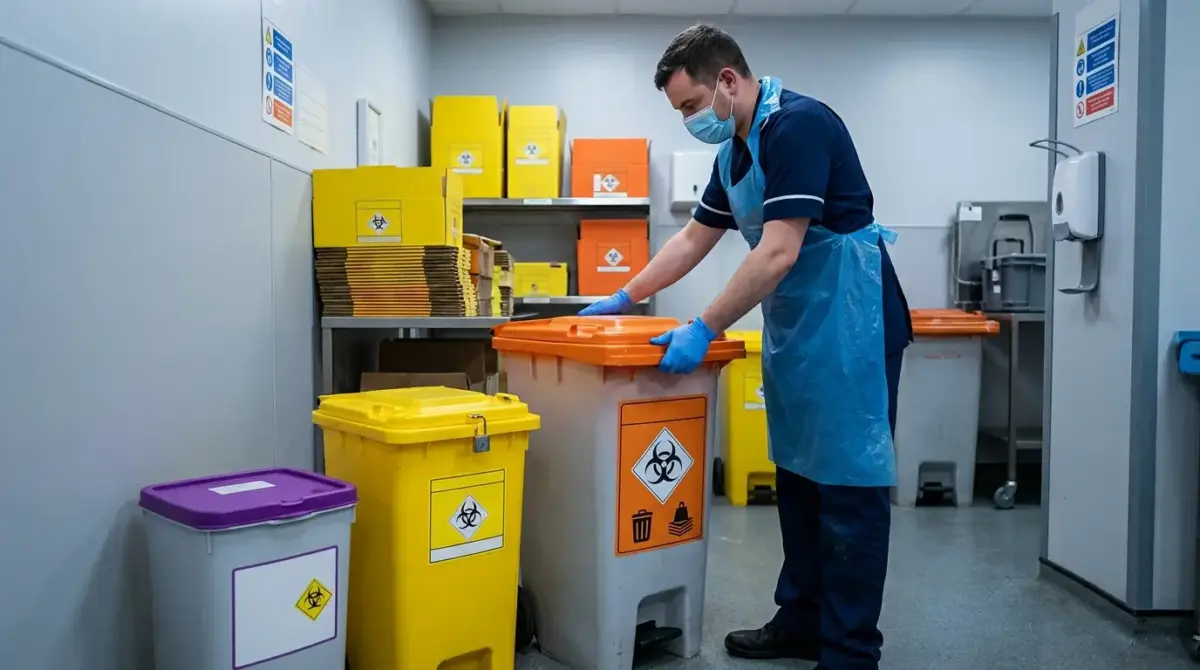
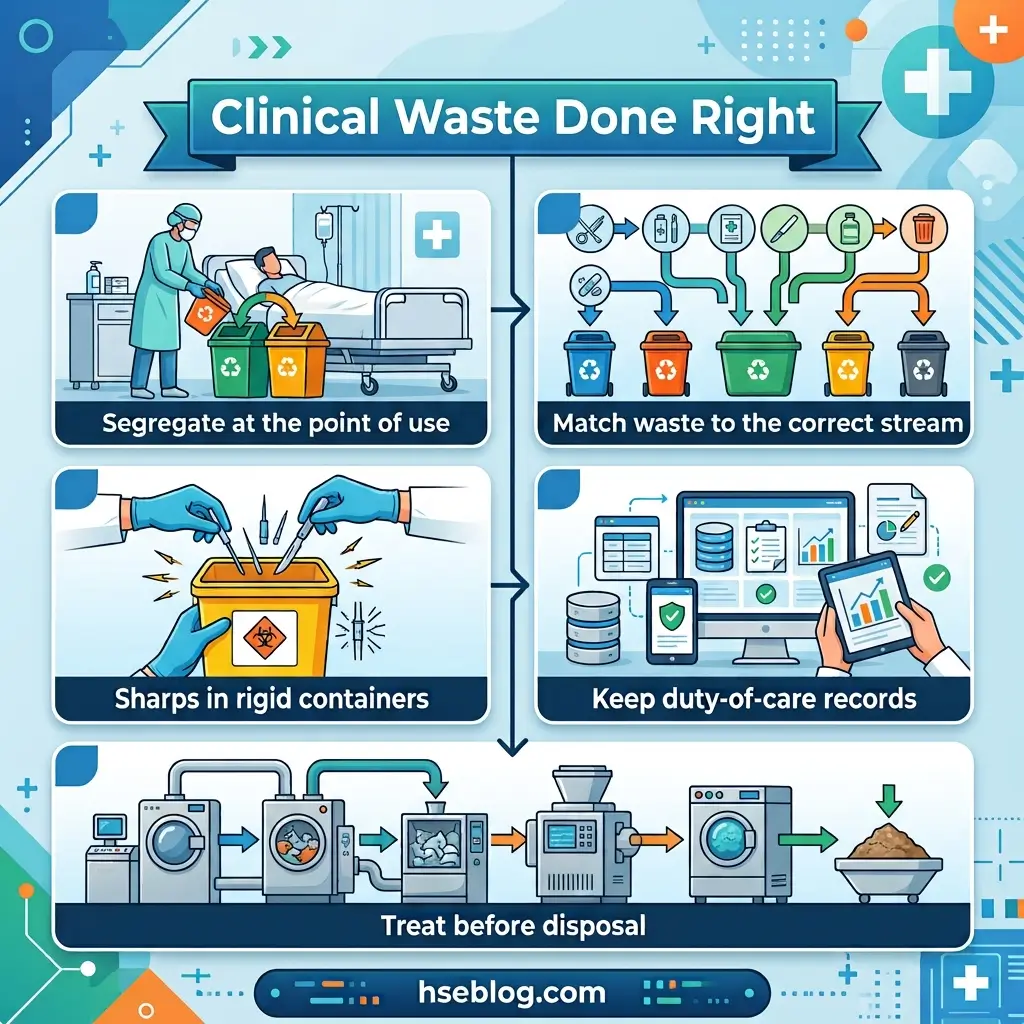
- Segregate at the point of use. Correct classification at the moment waste is created sets its cost, carbon footprint and safety — nothing downstream fixes a mis-sorted bin.
- Match each waste type to its stream. Infectious, sharps, pharmaceutical, cytotoxic, chemical, anatomical and offensive wastes each follow a defined route.
- Treat before disposal. Most hazardous clinical waste is incinerated or rendered non-infectious by alternative treatment before it can reach landfill.
- Know your jurisdiction. The UK, EU and US govern clinical waste through different agencies and different rules — compliance is local, not universal.
Clinical waste management is the safe segregation, storage, transport, treatment and disposal of waste from healthcare activities that can cause infection, injury or environmental harm. Waste is sorted into categories — infectious, sharps, pharmaceutical, cytotoxic, chemical, anatomical and offensive — then routed to incineration, alternative treatment or controlled disposal according to its hazard.
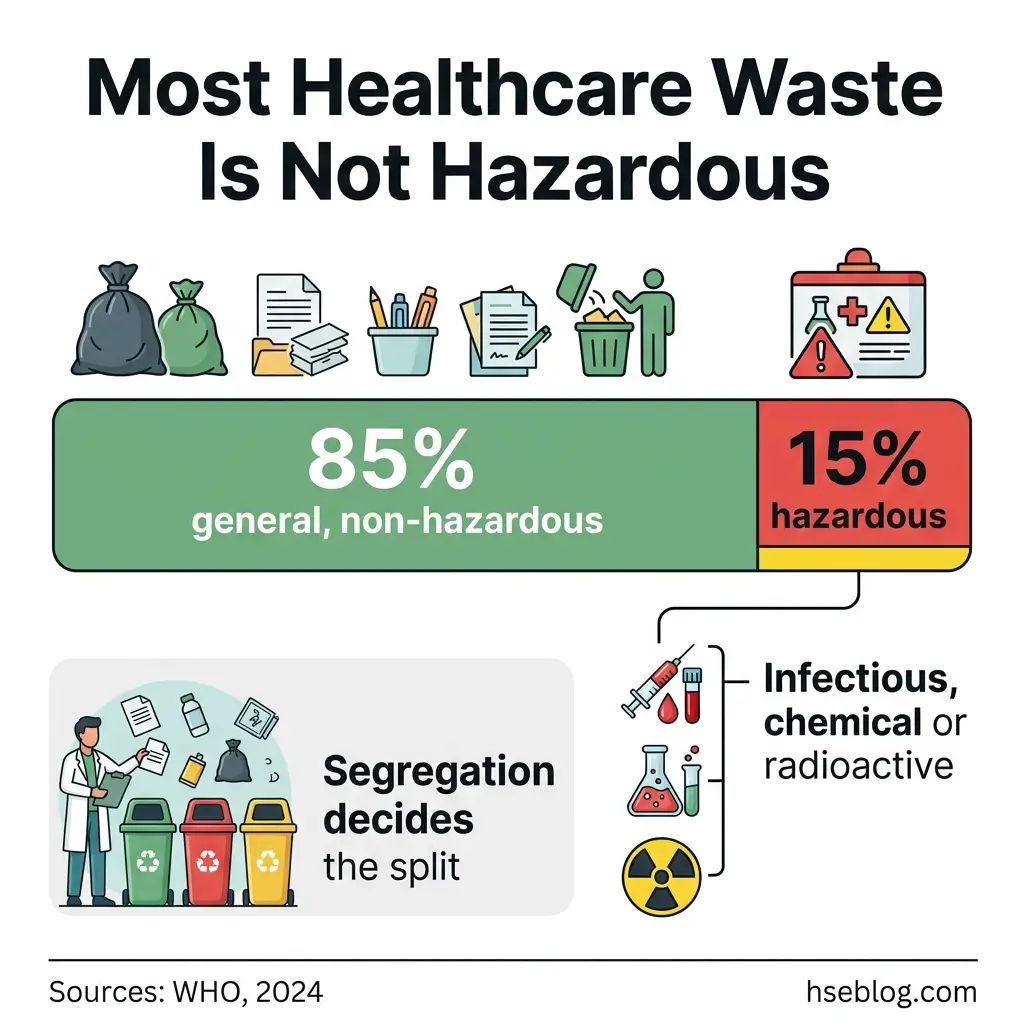
A hospital bin looks dangerous, so the instinct is to treat everything inside it as a biohazard — and that instinct quietly wastes money and energy. About 85% of the waste from healthcare activities is general, non-hazardous material comparable to household waste, while only the remaining 15% is infectious, chemical or radioactive (World Health Organization, 2024).
That 15% still carries real consequences. A needlestick from an infected source patient carries roughly a 30% risk of hepatitis B, 1.8% for hepatitis C and 0.3% for HIV (World Health Organization, 2024), which is why sound clinical waste management sets out to keep the hazardous fraction separated, contained and destroyed. This article breaks down the categories of clinical waste, the disposal methods matched to each, and the rules that govern them across the UK, EU and US.
What Counts as Clinical Waste — and Why Classification Comes First
Clinical waste is not defined by where it comes from but by what it can do. A cardboard box from a ward is general waste; a dressing soaked in body fluid from the same ward is not.
Waste crosses into the clinical stream when it meets one of a few tests. Getting that judgement right at the bin is the single most important decision in the whole system.
- Infection risk. The item has been in contact with blood, body fluids, or a patient with a known or suspected infection.
- Sharps hazard. The item can puncture skin — needles, blades, broken glass, infusion sets.
- Chemical or medicinal content. The waste contains or is contaminated by pharmaceuticals, cytotoxic drugs, or laboratory chemicals.
- Anatomical content. The waste is human tissue, an organ, or a recognisable body part.
The reason classification comes first is simple: it is the only point where a human looks at the item and decides its fate. Once a bag is sealed and collected, the treatment facility processes it as labelled, whether or not the label is correct.
The Main Categories of Clinical Waste
Two classification systems dominate practice. The WHO framework names seven hazardous types, and the UK layers a colour-coded packaging system on top so that staff can sort waste without reading a technical memorandum every time.
The WHO groups healthcare waste into infectious, pathological, sharps, chemical, pharmaceutical, cytotoxic and radioactive categories, plus general non-hazardous waste (World Health Organization, 2024). The UK translates those hazards into colours defined by HTM 07-01, refreshed in March 2023 for the first time in a decade.
| Colour stream | Waste type | Typical disposal route |
|---|---|---|
| Orange | Infectious waste, no chemical or medicinal contamination | Alternative treatment or incineration |
| Yellow | Infectious waste with chemical or medicinal contamination | High-temperature incineration |
| Red | Anatomical waste, such as body parts and placenta | Incineration |
| Purple | Cytotoxic and cytostatic waste | Incineration at a permitted facility |
| Blue | Medicines other than cytotoxic and cytostatic | Incineration |
| Yellow-and-black (tiger) | Non-infectious offensive or hygiene waste | Treatment, incineration or permitted landfill |
Source: Types of healthcare waste by packaging colour, gov.uk.
Where sharps and codes fit
Sharps do not get their own colour bag; they get a rigid, puncture-resistant container whose lid colour matches the stream — orange for treatable sharps, yellow for those needing incineration, purple for cytotoxic contamination. Each stream also carries a List of Waste code, and an asterisk on that code (for example, 18 01 03* for infectious waste) marks it as legally hazardous. A single item can need more than one code, such as an infectious sharp also contaminated with a cytotoxic drug.
How Clinical Waste Is Treated and Disposed Of
In practice, disposal splits into two questions: does the hazard need to be destroyed by heat, or can it be neutralised more gently first? The answer determines the route, the cost, and the carbon.
High-temperature incineration
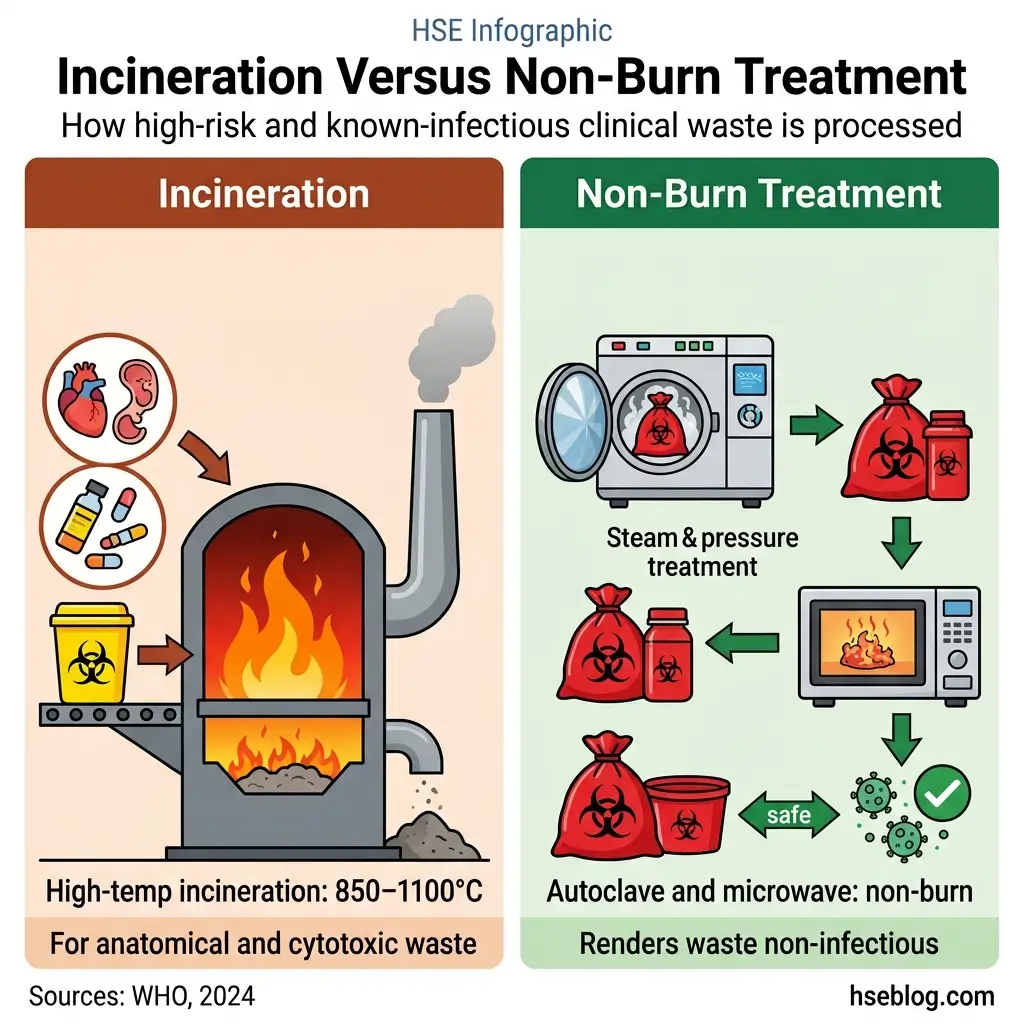
Incineration is the destruction route for the highest-risk streams — anatomical waste, cytotoxic and cytostatic waste, and infectious waste contaminated with chemicals or medicines. Only modern incinerators running at 850–1100°C with dedicated gas-cleaning equipment meet international emission limits for dioxins and furans (World Health Organization, 2024). It is the most certain method and the most carbon-intensive, which is why it is reserved for waste that genuinely needs it.
Alternative (non-burn) treatment
For infectious waste that carries no chemical or medicinal contamination — the orange stream — the goal is to render it non-infectious rather than incinerate it.
- Autoclaving. Pressurised steam, typically around 121–134°C, kills pathogens; the treated waste can then go to shredding and landfill.
- Microwave treatment. Moist heat generated within the waste achieves the same disinfection with lower emissions.
- Chemical disinfection. Used mainly for liquids and specific waste types where heat is impractical.
The WHO explicitly favours autoclaving, microwaving and steam treatment over incineration wherever a facility has the resources to run them safely (World Health Organization, 2024).
Final disposal and its limits
Treated, rendered-safe waste generally goes to engineered landfill. Untreated hazardous waste does not — dumping it risks contaminating ground and surface water. Some streams can never be landfilled directly: anatomical and cytotoxic waste must be incinerated regardless of cost.
Segregation, Storage and Transport: Where the Chain Breaks
The most common failures I see across the published record are not exotic. They are ordinary segregation errors repeated thousands of times a day, and they push safe waste into hazardous routes or hazardous waste into safe ones.
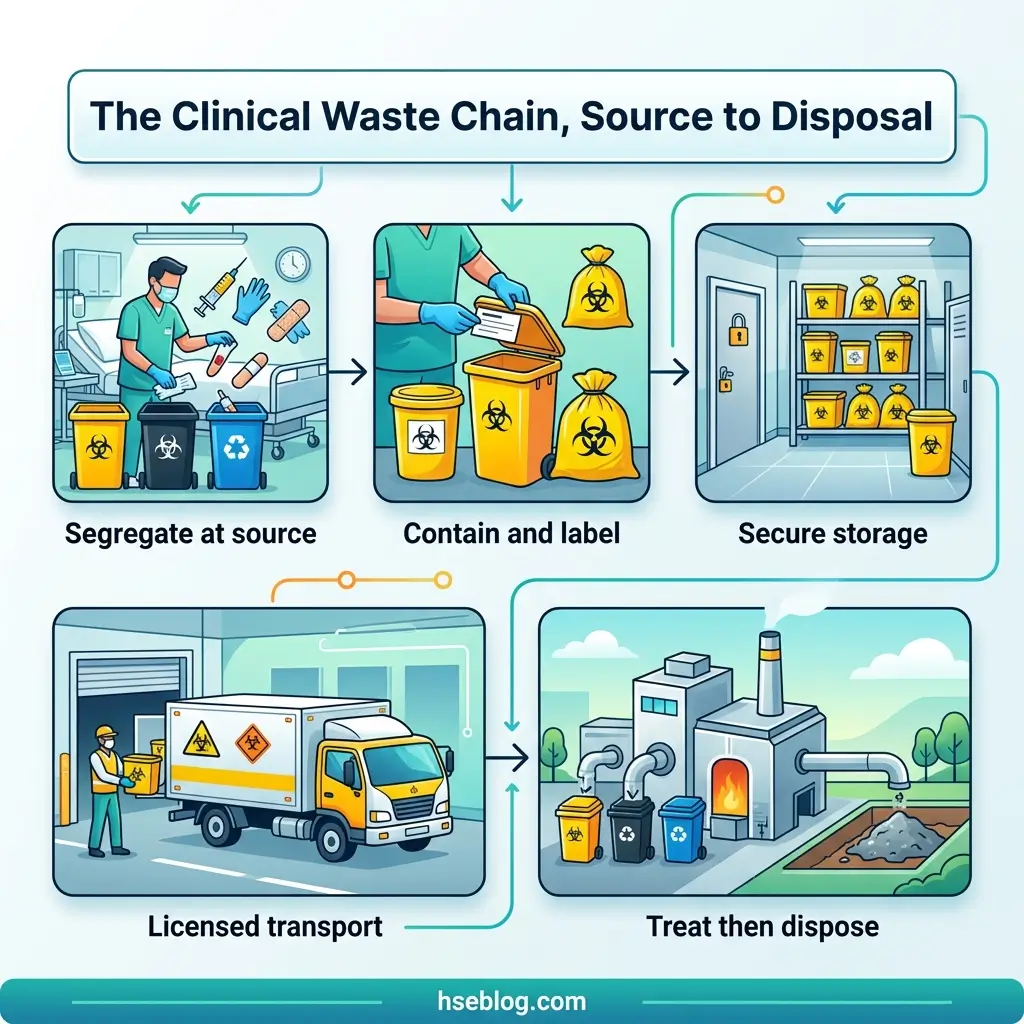
A compliant chain runs through a fixed sequence, and each link has a failure mode worth naming.
- Segregate at the point of use. The error here is over-classification — non-infectious waste dropped into orange or yellow bags, sending it to unnecessary incineration.
- Contain and label correctly. Sharps left loose or containers overfilled past the fill line are a leading cause of needlestick injuries.
- Store securely. Waste must sit in a locked, access-controlled area, separated by stream, until collection.
- Transport under licence. In England and Wales, the producer holds a legal duty of care and must keep auditable consignment records for every movement.
- Treat, then dispose. The facility processes waste as labelled; a mis-sort at step one cannot be corrected here.
Under the NHS Clinical Waste Strategy published in 2023, England set a “20-20-60” target for 2026 — 20% of waste to incineration, 20% to infectious treatment, and 60% to the offensive stream (NHS England). The strategy exists precisely because orange bags were being routinely filled with waste that never needed clinical treatment, inflating both cost and carbon.
Clinical Waste Regulations Across Jurisdictions
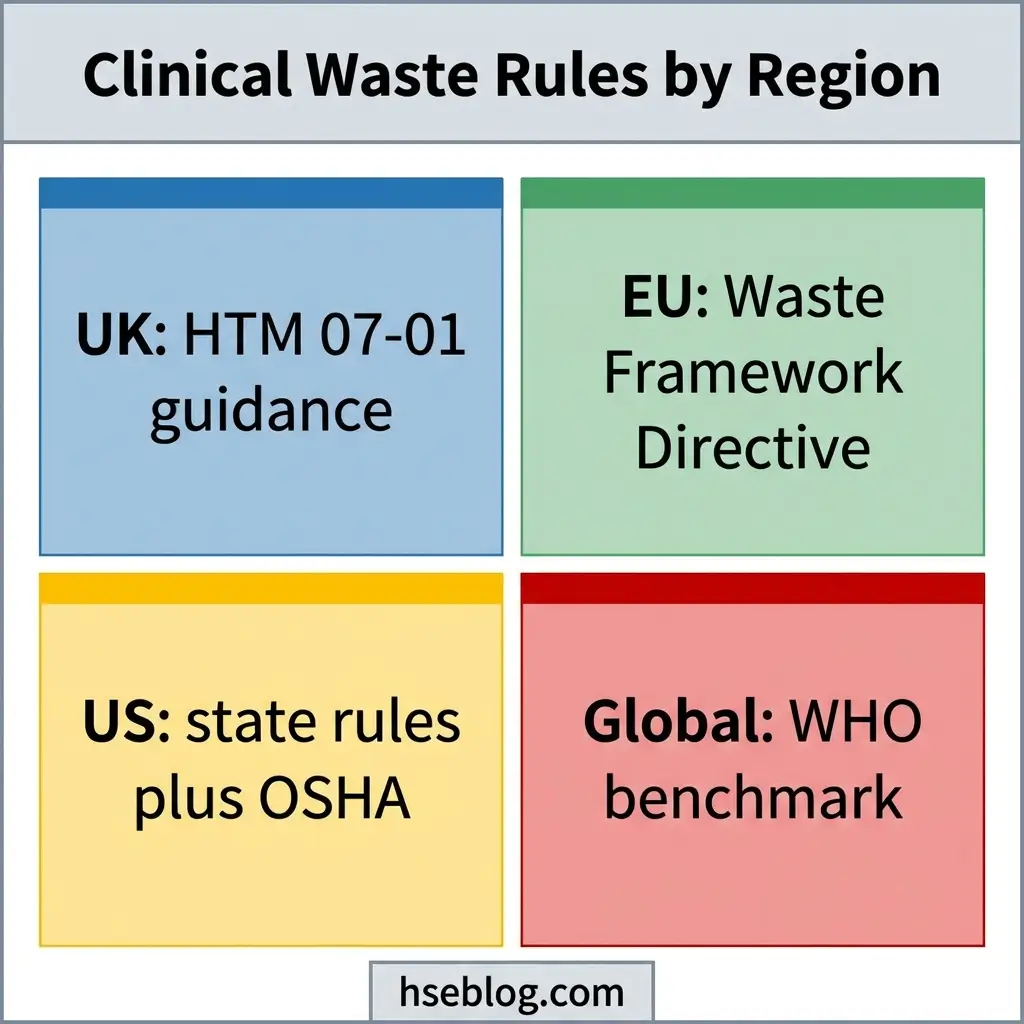
The rules governing clinical waste are strikingly different depending on where you operate, and assuming one country’s model applies elsewhere is a fast route to non-compliance. The waste is similar everywhere; the legal architecture is not.
Regulatory content here reflects general HSE professional understanding of UK, EU and US requirements as of 2026. It is not legal advice. Specific compliance questions, enforcement situations, or prosecution risk should be directed to qualified legal counsel in the applicable jurisdiction.
| Jurisdiction | Key framework(s) | Regulatory focus |
|---|---|---|
| UK (England & Wales) | HTM 07-01 (2023); Environmental Protection Act 1990; Hazardous Waste Regulations 2005 | Classification, segregation, duty of care, disposal |
| EU | Waste Framework Directive 2008/98/EC; European List of Waste | Classification codes, treatment, transport |
| US | State medical waste rules; OSHA Bloodborne Pathogens Standard (29 CFR 1910.1030); RCRA Subpart P; EPA incinerator rules (40 CFR Part 60, Subpart Ec) | Worker exposure, pharmaceutical waste, incinerator emissions |
| International | WHO guidance; Basel Convention (1989) | Benchmark practice, transboundary movement |
The US case is the one professionals misread most often. There is no single federal agency that owns medical waste — the EPA stepped back after the Medical Waste Tracking Act of 1988 expired, leaving most rules to individual states. OSHA’s Bloodborne Pathogens Standard still applies nationwide for worker protection, RCRA’s Subpart P governs hazardous pharmaceutical waste, and the EPA retains incinerator emissions under the Clean Air Act — three separate tracks running at once. Because handling infectious and cytotoxic waste is high-consequence work, it should be carried out by trained personnel under jurisdiction-specific authorisation and site procedures, not from general guidance alone.
Cutting Cost and Carbon Through Better Segregation
The direction of travel across regulated markets is the same: destroy less, segregate more. Both the 2023 HTM 07-01 revision and the NHS Clinical Waste Strategy tie waste handling to net-zero commitments rather than treating it as a disposal cost alone.
The practical lever is the same one that has always mattered: segregation at source. Two shifts are visible across the sector as of 2026.
- The offensive-waste stream is growing. Non-infectious hygiene waste is being redirected from orange bags into tiger bags, which can be treated or landfilled rather than incinerated.
- On-site and non-burn treatment is expanding. Facilities are moving known-infectious waste toward autoclaving and microwaving to cut both emissions and transport.
Access to safe systems remains deeply uneven, which is the global backdrop to all of this. In 2021, only 61% of hospitals worldwide had basic healthcare waste services, and in fragile settings that figure fell to just 25% on 2023 data (WHO/UNICEF, 2024).
Frequently Asked Questions
Conclusion
Clinical waste management is shifting from a disposal problem into a segregation and carbon problem, and that shift rewards the organisations that get the first decision right. The regulatory direction across the UK, EU and international guidance now points the same way: destroy the fraction that genuinely needs destroying, and stop routing safe waste into hazardous streams.
Expect on-site non-burn treatment, growing offensive-waste diversion, and tighter links between waste rules and net-zero targets to define the next few years, with the 2023 HTM 07-01 revision and the 2026 NHS segregation targets as the current benchmarks. The technology and the colour codes will keep evolving, but the point of failure will stay exactly where it is today — the moment a gloved hand chooses which bin an item goes into.