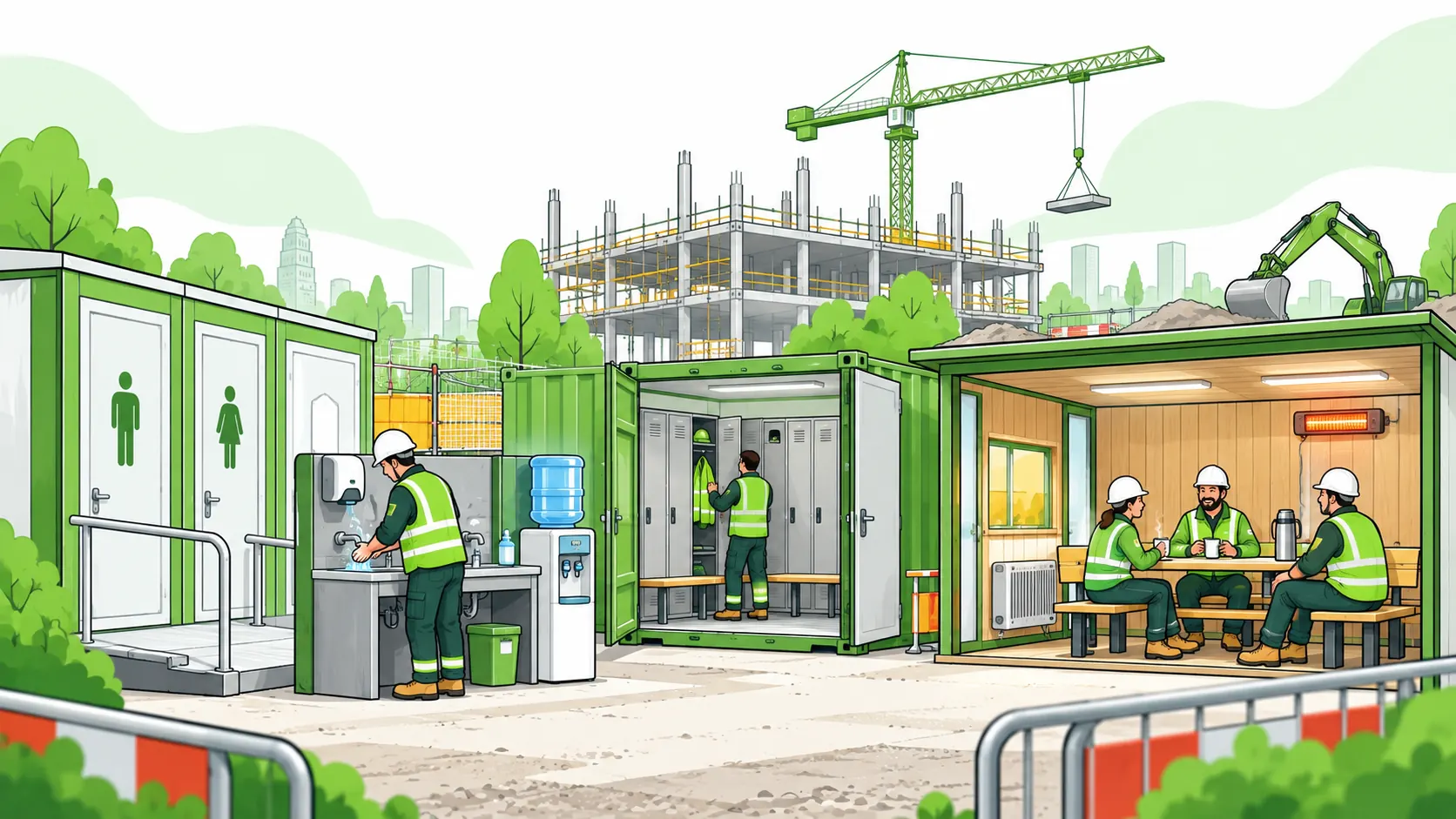
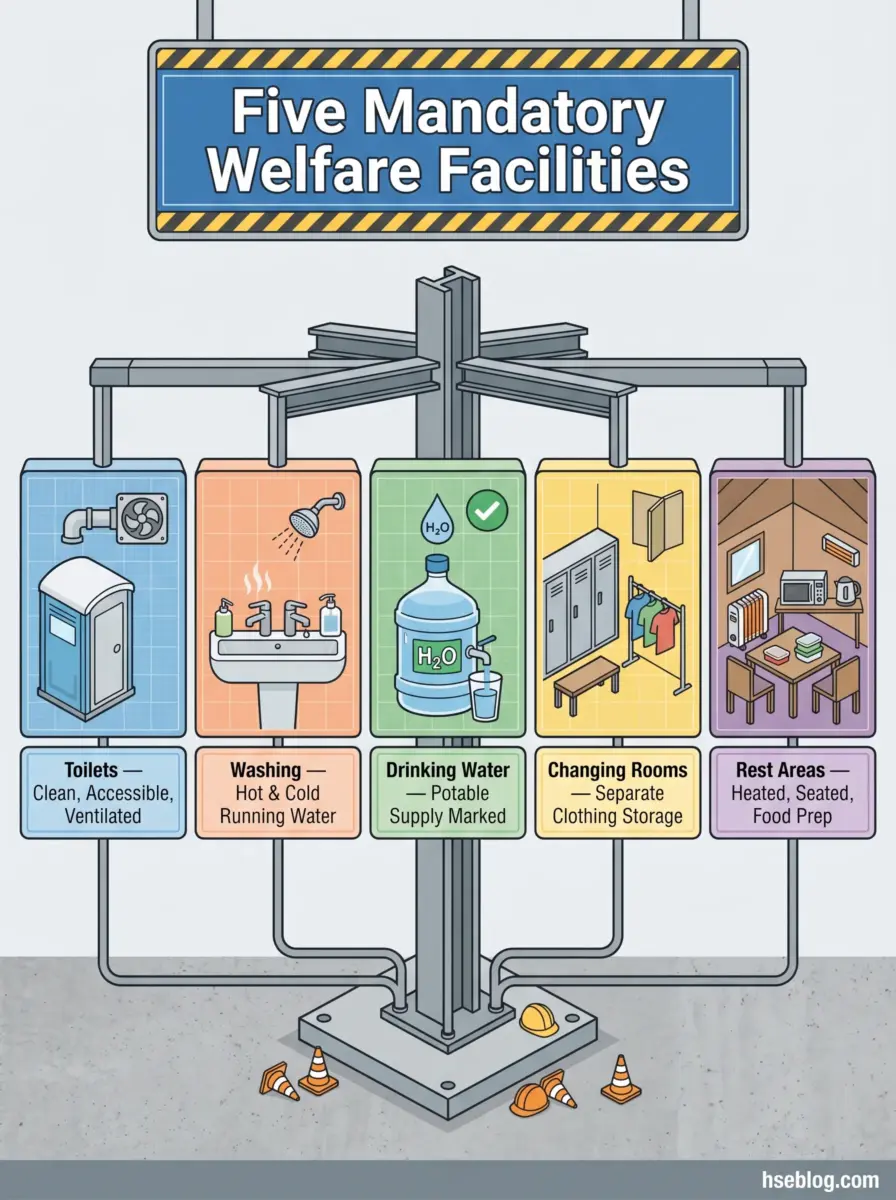
Construction sites must provide, at minimum, clean and accessible toilets, washing facilities with hot and cold running water and soap, a supply of wholesome drinking water, changing rooms with storage for personal and work clothing, and heated rest areas with tables, seating, and means to heat food. In the UK, Schedule 2 of the CDM 2015 Regulations mandates these facilities. In the US, OSHA standard 29 CFR 1926.51 sets equivalent sanitation requirements. Facilities must be in place from day one and maintained throughout the project duration.
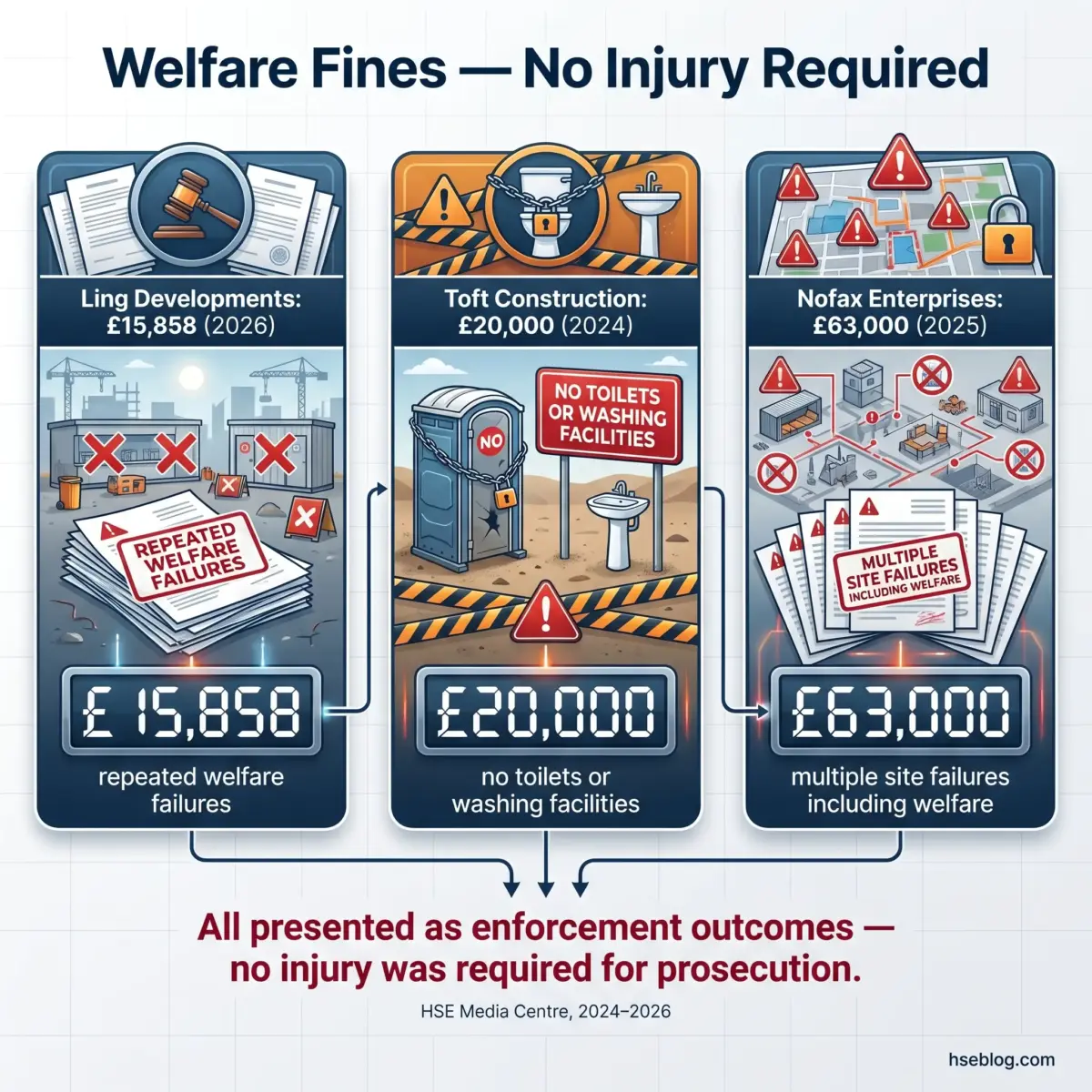
In April 2026, HSE prosecuted Ling Developments Limited for repeated failure to provide hot water and suitable rest facilities across four construction sites in the West Midlands. The fine — £15,858 plus £3,858 in costs — came despite the company having received prior enforcement action for the same failures (HSE Media Centre, 2026). No worker was injured. The prosecution was entirely duty-based: the facilities were inadequate, the duty-holder had been warned, and the problem persisted.
That case captures something broader about how the industry still treats welfare. Toilets, washing, drinking water, rest areas — these are not amenities. They are statutory minimums with enforcement consequences, health control functions, and a direct bearing on whether a site can legally operate. Handwashing removes hexavalent chromium from cement-exposed skin. Drinking water prevents heat illness. Rest facilities reduce fatigue-related errors. When welfare is cut or delayed — and it is routinely the first thing squeezed when budgets tighten — the result is not just discomfort. It is regulatory exposure, health harm, and on some sites, a prohibition notice that halts work entirely. This article sets out exactly what must be provided, who carries the duty, how to plan for it, and what happens when it falls short — across UK, US, EU, and international frameworks.
What Is Construction Site Welfare and Why Does It Matter?
The term "welfare facilities" in construction covers more ground than most site teams credit it for. The HSE defines it broadly: facilities necessary for the well-being of workers, including washing, toilet, rest, and changing facilities, along with somewhere clean to eat and drink during breaks. That definition is deliberately wide because welfare serves a dual function that gets lost when the conversation reduces it to "toilets and a kettle."
The first function is basic human dignity. Workers who cannot access a clean toilet, wash their hands, drink safe water, or sit down to eat in a sheltered space are working in conditions that no modern regulatory framework considers acceptable. The second function — and the one that connects welfare directly to hazard control — is health protection. Washing facilities are not convenience items on a site handling cement: they are the primary skin decontamination control against hexavalent chromium, a known sensitiser. Drinking water is not a perk in summer: it is the front-line defence against heat stress. Rest areas separated from work zones prevent ingestion of construction dusts during meals.
The documented health consequences of inadequate welfare are specific and well-established. Delayed or restricted toilet access is linked to urinary tract infections, a pattern particularly affecting female workers on sites with insufficient or inaccessible facilities. Inadequate washing leads to occupite dermatitis from prolonged cement contact. Lack of rest and hydration contributes to fatigue, which feeds directly into the incident chain for falls, struck-by events, and manual handling injuries.
Watch For: Welfare is one of the most common triggers for HSE enforcement action during routine site inspections — and one of the easiest things for an inspector to assess. A missing or filthy toilet is visible in seconds. An improvement notice follows in minutes.
What Welfare Facilities Must Be Provided on a Construction Site?
The facilities listed below represent legal minimums under CDM 2015 Schedule 2 (UK) and OSHA 29 CFR 1926.51 (US) — not aspirational standards. Where hazardous substances are present, additional facilities such as showers may be required. Gender-separated provision is expected where reasonably practicable; lockable single-occupancy rooms are the minimum alternative. Each facility type carries its own maintenance obligation: providing it once and allowing it to degrade is not compliance.
A persistent failure pattern across construction sites is treating welfare as a mobilisation task — adequate on day one, then left to deteriorate as phases change, workforce numbers climb, and attention shifts to programme milestones. The legal obligation is continuous. Facilities that were sufficient at the start of groundworks may be wholly inadequate by the time fit-out trades arrive at peak workforce.
Sanitary Conveniences (Toilets)
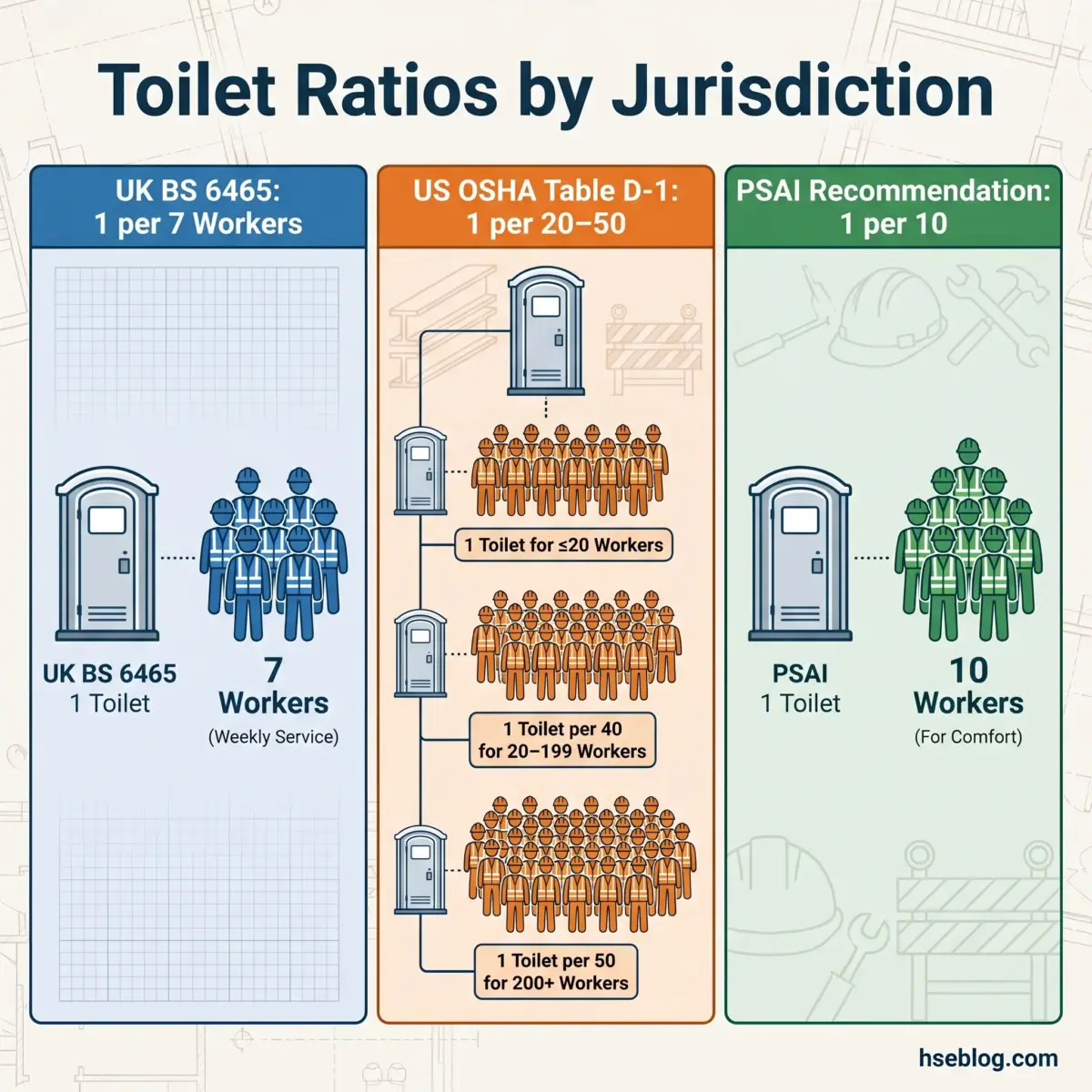
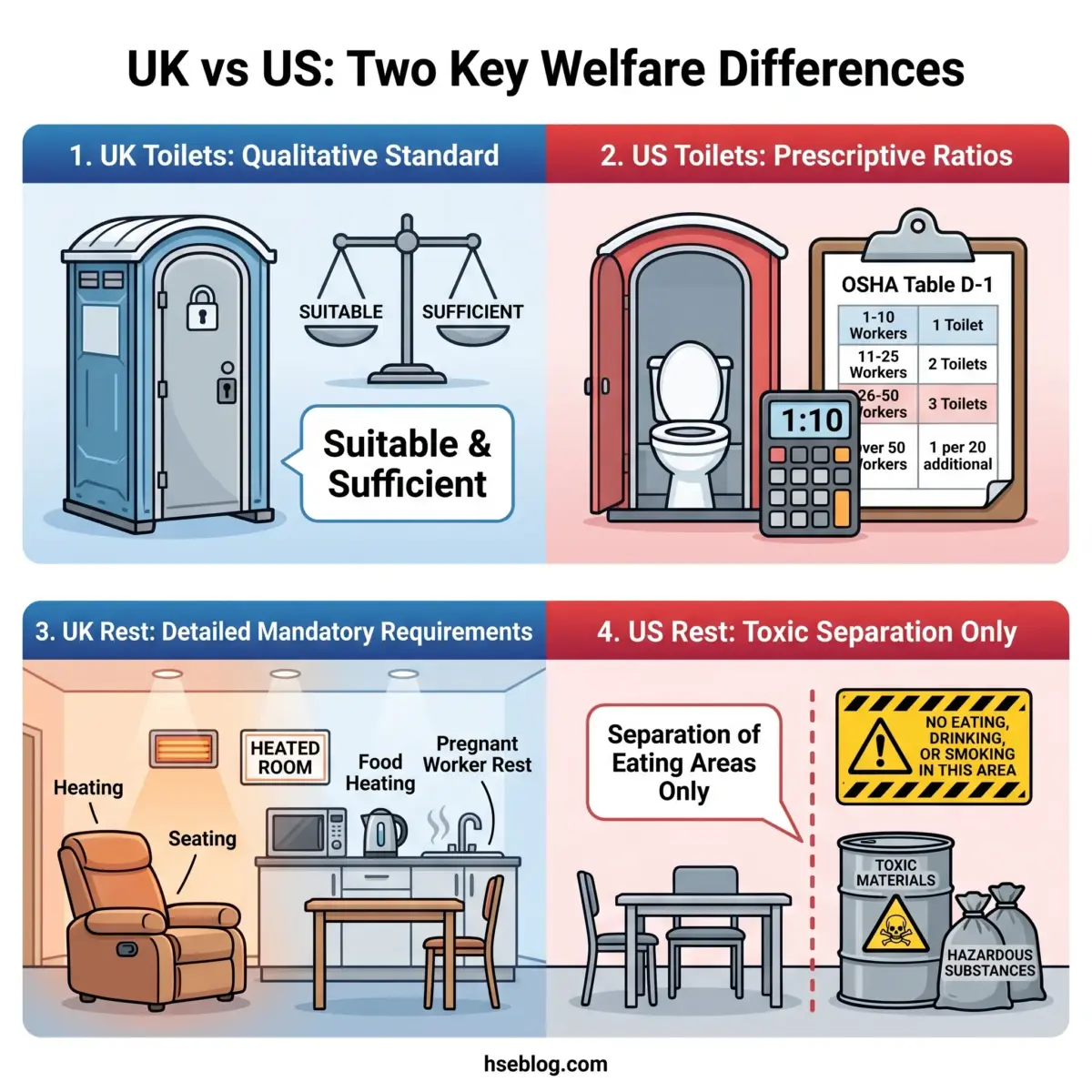
CDM 2015 Schedule 2 (UK) requires suitable and sufficient sanitary conveniences at readily accessible locations. The regulation uses the qualitative standard "suitable and sufficient" rather than prescribing numbers, but HSE guidance on welfare facilities during construction work (CIS59) and BS 6465-1:2006 provide the practical benchmark: one toilet per seven workers where portable units are serviced weekly.
In the US, OSHA construction sanitation standard 1926.51 is prescriptive. Table D-1 requires one toilet for up to 20 workers, one per 40 workers for crews of 20–199, and one per 50 for 200 or more. OSHA interpretation letters have established that toilets must be reachable within approximately ten minutes of the work area. The Portable Sanitation Association International (PSAI) recommends a ratio of 1:10 for adequate service levels.
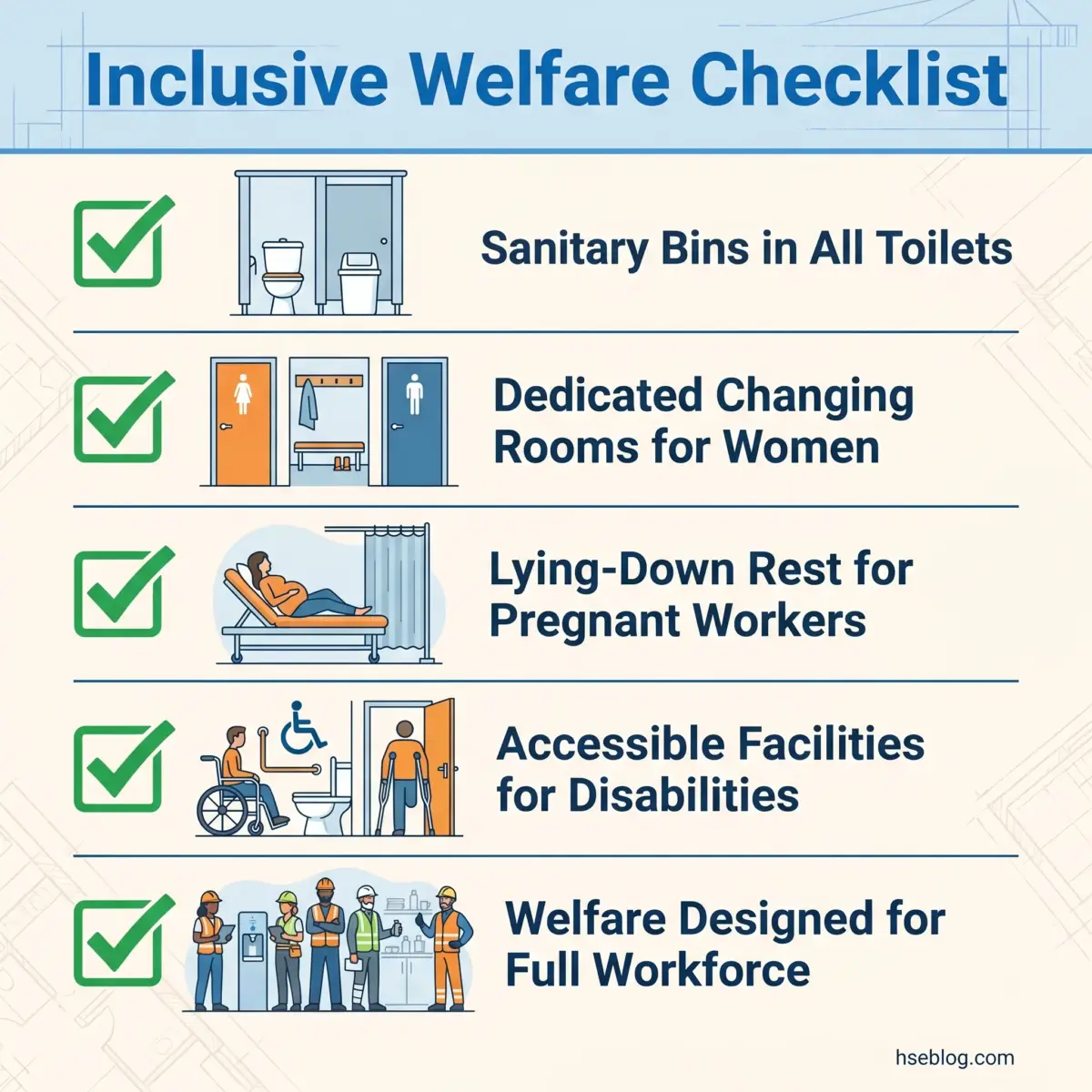
The provision obligation extends beyond placement. Toilets must be ventilated, lit, cleaned regularly, and stocked with toilet paper. Sanitary waste bins must be available — in all toilet facilities, not only those designated for female workers. Flushing toilets connected to mains drainage are the preferred standard; chemical portable toilets are a last resort, not the default.
Washing Facilities
Sinks with hot and cold (or warm) running water, soap, and towels or hand dryers must be provided adjacent to both toilet facilities and food preparation or eating areas. Basins must be large enough to wash hands and forearms — a common gap on sites where undersized portable sinks are installed as a box-ticking exercise.
Whole-body washing — showers — is required where the nature of the work involves hazardous substance exposure. Cement work triggers this through hexavalent chromium risk. Lead abatement, asbestos removal, and work with biological agents all require shower provision under both CDM 2015 Schedule 2 (UK) and OSHA 29 CFR 1926.51(f) (US). Gender-separated shower facilities or lockable individual cubicles are the standard.
Drinking Water
Wholesome (potable) drinking water must be available at readily accessible locations throughout the site. The supply must come from a mains connection or an approved potable source; bottled water dispensers are acceptable. Cups or drinking vessels must be provided unless the supply is from a drinking jet or fountain.
Conspicuous signage is required to mark potable water points. Equally important — and frequently missed — is clear signage on any non-potable water outlet to prevent confusion. OSHA 29 CFR 1926.51(a) (US) explicitly requires that non-potable water supplies are marked as unsafe for drinking.
Changing Rooms and Storage
Where workers need to change into protective or work-specific clothing, dedicated changing rooms must be provided. These require seating, adequate space, and separation between clean personal clothing and contaminated or wet work garments. Contaminated clothing storage must be ventilated to allow drying and to prevent cross-contamination.
Secure storage — lockers or equivalent — for personal belongings is a separate obligation. Changing facilities must be adjacent to washing and shower areas so workers are not forced to walk through operational zones in various states of undress. Male and female workers require separate changing areas, or scheduled separate use with lockable access as the minimum arrangement.
Rest and Eating Facilities
Heated, sheltered rest areas with tables and seating — chairs with backs, not upturned buckets — must be provided in sufficient numbers for the peak workforce expected on site. A means to heat food (microwave) and boil water (kettle) is required. Rest areas must be maintained as clean eating environments: they cannot double as material storage, tool caches, or drying rooms.
CDM 2015 Schedule 2 (UK) includes an explicit requirement that is still widely overlooked — suitable facilities for pregnant workers or nursing mothers to rest lying down. This is a mandatory provision, not a best-practice suggestion.
Who Is Responsible for Providing Welfare on a Construction Site?
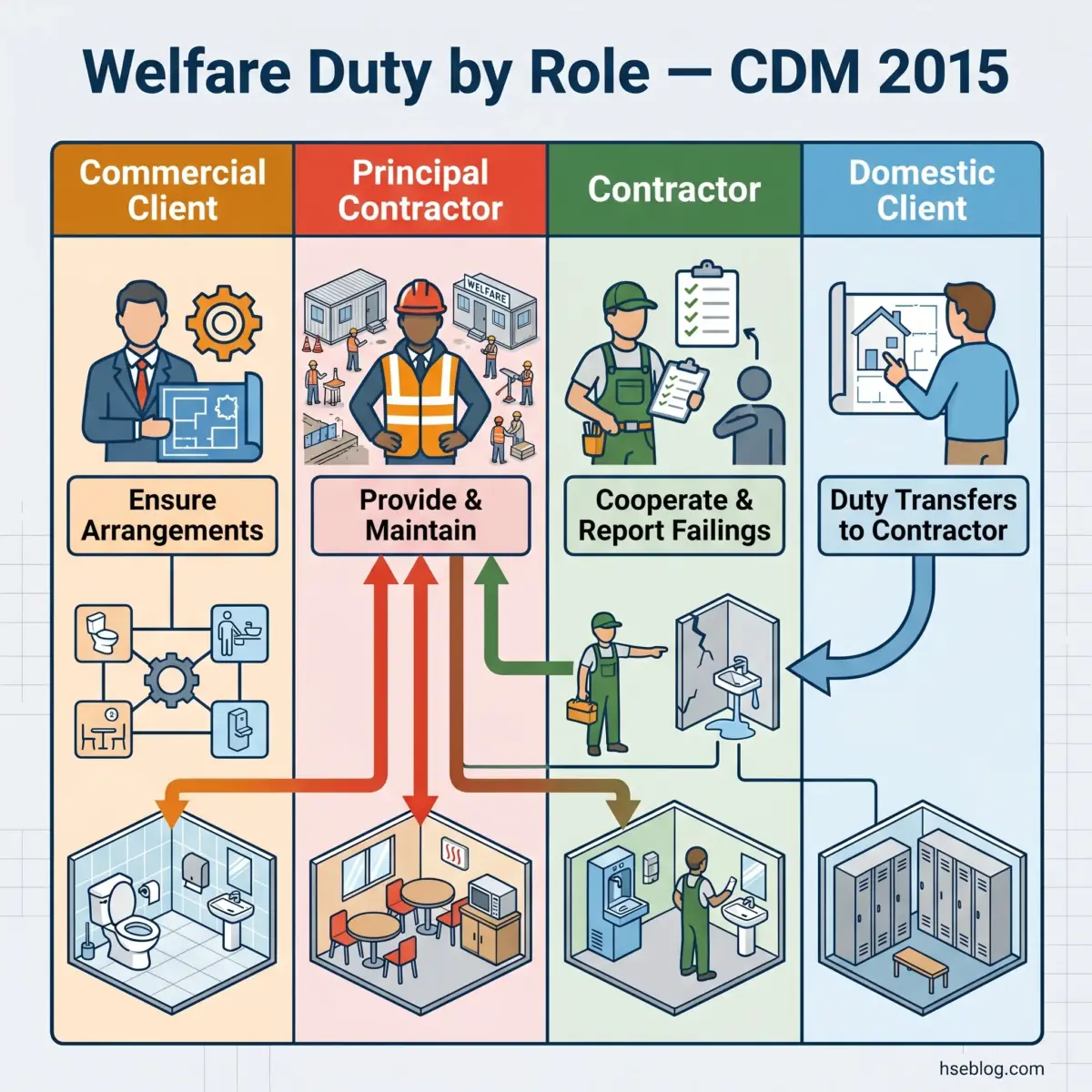
The most persistent source of welfare failure on multi-contractor sites is not budget — it is ambiguity over who carries the duty. The practical answer varies by project type, but the legal framework is precise. Here is how responsibility distributes across duty-holder roles under CDM 2015 (UK).
Commercial clients hold the overarching duty. They must ensure welfare arrangements are in place and must not allow construction work to start on notifiable projects (exceeding 30 working days or 500 person-days) until welfare facilities are operational. The client does not typically provide the facilities directly, but they must satisfy themselves that the principal contractor has done so.
Principal contractors carry the primary operational duty under CDM 2015 Regulation 13(4)(c) (UK). They must provide and maintain welfare facilities complying with Schedule 2 from project start to completion. They must coordinate welfare across all contractors on site. This duty cannot be delegated through sub-contract terms — even when the practical provision is handled by a welfare hire company or a trade contractor.
Contractors must provide welfare for workers under their direct control, as required by CDM 2015 Regulation 15(11) (UK). On sites with a principal contractor, this usually means cooperating with the principal contractor's welfare arrangements and reporting failings. On sites without a principal contractor (single-contractor projects), the contractor bears the full welfare duty.
Domestic (residential) clients transfer their duties to the contractor they engage. The contractor then carries the welfare obligation for the project.
Audit Point: On any multi-trade site, ask one question: does every worker on site know where the welfare facilities are, and does the principal contractor have a documented plan showing the welfare is scaled to the current workforce? If the answer to either is no, the arrangement is failing regardless of what the contract says.
The judgment call for principal contractors is straightforward but frequently ducked: you can sub-let the practical delivery of welfare, but you cannot sub-let the legal accountability. When an HSE inspector issues an improvement notice for inadequate toilets, it lands on the principal contractor — not on the welfare unit hire company and not on the sub-contractor whose workers are affected.
How to Plan Welfare Provision: From Pre-Construction to Project Completion
Welfare planning that begins on the morning the first excavator arrives has already failed. The consistent pattern in HSE enforcement is sites that treated welfare as a "we'll sort it when we get there" task — and then spent the first week or two of construction without adequate facilities, precisely when inspectors tend to conduct initial visits on notifiable projects.
Effective welfare planning follows a lifecycle approach, built into project documentation from the pre-construction phase onward.
- Pre-construction information must address welfare. The client's pre-construction information package should identify existing welfare provision on or near the site (are there buildings with usable facilities?), site access and positioning constraints, and any hazardous substance work that triggers shower requirements. This is not optional detail — it is information the principal contractor needs to plan welfare before mobilisation.
- The construction phase plan must include a welfare plan. Under CDM 2015, the construction phase plan addresses site organisation. Welfare layout — where facilities are positioned relative to work areas, traffic routes, and hazard zones — is part of that plan. Facilities should be close enough that workers can reach them within a reasonable walk. On larger sites, satellite welfare units or additional water points may be necessary for remote work areas.
- Plan for workforce scaling. The number of facilities adequate for the groundworks team of twelve will not serve the fit-out phase workforce of eighty. The welfare plan must anticipate peak workforce numbers and have procurement and positioning arrangements in place before numbers ramp up — not after the existing facilities are overwhelmed.
- Address transient and short-duration work specifically. Highway projects, utility maintenance, and phased work across multiple locations present distinct challenges. Options include a central compound with transport to welfare, mobile welfare units moved with the work front, or formal agreements to use existing nearby facilities (a café or public building). Any arrangement using third-party facilities must be documented, confirm availability during all working hours, and include measures to maintain cleanliness.
- Account for delivery logistics. Welfare units are heavy. Positioning them requires mechanical handling — crane, telehandler, or HIAB delivery. The site layout must accommodate safe delivery routes. Manual handling of welfare units is a risk in itself and must be planned, not improvised.
Field Test: Walk the site at 7:30 AM on a Monday at peak workforce. Can every worker reach a toilet, wash their hands, get a drink, and sit down for a break within a reasonable time? If the answer involves queuing, improvising, or leaving the site, the welfare plan has a gap — and HSE will find it before you fix it.
What Happens If You Fail to Provide Adequate Welfare?
HSE enforcement on welfare is not theoretical, and the penalties are not trivial. The enforcement escalation typically follows a pattern: informal advice on the first finding, an improvement notice requiring correction within a set timeframe, a prohibition notice halting work if conditions are serious, and prosecution for persistent or egregious failure.
The critical point that many duty-holders miss is this: welfare is a duty-based offence. No injury is required. No incident needs to occur. If the facilities are inadequate, the offence is complete.
Recent prosecutions illustrate the range and consistency of enforcement. Ling Developments Limited was fined £15,858 plus £3,858 in costs for repeated failure to provide hot water and suitable rest facilities across four sites — having previously received enforcement action for the same issues (HSE Media Centre, 2026). Toft Construction Limited was fined £20,000 plus £5,176.90 in costs after an HSE inspection of a domestic site in Salford found no toilets or washing facilities at all — a conviction under CDM Regulations 15(11) (HSE prosecution record, 2024). Nofax Enterprises received nine enforcement notices and was fined £63,000 plus £25,622 in costs for multiple site failures including inadequate welfare controls (HSE Media Centre, 2025).
These are not edge cases. HSE achieved a 96% conviction rate and reported £33 million in fines for 2024/25 (Health and Safety International, 2025). Welfare sits within that enforcement posture as one of the most straightforward things to assess and act on.
In the US, OSHA citations under 29 CFR 1926.51 carry per-instance penalties that can accumulate rapidly on sites with multiple deficiencies. The financial exposure is compounded by the project delays and contractual losses that follow a site shutdown — a prohibition notice during peak construction is not just a fine, it is a programme impact.
Jurisdiction Note: UK welfare prosecutions are duty-based (no injury required). US OSHA citations are also issued for conditions, not just incidents. In both systems, repeated non-compliance is treated as an aggravating factor that increases penalties and triggers investigation into the duty-holder's management systems.
Welfare Provision for an Inclusive Workforce
Construction's welfare infrastructure was designed, historically, for an all-male workforce. That assumption no longer holds — and it creates specific compliance gaps that duty-holders must address.
Approximately 14% of the US construction workforce are women (US Bureau of Labor Statistics, via NAWIC, 2025), with similar patterns emerging in the UK. CDM 2015 Schedule 2 (UK) explicitly requires separate sanitary and changing facilities for male and female workers where reasonably practicable, with lockable single-occupancy rooms as the minimum alternative. This is not new law — but compliance remains inconsistent.
Sanitary waste disposal bins must be provided in all toilet facilities, not only those designated for female use. The rationale is practical: restricting sanitary bins to specific cubicles forces female workers to identify themselves by facility choice, undermining the privacy the bins are meant to protect. Balfour Beatty's 2023 initiative to install sanitary disposal in all site toilet facilities reflected this reasoning.
CDM 2015 Schedule 2 requires rest facilities that include suitable provision for pregnant workers or nursing mothers to rest lying down. This is a mandatory requirement, not a discretionary upgrade. In the US, the Pregnant Workers Fairness Act (2023) requires reasonable accommodations for pregnancy-related conditions, which includes rest and facility access adjustments.
Case law under the Workplace (Health, Safety and Welfare) Regulations 1992 Regulation 24 (UK) has established that requiring women to change in a toilet area — even where the space is technically adequate in size — is a privacy violation. Separate, dedicated changing rooms are the standard.
The US Department of Labor guidance on creating safer construction workplaces for women identifies properly fitting PPE and appropriate welfare access as foundational requirements for inclusive site conditions.
Workers with disabilities are entitled to accessible welfare facilities under both the Equality Act 2010 (UK) and the Americans with Disabilities Act (US). On temporary construction sites, this may require accessible portable toilet units and ground-level access to rest areas.
The practitioner judgment here is straightforward: if the welfare provision on site only works for able-bodied men, it does not meet the legal standard and it signals to a growing portion of the potential workforce that the site was not designed with them in mind.
Construction Site Welfare Across Jurisdictions: UK, US, EU, and International Standards
For organisations operating across borders — or readers wanting to benchmark their provision against international expectations — the welfare frameworks share common ground but diverge on specificity, numeric thresholds, and the breadth of what is regulated.
| Welfare Facility | UK — CDM 2015 Schedule 2 | US — OSHA 29 CFR 1926.51 | EU — Directive 92/57/EEC | ILO — Convention C167 |
|---|---|---|---|---|
| Toilets | "Suitable and sufficient" (qualitative). BS 6465 guidance: 1:7 ratio | Table D-1: 1 per 20 (≤20); 1 per 40 (20–199); 1 per 50 (200+) | Framework requirement; transposed by member states | Article 19: sanitary facilities required |
| Washing | Hot and cold running water, soap, towels. Showers where hazardous substances present | Required for hazardous substance operations (§1926.51(f)) | General requirement in Annex IV | Washing facilities required |
| Drinking water | Wholesome, readily accessible, conspicuously marked | Potable water; non-potable outlets labelled | General requirement | Drinking water required |
| Changing rooms | Required where specialist/protective clothing worn. Separate contaminated clothing storage | Change rooms for hazardous substance work | General requirement | Changing rooms required |
| Rest/eating | Heated shelter, tables, seating with backs, food heating, pregnant worker rest | Eating areas separated from toxic materials | General requirement | Rest and eating facilities required |
| Numeric ratios in regulation? | No — qualitative standard; BS 6465 provides guidance | Yes — prescriptive in Table D-1 | No — framework | No — framework |
| Primary duty-holder | Principal contractor | Employer | Varies by member state transposition | Employer |
The material differences for practitioners operating across UK and US jurisdictions are concentrated in two areas. UK CDM 2015 rest and eating facility requirements are significantly more detailed than US OSHA equivalents — OSHA mandates separation of eating areas from toxic materials but does not require heated rest rooms, food-heating appliances, or pregnant worker rest provisions in the construction-specific standard. Conversely, US OSHA provides prescriptive toilet ratios that eliminate the interpretive uncertainty of the UK's "suitable and sufficient" standard.
EU Directive 92/57/EEC operates as a framework — each member state transposes it into national law with varying levels of specificity. The ILO Convention C167 sets baseline expectations that most developed-country frameworks meet or exceed. The practical value of the ILO framework is in jurisdictions without developed national construction safety legislation, where C167 provides a reference standard.
Frequently Asked Questions
How many toilets are required on a construction site?
There is no single universal number. In the UK, CDM 2015 Schedule 2 requires "suitable and sufficient" provision, with BS 6465-1:2006 recommending one toilet per seven workers where portable units are serviced weekly. In the US, OSHA Table D-1 prescribes one toilet for up to 20 workers, one per 40 for workforces of 20–199, and one per 50 for 200 or more. PSAI recommends one per 10 for adequate service. The applicable jurisdiction determines which ratio governs, but exceeding the regulatory minimum is widely recommended.
Can workers use a nearby café or public toilets instead of on-site facilities?
In limited circumstances, yes — but not as a default. UK HSE guidance permits use of nearby facilities only where there is an agreement with the owner, the facilities are available during all working hours, and measures exist to maintain cleanliness. This arrangement is not acceptable as permanent provision on longer-duration projects. On-site dedicated facilities remain the expected standard for any project lasting more than a few days.
Do welfare facilities need to be in place before construction work starts?
On notifiable projects in the UK — those exceeding 30 working days or 500 person-days — welfare must be operational before work begins. CDM 2015 requires the commercial client to ensure this. The general principle under both UK and US frameworks is that workers must have access to welfare from day one, not from the day procurement catches up with the programme.
Are showers required on all construction sites?
Not universally. Showers are required where workers are exposed to hazardous substances — cement (hexavalent chromium risk), lead, asbestos, and biological agents being the most common triggers. CDM 2015 Schedule 2 (UK) requires showers "where required by the nature of the work." OSHA mandates shower provision only when triggered by substance-specific standards. On sites without hazardous substance exposure, handwashing facilities at sinks are the standard.
Can you be fined for poor welfare even if no one is injured?
Yes. Welfare breaches are duty-based offences in both UK and US frameworks — no injury needs to have occurred. HSE routinely issues improvement notices and prosecutes for inadequate welfare as a standalone finding. Ling Developments Limited was fined £15,858 plus costs in 2026 for welfare failures with no associated injury (HSE Media Centre, 2026). In the US, OSHA citations under 29 CFR 1926.51 are issued for non-compliant conditions, not for resulting incidents.
What welfare must a sub-contractor provide on someone else's site?
The principal contractor holds the primary welfare duty under CDM 2015 Regulation 13(4)(c) (UK). Sub-contractors must cooperate with the principal contractor's arrangements and report failings. The legal duty cannot be contracted away through sub-contract terms, though practical delivery may be allocated by agreement. On projects without a principal contractor, the sub-contractor must provide their own welfare facilities to meet the Schedule 2 standard.
Conclusion
The industry's persistent weakness on construction site welfare is not a knowledge gap — every principal contractor knows toilets and washing facilities are required. The failure is one of priority. Welfare is the first budget line compressed, the last item on the mobilisation checklist, and the thing most likely to degrade unchecked as the project progresses. That pattern continues to produce enforcement action, prosecution, and on a more fundamental level, working conditions that no regulatory framework considers acceptable.
The single highest-impact change a duty-holder can make is to treat welfare as a pre-construction deliverable with the same programme status as structural design or temporary works — planned before mobilisation, scaled to peak workforce, maintained continuously, and inspected as seriously as any other compliance obligation. The legal framework across UK, US, and international standards is unambiguous: welfare facilities are not optional, not deferrable, and not someone else's problem.
Every enforcement case cited in this article shares a common thread. The duty-holder knew what was required. The facilities were either absent, inadequate, or allowed to deteriorate. And the inspector did not need to wait for someone to get hurt before acting. Construction site welfare is, in that sense, one of the simplest compliance tests in HSE — and one of the most reliably failed.