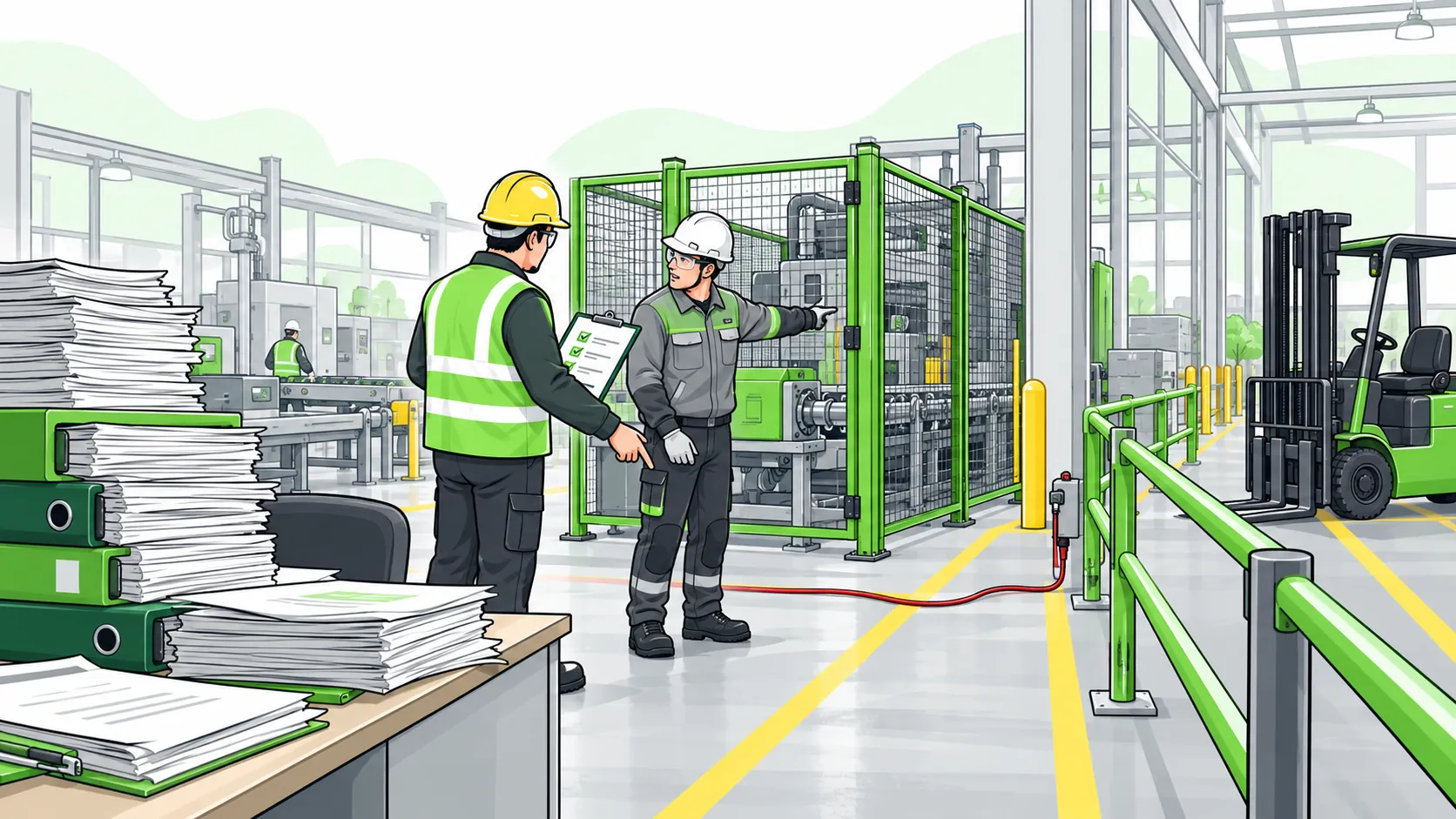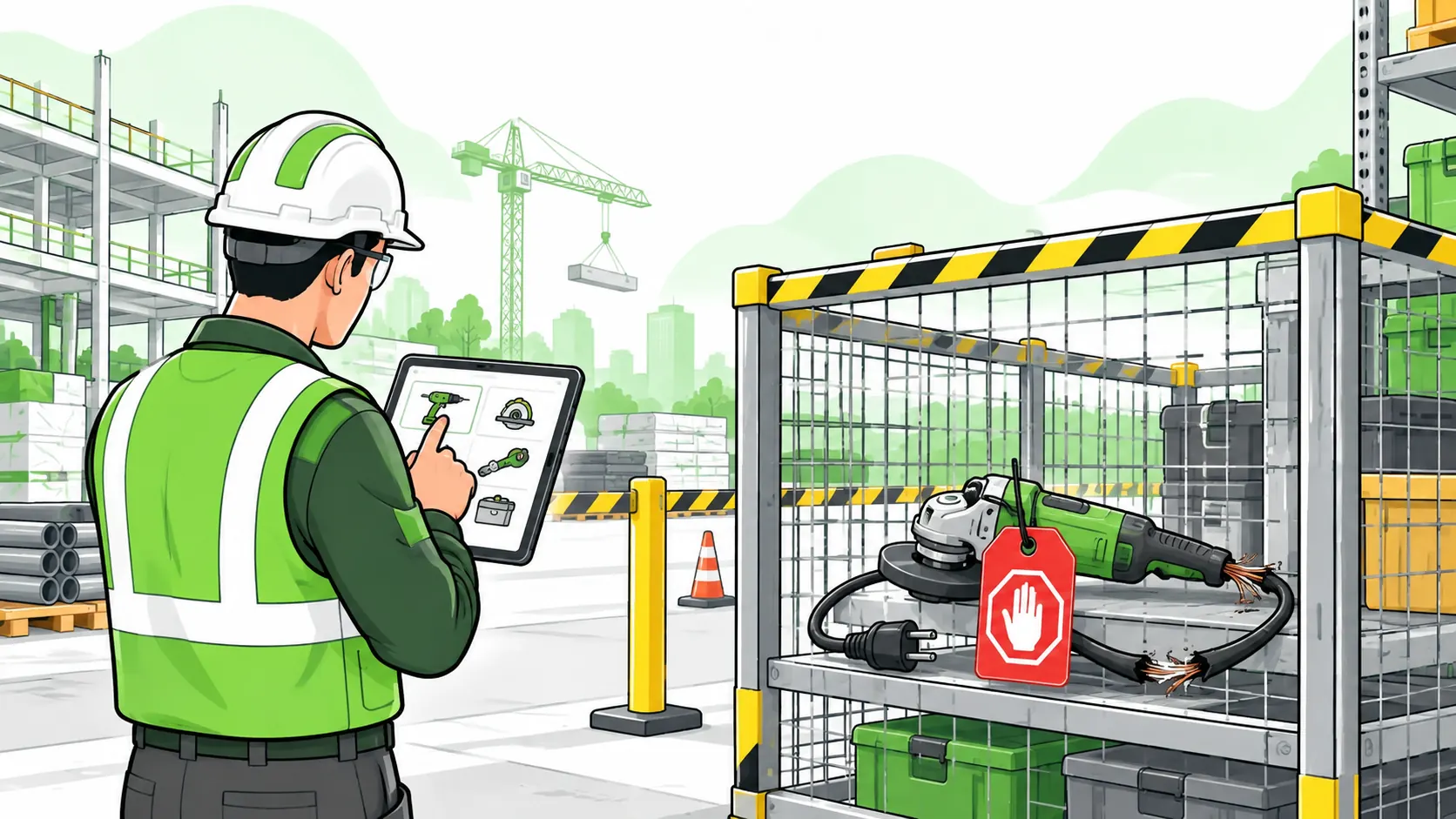
If you find defective equipment at work, stop using it immediately, isolate and tag it "Do Not Use," and report it to your supervisor and the workplace reporting system. Do not attempt unauthorised repairs. Only a competent person should inspect, repair, and return the equipment to service after verification.
A misconception worth correcting before anything else
Two beliefs cause most of the avoidable harm around defective equipment at work, and both sound reasonable on a busy shift. The first is "if it still runs, it's fine." The second is "nobody got hurt, so there's nothing to report."
Both are wrong, and the published incident record shows it. A guard removed from a running machine, an interlock bypassed to keep a line moving, a lifting sling kept in use past its inspection date — none of these stops the equipment "working," and all of them sit at the centre of fatal-accident investigations. Across Great Britain, 124 workers were killed in work-related accidents in 2024/25 (Health and Safety Executive, 2025, provisional), and "contact with moving machinery" remains a persistent category in HSE's kind-of-accident breakdown (Health and Safety Executive, 2025).
This article walks the actual workflow a worker faces at the moment of discovery, then separates the two reporting layers that nearly every competitor blurs together. It maps the UK duty to report equipment-failure events against the US duty to report injury outcomes, so you know which obligation applies before you act. The faulty work equipment procedure is only half the job; knowing who must be told, and when, is the other half.
Legal note: Regulatory content here reflects general HSE professional understanding of UK and US requirements as of 2025. It is not legal advice. Specific compliance questions, enforcement situations, or prosecution risk should be directed to qualified legal counsel in the applicable jurisdiction.
What Counts as Defective Equipment at Work?
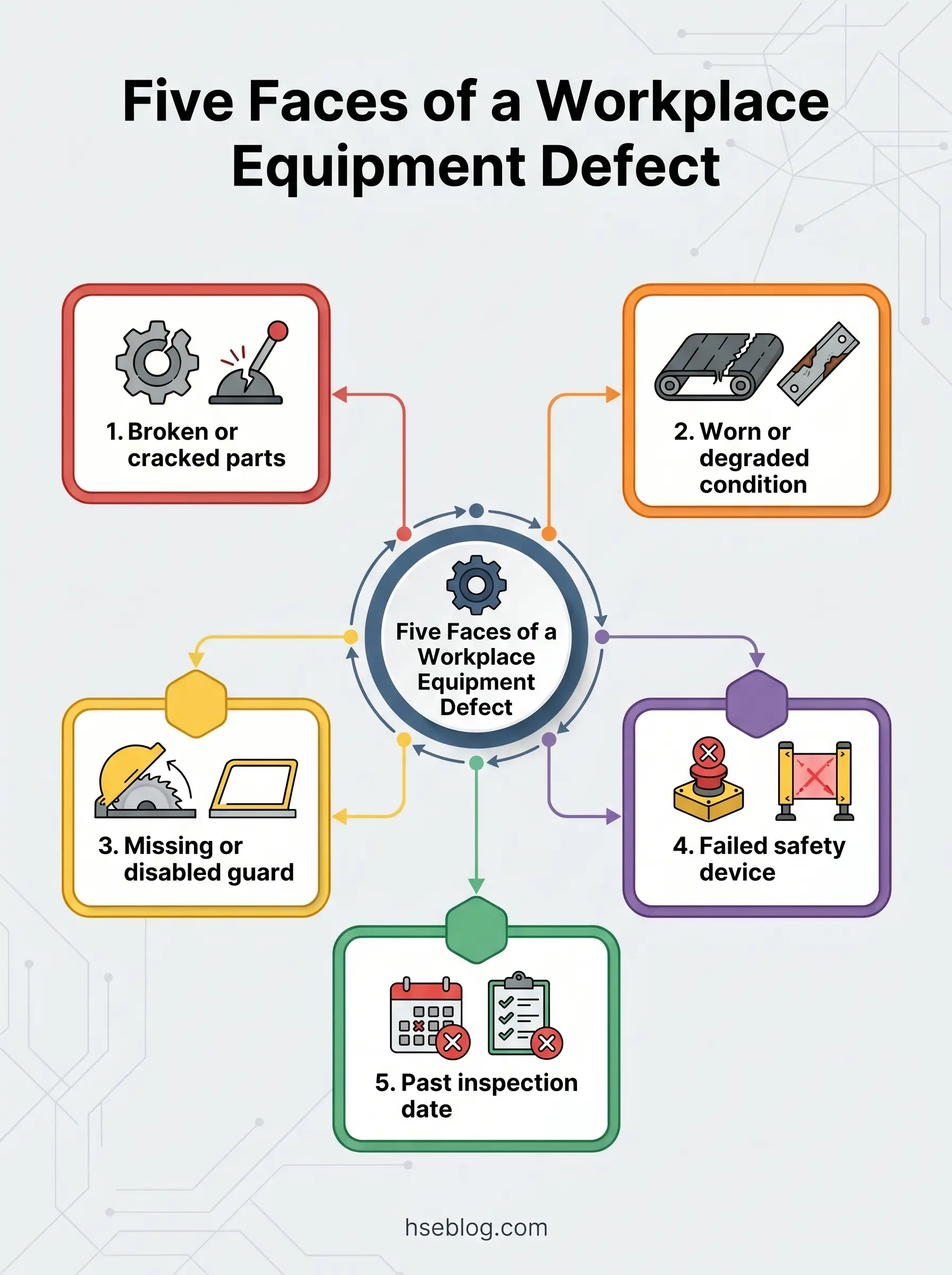
A defect is any condition that makes equipment unsuitable or unsafe for its intended task — not only the moment it stops working. That distinction matters because the law reads "defect" far more widely than most teams do on the floor.
Under PUWER 1998, "work equipment" covers almost anything used at work, and the duty to keep it in efficient working order applies across that whole range. The practical effect is that the term reaches well beyond the obvious machine breakdown.
What sits inside the definition:
- Hand and power tools — chisels with mushroomed heads, abrasive wheels with the guard removed, frayed power leads.
- Access equipment — ladders with bent stiles, mobile towers missing braces, defective fall-protection anchors.
- Machinery — missing or disabled machine guarding, a bypassed interlock, a worn brake.
- Lifting equipment — slings, chains, and hooks past their thorough-examination date under LOLER.
- Vehicles and PPE — a forklift with a failed reversing alarm, a respirator with a perished seal.
The line that trips teams up is the one between a fault and a safety-critical defect. A fault is functional — the tool runs rough, the reading drifts, the finish is poor. A safety-critical defect creates a real risk of harm, and it demands a different, faster response.
Why the response escalates for safety-critical defects:
- A functional fault can sometimes wait for scheduled maintenance.
- A safety-critical defect — disabled guard, failed brake, cracked lifting hook — means stop-use now.
- Treating the two the same is how a "minor niggle" stays in service until it fails under load.
A consistent pattern across the published record is the team that classifies only visibly broken items as defective. The disabled interlock and the removed guard keep getting used because the equipment "still runs" — yet the disabled safety device is usually the more dangerous defect, because it removes the protection that was holding the residual risk down.
What to Do Immediately When You Find Defective Equipment
The first action is to stop using the equipment — before you report it, before you investigate, before anything else. Reporting a hazard that is still live, still energised, and still available to the next person is the single most common sequencing error in the published record, and it is entirely avoidable.
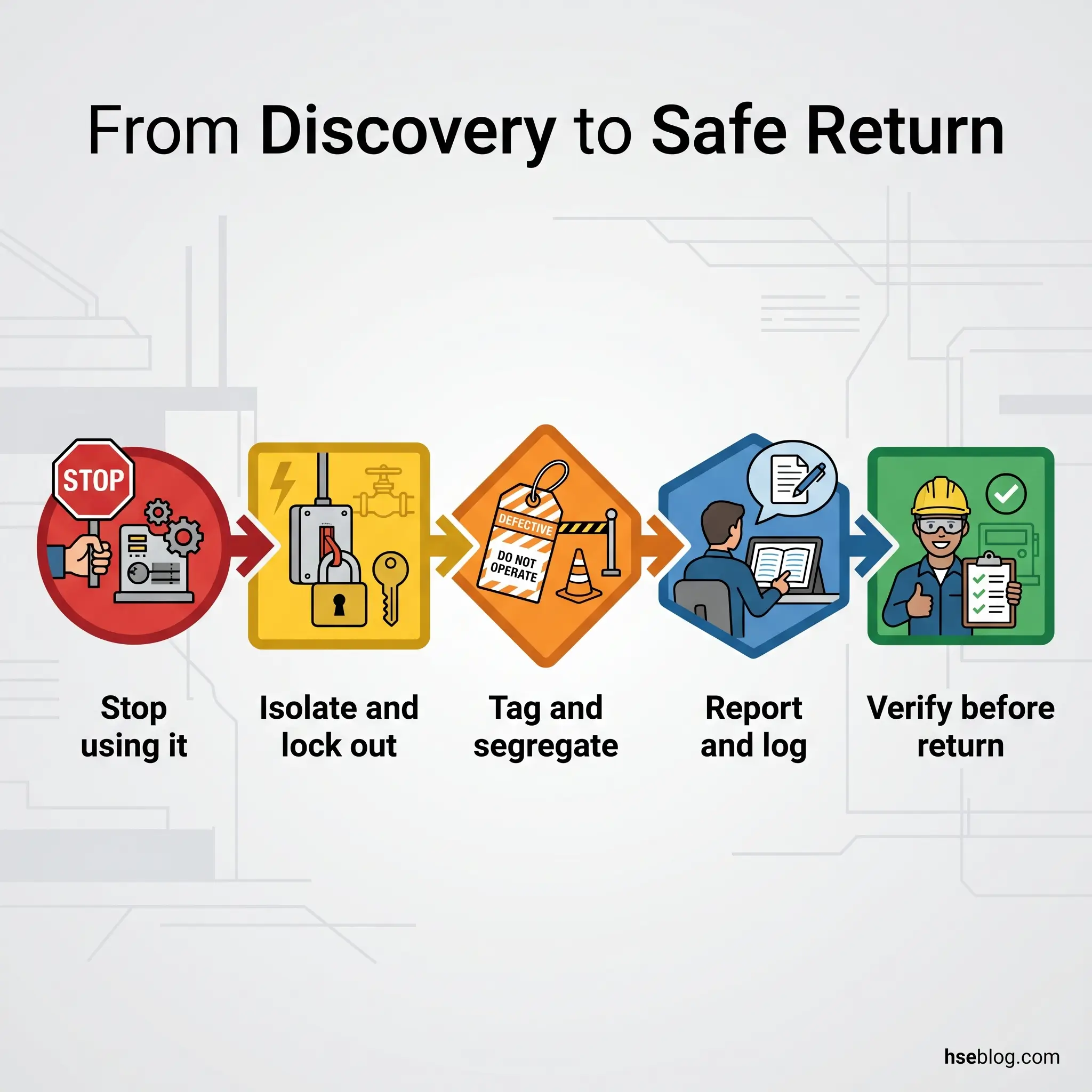
Here is the ordered decision sequence from the moment of discovery. Knowing what to do if equipment is defective at work is mostly a matter of getting these five steps in the right order.
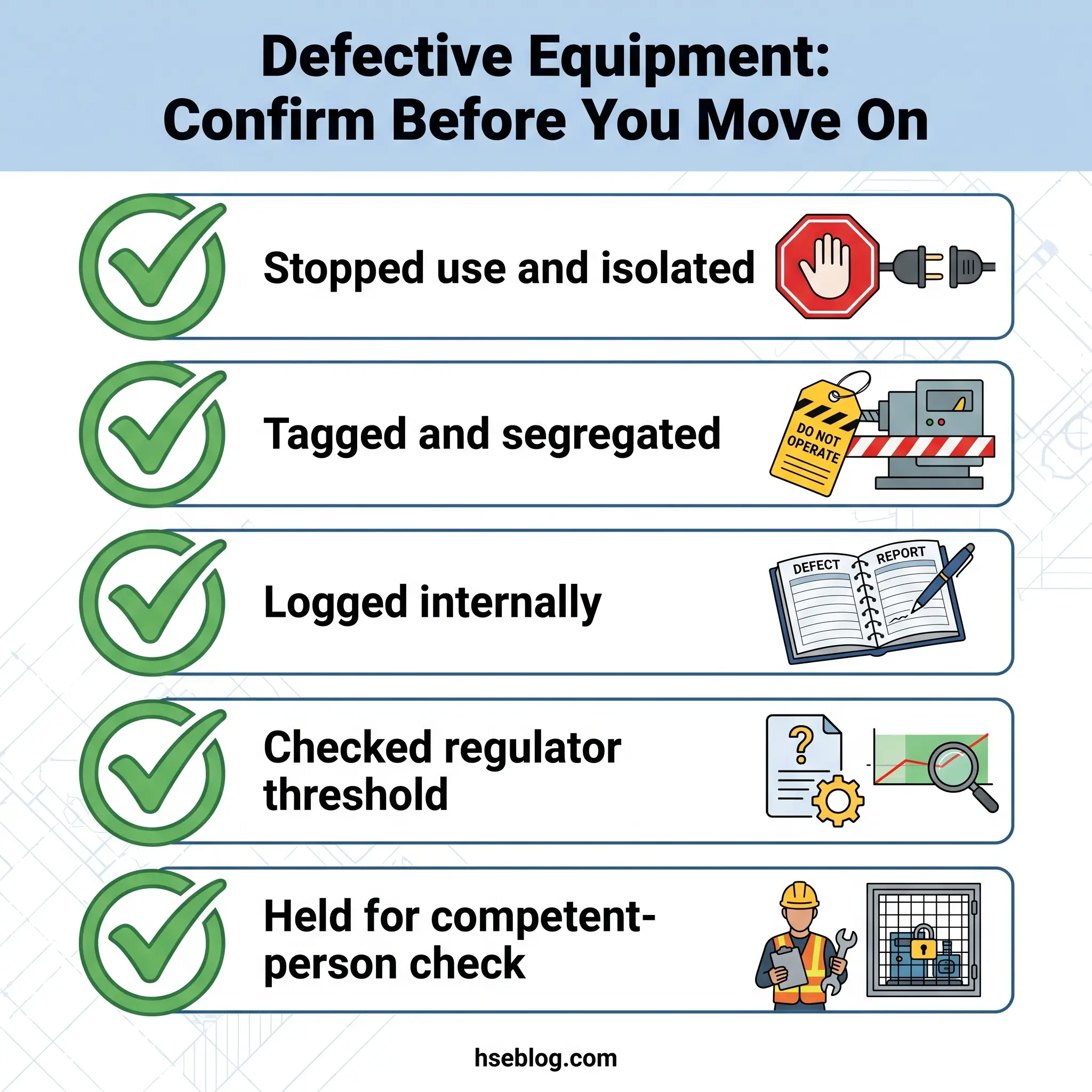
- Stop using it immediately. Do not finish "just this one task." Do not attempt an unauthorised repair to nurse it along.
- Isolate or de-energise where safe to do so. Cut the energy source and apply lockout/tagout (LOTO) so the equipment cannot be re-energised by anyone else.
- Tag and segregate. Apply a "Do Not Use" / out-of-service tag, then physically quarantine the item away from the work area where practical.
- Report and log it. Tell your supervisor or duty manager and record the defect in the reporting system. This is your internal hazard report — covered in detail in the next section.
- Hold it for a competent person. Equipment returns to service only after a competent person inspects, repairs, and verifies it — never on a colleague's say-so.
The recurring failure here is removing equipment from service on paper but not in practice. The item gets a tag, then stays exactly where it was. A later shift finds it, assumes the tag means "job's done," pulls it, and puts the equipment back to work.
What closes that loop:
- Segregation, not just signage — move the item, or lock the area, so the tag isn't the only barrier.
- Verification before return — a documented competent-person check, not a verbal "should be fine."
- A near-miss entry — log it even with no injury, so the pattern is visible if it repeats.
The "Do Not Use" Tag and Lockout/Tagout
A tag tells people not to use something; lockout/tagout physically stops them. Confusing the two is where defective equipment gets back into service before it's safe.
An out-of-service tag is a communication control — it relies on someone reading it and choosing to obey. That is fine for a hand tool sitting on a bench, but it is not enough where stored or live energy could injure someone during the fault. For those cases, the tag links to formal lockout/tagout under OSHA's energy-control standard (29 CFR 1910.147, US), which requires the energy source to be isolated and physically locked before work begins.
Who may remove a tag or lock — and why it's strict:
- The person who applied it, or an authorised competent person, removes it — never "whoever's free."
- Removal follows verification that the defect is corrected and the equipment is safe.
- Under a LOTO regime, the rule is one worker, one lock, one key, so nobody else can re-energise the equipment while a person is still exposed.
The practical reading is simple: tagging communicates, locking isolates. A defect that involves any energy source — electrical, hydraulic, pneumatic, stored mechanical — needs the lock, not just the label.
Internal Reporting vs Reporting to the Regulator: The Two Layers
There are two separate reporting duties, and they are not interchangeable. Every defect gets an internal report; only specific failures get an external one to the regulator — and conflating the two is the costliest mistake in this whole topic.
Layer 1 — internal hazard reporting (always). Every defect, near-miss, and out-of-service event should be reported and logged inside your organisation, regardless of severity. This is how patterns surface and how the duty-holder demonstrates a working safety system.
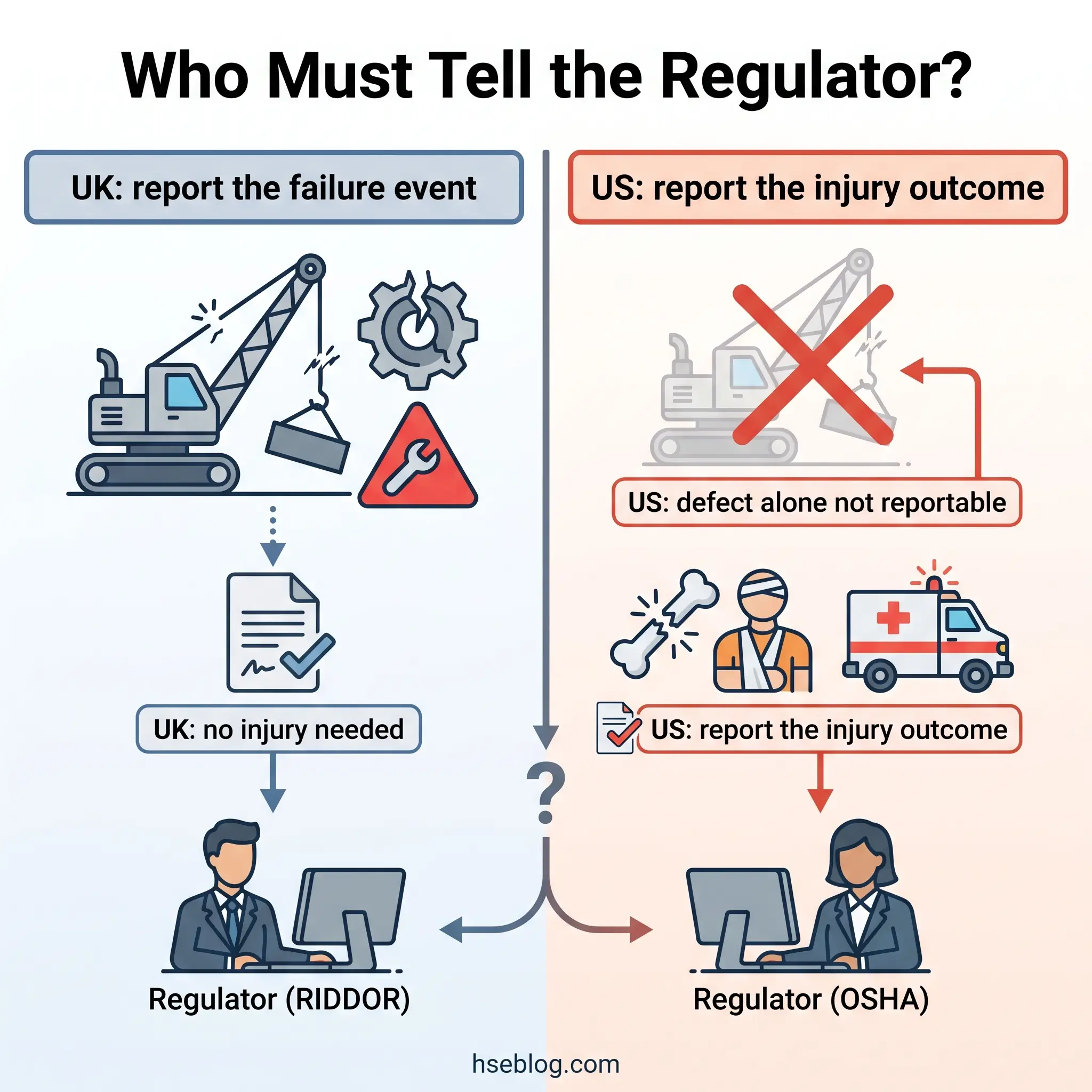
Layer 2 — external statutory reporting (only at defined thresholds). Only certain events trigger a legal duty to notify the regulator, and this is where jurisdiction decides everything. The trigger differs sharply between the UK and the US, so you must know which regime applies before giving anyone "you must report" guidance.
In the UK, RIDDOR 2013 (Schedule 2, Dangerous Occurrences) requires reporting of specified equipment-failure events even when no one is injured. That includes the collapse, overturning, or failure of a load-bearing part of lifting equipment, the failure of a pressure system, and the malfunction of breathing apparatus. The report goes to HSE — historically on form F2508 — and HSE's published list of reportable dangerous occurrences is the authoritative basis for the trigger.
In the US, the position is almost the reverse. OSHA imposes no general duty to report a defect to the agency at all. Reporting obligations under 29 CFR 1904.39 are triggered by outcomes — a work-related fatality (report within 8 hours) or an in-patient hospitalisation, amputation, or loss of an eye (within 24 hours) — not by the equipment failure itself.
| Question | United Kingdom (RIDDOR 2013) | United States (OSHA, 29 CFR 1904.39) |
|---|---|---|
| What triggers an external report? | A specified equipment-failure "dangerous occurrence" | A defined injury outcome |
| Is an injury required? | No — the failure event alone is reportable | Yes — fatality, hospitalisation, amputation, eye loss |
| Is the defect itself reportable to the agency? | Yes, if it's a listed dangerous occurrence | No general defect-reporting duty |
| Where does it go? | HSE (online; historically form F2508) | OSHA (phone or online) |
The interpretation error I see most often among UK duty-holders is "no injury, so nothing to report." Under RIDDOR the trigger is the failure event, not the harm — a crane's load-bearing part fails and drops a load into an empty exclusion zone, and that is still a reportable dangerous occurrence. The 59,219 employee injuries reported under RIDDOR in 2024/25 (Health and Safety Executive, 2025) sit alongside a separate, easily-missed stream of equipment dangerous occurrences that carry the same legal weight.
One freshness point worth flagging: HSE reorganised its RIDDOR online reporting forms in 2024 to front-load injury-severity questions, which changes how quickly a reporter can tell whether an equipment incident crosses the threshold. The stricter, more conservative reference here is the UK position — when in doubt and operating under RIDDOR, treat a listed failure as reportable.
Who Is Responsible for Defective Equipment at Work?
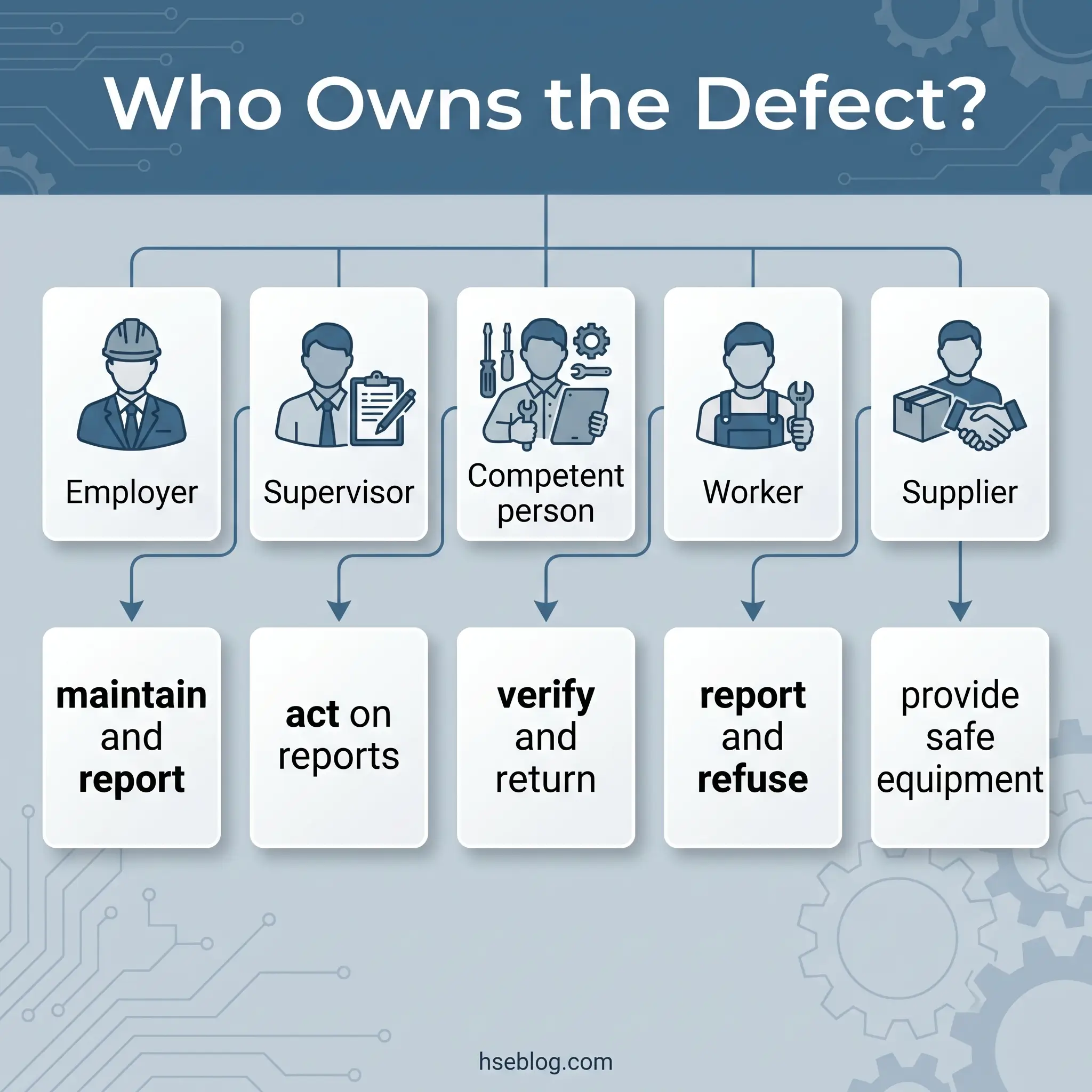
The primary legal duty sits with the employer, but responsibility runs down a chain — and the question "who is responsible for defective equipment in the workplace" has a different answer at each link. When everyone assumes someone else owns it, the duty quietly disappears.
Employer / duty-holder
- Holds the primary duty to provide and maintain safe work equipment — PUWER (UK) and the general-industry duty under OSHA (US).
- Owns the inspection regime, the maintenance system, and the statutory external report where one is required.
Manager / supervisor
- Acts on internal reports promptly rather than parking them.
- Ensures defective items are isolated, tagged, and segregated, and that tags aren't pulled prematurely.
The competent person
- The only role authorised to inspect, repair, and verify equipment for return to service.
- Defined by training, knowledge, and experience relevant to the specific equipment — not by job title alone.
The worker
- Has a duty to report defects and a right to raise safety concerns.
- Can decline dangerously defective equipment — the basis for "can you refuse to use faulty equipment at work" rests on this duty to report combined with protection from retaliation.
Manufacturer / supplier
- Must supply safe, defect-free equipment — HSWA 1974 s.6 (UK) and product-safety regimes generally.
- Where a defect is attributable to the manufacturer, the Employer's Liability (Defective Equipment) Act 1969 (UK) still makes the employer liable to an injured employee, who then has recourse up the chain.
Competent-person caveat: This article provides general HSE knowledge. Life-critical work such as inspecting and returning lifting equipment, pressure systems, or breathing apparatus to service must be planned and supervised by a competent person with relevant training, jurisdiction-specific authorisation, and a site-specific risk assessment. The information here does not replace that. Recognised pathways — NEBOSH, IOSH, OSHA outreach, or equivalent regional training — build that competence.
The pattern that defeats good intentions is orphaned responsibility on shared and contractor sites. Three parties use the same hoist, each assumes another inspected it, and nobody actually did. A written equipment register and a documented handover check at each transfer point is what prevents that gap — it forces the question "who signed this off?" to have an answer.
Inspection, Maintenance, and Pre-Use Checks That Catch Defects Early
The strongest control for defective equipment is finding the defect before the equipment is used. Reactive reporting matters, but it starts after the risk already exists — workplace equipment inspection is the layer that stops the defect reaching a worker's hands.
PUWER frames this in two duties worth knowing by clause. Regulation 5 requires work equipment to be maintained in efficient working order and good repair. Regulation 6 requires safety-critical equipment to be inspected by a competent person, with defects recorded and remedial action tracked — and HSE's PUWER guidance sets out how competent-person inspection and maintenance should operate in practice.
These three check types are easy to blur, so it helps to keep them distinct:
| Check type | Who does it | When | What it catches |
|---|---|---|---|
| Pre-use / daily check | The user | Before each use or shift | Obvious damage, missing guards, leaks, loose parts |
| Periodic competent-person inspection | A competent person | Risk-based interval | Wear, drift, developing faults not visible day-to-day |
| Statutory thorough examination | A competent person under specific law (e.g. LOLER for lifting) | Fixed statutory frequency | Hidden deterioration in load-bearing or pressure components |
Record-keeping does double duty here. A maintenance log and inspection record is a safety tool — it surfaces a trend before failure — and it is a compliance and legal-defence asset if an incident is ever investigated.
Setting the right inspection frequency:
- Drive the interval from the risk assessment plus the manufacturer's guidance, not from habit.
- Increase frequency for harsh duty cycles, corrosive environments, or heavy use.
- Review the schedule whenever the equipment's duty or environment changes.
The "set-and-forget" failure is common and quiet. An inspection schedule is written once, then never revised after the equipment moves to harder service or a dirtier environment — and the interval that was sensible at install is now far too long for the wear the equipment is actually taking.
Legal Consequences of Using or Ignoring Defective Equipment
Ignoring a known defect exposes an organisation to two distinct kinds of consequence: regulator enforcement and civil liability. They run on separate tracks, and they differ by jurisdiction — so the relevant regime has to be identified before any "this is what happens" claim is made. None of the below is legal advice.
United Kingdom
- HSE can serve an improvement notice (fix it within a set time) or a prohibition notice (stop the activity now) where risk is serious.
- Prosecution can follow under HSWA 1974 and PUWER 1998 for failure to maintain or inspect safe equipment.
- Civil liability runs in parallel; the Employer's Liability (Defective Equipment) Act 1969 means an employer can be liable to an injured employee even where the underlying defect originated with a manufacturer.
United States
- OSHA issues citations with civil penalties that are inflation-adjusted annually.
- Serious and other-than-serious violations carry a maximum of $16,550 per violation, and willful or repeated violations a maximum of $165,514 per violation (OSHA, 2025).
- A single inspection can produce multiple per-violation penalties, and a willful violation linked to a worker's death can carry criminal exposure.
The role of documentation cuts across both regimes. Reviewing how these cases resolve, strong contemporaneous records — tag logs, inspection history, dated report timestamps — often shape the outcome more than the defect itself, because they show whether the organisation had a working system or was running on luck.
One forward-looking point for anyone supplying or buying machinery into the EU: the Machinery Regulation (EU) 2023/1230 replaces the Machinery Directive and becomes applicable on 20 January 2027, tightening manufacturer and supplier obligations for defect-free supply of work equipment. The earlier Use of Work Equipment Directive 2009/104/EC continues to set the minimum safety requirements for the use side. Regulatory currency: this section's regulatory content was reviewed in 2025; OSHA penalty figures were drawn from osha.gov at that time and adjust each January.
Frequently Asked Questions
Can you refuse to use faulty equipment at work?
Yes. Workers have a duty to report defects and a right to raise safety concerns, and that supports declining equipment that is dangerously defective. In the UK this links to protections against being penalised for raising health and safety matters; in the US, anti-retaliation provisions protect workers who report hazards. This is a general principle, not case-specific legal advice — a genuine, reasonable belief of serious danger is the usual test.
Is defective equipment a RIDDOR reportable?
It depends. A defect on its own usually isn't reportable, but a specified equipment-failure dangerous occurrence is — even with no injury. Under RIDDOR 2013 (UK), the failure of a load-bearing part of lifting equipment, a pressure-system failure, or a breathing-apparatus malfunction must be reported to HSE. The trigger is the failure event itself, not whether anyone was hurt.
Does OSHA require you to report defective equipment?
No. OSHA (US) has no general duty to report a defect to the agency. Reporting obligations under 29 CFR 1904.39 are triggered by outcomes — a fatality within 8 hours, or an in-patient hospitalisation, amputation, or eye loss within 24 hours. This is the sharpest contrast with the UK's RIDDOR, where the equipment failure can be reportable on its own.
What's the difference between a fault and a defect on work equipment?
A fault is functional — the equipment works poorly. A safety-critical defect creates a risk of harm, such as a removed guard, a bypassed interlock, or a cracked lifting hook. The response escalates for the defect: stop-use is immediate, whereas a minor functional fault may sometimes wait for scheduled maintenance. Treating both the same is how dangerous items stay in service.
How should defective equipment be tagged and stored?
Apply a "Do Not Use" out-of-service tag, then physically segregate or quarantine the item away from the work area where practical. A tag alone is a communication control, not isolation — for any energy source it should be backed by lockout/tagout under OSHA 1910.147 (US) or an equivalent isolation procedure. Tagging without segregation is a common failure that lets the next shift put the equipment back to work.
Can an employee repair defective equipment themselves?
Only if they are the competent, authorised person for that equipment. Unauthorised repair risks an incomplete or unsafe fix and removes the verification step that should precede return to service. Equipment comes back into use only after a competent person has inspected, repaired, and verified it — recorded in the maintenance log, not confirmed verbally.
Conclusion
Handling defective equipment at work comes down to a short list of decisions made in the right order. Stop use and isolate before you report — a live hazard that is still available to the next worker is the error the published record keeps repeating.
Tag and segregate rather than tag alone, log every defect internally, and then ask the jurisdictional question that decides the rest: does this cross an external reporting threshold? Under RIDDOR in the UK, a listed equipment failure is reportable even with no injury; under OSHA in the US, only injury outcomes trigger a report, not the defect. Get that distinction right and you avoid both the under-reporting trap and the assumption that telling your employer is the same as telling the regulator.
The last decision is the one that closes the loop: nothing returns to service until a competent person has verified it, with the record to prove it. Strong contemporaneous documentation protects workers first and the organisation second — and on the day something is questioned, the tag log and inspection history will say more about your safety system than the defect ever could.