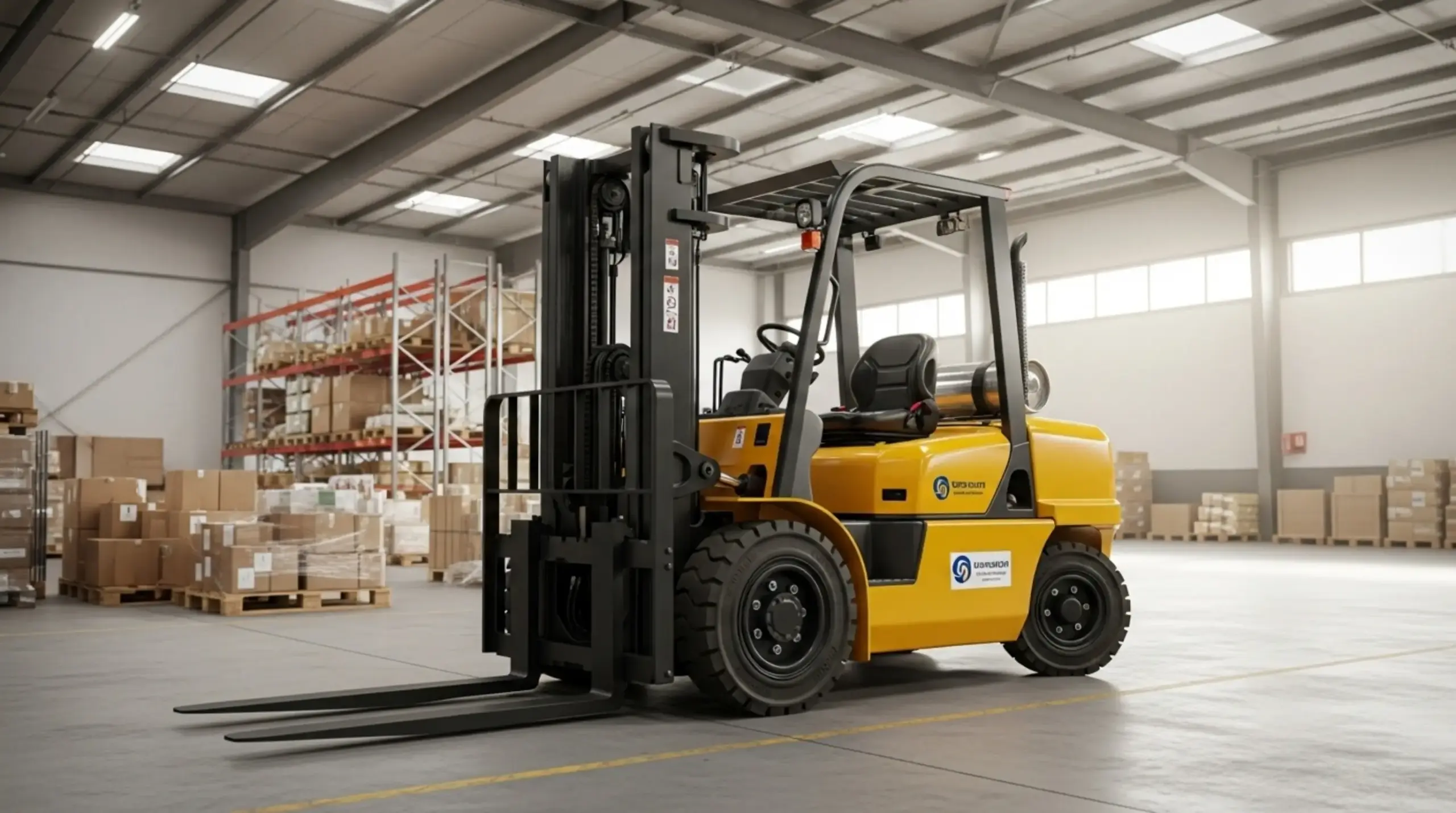
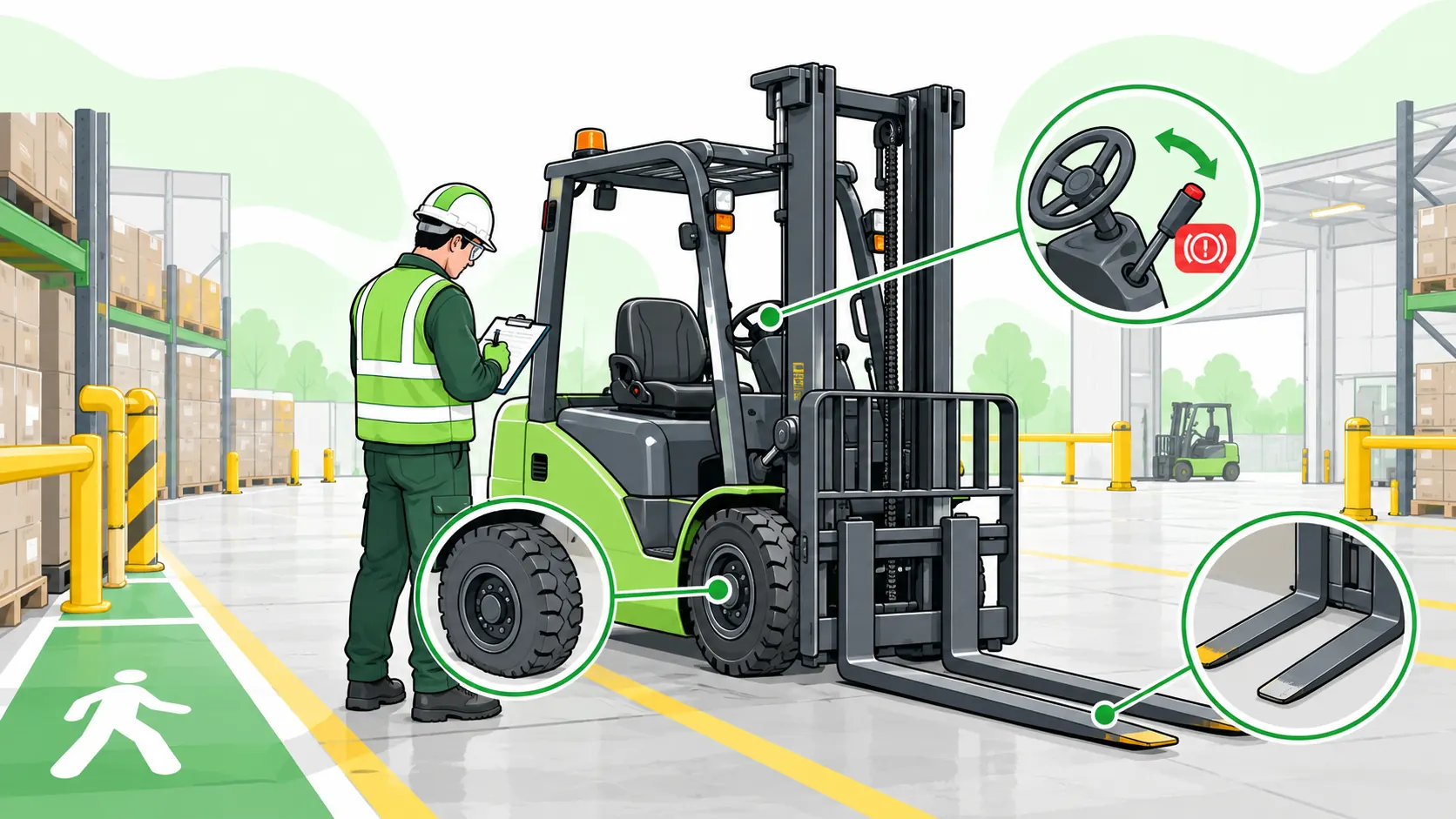
A pre-use equipment check is a quick visual and functional inspection an operator performs before each use or shift to confirm equipment is safe to operate. It covers damage, leaks, controls, brakes, and safety devices — a frontline safety duty under OSHA and UK PUWER, separate from scheduled maintenance or statutory examination.
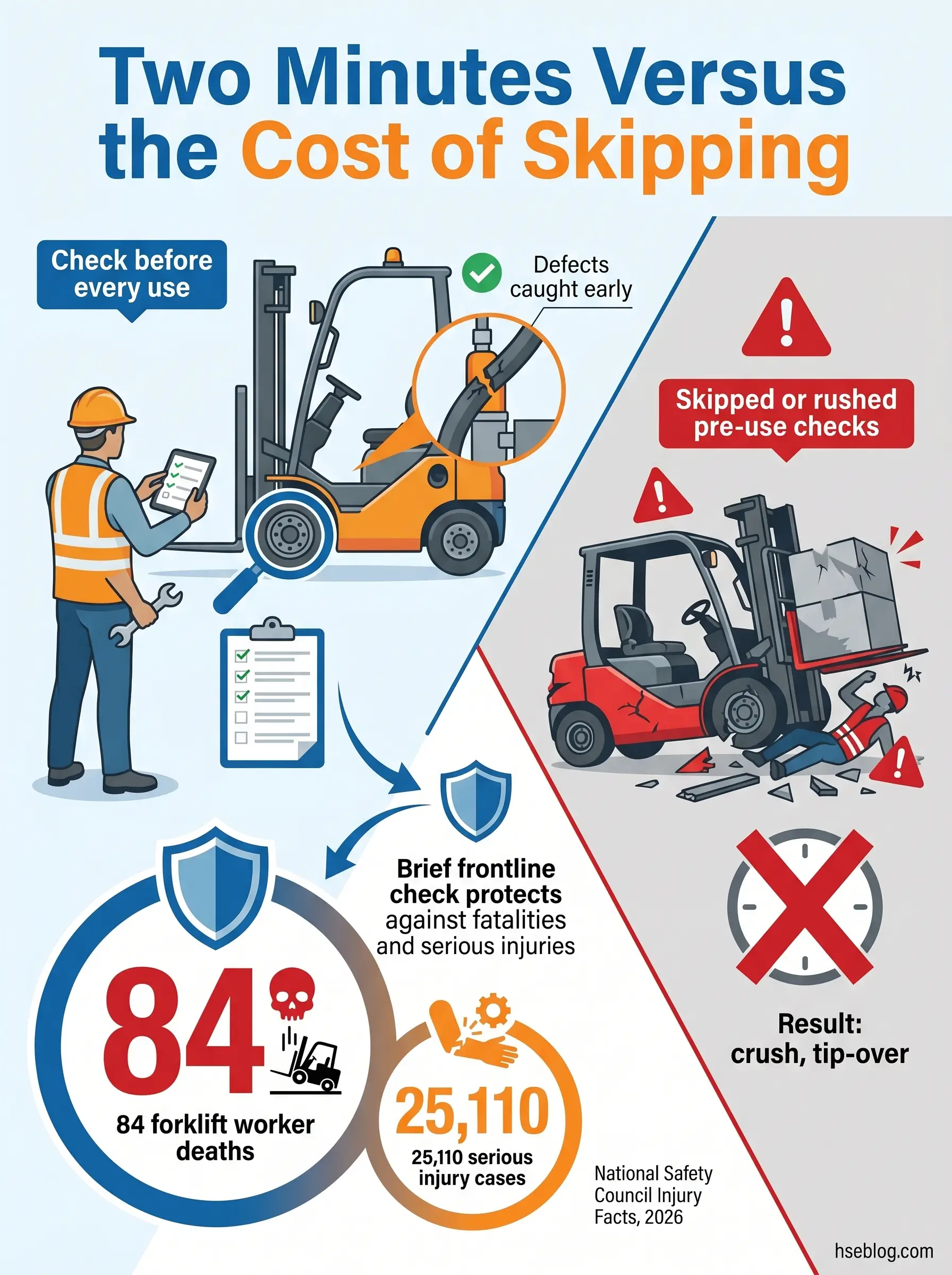
Material handling carries one of the heaviest fatality burdens in industrial work. Forklifts alone were the source of 84 worker deaths in 2024 in the US (National Safety Council Injury Facts, 2026), alongside 25,110 days-away, restricted, or transferred cases across 2023–2024.
The wider picture is just as stark. There were 5,070 fatal work injuries in the US in 2024, a rate of 3.3 per 100,000 full-time-equivalent workers (US Bureau of Labor Statistics, 2026), and transportation and material-moving occupations formed the single largest group at 1,391 deaths.
A large share of these events trace back to a defective brake, a failed emergency stop, or a cracked weld — conditions a competent operator check would have caught in minutes. Pre-use equipment checks are the cheapest, fastest control available, yet they are also the first to decay under production pressure, which is exactly why understanding them properly matters more than owning another template.
This guide separates the operator's pre-use check from formal inspection and statutory examination, sets out who is responsible and how often checks are required, walks the general method, and explains what to do when a defect surfaces — across OSHA and UK PUWER/LOLER regimes.
What Is a Pre-Use Equipment Check?
A pre-use equipment check is the operator-level confirmation that a piece of equipment is safe to operate, done before each use or shift. It is a frontline control — not a maintenance task, and not a recorded engineering inspection.
The check combines two things: a visual look for obvious damage and a functional test of the systems that keep the machine safe. It usually takes a few minutes and is performed by the person about to use the equipment.
Definition: A pre-use check (also called a pre-start, pre-operation, or pre-shift equipment check) is a visual and functional confirmation of safe condition, carried out by the operator before use. It verifies the machine is fit to run now — it does not service the machine or replace a competent person's inspection.
The duty does not depend on ownership. Owned, hired, and borrowed equipment all require the same operator equipment checks before use.
- Applies across machine classes — forklifts, MEWPs, vehicles, ladders, power tools, lifting gear, and PPE.
- Performed by the user — the person operating the equipment, who must be competent on that type.
- Quick and repeatable — minutes, not hours; designed to be done every shift without disruption.
The most common scoping error I see in practice is treating "pre-use check" and "inspection" as interchangeable words. That confusion pushes one of two failures: operators get handed what is really an engineer's job, or high-risk equipment receives only a cursory glance because the deeper inspection is assumed to have covered it.
Pre-Use Check vs Inspection vs Thorough Examination
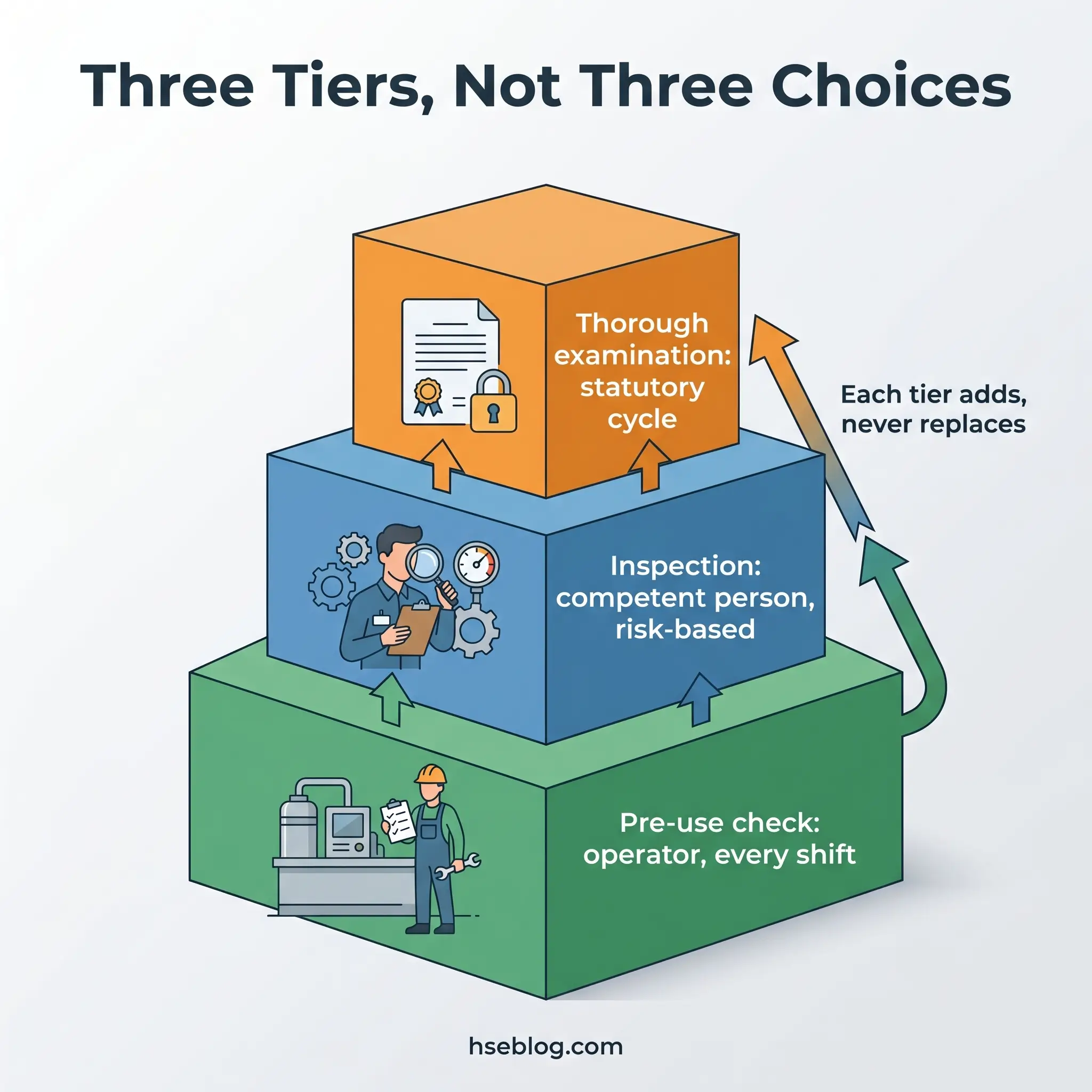
These three activities are not the same control, and conflating them is the single most expensive misunderstanding in work equipment safety checks. A pre-use check is the operator's quick confirmation; an inspection is a recorded, competent-person review; a thorough examination is a statutory exam for lifting equipment.
The cleanest way to hold them apart is by who does it, how often, whether it's recorded, and what law sits behind it.
| Pre-use check | Inspection (PUWER reg.6) | Thorough examination (LOLER reg.9) | |
|---|---|---|---|
| Who performs it | Operator (trained/competent) | Competent person | Competent person (independent judgement) |
| How often | Before each use / shift | Risk-based intervals | Statutory: ≥6 months (lifting persons & accessories), ≥12 months otherwise, or per written scheme |
| Recorded? | Often not formally recorded (UK) | Yes — findings recorded | Yes — formal report of thorough examination |
| Legal basis (UK) | Implicit under PUWER reg.4 | PUWER reg.6 | LOLER reg.9 |
| US framing | e.g. forklifts daily, 1910.178(q)(7) | Codified per equipment standard | No single "tier" — duty sits in equipment-specific standards |
A point worth stressing: the US regime does not mirror the UK's three named tiers. OSHA codifies pre-use and daily examination inside each equipment standard rather than through one overarching "inspection" concept, so the mapping above is a translation, not an exact equivalence. HSE's own guidance on operator pre-use checks under PUWER sets out the UK distinction in plain terms.
The failure mode this section exists to prevent is real and recurring. A forklift receives its statutory thorough examination once a year, and the team treats that rare deep check as if it discharges the daily duty — leaving day-to-day deterioration, the kind that kills, completely undetected between examinations.
Are Pre-Use Checks a Legal Requirement?
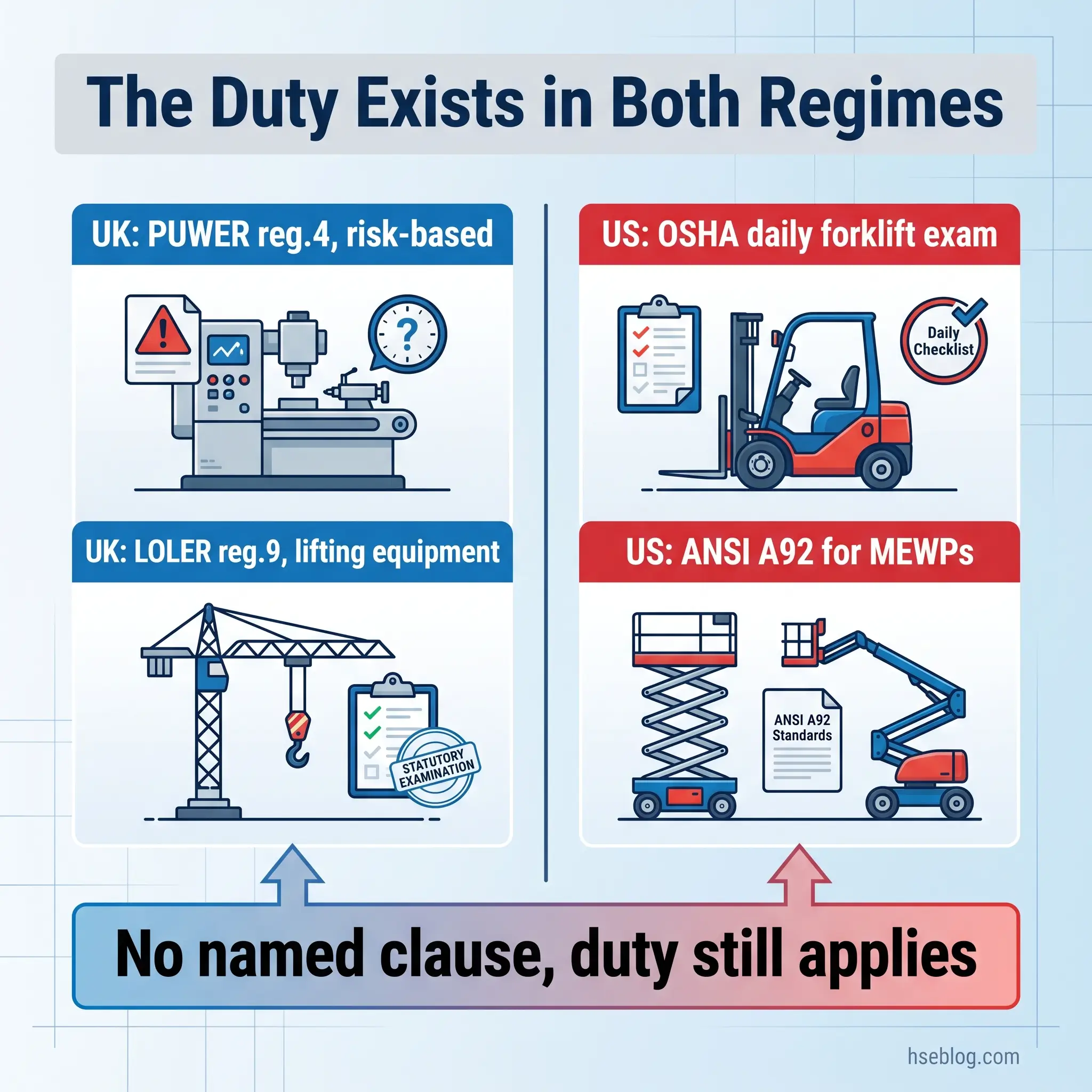
Yes — pre-use checks are a legal requirement in both the UK and US, though each regime expresses the duty differently. The obligation exists either through a specific named standard or through a general duty of care, so "no clause names my equipment" does not make the check optional.
The regulatory content here reflects general HSE professional understanding of UK and US requirements and is not legal advice. Specific compliance questions, enforcement situations, or prosecution risk should be directed to qualified legal counsel in the applicable jurisdiction. Regulatory currency: content reviewed against PUWER (L22), LOLER (L113), OSHA 29 CFR 1910.178 and 1926.453, and ANSI/SAIA A92.22-2021 as of the last-reviewed date above.
UK Duties (PUWER & LOLER)
HSE reads PUWER 1998 reg.4 as containing an implicit duty for appropriate — usually simple — operator pre-use checks of work equipment. PUWER's character is risk-based, with no fixed pre-use timeframe written into the regulation.
- PUWER reg.4 — equipment must be suitable and maintained safe in use; this underpins the pre-use check duty.
- PUWER reg.6 — higher-risk equipment whose safety critically depends on condition must be inspected at suitable, risk-based intervals by a competent person, with findings recorded.
- LOLER reg.9 — lifting equipment must be thoroughly examined by a competent person on the statutory 6/12-month cycle, or under a written scheme of examination.
The employer holds the ultimate duty in every case.
US Duties (OSHA & ANSI)
OSHA mandates pre-use and daily examination for specific equipment classes. For powered industrial trucks, 29 CFR 1910.178(q)(7) requires examination before being placed in service and at least daily — and after each shift where trucks run round-the-clock.
- Forklifts — the 1910.178(q)(7) standard text requires defects to be reported and corrected immediately, and the truck taken out of use if any condition adversely affects safety.
- Aerial lifts (construction) — 29 CFR 1926.453 ties aerial lifts to ANSI A92.2 design standards and limits operation to authorised persons.
- MEWPs — ANSI/SAIA A92.22-2021 requires a "frequent" (pre-use, before-first-use each shift) inspection plus operator familiarisation on each specific machine type and model.
- General Duty Clause — where no specific standard names the equipment, the duty to provide a safe workplace still bites.
Powered industrial trucks consistently rank among OSHA's most-cited standards, which tells you how often the daily-examination duty is missed in practice. The most common compliance misread is assuming that no named clause means no obligation — risk-assessment and general-duty requirements close that gap in both regimes.
Who Is Responsible for Pre-Use Checks?
Responsibility for pre-use checks is shared along a chain — the operator does the check, the supervisor ensures it happens, and the employer carries the ultimate legal duty. There is no single answer because the doing, the ensuring, and the owning of the duty sit with different people.
| Role | Responsibility | Key requirement |
|---|---|---|
| Operator | Performs the check before use | Trained and competent on that specific equipment type/model |
| Supervisor / manager | Ensures checks happen; actions defects | Verifies checks aren't quietly dropped under pressure |
| Employer | Holds ultimate legal duty | Sets up the system, training, and defect-reporting process |
| PPE wearer | Checks their own gear | Inspects fit and condition before each use |
The accountability gap opens when checks become "everyone's job." Without a named owner per shift, the check quietly stops being done while each person assumes someone else handled it — a pattern that shows up repeatedly in the published incident record after a defect-related event.
How to Perform a Pre-Use Equipment Check (General Method)
Competent-person caveat: This article provides general HSE knowledge. Life-critical work such as operating forklifts, MEWPs, and lifting equipment must be planned and supervised by a competent person with relevant training, jurisdiction-specific authorisation, and a site-specific risk assessment. The information here does not replace that.
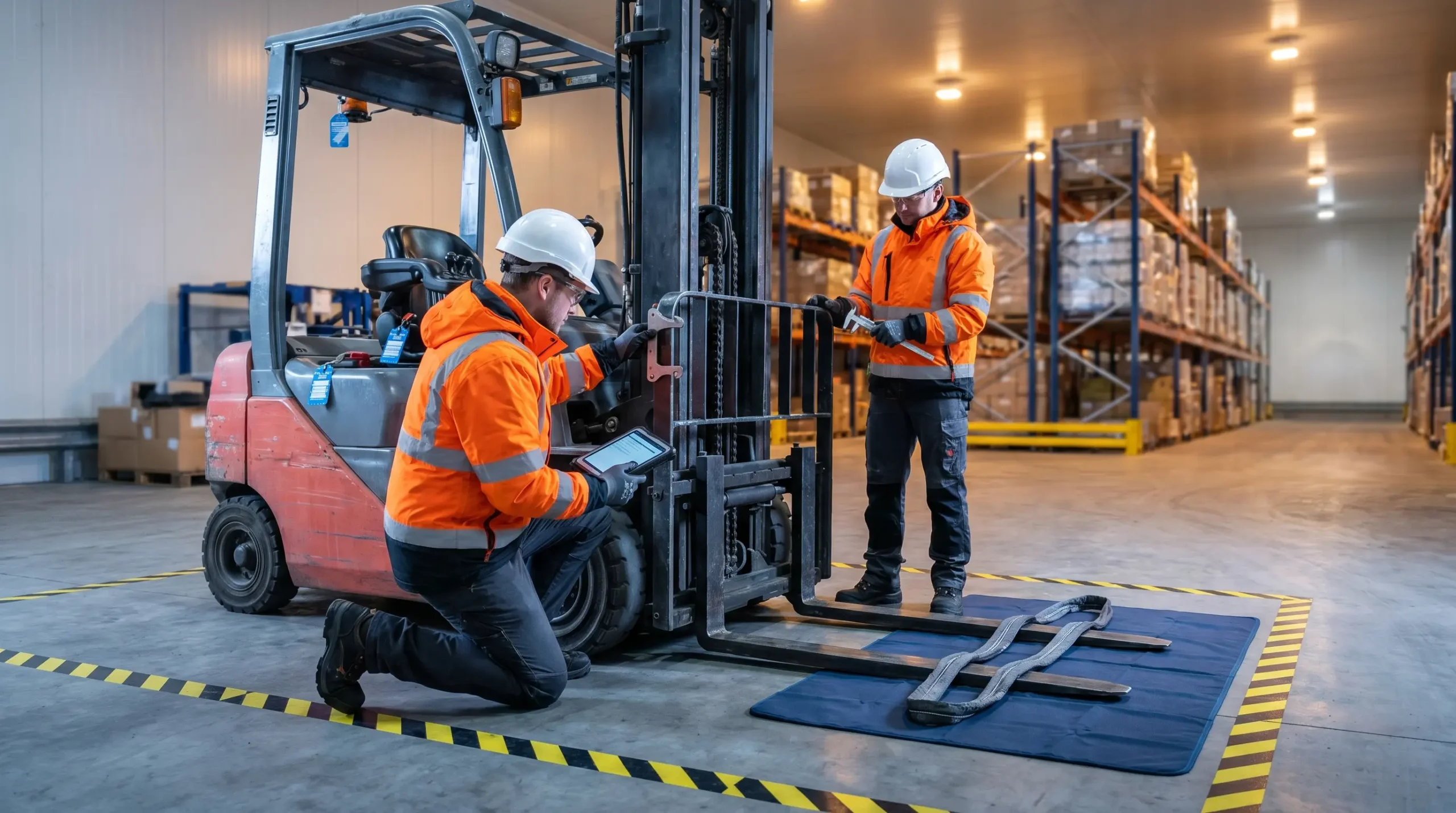
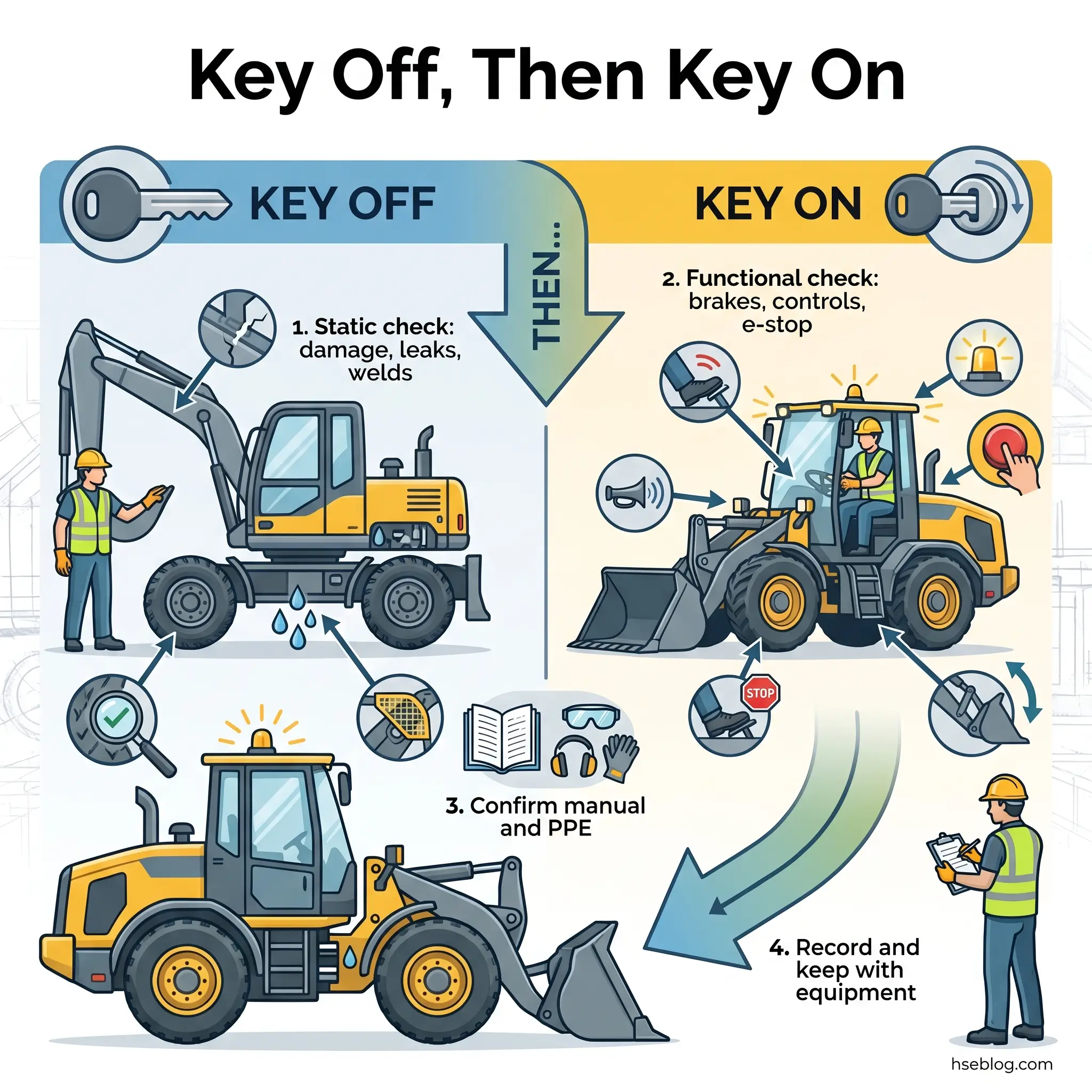
A sound pre-use check follows the same two-stage logic regardless of machine: a static look with the key off, then a functional test with the key on. Anchor every step to the manufacturer's manual, which defines the model-specific items no generic checklist can capture. OSHA's pre-operation forklift inspection guidance models this key-off/key-on approach well.
- Static (key-off) visual check — inspect for damage, leaks, and fluid levels; check tyres or tracks, guards, the data plate, attachments, and structural welds.
- Functional (key-on/operational) check — test brakes, steering, controls, lights, horn or travel alarms, the emergency stop, and hydraulics through their range.
- Confirm documentation — operator manual present, prior defect log reviewed, and required PPE or fall protection in place.
- Record the result — where the system requires it, log the outcome and keep the record with the equipment.
The pattern that undermines this method is the "walk-around only" check that skips the functional test. Many of the failures that kill — brake loss, a dead emergency stop, a silent reversing alarm — are completely invisible until the machine is energised, so a static-only inspection gives false confidence.
What to Do When a Defect Is Found
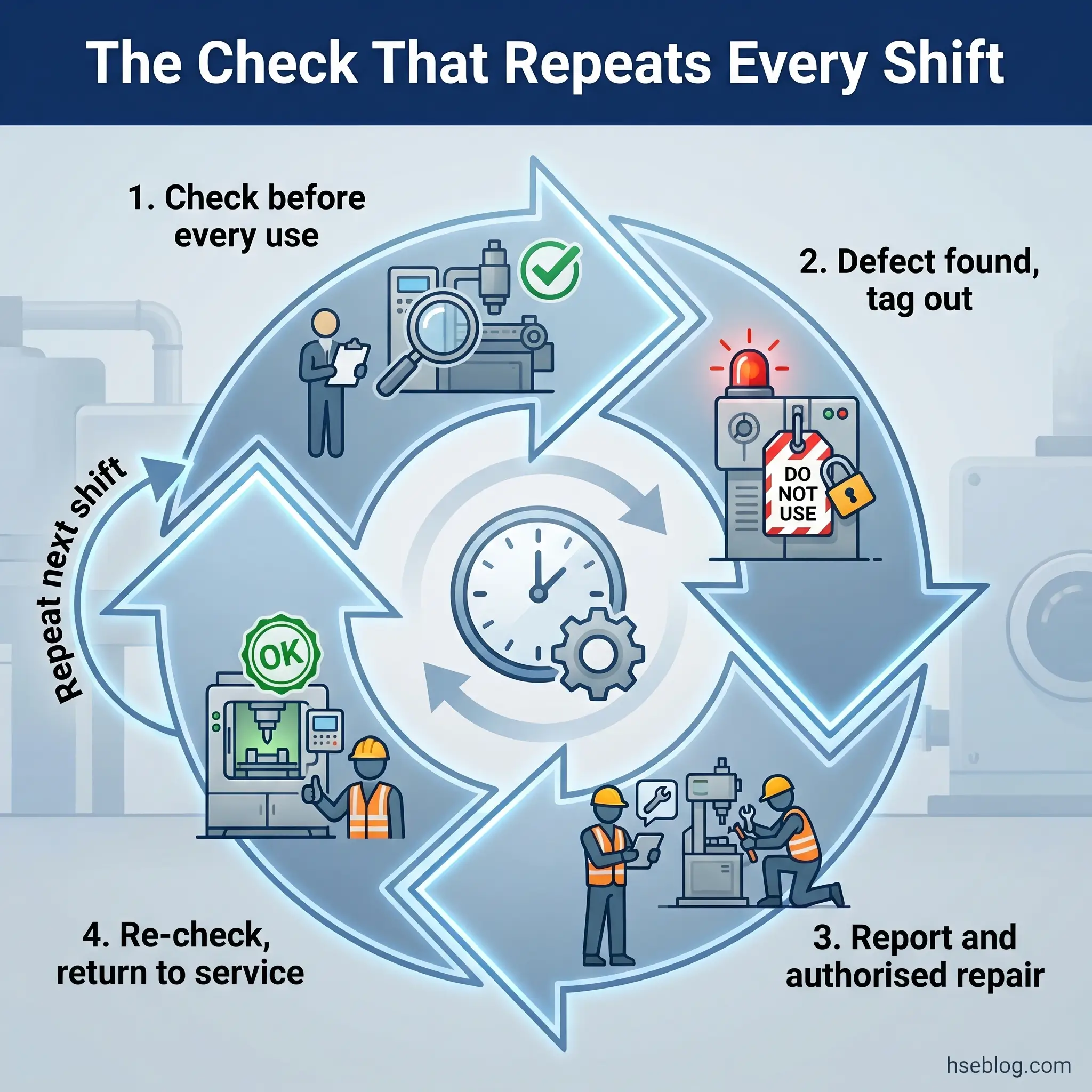
When a defect is found during a pre-use check, the equipment comes out of service — stop, tag, report, and do not run it. This is a safety-critical decision branch, not a footnote, and "fix it and carry on" is the wrong instinct unless you are trained and authorised to repair.
- Stop and isolate — do not operate the equipment; park or position it safely and remove the key where applicable.
- Tag it out — apply a clear "DO NOT USE / DANGER – DO NOT OPERATE" tag so no one else starts it. Where energy isolation is involved, this links directly into lock-out/tag-out.
- Report and record — notify the supervisor and enter the fault on the defect reporting log.
- Repair through authorised persons only — a trained or authorised person carries out the fix, and the equipment is re-checked before it returns to service.
Warning: A check has no value if the out-of-service step is negotiable. The most common failure I see is a defect logged honestly, then the machine kept running because "it's only a small leak" or "we need it for this one job."
That negotiable-out-of-service pattern is where pressure-to-produce quietly defeats the whole control. The tag exists precisely so the decision to stop does not depend on who is shouting loudest on the day.
How Often Should Equipment Be Checked Before Use?
The safe default is before each use or at the start of each shift — and that frequency is honestly different by jurisdiction and equipment. "Before every use" satisfies the most demanding of the three regimes and is defensible anywhere.
| Standard / regime | Pre-use frequency | Character |
|---|---|---|
| UK PUWER | No fixed timeframe | Risk-assessment-driven |
| OSHA 1910.178 (forklifts) | At least daily / each shift | Mandatory, equipment-specific |
| ANSI/SAIA A92 (MEWPs) | Before first use each shift | "Frequent" inspection + familiarisation |
| Best-practice default | Before every use | Documented pre-shift check |
The three regimes set different intervals for the same hazard, so where they conflict, publish to the stricter standard. Periodic and statutory inspections sit on top of pre-use checks — never instead of them.
There is also a frequency error that runs the other way. Overly long, multi-page daily forms on low-risk kit drive the "tick-box collapse," where operators sign without looking — so right-sizing the check to the actual risk is itself a safety control, not just an efficiency one.
Common Equipment Types and Their Specific Pre-Use Checks
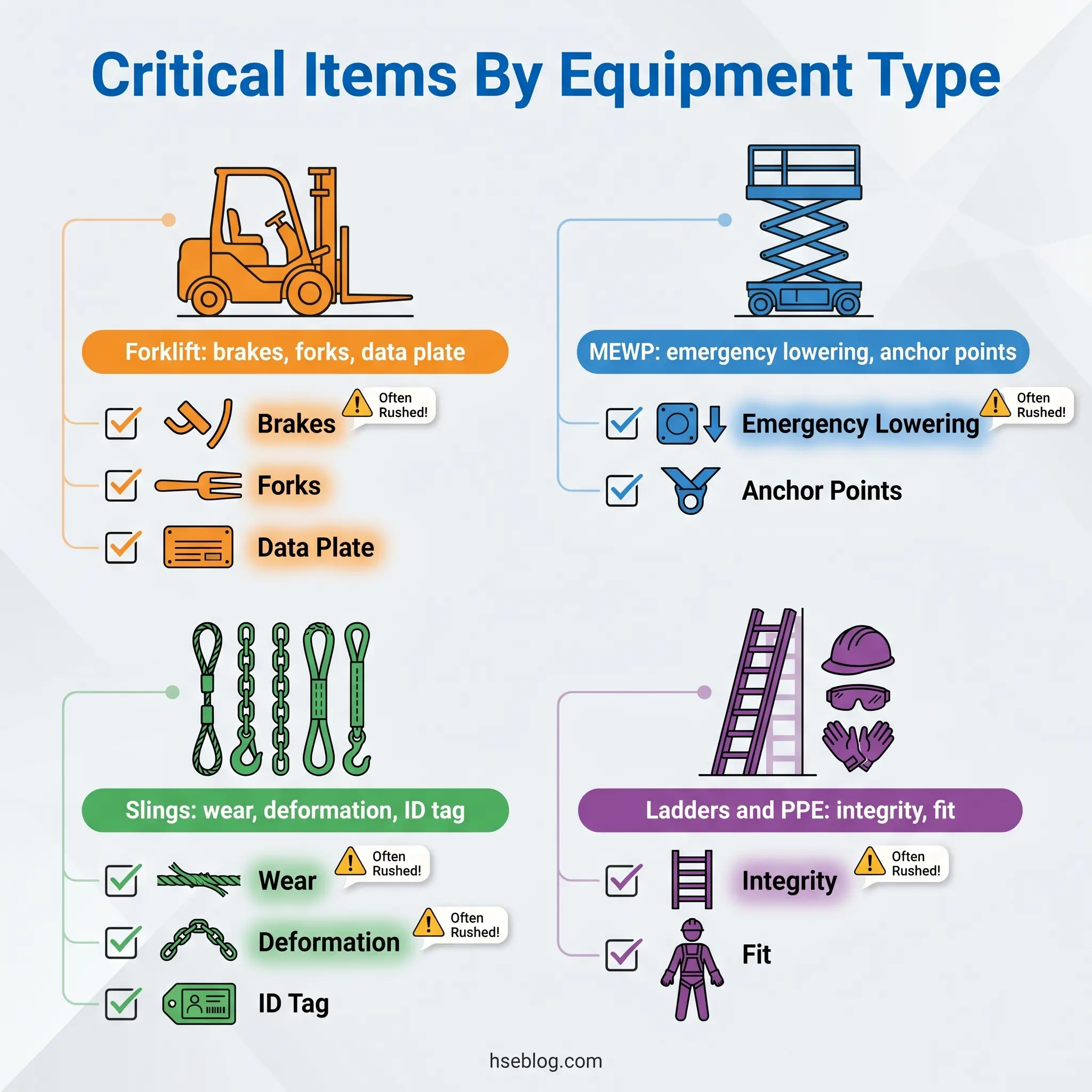
Different machine classes fail in different ways, so pre-use checks must be tailored to the equipment in hand. Across all of them, one lesson holds: the items that cause fatalities are consistently the ones rushed or skipped because they take longest to verify.
Forklifts / Powered Industrial Trucks
- Mast, forks, and chains — wear, cracks, twisted or worn forks, chain tension and damage.
- Brakes, steering, and horn — full functional test before travel.
- Data plate and tyres — legible capacity plate; tyre condition and pressure.
MEWPs / Aerial Lifts
- Guardrails and anchor points — secure, complete, undamaged fall-protection fixings.
- Emergency lowering and function test — confirmed working before anyone is lifted.
- Outriggers and ground conditions — deployment, level, and load-spreading.
Lifting Equipment & Accessories
- Slings, chains, eyebolts — wear, deformation, and legible identification.
- Thorough-examination status — within the LOLER reg.9 statutory cycle, with a current report of examination.
Ladders, Access Equipment, Power Tools & PPE
- Ladders/access — stiles, rungs, feet, and locking mechanisms.
- Power tools — guards, cables, and casing integrity.
- PPE — fit, expiry, and damage, checked by the wearer before use.
The cross-class pattern is consistent: brakes, emergency stop and lowering, structural welds, and fall-protection anchors are the high-consequence items, and they are the ones most often skipped under time pressure.
Frequently Asked Questions
Is a pre-use check the same as a thorough examination?
No. A pre-use check is a quick safety confirmation by the operator before use; a thorough examination under LOLER reg.9 (UK) is a statutory exam of lifting equipment by a competent person on a fixed 6- or 12-month cycle. One cannot substitute for the other — they sit on different legal tiers and answer different questions about the equipment's condition.
Do pre-use equipment checks legally have to be written down?
It depends on the regime. In the UK, pre-use checks are often not required to be formally recorded, while PUWER reg.6 inspections must be. OSHA expects documentation for forklift and heavy-equipment examinations. Regardless of the minimum, I'd record pre-use checks anyway — an honest, contemporaneous defect reporting log is your strongest evidence if an incident is investigated later.
Can I do a pre-use check on equipment I'm not trained on?
No. The operator must be trained and competent — and familiarised on that specific type and model. ANSI/SAIA A92.24 requires model-specific MEWP familiarisation, and PUWER imposes training duties. Knowing how to drive one forklift does not make you competent to check a different machine, because the safety-critical items and controls vary between models.
Who is liable if equipment fails after a pre-use check was signed off?
Liability is usually shared and fact-dependent — this is not legal advice. The operator, supervisor, employer, and sometimes the manufacturer or hirer can all bear responsibility, depending on whether the check was adequate, honest, and properly actioned. A signature on a tick-box form does not transfer liability if the check was rushed or the defect was knowingly ignored.
Are pre-use checks required for hired or borrowed equipment?
Yes. The duty follows the using business and operator, not the owner. UK PUWER applies explicitly to equipment regardless of who owns it, and the US employer duty operates the same way. Hiring in a forklift or MEWP does not outsource the responsibility to check it is safe before each use.
What's the difference between a pre-use check and preventive maintenance?
A pre-use check confirms the equipment is safe to use now; preventive maintenance is scheduled servicing to stop failures developing in future. They serve different purposes and run on different cycles. Neither replaces the other — a freshly serviced machine can still develop a defect overnight, which is exactly what the next pre-use check is there to catch.
Conclusion
The industry's recurring mistake is not failing to know what to check — templates are everywhere — it is letting the check decay into a signature. A pre-use equipment check only works while three things hold: the functional test isn't skipped, a named person owns the duty each shift, and the out-of-service decision stays non-negotiable when a defect appears.
If there is one highest-impact change to make, it is right-sizing the check to the risk and then defending the stop. Over-long forms breed tick-box collapse on low-risk kit; negotiable tag-out destroys the control on high-risk kit — and both failures are entirely within a site's power to fix without buying anything. The 2021 ANSI/SAIA A92.22 revision tightened pre-use and familiarisation expectations for MEWPs, and the BLS shift to a new injury classification system from the 2023 data year is reshaping how fatality trends are read (US Bureau of Labor Statistics, 2026), so the compliance picture keeps moving even where the equipment doesn't.
Build the system so the check survives a bad day, route your operators through recognised training pathways such as NEBOSH, IOSH, or OSHA outreach for their equipment class, and treat the pre-use equipment check as the frontline control it is — the last thing standing between a known defect and the person who has to operate the machine.