Cryogenic burns are cold-contact injuries caused by liquids and surfaces below roughly −150°C, such as liquid nitrogen at −196°C. First aid means moving the person clear, loosely covering the area, and rewarming slowly with lukewarm water — never hot water, rubbing, or dry heat — followed by prompt medical assessment regardless of how minor the burn appears.
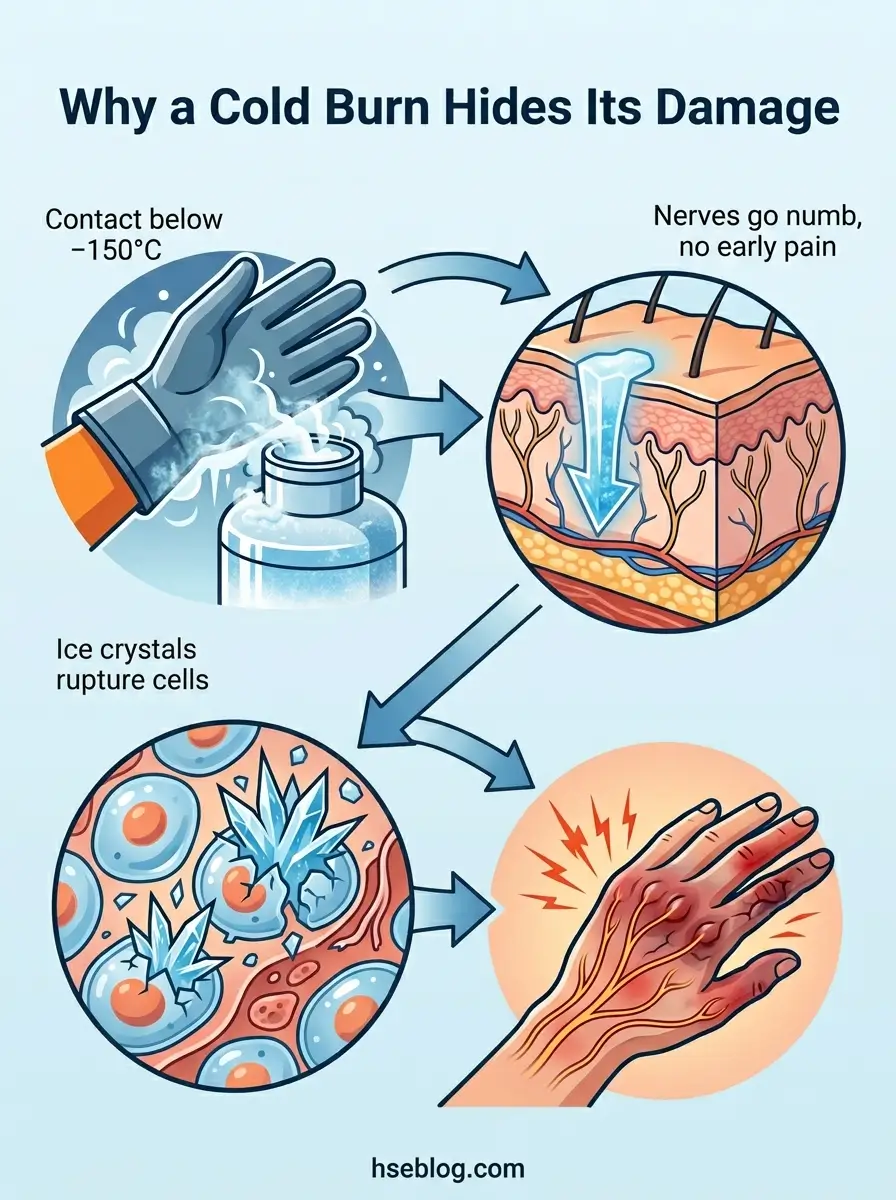
Liquid nitrogen sits at about −196°C, and liquid helium at roughly −269°C (NIST cryogenics data). Splash either on bare skin and the first sensation is almost nothing — a flash of cold, then numbness, because tissue stops signalling pain at low temperatures. That silence is the dangerous part: the injury is progressing while the body's alarm system has gone quiet.
A cryogenic burn is a freezing injury, not a heat injury, yet it destroys tissue through the same end result — dead cells, blisters, and in severe cases tissue that must be removed. This article covers how cryogenic burns happen, the first-aid sequence that actually limits damage, the genuine disagreement between "do nothing" and "rewarm" guidance, the prevention controls that work, and the oxygen-displacement co-hazard that kills far more people than the burns themselves.
How cryogenic burns destroy tissue before you feel them
The damage is mechanical, not thermal in the way a flame is. When skin contacts a cryogen, water inside and around the cells freezes, and the expanding ice crystals tear cell membranes apart.
That structural damage does not reverse on thawing. The Canadian Centre for Occupational Health and Safety notes that frozen skin appears waxy and yellow, carries no initial pain, and becomes intensely painful only as the tissue thaws (CCOHS, OSH Answers).
Three properties make these injuries deceptive on site:
- Numbness masks severity. Below roughly 7°C, tissue stops registering pain, so a worker can sustain a deep burn and feel only cold. Berkeley Lab's safety guidance describes two cryogenic burns at the facility where neither injured person recognised the injury at the time because of the numbness.
- Skin sticks to cold metal. Bare skin freezes to uninsulated pipework, valves, or tools cooled by cryogenic liquid, then tears when pulled away.
- Vapour and splash reach delicate tissue. Cold boil-off gas that would not mark the hands or face can still damage the eyes, where exposure tolerance is far lower.
Different cryogens reach different temperatures, and that changes how fast a burn develops on contact.
| Cryogen | Boiling point at 1 atm | Practical note |
|---|---|---|
| Liquid helium | −269°C (−452°F) | Coldest common cryogen; inert asphyxiant |
| Liquid hydrogen | −253°C (−423°F) | Flammable as well as cold |
| Liquid nitrogen | −196°C (−321°F) | Most widely used; inert asphyxiant |
| Liquid argon | −186°C (−303°F) | Inert; vapour heavier than air |
| Liquid oxygen | −183°C (−297°F) | Accelerates combustion; reacts with oils |
Boiling points per NIST cryogenics reference data.
The practical reading for a site team is simple: any surface that has carried a cryogenic liquid should be treated as a burn hazard until it has fully warmed and stopped condensing fog, not just while liquid is visibly present.
First aid for cryogenic burns: the first few minutes
This article provides general HSE knowledge. Life-critical first aid for cryogenic and cold-contact injuries must be planned and supervised by a competent first-aider with relevant training, jurisdiction-specific authorisation, and a site-specific emergency plan. The information here does not replace that.
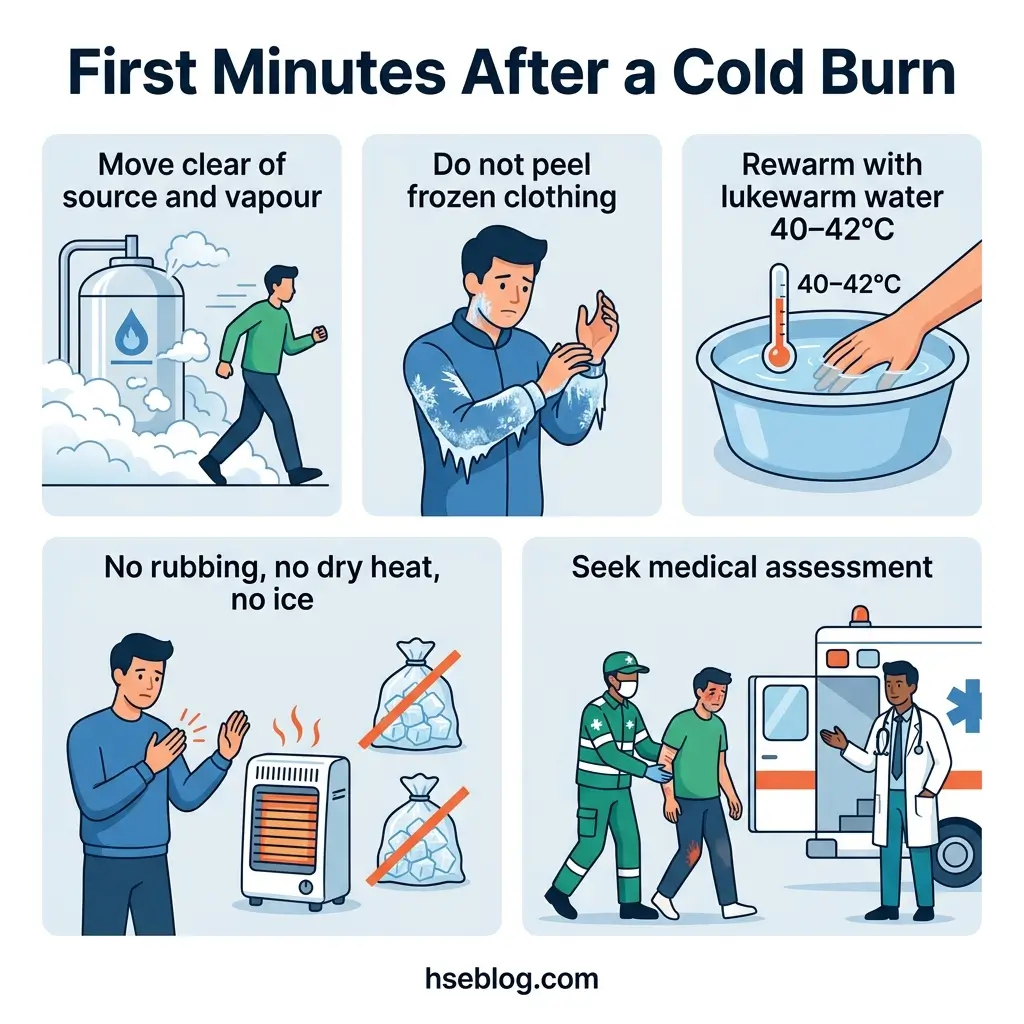
The goal in the first minutes is to stop further freezing and start gradual rewarming without adding injury. Work through this sequence:
- Remove the person from the source. Get them away from spilled liquid, the cold equipment, and any vapour cloud before assessing the burn. If a release is ongoing, treat the area as potentially oxygen-deficient and do not enter without monitoring.
- Do not remove frozen clothing. If a glove, sleeve, or boot has frozen to the skin, leave it in place and cut around it. Pulling it free strips the skin with it.
- Loosen, don't strip. Free up clothing around the area to keep circulation unrestricted, but only where it isn't frozen to tissue.
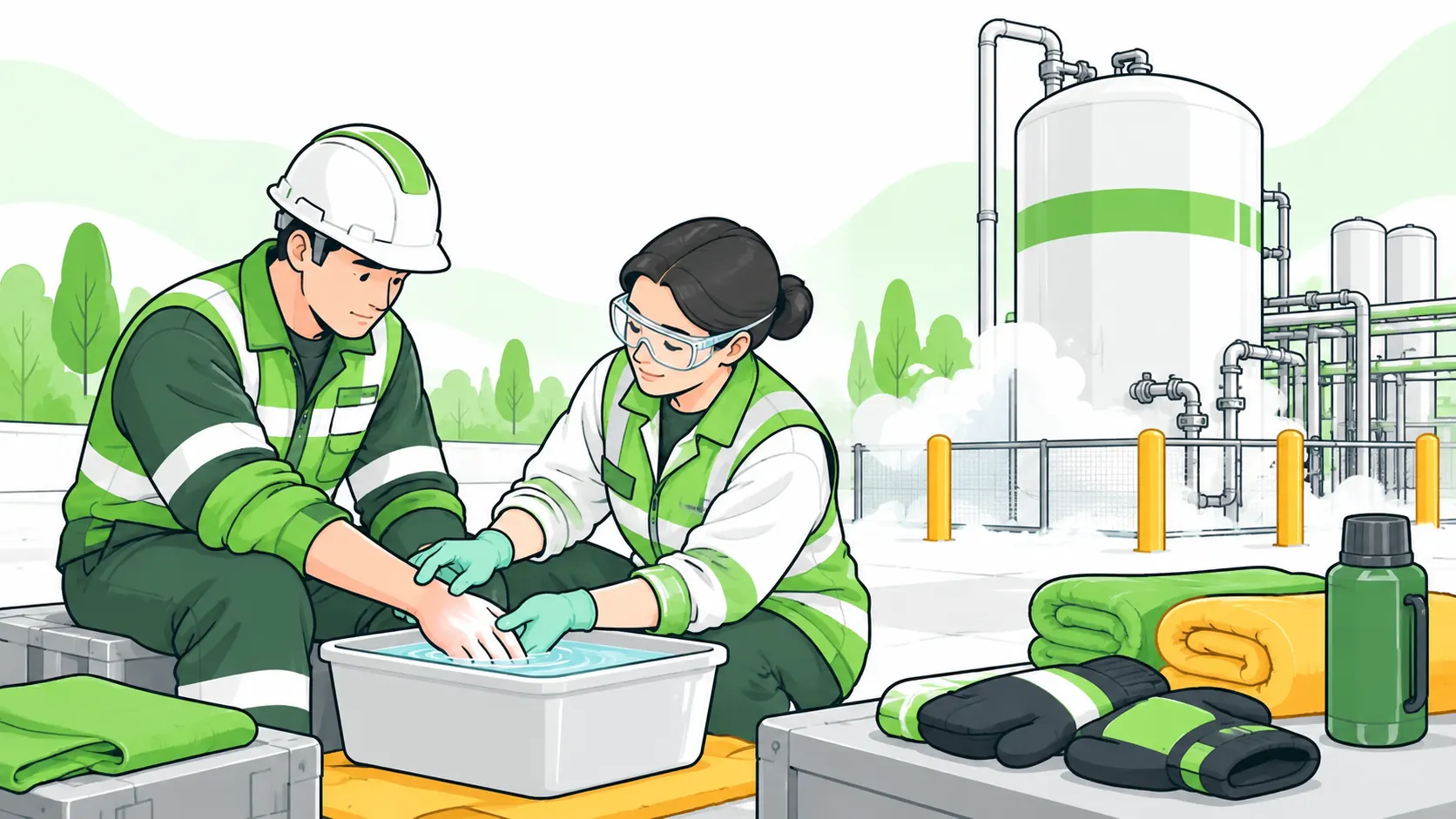
- Rewarm gradually with lukewarm water. Use water around 40–42°C (104–108°F). Several EHS and standards bodies cap this near 40–45°C; STFC's first-aid guidance warns that anything above about 45°C will add a heat burn on top of the cold injury.
- Flush eyes for 15 minutes. For splashes to the eyes, irrigate with tepid water for at least 15 minutes and arrange urgent medical care — cryogenic eye injuries can cost vision (Berkeley Lab EHS guidance).
- Cover loosely and get medical help. Once thawed, cover with a sterile, non-adherent dressing and seek medical assessment for every cryogenic burn, however minor it looks.
What must never happen during first aid:
- No dry heat — no heaters, hair dryers, or open flame on the area.
- No rubbing or massage — friction shears already-damaged tissue.
- No snow, ice, or refreezing — only rewarm if there's no chance the part will freeze again.
- No ointments in the field — they complicate later clinical assessment.
Content covering tissue injury, rewarming, and burn treatment here is for HSE practitioner reference. It is not medical advice. Anyone with a suspected cryogenic burn, eye exposure, or symptoms of hypothermia should be assessed by an occupational physician or emergency clinician.
"Do nothing" versus "rewarm": resolving the conflicting first-aid advice
If you compare authoritative guidance, you'll hit an apparent contradiction, and it confuses a lot of responders. It's worth resolving directly, because picking the wrong approach can worsen the injury.
Where the guidance diverges
The US Department of Energy's hydrogen safety resource (H2tools, maintained by PNNL) takes a deliberately minimal line: treatment of frozen tissue needs medical supervision, and the safest field action is often to protect the area with a loose cover and transport the casualty, because incorrect first aid reliably makes the injury worse.
Industry and laboratory guidance from sources such as EIGA, BCGA, and university EHS programmes instead describes active gradual rewarming with lukewarm water. Both can be correct — they're answering slightly different questions.
How to reconcile them
The judgment call comes down to two variables: control over the rewarming environment, and risk of refreezing.
- Choose minimal intervention when you can't guarantee controlled, contamination-free lukewarm water, when transport to definitive care is fast, or when there's any chance the part will refreeze. Loosely cover and move.
- Choose gradual rewarming when you have clean lukewarm water at a controlled temperature, no refreezing risk, and a delay before medical care. Rewarm slowly and never with heat.
The unifying principle behind every credible source is the same: do nothing that freezes the tissue again, and nothing that adds a heat burn. Rapid or hot rewarming, rubbing, and refreezing are what turn a recoverable injury into a permanent one.
Preventing cryogenic burns: PPE, engineering, and handling discipline
Most cryogenic burns trace back to a missing barrier or a rushed transfer, not bad luck. Prevention sits in three layers — engineering controls, PPE, and handling practice — and the strongest gains come from the first layer.
Engineering and the work environment
- Closed, insulated transfer. Use vacuum-jacketed lines and proper phase-separators so liquid and cold vapour stay contained during filling and decanting.
- Splash control and slow filling. Boiling and splashing are worst when warm containers or objects meet the liquid; charge containers slowly and lower objects in with tongs, never bare hands.
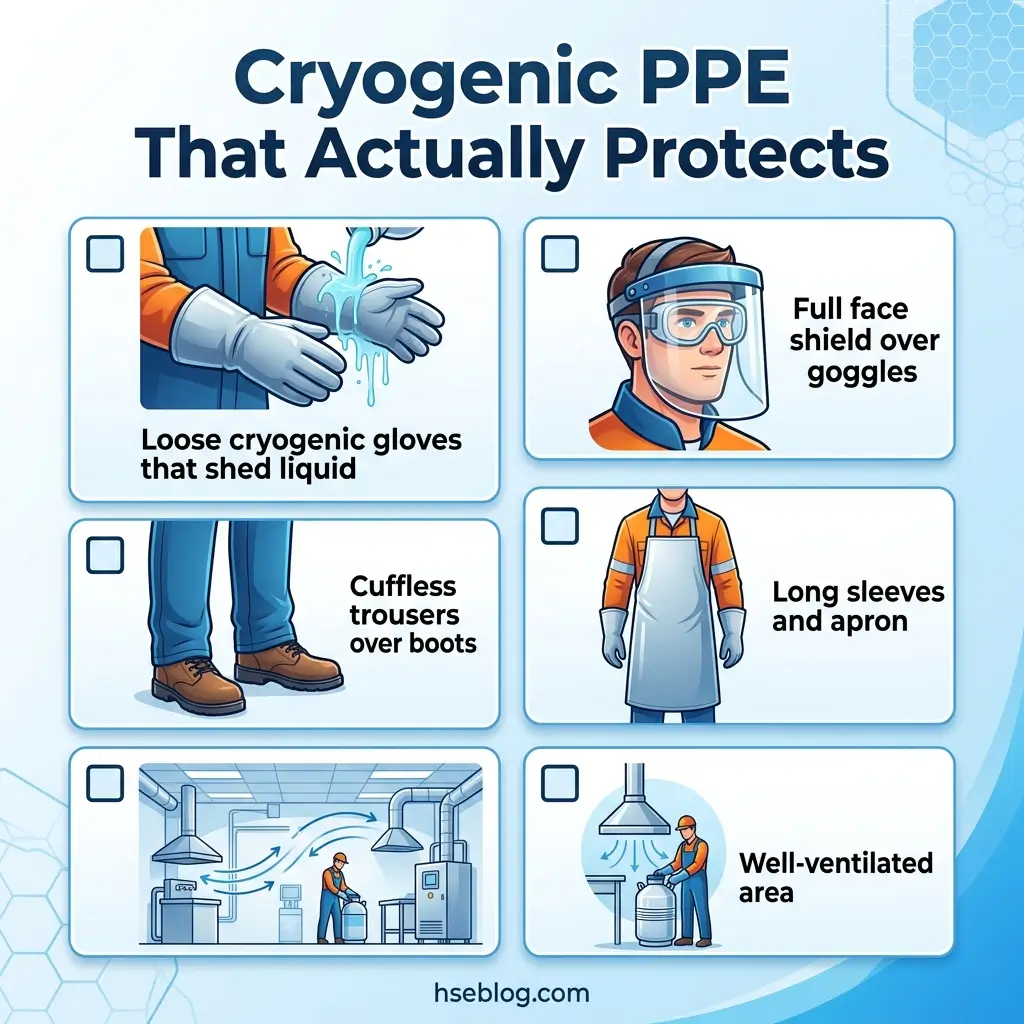
- Ventilation and oxygen monitoring. Use and store cryogens in well-ventilated areas, and fit fixed oxygen monitoring where vapour can accumulate — this protects against the asphyxiation co-hazard as well as cold exposure.
PPE that actually protects
- Loose-fitting cryogenic gloves, not tight ones. Gloves must shed instantly if liquid gets inside. A tight gauntlet that traps spilled cryogen against the skin causes a worse burn than no glove at all — a point EIGA's PPE guidance and university handling procedures both stress.
- Full face shield over safety goggles. The eyes need a barrier against splash and cold vapour; a shield alone is not enough.
- Cuffless trousers worn over the boots. Trousers should never be tucked in, so liquid runs off rather than pooling in a boot or cuff.
- Lab coat or apron and long sleeves to keep splash off the torso and forearms.
Handling discipline
These habits are where applied practice matters more than the written procedure. Under OSHA's general PPE rule (29 CFR 1910.132, US), the employer must assess the hazard and provide suitable protection — but the assessment only works if the loose-glove and cuffless-trouser logic is actually taught, not just listed. Auditors typically test this by watching a real transfer, not by reading the risk assessment.
The co-hazard that kills more often: oxygen displacement
A cryogenic burn rarely kills. The gas that the same liquid produces does — and it does so silently.
Why the vapour is lethal
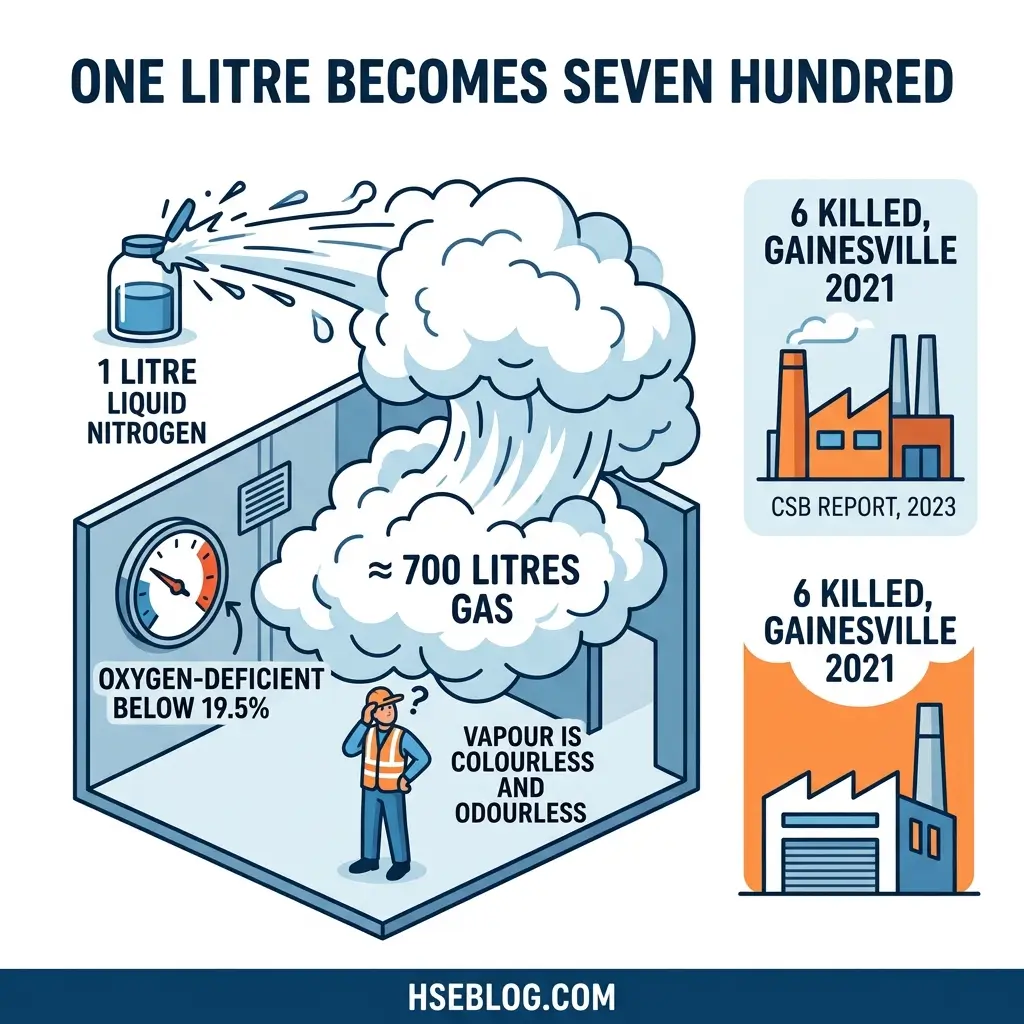
Cryogenic liquids expand enormously as they warm. One litre of liquid nitrogen becomes roughly 700 litres of gas at room temperature (NIST expansion data near 696:1). In an enclosed space, that gas pushes breathable air out and drops the oxygen concentration below the 19.5% minimum OSHA defines as oxygen-deficient (US). The vapour is colourless and odourless, so there is no warning before a person loses consciousness.
A published case that should change how teams respond
On 28 January 2021, a liquid nitrogen release at the Foundation Food Group poultry plant in Gainesville, Georgia, killed six workers and seriously injured three more employees and a firefighter. The US Chemical Safety and Hazard Investigation Board's final report, released in December 2023, traced the release to a bent bubbler tube that disabled the freezer's level control, allowing nitrogen to overflow and vaporise into a four-to-five-foot-high cloud (CSB Investigation Report 2021-03-I-GA).
The detail every responder should absorb: the CSB found that at least 14 workers entered the area to investigate or rescue colleagues, and several died doing so because they did not recognise the invisible vapour as deadly. OSHA cited the company for 26 violations, including six wilful, with penalties of about $595,000 (US).
The lesson carries directly into burn response. The instinct to rush in and help is exactly what the Gainesville record warns against — clear the atmosphere and confirm oxygen levels before anyone approaches a cryogenic spill, even to treat a burn.
What the standards require — and the regulatory gap
Cryogenic burn and asphyxiation hazards are governed by a patchwork rather than one dedicated rule, and the gaps matter for compliance.
| Standard / body | Jurisdiction | What it covers |
|---|---|---|
| OSHA 29 CFR 1910.132 / .133 / .138 | US | General PPE, eye/face, and hand protection — no cryogen-specific clause |
| NFPA 55, Compressed Gases and Cryogenic Fluids Code | US (consensus) | Storage, handling, and ventilation requirements |
| CGA P-12 / ANSI-CGA P-18 | US (consensus) | Safe handling of cryogenic liquids; bulk inert gas systems |
| BCGA guidance (under HSWA / COSHH) | UK | Cryogenic handling, PPE, and cold-burn first aid |
| EIGA Doc 136 and cold-burn guidance | EU | PPE selection and first-aid procedures |
| CCOHS OSH Answers | Canada | Hazard awareness and safe-work practices |
The honest reading is that the US has no dedicated OSHA cryogenic standard. The CSB's December 2023 final report specifically recommended that OSHA issue a national standard addressing cryogenic asphyxiants such as liquid nitrogen, and asked the Compressed Gas Association and NFPA to strengthen their guidance — a recommendation it would not have made if a comprehensive rule already existed.
Regulatory content here reflects general HSE professional understanding of the cited jurisdictions' requirements as of mid-2026. It is not legal advice. Specific compliance, enforcement, or prosecution questions should go to qualified legal counsel in the applicable jurisdiction.
For now, the practical compliance position is to build cryogenic burn and asphyxiation controls from the consensus codes (NFPA 55, CGA P-12, EIGA guidance) layered onto general PPE and duty-of-care obligations, rather than waiting for a single bespoke regulation.
Frequently Asked Questions
Is a cryogenic burn the same as frostbite?
They overlap but aren't identical. Frostbite usually develops from prolonged exposure to cold air or surfaces, while a cryogenic burn is a rapid freezing injury from contact with an ultra-cold liquid, vapour, or cooled equipment. CCOHS notes both produce waxy, painless skin that becomes intensely painful on thawing, and both need medical evaluation.
Can you treat a minor liquid nitrogen burn at home?
No cryogenic burn should be self-managed as routine. Even a small one can be deeper than it looks because numbness masks the damage, and the depth often becomes clear only after thawing. Rewarm gently with lukewarm water if there's no refreezing risk, then have it assessed clinically.
Why shouldn't you rub a cold burn to warm it up?
Rubbing feels intuitive but it shears tissue that ice crystals have already weakened, deepening the injury. The same applies to dry heat and hot water, which add a thermal burn on top of the freezing damage. Slow, passive rewarming with lukewarm water is the only safe method.
What's more dangerous, the burn or the gas?
In enclosed spaces, the gas. One litre of liquid nitrogen expands to roughly 700 litres of colourless, odourless gas (NIST), and it can drop oxygen below the 19.5% OSHA deficiency threshold without warning. The 2021 Gainesville incident killed six people by asphyxiation, not by burns.
Are liquid nitrogen burns becoming more common outside industry?
Occupational cryogenic burns remain rare, but clinicians have reported a rise in injuries from recreational use — liquid nitrogen added to drinks or food, causing burns to the mouth and digestive tract. It's an emerging edge case driven by novelty food trends rather than a workplace exposure.
Do you need a face shield if you're only pouring a small amount?
Yes. Brief vapour or splash exposure that wouldn't mark your hands can still damage the eyes, which tolerate far less cold. A full face shield worn over safety goggles is standard for any open transfer, regardless of volume.
Conclusion
The recurring failure in cryogenic burn cases isn't ignorance of the cold — it's the assumption that you'll feel the injury and react in time. You won't, because the same low temperature that freezes the tissue also silences the nerves, which is why numbness should be read as a warning, not reassurance. The single highest-impact change most teams can make is to treat every cold sensation around cryogens as a possible burn and every spill as a possible oxygen-deficient atmosphere.
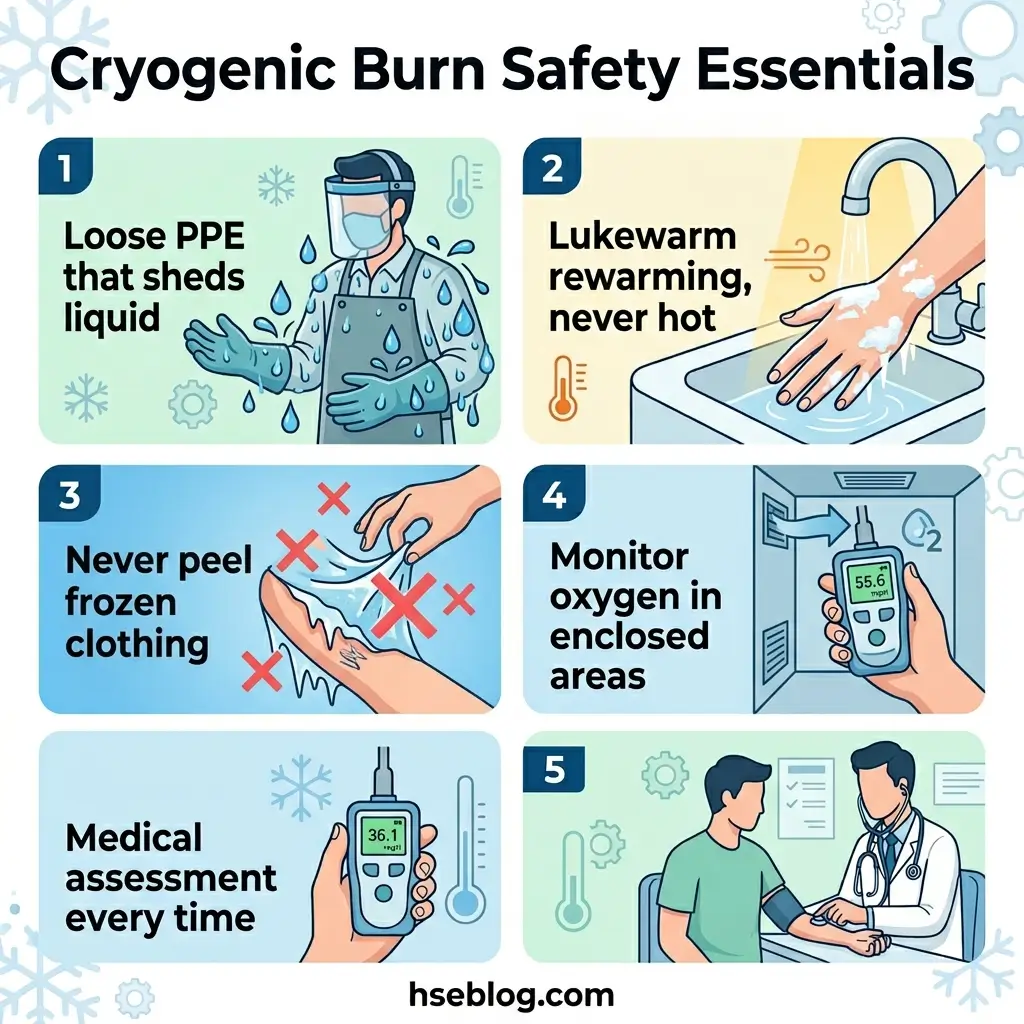
Get the barriers right and the rest follows: loose PPE that sheds spilled liquid, lukewarm-not-hot rewarming, no peeling of frozen clothing, oxygen monitoring wherever vapour can gather, and medical assessment every single time. The Gainesville record is the clearest reminder of the stakes — workers died because rescue instinct outran hazard awareness. Cryogenic burns are survivable and largely preventable; the cold just doesn't give you the warning that heat does, so the discipline has to come from the system, not the sensation.