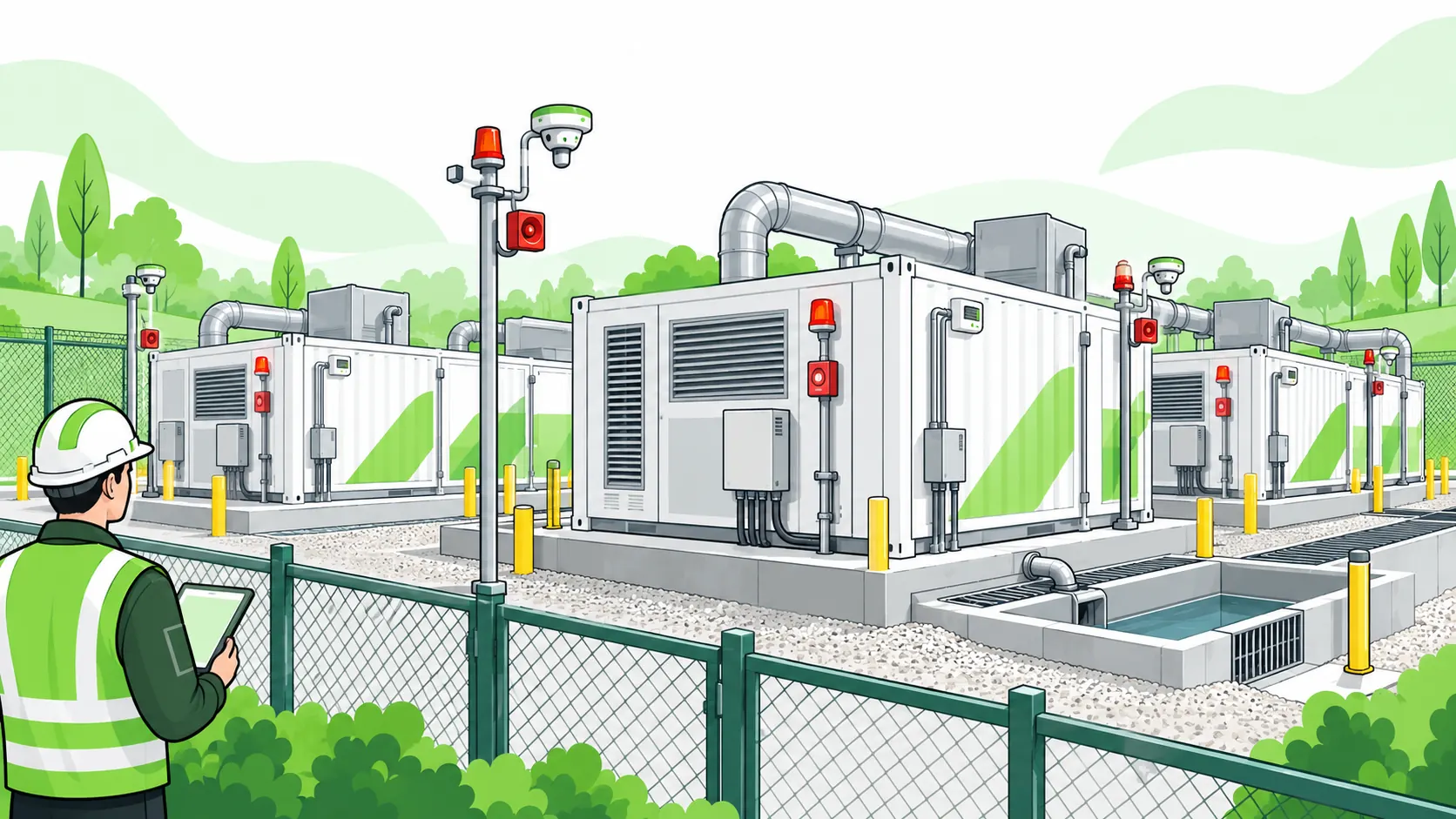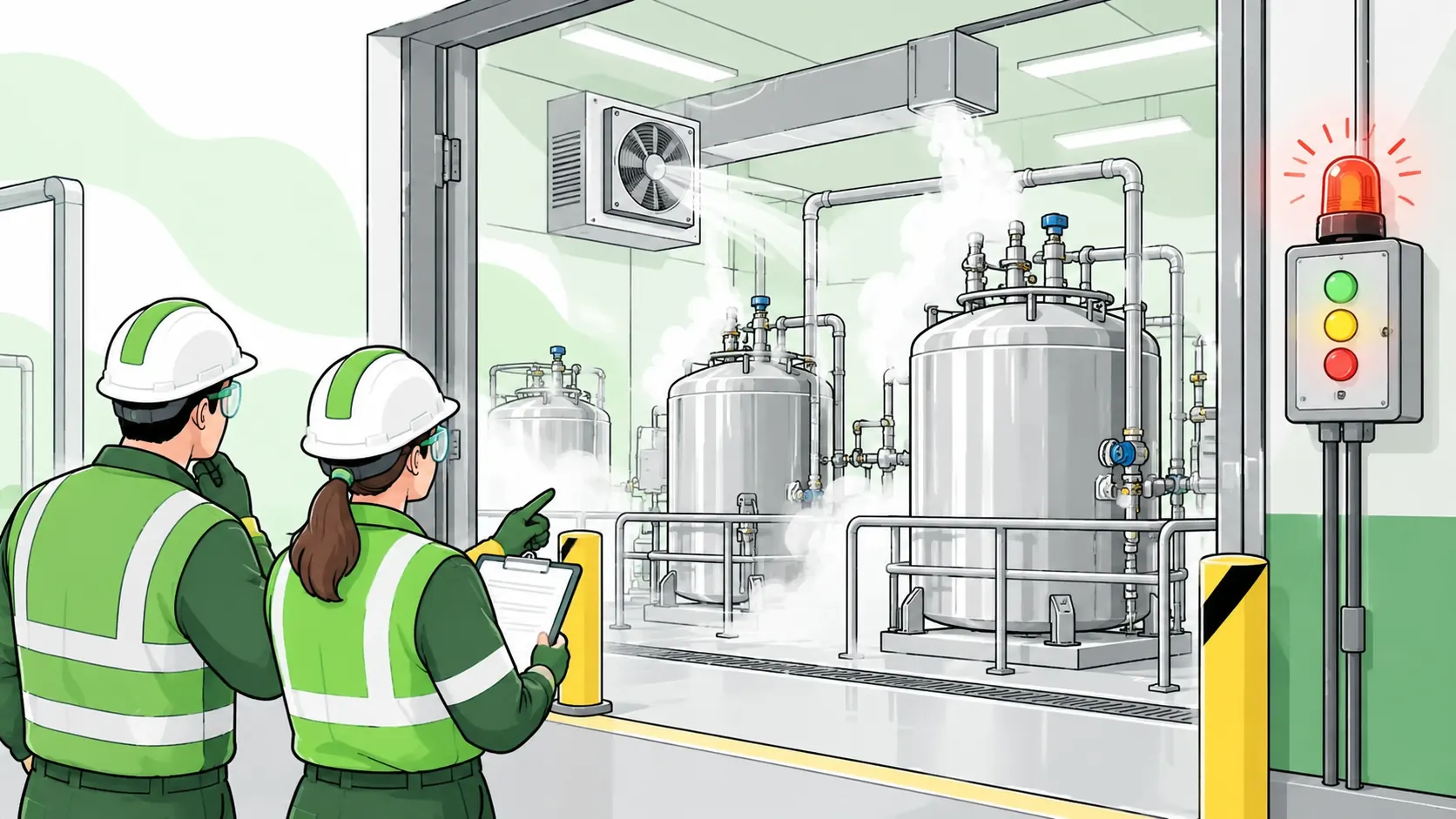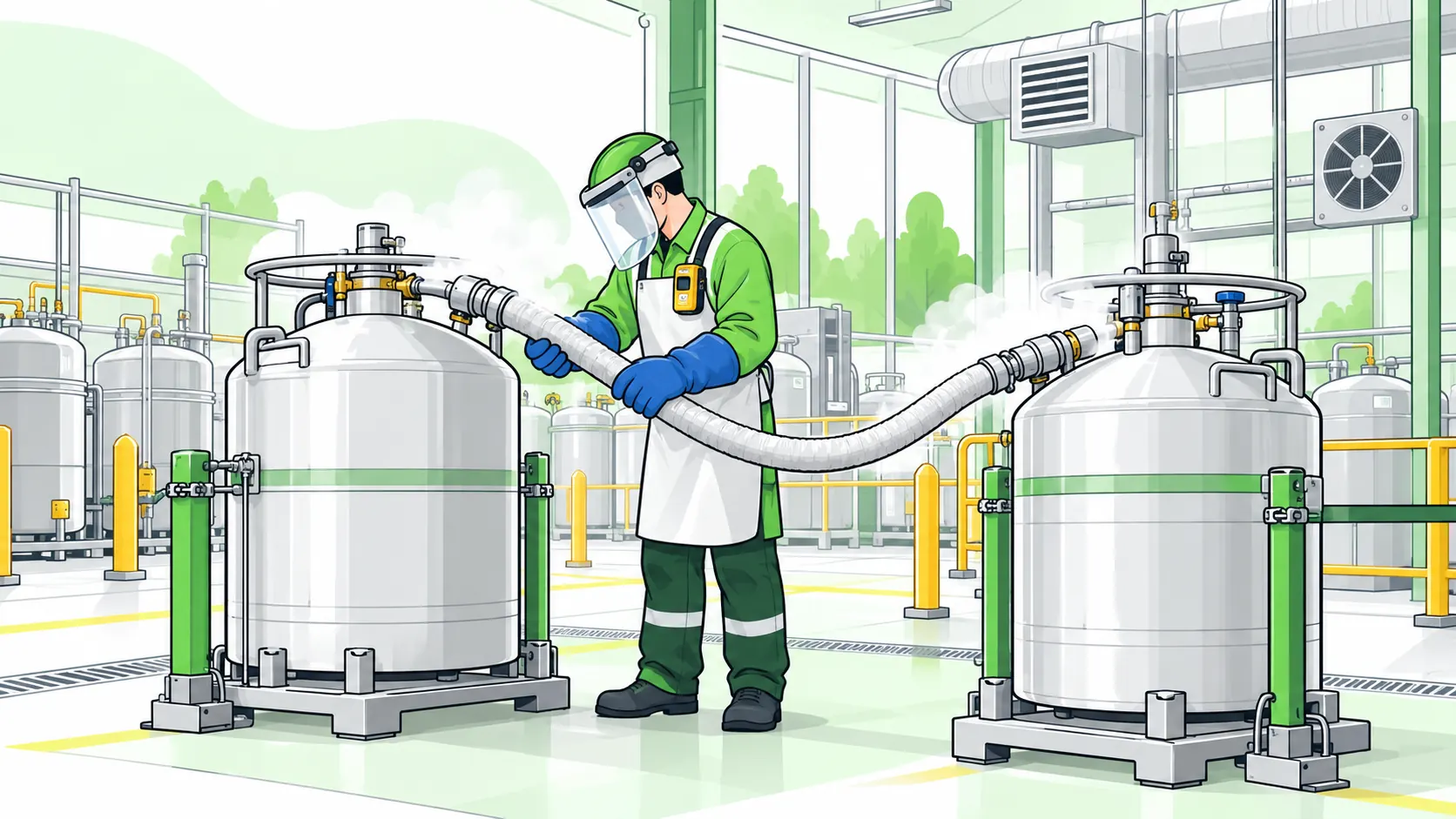
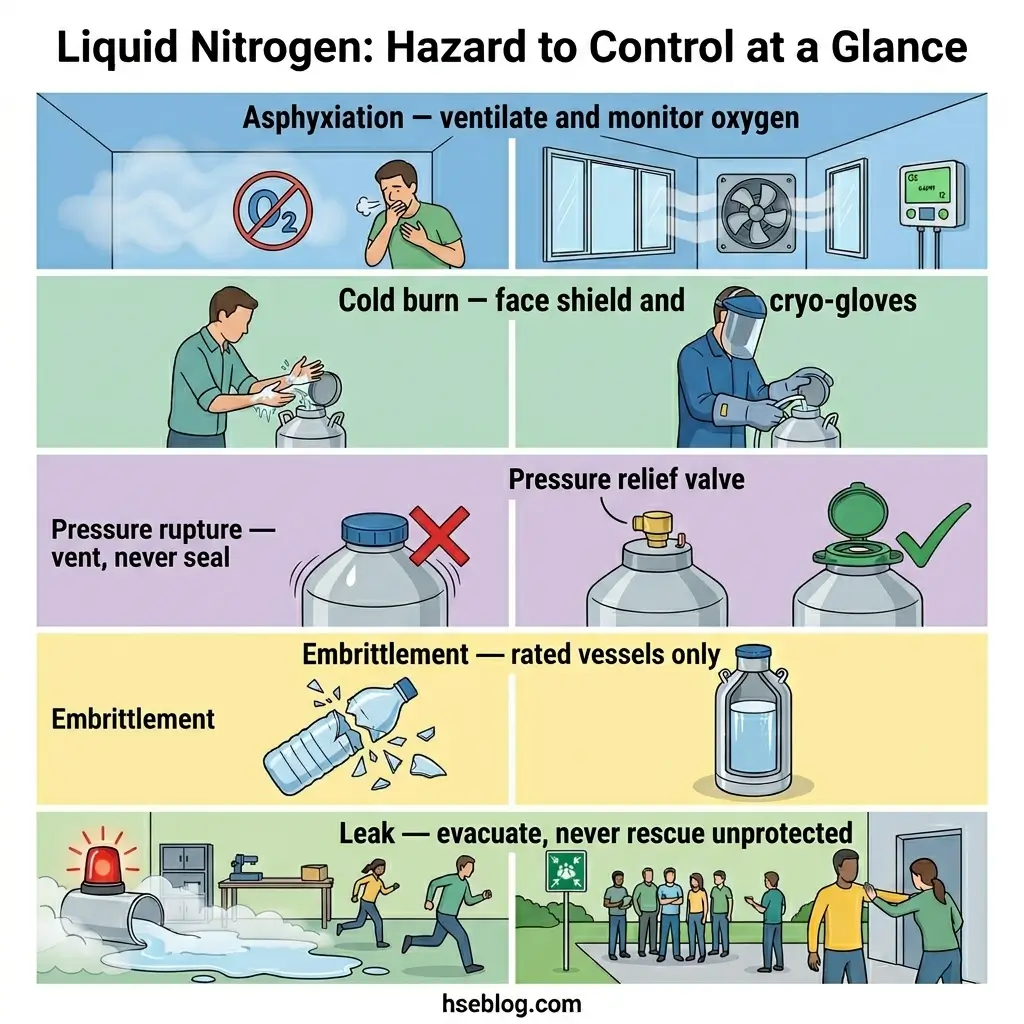
Liquid nitrogen safety rests on three controls that must work together: keep oxygen above 19.5% through ventilation and monitoring, store and transfer it only in vented cryogenic vessels never sealed containers, and protect skin and eyes with cryogenic PPE. The substance gives no warning before it kills, so engineering and procedure carry the load.
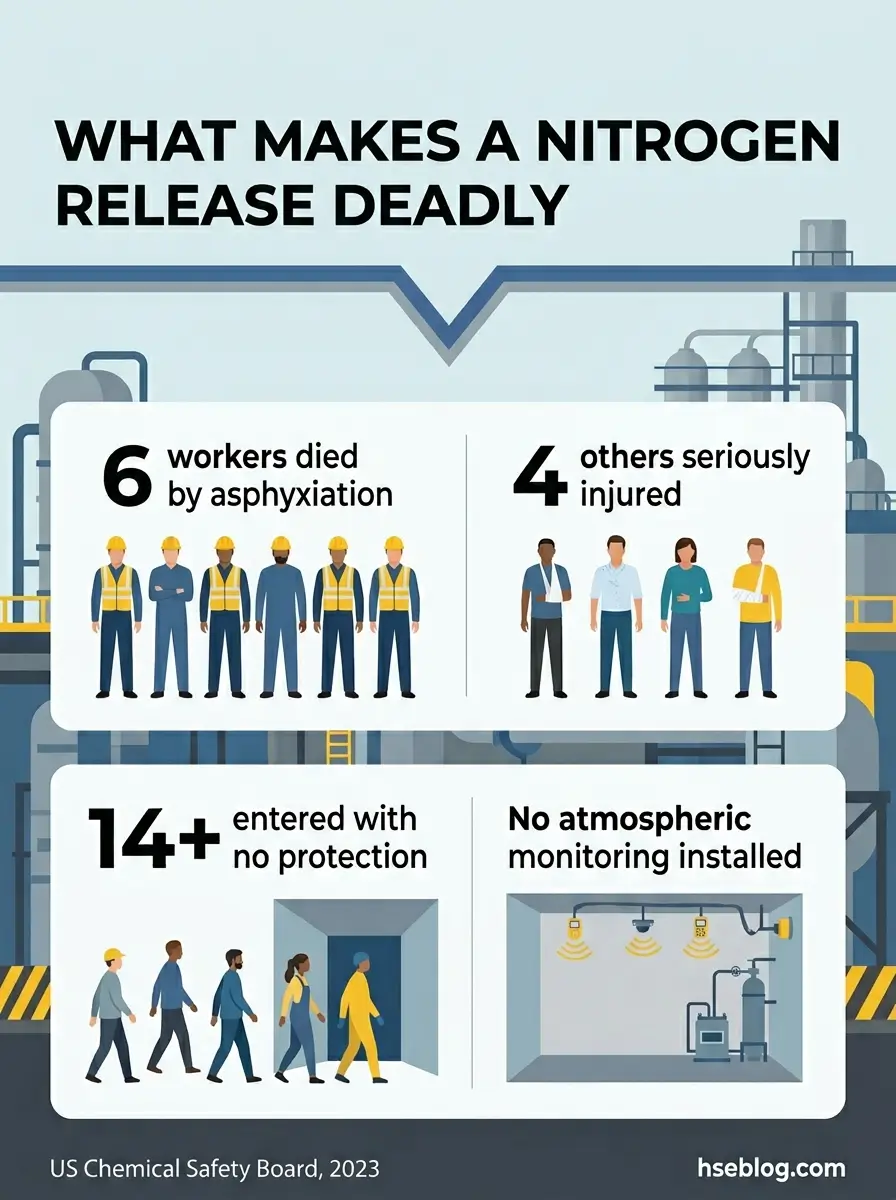
On 28 January 2021, six workers died at the Foundation Food Group poultry plant in Gainesville, Georgia, after a freezer's control system failed and liquid nitrogen flooded a processing room. The US Chemical Safety Board found that a bent "bubbler tube" let the room fill with an unsafe level of liquid nitrogen, which vaporized into a four-to-five-foot cloud and asphyxiated everyone who walked into it (CSB, 2023). Three more employees and a responding firefighter were seriously injured.
What turned a leak into a mass-fatality event was not the chemistry alone. The plant had no atmospheric monitoring, no training on nitrogen's hazards, and no equipment for safe entry, so at least 14 people entered the area to investigate or rescue colleagues without protection (CSB, 2023). This guide covers liquid nitrogen safety the way a competent person has to think about it: the physics that drives every hazard, the controls for handling and storage, the regulatory thresholds in the US and UK, and the emergency response that decides whether a leak claims one life or several.
Competent-person caveat: This article provides general HSE knowledge. Life-critical work such as bulk liquid nitrogen transfer, confined or low-lying storage areas, and entry into a suspected oxygen-deficient atmosphere must be planned and supervised by a competent person with relevant training, jurisdiction-specific authorization, and a site-specific risk assessment. The information here does not replace that.
Why Liquid Nitrogen Behaves the Way It Does
Every hazard in this guide traces back to four physical facts. Understand these and the controls stop looking like bureaucracy.
- It is brutally cold. At −196 °C, liquid nitrogen and its cold vapor freeze tissue on contact, and they cool nearby metal and plastic to temperatures those materials were never designed to survive (Compressed Gas Association).
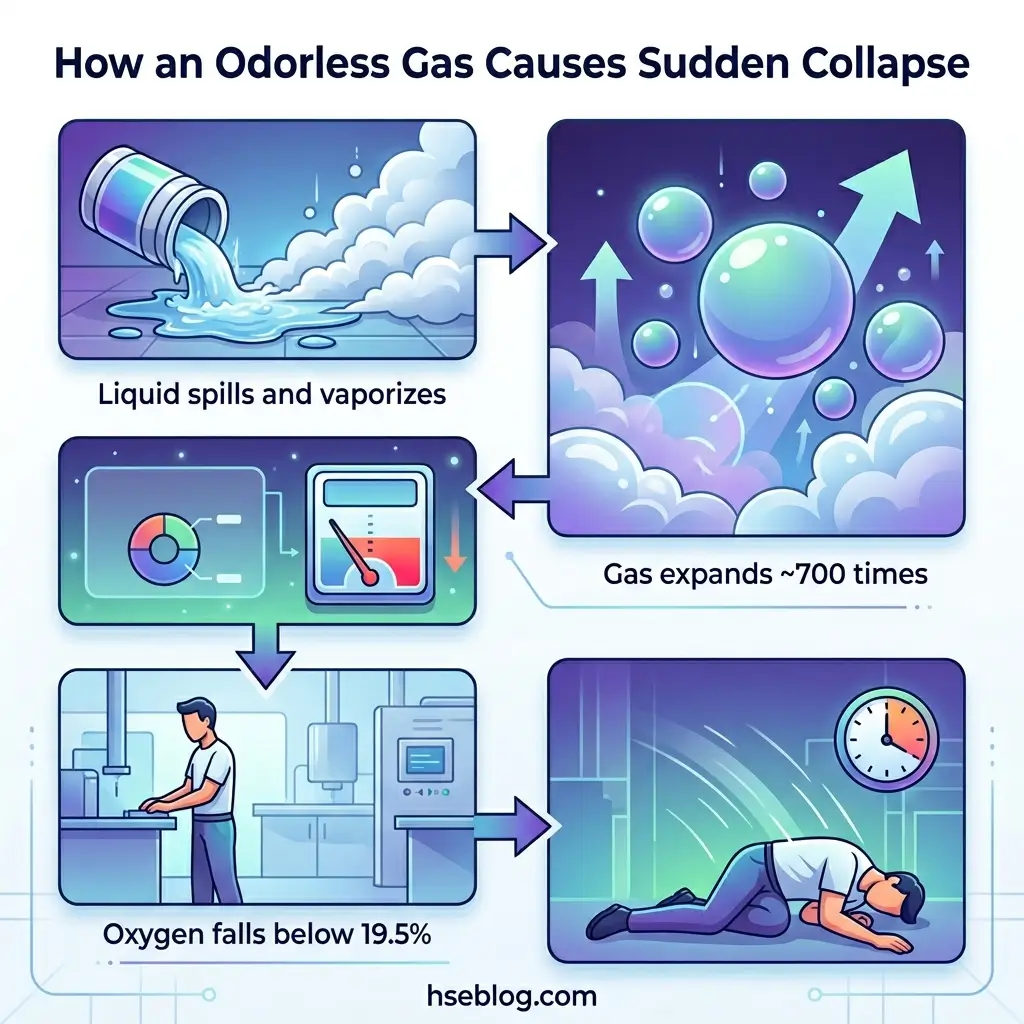
- It expands violently. As it warms back to a gas, one volume of liquid becomes roughly 700 volumes of gas (Compressed Gas Association). A few litres spilled in a closed room is enough to displace the breathable air.
- It is an inert simple asphyxiant. Nitrogen already makes up about 78% of the air, but extra nitrogen kills by pushing oxygen below the level the body needs. It does not poison you; it simply leaves no oxygen to breathe.
- It gives no warning. The gas is colorless, odorless, and tasteless. The white cloud you see at a spill is condensed water vapor from the air, not the nitrogen itself, so the dangerous gas extends well beyond the visible fog.
That last point is the one I press hardest with teams. People trust their senses, and with liquid nitrogen the senses report nothing until coordination and consciousness are already failing. The Compressed Gas Association's own liquid nitrogen guidance leads with these properties for exactly that reason.
The Hazards That Actually Cause Harm
Asphyxiation kills the most people, but it is not the only way liquid nitrogen injures. Each hazard has a distinct mechanism, and the control that stops one rarely stops the others.
| Hazard | How harm occurs | Early indicator | Primary control |
|---|---|---|---|
| Asphyxiation | Vaporizing nitrogen drops room oxygen below 19.5%; collapse can be sudden | None reliable — gas is odorless | Ventilation + fixed oxygen monitor with alarm |
| Cold burns / frostbite | Liquid, cold vapor, or cold-soaked objects freeze skin and eye tissue | Stinging, whitening, numbness of skin | Face shield, cryo-gloves, covered skin |
| Pressure rupture | Liquid boils in a sealed or under-vented vessel; pressure climbs fast | Hissing, frost, bulging, jammed valve | Vented vessels, pressure-relief devices |
| Material embrittlement | Carbon steel, rubber, and plastic turn brittle and crack at cryogenic temperatures | Frost lines on unrated equipment | Rated cryogenic materials only |
| Oxygen enrichment | Cold surfaces condense liquid oxygen from air, raising fire risk | Pale blue liquid on a cold finger | No combustibles near cold equipment |
A pattern runs through the published incident record on the cold-injury side, and it surprises newcomers: many serious eye and hand injuries come not from the liquid but from sealed vials. Purdue University's chemistry safety guidance documents cryotubes that admit liquid nitrogen through micro-cracks, then explode when warmed, sending plastic shards into hands and faces.
The asphyxiation mechanism deserves one more note, because it shapes where monitors go. Cold nitrogen vapor is initially denser than warm air and pools in low areas, pits, and floor-level spaces before it mixes. A consistent failure across confined-space fatality reports is testing the atmosphere at chest height at the entry point, while the oxygen-poor layer sits at the working level below.
PPE for Handling Liquid Nitrogen — and Its Hard Limits
Routine handling PPE protects against splashes and cold contact. It does nothing for an oxygen-deficient atmosphere, and confusing those two roles gets people killed. Sort the protection by what it actually does.
Eye and face protection
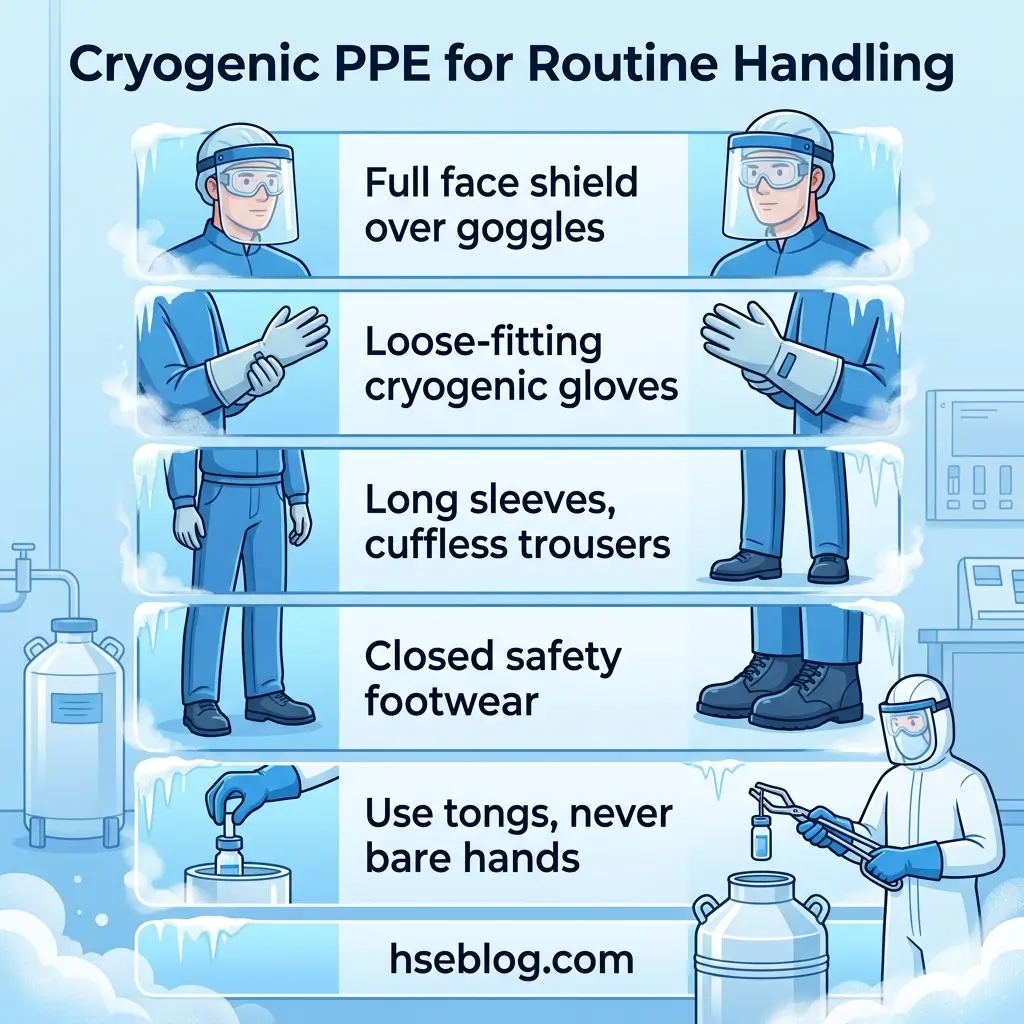
A full face shield worn over safety goggles is the standard for transfer and dispensing. Safety glasses, even with side shields, do not protect the lower face from splash, and liquid nitrogen splatters readily when it hits a warm surface.
Hand and body protection
- Cryogenic gloves, loose-fitting: the loose fit is deliberate. Insulated gloves resist brief contact only, so they must come off in a second if liquid pours inside the cuff.
- Long sleeves and cuffless trousers over the shoes: trousers worn outside the footwear stop liquid from running down into a shoe, where it can destroy tissue before the shoe comes off.
- Closed, easily removable footwear: open shoes and clogs are a spill route, not protection.
The single most common misconception I correct is the belief that cryo-gloves let you reach into liquid nitrogen to retrieve a dropped item. They do not. They buy seconds against accidental contact, nothing more. Use tongs or forceps to withdraw any object from the liquid.
What handling PPE does not cover
No glove, apron, or face shield protects you from suffocation. Entry into a known or suspected oxygen-deficient atmosphere, such as a freezer room after a leak, requires supplied-air or self-contained breathing apparatus and a separate entry procedure. That is rescue-and-entry equipment, not the kit you wear to top up a dewar.
Safe Handling and Transfer Procedures
Most cold-contact injuries and many small releases happen during transfer, when a warm vessel meets a cryogenic liquid and the nitrogen boils hard. Slow, deliberate technique controls it.
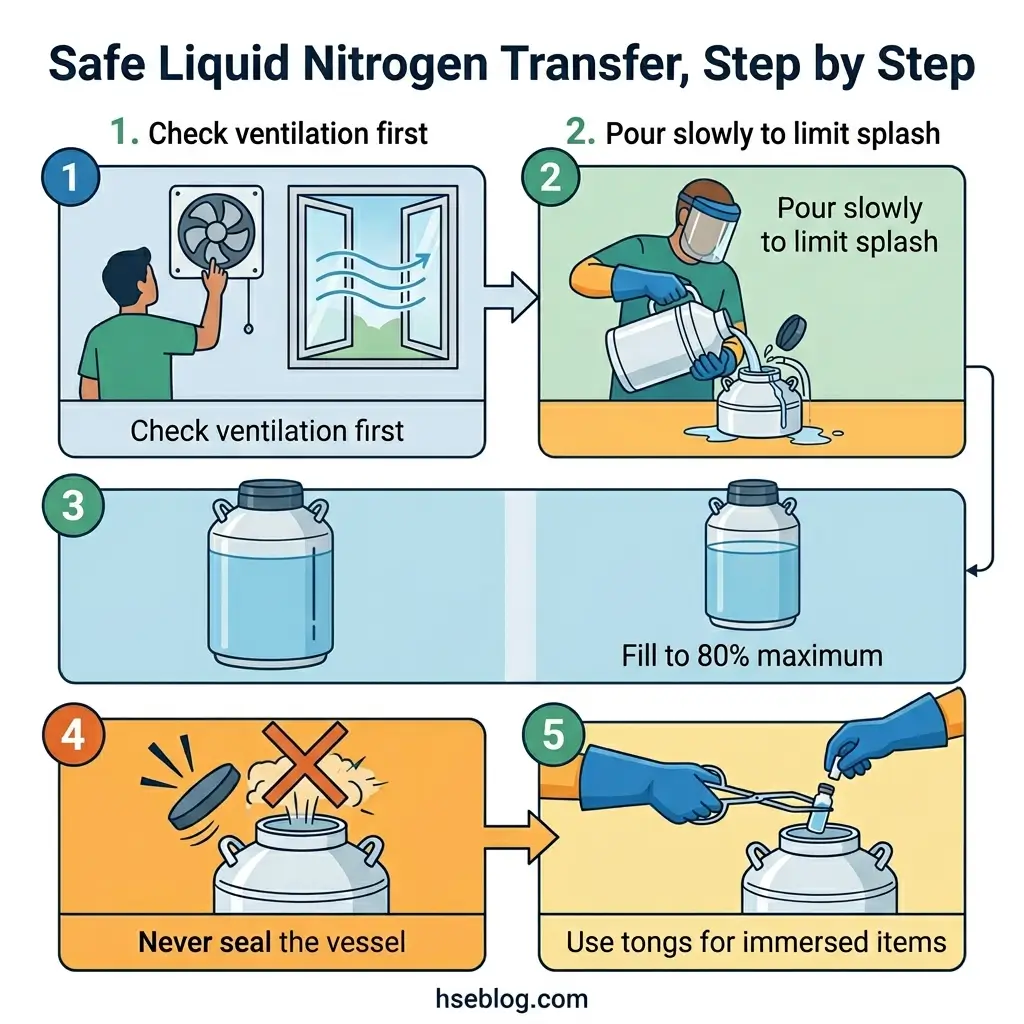
- Pour slowly to limit boiling and splashing. Charging a warm container always produces violent boil-off; a controlled rate keeps the splash inside the vessel.
- Never withdraw immersed objects by hand. Use tongs or forceps. Cold-soaked items stick to skin and tear flesh away if pulled off.
- Fill to no more than about 80% of capacity. Headspace absorbs the expansion of warming liquid and gas, reducing the chance of pressure-driven spillover.
- Never seal the container. A tightly closed vessel builds pressure as the liquid boils and can rupture. Use loose-fitting lids or vented closures only.
- Keep the work area ventilated. Transfer indoors only where air exchange is adequate, and stop work if you have any doubt about the ventilation.
- Secure vessels during transport and respect enclosed spaces. Never ride in a small elevator or an unventilated vehicle with an open dewar; if the vessel leaked, you would share the air with it. Many sites require liquid nitrogen and the person to travel separately, or by goods lift.
The UK's British Compressed Gases Association sets out comparable handling discipline in its Code of Practice 30 on the safe use of liquid nitrogen dewars, including the requirement to assess oxygen depletion before working in any enclosed area. The principle is the same on both sides of the Atlantic: the container must always be able to vent, and the room must always be able to breathe.
Storage Requirements and Container Selection
Storage is where the pressure and asphyxiation hazards quietly accumulate, because liquid nitrogen boils off continuously even in a good vessel. The container and the room have to be chosen together.
- Use only purpose-built cryogenic vessels. Open-neck vacuum-insulated dewars vent freely; pressurized liquid cylinders rely on engineered relief. Domestic thermos flasks are not free-venting and have ruptured in service, so they are never acceptable for cryogenic liquids.
- Respect the venting and relief design. Non-pressurized dewars release gas naturally through an open or loose neck. Pressurized cylinders use a primary pressure-relief valve backed by a rupture disc; when you are not drawing product, the valve will periodically vent and reseat, which is normal and not a fault.
- Match the room to the worst case. The governing question for any storage area is simple: if the largest vessel released its full contents quickly, would oxygen fall below 19.5%? UK guidance built on BCGA codes requires that oxygen-depletion calculation for enclosed storage, and where the answer is unsafe, a fixed oxygen-depletion monitor with an alarm is essential, not optional.
A few storage rules that prevent the most common problems:
- Store in ventilated areas, never in confined or low-lying spaces where cold gas can collect.
- Do not store dewars long-term in uncovered containers, and never in a cold room or any space a person could enter and meet an oxygen-deficient atmosphere.
- Tape glass dewars around the outside; the mesh sleeve on small flasks does little to stop glass shards from an implosion.
- Label vessels and keep the safety data sheet accessible. The Gainesville investigation found the freezers were not labelled as hazardous despite a long-standing US labelling requirement (CSB, 2023).
Oxygen Monitoring, Ventilation, and the Regulatory Picture
The whole regime hinges on one number: 19.5% oxygen. Both major jurisdictions converge on it, though they reach it by different routes and label it differently.
| Jurisdiction | Key reference | What it requires |
|---|---|---|
| United States | OSHA 29 CFR 1910.146 & 1910.134 | Below 19.5% O₂ is oxygen-deficient and treated as immediately dangerous to life (IDLH); entry needs supplied-air/SCBA |
| United States | OSHA 1910.146 — "inerting" | Displacing an atmosphere with nitrogen explicitly produces an IDLH oxygen-deficient atmosphere |
| United Kingdom | HSE guidance + BCGA CP 30 | Maintain workplace oxygen above 19.5%; entry below that not recommended; assess oxygen depletion by calculation |
| US / EU industry | CGA P-76 / EIGA codes | Detailed safe-practice guidance for oxygen-deficient atmospheres and inert gases |
Read those together and the practical reading on site is this. Normal air is about 20.9% oxygen, so a reading of 20.1% is not comforting, it is a warning that something is displacing oxygen. The standards mark the floor below which the law treats the space as deadly; competent practice acts well above it.
One regulatory gap is worth flagging, because it is current and load-bearing. As of its December 2023 final report, the CSB noted there is no dedicated US federal standard governing the storage, use, and handling of cryogenic asphyxiants, and it formally recommended that OSHA create one (CSB, 2023). Until that changes, US employers manage liquid nitrogen through general standards: confined spaces, respiratory protection, hazard communication, and the general duty to provide a safe workplace. You can read the OSHA permit-required confined space standard's atmospheric definitions directly at the agency's regulation page, and the CSB's recommendations in full on its incident report page.
Regulatory note: This content reflects general HSE professional understanding of US and UK requirements as of the review date above. It is not legal advice. Specific compliance or enforcement questions should go to qualified counsel in the applicable jurisdiction.
Emergency Response: When Liquid Nitrogen Escapes
The deadliest decision in any nitrogen release is the instinct to run in and help. Across the published record, the same pattern repeats: the first casualty collapses, colleagues rush to the rescue, and the rescuers become casualties because the air that dropped the first person drops them too. In Gainesville, that instinct cost lives more than once over.
The response sequence has to override that instinct.
- Do not enter. Never go into an oxygen-deficient or suspected oxygen-deficient atmosphere to retrieve a person without supplied-air breathing apparatus and a trained entry team. An unprotected rescuer adds a body, not a save.
- Raise the alarm and evacuate the area, moving people upwind and to higher ground away from the low-lying gas.
- Call emergency services and tell them it is an oxygen-deficiency / inert gas event, so responders arrive equipped for it.
- Isolate the source only if it can be done from outside the hazardous atmosphere, for example shutting a supply valve from a safe position.
- Let trained, air-supplied responders perform any rescue. Removal of the casualty to fresh air, followed by rescue breathing if needed, is their task.
For cold-contact injuries, the immediate first aid is gentle. Flush the affected area with large amounts of room-temperature (not hot) water, do not rub the tissue, and where skin has frozen to a cold surface, run cool water between the skin and the metal to release it before separating. Then get medical help.
Medical note: First-aid guidance here is for HSE practitioner reference and is not medical advice. Cold burns, frostbite, and any suspected asphyxiation exposure should be assessed by a qualified medical professional.
Frequently Asked Questions
Can you store liquid nitrogen in a sealed container?
No. As liquid nitrogen boils, the gas expands roughly 700 times in volume (Compressed Gas Association), and a sealed or under-vented vessel builds pressure until it ruptures. Use only open-neck dewars or pressurized cylinders fitted with a working relief valve and rupture disc, and never improvise with a thermos flask.
What oxygen level is dangerous when working with liquid nitrogen?
Below 19.5% oxygen by volume an atmosphere is oxygen-deficient and treated as immediately dangerous to life under OSHA 29 CFR 1910.146 and 1910.134, with UK and BCGA guidance setting the same floor. Normal air is about 20.9%, so any sustained drop is a warning that nitrogen is displacing breathable oxygen.
Is it safe to touch liquid nitrogen briefly with bare skin?
Brief, glancing contact may skitter off on a vapor cushion, but this is unreliable and not a safety technique. Sustained contact, splashes into shoes or gloves, and cold-soaked metal cause frostbite and serious cold burns. Always use cryogenic gloves and tongs, and keep skin covered.
Can I transport liquid nitrogen in a car or a passenger elevator?
Avoid both unless ventilation is assured. In an enclosed vehicle or small elevator, even normal boil-off can drop oxygen to dangerous levels with no warning. Many sites require the dewar to travel in a goods lift or ventilated vehicle, separate from people, and always secured against tipping.
Does liquid nitrogen use need a confined space permit?
It can. Under OSHA 1910.146, displacing a space's atmosphere with nitrogen creates an immediately dangerous oxygen-deficient atmosphere by definition. Any storage or use area where oxygen could fall below 19.5%, especially freezer rooms, pits, and cold rooms, should be assessed against confined-space requirements.
How long does liquid nitrogen last in a dewar?
It depends entirely on vessel quality, size, and how often it is opened. A good vacuum-insulated dewar can hold liquid nitrogen for weeks, while a poorly insulated or frequently opened vessel loses it far faster. That continuous boil-off is also why a storage room always needs ventilation, even when no one is working.
The Stakes Behind Liquid Nitrogen Safety
The hardest fact about liquid nitrogen safety is that the substance offers no second chance and no sensory warning. Six people in Gainesville did everything human instinct told them to do, ran toward colleagues in trouble, and died because nothing in their workplace had told them the air itself had turned lethal.
That is the real lesson the published record keeps teaching. The chemistry is fixed and well understood; the deaths come from missing monitors, sealed vessels, untrained responders, and rooms that could not breathe. None of those are exotic engineering problems. They are the difference between a vented dewar in a ventilated room with an oxygen alarm, and a single point of failure waiting for a bad day.
If you handle or store liquid nitrogen, the question is not whether your team knows it is cold. It is whether an oxygen monitor would alarm before anyone walked into the room, and whether every person on site knows that the right response to a colleague collapsing in a vapor cloud is to stay out and raise the alarm. Get those two answers right, and liquid nitrogen stays the useful tool it should be.