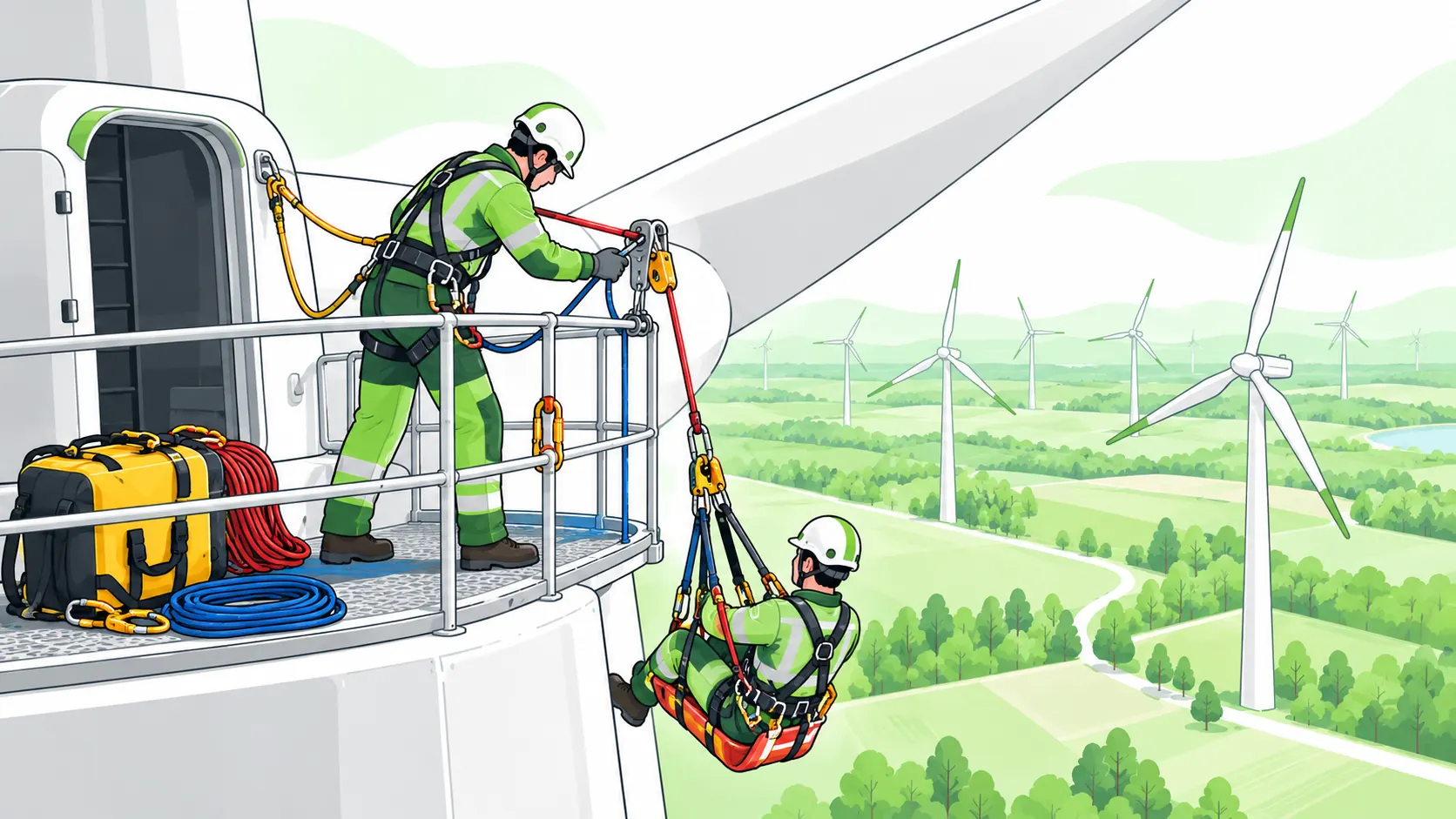
Wind turbine safety for working at height depends on two things working together: a fall-protection system that keeps the technician connected from the tower base to the nacelle, and a rescue plan that can recover a suspended worker within minutes. Because turbines are remote and stand over 200 feet tall, on-site rescue capability is not optional.
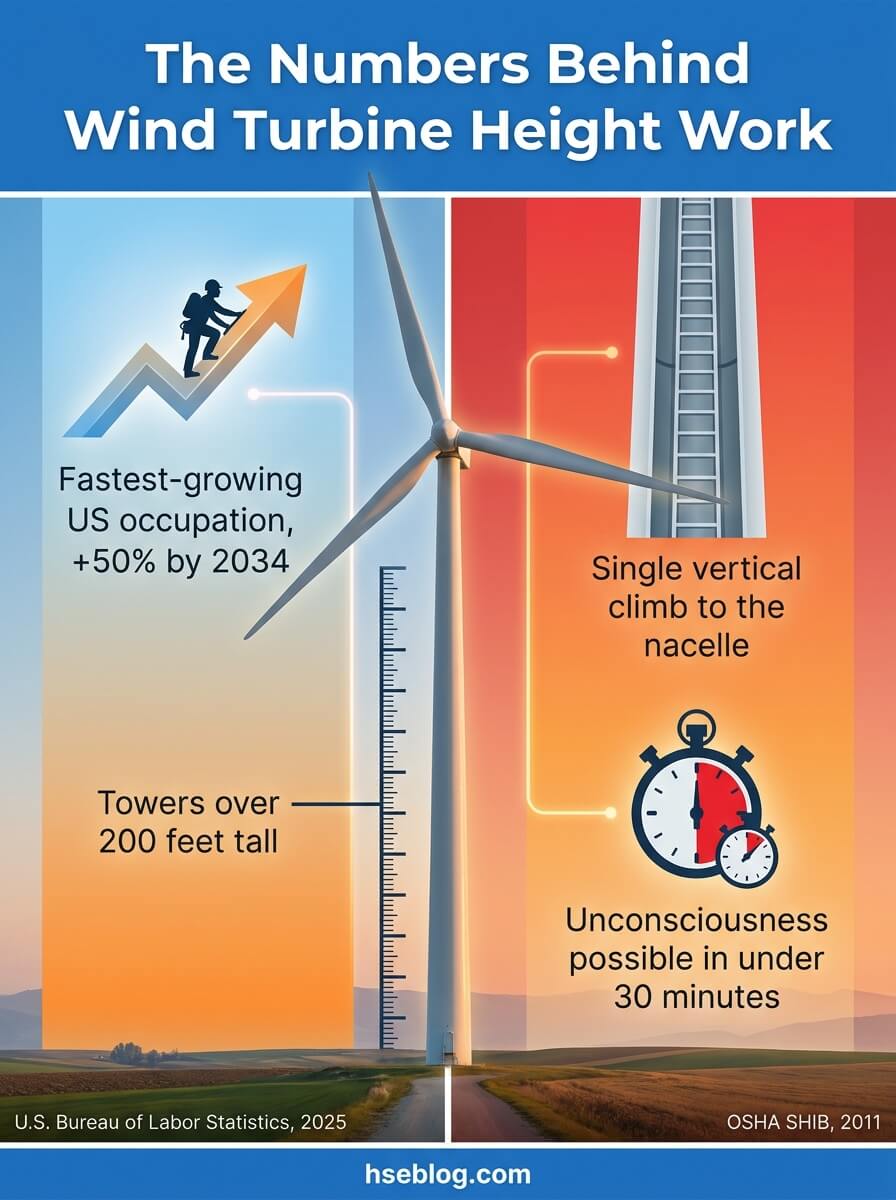
In its 2024–2034 projections, the U.S. Bureau of Labor Statistics again named wind turbine service technician the fastest-growing occupation in the country, forecasting 50% growth across the decade (BLS, 2025). Those new technicians will spend their working lives on structures the same agency describes as more than 200 feet tall, reached by climbing a fixed ladder while wearing a harness and carrying tools (BLS, 2025).
Height is only half the problem. A fall-arrest harness stops the fall, but it then suspends the worker hundreds of feet up, where a slow rescue can be as lethal as the impact it just prevented. This piece covers wind turbine safety across the full work-at-height picture — the systems that prevent a fall, the rescue procedures that follow one, and the regulatory framework that governs both.
Why a Wind Turbine Is One of the Hardest Places to Work at Height
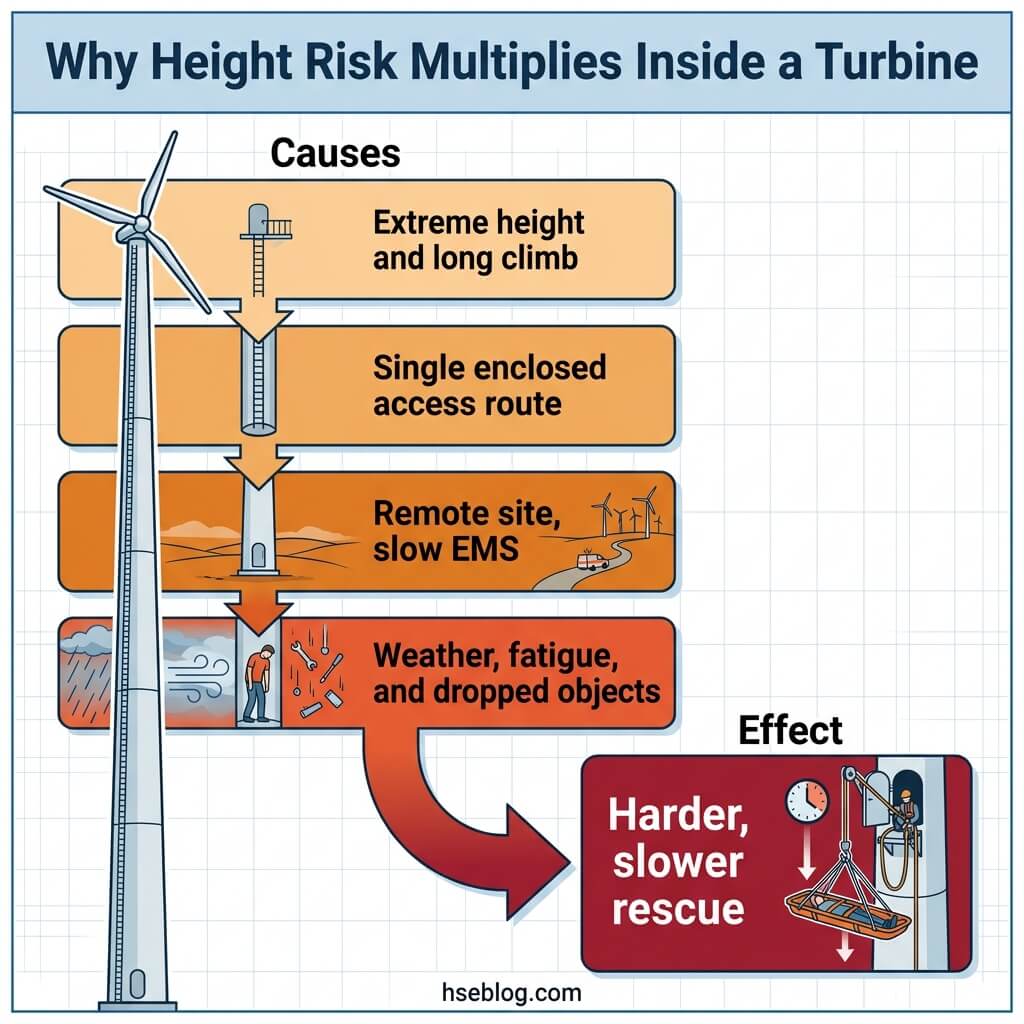
A wind turbine concentrates almost every work-at-height hazard into one narrow vertical structure, then strips away the easy rescue options. That combination is what makes it a category of its own.
Most height work on a building or scaffold offers more than one way down and a short trip for emergency services. A turbine offers neither — usually a single internal ladder, and a site that can sit miles from the nearest road.
| Hazard | Why it bites harder on a turbine |
|---|---|
| Extreme height and a long climb | A climb of 60–100 metres causes fatigue, cramping, and heat or cold stress before any task begins |
| Single enclosed access route | One ladder or lift means one path for ascent, descent, and rescue all at once |
| Remoteness from EMS | Help can be a long drive away, often longer than a suspended worker can safely wait |
| Weather at altitude | Wind, ice, and lightning intensify with height and can change fast mid-shift |
| Confined nacelle and hub | Tight, noisy spaces with moving parts and limited egress complicate any recovery |
| Dropped objects | A small wrench falling from 100 metres can kill anyone in the drop zone below |
There is a misconception worth correcting early. At first glance the inside of a tower does not look like a confined space, but the tower is essentially an enclosed shaft, and parts of the nacelle and hub have restricted egress and are not built for continuous occupancy.
That confined-space character changes the rescue problem entirely once a casualty is inside the hub or blade root rather than on the open ladder.
Fall Protection Systems That Keep Technicians Connected
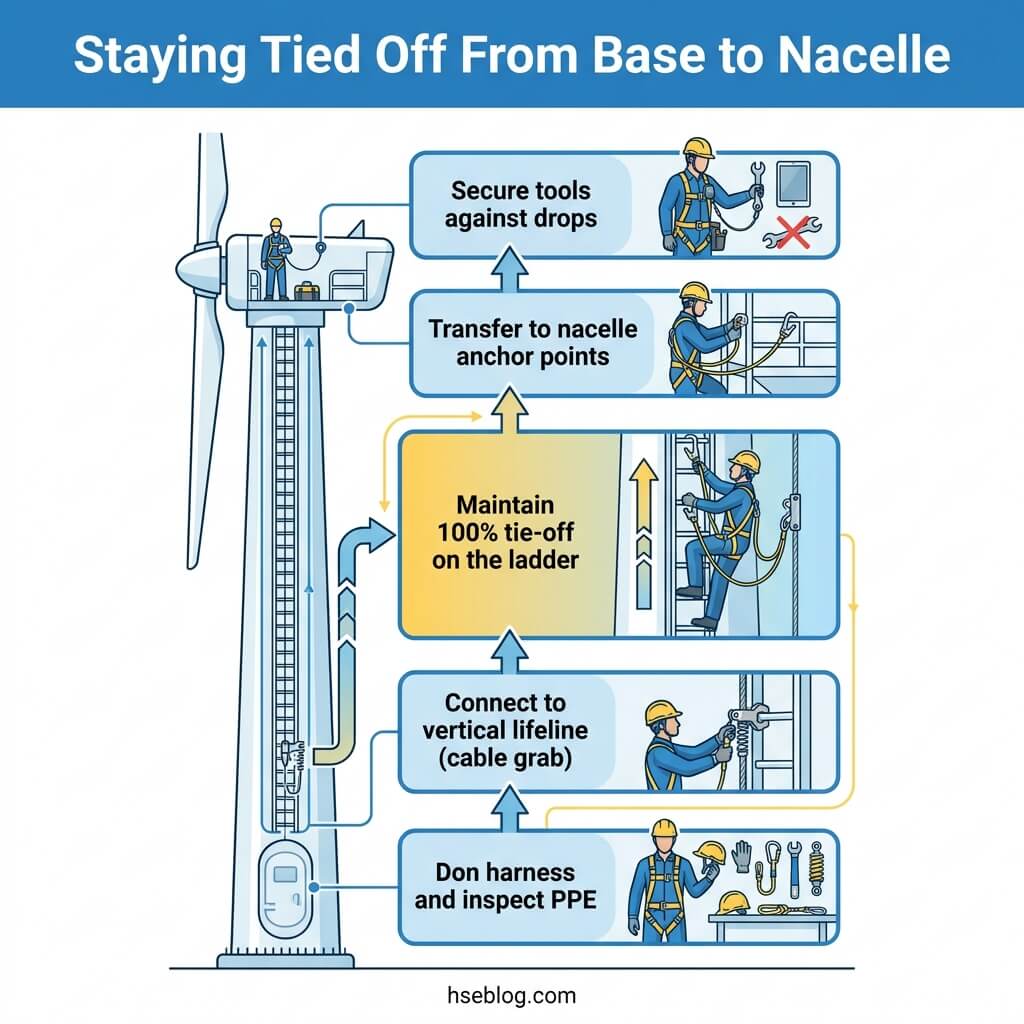
The goal of every wind fall-protection system is simple to state and hard to maintain: 100% tie-off, an unbroken connection from the moment a technician leaves the ground until they return to it. Every system below exists to close one gap in that chain.
Climb assist and the vertical lifeline
Inside most towers the ladder carries a vertical rail or cable. A carrier sleeve — a cable grab — travels with the climber and locks instantly if a fall occurs, allowing hands-free climbing with a constant point of attachment.
Climb assist is a separate system, and the two are routinely confused. Climb assist reduces the physical effort of the ascent, but it is the ladder safety system that arrests a fall — treating one as if it does the other's job is a dangerous mistake.
The personal fall-arrest system and its anchorage
Once at the nacelle, the technician transitions to anchor points and lanyards or a self-retracting lifeline. Under US general-industry rules, fixed ladders over 24 feet must include a personal fall-arrest system or a ladder safety system (OSHA, 29 CFR 1910.28(b)(9)).
Anchorage is where many systems quietly fail. For construction work, every anchorage used for fall arrest must support at least 5,000 pounds per worker, or form part of a system with a safety factor of two designed and supervised by a qualified person (OSHA, 29 CFR 1926.502(d)(15)).
SRL versus lanyard: a real judgment call
A self-retracting lifeline keeps slack out of the system and shortens any fall, and a leading-edge–rated SRL is the right choice over sharp edges or below-D-ring anchorage. Yet lanyards remain more common in wind work, partly through habit and partly through cost.
The honest practitioner reading is that the choice should follow the work position and the free-fall clearance available, not what is already clipped to the harness. Where edges, low anchors, or limited clearance are present, the lanyard is usually the weaker option.
The Real Danger After a Fall: Suspension Trauma and the Rescue Clock
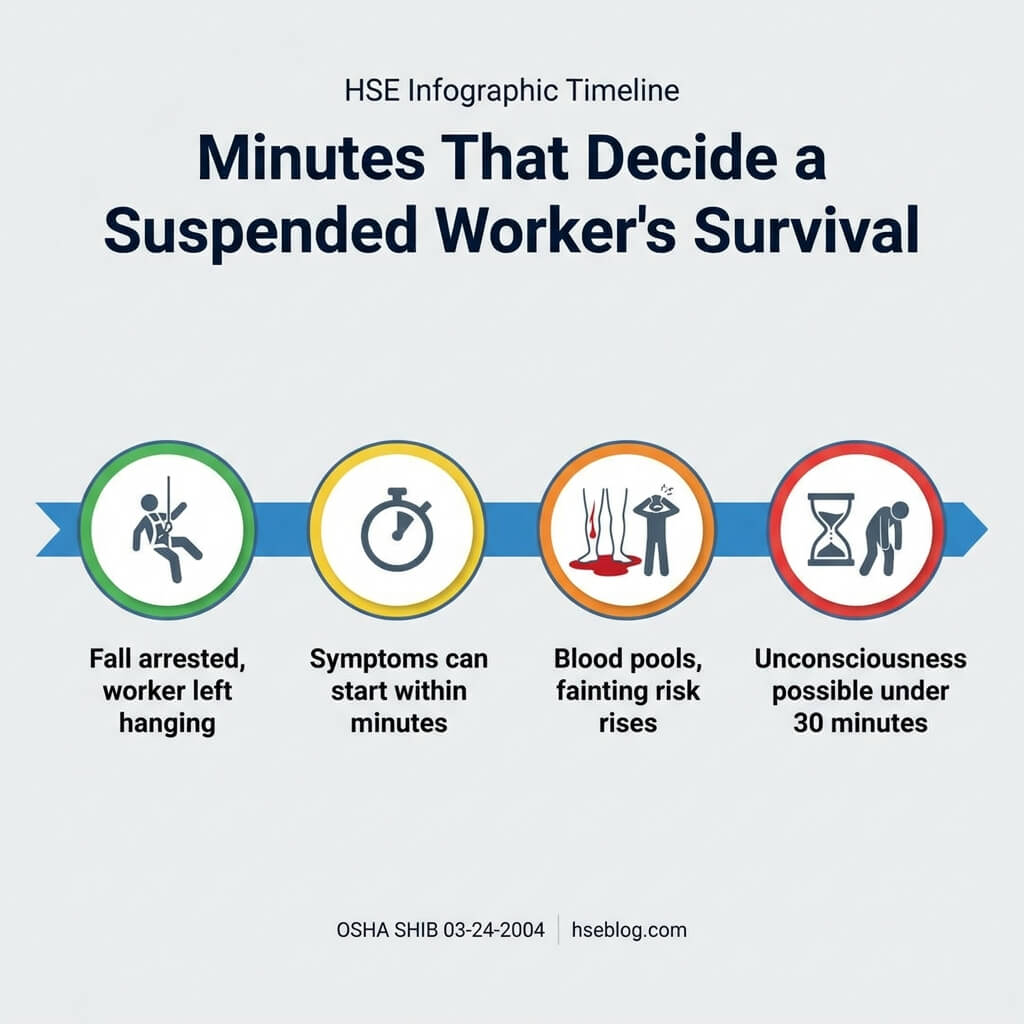
The most dangerous moment in a turbine fall is often not the fall itself but the minutes a worker spends hanging afterward. The harness that saved them then becomes the threat.
When a person hangs motionless in a harness, the leg straps compress the veins of the thighs and blood pools in the legs. Venous return to the heart drops, and the result — orthostatic intolerance, or suspension trauma — can progress to fainting and, if the worker stays unconscious and immobile, to death.
OSHA's safety bulletin on suspension trauma is blunt about the timeline: suspension in a fall-arrest device can result in unconsciousness, followed by death, in less than 30 minutes (OSHA, SHIB 03-24-2004, updated 2011). Warning signs can appear far sooner than that.
Watch for these early symptoms in a suspended casualty:
- Light-headedness and dizziness — among the first signs that venous pooling has begun.
- Nausea, sweating, and pallor — the body's stress response as circulation falls.
- Visual dimming and confusion — a signal that the situation is becoming critical.
- Loss of consciousness — the point at which a casualty can no longer help in their own rescue.
The description of suspension trauma here is for HSE practitioner reference and is not medical advice. A worker with symptoms after a fall, or with specific health concerns, should be assessed by an occupational physician or qualified medical professional.
This is why the most common rescue failure is not a lack of equipment but a flawed assumption — that calling emergency services and waiting counts as a plan. On a remote wind farm, the travel time alone can exceed the window in which a hanging worker stays conscious.
Rescue Procedures: Self-Rescue, Assisted Rescue, and Technical Rescue
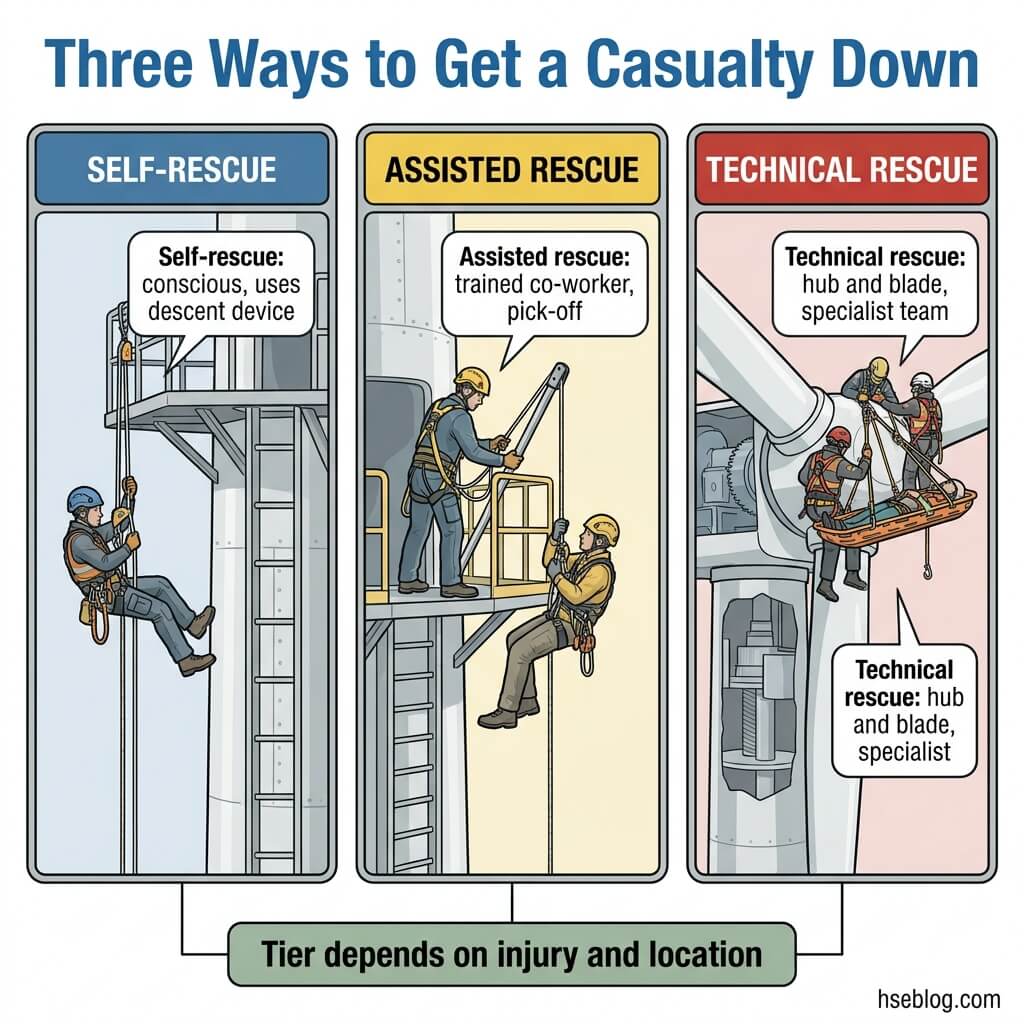
Turbine rescue comes in three tiers, and the right one depends on the casualty's condition and where in the turbine they are. Choosing in advance — not during the emergency — is what makes a rescue fast.
A pattern runs through published rescue guidance for tower work: the easiest casualty to recover is a conscious one on the open ladder or nacelle, and the hardest is an incapacitated one inside the hub or blade root, where confined space and awkward angles slow everything down.
| Rescue tier | When it applies | Who performs it | Core equipment | Main limitation |
|---|---|---|---|---|
| Self-rescue | Casualty conscious and uninjured | The fallen worker | Controlled-descent device carried on the person | Useless once the worker is unconscious or badly hurt |
| Assisted rescue | Casualty incapacitated but accessible (ladder/nacelle) | A trained co-worker on site | Rescue/descent kit, pick-off line, slings | Requires a competent second person, drilled and equipped |
| Technical rescue | Hub, spinner, or inside the blade; complex cases | Specialist team (GWO Advanced Rescue level) | Confined-space rescue gear, ascenders, the service lift | Slower; demands advanced training and pre-planning |
The zone matters as much as the casualty. Basic Working at Heights training covers rescue from the ladder, nacelle, and tower base, while extraction from the hub, spinner, or inside a blade falls under the separate Advanced Rescue Training standard for a reason — those spaces behave like confined spaces, not open height.
This article provides general HSE knowledge. Life-critical work such as rescue from a wind turbine must be planned and supervised by a competent person with relevant training, jurisdiction-specific authorization, and a site-specific risk assessment. The information here does not replace that. Recognized routes to that competence include GWO Basic Safety Training, with NEBOSH and IOSH qualifications underpinning the wider safety role.
Self-rescue is the fastest tool when it is available, but it is the worst plan to rely on, because the casualties who most need rescue are precisely the ones who cannot perform it.
Building a Wind Turbine Rescue Plan That Holds Up
OSHA's rescue rule is one sentence long, but the plan it demands is not — and "prompt" means minutes, not the hour an off-site team might take to arrive. The regulation sets the duty; competent planning fills the silence around it.
The core requirement reads: the employer shall provide for prompt rescue of employees in the event of a fall, or shall assure that employees are able to rescue themselves (OSHA, 29 CFR 1926.502(d)(20)). OSHA never defines "prompt," which means a slow rescue is judged after the fact — and negligence is easy to prove when no real capability existed.
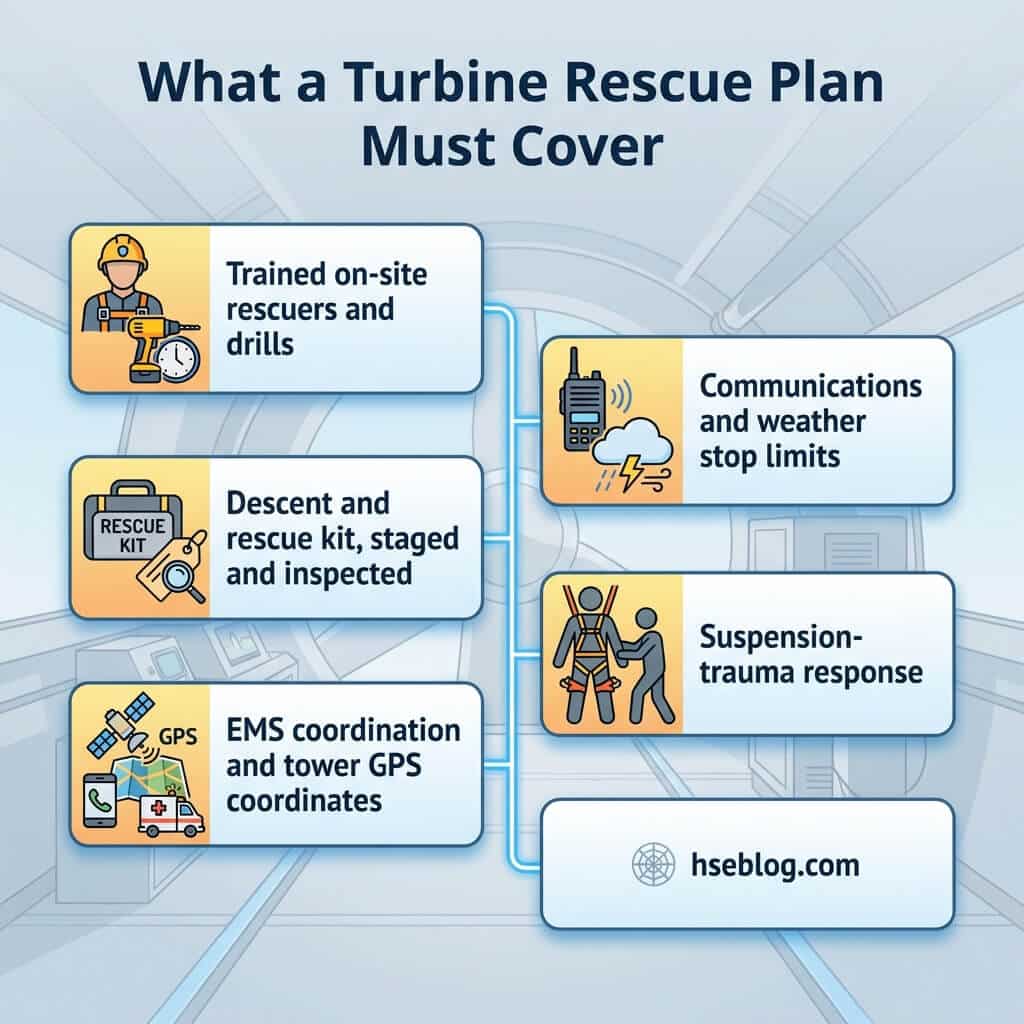
A defensible turbine rescue plan covers, at minimum, the following:
- Trained, on-site rescuers with drilled roles. Every climb needs at least one competent rescuer present and a team that has rehearsed who does what, not improvised it on the day.
- Descent and rescue equipment staged and inspected. Controlled-descent devices, pick-off lines, and slings rated for one- or two-person loads, checked before use and stored where they can be reached fast.
- EMS coordination built in advance. Tower GPS coordinates supplied to emergency services, clear tower marking, an assigned guide to lead responders in, and a designated helicopter landing zone for serious casualties.
- Communications that survive a power loss. Each worker carries a means of contact, and the plan accounts for an unlit tower interior if the turbine loses power.
- Weather limits and stop criteria. Defined wind, ice, and lightning thresholds that pause climbs, with a reassessment before any resumption.
- A suspension-trauma response. Specific steps to relieve leg-strap pressure and manage the casualty after recovery, since post-rescue handling carries its own risks.
The consensus standards add structure here. ANSI/ASSP Z359.2 sets out a managed fall-protection program that includes rescue planning, and Z359.4 covers assisted-rescue and self-rescue systems and components (United States, voluntary consensus).
One pattern is worth stating plainly: local fire and EMS crews are frequently not climb-certified or equipped for tower work, which is exactly why operators run their own rescue drills and invite responders to familiarize themselves with access routes and rendezvous points.
The Regulatory Map: OSHA, ANSI, HSE, and the GWO Standard
No single rulebook governs wind turbine work at height. Technicians sit at the intersection of national law, voluntary consensus standards, and an industry training framework, and the requirements do not always line up.
The same turbine can fall under different rules across its life. Erecting it is construction work; maintaining it afterward is general industry — and in the US those carry different fall-protection triggers.
| Framework | Jurisdiction | Status | Key requirement |
|---|---|---|---|
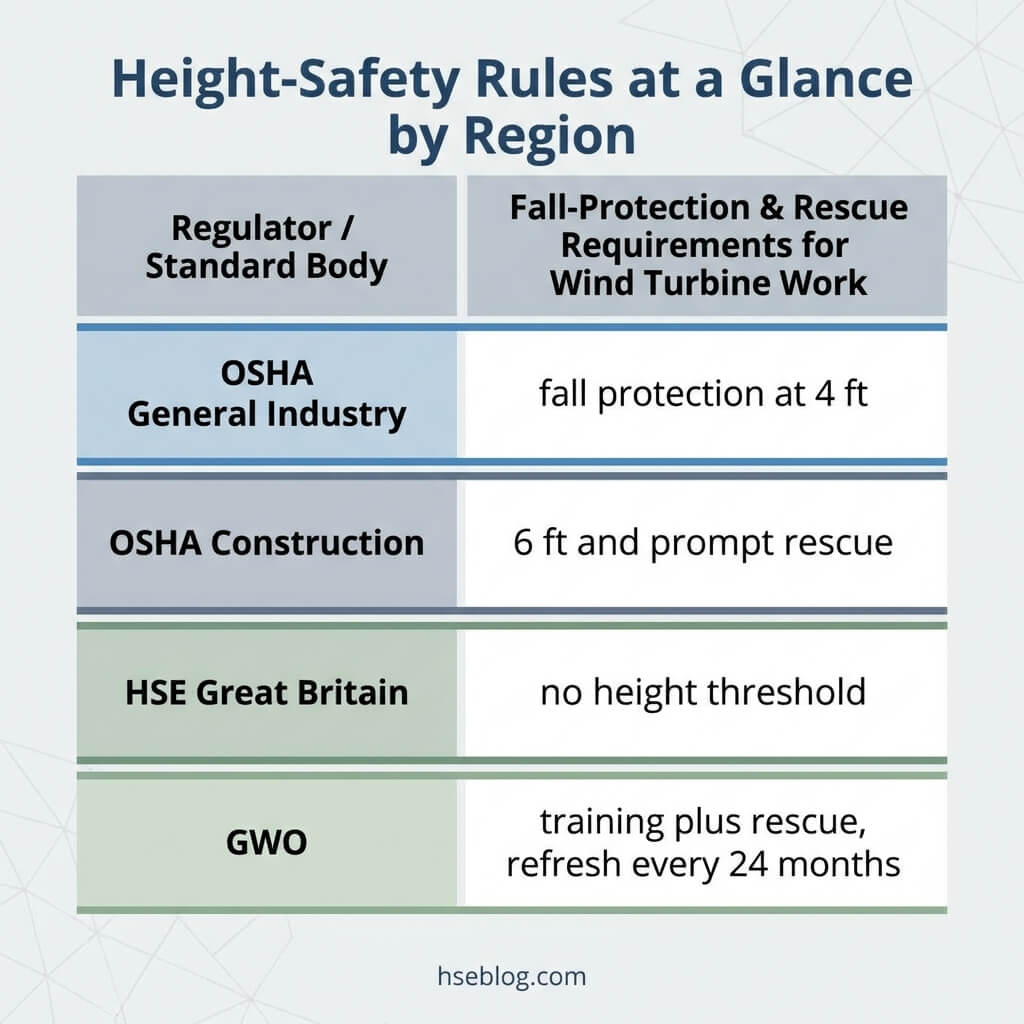
| OSHA general industry | United States | Law | Fall protection at 4 ft; fixed ladders >24 ft need a PFAS or ladder safety system (1910.28; 1910.140) |
| OSHA construction | United States | Law | Fall protection at 6 ft; prompt rescue or self-rescue; anchorage 5,000 lb per worker (1926.501; 1926.502) |
| ANSI/ASSP Z359 | United States | Voluntary consensus | Managed fall-protection program and rescue systems (Z359.2; Z359.4) |
| Work at Height Regulations 2005 | Great Britain | Law | Avoid, prevent, then minimise; no minimum height; plan for emergencies and rescue |
| GWO BST / ART | International industry | Not law | Working at Heights with basic rescue; refresher every 24 months; ART for hub and blade rescue |
Where these conflict, the safe practice is to work to the stricter standard. US general industry's 4-foot trigger is more protective than construction's 6 feet, and Great Britain goes furthest of all — the Work at Height Regulations 2005 set no height threshold, applying wherever a fall could cause injury, and require planning for emergencies and rescue (HSE, Great Britain).
The British framework also enforces a clear order of control under Regulation 6 — avoid work at height, then prevent falls with collective measures before personal ones, then minimise the distance and consequences — implementing EU Directive 2001/45/EC.
On competence, the de facto international benchmark is GWO. Its Basic Safety Training bundles five modules, including Working at Heights with basic rescue from height, and certification must be refreshed every 24 months, with records verifiable through the WINDA database.
This regulatory summary reflects a general HSE professional reading of the cited US, UK, and EU requirements as of 2026. It is not legal advice. Specific compliance or enforcement questions should go to qualified legal counsel in the applicable jurisdiction, and the regulatory content here should be reviewed periodically as standards are updated.
Frequently Asked Questions
At what height does fall protection become mandatory on a wind turbine?
It depends on the jurisdiction and the work phase. In the United States, OSHA requires fall protection for general-industry maintenance at 4 feet and for construction at 6 feet. Great Britain's Work at Height Regulations 2005 set no minimum height — any fall liable to cause injury triggers the duty, which is the stricter position.
How long does a suspended worker have before suspension trauma becomes dangerous?
Less time than most crews assume. OSHA's safety bulletin warns that suspension in a fall-arrest harness can cause unconsciousness, then death, in under 30 minutes, but warning signs such as light-headedness and nausea can begin within a few minutes. That narrow window is exactly why an off-site rescue is rarely fast enough on its own.
Can a wind turbine technician rescue themselves after a fall?
Sometimes, and self-rescue is the fastest option when it is possible. Many technicians carry a controlled-descent device that lets a conscious, uninjured worker lower themselves to the ground. The limitation is obvious: an unconscious or badly injured casualty cannot self-rescue, so every plan still needs an assisted-rescue capability staged on site.
Is GWO certification legally required to work on wind turbines?
Not by law in most countries — GWO is an industry framework, not legislation. In practice, most manufacturers and wind-farm operators require valid GWO Basic Safety Training, including the Working at Heights module, before a technician sets foot on a turbine. The certification must be refreshed every 24 months to remain valid.
Is the inside of a wind turbine tower a confined space?
Parts of it meet the definition. The tower is essentially an enclosed vertical shaft with limited entry and exit, and areas of the nacelle and hub have restricted egress and are not designed for continuous occupancy. That confined-space character is precisely what makes a hub or blade-root rescue far harder than a ladder rescue.
Should you just call the fire service for a wind turbine rescue?
Calling emergency services is part of the response, but it cannot be the whole plan. Local fire and EMS crews are often not climb-certified or equipped for tower work, and travel time to a remote wind farm can exceed the suspension-trauma window. On-site, trained rescuers with the right descent equipment are essential.
When Competence Is the Difference Between a Near-Miss and a Funeral
The fast growth of this workforce means more first-time technicians are climbing higher than any previous generation, often before they have stood in a single rescue drill. The hazard does not scale down for newcomers.
What separates a recoverable incident from a fatality is rarely the harness — modern fall-arrest gear works. It is whether someone competent, equipped, and already on site can reach a hanging colleague before the rescue clock runs out.
Treating wind turbine safety as an equipment-purchasing exercise misses the point, because the equipment only buys time. The real measure of a height program on a wind farm is the honest answer to one question: if a technician is hanging unconscious in the nacelle right now, who is going up, with what, and how soon?