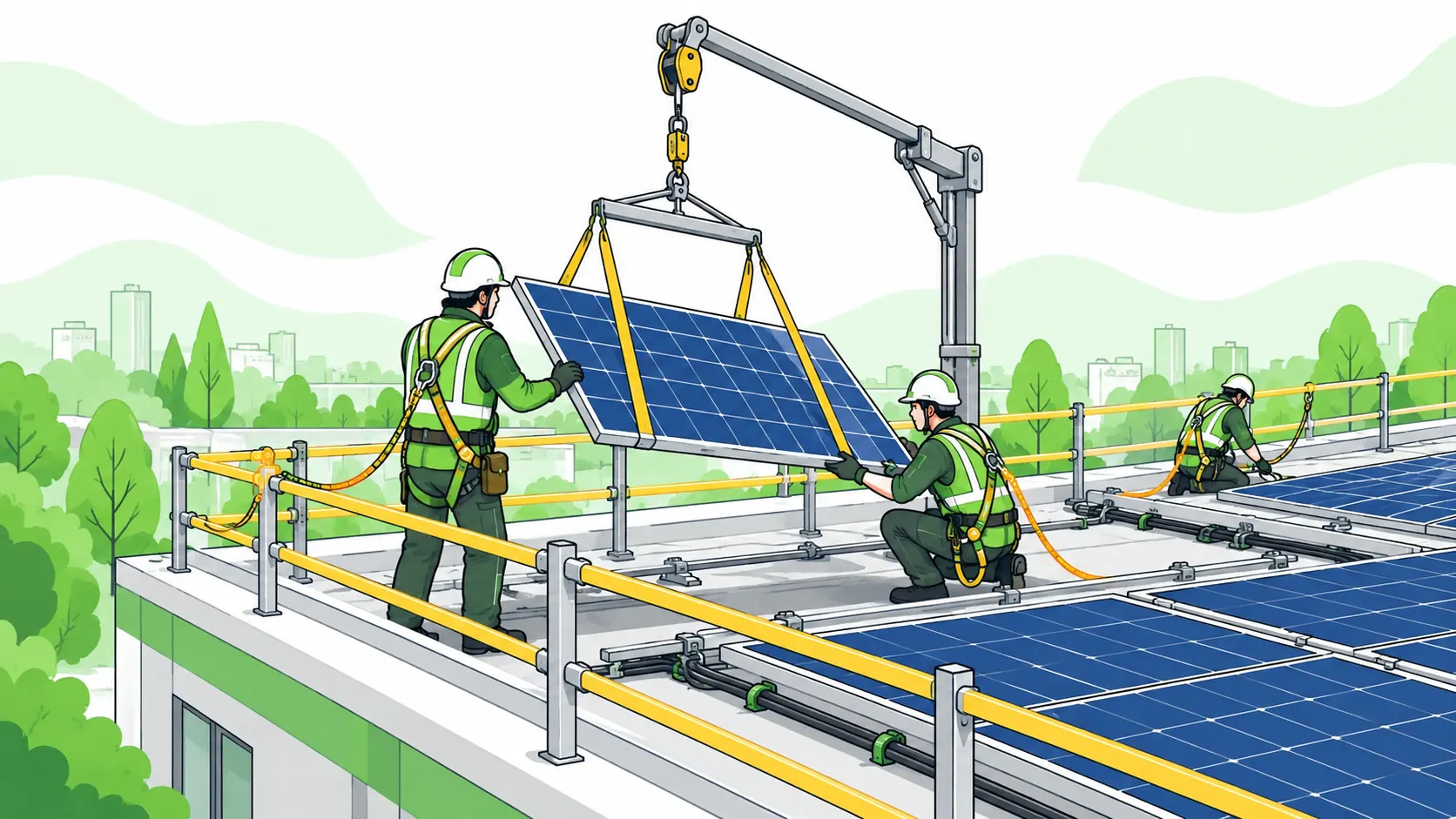
Solar panel installation safety means controlling several high-risk hazards at once: falls from roofs and ladders, live DC electricity and arc flash, manual handling of heavy modules, contact burns, and heat stress. Effective control follows the hierarchy of controls and the OSHA, HSE, and electrical-code requirements that apply to the specific work and jurisdiction.
A photovoltaic module behaves unlike almost any other component a worker meets on a roof. The moment daylight reaches its surface it generates direct-current voltage, and no inverter switch or main breaker fully shuts that off. A string of modules wired in series can sit at hundreds of volts in full sun — energized and waiting — while installers kneel inches away.
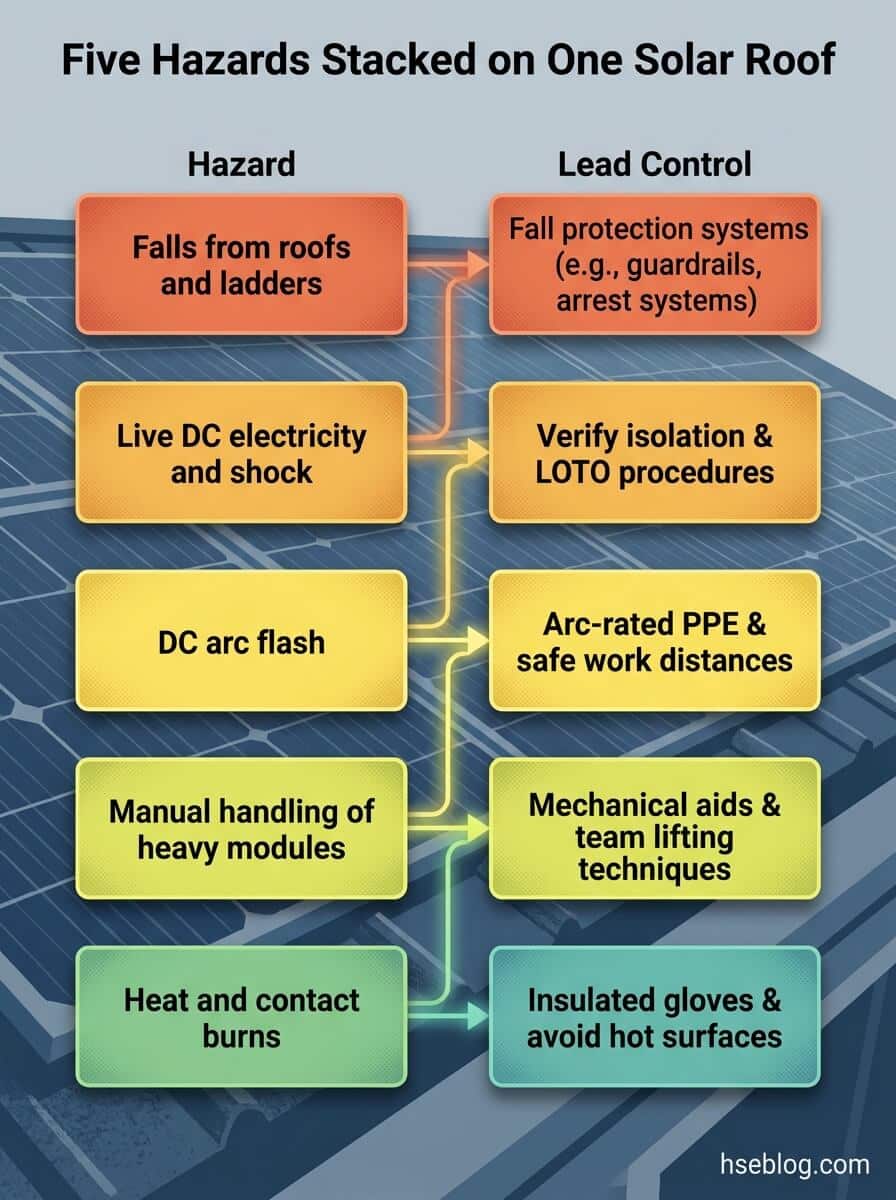
That live-by-daylight behaviour is only one of the hazards stacked into a single job. Solar panel installation safety has to manage falls, electrical shock and arc flash, heavy module handling, contact burns, and heat, often on the same sloped roof on the same afternoon. What follows is each hazard family in turn, with the controls that hold it down and how the rules differ between US and UK sites.
Why Solar Panel Installation Safety Is a Multi-Hazard Problem
The defining feature of solar work is convergence: it puts a fall hazard, a live electrical hazard, and a heat hazard in the same place at the same time. Plan for one in isolation and the others bite.
This article provides general HSE knowledge. Life-critical work such as roof access and energized PV electrical work must be planned and supervised by a competent person with relevant training, jurisdiction-specific authorization, and a site-specific risk assessment. The information here does not replace that.
The table below maps each hazard family to how harm actually occurs and the lead control. It is the skeleton the rest of this guide builds on.
| Hazard | How harm occurs | Lead control |
|---|---|---|
| Falls | Sloped, fragile, or wet roofs; ladder access; unprotected edges | Avoid height; collective protection; fall arrest with rated anchors |
| Electric shock | Live DC modules and conductors; energized AC after the inverter | Treat as live; test before touch; lockout/tagout; rapid shutdown |
| DC arc flash | Sustained arc at combiner boxes, connectors, or damaged cable | Arc-rated PPE; never break connectors under load; correct sequencing |
| Manual handling | Heavy, awkward modules lifted and hoisted to height | Mechanical hoisting; two-person lifts; never carry up ladders |
| Thermal burns and heat | Panels heat in sun; radiant roof heat; PPE load | Insulated gloves; schedule cool periods; hydration, shade, rest |
Each row carries its own engineering, mechanism, and law. Treating them as a single generic "solar safety" topic is exactly how crews get hurt — the controls do not transfer between hazards.
Fall Protection for Solar Installers: What OSHA Actually Requires
On a US solar job, fall protection is mandatory the moment a worker is exposed to a fall — but which rule applies depends on whether the work counts as construction or maintenance.
That distinction is not academic. New installation is generally governed by OSHA's construction standards, where the trigger for fall protection is 6 feet (1.8 m) above a lower level under 29 CFR 1926.501. Servicing an existing array is treated as general industry, where the threshold drops to 4 feet (1.2 m) under 29 CFR 1910.28 — a point OSHA states plainly on its own solar guidance pages.
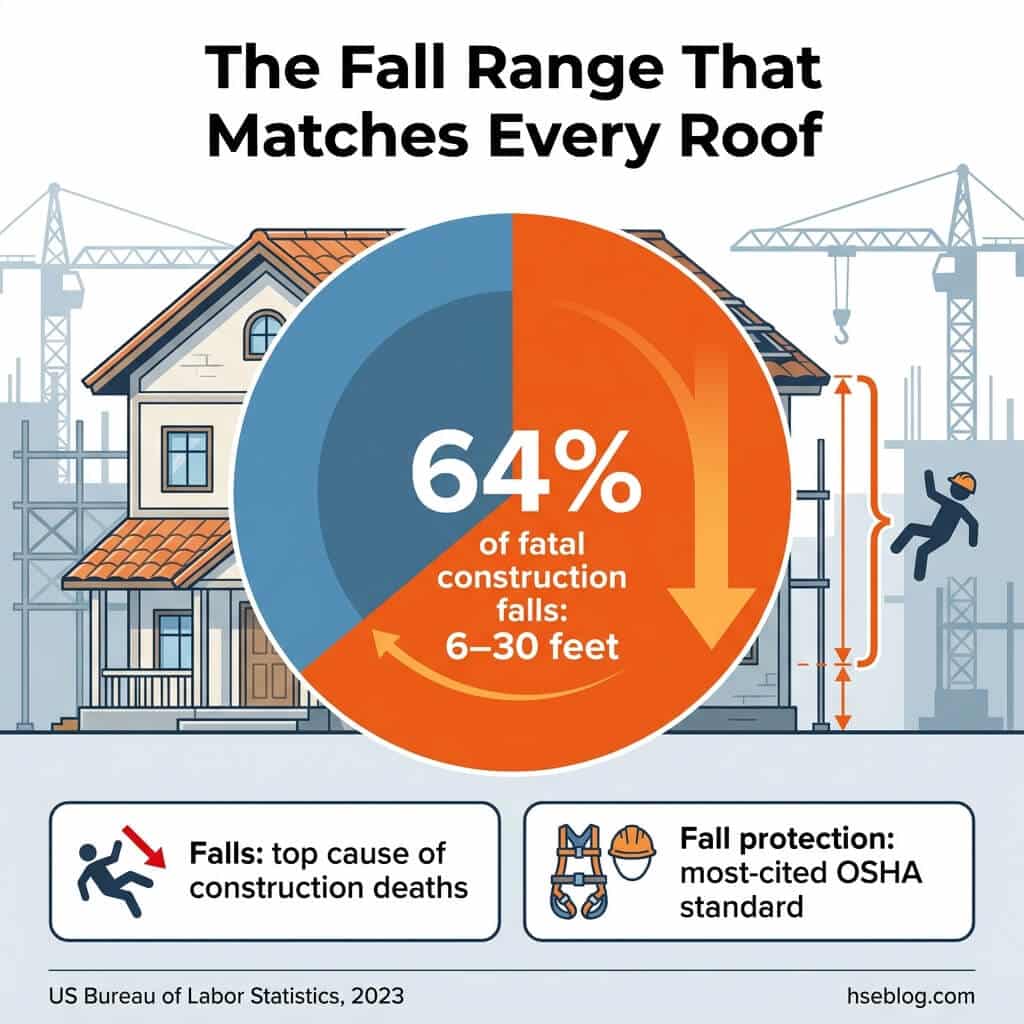
The published record explains why this matters. Falls are the leading cause of construction deaths, and most fatal falls to a lower level — 64.4% — occur between 6 and 30 feet, the precise band of a typical residential or commercial roof (US Bureau of Labor Statistics, 2023). Fall protection (1926.501) has also been OSHA's most frequently cited construction standard year after year, which tells you the issue is rarely missing rules and usually missing or misused equipment. You can read the construction duty directly on OSHA's fall protection standard.
Applied to a solar roof, the protection follows a clear order of preference:
- Avoid or reduce the height first. Pre-assemble racking and wire components at ground level so fewer tasks happen at the edge, and design conduit runs to minimize roof time.
- Use collective passive protection. Guardrails, parapets, or scaffold edge protection guard everyone without depending on individual behaviour.
- Apply restraint or positioning. A travel-restraint system stops a worker from physically reaching the edge — prevention beats arrest.
- Fall arrest as the active backstop. A personal fall arrest system needs an anchorage capable of supporting 5,000 lb per worker, or designed to a safety factor of two under a qualified person, per 29 CFR 1926.502(d)(15).
- Administrative controls. Warning lines and controlled-access zones have a place, but the safety-monitor and warning-line options are limited to defined roofing work, not general PV component installation.
A few practical points decide whether this holds on the day:
- Ladders are for access, not load. Modules must never be carried up a ladder; hoist them with a ladder hoist, swing hoist, or truck-mounted conveyor, as OSHA's solar falls guidance spells out.
- Use the right ladder material. Fibreglass side rails near live conductors; extend a straight or extension ladder at least three feet above the landing.
- Plan the rescue, not just the arrest. A worker hanging in a harness can develop suspension trauma within minutes, so a retrieval plan is part of the system — not an afterthought.
- Treat weather as a control variable. Wet, frosted, or wind-loaded roofs change footing and turn a flat module into a sail; postpone when conditions exceed the plan.
Why Are Solar Panels Live Whenever the Sun Is Up?
Solar panels are live whenever there is light because the photovoltaic effect converts photons directly into current — there is no "off" position on a sunlit module. This single fact separates solar electrical safety from almost everything else on a roof.
The DC side never truly switches off
Opening the AC disconnect or shutting the inverter kills the grid side, not the array. The DC conductors between the modules and the inverter remain energized in daylight, and string voltages of several hundred volts are routine.
- Covering reduces, it does not eliminate. Draping modules with an opaque cover lowers output, but ambient light can still produce hazardous voltage, so covers support de-energization rather than replace it.
- Inverters and capacitors hold a charge. Treat the inverter as energized for the manufacturer's stated discharge time even after isolation.
Why a DC arc is more dangerous than an AC arc
Alternating current crosses zero 100 to 120 times a second, and each crossing gives an arc a chance to self-extinguish. Direct current has no such crossing — once a DC arc strikes, it can sustain and grow rather than snuff itself out.
That is why a single careless action causes outsized harm. Pulling apart an energized DC connector or working a combiner box that aggregates several string currents can draw a sustained arc, which is the mechanism behind serious arc-flash and burn injuries on PV systems.
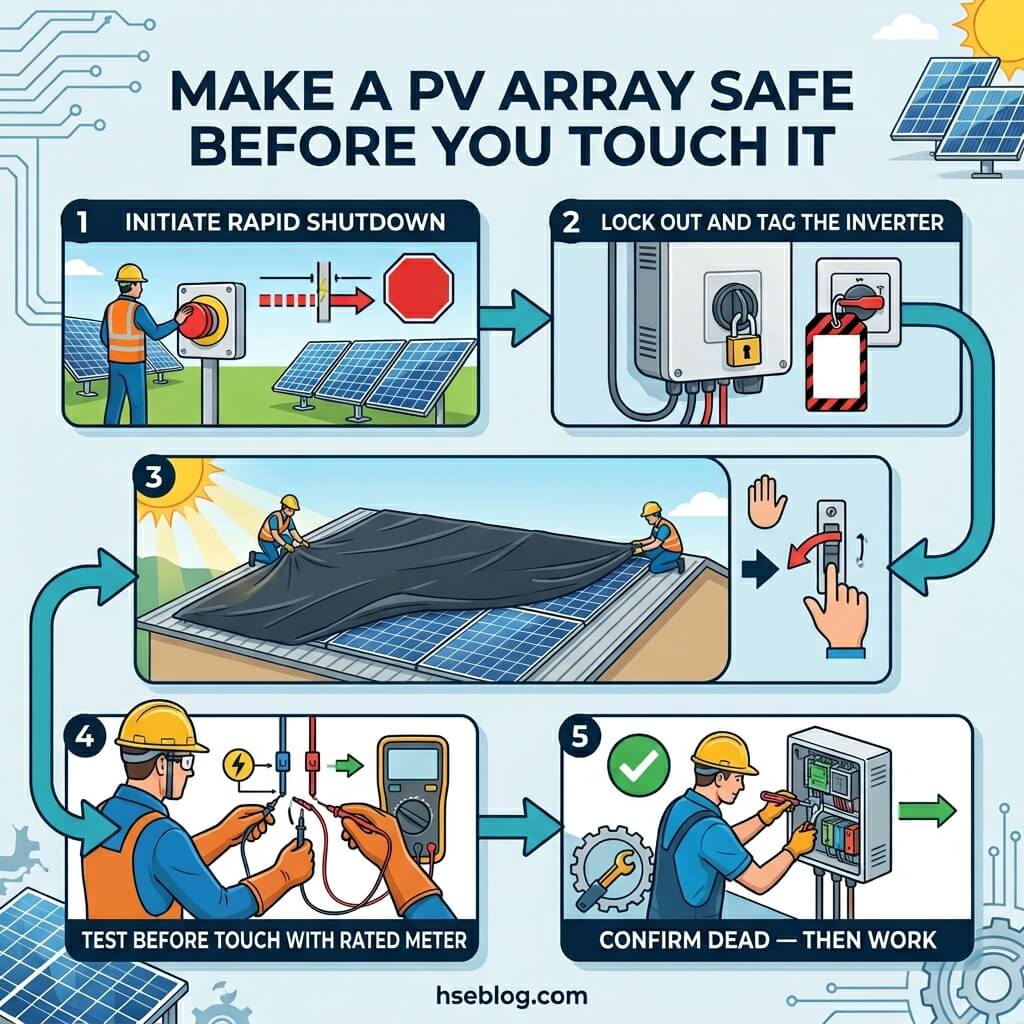
De-energize, then verify — every time
The controls here are sequence-driven and unforgiving:
- Lockout/tagout under 29 CFR 1910.147 isolates and secures every energy source before contact.
- Test before touch with a meter and leads rated for the application — overvoltage CAT III is standard for solar, and 1500 V architectures are now common on larger systems.
- Rapid shutdown under NEC 690.12 (introduced in the 2017 code cycle and tightened in later editions) drops conductor voltage within the array boundary so responders and workers are not exposed to lethal DC.
- Insulated rubber gloves to 29 CFR 1910.137 and arc-rated PPE selected through an NFPA 70E arc-flash assessment.
One correction worth making to crews directly: a current well under 100 milliamps across the chest can trigger fatal ventricular fibrillation. The danger is not "feeling a shock" — it is a current path through the heart. Grid-connected and utility-scale systems add the worker-training and safe-practice duties of 29 CFR 1910.269, summarized on OSHA's solar electrical hazards page.
Lifting, Burns, and Heat: The Underrated Solar Hazards
The hazards crews underestimate most are the ones that rarely make headlines — manual handling injuries, contact burns, and heat stress build quietly until someone is hurt. They lack the drama of a fall or an arc, which is exactly why they slip through.
Modules are deceptively punishing to handle. A residential panel commonly weighs around 18–27 kg (roughly 40–60 lb), is large and awkward, and large-format commercial modules are heavier still.
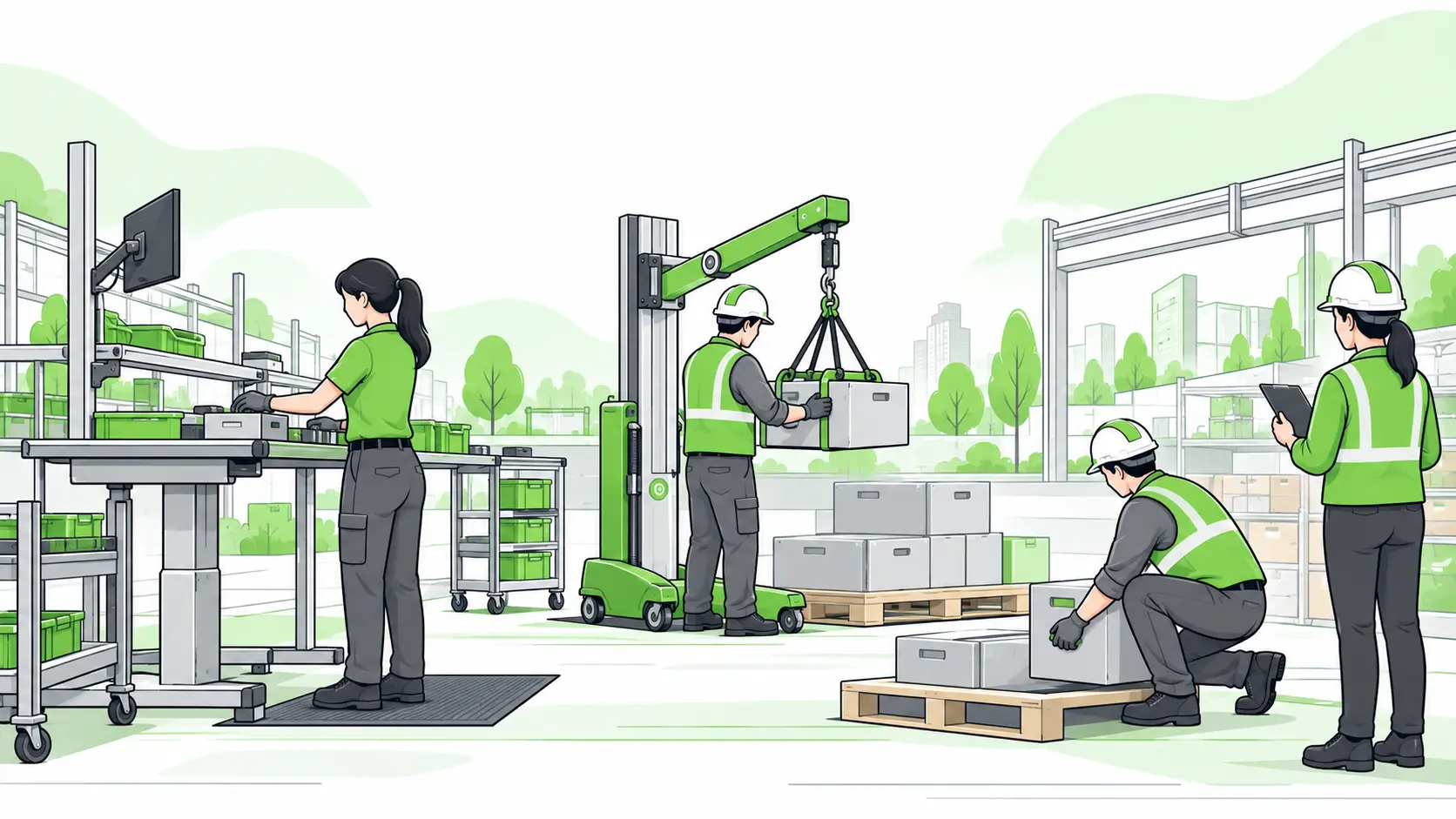
- Two people, mechanical assist. Use carts, hoists, or conveyors to move modules and reserve manual lifts for two workers with proper technique — load close to the body, no twisting.
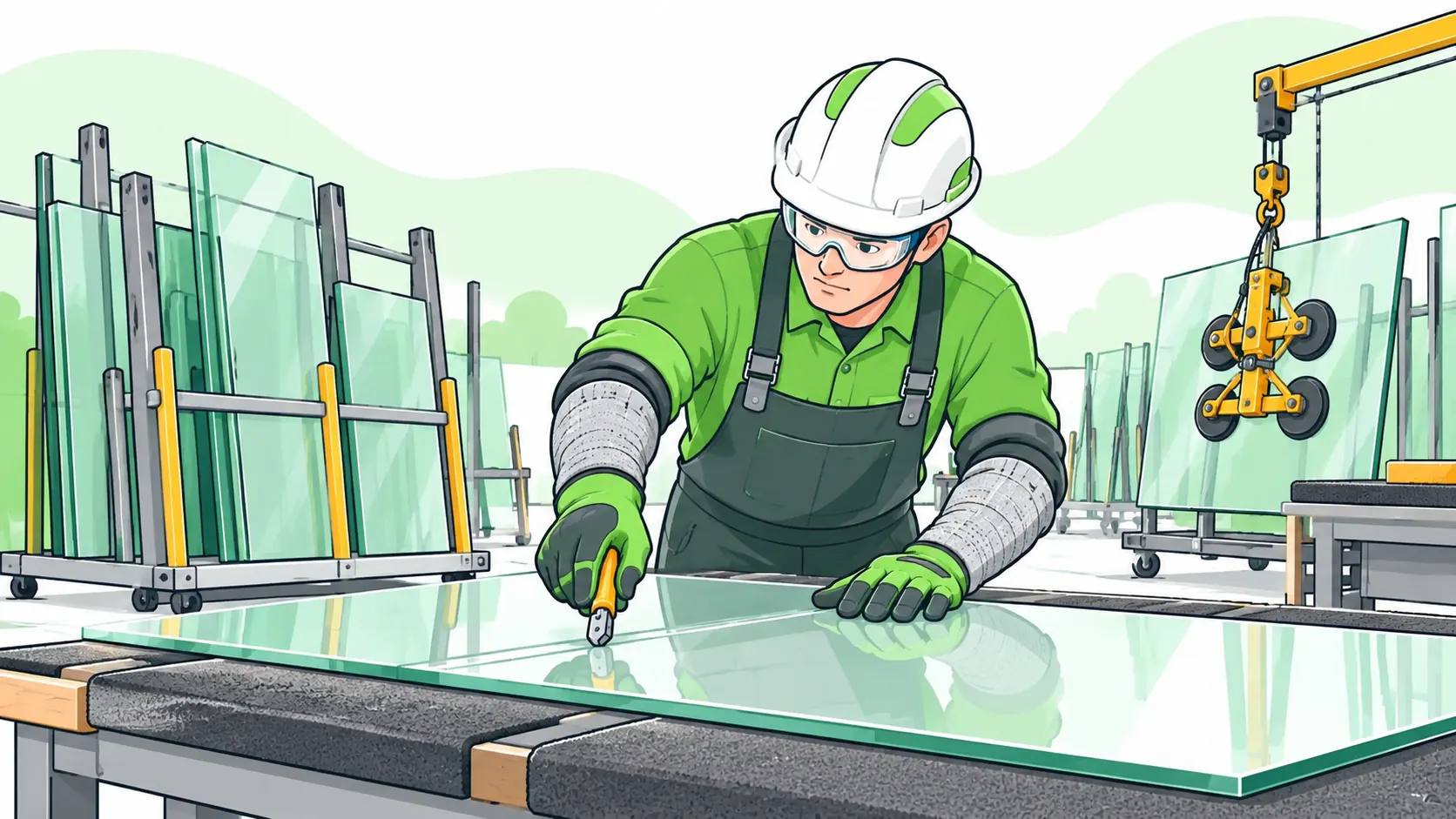
- Grip and protect. Cut-resistant gloves improve grip on glass-fronted panels and guard against laceration on frames and flashing.
- Hot to the touch. A module sitting in full sun heats quickly, so insulated or work gloves and cooler-period scheduling prevent contact burns during handling.
Heat stress on the roof
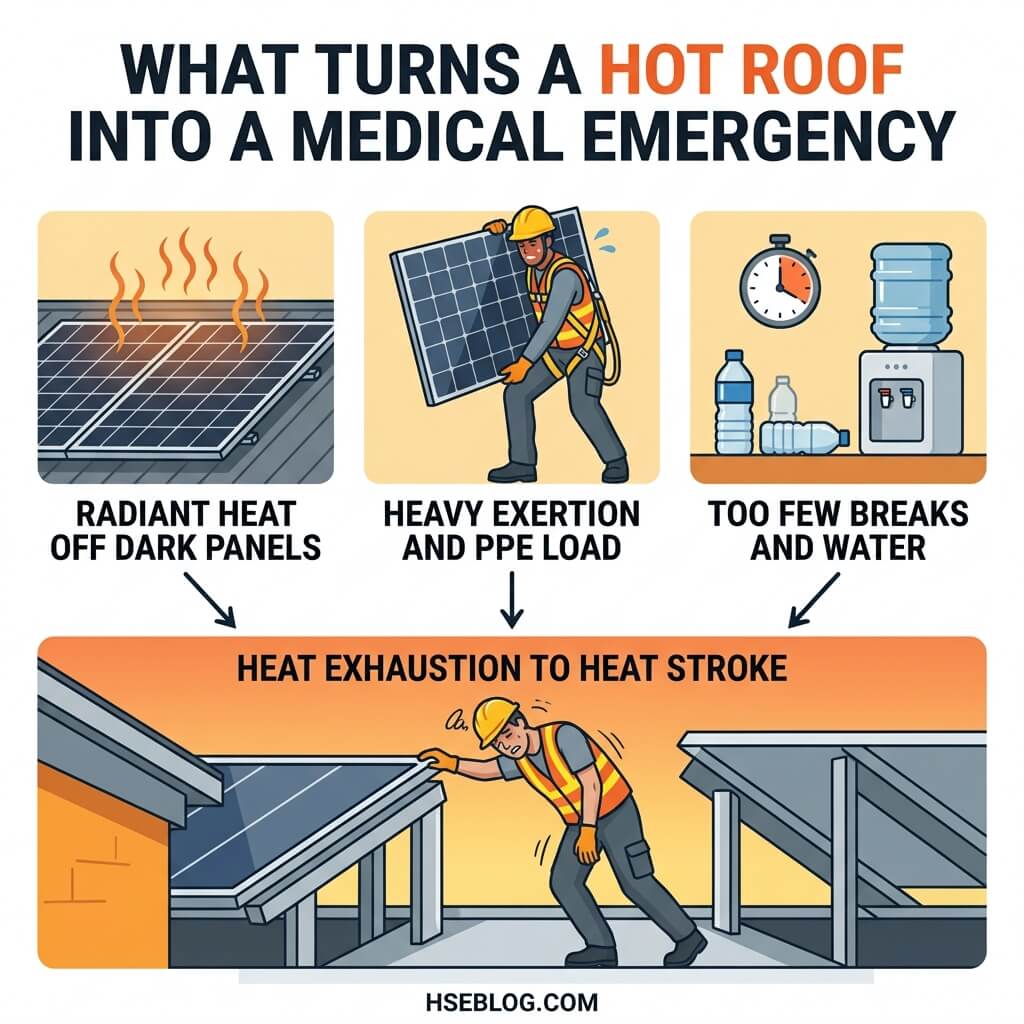
A roof is one of the harshest thermal environments a worker faces. Dark panels and membrane radiate heat upward, exertion adds metabolic load, and PPE traps it.
- Recognize the trigger levels. OSHA's proposed heat standard frames an initial heat-index trigger at 80°F and a high-heat trigger at 90°F, escalating controls as conditions worsen.
- Build the basics in. Acclimatize new and returning workers, supply cool water, schedule shaded rest, and watch for early symptoms.
- Treat it as a medical emergency. Heat stroke is life-threatening and time-critical, not something to "push through."
On regulatory status, accuracy matters here. OSHA published its heat-injury rulemaking as a proposed rule in August 2024, the public hearing concluded in July 2025, and the post-hearing comment period closed in October 2025 — but as of mid-2026 the rule has stalled with no finalization date. Meanwhile OSHA's original heat National Emphasis Program expired in April 2026 and was replaced by an expanded enforcement program, so heat remains enforceable through that program and the General Duty Clause regardless of the unfinished standard. The current state of the rulemaking is on OSHA's heat rulemaking page.
Turning Standards Into a Solar Panel Installation Safety Plan
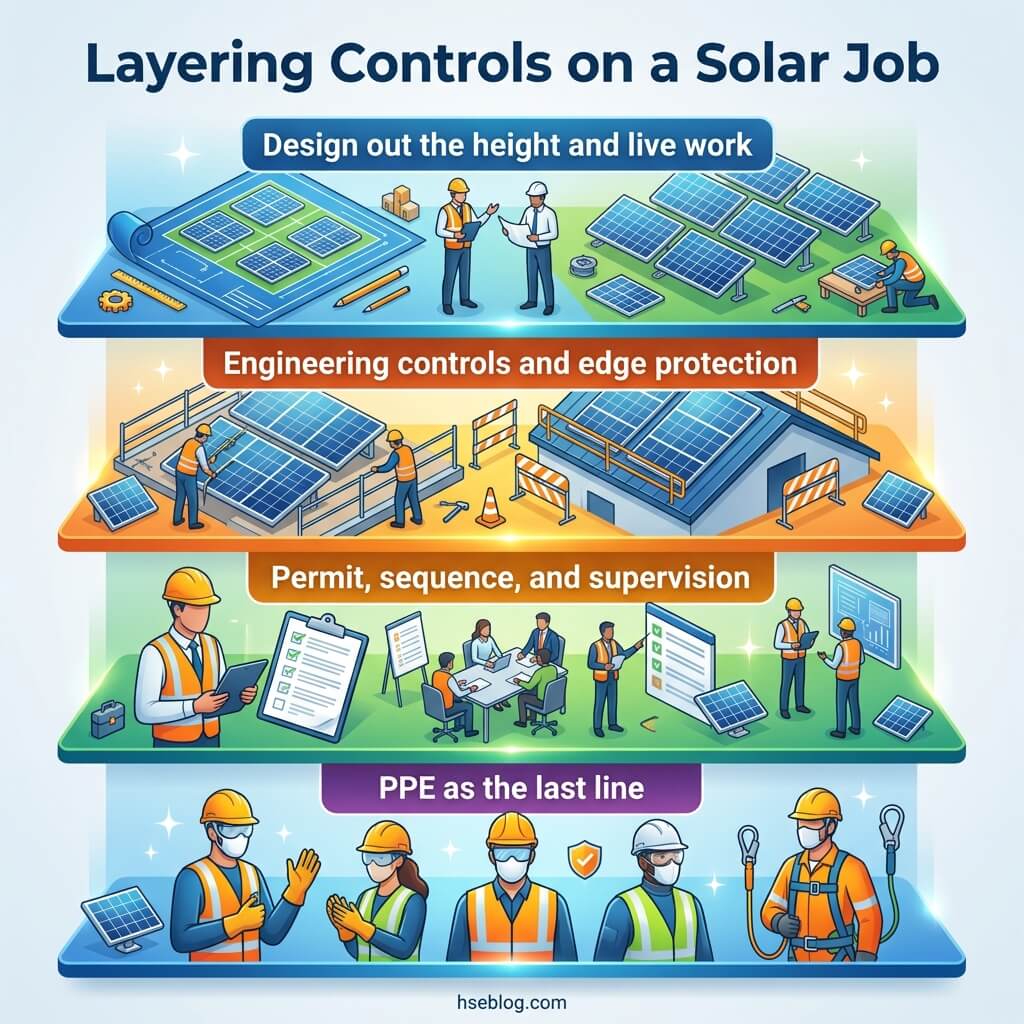
A safe solar installation is built the same way every time — controls layered from most effective to least, decided before anyone climbs. Bolting controls on at the roof's edge is the failure pattern; designing them in is the fix.
The order matters because the most effective controls are the ones that remove the hazard rather than ask a tired worker to behave perfectly at height. Work the stack top-down:
- Plan and survey. Produce a job safety analysis or risk-assessment and method statement, confirm the roof's structural capacity, check the weather window, and map the electrical work on a single-line diagram.
- Design out and substitute. Pre-assemble and pre-wire at ground level, specify rapid-shutdown-by-design, and reduce the number of energized tasks performed at height.
- Engineering controls. Install collective edge protection, use mechanical hoists for modules, and select enclosed, guarded combiner and disconnect equipment.
- Administrative controls. Run a permit-to-work for roof and live electrical tasks, fix the energization sequence, and ensure competent supervision throughout.
- PPE as the last line. Fall arrest, arc-rated clothing, insulated gloves, head, eye, and foot protection — the final layer, never the first.
- Rescue and emergency readiness. Keep a suspension-trauma retrieval plan and a heat-emergency response on site before work starts.
Competence ties the stack together, and it is where employers should invest. In the US, look for NABCEP certification alongside OSHA outreach training and the appropriate electrical license; in the UK, MCS-certified installers, CSCS cards, and formal work-at-height training; internationally, NEBOSH and IOSH qualifications signal a recognised HSE grounding. The judgment call most teams face is whether to treat ongoing servicing as construction or general industry — when in doubt, apply the stricter construction controls and document the reasoning, because that is the position an auditor will respect.
OSHA, HSE, and the Jurisdiction Trap
The same rooftop array is governed by different rules depending on where it is installed, and assuming OSHA logic applies in the UK — or the reverse — is a common, costly error. The hazards are universal; the legal triggers are not.
| Aspect | United States (OSHA) | United Kingdom (HSE) |
|---|---|---|
| Fall-protection trigger | 6 ft (1.8 m) in construction; 4 ft (1.2 m) in general industry | No minimum height; any fall liable to cause injury |
| Governing approach | Prescriptive height thresholds and named systems | Risk-based hierarchy under the Work at Height Regulations 2005 |
| Key fall standard | 29 CFR 1926.501 / 1910.28 | Work at Height Regulations 2005, Regulation 6 |
| Electrical safety | 29 CFR 1910.147, 1910.269, NFPA 70E, NEC 690.12 | Electricity at Work Regulations 1989; BS 7671 wiring |
The structural difference is the lesson. OSHA tells you when fall protection switches on by height; the UK's regulations set no minimum height at all and instead require you to control any fall that could cause injury, applying Regulation 6's hierarchy from avoidance down to personal protection. Add state variation — several OSHA state-plan states impose their own, sometimes stricter, fall and heat rules — and "compliant" only means something once you have named the jurisdiction.
Where two standards disagree, the safe default is to work to the stricter requirement and record why. A risk-based UK approach and a prescriptive US threshold can both be satisfied by the same well-engineered edge protection — the paperwork differs, the physics does not.
Regulatory content here reflects general HSE professional understanding of US and UK requirements as of June 2026. It is not legal advice. Specific compliance questions, enforcement situations, or prosecution risk should be directed to qualified legal counsel in the applicable jurisdiction.
Frequently Asked Questions
Can homeowners legally install their own solar panels?
In many places it is legal, but legality is not competence. A homeowner still faces live DC voltage, fall exposure, and electrical-code requirements, and most jurisdictions demand permits plus a final inspection — skipping them can void warranties and insurance. The shock and fall hazards do not soften for amateurs, which is why certified installers handle the energized and at-height portions.
Do you have to turn the panels off before working, and is that even possible?
You cannot truly switch a module off in daylight. Opening the AC disconnect kills the grid side, but the DC conductors stay live, and covering panels only reduces output. Safe practice combines rapid shutdown, lockout/tagout under OSHA 1910.147, and a test-before-touch check with a rated meter before any contact.
At what height do solar installers need fall protection?
It depends on the work. New installation is construction, so OSHA requires fall protection at 6 feet under 29 CFR 1926.501; servicing an existing array is general industry, where the trigger is 4 feet under 1910.28. In the UK the Work at Height Regulations 2005 set no minimum height — any fall that could injure must be controlled.
Is the DC side really more dangerous than the AC side?
Both can kill, but DC carries a distinct hazard. A DC arc has no zero-crossing to self-extinguish, so a fault drawn at a connector or combiner box can sustain and intensify rather than clear. That arc behaviour, plus high string voltages, is why breaking energized DC connectors under load is a serious mistake.
Can solar panels be installed in rain or high wind?
It is strongly discouraged. Wet or frosted roofs destroy footing, and a flat module acts like a sail in gusts, threatening both the worker's balance and the load. Manufacturers set wind limits for hoists and MEWPs, and a sound method statement defines a weather window beyond which work stops.
What certifications should a solar installer hold?
Look for evidence of both trade and safety competence. In the US that typically means NABCEP certification, OSHA 10 or 30 outreach training, and the appropriate electrical license; in the UK, MCS certification, a CSCS card, and work-at-height training. Recognised HSE qualifications such as NEBOSH or IOSH add a credible safety-management foundation.
Where Solar Safety Is Heading Next
The risk profile of this trade is shifting under the crews' feet. System voltages keep climbing toward 1500 V DC on larger arrays, which raises the stakes on arc-flash assessment and rated test equipment, while rapid-shutdown requirements continue to tighten through successive code cycles — the electrical hazard is becoming more, not less, demanding to manage.
Heat is the other front to watch. A federal US heat standard remains unfinished as of 2026, but enforcement has not paused, several states already mandate heat plans, and rising temperatures make rooftop thermal exposure a structural problem rather than a seasonal one. Crews that already run written heat plans, acclimatization schedules, and rescue procedures will adapt easily to whatever finally lands.
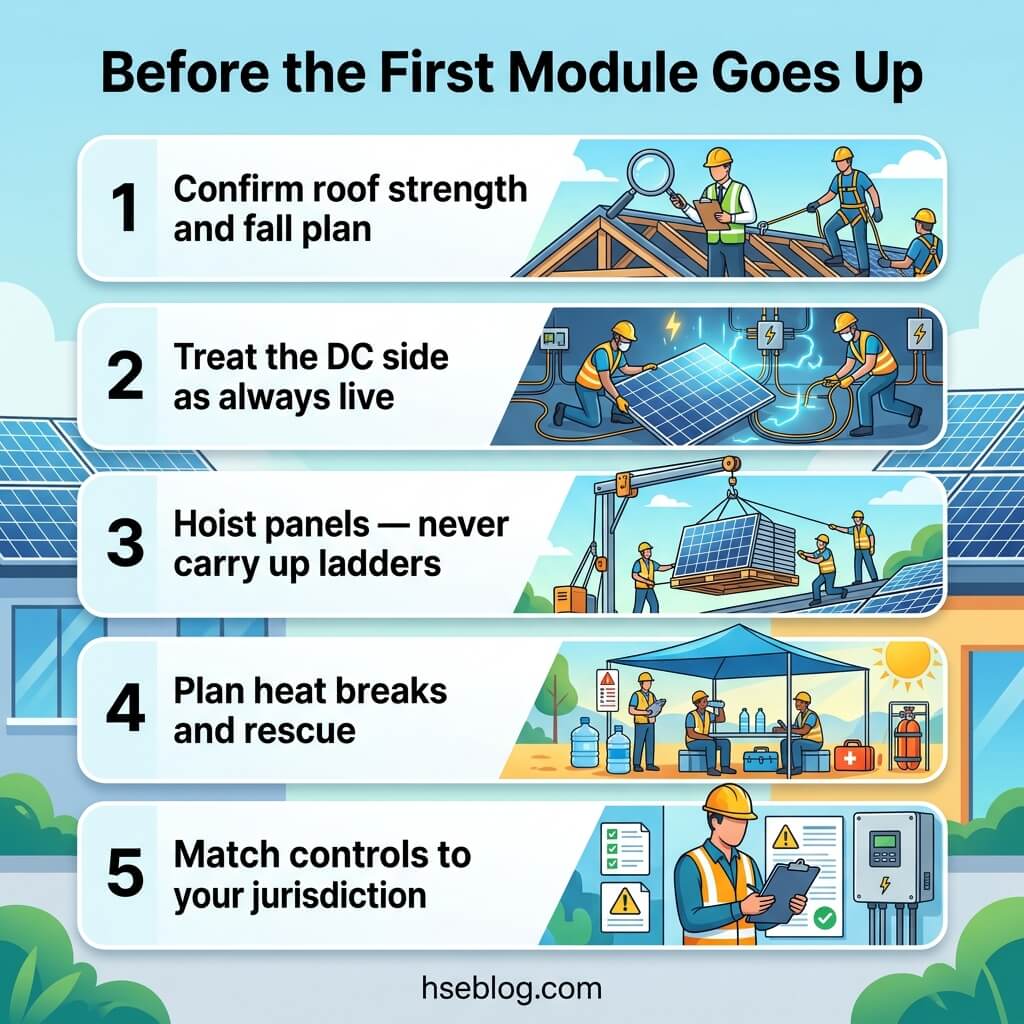
None of this changes the core of solar panel installation safety: remove the height where you can, treat the DC side as live until proven dead, hoist the panels you cannot carry safely, and match your controls to the jurisdiction you are working in. Get those four right, and the technology stays as clean as its promise — for the people on the roof as much as the grid below.