
Nanotoxicology is the study of how engineered nanomaterials — particles under 100 nanometres — harm the body in ways their larger counterparts do not. The core finding is that nanoscale size raises surface reactivity, lets particles cross biological barriers, and drives lung inflammation, oxidative stress, and, for some fibre-shaped materials, an asbestos-like fibrosis pathway.
A widely held assumption sits behind a lot of careless handling: if a material is harmless in bulk, the powdered nano version must be harmless too. The titanium dioxide on a painter's brush and in a sunscreen tube is the textbook counter-example — chemically the same compound, yet the International Agency for Research on Cancer classifies inhaled titanium dioxide as Group 2B, possibly carcinogenic to humans (IARC, 2010), and NIOSH treats it as a potential occupational carcinogen. Same chemistry, different rulebook, because size changes behaviour.
That gap between intuition and evidence is exactly where workers get exposed. This article lays out what nanotoxicology has established about the health impacts of engineered nanomaterials — the mechanisms of harm, the exposure routes, the lung evidence, the recommended limits, and the controls that hold up — so HSE professionals handling these materials can make decisions grounded in the published record rather than in the comfort of the bulk-material safety data sheet.
Medical disclaimer: Content here covering health effects, exposure, and health surveillance is for HSE practitioner reference. It is not medical advice. Workers with specific symptoms or exposure concerns should consult an occupational physician or qualified medical professional.
Why Size Rewrites the Toxicology Rulebook
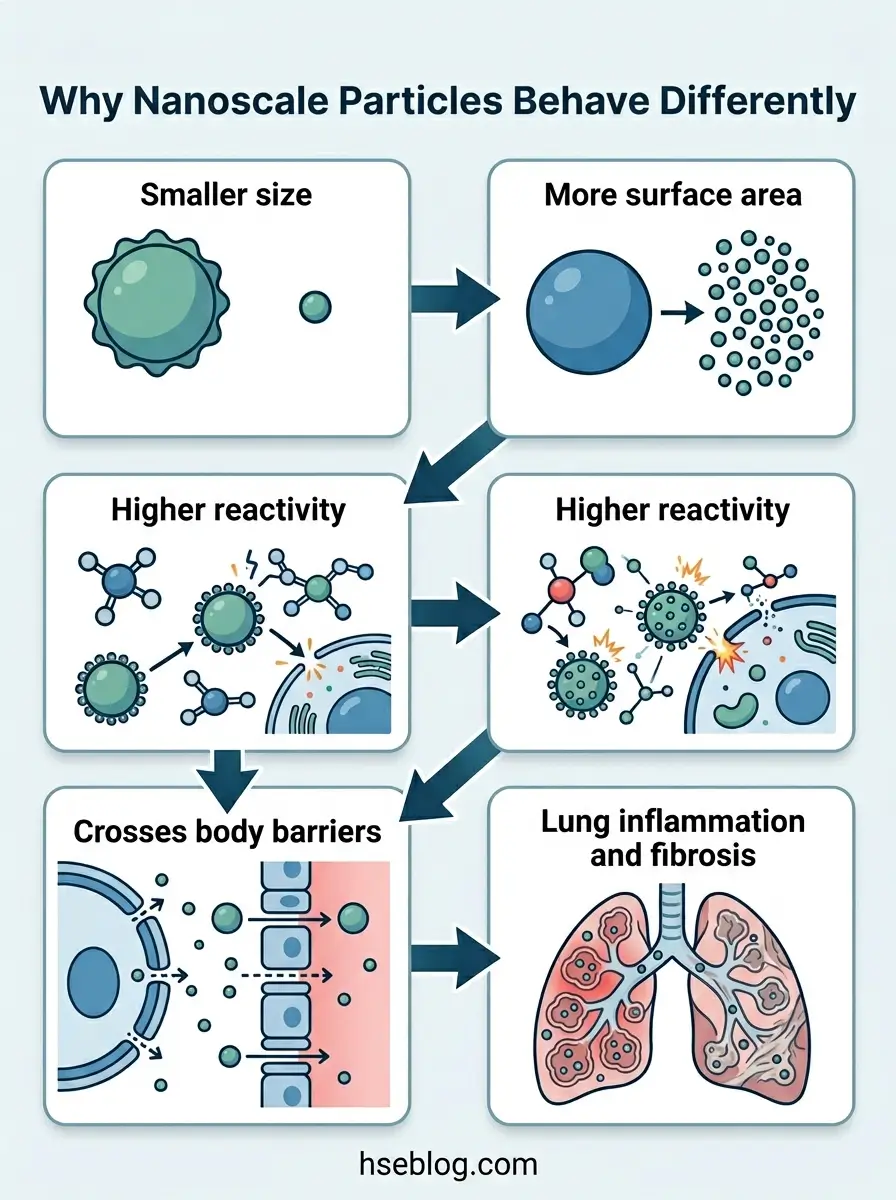
Shrink a particle to the nanoscale and you change its dose-response logic entirely. The same mass of material gains an enormous surface area, and surface is where chemistry happens.
A common reading of the science holds that for nanomaterials, mass matters less than two other properties — surface area and shape. That reframing is the foundation of nanotoxicology, and it explains why bulk-material exposure limits often fail to protect.
Three properties carry most of the hazard:
- Surface area per unit mass. A gram of nanopowder presents vastly more reactive surface than a gram of coarse powder, so it generates more reactive oxygen species and more inflammation at the same weight.
- Particle shape and aspect ratio. Long, thin, rigid fibres behave like fibres, not like dust — the dimension matters more than the chemistry.
- Biopersistence. Particles the body cannot dissolve or clear stay in tissue and keep provoking a response, which is the engine behind chronic disease.
OSHA's own guidance acknowledges the uncertainty plainly: the potential health effects are not fully understood, yet studies indicate some nanomaterials are biologically active, can penetrate intact skin, and produce toxic reactions in the lungs of exposed animals (OSHA, Nanotechnology — Health Effects). For an HSE professional, "not fully understood" is not a reason to relax — it is the reason to apply a precautionary control strategy.
How Nanoparticles Enter the Body — and Where They Travel
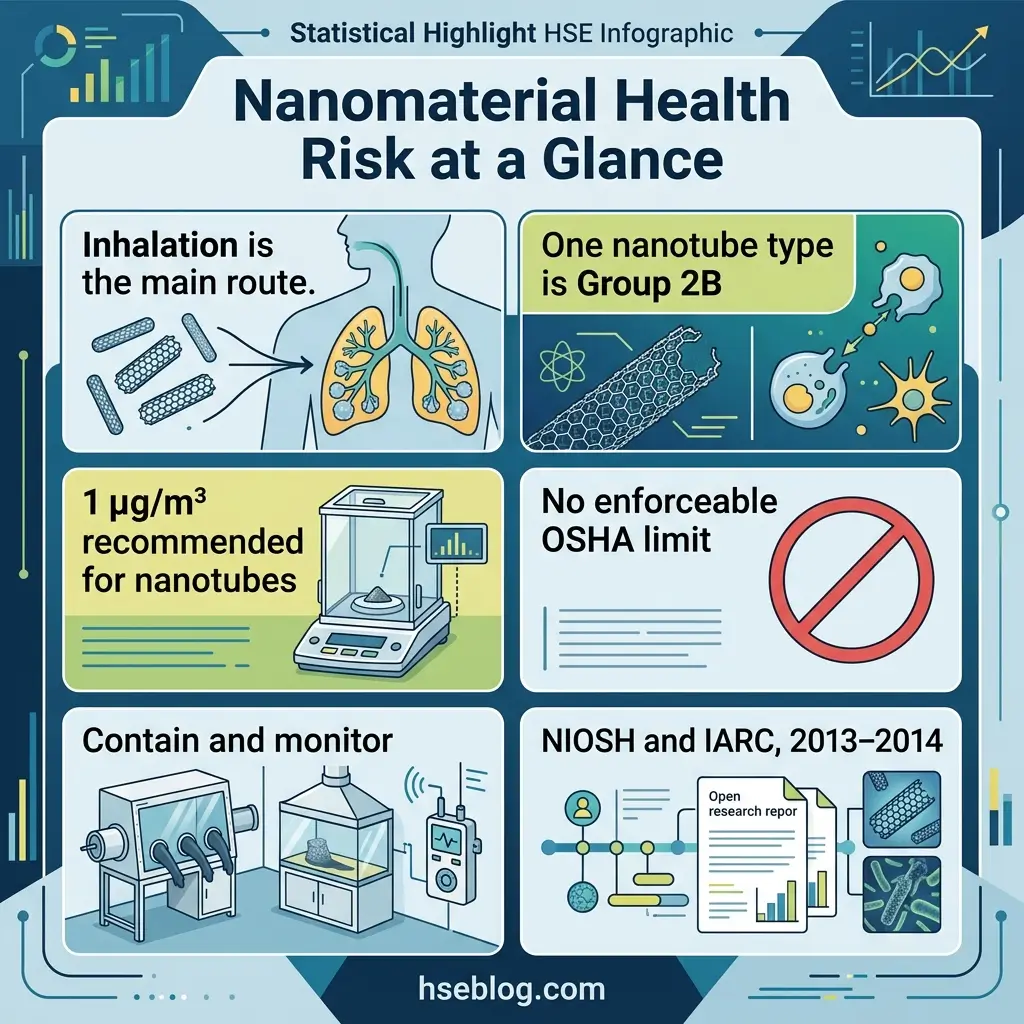
Inhalation is the route that matters most. Nanoparticles aerosolise easily during weighing, pouring, mixing, and cleanup, and once airborne they behave like a gas rather than settling like coarse dust.
The exposure picture across the published record follows a consistent order of concern:
- Inhalation (primary). Particles small enough to reach the deep lung deposit in the alveoli, where clearance is slow and translocation is possible.
- Dermal contact (secondary). Some nanomaterials may penetrate compromised or flexed skin; intact skin is a better barrier, but it is not absolute.
- Ingestion (incidental). Hand-to-mouth transfer and swallowed, cleared respiratory particles add a smaller but real pathway.
What distinguishes nanoparticles from ordinary dust is what happens after deposition. A consistent theme in the toxicology literature is translocation — the movement of nanoparticles out of the lung and into the bloodstream, with secondary distribution to other organs, a behaviour rarely seen with larger respirable particles.
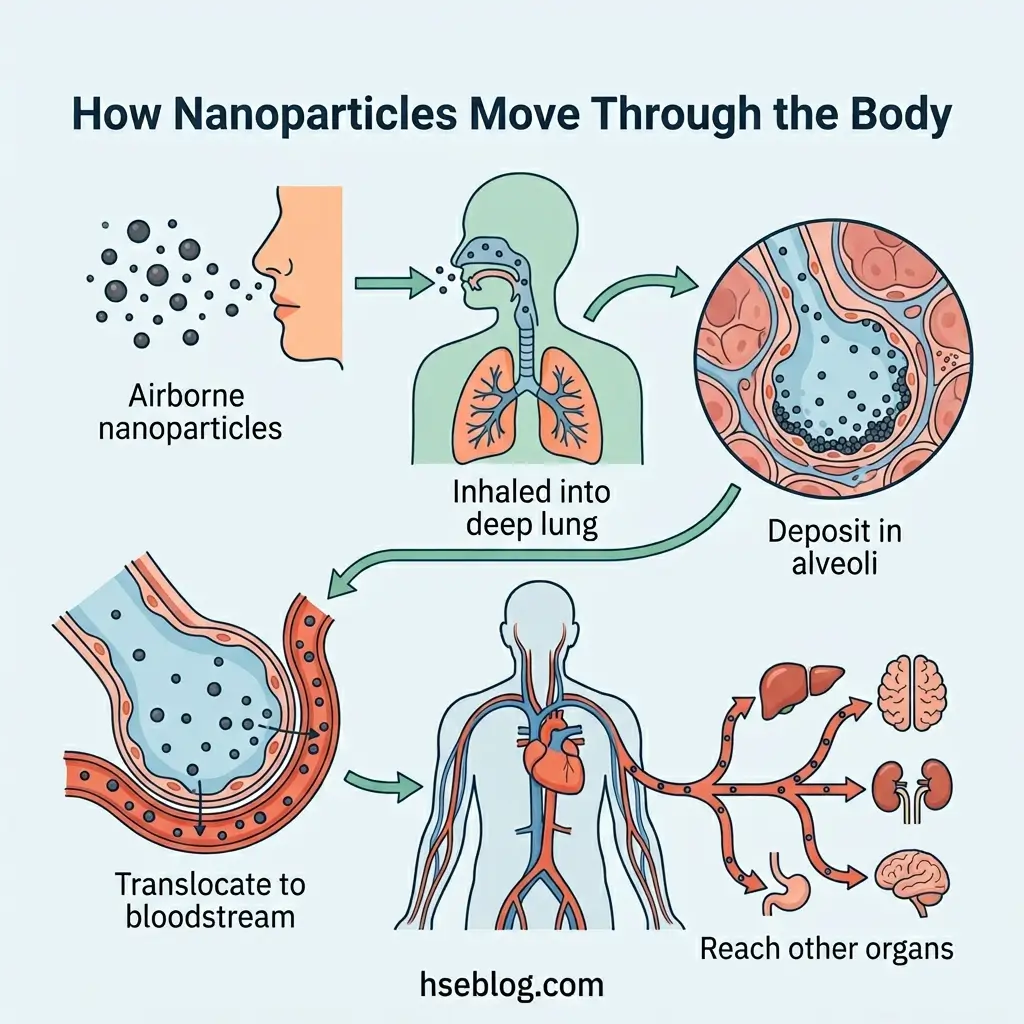
The practical lesson from this pathway is that respiratory protection and source containment do most of the protective work. Skin and ingestion controls matter, but an exposure-control plan that does not start with airborne containment is solving the wrong problem first.
What the Health Evidence Actually Shows
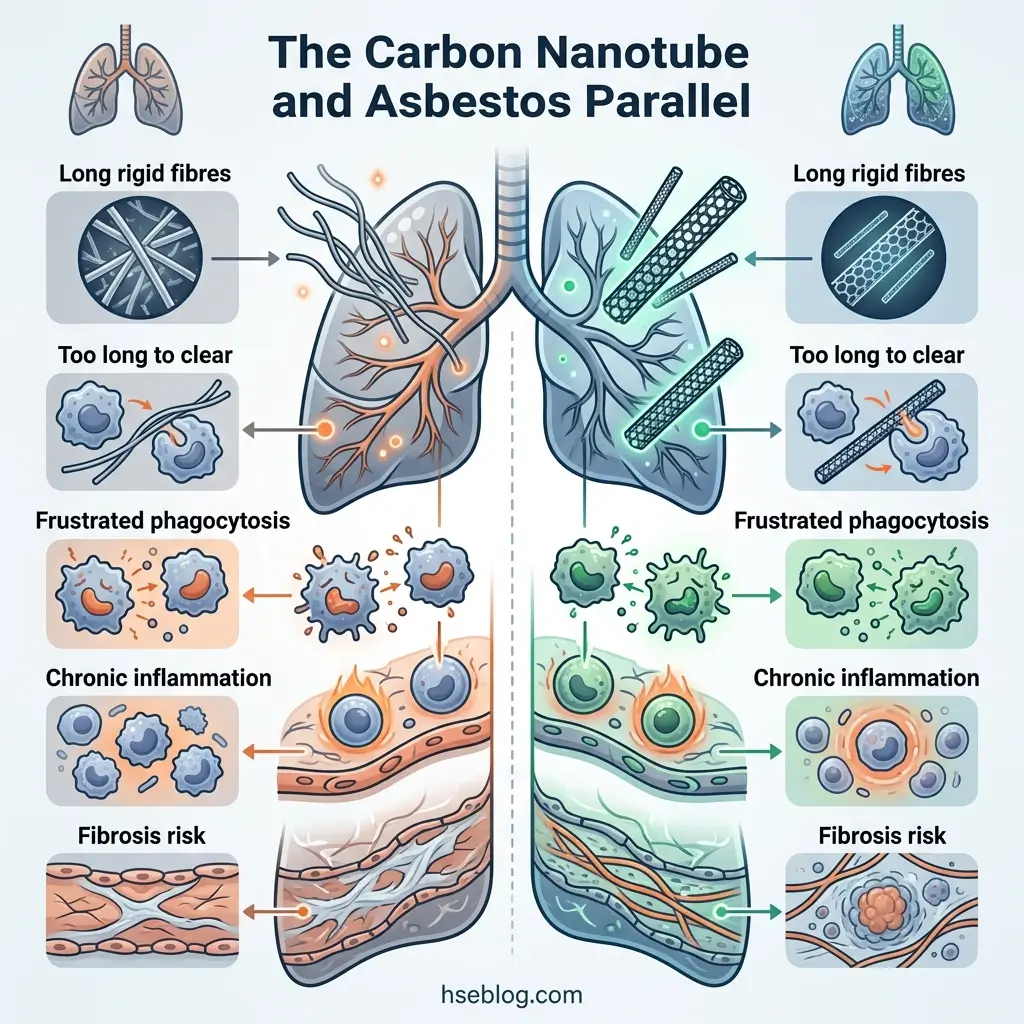
The strongest evidence sits in the lungs. Animal studies reviewed by NIOSH found that carbon nanotubes and nanofibers caused pulmonary inflammation and rapidly developing, persistent fibrosis at relatively low mass doses (NIOSH CIB 65, 2013).
The most discussed mechanism is the fibre parallel. Long, rigid, high-aspect-ratio nanotubes share the geometry that makes asbestos dangerous — they are too long for a lung macrophage to fully engulf, producing what researchers call frustrated phagocytosis and sustained inflammation.
That parallel is reflected in the cancer classifications, but the detail matters:
| Material | IARC classification | Source |
|---|---|---|
| Mitsui-7 (MWCNT-7) multi-walled carbon nanotube | Group 2B — possibly carcinogenic | IARC Monograph 111, 2014 |
| Other MWCNTs and single-walled carbon nanotubes | Group 3 — not classifiable | IARC Monograph 111, 2014 |
| Inhaled titanium dioxide | Group 2B — possibly carcinogenic | IARC Monograph 93, 2010 |
A misconception worth correcting directly: "carbon nanotubes are carcinogenic" overstates the evidence. Only one well-characterised type, Mitsui-7, drew the Group 2B label; the others were judged not classifiable on current data — which is a statement about evidence gaps, not a clean bill of health.
Beyond the lung, biomonitoring studies of exposed workers have detected raised oxidative-stress markers — for example, elevated markers in the exhaled breath of workers in nanoparticle production (Pelclova et al., Journal of Breath Research, 2016). These are early biological signals, not confirmed disease, and the field still lacks a validated surveillance biomarker, which is one of its real limitations.
The Exposure-Limit Gap: Why There Is No Simple Safe Number
Here is the uncomfortable operational reality. For most engineered nanomaterials, no occupational exposure limit exists at all — and where one does, it is recommended, not enforceable, in the United States.
NIOSH has published recommended exposure limits for only a short list of nanomaterials, and the values themselves carry caveats:
| Material | Recommended limit | Issuing body | Key caveat |
|---|---|---|---|
| Carbon nanotubes / nanofibers | 1 µg/m³ EC, 8-hr TWA | NIOSH (CIB 65, 2013) | Set at the lowest reliably measurable level, not a proven safe level |
| Ultrafine / nanoscale TiO₂ | 0.3 mg/m³ | NIOSH (CIB 63, 2011) | Eight times tighter than fine TiO₂ (2.4 mg/m³) |
| Respirable nanoscale TiO₂ | 0.2 mg/m³ TLV | ACGIH | Voluntary consensus value; stricter than the NIOSH figure |
The carbon nanotube number deserves a flag. The 1 µg/m³ REL corresponds to the lowest airborne concentration current sampling methods can accurately measure — it is a quantification floor, not a toxicology-derived "safe" threshold. Treating it as the latter is a genuine misreading I have seen repeated in risk assessments.
Two further problems compound the gap:
- The metric problem. Mass-based limits may understate nano-hazard, because surface area and particle number track the biology better than weight. A judgment call sits here: monitor what the standard specifies (mass) or what the science suggests (particle number and surface area). The defensible answer is to measure both where instrumentation allows.
- The SDS problem. A bulk-material safety data sheet does not describe the nanoform. EU rules now require nanoform-specific safety data sheets (Commission Regulation (EU) 2020/878, applying from January 2021), precisely because the bulk hazard profile was misleading users (ECHA/EUON, nanoform SDS requirements).
Controlling Nanomaterial Exposure at Work
Because the numbers are weak, the controls have to be strong. The sound approach treats every poorly characterised nanomaterial as a potential hazard and contains it accordingly — a precautionary posture endorsed across NIOSH, ISO, and EU-OSHA guidance.
A practical, layered control set looks like this:
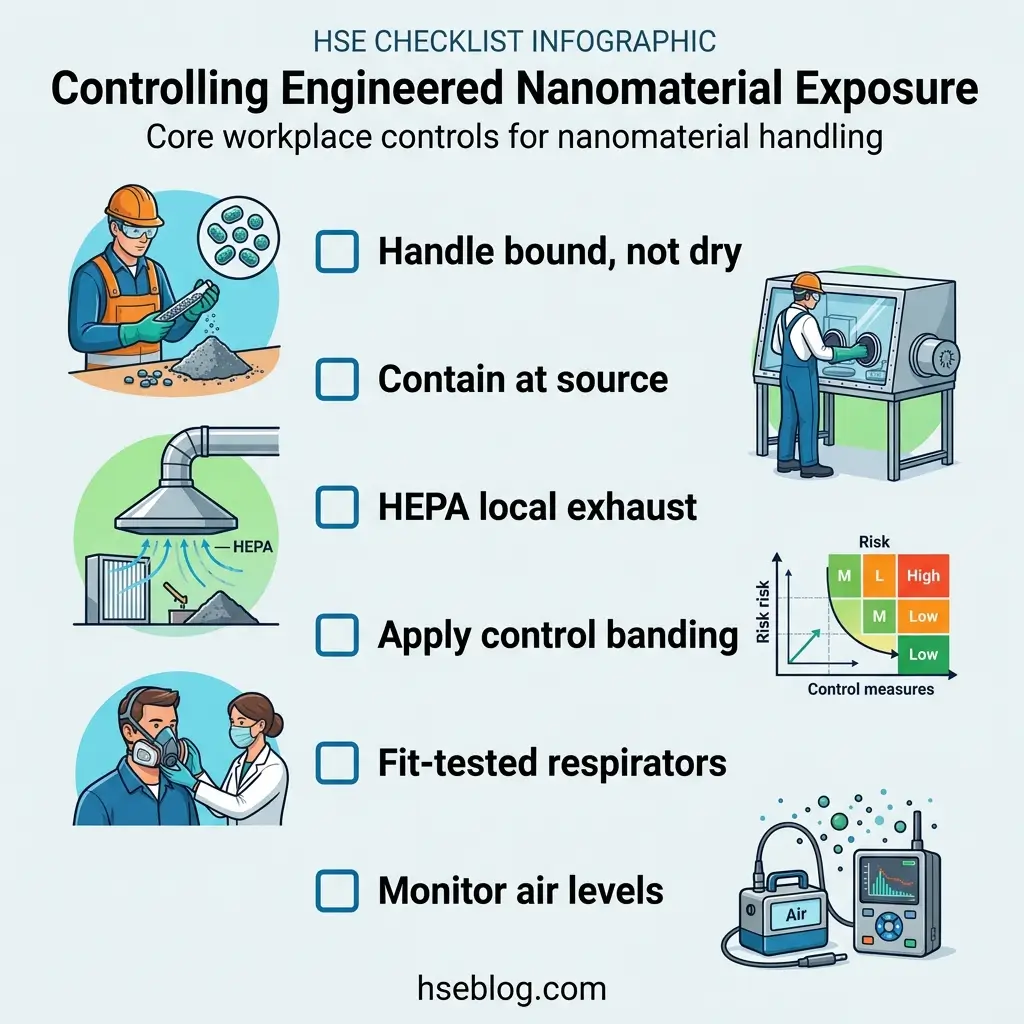
- Eliminate or substitute the airborne form. Handle nanomaterials as suspensions, pastes, or pellets rather than dry powders wherever the process allows — bound nanomaterials aerosolise far less.
- Contain at source. Glove boxes, ventilated enclosures, and local exhaust ventilation fitted with HEPA filtration capture particles before they reach the breathing zone.
- Apply control banding where data is thin. ISO/TS 12901-2 sets out a control-banding method that assigns a containment level by hazard and exposure band when no exposure limit exists — built for exactly this uncertainty.
- Select respiratory protection deliberately. Properly fitted, well-filtered respirators capture nanoparticles efficiently; the failure mode is fit and discipline, not filter penetration.
- Verify with monitoring. Combine mass sampling against any available REL with particle-number instruments to confirm controls are working, not just present.
ISO/TR 12885:2018 consolidates these occupational health and safety practices into a single reference and is a sound starting framework for a nano-specific risk assessment (ISO/TR 12885:2018).
The Regulatory Picture and Where It Is Heading
Regulation is unsettled, and the most recent movement has been toward caution about over-classifying. On 1 August 2025, the Court of Justice of the European Union upheld the annulment of the EU's harmonised classification of certain powder forms of titanium dioxide as a suspected inhalation carcinogen, confirming a 2022 General Court ruling (CJEU, joined cases C-71/23 and C-82/23, 2025).
That ruling does not declare nano-TiO₂ safe. It found the classification rested on insufficient scientific grounds — NIOSH still treats titanium dioxide as a potential occupational carcinogen, and IARC's Group 2B classification stands.
The broader regulatory direction shows three steady trends:
- Information-first rules. REACH nanoform requirements (effective January 2020) force registrants to characterise and report each nanoform, closing the data gap that lets nanomaterials slip through bulk registrations.
- Recommended over enforceable limits. Most jurisdictions still lean on NIOSH-style recommended values and consensus TLVs rather than statutory limits, putting the duty of care squarely on the employer.
- Standards filling the gap. ISO and EU-OSHA continue to publish practice guidance faster than binding limits emerge, which is where competent HSE teams should look for current method.
Frequently Asked Questions
Are all nanomaterials toxic to humans?
No. Toxicity depends on the specific material's size, shape, surface chemistry, and biopersistence, not on being nanoscale alone. Long rigid fibres such as certain carbon nanotubes raise more concern than soluble or low-aspect-ratio particles. The honest position is that many engineered nanomaterials remain inadequately characterised, which is itself a reason for caution.
Why is nano-titanium dioxide treated differently from the bulk pigment?
Particle size changes the hazard. NIOSH sets a tighter recommended limit for ultrafine TiO₂ (0.3 mg/m³) than for fine TiO₂ (2.4 mg/m³), and IARC classifies inhaled titanium dioxide as Group 2B. The same chemistry behaves differently in the deep lung at nanoscale, which the bulk safety data sheet does not capture.
Is there a legal exposure limit for nanomaterials in the United States?
There is no enforceable OSHA permissible exposure limit specific to engineered nanomaterials. Employers rely on NIOSH recommended exposure limits — currently published only for carbon nanotubes/nanofibers and titanium dioxide — plus general dust and air-contaminant duties. The absence of a statutory limit does not remove the employer's duty of care.
Can nanoparticles pass through the skin?
Intact skin is a reasonably effective barrier for many nanomaterials, and studies on nano-TiO₂ suggest it does not generally reach living cells through healthy skin. However, compromised, flexed, or damaged skin is a weaker barrier, and OSHA notes some nanomaterials may penetrate intact skin. Treat dermal contact as a real, secondary pathway.
Do ordinary dust masks protect against nanoparticles?
A properly selected, fit-tested respirator captures nanoparticles efficiently — filter penetration is rarely the limiting factor. The real-world failures come from poor fit, wrong selection, or inconsistent use. Respiratory protection should sit below source containment in the hierarchy, never substitute for it.
How should I assess a nanomaterial with no published exposure limit?
Use control banding. ISO/TS 12901-2 provides a structured method that assigns a containment level based on hazard and exposure bands when no occupational exposure limit exists. Combine it with source containment, HEPA-filtered local exhaust, and air monitoring to verify the controls perform.
Conclusion: A Field Still Writing Its Own Rules
Nanotoxicology is moving faster than the regulations meant to govern it, and the 2025 European court ruling on titanium dioxide shows the law correcting itself in real time rather than settling. For HSE professionals, the takeaway is not to wait for certainty. The strongest evidence — lung fibrosis from carbon nanotubes, the asbestos-like behaviour of rigid fibres, raised oxidative-stress markers in exposed workers — is already clear enough to justify firm containment now.
Expect the next few years to bring more nanoform-specific data, more consensus limits, and better surveillance biomarkers, but not a sudden flood of enforceable numbers. Until those arrive, the defensible position is a precautionary one: characterise the nanoform you actually hold, contain it at source, monitor what you can, and never let a bulk-material safety data sheet stand in for a nanoscale hazard assessment. The materials are new; the discipline of respecting an uncharacterised hazard is not.