

This is general HSE knowledge, not a substitute for a site-specific risk assessment.
PPE for working with nanomaterials means respiratory protection (N95 minimum, P100 or PAPR preferred), nitrile gloves (often double-layered), non-woven coveralls such as Tyvek, and sealed eye protection. NIOSH treats PPE as the last control after engineering containment. No enforceable OSHA exposure limit exists specifically for nanomaterials.
A persistent belief on the lab and production floor is that nanoparticles are simply too small for any respirator to stop — that if a particle is smaller than a virus, it must slip straight through the filter. The published filtration data say the opposite. NIOSH research shows the most penetrating particle size for N95 and P100 filters sits around 30 to 100 nm, and particles smaller than that are captured more efficiently as random diffusion pins them to the filter fibers (Rengasamy et al., Journal of Occupational and Environmental Hygiene, 2008).
That single misconception drives bad PPE decisions, because it pushes people to either over-trust a poorly fitted mask or abandon respiratory protection altogether. PPE for working with nanomaterials only works when it is selected against the real hazard mechanism — deep lung deposition, high aspect-ratio fibers, and uncertain skin penetration — rather than against intuition. This article covers respiratory protection, glove and skin barriers, eye and body protection, where PPE fits in the control hierarchy, and the exposure limits that do and do not exist across jurisdictions.
How Nanomaterials Actually Cause Harm
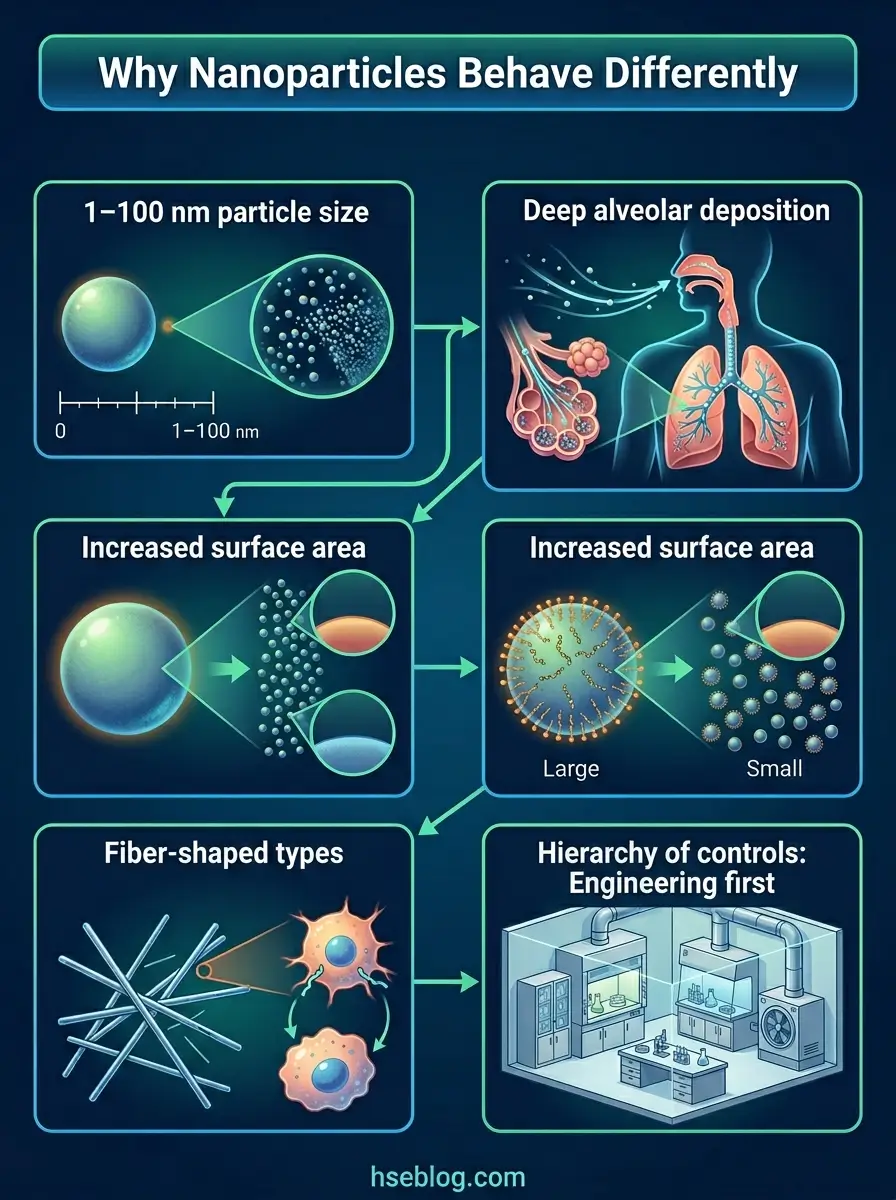
The reason ordinary PPE assumptions fail is that nanomaterials do not behave like the dusts most safety programs were built around. Three mechanisms drive the hazard, and each one changes the PPE you select.
Deep lung deposition
Particles in the 1–100 nm range deposit efficiently in the alveolar region, the deepest part of the lung where gas exchange happens. They are small enough to bypass the upper-airway defenses that trap larger dust, which is why a nuisance-dust mindset underestimates them.
Surface area, not just mass
Nanomaterials carry an enormous surface area relative to their mass, and that surface is where biological reactivity happens. A tiny airborne mass can therefore present a large reactive dose — one reason mass-based exposure thinking can mislead here.
Fiber shape and the asbestos parallel
Some nanomaterials are long, rigid, high-aspect-ratio fibers. The concern is that the lung's clearance cells cannot fully engulf a long stiff fiber — so-called frustrated phagocytosis — producing persistent inflammation.
This is not theoretical. The International Agency for Research on Cancer classified one multi-walled carbon nanotube, MWCNT-7 (Mitsui-7), as Group 2B, possibly carcinogenic to humans, in Monograph 111, while other MWCNTs and single-walled tubes were placed in Group 3 (IARC, 2014). A 2025 review in Nanomaterials argued the carcinogenicity of several MWCNT types deserves reassessment as newer two-year animal data emerge — a reminder that the hazard picture is still moving.
Respiratory Protection: What Actually Works Against Nanoparticles
Respiratory protection is the highest-stakes PPE decision here, because inhalation is the dominant exposure route. The encouraging news is that filter media are not the limiting factor.
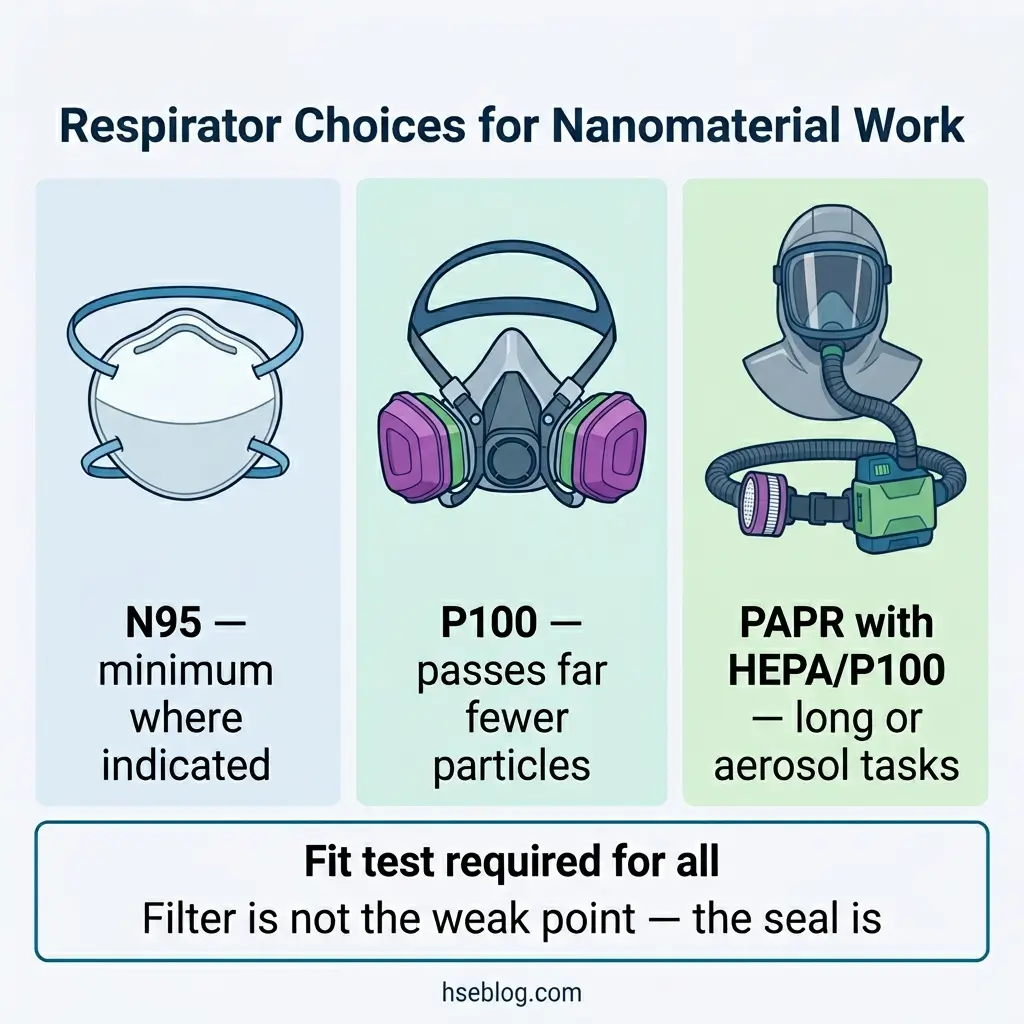
- Filtration works better than intuition suggests. Below the most penetrating particle size (~30–100 nm), diffusion capture increases, so N95 and P100 media capture the smallest nanoparticles efficiently (Rengasamy et al., 2008).
- N95 is the floor, not the target. OSHA's nanotechnology fact sheet treats a NIOSH-approved N95 as a minimum where respiratory protection is indicated, with higher classes preferred for more toxic or fibrous materials (OSHA, FS-3634).
- P100 buys a wide margin. A P100 passes roughly 167 times fewer particles than an N95 at the most penetrating size, which matters across a working lifetime of exposure to a possible carcinogen.
- PAPR for sustained or aerosol-heavy work. Powered air-purifying respirators with HEPA or P100 cartridges suit tasks outside a ventilated enclosure or where wear time is long.
- The seal is the real failure point. Filter penetration is small; face-seal leakage is not. A respirator only delivers its rated protection inside a fit-testing and respiratory-protection program.
That last point is where I see programs come apart. The mask is specified correctly, then issued without quantitative fit testing, and the assigned protection factor on paper never exists in practice.
This article provides general HSE knowledge. Life-critical decisions such as respiratory protection selection must be planned and supervised by a competent person with relevant training, jurisdiction-specific authorization, and a site-specific risk assessment. The information here does not replace that. Workers and employers can build competence through recognized pathways such as NEBOSH, IOSH, or OSHA outreach training.
Gloves and Skin: Choosing the Right Dermal Barrier
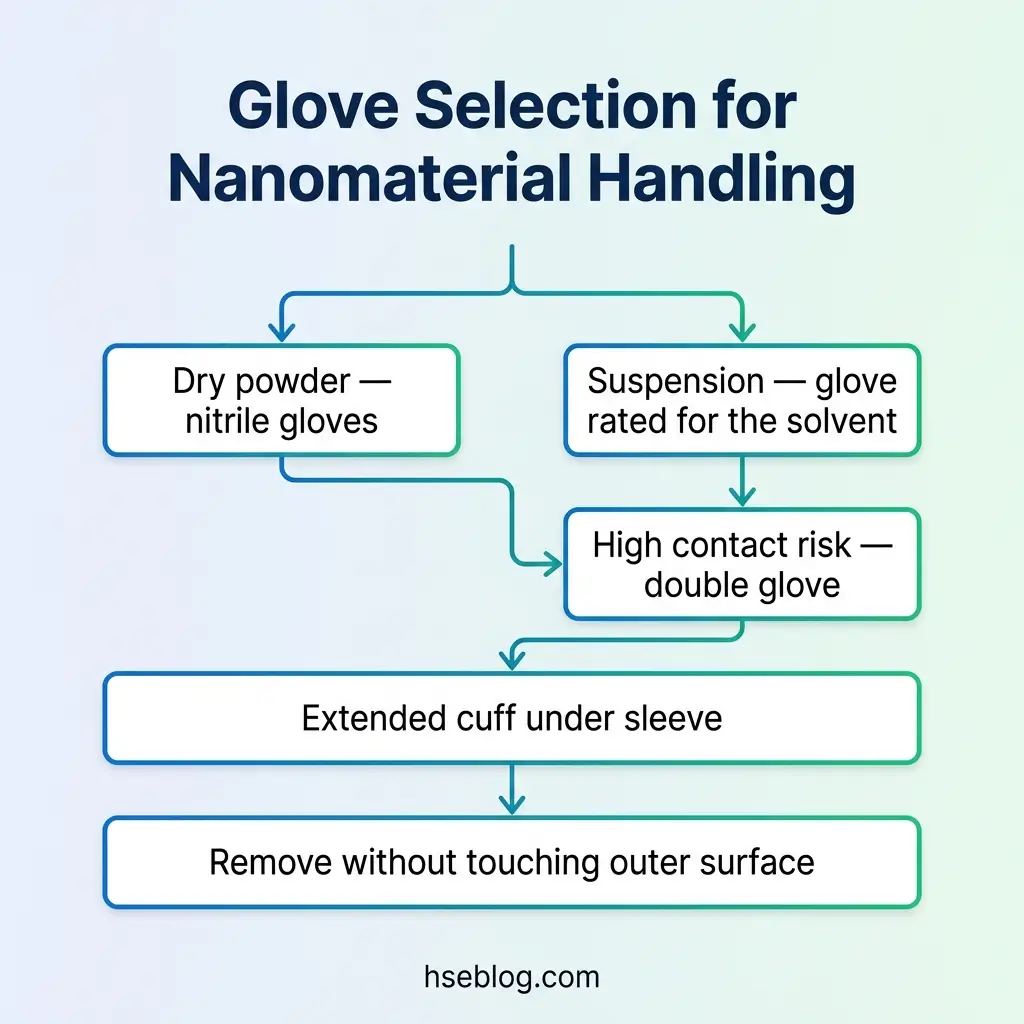
Dermal exposure carries lower certainty than inhalation — skin penetration of intact-skin nanoparticles is still debated — but the WHO nano guidelines treat glove use and surface hygiene as a precautionary baseline (WHO/NIOSH, 2017). Glove selection follows a short decision sequence.
- Start with nitrile for dry powders. NIOSH guidance for research laboratories specifies polymer gloves such as nitrile as the default for handling engineered nanomaterials.
- Double-glove for higher-risk handling. Where skin contact risk is significant, NIOSH and university EHS programs recommend two glove layers with extended cuffs until penetration data improve.
- Match the glove to the carrier liquid, not the particle. For nanomaterials in suspension, choose a glove rated against the solvent, because the liquid carries the particles through any chemical breakthrough.
- Cover the wrist gap. Extended-cuff gloves tucked under a sleeve close the most common skin-exposure point — the wrist seam.
- Treat gloves as consumables. Change on a defined schedule, remove without touching the outer surface, and never reuse single-use layers.
The judgment call I flag most often is liquid versus powder. Teams pick a glove for the nanomaterial and forget that a solvent breakthrough delivers the particle to skin regardless of how "nano-proof" the glove feels.
Eye Protection and Protective Clothing
Skin and eye barriers are where the "any coverall will do" assumption does real damage, because woven fabrics simply do not behave as barriers at the nanoscale.
Eye protection
Safety glasses or goggles are the baseline eye protection for nanomaterial work, with a full face shield added for any task that can aerosolize liquid or powder (university EHS guidance aligned to NIOSH, 2009). Labs and process areas handling nanomaterials should also keep an ANSI/OSHA-compliant eyewash station available.
Protective clothing
The fabric distinction matters more than the garment name:
- Non-woven barrier suits work. Tyvek-type or other air-tight non-woven coveralls resist particle penetration and are the recommended body barrier for high-contact tasks.
- Woven cotton or poly fabrics do not. Their weave openings are vastly larger than nanoparticles, so they collect contamination rather than block it.
- No cuffs, no open seams. Long sleeves and cuffless trousers reduce particle traps and entry points.
- Decontaminate on exit. Contaminated clothing leaving the work area is a classic take-home exposure route for families and clean spaces alike.
A common teaching gap is treating a lab coat as protective clothing. A standard woven coat keeps your shirt clean; it is not a nanoparticle barrier, and saying so plainly prevents false confidence.
PPE Is the Last Line: Containment Comes First
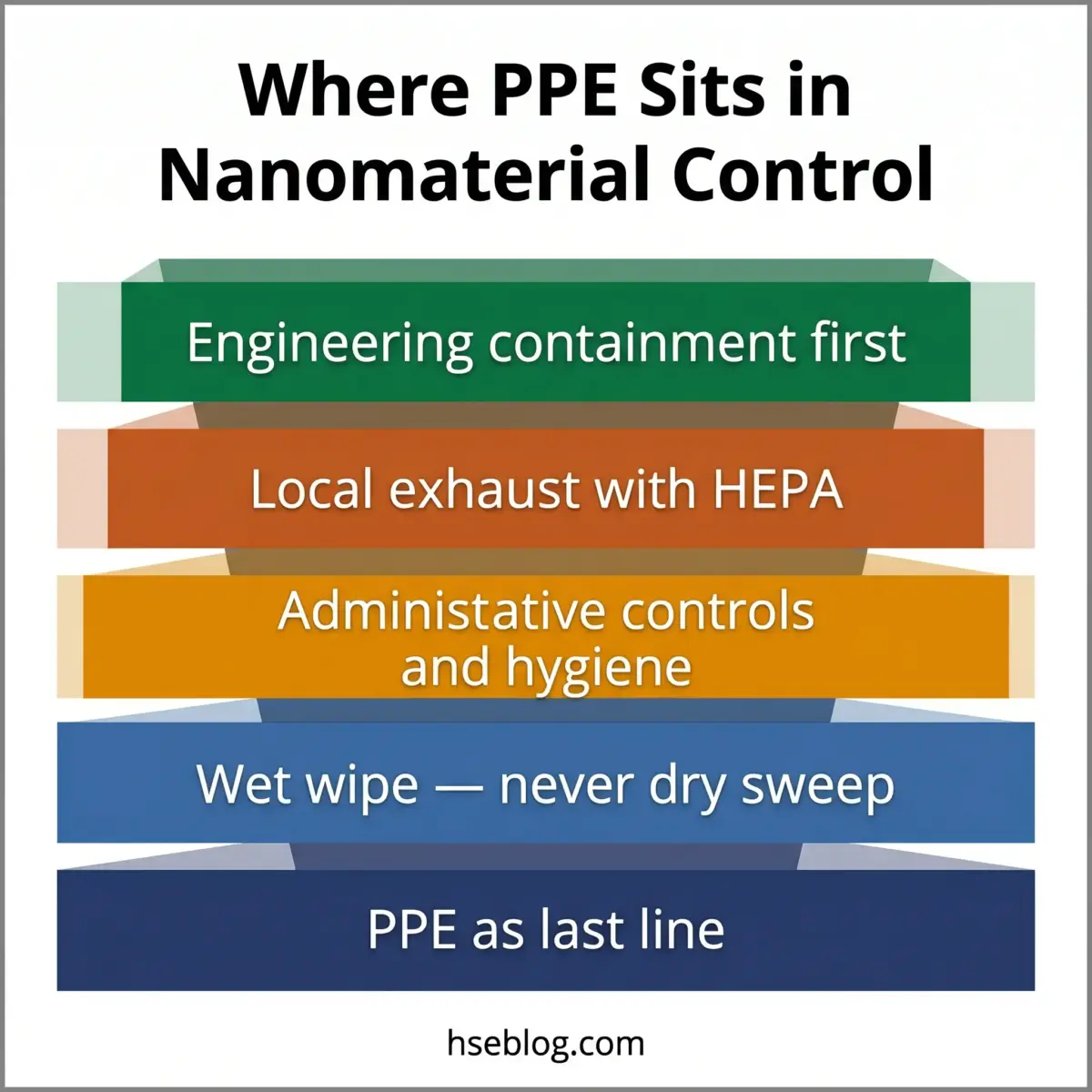
Every credible nano guidance document places PPE at the bottom of the control hierarchy, and that ordering is not a formality. The WHO nano guidelines make engineering controls the primary recommendation, reserving PPE — especially respiratory protection — for situations where containment is absent or inhalation exposure is high (WHO/NIOSH, 2017).
- Engineering controls first. Fume hoods, glove boxes, nanomaterial-handling enclosures, and local exhaust ventilation with HEPA filtration capture material at the source.
- Control banding when data are thin. Where no workplace exposure measurement is available, WHO supports control banding to select controls under uncertainty.
- Ban dry sweeping and compressed air. Cleanup uses wet wiping and HEPA-filtered vacuums; dry methods re-aerosolize settled nanomaterial.
- Administrative backup. Handwashing on exit, defined spill procedures, and restricted-access work zones reduce the load PPE has to carry.
- PPE last, never alone. If your only control is a respirator, the hierarchy has already failed upstream.
I read PPE-heavy programs as a warning sign. When the respirator is doing the work that a fume hood or enclosure should be doing, the residual risk is higher than the paperwork implies.
Exposure Limits and Where the Rules Stop
PPE selection should be anchored to an exposure benchmark — but for nanomaterials, the benchmark depends heavily on jurisdiction, and the gaps are as important as the numbers. The United States has no enforceable OSHA permissible exposure limit specific to nanomaterials; NIOSH publishes recommended limits (RELs) that are advisory, not mandatory.
Content covering exposure limits and health surveillance is for HSE practitioner reference. It is not medical advice. Workers with specific symptoms or exposure concerns should consult an occupational physician or qualified medical professional.
| Material / standard | Limit (jurisdiction) | Status | Source |
|---|---|---|---|
| Carbon nanotubes & nanofibers (NIOSH REL) | 1 µg/m³ respirable elemental carbon, 8-hr TWA (US) | Recommended, not enforceable | NIOSH CIB 65, 2013 |
| Nanoscale titanium dioxide (NIOSH REL) | 0.3 mg/m³ (US) | Recommended | NIOSH CIB 63 / OSHA FS-3634 |
| Fine titanium dioxide (>100 nm) | 2.4 mg/m³ (US) | Recommended | NIOSH / OSHA FS-3634 |
| Nanoscale silver (NIOSH draft REL) | 0.9 µg/m³ respirable, 8-hr TWA (US) | Draft | NIOSH |
| Nanomaterials generally (OSHA PEL) | None specific to nanoscale | No enforceable limit | OSHA |
The carbon-nanotube REL carries a caveat worth understanding: 1 µg/m³ reflects the lowest concentration the standard method can reliably measure, not a proven "safe" threshold, and NIOSH explicitly advises keeping exposures below it where feasible (NIOSH, CIB 65, 2013).
The EU takes a different route. Under REACH, nanoforms have carried explicit registration and safety-data-sheet obligations since 1 January 2020, yet enforcement is uneven — an ECHA enforcement report found that, among new information requirements, nanoform data were missing in 67% of checked safety data sheets where they were required (ECHA, December 2024). When a worker's protection depends on hazard information that two-thirds of relevant SDSs omit, PPE selection is operating partly blind, and that argues for precaution rather than minimum compliance.
Frequently Asked Questions
Do surgical or dust masks protect against nanomaterials?
No. Surgical masks and hardware-store dust masks are not NIOSH-approved respiratory protection and lack a validated face seal. A NIOSH-approved N95 is the practical minimum where respiratory protection is indicated, with P100 or PAPR preferred for fibrous or more toxic nanomaterials (OSHA, FS-3634).
Is there a legal exposure limit for nanomaterials in the US?
No nanomaterial-specific OSHA permissible exposure limit exists. NIOSH publishes recommended exposure limits — 1 µg/m³ for carbon nanotubes and nanofibers and 0.3 mg/m³ for nanoscale titanium dioxide — but these are advisory, not enforceable (NIOSH, CIB 65, 2013).
Why double-glove if nitrile already resists chemicals?
Penetration data for nanoparticles through glove materials remain limited. NIOSH and several university EHS programs recommend double nitrile gloves with extended cuffs for higher-risk handling as a precaution until more is known, not because a single glove is known to fail.
Are all carbon nanotubes carcinogenic?
No. IARC classified one specific multi-walled type, MWCNT-7, as Group 2B (possibly carcinogenic to humans) based on animal evidence; other MWCNTs and single-walled tubes were placed in Group 3, not classifiable (IARC, Monograph 111, 2014). Hazard is material-specific, so PPE should be set conservatively.
Does the EU regulate nanomaterial PPE differently from the US?
The frameworks differ. The EU's REACH regime imposes nanoform-specific registration and SDS duties (since January 2020), while the US relies on advisory NIOSH RELs and general OSHA respiratory rules. Always state the governing jurisdiction in your risk assessment.
Can nanoparticles pass through the skin?
The evidence on intact-skin penetration is still debated and generally limited. Because uncertainty is high, WHO guidance recommends precautionary dermal controls — appropriate gloves plus surface hygiene — rather than assuming skin is a reliable barrier (WHO/NIOSH, 2017).
Conclusion
The recurring failure with nanomaterial PPE is not a shortage of equipment — it is selecting that equipment against intuition instead of mechanism. Teams worry that filters cannot catch particles this small, when the data show diffusion captures them well and the real vulnerability is a poorly fitted seal and an unvalidated respiratory program.
If there is one highest-impact change, it is to stop letting PPE substitute for containment. A correctly specified P100 or PAPR, nitrile gloves matched to the carrier liquid, a non-woven barrier suit, and sealed eye protection are necessary — but they only deliver real protection downstream of a fume hood, an enclosure, and a fit-testing program built around the specific nanomaterial in front of you. Build the engineering controls first, treat the NIOSH carbon-nanotube REL of 1 µg/m³ as a ceiling to stay well under rather than a safe target, and document the jurisdiction your decisions rest on.