

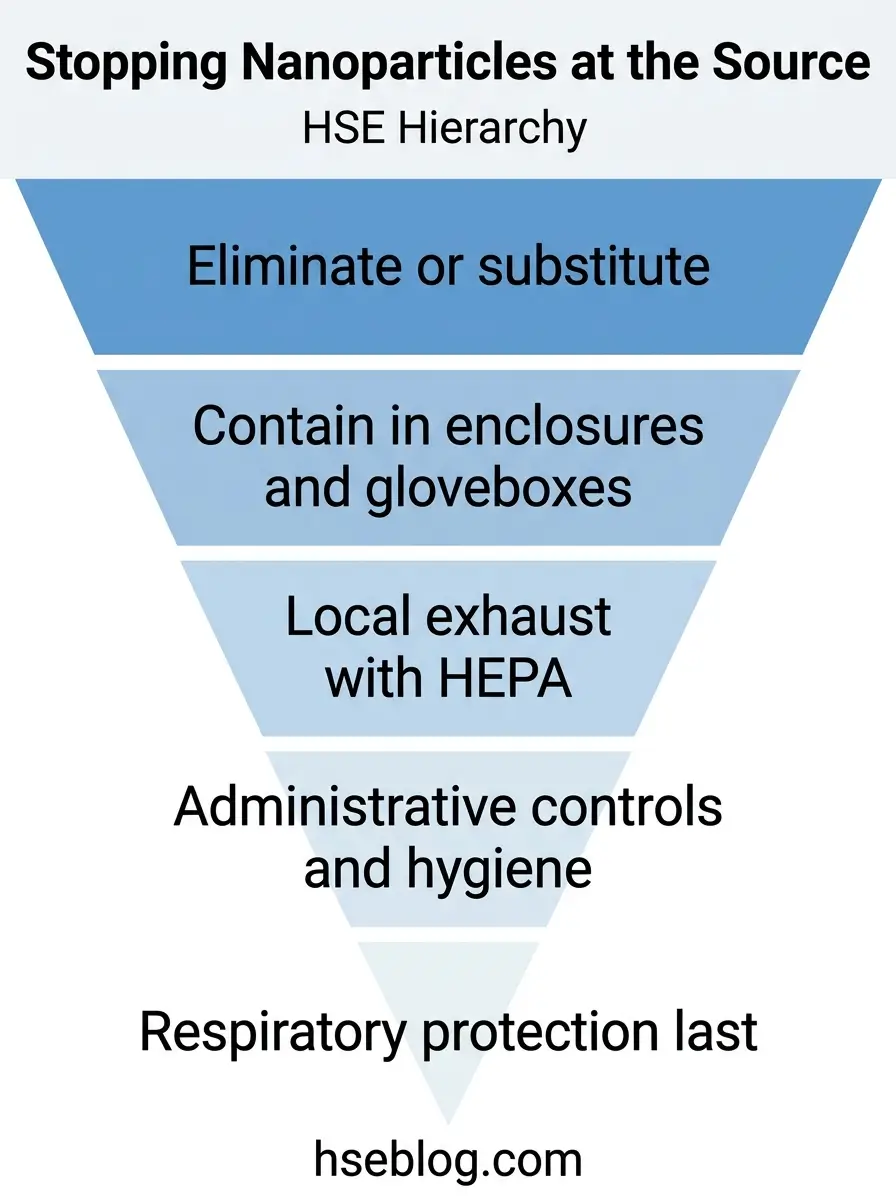
Engineering controls for nanomaterial handling are physical measures — containment enclosures, local exhaust ventilation, and HEPA filtration — that isolate workers from airborne engineered nanoparticles. They rank above administrative controls and PPE because nanoparticle aerosols stay suspended for long periods and resist simple dilution, making source capture the only reliable defense.
A nanoparticle aerosol does not behave like ordinary dust. Particles below 100 nanometers carry almost no mass, drift on air currents the way smoke does, and stay airborne long enough to spread across a room before settling — which is exactly why dilution ventilation and respirators alone fail to protect the people working closest to the source.
That behavior is the whole reason engineering controls for nanomaterial handling sit at the center of any credible nanotechnology safety programme. This article walks through the containment-first hierarchy, the filtration science that surprises most teams, the secondary release points that audits miss, how to prove a control actually works, and the exposure benchmarks that differ across the US, UK, and EU.
Why Nanoparticles Beat PPE-First Thinking
The honest answer: respirators are the weakest line, not the first. Engineered nanomaterials demand source control because their physics defeats the assumptions behind dilution and personal protection.
Three properties drive this:
- Persistent airborne suspension — sub-100 nm particles settle slowly and travel on the faintest draft, so a release at one bench reaches the next.
- High surface-area-to-mass ratio — a tiny mass carries enormous reactive surface, which is why nanoscale TiO₂ is treated as a potential occupational carcinogen by NIOSH while bulk TiO₂ is not (NIOSH, 2011).
- Deep respiratory penetration — inhaled nanoparticles deposit in the deep lung; carbon nanotubes and nanofibers can drive pulmonary inflammation and fibrosis, with biopersistent high-aspect-ratio forms raising asbestos-style concerns (NIOSH, 2013).
The practical reading of the hierarchy of controls here is unusual. For most dusts, good housekeeping and a P100 respirator buy real protection. For unbound nanopowders, the mass you can weigh on a filter may understate the particle count by orders of magnitude — so a control strategy that depends on measuring mass and trusting a respirator is building on sand. Containment that never lets the aerosol form is the only approach that scales.
Containment First: Enclosures, Gloveboxes, and Ventilated Cabinets
Start by asking whether the task can be fully enclosed. The strongest engineering control for nanomaterial handling is physical containment that prevents aerosol generation in the first place, applied to any task that can liberate dry particles — weighing, mixing, sonication, or transfer.
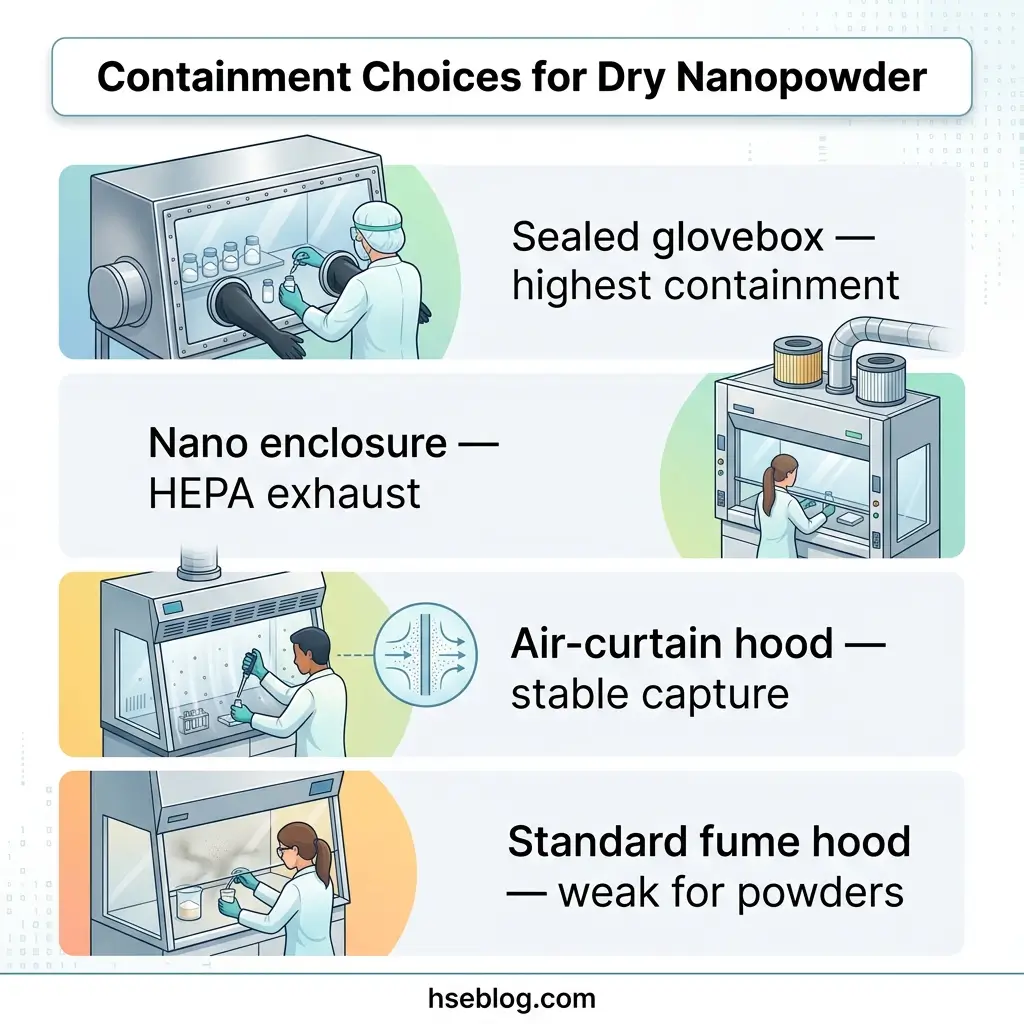
The containment options, strongest first:
- Sealed gloveboxes and process chambers — full enclosure with glove ports for the highest-risk dry handling; the worker never shares air with the material.
- Purpose-built nanomaterial handling enclosures — ventilated cabinets engineered with controlled, low-turbulence airflow and HEPA exhaust (NIOSH, 2018).
- Air-curtain and constant-velocity hoods — designed to hold a stable capture envelope at the working face rather than relying on a sash.
- Conventional bench fume hoods — useful for liquid chemistry, but a poor default for dry nanopowder because turbulent airflow at the sash can pull released particles back toward the operator.
That last point is a common misconception worth correcting. A standard fume hood feels like adequate protection, yet it was designed to sweep away vapors, not to hold a low-mass particle cloud against turbulence — which is why NIOSH and the AIHA point practitioners toward ventilated enclosures purpose-built for nanomaterials rather than general lab hoods (AIHA, 2023).
ISO frames the same logic internationally. ISO/TS 12901-1:2012 sets out the principles and approaches for occupational risk management of engineered nanomaterials, including engineering controls and handling of spills, and is written for competent personnel such as occupational hygienists and production managers (ISO, 2012).
Do HEPA Filters Actually Catch Nanoparticles?
Yes — and more efficiently than they catch the 0.3 µm particles they are rated against. This is the single most persistent myth in nanomaterial handling, and getting it wrong leads teams to over-spend on exotic media or, worse, to assume filtration is hopeless.
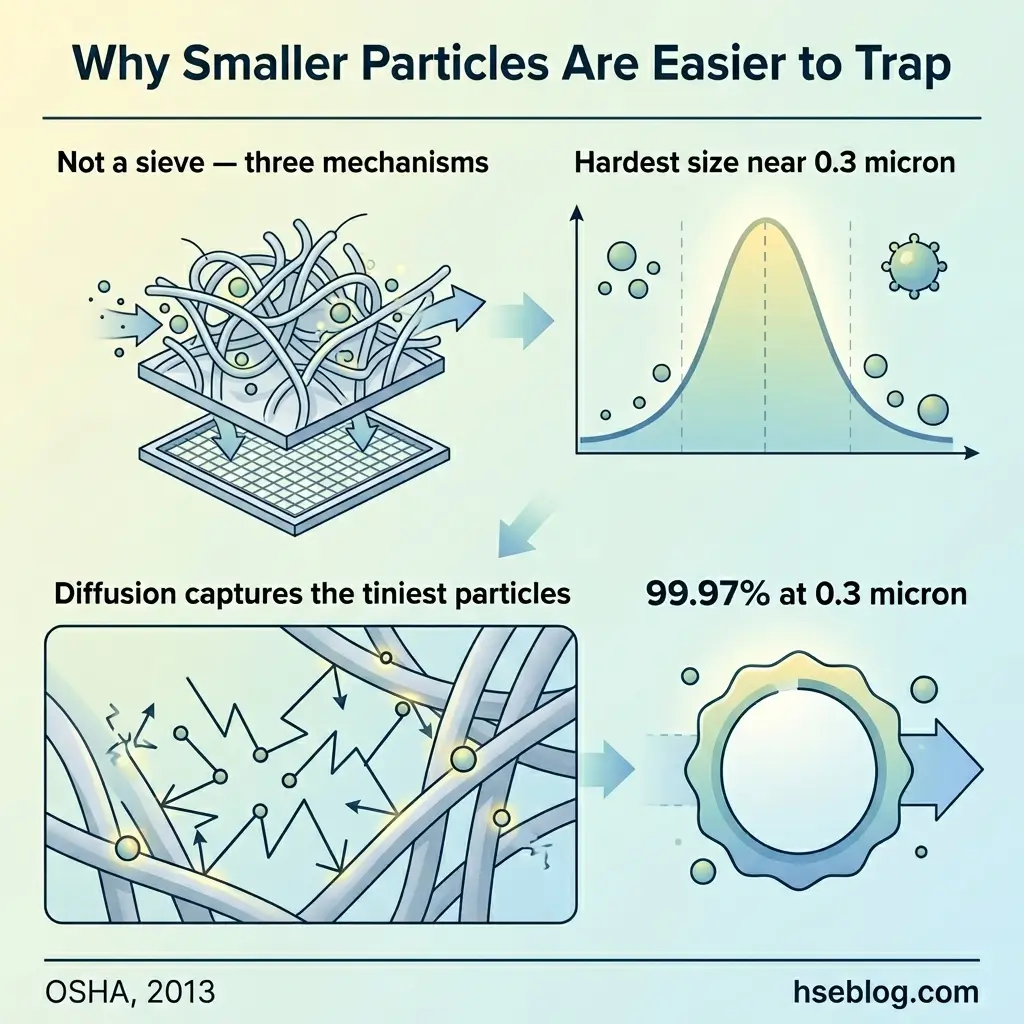
The reasoning that fools people goes like this: a HEPA filter is rated at 0.3 µm, a nanoparticle is far smaller than 0.3 µm, therefore the particle slips through the pores. It treats a filter like a sieve. It is not a sieve.
HEPA media capture particles through three mechanisms working together:
- Impaction — larger, heavier particles can't follow the airstream around a fiber and slam into it.
- Interception — mid-size particles following the airstream still brush a fiber and stick.
- Diffusion — the smallest particles move erratically by Brownian motion, zig-zagging into fibers far more often than their size would suggest.
The catch is that all three are weakest at one crossover size — the most penetrating particle size (MPPS), generally around 0.1–0.3 µm, which is precisely why the HEPA standard tests there (multiple peer-reviewed sources; ISO 29463 / EN 1822). A true HEPA filter removes at least 99.97% of particles at 0.3 µm (OSHA, 2013).
Below the MPPS, diffusion takes over and efficiency climbs back toward 100%. Filtration studies using engineered nanoparticles report close to complete collection in the nanoscale range, with capture rising as particle size falls (peer-reviewed filtration research). The interpretation for site teams is reassuring: properly specified HEPA exhaust on an enclosure or local exhaust ventilation system is a sound engineering control, provided the filter is intact, correctly seated, and leak-tested.
The Release Points Audits Routinely Miss
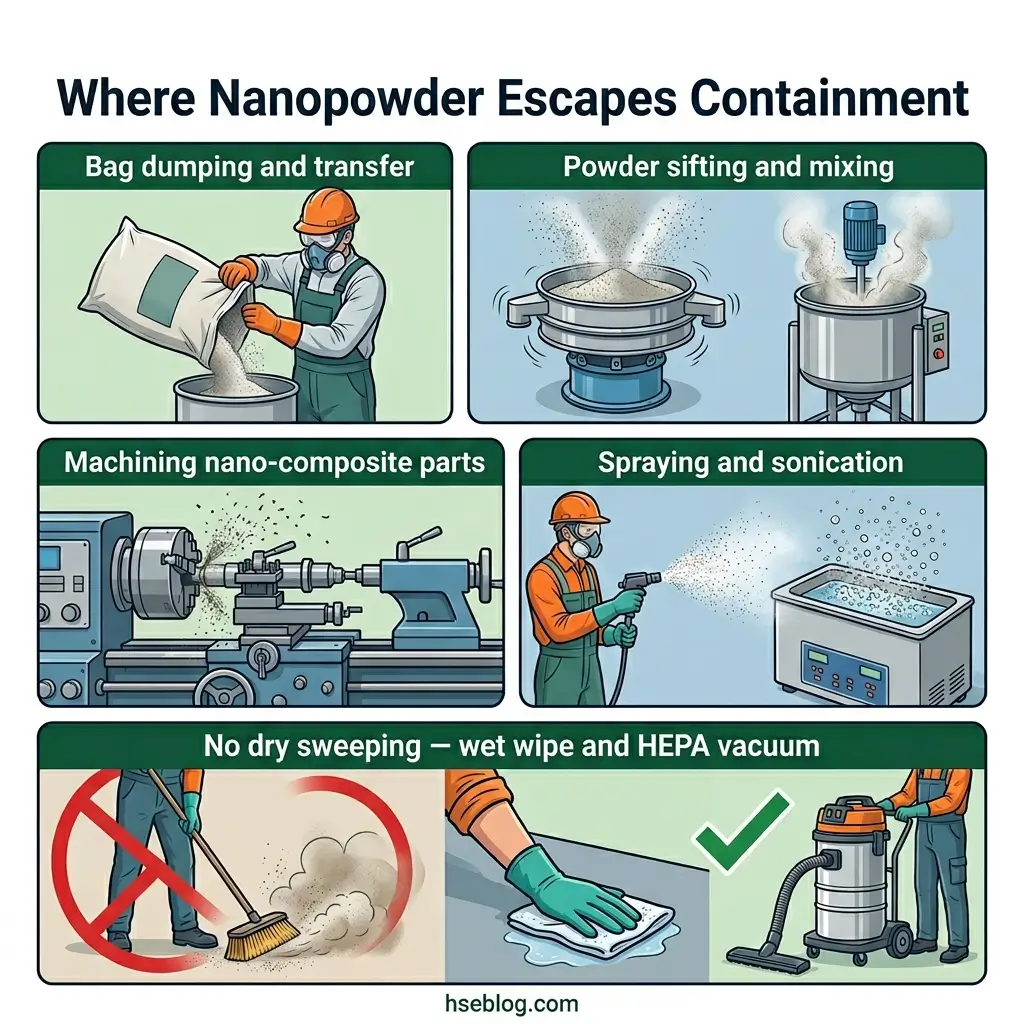
A consistent pattern across the published exposure record: the worst releases happen at transfer and secondary-handling steps, not at the well-engineered reactor. Teams contain synthesis beautifully, then lose control where the powder moves.
The downstream activities most likely to liberate nanoparticles include bag dumping, manual transfer between processes, mixing and compounding, powder sifting, and machining or cutting of finished parts that contain nanomaterials (NIOSH, 2014). Each shares a signature: the material leaves containment and enters open air under mechanical energy.
Control these the way you control the source:
- Enclose the transfer — split-butterfly valves, glovebag dumping stations, and ventilated weighing booths keep the pour inside a captured envelope.
- Capture machining at the tool — fit on-tool local exhaust with HEPA to grinding, drilling, or cutting of nano-composites; never let the swarf become an aerosol.
- Manage liquids honestly — suspensions are lower risk, but spraying, sonication, and drying re-aerosolize the particles, so treat those steps as dry-handling equivalents.
Cleanup is its own failure mode. Dry sweeping and compressed-air blow-down resuspend everything the controls just captured, which is why OSHA explicitly directs teams to prohibit both and to use wet wiping and HEPA-filtered vacuums instead (OSHA, 2013). UK practice reaches the same conclusion under the Control of Substances Hazardous to Health Regulations 2002, where HSE guidance HSG272 sets out a precautionary, COSHH-based approach for manufactured nanomaterials and biopersistent high-aspect-ratio nanomaterials (HSE, 2013).
Proving the Control Works
Installing an enclosure is not the same as controlling exposure. The judgment call that separates a real programme from a paper one is verification — does air actually move the way the design assumed, and does the contaminant stay inside?
A workable verification sequence:
- Visualize the airflow — smoke or tracer visualization at the working face shows whether the capture envelope holds under real movements, not just at rest.
- Quantify containment — tracer-gas testing measures how much escapes a glovebox or enclosure under operating conditions.
- Find the high-exposure tasks — video exposure monitoring synchronizes a real-time particle counter with footage, exposing which specific motions spike the count (NIOSH, 2014).
- Confirm against a benchmark — the Nanoparticle Emission Assessment Technique (NEAT) pairs direct-reading instruments with filter samples to judge whether a release is occurring and whether mass-based limits are met.
The reason this matters is captured in recent field data. In a 2025 study of nano-TiO₂ workplaces, 3 of 30 personal samples exceeded the NIOSH limit, all during bulk loading and spraying, with the airborne particles measured at 80–147 nm (Annals of Work Exposures and Health, 2025). The controls were present; the high-energy transfer tasks still broke through. Verification is what turns "we have controls" into "our controls work."
One honest limitation: mass-based sampling can understate nanoscale exposure because a low total mass may still contain vast particle numbers. That gap is exactly why international guidance keeps evolving — the OECD updated its grouping guidance and its sample-preparation and dosimetry guidance for manufactured nanomaterials in 2025, reflecting a field still refining how it measures dose (OECD, 2025).
Exposure Benchmarks and the Regulatory Picture
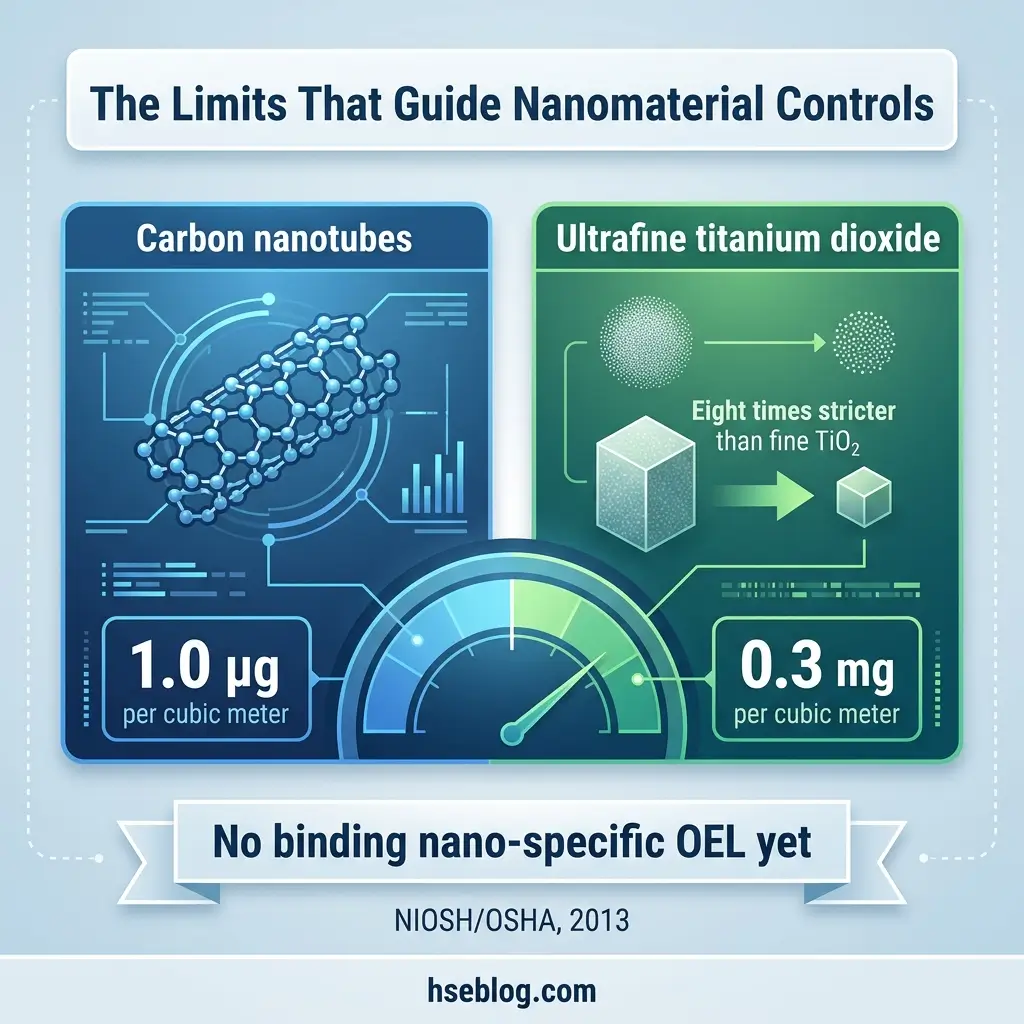
No jurisdiction yet sets a legally binding, nano-specific occupational exposure limit for most engineered nanomaterials — so the enforceable duty falls back on general obligations, while practitioners use recommended limits as the working benchmark.
| Jurisdiction | Legal hook | Benchmark / status |
|---|---|---|
| United States | OSHA General Duty Clause 5(a)(1); 29 CFR 1910.134 for respirators | NIOSH RELs: CNT/CNF 1.0 µg/m³; ultrafine TiO₂ 0.3 mg/m³ (recommended, not enforceable as nano-specific PELs) |
| United Kingdom | COSHH 2002 (as amended); DSEAR for fire/explosion | HSE HSG272 precautionary control approach; no nano-specific WEL |
| European Union | REACH (with nanoform information requirements); Chemical Agents Directive 98/24/EC; CMD 2004/37/EC | Risk management via the control hierarchy; control banding where data is thin |
| International | ISO/TS 12901 series | ISO/TS 12901-2:2014 control banding for nano-objects, aggregates and agglomerates |
Where recommended limits exist, treat the stricter figure as primary. The nanoscale TiO₂ limit of 0.3 mg/m³ is eight times tighter than the 2.4 mg/m³ for fine TiO₂, reflecting the higher mass-based potency of the nanoform (NIOSH/OSHA). The EU has pushed hardest on hazard information, requiring nanoform-specific data under REACH so that downstream employers receive the safety data they need to assign controls.
When you genuinely lack toxicity or exposure data, control banding fills the gap. ISO/TS 12901-2:2014 describes a banding approach for nano-objects and their aggregates and agglomerates greater than 100 nm, designed to assign a control band even when quantitative exposure estimates are missing (ISO, 2014). It is a pragmatic first line, not a substitute for measurement once the operation matures.
Frequently Asked Questions
Do standard chemical fume hoods protect workers handling dry nanopowders?
Not reliably. A conventional fume hood is built to remove vapors, and turbulent airflow at the sash can draw low-mass nanoparticles back toward the operator. NIOSH and AIHA guidance points to purpose-built nanomaterial enclosures, gloveboxes, or air-curtain hoods with HEPA exhaust for dry handling (AIHA, 2023).
Are there legally enforceable exposure limits for nanomaterials?
For most engineered nanomaterials, no nano-specific binding limit exists. In the US, the OSHA General Duty Clause applies; in the UK, COSHH 2002 governs; NIOSH recommended limits for carbon nanotubes and titanium dioxide are widely used benchmarks but are advisory, not enforceable nano-specific PELs (OSHA, 2013).
Do HEPA-filtered respirators stop nanoparticles?
Yes. N100, R100, and P100 filters capture nanoparticles efficiently through diffusion, and OSHA references them under 29 CFR 1910.134 (OSHA, 2013). But a respirator is the last line — fit, seal, and discipline all degrade in practice, so engineering controls must do the primary work.
Is handling nanomaterials in liquid suspension safer than dry powder?
Generally yes, because bound particles in liquid resist aerosolization. The exception matters: spraying, sonication, pouring, and drying can re-aerosolize the nanoparticles. Treat those high-energy wet steps with the same containment and local exhaust you apply to dry powders.
Can nanomaterial dust cause a fire or explosion?
It can. Some nanoparticle dusts ignite with less energy than larger combustible dusts, and certain nanomaterials act as catalysts that trigger unexpected reactions (OSHA, 2013). In the UK this falls under DSEAR, requiring dust-explosion risk assessment alongside health controls.
Where Teams Get This Wrong
The recurring failure in nanomaterial handling is not ignorance of the hazard — it's misplacing the control effort. Sites pour engineering into the reactor, then lose containment at the bag dump, the spray booth, and the cleanup, where the published exposure record keeps showing the real breaches.
The highest-impact change is also the least glamorous: contain every step that can aerosolize the material, then prove the containment holds with airflow visualization and particle monitoring rather than assuming it. A glovebox you never leak-test and a HEPA system you never confirm are credibility, not control.
Treat the NIOSH recommended limits as your working line until binding standards catch up, respect the stricter nanoform figure whenever the bulk and nano limits diverge, and design controls for the way nanoparticles actually move — drifting, diffusing, and outlasting the shift. Engineering controls for nanomaterial handling work when they stop the aerosol from forming; everything downstream of that is damage limitation.