
TL;DR — Reservoir Safety Myths vs Reality
- Myth: A reservoir is just a big lake. Reality: it hides intake currents, steep engineered banks and water cold enough to disable a swimmer within seconds.
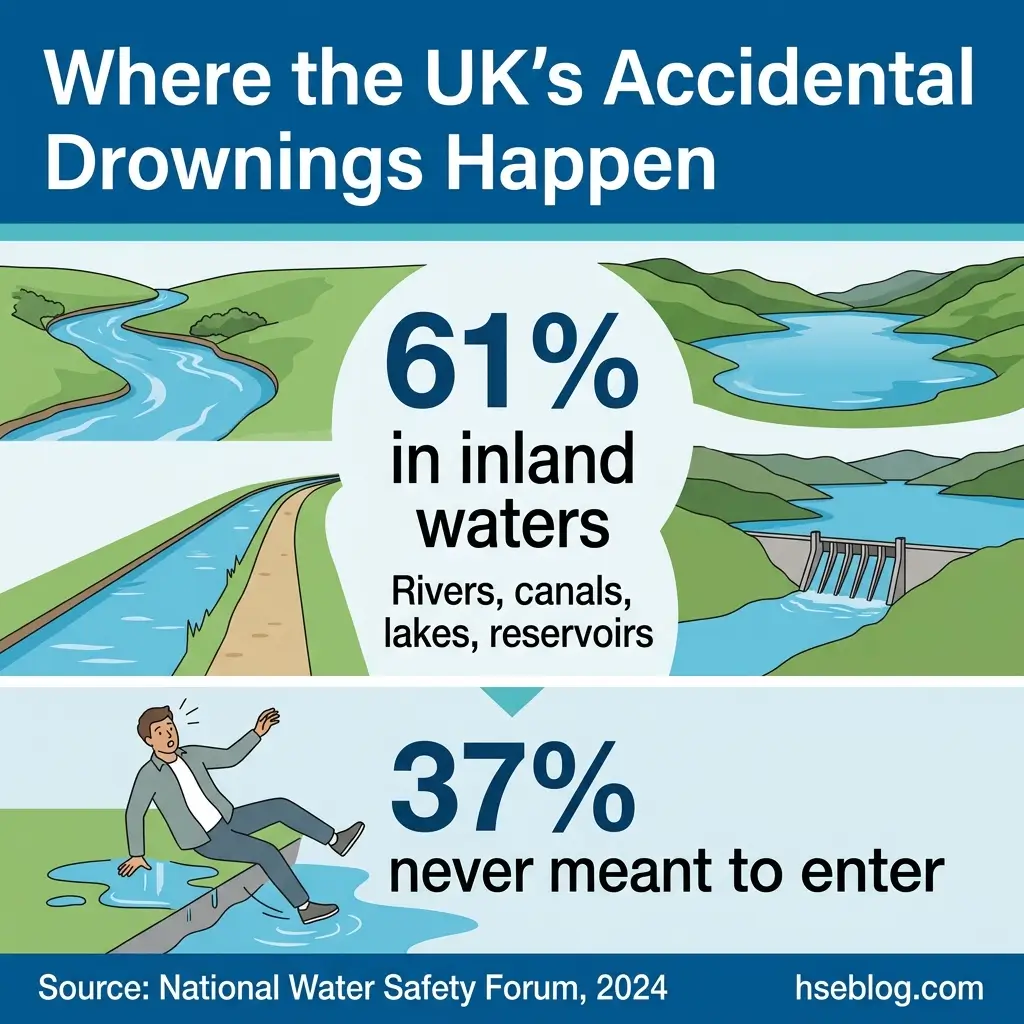
- Myth: Strong swimmers are safe. Reality: cold water shock removes breathing control before fitness matters — 61% of UK accidental drownings are in inland waters (National Water Safety Forum, 2024).
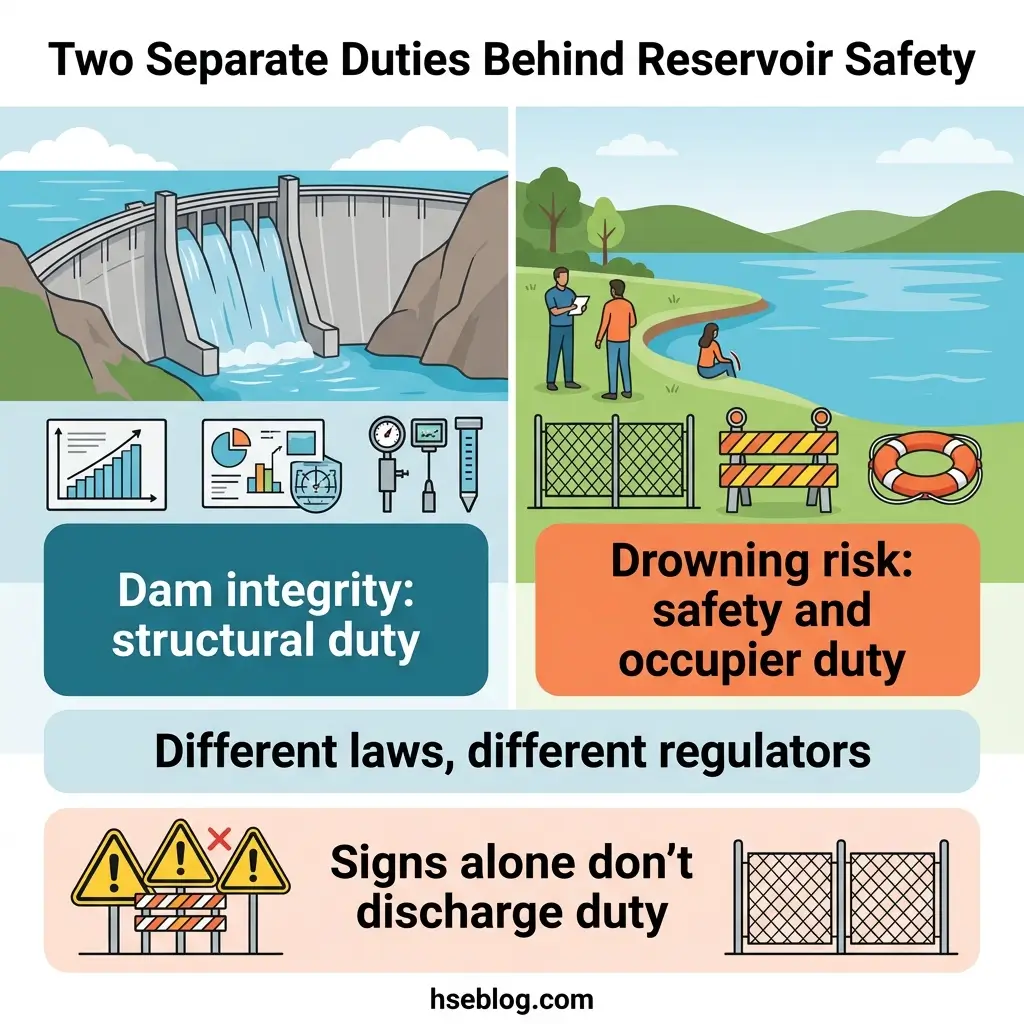
- Myth: “Reservoir safety” is covered by dam-safety law. Reality: dam legislation protects communities from structural failure; drowning risk sits under separate health-and-safety and occupiers’ duties.
- Myth: Warning signs discharge the operator’s duty. Reality: signs are one control; courts weigh what was reasonably practicable, not whether a notice existed.
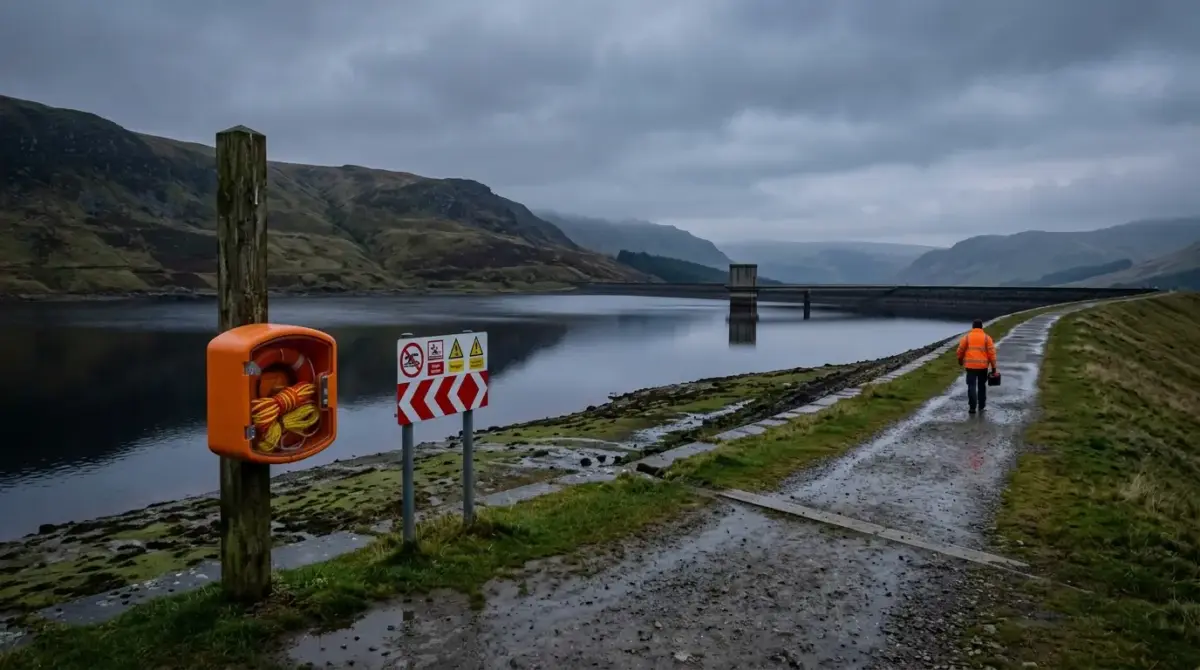
Reservoir safety means managing drowning risk at deceptively calm water that combines cold water shock, hidden intake currents and steep, slippery sides. Effective drowning prevention layers physical access controls, clear hazard-and-action signage, self-rescue design and public rescue equipment — because at remote sites, help usually arrives minutes after it is needed.
The Number That Reframes Reservoir Drowning
In 2024, 193 people died in accidental water-related incidents across the UK, and inland waters — rivers, canals, lakes, reservoirs and quarries — accounted for 61% of them (National Water Safety Forum, 2024). More telling for anyone who manages a reservoir: 37% of those who died were walking or running and never intended to enter the water at all.
That reframes the task. Reservoir safety is less about deterring determined swimmers than protecting ordinary visitors — a slip on a wet bank, a dog in the water, a child reaching for a ball. The sections below cover how reservoirs actually kill, what the law demands of UK and US operators, and which drowning prevention and access controls reduce risk rather than merely signalling effort.
Why a Calm Reservoir Kills Confident Swimmers
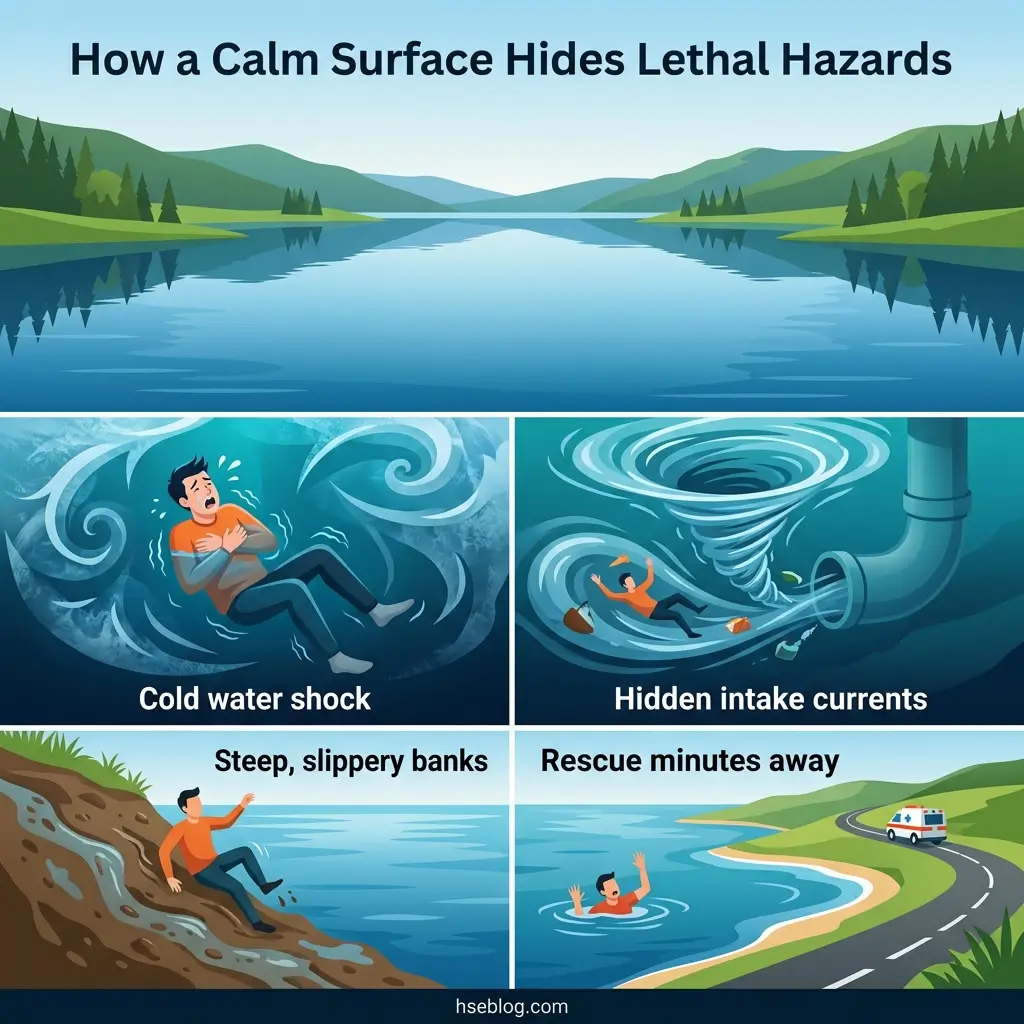
A reservoir’s danger is that it looks manageable. The same features that make it a good water store — depth, engineered inflows and outflows, and steep retaining banks — are the ones that drown people.
Most of these hazards defeat swimming ability rather than test it. That is the point competitors miss when they frame the problem as “keep non-swimmers out.”
| Hazard | How it harms | Why it beats a strong swimmer |
|---|---|---|
| Cold water (often below 16°C) | Triggers the gasp reflex and strips muscle control | Fitness is irrelevant once you cannot control breathing |
| Steep, algae- or mud-covered banks | Easy to slide in, nothing to grip climbing out | Exhaustion sets in at the edge, within reach of safety |
| Draw-off tower and intake currents | Unseen suction pulls water toward valves and outlets | Drags a swimmer down or along before they react |
| Aerators and bubble curtains | Reduce water density around the plume | Sudden, unexpected loss of buoyancy |
| Submerged weed and debris | Entangles legs and arms | Panic and rapid fatigue |
| Remote location | Emergency response is minutes away | Self-rescue is the only fast option |
| Blue-green algae (cyanobacteria) | Toxic blooms gather at sheltered edges | Illness on top of, or instead of, the drowning risk |
The recurring failure pattern is treating a reservoir like a swimming venue with a “no” attached. It is an operational industrial site that the public can walk up to.
Cold Water Shock Is the Mechanism, Not the Cold
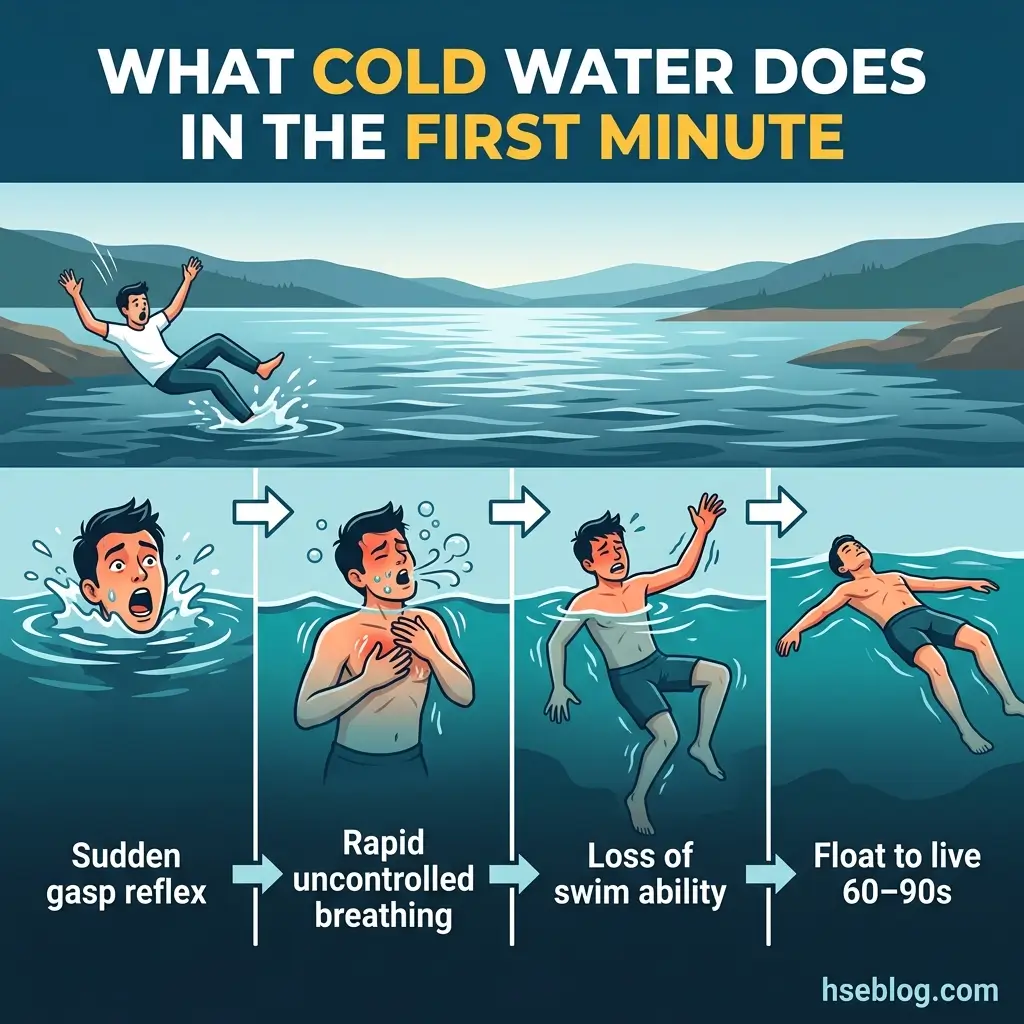
Cold water shock, not hypothermia, is what kills most quickly. Water around 15°C is enough to trigger it, and many UK inland waters stay below 16°C all year (National Water Safety Forum, 2024).
The body’s response to sudden immersion runs in a predictable sequence:
- Gasp reflex — an involuntary intake of breath, dangerous if the head is underwater.
- Hyperventilation — rapid, uncontrolled breathing that the person cannot override.
- Loss of swim ability — coordination and grip fail as cold reaches the muscles.
- Cardiac stress — the shock places sudden strain on the heart.
The trap is air temperature. The deadliest days are warm ones: May 2024 was the UK’s warmest May on record and saw 28 accidental water fatalities, the highest of any month that year (National Water Safety Forum, 2024). People judge the water by the air and enter on impulse.
Thresholds also vary by jurisdiction, which matters if you operate sites in more than one country. UK guidance flags roughly 15–16°C as the danger zone, while US Army Corps of Engineers advice warns that falling into water below about 21°C (70°F) can already cause involuntary gasping. The more cautious reading is that risk begins well above the 15°C mark — treat any cold immersion as capable of triggering the response.
The survival response is to fight the instinct to thrash. Lean back, spread the arms and legs, and float until the shock passes — usually within 60 to 90 seconds — before trying to swim or call for help.
“Reservoir Safety” Is Two Different Legal Duties
In law, “reservoir safety” splits into two separate duties that operators routinely conflate. One protects communities downstream from a dam failure; the other protects people at the water’s edge from drowning. Confusing them is how sites end up compliant on paper and exposed in practice.
The structural duty — the dam
In England and Wales, the Reservoirs Act 1975 governs large raised reservoirs — those holding more than 25,000 cubic metres above natural ground level — through registration, inspection by panel engineers and Environment Agency oversight. Its purpose is narrow and structural.
- It exists to prevent an uncontrolled release of water and downstream flooding.
- It says nothing about someone drowning in the reservoir itself.
- The regime is under a Defra and Environment Agency reform programme moving toward a risk-based classification (Defra/Environment Agency, 2023).
The public-safety duty — the water
Drowning risk falls under an entirely different regime. In the UK, that means the Health and Safety at Work etc. Act 1974 — particularly the Section 3 duty to protect people who are not employees — alongside the Occupiers’ Liability Acts 1957 and 1984, which set duties to lawful visitors and to trespassers respectively.
The leading case is Tomlinson v Congleton Borough Council [2003] UKHL 47. A young man dived into a lake at a country park, despite “Dangerous Water: No Swimming” signs and ranger patrols, and was paralysed. The House of Lords held the council owed no duty to protect him from an obvious risk he freely chose to run.
The practical reading matters in both directions. Operators cannot assume a sign discharges the duty, and they are not required to eliminate every obvious risk either — the legal test is what was reasonably practicable, weighing the gravity of the risk against the cost and social value of the control.
United States and international frameworks
US arrangements are more fragmented. The US Army Corps of Engineers operates more than 400 lake and river projects with recreation as an authorised purpose; the Federal Energy Regulatory Commission requires public safety plans and signage at licensed hydropower projects; state dam-safety programmes and state premises-liability and attractive-nuisance doctrines fill the rest.
Globally, drowning is now a recognised public-health priority. The World Health Organization’s Global Status Report on Drowning Prevention 2024 records around 300,000 drowning deaths in 2021 and a 38% fall in the death rate since 2000, following a 2021 UN resolution and World Health Assembly resolution 76.18 in 2023.
Regulatory content here reflects general HSE professional understanding of UK and US requirements as of 2025. It is not legal advice. Specific compliance questions, enforcement situations, or liability risk should be directed to qualified legal counsel in the applicable jurisdiction.
Access Controls That Reduce Drowning — and the Ones That Only Look Like It
No single control stops reservoir drownings; effective sites layer several, each aimed at a specific way people die. The weakest programmes buy one measure — usually signage — and treat the duty as discharged.
A defensible layered approach runs roughly in this order:
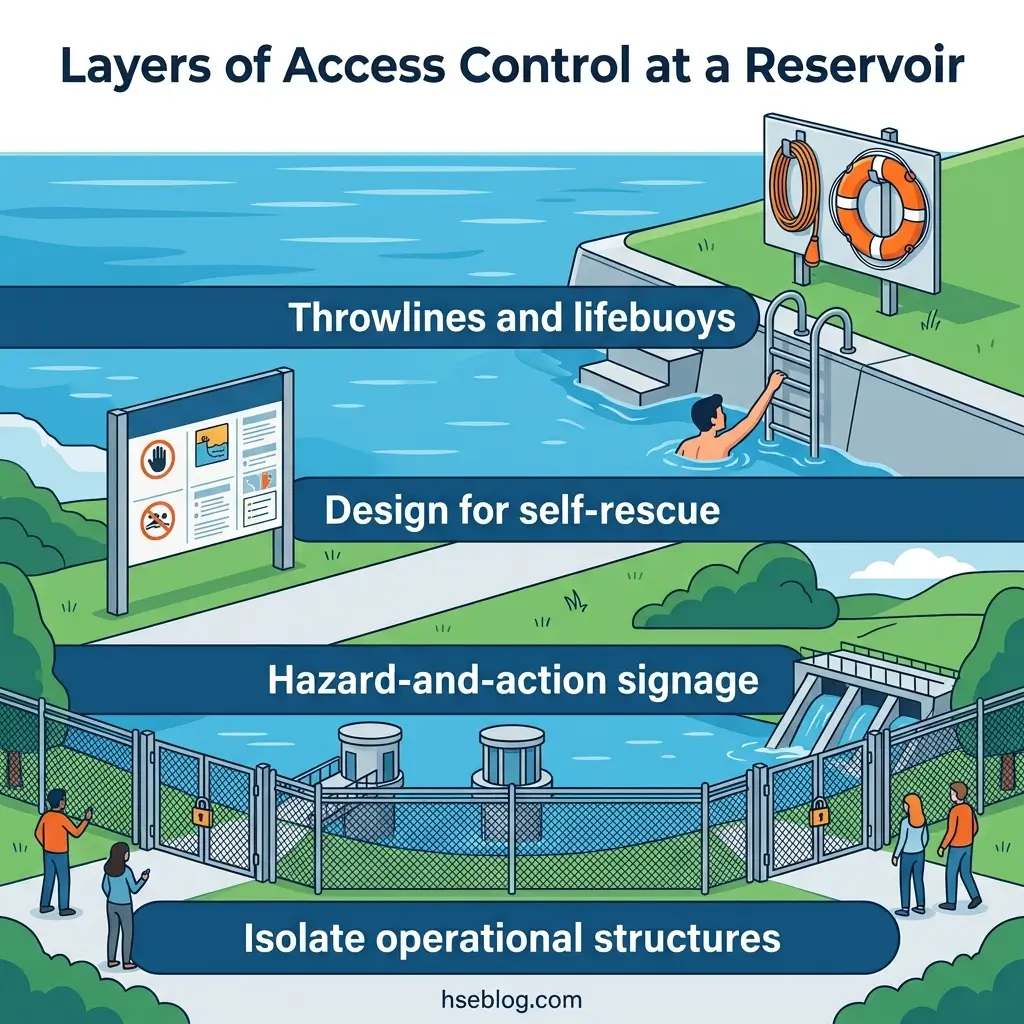
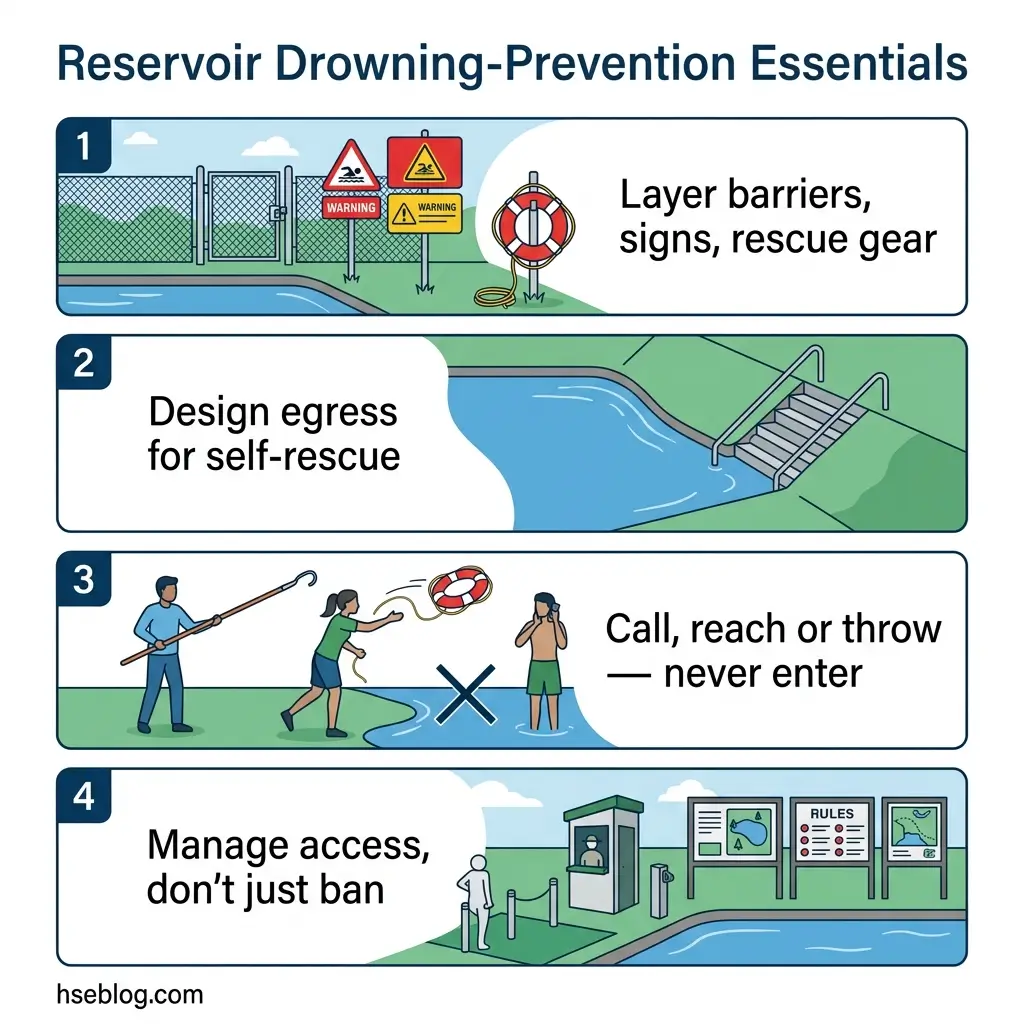
- Isolate operational structures, not the whole shoreline. Fence and secure draw-off towers, intakes, spillways and dam crests. Fencing miles of open bank is rarely reasonably practicable and often pushes people to worse, unmonitored entry points.
- Make signs state hazard and action. Pair the danger with the instruction — for example “Danger: deep cold water” followed by “No swimming — nearest safe access 400m.” Place them at real entry points, car parks and launch areas, and reposition them as water levels change (FEMA, dam-safety signage best practice).
- Design the water’s edge for self-rescue. Add safety shelves, grab rails and egress ladders at intervals, grade margins gently where feasible, and mark aerators and intake zones with buoys.
- Provide and maintain public rescue equipment. Site throwlines and lifebuoys at high-use spots. Some sit in lockable boxes whose code is released by the emergency control room on a 999 or 911 call, which reduces theft while keeping them available.
- Add presence and surveillance at hotspots. Ranger patrols at peak times, CCTV at known entry points, and location markers so callers can pinpoint an incident.
- Manage access rather than only prohibit it. Where demand is high, a supervised or designated swim area can beat an unenforceable blanket ban. People swim regardless; a managed option concentrates risk where it can actually be controlled.
The judgment call between prohibition and managed access is where operators most often default to the easy answer. A ban that nobody obeys is not a control — it is a hope with a sign on it.
When Prevention Fails: The Reservoir Rescue Chain
At a remote reservoir, the emergency response time is the enemy. The site’s design and the actions of whoever is nearby decide the outcome before help arrives.
This article provides general HSE knowledge. Life-critical work such as water rescue and reservoir emergency planning must be led by a competent person with relevant training, jurisdiction-specific authorisation and site-specific risk assessment. The information here does not replace that.
If you fall in
Float first, act second. Lean back, spread your arms and legs, and let the gasp reflex pass — around 60 to 90 seconds — before you attempt to swim or signal. Trying to swim through the initial shock is what drowns capable swimmers.
If you see someone in trouble
The instinct to jump in is how the second victim dies. Would-be rescuers are a persistent category in open-water fatalities.
- Call first — dial 999 or 911 and give a precise location using markers or a locating app.
- Reach or throw, never enter — extend a pole, branch or rope, or throw a lifebuoy, throwline or anything buoyant.
- Keep them talking — encouragement helps the casualty hold position until responders arrive.
What the site emergency plan needs
- Mapped throwline and lifebuoy locations, checked and audited on a schedule.
- Location references at intervals so callers can be found quickly.
- Staff trained in shore-based rescue only, with clear links to local fire and rescue.
- Recognised training pathways for the people who own this risk — occupational risk-assessment qualifications such as IOSH or NEBOSH for the management side, and accredited lifesaving or water-rescue training for anyone expected to respond, matched to role and jurisdiction.
Frequently Asked Questions
What the Industry Keeps Getting Wrong
The recurring mistake in reservoir safety is treating it as a signage-and-fence exercise, or confusing it with dam-safety compliance. A registered, inspected reservoir can be structurally sound and still drown a visitor every summer, because the two duties answer different questions and the second one gets less attention.
The single highest-impact change is to design and manage for the person who never meant to be in the water. That means egress a tiring casualty can actually reach, barriers around the structures that create currents, maintained rescue equipment people can find, and honest risk assessment in place of box-ticking. Assume help is minutes away, and build the site so that ordinary people can save themselves in those minutes.
A reservoir will never announce which warm afternoon becomes the one a dog owner or a teenager goes in after something — so the controls have to be in place long before that day arrives.